Traditional health technology assessment (HTA) carried out at national or regional (N/R) level for policy decision making has advanced considerably over the past years with the establishment of principles to guide the HTA process and outputs. The principles reflect mandates, objectives, profiles of end-users, and overall characteristics of traditional HTA. These, however, differ for hospitals mostly taking meso- and micro-decisions, that is, on the acquisition and use of new technologies (Reference McGregor1). Hospitals, as the main entry point for innovative technologies, require timely and contextualized input for making decisions as regards investments in health technologies (HTs) (Reference Cicchetti, Marchetti, Bidino and Corio2;Reference Sampietro-Colom, Morilla-Bachs, Gutierrez-Moreno and Gallo3). Moreover, the profile of end-users (i.e., clinicians and hospital managers) affects the provision of HTA input targeted at different informational needs and output measures (Reference McGregor1;Reference Kidholm, Ølholm and Birk-Olsen4). Hospital-based HTA (HB-HTA) designed to meet the local requirements for meso- and micro-decisions is an expanding activity with several initiatives that have been informally collaborating with an attempt to produce guidance for HB-HTA. Yet there is no robust guidance specifically for HB-HTA, unlike the traditional HTA performed at N/R level (Reference Drummond, Schwartz and Jönsson5). Given the specific requirements for carrying out HB-HTA, principles devised for traditional HTA do not seem to be fully applicable to it, which creates a need for principles appropriate for HB-HTA. Therefore, this study aims to describe the criteria for good practices appropriate for HB-HTA and also present how European HB-HTA units are performing as regards these criteria.
MATERIALS AND METHODS
Setting up a Research Framework for Good Practice Criteria
As a first step, the EFQM excellence model was selected as a basis to explore the types of good practice criteria that could fit HB-HTA requirements. The EFQM was selected because it is an excellence model that had already been used by hospitals (Reference Vallejo, Saura and Sunol6), and it would provide a common language for a dialogue and mutual understanding between hospital management and HB-HTA units. It is composed of the following overarching criteria: leadership; people; strategy; partnership and resources; process, product, and services; people, customer, society results; and business results.
Second, a review of the scientific literature was carried out to identify: (i) articles describing good practices in general HTA carried out at N/R level and; (ii) articles describing practices in HB-HTA. This review resulted in the identification of thirty-nine potential criteria which were classified according to the overarching criteria of the EFQM model.
Refinement of Good Practice Criteria
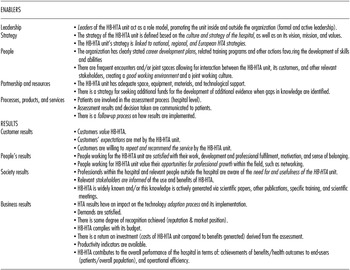
A focus group involving eight HB-HTA stakeholders identified twenty-five additional relevant criteria to be considered for good practices in HB-HTA (Reference Rosenmöller, Sampietro-Colom and Farré7) (Table 1). The complete list of criteria identified by both the literature review and the focus group was carefully analyzed (e.g., looking for consistency in definitions, redundancies in concepts, etc.) which resulted in a final list of forty-two criteria for good practices in HB-HTA units.
Good Practice Criteria Identified through HB-HTA Experience and Contribution from Hospital Management and HTA Stakeholders*

*Managers, industry representatives, HB-HTA representatives, a patient representative, and an HTA representative.
Consensus on the Importance of the Identified Criteria
The forty-two identified criteria were subsequently exposed to the views of a wider sample of stakeholders in a Delphi panel (N = 48) to assign importance ratings (Supplementary Table 2). The results from the Delphi panel along with the evidence accumulated in the AdHopHTA research project (8) were used to develop a final set of criteria for good practices in HB-HTA units (Figure 1).
Activities and methods of the AdHopHTA research project.

Defining the Guiding Principles for Good Practices in HB-HTA Units
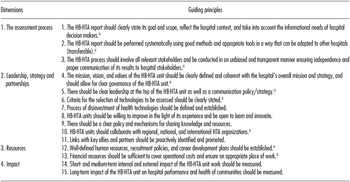
A content analysis of the final set of criteria was carried out with the aim of grouping the criteria in similar concepts to present them in a more succinct manner. Subsequent discussions with experienced HB-HTA units in the AdHopHTA project were used to define the final fifteen guiding principles for HB-HTA good practice categorized under four dimensions (Table 2). Finally, nine guiding principles were selected as core based on the expertise of HB-HTA units participating in the project. The guidance and tools for a pragmatic application of these guiding principles are available in the Toolkit for HB-HTA (9).
Guiding Principles for Good Practices in HB-HTA Units within Dimensions

*The assessment process (dimension 1) lies at the center of the framework. This is the keystone necessary to achieve the main objective of any HB-HTA unit, which is to provide the high quality information needed by hospital decision makers. The assessment process is driven, governed, and facilitated by leadership, strategy, and partnerships (dimension 2) as well as supported by adequate resources (dimension 3). The conjunction of these three key dimensions conditions the overall performance of the HB-HTA unit, with its expected positive impact of creating value for hospital decision makers, as well as indirectly for society (dimension 4).
a Nine Core Guiding Principles are defined as prerequisites for setting-up and running HB-HTA units.
The resulting fifteen guiding principles were validated by agreement with: (i) clinicians and hospital managers from European partner countries; (ii) the Advisory Board of the project consisting of representatives from not-for-profit organizations and commercial enterprises; (iii) participants of an international workshop, including head of the economic evaluation, chief physician and CEO affiliated to university hospitals, patients’ representative, and industry's representative, among others—all familiar with HTA.
More details about methods of the AdHopHTA project are available at www.adhophta.eu (8).
RESULTS
Assessment Process
Guiding Principle 1: The HB-HTA Report Should Clearly State Its Goal and Scope, Reflect the Hospital Context, and Take into Account the Informational Needs of Hospital Decision Makers
To ensure the quality and clarity of HB-HTA reports, the assessment question (scope) should be defined through TICO (technology, the name and type of the technology; indication, the target disease, individuals, and purpose of the HT; comparator, technology used in the hospital; outcomes, expected from using the HT). This activity should always be performed with hospital professionals who are going to use and pay for the technology; leading to the selection of meaningful outcomes for both clinicians and financial managers (Reference McGregor1). Current HB-HTA units use PICO instead of TICO. During the scoping, they involve both health professionals (physician requesting the technology, nurses, bioengineers, and planning professionals) and the financial manager.
Local context's characteristics is crucial for HB-HTA. Specific hospital clinical and economic information should be incorporated into HB-HTA reports, complementing global evidence. Current HB-HTA units do take into account the hospital context (e.g., real hospital healthcare cost data). Additionally, some of them carry out data collection activities jointly with clinicians to produce the clinical and cost data needed in the assessment.
The informational needs of hospital decision makers for an HB-HTA report include: the health problem and current use of the technology; clinical effectiveness; safety; cost and economic evaluation from the hospital point of view; organizational aspects, political, and strategic aspects for the hospital related to the technology being assessed (Reference Kidholm, Ølholm and Birk-Olsen4). HB-HTA units include the information needed; however, the strategic aspects remain a challenge as they are addressed superficially or not at all.
Guiding Principle 2: The HB-HTA Report Should Be Performed Systematically Using Good Methods and Appropriate Tools in a Way That Can Be Adapted to Other Hospitals (Transferable)
Methods and tools for good quality management and execution of N/R HTA are required (Reference Lafortune, Farand, Mondou, Sicotte and Battista10–Reference McGregor and Brophy15) and available (16–Reference Hailey19), but these are not specific for HB-HTA. A review of available external N/R HTA reports is a common practice in HB-HTA units as a starting point of the assessment; which is updated with primary studies when needed. Economic evaluation always takes into account the perspective of the hospital and budget impact analysis is frequently performed. In their economic evaluation, some HB-HTA units adjust the baseline analysis, or “reference case” of published models, to either the profile of patients in the hospital or its clinical practice. Quality of information used is assessed indicating the levels of evidence.
An HB-HTA report should be produced in a way that can be adapted to other hospitals (transferability). Therefore, the assessment requires explicit reporting and a clear description of the assessment's goal and scope as well as methods used to produce it. The AdHopHTA quality checklist (Reference Ølholm, Kidholm and Birk-Olsen20) can be of help in making reports transferable. Certain elements of HB-HTA reports can be directly transferred (e.g., systematic review) and used as a starting point for HB-HTA in another setting (Reference Gagnon, Abdeljelil and Desmartis12). Current HB-HTA reports provide the information necessary to ensure its transferability to other hospitals. Moreover, the assessment reports include authors’ contact information which makes it easier to obtain missing details for report adaptation.
Guiding Principle 3: The HB-HTA Process Should Involve All Relevant Stakeholders and Be Conducted in an Unbiased and Transparent Manner Ensuring Independence and Proper Communication of Its Results to Hospital Stakeholders
Internal stakeholders at hospital are mainly of three types: those who are going to decide on the investment (i.e., managers and procurement professionals), healthcare professionals (i.e., clinicians, nurses, pharmacists), and patients. Most hospitals with HTA activities involve healthcare professionals in the process (Reference McGregor and Brophy15;Reference Stafinski, Topfer, Zakariasen and Menon21) which is seen as a key success factor (Reference Gagnon, Abdeljelil and Desmartis12;Reference Gallego, van Gool and Kelleher22). Participation guarantees that the report is locally relevant (Reference McGregor and Brophy15) and ensures support for the implementation of results (Reference McGregor1). In some HB-HTA units, the assessment team includes the requesting clinician and the professionals from the HB-HTA unit. Other practices include a fixed team of five to ten clinicians and a nurse with knowledge of the assessment methods. Professionals from the pharmacy, financial, and procurement departments are also involved in the assessment when needed. The final recommendation is usually issued with the agreement of all participants involved in the assessment process.
External stakeholders include patients and industry. Most HB-HTA units lack experience on patient involvement in the assessment, nevertheless there is one HB-HTA unit that reported asking patients for example, on quality of life and overall experiences with the HT studied. HB-HTA units do not systematically involve industry in their assessments. Nevertheless, they are approached when scientific literature required in the assessment is not available.
The carrying out of HB-HTA in an unbiased and transparent manner is highly valued in hospitals (Reference Gagnon, Abdeljelil and Desmartis12;Reference Gallego, van Gool and Kelleher22). Mechanisms used to assure it by hospitals differ. Some hospitals document every step of the assessment process and put this information into the intranet of the hospital. Other hospitals carry out internal (professional in-hospital) or external reviews of the assessment.
Ensuring independence from particular interest groups is key for HTA (Reference Goodman11;Reference Lavis, Oxman, Moynihan and Paulsen13). Some existing HB-HTA units address the issue of independence mostly by including in the HB-HTA report a disclosure statement from the participants. When a clinician with conflict of interest is a member of the HB-HTA committee, he or she is asked not to comment or vote on final recommendation.
Good communication of results of the assessment is crucial for stakeholder understanding (Reference Gagnon, Abdeljelil and Desmartis12). The HB-HTA unit should ensure that both clinical and economic information presented in HB-HTA reports are understood by all those who are going to use them. Some hospitals work closely with the clinician and the manager throughout the assessment process sharing findings and explaining them in an understandable manner; or use tools that present the technology's benefits and risks at a glance (Reference Sampietro-Colom, Morilla-Bachs, Gutierrez-Moreno and Gallo3).
Leadership, Strategy, and Partnerships
Guiding Principle 4: The Mission, Vision, and Values of the HB-HTA Unit Should Be Clearly Defined and Coherent with the Hospital's Overall Mission and Strategy, and Should Allow for Clear Governance of the HB-HTA Unit
HB-HTA units should have an explicit mission coherent with the hospital's mission, its strategic planning (Reference Haselkorn, Rosenstein, Rao, Van Zuiden and Coye23), and with the hospital's values. Currently, some HB-HTA units express the mission in general terms (e.g., “providing information to hospital decision makers about new and existing health technologies”); while others are more explicit (e.g., “to ensure that the hospital would only use effective and cost-effective interventions”). Whatever the case, the stated mission should be explicitly linked to the role of the HB-HTA unit, and not as another aim of the hospital. This is achieved in different ways, for instance by adhering to a specific document on how new HTs should be introduced into the hospital, stressing the need for the clinician to contact the HB-HTA unit, or including the need for assessment of new HTs in the hospital strategic plan.
Healthcare organizations require explicit rules for governance and authority (Reference Goodman11;Reference Moharra, Espallargues and Kubesch24). In the case of HB-HTA units clear governance consists in: (i) designating its place in the general organization of the hospital, and (ii) defining how its work is related to hospital departments. As to the former, a clear position in the organizational chart of the hospital is desirable. Most HB-HTA units have a clear position in the organizational chart (e.g., formal units working directly for the CEO, the CMO or under the Research and Innovation Directorate). Authority of HB-HTA unit differs among hospitals. While in one hospital it is mandatory to consult the unit when a new HT is considered for the investment, in others, this activity is voluntary, although highly recommended, especially for costly and sophisticated HTs.
Guiding Principle 5: There Should Be Clear Leadership at the Top of the HB-HTA Unit as Well as a Communication Policy/Strategy
Well-defined and active leadership in HTA organizations is an important prerequisite for their organizational climate and improved performance (Reference Lafortune, Farand, Mondou, Sicotte and Battista10). HB-HTA leaders should promote HB-HTA activity inside the hospital and engage personally in communication activities with current and potential customers. Current practice shows that leaders of HB-HTA units work closely with heads of clinical departments to identify technologies to be assessed and also to make the clinicians aware of the support that the unit can provide them with in introducing HTs. Cooperation with heads of departments also include the support for introducing of HTA methodology in clinical trials, and promotion of HB-HTA in the national and international clinical scientific societies.
Visibility of the HB-HTA unit can be enforced through a good policy/communication strategy. Active communication inside the hospital includes making hospital decision makers more aware of the potentialities and value of HB-HTA. This is currently communicated through specific courses on HB-HTA and lectures for hospital departments, or by presenting specific case-studies in clinical rounds at hospital departments. The hospital website is the communication tool most often used, where full HB-HTA reports are available. Chapters dealing with HB-HTA are delivered for books and journals addressed either to clinicians or to healthcare managers. Most hospitals participate in national and international conferences by invitation as a speaker or by presenting results from their assessments. Visibility of HB-HTA unit is also reached through collaboration with other hospitals including guidance on setting up an HB-HTA unit, and hosting professionals who want to learn about HB-HTA.
Guiding Principle 6: Criteria for the Selection of Technologies to Be Assessed Should Be Clearly Stated
Scant resources call for prioritization of technologies to be assessed (Reference Lafortune, Farand, Mondou, Sicotte and Battista10;Reference Goodman11;Reference McGregor and Brophy15;Reference Stafinski, Topfer, Zakariasen and Menon21;Reference Moharra, Espallargues and Kubesch24–Reference Rubinstein, Pichon-Riviere and Augustovski28). For HB-HTA, screening guides (checklists) with specific criteria are available (Reference Gagnon, Abdeljelil and Desmartis12;Reference Poulin, Austen, Kortbeek and Lafrenière25). Nevertheless, in practice prioritization is an ad-hoc activity. In some hospitals, the choice of topics is prioritized according to urgency, potential budget impact, the uncertainty of health benefits to be expected, concerns about the level of proof of the health benefits, and the presence of significant legal or ethical issues (Reference McGregor and Brophy15).
Guiding Principle 7: Process of Disinvestment of Health Technologies Should Be Defined and Established
Partial or total removal of resources allotted to technologies with limited therapeutic benefit prevents inefficiencies and makes it possible to re-invest in other HTs of greater benefit (Reference Poulin, Austen, Kortbeek and Lafrenière25;Reference Elshaug29). Disinvestment activities at hospitals are usually undertaken due to budget cuts. This activity, under the umbrella of HB-HTA, is now being adopted by a few hospitals. Among the few examples that yet exist are proactive disinvestment process in surgical meshes for inguinal hernia repair, and targeting the use of expensive drugs only at patients where there is incontestable evidence of their benefits.
Guiding Principle 8: HB-HTA Units Should Be Willing to Improve in the Light of Is Experience and Be Open to Learn and Innovate
Capacity to learn from experience and look for innovative ways to adapt in a changing environment requires a system of self-evaluation and monitoring (Reference Battista14;Reference Poulin, Austen, Kortbeek and Lafrenière25;Reference Juzwishin, Olmstead and Menon26). Most HB-HTA units currently do not use formal and structured systems to review their performance and to adjust to new requirements. Like their clinical peers in the hospital, who quickly adjust their patterns of care to new patient needs, most follow a pragmatic approach supervising closely in an ad-hoc way both the running of the HB-HTA unit and the assessments produced, proposing appropriate changes.
Guiding Principle 9: There Should Be a Clear Policy and Mechanisms for Sharing Knowledge and Resources
Hospitals with experience in HB-HTA should share their experience with other hospitals (Reference Juzwishin, Olmstead and Menon26). Sharing of knowledge and information is done internally (i.e., in-hospital) and externally (i.e., national/international level). The former include HTA courses organized for staff. Courses outside the hospital are also held, including national HTA training days and its place in hospitals, or bringing HTA courses into MBA programs. Sharing knowledge internationally is mostly performed thorough the participation in the Interest Subgroup of the International Society for Health Technology Assessment and in its Annual Meeting.
Guiding Principle 10: HB-HTA Units Should Collaborate with Regional, National, and International HTA Organizations
Successful collaboration between HB-HTA units and N/R HTA organizations consists in good leadership, competent personnel, better use of resources, strategic and political support across levels and relevant outputs. Improved efficiency may be achieved through sharing resources (e.g., library) and exchanging knowledge (Reference Arentz-Hansen, Bjørnebek Frønsdal and Fure30;Reference Pasternak, Halmesmäki and Roine31). Currently, in countries with legislation mandating the use of HTA in decision making, linkages between HB-HTA and N/R HTA are stronger or are perceived as more useful. For example, the Managed Uptake of Medical Methods program (MUMM) in Finland fosters collaboration of all hospital districts in the country with the Finnish HTA Office (Reference Mäkelä and Roine32). Informal collaborations also exist, especially for mutual strategic or political support and joint efforts in capacity building in HTA.
Guiding Principle 11: Links with Key Allies and Partners Should Be Proactively Identified and Promoted
Partners can be domestic (i.e., in-hospital or close at hand), national, or international. In-hospital partnerships are established by close collaboration with clinical departments (e.g., some are closer to IT departments, others to diagnostic imaging or laboratory departments). In the immediate surroundings of hospitals, most HB-HTA units have domestic alliances which aim to cover unmet technical needs (e.g., university libraries). Partnerships outside the hospital include interactions with other domestic hospitals, scientific societies, and companies that work closely with clinicians. HB-HTA units around the world are informally supporting each other, which also contributes to their consolidation inside their own hospital. These interactions lead to the creation of informal HB-HTA networks in different continents (e.g., Pan-Canadian HB-HTA network and the EU HB-HTA network).
Resources
Guiding Principle 12: Well-Defined Human Resources, Recruitment Policies, and Career Development Plans Should Be Established
Professionals are the main asset of any organization and key for its success. Establishing explicit criteria for hiring staff, giving clear job descriptions and designing mechanisms to encourage teamwork is recommended (Reference Lafortune, Farand, Mondou, Sicotte and Battista10;Reference Goodman11;Reference Moharra, Espallargues and Kubesch24;Reference Poulin, Austen, Kortbeek and Lafrenière25). The HB-HTA unit should have a basic organizational structure, that is, core staff with specific profiles working on a full-time basis as well as ad-hoc experts. Most active HB-HTA units’ staff includes medical doctors, economists and public health specialists. However, they also look for ad-hoc expertise among their hospital colleagues (e.g., clinicians, bioengineers, nurses) and outside the hospital (Reference Juzwishin, Olmstead and Menon26). While more developed HB-HTA units have well developed job descriptions, the newly funded ones rather invite hospital professionals with specific interest or skills to collaborate.
Successful HTA programs (Reference Moharra, Espallargues and Kubesch24) ensure proper career development plan; which assures high quality assessments and increase the confidence of hospital decision makers in the results received. Nevertheless, current HB-HTA units have informal career development plans. Most heads of units identify potentially interesting training activities on an ad-hoc basis and offer them to staff.
Guiding Principle 13: Financial Resources Should Be Sufficient to Cover Operational Costs and Ensure an Appropriate Place of Work
The availability of specific resources devoted to HB-HTA is key for the development of its activity (Reference Gagnon, Abdeljelil and Desmartis12) and the success of the unit itself. Senior hospital managers need to be aware of the basic needs of an HB-HTA unit, and be sensitive to them. Clinicians should also know about the need to have proper funds to carry out the HB-HTA work. The HB-HTA unit should have an allotted budget ideally coming from the hospital, aimed at maintaining a core structure and covering its operational costs. Once basic support is granted a strategy for seeking additional funds could be implemented. Most HB-HTA units do not have a specific budget assigned by the hospital, which mainly provides the working space and covers the salary of the head. Most HB-HTA units, therefore, look for complementary sources of funding (e.g., research projects).
Impact
Guiding Principle 14: Short- and Medium-Term Internal and External Impact of the HB-HTA Unit Work Should Be Measured
Impact measurement is a good practice (Reference Lafortune, Farand, Mondou, Sicotte and Battista10;Reference Moharra, Espallargues and Kubesch24;Reference Granados, Jonsson and Banta33;Reference Bennie, Dear and Hems34) although is rare among HTA organizations (Reference Neumann, Drummond and Jönsson35). One short-term impact measurement is the use of the assessment report by decision makers (36). Another is checking if recommendations made by the HB-HTA reports are followed. Correspondence between recommendation provided by current HB-HTA reports and decisions is very high (up to 99 percent and 100 percent concordance in some hospitals).
The level of follow-up and monitoring of recommendation varies. HB-HTA units are small and have no resources to closely follow-up the implementation of their recommendations. Nevertheless, some perform an annual audit for specific assessments providing medium-term impact data (e.g., a 10 percent decrease in unnecessary laboratory tests).
HB-HTA should also demonstrate that it generates economic value for the hospital. Some hospitals measure the global impact of the recommendations in financial terms, for example, systematically updating the net present value for the hospital of HTs which have been recommended and for those that were rejected. This is compared with the cost of running the HB-HTA unit, which yields an indirect estimation of the efficiency of the unit. Another indicator is the amount of money obtained from external sources and how this contributes to the sustainability of the HB-HTA unit. Performance indicators, such as productivity, can also be used (Reference Lafortune, Farand, Mondou, Sicotte and Battista10), for example, number of reports, dissemination activities, training activities.
Customer satisfaction is another indicator, but it is not often formally measured by most HB-HTA units. Satisfaction is usually informally perceived by the head of the unit through periodic interactions with clinicians. Formal measurement is performed by some units through a satisfaction survey of all professionals who collaborated in the assessments. Measurement of staff satisfaction is another indicator (Reference Lafortune, Farand, Mondou, Sicotte and Battista10). Some HB-HTA units periodically carry out formal written assessments of job satisfaction. Others explore it in informal ways or through indirect indicators (e.g., retention of staff and clinical collaborators).
Timely delivery of assessment results influences customer satisfaction and ensures the usefulness of HTA (Reference Lafortune, Farand, Mondou, Sicotte and Battista10;Reference Gagnon, Abdeljelil and Desmartis12;Reference Gallego, van Gool and Kelleher22;Reference Juzwishin, Olmstead and Menon26;Reference Attieh and Gagnon37–Reference Luce and Brown39). This is especially relevant for hospitals, where decisions in real-life have to be taken usually more quickly than at N/R level (Reference McGregor and Brophy15). Current HB-HTA units deliver answers on time; moreover, the involvement of the clinicians who request the assessment through all the process ensures keeping them updated on findings throughout the process.
The external impact of the HB-HTA unit's work outside the hospital should be measured. Indirect indicators such as the frequency and number of requests for talks or training activities can be used to this end. Most HB-HTA units perform talks and trainings for private (e.g., industry) and public (e.g., patient and scientific societies) organizations nationally and internationally. Other units have developed courses on HB-HTA that are included in formal educational activities (e.g., International Master in HTA-Ulysses). Scientific outreach can also be measured by the number of papers in scientific journals and presentations at national and international scientific meetings. Most HB-HTA units have a long track record of this.
Guiding Principle 15: Long-Term Impact of the HB-HTA Unit on Hospital Performance and Health of Communities Should Be Measured
The results from HB-HTA activities might also be expected to increase the ability of hospitals to use their resources more efficiently (Reference Attieh and Gagnon37). This long-term measurement is difficult to perform because it requires devoting considerable resources. Furthermore, proving a direct cause-effect relationship between an HB-HTA unit's performance and hospital impact is very challenging. Another challenging measurement is the impact of the work of the HB-HTA unit on the health of communities. This type of impact measurement can include indicators, such as how the work performed by HB-HTA contributes to the quality of life of a population and efficient use of limited resources in the healthcare system. Although chosen as a guiding principle, this type of measurement is extremely difficult and is not currently performed by any HB-HTA unit (Reference Lafortune, Farand, Mondou, Sicotte and Battista10).
DISCUSSION
The guiding principles in this research have been inspired by the EFQM business model because it is the framework most frequently used by healthcare centers when looking at the excellence of their quality. The use of other business model frameworks might yield a different result. Nevertheless, if this were the case, the final set of guiding principles would probably not be very different because, although inspired by the EFQM model, they come from the multi-method research carried out in the AdHopHTA project and the experience of professionals performing HB-HTA. Methods used in the project have relied on convenience samples, which could not be representative of the universe of hospital decision makers. Nonetheless, the selection was performed taking into account their expertise in the field and potential for substantive input to the project.
CONCLUSIONS
Guiding principles for good practices in HB-HTA constitute an important advancement of HB-HTA, especially in the light of the limited published body of knowledge available in this field. These guiding principles represent the ideal framework for performance of HB-HTA units; nevertheless, when performing HTA at hospital level, context also matters and, therefore, they should be adapted to ensure their applicability and feasibility in the context of a specific hospital or country.
SUPPLEMENTARY MATERIAL
Supplementary Tables 1 and 2 http//:dx.doi.org/10.1017/S0266462315000732
CONFLICTS OF INTEREST
The authors report no conflict of interest.