The apparent growth in desk rejections in recent years has generated considerable controversy in the political science discipline. As discussed in this symposium, there are many good reasons for journal editors to expand the share of manuscripts that are rejected without peer review, particularly in light of the undersupply of willing reviewers in comparison to the demand for reviews. Indeed, for many journal editors, the smooth and efficient operation of their journals necessitates the use of desk rejects to move manuscripts that have little chance of publication along in the process and to alleviate the stress on reviewer pools. However, as also noted in this symposium, there are many political scientists who are dissatisfied with the reduced role of peer review in the editorial process and (what many perceive to be) the subsequent intrusion of a desk-rejection regime into the editorial practices of our discipline’s journals. This disagreement among advocates and opponents of desk-rejection practices occurs primarily with anecdotes as the primary data points. Currently, we know relatively little about how and to what degree journal editors incorporate desk rejections into their editorial processes.
This disagreement among advocates and opponents of desk-rejection practices occurs primarily with anecdotes as the primary data points.
This article brings data to bear on how journal editors use desk rejections. We report on the results of two studies relating to desk-rejection practices. First, we describe the results from a survey of journal editors of scholarly political science journals that we conducted in fall 2020. We asked journal editors about the percentage of submitted manuscripts that were desk rejected, rejected after peer review, and accepted for publication; we expected and found considerable variation in journal desk-rejection rates. We also asked journal editors about whether they had an official or unofficial desk-rejection policy, as well as about a range of possible reasons for desk rejecting manuscripts.
Second, we obtained from the American Political Science Association (APSA) blinded manuscript- and author-level data on each manuscript submitted to the American Political Science Review (APSR), Perspectives on Politics (POP), and PS: Political Science & Politics (PS) from December 2017 to July/August 2019. The data include manuscript-level variables relating to the number of authors, type of submission, subfield, and methodological approach of each submitted manuscript, as well as author-level data on country of origin, type of employer, academic rank, gender, and race/ethnicity of submitting authors. Using these data, we estimate a series of models to determine the degree to which these manuscript- and author-level variables predict whether manuscripts are desk rejected, rejected after review, or accepted for publication. These analyses provide insight about the factors associated with editorial decisions at these three APSA journals.
STUDY 1: A SURVEY OF POLITICAL SCIENCE JOURNAL EDITORS
To gather data on desk-rejection policies, practices, and frequency of desk rejections, we conducted a survey of journal editors for 56 journals, mostly selected from the ranks of the top-50-ranked journals as reported by Garand et al. (Reference Garand, Giles, Blais and McLean2009). We also included a small number of journals that were not ranked in Garand et al.’s study to represent the diversity of the profession and relatively new journals with some visibility in the discipline. The survey was sent to journal editors using Qualtrics and was in the field during the fall semester; we ultimately received usable responses from a majority of journal editors for a response rate of 55% (N = 31). The list of questions used in the survey is in online appendix 1.
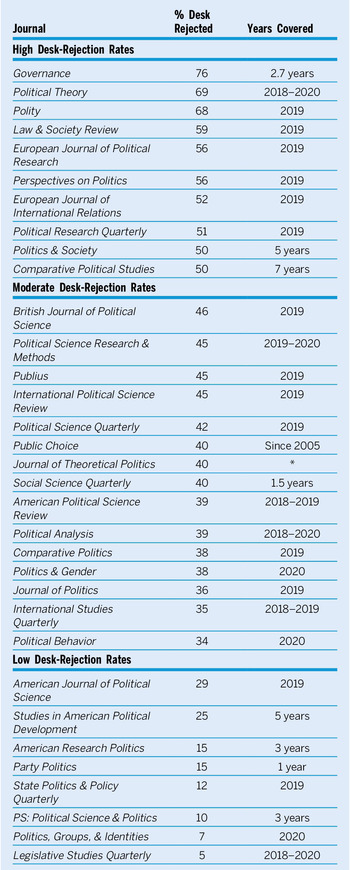
Table 1 reports the desk-rejection rates for 33 political science journals, ranked from highest to lowest.Footnote 1 As shown in the table, there is wide variation in desk-rejection rates across journals, ranging from a high of 76% (i.e., Governance) to a low of 5% (i.e., Legislative Studies Quarterly). There are three groups of journals categorized by their desk-rejection rates. We classify journals with desk-rejection rates of 50% or greater as having high desk-rejection rates (e.g., Political Theory, POP, Political Research Quarterly, and Comparative Political Studies). These journals apparently are serious about carefully managing reviewer resources and about editors’ roles in discarding at the outset submitted manuscripts that are perceived as unlikely to make the cut. In the middle category are journals with moderate desk-rejection rates above 30% but below 50%. These journals include some of the most prominent journals in the discipline (e.g., APSR, Journal of Politics, British Journal of Political Science, and International Studies Quarterly). On the other extreme are journals with a desk-rejection rate of 30% or lower, which we classify as having low desk-rejection rates. These journals include the prestigious American Journal of Political Science as well as a group of subfield journals.
Desk-Rejection Rates for 33 Political Science Journals

Notes: Mean=39.7; Standard deviation=18.00
* Data not reported or not available.
Why do journal editors desk reject manuscripts? Our survey asked journal editors if they desk rejected manuscripts for one or more of seven reasons; their responses are summarized in online appendix 1, table A2.Footnote 2 More than 90% of journal editors indicated that they desk reject manuscripts for the following reasons: (1) “manuscript is not a scholarly contribution appropriate for a scholarly journal (e.g., editorial, opinion piece)”; (2) “manuscript does not fit the substantive content of the journal”; and (3) “manuscript is flawed or of insufficient scholarly quality.” Most journal editors occasionally receive manuscripts that are not scholarly contributions or that do not fit with the substantive content of a given journal, which is a natural basis for desk rejecting manuscripts. What may be at issue in debates about desk rejections is the degree to which manuscripts that are flawed or deemed by editors to be of low quality should be desk rejected and therefore not provided with peer reviews that identify flaws and suggest corrective action. We also find that a significant minority (44%) of journal editors agree that a manuscript can be desk rejected if it “fails to meet the journals’ required submission guidelines (e.g., length).” There are three reasons presented that generate scant support, with only one journal editor agreeing to each of the following statements: (1) “manuscript is not properly formatted according to journal guidelines”; (2) “reviewer fatigue, or shortage of reviewers”; and (3) “diversity/inclusion criteria.” We are surprised by editors’ disagreement that reviewer fatigue or a shortage of reviewers is an appropriate reason for a desk rejection. The oversupply of manuscripts and the undersupply of willing reviewers is a common theme in both informal communication with journal editors and of the journal editors contributing to this symposium.
Based on our survey, we find considerable variation in desk-rejection rates across scholarly journals in political science. Some journals rely on desk rejections on a majority (or more) of submissions and others rely on desk rejections less frequently or, in some cases, hardly at all. We also find that journal editors have either a written (formal) or informal desk-rejection policy, and there appears to be a consensus among journal editors about the legitimate reasons to desk reject a manuscript or not.
Based on our survey, we find considerable variation in desk-rejection rates across scholarly journals in political science. Some journals rely on desk rejections on a majority (or more) of submissions and others rely on desk rejections less frequently or, in some cases, hardly at all.
STUDY 2: AN ANALYSIS OF APSA JOURNAL EDITORIAL DECISIONS
In recent years, APSA has collected both manuscript- and author-level data for papers submitted to its three major journals (i.e., APSR, POP, and PS). In this second study, we use data made available by APSA to identify the variables that predict editorial decisions by these three journals. The data include a range of manuscript-level variables (i.e., subfield, methodological approach, number of authors, and type of manuscript submission) and author-level variables (i.e., home country, type of employer, academic rank, gender, and race/ethnicity). The data were blinded so that we could not identify manuscript authors or their specific employing institutions. The coverage dates and sample sizes for data for each journal are (1) APSR: December 19, 2017, to June 4, 2019 (N = 1,715); (2) POP: December 22, 2017, to August 31, 2019 (N = 725); and (3) PS: January 8, 2018, to July 11, 2019 (N = 321).
Dependent Variable: Final Editorial Decision
In the manuscript files for each journal, a variable representing the final disposition of each manuscript is coded 0 for desk-rejected manuscripts, 1 for manuscripts rejected after peer review, and 2 for manuscripts accepted for publication. (Manuscripts that were given a revise and resubmit but later rejected were coded as 1.) The three APSA journals differ considerably in the distribution of final editorial decisions on submitted manuscripts (see online appendix 1, table A3). As we might expect for the flagship journal of the discipline, APSR accepted only 5.6% of manuscripts during the period covered by these data. Among those 94.4% of manuscripts that did not escape the editorial gauntlet, 39.1% were desk rejected at the outset and 55.4% were rejected after peer review. POP had a final acceptance rate of 12.8%; however, in rejecting the remaining 87.2%, it relied more heavily on desk rejections. Indeed, 61% of manuscripts submitted to POP were desk rejected, with the remaining 26.2% rejected after the peer-review process. Finally, relative to APSR and POP, PS has a broader role in the discipline, with fully 73.1% of manuscripts accepted for publication. Most rejected manuscripts go through peer review (19.3%), with only a small number subjected to desk rejection (7.6%). Clearly, the three APSA journals differ in their reliance on desk rejections.
Independent Variables
This section describes the manuscript- and author-level independent variables that we include in our models of final editorial decisions for APSR, POP, and PS.
Manuscript-Level Variables
We include three sets of manuscript-level independent variables in our models of final editorial decisions. First are two general variables that do not have any substantive content: (1) number of authors; and (2) submission type—that is, article versus letter (APSR), or regular article versus special-issue manuscript versus reflection/review manuscript (POP). We do not have a strong expectation of the effects of either of these variables on editorial decisions.
Second, manuscripts submitted to APSA journals are coded in terms of their methodological approach. We create separate dichotomous independent variables, coded 1 if a given manuscript falls in one of the following methodological approaches and 0 otherwise: case study, critical theory/post-structuralist, ethnographic, experimental, formal, interpretive, normative, not applicable, and statistical/observational. The statistical/observational variable represents the omitted (i.e., contrast) category. APSA journals sometimes are criticized for favoring statistical studies, so we expect manuscripts adopting another nonstatistical approach to have higher rates of desk rejection and rejection with peer review.
Third, manuscripts submitted to APSA journals also are coded in terms of substantive area. Again, we create separate dichotomous independent variables, coded 1 if a given manuscript falls into one of the following subfield categories and 0 otherwise: American politics, comparative politics, international relations, methodology, political theory, public administration and policy, or other. We retain American politics as the excluded (i.e., contrast) category; therefore, the effects of a manuscript being in the other categories are estimated in comparison to being in the American politics category.Footnote 3 We do not have a strong expectation about which subfields have higher or lower rates of desk rejection or rejection with review.
Author-Level Variables
In addition to manuscript-level variables, we include in our models variables that represent the attributes of (co)authors. Certain author characteristics may have either a positive or negative effect on the probability that a given manuscript is accepted, desk rejected, or rejected with peer review. First, the APSA dataset includes a variable for the country/region of authors. We convert this variable into a series of dichotomous variables representing whether there is at least one coauthor from each country/region: United States, Western Europe, Canada–Australia–New Zealand, Asia, or other country/region (i.e., Africa, Latin America, Eastern Europe, or Russia). We expect that authors from the United States would be more familiar with editorial standards for American political science journals and therefore are less likely to be desk rejected and rejected with review.
Second, we convert the original variable categorizing authors by their employment type into a series of dichotomous variables indicating whether there is at least one author employed by a PhD-granting university, a non-PhD-granting university, another college (i.e., community college or undergraduate college), the noneducational sector (i.e., government, nonprofit, or private sector), or prefer not to say. We expect that authors from PhD-granting universities—which place a high priority on research activity—would have lower rates of desk rejection and rejection with review.
Third, APSA collects data on the academic rank of authors, so we create dichotomous variables representing whether a given manuscript had at least one author who is an assistant professor, associate professor, full professor, graduate student, postdoctoral fellow, non-tenure-track faculty, or another rank. We expect that full professors would have lower rates of desk rejection and rejection with review than each of these other categories.
Fourth, we account for possible effects of gender and race in the review process. For gender, we code separate dichotomous variables indicating whether any of the authors of a given manuscript are male, female, nonbinary, or prefer not to say. In addition, for race, we code separate dichotomous variables for the following groups: Anglo white, Black, Latino, non-Anglo white, Asian, Middle Eastern, Native American, mixed race, other race, or prefer not to say. The expected effects of gender and race are unclear. On the one hand, if there is a bias by journal editors or other factors that disfavor authors who are women, nonbinary, or members of certain racial groups, we expect these groups to show higher rates of desk rejection and rejection with review. On the other hand, attention by APSA has been given to the diversity of authors published in its journals; therefore, it is possible that manuscripts submitted by underrepresented groups of authors would be given additional consideration, particularly in the decision to desk reject or send out for peer review.
Empirical Results
We report the results from our multinomial logit models for APSR, POP, and PS in online appendix 1, tables A4, A5, and A6, respectively. Because the dependent variable in our models is measured as a nominal (i.e., non-orderable) variable, ordinary least squares regression is inappropriate; therefore, we estimate our models using multinomial logit.
General Independent Variables
In the general variables in our models, we find that the number of authors has a significant negative effect on the probability that a manuscript was desk rejected for POP (b = −0.753, z = −2.95); however, no effect is observed for APSR or PS. Simply stated, manuscripts submitted to POP with more authors have considerably lower desk-rejection rates than those with a single or fewer authors, but there is no similar effect on the probability of a rejection with peer review. Moreover, whereas there is no effect of article type on editorial decisions for APSR, we find that for POP, reflection pieces or review manuscripts were less likely to be desk rejected and rejected with review, and special-issue manuscripts were less likely to be rejected with review.
Manuscript Methodology
We find only mixed evidence of methodology effects across the three APSA journals. None of the methodology coefficients is statistically significant for APSR; however, for POP, the effects of two methodology variables—that is, interpretive method (b = 1.359, z = 2.64) and method not applicable (b = 1.684, z = 2.36)—suggest higher rates of desk rejection for manuscripts in these categories than for those that adopt a quantitative/formal approach. Furthermore, the effects of method not applicable suggests higher rates of rejection with review compared to manuscripts that adopt a quantitative/formal approach for both POP (b = 2.272, z = 2.98) and PS (b = −1.262, z = −2.44).
Manuscript Subfield
We find only weak evidence of significant effects of manuscript subfield on final editorial decisions. For desk-rejection decisions, there is a significant international relations effect for APSR (b = 0.998, z = 2.19), with those submissions more likely to be desk rejected than submissions from American politics (i.e., the excluded contrast group). Subfield desk-rejection effects are not found for POP or PS. There also is a significant negative effect on rejections with review for methodology manuscripts submitted to POP (b = −2.095, z = −2.13), but similar subfield effects are not found for APSR or PS.
Author Country/Region
For the country/region of authors variable, we find discernible effects for APSR, particularly in terms of desk rejections. The presence of at least one coauthor from the United States has a significant negative effect on desk rejections (b = −1.011, z = −2.30); having a coauthor from an “other” country (i.e., Africa, Latin America, or Eastern Europe) increased the likelihood of a desk-rejection decision (b = 1.353, z = 1.72). Moreover, POP shows strong country/region effects: manuscripts with at least one coauthor from the United States (b = −1.667, z = −3.64) or from Western Europe (b = −0.960, z = −2.14) were less likely to be desk rejected. Having an author or coauthor from the United States also has a small (but significant) negative effect on the probability of rejection with review (b = −0.792, z = −1.66). Finally, country/region effects for PS are limited to manuscripts with an author or coauthor from an “other” country; these manuscripts are more likely to be both desk rejected (b = 2.616, z = 2.11) and rejected with review (b = 1.881, z = 2.05).
Author Employment Institution
We also find only weak effects of the employing institution on editorial decisions. We expect that manuscripts with authors from PhD-granting universities would be advantaged in the editorial process; however, this assertion is supported only by weak negative effects of authors from PhD-granting universities observed for desk-rejection decisions at APSR (b = −1.315, z = −1.85). We also find for POP a desk-rejection disadvantage for manuscripts with non-PhD-granting university faculty (b = 0.942, z = 2.06), but there are no significant employing-institution effects for PS. In summary, it appears that employing institution has only a weak and inconsistent effect on journal editorial decisions.
Academic Rank
We also consider the effects of academic-rank variables on final editorial decisions. For APSR, we find—surprisingly—that assistant professors (b = −0.693, z = −2.00) and postdoctoral fellows (b = −0.969, z = −2.62) have lower desk-rejection rates. Moreover, postdoctoral fellows have lower rates of desk rejection after peer review (b = −0.736, z = −2.13). On the one hand, we expect full professors to be at the top of their field and more likely to produce high-quality work warranting publication in the discipline’s flagship journal. On the other hand, APSR is known for publishing cutting-edge research, and it is possible that newly trained assistant professors and postdoctoral fellows are producing innovative research that may be more likely to meet the “cutting-edge” standard.
The effects of academic rank are not limited to APSR. For POP, there is a small positive effect of having a graduate-student author on the probability that a manuscript was desk rejected (b = 0.804, z = 1.77), as well as small positive effects on both desk-rejection (b = 1.228, z = 1.79) and rejection after review (b = 1.212, z = 1.66) decisions for non-tenure-track faculty. For PS, there is no apparent effect of academic rank on desk-rejection decisions, although having both full-professor (b = −1.245, z = −2.01) and associate-professor (b = −1.177, z = −2.10) coauthors depresses the probability that a manuscript would be rejected after full peer review.
Gender and Race/Ethnicity
There is considerable interest in the possibility of gender or race/ethnicity effects in editorial decisions, but we find little evidence of systematic effects of the various gender or race/ethnicity variables. For APSR and PS, there are no significant coefficients among the gender and race/ethnicity variables; it appears that these journals do not provide a gender, racial, or ethnicity advantage in their editorial decisions. For POP, there is no gender effect and minimal racial/ethnic effect; the one exception is the Asian variable (b = 1.177, z = 2.12): manuscripts with Asian coauthors exhibit a higher probability of being desk rejected.
There is considerable interest in the possibility of gender or race/ethnicity effects in editorial decisions [of APSA journals], but we find little evidence of systematic effects of the various gender or race/ethnicity variables.
CONCLUSION
In recent years, there has been much debate about the increased use of desk rejections and the commensurate diminished role of near-universal peer review in political science journals.Footnote 4 Although it is common to share or hear anecdotes about desk rejections, we do not know much about journal desk-rejection policies and practices, as well as the prevalence and correlates of desk-rejection editorial outcomes. This article brings data to bear on three basic questions: What are desk-rejection rates across political science journals? Which explicit criteria do journal editors use to determine which manuscripts should be desk rejected? Beyond that, which manuscript- and author-level characteristics are related to editorial decisions (including the decision to desk reject) on submitted manuscripts?
To answer these questions, we conducted two studies. Based on survey results, we find that the average journal desk rejects approximately 40% of submitted manuscripts. There is wide variation in desk-rejection rates, with some journals desk rejecting more than 50% of manuscripts submitted and others desk rejecting less than 30%. The highest-impact journals in the profession have desk-rejection rates that are distributed throughout, although the lion’s share of the most prestigious journals are in the middle category, desk rejecting between 30% and 50% of submitted manuscripts. We also find that journal editors report that they desk reject manuscripts for various reasons, including whether a submission is “not a scholarly contribution,” “does not fit the substantive content of the journal,” or “is flawed or of insufficient scholarly quality.” It appears that journal editors do not desk reject manuscripts based on diversity/inclusion criteria, improper formatting, or (surprisingly) a shortage of reviewers.
Our second study is based on blinded manuscript-level data made available by APSA for APSR, POP, and PS. We are able to model final editorial decisions (i.e., desk rejection, rejection after review, and accepted for publication) as a function of a set of manuscript- and author-level variables. We find that the effects of these variables and desk-rejection outcomes differ across the three journals. There are methodology effects for POP and PS (but not for APSR) and there are only a couple of subfield effects found across the three journals. Among the author-level variables, we find some country/region effects for each of the three journals: manuscripts with a coauthor from the United States were less likely to be desk rejected for APSR and POP. We also find that the academic rank of submitting authors matters; for APSR, assistant professors and postdoctoral fellows were less likely to be desk rejected, whereas for POP, there was a weak tendency to desk reject manuscripts by a graduate-student or non-tenure-track faculty coauthor. For PS, there was a lower probability that full and associate professors would have their manuscript rejected after review. Finally, we find scant evidence that gender and race/ethnicity had any effect on final editorial decisions.
In summary, these two studies provide insight into how scholarly journals in political science make desk-rejection decisions. Clearly, we do not know everything that we need to know, so more work is needed.
ACKNOWLEDGMENTS
We are grateful to Erin McGrath, Jon Gurstelle, and Betsy Super from APSA for their assistance in compiling manuscript- and author-level data on manuscripts submitted to APSR, POP, ad PS. We also thank Kallie Comardelle, Rehm Maham, and Sydney Kerr for their assistance in compiling data for the tables.
SUPPLEMENTARY MATERIALS
To view supplementary material for this article, please visit http://dx.doi.org/10.1017/S1049096521000573.