Introduction
During evolution, insects have entered into symbiotic relations with a wide range of microorganisms. Long-lasting obligate partnerships between insects and bacteria exert a strong influence on various physiological functions of the host. Insects often act as hosts for various bacteria that colonize certain tissues and cells (endosymbionts), in addition to the symbiotic bacteria that constitute the native microbiota. In order to evade the host immune system and ensure their transmission to the next generation, these bacteria have had to develop a number of strategies (Eleftherianos et al., Reference Eleftherianos, Atri, Accetta and Castillo2013). For example, most endosymbionts can increase the resistance of a host to various pathogens by mediating the activation of defence systems (Dolezal et al., Reference Dolezal, Krejcova, Bajgar, Nedbalova and Strasser2019; Feldhaar and Gross, Reference Feldhaar and Gross2009; Perlmutter et al., Reference Perlmutter, Atadurdyyeva, Schedl and Unckless2023; Xie et al., Reference Xie, Butler, Sanchez and Mateos2014). Wolbachia is one of the most common facultative endosymbiotic bacteria. It belongs to the group of intracellular α-proteobacteria (Anaplasmataceae: Rickettsiales), which includes species having parasitic, mutualistic, or commensal relationships with their hosts. This bacterium affects diverse invertebrates, with over 60% of species being affected, including some nematodes (Hilgenboecker et al., Reference Hilgenboecker, Hammerstein, Schlattmann, Telschow and Werren2008; Weinert et al., Reference Weinert, Araujo-Jnr, Ahmed and Welch2015). During ontogenesis, the endosymbiont can migrate from cell to cell, thereby colonising various organs of a host (Pietri et al., Reference Pietri, DeBruhl and Sullivan2016; Sicard et al., Reference Sicard, Dittmer, Grève, Bouchon and Braquart‐Varnier2014). The presence of the bacterium in somatic tissues (the fat body, nervous tissue, haemocytes, and gut tissues) can affect the host’s lifespan and its interaction with pathogens (Albertson et al., Reference Albertson, Casper‐Lindley, Cao, Tram and Sullivan2009; Frydman et al., Reference Frydman, Li, Robson and Wieschaus2006; Ijichi et al., Reference Ijichi, Kondo, Matsumoto, Shimada, Ishikawa and Fukatsu2002, Reference Landmann, Bain, Martin, Uni, Taylor and Sullivan2012; Landmann et al., Reference Landmann, Foster, Slatko and Sullivan2010; Panteleev et al., Reference Panteleev, Goryacheva, Andrianov, Reznik, Lazebny and Kulikov2007; Pietri et al., Reference Pietri, DeBruhl and Sullivan2016; Porter and Sullivan, Reference Porter and Sullivan2023). Given that Wolbachia resides in host-derived vacuoles in order to replicate and evade an immune response, its impact on antimicrobial defence is of particular interest (Fattouh et al., Reference Fattouh, Cazevieille and Landmann2019).
The molecular mechanisms of Wolbachia–host interactions and the influence of the endosymbiont on a host’s resistance to pathogens are subjects of active research, and the understanding of these processes is not yet complete.
The studies published so far are quite contradictory. One hypothesis is that Wolbachia promotes resistance to pathogens by preactivating the host immune response (Pan et al., Reference Pan, Zhou, Wu, Bian, Lu, Raikhel and Xi2012; Prigot-Maurice et al., Reference Prigot-Maurice, Cerqueira De Araujo, Beltran-Bech and Braquart-Varnier2021). Although some articles show no effect of Wolbachia on a host’s resistance to pathogen invasions (Bourtzis et al., Reference Bourtzis, Pettigrew and O’Neill2000; Rottschaefer and Lazzaro, Reference Rottschaefer, Lazzaro and Moreira2012; Wong et al., Reference Wong, Hedges, Brownlie and Johnson2011), others indicate increased susceptibility of a host to pathogens/parasitoids (Fytrou et al., Reference Fytrou, Schofield, Kraaijeveld and Hubbard2006; van Nouhuys et al., Reference van Nouhuys, Kohonen and Duplouy2016). The scientific literature contains numerous studies pointing to successful suppression of viral infections during host–Wolbachia symbiosis. In particular, the ability of Wolbachia to delay and/or reduce host mortality from infections by natural RNA viruses has been demonstrated in the fruit fly Drosophila melanogaster (Bruner-Montero et al., Reference Bruner-Montero and Jiggins2023; Cogni et al., Reference Cogni, Ding, Pimentel, Day and Jiggins2021; Hedges et al., Reference Hedges, Brownlie, O’Neill and Johnson2008; Teixeira et al., Reference Teixeira, Ferreira and Ashburner2008). Furthermore, resistance of mosquitoes Aedes albopictus (Mousson et al., Reference Mousson, Zouache, Arias-Goeta, Raquin, Mavingui and Failloux2012), Culex quinquefasciatus (Glaser and Meola, Reference Glaser, Meola and Liu2010), and Aedes aegypti (Amuzu and McGraw, Reference Amuzu and McGraw2016) to dengue and West Nile RNA viruses is also due to the effects of this endosymbiont (Glaser et al., Reference Glaser, Meola and Liu2010; Mousson et al., Reference Mousson, Zouache, Arias-Goeta, Raquin, Mavingui and Failloux2012). The influence of Wolbachia on host resistance to a bacterial infection is not obvious, despite the existence of a substantial number of research articles. The lack of Wolbachia’s effect on resistance to a bacterial infection has been demonstrated in Drosophila simulans and D. melanogaster during systemic infection with Pseudomonas aeruginosa, Serratia marcescens, or Erwinia carotovora (Wong et al., Reference Wong, Hedges, Brownlie and Johnson2011). Similar results have been obtained when D. simulans and A. albopictus have been infected with Escherichia coli DH5a or Micrococcus luteus ATCC 0533 (Bourtzis et al., Reference Bourtzis, Pettigrew and O’Neill2000). On the other hand, Ye et al. (Reference Ye, Woolfit, Rancès, O’Neill and McGraw2013) demonstrated that A. aegypti infected with various Wolbachia strains exhibits different degrees of antibacterial activity, with strain wMelPop-CLA giving more effective protection than wMel does, against a broader spectrum of bacteria (Ye et al., Reference Ye, Woolfit, Rancès, O’Neill and McGraw2013).
Hymenoptera, in particular parasitic wasps Habrobracon hebetor Say, are also carriers of Wolbachia (Kageyama et al., Reference Kageyama, Narita, Imamura and Miyanoshita2010; Kryukova et al., Reference Kryukova, Kryukov, Polenogova, Chertkova, Tyurin, Rotskaya, Alikina, Kabilov and Glupov2023). The small number of research articles on the interaction between the ectoparasitoid H. hebetor and Wolbachia is mainly devoted to the influence of the symbiont on sexual structure of a host’s population, fecundity, viability, and mating behavior (Bagheri et al., Reference Bagheri, Talebi, Asgari and Mehrabadi2019; Doostalizadeh et al., Reference Doostalizadeh, Talebi, Fathipour, Hoffmann and Mehrabadi2024; Nasehi et al., Reference Nasehi, Fathipour and Mehrabadi2021). The influence of Wolbachia on host immunity and on its ability to resist infection has been presented in sporadic studies and still leaves many questions open regarding the mechanisms of their interaction. Effects of Wolbachia on host immunity in the parasitoid–bacterium system are presented only in a few studies, namely, papers about Nasonia vitripennis (Li et al., Reference Li, Wang, Liu and Qiu2018; Tiwary et al., Reference Tiwary, Babu, Sen and Raychoudhury2022) and Asobara tabida (Kremer et al., Reference Kremer, Charif, Henri, Gavory, Wincker, Mavingui and Vavre2012). It is known that H. hebetor is actively used to control agricultural pests, often in combination with insecticides based on bacteria of the genus Bacillus (Oluwafemi et al., Reference Oluwafemi, Rao, Wang and Zhang2009). In insect pest control, one of widely used and widespread entomopathogenic bacteria is Bacillus thuringiensis. The insecticidal effect of B. thuringiensis is due to the presence of a crystalline endotoxin (Cry toxin), whose activation in an insect’s gut leads to the formation of pores, lysis of gut cells, and consequent sepsis (Bravo et al., Reference Bravo, Gill and Soberón2007, Reference Bravo, Gill, Soberón and Schmidt2019; Fortier et al., Reference Fortier, Vachon, Frutos, Schwartz and Laprade2007; Soberón et al., Reference Soberón, Gill and Bravo2009). At their larval stage, parasitoids feed on hosts with developing septicemia for several days. During this period, they are exposed to bacteria from the host’s intestinal microbiota and to B. thuringiensis cells that enter a body cavity through intestinal damage. The parasitoid becomes infected with the bacterium when it feeds on an infected host. The entry of a pathogenic microbiota into the gut activates the system of synthesis of AMPs and reactive oxygen species (AMPs/ROS) (Zeng et al., Reference Zeng, Jaffar, Xu and Qi2022).
AMPs are important effectors of an immune response in insects and have a broad spectrum of antibacterial, antifungal, and antiparasitic activities. They kill pathogens by acting as pore-formers or metabolic inhibitors (Eleftherianos et al., Reference Eleftherianos, Zhang, Heryanto, Mohamed, Contreras, Tettamanti, Wink and Bassal2021). In the insect gut, the coordinated action of IMD and Jak–STAT pathways and of the Duox–ROS system is aimed at eliminating pathogens (Kleino and Silverman, Reference Kleino and Silverman2019; Neyen et al., Reference Neyen, Poidevin, Roussel and Lemaitre2012; Zeng et al., Reference Zeng, Jaffar, Xu and Qi2022). After recognition by appropriate pattern recognition receptors, IMD pathways are activated by peptidoglycan from gram-positive bacteria and DAP-type peptidoglycan from gram-negative bacteria (Kleino and Silverman, Reference Kleino and Silverman2019; Lemaitre and Hoffmann, Reference Lemaitre and Hoffmann2007; Zeng et al., Reference Zeng, Jaffar, Xu and Qi2022). Lysozyme represents another important class of effector proteins, which may regulate gut gram-positive bacteria via cleavage of exposed peptidoglycan on their cell wall (McKenzie and White, Reference McKenzie and White1991; Regel et al., Reference Regel, Matioli and Terra1998). For the activation of AMPs, small heat shock proteins such as Hsp70 are important. These chaperones also ensure the correct conformation of AMPs during folding and prevent their aggregation (Treweek et al., Reference Treweek, Meehan, Ecroyd and Carver2015; Wojda et al., Reference Wojda, Cytryńska, Zdybicka-Barabas and Kordaczuk2020).
In this study, we investigated the effect of the endosymbiotic bacterium Wolbachia on the ability of larvae of the parasitoid H. hebetor to prevent bacterial infection during H. hebetor development on a host infected with entomopathogenic bacteria. The parasitoid larvae fed on a host perorally infected with a sublethal dose (LD15) of the entomopathogenic bacterium B. thuringiensis. Because only parasitoid larvae were in direct contact with the host, all experiments were conducted only at this stage of ontogenesis. The parasitoid’s survival was estimated at developmental stages from second-instar larvae to adults. In fourth-instar larvae, mRNA expression of lysozyme-like and AMPs (defensin-like and nabaecin-like) and of Hsp70 was analysed, as were lysozyme-like and antibacterial activities.
Materials and methods
Insects
Two lines of H. hebetor (Say), Wolbachia-infected (W+) and Wolbachia-free (W−), were used in this work. As a host insect for H. hebetor, fourth-instar larvae of Galleria mellonella L. of a laboratory line from the Institute of Systematics and Ecology of Animals, the Siberian Branch of the Russian Academy of Sciences (ISEA SB RAS) were employed. The laboratory population of G. mellonella was maintained at 28°C on an artificial diet (Kryukova et al., Reference Kryukova, Dubovskiy, Chertkova, Vorontsova, Slepneva and Glupov2011; Polenogova et al., Reference Polenogova, Kabilov, Tyurin, Rotskaya, Krivopalov, Morozova, Mozhaitseva, Kryukova, Alikina, Kryukov and Glupov2019). Adult ectoparasitoids were maintained on 12% honey syrup at 28°C under a photoperiod of 14 h (Ghimire and Phillips, Reference Ghimire and Phillips2010). The W− line was obtained by a published method (Kryukova et al., Reference Kryukova, Kryukov, Polenogova, Chertkova, Tyurin, Rotskaya, Alikina, Kabilov and Glupov2023) via injection of the host (G. mellonella) with macrocyclic antibiotic rifampicin (RUPE Belmedpreparaty, Belarus). The first three generations of parasitoids were grown on antibiotic-treated wax moth larvae. Next, all subsequent generations of H. hebetor were reared on the untreated larvae. The W− parasitic-wasp line was maintained in the laboratory for more than 5 years. The presence or absence of Wolbachia in the parasitoid was verified every 6 months by PCR analysis of the adult individuals’ whole-body homogenates (both male and female) with the specific primers targeting Wolbachia’s wsp gene (Supplementary file S1) (Kryukova et al., Reference Kryukova, Kryukov, Polenogova, Chertkova, Tyurin, Rotskaya, Alikina, Kabilov and Glupov2023).
Bacteriosis modeling and H. hebetor survival estimation
The entomopathogenic bacterium B. thuringiensis var. galleriae H5ab (Bt) from the collection of entomopathogenic microorganisms of the ISEA SB RAS was employed to assess the survival rate of H. hebetor. G. mellonella larvae were infected with Bt. The bacterium was cultivated on nutrient agar (pH 7.2; Himedia, Mumbai, India) at 28°C for 6 days. The bacterial suspension was prewashed twice with 150 mM sterile saline (SS; with centrifugation at 6000×g for 10 min) and used to prepare a suspension with a titer of 2 × 10⁷ spores and crystals per millilitre. Bacterial titers were determined on a Neubauer hemocytometer. The ratio of spores to crystals was determined in a microbiological smear prestained with a 5% aqueous eosin solution. The ratio of spores to crystals was 1:1. Infection with Bt was performed on fourth-instar larvae of the greater wax moth (G. mellonella). The titer of Bt used for the infection was 2 × 10⁷ spores and crystals per millilitre. Fourth-instar wax moth larvae were kept without food for 2 h prior to the infection and were then fed 3 g of the artificial diet with 1 mL of the bacterial suspension. In the control group, 1 mL of SS was added to the artificial diet. Artificial feed was mixed with the bacterial suspension and SS in a mortar using a pestle. H. hebetor adults (females and males) were fed with 12% honey syrup for 2 days. Twenty-four hours after the infection initiation, one G. mellonella larva and one H. hebetor female were placed in 30-mL disposable plastic containers with perforated lids. H. hebetor larvae fed on the host from egg hatching (2 days after egg laying) to pupation (6 days after egg laying). The ectoparasitoid’s survival was evaluated by means of second-instar larvae (assessed under binoculars) until emergence of adults. Survival was measured as a percentage of the previous developmental stage: from the second instar to fourth instar, from the fourth instar to pupa, from the pupa to adult. Twenty females from each line were utilized for each experiment, and the experiment was repeated three times.
PCR analysis
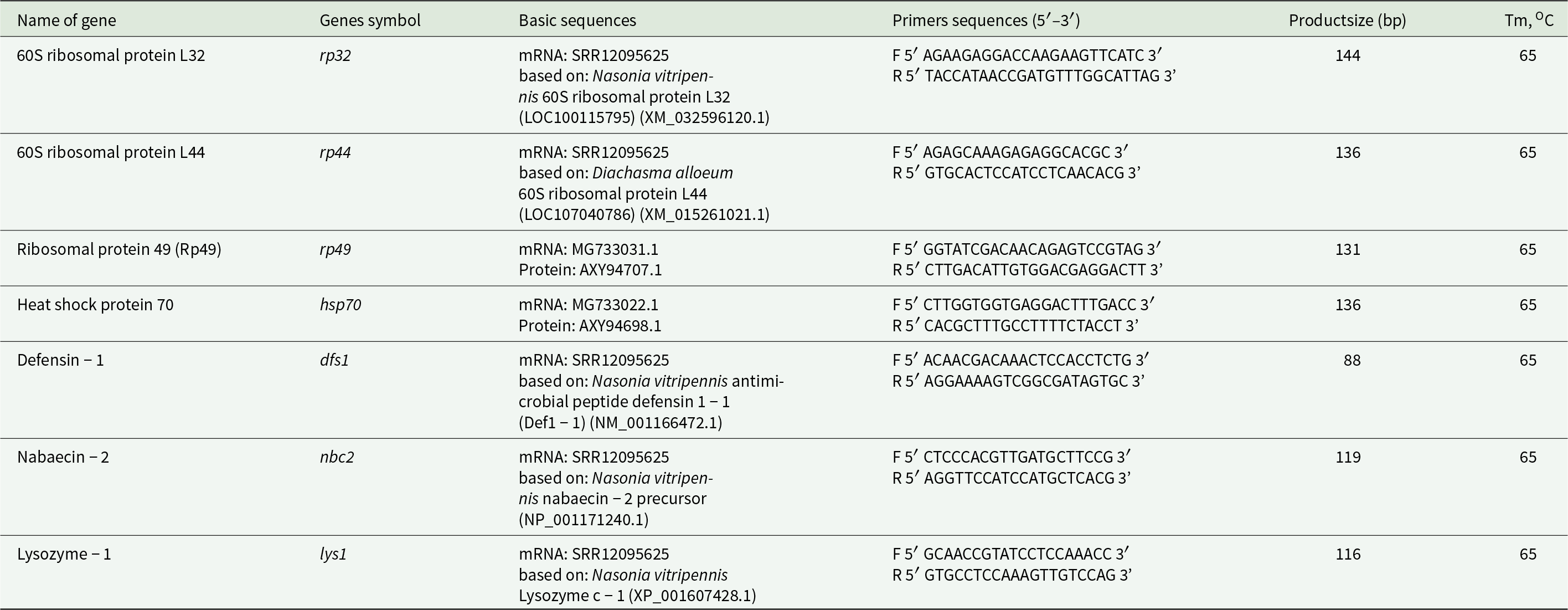
Whole fourth-instar H. hebetor larvae were collected from paralyzed G. mellonella larvae on ice. Five larvae were pooled into one biological replicate. The collected samples were frozen in liquid nitrogen and stored at –80°C. Before RNA extraction, the samples were lyophilized at –65°C and 600 mTorr for 15 h and disrupted in liquid nitrogen with micropestles. Total-RNA extraction was performed according to the manual of the Lira Reagent (BioLabMix, Novosibirsk, Russia); it is a chemical analog of the TRIzol reagent for RNA extraction. Treatment with DNase I (RNase-free) (Transgenbiothech, Beijing, China) was carried out according to the manual. Reverse transcription of RNA into cDNA was performed with RevertedAidTM M-MuLV Reverse Transcriptase (Fermentas, Vilnius, Lithuania) and 2.0 pmol of 9 N primers. Quantitative PCR (qPCR) was carried out by means of the HS-qPCR SYBR Blue (2×) mix (BioLabMix, Novosibirsk, Russia) on a thermal cycler (CFX96 Touch Real-Time PCR Detection System; Bio-Rad, Hercules, CA, USA). The qPCR was conducted in triplicate under the following conditions: 95°C for 3 min, followed by 40 cycles of 94°C for 15 s and annealing and elongation at 65°C for 30 s, with subsequent melting-curve analysis (70–90°C). The melting curves for each sample were analysed after each run to check the specificity of amplification. The following genes of H. hebetor served as a reference: 60S ribosomal protein L32 (rp32), 60S ribosomal protein L44 (rp44), and 60S ribosomal protein L49 (rp49) (Supplementary file S2). In NCBI GenBank, only 60S ribosomal protein L49 mRNA sequence is described (accession No. MG733031.1). mRNA sequences for rp32 and rp44 were found in the Sequence Read Archive (SRA) of H. hebetor by BLASTn with mRNA of N. vitripennis 60S ribosomal protein L32 (LOC100115795) (XM_032596120.1) and of Diachasma alloeum 60S ribosomal protein L44 (LOC107040786) (XM_015261021.1), respectively. Heat shock protein 70 (hsp70), defensin-1 (dfs1), nabaecin-2 (nbc2), and lysozyme-1 (lys1) were analysed as genes of interest. The mRNA sequence of hsp70 was taken from NCBI GenBank (MG733022.1). The mRNA sequences of dfs1, nbc2, and lys1 were found in the SRA of H. hebetor by BLASTn with mRNA sequences of N. vitripennis AMP defensin 1-1 (Def1-1) (NM_001166472.1), an N. vitripennis nabaecin-2 precursor (NP_001171240.1), and N. vitripennis lysozyme c-1 (XP_001607428.1), respectively. Primers were designed with the help of the NCBI Primers-BLAST resource [National Library of Medicine. BLAST: Basic Local Alignment Search Tool; available online: https://www.ncbi.nlm.nih.gov/tools/primer-blast/ (accessed on 25 November 2024)], and the primers’ properties were assessed in IDT OligoAnalyser 3.1 [Integrated DNA Technologies. OligoAnalyzer Tool – Primer Analysis|IDT; available online: https://eu.idtdna.com/pages/tools/oligoanalyzer (accessed on 25 November 2024)]. The primers were synthesized by the Biosset company (Novosibirsk, Russia). The specificity of the primers for H. hebetor was confirmed via sequencing of PCR products. Gene expression was calculated by the 2∆∆Cq method in Bio-Rad CFX Manager (Bio-Rad, Hercules, CA, USA). Primer sequences are given in Table 1. In the analysis of Bt-related changes, data on gene expression were normalized to gene expression in Bt-free larvae of H. hebetor without Wolbachia.
Primers used for the qPCR

Defensin-1, nabaecin-2, and lysozyme-1 genes were investigated as AMPs because they have been described for closely related species N. vitripennis and Diachasma alloeum (Gao and Zhu., Reference Gao and Zhu2010; Tvedte et al., Reference Tvedte, Walden, McElroy, Werren, Forbes, Hood, Logsdon, Feder and Robertson2019; Ye et al., Reference Ye, Zhao, Wang, Bian and Zheng2010). Their orthologs were found in NCBI GenBank SRA datasets of H. hebetor using the BLAST online utility.
Lysozyme-like activity
This activity in each whole-body homogenate of fourth-instar H. hebetor larvae was determined by an analysis of a lytic zone by the agar diffusion method of Moreira-Ferro et al., with modifications (Moreira-Ferro et al., Reference Moreira-Ferro, Daffre, James and Marinotti1998). Namely, 10 mL of a mixture of nutrient agar (HiMedia, India) and lyophilized Micrococcus lysodeikticus ATCC 4698 (Sigma-Aldrich) was added to Petri dishes. To prepare the mixture, 3 g of nutrient agar was dissolved by heating in 100 mL of 0.9% NaCl (SS). After it cooled down to 50°C, 1 mL of a suspension of lyophilized bacteria (4 mg/mL in SS) was introduced. Wells of a 2 mm diameter were made in agar, and the sample (5 μL) was placed there, followed by incubation at 28°C for 24 h. As a control, 0.001 mg/mL chicken egg white lysozyme (EWL; Sigma-Aldrich) was added into each dish. Separately for each replicate, Petri dishes were prepared with serial dilutions of lysozyme (0.001, 0.005, 0.01, 0.02, and 0.05 mg/mL) to build a calibration curve, which was then used in calculations. There were five wells in each Petri dish (1 well = 1 sample). Lytic activity was determined by measurement of the clear zone around each well and was expressed in EWL equivalents (mg/mL) using the calibration curve. The diameter (mm) of the clear zone around each well was measured using Vernier calipers. The analysis was performed on three biological replicates.
Antibacterial activity
This activity was tested on nutrient agar in an analysis of inhibition zones by the agar diffusion method using gram-positive bacteria Bacillus cereus (6250) and B. subtilis (4232) and the gram-negative bacterium E. coli (4311E) from the ISEA SB RAS microbial collection. Overnight bacterial cultures were grown at 28°C for 16 h on nutrient agar (HiMedia, India), and suspensions were prepared in SS. After the nutrient agar was cooled to 45°C, bacterial suspensions (final concentrations of 1 × 10⁷ cells per mL) were added, and 10 mL of this suspension was poured into 90-mm Petri dishes. After solidification (∼30 min), 1.5-mm-diameter wells were formed, and 3 µL of the sample was placed there. There were six wells in each Petri dish (1 well = 1 sample). Rifampicin (RUPE Belmedpreparaty, Belarus) was used to set up a positive control for the gram-positive bacteria [B. cereus (6250) and B. subtilis (4232)], and streptomycin for E. coli (4311E). Both antibiotics were employed at 30 µg/mL. The antibiotic concentration used in this work was selected from a series of standard dilutions at concentrations ranging from 0.5 to 30 µg/mL according to Clinical and Laboratory Standards Institute (2017). SS served as a negative control for all groups. Antibacterial activity was determined by measurement of the clear zone (growth inhibition) around the wells after 24 h incubation at 28°C. Three biological replicates (i.e., three whole-body homogenates) were analysed in parallel. The diameter of the growth inhibition zone was measured using Vernier calipers and expressed in mm as the mean ± SEM.
Statistical analysis
Data analysis was performed in PAST 3 and STATISTICA 8 (StatSoft Inc., USA). The normality of the distribution of data was tested by the Shapiro–Wilk W test. Because some data had a non-normal distribution (p ˂ 0.05), we performed the Kruskal–Wallis ANOVA followed by Dunn’s post hoc test. Differences in the mortality rate were analysed by the Kaplan–Meier logrank test followed by the Holm–Sidak adjustment. Survival rates were analysed by a nonparametric analogue of two-factor ANOVA followed by the Scheirer–Ray–Hare test (Scheirer et al., Reference Scheirer, Ray and Hare1976).
Results
Survival rate
Examination of the survival of parasitoid larvae from the two parasitoid lines, W+ and W−, that developed on the host infected with a sublethal dose (1 × 10⁷ spores and crystals in 1 mL) of Bt showed that the presence of Wolbachia did not induce but slightly reduced the ability of the parasitoid to resist bacterial invasion. Specifically, only 44% of W+ individuals developed from second-instar larvae to adults as compared to 52% of W− larvae (p = 0.03, Dunn’s post hoc test; Fig. 1). The highest mortality rate was observed among larvae from the second instar to the fourth instar (p = 0.04; Fig. 1). Only 64.68% of the W+ larvae developed to the fourth instar as compared to 74.77% of W− larvae. In summary, there were no statistically significant differences in survival between W+ and W− lines when they fed on either an infected host or an uninfected host at any developmental stage (Kaplan–Meier analysis; χ2 = 1.684699; df = 3; p = 0.64034). In addition, the Scheirer–Ray–Hare test detected a pronounced trend in the influence of the Bt factor on the survival of larvae of both lines from the second to fourth instar (p = 0.0605). Starting from the fourth instar and up to adults, this test revealed no significant differences in survival between the lines. Thus, the first two instar stages are the most vulnerable (Fig. 1).
Survival dynamics of the parasitoid H. hebetor of two lines (W+ and W−) reared on the host infected or uninfected with B. thuringiensis var galleriae h5ab (Bt). The x-axis shows the developmental stages in days: 4 days corresponds to larval development from the second to fourth instar; 6 days: pupal formation; 14 days: imago emergence. Different letters (a–c) indicate significant differences between treatments as determined by the logrank test (χ2 = 1.684699; df = 3; p = 0.64034). Control W+: larvae from the W+ line that were fed with the uninfected host; Control W−: larvae from the W− line that were fed with the uninfected host; Bt W+: larvae from the W+ line that fed on the host with sublethal bt bacteriosis; Bt W−: larvae from the W− line that fed on the host with sublethal bt bacteriosis.

Lysozyme-like activity
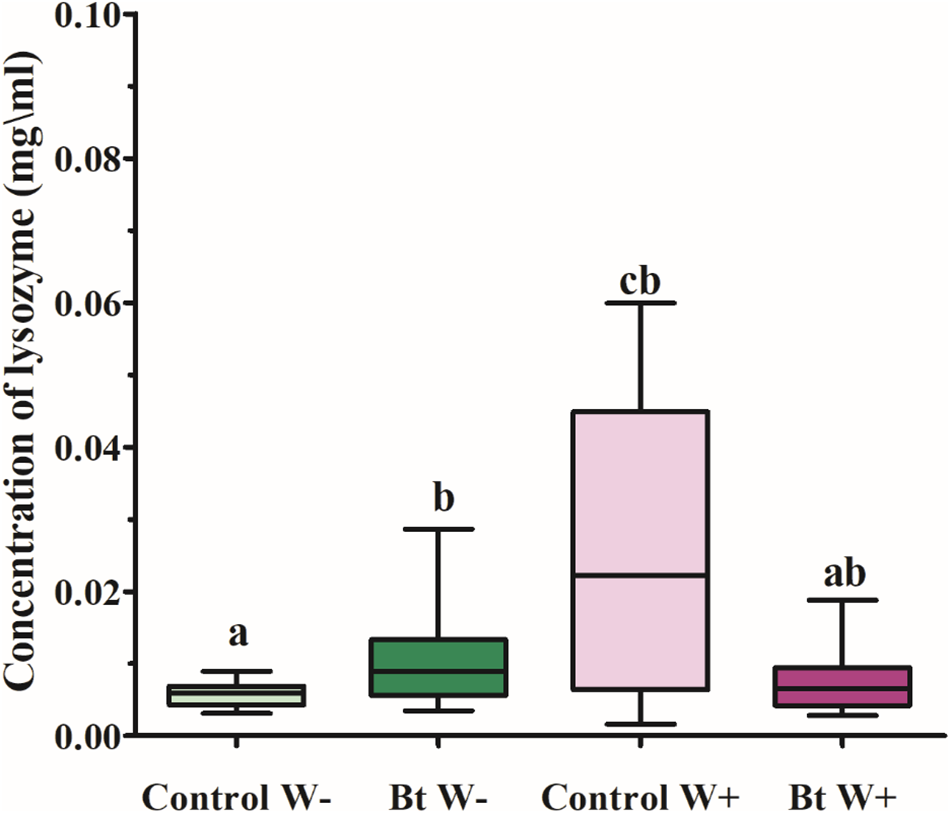
This activity of whole-body homogenates of fourth-instar larvae of two lines, W+ and W−, was analysed by the agar diffusion method. Control samples from W+ individuals that fed on the uninfected host showed a higher activity (4.3-fold) compared to W− controls (p = 0.005755, Dunn’s post hoc test; Fig. 2). It should be noted that in the W+ larvae that were fed with the infected host, the lysozyme-like activity was threefold lower as compared to the W+ control and was approximately at the level of the W− line samples; there were no statistically significant differences between them (p = 0.4492; p = 0.1938, Dunn’s post hoc test; Fig. 2). At the same time, feeding of W− larvae on the host infected with Bt stimulated lysozyme-like activity in them. It was twofold higher relative to the W− control (p = 0.03995, Dunn’s post hoc test; Fig. 2).
Lysozyme-like activity of whole-body homogenates of fourth-instar larvae of the parasitoid H. hebetor of two lines (W+ and W−) reared on the host infected or uninfected with B. thuringiensis var galleriae h5ab (bt). Bars show confidence intervals (P = 0.05). Error bars indicate standard error. Bars with the same letter are not significantly different (Dunn’s post hoc test, p > 0.05). Control W+: larvae from the W+ line that were fed with the uninfected host; Control W–: larvae from the W− line that were fed with the uninfected host; Bt W+: larvae from the W+ line that fed on the host with sublethal Bt bacteriosis; Bt W−: larvae from the W− line that fed on the host with sublethal Bt bacteriosis.

Antibacterial activity
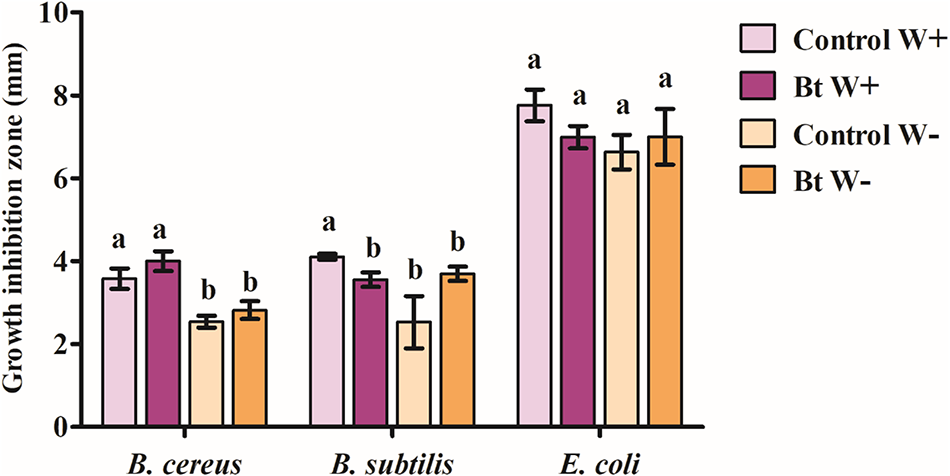
This activity against gram-positive [B. cereus (6250) and B. subtilis (4232)] and gram-negative [E. coli (4311E)] bacteria was tested in whole-body homogenates of H. hebetor fourth-instar larvae of two parasitoid lines (W+ and W−-) that fed on G. mellonella larvae either infected or uninfected (control) with the sublethal dose of Bt. Homogenates of larvae from both lines manifested a high activity against E. coli (4311E), regardless of the host’s infection status. At the same time, feeding of the larvae on the infected host did not lead to significant changes (p = 0.3385, Kruskal–Wallis test; Fig. 3). Although activity against gram-positive bacteria was also observed in both lines, it was significantly lower than that against E. coli. In homogenates from larvae that fed on the uninfected host, the antibacterial activity against B. cereus and B. subtilis was significantly higher in the W+ line than in the W− line (p ˂ 0.05, Kruskal–Wallis test; Fig. 3). The feeding of the parasitoid on the infected host did not significantly increase antibacterial activity against gram-positive bacteria in either W+ or W− larvae. Nonetheless, in W+ larvae, antibacterial activity against B. subtilis was significantly lower as compared to the control of the same line (p = 0.008466, Kruskal–Wallis test; Fig. 3).
The antibacterial activity against gram-positive [B. cereus (6250) and B. subtilis (4232)] and gram-negative bacteria [Escherichia coli (4311E)] in whole-body homogenates of fourth-instar larvae of the parasitoid H. hebetor of two lines (W+ and W–) reared on the host infected or uninfected with B. thuringiensis var galleriae h5ab (Bt). Different letters (a,b) indicate significant differences between treatments as determined by the Kruskal–Wallis test (P ˂ 0.05).

mRNA expression of antibacterial peptides, lysozyme-like protein, and Hsp70
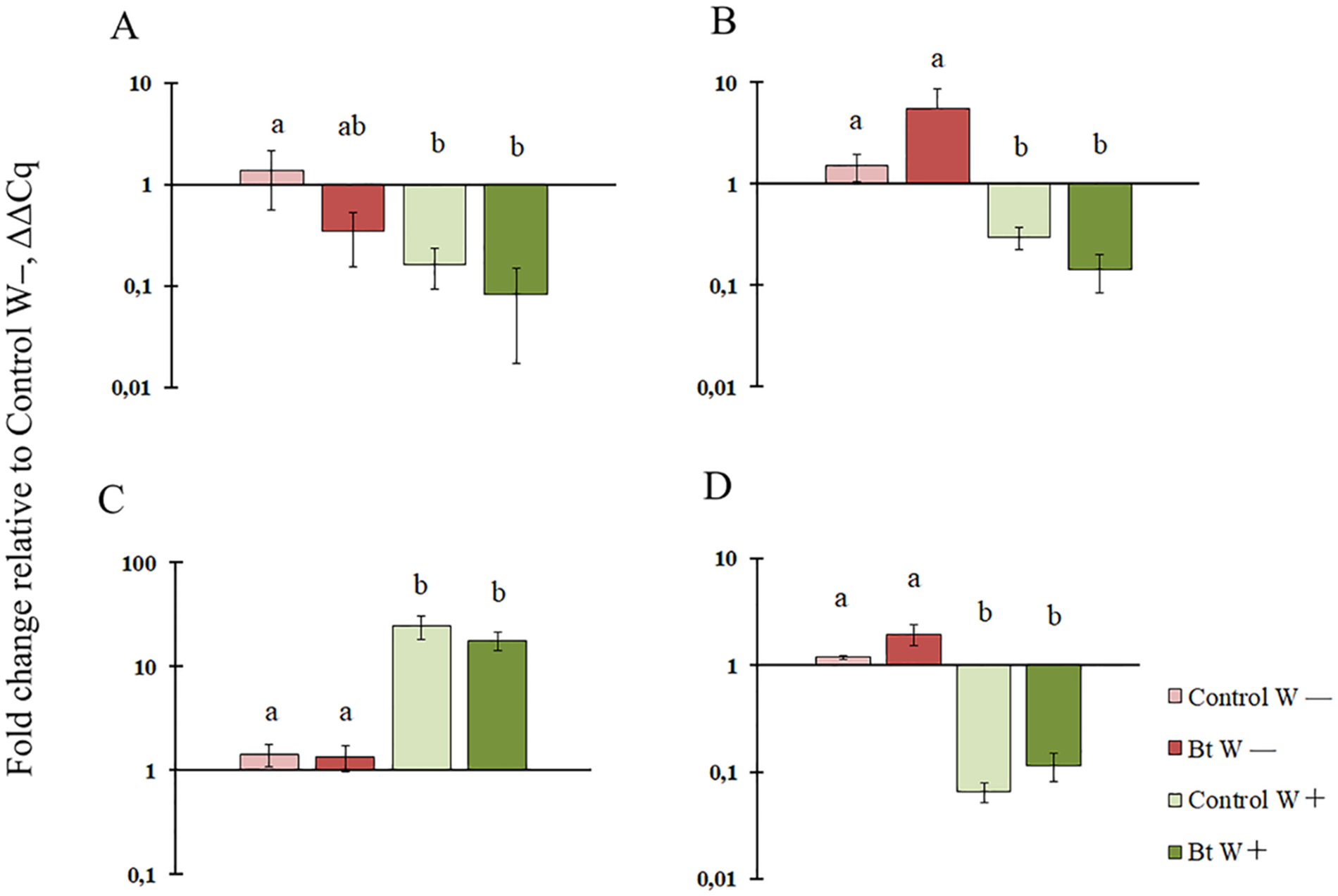
mRNA expression of AMPs, such as defensin-like and nabaecin-like peptides, and of a lysozyme-like protein and Hsp70 was evaluated in larvae of the two parasitoid lines (W+ and W−). qPCR analysis showed that when parasitoid larvae fed on the uninfected host, mRNA expression levels of defensin-like and nabaecin-like AMPs and of heat shock protein Hsp70 were lower in W+ larvae than in uninfected larvae (p = 0.02749, p = 0.03379, p = 0.003289 respectively; Dunn’s post hoc test; Fig. 4A, B, D). Feeding of the larvae on the infected host did not cause significant changes in the mRNA expression levels of these peptides and Hsp70 in either line (p > 0.05 Dunn’s post hoc test; Fig. 4A, B, D). At the same time, the expression of the gene of the lysozyme-like protein was significantly higher in the W+ line than in the W– line, both in control larvae and in larvae reared on the infected host (p = 0.03289, p = 0.003289 respectively; Dunn’s post hoc test; Fig. 4C).
Relative mrna expression of (A) defensin-like (dfs), (B) nabaecin (nbc), (C) lysozyme-like (lys), and (D) hsp70 genes in the two lines of H. hebetor (W+ and W–) reared on the host infected or uninfected with B. thuringiensis var galleriae h5ab (Bt). in the analysis of bt-related changes, gene expression data were normalized to bt-free H. hebetor larvae without Wolbachia. Error bars indicate standard error. Bars with the same letter are not significantly different in gene expression between rearing conditions (Dunn’s post hoc test, p > 0.05). Control W+: larvae from the W+ line that were fed with the uninfected host; Control W–: larvae from the W– line that were fed with the uninfected host; Bt W+: larvae from the W+ line that fed on the host with sublethal Bt bacteriosis; Bt W–: larvae from the W– line that fed on the host with sublethal Bt bacteriosis.

Discussion
Literature data about Wolbachia’s influence on bacterial invasion are currently mixed: numerous studies show increased host resistance to viral, bacterial, and fungal infections (Braquart-Varnier et al., Reference Braquart-Varnier, Altinli, Pigeault, Chevalier, Grève, Bouchon and Sicard2015; Díaz-Nieto et al., Reference Díaz-Nieto, Gil, Lazarte, Perotti and Berón2021; Gupta et al., Reference Gupta, Vasanthakrishnan, Siva-Jothy, Monteith, Brown and Vale2017; Hedges et al., Reference Hedges, Brownlie, O’Neill and Johnson2008; Moreira et al., Reference Moreira, Iturbe-Ormaetxe, Jeffery, Lu, Pyke, Hedges, Rocha, Hall-Mendelin, Day, Riegler, Hugo, Johnson, Kay, McGraw, van den Hurk, Ryan and O’Neill2009; Perlmutter et al., Reference Perlmutter, Atadurdyyeva, Schedl and Unckless2023; Schultz et al., Reference Schultz, Tan, Gray, Isern, Michael, Frydman and Connor2018; Van den Hurk et al., Reference Van den Hurk, Hall-Mendelin, Pyke, Frentiu, McElroy, Day, Higgs and O’Neill2012; Ye et al., Reference Ye, Woolfit, Rancès, O’Neill and McGraw2013), but there is an equally large number of articles indicating the absence of this effect (Bourtzis et al., Reference Bourtzis, Pettigrew and O’Neill2000; Rottschaefer et al., Reference Rottschaefer, Lazzaro and Moreira2012; Wong et al., Reference Wong, Hedges, Brownlie and Johnson2011).
Our findings suggest that the presence of Wolbachia in the parasitoid H. hebetor does not affect the ability of its larvae to resist bacterial and toxigenic loads when feeding on a host with slow bacteriosis. Furthermore, the viability of endosymbiont-infected larvae is not high and less than that of Wolbachia-uninfected larvae. Similar phenomena have been observed in D. simulans infected with entomopathogenic bacteria P. aeruginosa, S. marcescens, or E. carotovora (Wong et al., Reference Wong, Hedges, Brownlie and Johnson2011), and when it is infected with pathogenic intracellular bacteria Listeria monocytogenes or Salmonella typhimurium or the pathogenic bacterium Providencia rettgeri (Rottschaefer et al., Reference Rottschaefer, Lazzaro and Moreira2012). Although viability parameters of our W+ larvae did not differ significantly from those of the W− line, the lysozyme-like activity was higher (Fig. 2), as was mRNA expression of the gene of a lysozyme-like protein (Fig. 4). Lysozymes are small proteins that have N-acetylmuramidase activity, i.e., they cleave the β-1,4-glycosidic linkage between N-acetylmuramic acid and N-acetylglucosamine of a cell wall component of gram-positive bacteria (McKenzie and White, Reference McKenzie and White1991). Moreover, lysozymes are members of lysosomal enzymes (Bang et al., Reference Bang, Sekhon, Ahn, Kim and Min2014) which participate in intracellular protein degradation (Ciechanover, Reference Ciechanover2017). Because Wolbachia has lost the ability to synthesize many amino acids during evolution (Jiménez et al., Reference Jiménez, Gerdtzen, Olivera-Nappa, Salgado and Conca2019; Wu et al., Reference Wu, Sun, Vamathevan, Riegler, Deboy, Brownlie, McGraw, Martin, Esser, Ahmadinejad, Wiegand, Madupu, Beanan, Brinkac, Daugherty, Durkin, Kolonay, Nelson, Mohamoud, Lee, Berry, Young, Utterback, Weidman, Nierman, Paulsen, Nelson, Tettelin, O’Neill and Eisen2004), activation of protein and peptide degradation processes to amino acids is advantageous to this bacterium. Dou et al. have suggested that Wolbachia can obtain amino acids from a host via the lysosomal degradation pathway by activating the synthesis of lysosomal enzymes (Dou et al., Reference Dou, Miao, Xiao and Huang2021). Therefore, we can hypothesize that the high lysozyme-like activity is a ‘nice bonus’ among Wolbachia-modulated changes in host metabolism.
At the same time, we observed that the presence of the endosymbiont insignificantly altered the antibiotic-like activity of W+ larvae against gram-positive (B. subtilis and B. cereus) and gram-negative (E. coli) bacteria. Nonetheless, W+ larvae fed with the native host showed greater activity against gram-positive bacteria as compared to the W− lineage (p ˂ 0.05).
This result may be due to the finding that W+ larvae initially had higher levels of the lysozyme-like activity, which is predominantly directed against gram-positive bacteria. This is probably because the antimicrobial activity was evaluated in whole-body homogenates of parasitoid larvae. Therefore, a higher activity was obtained in the W+ line owing to lysozyme involved in protein degradation. The lack of differences in activity against gram-negative E. coli between the lines, regardless of larval diet, could be due to the fact that the host was infected with a gram-positive bacterium, whereas the host’s gut microbiota, which may have made adjustments for the onset of septicemia, is also predominantly gram-positive (Allonsius et al., Reference Allonsius, Van Beeck, De Boeck, Wittouck and Lebeer2019).
Our examination of the expression of genes of defensin-like and nabaecin-like AMPs and of Hsp70 revealed that these genes were initially expressed at significantly higher levels in W− larvae than in W+ ones. Furthermore, feeding of the parasitoid on the infected host did not induce the expression of these genes. As an intracellular symbiont, Wolbachia will benefit from the regulation of the immune response, including the synthesis of antibacterial peptides. It is known that Wolbachia also forms an additional layer of host endoplasmic reticulum components to avoid immune recognition and thus to colonize host cells more densely (Fattouh et al., Reference Fattouh, Cazevieille and Landmann2019). It seems probable that the partial suppression of the antibacterial protein synthesis system recorded in our work is also intended to enhance survival within the host. For example, underexpression of immune effectors Toll, Imd, and JAK–STAT pathway has been noted in A. tabida, and those researchers have proposed that Wolbachia may employ an active immune evasion strategy (Kremer et al., Reference Kremer, Charif, Henri, Gavory, Wincker, Mavingui and Vavre2012). The absence of innate-immunity gene expression in insect species naturally infected with Wolbachia has been demonstrated in D. simulans, D. melanogaster, and A. albopictus. In these cases, no differences in gene regulation were observed between Wolbachia-infected insects and their uninfected counterparts (Bourtzis et al., Reference Bourtzis, Pettigrew and O’Neill2000; Rancès et al., Reference Rancès, Ye, Woolfit, McGraw and O’Neill2012; Wong et al., Reference Wong, Hedges, Brownlie and Johnson2011).
The expression of Hsp70 was evaluated in our work because it is a nonspecific stress marker. Small heat shock proteins, which include Hsp70, play a major part in mitigation and prevention of protein aggregation under stress conditions such as elevated temperature, oxidation, and infection. They help ensure protein homeostasis (proteostasis) by preventing deleterious effects of the loss of protein function and/or aggregation (Treweek et al., Reference Treweek, Meehan, Ecroyd and Carver2015). Furthermore, heat shock proteins facilitate full activation of AMPs, by giving them the correct conformation in the process of folding and by preventing their aggregation under stress conditions (Treweek et al., Reference Treweek, Meehan, Ecroyd and Carver2015; Wojda et al., Reference Wojda, Cytryńska, Zdybicka-Barabas and Kordaczuk2020). We noticed that a significant decrease in mRNA expression of Hsp70 in W+ larvae correlates with downregulation of AMPs. The relation between the expression of AMPs and of heat shock proteins has been demonstrated in the Drosophila S2 cell line, where underexpression of heat shock proteins, including Hsp70, occurs under the influence of Wolbachia (Xi et al., Reference Xi, Gavotte, Xie and Dobson2008). In addition, in Anopheles gambiae cell culture, the most striking effect observed during Wolbachia infection is general suppression of transcription of heat shock protein genes (Hughes et al., Reference Hughes, Ren, Ramirez, Sakamoto, Bailey, Jedlicka and Rasgon2011). Consequently, we can theorize that mRNA expression of Hsp70 is regulated by Wolbachia in parasitoid larvae and is not altered by bacterial infection.
On the basis of our data, we can say that there is no obvious immunostimulatory effect of Wolbachia in H. hebetor larvae when they feed on a host infected with an entomopathogenic bacterium (Bt). Given the high baseline level of lysozyme-like activity, the lack of the immunostimulatory effect may be explained by its dispensability at low (sublethal) bacterial loads. At the same time, it is known that W+ H. hebetor is characterized by higher fecundity and more viable offspring (Bagheri et al., Reference Bagheri, Talebi, Asgari and Mehrabadi2019). Thus, there is no need to regulate host resistance to low bacterial loads because the number of surviving offspring allows for rapid recovery of population levels. To understand finer features of interactions in the H. hebetor–Wolbachia system, there is certainly a need for investigation into alterations in host immunity at high and/or prolonged pathogen loads.
Supplementary material
The supplementary material for this article can be found at https://doi.org/10.1017/S0007485324000890.
Acknowledgements
The English language was corrected and certified by shevchuk-editing.com.
Author contributions
N.A.K.: conceptualization, formal analysis, writing-original draft, visualization, writing-review and editing, funding acquisition, and project administration; O.V.P.: investigation, methodology, data curation, and writing-original draft; U.N.R.: methodology, investigation, and formal analysis; K.A.Z.: methodology and investigation; E.A.C.: methodology, investigation, and writing-original draft.
Financial support
All experiments were supported by the Russian Science Foundation [grant number 23-24-00259].
Data availability statement
Raw data are available upon request from the corresponding author.
Competing interests
The authors declare no conflict of interest.