The shift in the 1980s and 1990s from a development strategy based on a strong state and a relatively closed economy to one that is market-oriented and open was among the most profound changes in Latin American economic history. Listening to the political rhetoric in the first decade of the 2000s, by contrast, an observer might well conclude that the new strategy has been abandoned. It is hard to find any politicians today who are willing to stand up and support the economic reforms that were behind the change in strategy, and some attack them openly. Of course, Hugo Chávez and Evo Morales are the most vocal opponents, but they are not the only ones.
We wrote a book, published in 2000, which captured the peak of the reform process.Footnote 1 It thus provided a benchmark for the reforms themselves and their impact through the late 1990s. By extending the reform index we used in that earlier work, together with complementary data from national sources, we are in a good position to evaluate what has happened in terms of the reforms during the intervening decade.
Most of the literature on the reforms was produced in the late 1990s and early 2000s. The findings were increasingly negative, focusing on ‘disappointing results’ in terms of economic growth and social indicators and ‘reform fatigue’ among the public. Simultaneously, high-profile academics urged governments to move ‘toward the post-Washington Consensus’, ‘to reform the reforms’ and to proceed ‘beyond neoliberalism’.Footnote 2 In this context, it would not be unreasonable if many of the reforms had been reversed.
In this paper we want to ask if this has indeed happened and, if so, how widespread the reversal has been. We are also interested in the political correlates of any reversal (or lack thereof) in public opinion, as well as political rhetoric. Finally, we want to return to the impact of the reforms to see whether the largely negative evaluation in terms of growth in the early 2000s still holds, or if some more positive results can now be identified.
The first section of the paper reviews the major strands of the literature on reforms published since 2000 and presents our hypotheses. We then provide an updated reform index at the regional and country levels and with respect to particular reform areas, before looking in more detail at reforms and countries where reversal has occurred. In the later parts of the paper we present public opinion data on the reforms and contrast them with political rhetoric, and analyse the impact of the reforms with respect to the high-growth period of 2004–8 and the relatively favourable performance of Latin America during the 2008–9 crisis. The paper concludes with a look towards the future.
Literature Review and Hypotheses
While the pace of economic reforms has slowed to a trickle since 2000, scholars continue to study the reasons why the reforms were carried out in the 1980s and 1990s and the nature of their impact. Our book, published at the beginning of the decade, synthesised the results of a dozen volumes analysing nine countries in Latin America and the Caribbean with respect to the impact of five reforms: trade, domestic finance, capital account opening, taxes and privatisation.Footnote 3 Despite the high expectations of reform proponents, econometric evidence showed a surprisingly small impact at the aggregate regional level: a small positive impact on growth and investment together with a small negative impact on employment and income distribution. We argued that it was necessary to look at the country, sectoral and micro-economic levels to find strong evidence of the reforms’ impact. They fostered investment and modernisation, but at the same time they led to significant differences in performance: high- and low-growth countries, dynamic and lagging sectors, a gap between large and small firms, and a growing differential between the incomes of the well-educated and the rest of the population. These gaps that emerged in the 1990s had the potential to undermine support for the reform process in general, a trend which, indeed, had manifested itself by the end of the decade.
The only large-scale follow-up in the 2000s was a project carried out by the Global Development Network (GDN), which analysed reforms in several developing regions and published a separate volume on Latin America.Footnote 4 The basic message of the GDN project was that poor initial conditions in most countries made it fairly easy to initiate reforms that were expected to resolve outstanding economic and social problems and to help nourish new democracies. By contrast, it proved more difficult to implement the reforms fully and to sustain them. When the results were not as positive as had been promised, reform fatigue set in. The main factor identified as the key to success or failure was institutionalisation, defined as (new) rules of the game that were generally accepted by the population. This, in turn, depended on country-specific conditions in the economic and political realms. Only Chile was seen to have institutionalised the reforms to a significant extent. The policy dilemma arising from the analysis is that institutionalisation is extremely difficult, takes a long time, and is highly context-specific compared to the reform blueprint.
Some of the most interesting analyses were by scholars who had been relatively positive about the reforms in the 1990s, but who became disillusioned in the 2000s. Eduardo Lora of the Inter-American Development Bank (IDB), for instance, had been an important proponent of the reforms, but by the early 2000s he had revised his previous conclusions. Lora and Panizza, to cite another example, argued that the reforms had been uneven and incomplete across countries and reform areas, depending on the quality of institutions. The positive impact on growth had been temporary, and the effects on employment and income distribution uneven. This led to a growing disillusion among the public, especially because of the corruption involved in privatisation.Footnote 5
Likewise, John Williamson, who coined the term ‘Washington Consensus’ (often used as a shorthand expression for the reforms), co-edited a 2003 book which painted a pessimistic picture:
When all is said and done, Latin Americans are entitled to feel disappointed that the past decade did not live up to the hopes that were kindled at the start of the 1990s, when it was widely expected that the reforms would get the region back on a growth path that would allow living standards to start catching up with those in industrial countries.Footnote 6
Although arguing that the reforms could not be held responsible for the problems of the 1990s, the book nonetheless set out a new policy agenda that was an implicit critique of the reforms: the need to protect countries against crises; to complete first-generation reforms (especially labour reform, but also more trade integration and privatisation); to carry out second-generation reforms (strengthening institutions); and to improve income distribution and social services.
The IMF, which had been positive about the reforms previously, also came to see the Latin American situation in a pessimistic light. In 2005, for example, the director of the Western Hemisphere Department and his colleagues stated:
Reforms were uneven and incomplete. More progress was made with measures that had low up-front costs, such as privatization, relative to reforms that promised greater long-term benefits such as improving macroeconomic and labor market institutions, and strengthening legal and judicial systems. Insufficient emphasis was placed on ensuring that the benefits were broadly shared, thus jeopardizing popular support for them.Footnote 7
The World Bank also reconsidered its approach to reforms. In the case of Latin America it concluded that the financial crises had caused great damage and that, in general, ‘growth payoffs had been smaller than expected’.Footnote 8 The basic lesson that the World Bank took from the 1990s was the need for diverse ways to achieve growth and other goals, given the differences in institutional strengths and weaknesses across countries. The UN Economic Commission for Latin America and the Caribbean (ECLAC), by contrast, was always more sceptical about the reforms. As early as 1998, ECLAC's then-executive secretary wrote of the need to move ‘beyond the Washington Consensus’ to a second generation of reforms. He pointed to the need for a broader view of macro-economic stability, policy interventions in the productive sector, and a central role for social policies.Footnote 9
Given this pessimism, it would seem reasonable for governments to reverse the reforms that have disappointed them. William Gruben and Richard Aim, however, use data from the Fraser Institute and the World Bank to argue that this has not happened, except in a few selected countries such as Argentina and Venezuela.Footnote 10 Others have made similar claims in the context of studying Latin America's supposed ‘left turn’.Footnote 11 Likewise, Robert Kaufman reports that leftist rhetoric has not been accompanied by populist macro-economic policies.Footnote 12 This apparent combination of pessimism about outcomes and the continuity or preservation of the reforms is a puzzle.
Another strand of the recent literature has focused on the politics of reform. In addition to a number of country case studies, econometric analyses have examined the political causes of reform.Footnote 13 In a typical methodological approach, Glen Biglaiser and David Brown used reform indices as dependent variables with political variables and various economic controls as an explanatory framework. The former included party fragmentation, polarisation, strength of the presidency, divisions in government, democracy, the honeymoon period, executive ideology and external factors. In general, the political variables were not very important; only a few cases of statistical significance were found. Rather, inflation was the strongest explanatory factor. The authors concluded that politics is not a constraint for implementing reforms.Footnote 14
Sarah Brooks and Marcus Kurtz looked at two types of reforms, trade and capital account opening, and argued that looking at reforms in general is inappropriate since they found different (political) explanations for the two reform types. With respect to trade liberalisation, they reported that executive ideology was less important than political fragmentation in the legislature; the opposite was true for capital account liberalisation.Footnote 15 Similarly, Beatriz Magaloni and Vidal Romero compared trade and privatisation in the context of analysing the role of partisan cleavages in shaping public opinion about reforms. They found that left-wing parties generally opposed state retrenchment while favouring free trade. Low-skilled workers opposed both. Beyond immediate preferences, the history of strong states with strong labour unions tended to produce a legacy that opposed both free trade and privatisation.Footnote 16 Peter Kingstone and Joseph Young analysed earlier versions of the same five reform indices that we use in this paper. While they found some differences across reforms, these were not particularly important. Their main finding was that a president's ideology is not relevant for explaining reform policy, while the presence of an IMF programme is significant.Footnote 17
From this literature of the past decade, six main findings can be identified. First, reform fatigue has set in, as seen through negative public opinion polls and anti-reform rhetoric from politicians and governments. Second, reform fatigue is attributed to the volatile characteristics of economic growth and uneven results, especially in the social realm. Third, despite disappointing results and reform fatigue, there appears to have been little backsliding on the reforms or on macro-economic policies. Fourth, much of the recent literature has turned from economic analysis of the reforms’ impact to political analysis of why reforms were or were not carried out. Very different results have been reported by different authors; different variables have also been used. No consensus has emerged as to whether political factors were a serious constraint on reforms. Fifth, there is a call to disaggregate the concept of reforms rather than speak in general terms, since different explanations have been found for different reforms. Sixth, institutionalisation, defined as new rules of the game that are widely accepted as legitimate by the population, is needed to make reforms successful. Although it is unclear how to bring about institutionalisation, there is some agreement that it must be done on a case-by-case basis.
Within the context of this literature, our contributions in this paper are of two types. On the one hand, we provide new data on reforms with a specific focus on the 2000–9 decade. Most of the existing literature used earlier data. We extend our widely used reform index to confirm findings that no generalised reform reversion has occurred. We also provide detailed information on the main area of reversion, privatisation, together with a discussion of more modest changes in the financial and industrial policy areas. In addition, we examine the relationship between government discourse on reforms and public opinion in the period between 2000 and 2009. On the other hand, we reinterpret the literature on the negative impact of the reforms. By focusing on the 2004–8 boom and 2008–9 recession, we find support for the proposition that the reforms made a positive contribution.
Our analysis is carried out in the format of testing four hypotheses:
1. The reforms may have stopped, but there has been little backsliding toward the status quo ante. We expect this result to hold for the reforms in general, for the majority of individual countries, and with respect to most reform areas.
2. Some reversal has occurred in selected countries, but this has focused mainly on privatisation. At the opposite extreme, trade reform remains in place almost everywhere.
3. Public opinion with respect to reforms is negative, mainly about privatisation. Negative public opinion is correlated with anti-reform rhetoric by politicians, although there is substantial heterogeneity among governments in the region on the subject of reforms.
4. The outcomes of the reforms and associated macro-economic policies, even if disappointing in many ways, helped to pave the way for high growth in 2004–8 and to shield Latin America from the worst effects of the recent international crisis.
Reform Continuity
We define reforms in this paper as the five sets of structural changes in our original project: import liberalisation, domestic financial liberalisation, capital account opening, privatisation and tax reform. These changes, in turn, had an impact on economic and social outcomes, but the outcomes depended on other factors as well, both internal and external to the respective economies. In the next three sections of the paper we concentrate on the reforms as dependent variables; we then look at economic outcomes, where the reforms were one of several explanatory factors.
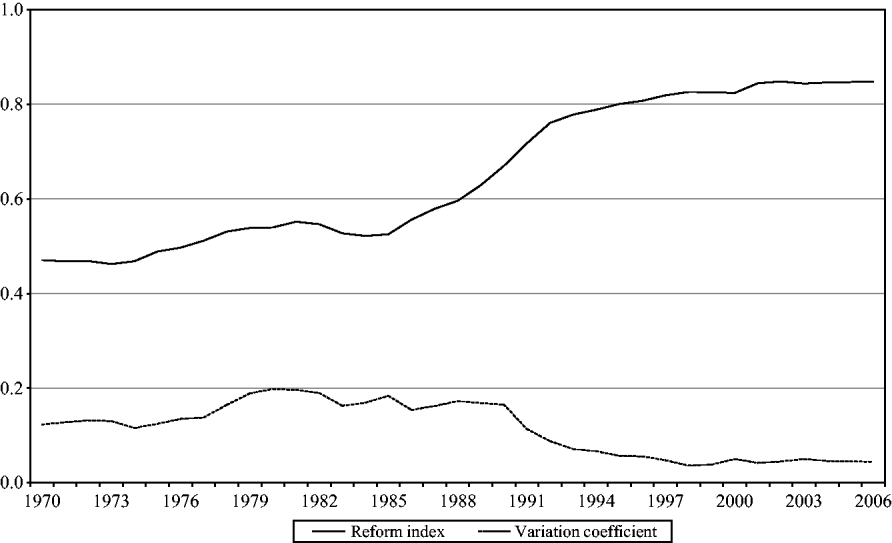
We extend the reform indices, both in terms of time span and number of countries included. This provides a longer view of the process towards market-oriented economies for 17 Latin American and Caribbean countries from 1970 to 2006.Footnote 18 Inspection of Figure 1 shows that after a decade of intensive reforms in the 1990s, the process peaked around 2000. From then on, a very stable situation prevailed. The general index (an average of the five reform indices) does not show any reversal of the process. Moreover, there is an important reduction in the coefficient of variation of this index for the group of 17 countries under consideration, which suggests increasing homogeneity regarding the reform process.Footnote 19
Figure 1.General Reform Index for 17 Latin American Countries, 1970–2006
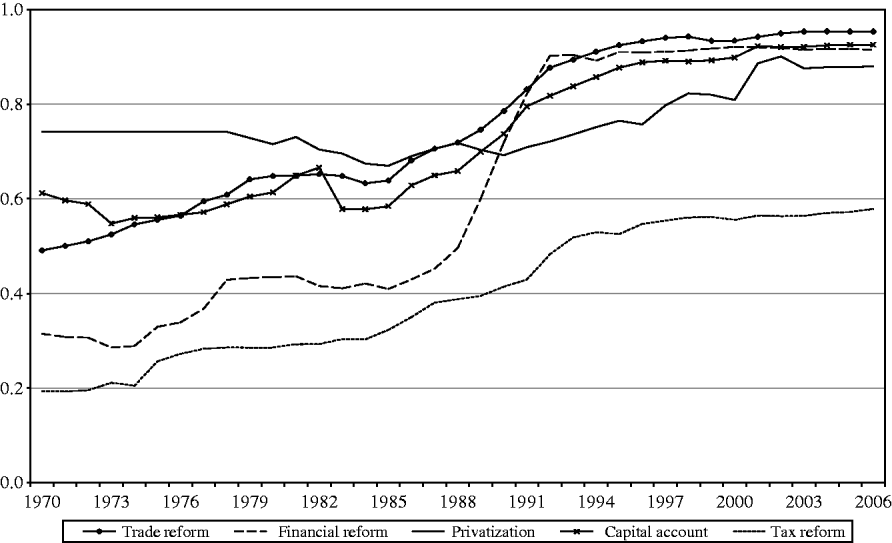
Source: authors’ calculations based on Samuel Morley, Roberto Machado and Stefano Pettinato, ‘Indexes of Structural Reform in Latin America’, ECLAC Working Paper, Serie Reformas Económicas, no. 12 (Santiago: ECLAC, 1999), and unpublished data. At the level of specific reforms, Figure 2 shows that the indices for three of them (trade liberalisation, domestic financial liberalisation and capital account opening) peaked in the mid-1990s and, from that point, continued with very high values. Privatisation increased until around 2000 and then fell slightly, though it also remained at a high level. Tax reform lagged behind and never played as important a role as other reforms. Except for the small decline in the privatisation index between 2003 and 2006, we found no evidence of a reversal of reforms in the region. Nonetheless, as will be discussed below, some of the most significant cases of turnarounds in privatisation took place after 2006.
Figure 2.Reform Indices by Type of Reform for 17 Latin American Countries, 1970–2006
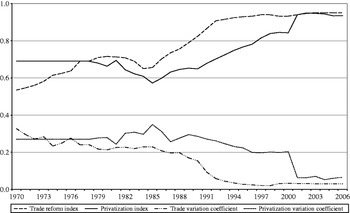
Source: authors’ calculations based on Morley, Machado and Pettinato, ‘Indexes of Structural Reform in Latin America’, and unpublished data. We showed in our earlier work that two reforms had significant impacts on investment and economic growth in the post-reform period of the late 1990s: trade liberalisation and privatisation.Footnote 20 In Figure 3, we illustrate the convergence of the nine countries included in our book regarding both areas.Footnote 21 Not only did the trade liberalisation index attain, and maintain, a very high level, but the coefficient of variation among countries became so small that we can assert that there is a single trade pattern in the region: trade openness.Footnote 22 This result holds despite the different approaches to bilateral or multilateral free-trade agreements prevailing in the region. With a few years’ time lag, the privatisation index followed the path of trade reform, at least until 2006, and also showed a remarkable convergence among countries.
Figure 3.Trade Reform and Privatisation Indices for Nine Latin American Countries, 1970–2006
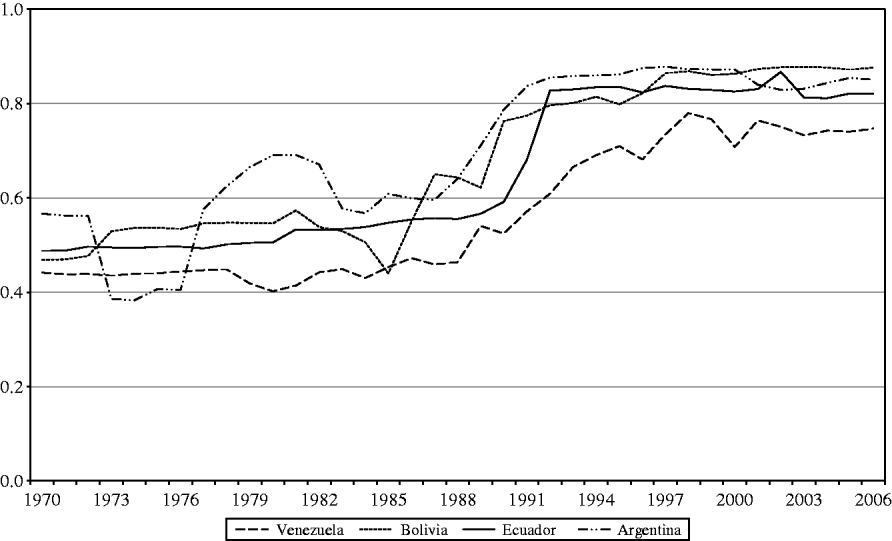
Source: authors’ calculations based on Morley, Machado and Pettinato, ‘Indexes of Structural Reform in Latin America’, and unpublished data. These data contrast with the widespread perception, within and outside the region, that many Latin American countries are following new, anti-market development models. In particular, this opinion exists with respect to Bolivia, Ecuador and Venezuela, in terms of their general development models, and Argentina, with regard to its macro-economic and foreign debt policies. The important question is how far these countries have diverged from the reform model prevalent in the region. The general reform indices for these four countries do not show a significant reversal, much less a sharp U-turn (see Figure 4). The reforms reached their maximum around 2000, albeit at a much lower level in Venezuela, and from then on stabilised or showed a small decrease until 2006.
Figure 4.General Reform Index for Argentina, Bolivia, Ecuador and Venezuela, 1970–2006
Source: authors’ calculations based on Morley, Machado and Pettinato, ‘Indexes of Structural Reform in Latin America’, and unpublished data. The explanation for reform continuity is multifaceted. One aspect is institutional, where institutions, as mentioned earlier, are defined as generalised public acceptance of new rules of the game. In the trade area, the main enforcer of the rules is the World Trade Organization (WTO). All Latin American countries are members, and many have signed bilateral or plurilateral preferential trade agreements (PTAs) that reinforce or sometimes extend limits on the variation in tariffs and other trade policies. PTAs with the United States and European Union, in particular, have limited the possibilities of reversing reforms. Indeed, in some cases, such as the Salinas government in Mexico, international treaties were seen as a tool to ‘lock in’ reforms.Footnote 23 With respect to finance, membership of the IMF has a similar impact in placing limits on government action, as do the roles of the international credit-rating agencies and some of the PTAs. In the case of finance, an important feedback loop was created when central banks became independent; these institutions, in turn, argued in favour of the financial reforms. Despite several attempts, no international organisation or treaty exists in the area of foreign investment, although bilateral agreements bind some Latin American countries.Footnote 24
Equally relevant is the timing of the impact of the various reforms. Much of the cost of lowering tariff barriers was paid at the beginning of the process, as non-competitive firms went out of business and thus limited later pressure for reversal. Moreover, non-tariff barriers can relieve special competitiveness problems to some extent, as can informal arrangements between countries.
In the areas of domestic and international finance, as will be discussed in the next section, some adjustments have been deemed necessary to complement the reforms, but they have not undermined the spirit of market-determined interest rates and international financial integration. Another factor that limits demands for reversal of financial reforms is that finance has typically been considered a technical subject, best left to ‘experts’, instead of becoming part of public ideological discussion.
Privatisation is different. Rather than being an impersonal macro-level process, it usually involves a limited number of highly visible firms, and the new owners have often been foreigners. Whether the new owners were foreign or national, accusations of corruption have frequently been heard. Once privatisation occurred, the new owners typically improved services, but they also raised prices to the point of making the services too costly for a substantial part of the population. This pattern has been especially evident with respect to water, but it has also affected other public utilities. In the area of natural resources, issues of national sovereignty are clearly relevant. The combination lends itself to political manipulation by politicians, especially those operating outside the traditional party systems and in need of ways to gain support.
Reform Reversals and Complementarities
Continuity is not the whole story. Nationalisations are the most obvious example of change in the direction of the reforms, as Luigi Manzetti has stressed.Footnote 25 In addition, however, there have been more subtle changes that were meant to complement, rather than reverse, the reforms. The most important ones involved regulation of the financial sector and some limits on capital account opening. Different kinds of industrial policies have also been introduced in some countries with the aim of stimulating economic growth. These may be considered complementary to the reforms or antagonistic, depending on individual cases.
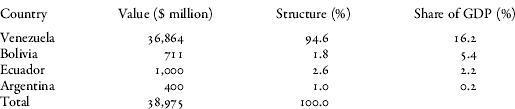
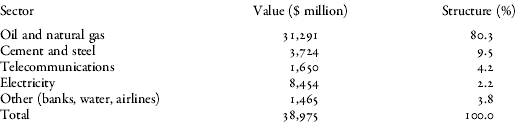
Evaluating the magnitude of nationalisations (as well as privatisations) is particularly difficult. The usual indicators, the share of state-owned enterprises in GDP or the amount paid for nationalised firms, depend on relative prices, unpublished data or operations that never materialised under the terms announced. Moreover, some nationalisations imply actions whose economic value is complicated to evaluate – for example, changing participant control of a joint venture, or transferring the management, but not the ownership, of financial assets to the state. Because of these constraints, we carried out a detailed study of nationalisations in the relevant Latin American countries for the period from 2006. Tables 1 and 2 summarise our findings.
Table 1.Nationalisations in Latin America by Country, 2006–09
Table 2.Nationalisations in Latin America by Sector, 2006–09
In total, nationalisations reached some US$ 39 billion between 2006 and 2009. This amount is about one-fifth of the proceeds from privatisations in Latin America in the 1990s, which totalled US$ 178 billion, according to Alberto Chong and Florencio López-de-Silanes.Footnote 26 One set of operations accounts for the bulk of this total: the nationalisation of the heavy-oil fields in the Orinoco Belt of Venezuela. On 1 May 2007, following a long negotiation process, the Venezuelan government seized control of assets from Total (France), Statoil-Sincor (Norway), BP (British Petroleum), Chevron Texaco, Conoco-Phillips and Exxon Mobil (United States). The main projects, valued at about US$ 30 billion, were transformed into joint ventures with a minimum 60 per cent stake in the hands of the state-owned Petróleos de Venezuela (PDVSA).
The nationalisation of oil or natural gas fields was also significant in Bolivia and Ecuador, where assets were seized from Shell, BP, Repsol-YPF (Spain) and Occidental Petroleum (United States). In addition, the Bolivian government reached an agreement with the Brazilian oil giant Petrobras, which meant that the former increased its share of revenues from natural gas production from 50 to 82 per cent. Thus oil and natural gas explain over 80 per cent of total nationalisations in the region after 2006.
Other significant nationalisations took place in Venezuela, mainly in cement and steel production and in banking, where the firms taken over by the state were previously owned by corporations based in Mexico (CEMEX), Argentina (Techint) or Spain (Banco Santander). In other service sectors, telecommunications companies were nationalised in Bolivia (ENTEL, previously owned by Telecom Italia) and in Venezuela (CANTV, a former Verizon company), while the government took over the operations of two water distribution and sewage treatment utilities in Argentina and Bolivia: Aguas Argentinas from Suez and Aguas del Illimani from Lyonnaise des Eaux, both of which are French companies.
In Argentina the largest nationalisation was the reversal of the privatisation of two airlines, Aerolíneas Argentinas and Austral, from a Spanish group, Marsans. But the best-known operation involved transferring management of the Argentine pension funds from private firms (Administradoras de Fondos de Jubilaciones y Pensiones, AFJPs) to the government. In itself, however, this does not constitute nationalisation, since the state did not obtain ownership of the assets involved.
In summary, some important nationalisation processes went on in Latin America between 2006 and 2009; the largest operations took place in Venezuela and, to a lesser degree, Bolivia. In Ecuador and Argentina, they played a minor role. For other countries in the region, we were not able to identify any significant reversal of privatisation. It is important to note that almost all nationalised companies were producers of natural resources, natural resource-based goods or public utilities. These are sectors that were successively nationalised, privatised and renationalised in many Latin American countries over the course of the last century. The most significant change was the widespread nationalisation in Venezuela, where, besides the large operations, many smaller ones after 2009 suggest that nationalisations will continue and further increase the state's share of the economy.Footnote 27 Albeit at a slower pace, Bolivia may be following a similar road.Footnote 28
Financial regulation and limits on capital account opening were more subtle changes than nationalisation; they involved modification of domestic and international financial liberalisation respectively. The indicators that made up our index of domestic financial liberalisation were whether deposit and lending rates were controlled by the government and the size of the required reserves-to-deposits ratio. Together with directed credit, control of interest rates and lending amounts were the main ways through which governments exercised influence over banks in the pre-reform period.
After liberalisation took place, so-called prudential regulation came to the forefront, especially after several Latin American countries suffered severe banking crises. Prudential regulation aimed to insure that banks operated in a safe way so as not to endanger the rest of the economy. The main measures included adequate provisions to cover expected loan losses and sufficient capital to cover more general risks. In some cases regulations also involved greater transparency, detailed requirements for setting up banks and limits on the activities in which banks could engage. Supervision involved the ability to enforce these regulations.Footnote 29
In the period after the Mexican crisis in 1995, Latin American governments required banks to lower the level of non-performing loans (NPLs) substantially, and strengthened regulation. Between 2000 and 2008 NPLs fell from 8.5 to 2.6 per cent of all loans, while provisions as a share of NPLs rose from 94 to 155 per cent and capital-to-asset ratios rose from 13 to 15 per cent, well above the international standard of 8 per cent.Footnote 30 These measures are considered to have helped to protect Latin America from banking crises during the recent recession.Footnote 31
The degree of capital account opening is more controversial than bank regulation in Latin America, especially with regard to the control of capital inflows, which was one of our indicators of international financial liberalisation. In the early 1990s Brazil put a tax on financial inflows, while Chile and Colombia instituted unremunerated reserve requirements for certain capital inflows. All of these were eliminated when capital inflows slowed later in the decade. Proponents cited two reasons for these policies: to limit exchange rate appreciation and to avoid large inflows of ‘hot money’ that could swamp local banking systems. In the first decade of the 2000s Argentina, Brazil, Colombia and Peru experimented with similar policies. Colombia and Peru maintained their policies only briefly, but Argentina's have been in place since June 2005 and Brazil's since October 2009.Footnote 32 While there is debate on their degree of success, the IMF recently changed its long-standing position and endorsed controls under certain conditions.Footnote 33
Another significant and also subtle change in the last decade is the more active role that states are playing in the promotion of economic development. This involves horizontal policies aimed at the correction of market failures in factor markets, such as those for technology or skilled labour, but also, though less frequently, policies at the vertical or industry level. Horizontal policies are consistent with the reform model, but vertical policies, because of their sectoral approach, imply a departure from the model. Whereas some countries reject these policies, despite providing ad hoc sectoral support in practice, others see a value in targeted policies aimed at increasing the competitiveness of activities with strong growth and technological or export potential.Footnote 34
The return of industrial policies to Latin America was a slow process.Footnote 35 In the early 1990s Mexico launched competitiveness programmes aimed at sectors with comparative advantages, while the Andean countries, led by Colombia, resumed sectoral promotion under the name of cluster development or competitiveness policies, an approach that was also followed by some Central American and Caribbean countries before the end of the decade. After the 2001 crisis Argentina selected production chains to be supported, while other countries, such as Costa Rica, Peru and Uruguay, targeted development actions in even greater detail, supporting individual projects in specific firms. Beyond these specific cases, the comeback of sectoral policies is best exemplified by Brazil, where the government launched an industrial policy with a strong sectoral focus in May 2008.Footnote 36 Beyond horizontal, basically fiscal measures and six strategic technological programmes, this policy included seven programmes targeted at leading sectors and 12 industrial competitiveness programmes.
Although Brazil's experience is unique in the region in terms of the scope and intensity of its industrial policy, in many other countries there is growing acceptance of policies aimed at changing the production structure in the direction of more complex and technology-intensive industries. Despite failures in their implementation, these policies represent a significant departure from the dictum of the heyday of the reforms: ‘The best industrial policy is no industrial policy.’
Reforms, Political Rhetoric and Public Opinion
In the previous sections we provided new data to confirm claims that reversal of the reforms has been limited to a few countries and centred mostly on privatisation. How can this fact be squared with reform fatigue on the part of the public and lack of support (or outright hostility) on the part of governments? We approach this important question in two steps. First, we create a typology of government positions, and then we take a new look at public opinion during the 2000s.
There has been a good deal of journalistic and academic discussion about a ‘left turn’ in Latin America after 2000.Footnote 37 This implies, among other things, a lack of support for a private-sector-based, open, economic model as created by the reforms in the 1980s and 1990s. Even if this left turn exists, however, governments’ positions are not homogeneous. The best-known attempt to categorise this phenomenon was Castañeda's ‘good Left’ and ‘bad Left’, but there have been a number of critiques of this article as over-simplistic and ideological.Footnote 38 For our purposes, we expand the dichotomy to a three-part typology that is specifically focused on the reforms, and provide examples from a variety of countries in the region as of 2009.
Conservative: Colombia, El Salvador, Guatemala, Mexico. These governments do not have an anti-reform discourse, but they have not gone out of their way to defend the reforms. There have been some attempts to extend the reforms – for example, in Mexico with respect to foreign investment in the petroleum and electricity sectors, and labour market flexibilisation – but they have generally been unsuccessful. Conservative macro-economic policies have been followed.
Centre: Brazil, Chile, Costa Rica, Peru, Uruguay. These governments have implicitly or (sometimes) explicitly criticised the reforms in terms of their impact on poverty, income distribution and the need for the state to recover some of the powers that it had ceded to the private sector. They have followed up with policies to move on these issues, with greater or lesser success. Reducing poverty has proved easier than reducing inequality. Greater state power has been exerted in terms of regulation, especially of the financial sector and some utilities; also, policies have been proposed to increase productivity and employment. Again, conservative macro-economic policies have been followed.
Left: Argentina, Bolivia, Ecuador, Venezuela. These are the governments that have received the most attention for their alleged left turn. They openly and frequently criticise the reforms as part of a general political stance. Venezuela has taken the lead in nationalising a number of private sector firms. While greatly expanding public sector expenditure, it has not run huge deficits because of access to petroleum revenues. Venezuela has also provided support of various kinds to other countries in this group. The most anti-reform of the other countries has been Bolivia. Despite the rhetoric, however, reforms such as trade and financial liberalisation have not been reversed in these countries, and macro-economic policies have been conservative.
Turning from government stance to public opinion about reforms, the literature published since 2000 has generally portrayed a negative view. Indeed, the main thrust has been to explain why the public has turned against reforms, especially privatisation. In the most exhaustive analysis in the first half of the decade, Ugo Panizza and Mónica Yañez stated: ‘The main objective of this paper is to use public opinion polls to document Latin Americans’ increasing discontent with those reforms and to explore possible explanations for this trend.’Footnote 39 They studied and rejected three hypotheses that might explain increasing opposition to reforms: increased leftist orientation of the population in general, increased activity by those who opposed reforms, and a decline in trust in political institutions. The only statistically significant results they found were related to the state of the economy. Thus economic problems, especially low growth and increased unemployment, lowered support for reforms.
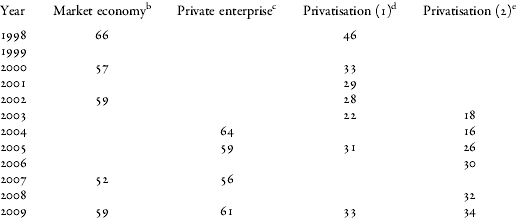
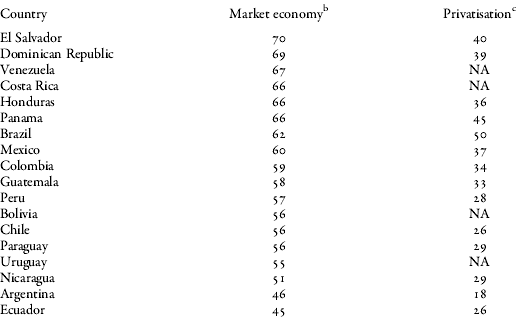
Seen from the end of the decade, by contrast, the situation looks quite different. Support for a market-led economy is substantial, and has remained at the same level since 2000, or actually increased. Even for privatisation, long the reform that sustained the highest level of criticism, support has risen. Table 3 shows the trends for four questions included in the Latinobarómetro poll, which is the source for most of the comparative analysis of public opinion across countries in Latin America.
Table 3.Public Opinion with Respect to Economic Reforms in Latin America, 1998–2009a
The Latinobarómetro surveys have been carried out since the mid-1990s with a sample of approximately 1,000 in each of 18 countries. The questions vary from year to year, so it is not possible to obtain an annual series for most questions. Also, as others have remarked in the past, a serious problem exists in finding questions that adequately reflect the reforms of interest, or such questions were only asked once in the early years of the survey. Of greatest concern is the lack of a continuous question that measures opinion about trade liberalisation. Two quite different questions sought opinion on trade, but they were asked only in 1996 and 2003. Likewise, a question about foreign investment was asked only in 1998 and 2001.Footnote 40 Only with respect to privatisation were adequate questions asked over a number of years. In addition, there were questions about the benefits of a market economy and private enterprise which provide a broad view of opinion about individual reforms. In the absence of adequate data that reflect our definition of reforms beyond privatisation, we fall back on these more general questions.
Returning to Table 3, it is clear that opinion about the market economy in general and privatisation in particular was much more favourable in the late 1990s than in the following decade. Measured within the 2000s, however, the trend is different. With respect to whether a market economy is best for the country, the 2009 figure (59 per cent in agreement) is higher than that for the beginning of the decade. Likewise, opinion about whether private enterprise is essential for development, after having fallen from 2004 to 2007, rose substantially in 2009 (to 61 per cent). More surprisingly, the percentage of interviewees saying that privatisation has been good for the country, after having dipped between 2000 and 2003, then increased to the same level as 2000 (33 per cent). A related question about satisfaction with services provided by privatised utilities showed an even more dramatic rise. After falling to only 16 per cent satisfied in 2004, the share more than doubled to 34 per cent by 2009. Thus, by the end of the 2000s, a solid majority thought that a market economy is best for the country and that the private enterprise system is crucial for development. At the same time, only a third of respondents were happy with the privatisations.
As would be expected, significant differences exist across countries with respect to those in favour of a market economy or private enterprise in general, as well as privatisations in particular. Table 4 shows the variation on the market economy and the general privatisation questions for 2009. With respect to the market economy, where the regional average was 59 per cent, the countries with the most favourable opinion were El Salvador and the Dominican Republic at 70 and 69 per cent favourable, while the lowest were Ecuador and Argentina with only 45 and 46 per cent favourable respectively. On privatisations there were data for only 14 countries in 2009; the Latin American average was 33 per cent. Brazilians were the most satisfied at 50 per cent, while Argentines were the least satisfied at only 18 per cent.Footnote 41 In 2009 Bolivians and Venezuelans were asked about their opinion on nationalisations for the first time. Here, again, the differences were important. Some 62 per cent of Bolivians were favourable, but only 42 per cent of Venezuelans expressed a positive opinion.Footnote 42
Table 4.Public Opinion with Respect to Economic Reforms by Country, 2009a
While there is a fair amount of overlap between government position and public opinion, the correlation is far from perfect. Citizens of Argentina and Ecuador, whose governments were among those taking the most anti-reform positions, were also those whose opinions were most negative. Bolivia was also in the bottom part of the scale, and a substantial majority approved of the nationalisations in that country. The Venezuelan public, in sharp contrast, was one of the most pro-market in the region, with only 42 per cent approving of the nationalisations. This apparent gap between citizen opinion and government policy in Venezuela suggests that the government has not been able to legitimise its position and so clashes are likely to continue there. Countries whose government positions we labelled conservative were generally located in the top half of Table 4 (more favourable to reforms). This held especially for the Central American cases; Colombia and Mexico were near the middle of the spectrum. Those we called centrist were found on both sides of the regional average. Brazilian opinion was surprisingly positive to reforms, while Chilean opinion was not as positive as might have been expected.
We are interested in public opinion as an independent variable, but knowing why support for reforms has increased recently is useful for considering the relationship between public opinion and the future of reforms. The data for the 2000s partially fit the Panizza/Yañez hypothesis, which says that reforms are more popular when the economy is doing well. This is especially true with privatisation, where the low point was at the end of the 1999–2003 recession. For the market economy/private enterprise question, however, the low point was well within the 2004–8 high-growth period. In neither case was there a drop in support during the recent recession.
An alternative framework is offered by Andy Baker, who argues that Latin America has become a consumer society rather than one whose politics are based on production relations. According to this approach, support exists for trade reform because it provides lower-cost goods and greater choice. Likewise, privatisation is frequently unpopular because of higher prices and poor service, rather than because of job losses or for general ideological reasons. Broadly speaking, the idea is that the region has become more pragmatic and less ideological. If the reforms ‘work’, they will be supported. If not, they will not be.Footnote 43
The Baker hypothesis appears to fit the Latinobarómetro data for the 2000s better than the Panizza/Yañez hypothesis. The former would imply a long-term trend toward support for reforms that provide goods and services desired by consumers, while the latter would predict a cyclical pattern based on the state of the economy. In either case, when considered in conjunction with the failure to find evidence of political constraints on reforms, the conclusion would seem to be that governments wanting to maintain the reforms or even pursue additional ones can do so. The question is whether they should want to. Are the reforms ‘working’ at the macro level?
The Impact of Reforms: A New Look
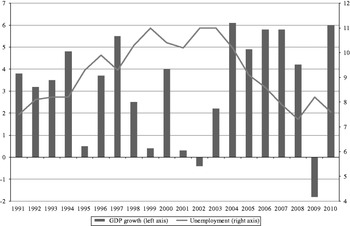
The end of the 2000s provides a useful vantage point from which to re-examine the impact the reforms have had on Latin America's economic performance. The main criticisms of their ‘disappointing’ results were made during the late 1990s and early 2000s. As seen in Figure 5, this was a period of low growth and high unemployment; GDP growth averaged only 1.3 per cent between 1999 and 2003, while unemployment averaged 10.7 per cent. Not surprisingly, the period was also characterised by increased levels of poverty. It was followed by five years (2004–8) of much stronger performance, when GDP growth averaged 5.3 per cent while unemployment fell to an average of 8.7 per cent, and a year (2009) in which Latin America faced serious problems but fared better than the main industrial economies.Footnote 44 We are particularly interested in whether there is any evidence that the reforms made a positive contribution to either of the latter sub-periods.
Figure 5.GDP Growth and Unemployment Rates, 1991–2010
Sources: CEPALSTAT database for growth rates and for unemployment rates 1991–2005; ECLAC,Preliminary Overview of the Economies of Latin America and the Caribbean 2010 (Santiago: ECLAC, 2010) for unemployment 2006–10; data for 2010 are preliminary. The 2004–8 years saw the most sustained growth in Latin America since the 1960s. It brought down unemployment and poverty across the region, although some countries, of course, fared better than others. The explanation for this successful half-decade is multifaceted. It involved improved domestic macro-economic policies as well as a favourable external trade and financial environment. During the latter half of the 1990s and the early 2000s Latin American countries saw sharp drops in the inflation rate due, in part, to prudent fiscal and monetary policy and greater exchange rate flexibility. The greater stability, in turn, led to increased investment, which promoted growth.Footnote 45 At the same time, a consensus has emerged on the centrality of a positive terms-of-trade shock as an explanatory factor. Export prices, especially for commodities, rose as demand in China accelerated. The value of Latin American exports thus expanded and, as a consequence, growth increased. China's new importance can be seen in the evolution of trade statistics. Latin American exports to China increased seven-fold between 2000 and 2008, and China became the largest export market for Brazil and Chile, the second-largest for Argentina, Costa Rica and Peru, and among the top four markets for Colombia, Panama and Venezuela.Footnote 46
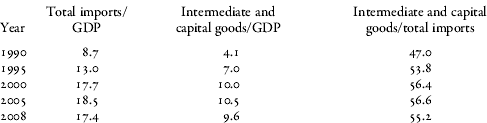
Our argument is that, in addition to the ‘China factor’ and better macro-economic management, the reforms of the previous decades also helped to foment the high-growth period. Two main channels were important. First, trade liberalisation lowered tariffs on all kinds of goods. In a recent article, Antoni Estevadeordal and Alan Taylor argue that the most relevant tariffs for promoting investment and growth are those on intermediate and capital goods. They provide data showing that Latin American countries lowered both average tariffs and tariffs on intermediate and capital goods in the period between the mid-1980s and the mid-2000s.Footnote 47Table 5 offers complementary information about the types of imports that came into the region between 1990 and 2008. It indicates that intermediate and capital goods increased from 4 to 10 per cent of GDP between 1990 and 2008 and from 47 to 55 per cent of total imports during the same period.Footnote 48
Table 5.Import Statistics for Latin America, 1990–2008 (%)
This increase suggests a positive impulse for investment, which would help to expand the production of all goods, including exports. Our analysis of the 1990s showed that two reforms, trade liberalisation and privatisation, helped to spur investment in plant and equipment.Footnote 49 Trade liberalisation lowered prices on investment goods, consistent with the analysis of Estevadeordal and Taylor. At the same time, privatisation, the vast majority of which involved foreign direct investment, provided increased capital and access to technology and foreign markets.Footnote 50
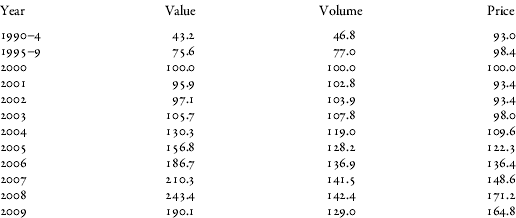
A second channel involves Latin American countries’ ability to respond to higher export prices in the 2004–8 period with greater supply. As seen in Table 6, higher prices were the main source of increased export value in those years (accounting for about 70 per cent of the total), but volume also rose (about 30 per cent). Since export value increased by US$ 425 billion in the five-year period, this implies a rise in volume equivalent to US$ 128 billion, or a little over US$ 25 billion per year (compared to only US$ 11 billion per year between 1990 and 2003). An examination of production levels for individual commodities between 2000 and 2008 also shows large supply increases in most cases. Thus the physical volume of production increased substantially for natural gas, copper, silver, iron ore, soy and beef.Footnote 51
Table 6.Export Statistics for Latin America, 1990–2009 (2000=100)
This supply response was not automatic and, indeed, it varied from country to country and from product to product. On a country basis, the biggest difference was between the South American commodity exporters and Mexico and the Central American countries, which rely more on industrial exports. The weighted average of increased supply between 2004 and 2008 in the two subregions was 70 per cent for the former versus 29 per cent for the latter.Footnote 52 Even among commodity exporters, however, there were differences based on political as well as economic factors. The petroleum industry illustrates these differences in a particularly interesting way in a comparison between Brazil, Mexico and Venezuela.
While the volume of petroleum produced in Brazil (measured in millions of cubic metres) increased by 43 per cent between 2000 and 2008, the volume actually fell by small amounts in Mexico and Venezuela.Footnote 53 The three cases represent different strategies of natural resource production, some of which were more successful than others. The state and the private sector worked closely together in Brazil, where Petrobras had been partially privatised in the late 1990s. The Banco Nacional do Desenvolvimento (National Development Bank, BNDES) was important in providing complementary finance to that raised in international markets. The result was a significant expansion of production. The opposite extreme occurred in Venezuela, where there was great strife between the public and private sectors, and between workers and management in the public sector, culminating in the nationalisation of the main oil fields in mid-2007 and declining production. In Mexico, oil production remained in the public sector despite warnings from both the Fox and Calderón governments that production was falling and private investment was needed. Inter-party conflict in the Mexican congress kept this change from taking place.Footnote 54
The new ability to increase supply came with a price. Specialisation in sectors with comparative advantages, basically natural resources and low-technology assembly plants (maquiladoras), led to export growth, but also to a less complex production structure. Some of the linkages developed under the old import substitution industrialisation (ISI) model were destroyed because imports displaced inefficient domestic inputs. On average, for the region as a whole, domestic technological efforts decreased, and the labour productivity gap vis-à-vis the United States increased from the late 1990s.Footnote 55 Although for some industries, basically those with comparative advantages, the productivity gap is minimal or nil, the destruction of linkages implied that this dynamic did not permeate the overall production structure. Given that the competitive industries were capital-intensive, most new jobs were created in low-productivity, low-wage industries. Specialisation was thus a mixed blessing. On the one hand, it allowed for an increase in exports and the reduction of the external constraint to growth; on the other, it reinforced a low-technology-intensive production structure.Footnote 56
Up until now we have been looking at the impact of the reforms during the 2004–8 boom, but we also want to ask if they made a positive contribution to Latin America's performance during the 2008–9 recession. The recession in the region was fairly shallow, and a quick recovery took place in comparison with the industrialised world. As seen in Figure 5, the region's GDP fell by 1.8 per cent in 2009 and rose by 6.0 per cent in 2010. Comparable figures for the advanced economies are 3.4 and 3.0 per cent respectively.Footnote 57 Analyses of the crisis in Latin America give most of the credit for its contained nature to macro-economic variables, including counter-cyclical policies in some cases, and cautious handling of the financial sector.Footnote 58 These factors were clearly relevant for the absence of a banking crisis, which would have spilled over into the real economy, as happened in the United States and Europe. On the positive side, the availability of domestic credit helped production to pick up again in 2010.
As for the reforms, the growth of exports between 2004 and 2008, in volume as well as price, helped countries to accumulate reserves through large trade surpluses. This self-insurance provided a cushion against possible currency crises in 2008–9. Also, export growth in 2010 was a significant component of the rapid recovery. On the financial side, stronger regulation of the banking sector meant that the banks largely avoided the ‘exotic’ instruments that caused so much damage in the industrial countries. It also put them in a strong enough position that, despite open capital accounts, they were able to handle a US$ 59 billion net outflow of funds between 2007 and 2009.Footnote 59
In summary, we can make the following four points about the impact of the reforms in the 2000s. First, the reforms led to a decline in tariffs on intermediate and capital goods in Latin America which, together with privatisation, provided a stimulus to investment and so resulted in higher production of all goods, including exports. Second, Latin America's high growth rates in 2004–8 included a supply response on the export side, particularly among commodity producers in South America. This supply response was not automatic, but depended on mutually supportive relations between public and private sectors. Third, the reforms also helped to shelter Latin America from the worst aspects of the 2008–9 crisis. The fact that Latin America performed better than the industrial countries was mainly due to macro-economic and financial policy, but trade reform contributed through reserve accumulation in prior years and helped with the resumption of growth in 2010 and beyond. Finally, our evidence puts the discussion of the impact of reforms in a more positive light and suggests the value of engaging in new quantitative analysis to arrive at more precise conclusions. The ‘disappointing results’ need to be reconsidered in light of evidence from the past decade.
Conclusions
This paper has focused on economic reforms in Latin America in the decade between 2000 and 2010. This period has not been taken adequately into account in the analysis of the reforms, since most of the conclusions are based on data from the late 1990s and the first couple of years of the 2000s. The latter time period is likely to have biased the results. Most obviously, it was a period of economic recession in the region. In addition, it may have been too soon for some of the problems with the reforms to have been diagnosed and repaired.
We investigated four hypotheses and found support for all four. The first was that there has been little backsliding on the reforms. The pattern is clear. The main reform period was from the mid-1980s through the late 1990s. After that, the general reform index was basically flat – no increase, but no reversal. Individual reforms followed a similar pattern. Explanations for this continuity include institutional relationships that made change difficult as well as the upfront timing of the adjustment costs of trade and financial liberalisation. Privatisation was much more controversial. Accusations of fraud often accompanied the sale of firms, and new owners frequently raised prices in addition to improving services. National sovereignty was challenged by foreign purchase of natural resources. Not surprisingly, then, public opinion was more supportive of trade and financial reform than of privatisation.
Second, we hypothesised that the backsliding that has occurred was limited to a few countries and concentrated on a single reform, privatisation. Our indices go only up to 2006, so we looked at individual country data for the most recent years. The main change concerned privatisation in two countries: Venezuela and, to a lesser degree, Bolivia. Between 2006 and 2009 Venezuela nationalised firms whose assets were worth US$ 37 billion (16 per cent of GDP), while nationalisations in Bolivia exceeded 5 per cent of GDP. Moreover, the reversal of privatisation is not finished in either country; in 2010–11 both nations continued announcing the takeover of private firms. Argentina and Ecuador also nationalised some firms, but their magnitude relative to the size of the local economies was much smaller. We also found more subtle changes, such as the generalised strengthening of banking regulation, while some countries experimented with capital controls and industrial policies.
The third hypothesis is that negative public opinion was also concentrated mainly on privatisation. Public opinion data, which have been the basis for the claims of reform fatigue in the region, showed unexpected trends in the last decade. Although support for reforms clearly declined between the late 1990s and the present, there was no decline – and sometimes an increase – in support during the 2000–9 period. Especially surprising was the increased support for privatisation, although still only one-third of the population is satisfied with the services provided by privatised utilities. Two possible explanations have been suggested: cyclical support based on the state of the economy, or a long-run trend toward support for reforms that provide what consumers desire. The absence of a decline in support for reforms during the recent crisis implies that the latter is more accurate, but since the crisis was so short-lived in Latin America, more evidence is needed.
Finally, we found evidence for the hypothesis that the reforms helped to make the period of high growth between 2004 and 2008 possible and provided some shelter from the 2008–9 crisis. Given the dominant role played by exports in promoting growth between 2004 and 2008, we argue that trade liberalisation, together with better macro-economic management, played a role through increasing competitiveness in the natural resource sector. Also, both trade reform and privatisation promoted investment in export sectors in general. When a positive terms-of-trade shock occurred in the mid-2000s via a large increase in demand from China, a supply response was supported by earlier reforms, although the response varied by subregion and product. Macro-economic reforms were important in restraining the fall in GDP in 2008–9. Trade reform also helped by supporting the creation of an international reserve cushion and promoting the growth resurgence in 2010.
Having said this, Latin America clearly needs to do much more if it is to grow faster, create more and better jobs, and reduce inequality as well as poverty. In the mid-1990s an intense debate began on what should be done. Three lines of thought developed in the following years. The first set of proposals argued that the reform process should continue, either by completing the original reform project or introducing new institutional reforms. In particular, labour market reform is present on many private sector and government policy agendas. A second line of thought, although it recognised that the reforms had been necessary, even if frequently excessive or hasty, considered that the reform package did not take into account important determinants of growth and equity. Thus, among others, ECLAC highlighted the need for policies aimed at changing the production structure, such as industrial policy, and the ‘Washington Contentious’ agenda demanded social policies well beyond first-generation reforms.Footnote 60 A third set of proposals was more radical. For proponents of this approach, the reforms were plainly wrong and frequently the result of conditionality imposed by external actors. This position began as a critique by small, highly proactive civil society groups; it has developed as a full political proposal with significant force in several governments in the region.Footnote 61
We tend to agree with the approach that the reforms were necessary, but insufficient, for growth and equity. The reforms solved, at least partially, some important problems in the region, but they also created new problems and exacerbated old ones. We also agree with the proposition that future policies need to be designed on a case-by-case basis. Whatever the policy proposals, however, there is a clear need for up-to-date information on the reforms in the region and an objective view about their impact. Our aim in this article was to contribute to these goals.




 You have
Access
The shift in the 1980s and 1990s from a development strategy based on a strong state and a relatively closed economy to one that is market-oriented and open was among the most profound changes in Latin American economic history. Listening to the political rhetoric in the first decade of the 2000s, by contrast, an observer might well conclude that the new strategy has been abandoned. It is hard to find any politicians today who are willing to stand up and support the economic reforms that were behind the change in strategy, and some attack them openly. Of course, Hugo Chávez and Evo Morales are the most vocal opponents, but they are not the only ones.
We wrote a book, published in 2000, which captured the peak of the reform process.Footnote 1 It thus provided a benchmark for the reforms themselves and their impact through the late 1990s. By extending the reform index we used in that earlier work, together with complementary data from national sources, we are in a good position to evaluate what has happened in terms of the reforms during the intervening decade.
Most of the literature on the reforms was produced in the late 1990s and early 2000s. The findings were increasingly negative, focusing on ‘disappointing results’ in terms of economic growth and social indicators and ‘reform fatigue’ among the public. Simultaneously, high-profile academics urged governments to move ‘toward the post-Washington Consensus’, ‘to reform the reforms’ and to proceed ‘beyond neoliberalism’.Footnote 2 In this context, it would not be unreasonable if many of the reforms had been reversed.
In this paper we want to ask if this has indeed happened and, if so, how widespread the reversal has been. We are also interested in the political correlates of any reversal (or lack thereof) in public opinion, as well as political rhetoric. Finally, we want to return to the impact of the reforms to see whether the largely negative evaluation in terms of growth in the early 2000s still holds, or if some more positive results can now be identified.
The first section of the paper reviews the major strands of the literature on reforms published since 2000 and presents our hypotheses. We then provide an updated reform index at the regional and country levels and with respect to particular reform areas, before looking in more detail at reforms and countries where reversal has occurred. In the later parts of the paper we present public opinion data on the reforms and contrast them with political rhetoric, and analyse the impact of the reforms with respect to the high-growth period of 2004–8 and the relatively favourable performance of Latin America during the 2008–9 crisis. The paper concludes with a look towards the future.
Literature Review and Hypotheses
While the pace of economic reforms has slowed to a trickle since 2000, scholars continue to study the reasons why the reforms were carried out in the 1980s and 1990s and the nature of their impact. Our book, published at the beginning of the decade, synthesised the results of a dozen volumes analysing nine countries in Latin America and the Caribbean with respect to the impact of five reforms: trade, domestic finance, capital account opening, taxes and privatisation.Footnote 3 Despite the high expectations of reform proponents, econometric evidence showed a surprisingly small impact at the aggregate regional level: a small positive impact on growth and investment together with a small negative impact on employment and income distribution. We argued that it was necessary to look at the country, sectoral and micro-economic levels to find strong evidence of the reforms’ impact. They fostered investment and modernisation, but at the same time they led to significant differences in performance: high- and low-growth countries, dynamic and lagging sectors, a gap between large and small firms, and a growing differential between the incomes of the well-educated and the rest of the population. These gaps that emerged in the 1990s had the potential to undermine support for the reform process in general, a trend which, indeed, had manifested itself by the end of the decade.
The only large-scale follow-up in the 2000s was a project carried out by the Global Development Network (GDN), which analysed reforms in several developing regions and published a separate volume on Latin America.Footnote 4 The basic message of the GDN project was that poor initial conditions in most countries made it fairly easy to initiate reforms that were expected to resolve outstanding economic and social problems and to help nourish new democracies. By contrast, it proved more difficult to implement the reforms fully and to sustain them. When the results were not as positive as had been promised, reform fatigue set in. The main factor identified as the key to success or failure was institutionalisation, defined as (new) rules of the game that were generally accepted by the population. This, in turn, depended on country-specific conditions in the economic and political realms. Only Chile was seen to have institutionalised the reforms to a significant extent. The policy dilemma arising from the analysis is that institutionalisation is extremely difficult, takes a long time, and is highly context-specific compared to the reform blueprint.
Some of the most interesting analyses were by scholars who had been relatively positive about the reforms in the 1990s, but who became disillusioned in the 2000s. Eduardo Lora of the Inter-American Development Bank (IDB), for instance, had been an important proponent of the reforms, but by the early 2000s he had revised his previous conclusions. Lora and Panizza, to cite another example, argued that the reforms had been uneven and incomplete across countries and reform areas, depending on the quality of institutions. The positive impact on growth had been temporary, and the effects on employment and income distribution uneven. This led to a growing disillusion among the public, especially because of the corruption involved in privatisation.Footnote 5
Likewise, John Williamson, who coined the term ‘Washington Consensus’ (often used as a shorthand expression for the reforms), co-edited a 2003 book which painted a pessimistic picture:
When all is said and done, Latin Americans are entitled to feel disappointed that the past decade did not live up to the hopes that were kindled at the start of the 1990s, when it was widely expected that the reforms would get the region back on a growth path that would allow living standards to start catching up with those in industrial countries.Footnote 6
Although arguing that the reforms could not be held responsible for the problems of the 1990s, the book nonetheless set out a new policy agenda that was an implicit critique of the reforms: the need to protect countries against crises; to complete first-generation reforms (especially labour reform, but also more trade integration and privatisation); to carry out second-generation reforms (strengthening institutions); and to improve income distribution and social services.
The IMF, which had been positive about the reforms previously, also came to see the Latin American situation in a pessimistic light. In 2005, for example, the director of the Western Hemisphere Department and his colleagues stated:
Reforms were uneven and incomplete. More progress was made with measures that had low up-front costs, such as privatization, relative to reforms that promised greater long-term benefits such as improving macroeconomic and labor market institutions, and strengthening legal and judicial systems. Insufficient emphasis was placed on ensuring that the benefits were broadly shared, thus jeopardizing popular support for them.Footnote 7
The World Bank also reconsidered its approach to reforms. In the case of Latin America it concluded that the financial crises had caused great damage and that, in general, ‘growth payoffs had been smaller than expected’.Footnote 8 The basic lesson that the World Bank took from the 1990s was the need for diverse ways to achieve growth and other goals, given the differences in institutional strengths and weaknesses across countries. The UN Economic Commission for Latin America and the Caribbean (ECLAC), by contrast, was always more sceptical about the reforms. As early as 1998, ECLAC's then-executive secretary wrote of the need to move ‘beyond the Washington Consensus’ to a second generation of reforms. He pointed to the need for a broader view of macro-economic stability, policy interventions in the productive sector, and a central role for social policies.Footnote 9
Given this pessimism, it would seem reasonable for governments to reverse the reforms that have disappointed them. William Gruben and Richard Aim, however, use data from the Fraser Institute and the World Bank to argue that this has not happened, except in a few selected countries such as Argentina and Venezuela.Footnote 10 Others have made similar claims in the context of studying Latin America's supposed ‘left turn’.Footnote 11 Likewise, Robert Kaufman reports that leftist rhetoric has not been accompanied by populist macro-economic policies.Footnote 12 This apparent combination of pessimism about outcomes and the continuity or preservation of the reforms is a puzzle.
Another strand of the recent literature has focused on the politics of reform. In addition to a number of country case studies, econometric analyses have examined the political causes of reform.Footnote 13 In a typical methodological approach, Glen Biglaiser and David Brown used reform indices as dependent variables with political variables and various economic controls as an explanatory framework. The former included party fragmentation, polarisation, strength of the presidency, divisions in government, democracy, the honeymoon period, executive ideology and external factors. In general, the political variables were not very important; only a few cases of statistical significance were found. Rather, inflation was the strongest explanatory factor. The authors concluded that politics is not a constraint for implementing reforms.Footnote 14
Sarah Brooks and Marcus Kurtz looked at two types of reforms, trade and capital account opening, and argued that looking at reforms in general is inappropriate since they found different (political) explanations for the two reform types. With respect to trade liberalisation, they reported that executive ideology was less important than political fragmentation in the legislature; the opposite was true for capital account liberalisation.Footnote 15 Similarly, Beatriz Magaloni and Vidal Romero compared trade and privatisation in the context of analysing the role of partisan cleavages in shaping public opinion about reforms. They found that left-wing parties generally opposed state retrenchment while favouring free trade. Low-skilled workers opposed both. Beyond immediate preferences, the history of strong states with strong labour unions tended to produce a legacy that opposed both free trade and privatisation.Footnote 16 Peter Kingstone and Joseph Young analysed earlier versions of the same five reform indices that we use in this paper. While they found some differences across reforms, these were not particularly important. Their main finding was that a president's ideology is not relevant for explaining reform policy, while the presence of an IMF programme is significant.Footnote 17
From this literature of the past decade, six main findings can be identified. First, reform fatigue has set in, as seen through negative public opinion polls and anti-reform rhetoric from politicians and governments. Second, reform fatigue is attributed to the volatile characteristics of economic growth and uneven results, especially in the social realm. Third, despite disappointing results and reform fatigue, there appears to have been little backsliding on the reforms or on macro-economic policies. Fourth, much of the recent literature has turned from economic analysis of the reforms’ impact to political analysis of why reforms were or were not carried out. Very different results have been reported by different authors; different variables have also been used. No consensus has emerged as to whether political factors were a serious constraint on reforms. Fifth, there is a call to disaggregate the concept of reforms rather than speak in general terms, since different explanations have been found for different reforms. Sixth, institutionalisation, defined as new rules of the game that are widely accepted as legitimate by the population, is needed to make reforms successful. Although it is unclear how to bring about institutionalisation, there is some agreement that it must be done on a case-by-case basis.
Within the context of this literature, our contributions in this paper are of two types. On the one hand, we provide new data on reforms with a specific focus on the 2000–9 decade. Most of the existing literature used earlier data. We extend our widely used reform index to confirm findings that no generalised reform reversion has occurred. We also provide detailed information on the main area of reversion, privatisation, together with a discussion of more modest changes in the financial and industrial policy areas. In addition, we examine the relationship between government discourse on reforms and public opinion in the period between 2000 and 2009. On the other hand, we reinterpret the literature on the negative impact of the reforms. By focusing on the 2004–8 boom and 2008–9 recession, we find support for the proposition that the reforms made a positive contribution.
Our analysis is carried out in the format of testing four hypotheses:
1. The reforms may have stopped, but there has been little backsliding toward the status quo ante. We expect this result to hold for the reforms in general, for the majority of individual countries, and with respect to most reform areas.
2. Some reversal has occurred in selected countries, but this has focused mainly on privatisation. At the opposite extreme, trade reform remains in place almost everywhere.
3. Public opinion with respect to reforms is negative, mainly about privatisation. Negative public opinion is correlated with anti-reform rhetoric by politicians, although there is substantial heterogeneity among governments in the region on the subject of reforms.
4. The outcomes of the reforms and associated macro-economic policies, even if disappointing in many ways, helped to pave the way for high growth in 2004–8 and to shield Latin America from the worst effects of the recent international crisis.
Reform Continuity
We define reforms in this paper as the five sets of structural changes in our original project: import liberalisation, domestic financial liberalisation, capital account opening, privatisation and tax reform. These changes, in turn, had an impact on economic and social outcomes, but the outcomes depended on other factors as well, both internal and external to the respective economies. In the next three sections of the paper we concentrate on the reforms as dependent variables; we then look at economic outcomes, where the reforms were one of several explanatory factors.
We extend the reform indices, both in terms of time span and number of countries included. This provides a longer view of the process towards market-oriented economies for 17 Latin American and Caribbean countries from 1970 to 2006.Footnote 18 Inspection of Figure 1 shows that after a decade of intensive reforms in the 1990s, the process peaked around 2000. From then on, a very stable situation prevailed. The general index (an average of the five reform indices) does not show any reversal of the process. Moreover, there is an important reduction in the coefficient of variation of this index for the group of 17 countries under consideration, which suggests increasing homogeneity regarding the reform process.Footnote 19
General Reform Index for 17 Latin American Countries, 1970–2006
At the level of specific reforms, Figure 2 shows that the indices for three of them (trade liberalisation, domestic financial liberalisation and capital account opening) peaked in the mid-1990s and, from that point, continued with very high values. Privatisation increased until around 2000 and then fell slightly, though it also remained at a high level. Tax reform lagged behind and never played as important a role as other reforms. Except for the small decline in the privatisation index between 2003 and 2006, we found no evidence of a reversal of reforms in the region. Nonetheless, as will be discussed below, some of the most significant cases of turnarounds in privatisation took place after 2006.
Reform Indices by Type of Reform for 17 Latin American Countries, 1970–2006
We showed in our earlier work that two reforms had significant impacts on investment and economic growth in the post-reform period of the late 1990s: trade liberalisation and privatisation.Footnote 20 In Figure 3, we illustrate the convergence of the nine countries included in our book regarding both areas.Footnote 21 Not only did the trade liberalisation index attain, and maintain, a very high level, but the coefficient of variation among countries became so small that we can assert that there is a single trade pattern in the region: trade openness.Footnote 22 This result holds despite the different approaches to bilateral or multilateral free-trade agreements prevailing in the region. With a few years’ time lag, the privatisation index followed the path of trade reform, at least until 2006, and also showed a remarkable convergence among countries.
Trade Reform and Privatisation Indices for Nine Latin American Countries, 1970–2006
These data contrast with the widespread perception, within and outside the region, that many Latin American countries are following new, anti-market development models. In particular, this opinion exists with respect to Bolivia, Ecuador and Venezuela, in terms of their general development models, and Argentina, with regard to its macro-economic and foreign debt policies. The important question is how far these countries have diverged from the reform model prevalent in the region. The general reform indices for these four countries do not show a significant reversal, much less a sharp U-turn (see Figure 4). The reforms reached their maximum around 2000, albeit at a much lower level in Venezuela, and from then on stabilised or showed a small decrease until 2006.
General Reform Index for Argentina, Bolivia, Ecuador and Venezuela, 1970–2006
The explanation for reform continuity is multifaceted. One aspect is institutional, where institutions, as mentioned earlier, are defined as generalised public acceptance of new rules of the game. In the trade area, the main enforcer of the rules is the World Trade Organization (WTO). All Latin American countries are members, and many have signed bilateral or plurilateral preferential trade agreements (PTAs) that reinforce or sometimes extend limits on the variation in tariffs and other trade policies. PTAs with the United States and European Union, in particular, have limited the possibilities of reversing reforms. Indeed, in some cases, such as the Salinas government in Mexico, international treaties were seen as a tool to ‘lock in’ reforms.Footnote 23 With respect to finance, membership of the IMF has a similar impact in placing limits on government action, as do the roles of the international credit-rating agencies and some of the PTAs. In the case of finance, an important feedback loop was created when central banks became independent; these institutions, in turn, argued in favour of the financial reforms. Despite several attempts, no international organisation or treaty exists in the area of foreign investment, although bilateral agreements bind some Latin American countries.Footnote 24
Equally relevant is the timing of the impact of the various reforms. Much of the cost of lowering tariff barriers was paid at the beginning of the process, as non-competitive firms went out of business and thus limited later pressure for reversal. Moreover, non-tariff barriers can relieve special competitiveness problems to some extent, as can informal arrangements between countries.
In the areas of domestic and international finance, as will be discussed in the next section, some adjustments have been deemed necessary to complement the reforms, but they have not undermined the spirit of market-determined interest rates and international financial integration. Another factor that limits demands for reversal of financial reforms is that finance has typically been considered a technical subject, best left to ‘experts’, instead of becoming part of public ideological discussion.
Privatisation is different. Rather than being an impersonal macro-level process, it usually involves a limited number of highly visible firms, and the new owners have often been foreigners. Whether the new owners were foreign or national, accusations of corruption have frequently been heard. Once privatisation occurred, the new owners typically improved services, but they also raised prices to the point of making the services too costly for a substantial part of the population. This pattern has been especially evident with respect to water, but it has also affected other public utilities. In the area of natural resources, issues of national sovereignty are clearly relevant. The combination lends itself to political manipulation by politicians, especially those operating outside the traditional party systems and in need of ways to gain support.
Reform Reversals and Complementarities
Continuity is not the whole story. Nationalisations are the most obvious example of change in the direction of the reforms, as Luigi Manzetti has stressed.Footnote 25 In addition, however, there have been more subtle changes that were meant to complement, rather than reverse, the reforms. The most important ones involved regulation of the financial sector and some limits on capital account opening. Different kinds of industrial policies have also been introduced in some countries with the aim of stimulating economic growth. These may be considered complementary to the reforms or antagonistic, depending on individual cases.
Evaluating the magnitude of nationalisations (as well as privatisations) is particularly difficult. The usual indicators, the share of state-owned enterprises in GDP or the amount paid for nationalised firms, depend on relative prices, unpublished data or operations that never materialised under the terms announced. Moreover, some nationalisations imply actions whose economic value is complicated to evaluate – for example, changing participant control of a joint venture, or transferring the management, but not the ownership, of financial assets to the state. Because of these constraints, we carried out a detailed study of nationalisations in the relevant Latin American countries for the period from 2006. Tables 1 and 2 summarise our findings.
Nationalisations in Latin America by Country, 2006–09
Source: authors’ calculations, based on media information.
Nationalisations in Latin America by Sector, 2006–09
Source: authors’ calculations, based on media information.
In total, nationalisations reached some US$ 39 billion between 2006 and 2009. This amount is about one-fifth of the proceeds from privatisations in Latin America in the 1990s, which totalled US$ 178 billion, according to Alberto Chong and Florencio López-de-Silanes.Footnote 26 One set of operations accounts for the bulk of this total: the nationalisation of the heavy-oil fields in the Orinoco Belt of Venezuela. On 1 May 2007, following a long negotiation process, the Venezuelan government seized control of assets from Total (France), Statoil-Sincor (Norway), BP (British Petroleum), Chevron Texaco, Conoco-Phillips and Exxon Mobil (United States). The main projects, valued at about US$ 30 billion, were transformed into joint ventures with a minimum 60 per cent stake in the hands of the state-owned Petróleos de Venezuela (PDVSA).
The nationalisation of oil or natural gas fields was also significant in Bolivia and Ecuador, where assets were seized from Shell, BP, Repsol-YPF (Spain) and Occidental Petroleum (United States). In addition, the Bolivian government reached an agreement with the Brazilian oil giant Petrobras, which meant that the former increased its share of revenues from natural gas production from 50 to 82 per cent. Thus oil and natural gas explain over 80 per cent of total nationalisations in the region after 2006.
Other significant nationalisations took place in Venezuela, mainly in cement and steel production and in banking, where the firms taken over by the state were previously owned by corporations based in Mexico (CEMEX), Argentina (Techint) or Spain (Banco Santander). In other service sectors, telecommunications companies were nationalised in Bolivia (ENTEL, previously owned by Telecom Italia) and in Venezuela (CANTV, a former Verizon company), while the government took over the operations of two water distribution and sewage treatment utilities in Argentina and Bolivia: Aguas Argentinas from Suez and Aguas del Illimani from Lyonnaise des Eaux, both of which are French companies.
In Argentina the largest nationalisation was the reversal of the privatisation of two airlines, Aerolíneas Argentinas and Austral, from a Spanish group, Marsans. But the best-known operation involved transferring management of the Argentine pension funds from private firms (Administradoras de Fondos de Jubilaciones y Pensiones, AFJPs) to the government. In itself, however, this does not constitute nationalisation, since the state did not obtain ownership of the assets involved.
In summary, some important nationalisation processes went on in Latin America between 2006 and 2009; the largest operations took place in Venezuela and, to a lesser degree, Bolivia. In Ecuador and Argentina, they played a minor role. For other countries in the region, we were not able to identify any significant reversal of privatisation. It is important to note that almost all nationalised companies were producers of natural resources, natural resource-based goods or public utilities. These are sectors that were successively nationalised, privatised and renationalised in many Latin American countries over the course of the last century. The most significant change was the widespread nationalisation in Venezuela, where, besides the large operations, many smaller ones after 2009 suggest that nationalisations will continue and further increase the state's share of the economy.Footnote 27 Albeit at a slower pace, Bolivia may be following a similar road.Footnote 28
Financial regulation and limits on capital account opening were more subtle changes than nationalisation; they involved modification of domestic and international financial liberalisation respectively. The indicators that made up our index of domestic financial liberalisation were whether deposit and lending rates were controlled by the government and the size of the required reserves-to-deposits ratio. Together with directed credit, control of interest rates and lending amounts were the main ways through which governments exercised influence over banks in the pre-reform period.
After liberalisation took place, so-called prudential regulation came to the forefront, especially after several Latin American countries suffered severe banking crises. Prudential regulation aimed to insure that banks operated in a safe way so as not to endanger the rest of the economy. The main measures included adequate provisions to cover expected loan losses and sufficient capital to cover more general risks. In some cases regulations also involved greater transparency, detailed requirements for setting up banks and limits on the activities in which banks could engage. Supervision involved the ability to enforce these regulations.Footnote 29
In the period after the Mexican crisis in 1995, Latin American governments required banks to lower the level of non-performing loans (NPLs) substantially, and strengthened regulation. Between 2000 and 2008 NPLs fell from 8.5 to 2.6 per cent of all loans, while provisions as a share of NPLs rose from 94 to 155 per cent and capital-to-asset ratios rose from 13 to 15 per cent, well above the international standard of 8 per cent.Footnote 30 These measures are considered to have helped to protect Latin America from banking crises during the recent recession.Footnote 31
The degree of capital account opening is more controversial than bank regulation in Latin America, especially with regard to the control of capital inflows, which was one of our indicators of international financial liberalisation. In the early 1990s Brazil put a tax on financial inflows, while Chile and Colombia instituted unremunerated reserve requirements for certain capital inflows. All of these were eliminated when capital inflows slowed later in the decade. Proponents cited two reasons for these policies: to limit exchange rate appreciation and to avoid large inflows of ‘hot money’ that could swamp local banking systems. In the first decade of the 2000s Argentina, Brazil, Colombia and Peru experimented with similar policies. Colombia and Peru maintained their policies only briefly, but Argentina's have been in place since June 2005 and Brazil's since October 2009.Footnote 32 While there is debate on their degree of success, the IMF recently changed its long-standing position and endorsed controls under certain conditions.Footnote 33
Another significant and also subtle change in the last decade is the more active role that states are playing in the promotion of economic development. This involves horizontal policies aimed at the correction of market failures in factor markets, such as those for technology or skilled labour, but also, though less frequently, policies at the vertical or industry level. Horizontal policies are consistent with the reform model, but vertical policies, because of their sectoral approach, imply a departure from the model. Whereas some countries reject these policies, despite providing ad hoc sectoral support in practice, others see a value in targeted policies aimed at increasing the competitiveness of activities with strong growth and technological or export potential.Footnote 34
The return of industrial policies to Latin America was a slow process.Footnote 35 In the early 1990s Mexico launched competitiveness programmes aimed at sectors with comparative advantages, while the Andean countries, led by Colombia, resumed sectoral promotion under the name of cluster development or competitiveness policies, an approach that was also followed by some Central American and Caribbean countries before the end of the decade. After the 2001 crisis Argentina selected production chains to be supported, while other countries, such as Costa Rica, Peru and Uruguay, targeted development actions in even greater detail, supporting individual projects in specific firms. Beyond these specific cases, the comeback of sectoral policies is best exemplified by Brazil, where the government launched an industrial policy with a strong sectoral focus in May 2008.Footnote 36 Beyond horizontal, basically fiscal measures and six strategic technological programmes, this policy included seven programmes targeted at leading sectors and 12 industrial competitiveness programmes.
Although Brazil's experience is unique in the region in terms of the scope and intensity of its industrial policy, in many other countries there is growing acceptance of policies aimed at changing the production structure in the direction of more complex and technology-intensive industries. Despite failures in their implementation, these policies represent a significant departure from the dictum of the heyday of the reforms: ‘The best industrial policy is no industrial policy.’
Reforms, Political Rhetoric and Public Opinion
In the previous sections we provided new data to confirm claims that reversal of the reforms has been limited to a few countries and centred mostly on privatisation. How can this fact be squared with reform fatigue on the part of the public and lack of support (or outright hostility) on the part of governments? We approach this important question in two steps. First, we create a typology of government positions, and then we take a new look at public opinion during the 2000s.
There has been a good deal of journalistic and academic discussion about a ‘left turn’ in Latin America after 2000.Footnote 37 This implies, among other things, a lack of support for a private-sector-based, open, economic model as created by the reforms in the 1980s and 1990s. Even if this left turn exists, however, governments’ positions are not homogeneous. The best-known attempt to categorise this phenomenon was Castañeda's ‘good Left’ and ‘bad Left’, but there have been a number of critiques of this article as over-simplistic and ideological.Footnote 38 For our purposes, we expand the dichotomy to a three-part typology that is specifically focused on the reforms, and provide examples from a variety of countries in the region as of 2009.
Conservative: Colombia, El Salvador, Guatemala, Mexico. These governments do not have an anti-reform discourse, but they have not gone out of their way to defend the reforms. There have been some attempts to extend the reforms – for example, in Mexico with respect to foreign investment in the petroleum and electricity sectors, and labour market flexibilisation – but they have generally been unsuccessful. Conservative macro-economic policies have been followed.
Centre: Brazil, Chile, Costa Rica, Peru, Uruguay. These governments have implicitly or (sometimes) explicitly criticised the reforms in terms of their impact on poverty, income distribution and the need for the state to recover some of the powers that it had ceded to the private sector. They have followed up with policies to move on these issues, with greater or lesser success. Reducing poverty has proved easier than reducing inequality. Greater state power has been exerted in terms of regulation, especially of the financial sector and some utilities; also, policies have been proposed to increase productivity and employment. Again, conservative macro-economic policies have been followed.
Left: Argentina, Bolivia, Ecuador, Venezuela. These are the governments that have received the most attention for their alleged left turn. They openly and frequently criticise the reforms as part of a general political stance. Venezuela has taken the lead in nationalising a number of private sector firms. While greatly expanding public sector expenditure, it has not run huge deficits because of access to petroleum revenues. Venezuela has also provided support of various kinds to other countries in this group. The most anti-reform of the other countries has been Bolivia. Despite the rhetoric, however, reforms such as trade and financial liberalisation have not been reversed in these countries, and macro-economic policies have been conservative.
Turning from government stance to public opinion about reforms, the literature published since 2000 has generally portrayed a negative view. Indeed, the main thrust has been to explain why the public has turned against reforms, especially privatisation. In the most exhaustive analysis in the first half of the decade, Ugo Panizza and Mónica Yañez stated: ‘The main objective of this paper is to use public opinion polls to document Latin Americans’ increasing discontent with those reforms and to explore possible explanations for this trend.’Footnote 39 They studied and rejected three hypotheses that might explain increasing opposition to reforms: increased leftist orientation of the population in general, increased activity by those who opposed reforms, and a decline in trust in political institutions. The only statistically significant results they found were related to the state of the economy. Thus economic problems, especially low growth and increased unemployment, lowered support for reforms.
Seen from the end of the decade, by contrast, the situation looks quite different. Support for a market-led economy is substantial, and has remained at the same level since 2000, or actually increased. Even for privatisation, long the reform that sustained the highest level of criticism, support has risen. Table 3 shows the trends for four questions included in the Latinobarómetro poll, which is the source for most of the comparative analysis of public opinion across countries in Latin America.
Public Opinion with Respect to Economic Reforms in Latin America, 1998–2009a
a Numbers in cells are percentage in agreement or very much in agreement; the percentages are the share of the total sample, including ‘Don't know’ and ‘No response’.
b Market economy is the best for the country.
c Private enterprise is indispensable for the country to develop.
d Privatisations have been good for the country.
e Satisfied with the services provided by privatised utilities.
Source: www.latinobarometro.com.
The Latinobarómetro surveys have been carried out since the mid-1990s with a sample of approximately 1,000 in each of 18 countries. The questions vary from year to year, so it is not possible to obtain an annual series for most questions. Also, as others have remarked in the past, a serious problem exists in finding questions that adequately reflect the reforms of interest, or such questions were only asked once in the early years of the survey. Of greatest concern is the lack of a continuous question that measures opinion about trade liberalisation. Two quite different questions sought opinion on trade, but they were asked only in 1996 and 2003. Likewise, a question about foreign investment was asked only in 1998 and 2001.Footnote 40 Only with respect to privatisation were adequate questions asked over a number of years. In addition, there were questions about the benefits of a market economy and private enterprise which provide a broad view of opinion about individual reforms. In the absence of adequate data that reflect our definition of reforms beyond privatisation, we fall back on these more general questions.
Returning to Table 3, it is clear that opinion about the market economy in general and privatisation in particular was much more favourable in the late 1990s than in the following decade. Measured within the 2000s, however, the trend is different. With respect to whether a market economy is best for the country, the 2009 figure (59 per cent in agreement) is higher than that for the beginning of the decade. Likewise, opinion about whether private enterprise is essential for development, after having fallen from 2004 to 2007, rose substantially in 2009 (to 61 per cent). More surprisingly, the percentage of interviewees saying that privatisation has been good for the country, after having dipped between 2000 and 2003, then increased to the same level as 2000 (33 per cent). A related question about satisfaction with services provided by privatised utilities showed an even more dramatic rise. After falling to only 16 per cent satisfied in 2004, the share more than doubled to 34 per cent by 2009. Thus, by the end of the 2000s, a solid majority thought that a market economy is best for the country and that the private enterprise system is crucial for development. At the same time, only a third of respondents were happy with the privatisations.
As would be expected, significant differences exist across countries with respect to those in favour of a market economy or private enterprise in general, as well as privatisations in particular. Table 4 shows the variation on the market economy and the general privatisation questions for 2009. With respect to the market economy, where the regional average was 59 per cent, the countries with the most favourable opinion were El Salvador and the Dominican Republic at 70 and 69 per cent favourable, while the lowest were Ecuador and Argentina with only 45 and 46 per cent favourable respectively. On privatisations there were data for only 14 countries in 2009; the Latin American average was 33 per cent. Brazilians were the most satisfied at 50 per cent, while Argentines were the least satisfied at only 18 per cent.Footnote 41 In 2009 Bolivians and Venezuelans were asked about their opinion on nationalisations for the first time. Here, again, the differences were important. Some 62 per cent of Bolivians were favourable, but only 42 per cent of Venezuelans expressed a positive opinion.Footnote 42
Public Opinion with Respect to Economic Reforms by Country, 2009a
a Numbers in cells are percentage in agreement or very much in agreement; the percentages are the share of the total sample, including ‘Don't know’ and ‘No response’.
b Market economy is the best for the country.
c Privatisations have been good for the country.
Source: www.latinobarometro.com.
While there is a fair amount of overlap between government position and public opinion, the correlation is far from perfect. Citizens of Argentina and Ecuador, whose governments were among those taking the most anti-reform positions, were also those whose opinions were most negative. Bolivia was also in the bottom part of the scale, and a substantial majority approved of the nationalisations in that country. The Venezuelan public, in sharp contrast, was one of the most pro-market in the region, with only 42 per cent approving of the nationalisations. This apparent gap between citizen opinion and government policy in Venezuela suggests that the government has not been able to legitimise its position and so clashes are likely to continue there. Countries whose government positions we labelled conservative were generally located in the top half of Table 4 (more favourable to reforms). This held especially for the Central American cases; Colombia and Mexico were near the middle of the spectrum. Those we called centrist were found on both sides of the regional average. Brazilian opinion was surprisingly positive to reforms, while Chilean opinion was not as positive as might have been expected.
We are interested in public opinion as an independent variable, but knowing why support for reforms has increased recently is useful for considering the relationship between public opinion and the future of reforms. The data for the 2000s partially fit the Panizza/Yañez hypothesis, which says that reforms are more popular when the economy is doing well. This is especially true with privatisation, where the low point was at the end of the 1999–2003 recession. For the market economy/private enterprise question, however, the low point was well within the 2004–8 high-growth period. In neither case was there a drop in support during the recent recession.
An alternative framework is offered by Andy Baker, who argues that Latin America has become a consumer society rather than one whose politics are based on production relations. According to this approach, support exists for trade reform because it provides lower-cost goods and greater choice. Likewise, privatisation is frequently unpopular because of higher prices and poor service, rather than because of job losses or for general ideological reasons. Broadly speaking, the idea is that the region has become more pragmatic and less ideological. If the reforms ‘work’, they will be supported. If not, they will not be.Footnote 43
The Baker hypothesis appears to fit the Latinobarómetro data for the 2000s better than the Panizza/Yañez hypothesis. The former would imply a long-term trend toward support for reforms that provide goods and services desired by consumers, while the latter would predict a cyclical pattern based on the state of the economy. In either case, when considered in conjunction with the failure to find evidence of political constraints on reforms, the conclusion would seem to be that governments wanting to maintain the reforms or even pursue additional ones can do so. The question is whether they should want to. Are the reforms ‘working’ at the macro level?
The Impact of Reforms: A New Look
The end of the 2000s provides a useful vantage point from which to re-examine the impact the reforms have had on Latin America's economic performance. The main criticisms of their ‘disappointing’ results were made during the late 1990s and early 2000s. As seen in Figure 5, this was a period of low growth and high unemployment; GDP growth averaged only 1.3 per cent between 1999 and 2003, while unemployment averaged 10.7 per cent. Not surprisingly, the period was also characterised by increased levels of poverty. It was followed by five years (2004–8) of much stronger performance, when GDP growth averaged 5.3 per cent while unemployment fell to an average of 8.7 per cent, and a year (2009) in which Latin America faced serious problems but fared better than the main industrial economies.Footnote 44 We are particularly interested in whether there is any evidence that the reforms made a positive contribution to either of the latter sub-periods.
GDP Growth and Unemployment Rates, 1991–2010
The 2004–8 years saw the most sustained growth in Latin America since the 1960s. It brought down unemployment and poverty across the region, although some countries, of course, fared better than others. The explanation for this successful half-decade is multifaceted. It involved improved domestic macro-economic policies as well as a favourable external trade and financial environment. During the latter half of the 1990s and the early 2000s Latin American countries saw sharp drops in the inflation rate due, in part, to prudent fiscal and monetary policy and greater exchange rate flexibility. The greater stability, in turn, led to increased investment, which promoted growth.Footnote 45 At the same time, a consensus has emerged on the centrality of a positive terms-of-trade shock as an explanatory factor. Export prices, especially for commodities, rose as demand in China accelerated. The value of Latin American exports thus expanded and, as a consequence, growth increased. China's new importance can be seen in the evolution of trade statistics. Latin American exports to China increased seven-fold between 2000 and 2008, and China became the largest export market for Brazil and Chile, the second-largest for Argentina, Costa Rica and Peru, and among the top four markets for Colombia, Panama and Venezuela.Footnote 46
Our argument is that, in addition to the ‘China factor’ and better macro-economic management, the reforms of the previous decades also helped to foment the high-growth period. Two main channels were important. First, trade liberalisation lowered tariffs on all kinds of goods. In a recent article, Antoni Estevadeordal and Alan Taylor argue that the most relevant tariffs for promoting investment and growth are those on intermediate and capital goods. They provide data showing that Latin American countries lowered both average tariffs and tariffs on intermediate and capital goods in the period between the mid-1980s and the mid-2000s.Footnote 47Table 5 offers complementary information about the types of imports that came into the region between 1990 and 2008. It indicates that intermediate and capital goods increased from 4 to 10 per cent of GDP between 1990 and 2008 and from 47 to 55 per cent of total imports during the same period.Footnote 48
Import Statistics for Latin America, 1990–2008 (%)
Source: ECLAC, Latin America and the Caribbean in the World Economy, 2008/2009 (Santiago: ECLAC, 2009).
This increase suggests a positive impulse for investment, which would help to expand the production of all goods, including exports. Our analysis of the 1990s showed that two reforms, trade liberalisation and privatisation, helped to spur investment in plant and equipment.Footnote 49 Trade liberalisation lowered prices on investment goods, consistent with the analysis of Estevadeordal and Taylor. At the same time, privatisation, the vast majority of which involved foreign direct investment, provided increased capital and access to technology and foreign markets.Footnote 50
A second channel involves Latin American countries’ ability to respond to higher export prices in the 2004–8 period with greater supply. As seen in Table 6, higher prices were the main source of increased export value in those years (accounting for about 70 per cent of the total), but volume also rose (about 30 per cent). Since export value increased by US$ 425 billion in the five-year period, this implies a rise in volume equivalent to US$ 128 billion, or a little over US$ 25 billion per year (compared to only US$ 11 billion per year between 1990 and 2003). An examination of production levels for individual commodities between 2000 and 2008 also shows large supply increases in most cases. Thus the physical volume of production increased substantially for natural gas, copper, silver, iron ore, soy and beef.Footnote 51
Export Statistics for Latin America, 1990–2009 (2000=100)
Sources: CEPALSTAT database (online) for 1990–2008; ECLAC, Preliminary Overview of the Economies of Latin America and the Caribbean 2010, for 2009.
This supply response was not automatic and, indeed, it varied from country to country and from product to product. On a country basis, the biggest difference was between the South American commodity exporters and Mexico and the Central American countries, which rely more on industrial exports. The weighted average of increased supply between 2004 and 2008 in the two subregions was 70 per cent for the former versus 29 per cent for the latter.Footnote 52 Even among commodity exporters, however, there were differences based on political as well as economic factors. The petroleum industry illustrates these differences in a particularly interesting way in a comparison between Brazil, Mexico and Venezuela.
While the volume of petroleum produced in Brazil (measured in millions of cubic metres) increased by 43 per cent between 2000 and 2008, the volume actually fell by small amounts in Mexico and Venezuela.Footnote 53 The three cases represent different strategies of natural resource production, some of which were more successful than others. The state and the private sector worked closely together in Brazil, where Petrobras had been partially privatised in the late 1990s. The Banco Nacional do Desenvolvimento (National Development Bank, BNDES) was important in providing complementary finance to that raised in international markets. The result was a significant expansion of production. The opposite extreme occurred in Venezuela, where there was great strife between the public and private sectors, and between workers and management in the public sector, culminating in the nationalisation of the main oil fields in mid-2007 and declining production. In Mexico, oil production remained in the public sector despite warnings from both the Fox and Calderón governments that production was falling and private investment was needed. Inter-party conflict in the Mexican congress kept this change from taking place.Footnote 54
The new ability to increase supply came with a price. Specialisation in sectors with comparative advantages, basically natural resources and low-technology assembly plants (maquiladoras), led to export growth, but also to a less complex production structure. Some of the linkages developed under the old import substitution industrialisation (ISI) model were destroyed because imports displaced inefficient domestic inputs. On average, for the region as a whole, domestic technological efforts decreased, and the labour productivity gap vis-à-vis the United States increased from the late 1990s.Footnote 55 Although for some industries, basically those with comparative advantages, the productivity gap is minimal or nil, the destruction of linkages implied that this dynamic did not permeate the overall production structure. Given that the competitive industries were capital-intensive, most new jobs were created in low-productivity, low-wage industries. Specialisation was thus a mixed blessing. On the one hand, it allowed for an increase in exports and the reduction of the external constraint to growth; on the other, it reinforced a low-technology-intensive production structure.Footnote 56
Up until now we have been looking at the impact of the reforms during the 2004–8 boom, but we also want to ask if they made a positive contribution to Latin America's performance during the 2008–9 recession. The recession in the region was fairly shallow, and a quick recovery took place in comparison with the industrialised world. As seen in Figure 5, the region's GDP fell by 1.8 per cent in 2009 and rose by 6.0 per cent in 2010. Comparable figures for the advanced economies are 3.4 and 3.0 per cent respectively.Footnote 57 Analyses of the crisis in Latin America give most of the credit for its contained nature to macro-economic variables, including counter-cyclical policies in some cases, and cautious handling of the financial sector.Footnote 58 These factors were clearly relevant for the absence of a banking crisis, which would have spilled over into the real economy, as happened in the United States and Europe. On the positive side, the availability of domestic credit helped production to pick up again in 2010.
As for the reforms, the growth of exports between 2004 and 2008, in volume as well as price, helped countries to accumulate reserves through large trade surpluses. This self-insurance provided a cushion against possible currency crises in 2008–9. Also, export growth in 2010 was a significant component of the rapid recovery. On the financial side, stronger regulation of the banking sector meant that the banks largely avoided the ‘exotic’ instruments that caused so much damage in the industrial countries. It also put them in a strong enough position that, despite open capital accounts, they were able to handle a US$ 59 billion net outflow of funds between 2007 and 2009.Footnote 59
In summary, we can make the following four points about the impact of the reforms in the 2000s. First, the reforms led to a decline in tariffs on intermediate and capital goods in Latin America which, together with privatisation, provided a stimulus to investment and so resulted in higher production of all goods, including exports. Second, Latin America's high growth rates in 2004–8 included a supply response on the export side, particularly among commodity producers in South America. This supply response was not automatic, but depended on mutually supportive relations between public and private sectors. Third, the reforms also helped to shelter Latin America from the worst aspects of the 2008–9 crisis. The fact that Latin America performed better than the industrial countries was mainly due to macro-economic and financial policy, but trade reform contributed through reserve accumulation in prior years and helped with the resumption of growth in 2010 and beyond. Finally, our evidence puts the discussion of the impact of reforms in a more positive light and suggests the value of engaging in new quantitative analysis to arrive at more precise conclusions. The ‘disappointing results’ need to be reconsidered in light of evidence from the past decade.
Conclusions
This paper has focused on economic reforms in Latin America in the decade between 2000 and 2010. This period has not been taken adequately into account in the analysis of the reforms, since most of the conclusions are based on data from the late 1990s and the first couple of years of the 2000s. The latter time period is likely to have biased the results. Most obviously, it was a period of economic recession in the region. In addition, it may have been too soon for some of the problems with the reforms to have been diagnosed and repaired.
We investigated four hypotheses and found support for all four. The first was that there has been little backsliding on the reforms. The pattern is clear. The main reform period was from the mid-1980s through the late 1990s. After that, the general reform index was basically flat – no increase, but no reversal. Individual reforms followed a similar pattern. Explanations for this continuity include institutional relationships that made change difficult as well as the upfront timing of the adjustment costs of trade and financial liberalisation. Privatisation was much more controversial. Accusations of fraud often accompanied the sale of firms, and new owners frequently raised prices in addition to improving services. National sovereignty was challenged by foreign purchase of natural resources. Not surprisingly, then, public opinion was more supportive of trade and financial reform than of privatisation.
Second, we hypothesised that the backsliding that has occurred was limited to a few countries and concentrated on a single reform, privatisation. Our indices go only up to 2006, so we looked at individual country data for the most recent years. The main change concerned privatisation in two countries: Venezuela and, to a lesser degree, Bolivia. Between 2006 and 2009 Venezuela nationalised firms whose assets were worth US$ 37 billion (16 per cent of GDP), while nationalisations in Bolivia exceeded 5 per cent of GDP. Moreover, the reversal of privatisation is not finished in either country; in 2010–11 both nations continued announcing the takeover of private firms. Argentina and Ecuador also nationalised some firms, but their magnitude relative to the size of the local economies was much smaller. We also found more subtle changes, such as the generalised strengthening of banking regulation, while some countries experimented with capital controls and industrial policies.
The third hypothesis is that negative public opinion was also concentrated mainly on privatisation. Public opinion data, which have been the basis for the claims of reform fatigue in the region, showed unexpected trends in the last decade. Although support for reforms clearly declined between the late 1990s and the present, there was no decline – and sometimes an increase – in support during the 2000–9 period. Especially surprising was the increased support for privatisation, although still only one-third of the population is satisfied with the services provided by privatised utilities. Two possible explanations have been suggested: cyclical support based on the state of the economy, or a long-run trend toward support for reforms that provide what consumers desire. The absence of a decline in support for reforms during the recent crisis implies that the latter is more accurate, but since the crisis was so short-lived in Latin America, more evidence is needed.
Finally, we found evidence for the hypothesis that the reforms helped to make the period of high growth between 2004 and 2008 possible and provided some shelter from the 2008–9 crisis. Given the dominant role played by exports in promoting growth between 2004 and 2008, we argue that trade liberalisation, together with better macro-economic management, played a role through increasing competitiveness in the natural resource sector. Also, both trade reform and privatisation promoted investment in export sectors in general. When a positive terms-of-trade shock occurred in the mid-2000s via a large increase in demand from China, a supply response was supported by earlier reforms, although the response varied by subregion and product. Macro-economic reforms were important in restraining the fall in GDP in 2008–9. Trade reform also helped by supporting the creation of an international reserve cushion and promoting the growth resurgence in 2010.
Having said this, Latin America clearly needs to do much more if it is to grow faster, create more and better jobs, and reduce inequality as well as poverty. In the mid-1990s an intense debate began on what should be done. Three lines of thought developed in the following years. The first set of proposals argued that the reform process should continue, either by completing the original reform project or introducing new institutional reforms. In particular, labour market reform is present on many private sector and government policy agendas. A second line of thought, although it recognised that the reforms had been necessary, even if frequently excessive or hasty, considered that the reform package did not take into account important determinants of growth and equity. Thus, among others, ECLAC highlighted the need for policies aimed at changing the production structure, such as industrial policy, and the ‘Washington Contentious’ agenda demanded social policies well beyond first-generation reforms.Footnote 60 A third set of proposals was more radical. For proponents of this approach, the reforms were plainly wrong and frequently the result of conditionality imposed by external actors. This position began as a critique by small, highly proactive civil society groups; it has developed as a full political proposal with significant force in several governments in the region.Footnote 61
We tend to agree with the approach that the reforms were necessary, but insufficient, for growth and equity. The reforms solved, at least partially, some important problems in the region, but they also created new problems and exacerbated old ones. We also agree with the proposition that future policies need to be designed on a case-by-case basis. Whatever the policy proposals, however, there is a clear need for up-to-date information on the reforms in the region and an objective view about their impact. Our aim in this article was to contribute to these goals.