Introduction
Relative to women, men consume alcohol more frequently and in greater quantities, and so have higher rates of alcohol use disorder (AUD) [Diagnostic and Statistical Manual of Mental Disorders, 4th edition (DSM-IV) abuse, 24.6%; dependence, 17.4%] than women (abuse, 11.5%; dependence, 8.0%) (Keyes et al. Reference Keyes, Grant and Hasin2008). These differences have encouraged the separate study of risk exposure and outcomes in men and women; however, leveraging gender as a third variable to help account for the association between psychosocial factors and AUD may advance understanding of etiological mechanisms and clinical outcomes (Rutter et al. Reference Rutter, Caspi and Moffitt2003).
Two types of gender effects – mean-level and structural – help to organize our understanding of the links among gender, AUD and important psychosocial variables. Mean-level gender effects (i.e. the main effect of gender) refer to the absolute amount or severity of risk exposure experienced by men and women with AUD (e.g. a risk factor may occur at a higher rate in men than women). Another important source of gender differences are structural effects or the strength of the association between a risk factor and AUD within each gender. In particular, gender differences in both AUD and a psychosocial variable can obscure gender's moderating effects (i.e. interaction effects). For instance, a psychosocial variable could have a stronger association with AUD in one gender than the other, irrespective of mean-level gender differences for that variable. Risk factors with strong structural effects on AUD may be more potent in one gender and, consequently, require a lower mean level of exposure to produce AUD. By controlling for the mean-level effect of gender, the strength of the association between AUD and each psychosocial variable (i.e. interaction effects) can be estimated directly.
Delineating the mean-level and structural effects of gender for multiple psychosocial variables can increase insight regarding the accumulation of impairment across different domains that may comprise gender-specific pathways for AUD. Further, evaluating mean-level and structural effects at key developmental periods for AUD will help identify patterns of psychosocial impairment that contribute to the onset and persistence of AUD. Specifically, late adolescence (when early-onset AUD cases emerge) and young adulthood (when drinking reduces and serious consequences accumulate if AUD persists) are particularly informative periods to examine how gender differences in early risk factors and consequences of AUD underlie gender difference in its prevalence.
Common risk factors and outcomes for AUD
AUD represents the end point in a long history of biological, psychosocial and environmental risk factors interacting and accumulating over the course of development (Caspi et al. Reference Caspi, Henry, McGee, Moffitt and Silva1995, Reference Caspi, Moffitt, Newman and Silva1996; Masse & Tremblay, Reference Masse and Tremblay1997; Blazei et al. Reference Blazei, Iacono and Krueger2006; Wong et al. Reference Wong, Nigg, Zucker, Puttler, Fitzgerald, Jester, Glass and Adams2006; Zucker, Reference Zucker, Cicchetti and Cohen2006). Importantly, these variables may exhibit gender differences in their mean-level and structural associations with AUD. For example, behavioral disinhibition – a heritable cluster of disinhibited personality traits and externalizing disorders (Moffitt et al. Reference Moffitt, Caspi, Rutter and Silva2001; Rutledge & Sher, Reference Rutledge and Sher2001; Krueger et al. Reference Krueger, Hicks, Patrick, Carlson, Iacono and McGue2002; Slutske et al. Reference Slutske, Heath, Madden, Bucholz, Statham and Martin2002; Kendler et al. Reference Kendler, Prescott, Myers and Neale2003) – increases the odds of early-onset AUD and other problem behaviors (e.g. drug use, delinquency, precocious sexual behavior; Hawkins et al. Reference Hawkins, Catalano and Miller1992; Iacono et al. Reference Iacono, Malone and McGue2008). A cycle of coercive parent–child interactions, conflict with socializing agents (e.g. teachers and prosocial peers) and affiliation with deviant peers (Dishion et al. Reference Dishion, Patterson, Stoolmiller and Skinner1991; Tangney et al. Reference Tangney, Miller, Flicker and Barlow1996; Patterson & Yoerger, Reference Patterson, Yoerger and Osgood1997, Reference Patterson and Yoerger1999; Granic & Patterson, Reference Granic and Patterson2006) also contributes to AUD and related adult impairment (e.g. unemployment, romantic partnership problems and life satisfaction; Cranford et al. Reference Cranford, Floyd, Schulenberg and Zucker2011). Other non-specific risk factors for AUD include internalizing disorders and exposure to traumatic life events like physical and sexual abuse and assault (Cutler & Nolen-Hoeksema, Reference Cutler and Nolen-Hoeksema1991; Widom et al. Reference Widom, Ireland and Glynn1995; Wilsnack et al. Reference Wilsnack, Vogeltanz, Klassen and Harris1997; Kilpatrick et al. Reference Kilpatrick, Acierno, Saunders, Resnick, Best and Schnurr2000; Nolen-Hoeksema & Hilt, Reference Nolen-Hoeksema and Hilt2006). While these patterns of risk and consequences are generally associated with AUD, there may be gender differences in their mean level and the strength of their association with AUD (i.e. structural effects). Examining the nature of gender differences in risk factors and consequences can help explain the prevalence, etiological course and relative severity of AUD.
Gender differences in mean levels of risk factors for AUD
The greater prevalence of AUD in men suggests that men experience higher mean levels of risk exposure than women (i.e. between-gender differences in those with AUD). To express AUD, then, a woman must be more deviant relative to the norm for her gender (i.e. within-gender mean-level effects) than a man. Therefore, elucidating gender differences in the risks and consequences for AUD requires comparing men and women with alcohol use problems with those of the same gender that do not (e.g. AUD women versus non-AUD women). However, risk factors are often studied individually using between-gender comparisons of mean-level effects, making it difficult to discern their relative contributions to the development of AUD in men and women (Labouvie & McGee, Reference Labouvie and McGee1986; Waldeck & Miller, Reference Waldeck and Miller1997; Moffitt et al. Reference Moffitt, Caspi, Rutter and Silva2001; Petry et al. Reference Petry, Kirby and Kranzler2002). For example, though mean levels of behavioral disinhibition and sexual trauma vary significantly by gender, both are equally predictive of AUD in boys and girls (Stein et al. Reference Stein, Golding, Siegel, Burnam, Sorenson, Wyatt and Powell1988; Cutler & Nolen-Hoeksema, Reference Cutler and Nolen-Hoeksema1991; Moffitt et al. 2001; Iacono et al. Reference Iacono, Malone and McGue2008). Studies conducting between-gender comparisons of a single factor are not well equipped to test the etiological importance of these factors as gender-specific pathways to AUD. Within-gender comparisons of mean levels of risk between those with and without AUD estimate the importance of a risk factor on AUD separately for men and women. These comparisons are vital for identifying which risk factors are more predictive of AUD in men relative to women.
Gender differences in structural associations between AUD risk factors and consequences
Another possible cause of gender differences in AUD is that psychosocial factors may have different structural associations with AUD in men and women. Notably, the association (e.g. correlation) between AUD and several psychosocial factors differs across gender. For example, alcohol's rewarding effects have been linked with AUD in men (Schuckit, Reference Schuckit1994; Wilhelmsen et al. Reference Wilhelmsen, Schuckit, Smith, Lee, Segall, Feiler and Kalmijn2003) while, the lower threshold for alcohol-related impairment and toxicity in women has been conceptualized as a deterrent of heavy drinking (Klassen & Wilsnack, Reference Klassen and Wilsnack1986; Niaura et al. Reference Niaura, Nathan, Frankenstein, Shapiro and Brick1987; Nixon, Reference Nixon1994; Blume & Russell, Reference Blume, Russell, Stotland and Steward2001). Also, internalizing disorders may play a more prominent role in the development of AUD among women (Nolen-Hoeksema, Reference Nolen-Hoeksema2004). For example, even after controlling for higher rates of depression in women relative to men, depressive symptoms have been prospectively associated with AUD in women (Kendler et al. Reference Kendler, Walters and Kessler1997; Brady & Randall, Reference Brady and Randall1999; Sannibale & Hall, Reference Sannibale and Hall2001). Finally, even among those who desist by young adulthood, a greater proportion of women than men exhibit enduring consequences of AUD, including prolonged polysubstance abuse, psychiatric problems and poor psychosocial adjustment (Hicks et al. Reference Hicks, Durbin, Blonigen, Iacono, McGue and Zucker2010a , Reference Hicks, Durbin, Blonigen, Iacono, McGue and Zucker b ; Foster et al. Reference Foster, Hicks, Iacono and McGue2014). As such, AUD may be less prevalent in women because it is a more extreme form of psychopathology, requiring a greater loading of risk before the disorder is expressed. These findings suggest then that gender-specific associations between AUD and its risk factors may contribute to gender differences in the prevalence of AUD.
Leveraging gender differences to study the etiology of AUD
Research on AUD has often been constrained within gender under the assumption that the link between AUD and its risks and consequences differs by gender. Consequently, few studies have compared the relative effects of multiple risk factors and outcomes for AUD in men and women in the same study. Without such tests, it is unclear if psychosocial risks and outcomes are simply more prevalent in one gender, or if gender-specific influences increase their association with AUD in one gender more than the other. To examine the potential moderating role of gender, we directly compared the effects of several well-replicated risk factors for and outcomes of AUD in a large, community sample of men and women at 17 and 29 years of age. Specifically, separately for men and women, we first estimated the odds of developing AUD by 29 years of age given the mean level of risk evident for each risk factor at 17 years of age after controlling for the average amount of exposure to the risk factor within each gender. We then estimated the association between AUD and several psychosocial outcomes at 29 years of age, after adjusting for gender differences in the base rates of AUD and the psychosocial outcome. We hypothesized that mean-level but not structural gender effects would be present across risk factors. One exception, however, was internalizing disorders for which we predicted a stronger association with AUD in women relative to men.
Method
Sample
Participants were male (n = 578) and female (n = 674) twins of the Minnesota Twin Family Study (MTFS), a prospective, community-based study designed to investigate the etiology of substance use disorders (for extensive details on study design, see Iacono et al. Reference Iacono, Carlson, Taylor, Elkins and McGue1999). Twin pairs born between the years of 1972 and 1979 were recruited from Minnesota public birth records at 17 years of age. Of the 90% of families located, 83% completed the in-person laboratory assessment at the University of Minnesota. Nearly all participants were of European American ancestry (96%) and were similar to non-participating families in parental occupation, education and history of mental health treatment.
Assessment
At the age 17 years assessment, multiple informants (twins, parents and teachers) provided information on alcohol and other substance use along with psychiatric, psychosocial and environmental functioning. Follow-up assessments occurred every 3–5 years at the target ages of 20 years old (n = 1110, 89% retention rate, 83% of men and 93% of women), 24 years old (n = 1159, 92% retention rate, 94% of men and 91% of women) and 29 years old (n = 1164, 93% retention rate, 91% of men and 94% of women). The current report focused on risk factors and domains of psychosocial functioning at the ages of 17 and 29 years (Hicks et al. Reference Hicks, DiRago, Iacono and McGue2009, Reference Hicks, Durbin, Blonigen, Iacono, McGue and Zucker2010a , Reference Hicks, Iacono and McGue b ) to assess both risk and outcomes for lifetime AUD by the age of 29 years. More comprehensive descriptions of the measures are provided elsewhere (Hicks et al. Reference Hicks, DiRago, Iacono and McGue2009, Reference Hicks, Durbin, Blonigen, Iacono, McGue and Zucker2010a , Reference Hicks, Iacono and McGue b ).
AUD diagnosis
Trained staff administered the Substance Abuse Module (Robins et al. Reference Robins, Baber and Cottler1987) of the Composite International Diagnostic Interview (Robins et al. Reference Robins, Wing, Wittchen, Weler, Babor, Burke, Farmer, Jablenski, Pickens, Regier, Sartorius and Towle1988) to determine lifetime AUD status at the age of 17 years. Subsequent evaluations measured AUD symptoms since the last assessment. Consistent with DSM-5, AUD was defined as two or more symptoms of alcohol abuse or dependence for at least one assessment by the age of 29 years (men, n = 316; women, n = 155). Multiple studies using the MTFS sample have demonstrated the validity of this approach (Elkins et al. Reference Elkins, McGue, Malone and Iacono2004, Reference Elkins, King, McGue and Iacono2006, Reference Elkins, McGue and Iacono2007; McGue & Iacono, Reference McGue and Iacono2005). For each gender, an AUD group was compared with a non-AUD group (i.e. no more than one AUD symptom at any assessment; men, n = 226; women, n = 449) on the risk factors and outcomes.
Measures of risk and impairment
Prior studies using the MTFS sample have linked several measures of risk and consequences with AUD in both genders (Hicks et al. Reference Hicks, Durbin, Blonigen, Iacono, McGue and Zucker2010a , Reference Hicks, Iacono and McGue b ; Foster et al. Reference Foster, Hicks, Iacono and McGue2014). Using principal components analysis and theoretical considerations, we combined variables into composites (i.e. mean z-score across constituent variables) to assess critical domains of AUD risk exposure and impairment at the ages of 17 and 29 years. Whenever possible, the same measures were used to assess each factor across different assessment periods. However, certain domains were age-specific including family adversity and academic problems in adolescence (age 17 years only) and romantic partner relationships and socio-economic status in adulthood (age 29 years only).
Alcohol, nicotine and illicit substance use
Alcohol use was assessed using past-year average quantity and the maximum number of drinks consumed in 24 h. Nicotine and illicit drug use was estimated using DSM-IV symptoms of nicotine dependence and abuse/dependence for illicit drugs, along with quantity and frequency of use and the number of drug classes tried. Substances assessed included nicotine, amphetamine, cannabis, cocaine, hallucinogen, inhalant, opioid, phencyclidine (PCP) and sedatives. The illicit drug class with the greatest number of reported symptoms was used for each participant's drug abuse/dependence variable.
Externalizing symptoms
At the age of 17 years, symptoms of adult antisocial behavior were evaluated using a structured interview similar to the Structured Clinical Interview for DSM-IV Axis II (SCID-II) module for antisocial personality disorder. Personality traits of disinhibition were assessed using the behavioral constraint (i.e. inclination toward planning, traditional social values, and caution) factor of the Multidimensional Personality Questionnaire (MPQ; Tellegen & Waller, Reference Tellegen, Waller, Boyle, Matthews and Saklofske2008). At the age of 29 years, symptoms of adult antisocial behavior over the past 6 years were evaluated in conjunction with behavioral constraint.
Internalizing distress
Internalizing distress was assessed using lifetime symptoms of major depressive disorder, negative emotionality and significant mental health problems (i.e. prior suicide attempts, mental health treatment, or psychiatric hospitalization). Symptoms of major depression were assessed using the Structured Clinical Interview for DSM-III-R. Trait negative emotionality (i.e. propensity toward breakdown under stress and a suspicious, aggressive interpersonal style) was assessed using the MPQ. Mental health problems were assessed using the Lifetime Events Interview (Bemmels et al. Reference Bemmels, Burt, Legrand, Iacono and McGue2008). At the age of 29 years, the same variables were used to estimate internalizing distress (i.e. major depression symptoms, mental health problems over the past 6 years, and negative emotionality scores).
Deviant peer group affiliation
Adolescent peer groups were assessed for antisocial (α = 0.82; e.g. my friends enjoy getting drunk, get into fights, can't seem to hold a job) and prosocial behaviors (α = 0.60; e.g. my friends work hard, do volunteer work, have a regular job) using a teacher rating form (five items each; Walden et al. Reference Walden, McGue, Iacono, Burt and Elkins2004). At the age of 29 years, participants reported antisocial (coded positive) and prosocial (coded negative) qualities of their own peer group (27-item questionnaire).
Family adversity
At the age of 17 years, family adversity was indexed by socio-economic status for the family of origin, quality of the parent–child relationship, and parental externalizing disorder symptoms. Socio-economic status was defined as the mean z-score for each parent's years of education, occupational status (Hollingshead index) and annual income. The Parent Environment Questionnaire (PEQ; Elkins et al. Reference Elkins, McGue, Iacono and Tellegen1997) measured quality of the parent–child relationship from each parent and adolescent (mean z-score of the three informant ratings for the first principal component of the PEQ scales; Hicks et al. Reference Hicks, DiRago, Iacono and McGue2009). Parental externalizing disorders were indexed using the symptoms of antisocial personality disorder and alcohol, nicotine and drug abuse/dependence.
Academic problems
At the age of 17 years, difficulties in school were evaluated using the Academic History Questionnaire (Johnson et al. Reference Johnson, McGue and Iacono2006) that queried mother and child for cumulative grade-point average and positive engagement with academics (seven items; α = 0.83).
Adult romantic partner drug use
Participants in a current romantic relationship (i.e. married, cohabiting, or consistently dating the same person for 3 months or more) at the age of 29 years reported their partner's past-year drinking patterns including the frequency, quantity and proportion of intoxicating drinking episodes and attitudes toward substance use (e.g. ‘my spouse/partner would be upset if he knew I was smoking’; ‘my spouse/partner would purchase alcohol if I asked him to’; ‘my spouse's/partner's friends use marijuana’) using an 11-item scale (α = 0.84).
Adult socio-economic status
Measures of educational attainment, a Hollingshead rating of current occupational status, and annual income all reported in the Life Events Interview and the Social Adjustment Inventory were used to create a composite for socio-economic status.
Statistical analysis
A series of hierarchical linear models was fit to estimate the associations between AUD, gender and the risk factors assessed at the age of 17 years. Generalized estimating equations were used to model the associations between adolescent risk exposure and the odds of developing AUD by the age of 29 years in men and women using the following model:
 $$\eqalign{{\rm AUD}_{ij} \, & = \,\gamma 00 + \gamma {\rm 1}0 \times {\rm GENDER}_{ij} + \gamma {\rm 2}0 \times {\rm RISK}_{ij} + \gamma {\rm 3}0 \cr & \quad \times {\rm GENDER} \times {\rm RISK}_{ij} + \mu 0_j }.$$
Data for this model were mean-centered within each gender to facilitate interpretation as follows. The main effect of gender (γ10) was the increase in the odds of AUD by the age of 29 years given gender status and an average level of risk exposure for that gender (e.g. increase in odds for men compared with women, given average levels of risk within men and women). The main effect for the risk factor (γ20) was estimated as the increase in the odds of AUD by the age of 29 years given a 1 s.d. increase in risk exposure. The gender x risk interaction term (γ30) tested whether the association between AUD and the risk factor was moderated by gender. Models were fit using the Bernoulli option in HLM 7.0 (SSI Scientific Software, USA) specifically designed to predict binary outcomes (i.e. AUD or non-AUD by the age of 29 years in this case). Data were nested within families (γ00) to adjust for the non-independence of the twin data and any non-normal distributions for the risk factor variables. A residual term was also included (μ0 j ) to account for variation in the outcome not accounted for by the predictor variables.
For the age 29 years assessment, we estimated the associations between lifetime AUD, gender and several psychosocial consequences using the following model:
 $$\eqalign{{\rm OUTCOME}_{ij} \, & = \, \gamma 00 + \gamma 10 \times {\rm GENDER}_{ij} + \gamma 20 \times {\rm AUD}_{ij} \cr & \quad + \gamma 30 \times {\rm GENDER} \times {\rm AUD}_{ij} + \mu 0_j}.$$
This model included the main effects of gender (γ10) and AUD status (γ20) and the gender × AUD interaction (γ30) in the prediction of each psychosocial outcome at the age of 29 years. Parameters were adjusted for other variables in the model so that the effect of gender on the outcome was adjusted for AUD versus non-AUD group differences in outcome, while the effect of AUD was adjusted for gender differences on the outcome. The gender × AUD interaction term tested whether gender moderated the association between AUD and the adult outcome. Models for outcome variables at the age of 29 years were fit using the cluster option and the MLR estimator in Mplus 5.0 (https://www.statmodel.com/) that is appropriate for continuous outcomes (i.e. degree of the risk outcome). All standard errors and p values were adjusted for the non-independence of the family-level data (i.e. nested by γ00) and any non-normal distributions for risk factor variables. A residual term was also included (μ0 j ) to account for variance in the outcome independent of gender, AUD and their interaction.
Results
Over a third of the sample (n = 471, 37.6%) reported two or more symptoms of AUD at one or more assessments by the age of 29 years. In our sample, lifetime AUD was more prevalent among men than women [odds ratio (OR) 2.37, 95% confidence interval (CI) 1.90–2.90].
Risk exposure at the age of 17 years and lifetime AUD outcomes by gender
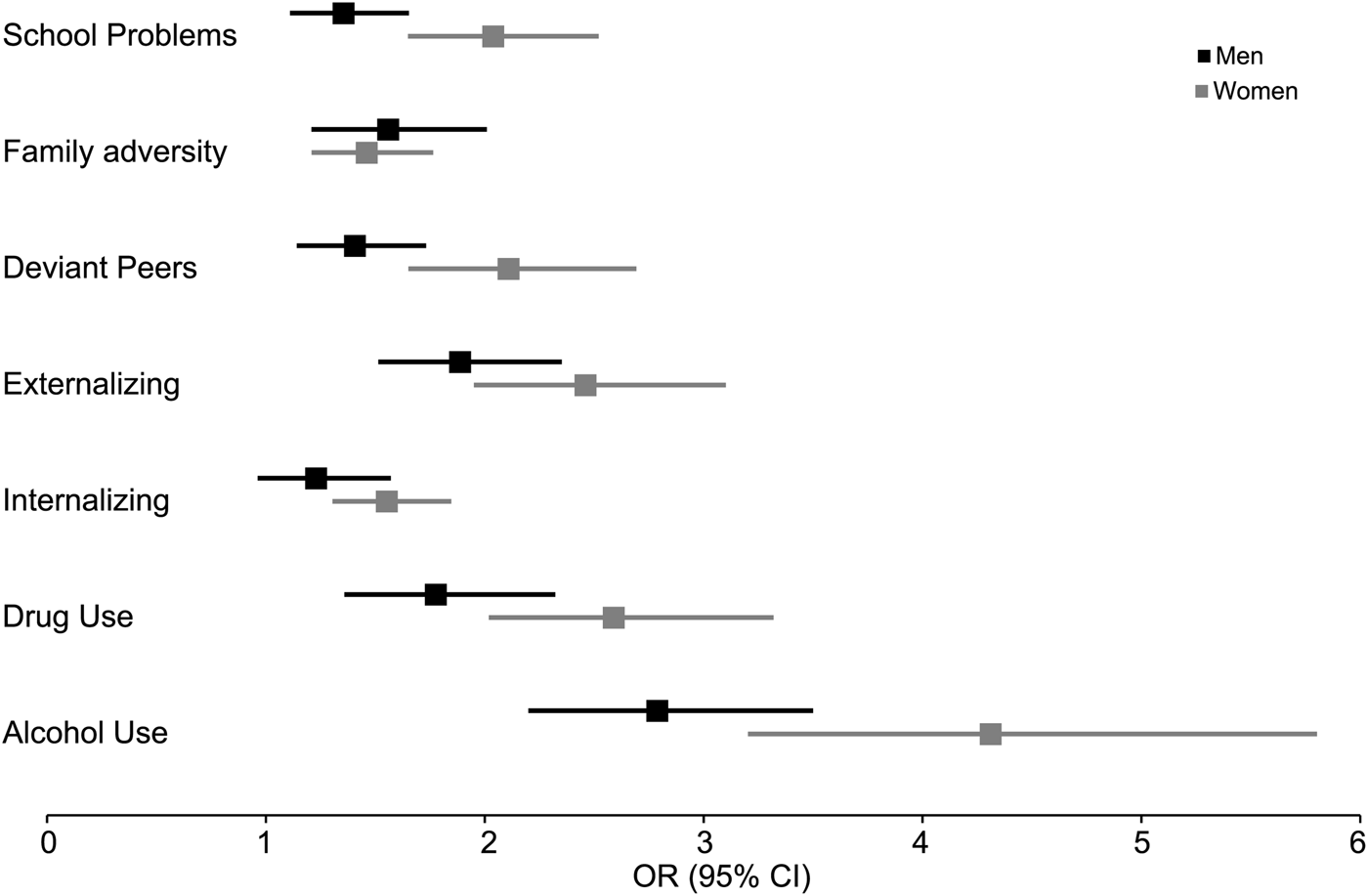
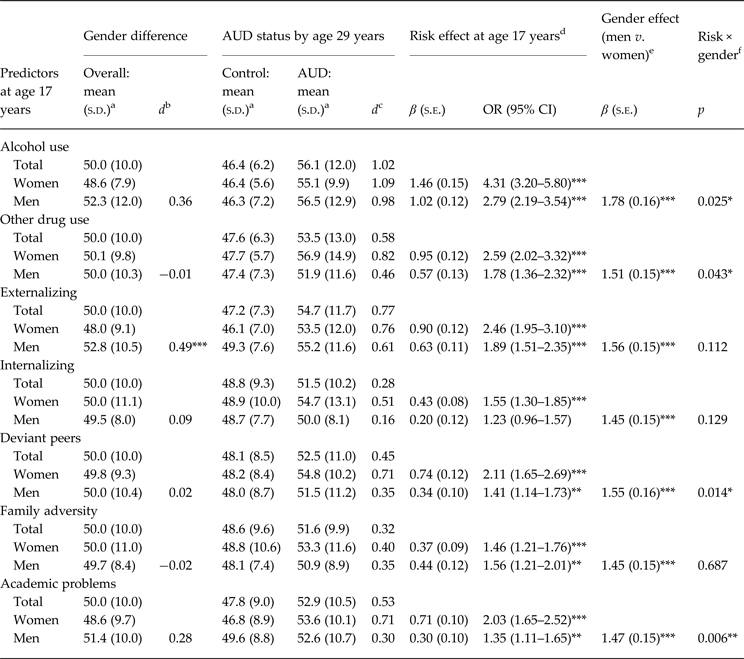
Results for the main effects of gender, risk factor, and the gender × risk factor interaction terms at the age of 17 years are reported in Table 1. The average level of risk exposure common to boys at the age of 17 years significantly increased the odds of developing AUD relative to the average level of risk exposure common to girls at the age of 17 years. The significant main effects of risk exposure at the age of 17 years indicated that higher levels of risk increased the odds of developing AUD by the age of 29 years. Within both men and women, a 1 s.d. increase in alcohol use, other drug use, externalizing problems, deviant peers, family adversity and academic problems increased the odds of AUD. Internalizing distress at the age of 17 years was associated with increased odds of AUD in women (OR 1.55, 95% CI 1.30–1.85, p < 0.001) but not men (OR 1.23, 95% CI 0.96–1.57, p = 0.098), suggesting a gender-specific risk factor for AUD. Finally, the association between each risk exposure and AUD was stronger for women except for family adversity, suggesting that similar increases in risk for both genders are linked with more severe consequences in women compared with men (see Fig. 1). For instance, a 1 s.d. increase in drug use was associated with a greater increase in the odds of AUD in women (OR 2.59, 95% CI 2.02–3.32) compared with men (OR 1.78, 95% CI 1.36–2.32). Consequently, we detected gender x risk factor interactions for alcohol use, other substance use, deviant peers and academic problems, such that greater risk exposure on these variables had a significantly stronger association with AUD in women relative to men.
Odds of developing alcohol use disorder by the age of 29 years for each 1 s.d. increase from the average level of risk exposure for a person of that gender at the age of 17 years. OR, Odds ratio; CI, confidence interval.

T-score means, standard deviations, Cohen's d and results for the generalized estimating equation using risk factors at age 17 years and gender to predict the odds of developing AUD by the age of 29 years

AUD, Alcohol use disorder; s.d., standard deviation; s.e., standard error; OR, odds ratio; CI, confidence interval.
a T-score means arranged by gender and AUD status (women: n = 155 AUD, 449 control; men: n = 316 AUD, 226 non-AUD) reflect mean level of risk exposure for each group at the age of 17 years.
b,c Cohen's d effect sizes estimate the magnitude of the difference in the average level of risk between males and females overall (i.e. all men versus all women; d b) and the change in risk exposure coinciding with AUD in each gender (e.g. control women versus AUD women; d c).
d The risk effect for each gender estimates the increased odds of developing AUD by the age of 29 years as a result of a 1 s.d. increase in risk exposure for a person of that gender (i.e. potency of the risk).
e The gender effect estimates the increase in odds of developing AUD by the age of 29 years in men compared with women given an average level of risk exposure within each gender. A positive β value denotes higher odds in men compared with women.
f The risk × gender interaction effect was tested if gender moderated the relationship between the risk factor and the AUD outcome.
* p < 0.05, ** p < 0.01, *** p < 0.001.
Consequences of AUD at the age of 29 years
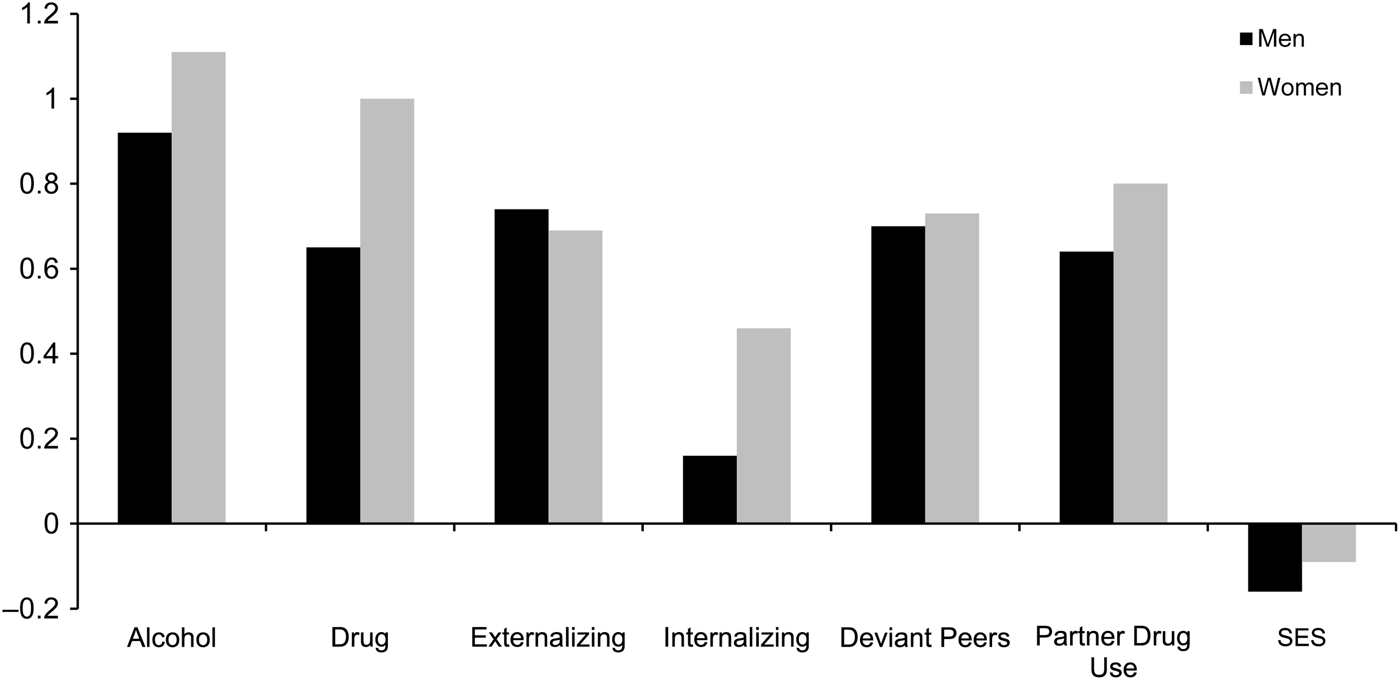
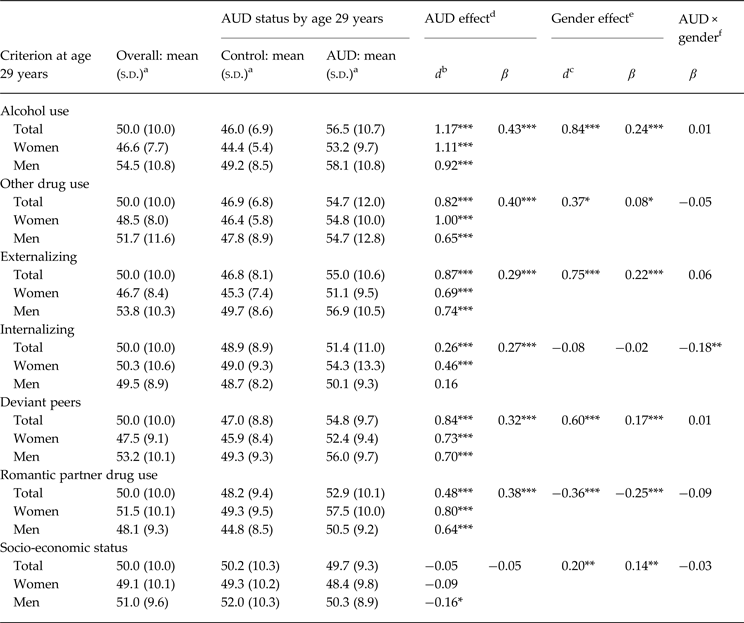
Results for the main effects for gender, AUD, and the gender x AUD interactions for the age 29 years outcomes are reported in Table 2. Lifetime AUD predicted greater alcohol consumption, nicotine and illicit drug use, internalizing distress, externalizing problems, deviant peer affiliation and substance use by a romantic partner at the age of 29 years. Men exhibited significantly greater alcohol use, other substance use, externalizing symptoms, deviant peer affiliation and socio-economic status. Women reported greater partner substance use. Although mean-level comparisons at the age of 29 years suggest that men with AUD were more impaired than women with AUD, the difference in psychosocial outcome between non-AUD and AUD groups was larger among women than men for alcohol use, drug use, internalizing, deviant peers and romantic partner drug use. That is, AUD coincided with greater overall decrements in functioning among women than men compared with those of the same gender without the disorder (see Fig. 2). For example, the effect size of AUD on other drug use was larger in women (d = 1.00) relative to men (d = 0.65). We also detected a gender x AUD interaction for internalizing distress, such that the differences between AUD and non-AUD groups were greater among women than men.
Cohen's d effect sizes for the main effect of alcohol use disorder within each gender at the age of 29 years. SES, Socio-economic status.

T-score means, standard deviations, Cohen's d and β values when AUD status and gender predict age 29 years psychosocial functioning

AUD, Alcohol use disorder; s.d., standard deviation.
a T-score means arranged by gender and AUD status (women: n = 155 AUD, 449 control; men: n = 316 AUD, 226 non-AUD) reflect mean level of consequences for each group at the age of 29 years.
b,c Cohen's d effect sizes estimate the magnitude of the change in consequence factor coinciding with AUD in each gender (i.e. control women versus AUD women; d b) and the difference in each mean-level consequence between men and women at the age of 29 years (i.e. all men versus all women; d c).
d The AUD effect estimates the level of consequences at the age of 29 years associated with lifetime AUD status compared with control status.
e The gender effect estimates the difference in consequences at the age of 29 years for men compared with women.
f The AUD × gender interaction effect tests if gender moderates the relationship between AUD and consequences at the age of 29 years.
* p < 0.05, ** p < 0.01, *** p < 0.001.
Discussion
The higher prevalence of AUD in men relative to women suggests that mean levels of risk exposure for AUD are either greater in men or that certain risk factors have differential effects across gender. To test the moderating role of gender, we estimated the strength of the association between AUD and several established risk factors and negative outcomes after adjusting for gender differences in their prevalence. Our results confirmed the hypothesis that women with AUD have a greater loading of risk at 17 years old and that AUD increases mean levels of psychosocial impairment in young adulthood for both men and women, but that internalizing distress has a stronger structural relationship with AUD for women than men.
Greater exposure to each risk factor was associated with increased odds of AUD by 29 years old. Further, men tended to have higher mean levels of risk exposure that contributed to a higher prevalence of AUD in men relative to women. Despite the higher level of absolute risk in men, AUD in women was associated with an especially high level of risk exposure during adolescence relative to their gender norm and a higher level of risk exposure was necessary for women to exhibit AUD relative to men. Gender variation in the psychosocial consequences of AUD during young adulthood followed a similar pattern. That is, the magnitude of the difference between AUD and non-AUD impairment levels at 29 years old (i.e. effect size) was larger in women than men for most variables. Compared with their gender norm, women with AUD tended to experience both higher risk exposure in adolescence and more negative outcomes in young adulthood relative to men with AUD. Consequently, AUD appears to be a more severe form of psychopathology in women, with a risk structure that is present early in development (i.e. at least by adolescence).
We detected several interactions between gender and adolescent risk factors, such that increases in alcohol use, other substance use, deviant peer relationships and academic problems increased the odds of developing AUD more dramatically in women compared with men. Notably, these risks are not necessarily associated with concurrent AUD, as our AUD groups were derived using lifetime diagnoses by the age of 29 years. That is, the risk structure for AUD appears to emerge by adolescence, irrespective of the onset and chronicity of alcohol problems. The higher levels of adolescent risk exposure and young adult consequences associated with AUD in women provide further evidence that it is a more severe and debilitating disorder in women than men. While psychosocial problems in young adulthood may be consequences of AUD they may, alternatively, also reflect the persistence of the high loading of risk present in adolescence for women with AUD. Studies aiming to understand the etiology of AUD in women would benefit from examining risk structure at even earlier ages to track how risk exposure relates to the onset and persistence of AUD and psychosocial problems.
Consistent with previous reports (Nolen-Hoeksema, Reference Nolen-Hoeksema2004; Foster et al. Reference Foster, Hicks, Iacono and McGue2014), internalizing distress exhibited a unique structural relationship with AUD in women compared with men, suggesting it may be a gender-specific risk factor for AUD. In women, increases in internalizing distress significantly increased the odds of AUD during adolescence and also had a significant relationship with AUD in young adulthood. In contrast, AUD had a near-zero association with internalizing distress in men at both ages, suggesting that it is neither a risk for nor a consequence of AUD in men. While previous literature has documented that women develop internalizing symptoms at a higher rate than men, our results suggest that, even after controlling for gender differences in their prevalence, internalizing symptoms probably play a role in the development of AUD in women but not men. The early emergence of internalizing symptoms in girls may potentiate alcohol use problems later in life through a developmental cascade. For example, symptoms of depression and anxiety that are more common in girls than boys during adolescence may be commonly associated with difficulties in school, work and peer relationships during puberty and catalyse alcohol use problems as a method of coping with negative emotions. As a result, alcohol use may exacerbate internalizing distress indirectly through its negative influence on psychosocial development.
The temporal relationship between internalizing distress and alcohol problems, however, remains unclear. Another possibility is that girls may engage in early and heavy use of alcohol independent of internalizing distress. Heavy alcohol use by adolescent girls has been shown to impair neurocognitive functioning (Squeglia et al. Reference Squeglia, Spadoni, Infante, Myers and Tapert2010, Reference Squeglia, Schweinsburg, Pulido and Tapert2011) and may increase isolation, disrupt social relationships and hinder academic engagement. A lack of stability in social support and academic success may substantially diminish girls’ self-esteem and efficacy for coping with negative emotions in adaptive and prosocial ways (Lopez & DuBois, Reference Lopez and DuBois2005). Subsequently, internalizing symptoms may emerge during young adulthood. Directly testing the temporal relationship between internalizing distress and alcohol problems using longitudinal methods will be vital for explicating this aspect of women's vulnerability to AUDs.
Overall, we provided evidence that AUD is a more severe disorder in women and that internalizing distress may play a gender-specific role in AUD symptoms among women. As only a few studies of gender differences have directly compared men and women in the association between multiple risk variables and the development of AUD at multiple time points, this research represents an important advancement of current research. However, these findings are limited in a number of ways. First, the same associations between each risk factor and AUD may not apply to more diverse samples of men and women. Replication among a more racially and ethnically diverse sample is needed to determine the generalizability of our findings. Second, the associations between risk factors and AUD may be better explained by a third variable that also varies by gender. Third, the use of multiple comparisons is not ideal but allowed for the comparison of the relative contributions of a number of risks to identify candidates for causal pathways that should be validated through future replication of this work and other investigations of individual risk factors. Finally, our analyses do not address the co-development between each risk exposure and AUD. Future work in these areas will be important for determining the etiological role of these for AUD and its clinical features (i.e. onset and course).
Acknowledgements
This research was supported by National Institute on Drug Abuse Awards R37 DA005147 and R01 DA034606 and National Institute on Alcohol Abuse and Alcoholism Award R01AA 009367. K.T.F. was supported by National Institute on Alcohol Abuse and Alcoholism F31 Fellowship Award AA 023121. B.M.H. was supported by National Institute on Drug Abuse Award K01 DA 025868. The content is solely the responsibility of the authors and does not necessarily represent the official views of the National Institutes of Health.
Declaration of Interest
None.