INTRODUCTION
Intersectionality has contributed to the on-going scholarly and political deconstruction of dichotomous and essentializing categories of identity and oppression. This analytic frame has successfully destabilized assumptive similarities within social categories. The explanatory power of intersectionality lies in its ability to conceptualize multiple identities simultaneously; and to show the ways in which these intersecting identities are tied to legal doctrine, social structures, and inequalities (Cho Reference Cho2013; Collins 2004; Crenshaw Reference Crenshaw1991). Nonetheless, as some have argued, intersectionality has often focused on charting identity constellations that pinpoint the impact and merger of race, class, gender, and sexuality on the life chances of individuals and groups. These identity constellations have been helpful in understanding the experiences of individuals and communities that have often been overlooked and under-theorized, and for suggesting what these individuals and communities think about. Yet, they do not account for the diversity of thought within particular identity constellations nor do they adequately explain how people think and make sense of their lives (Kelly Reference Kelly2013; O’Leary Reference O’Leary1998; West and Turner, Reference West and Turner2013). As Ana Carasthathis (2008) suggests, the unitary model of identity and experience that intersectionality purports to subvert inadvertently replaces one totalizing model for another. That is, by suggesting a person can be “known” if we meticulously map their experiences of marginalization and privilege implicitly suggest we can draw conclusions about the ways in which a person thinks. For example, intersectionality runs the risk of suggesting that if we map the experience of Black, low-income lesbians in a certain locale we can predict how Black, low-income lesbians in that locale will think about particular political issues. We know, though, that this is not the case. For instance, research has shown that Black gays and lesbians locally and nationally often differ among themselves in their views of same-sex marriage as a civil rights issue; and identity constellations do not determine those differences (Rogowski and Cohen, Reference Rogowski and Cohen2014). Thus, intersectionality has debunked a socio-biological, single-node paradigm based in the concrete realities of the material world while unintentionally codifying a deterministic form of social cognition (Carastathis Reference Carastathis2008; Goff and Kahn, Reference Goff and Kahn2013). By social cognition, I mean the ways in which people make sense of others, themselves, and social phenomenon, and the social context and cultural symbols from which individuals utilize in those processes (Howard Reference Howard1994). This distinction between material reality and cognition is not trivial. On the contrary, how one thinks can impact the material world and vice-versa via social action (Weber Reference Weber1974), civic engagement (Harris-Perry Reference Harris-Perry2011), and political participation (Fowler and Kam, Reference Fowler and Kam2007).
But how do we explain that people with similar identity constellations can often think about the world differently? And, conversely, how do we explain that people with dissimilar identity constellations can often think about the world similarly? I suggest one mechanism for untangling this intersectional dilemma: disclosure practices. Disclosure practices require self-conscious identification with social statuses that may or may not be valued in particular situations. Disclosing a stigmatized identity opens one up to the possibility of shaming, and perhaps the loss of social support, resources, and self-esteem. On the other hand, stigmatized disclosure can be empowering and is often, though certainly not always, associated with a host of mental and physical health benefits (Pastrana Reference Pastrana2014). In accordance with social cognition theories, disclosure is a proactive, self-reflecting, and self-regulating agentic strategy that people utilize to navigate the material, social, and psychological dimensions of their everyday lives. Thus, disclosure of stigmatized statuses—whether the result of an event or identification—can illuminate how macrolevel inequalities manifest in individual thought processes as social actors appraise the cost and benefits of disclosing. To be clear, this study does not attempt to unseat the advances of intersectionality. Rather, like Jennifer Nash (Reference Nash2008), I build upon and “grapple with intersectionality’s theoretical [and] political murkiness to construct a more complex way of theorizing identity and oppression” (p. 1).
This study adds to emerging research by showing how social actors rely on intersectional experiences to understand, think about, and frame complex political problems. I examine this topic via 197 interviews with 102 Black participants that self-identify as lesbian, gay/same gender loving, bisexual, or transgender (LGBT) about their views on same-sex marriage as a civil rights issue before and after the landmark U.S. Supreme Court decision that legalized same-sex marriage across the country. Due to their intersecting marginalized identities, Black LGBT individuals are at particular risk for shaming (and the violence that can come along with shaming practices), and the act of disclosure is a particularly powerful tool for theorizing about how intersectional experiences contour social cognition.
I argue that the Black LGBT participants’ experience with intersectional discrimination (i.e., discrimination based on one or more of their marginalized identities in isolation or in tandem) and their degrees of sexual and gender identity disclosure account for their personal views on same-sex marriage and civil rights. The intersectional framework I deploy here showcases the ways in which social identity markers coalesce with disclosure practices, which in turn, shape social cognition. Specifically, my argument about disclosure practices remedies two theoretical weaknesses of intersectionality’s current formulation: 1) the ability to account for differences within identity constellations; and 2) how to understand the ways people think about and make meaning of their lives and complex social issues. Concerning the former, disclosure practices reveal how people within intersectional constellations can experience the world in radically different ways depending on if they choose to disclose a stigmatized, though not necessarily visible, identity. Regarding the latter, by choosing to either open one’s self up for defamation by disclosing a stigmatized identity (or choosing not to do so), disclosure practices suggests how people will cognitively process their intersectional experiences and make sense of their social and political lives. Disclosure, though, is not equivalent to another intersectional category, such as race or gender. Instead, disclosure practices highlight the process of making meaning that is agentic rather than deterministic. Disclosure practices provide pathways of thought and lend themselves to particular logics based on the identifications that disclosure entails. It’s not so much that disclosure determines political views but that disclosure makes certain views fit together more coherently.
INTERSECTIONAL LIVES & THOUGHT: THE MARRIAGE EQUALITY CASE
Examining the political beliefs of Black LGBT participants is an excellent way to illuminate social cognition from an intersectional perspective. On a more general level, focusing on Black LGBT participants disrupts the longstanding preoccupation with the political views of mainstream Whites (Moodie-Mills Reference Moodie-Mills2012). Second, investigating the multiply marginalized adds to our understanding of the ways in which individual identities and experiences are used to make sense of one’s political claims (Harris-Perry Reference Harris-Perry2011). Third, making sense of political issues often necessitates the desire to balance both self-interest and group position (Bobo and Hutchings, Reference Bobo and Hutchings1996).
Fourth, focusing on Black LGBT political perspectives of marriage equality is specifically advantageous because members of this community embody many overlapping stigmatized identities simultaneously; therefore providing several analytic opportunities to study identity constellations along several different axes of power. Additionally, both the Black Civil Rights and same-sex marriage movements have produced iconic cultural symbols (e.g., Martin Luther King, Jr in the former, and Stonewall in the latter) that can be utilized to cognitively process information. And last, survey data does suggest that there are several issues in which identity constellations do predict Black LGBT political perspectives. However, this same survey material also demonstrates that this is not always the case (see below); yet, we do not have the tools to make sense of contradictions in these identity constellations. Thus, the intersecting identities of Black LGBT individuals demonstrate that self-interests are fluid, one’s group position is conditional, and processes of making sense of social life are indeterminate. Consequently, the views expressed by Black LGBT participants are the result of both personal and collective processes, which are contingent upon the social context from which they are drawn (see Moore Reference Moore2011).
White LGBT youth and adults prioritize same-sex marriage and often view it as this generation’s civil rights issue, often evoking Black Civil Rights imagery of the 1960s to rally both political and financial support for the cause of marriage equality (Battle et al., Reference Battle, Cohen, Warren, Fergerson and Audam2002; Moodie-Mills Reference Moodie-Mills2012; Moore Reference Moore2011). Although some Blacks agreed, a number of others disparaged this comparison, suggesting the fight for marriage equality is not equivalent to racial equality and is, thus, not comparable to the Black Civil Rights Movement. Despite the legal gains of the LGBT movement and media representations of gay affluence, Blacks in this community are one of the most economically insecure in the country (Moodie-Mills Reference Moodie-Mills2012). Further, the Black LGBT community is: 1) significantly more likely to be homeless (Diaz and Kosciw, Reference Diaz and Kosciw2009); 2) at a higher risk of contracting HIV/AIDS (Malebranche et al., Reference Malebranche, Fields, Bogart, Smith, Ellen and Schuster2011); and 3) is more likely to be incarcerated and the targets of hate crimes (Himmelstein and Bruckner, Reference Himmelstein and Bruckner2011). Considering these stark economic and health disparities, research demonstrates that Black LGBT social and political cognitions are rooted in part in ongoing relations of racial inequality. It is not surprising, then, that other issues superseded marriage equality for Black LBGT populations (Rogowski and Cohen, Reference Rogowski and Cohen2014).
SOCIAL COGNITION AND THE POLITICS OF DISCLOSURE
While the informative studies above tell us much about differences between Black and White LGBT political priorities, they tell us little about how individuals within Black LGBT communities think about these issues. For instance, although the Black Pride survey revealed that many Black LGBT individuals ranked marriage equality as a very low priority, some ranked it high; and their distinct, intersectional identity constellations did not correlate with their thinking (see Battle et al., Reference Battle, Cohen, Warren, Fergerson and Audam2002). Likewise, identity constellations also did not map neatly onto the political views of my study’s participants. Black identity, ethnicity, gender, sexuality and social class specificities did not explain nor predict how a participant assessed same-sex marriage as a civil rights issue. Rather, it was the participants’ intersecting experiences in conjunction with their levels of disclosure that explained their views. As such, two bodies of literature inform this intersectional study to underscore how macro-institutions and interconnecting inequalities shape micro-experiences and thought processes: social cognition and disclosure practices.
Examining meaning making and how people think is a central concern of social scientists interested in social cognition. A key component of sociological understandings of cognition is that individual thought is inseparable from social structure; for it is social structure that often provides the cultural material and symbols from which social actors draw meaning. Despite linkages between individuals and society, social psychology has been heavily criticized for its lack of sustained attention to understanding how inequalities shape cognition (Hollander and Howard, Reference Hollander and Howard2000; Hunt et al., Reference Hunt, Jackson, Powell and Steelman2000). In particular, intersectionality and sexuality have largely been ignored in social psychological and cognitive research (see Hunt et al., Reference Hunt, Jackson, Kye, Powell and Steelman2013). Consequently, there is a serious lack of concepts and research demonstrating how intersectionality impacts cognitive capacities.
Part of the issue is that intersectionality has largely been localized to the level of experience. Conceived out of Black feminist and critical race theories, intersectionality is rooted in the experiences of Black women and the ways in which they navigate race, class, and gender hierarchies (Crenshaw Reference Crenshaw1991; Nash Reference Nash2008). As intersectional theories continue to expand, the scope of experiences informing intersectionality have moved beyond Black women and includes other marginalized groups, as well as the privileged (Madison and Partridge, Reference Madison and Partridge2014). Nonetheless, there is still a dearth of literature that conceptualizes how intersectional experiences lead to intersectional cognitive practices.
Some recent scholarship, however, has taken this conceptual turn and demonstrates how interlocking structural inequalities constrain and facilitate the experiences of individuals; as well as provides the culturally symbolic resources that assist in meaning-making and to cognitively process information. Recent work on Black women rape survivors, for instance, highlights how women’s cognitive frames are shaped by both their structural position as Black women and the available cultural symbols that often portray Black women as promiscuous and impervious to hardship. The sexual assault survivors used an appraisal process that took into account their experiences as Black women in a sexist, racist, and classist social system to assess the likely responses of others and the cost and benefits to what they perceived to be “the Black community” if they disclosed the assault to authorities. Thus, the act of disclosure fashioned the women’s intersecting experiences and shaped the ways they processed their sexual assault (McGuffey Reference McGuffey2013).
Although most research on the disclosure of sexual orientation has focused on the experiences of middle-class White gays and lesbians, there is a growing amount of research indicating that disclosure occurs differently for low-income individuals and/or people of color. The intersectional perspective on sexual identity annuls the developmental assumption that disclosure is tied to linear ideals of maturity and identity formation (Moore Reference Moore2011). Rather, an intersectional perspective links disclosure to structural forces (Pastrana Reference Pastrana2014). For example, most research suggests publicly identifying as White, well educated, male, and middle to upper class increases the likelihood of sexual orientation disclosure; while those who identify as a person of color, less educated, female and poor are less likely to self-disclose (Potoczniak et al, Reference Potoczniak, Crosbie-Burnett and Saltsburg2009). Age is also a factor, with youth being more likely to self-disclose than older cohorts; and adolescent boys and men disclosing at earlier ages than their lesbian counterparts (Floyd and Bakeman, Reference Floyd and Bakeman2006). Some scholars, however, are challenging this idea. Both the middle-class and working-class participants with middle-class aspirations in Mignon Moore’s (2011) study on Black lesbians, for instance, had the most difficulty with self-disclosure: “Upwardly mobile [lesbians] believed they had something concrete to lose in taking on an openly gay identity as they entered adulthood” (p. 31). The working class Black lesbians without middle class aspirations felt free from the politics of respectability and were, thus, more inclined to act upon their same-sex desires and to disclose their Black lesbian identities at earlier ages.
The limited research on transgender people of color reveals that the experience of gender identity self-disclosure is different from the disclosure of sexual orientation. Not only are transgender people of color marginalized by race (and often class), but transitioning to an either more or less privileged gender identity category further contextualizes their marginalization (Bockting et al., Reference Bockting, Miner, Romine, Hamilton and Coleman2013). Also, disclosure practices are further complicated for many who aspire and/or are capable of “passing” undetected as a transgender person (Pastrana Reference Pastrana2014). I propose that these debates and conflicting findings illuminate that structures do not necessarily determine disclosure as much as individuals actively strategize about their current situation and future prospects based on the ways in which they make meaning of their social constraints; thus, leaving room for indeterminacy. Further, although some of my participants use the popular language of “coming out,” I purposely avoid this lexicon because it suggests a static identity in and of itself; whereas disclosure highlights the contextual and strategic processes that individuals employ to negotiate their sexual and/or gender identities in their everyday lives.
In sum, although intersectional identity constellations can often explain what social actors think about, these constellations run the risk of solidifying an overly deterministic model of social cognition. This project suggests new questions and directions in the empirical study of social cognition and identifies disclosure practices as key mechanisms that bind intersectional identities to cognition. A social cognitive perspective helps us understand how the structural and cultural components of intersectionality unfold in internal lives.
METHODS
Study Participants
Participation in the study was restricted to those between the ages of eighteen and thirty who identified as Black and as a sexual or gender minority. Emerging adulthood is a developmental stage characterized by subjective perceptions of responsibility and independence and identity explorations (see Herzog Reference Herzog2017); where people are actively negotiating sexual, gender, and racial identities simultaneously (Diaz and Kosciw, Reference Diaz and Kosciw2009). Further, this is an age where young people develop their political consciousness (Jennings 1996), self-reflect on and “test” political ideas (Ellison Reference Ellison2003), and cement “concrete affiliations and partnerships” (Erikson Reference Erikson1993, p. 278). As such, this is an appropriate targeted age group to study Black LGBT identities and political perspectives. The twelve-year-age span also increases my ability to account for a diversity of emerging adult perspectives as participants are both entering and leaving this developmental stage.
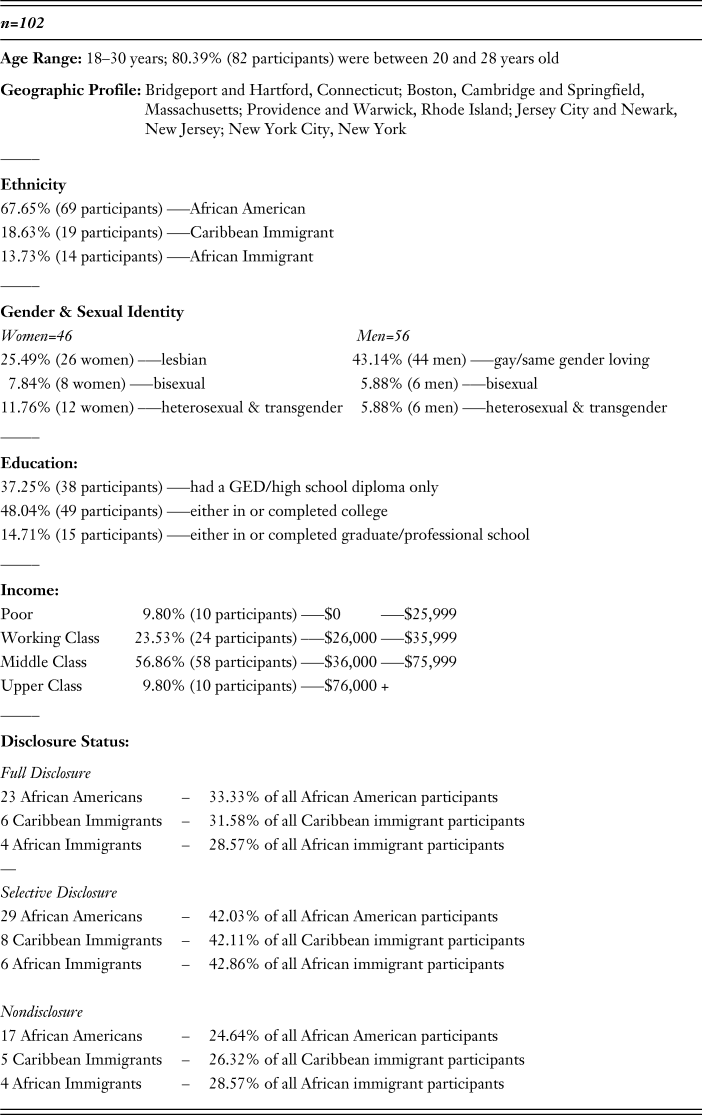
The findings from this study are based on 197 interviews with 102 participants, comprising fifty-six men and forty-six women.Footnote 1 Participants found out about the study from advertisements on mainstream on-line LGBT support sites, Black on-line LGBT social and support sites, community board postings, list-serves, and through word of mouth. All participants lived in the Northeast and were drawn from ten cities in five states. Although the geographic specificity of the participants surely shaped this project, my findings are consistent with quantitative research relying on national surveys that show a connection between levels of sexual disclosure and political orientations (Swank and Fahs, Reference Swank and Fahs2013); as well as qualitative studies in the South that find Black gays and lesbians that see a disconnect between their identities often minimize their sexuality (McQueeney Reference McQueeney2009).
Black LGBT Participant Characteristics
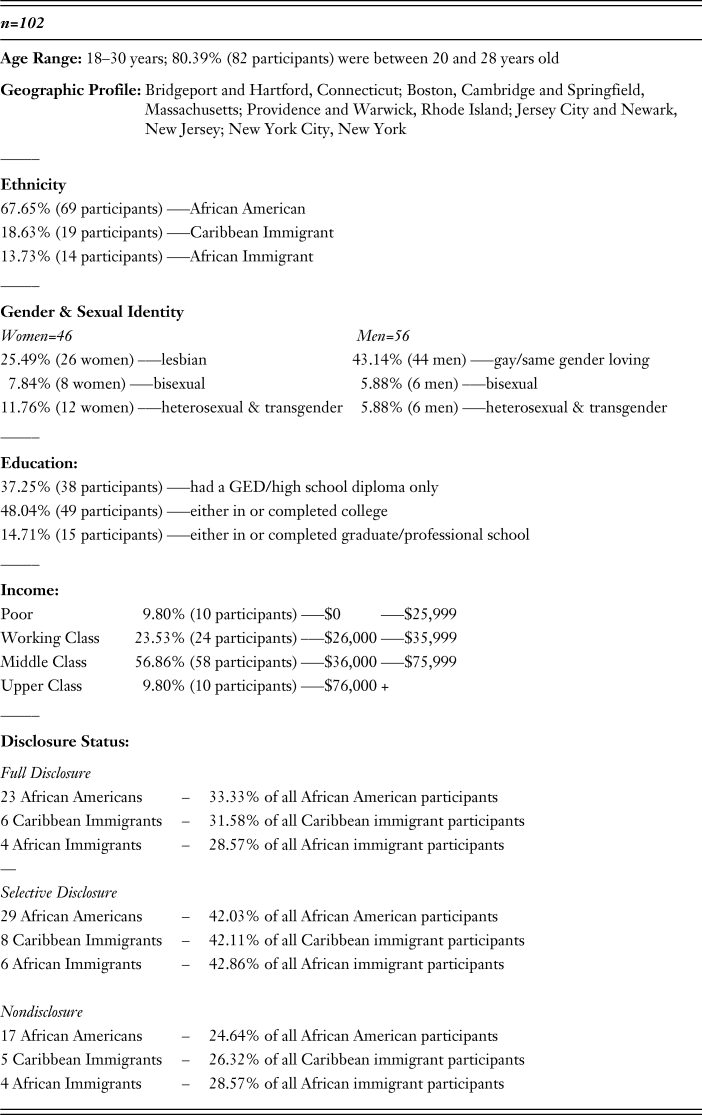
Data Collection
Phase One
I collected the data in two different phases. In phase one I conducted face-to-face interviews with sixty-seven participants and an additional thirty-five interviews via Skype, a telecommunication software that allows users to see and hear each other in real-time while being in different locations. All interviews were recorded, transcribed, and took place at a location of the participants’ choosing between 2012 and 2014. Participants were categorized into three different groups based on their responses to the following three sets of questions:
• Do you go out of your way to hide your sexual or gender identity from any of your…Friends? Family? Co-workers?
• Do all the important people in your life know about your sexual or gender identity?
• If you discovered that someone didn’t know about your sexual or gender identity, would you tell that person if it came up in conversation with…Friends? Family members? Co-workers?
Individuals that answered “no” to all parts of the first question, “yes” to the second, and “yes” to all parts of the third question were grouped in the full disclosure category. Participants were categorized as selective disclosure if they answered, “yes” to any parts of the first question, “no” to the second question, and “no” to any part of the third question. The nondisclosure category was reserved for those that answered, “yes” to all parts of first question, “no” to the second, and “no” to all parts of the last question.
Phase Two
After categorizing participant responses, I reinterviewed respondents in phase two between 2015-2016, after the U.S. Supreme Court decision on June 26, 2015 that legalized same-sex marriage across the country. This was done to see if the court decision impacted their previous responses. I reinterviewed all thirty-three participants in the full disclosure category; forty of the forty-three selective disclosures; and twenty-two of the twenty-six nondisclosed participants. In total, I conducted 197 interviews.
Conducting the Interviews
While I did not specify my social identities to potential participants, my interview recruitment tools included a photograph of myself and stated that I am an associate professor of Sociology and African and African Diaspora Studies. Further, when respondents inquired about any of my identities, or disclosure practices, I politely told them that I would be glad to discuss this after the first interview. I believe my ability to be perceived as similar to the majority of participants greatly aided in my ability to collect interview data, as research suggests that race, gender, sexuality and class shapes participant rapport (see Eghareuba Reference Eghareuba2001; Kanuha Reference Kanuha2000, McGuffey Reference McGuffey2013).
After the initial interview, participants and I had a discussion of my social identities that revealed clear ways in which they were making assumptions about me. My familiarity with various slang, music, food, customs and other cultural and class codes throughout the African diaspora may have implied group membership and/or allegiances. As such, most interpreted my self-presentation to mirror their identities. That is, all participants initially identified me racially as “Black,” “Black-ish,” or “at least half-Black.” Additionally, the vast majority of women and men that expressed same-sex attraction assumed I did as well; and all those that identified as bisexual categorized me as such. In terms of ethnicity, all African Americans presumed that I was, too; and 78.95% of Caribbean immigrants classified me as Caribbean despite the fact that I do not have a Caribbean accent. None, however, suggested that I was an African immigrant. African immigrants, nonetheless, repeatedly conveyed appreciation for my knowledge of West and South African traditions, geography, and localized queer vernacular. While no one thought I was currently poor or working class, 64.71% of the poor and working-class participants thought I was raised in a working class or poor household. All participants identified me as a man. Only one transgender person, however, assumed I was a transgender man, and that was primarily due (according to him) to my fluency in trans men’s specific lingo and knowledge of gender confirmation medical procedures.
Analysis
The interviews were coded and grouped using NVivo 11 qualitative research software and a constant comparative method (CCM) was used to analyze the data. CCM compels investigators to constantly check, code, and recode the data. Modifying Hennie Boeije’s (2002) CCM model, a four-step CCM analysis was utilized in this project:
1) Comparison within a single interview: Categories were established through open coding and a code tree was developed for preliminary conceptualization.
2) Comparison between interviews within the same group: Participants were compared with others of the same ethnic, gender, sexual, and class groups through axial coding.
3) Comparison of interviews between groups: Participant groups were compared to other participant groups for conceptual refinement.
4) Comparison of interviews between cities and states: Participants were compared with members from each of the five states and then, again, from each of the ten cities to identify any potential regional idiosyncrasies. No idiosyncrasies were identified.
If the data aligns with the frameworks then the CCM concludes that the findings confirm conceptual models (Miles and Huberman, Reference Miles and Huberman1984). Conversely, discrepancies from existing models (i.e., negative cases) necessitate that the researcher develops new theories or postulate and/or extend prior formulations. The classifications are considered “saturated” when new cases no longer generate novel information. At this point researchers can draw conclusions (Boeije Reference Boeije2002).
FINDINGS
The findings are separated into five sections. The first section demonstrates the variance in social cognition among those with similar identity constellations. Sections two through four underscore how disclosure practices help us understand the predictability of meaning making. In particular, the second section focuses on those that are fully disclosed; the third on selective disclosure; and the fourth on the nondisclosed. These groupings demonstrate that disclosure practices and perceived experiences of intersectional discrimination contour how the participants think about same-sex marriage as a civil rights issue.
I present the first four sections through the accounts of three case studies. All names are pseudonyms. Focusing on a relatively small number of participants for analytic clarity has been applied to influential studies on gender and race (Chen Reference Chen1999), and race and social class (Lareau Reference Lareau2002), as it allows for a more nuanced understanding of the phenomenon in question. This is especially vital for this study for two reasons. First, context is central to understanding the connection between biography and perception and how accounts are contoured by structural constraints. Using fewer cases to illuminate these processes allows the researcher to underscore the significance of context. Second, as stated earlier, I am illuminating how intersectional experiences shape how people think about complex social problems. This necessitates a longer discussion of fewer cases that represents each disclosure practice in order to refine the connection between intersectional and social psychological approaches.
The last section focuses on the negative cases; that is, the ways in which disclosure practices do not explain how respondents think about social issues. Focusing on these negative cases reveal that while disclosure practices explain how participants make sense of their social life and political attitudes towards civil rights, disclosure practices do not explain how they assess the perceived aims and priorities of LGBT rights organizations. Rather, collective understandings of anti-Blackness and transgender invisibility explain participant perspectives.
Identity Constellations and Social Cognitive Variance: “I Am the Connection.”
The three participants discussed in this section have remarkably similar identity constellations. All three are: 1) middle class, 2) born and raised in the same city in predominately Black neighborhoods, 3) products of two parent, dual income households, 4) attending the same highly selective university, 5) either nineteen or twenty years of age at the time of their initial interviews, 6) members of Baptist churches, and 7) self-identified African American gay men. One might assume that these three would have similar political perspectives based on their similar intersectional identities. This, however, is not the case. Their differing disclosure practices reveal how their intersecting identities and perceived levels of discrimination are used to make sense of the world very differently.
Darryl is a nineteen-year-old college sophomore that practices full disclosure. He was kicked out of his house at the age of sixteen when he disclosed his sexual identity to his homophobic parents. Although he eventually moved back in the house, he stated that he was “glad” that he earned a full scholarship to attend his university “so that I could escape the homophobia I experienced at home.” At the university, however, Darryl experienced “constant microagressions and racism by Whites.” Darryl used his intersecting experiences with homophobia and racism to frame his views on gay marriage and civil rights. He stated:
I grew up Black in [the city] so you know I experienced racism… And [the university] is just a wealthier microcosm of the city so I get racism here. And the homophobia got me kicked out the house so there’s that…So yeah, I’ve experienced discrimination all the way around and I definitely see a connection between civil rights and gay marriage. It’s impossible for me not to see the connection. I am the connection.
Brian is also nineteen and a sophomore. However, Brian perceived the two movements as parallel, but not linked. He framed his thought processes around his selective disclosure practices and his perceived levels of discrimination. Brian explained:
Look, I’m Black. I factually can’t get around that. But I can tell or not tell people I’m gay…I really don’t experience much homophobia because most people who would be homophobic to me don’t know. But I experience racism about every damn day. So, no, I don’t see Black and gay as equivalent and I don’t see Black rights and gay rights as associated. Sure, Blacks and gays should have the same rights as White straight people but these are separate issues.
Chad, a twenty-year-old junior that practices nondisclosure, also does not see a connection between marriage equality and Black Civil rights: “I’m Black and I’m gay; but I’m usually not those things at the same time. The only people who really know I’m gay are the guys I’m having sex with, and there aren’t many of those. So I don’t see no relation between being Black and being gay, or between gay rights and Black rights.” Unlike Brian, though, Chad harshly criticizes the gay rights movement more generally because “it” puts him in “uncomfortable situations.” He explained:
Here’s what I fucking hate about the gay rights movement. You’re minding your business, trying to live your life and then some gay rights commercial or news comes on the TV while you’re watching with your family or friends and then they start saying something and then I’ve got to feel some type of way. And it could even be something positive, or it could be really negative but I’m thinking: ‘Holy shit. I really don’t want to be here right now.’ That’s why I wish this whole gay rights business would just go away…Just have sex with who you want and shut up. It’s really not that difficult.
Comparing these three young men with similar intersectional identities reveals how their intersectional identities do not correspond to similar ways of thinking about the world. Rather, the data reveals how disclosure practices and perceived experiences of discrimination are used as discursive strategies to make sense of the social world and to explain political perspectives.
Full Disclosure and Intersectional Discrimination: “I Am All These Struggles. There Is No Separation for Me.”
Whereas the previous section examined differences in social cognition within particular identity constellations, the following three sections illuminate similarities across different identities. For instance, all of the participants that practiced full disclosure processed the Black Civil Rights Movement and the LGBT movement as interconnected and as part of a larger civil and human rights agenda. They attributed this to the fact that they perceived racial and sexual and/or gender minority statuses as connected. Adam, for instance, is a twenty-one-year-old fully disclosed African American man. He is also an Ivy League college student from an elite family. Adam first disclosed his sexual identity to his older, lesbian cousin at the age of eleven. Over the next two years, he slowly disclosed his identity to his boarding school classmates, and then to other family members at the age of fourteen. His immediate family proved very supportive; including planning frequent vacations to Provincetown, MA, a popular LGBT destination and Atlanta, GA, which Adam described as the “Black gay mecca.” “My family wanted me to have role models,” Adam stated, “and to feel comfortable in both my Blackness and queerness.”
Adam’s supportive family, however, could not protect him from experiencing racism and homophobia. Adam used these interconnecting experiences to explain his view of marriage equality as a civil rights issue:
Of course same-sex marriage is a civil rights issue…Just like Black civil rights shouldn’t be voted on, neither should the right to marry…For me, my experience as a Black gay man helps me see and know the inseparable link between gay rights and Black civil rights. I experience racism and racial profiling despite my economic privilege and I experience homophobia and have been threatened because I’m an effeminate gay man. As a Black gay man my existence is constantly in a state of double jeopardy.
Adam’s account demonstrates how his disclosure practice shapes his cognition. It’s not just that Adam is “a Black gay man” that allows him “to see and know the inseparable link between gay rights and Black civil rights,” it’s the fact he is a fully disclosed Black gay man that shapes his thought processes. Full disclosure opens Adam up to direct discrimination based on his sexual orientation while his clearly identifiable racial status compels him to negotiate racial inequality.
Nichelle is a twenty-six-year-old African American lesbian currently living on public assistance. She grew up with a single mother and a brother in a housing project and attended school in one of the city’s most disadvantaged areas. Nichelle first disclosed her sexual identity when she was sixteen to her mother. Although Nichelle’s mother was not supportive, “she did the best she could considering how she was raised.” Nichelle did not practice full disclosure until three years later when she graduated from high school, at which time she got a job at a mainstream LGBT rights organization. Fed up with the racism she experienced at that job with “‘colorblind,’ racist White liberal gays and lesbians in the movement,” she left and got a job at a non-profit focused on homelessness. There a White client raped her and a pregnancy resulted from the assault. Like Adam, Nichelle experienced multiple levels of discrimination and attributes her views of same-sex marriage as a civil rights issue to her experiences as a fully disclosed lesbian:
I didn’t really relate with Whites until I worked at [mainstream LGBT rights group]. That’s when I really experienced racism…And then I get the homophobia from [Black] people. The White man who raped me did it ‘cause he said homosexuality was a sin and he was going to fuck me straight so I could go to heaven…so living my authentic life helps me see the connection between marriage equality and civil rights. I know what it’s like to be discriminated against on all fronts.
As Nichelle articulates, her practice of full disclosure and “living [an] authentic life” provides the experiential material to conceptualize marriage equality as a civil rights issue. Her account, along with Adam’s, illuminates the ways in which political orientations are shaped by experiences of full disclosure and intersecting discrimination.
Carmen is a twenty-eight-year-old Senegalese, openly transgender woman. Her family moved from Senegal to the deep South when she was in elementary school. Carmen was assigned the designation “boy” at birth and “Omar” was her given name. At the age of fourteen, Carmen’s father found “Omar” dressed in women’s clothing and beat her savagely. Carmen subsequently ran away and, after a year of traveling, eventually made it to the North where she’s lived ever since. Part of a city’s working class, Carmen is currently employed in the entertainment industry. Discussing her perceived connections between racial and LGBT civil rights, Carmen explained:
Of course LGBT rights and civil rights are connected. LGBT rights are civil rights. They are human rights. I have experienced every sort of discrimination and hate crime you can possibly imagine…and I can tell you pain is pain. When I was a kid [in the South] and the White kids called me nigger and threw rocks at me and [my sister], it hurt. When my father beat me because I was dressed as a girl, it hurt…Before I knew living as a woman was even a possibility for me I just thought I was a gay man. And when I was walking down the street with my boyfriend and a group of [gang members] called us faggot and stabbed us, it hurt. And when after I transitioned into living as a woman and this nigga broke my jaw because he was flirting with me and then realized I was trans, that really hurt…So for me I see how all these struggles are connected and I have to support them all because I am all these struggles. There is no separation for me.
Here, Carmen clearly articulates that her intersecting identities have resulted in intersecting discriminations. She experienced White racism as a child in her southern school and neighborhood, and Black transphobia and homophobia in her family and everyday experiences in the Northeast. Her lived experience as a disclosed Black transgender woman has shaped the way she thinks about racial and LGBT rights. She perceives these movements as connected precisely because she perceives her intersecting experiences of discriminations as connected.
As these accounts demonstrate, fully disclosed participants use their experience of intersectional discrimination to make sense of civil rights, LGBT politics, and the mutually constitutive character of race, gender and sexual identities. It is also important to note that these political views are not necessarily economic expressions. On the contrary, Adam, who is upper class, has similar views as Nichelle and Carman who are poor and working class respectively. Instead, the ways in which intersecting inequalities have constrained their fully disclosed lives provides the perceptual context and experiential knowledge to utilize in their social cognitions. Experiencing these intersecting inequalities, however, do not shape social cognitions in a deterministic way. Rather, openly identifying as gay, lesbian, bisexual, or transgender is a fundamental identification for those who are fully disclosed as compared to those in other categories. Thus, the fully disclosed make gay, lesbian, bisexual or trans identities important public identifications.
Selective Disclosure and Perceived Selective Discrimination: “My Blackness Is Written on Me in Ways Being Gay Is Not.”
Thirty-eight of the forty-three participants (88.37%) who practiced selective disclosure thought the Black Civil Rights Movement and the LGBT movement were similar, but not necessarily connected. They did not perceive their racial identity as mutually constitutive of their sexual and/or gender identities. Many felt their Black life could be separated from their sexuality or trans identity. And most expressed they could choose to publically identify as LGBT, but identifying as Black was not an option. This is not simply a distinction in the abstract. It is a distinction that is real in their everyday lives, as they have opted to selectively disclose their sexual or transgender identify. As such, this lead many, like Jordan, to believe the movements were not interconnected. Jordan, a twenty-year-old Black American man, has disclosed his sexuality to his friends and professors at his college but keeps his sexual identity a secret from his middle-class family and friends in his hometown. He fears his family would not financially support him if they knew he was gay. As he stated:
I will always support gay marriage and equal rights for all. But it really, really bothers me when gay rights groups equate civil rights and gay rights, or when gays say ‘gay is the new Black.’ No it isn’t and it never will be. Although I don’t think you can choose to be gay, I am living proof you can choose to identify as gay or not. I do that every time I go home. I do not have to deal with homophobia because I can choose not to tell people I’m gay if it will hurt me physically, economically, or emotionally. But I can’t ever choose not to be Black. My Blackness is written on me in ways being gay is not. I have to face racism. I don’t have to face homophobes…And I’m so glad we have gay marriage now so if I ever decide to marry I can. But gay marriage is not going to stop people from being homophobic. I still have to choose my battles.
Here Jordan clearly suggests that he experiences his identities as separate categories because he practices selective disclosure. By articulating this separateness, Jordan provides a cognitive map that underscores how his perception of the two movements is contoured by his perceived experience of separate, but unequal, identities and discrimination. That is, he perceives the challenges that come along with his sexual status as a choice he can choose to maneuver after careful consideration of the pros and cons of disclosure, whereas racial oppression is an inescapable fact of life.
Like Jordan, twenty-three year-old Robert suggests he is “living proof” sexual and racial identities are distinct and, thus, same-sex marriage and racial justice movements are discrete. A bisexual, second generation Trinidadian, Robert hopes to move himself and his siblings out of poverty. Growing up adjacent to a housing project, Robert’s impoverished family has always depended on his income. As such, he was not concerned about disclosing his bisexual identity to his parents at the age of seventeen, and he currently feels equally comfortable bringing both male and female romantic partners around his family. “I’ve always worked to help my [family]’s bills get paid so they needed me…so I didn’t have to hide [my sexuality] like some of [my friends]. Mom and dad didn’t like it but what the hell was they going to do? Kick me out? They religious but they ain’t stupid [he laughs].” Nonetheless, Robert keeps his sexuality a secret from his co-workers. As a rookie police officer, Robert feels he must maintain a masculine, heterosexual appearance in order to gain respect and to successfully move up the ranks. He chooses not to disclose his sexuality in hopes of lessening the discrimination he already faces due to racism:
I gotta deal with the racist bullshit on the job. And I mean both the racist bull I gotta deal with personally, but also all the racist bull I gotta witness happening to my [Black] community by the police…So I don’t say anything about the bisexual thing. I needs my respect. My career, my future depends on respect…I live two different lives, one at home and one at work…the gay marriage thing, that ain’t the same as the race thing. And it pisses me off when people say they are. I gotta live with racism. I ain’t gotta live with the gay shit… They two different things. I’m glad we got gay marriage now but that’s not changing my situation. Gay marriage ain’t going to feed my family.
Robert’s account shows how he makes sense of both his sexual and racial identities and the same-sex marriage and racial equality movements. His economic leverage within his poor family affords him the luxury to disclose his bisexuality with little consequences. Yet he perceives that his future economic prospects within the police department demands sexual secrecy. However, he can’t hide his racial identity and he experiences routine racial oppression on the job. Thus, he perceives that he lives in “two different worlds,” worlds where experiences of homophobia can be managed but racism cannot. Consequently, he makes sense of same-sex marriage and racial justice as different battles that should not be conflated.
Cynthia is a twenty-five-year-old African American working class transgender woman. Cynthia dropped out of high school and spent most of her adolescence homeless and engaging in “survival sex.” That is, engaging in sexual activities in exchange for housing and food after her parents kicked her out when she disclosed her trans identity. In her early twenties, she became a high-end escort in order to pay for her “feminine enhancing procedures.” Although she made considerably more money as an escort, she quit the business once she completed her physical transition and currently works as a low-paid administrative aid. Cynthia attends a support group for transgender women of color and is out about her trans identity to her friends and significant other. She hasn’t disclosed her identity to her co-workers, however. Although anti-discrimination policies protect her, she feels it’s “just easier to keep it secret. I don’t think the other women [at work] would accept me as much if they knew.” She continued:
The other women at work are very traditional White women. They’ve gone to college, married with kids—you know, soccer moms. Then there’s me—Black, high school dropout. I feel I got enough against me. I just don’t feel the need to tell them about this too. And them not knowing makes me feel more like a woman…And I don’t think gay marriage is like the Black Civil Rights Movement—not at all [she laughs]. Is [gay marriage] a civil right? Yes, child. But let’s not get it twisted. Sexuality and race are not the same thing. They are different…I live Blackness. I can pass as a woman who was born with female chromosomes so I can choose to let people know…so gay marriage and Black Civil Rights are not the same movement.
Like Jordan and Robert, Cynthia’s selective disclosure and perceived selective discrimination positions her to think about same-sex marriage and racial civil rights as distinct movements. Selective disclosure and being able to choose to publically identify as gay (Jordan), bisexual (Robert), or transgender (Cynthia) provided the social cognitive context for these participants to think that their various identities were not necessarily mutually constitutive. And while Jordan, who discloses his gay identity at school and does not with his family, may seem different from Robert, who keeps his bisexuality a secret from his co-workers but discloses at home, what unites them is how they use disclosure practices to make sense of their sociopolitical worlds.
Nondisclosure and Perceived Selective Discrimination: “What I Hate Hate Hate Is All This Gay Gay Gay.”
Like their selectively disclosed counterparts, participants who practiced nondisclosure did not perceive their racial identity as mutually constitutive of their sexual or gender identity. They also thought that the fight for LGBT rights was of less significance. Unlike the selectively disclosed, however, 92.31% of the nondisclosed were openly hostile towards the LGBT movement. Those in this category blamed the LGBT movement for either their own routine unhappiness and/or for causing temporary stress. Many expressed that they preferred living their lives as nondisclosed LGBT individuals.
For instance, Chrisaane is a married, middle class, twenty-four-year-old bisexual Jamaican woman with three kids. She is not open about her bisexuality to any of her friends, family, or husband. She’s been sexually active with women since she was sixteen and is currently having an affair with three women whom she sees sporadically. She repeatedly stated that she was “very happy” with her husband “emotionally and sexually” and the affairs were not a threat to her marriage because they were purely sexual. She makes it clear that she not only perceives of her racial and sexual identities as disconnected, but that the LGBT movement is an irritation:
They’re not the same, completely different…Your race is what you are. Your sex is what you do. Gay marriage is not a civil right. Civil rights are supposed to protect you from harm. If no one knows you’re gay no one is harmed…I like having a husband, beautiful kids, and having the life people dream about. I just like to have sex with women sometimes, too… What I hate hate hate is all this gay gay gay I’m seeing on TV… The gays think that the only way to be happy is to be out of the closet. Well let me tell you I’m happy in my closet. It’s very comfortable in here.
Chrisanne articulates both her perception that sexuality and race are distinctive and that same-sex marriage is not a civil rights issue. Nondisclosure allows her to perceive both her identities and the movements as separate. She also expresses her frustration with the larger LGBT movement because it “forces” an “out of the closet” agenda that she believes would destroy her happy home.
Aleesia is a single, twenty-three-year-old lesbian mother of seven-year-old twins. She originally lived in a southern state with a same-sex marriage ban. Now she lives in the Northeast and works three part-time jobs to keep her low-income family afloat. Aleesia’s perspective is particularly interesting because her disclosure has changed over time—but not in the direction one might assume. Aleesia went from practicing nondisclosure, to selective, and back to nondisclosure: “‘Er’body [down South] but my momma and my church knew I was a lesbian,” she stated. From Aleesia’s perspective, living a nondisclosed life in the Northeast is considerably easier than living as a selectively disclosed lesbian in the South. This shift in disclosure correlates with a shift in her views:
When I let people know [I was a lesbian while living in the South] it made it hard to get [public services for low-income families] and I had to deal with a lot of discrimination. I didn’t want that anymore so I moved up North where nobody knows me so I could start over. I ain’t told nobody up here…Now I don’t experience the gay discrimination, just race discrimination.
As such, she makes sense of the world differently and her views on the same-sex marriage debate have changed. She now “hates” the “gay movement” for it’s “pro-out philosophy” and “White-wing politics”: “I used not hate gay marriage or the gay rights movement. Now I hate ‘em both.” She explained:
When I was ‘out’ I couldn’t get a job and people treated me like shit and I couldn’t feed my family. So I say fuck all this ‘out’ business. And same-sex marriage ain’t no relation to civil rights. See, I don’t face gay abuse anymore, now that I don’t tell nobody. But I still have to deal with how people treat me ‘cause I’m Black and poor… But I see why some of them Black [LGBT] think gay marriage is like a civil right. I can see why it makes sense to them because I was them. But I ain’t them now. And I know one ain’t like the other.
Aleesia’s shifting disclosure practices and thoughts about marriage equality emphasizes important aspects of intersectional discrimination and social cognition. One, it showcases the agentic and strategic aspects of disclosure practices, as individuals consider the prudency of disclosure. According to Aleesia, being Black and poor is challenging enough, and, based on her experiences in the South, she feels that she can’t risk her family’s economic stability by disclosing her sexuality in the North. It is precisely because she experienced unbearable heterosexism that she physically moved her family to the Northeast and personally moved from practicing selective to nondisclosure. Two, disclosure practices suggest how a person will cognitively process their intersectional experiences to understand their social and political worlds. When Aleesia practiced selective disclosure she didn’t “hate” the LGBT movement and she stated she could understand why some members of the Black LGBT community could see parallels between marriage equality and civil rights. When Aleesia switched to nondisclosure, however, the LGBT movement’s advocacy for full disclosure no longer fit within her nondisclosure logic. She is now antagonistic towards the LGBT movement and attributes her previous hardships to the movement’s perceived “pro-out philosophy.” Further, Aleesia’s justification for her shifting views on marriage equality suggests that disclosure doesn’t necessarily determine political perspectives but that disclosure makes certain views align more lucidly.
Quentin is a wealthy transgender man. His mother and sister were killed in a car accident when he was fourteen and his father had a heart attack and died when he was nineteen. As the only surviving family member, Quentin used his family fortune to undergo gender confirmation surgery, changed his name, and moved to start a new life, with a new legal identity: “I was devastated when [my family died] but it gave me the opportunity to start over. I could move away where no one knew me and could live my real life as a man.” He has not disclosed his transgender status to anyone in his new community—not friends, co-workers, or lovers. He believes that his current heterosexual and transgender status reveals that gender and sexual identities are different from racial identifications:
I don’t put gay marriage and civil rights in the same category. They are different struggles. I know because I’ve lived as a lesbian and now I’m living as my true self, as a man, and I can keep those parts of me secret. I can’t keep my Black skin a secret. I’ve got to face racism…And don’t tell me that I need to be—as they say—‘out.’ I despise the gay agenda of being out. And I hate that transgender rights has followed the gay agenda. I don’t want to be out as a trans person. Part of being a man is always being a man. Being out would emasculate me because most people wouldn’t truly accept me as a man. I don’t want to pass as a man. I want to be a man.
Quentin’s account shows how his nondisclosure status allows him to see his identities as separate and, in addition, how same-sex marriage and civil rights are not “in the same category.” Like other nondisclosed participants, since Quentin has the ability to keep his previous self-identified sexual identity (i.e., lesbian) and his current transgender status as secrets he perceives he can choose to face discrimination based on those identities while his racial identity must be addressed. Further, part of Quentin’s gender identity is bound up in him being perceived as a man and for him that means no one knowing that he was assigned the gender identification of “girl” at birth.
As these nondisclosed participants demonstrate, those that fall into this category perceive that they experience sexual or gender identity as separate from their race. In other words, they do not see their various statuses as constitutive of one another. This provides the social cognitive context for them to not think of same-sex marriage and the larger LGBT movement as akin to the Black Civil Rights movement. In fact, they are openly hostile towards the LGBT movement because they view it as pushing an “out agenda” that they think damages their lives.
Anti-Blackness, White Privilege, and Trans Marginalization: “Gay Is Not the New Black. Gay Is the Old White.”
Examining the contradictions in the data is central to the constant comparative method, as it refines the analysis by identifying the social and psychological conditions that explain “negative cases” (Boeije Reference Boeije2002; Miles and Huberman, Reference Miles and Huberman1984). While the overwhelming majority of participants (93.14%) adhered to the theoretical model presented thus far, disclosure practices did not explain many participants’ suspicion of the motives behind marriage equality initiatives. Perhaps surprisingly, the legalization of same-sex marriage did not impact identifications or individual views on the movements because many (although certainly not all) participants across disclosure practices articulated cynicism towards same-sex marriage in particular, and mainstream LGBT organizations more generally. This cynicism is due to their beliefs that the Whites who spearheaded these movements and organizations are privileged and self-serving and, for the transgender participants, that same-sex marriage further marginalizes the concerns of transgender women and men.
Specifically, sixty-one participants (59.8%) suggested that same-sex marriage campaigns primarily benefited White gays and lesbians by codifying the economic advantage that Whites as a racial group have accumulated due to their racial privilege and state-sanctioned anti-Black racism, but which White LGBT individuals are/were unable to fully exercise due to state-sanctioned heterosexism vis-à-vis same-sex marriage bans. Even participants that were in favor of same-sex marriage (and some are, indeed, married) often perceived the centrality of same-sex marriage in the gay rights movement as intensifying the racial and often classed hierarchies between those who identify as LGBT. In addition to fortifying White economic privilege, 61.1% of transgender participants across disclosure categories highlighted that same-sex marriage was not an essential concern of theirs due to the fact that they identified as heterosexual and were not seeking a mate of the same gender.
Thus, the remainder of this section will highlight the ways in which the previously discussed participants articulate a shared historical analysis and contemporary interpretation of anti-Blackness across disclosure patterns, and the ways in which more than half of all transgender participants in all disclosure categories believed that same-sex marriage initiatives privilege sexuality over gender expression. Reintroducing the previous participants in this section reveals how respondents that disagreed on whether or not same sex marriage was linked to civil rights based on their disclosure patterns can still have similar racial assessments of the logics of mainstream LGBT rights groups and/or the devaluation of transgender identities in LGBT movements.
For instance, despite Adam’s full disclosure, support for marriage equality and his belief that marriage is a civil right, Adam is circumspect of the LGBT movement ranking same-sex marriage as its top priority. His account reveals how he conceptualizes the push for marriage equality as a way to strengthen the economic interests of Whites:
I’m so happy that the [U.S. Supreme Court] supported marriage equality but marriage is not really an equal concern for all LGBT people. I know from my friends and my own studies that marriage equality is the issue for White gays… most Blacks and Latinos and Latinas do not, and we want to focus on more life and death issues like HIV and homelessness…Putting all the legal and financial focus on marriage ensures that the White gays can maintain their interests, and especially their financial interests.
Similarly, Nichelle, who is a lesbian, practices full disclosure and previously worked for a mainstream LGBT rights organization, offers an analysis of how same-sex marriage came to be the center of mainstream LGBT politics:
When I canvassed Black and Latino gays in the community for [mainstream LGBT organization] and most said marriage equality wasn’t they most important issue and it focused too much on what White people wanted [the organization] got mad and didn’t listen, said I must’ve did the canvassing wrong...Gay marriage is the issue on the gay agenda because White gays want to keep they White privilege and White money in the family...Now that they got what they wanted and gay marriage is nationwide I hope [mainstream] gay organizations can work on more diverse issues.
Thus, she suggests that marriage equality efforts forgo the needs of Black and Latina/o members of the LGBT community in order to promote the desires of the most privileged members.
Jordan, who is gay and practices selective disclosure, also articulated a connection between White wealth and the prioritization of same-sex marriage in the gay rights movement. He stated:
Historically marriage was about property interest and transfers of wealth, not love. Moneyed White gays don’t want to be penalized financially for being out…Just look at the Supreme Court decision, U.S. v. Windsor. Those White millionaire lesbians were legally married on the state level but denied the federal financial benefits when Windsor’s wife died. Windsor didn’t go to court to prove her love. [She] went to court ‘cause she didn’t want to pay almost $400,000 in estate taxes. See, gay is not the new Black. Gay is the old White.
Although Jordan doesn’t see sexuality and racial struggles as constitutive, he does reluctantly support gay marriage. He hopes to get married some day but fears the push for same-sex marriage over other priorities emphasizes the needs of White members of the LGBT community: “Yes, I support gay marriage but when you say that it’s more important than all the things that impact the life and death of many people who look like me it lets me know that this movement is really about maintaining their White privilege and not about sustaining our survival.”
Aleesia, the nondisclosed lesbian mother of twins, further demonstrates how many participants explained their hesitance to prioritize marriage equality: “White people have the money and they want to keep it in the family. So why wouldn’t they push marriage [equality] to the top of the list? That just makes sense—to them. Now that they got it I hope they shut up so I can live my life ‘cause it ain’t changed a damn thing for me.”
Similarly, transgender participants also united across disclosure patterns and were routinely cynical of same-sex marriage. In addition to reinforcing race and class hierarchies within LGBT communities, though, transgender participants also underscored how they perceived that the focus on marriage equality marginalizes many transgender people by emphasizing sexuality over gender expression. Cynthia, for example, practices selective disclosure and rates same-sex marriage as a lower priority because she isn’t romantically attracted to women. She stated: “I am a woman and I ain’t interested in marrying a woman so gay marriage really ain’t my issue. I’m happy for the gays, though. I’m glad they got their gay marriage.” Quentin, an elite transgender man practicing nondisclosure, makes comparable claims:
Let me make this quick for you. Gay marriage does two things. It protects the most privileged in the LGBT community because they gain the most from marriage—and that’s White gay men and women with money. It also forgets the trans community, especially trans that aren’t White. Now I’ve got money; but most trans people of color don’t and most trans people aren’t gay.
Although Carmen is fully disclosed and believes civil and LGBT rights are connected, like many participants Carmen felt disengaged from mainstream LGBT organizations due to her race, class, and transgender statuses:
I think everybody has the right to marry whomever they love. But personally, I don’t give two fucks about gay marriage because I’m not gay. And even if I was [gay] I don’t be caring about no gay marriage because I’m broke as hell. I’m too concerned about getting my ass beat walking down the street than whether two queens can get married. Fight for me not getting discriminated against at work and make it safe for me to walk down the street, then get back at me about gay marriage.
Carmen’s account demonstrates how the focus on same-sex marriage privileges the lives of those with same-sex attraction. Although some transgender individuals do express same gender attraction, same-sex marriage is not as much of a concern for those such as Carmen that do not. Issues related to poverty, employment, and violence supersede issues of marriage equality for Carmen. She continued:
Besides, the ones fighting for gay marriage are mostly White folk. Whites have worked hard to discriminate against Blacks in this country for centuries and they don’t want all that accumulated wealth that resulted from all that discrimination to go to waste, honey. They want to make sure that government homophobia doesn’t stop them from enjoying all that [money] that anti-Blackness has assured them for generations…That’s why I’m torn about supporting [same-sex marriage]. I know it’s the right thing to do. But I also know it’s the White thing to do because it’ll be congealing more privilege to the White gays who already run everything.
Thus, while Carmen’s disclosure status and experiences with intersectional discriminations have shaped the way she connects same-sex marriage to larger struggles for civil rights, racism, economic and transgender marginalization also dulls her commitment for marriage equality struggles. After the Supreme Court decision that legalized same-sex marriage, Carmen said she cried and was momentarily overjoyed: “Two days later, though, I was laid off [from one of my jobs] and sexually harassed on the street—again…That gay marriage decision didn’t do much for me or for us who are poor, Black, and trans.”
As these transgender respondents with different disclosure patterns demonstrate, transgender status can shape the way individuals think about political issues like same-sex marriage. All three perceive the prioritization of same-sex marriage as a solidification of White economic privilege and as a lower priority due to the fact that they all identify as heterosexual and, thus, are personally uninterested in gay marriage. They also do not feel that gay rights organizations such as the Human Rights Campaign and Marriage Equality USA addresses the issues of more marginalized members of the LGBT community. As Carmen stated, “I know the mainstream gay rights movement will not support me in all my Blackness and poverty.” Thus, many feel “torn” about supporting a political agenda that Carmen suggests is the right (and White) thing to do.
CONCLUSION AND DISCUSSION
Intersectionality remains a formidable theoretical framework for understanding the ways in which race, class, gender, and sexuality (among other hierarchal categories) coalesce and align macrolevel inequalities with everyday interactions. Thus, the workings of domination have been deconstructed and the methods of coercion continue to be aired. My research illustrates two related points about social cognition and intersectionality: 1) The disclosure of marginalized social identities contour how individuals perceive intersectional discrimination; and 2) disclosure practices are a particular mechanism that helps scholars envisage meaning-making more generally, and Black LGBT participants’ subjective views on same-sex marriage and civil rights specifically. Disclosure practices shape social cognition as individuals appraise the pros and cons of disclosing stigmatized identities since disclosure can potentially intensify shaming. In this way, disclosure practices underscore how individuals with comparable intersecting identities can utilize and consider the same cultural symbols and phenomenon yet cognitively process information dissimilarly. Conversely, disclosure practices help us understand how individuals with dissimilar identity constellations can make sense of the world in similar ways. For instance, a wealthy gay man (e.g., Adam) and a working-class transgender woman (e.g., Carmen) can interpret the world and their identities analogously if they have similar disclosure practices due to the ways in which disclosure shapes perceptual experiences of intersectional discrimination and the meanings of cultural symbols. Further, the study shows how White privilege and anti-Black racism often trump disclosure practices and reveal connections between individuals. Thus, the findings emphasize social and cognitive processes rather than unintentionally reifying differences. It is precisely this sort of intersectional analysis that is needed to further extrapolate the complexities of intersectionality as an influential and adaptive theory, method, and practice.
Specifically, this article reveals that Black LGBT participants’ experience with intersectional discrimination and their levels of sexual and gender identity disclosure explain their subjective views on same-sex marriage and civil rights. Participants who were fully disclosed and expressed experiences of discrimination due to their racial, sexual and/or gender identities articulated a direct connection between civil and gay rights issues. Nonetheless, some had experienced so much discrimination between and within various raced, sexualized, and gendered groups that while they saw the connections between the two movements, they often felt disaffected from single-issue groups or social spaces. Participants that practiced selective disclosure regarded the two movements as parallel, but not interlocked. On the other hand, the lesbian, gay, and bisexual participants who did not disclose their sexual identities and the transgender men and women who did not disclose the gender that was assigned to them at birth did not think of Black civil rights and gay rights as comparable. They were the most ardent in their views that civil and gay rights were discrete concerns.
Across disclosure practices, however, the participants often articulated that Whiteness was privileged in the LGBT movement and that the concerns of people of color were overlooked; thus, reinforcing White economic privilege that largely resulted from accumulated anti-Black racism. In addition, the Black transgender participants also stressed that their specific issues went unaddressed in the marriage equality movement, as they were not seeking to marry someone of the same gender.
It is important to note, nonetheless, that this research is focused on social cognition and the ways in which the participants perceive their reality. The participants who practiced selective and nondisclosure, for instance, often stated that they did not experience homophobia or discrimination based on their sexual or transgender identity because they did not disclose their stigmatized identity to those who could potentially physically, emotionally, and/or economically victimize them. Hence, they did not perceive that they experienced homo- or transphobia. Structural approaches, nevertheless, illuminate the ways in which race, sexuality, and gender are part and parcel to the social fabric and allocate economic, social, and psychological resources unevenly. Consequently, LGBT individuals and communities are continually disadvantaged and experience intersectional discrimination regardless of their disclosure status (Diaz and Kosciw, Reference Diaz and Kosciw2009; Moodie-Mills Reference Moodie-Mills2012). Accordingly, although their accounts are a reflection of the mental maps they use to cognitively process information, the accounts may not be an accurate reflection of the levels of indirect discrimination they endure in their everyday lives.
Future research should examine how age cohorts and self-perception of sexual and gender expressions might shape political responses. While some older adults may have favorable views of marriage equality because they are more likely to be in or seeking the legal benefits of matrimony, others may hold conventional views about marriage rooted in previously unimaginable expectations of marriage and family. In addition, while this research has depended on self-perceptions of sexual and gender identities through interviewing, ethnographic approaches may be useful to see if the selective and nondisclosed individuals are perceived as “passing” to others and, if they are not, how this could shape cognition and political interpretations.
While outside the scope of this paper, scholars should also examine how prior commitments might shape how people navigate their lives and contour political perceptions; especially when disclosure practices indicate a set of political choices that precede one’s decision to disclose (or not). Participant responses, though, suggest that disclosure does shape how people make sense of their race, sexuality, gender identities, and political beliefs despite their views before or after their disclosure decisions. For instance, Nichelle went from selective disclosure to full disclosure: “I had always been a progressive [and] supported gay marriage in principle but I didn’t understand that Black Civil Rights and the push for LGBT rights was tied until I came all the way out. When I came all the way out and started facing the racism with the homophobia I saw—I felt—the tie. I wasn’t no longer feeling the separation. My gay and Black became part of the same.” Robert, the bisexual Trinidadian police officer, also stated that his views changed once he transitioned from nondisclosure to selective disclosure: “Gay marriage used to piss me off before I started letting my friends [and] family know about me going with women and men…’Cause of where we live the gay marriage thang was just everywhere so you had to talk about it. And when you don’t want people to know you not straight you hate having to talk about it so I hated gay marriage. Now I think it’s good. I still don’t think it’s like Black Civil Rights, though. They ain’t the same.” And as I discussed earlier, Aleesia’s opinion on gay marriage and LGBT rights more generally correlated with a change in her disclosure status when she moved from selective disclosure to nondisclosure.
Beyond this summary, however, I also suggest larger implications for LGBT politics and the connections between self-interest and political perspectives. For instance, the intersectional cognitive approach bridges debates that takes either a self-interest versus public good, or assimilation versus differentiation model (Fowler and Kam, Reference Fowler and Kam2007). Rather, intersectional social cognition suggests that individuals eschew political stances that are either too individualized or too general; and instead justify their views in relation to crosscutting memberships that simultaneously provide a sense of belonging and a sense of particularity. Additionally, this study supports research that suggests that political perspectives are the product of cognitive codes derived from larger social narratives about the public good (Sears and Funk, Reference Sears and Funk1991). So although the majority of participants were wary of the emphasis given to marriage equality, they were still supportive of it as an overall public good. Even the majority of the transgender participants who largely did not express self-interest in same-sex marriage primarily supported the measure because they believed equality was beneficial to the broader community.
Nonetheless, as LGBT rights leaders continue to fight for full equality this is a time to construct a more inclusive and progressive movement by listening to the concerns and interests of the most marginalized. For instance, many scholars suggested that the White/Black favorability gulf towards marriage equality was due to Black LGBT community members prioritizing other issues over same-sex marriage. This study advances another related reason why Black LGBT individuals are more cautious about same-sex marriage. The majority of the Black LGBT participants in this study perceived the mainstream gay rights movement’s prioritization of same-sex marriage as a continuation of White racial privilege by assuring the property rights and resources that Whites have amassed as a result of historical and contemporary state-sanctioned anti-Black racism. This suggests a strong critique of the liberal free market approach to rights and activism. The participants in this study expressed a solid suspicion of the benefits of a marriage equality logic that they perceived as being rooted in capitalistic free market values while being simultaneously embedded in White privilege and Black disenfranchisement. As such, LGBT leaders and organizers should take seriously how future social policy agendas may limit the support from constituents of color if their primary interventions do not take into account the ways in which sexual and gender inequalities exists within a long tradition of group-based, state-sanctioned racial discrimination.
Lastly, I would be remiss if I did not call attention to the fact that all interviews for this research concluded a couple of months before the 2016 U.S. presidential election, wherein LGBT communities had made considerable legal gains under the Obama administration. As such, my respondents may understand the connections between self-interest and political perspectives differently now that the current administration has resulted in: 1) a reversal of an Obama directive to include sexual orientation on the 2020 census; 2) the election of one of the most anti-LGBT politicians as vice-president; 3) repeated attacks against transgender people’s rights to serve in the military and LGBT families' rights to adopt children; 4) the Department of Health and Human Services creating the Conscious and Religious Freedom Division that gives leverage to healthcare providers to deny service to LGBT patients due to personal, religious objections; 5) this administration reversing international U.S. agendas that promoted LGBT rights around the world; 6) limiting LGBT workplace and public accommodations protections; and 7) judicial appointments with anti-LGBT records. In other words, now that the political context has taken a dramatic turn away from gender and sexual equality, future research should examine potential shifts in the ways participants make sense of their political lives. The findings from this study, though, make clear that as LGBT rights leaders organize under this current administration they must take seriously how future social policy agendas may limit the support from constituents of color. Moreover, study findings highlight the fact that the long tradition of group-based, state-sanctioned racial discrimination can no longer be ignored in LGBT social justice advocacy.
ACKNOWLEDGMENTS
The author would like to thank Caliesha Comley, Hilton Kelly, Tanya Sharpe, Cedrick Simmons, Robert Zussman and the reviewers for their thoughtful feedback. Further, Amir Dixon and Kenneth Jones directed me to key studies that helped shape the literature review. Most importantly, I thank the participants that gave so much of their time and energy to this project.