Introduction
The concept of a creative class was introduced by Richard Florida in Reference Florida2002 in his book The Rise of the Creative Class. The creative class consists of people involved in occupations recognised as inventive. Research into the creative class has been carried out in the USA, Canada, China and elsewhere. The recommendations contained in these studies are related to the development achieved by focusing on the sphere of economics and the labour market in order to improve the quality of life. Most importantly, these studies suggest that it is necessary to establish the optimum conditions for development, taking into account the factors of talent, tolerance and technology. According to Florida, these factors determine regional economic development.
The current study aims to identify the capacities for the development of creative capital in the counties of Lithuania. Since it is difficult to obtain data related to employment in jobs classified as creative, the study focuses on factors affecting the development of not only the narrowly understood creative class, but also creative capital. The authors’ own definition, adopted for the needs of the current study, says that creative capital is considered to be a resource in everyone but particularly people who cooperate and function in new conditions, using their creativity.
The creative class, therefore, corresponds to a narrow concept of creative capital which, in its broader definition may also comprise representatives of other occupations. The model reflecting the attractiveness of an area for the creative class includes the factors of talent, technology and tolerance (3Ts), which determine the basis of economic growth in a given region.
Determinants of Development from the Viewpoint of Creative Capital
Florida refers to talent, technology and tolerance as the determinants of development. His definition of a creative class is based on economic factors. The class draws its identity from its role as creativity providers. Assuming that creativity is the driving force of economic growth, this class has gained a dominant place in society comprising those members of society that have the opportunity to turn their introspection and soul-searching into real energy for a broader renewal and transformation; (Florida Reference Florida2010, 21–23).
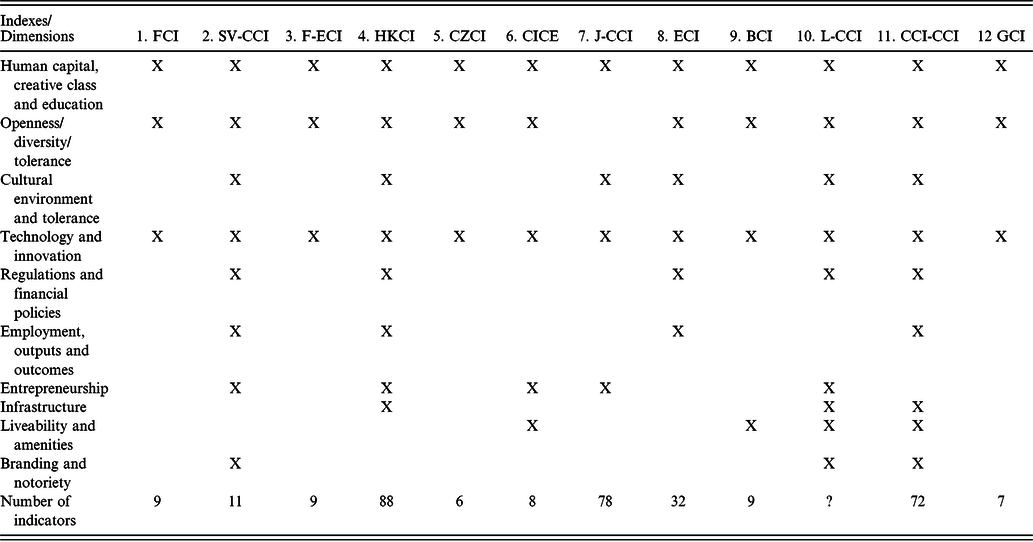
Occupations whose representatives are considered to belong to the creative class are distinguished based on the codes applied in ISCO–88.Footnote 1 This category, along with those presented in Table 1, constitutes the so-called Creativity Index. This synthetic measure (index) comprises the components of talent, tolerance and technology.

Tolerance is one of the factors determining regional development. According to Florida, it allows creative people to mark their presence. It attracts diverse and interesting people to a specific region. Greater diversity, ethnic variety and diversification of groups are factors that generally correspond to greater and more unique opportunities to experience different aspects of life. Furthermore, diversity and multifariousness provide inspiration for innovativeness.
Research (see Florida Reference Florida2010) has established that one belongs to the creative class because of one’s occupation rather than one’s skin colour, religion, nationality or orientation. The more varied the employees in the enterprise the greater the opportunities for development. On the other hand, we must not forget that diversity and differences also lead to problems, which explains such a great need for tolerance in current societies. Growth characterised by and based on tolerance allows people to open their minds to new ideas. Furthermore, the creative class has a high regard for amenities and attractions. This is reflected by the need for cultural infrastructure.
A climate that is favourable to people’s well-being also fosters the growth of business, manifested, for instance, by increased numbers of start-ups and high-tech companies. Creative individuals seek and find employment in places to which they are drawn, mainly urban conurbations. This is linked with their ‘nonconformity’ and need for expression and self-satisfaction; hence they, for instance, participate in concerts both as performers and members of the audience. The creative industries, known as the cultural sector, constitute a new area in which we can find representatives of creative capital, and which have also been recognised in the economy of many countries because of their contribution to GDP (Creative 2018, 11)
The factors determining development also include talent. This is a characteristic of an employee in the enterprise who makes an outstanding contribution to the implementation of an organisation’s strategy and has significant potential for further growth. In the literature we can encounter an elitist and egalitarian approach to talent (Szmidt Reference Szmidt2005, 71). Creativity is the lowest form of talent. It is a basic, though indirect, causative factor in socioeconomic progress because every socio-cultural transformation, each business project carried out by individuals, teams or on a massive scale, and characterised by innovativeness and value (determinants of creative work), is first conceived in the human mind (Lipka et al. Reference Lipka, Waszczak and Winnicka-Wejs2013, 9). Creative pursuits, further on, lead to innovation.
Technological capacities enabled by innovations are so diverse and their economic value is depreciated so rapidly that today’s growth-related advantages and opportunities are gained only by those entities with access to cutting-edge technologies. This is a consequence of new industrial policies and a complex approach to technological changes, as noted by the World Bank. On the other hand, innovations commonly aim at the advancement of restructuring processes and technological changes, which mainly provide solutions to the weaknesses of a sector-based as well as a horizontal approach to industrial policy. This is linked with attempts to ensure the efficient operation of public institutions, to refine newly established laws and their applicability, as well as to promote social attitudes fostering collaboration and entrepreneurship (Klincewicz Reference Klincewicz2012, 13).
Technological changes occurring in each dynamic economy are associated with greater innovativeness and competitiveness. The effects of technological advances can be observed very quickly and are frequently linked to the creation of new jobs. This is linked with the education of the future workforce, which is another factor reflecting the importance and role of technology in economic growth. Changes in the markets for products or technological processes enforce adjustments in the economy. A lack of change results in stagnation, while technology contributes to progress in the quality of life.
The factors of talent, technology and tolerance are described by different variables. Owing to a lack of data, researchers introduce numerous modifications in the indexes measuring these factors. As an example, some modifications were proposed by de Oliveira Correia (Reference de Oliveira Correia2012, 22, Table 2).
Checklist of indexes, dimensions and indicators.

FCI – Florida’s Creative Index (Reference Florida2002); SV-CCI – Silicon Valley’s Creative Community Index; F-ECI – Euro Creativity Index; HKCI – Hong Kong Creative Index; CZCI – Czech Creative Index; CICE – Composite Index of the Creative Economy; J-CCI – Creative City Index; ECI – European Creativity Index; BCI – Baltimore Creativity Index; L-CCI – Landry’s Creative City Index; CCI-CCI – Creative City Index; GCI – Global Creative Index
Source: de Oliveira Correia CM (Reference de Oliveira Correia2012).
There are far more factors affecting development and they are not explicitly defined once and for all, which is reflected by the indexes in Table 2. This is also reflected by the widespread criticism of Florida’s theory, the main points being:
-
It does not differ from the Human Capital Theory (Glaeser Reference Glaeser2004),
-
it proposes blurry definitions (Evans Reference Evans2009, 1003–1040, Markusen et al. Reference Markusen, Wassal and DeNatale2006, 43),
-
the measures of economic growth used by Florida are not accurate (Malanga Reference Malanga2004),
-
the measure of income level is ‘problematic from the perspective of social equity’ (Thomas and Darnton Reference Thomas and Darnton2006, 153–168),
-
it underestimates the problem of inequality (McCann Reference McCann2007, 188–196),
-
the concept of a creative class disregards the issues of ‘internal inequality and poverty’ (Peck Reference Peck2005, 3–5),
-
it is an inadequate approach to the relationship between creativity and economic growth (Krätke Reference Krätke2010, 835–853; Szmidt Reference Szmidt2005, 3–5),
-
the structure of the index is inadequate (Sands and Rese Reference Sands and Reese2008, 8–23),
-
the method for establishing cause-and-effect links is disputable (Gibson and Kong Reference Gibson and Kong2005, 180–195; Pratt Reference Pratt2008, 541–561).
Capacities for the Development of a Creative Class in Lithuania
It should be emphasised that the Lithuanian economy at present is mainly based on industry and agriculture. The favourable conditions fostering the development of agriculture include the large agricultural areas and quite a good climate. Industry has a 39% share in the national economy and mainly involves processing operations, since Lithuania does not have significant mineral resources. The country’s major industries are represented by manufacture of electronics, chemicals, tools, metal products, construction materials, home appliances, food, textiles, apparel and furniture. Lithuania also supports the development of oil refineries and shipyards. The industrial sector generates 30.5% of GDP and employs approximately 25% of the country’s working population. Agriculture and fishing account for 3.4% of GDP. The most important products of Lithuanian agriculture and forestry include: wheat, timber, barley, potatoes, sugar beet, wine and meat (beef, mutton and pork). Agriculture provides jobs for nearly 9% of the working population. The services sector generates 66% of GDP and employs 65.8% of the working population. The information and telecommunications sectors have the largest share in GDP (https://exportenterprises).
A review of international research related to Lithuania suggests that the country has moderate potential for development of the creative class. On the Global Creativity Index calculated for 139 countries Lithuania ranked 51st (Florida et al. Reference Florida, Mellander and King2015, 55), in the same group as the Slovak Republic, Serbia, Greece and Croatia. This means that the country’s capacities for creative capital development are moderate, compared with those in Australia, which took the top spot, the USA, which ranked second, or European countries such as Denmark, Finland and Sweden, occupying positions five, six and seven, respectively.
Another way to make an assessment is based on the CSI index, which comprises a number of quantitative and qualitative measures designed to estimate creativity at the level of a country, region and city. According to this methodology (CSI), Lithuania ranked 24 of 26 EU countries covered by the study (de Oliviera Correia Reference de Oliveira Correia2012, 7–26). This shows that the country does not rank high when it comes to development of creativity. Conversely, based on the ECI calculated for the (then) 28 EU countries Lithuania in 2014 ranked 18th (Kregzdaite Reference Kregzdaite2015, 11).
The research findings depend on the methodological assumptions adopted, index structure and availability of data. It seems interesting to find out whether or not these determinants are identical across the entire territory of the country.
Methodological Assumptions
The theory of the creative class suggests that regional economic development depends on the choice of location for operations by those owning creative capital, who generally show a preference for diversity, tolerance and openness to new ideas (Florida Reference Florida2010, 223). Therefore, it is assumed that conditions promoting the growth of a creative class (creative capital) can also be observed in various types of territorial units, such as the counties of Lithuania discussed in this article.
In line with this assumption, it was necessary to determine what available data could be adopted for the assessment of tolerance, talent and technology (3Ts). Accordingly, the measurement was based on generally available data acquired from the Statistical Yearbook of Lithuania. The study took into account information related to all the counties of the Republic of Lithuania, and pertaining to the year 2016, and in some cases to 2015. The accumulated data described, at a relative level, the areas of talent, tolerance, technology and cultural amenities.
The factor of talent was represented and characterised by variables describing the regions’ demographic situation, i.e. population density per km2 (for 2016), and population aged 15 to 70 as a percentage of the overall population of the region (for 2016). Tolerance was analysed taking into account the migration balance and divorce to marriage ratio in 2016. In source indexes (i.e. those used by Florida), technology was assessed by taking into account research and development expenditure. Owing to the lack of generally available regional-level data, the current study has examined investments in tangible fixed assets at current prices as well as value added at factor cost, according to the location of operations, for 2015. The growth of the creative class is driven by infrastructure, which is represented by cultural amenities in this study. It was assessed in terms of such specific variables as the number of theatres, museums, restaurants, libraries, cinemas and clubs (http://osp.stat.gov).
Differences between Lithuanian Regions in their Capacities for Creative Capital Development
The territory of the Republic of Lithuania currently comprises 10 counties and 60 municipalities, all of which, according to Law, count as Territorial Administrative Units. Assessment of differences in economic growth should take into account a variable showing basic information on economic results, i.e. Gross Regional Product (GRP). An increase or decrease in actual GDP is a measure of economic growth. GDP per capita is a commonly used measure of affluence. An indicator of such changes is recognised as one of the most important macroeconomic rates, as it reflects trends and assesses the state of the economy and quality of life.
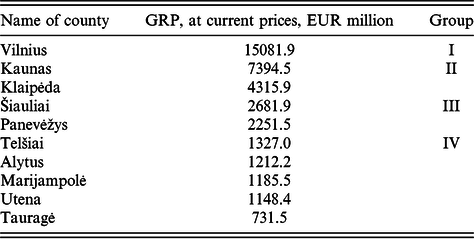
The gross regional product (Table 3) shows differences in the economies of Lithuanian regions.

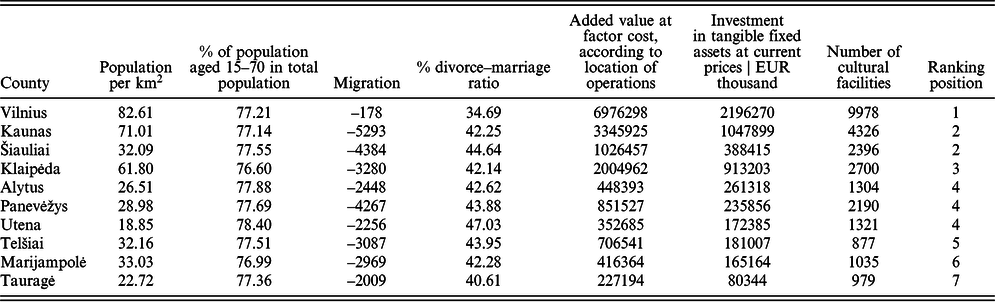
The criterion used in classifying the groups, i.e. the size of the regional product, allows one to identify Vilnius County as the leader. This is linked with the character of this area, the fact that it is the main city and the capital of the country. Groups II and III comprise two regions each, classified based on their regional product. Because of the significant variations in the size of the regional product in the other areas, group IV comprises the remaining regions. Ranks were calculated based on the analysis of factors promoting the development of creative capital; the results are listed in Table 4.

The ranking of the relevant factors in the Lithuanian counties shows the dominant role of Vilnius. This is consistent with the leading position of the area comprising the national capital and achieving the highest regional product per capita. The counties of Kaunas and Šiauliai obtained the same score in the ranking, just like another group of counties, i.e. Alytus, Panevėžys and Utena. The lowest position in the ranking was scored by Tauragė county.
These results are consistent with the regional product in these counties. This means that GRP per capita corresponds with the conditions predominant in a given area. This may suggest that capacities for the development of creative capital are not uniform throughout Lithuania, the most and the least favourable areas being Vilnius, and Tauragė respectively. A share of more than 77% of the working age population in the total population reflects a capacity for the development of human capital. The migration balance reflects tolerance for other nations. However, the negative numbers reflect outflow, rather than inflow of people, which suggests a trend of work-related migration. Values shaped by family may be recognised as favourably affecting development. An approximately 40% divorce rate shows that family values are recognised as foundational. The added value and investment rates identified correspond with the very industrial character of Vilnius and Kaunas counties.
Discussion
The ranking of Lithuanian counties suggests a clear dominance of Vilnius. The region visibly stands out for its great diversity. Its available resources seem to ensure appropriate living conditions for its inhabitants, matching western standards. A comparison of Riga, Tallinn and Vilnius shows above average rates related to the creative class in these cities. Vilnius has the largest share of the creative class among the regional capitals; Tallinn is second, and Riga is third (Dzene and Kula Reference Dzene and Kula2007, 47–49).
Vilnius County develops much faster than the national average. Compared with other counties, the region is characterised by more rapid economic development, and forecasts related to its further development are more favourable. Hopefully, the economic growth rate in the region will not decrease in the future. However, there is a large difference between the socio-economic development levels in Vilnius city and the rest of the municipalities in that county. Due to this, it is imperative that assistance from the EU Structural Funds can be used effectively in order to achieve more balanced regional development.
For a number of historical, political and economic reasons, until the late twentieth century Lithuania’s economic development was not based on free-market principles or globalisation trends. That is why the creative industries in Lithuania emerged a few decades later than in the leading European countries. However, after independence was restored in 1990 and the country again joined the family of democratic European states, Lithuania immediately adopted a new approach focusing on the development of knowledge and a creative society. It is clear that from the start of the twenty-first century onwards, creative industries have provided a significant stimulus to economic and social development in Lithuania. Since the creative industries have been recognised as a significant branch of the economy and a priority, it is important that the country’s educational system should also focus on the teaching of creativity (Biveniene Reference Biveniene2015, 6–7). This suggests that a lot of attention in Lithuania is paid to creativity and the creative industries as factors contributing to development (Snieska and Normantiene Reference Snieska and Normantiene2012). This particularly relates to the development of Lithuanian cities, with Vilnius in the leading position.
From the viewpoint of creative people, it is also important to note that in 2015 the Mercer Cost of Living Index ranked the city of Vilnius as one of the five least expensive urban areas in the EU. This fact is illustrated by the following description:
With its plenitude of green parks and pure air, and its relaxed, yet energising vibe, Vilnius offers the perfect location for business. Lithuania is so much more than its capital though; its second city Kaunas is home to a bustling international airport, and the city’s thriving cultural scene is best exemplified by the renowned international jazz festival it hosts each year in the autumn. While Klaipeda, the county’s port city, offers ferry access to Scandinavia and Lithuania’s premier tourist attraction, Nida and the Curonian Spit. (Jucecicius et al. Reference Jucecicius, Jukneviciene, Mikolaityte and Samparniene2017, 17)
The position of Vilnius County suggests that its development is promoted by its economic enterprises, cultural attractions and people who are open to the diversity characteristic of this area. Kaunas County (Kaunas 2014, 27) generates the second largest regional product and it also occupies the same position based on the relative characteristics adopted here. Higher education, which is an important aspect of development, is represented by the region’s universities with a total of 58,000 students (in 2013). The Special Economic Zone, which in addition to the development of entrepreneurship also promotes creativity, provides opportunities for growth for many businesses. Kaunas is the country’s largest industrial centre (http://www.investlithuania_Kaunas).
The creative approach can be seen not only in business operations, but also in the attitude to human resources. The fact that favourable conditions are ensured for people is an example of how a good climate for creative capital is being built. This can be seen in the approach to the development of people’s talents, which, for example, is reflected in the following comment:
Since 2008 Lithuania has been ranked among the top 5 fastest growing economies in the EU and is forecasted to continue to grow above the EU average. Added to this, Lithuania’s can-do-approach has enabled us to jump eleven places since 2013 for the ease of starting a business to 11th place globally in the World Bank’s Doing Business Report. Wanting to be the best is one thing, but making it happen is another. We understand this. We have developed our infrastructure, tax and legal framework, and most importantly talent, so that we can provide the perfect environment for business growth. (Juknevicience and Bersenaite Reference Juknevicience and Bersenaite2016, 158–165)
The second position in the ranking is shared by the counties of Kaunas and Šiauliai. In historical terms, the industrial traditions of the Šiauliai region are linked with the region’s incorporation in the Soviet Union. Today its advantages result from innovation (Juknevicience and Bersenaite Reference Juknevicience and Bersenaite2016, 158–165). Innovation can be interpreted as the outcome of operations carried out by creative capital, which seems to be consistent with the second position held by the region.
Klaipėda County occupies position three in the ranking. It is the only region of Lithuania with access to the sea. In the north it is bordered by Latvia, and to the south by the Kaliningrad region of the Russian Federation. It consists of seven municipalities, but only four of which have a coastline. One of these, Neringa, with its coastline of 60.6 km, does not have business operations except for those related to tourism, since it is located in a protected area. The economic attractiveness of the region is determined by the involvement of foreign direct investment (FDI). The employment or activity rate in Klaipėda County always slightly exceeded the national average, with differences ranging from 0.1% to 2.9%. Unemployment in 2000 and 2013 was lower than in the country as a whole; however, in 2004 and 2010 it exceeded the average rate. The lowest unemployment figures recorded at the beginning of 2013 were 4.4% below the overall national rate. Thus, it can be argued that Klaipėda County is one of the leaders in the growth of Lithuanian GDP.
Klaipėda County, together with Vilnius and Kaunas, is one of the Lithuanian regions contributing the highest surplus value. The main types of operations responsible for surplus value here include the wholesale and retail trade, transport, accommodation and food service activities (43.2%) and industry apart from construction (25.5%), which together comprise more than two thirds of the total surplus value in the region. The Port of Klaipėda is a leader among the country’s clusters of logistic services and forms the basis of its positive growth and development (Markevicius Reference Markevicius2015, 39–45). Such conditions mainly foster development based on technologies, access to which, those enterprises intending to achieve faster growth must give special attention.
Three counties, i.e. Alytus, Panevezysi and Utena, obtained the same result in the ranking. Alytus is the most forested area, with forests and woodland covering 44% of the region’s territory, particularly in the rural districts of Lazdijai and Varena (Case Study Contextual). Panevėžys region is a significant supplier of metal and electrical components for the automotive industry, with such established names as Volvo, Scania and MAN as end users of its products. Panevėžys is home to the largest concentration of Norwegian investors. Panevėžys Industrial Park, established by the Norwegian government, has been successfully attracting furniture manufacturers from Norway since 2000. The region contributes 6% to GDP, being the fifth largest contributor to the Lithuanian economy (http://www.investlithuania_Utena,%20_Panevezys). 17 Utena ranks as high as Alytus and Panevėžys:
Utena has a large pool of highly skilled professionals with experience in the energy sector. The country’s largest brewery, the Carlsberg-owned Švyturys–Utenos brand, boasts a long tradition of skill and mastery in this sector. Outside of its strong industrial competences, Utena is characterised by its scenic setting and its traditions of organic food production and niche agricultural services such as horse-breeding and training. (Draft 2000)
These descriptions reflect that these regions focus on the development of business enterprises. The factors determining development include innovation because, without this, businesses cannot compete in the market. It seems that such conditions are a good starting point for the development of creativity. Entrepreneurship and innovativeness are always accompanied by creativity.
One of the counties at the bottom of the ranking is Marijampolė County, which is mainly a rural region with agricultural land covering 67.5% of its area. It also has a large potential for the development of tourism and recreation-related activities (Ginevivius and Podvezko Reference Ginevivius and Podvezko2015).
The final position is occupied by Tauragė County. This is a typically agricultural region, with industry based on renewable energy, as well as numerous food processing operations. In a study conducted by other authors (http://www.investlithuania_Taurage) this region also received the lowest rating. On the other hand,
the region offers an established and experienced production base for the key industries of agriculture and food processing. Tauragė offers direct entry to Kaliningrad (Russia), as well as a developed private industrial park which is currently home to a number of international businesses, including companies from Scandinavia and the US. Green energy (biomass, wind power, hydro energy, and solar systems) is produced widely within the region, ensuring reduced heating costs for local businesses. (http://www.investlithuania_Taurage)
The Tauragė region has the highest rate of rural population and therefore agriculture is of key importance for its economy. Nevertheless, economically, this is one of the weakest regions of the country, with the lowest contribution to the Lithuanian GDP, and the lowest GDP per capita. This is due to the insufficient competitiveness of the Tauragė region resulting from poor productivity of the labour force, lack of capital and feeble technological progress. The educational level of the region’s population is lower compared with other regions, which is reflected by the highest rate of unqualified labour and the lowest rate of labour with good skills found there. Tauragė County attracts fewer foreign investors compared with other regions, while the companies operating in this area also tend to spend less on material investment. This situation also adversely affects the economic growth of the Tauragė region. To increase productivity it is necessary to promote investment, support initiatives facilitating improvement in labour force qualifications, attract foreign and domestic investments and support investment in innovation (http://www.investlithuania_Taurage).
Conclusions
Creative capital can be assessed using various indices. A location, in this case a county, defines capacities for linking creative individuals with the opportunities existing in the area and reflected in the economy. Favourable conditions for growth, in the areas of talent, tolerance and technology, are associated with gross regional product. Although, compared with other countries, Lithuania does not rank high in terms of creative capital, it achieves surprisingly good results in ratings of living conditions. Lithuania is recognized among the top 40 countries in the world for quality of life (Business 2015).
The above analysis shows significant differences between Lithuanian regions. The highest potential for development has been identified in Vilnius County. Culture industries reflect directions in development based on creative capital, which also corresponds with international growth trends. Differences in the potential for the development of creative capital in Lithuanian regions are linked to their historical background, yet this does not mean that development of such capital is not being encouraged in specific counties such as Kaunas and Šiauliai. The rating scored by the agricultural county of Tauragė supports Florida’s assumptions related to the slower development of creativity in regions of this type (Florida Reference Florida2010, 338–339). Our findings show that the regions of Lithuania are varied, and this is reflected in their capacities for the development of creative capital. It is important that the administrators of the specific regions recognise the need for development towards creativity and creative capital.
About the Authors
Katarzyna Szara’s research focuses on Project Management, interaction and cooperation between businesses, entrepreneurship and innovation, creativity and creative capital, creative capital in the behavioural economy, and regional economics.
Bogusław Ślusarczyk is Head of the Department of Macroeconomics and International Relations. In his research he focuses on methods of determining the competitive position of the Polish market in selected countries, trading partners, and the development of competitiveness on the micro- and macroeconomic scale after Polish accession to the EU and in the light of ongoing changes in the global economy.