Introduction
In the last decade, a growing demand of consumers for improvements in pork meat quality and an increased interest in animal welfare have led to the development of alternative pig production systems, such as outdoor rearing (Kernmeyer, Reference Kernmeyer1993). Up to now, several studies have been conducted to characterise autochthonous pig breeds such as Iberian (Rey et al., Reference Rey, Daza, López-Carrasco and López-Bote2006), Gascon (Sans et al., Reference Sans, Andrade, Ventanas and Ruiz2004), Nero Siciliano (Pugliese et al., Reference Pugliese, Calagna, Chiofalo, Moretti, Margiotta, Franci and Gandini2004) and Cinta Senese (Pugliese et al., Reference Pugliese, Bozzi, Campodoni, Acciaioli, Franci and Gandini2005) being raised in outdoor production systems in the Mediterranean area. The main purpose of these local pig breeds is the fabrication of high-quality dry-cured meat products taking advantage of their good rusticity and the natural feed resources. However, the knowledge of the performance of modern pig genotypes in outdoor conditions is very limited and might be worth testing them in regions, such as the Spanish Pyrenees Mountains, which are rich in grass, shrubs and trees, where no local breeds are raised.
The most used boar lines in Spain are Pietrain (PI) and Duroc (DU). However, reports on the quality characteristics of these genotypes are contradictory. Latorre et al. (Reference Latorre, Lázaro, Gracia, Nieto and Mateos2003a and Reference Latorre, Medel, Fuentetaja, Lázaro and Mateos2003b) reported better pork characteristics in DU-sired than in PI-sired lines whereas Glodek et al. (Reference Glodek, Kratz, Schulz and Flachowsky2004) concluded that DU-sired pigs showed inferior meat quality than PI-sired pigs. The objective of this investigation was to study the effect of sire breed on carcass characteristics, meat quality and fatty acid (FA) profile of heavy white pigs reared outdoor and intended for dry-cured products.
Material and methods
Husbandry and diets
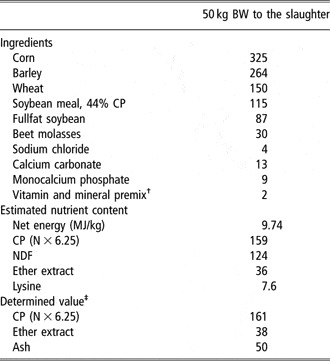
The routine of animal care and experimental procedures used in this study conformed to Boletín Oficial Estado (2005). A trial was conducted in a commercial farm located close to Pyrenees Mountains (La Fueva, Huesca, Spain) to study the influence of sire line (DU and PI) on carcass, meat and fat quality of pigs intended for dry-cured products. Female line was Landrace (LR) × Large White (LW) in both cases. A total of 70 pigs, barrows and gilts in the same proportion, were born in the second week of April and reared indoor until the third week of July, when they achieved an average BW of 50 ± 2.5 kg. Afterwards, all pigs were reared kept outdoor together until the fourth week in December (about 160 days). During the free rearing time, in a total area of 1.75 ha (250 m2/animal), pigs had free availability of grass (Festuca glauca and Poa pratensis), shrubs (Ulex parviflorus and Lavandula angustifolia) and trees (Quercus ilex and Quercus faginea), and also a limited amount (although not quantified) of acorns. Also, animals had ad libitum access to water and a pelleted barley–corn–wheat–soybean meal concentrate. The diet was formulated to meet or exceed the nutrient requirements recommended by the National Research Council (1998) for pigs of these ages. The ingredient composition, the estimated nutrient value and the determined analyses of the diets (Association of Official Analytical Chemists, 2000) are shown in Table 1. At the end of the outdoor rearing period, a subsample of 16 animals chosen at random was slaughtered (135 ± 3.6 kg BW for PI and 145 ± 3.9 kg BW for DU) and used for the study. Each of the two treatments, with barrows and gilts in the same proportion, was replicated eight times.
Ingredient composition and estimated and determined analyses of the diet (g/kg as fed)

†Supplied (mg/kg diet): retinol: 2.1; cholecalciferol: 0.03; dl-α-tocopherol: 7.37; menadione: 0.5; thiamin: 0.2; riboflavin: 2.5; pantothenic acid: 8; niacin: 15; choline: 350; pyridoxine: 0.2; cyanocobalamin: 0.015; Cu: 75; Fe: 80; Mn: 50; Zn: 110; Co: 0.1; Se: 0.2; I: 0.5.
‡According to Association of Official Analytical Chemists (2000).
Carcass quality traits
The day before slaughter, pigs were maintained without feed for 7 h and transported 80 km to a local slaughterhouse (Barbastro, Huesca, Spain) where they had a 10 h rest period with full access to water but not feed. Pigs were electrically stunned (225–380 V, 0.5 A, 5–6 s), exsanguinated and eviscerated according to standard commercial procedures. The carcasses were then split down the midline and hot weight was recorded. Afterwards, the head was removed at the atlanto-occipital junction. At 45 min post mortem, carcass length (from the posterior edge of the Symphysis pubis to the anterior edge of the first rib), ham length (from the anterior edge of the Symphysis pubis to the hock joint), ham circumference (at its widest side), minimum fat thickness over the Gluteus medius muscle (GM) and backfat thickness (BF; between the third and fourth last ribs on the midline of the carcass) were measured on the left side of each carcass. Afterwards, carcasses were quartered by dissecting the legs, loins, shoulders, bellies, tenderloins, neck fat and BF according to the simplified EC-reference method (Branscheid et al., Reference Branscheid, Dobrowolski and Sack1990). Hams, shoulders, loins and bellies from each carcass were trimmed and weighed for yield evaluation.
Meat quality traits
After carcass data collection, a section of 400 ± 20 g of the Longissimus dorsi muscle (LD) was excised, at the level of the last rib from the left side loin of each carcass. Muscle chops were vacuum-packed and stored in individual plastic bags and frozen at −20°C until subsequent analysis. Chops were thawed for 24 h at 4°C, removed from packages, blotted dry and weighed. Thawing losses were calculated by dividing the difference in weight between the fresh and thawed samples by the initial fresh weight. Afterwards, meat colour was evaluated with a chromameter (Model no. 52-00, Crison Instruments SA, Barcelona, Spain), previously calibrated with a pure white colour tile, using objective measurements (Commission International de l’Eclairage, 1976). An average of three observations per sample were used to measure the lightness (L*) and two colour co-ordinates (redness, a*; yellowness, b*). Additionally, the chroma value (c* = √(a*2 + b*2)), which describes the intensity of the colour, was calculated (Wyszcecki and Stiles, Reference Wyszcecki and Stiles1982).
The intramuscular fat (IMF), crude protein and moisture proportions were determined with a near-infrared transmittance meat analyzer (Infratec® 1265; Tecator, Höganäs, Sweden). The monochromator contained a 50 W tungsten lamp and a diffraction grating that created monochromatic light. Chops were trimmed of all visible external fat, minced and then distributed in the cup ring equipped with a plastic bottom plate (100 mm diameter and 15 mm deep). The measurements were made by spectroscopy in near-infrared between 700 and 1100 nm.
Afterwards, cooking loss was determined by the method described by Honikel (Reference Honikel1998). Briefly, an LD slice was taken from each chop, weighed (200 ± 15 g), placed in a plastic bag and cooked to an internal temperature of 70°C in a 75°C water bath (Precisterm; J.P. Selecta S.A., Barcelona, Spain). Internal temperature was monitored during cooking with a handheld temperature probe (model HI 9063; Hanna Instruments, Woonsocket, RI, USA). Cooked samples were allowed to cool at 15°C for 30 min, blotted dry and weighed. The difference between pre- and post-cooking weights was divided by the pre-cooked weight to calculate cooking loss percentage.
Fatty acid profile of subcutaneous and intramuscular fat
The BF samples, including fat layers, skin and lean, were taken at tail insertion in the coxal region of the left side of each carcass, stored in individual plastic bags and frozen at −20°C until subsequent analysis. The day before the analysis, samples were thawed and skin and lean were removed. Then, 50 g of minced sample and 50 ml of diethyl ether were mixed in a blade homogenizer (Masticator IUL Instruments, Barcelona, Spain) for 2 to 4 min at ambient temperature. After filtration, the extract was placed in a rotary evaporator (Büchi R-205; Buchi Labortechnik AG, Flawil, Switzerland) provided with a heating bath at 48 ± 2°C for 3 to 4 min. A sample of 0.2 ± 0.01 g of extracted fat was dissolved in 4 ml of n-hexane and in 200 μl of KOH 2 M in methanol. After vigorous shaking at 2000 r.p.m. for 1 min, the solution was left to decant for 30 min and 0.5 μl were injected into a gas chromatograph (Autosystem XL Agilent Technologies 6890N Net Work GC System; Perkin-Elmer, Boston, USA) equipped with a flame ionisation detector, a Hamilton injector, a tubochrom 4 software and a 30 m to 0.32 mm Omegawax 320 capillary column (Supelco, Bellefonte, PA, USA) with a stationary phase (0.25 μm thickness). The inlet and detector temperature was 260°C and the initial temperature of the oven was 190°C for 2 min increasing to 205°C at a rate of 5°C/min for 3 min. The carrier gas (helium) flow rate was 0.4 ml/min. Identification of FA was accomplished comparing retaining times for standards and samples. Data were reported as the proportion of the total area (%) of the injected methyl esters. The percentages of total saturated FA (SFA), monounsaturated FA (MUFA), polyunsaturated FA (PUFA), unsaturated FA (UFA) and also PUFA/SFA ratio were calculated from individual FA percentages.
Statistical analyses
Data were analysed as a completely randomised design using the GLM procedure of Statistical Analysis Systems Institute (1990). The model included the sire line as main effect and the carcass weight as a covariate to analyse carcass traits. Data in tables are presented as least-square means for carcass parameters and as means for meat traits and FA profile. The individual pig was the experimental unit for statistical analysis.
Results
Carcass quality traits
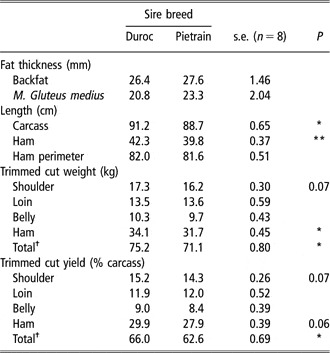
The thickness of BF and fat covering the GM muscle was similar between genotypes (P > 0.10) (Table 2). However, DU-sired pigs had longer carcasses (91.2 v. 88.7 cm; P < 0.05) and hams (42.3 v. 39.8 cm; P < 0.01) than PI-sired pigs. Weight of primal lean cuts (shoulders + loins + bellies + hams) was higher in DU than in PI offspring (75.2 v. 71.1 kg; P < 0.05) due to the higher weight of hams (34.1 v. 31.7 kg; P < 0.05) and shoulders (17.3 v. 16.2 kg; P = 0.07). Also, the DU progeny tended to show higher yield of trimmed shoulders (15.2% v. 14.3%; P = 0.07) and hams (29.9% v. 27.9%; P = 0.06) than the PI progeny. Therefore, primal trimmed cut yield was higher in DU than in PI crossbreed (66.0% v. 62.6%; P < 0.05).
The effect of sire breed on carcass traits of outdoors pigs

*P < 0.05; **P < 0.01.
†Shoulder + loin + ham + belly.
Meat quality traits
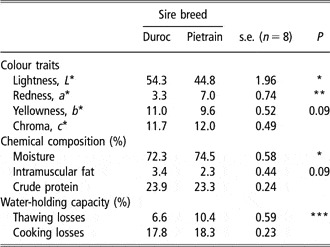
Loin from the DU crossbreed had higher lightness (L*) (54.3 v. 44.8; P < 0.05) and yellowness (b*) (11.0 v. 9.6; P = 0.09 but was less red (a*) (3.3 v. 7.0; P < 0.01) than loin from the PI crossbreed (Table 3). Pork from DU-sired pigs had less moisture percentage (72.3% v. 74.5%; P < 0.05) and tended to show higher IMF proportion (3.4% v. 2.3%; P = 0.09) than meat from PI-sired pigs. Also, the LD from DU-sired pigs had lower thawing losses (6.6% v. 10.4%; P < 0.001) than LD from PI-sired pigs but both crossbreeds showed similar cooking losses (P > 0.10).
The effect of sire breed on M. Longissimus dorsi traits of outdoors pigs

*P < 0.05; **P < 0.01; ***P < 0.001.
Fatty acid profile of subcutaneous and intramuscular fat
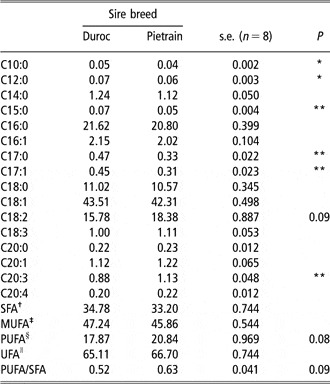
Although BF of DU-sired pigs showed higher levels of C10:0 (0.05% v. 0.04%; P < 0.05), C12:0 (0.07% v. 0.06%; P < 0.05), C15:0 (0.07% v. 0.05%; P < 0.01) and C17:0 (0.47% v. 0.33%; P < 0.01) than PI-sired pigs, the SFA proportion was similar between genotypes (P > 0.10) (Table 4). Also, although DU crossbreeds had a higher level of C17:1 (0.45% v. 0.31%; P < 0.01) than the PI crossbreed, no effect of sire genotype was detected on MUFA proportion (P > 0.10). However, DU-sired pigs tended to show lower PUFA percentage than PI-sired pigs (17.87% v. 20.84%; P = 0.08) due to the lower proportion in C18:2 (15.78% v. 18.38%; P = 0.09) and C20:3 (0.88% v. 1.13%; P < 0.01). Crossbreed did not modify UFA percentages (P > 0.10) but the DU progeny tended to show a lower PUFA/SFA ratio than the PI progeny (0.52% v. 0.63%; P = 0.09).
The effect of sire breed on fatty acid composition (%) of subcutaneous fat of outdoors pigs

*P < 0.05; **P < 0.01.
†∑ Saturated fatty acids (SFAs) = C10:0 + C12:0 + C14:0 + C15:0 + C16:0 + C17:0 + C18:0 + C20:0.
෠Monounsaturated fatty acids (MUFAs) = C16:1 + C17:1 + C18:1 + C20:1.
§∑ Polyunsaturated fatty acids (PUFAs) = C18:2 + C18:3 + C20:3 + C20:4 + C22:4 + C22:5.
∥∑ Unsaturated fatty acids (UFAs) = MUFA + PUFA.
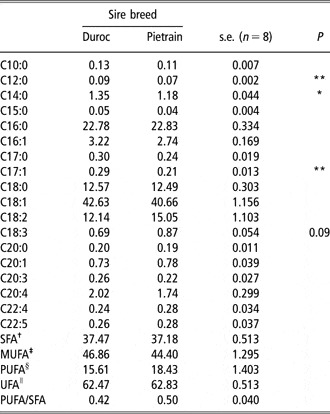
Although the IMF of DU progeny had higher levels of C12:0 (0.09% v. 0.07%; P < 0.01) and C14:0 (1.35% v. 1.18%; P < 0.05) than PI progeny, the SFA proportion was similar between genotypes (P > 0.10) (Table 5). Also, DU offspring showed higher levels of C17:1 (0.29% v. 0.21%; P < 0.01) and tended to show lower percentage of C18:3 (0.69% v. 0.87% P = 0.09) than PI offspring but no influence of crossbreed was detected on MUFA or PUFA proportions (P > 0.10). Also, UFA or PUFA/SFA ratios were not affected by crossbreed (P > 0.10).
The effect of sire breed on fatty acid composition (%) of intramuscular fat (M. Longissimus dorsi) of outdoors pigs

*P < 0.05; **P < 0.01.
†∑ Saturated fatty acids (SFAs) = C10:0 + C12:0 + C14:0 + C15:0 + C16:0 + C17:0 + C18:0 + C20:0.
෠Monounsaturated fatty acids (MUFAs) = C16:1 + C17:1 + C18:1 + C20:1.
§∑ Polyunsaturated fatty acids (PUFAs) = C18:2 + C18:3 + C20:3 + C20:4 + C22:4 + C22:5.
∥∑ Unsaturated fatty acids (UFAs) = MUFA + PUFA.
Discussion
Carcass quality traits
Genotype did not affect carcass fat thickness, which agrees with Latorre et al. (Reference Latorre, Lázaro, Gracia, Nieto and Mateos2003a) who compared DU and PI × LW-sired pigs. Traditionally, it has been accepted that DU is a fatter breed than PI (Nieuwhof et al., Reference Nieuwhof, Kanis, Van der Hel, Vestergen, Huisman and Van der Wal1991; Ellis et al., Reference Ellis, Webb, Avery and Brown1996). However, Lonergan et al. (Reference Lonergan, Huff-Lonergan, Rowe, Kuhlers and Jungst2001) found that selection for lean growth efficiency in DU resulted in lines with more lean gain and higher percentage of carcass lean at the expense of fat. Latorre et al. (Reference Latorre, Medel, Fuentetaja, Lázaro and Mateos2003b) confirmed these results in a comparative study between DU and PI × LW-sired pigs.
Similar to Edwards et al. (Reference Edwards, Bates and Osburn2003), DU-sired pigs showed 2.8% and 6.3% longer carcasses and hams, respectively, than PI-sired pigs but no differences were detected in ham perimeter. Latorre et al. (Reference Latorre, Medel, Fuentetaja, Lázaro and Mateos2003b) reported similar ham perimeter but lower differences in carcass and ham length (1.6% and 4.3%, respectively) comparing DU and PI × LW-sire lines slaughtered at lower weights. The references about carcass and ham size in outdoor pigs are scarce but Enfält et al. (Reference Enfält, Lundström, Hansson, Lundeheim and Nyström1997) reported that physical exercise does not seem to influence skeletal development. These results go against the preference of pork processors for short and easy-to-handle carcasses or cuts, but meet the requirements of Spanish consumers for long and narrow cuts as these characteristics are associated with the more popular Iberian hams.
The existing data in the literature about the influence of PI and DU on the proportion of lean cuts are conflicting. Traditionally, PI pigs have shown consistently higher ham yield than DU pigs (Oliver et al., Reference Oliver, Gispert and Diestre1993). However, García-Macías et al. (Reference García-Macías, Gispert, Oliver, Diestre, Alonso, MuñozLuna, Siggens and CuthbertHeavens1996) observed that the proportion of lean cuts was similar between both breeds and Latorre et al. (Reference Latorre, Lázaro, Gracia, Nieto and Mateos2003a and Reference Latorre, Medel, Fuentetaja, Lázaro and Mateos2003b) found that lean cut yield was higher for DU than for PI × LW offspring. Our results indicate that DU boars had a higher percentage of trimmed lean cuts than PI boars, and the difference was mostly due to the greater proportion of hams and shoulders. On the other hand, in the present trial, the yield of loins and shoulders is similar between crossbreeds but the yield of hams was lower than that reported by Latorre et al. (Reference Latorre, García-Belenguer and Ariño2008a) with DU × (LR × LW) pigs reared indoor and slaughtered at similar weights. The reason could be that outdoor rearing would induce greater development of the ham muscles compared to the LD (Enfält et al., Reference Enfält, Lundström, Hansson, Lundeheim and Nyström1997).
Meat quality traits
The references about the influence of terminal boar genotype on meat colour are conflicting. Most authors have not detected any effect of breed on meat colour as measured by visual scores (Ellis et al., Reference Ellis, Webb, Avery and Brown1996), objective parameters (L*, a* and b*; Nieuwhof et al., Reference Nieuwhof, Kanis, Van der Hel, Vestergen, Huisman and Van der Wal1991) or myoglobin content (García-Macías et al., Reference García-Macías, Gispert, Oliver, Diestre, Alonso, MuñozLuna, Siggens and CuthbertHeavens1996). However, loins from DU crossbreed had more lightness but were paler than those from PI crossbreed, in agreement with Latorre et al. (Reference Latorre, Lázaro, Gracia, Nieto and Mateos2003a) who found higher a* values in loin from PI × LW than in that from DU-sired pigs.
In accordance with Nieuwhof et al. (Reference Nieuwhof, Kanis, Van der Hel, Vestergen, Huisman and Van der Wal1991) and Latorre et al. (Reference Latorre, Medel, Fuentetaja, Lázaro and Mateos2003b), loins from DU-sired pigs showed less moisture but more IMF proportions than loins from PI-sired pigs. However, the difference detected in IMF in the current trial was very high (47%), which might be due, in part, to the heavier carcass weight of DU-sired than PI-sired pigs. In fact, Latorre et al. (Reference Latorre, Medel, Fuentetaja, Lázaro and Mateos2003b) found an increase of IMF as slaughter weight increased in similar pigs. On the other hand, the higher daily gains of DU-sired than that of PI-sired animals could be also responsible for the high differences in IMF between crossbreds. Suzuki et al. (Reference Suzuki, Kadowaki, Shibata, Uchida and Nishida2005) reported that the correlations between daily growth and IMF differ according to the pig genotype, this relationship being positive in DU crossbreds and negative with other genotypes. Traditionally, a higher IMF content has been associated with more juiciness and greater acceptability of the meat (Barton-Gade, Reference Barton-Gade1987; Ellis et al., Reference Ellis, Webb, Avery and Brown1996). However, when pigs are intended for dry-cured processing, the IMF even achieves higher value because the dehydration makes the product dry and therefore the juiciness is sustained mainly in the lipid content (Ruiz-Carrascal et al., Reference Ruiz-Carrascal, Ventanas, Cava, Andrés and García2000). However, in the present trial, the IMF levels were lower than those found in local outdoor breeds slaughtered at similar weights such as Iberian (4.7–8.7%; Ventanas et al., Reference Ventanas, Ventanas, Jurado and Estévez2006), Cinta Senese (4.0%; Pugliese et al., Reference Pugliese, Bozzi, Campodoni, Acciaioli, Franci and Gandini2005) or Nero Siciliano (4.3%; Pugliese et al., Reference Pugliese, Calagna, Chiofalo, Moretti, Margiotta, Franci and Gandini2004). An interesting observation in the present trial was that the DU progeny had similar BF but more IMF fat than the PI progeny, which is in agreement with the results of Latorre et al. (Reference Latorre, Lázaro, Gracia, Nieto and Mateos2003a and Reference Latorre, Medel, Fuentetaja, Lázaro and Mateos2003b) comparing DU and PI × LW-sire lines. This result confirms the weak relationship between these two variables (Huff-Lonergan et al., Reference Huff-Lonergan, Bass, Malek, Dekkers, Prusa and Rothschild2002; Latorre et al., Reference Latorre, Pomar, Faucitano, Gariépy and Méthot2008b).
Cooking losses were not affected by genotype but thawing losses were lower in DU than in PI-sired pigs, which agree with Nieuwhof et al. (Reference Nieuwhof, Kanis, Van der Hel, Vestergen, Huisman and Van der Wal1991) and Latorre et al. (Reference Latorre, Lázaro, Gracia, Nieto and Mateos2003a), indicating that, in general, water-holding capacity is higher for DU-sired than for PI-sired lines. The higher IMF proportion and the lower thawing losses in DU may contribute to the higher tenderness scores reported for DU genetics in previous studies (Huff-Lonergan et al., Reference Huff-Lonergan, Bass, Malek, Dekkers, Prusa and Rothschild2002; Latorre et al., Reference Latorre, Lázaro, Gracia, Nieto and Mateos2003a).
Fatty acid profile of subcutaneous and intramuscular fat
The FA values were acceptable but the effect of crossbreed was higher on the BF than on the IMF. The proportions of SFA and PUFA of the BF found in the present trial (34% and 19%, respectively) differ than those reported by Latorre et al. (Reference Latorre, García-Belenguer and Ariño2007) (39% and 15%, respectively) for heavy pigs reared indoor. The lower level of SFA in outdoor pigs is in agreement with several authors who have studied the effect of rearing system (out- and indoor) in local pig breeds, such as Cinta Senese (Pugliese et al., Reference Pugliese, Bozzi, Campodoni, Acciaioli, Franci and Gandini2005), Nero Sicilano (Pugliese et al., Reference Pugliese, Calagna, Chiofalo, Moretti, Margiotta, Franci and Gandini2004) or Iberian (Rey et al., Reference Rey, Daza, López-Carrasco and López-Bote2006) and also in commercial breeds (Lebret et al., Reference Lebret, Massabie, Granier, Juin, Mourot and Chevillon2002). The reason for the higher percentage of PUFA in outdoors pigs could be that the grass intake increases the proportion of C18:3 (Rey et al., Reference Rey, Daza, López-Carrasco and López-Bote2006) and grass is generally considered to have a high content of alpha-linolenic acid (Högberg et al., Reference Högberg, Pickova, Stern, Lündstrom and Bylund2004). However, the MUFA proportion found in the current trial is similar to that found in indoor pigs, which was unexpected because Sans et al. (Reference Sans, Andrade, Ventanas and Ruiz2004) and Pugliese et al. (Reference Pugliese, Calagna, Chiofalo, Moretti, Margiotta, Franci and Gandini2004 and Reference Pugliese, Bozzi, Campodoni, Acciaioli, Franci and Gandini2005) reported higher MUFA percentage in fat from outdoor pigs, essentially due to the high level of C18:1. Acorn is characterised by a higher content of MUFA and a lower content of PUFA with respect to concentrate feed (Cava et al., Reference Cava, Ruiz, López-Bote, Martín, García, Ventanas and Antequera1997). The reason for the results of the present trial could be that the availability of acorns was limited and maybe it was not enough to detect differences in fat quality. On the other hand, the PUFA/SFA ratio is a criterion to evaluate the nutritional quality of pork, a ratio between 0.4 and 1.0 being recommended (Enser, Reference Enser2000). In our study, the PUFA/SFA ratio of LD corresponded to the recommended value, but crossbreed had a little effect on it. Consequently, extensive rearing system could improve the dietetic property of fat and the FA profile could be adequate for dry-cured processing because of its adequate technological properties. The composition of the fat seems to have positive consequences on the development of flavour during the processing, which is one of the main features determining the acceptability of dry-cured products (Ruiz-Carrascal et al., Reference Ruiz-Carrascal, Ventanas, Cava, Andrés and García2000).
No differences between sire breeds were observed on MUFA, PUFA, UFA or SFA of LD. Similarly, no influence of sire genotype was found on SFA or MUFA of BF. However, BF from DU-sired pigs tended to show lower PUFA than PI-sired pigs, in agreement with Raj et al. (Reference Raj, Skiba, Weremko, Fandejewski, Migdal and Borowiec2005) who compared the same crossbreeds. However, Glodek et al. (Reference Glodek, Kratz, Schulz and Flachowsky2004) detected higher PUFA and Omega 3 FA in LD from DU than those from PI offspring. The reason for the discrepancies is unknown but Jacyno et al. (Reference Jacyno, Pietruszka, Kolodziej and Czarnecki2002) found lower UFA in the BF from the progeny of crossbreed DU females × PI males than in the progeny of crossbreed DU males × PI females, suggesting that the UFA proportion depends on the breeds used as boar and as sow. The higher proportion of C18:2 in BF of PI than that of DU-sired pigs has to be remarked. High content of linoleic acid reduces consistency of subcutaneous fat and increases fat oxidation rate (Wood et al., Reference Wood, Enser, Fisher, Nute, Sheard, Richardson, Hughes and Whittington2008), which might affect negatively the colour, aroma and flavour of end products. Also, Warnants et al. (Reference Warnants, Van Oeckel and Boucqué1996) concluded that, although not for pork, problems of consistency or oxidative stability could occur for cured meat preparations if PUFA is over 22%, a level that was not achieved in any of the treatments studied.
Conclusions
DU-sired pigs had higher trimmed lean cut yield in carcass and tended to show higher IMF proportion in meat than PI-sired pigs. The differences between crossbreeds in fatty acid composition were scarce but higher in BF than in LD; the subcutaneous fat from DU-sired pigs tended to show lower PUFA proportion than that from PI-sired pigs. Both sire breeds can be used successfully under outdoor conditions but the DU boar line is more adequate than the PI boar line for heavy-weight crossbreeds intended for dry-cured meat industry.
Acknowledgements
The authors would like to thank M. C. Salinas and R. Castillón (La Fueva, Huesca, Spain) for the work at farm, local slaughterhouse at Barbastro (Huesca, Spain) for the use of the facilities, and Carnes y Embutidos Casa Gorré (Boltaña, Huesca, Spain) for the cession of the samples. Also thanks to G. Ripoll for the meat colour measurement.