INTRODUCTION
For conservation to succeed in the 21st century, innovative partnerships to conserve biodiversity are urgently needed (Vermeulen & Sheil Reference Vermeulen and Sheil2007; Boutin Reference Boutin2010; Rands et al. Reference Rands, Adams, Bennun, Butchart, Clements, Coomes, Entwistle, Hodge, Kapos, Scharlemann, Sutherlands and Vira2010). Nature-based tourism has been much cited as providing one such partnership (Goodwin & Swingland Reference Goodwin and Swingland1996; Balmford et al. Reference Balmford, Beresford, Green, Naidoo, Walpole and Manica2009; Hall Reference Hall2010) because it can harness economic and human values to contribute to conservation (Diamantis Reference Diamantis1999; Kiss Reference Kiss2004; Naidoo & Adamowicz Reference Naidoo and Adamowicz2005). The individuals, organizations and societies that rely on a nature-based tourist attraction have an interest in its conservation, otherwise their income base and livelihoods are at risk (Spenceley & Goodwin Reference Spenceley and Goodwin2007; Buckley Reference Buckley2009; Hall Reference Hall2010). Sustainable nature-based tourism is defined as the direct enjoyment of relatively undisturbed natural areas in a non-damaging way that contributes to the continued conservation and management of the areas used (Valentine Reference Valentine1992; Orams Reference Orams1995).
Nature-based tourism can contribute to conservation through four mechanisms. First, agglomerations of tourism enterprises can make a significant regional economic contribution, leading to policy support for biodiversity conservation initiatives that attracts tourists, such as national parks and protected areas (Rotherham et al. Reference Rotherham, Doncaster and Egan2005; Buckley Reference Buckley2009; Frost & Hall, Reference Frost and Hall2009). Second, nature-based tourism enterprises can take direct conservation action to improve their local environment and generate environmental awareness (Carlsen et al. Reference Carlsen, Getz and Ali-Knight2001; Curtin & Wilkes Reference Curtin and Wilkes2005; Russell et al. Reference Russell, Lafferty and Loudoun2008), thereby mitigating against the negative impacts of tourism activities on the environment (Buckley Reference Buckley2009). These actions include responsible wildlife-viewing practices, minimizing energy and water use, and offsetting carbon emissions. Third, tourists may improve their environmental behaviours as a result of positive visitor experiences and improve environmental practices in their own lives, particularly when the experience is interpreted by a tour guide (Birtles et al. Reference Birtles, Valentine, Curnock, Arnold and Dunstan2002; Zeppel & Muloin Reference Zeppel and Muloin2008). Finally, visitors can also become ‘ambassadors’ for conservation initiatives (Powell et al. Reference Powell, Kellert and Ham2008), for example by contributing to an international protest if a resource is under threat (for example see Dobson et al. Reference Dobson, Borner and Sinclair2010).
However, nature-based tourism enterprises are under increasing pressure as the biodiversity they promote to visitors continues to degrade in many areas (Gössling & Hall Reference Gössling and Hall2006; Marshall et al. Reference Marshall, Marshall, Abdulla, Rouphael and Amr2010; Biggs et al. Reference Biggs, Biggs, Dakos, Scholes and Schoon2011). Recent research suggests that the lifestyle values of nature-based tourism enterprises may be important in building the resilience of enterprises to crises (Biggs Reference Biggs2011). A resilient enterprise is defined as one that can maintain or grow its income and employment in the face of crises and change (Biggs Reference Biggs2011).
Lifestyle values refer to the desire of enterprise owners and staff to live in a particular location because of its amenity values and associated quality of life. They form part of an entrepreneurial strategy that has lifestyle goals, often including the desire to find a sense of place, as well as profit-driven motives (Ateljevic & Doorne Reference Ateljevic and Doorne2000; Bensemann & Hall Reference Bensemann and Hall2010; Lai & Lyons Reference Lai and Lyons2011). Lifestyle values are a type of tacit value that is closely related to ‘sense of place’ and ‘attachment to place’ (Davenport & Anderson Reference Davenport and Anderson2005; Anthony et al. Reference Anthony, Atwood, August, Byron, Cobb, Foster, Fry, Gold, Hagos, Heffner, Kellogg, Lellis-Dibble, Opaluch, Oviatt, Pfeiffer-Herbert, Rohr, Smith, Smythe, Swift and Vinhateiro2009), which respectively refer to the way in which people assign meanings to places and derive meaning in their lives from places. Some place meanings translate into strong emotional bonds that influence attitudes and behaviours within places (Davenport & Anderson Reference Davenport and Anderson2005).
Tacit values, such as lifestyle values, are the most influential in determining stakeholder participation in efforts such as conservation, because they derive from and shape individual experiences and beliefs (Anthony et al. Reference Anthony, Atwood, August, Byron, Cobb, Foster, Fry, Gold, Hagos, Heffner, Kellogg, Lellis-Dibble, Opaluch, Oviatt, Pfeiffer-Herbert, Rohr, Smith, Smythe, Swift and Vinhateiro2009). A community comprised of lifestyle-oriented entrepreneurs, such as the reef tourism sector, may therefore lead to the emergence of a community of practice for reef tourism and reef conservation (Barthel et al. Reference Barthel, Folke and Colding2010), where a group, or groups, of people share a concern for something that they do and learn how to do it better through regular interaction (Cundill et al. Reference Cundill, Cumming, Biggs and Fabricius2012). Such a community of practice in reef tourism, enabled by shared lifestyle values, can foster social learning for the management of reef tourism and conservation (Tidball et al. Reference Tidball, Krasny, Svendsen, Campbell and Helphand2010). Thus, the emotional attachments of owners and staff of lifestyle tourism enterprises to their local environment and community create a community committed to a location and its conservation (Carlsen et al. Reference Carlsen, Getz and Ali-Knight2001; Davenport & Anderson Reference Davenport and Anderson2005; Cooke Reference Cooke2007).
Thus, enterprises whose owners and staff are motivated by lifestyle values are also likely to be reluctant to abandon the enterprise and location during difficult times (Getz Reference Getz2004; Roberts & Tribe Reference Roberts and Tribe2008). Lifestyle-driven entrepreneurs are therefore likely to stay in a nature-tourism sector for longer, and under more trying circumstances, than businesses solely driven by profit (Getz Reference Getz2004; Biggs Reference Biggs2011), and participate in a community of practice (such as reef conservation; Davenport & Anderson Reference Davenport and Anderson2005; Anthony et al. Reference Anthony, Atwood, August, Byron, Cobb, Foster, Fry, Gold, Hagos, Heffner, Kellogg, Lellis-Dibble, Opaluch, Oviatt, Pfeiffer-Herbert, Rohr, Smith, Smythe, Swift and Vinhateiro2009; Barthel et al. Reference Barthel, Folke and Colding2010).
To date, relationships between lifestyle values and conservation behaviours have been explored in agricultural systems (see Davenport & Anderson Reference Davenport and Anderson2005; Pannell & Wilkinson Reference Pannell and Wilkinson2009) and the rural hospitality sector (for example Carlsen et al. Reference Carlsen, Getz and Ali-Knight2001) The contribution of this paper is to empirically explore the relationship between lifestyle values, conservation ethics and actions, and the resilience of enterprises that operate in the coral reef tourism sector.
We focus on reef tourism enterprises on Australia's Great Barrier Reef (GBR) because of the reef's global significance for biodiversity (McCook et al. Reference McCook, Ayling, Cappo, Choat, Evans, De Freitas, Heupel, Hughes, Jones, Mapstone, Marsh, Mills, Molloy, Pitcher, Pressey, Russ, Sutton, Sweatman, Tobin, Wachenfeld and Williamson2010) and nature-based tourism (Scott et al. Reference Scott, Hall and Gössling2012). Specifically, we address the following questions: (1) Are lifestyle values of tourism enterprises related to a higher level of enterprise support for conservation? (2) Are there differences in the extent of support for conservation between more resilient and less resilient enterprises? (3) What are the barriers and opportunities for tourism enterprises to contribute to conservation?
METHODS
Study area
The Great Barrier Reef Marine Park, created in 1975 (and subsequently designated as a World Heritage Area) to manage multiple uses and preserve the reef ecosystem, is managed by the Great Barrier Reef Marine Park Authority (GBRMPA). Domestic and international tourism to the GBR contributes AU$ 5.8 billion (AU$ 1 = US$ 1.07, May 2011) to the Australian economy per annum and sustains 55 000 jobs (Access Economics 2007). The majority of reefs on the GBR lie over 20 km offshore and require well-equipped boats to access. While there are over 900 active permits for conducting tourism operations in the GBRMP (GBRMPA 2009a), 50 enterprises are responsible for almost three-quarters of the tourist visitor days. Reef tourism enterprises on the GBR pay an Environmental Management Charge to GBRMPA of AU$ 5.50 per tourist per day (GBRMPA 2010), primarily to recoup a percentage of the cost of managing the Great Barrier Reef Marine Park; it contributed over AU$ 7 million (18.5%) to GBRMPA's annual budget in 2007 (GBRMPA 2009a).
The GBR is characterized by a strong relationship between reef tourism enterprises and reef management agencies (Harriot Reference Harriot2002). The contribution of tourism enterprises to control outbreaks of coral-feeding crown-of-thorns starfish (Acanthaster planci) provides an example of this relationship. Since the 1960s, outbreaks of crown-of-thorns starfish have led to mass mortality of corals (Brodie et al. Reference Brodie, Fabricius, De'ath and Okaji2005; De'ath & Fabricius Reference De'ath and Fabricius2010). Large-scale crown-of-thorns starfish outbreaks are a recent phenomenon probably related to a combination of fishing pressure and high nutrient loads from terrestrial run-off (Jackson et al. Reference Jackson, Kirby, Berger, Bjorndal, Botsford, Bourque, Bradbury, Cooke, Erlandson, Estes, Hughes, Kidwell, Lange, Lenihan, Pandolfi, Peterson, Steneck, Tegner and Warner2001; Brodie et al. Reference Brodie, Fabricius, De'ath and Okaji2005). The tourism industry has made large investments to preserve areas of living reef from crown-of-thorns starfish around tourist facilities by actively monitoring and removing starfish (Harriot Reference Harriot2002). Furthermore, since 2009, GBRMPA has actively provided incentives for conservation practices by allowing enterprises with Advanced Ecotourism certification with Ecotourism Australia to obtain an extended permit of 15 years for operating tours to certain areas on the GBR. Advanced Certification with Ecotourism Australia is awarded to enterprises that commit to achieving best practice in resource use, ecological sustainability and the provision of quality ecotourism experiences (Ecotourism Australia 2010). In addition, GBRMPA has also recently initiated a Climate Action Certification scheme that operators have begun to participate in (GBRMPA 2011; Zeppel Reference Zeppel2011).
Interviews
Semi-structured interviews (n = 48) with owners and senior managers of reef tourism enterprises were conducted in the Cairns and the Whitsundays regions, where c. 88% of tourist visits to the GBR have occurred since 1994 (GBRMPA 2010). Our interviews targeted enterprises whose dominant source of income was taking visitors to reef attractions to dive and snorkel. Reef tourism enterprises that met this criterion were compiled using the GBRMPA list of Ecotourism Australia accredited operators, internet searches and meetings with local tourism offices (Biggs Reference Biggs2011) (n = 76). The 76 enterprises were contacted on at least three occasions by telephone and email, and the 48 enterprises willing to be interviewed were included in this study. We conducted one interview per enterprise. We interviewed enterprise owners and senior managers because they play a leading role in determining the fate of particularly small and medium-sized enterprises. We therefore assumed that the responses of the interviewees represented the response of the enterprises. This assumption, and the role that enterprise size plays in enterprise behaviour (Hall & Williams Reference Hall and Williams2008; Biggs Reference Biggs2011), led us to eliminate one large enterprise from the sample because it had > 500 employees. This enterprise was nearly five times the size of the next largest enterprise measured by the number of employees. On average, the enterprises included in our analysis had 22.3 employees. In some cases, pertinent quotes were recorded verbatim (but interviews were not tape-recorded). Interviews varied in length from 25 to 90 minutes, and not all enterprises responded to all the survey questions.
Conservation support and action
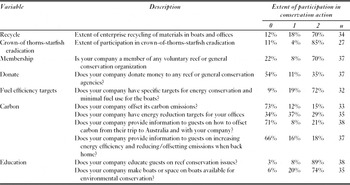
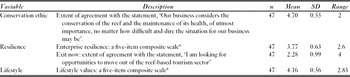
We measured the conservation ethic of enterprises, their participation in conservation actions, their perceptions about climate change and the barriers that enterprises face in participating in conservation. We also investigated the conservation actions that enterprises participated in by asking about eight conservation actions: recycling materials, crown-of-thorns starfish eradication programmes, fuel efficiency targets, carbon emissions reduction programmes, contribution to education on reef conservation issues, membership of voluntary reef conservation organizations and donating to conservation (Table 1) (based on the method used by Trumbo & O'Keefe Reference Trumbo and O'Keefe2001). Participation in recycling and crown-of-thorns starfish eradication was measured with one question each (Table 1). Activities targeted towards the reduction of carbon emissions were measured using four questions pertaining to different energy and carbon reduction strategies. Education was measured by investigating the extent that enterprises educated tourists and used their boats and facilities for environmental education. We also measured whether enterprises were members of, or donated to conservation agencies. The extent of participation in conservation actions was measured on a three-point Likert scale (Likert Reference Likert and Fishbein1967). The extent of enterprise participation in conservation actions was recorded in three categories in response to the question, ‘to what extent does your enterprise participate in an action?’ The response categories varied from 0 = no participation to 2 = extensive participation. Respondents were asked to provide details of their actions to illustrate the extent of their participation in conservation actions. Conservation ethic of enterprises was measured with a single item anchored by a five-point Likert scale of the response to the statement, ‘Our business considers the conservation of the reef and the maintenance of its health, of utmost importance, no matter how difficult and dire the situation for our business may be’ (Likert Reference Likert and Fishbein1967; Table 2).
The extent of participation in conservation action by enterprises were classified into three categories (where 0 = no participation, 1 = some participation and 2 = extensive participation).

Descriptive statistics of the conservation, enterprise resilience and lifestyle variables. Measures of enterprise resilience and lack of resilience were assessed on a five-point Likert scale (1 = strongly disagree to 5 = strongly agree). *See Appendix 1 (supplementary material at Journals.cambridge.org/ENC) for details of composite scales.

We selected the conservation actions that we measured from discussions with key informants in reef tourism and conservation. In addition, we measured the extent to which enterprises perceived climate change as important for their future well-being. We used open-ended questions and discussion to obtain information from enterprises on the perceived barriers and constraints in their contributions to conservation.
Enterprise resilience and lifestyle values
To gauge enterprise resilience, we developed a composite scale using five items, each measured with a five-point Likert scale, where 1 = strongly disagree and 5 = strongly agree (Likert Reference Likert and Fishbein1967; Bernard Reference Bernard2002). The five items addressed interviewee's perceptions of: (1) their enterprise's ability to adapt to change, (2) confidence for the future, (3) availability of options to stay working in reef tourism, (4) likelihood of staying in the reef tourism industry in the future, and (5) ability to endure future changes in the industry (Appendix 1, Table S1, see supplementary material at Journals.cambridge.org/ENC; detailed further in Biggs Reference Biggs2011). We also measured the extent to which the owners and senior managers indicated that they were seeking opportunities to exit the reef tourism industry, as a measure of a lack of resilience, on a single item anchored by a five-point Likert scale (Table 2).
We developed another five-item composite scale to assess the extent to which lifestyle values motivate the participation of owners and senior managers in reef tourism enterprises (Appendix 1, Table S2, see supplementary material at Journals.cambridge.org/ENC and Biggs Reference Biggs2011 for a more detailed discussion of the lifestyle values scale). Each item was measured with a five-point Likert scale (1 = strongly disagree to 5 = strongly agree). The survey items addressed respondents’: (1) love for the industry, (2) perception of reef tourism as the best working environment, (3) level of enjoyment from sharing experiences and knowledge of coral reefs with visitors, (4) enjoyment of the lifestyle of reef tourism, and (5) perspective on how important participation in reef tourism is for their personal identity (Appendix 1, Table S2, see supplementary material at Journals.cambridge.org/ENC). In addition, we collected qualitative data on the lifestyle values of interviewees by asking respondents, ‘what are the best things about being involved in the reef-based tourism sector?’
Analyses
We calculated Spearman's rank correlation coefficient to ascertain (1) whether the lifestyle values of tourism enterprises are related to a higher level of enterprise support for, and participation in, conservation, and (2) whether there are differences in the extent of support for conservation between more resilient and less resilient enterprises. We also calculated the adjusted the p-values using the conservative Bonferroni correction for multiple testing (Quinn & Keough Reference Quinn and Keough2002; Field Reference Field2009). We coded and summed responses to the open-ended questions on barriers to enterprise participation in conservation. Finally, qualitative statements by interviewees about lifestyle values were coded, grouped into similar categories, and summed.
RESULTS
Conservation ethics and action, resilience and lifestyle value scores
Enterprises had high ethic scores (out of a maximum score of 5, 21% scored 4 and 75% scored 5; n = 47) (Table 2) and participated to varying extents in different actions. The majority of enterprises (> 70%) participated extensively in recycling, crown-of-thorns starfish eradication, membership, education and fuel efficiency targets (Table 1). Only 35% of enterprises donated extensively to conservation agencies, and extensive participation in carbon offsetting and emissions reduction activities varied between 15% and 29%. Thirty-seven enterprises (79%) felt that climate change is very important for their future due to adverse impacts on reefs. The majority of respondents (28/48 = 58%) mentioned participation in reef conservation as a critical part of their enterprise and its success during open discussion. Furthermore, enterprises felt that their clients want environmentally-conscious operations, as indicated by the following quote from an enterprise owner, ‘I contribute to conservation because it is my passion, it is the right thing to do and it makes sense for my business’.
The different measures of enterprise resilience (and lack of resilience) showed that enterprises were confident about their futures, other than in the face of a large crisis. The mean score on the composite scale for enterprise resilience was 3.77 (SD = 0.63, n = 47, Table 1). The mean score in response to the statement, ‘I am looking for opportunities to move out of the reef-based tourism sector’ was 2.28 (SD = 0.99, n = 47, Table 1).
The owners and senior managers of enterprises reported high lifestyle values associated with their participation in reef tourism (mean = 4.15, SD = 0.56, n = 47). Respondents reported that the most valued aspects of being involved in reef tourism included ‘people you meet, interact and share the wonderful experience of the reef with’ (64%), ‘lifestyle’ (57%), ‘enjoying the beauty of the natural marine environment (45%), ‘contributing to the education of people that you take out’ (30%), and ‘satisfaction in running an exciting and fun business professionally’ (23%).
Relationship between lifestyle values, conservation and enterprise resilience
The conservation ethic of enterprises was positively correlated with the composite scale of the lifestyle values of enterprise owners and senior managers (Table 3). The extent to which enterprises participate in recycling and crown-of-thorns starfish eradication were also positively correlated with the lifestyle values of senior enterprise staff. However, after the application of the conservative Bonferroni correction (Quinn & Keough Reference Quinn and Keough2002), these relationships were no longer significant.
Spearman's rank correlation matrix of the relationship between conservation ethic and actions, the lifestyle values of key enterprise staff and the levels of enterprise resilience. Results are exploratory and significance values are prior to the application of the conservative Bonferroni correction. *p < 0.05. See Appendix 1 for details of composite scales.

There was a negative correlation between enterprises currently seeking to exit reef tourism and the level of contribution to crown-of-thorns starfish eradication and level of donations given to conservation agencies (Table 3). However, this relationship did not remain significant after the application of the Bonferroni correction. There were no other significant correlations between measures of enterprise resilience and lack of resilience, and support for conservation.
Barriers to and opportunities for enterprise contribution to conservation
Four main barriers and opportunities to enterprise participation in conservation action emerged from our study based on responses by enterprises. These are regulatory and bureaucratic obstacles, infrastructure constraints, lack of knowledge and cost. Most respondents mentioned barriers, but some opportunities were highlighted as well. First, eight out of 38 enterprises (21%) mentioned regulatory and bureaucratic barriers to taking pro-conservation steps. More specifically, 16 out of 38 (43%) of enterprises were concerned about the bureaucracy and inefficiencies associated with how GBRMPA's Environmental Management Charge was spent to achieve conservation outcomes. One interviewee stated, ‘We want to use alternative fuel sources for our boats, but the Marine Safety Authorities won't allow us’. Second, infrastructure constraints were mentioned as obstacles to conservation. Examples included lack of recycling facilities in the marinas in Cairns and the Whitsundays and difficulty using biodiesel. The latter was mentioned by several participants: ‘we are trying to move to green (bio)diesel, but marina infrastructure challenges are a constraint’. Third, enterprises also reported that they lacked the knowledge to participate effectively in carbon offsetting.
Finally, cost was mentioned as a barrier. While certification for advanced ecotourism practices is an example of how the commercial and conservation interests of enterprises can be connected, the cost thereof was mentioned as a problem. Twenty out of 48 (42%) of interviewed enterprises had Advanced Ecotourism Australia certification. Enterprises indicated that the Advanced Ecotourism Australia accreditation was worthwhile because of the marketing value and the opportunity to gain access to a longer term permit, as reflected in the following quote, ‘We have advanced Ecotourism certification which gets us to keep a longer GBRMPA permit (i.e. 15 years instead of seven). We are also doing Ecotourism Australia Climate Action certification. This is the right thing to do and it is good for marketing’. However, a few enterprises mentioned that the Ecotourism Australia certification was expensive, a lot of paperwork, and was more about branding than improved environmental practice. As a respondent said, ‘Ecotourism Australia is too much paperwork, and is not that useful as a reflection of environmental consciousness’. Another had a similar sentiment, ‘Ecotourism Australia certification is a lot of paperwork and it is expensive’.
DISCUSSION
This paper is the first exploration of the relationship between the lifestyle values of owners and senior staff of coral reef tourism enterprises, contribution to conservation and enterprise resilience to crises. We showed that enterprises with higher lifestyle value scores considered reef conservation to be more important. They participated to a greater degree in selected conservation actions (but not all actions) compared to enterprises with lower lifestyle values. Overall, our results did not show a significant positive relationship between enterprise resilience and contribution to conservation. However, Biggs (Reference Biggs2011) showed through regression analysis that lifestyle values are a significant predictor of enterprise resilience. Thus, even though there is no direct statistically significant relationship in our study, lifestyle values may serve as a potential link between enterprise resilience and enterprise contribution to conservation.
Our results align with research on tourism enterprises in several sectors that also highlight the importance of lifestyle considerations and an attractive environment in the establishment of rural enterprises (such as the accommodation sector; Dewhurst & Thomas Reference Dewhurst and Thomas2003). Such lifestyle-motivated rural enterprises are typically also interested in contributing to the conservation of their chosen locale (Carlsen et al. Reference Carlsen, Getz and Ali-Knight2001). Similarly, lifestyle values are important in decision-making among small scale fishers in south-east Asia (Pollnac et al Reference Pollnac, Pomeroy and Harkes2001), farmers in Australia (Holmes & Day Reference Holmes and Day1995; Pannel & Wilkinson Reference Pannell and Wilkinson2009) and foresters in Virginia, USA (Kendra & Hull Reference Kendra and Hull2005). In addition, one study showed a relationship between the extent of lifestyle value orientation and a pro-environment and conservation attitude (Pannel & Wilkinson Reference Pannell and Wilkinson2009).
Barriers to enterprise participation in conservation
Understandably, cost is an important consideration for tourism enterprises (Vernon et al Reference Vernon, Essex, Pinder and Curry2003). Conservation actions that are simple and have a direct and visible benefit to tourism enterprises, and can be done at limited extra cost, such as the crown-of-thorns starfish removal in our study, are likely to be supported to a greater degree (Russell et al. Reference Russell, Lafferty and Loudoun2008; Carmody & Zeppel Reference Carmody and Zeppel2009). In the GBR, because the majority of reef tour enterprises operate at only one or a few sites due to permit restrictions, keeping these sites in as healthy condition as possible is in their interest. In contrast, enterprise participation in conservation actions with higher cost of participation, and that yield public rather than private benefits (such as mitigation and offsetting of carbon emissions), is likely to be lower (Carmody & Zeppel Reference Carmody and Zeppel2009; Van Haastert & Grosbois Reference van Haastert and de Grosbois2010). Research from the hotel industry suggests that the majority of tourists are willing to pay only between 1 and 5% extra to cover the increased costs of renewable energy sources (Dalton et al. Reference Dalton, Lockington and Baldock2008). The cost of reducing carbon emissions is substantial for many tourism enterprises, particularly on the GBR due to the long travel distances to the reef. This cost factor may be important in explaining the low levels of participation in offsetting on the GBR (Table 1).
Regulatory and infrastructure constrains were also mentioned by interviewees as impediments to conservation. Regulatory barriers and bureaucratic delays directly limit pro-conservation activities (Carmody & Zeppel Reference Carmody and Zeppel2009) for example by restricting operating licenses for alternative greener technology on boats, or reuse of grey water in hotels (Gössling et al. Reference Gössling, Peeters, Hall, Ceron, Dubois, Lehmann and Scott2012). Some delays are understandable (for example due to safety concerns), but unnecessary delays in the implementation of green technology is a barrier to conservation action and can be a financial burden, particularly on small enterprises (Russell et al. Reference Russell, Lafferty and Loudoun2008; Biggs Reference Biggs2011). Similarly, infrastructure constraints (Carmody & Zeppel Reference Carmody and Zeppel2009), and a lack of knowledge about how to participate in conservation actions (such as mitigating carbon emissions through offsetting in the GBR) have been identified as a barrier to tourism enterprises participating in conservation actions elsewhere (Dewhurst & Thomas Reference Dewhurst and Thomas2003; Carmody & Zeppel Reference Carmody and Zeppel2009; van Haastert & Grosbois Reference van Haastert and de Grosbois2010).
Removing obstacles to nature-based tourism's contribution to conservation
Conservation agencies (namely government, private sector and civil society organizations with a full or partial mandate of conservation) can actively contribute to reducing the obstacles that nature-based tourism enterprises face in contributing to conservation in three key ways. (1) By disseminating information and raising awareness about pro-conservation behaviours, such as improved carbon efficiency (see Simpson et al. Reference Simpson, Gössling, Scott, Hall and Gladin2008; Zeppel Reference Zeppel2011; Zeppel & Beaumont Reference Zeppel, Beaumont and Gross2011). (2) By contributing to, and lobbying for, the development of policies and infrastructure that enables enterprises to undertake pro-conservation actions (such as recycling and use of alternative fuels). (3) By promoting pro-conservation behaviours through incentives (for example longer term or more favourable operating permits to reward pro-conservation behaviours; see also Rivera Reference Rivera2002).
Harnessing nature-based tourism's potential contribution to conservation
Our finding that high lifestyle values and conservation efforts are linked present an opportunity to strengthen conservation outcomes in three key ways. First, enterprises characterized by strong lifestyle values can advance the conservation agenda within tourist associations and tourism representation bodies through partnerships with relevant government agencies and non-governmental organizations. For example, the Reef Water Quality Protection Plan on the GBR (Prange et al. Reference Prange, Johnson and Morris2009) emerged in part in response to the recognition of the economic contribution of tourism to the GBR. Organized and vocal bodies that represent agglomerations of lifestyle-motivated nature-based tourism enterprises can increase the likelihood of such positive conservation outcomes emerging. Second, lifestyle and conservation-motivated enterprises are more likely to take direct conservation action to improve their local environment (for example the local eradication of crown-of-thorns starfish in the GBR, or a tourism company's efforts to reduce poaching in Zimbabwe's Hwange National Park; Wilderness Safaris 2011). Conservation actions by tourism enterprises are likely to become increasingly important as the threats to biodiversity continue to escalate through the 21st century (Rands et al. Reference Rands, Adams, Bennun, Butchart, Clements, Coomes, Entwistle, Hodge, Kapos, Scharlemann, Sutherlands and Vira2010). Third, enterprises characterized by higher lifestyle values are more likely to play an active role in generating awareness about the conservation value of the natural attractions their clients come to visit, and thus can play an important role in mobilizing awareness and contributing to an international outcry when a particular natural asset comes under threat. Nature-based tourism enterprises have added their voice to the international outcry against the proposed tarmac road through the Serengeti National Park (Dobson et al. Reference Dobson, Borner and Sinclair2010). This contribution to public awareness, and, if necessary, public opposition, to the degradation of natural areas may become increasingly important as pressure on natural resources increases.
Limitations and future research
This research was a first attempt to explore the link between the nature tourism enterprises’ lifestyle values, contribution to conservation, and resilience. However, our sample size was limited, affecting the types of analyses and the significance values after the application of conservative Bonferroni correction (Kass Reference Kass1980; Quinn & Keough Reference Quinn and Keough2002). Research with a larger sample size will allow for a more in-depth and sophisticated exploration of the relationship between lifestyle values, enterprise contribution to conservation and enterprise resilience. Moreover, further research may provide insights into why certain conservation actions (such as crown-of-thorns starfish eradication in our study) are positively correlated with higher lifestyle values and others (like education) are not.
A further limitation of the research is that conservation ethic was measured with a single-item scale. An individual's conservation ethic is a multi-faceted concept and future research can build on the findings presented here by developing composite measures of conservation ethics. Existing indexes and measures, such as the new environmental paradigm and the ecotourism ethics assessment, may provide a good starting point for such research (see Dunlap et al. Reference Dunlap, Liere, Mertig and Jones2000; Dunlap & York Reference Dunlap and York2008; Nowaczek Reference Nowaczek2009; Moon & Cocklin Reference Moon and Cocklin2011).
An area for future research is the perceived and real difficulties enterprises have with reducing their carbon footprint (Gössling Reference Gössling2010; Scott et al. Reference Scott, Hall and Gössling2012). Reef tourism is a carbon-intensive industry on Australia's GBR because of the distance to reefs from the main tourist ports. GBRMPA's Climate Change Action Strategy (GBRMPA 2009b) lists objectives and actions to reduce the carbon footprint of the reef tourism industry, for example by the revegetation of reef catchments to offset the industry's carbon emissions. The extent to which enterprises participate in these actions is an opportunity to further the understanding of the relationship between enterprises’ lifestyle values, resilience and willingness to undertake conservation-oriented actions that have a cost to businesses. Similarly, the implementation of Australia's new Clean Energy Act (Australian Government 2011), also known as the carbon tax, presents an opportunity to investigate how reef tourism enterprises respond to a policy that supports healthy reef ecosystems but has a cost burden on enterprises (see Elks Reference Elks2011; Scott et al. Reference Scott, Hall and Gössling2012). Moreover, there is a need to explore how the level of demand for carbon offsets by visitors affects the nature and the extent to which reef tourism enterprises aim to reduce their emissions (Doug Baird, Quicksilver Group, Australia, personal communication 2011; Mair Reference Mair2011).
Additional research is warranted to further investigate the educational influence of nature-based tourism. There is evidence to suggest that the education and awareness benefits that visitors gain from a nature-based tourist experience depends on factors such as gender, levels of previous experience, and the type of wildlife encounter (for example boat or land-based) (Birtles et al. Reference Birtles, Valentine, Curnock, Arnold and Dunstan2002; Zeppel & Muloin Reference Zeppel and Muloin2008). Guidance on educational strategies that work could inform programmes by nature-based tourism enterprises so that they can develop programmes that are effective at educating visitors.
We suggested in the introduction that a community of entrepreneurs motivated by lifestyle values may lead to the emergence of a community of practice for reef tourism and conservation (Barthel et al. Reference Barthel, Folke and Colding2010). We did not investigate this explicitly and the analysis of which types of enterprises, in which social and institutional contexts, enabled by which other factors support the emergence of a community of practice would be valuable. Evidence elsewhere suggests that government and other support, including appropriate legislation that enables the functioning of communities of practice for conservation, is important for communities of practice to succeed (Ostrom & Schlager Reference Ostrom, Schlager, Hanna, Folke and Maler1996; Barthel et al. Reference Barthel, Folke and Colding2010). An understanding of the type of external and government support and facilitation that will enable communities of practice to emerge in conservation will be valuable.
CONCLUSIONS
Partnerships and synergies between conservation and other sectors are critical to stem the tide of biodiversity loss. Nature-based tourism enterprises whose owners and staff are motivated by lifestyle values are potentially valuable partners for conservation because of their conservation ethic. Conservation agencies can strengthen the opportunities for nature-based tourism enterprises to contribute to conservation by (1) generating awareness and creating opportunities for enterprises to support and participate in conservation action; (2) actively supporting the development of infrastructure and policies that enable enterprise support of conservation; and (3) working in partnership with enterprises to reduce regulatory and other barriers that directly or indirectly hamper the ability and motivation for lifestyle-driven enterprises to contribute to conservation. Conservation agencies should grasp the opportunity that the nexus of lifestyle values and conservation, and potentially resilience, presents to ensure that nature-based tourism's contribution to conservation is maximized.
ACKNOWLEDGEMENTS
We thank Christina Hicks for assistance with the analysis on this paper and Terry Hughes, Katie Moon, Natalie Stoeckl and Rebecca Lawton for comments on earlier drafts, as well as Gianna Moscardo for her insights on prior research on lifestyle and conservation issues on Australia's Great Barrier Reef.