Suicide is a leading cause of death worldwide (World Health Organization, 2017), especially during adolescence and young adulthood (National Center for Injury Prevention and Control, 2020). Having a parent who has attempted suicide increases the offspring's risk of attempting or dying by suicide above and beyond parental and offspring psychopathology (Geulayov, Gunnell, Holmen, & Metcalfe, Reference Geulayov, Gunnell, Holmen and Metcalfe2012). Familial high-risk studies interested in understanding the transmission of suicide risk have focused on parental history of suicide attempts (SAs), without distinguishing the timing of when the parent attempted suicide. A parent may have attempted suicide before or after a child's birth. Not distinguishing between these periods poses a problem by entangling the effect of the exposure to a parental SA that occurred after the child was born with the possible suicide vulnerability that is transmitted from parents to children when the parent attempted suicide before the child's birth. Indeed, studies on the intergenerational transmission of psychopathology and early life stress indicate that the mechanisms underlying the exposure before and after birth are different, go beyond the genetic transmission, and may include epigenetics and environmental factors (Lane, Robker, & Robertson, Reference Lane, Robker and Robertson2014; Lomanowska, Boivin, Hertzman, & Fleming, Reference Lomanowska, Boivin, Hertzman and Fleming2017). Furthermore, the effect of a parental SA that occurred after birth may differ depending on the offspring age when the parent attempted suicide. According to developmental neuroscience, early exposure to adversities, when the brain architecture and neurobiological systems are undergoing rapid changes, may have a more deleterious impact on development than exposure later in life (Fox, Levitt, & Nelson, Reference Fox, Levitt and Nelson2010; Lupien, McEwen, Gunnar, & Heim, Reference Lupien, McEwen, Gunnar and Heim2009). Finally, most intergenerational studies on the transmission of suicide risk show that a maternal SA has a stronger association with offspring suicide risk than a paternal SA (Mittendorfer-Rutz, Rasmussen, & Wasserman, Reference Mittendorfer-Rutz, Rasmussen and Wasserman2008; Pfeffer et al., Reference Pfeffer, Hurt, Kakuma, Peskin, Siefker and Nagabhairava1994; Sorenson & Rutter, Reference Sorenson and Rutter1991), suggesting sex-specific pathways in the transmission of suicide risk. Information about the time-dependent effects of a parental SA on offspring suicidal behavior has the potential to elucidate its developmental course and guide clinical assessments and time-sensitive interventions.
To date, few studies have examined the association between the timing of a parental SA and offspring suicide risk. A register-based study found that offspring exposed to any parental self-harmFootnote 1 that occurred within a specific period (‘pre-pregnancy’, ‘pregnancy and first year of life’, ‘childhood’, and ‘adolescence’) were at higher risk of self-harm than unexposed offspring during the same period. After adjusting for offspring mental health, only the association between pre-pregnancy self-harm and offspring self-harm remained significant (Hu, Taylor, Glauert, & Li, Reference Hu, Taylor, Glauert and Li2019). Other studies have defined the periods based on when a parent attempted for the first time, providing mixed findings. A register-based study found that, compared to unexposed offspring, those exposed to a first parental SA ‘before birth-age 3’, ‘ages 3–10’, and ‘ages 10–31’ were at higher risk of attempting and dying by suicide (Niederkrotenthaler, Floderus, Alexanderson, Rasmussen, & Mittendorfer-Rutz, Reference Niederkrotenthaler, Floderus, Alexanderson, Rasmussen and Mittendorfer-Rutz2012). A birth cohort study found that, compared to unexposed offspring, those exposed to a maternal SA for the first time at an older age (‘74–110 months’ and ‘111–134 months’) endorsed a higher prevalence of lifetime self-harm with suicidal intent at age 16–17. This association was not significant among offspring exposed at earlier ages (‘pregnancy-21 months’, ‘22–47 months’, and ‘48–73 months’) (Geulayov, Metcalfe, Heron, Kidger, & Gunnell, Reference Geulayov, Metcalfe, Heron, Kidger and Gunnell2014). These studies neither reported on the timing of a paternal SA nor adjusted for offspring psychopathology. As such, to advance our understanding on the intergenerational influences and possible transmission of suicide risk, it is important to clarify how the risk of attempting or dying by suicide varies depending on (1) the period when a parent first attempted suicide, including pre-pregnancy, pregnancy, and meaningful developmental stages, and (2) the sex of the parent who attempted suicide.
Informed by an intergenerational life-course approach, we used data from a register-based Finnish birth cohort to examine how the timing of a first parental SA, either before (i.e. pre-pregnancy and during pregnancy) or after the child's birth, and at a specific developmental stage (i.e. infant/toddler years, childhood, adolescence, and young adulthood), increased the offspring's risk of attempting or dying by suicide, separately, compared to unexposed offspring. We hypothesized that, compared to unexposed offspring, being exposed to a parental SA before and after birth would increase the offspring's risk of attempting or dying by suicide. Given the mixed evidence on the timing of a parental SA, we did not formulate any hypotheses about the periods of exposure. Additionally, we examined the time-dependent effects of a maternal and a paternal SA. We expected that a maternal SA would have a stronger association with offspring suicide risk than a paternal SA. Information on when a parental SA exerts the strongest influence on suicide risk may help clinicians identify offspring with familial vulnerability with a heightened risk of attempting or dying by suicide.
Methods
Sample
The sample was drawn from the 1987 Finnish Birth Cohort, an ongoing register-based study on the development of health and well-being of the children born in Finland in 1987 (n = 60 069) (Paananen & Gissler, Reference Paananen and Gissler2011). Information of the children who survived the perinatal period (n = 59 476) to 2013, when they turned 26 years old, was extracted together with their parents' information using personal identification numbers from several national administrative registers. Seven cases with missing or incorrect maternal identification numbers were excluded, leaving a final sample of 59 469 children (48.8% girls).
Measures
Parental and offspring suicide attempts
Information about the SAs that occurred between 1969 and 2013 was collected from the Finnish Hospital Discharge Register (FHDR), which contains nationwide data on general hospital admissions since 1969 and specialized-level outpatient visits to public hospitals since 1998. Several studies show that the completeness and accuracy of the FHDR vary from satisfactory to very good depending on the disease group (Sund, Reference Sund2012). The identification of SAs was based on the International Statistical Classification of Diseases and Related Health Problems (ICD) codes (E950–E959 or V156 or V658 in ICD-8 and ICD-9 between 1969 and 1995, and X60–X84 or Z72.8 or Z91.5 in ICD-10 since 1996). For parental SAs, we used information from hospital admissions (1969–2013) to maintain a consistent source of information across periods. For offspring, we used both hospital admissions (1987–2013) and outpatient visits (1998–2013). The lower age limit for an offspring SA or suicide was 5 years old (Centers for Disease Control and Prevention, 2020).
Offspring suicide
This information was collected from the Cause of Death Register (1987 to 2013). Death by suicide was identified using the ICD codes for SAs listed above.
Covariates
Offspring's birthdate and biological sex were collected from the Finnish Medical Birth Register. Parental marital status at childbirth (biological parents married v. not married) was extracted from the Finnish Medical Birth and the Population Registers. Maternal age at offspring's birth, collected from the Finnish Medical Birth Register, was dichotomized using >20 years old as the cutoff point to define ‘teen motherhood’ (Hamilton, Martin, Osterman, & Rossen, Reference Hamilton, Martin, Osterman and Rossen2019). Information on reception of social assistance between 1987 and 1989, from the Register on Social Assistance, was used as a proxy for socio-economic status during the infant/toddler years. Any parental psychiatric diagnoses and any offspring psychiatric diagnoses were coded as present if the parent or the offspring, respectively, received a psychiatric diagnosis using the FHDR ICD codes (290–310 in ICD-8 and ICD-9 between 1969 and 1995, and F00–F99 in ICD-10 since 1996) from general hospital admissions (1969–2013) for parents and offspring, and from outpatient visits (1998–2013) for offspring. The codes for intellectual disability were excluded. Information on parental death by any cause, including suicide, was collected from the Cause of Death Register (1987–2013). Any offspring psychiatric diagnoses, any parental psychiatric diagnoses, and parental death were coded as present only when they occurred before the year when offspring first attempted suicide or died by suicide. For offspring that neither attempted nor died by suicide, these variables were coded as present when they occurred before or in 2013. For offspring who attempted suicide and at a later time died by suicide (n = 20), these variables were coded as preceding their first SA. For offspring whose father's identity was unknown in official registers (1.4%), covariates were constructed with mother's data.
This study was approved by the Institutional Review Boards of the Finnish Institute for Health and Welfare and the City University of New York.
Data analysis
Offspring were classified into three mutually exclusive categories: never attempted or died by suicide, attempted suicide, and died by suicide. Offspring who attempted suicide and then died by suicide were assigned to the suicide category only.
We created independent variables for mothers, fathers, and both combined (i.e. either the mother and/or the father). To guarantee the temporal sequence of exposure and outcomes, the periods were coded based on when a parent attempted suicide for the first time, as long as the SA preceded the year when the offspring first attempted or died by suicide, except for pregnancy, where we included any parental SA that occurred during that period. As such, the periods were defined as before and after the child's birth as follows: pre-pregnancy, during pregnancy (coded as the 9 months preceding the child's birth), infant/toddler years (0–2 years), childhood (3–11 years), adolescence (12–17 years), and young adulthood (18–26 years) (National Center on Birth Defects and Developmental Disabilities, 2020; Wilens & Rosenbaum, Reference Wilens and Rosenbaum2013). Parents who first attempted suicide after the offspring first SA or death by any cause were classified as non-attempters.
The χ2 and post hoc tests were used to identify differences in the distribution of the covariates between offspring who attempted suicide, died by suicide, and never attempted or died by suicide.
Multinomial regression analyses were used to test the association between having a parent who attempted suicide and offspring's risk of attempting or dying by suicide, separately. The same analyses were used to examine the effect of a parental SA that occurred before and after the child's birth and at each development stage (i.e. infant/toddler years, childhood, adolescence, and young adulthood) on offspring's risk of attempting or dying by suicide, compared to offspring whose parents never attempted suicide (or ‘unexposed offspring’). Similar models were run for maternal and paternal SAs, when the sample sizes allowed for those comparisons. Each unadjusted model (model 1) was adjusted for offspring sex, reception of social assistance, teen motherhood, parental marital status, any parental psychiatric diagnoses, and parental death by any cause (model 2), and any offspring psychiatric diagnoses (model 3). Maternal and paternal psychiatric diagnoses and death by any cause were combined into two separate variables following the either/or rule to serve as covariates in the multinomial models. Analyses were conducted with R Statistical Software.
Results
In this cohort, from birth to age 26 (1987–2013), 929 (1.6%) offspring made a SA that required an outpatient visit or hospital admission and 141 died by suicide (0.2%). The methods more frequently used for attempting suicide were self-poisoning by and exposure to other and unspecified chemicals and noxious substances (82.2%), intentional self-harm by a sharp object (9.5%), and intentional self-harm by jumping from a high place (3.2%). Intentional self-harm by hanging, strangulation, and suffocation (37.6%); intentional self-harm by rifle, shotgun, and larger firearm discharge (14.9%); and intentional self-harm by jumping or lying in front of moving object (9.2%) were the three most frequent methods of suicide. Figure 1 displays the incidence of offspring first SA and suicide. The average age when the offspring first attempted suicide was 21.10 years old (s.d. = 3.30, age range = 6.42–26.9) and died suicide was 21.52 years old (s.d. = 2.79, age range = 14.07–26.57).
Age at first suicide attempt or suicide for each cohort member (n = 59 469). In the x-axis–the first row indicates the calendar year–the second row indicates the age of the cohort member during that year. Only one suicide attempt was not considered valid because the cohort member received an ICD-9 code for a suicide attempt at the age of 2.6 years old.

The distribution of the covariates differed between offspring who attempted suicide, died by suicide, or never attempted or died by suicide, except for maternal death by any cause (Table 1).
Distribution of the socio-economic and psychiatric factors by offspring outcome (n = 59 469)

Column percent. SA, suicide attempt; df, degrees of freedom.
Percentages were rounded to the nearest whole percent.
Significant post hoc comparisons (Bonferroni correction, p < 0.008).
aOffspring never SA/suicide.
bOffspring SA.
cOffspring suicide.
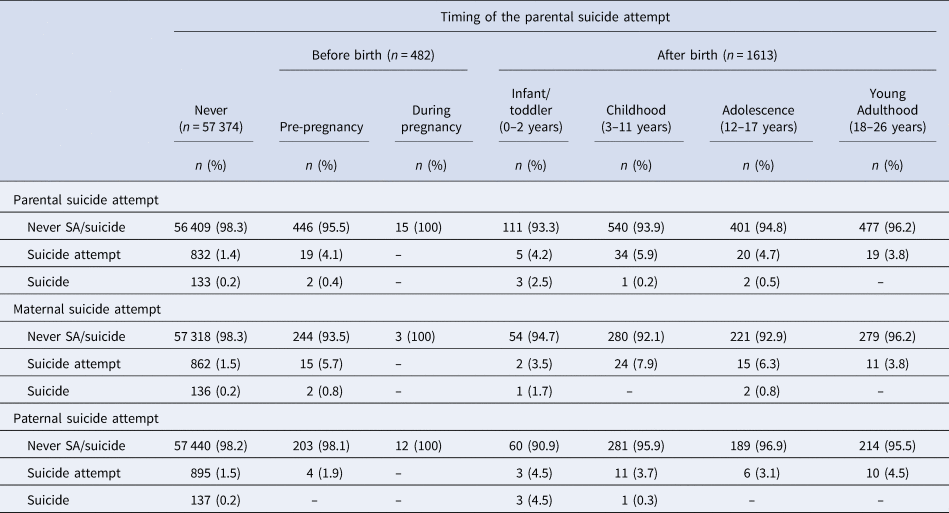
Over 2000 offspring (n = 2095; 3.5%) had a parent who attempted suicide (Table 2). Among parents who attempted suicide before the child's birth (n = 482), 96.9% attempted pre-pregnancy and 3.1% during pregnancy. None of the parents who attempted suicide pre-pregnancy did it again during the pregnancy period. Among parents who first attempted suicide after the child's birth (n = 1613), 7.4% attempted during the infant/toddler years, 35.6% during childhood, 26.2% during adolescence, and 30.7% during young adulthood. The distributions of maternal and paternal SAs by offspring outcomes are presented in Table 2. Given that no offspring whose parents made a SA during pregnancy attempted suicide or died by suicide, pregnancy and pre-pregnancy periods were combined and labeled ‘before birth’ in the multinomial models.
Distribution of offspring who never attempted or died by suicide, attempted suicide, or died by suicide by timing of exposure to a parental suicide attempt (n = 59 469)

SA, suicide attempt.
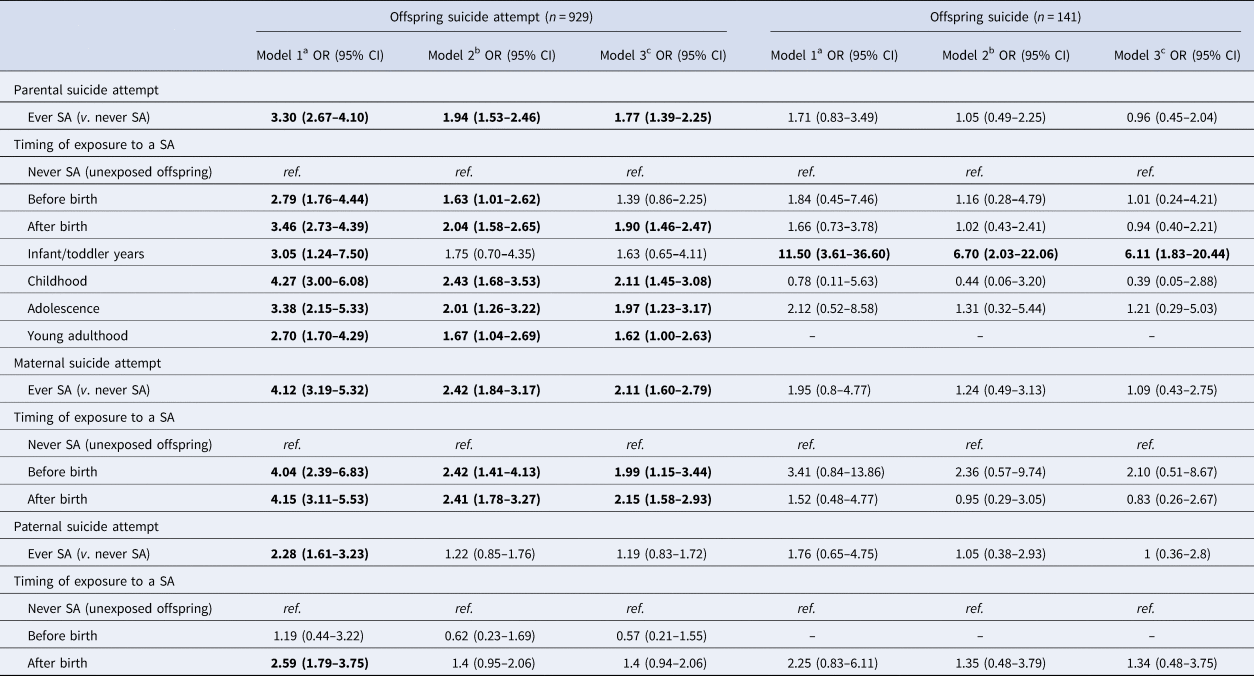
The odds of attempting suicide were 3.3 times greater among offspring with a parent who attempted suicide than among those whose parents never attempted suicide (Table 3, model 1). The strength of this association decreased but remained significant after adjusting for the covariates. Compared to unexposed offspring, a parental SA that occurred before and after the child's birth was both associated with higher odds of attempting suicide; however, the association of a parental SA that occurred before birth was no longer significant after adjusting for offspring psychiatric diagnoses (Table 3, model 3). Offspring with a parent who attempted suicide at each developmental stage were at higher risk of attempting suicide compared to unexposed offspring. These associations remained significant after adjusting for the covariates, except for during the infant/toddler years. The association between exposure to a parental SA during this period and offspring SA was no longer significant after adjusting for the socio-economic variables, any parental psychiatric diagnoses, and parental death (Table 3, model 2).
Multinomial regressions examining the association between timing of exposure to a parental suicide attempt and offspring suicide attempts and suicide (n = 59 469)

Note: Statistically significant estimates (p < 0.05) are in bold. CI, confidence interval; OR, odds ratio; SA, suicide attempt; ref., reference category. Pregnancy and pre-pregnancy periods were combined and labeled ‘before birth’.
a Model 1: unadjusted OR.
b Model 2: analyses additionally adjusted for offspring sex, income support, teen motherhood, parental marriage status at birth, any parental psychiatric diagnoses, and parental death by any cause.
c Model 3: analyses additionally adjusted for any offspring psychiatric diagnoses.
Having a mother who attempted suicide increased the offspring's risk of attempting suicide regardless of when the SA occurred (i.e. ever, before, or after the child's birth), compared to unexposed offspring (Table 3). After adjusting for exposure to any paternal SA, maternal findings remained the same (online Supplementary Table S1, model 4). The initial significant associations between a paternal SA that occurred ever or after birth and offspring's risk of attempting suicide were no longer significant after adjusting for the socio-economic variables, any parental psychiatric diagnoses, and parental death (Table 3, model 2). Exposure to a paternal SA before birth was not associated with an increased risk of attempting suicide.
Offspring's risk of dying by suicide was not significantly different between those with a parent, mother, or father who attempted suicide and unexposed offspring (Table 3). Similarly, the risk of dying by suicide did not differ between offspring whose parents, mother, and father attempted suicide before and after the child's birth (v. unexposed). By developmental stage, only offspring exposed to a parental SA during the infant/toddler years had 6.1 (95% CI 1.83–20.44) higher odds of dying by suicide than unexposed offspring (Table 3, model 3).
Additional analysis
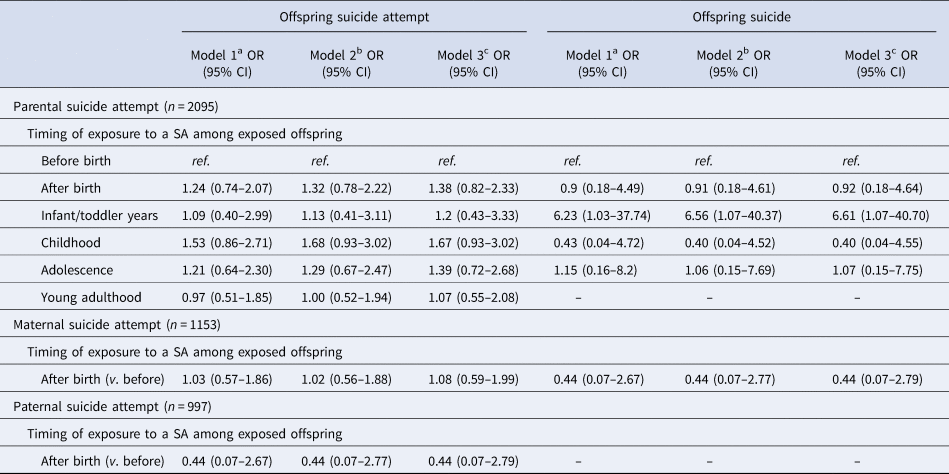
To explore differences in suicide risk among offspring with a parent who attempted suicide before and after birth, we conducted multinomial regression analyses using ‘before birth’ as reference category and restricting the sample to offspring with a parent (n = 2095), mother (n = 1153), or father (n = 997) who attempted suicide (Table 4). The offspring's risk of attempting or dying by suicide was not statistically different between offspring with a parent who first attempted suicide after the child's birth, or at each developmental stage, and offspring with a parent who attempted suicide before birth. Only offspring exposed to a parental SA during the infant/toddler years had 6.6 (95% CI 1.07–40.70) higher odds of dying by suicide than those with a parent who attempted before birth (Table 4, model 3). We found no differences in offspring's risk of attempting or dying by suicide between those whose mother or father attempted suicide before and after birth.
Multinomial regressions examining the association between timing of exposure to a parental suicide attempt and offspring suicide attempts and suicide among exposed offspring using ‘before birth’ as the reference category

Note: Statistically significant estimates (p < 0.05) are in bold. CI, confidence interval; OR, odds ratio; SA, suicide attempt; ref., reference category. Pregnancy and pre-pregnancy periods were combined and labeled ‘before birth’.
a Model 1: unadjusted OR.
b Model 2: analyses additionally adjusted for offspring sex, income support, teen motherhood, parental marriage status at birth, any parental psychiatric diagnoses, and parental death by any cause.
c Model 3: analyses additionally adjusted for any offspring psychiatric diagnoses.
Discussion
This study examined the time-dependent effects of a parental SA on offspring's risk of attempting and dying by suicide. Having a parent who first attempted suicide both before and after the child's birth increased the offspring's risk of attempting suicide. However, the effect of a parental SA that occurred before birth was no longer significant after adjusting for offspring psychiatric diagnoses. By developmental stage, having a parent who first attempted during the offspring's childhood, adolescence, and young adulthood was associated with offspring SA. The association between exposure during the infant/toddler years and offspring SA was accounted for by socio-economic variables, any parental psychiatric diagnoses, and parental death. While exposure to a maternal SA increased the offspring's risk of attempting suicide regardless of when it occurred (i.e. ever, before, or after the child's birth), exposure to a paternal SA was not associated with offspring SA in the multivariate models. Exposure to a parental, maternal, or paternal SA did not increase the offspring's risk of dying by suicide. An exception was offspring exposed during the infant/toddler years, who were at higher risk of dying by suicide; however, these findings warrant cautious interpretation.
In line with register-based, community, and clinical studies, having a parent who ever attempted suicide increased the offspring's risk of attempting suicide above and beyond parental and offspring psychopathology (Brent et al., Reference Brent, Melhem, Oquendo, Burke, Birmaher, Stanley and Mann2015; Geulayov et al., Reference Geulayov, Gunnell, Holmen and Metcalfe2012). Contrary to our expectations, having a parent who attempted suicide did not increase the offspring's risk of dying by suicide. Only two studies have examined this association, a register-based study and a study with a sample of mothers with psychotic disorders (Niederkrotenthaler et al., Reference Niederkrotenthaler, Floderus, Alexanderson, Rasmussen and Mittendorfer-Rutz2012; Suvisaari, Hakkinen, Haukka, & Lonnqvist, Reference Suvisaari, Hakkinen, Haukka and Lonnqvist2008). In both studies, having a parent who attempted suicide increased the offspring's risk of dying by suicide. Methodological differences, such as a larger sample size and the use of a clinical sample, respectively, may explain the different findings between those and our study. The small number of offspring exposed to a parental SA who died by suicide may have interfered with our statistical power to find differences.
When examining the timing of a parental SA, being exposed after birth had an independent effect on offspring's risk of attempting suicide. From the developmental psychopathology perspective (Cicchetti & Banny, Reference Cicchetti, Banny, Lewis and Rudolph2014; Sroufe, Reference Sroufe2013), the child's exposure to the possible mental health conditions underlying the SA and the adverse circumstances preceding and following the hospitalization of the parent after attempting suicide, such as disruptions in care, parent–child relationship, and family dynamics (Roberts & Hawton, Reference Roberts and Hawton1980), may compromise the offspring's acquisition of the stage-salient developmental tasks. This failure, in turn, can lower the probability of mastering subsequent developmental tasks, placing offspring with familial vulnerability at higher risk of attempting suicide. The initial significant association between a parental SA that occurred before birth and offspring SA was accounted by offspring psychiatric diagnoses, suggesting a potential mechanism of the transmission of suicide risk of offspring whose parents attempted suicide before they were born.
Our findings on the developmental stages indicated that offspring exposed to a parental SA in childhood, adolescence, and young adulthood were at higher risk of attempting suicide than unexposed offspring. These findings align with the birth cohort study (Geulayov et al., Reference Geulayov, Metcalfe, Heron, Kidger and Gunnell2014), which found that offspring exposure to a maternal SA between ages 6 and 11, but not earlier (from pregnancy to 5 years old) was associated with offspring lifetime self-harm with suicidal intent, and suggest that processes such as imitation could play a role in the transmission of suicide risk among offspring exposed at older ages (Insel & Gould, Reference Insel and Gould2008). Additionally, two prior studies have found that among adolescents and young adults, the risk of attempting suicide is higher within the 2 years after the death of a parent to suicide, indicating that this event could act as a precipitant of the offspring SA (Kuramoto, Runeson, Stuart, Lichtenstein, & Wilcox, Reference Kuramoto, Runeson, Stuart, Lichtenstein and Wilcox2013; Mittendorfer-Rutz, Rasmussen, & Lange, Reference Mittendorfer-Rutz, Rasmussen and Lange2012). Similar short-term effects have been found for offspring (15–31 years old) exposed to a maternal and a paternal SA (Mittendorfer-Rutz et al., Reference Mittendorfer-Rutz, Rasmussen and Lange2012). Future studies should elucidate whether this short-term risk differs based on the offspring age at the time of the parental SA.
Although exposure during the infant/toddler years did not increase the risk of attempting suicide, it was the only period associated with a higher risk of dying by suicide, proving partial support to findings from developmental neuroscience (i.e. early exposure to adverse experiences may exert a stronger impact on development than exposure later in life). The effect of a parental SA during the infant/toddler years on offspring's risk of attempting suicide was explained mostly by factors that occurred around or after birth and have been linked to a higher risk of SA, such as teen or single motherhood, reception of social assistance, or having a parent with mental health problems (Orri et al., Reference Orri, Russell, Mars, Turecki, Gunnell, Heron and Geoffroy2020). Adam's developmental model of attachment and suicide theorized that the lethality of suicidal behavior may vary depending on the severity of the insecure attachment and subsequent consequences on self-worth, emotional regulation skills, and interpersonal capabilities (Adam, Reference Adam, Sperling and Berman1994; Stepp et al., Reference Stepp, Morse, Yaggi, Reynolds, Reed and Pilkonis2008). For some children, a parental SA during offspring's infancy could severely disrupt the attachment process, leading to the development of strong negative representations of oneself and others, as well as more despairing and highly lethal behavior, including suicide.
Especially novel is the examination of the time-dependent effects by parental sex. Having a mother who attempted suicide was associated with a higher risk of attempting suicide in the offspring. This association was also significant for mothers who first attempted before and after the child's birth. However, having a father who attempted suicide did not increase the offspring's risk of attempting suicide. The initial significant associations between the timing of a paternal SA, ever and after the child's birth, and offspring SAs were further explained by the socio-economic variables, any parental psychiatric diagnoses and parental death. Numerous hypotheses may explain the heightened suicide risk among offspring whose mothers attempted suicide. For mothers who attempted suicide after the child's birth, the maternal admission to a hospital may imply the offspring's separation from the main caregiver and subsequent alterations in the mother–child relationship and quality of care, which have been related to worse developmental outcomes (Enns, Cox, & Clara, Reference Enns, Cox and Clara2002). For mothers who attempted suicide before the child's birth, the transmission of suicide risk may have occurred through unique epigenetic or other stress-induced molecular changes, including alterations in the placental physiology during pregnancy (Moog et al., Reference Moog, Buss, Entringer, Shahbaba, Gillen, Hobel and Wadhwa2016). Additionally, experiencing mental health problems during pre-pregnancy has been associated with complications during pregnancy and adverse birth outcomes (Witt, Wisk, Cheng, Hampton, & Hagen, Reference Witt, Wisk, Cheng, Hampton and Hagen2012), as well as mental health problems during the perinatal period, such as postpartum depression (PPD) (Faisal-Cury & Menezes, Reference Faisal-Cury and Menezes2012; Patton et al., Reference Patton, Romaniuk, Spry, Coffey, Olsson, Doyle and Brown2015). These complications may affect parenting capacities (Smith, Reference Smith2004; Smith, Landry, & Swank, Reference Smith, Landry and Swank2006) and increase the offspring's risk of attempting suicide (Hu, Li, Glauert, & Taylor, Reference Hu, Li, Glauert and Taylor2017; Orri et al., Reference Orri, Russell, Mars, Turecki, Gunnell, Heron and Geoffroy2020). Mothers with PPD are less emotionally available and attuned to their infant's needs, have fewer positive interactions with their babies, and are more likely to use harsh parenting (Field, Reference Field2010; Lovejoy, Graczyk, O'Hare, & Neuman, Reference Lovejoy, Graczyk, O'Hare and Neuman2000). The only study on maternal self-harm (with and without suicidal intent) before pregnancy provides partial support for these hypotheses. The authors found that while self-harm during young adulthood was related to perinatal depressive symptoms and mother–infant bonding problems, self-harm during adolescence was not (Borschmann et al., Reference Borschmann, Molyneaux, Spry, Moran, Howard, Macdonald and Patton2019).
Noteworthy, more fathers than mothers attempted suicide during the pregnancy period. Although our numbers are small, they align with studies demonstrating that pregnancy is a low-risk period for attempting suicide among women (Mota et al., Reference Mota, Chartier, Ekuma, Nie, Hensel, MacWilliam and Bolton2019).
Our additional analysis indicated that the risk of attempting or dying by suicide did not differ between offspring with a parent who attempted suicide before or after the child's birth. Only exposure to a parental SA during the infant/toddler years (v. before birth) was associated with a higher risk of dying by suicide, supporting our hypothesis on its implications for attachment development.
This study has several limitations. For the identification of offspring SAs, we combined ICD codes from hospital admissions and outpatient visits, which became available in 1998, when the offspring turned 11 years old. It is likely that we may have misclassified a small number of offspring who attempted suicide and received outpatient care before 1998. To maintain a consistent source of information for parental SAs across periods, we only utilized the ICD codes from hospital admissions. Parents and offspring who attempted suicide and did not seek care were coded as non-attempters, as such the generalizability of our findings might be limited to populations who are receiving care in health care systems. However, the study sample contains individuals who accessed services and, therefore, those to whom assessments and interventions could potentially be provided. In interpreting the findings, we assumed that parents and offspring had some level of contact after the child's birth; however, this information was unavailable in the registers. Future studies including this information would be able to better disentangle the role of environmental and biological influences. Given that no offspring whose parents made a SA during pregnancy attempted or died by suicide, this period was combined with pre-pregnancy, which precluded the examination of their independent associations. Additionally, the sample size of offspring suicide for certain developmental stages of exposure was very small (e.g. young adulthood). Limited statistical power may have prevented the detection of associations between parental SA and offspring's risk of dying by suicide. However, our findings contribute to the scarce literature on parental SA and offspring suicide. Although non-significant, the associations between the exposure to a parental SA at different periods and offspring suicide were mostly in the expected direction, with exposed offspring showing a higher risk of dying by suicide. The significant association between exposure to a parental SA during the infant/toddler years and offspring suicide should be considered with caution as it is based on only three cases. However, this finding signals a potential highly sensitive period for the exposure to a parental SA that should be investigated by future studies.
This study provides evidence that suicide risk in the offspring varies depending on when the parent attempted suicide, suggesting that the familial clustering of suicidal behavior may be due to the transmission through not only hereditary factors but also environmental influences, such as psychosocial circumstances and family dynamics. Based on our findings, when conducting diagnostic assessments, clinicians should inquire about family history of SAs, the sex of the parent who attempted suicide, and the timing of the parental SA, including pre-pregnancy, a period barely considered in current strategies for suicide prevention. During prenatal visits, professionals should screen for maternal depression as well as any SA that may have occurred before conception to be able to provide adequate prenatal care and close observation of the family as the child grows. Close monitoring is needed for offspring exposed to a parental SA during childhood, adolescence, and young adulthood, as they are at particular high risk of attempting suicide. Future research involves the identification of mechanisms underlying the transmission of suicide risk depending on the timing of the parental SA to design time-sensitive interventions tailored to youth with familial vulnerability to suicide.
Supplementary material
The supplementary material for this article can be found at https://doi.org/10.1017/S0033291721002397.
Acknowledgements
The authors acknowledge the contribution of Tiina Ristikari, PhD, Department of Children, Young People and Families at the Finnish Institute for Health and Welfare (Finland), and Lupo Geronazzo-Alman, PhD, New York State Psychiatric Institute, Columbia University Irving Medical Center, New York, NY (USA).
Financial support
The first author received a Pilot Innovation Grant from the American Foundation for Suicide Prevention [PRG-0-100-16] to conduct this study. The 1987 Finnish Birth Cohort Study has been supported by the Academy of Finland and the Finnish Institute for Health and Welfare (THL).
Conflict of interest
None.
Ethical standards
The authors assert that all procedures contributing to this work comply with the ethical standards of the relevant national and institutional committees on human experimentation and with the Helsinki Declaration of 1975, as revised in 2008.