Introduction
The use of two or more languages is natural and common in many countries around the world. For instance, in the Brazilian scenario, linguistic diversity includes 274 indigenous languages, 56 languages of immigration, the languages of Afro-Brazilian communities, and creole languages (Hubner, Reference Hubner2016), together with border languages (Morello & Seiffert, Reference Morello and Seiffert2019), used in family and social contexts. In academic, scientific, and technological contexts, as in many other countries, the English language is the lingua franca, used mainly in the written modality. In the case of immigration languages or dialects, speakers do not always show balanced fluency in the languages they manage. In some cases, they do not master writing and reading skills – only oral ones (speaking and oral comprehension) passed down over generations – because they did not receive formal education in these two abilities.
Concerning the literacy development and school performance of bilingual children, studies are still scarce, and data are still inconclusive regarding the impact of bilingualism on these two educational aspects. Research has postulated that similar aspects in two languages can allow bilinguals to use the literacy skills acquired in one of the languages to obtain gains in the other one (Proctor, August, Snow & Barr, Reference Proctor, August, Snow and Barr2010). The Van der Vel de Kremin, Arredondo, Hsu, Satterfield, and Kovelman (Reference Van der Vel de Kremin, Arredondo, Hsu, Satterfield and Kovelman2019) study, comparing bilingual Spanish–English and monolingual English children, revealed that bilinguals performed better in phonological and orthographic representations than did monolinguals when reading in English. This suggests that the experiences of bilingual children with Spanish contributed directly and positively to literacy in English.
On the other hand, a good amount of research has concentrated lately on investigating the impact of bilingualism on cognitive functions. For example, bilingual experience may affect the development of executive functions (EF) (Bialystok, Craik, Green & Gollan, Reference Bialystok, Craik, Green and Gollan2009; Chung-Fat-Yim, Himel & Bialystok, Reference Chung-Fat-Yim, Himel and Bialystok2019) due to the richer linguistic environment influence on the quality of cognitive development (Goldin-Meadow, Levine, Hedges, Huttenlocher, Raudenbush & Small, Reference Goldin-Meadow, Levine, Hedges, Huttenlocher, Raudenbush and Small2014). The EF consist of a set of processes of general control that are fundamental to the self-regulation of thoughts and planning for the achievement of objectives (Diamond, Reference Diamond2013; Paap, Johnson & Sawi, Reference Paap, Johnson and Sawi2015). Bilingualism is a phenomenon in which the individual is capable of communicating actively in two languages or dialects as a function of their daily needs (Grosjean, Reference Grosjean2010; Jaekel, Jaekel, Willard & Leyendecker, Reference Jaekel, Jaekel, Willard and Leyendecker2019).Thus, the bilingual cognitive advantage would derive from the necessity of controlling and monitoring the use of two (or more) distinct competing languages in the brain (Green & Abutalebi, Reference Green and Abutalebi2013; Kroll, Bobb & Hoshino, Reference Kroll, Bobb and Hoshino2014), which would create higher cognitive demands on bilinguals as compared to monolinguals.
The interface between EF and bilingualism has increasingly raised interest in educational and clinical research. Some studies indicate that EF develop earlier in bilingual children than in monolingual ones (Bialystok, Reference Bialystok2010; Carlson & Meltzoff, Reference Carlson and Meltzoff2008; Hartanto, Toh & Yang, Reference Hartanto, Toh and Yang2019). In addition, bilingual children tend to overcome their monolingual peers in tasks that evaluate the comprehension of the abstract structure of a language (Bialystok, Reference Bialystok2015); however, these advantages seem to become evident when tasks include conflict management (Bialystok, Reference Bialystok2015). Moreover, the bilingual experience can help develop basic interpersonal communication skills (Jaekel et al., Reference Jaekel, Jaekel, Willard and Leyendecker2019), and help manage more complex and multitask language processing as compared to monolinguals in contexts in which more EF are recruited (Poarch & Bialystok, Reference Poarch and Bialystok2015).
In relation to other cognitive gains, Bialystok and Viswanathan (Reference Bialystok and Viswanathan2009) propose that the benefits of bilingualism affect executive functioning more broadly, also influencing performance in tasks involving conceptual knowledge, such as problem-solving. In other words, bilingualism would impact children's school performance because bilinguals would be quicker and more accurate than monolingual children in finding an answer or a solution to adversity.
From an opposite perspective, Sánchez-Azanza et al. (Reference Sánchez-Azanza, López-Penadés, Buil-Legaz, Aguilar-Mediavilla and Adrover-Roig2017) stress that the number of studies challenging the bilingual advantage hypothesis has increased notably in the last decade. For example, Paap and Sawi (Reference Paap and Sawi2014) administered four tasks (antisaccade, attentional network test, Simon task, and color-shape switching) to evaluate the bilingual advantage. The results were not significant in some tasks, while in others the monolingual group had an advantage over the bilingual one. According to Paap, Johnson, and Sawi (Reference Paap, Johnson and Sawi2015), studies should verify whether the differences reported in the performance of bilinguals and monolinguals are due to other causes rather than to bilingualism, and whether the dependent variables used actually measure EF. Similarly, Antón, Carreiras and Duñabeitia (Reference Antón, Carreiras and Duñabeitia2019) argue that differences in performance between young adult groups may be an effect of uncontrolled factors or imperfectly matched samples and that domain-specificity of the executive functions and working memory must be taken into account when one is discussing results comparing bilinguals’ and monolinguals’ performances.
Few studies investigate the relationship between bilingualism and specific executive components (Bialystok et al., Reference Bialystok, Craik, Green and Gollan2009; Valian, Reference Valian2016). Jaekel et al. (Reference Jaekel, Jaekel, Willard and Leyendecker2019) found no effects of bilingualism on performance in tasks of processing speed, inhibition, and cognitive flexibility by bilingual and monolingual children. Another study including more than 4,000 bilingual children found that bilingualism moderated the effects of lower socioeconomic level in tasks of inhibition and cognitive flexibility; also, the authors found that only socioeconomic level was a predictor of working memory performance (Hartanto et al., Reference Hartanto, Toh and Yang2019).This shows the need for matching SES when comparing groups’ performance in EF components and other cognitive and linguistic variables under analysis.
Metalinguistic knowledge and ability intrinsically related to EF due to its demands on monitoring, analyzing, and controlling linguistic processing at a conscious level have been pointed out as being more developed in bilinguals (Bialystok, Reference Bialystok2015). Metalanguage refers to the explicit knowledge of the linguistic structure and the ability to intentionally access this knowledge (Barac & Bialystok, Reference Barac and Bialystok2012). According to Bialystok (Reference Bialystok2015), the bilinguals’ metalinguistic advantage would reside much more in their cognitive capacity than in the linguistic processing itself. This benefit, as already mentioned, would derive from the practice of managing two languages (Bialystok, Reference Bialystok2007), as the exercise of controlling two languages would foster more efficient and faster cognitive processing.
Consequently, in metalinguistic tasks, which favor the recruitment of executive control processes in which it is difficult to isolate the form from its meaning, bilingual children would perform better than monolingual children. Furthermore, according to Eviatar, Taha, Cohen, and Schwartz (Reference Eviatar, Taha, Cohen and Schwartz2018), the typological proximity between two languages (as is the case in our research, regarding Brazilian Portuguese and Spanish) might improve bilingual children's ability to understand the structure of the word on both the phonemic and morphemic levels, and provide an advantage over their monolingual peers.
Some metalinguistic studies of bilingual children's reflection upon language arbitrariness (Cohen, Reference Cohen2013; Mendonça, Reference Mendonça2009; Piantá, Reference Piantá2011; Safinia, Reference Safinia2015) have shown divergent results. Safinia (Reference Safinia2015) applied word-manipulation tasks, word exchange, the Wug task, and a grammatical judgment task. There was a significant difference between the linguistic groups only in the task of word manipulation, with an advantage for the bilingual group. Cohen (Reference Cohen2013) administered four metalinguistic tasks (Word order repetition, Word renaming, Symbol substitution, and Grammar judgments) in a balanced bilingual group and a dominant bilingual group (French or English). There was a difference between groups only in the Word renaming task, showing better results for the balanced bilingual group.
Mendonça (Reference Mendonça2009) and Piantá (Reference Piantá2011) administered a task of Language Arbitrariness and one of Symbol Substitution to Brazilian Portuguese-speaking children, learners of English as L2. In the first study, the results showed no difference between groups in the two metalinguistic tasks. In the second study, the results indicated higher development of metalanguage and inhibition abilities. Participants with higher L2 exposure obtained the higher scores in both tasks.
The divergent results reported above in bilingual children's metalinguistic performance might be a consequence of variables related to individual, linguistic, and contextual factors. An example of individual aspects is the stage of literacy process that the children are in when metalinguistic data are collected. Yet contextual factors, such as an unbalanced SES level between children's groups, could also reflect on their performance; conversely, cultural and socio-demographic aspects, including parents’ schooling and socio-economical levels, the frequency of storytelling to their children, and their own reading and writing habits, may reflect on children's metalinguistic and literacy development. Finally, language typology could influence the results, as similarities or differences between languages could influence the level of ease or difficulty in transferring or suppressing metalinguistic and literacy mastery in each language (Bialystok, Reference Bialystok2007).
Taken together, the studies analyzed above reflect the lack of consensus on the impact of bilingualism on EF and metalinguistic knowledge. Mismatching results may be related to: 1) the differences in tasks of executive functions that predominantly evaluate one or another specific component (Valian, Reference Valian2016), in general using either verbal or non-verbal tasks; 2) the variability of factors that influence executive functioning and that have not always been controlled for or matched between bilingual and monolingual groups, including socioeconomic level and personality variables (Valian, Reference Valian2016), reading and writing habits, and educational level (Bialystok et al., Reference Bialystok, Craik, Green and Gollan2009); and 3) the observance of language typology (whether or not belonging to the same family) and language context of use (as in the case of border languages, in which switching and mixing phenomena may take place much more heavily and frequently).
Thus, this study aimed to verify whether there are differences between bilingual and monolingual children in learning achievement (reading, writing, and arithmetic), verbal and nonverbal EF (planning, inhibitory control, working memory, cognitive flexibility, and cognitive efficiency), and metalinguistic abilities. Investigations with this profile of participants may be useful, for example, for further studies with immigrant populations. To verify the hypothesis that bilingualism increases children's performance in reading and writing ability, EF, and metalinguistic processing, a monolingual group and a bilingual group of school children from 1st to 3rd years were compared. The next sections report on the study, its results, and a discussion of them.
Method
Participants
Fifty children aged 6 to 8 years were initially recruited to participate in this study. Four children did not meet one or more of the selection criteria and were not included. Thus, the final sample was composed of 46 children recruited from public schools in two cities in the south of Brazil. The participants were classified according to language experience as follows: one group was composed of Brazilian Portuguese (BP) – Spanish (S) bilingual students (n 23) who lived in a border area between Brazil and Uruguay and had learned both languages before the age of five, but were literate in Portuguese at school. The bilingual group lived in a family and social bilingual immersion context, they had daily exposure to both languages, because both Brazilian Portuguese and Spanish were freely and constantly practiced at home, work, school, commerce, and services, mainly in the oral modality. Their parents were also bilinguals and were native speakers of either one or the other language (BP or S). For purposes of avoiding the effect of daily exposure to an additional language, a second group included monolingual (Brazilian Portuguese) students (n 23) who did not live in a border area. Children were recruited within the first three years of elementary school, when literacy was being developed in Brazilian schools, and the groups were matched for age and school year.
Among the inclusion criteria were daily exposure to both languages, with one of the parents being a native Spanish speaker (specifically for the bilingual group), with no auditory or visual uncorrected problems, presenting typical language processing. All participants’ present IQ was equal to or higher than 80 (WASI – Yates et al., Reference Yates, Trentini, Tosi, Corrêa, Poggere and Valli2006).
Instruments
Important methodological decisions were taken to ensure that the two groups were under the same conditions, so that sociodemographic, cognitive, school, and health issues directly related to cognitive performance were observed to form the groups. All instruments were administered in their versions adapted to Brazilian Portuguese.
* Three questionnaires related to the identification of participants’ bilingual profile, health issues, and socioeconomic status
1) Data Survey for Children's Bilingualism Research. This questionnaire was developed by the researchers and administered to the bilingual children's parents. It includes questions related to the parents’ place of birth, language used at home and in the community, the language in which they feel most comfortable talking, and whether or not they consider themselves bilingual, as well as their child's age of language acquisition, years and amount of exposure, and proficiency in both languages. Although a subjective measure, the bilingual parents’ statements confirming that their children used both languages in their daily lives is a valid and reliable tool for assessing the children's bilingual condition (Marian, Blumenfeld & Kaushanskaya, Reference Marian, Blumenfeld and Kaushanskaya2007; Paap & Sawi, Reference Paap and Sawi2014).
2) Questionnaire on health, sociodemographic, and cultural factors for children's neuropsychological assessment (Fonseca, Jacobsen & Pureza, Reference Fonseca, Jacobsen, Pureza, Salles, Haase and Malloy-Diniz2015). The questionnaire was developed to examine the child's clinical, educational, and socio-cultural history. More specifically, this instrument investigates diseases, hospitalizations, school difficulties, writing and reading habits, socioeconomic level, and parental education.
3) Brazilian Economic Classification Criterion (Associação Brasileira de Empresas de Pesquisa, 2016). This survey assesses the participants’ socioeconomic level, considering movable property, the education level of the head of the family, and access to public services. The classification is organized into seven social classes (A, B1, B2, C1, C2, D, and E).
This study aimed at assessing EF components and metalanguage abilities through the administration of multiple verbal and nonverbal tasks to groups of bilingual and monolingual children at different ages in their literacy development process, as already mentioned. The adopting of various typologies of tasks measuring the same constructs has been suggested by Paap and Sawi (Reference Paap and Sawi2014) and Valian (Reference Valian2016), who state that different tasks and measures are very rarely used in the same study to check for bilingual advantage. In this way, more consistent evidence can be reached.
Tasks assessing school performance
a) School Performance Test II - TDE-II (Stein, Giacomoni & Fonseca, Reference Stein, Giacomoni and Fonseca2019). This instrument evaluates the fundamental abilities for school performance, such as reading, arithmetic, and writing. Each competence corresponds to a subtest. The maximum score in each subtest is as follows: a) written - 40 points; b) arithmetic - 37 points; and c) reading - 36 points.
b) Reading and Writing Scale - teacher version - RWS (Morais, Reference Morais2016). This scale investigates possible difficulties in reading and writing learning that may lead a child/adolescent to perform poorly. The score ranges from 0 to 64 points. A score equal to or greater than 62 points indicates that the child has a degree of difficulty in reading and writing and should receive monitoring.
Tasks assessing EF components
a) Child Hayling Test - HCT (Siqueira, Gonçalves, Hübner & Fonseca, Reference Siqueira, Gonçalves, Hübner and Fonseca2016). This is a verbal task to assess the executive components of initiation, verbal inhibition, cognitive flexibility, and processing speed. The test consists of two parts (A and B), with a score of correct answers ranging from 0 to 10. The evaluated measures are execution time and errors.
b) Digits Span Test - DST, a subtest of the Infant Brief Neuropsychological Assessment Instrument - NEUPSILIN-INF (Salles, Fonseca, Parente, Cruz-Rodrigues, Mello, Barbosa & Miranda, Reference Salles, Fonseca, Parente, Cruz-Rodrigues, Mello, Barbosa and Miranda2016). This is a verbal task less dependent on language, to examine verbal/phonological working memory. The test consists of two parts (forward and backward), with scores ranging from 02 to 09 in each part. The span is indicated by the number of items in the last sequence repeated correctly.
c) Corsi's Blocks Test - CBT, subtests of the Infant Brief Neuropsychological Assessment Instrument - NEUPSILIN-INF (Salles et al., Reference Salles, Fonseca, Parente, Cruz-Rodrigues, Mello, Barbosa and Miranda2016). This is a non-verbal task to evaluate the visuospatial component of working memory. The test consists of eight square sequences varying in length, between two and five stimulis. The sequence score ranges from 02 to 05 points. Participants’ performance in the task is measured by the longest sequence answered correctly and by the total score.
d) Five Digits Test - FDT (Sedó, De Paula & Malloy-Diniz, Reference Sedó, de Paula and Malloy-Diniz2015). This is a non-verbal task to evaluate the speed of cognitive processing, attention, inhibition, and cognitive flexibility. The test consists of four parts (reading, counting, choosing, and shifting), ranging from 0 to 50 points each. Performance is measured through execution time and errors for each part.
e) Trail Making Test for children- TMT (Trevisan & Seabra, Reference Trevisan, Seabra, Seabra and Dias2012). This is a non-verbal task to assess the development of cognitive flexibility in children. This task consists of two parts (A and B). In the first, there are five sequences and four connections of stimuli, while in the second there are 10 sequences and nine connections. Performance is measured according to the number of correct sequences and connections, in addition to the execution time of each part.
f) Pseudowords Span - PS, a subtest of the Infant Brief Neuropsychological Assessment Instrument - NEUPSILIN-INF (Salles et al., Reference Salles, Fonseca, Parente, Cruz-Rodrigues, Mello, Barbosa and Miranda2016). This is a verbal task to examine verbal/phonological working memory. The total score is 20 points, with one point per word correctly repeated. In addition, the task is scored by the longest sequence repeated correctly.
g) Bells Test for children (Fonseca, Jacobsen & Pureza, Reference Fonseca, Jacobsen, Pureza, Salles, Haase and Malloy-Diniz2015). This is a non-verbal task to evaluate focused and selective attention, visual perception, and processing speed. The maximum score of the task is 35 points. Performance is assessed by the number of errors and omissions and the execution time of the task.
Tasks assessing metalinguistic knowledge at the word level
a) Language Arbitrariness Test- LAT (Mendonça, Reference Mendonça2009; Piantá, Reference Piantá2011). This assesses awareness of the arbitrary nature of the word-referent relationship. The test consists of two parts (A and B), with a score of up to 10 points in each part. The score for each part and the total score are the measures of that task.
b) Symbol Substitution Test- SST (Mendonça, Reference Mendonça2009; Piantá, Reference Piantá2011). This assesses the understanding of the arbitrary nature of the word-referent relationship.The test consists of two parts (A and B), with a score of up to 10 points in each part. The score for each part and the total score are the measures of that task.
This research was approved by the Ethics Committee at the Pontifical Catholic University of Rio Grande do Sul (PUCRS) under protocol number 1.686.833. The children who participated in the study were read the terms of informed consent to participate in the study and signed it. Additionally, their parents or legal representatives gave their formal consent.
Procedures for data collection
At first, the Reading and Writing Scale was administered to the teacher (teacher assessment of the student), while the TDE-II was administered to each child. Afterward, the other tests were administered, in the following order: Child Hayling Test, Digits Span Test, Corsi's Blocks Test, Language Arbitrariness Test, Symbol Substitution Test, Five Digits Test, Trail Making Test for children, Pseudowords Span, and Bell Canceling Test for children. Each participant was individually administered all the tests in his/her respective school in a quiet environment, in a single session lasting approximately one and a half hours. Standardized instructions were used for each test.
Data analyses
The normality test (Shapiro-Wilk) showed that the data did not present normal distribution. Thus, the non-parametric Mann-Whitney test was chosen. Alpha <0.05 was considered. The analyses were performed using statistical software SPSS version 17.0. Beyond the level of significance, the effect size of the differences between groups was considered (Hedges' g) using the computer calculator available at https://www.socscistatistics.com/effectsize/default3.aspx. Groups’ performances were compared in all tasks. The magnitude of effect sizes was defined by Cohen's (Reference Cohen1988) criteria as small (0.2), medium (0.5), and large (0.8). Effect size analyses complement the significance analyses, as they indicate the magnitude of the difference between groups (APA, 2010). This type of analysis has been pointed out as being very appropriate and reliable in experimental studies (Schuele & Justice, Reference Schuele and Justice2006) and in a small sample; in our study, the analyses of effect size are relevant to show how strong the effect can be (Halsey, Reference Halsey2019).
Results
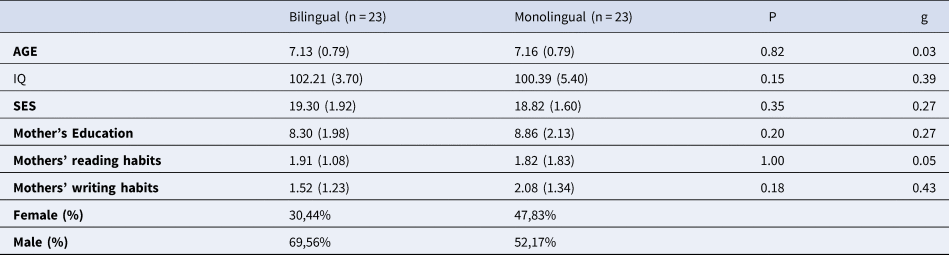
The groups did not differ in relation to age, intelligence quotient (IQ), socioeconomic status (SES), mother's education, and mother's reading and writing habits (Table 1).
Participants’ socio-demographic characteristics and IQ measures

Notes: SD – standard deviation; SES - socioeconomic status as calculated according to the Brazilian Economic Classification Criteria (Brazilian Association of Research Companies, 2015): Class A = 45–100 points, B1 = 38–44 points, B2 = 29–37 points, C1 = 23–28 points, C2 = 17–22 points, D-E = 0–16 points; IQ - Intellectual quotient as measured by the Wechsler Abbreviated Scale of Intelligence (WASI).Mothers' reading habits and Mothers' writing habits measured the time in hours dedicated to reading and writing by the participants' mother.
Table 1 presents the groups’ socio-demographic profile in terms of means and standard deviations. As indicated in the table, the children came from medium-low SES. Considering the average of the SES variable, the participants in both groups belong to an economic class with few financial resources (C2), though they do not belong to the least favored classes (D-E). According to the Brazilian Market Research Association (Associação Brasileira de Empresas de Pesquisa, 2016), class C2 represents 25.60% of the Brazilian population, who do not have access to public utility services or the highest levels of formal education. The average household income for families in this group is US$338.28/month.
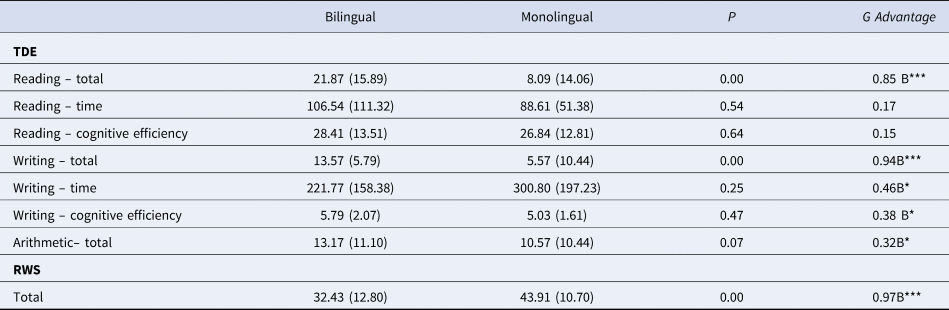
Regarding school learning assessment, comparisons between groups on reading, writing, and arithmetic abilities (TDE-II) showed a significant advantage of the performance of the bilingual group over the monolingual one, with low to high effect sizes. More specifically, the statistical advantage and effect sizes were found in the total reading score and total writing score (high effect size), the total writing time (moderate effect size), writing – cognitive efficiency, and total arithmetic ability (low effect size). Conversely, the results of the Reading and Writing Scale (RWS), answered by the teacher, corroborate the findings of TDE-II, reporting a bilingual advantage. The bilingual group showed higher reading and writing performance as compared to the monolingual group (p <0.001) (Table 2).
Language groups’ school learning differences

Note: TDE II - School Performance Test II; RWS - Reading and Writing Score. The time and cognitive efficiency scores of the reading and writing subtests were performed based on the scores of 17 bilingual and 6 monolingual children in the process of literacy.* Low effect size; ** Moderate effect size; ***High effect size
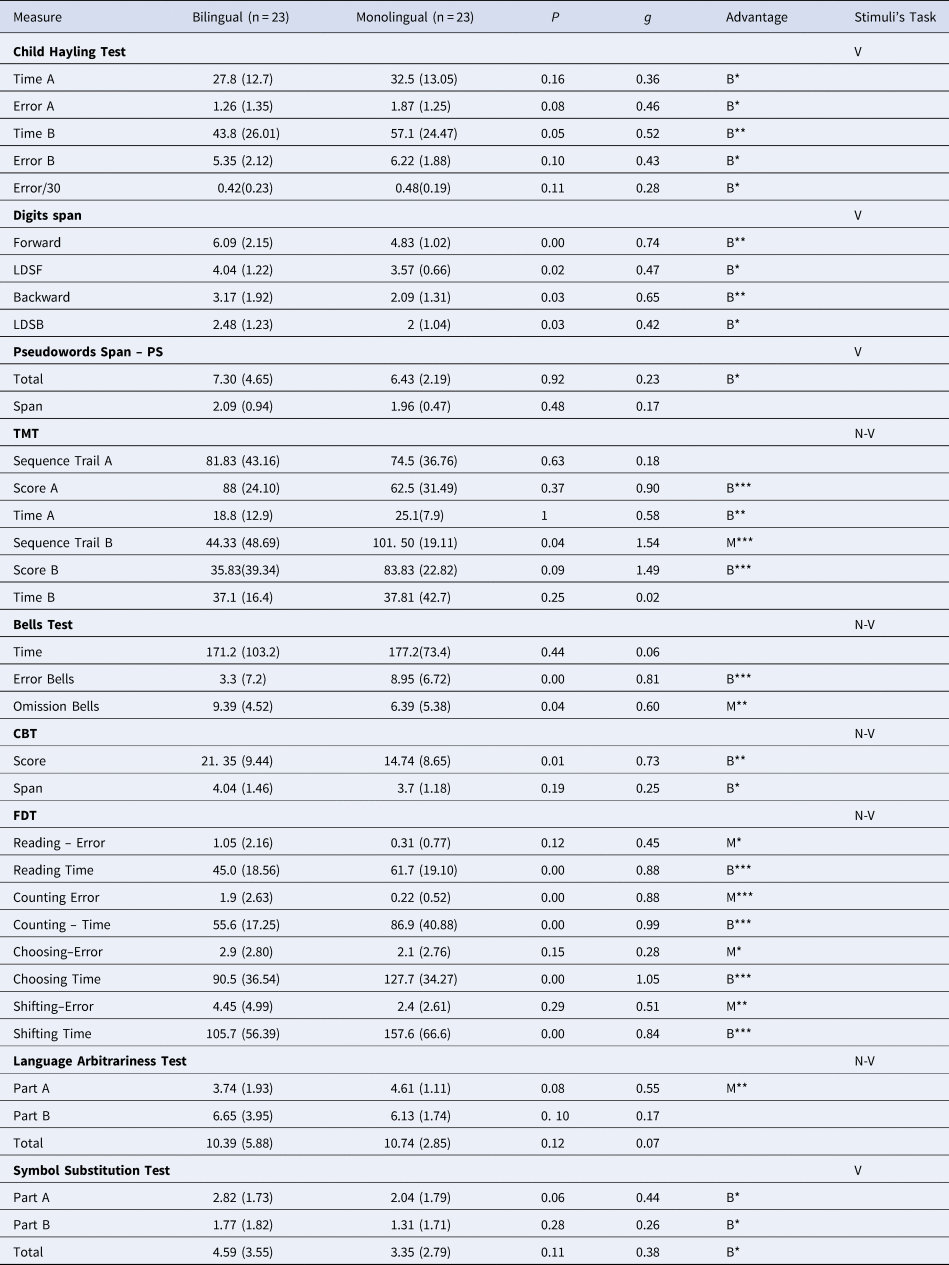
There were no significant differences in the scores of metalanguage measures but moderate and small effect sizes were found in the three subtasks of Symbol Substitution favoring bilinguals, while a moderate effect favoring monolinguals was found in Part A of the Language Arbitrariness Test. Yet, from the 30 scores generated by the seven tasks measuring EF, there was a monolingual advantage in three of them and an advantage for bilinguals in 10 of them. The analyses of effect size showed a much higher bilingual advantage as compared to a monolingual one, with a low and mainly moderate and high effect size in 12 out of 30 subtasks, while monolingual advantage was observed in six (Table 3).
Means, standard deviations, significant differences and effect size between language groups in EF components

Notes: DST – Digit Span test; LDSF - Longest Digit Span Forward; LDSB - Longest Digit Span Backward; CBT –Corsi's Blocks Task; FDT- Five Digits Test; TMT – Trail Making Test; SD – standard deviation. B – Bilingual; M – Monolingual; * Low effect size; ** Moderate effect size; ***High effect size; V – verbal; N-V – Non-verbal.
Discussion
The bilingual group in this study outperformed the monolingual one in reading, writing, and arithmetic abilities, which are measures of school performance, in consonance with the study conducted by Van der Vel de Kremin et al. (Reference Van der Vel de Kremin, Arredondo, Hsu, Satterfield and Kovelman2019). A large effect size was observed in total reading, total writing, and total reading and writing score (RWS), small effect size in two writing subtasks. There was a small effect size on arithmetic ability. It may be the case that, in this study, the performance of the bilingual group in the reading and writing skills developed during literacy in Portuguese has been favored by the oral linguistic knowledge acquired in Spanish. As reported by Proctor, August, Snow, and Barr (Reference Proctor, August, Snow and Barr2010), literacy skills acquired in a language can be transferred to another language, especially when they share similar properties, such as is the case with the two languages in this study.
Data collected for this study indicated significant differences between monolingual and bilingual children concerning EF components – namely, inhibition, working memory, and cognitive flexibility – as well as in reading and writing performance. However, regarding metalinguistic processing, no differences were found in the comparisons between groups. Thus, these results corroborate the hypothesis that bilingualism seems to improve some components of EF and impacts the literacy process in bilingual children.
Our data are in accordance with those of Kroll and Bialystok (Reference Kroll and Bialystok2013) and Hartanto et al. (Reference Hartanto, Toh and Yang2019), showing a bilingual advantage in inhibition, though they are in only partial accordance with the results presented by Antón, Duñabeitia, Estévez, Hernández, Castillo, Fuentes, and Carreiras (Reference Antón, Duñabeitia, Estévez, Hernández, Castillo, Fuentes and Carreiras2014), Duñabeitia, Hernández-Cabrera, Antón, Macizo, Estévez, Fuentes, and Carreiras (Reference Duñabeitia, Hernández-Cabrera, Antón, Macizo, Estévez, Fuentes and Carreiras2013) and Gathercole, Thomas, Kennedy, Prys, Young, Viñas Guasch, and N.Jones (Reference Gathercole, Thomas, Kennedy, Prys, Young, Viñas Guasch and Jones2014), who did not use the Stroop task and did not find evidence of significant differences in the comparison between groups. Also, the conclusion drawn by Hilchey and Klein's (Reference Hilchey and Klein2011) study – that the evidence for an advantage in inhibition in bilingual children would be rare and inconsistent – does not fit this study, as five out of six measures pointed to an advantage for bilingual children in inhibitory control as compared to monolingual children's control.
Regarding the speed of processing, bilinguals outperformed monolinguals in response times for tasks requiring sustained and focused or executive attention, working memory, and inhibition, in consonance with the study of Valian (Reference Valian2015). In Valian's study, and in ours, bilingual children presented lower average means of response time than did monolinguals in the tasks that generated conflict of response. Conversely, Hartanto et al. (Reference Hartanto, Toh and Yang2019) showed better results obtained by bilingual children as compared to monolinguals in inhibition tasks, regardless of socioeconomic status.
The bilingual children presented superior results in all the measures of the Digits Span and the Corsi's Blocks Task of NEUPSILIN-INF (Salles et al., Reference Salles, Fonseca, Parente, Cruz-Rodrigues, Mello, Barbosa and Miranda2016). The bilingual experience may have favored the visual and verbal working memory, because, in these tasks, the bilingual participants manipulated a quantity of visual and verbal information, in direct order, with greater accuracy than the monolingual group. These results are consistent with those reported by Morales, Calvo, and Bialystok (Reference Morales, Calvo and Bialystok2013) and Blom, Kuntay, Messer, Verhagen, and Leseman (Reference Blom, Kuntay, Messer, Verhagen and Leseman2014), who also found a higher performance of bilingual children in tasks evaluating WM as compared to monolinguals. Meanwhile, they differed from the results of Engel de Abreu (Reference Engel de Abreu2011) and Hartanto et al. (Reference Hartanto, Toh and Yang2019), which did not indicate a difference between language groups.
Differences between language groups were found in two tasks measuring time and cognitive flexibility (TMT and FDT). The bilingual group obtained better results in the time score of the Shifting measure (FDT) (p = 0.00, high effect size). Monolinguals, in turn, made fewer errors (moderate effect size, but without statistical significance). This shows the advantage of bilingual children in this task, as they demonstrated better skills regarding alternate thinking and answering tasks with verbal output. On the other hand, they had worse results in Sequence Trail Part B of TMT (p = 0.04, high effect size), indicating that the monolingual group performed better when they had to alternate their thinking to answer tasks with motor output. Some studies show that bilingual children obtain better results in tasks that depend on the alternation of attention (Carlson & Meltzoff, Reference Carlson and Meltzoff2008; Martin-Rhee & Bialystok, Reference Martin-Rhee and Bialystok2008). Thus, it is hypothesized that bilingualism stimulates cognitive flexibility skills, especially when they involve linguistic stimuli, but has no influence on the speed of processing and visuospatial perception. This hypothesis is reinforced by the better performance of monolinguals in the Counting measure (FDT), which demands processing speed for the estimation of numerical magnitudes, without involving linguistic processing.
In general, the tasks that evaluate the components of the EF with non-verbal stimuli – Corsi's Blocks Test, FDT, Bells Test – showed significant differences between the linguistic groups, with higher effect sizes than verbal tasks. Evidence found by Luo, Luk, and Bialystok (Reference Luo, Luk and Bialystok2010) shows that the performance of bilingual children in verbal tasks would be influenced by their two or more languages (slower lexical access), unlike performance on non-verbal tasks, in which bilingual groups seem to have a better response time. The results of this investigation show that bilingual participants performed better in both non-verbal and verbal tasks, which allows for an inference about the impact of bilingualism on general cognitive development.
Concerning metalanguage processing, no differences were found between the language groups, which is unlike the results presented by Bialystok, McBride-Chang, and Luk (Reference Bialystok, McBride-Chang and Luk2005), Davidson and Raschke (Reference Davidson and Raschke2008), Davidson, Rainey Raschke, and Pervez (Reference Davidson, Raschke and Pervez2010), Francis (Reference Francis2002), Kang (Reference Kang2012), Laurent and Martinot (Reference Laurent and Martinot2010), and Serratrice, Sorace, Filiaci, and Baldo (Reference Serratrice, Sorace, Filiaci and Baldo2009), who indicated some metalinguistic advantage for bilingual children over their monolingual peers. However, our data, considering effect size,are partially in consonance with those of the studies of Cohen (Reference Cohen2013) and Safinia (Reference Safinia2015), whose data revealed differences in just one of the evaluated tasks (Word renaming).
The performance of children of both language groups in the tasks that evaluated metalanguage may have been affected by age because the youngest children had difficulty segmenting and manipulating words with semantic function (nouns and adjectives) and with syntactic-sentence function (pronouns). It is considered that the ability to segment oral language into words occurs systematically around 7 years of age (Barrera & Maluf, Reference Barrera and Maluf2003). Our participants are in the age group of 6 to 8 years old and, therefore, may still be developing this metalinguistic ability. It is noteworthy that the older children had better scores on metalinguistic tasks as compared to the younger children, which reflects a growing metalinguistic development over school years, which is also associated with literacy development in one or more languages (Bialystok, Reference Bialystok2007).
Another consideration to be taken into account when one is analyzing the metalinguistic data relies on the similarity of vocabulary and sound structure of spoken language between Brazilian Portuguese and Spanish – both Latin-based languages – spoken in northern Uruguay and their frequent use in the oral mode. These two facts may reduce the ability of border children to differentiate between coexisting languages. These languages share 60% of their vocabulary (Carvalho, Reference Carvalho2002). As languages show great vocabulary and phonological similarity, these children may have a metalinguistic development similar to that of the tested monolingual children, because they do not need to consciously control and reflect upon the use of languages in their speech contexts, as mixing vocabulary is common in everyday conversations.
Conclusion
This cross-sectional study showed differences in performance between language groups by analyzing the context of the use of two Latin-based languages in contact, spoken in a border region. Taken together, our data pointed to significant differences in the performance of bilingual and monolingual children in EF measures, among whom the great majority indicated a bilingual advantage, while no differences were found between groups in the metalanguage measures. Also, the bilingual group surpassed the monolingual group in school performance tasks (TDE-II and RWS).
These findings have implications for educational and neuropsychological assessment and intervention programs, especially regarding the needs of specific preventive stimulation for monolingual children and for different programs considering the bilingualism factor. Literacy improvement and access to reading and writing material (especially in two or more languages) seems to have the potential to increase linguistic and cognitive abilities. A longitudinal study could shed more light on the impact of bilingualism on literacy development by testing children's overall school performance in linguistic and arithmetic tasks and, therefore, provide important evidence of linguistic and cognitive maturation in children during the literacy process. Moreover, regarding the neuropsychological assessment of bilingual children, verbal and nonverbal EF tasks should be administered, as children's performance can be influenced by task typology and the specific EF subcomponents measured. Preventive neuropsychological intervention should stimulate EF development in bilingual children, focusing mainly on the use of nonverbal tasks.
Acknowledgements
We thank Coordenação de Aperfeiçoamento de Pessoal de Nível Superior - CAPES (Higher Education Personnel Improvement Coordination) and Conselho Nacional de Desenvolvimento Científico e Tecnológico – CNPq (National Council for Scientific and Technological Development) for scholarships and research grants supporting this research. We also thank the Pontifical Catholic University of Rio Grande do Sul – PUCRS for financial support. We thank GNCE group members, coordinated by RPF, for their support in tasks administration and scoring. Our special thanks to the children, their parents, teachers and school members, who gently participated and contributed to this study.