Creativity is essential for innovations and inventions in the human world. The products and business processes all around us largely depend on the innovations of creative minds. One of the resources to achieve innovation is nature. Nature's processes provide biological inspiration, which has already solved its problems over millions of years of evolution (Benyus, Reference Benyus2002). When nature is used as an inspiration to solve a human problem, there is a transfer of biological knowledge implementing innovations as products or processes. Over the last two decades, there has been a tremendous increase in bioinspired design-based publications (Sharma and Sarkar, Reference Sharma, Sarkar and Chakrabarti2019). From a comparatively tiny field of tens of publications in the mid-1990s, biomimetics, a synonymous term for bioinspired design, has since grown rapidly to about 3000 papers every year in 2011. The topic field has doubled in size every 2–3 years (Lepora et al., Reference Lepora, Verschure and Prescott2013). Lenau et al. (Reference Lenau, Metze, Hesselberg and Lakhtakia2018) also reported that the publications in bioinspired design till 2017 are increasing, though not exponentially. Sharma and Sarkar (Reference Sharma, Sarkar and Chakrabarti2019) explored the Web of Science database using various keywords and reported that most of this bioinspired design research had been accomplished in chemistry, material science, and engineering. Bioinspired design uses nature as an inspiration to design solutions to engineering problems (Glier et al., Reference Glier, Tsenn, Linsey and McAdams2011). The knowledge of biological systems can be used to solve transportation problems, and energy issues, in medicine, architecture, robotics, sensors, communication, and in agriculture (Sharma and Sarkar, Reference Sharma and Sarkar2022). Commercially, bioinspired design is innovated by inventors in industrial and scientific research (Sharma and Sarkar, Reference Sharma and Sarkar2023). It has produced revolutionary products and applications such as lotus leaf-inspired superhydrophobic surfaces (Lotusan) (Sto, 1999; Koch et al., Reference Koch, Bhushan and Barthlott2009), cocklebur-inspired Velcro (de Mestral, Reference de Mestral1955), whale-inspired wind turbines (Canter, Reference Canter2008; Fish et al., Reference Fish, Weber, Murray and Howle2011), spiderweb inspired bird-safe glass (Bar-Cohen, Reference Bar-Cohen2006; Arnold et al., Reference Arnold, Sader, Meyerhuber and Meyerhuber2010), and kingfisher inspired nose of the Japanese bullet train (Bhushan, Reference Bhushan2009). Therefore, it becomes imperative to measure ideation effectiveness to know the impact of generated bioinspired concepts with designers.
Background
Researchers have used different approaches, tools, and techniques to evaluate concept generation. Sarkar and Chakrabarti (Reference Sarkar and Chakrabarti2011) describe methods for assessing novelty, usefulness, and creativity based on FBS (Function–Behavior–Structure) and SAPPhIRE. Fu et al. (Reference Fu, Murphy, Yang, Otto, Jensen and Wood2015) reported significantly improved results on the novelty of solutions generated and no significant change in the total quantity of solutions generated when extracting functional analogies from patent databases to assist designers. To evaluate the effects of an automated conceptual design tool on concept generation, Kurtoglu et al. (Reference Kurtoglu, Campbell and Linsey2009) used three metrics: completeness, novelty, and variety, and reported improved idea generation performance. Srivathsavai et al. (Reference Srivathsavai, Genco, Hölttä-Otto and Seepersad2010) investigated the inter-rater reliability of quality, novelty, and variety metrics and reported that the originality and novelty metrics attained better inter-rater reliability at the feature level than the concept level. Borgianni et al. (Reference Borgianni, Maccioni, Fiorineschi and Rotini2020) investigated the outcome when participants were provided textual, pictorial, or combined stimuli and reported that pictorial presence resulted in a significant increase in terms of rarity and non-obviousness of ideas but did not affect quality, originality, or quantity metrics. Hashemi Farzaneh (Reference Hashemi Farzaneh2020) evaluated the concepts for quality using general feasibility criteria and task-specific criteria with weighting factors. Glier et al. (Reference Glier, Tsenn, McAdams, Linsey and Gero2014) evaluated the quantity of ideas at the participant level for functional modeling, BioTRIZ, and bio-keyword searches by summing the non-redundant ideas from all the solutions. Shah et al. (Reference Shah, Smith and Vargas-Hernandez2003) presented the most widely accepted metrics for ideation effectiveness, including quantity, quality, novelty, and variety of ideas. We use these ideation metrics to establish and investigate whether bioinspired design generated after taking inspiration from provided multiple biological analogies is better than the unaided concept generation process. From the research cited, it is confirmed that ideation effectiveness metrics are utilized to measure concepts generated in engineering design.
For providing multiple biological analogies, biological databases can be used. Three significant databases for biological analogies are DANE, IDEA-INSPIRE, and AskNature.org. DANE (Design by Analogy to Nature Engine) provides Structure–Behavior–Function (SBF) models of biological and engineering systems using text descriptions and images as a design case library. It consists of 40 FBS models, and each model takes 40–100 h to develop (Vattam et al., Reference Vattam, Wiltgen, Helms, Goel and Yen2010). IDEA-INSPIRE is a private computational tool that provides analogical ideas of natural or artificial systems as inspirations to designers to support the generation of novel solutions for product design problems. It consists of 100 entries from plant and animal domains (Chakrabarti et al., Reference Chakrabarti, Sarkar, Leelavathamma and Nataraju2005). An updated version of IDEA-INSPIRE 3.0 consists of 1200 natural and artificial systems stored in a database. Each system is described using two representations, FBS model and the other using the SAPPhIRE model, along with images and videos (Chakrabarti et al., Reference Chakrabarti, Siddharth, Dinakar, Panda, Palegar, Keshwani, Chakrabarti and Chakrabarti2017). In AskNature.org, 1600 biological strategies are compiled by trained scientists using a taxonomy to describe groups, subgroups, and functions. Due to this availability of a large number of biological analogies and functional grouping, AskNature.org has been selected as the primary source of biological analogies (Deldin and Schuknecht, Reference Deldin, Schuknecht, Goel, McAdams and Stone2014).
Research and issues in bioinspired ideation effectiveness metrics
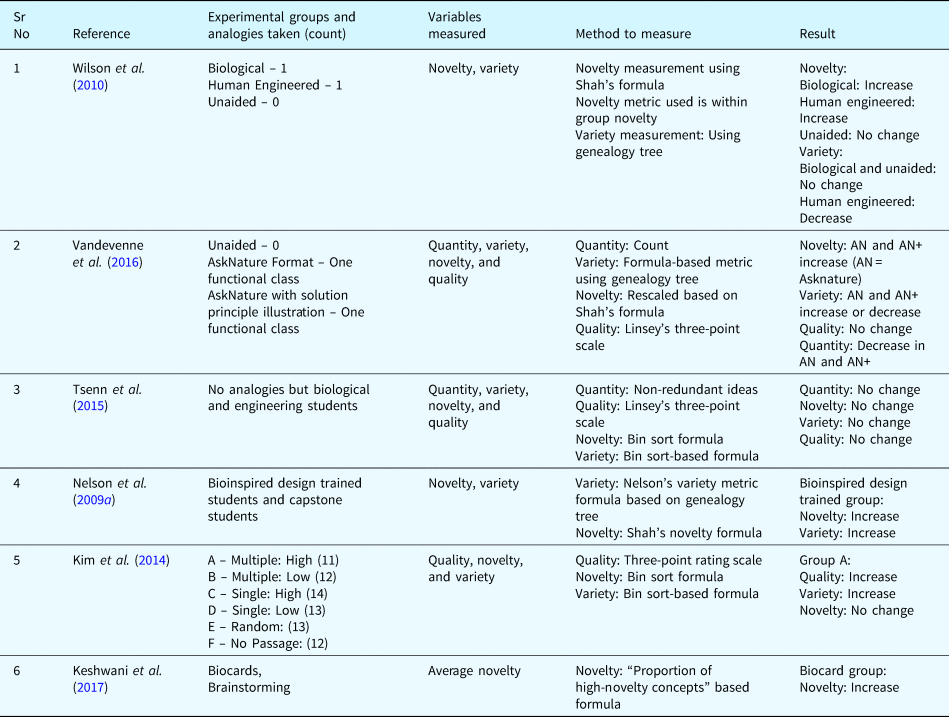
Ideation effectiveness metrics have also been used in concept generation using bioinspired design. Vandevenne et al. (Reference Vandevenne, Pieters and Duflou2016) measured quantity, quality, variety, and novelty and reported novelty increase when using the popular biological knowledge-based tool, AskNature.org. Furthermore, they reported a negative impact on the number of generated ideas by the biological stimulus representation. Jia et al. (Reference Jia, Becattini, Cascini and Tan2020) examined quantity, quality, novelty, and variety to evaluate the impact of analogical distance when subjects are presented with near, medium, and far-field analogies. They reported that near-field analogies are the most effective for quantity, variety, and novelty. Kim et al. (Reference Kim, McAdams and Linsey2014) looked into the impact of the presentation format and concluded that while originality is unaffected, the value of passages and presentation format has a major impact on variety. Durand et al. evaluated the ideas generated by the participants for quantity and quality in bioinspired design. For measuring quality metric, they used a three-point rating scale earlier described by Linsey and the team (Durand et al., Reference Durand, Helms, Tsenn, McTigue, McAdams and Linsey2015). Table 1 shows the compiled previous research accomplished for ideation effectiveness measurement in concept generation using biological support. However, most of the research work has some concerns. Wilson et al. provide only one example for biological and one example for the human-engineered group to establish novelty and variety. We understand that with one biological inspiration, concept variety can be significantly less. Designers may not be bioinspired but fixated on one functional principle. Also, with no training in abstraction, the final concept may not be bioinspired. The same designer has been provided bioinspiration in the mid of experimentation means greater chances of generating a modified design that can be similar to previous designs (Wilson et al., Reference Wilson, Rosen, Nelson and Yen2010). This issue can be overcome by providing designers with multiple biological analogies and prior training for abstraction (R1). In Vandevenne et al. research paper, the information on biological analogies used is unavailable. The raw information presented is without proper knowledge representation and may not be equally understandable by designers. Their evaluation is based on AskNature, an online biological knowledge tool (Vandevenne et al., Reference Vandevenne, Pieters and Duflou2016). This unformatted raw knowledge can be overcome by providing a uniform format of refined knowledge for all biological analogies (R2). Tsenn et al. used a small biological group (11) and a very simple problem asking for bioinspired solutions. However, the solutions hardly use any biological analogies. Designers can be ensured to use biological analogies, and a comparison of the concept generated and biological analogies used can ensure whether the concept is bioinspired or not (R3). Nelson et al. used participants from a semester-long instruction in bioinspired design. However, the problem does not ask for bioinspired solutions; rather, artificial inspirations are taken to solve the problem (Tsenn et al., Reference Tsenn, McAdams, Linsey, Gero and Hanna2015). Kim et al. use textual stimuli where passages contain one or two sentences that are too technical and without the proper introduction of biological entities. Twenty high-quality short passages and 20 low-quality short passages in biological language are used, which can be difficult for designers to understand. No images are given for text which can represent functional principles and physical principles (Kim et al., Reference Kim, McAdams and Linsey2014). It is imperative to introduce biological analogies with images and functions so that principles can be understood properly (R4). Keshwani et al. used two biological analogies (biocard) for each problem. The biocard is generated by the participant. Brainstorming has not been explained at the time of the experiment (Keshwani et al., Reference Keshwani, Lenau, Ahmed-Kristensen and Chakrabarti2017). All the remedies (R1, R2, R3, and R4) suggested in this section for the issues with previous research have been implemented and used in this research. Researchers have used one biological example (Wilson et al., Reference Wilson, Rosen, Nelson and Yen2010), two biocards developed from memory after selection from more than 10 biological analogies (Keshwani et al., Reference Keshwani, Lenau, Ahmed-Kristensen and Chakrabarti2017), the same functional class that provided multiple biological analogies but not the intended function (Vandevenne et al., Reference Vandevenne, Pieters and Duflou2016) and biological lines and passages (Kim et al., Reference Kim, McAdams and Linsey2014). However, the use of providing a very large number of biological analogies fulfilling the same function in a presentable format has not been investigated for measuring ideation effectiveness in the developed bioinspired solutions. We intend to determine the effect of providing multiple biological analogies that perform a similar function, that is, insulation/protection from cold, and is provided in a common standard presentable format to the designer. Though the word “multiple” means more than one, throughout this paper, multiple biological analogies refer to 26 biological analogies that are provided to the designer in a common presentable format. By providing biological analogies in a presentable format, we prevent the chance of using them to serve untargeted functions.
Biological support used in previous research for ideation effectiveness

Disagreements in bioinspired ideation effectiveness research
It should be noted that Vandevenne et al. and Kim et al. both use passages. However, the results reported by them are conflicting. Vandevenne et al. stated novelty increased with respect to unaided condition, while Kim et al. reported no change in novelty. Vandevenne et al. reported no change in quality, while Kim et al. described quality reduced significantly with respect to unaided condition. Vandevenne et al. (Reference Vandevenne, Pieters and Duflou2016) reported variety may increase or decrease. However, Kim et al. reported no change to increase in variety. It is obvious that both of these research does not clarify what the impact of biological information on ideation effectiveness metrics is (Kim et al., Reference Kim, McAdams and Linsey2014). A more detailed comparison of bioinspired ideation effectiveness results is shown in Table 1. Thus, it becomes imperative to enquire about ideation effectiveness measured results when biological analogies are provided to designers.
Novelty and its measurement
Novelty is considered one of the important ideation effectiveness metrics (Dahl and Moreau, Reference Dahl and Moreau2002). Uncommon concepts can be called novel. Furthermore, concepts seen for the first time to solve a specific problem can also be novel. It is to be noted that the ideas evaluated may vary from not novel to very novel after idea analysis. The concept of novelty in terms of the “uncommonness” of ideas is mostly considered in design studies (Shah et al., Reference Shah, Smith and Vargas-Hernandez2003; Fiorineschi et al., Reference Fiorineschi, Frillici and Rotini2022). The novel ideas occupy points of the design space that are not immediately obvious. According to Nelson et al., novelty measures whether the exploration of ideas happened in well-traveled or less-traveled sections of the design space (Nelson et al., Reference Nelson, Wilson, Rosen and Yen2009b). Sarkar (Reference Sarkar2007) stated that a novel outcome is generated when it is not identical to any existing outcome(s). Fiorineschi and Rotini create a novelty map based on three dimensions: the concept of novelty underlying the metric, novelty type (P-Novelty vs. H-Novelty), and metric type (score assigned vs. score calculated) (Fiorineschi and Rotini, Reference Fiorineschi and Rotini2021).
There are various approaches for determining novelty in ideas, concepts, and products. Chakrabarti and Khadilkar (Reference Chakrabarti and Khadilkar2003) created a method for determining the novelty of a product by comparing similarities or differences with existing products as a benchmark. Lopez-Mesa and Vidal (Reference Lopez-Mesa and Vidal2006) study the effect of idea finding method based on visual stimuli and SCAMPER and evaluate novelty based on newness and non-obviousness. Linsey (Reference Linsey2007) employs “infrequency” to measure novelty. “Infrequency” means the more an idea appears within a set (e.g., from an idea generation session), the lower the related degree of novelty. Peeters et al. (Reference Peeters, Verhaegen, Vandevenne, Duflou, Fischer and Nadeau2010) proposed a modified novelty metric to calculate the novelty using three hierarchical levels previously employed for calculating variety using an ideation tool called PAnDA (Product Aspects in Design-by-Analogy). Sarkar and Chakrabarti (Reference Sarkar and Chakrabarti2011) employed a relative novelty approach to assess the novelty, where one can compare the characteristics of that product with those of other products. Shah et al.'s (Reference Shah, Smith and Vargas-Hernandez2003) methodology includes an “a posteriori” premise, whereby all participants’ ideas from all methods are gathered attributes, and means of satisfying those attributes are counted for novelty. Ranjan et al. proposed a creativity assessment method utilizing novelty and requirement satisfaction intended to be used during the design process. They used weighted requirement satisfaction with the SAPPhIRE method as a proxy measure for usefulness (Ranjan et al., Reference Ranjan, Siddharth and Chakrabarti2018). Design fixation has been measured using novelty as one parameter in SCAMPER and WordTree methods (Moreno et al., Reference Moreno, Blessing, Yang, Hernández and Wood2016).
The bioinspired design has also used novelty metric to measure ideation effectiveness. Using biological analogies over conventional brainstorming, Keshwani et al. (Reference Keshwani, Lenau, Kristensen and Chakrabarti2013) assessed the novelty of design concepts generated and found that the percentage of highly novel ideas and the novelty of the concept space with biological analogies increased. When superficial and shallow analogues are given, Keshwani and Chakrabarti found that biological domain analogies create much more novelty, but cross-domain and biological domain analogies produce no significant difference in novelty (Keshwani and Chakrabarti, Reference Keshwani and Chakrabarti2017). Wilson et al. (Reference Wilson, Rosen, Nelson and Yen2010) observed that after being exposed to biological entities, the novelty of design ideas produced increased without decreasing the variety. When mechanical engineering student groups trained in a semester-long course on biologically inspired design are given a design task, the bioinspired design ideas showed an average novelty score of 80% higher and an average variety score of 37% higher than mechanical engineering students from a capstone design class. However, most solutions are inspired by artificial solutions rather than being biologically inspired (Nelson et al., Reference Nelson, Wilson and Yen2009a).
Shah's novelty measurement
According to Shah et al., the problem is deconstructed into its major functions or characteristics following Pahl and Beitz's principles to evaluate novelty (Shah et al., Reference Shah, Smith and Vargas-Hernandez2003). Each function is assigned a weight reflecting the importance of the function to the problem definition. Each produced idea is then analyzed in relation to the function it satisfies, and every idea is graded for novelty. The overall novelty score for each idea can be calculated according to the following equation.
 $$M_N = \mathop \sum \limits_{\,j = 1}^m f_j\mathop \sum \limits_{k = 1}^n S_{Njk}p_k,$$
where MN is the novelty score for an idea with m functions and n stages. Weights are applied to the importance of function (fj) and stage (pk). SN is calculated by
 $$S_{Njk} = \displaystyle{{T_{\,jk}-C_{\,jk}} \over {T_{\,jk}}} \times 10,$$
where Tjk is the total number of ideas for the function j and stage k, and Cjk is the total number of solutions in Tjk that match the current idea being evaluated. Multiplying it with 10 normalizes the outcome.
Linsey's novelty measurement
The number of similar concepts divided by the total number of concepts gives a novelty score. This is calculated by subtracting the frequency of ideas in a specific bin from one.
 $${\rm Novelty} = 1-{\rm Frequency} = 1-\displaystyle{{{\rm Number}\,{\rm of}\,{\rm ideas}\,{\rm in}\,{\rm bin}} \over {{\rm Total}\,{\rm number}\,{\rm of}\,{\rm ideas}}}.$$
Variety and its measurement
The need to measure variety is of significant importance. Exploring the breadth of the design space is essential to produce a creative and successful design (Henderson et al., Reference Henderson, Helm, Jablokow, McKilligan, Daly and Silk2017; Ramachandran et al., Reference Ramachandran, Miller, Hunter and Fuge2018). Variety is a key feature of design concepts since it reveals how far the solution space has been explored. When a more diversified set of ideas is developed in the early phases of design, the chances of effectively solving a design problem increase (Henderson et al., Reference Henderson, Helm, Jablokow, McKilligan, Daly and Silk2017). Variety refers to the degree to which a single designer's ideas differ from those of other designers (Nelson et al., Reference Nelson, Wilson, Rosen and Yen2009b). The variety of an idea in a concept space is defined as the difference between the concept and all previous concepts generated in that concept space (Srinivasan and Chakrabarti, Reference Srinivasan and Chakrabarti2010). It evaluates how different an individual's set of developed concepts or ideas are from one another (Vandevenne et al., Reference Vandevenne, Pieters and Duflou2016). For assessing the variety of designers in engineering design, Srinivasan and Chakrabarti (Reference Srinivasan and Chakrabarti2010) used seven constructs of SAPPhIRE. In their approach, the second idea is compared with the first, which is assigned a score of 0. The differences are noted, and a variety score is awarded based on a difference at the highest level of abstraction. The third concept is compared to the first and second concepts, and the cycle is continued until each concept in the concept space has a variety score assigned to it. Atilola and Linsey (Reference Atilola and Linsey2015) reported no change in the variety of engineering designers when evaluating creativity and design fixation using computer-aided design (CAD), sketch, or photograph representations. A level-based, correctly normalized variety metric is also developed by Verhaegen et al. (Reference Verhaegen, Vandevenne, Peeters and Duflou2015) for overcoming shortcomings in the variety metric, such as unaccounted fairness of the distribution of ideas for engineering design problems. For concept evaluation in bioinspired design, Wilson et al. employed coded genealogical trees to create a four-level categorization scheme based on the participants’ idea set. They concluded that the participants’ design concepts in the biological and unaided circumstances did not differ substantially (Wilson et al., Reference Wilson, Rosen, Nelson and Yen2010). Tsenn et al. (Reference Tsenn, McAdams, Linsey, Gero and Hanna2015) evaluated the variety for biology and engineering students and concluded that both generate a similar variety of solutions, on average, when using different methods, namely directed, case study, AskNature.org, BioTRIZ, and functional modeling.
Shah's variety measurement
Shah and group's variety measure (2002) described the degree of difference among a set of designs delivered by a designer with a score range of zero to ten. Measuring the variety necessitated first developing a genealogy tree of the solution supported by functional category. The physical principle, working principle of the solution, the embodiment of the solution, and details of the solution are used to categorize solutions among the tree's hierarchical branches. Following the creation of the tree, the number of ideas in each differentiated category is tabulated. The total variety score is given as follows.
 $$V = \mathop \sum \limits_{\,j-1}^m f_j\mathop \sum \limits_{k = 1}^4 \displaystyle{{S_kB_k} \over N},$$
where V is the variety score, m is the total number of required functions solved by design, fj is a weighting factor for the relative importance of function j, Sk is the score for hierarchical level k (scores of 10, 6, 3, and 1, respectively for the four levels), Bk is the number of branches at hierarchical level k, and N is the total number of ideas in the set.
Linsey's variety measurement
Linsey and her group created variety trees for assessing variety holistically rather than dividing a design context into functions. Instead, a coder divided ideas with comparable characteristics into different “bins” depending on their overall differences. The variety score of an individual is computed by dividing the number of bins into which their ideas are grouped by the total number of bins (Linsey et al., Reference Linsey, Clauss, Kurtoglu, Murphy, Wood and Markman2011; Henderson et al., Reference Henderson, Helm, Jablokow, McKilligan, Daly and Silk2017).
Quality and its measurement
In engineering design, it is critical to generate high-quality concepts (Helm et al., Reference Helm, Jablokow, Daly, Silk, Yilmaz and Suero2016). Even when the number of ideas is high, and the variety is more, if the ideas are non-executable, the design efforts may be fruitless. A quality metric is necessary in engineering design for an idea to be feasible and practical (Charyton et al., Reference Charyton, Jagacinski, Merrill, Clifton and DeDios2011). Quality is a measurement of an idea's feasibility and how well it adheres to the design specifications (Nelson et al., Reference Nelson, Wilson, Rosen and Yen2009b). The quality of a concept, according to Lamm and Trommsdorff (Reference Lamm and Trommsdorff1973), is its effectiveness (its capacity to meet the stated requirements) plus its feasibility (i.e., the degree to which an idea may be realized within the restrictions of reality). According to Linsey (Reference Linsey2007), quality is equivalent to technical feasibility or implementability. Dean et al. (Reference Dean, Hender, Rodgers and Santanen2006) suggested workability, relevance, and specificity as sub-dimensions of quality. In organizational problem solving, to measure quality, Reinig et al. evaluate ideation quality, including idea count, sum of quality, average quality, and good idea count (Reinig et al., Reference Reinig, Briggs and Nunamaker2007). Feasibility and effectiveness are two commonly defined components of quality (Cheeley et al., Reference Cheeley, Weaver, Bennetts, Caldwell and Green2018). The most commonly used quality attribute to describe a creative product is usefulness (Kudrowitz and Wallace, Reference Kudrowitz and Wallace2013). QFD, the Pugh matrix, and Decision Tables can be used to determine the quality variable. Acceptability, applicability, clarity, effectiveness, implementability, and implicational explicitness are six design metrics used to judge the quality of each concept (Henderson et al., Reference Henderson, Jablokow, Daly, McKilligan, Silk and Bracken2019). Tsenn et al. (Reference Tsenn, Atilola, McAdams and Linsey2014) compared a 50-minute concept generating session to a 120-minute session and reported that a 50-minute ideation time produces high-quality, novel solutions in engineering design.
Linsey's quality measurement
Linsey et al. (Reference Linsey, Clauss, Kurtoglu, Murphy, Wood and Markman2011) measured quality using a three-point rating scale rated independently by two judges. Each concept received a quality score. The evaluation involved simple yes/no answers that were converted to quantified data. The quality scale inquired about the technical feasibility and technically difficult within the context.
Shah's quality measurement
The metric for the quality measure is shown in the following equation.
 $$M_L = \mathop \sum \limits_{\,j = 1}^m f_j\mathop \sum \limits_{k = 1}^2 \displaystyle{{S_{\,jk}p_k} \over {\left({n \times \mathop \sum \nolimits_{\,j = 1}^m f_j} \right)}},$$
where ML is the quality rating for a set of ideas based on the score Sjk at function j and stage k. Weights are applied to the function (fj), and the stage (pk) and m is the total number of functions. The denominator is used to normalize the result to a scale of 10.
Quantity and its measurement
Quantity refers to the total number of ideas generated by a group or individual during a set period of time or throughout the completion of all phases in a concept generation process. Counting all the ideas developed by the participants gives the number of ideas generated. Quantity does not have a defined metric. This metric is applicable to individual designers as well as to a group of designers who have been given the same problem to solve. The rationale for employing quantity is that producing a large number of ideas raises the odds of finding superior ideas (Shah et al., Reference Shah, Smith and Vargas-Hernandez2003).
Experiment
Our study uses the same metrics that Shah et al. (Reference Shah, Smith and Vargas-Hernandez2003) have demonstrated. We compare concepts generated with and without the aid of biological analogies. This study tested the following specific hypotheses.
-
Hypothesis 1: When designers are provided with multiple biological analogies performing a similar function in a presentable format, they can generate bioinspired solutions.
-
Hypothesis 2: When designers are provided with multiple biological analogies performing a similar function in a presentable format, the bioinspired solutions generated are more novel than solutions generated in unaided conditions.
-
Hypothesis 3: When designers are provided with multiple biological analogies performing a similar function in a presentable format, the bioinspired solutions generated have more variety than solutions generated in unaided conditions.
-
Hypothesis 4: When designers are provided with multiple biological analogies performing a similar function in a presentable format, the bioinspired solutions generated have higher quality than solutions generated in unaided conditions.
-
Hypothesis 5: When designers are provided with multiple biological analogies performing a similar function in a presentable format, the bioinspired solutions generated are more in quantity than solutions generated in unaided conditions.
The following experimental setup has been administered to verify the hypotheses in this study.
Participants
In testing hypotheses 1–5, participants are put into one of two conditions. Six participants participated in aided condition with biological analogies, and the other six participated in the unaided condition where no support is provided. All 12 participants (all males) have completed their Master's in Mechanical Engineering and are currently enrolled in doctoral research (full or part-time) at a major research institute in northern India. All of them have either academic or industry experience (including design). The average experience in the biological group is 2.1 years. The average experience in the control group is 4.5 years. All participants voluntarily participated, and no compensation is provided to any participants. The participants are considered designers throughout this paper and have no previous experience with bioinspired design concept generation.
Selection of biological analogies in experiment
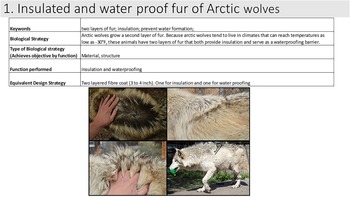
The primary source of selection of biological analogies that have been presented to designers is AskNature. Other secondary sources searched are websites and online resources. A detailed search is carried out rigorously using different keywords “how organisms (animals/plant/marine life) keep warm (in habitat/winters/cold region)”. The list of the biological organism with functions and images supporting the function is compiled. Furthermore, these are filtered to clean irrelevant biological analogies. For example, fur coats are present in sheep, muskox, and otters. In order to avoid repetition, sheep are kept, and others are removed. The biological analogies have been presented with text and images in a presentation format with the following elements.
1) Function description header: The header defines the function attained by the organism.
2) Keywords: Important keywords are represented as compiled from the description.
3) Biological Strategy Description: Passage describing the strategy details of the biological organism.
4) Type of biological strategy: Whether the function is achieved through material, structure, process, or behavior.
5) Function performed: Principle of the function performed by the organism.
6) Equivalent design strategy: It describes the potential application of an organism's function.
One example of the provided biological analogy is shown in Figure 1.
Provided biological analogy to solve the design problem.

Experiment
All designers are given one problem to be solved in a limited time frame. The designers supported with provided biological analogies are referred to as biological group. The designers who are not given any biological analogies are called as control group in this research. Two different groups of designers are selected as previously generated ideas may positively or negatively influence idea generation (Keshwani et al., Reference Keshwani, Lenau, Ahmed-Kristensen and Chakrabarti2017). For the control group, six designers solve the problem without using support. For the biological group, another six designers solve the same problem supported by provided biological analogies. The design problem with customer needs is described as follows. “Defense forces in cold hilly areas occupy border posts, and they need drinkables to keep them warm. The goal is to develop solutions to keep liquids in containers warm in the cold region. There is no restriction for generating the number of solutions.
Customer needs:
• Must be a portable container.
• Electrical outlets are not available.
• Must keep the contents, that is, liquids, warm for longer durations.”
All participants participated via online mode only (in online google meet due to the global pandemic situation). The online participants are asked to make arrangements for several sheets of blank A4 paper, a pencil, a pen, a good quality camera, a headphone, and a laptop/workstation with good internet connectivity beforehand. The experiment is conducted in two rounds. One for aided condition (biological group) and another for the unaided condition (control group). Two experimenters coordinate the experiment in digital mode. Designers are randomly assigned to one of the experimental conditions, and they are unaware of the other experimental condition. All instructions are given to designers. Five minutes are given to review the problem. Another 45 min are given to complete the design task. All designers are instructed to completely use the time allotted and generate as many as possible legible and labeled concepts. In the biological group, the designers are provided a total of 26 biological analogies to support them in solving the problem using bioinspiration only. An online training presentation of 30 min is given to designers in the biological group. The presentation also described how to extract any feature, function, and behavior from the biological analogies. Furthermore, the presentation provided the biological analogies in a format consisting of a biological inspiration title, keywords, description, type of strategy, the function performed, an equivalent design strategy, and images showing the biological phenomenon. One example from the biological analogies provided to the designer is shown in Figure 1. In the control group, only the design problem is provided to designers. The submissions are collected digitally.
Evaluation metrics and results
To test our hypotheses, a comparative measurement of the overall effectiveness of the solutions generated in the biological and control group is accomplished. Four metrics, namely novelty, variety, quality, and quantity, as proposed by Shah et al. (Reference Shah, Smith and Vargas-Hernandez2003), have been employed. While the approach for measuring novelty, quality, and quantity is somewhat based on Shah's formulas, the method for measuring variety is different. The objective of using these metrics is to measure ideation effectiveness in the control group and biological group. The analysis of these parameters can help us understand the effectiveness of using biological analogies for bioinspiration to solve a design problem. It also compares the design solutions generated when the biological analogy is provided and when no biological analogy is provided. These four metrics together can provide significant evidence for the assessment of the hypotheses. Two authors have evaluated all the metrics. For reliability, the evaluations are repeated twice to ensure correctness.
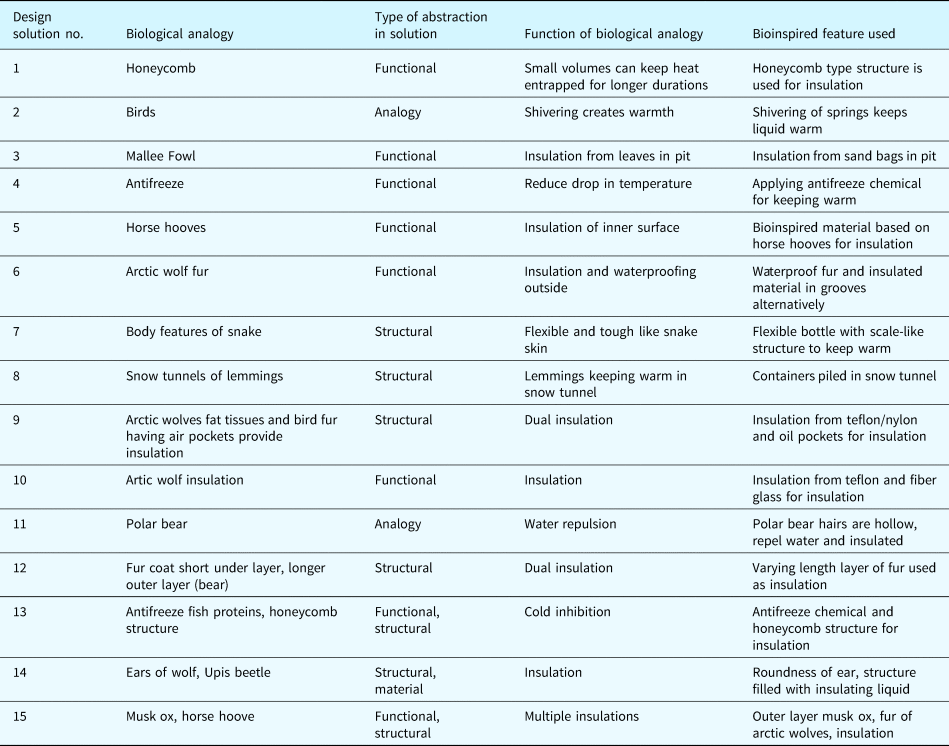
In hypothesis 1, we aim to find out whether providing multiple biological analogies to designers can help them generate solutions. This hypothesis can be investigated by comparing utilized biological analogies and concepts developed thereof in the biological group with concepts generated in the control group. Refer to Table 2 for a detailed list of bioinspired solutions for the biological group. All 15 solutions in the biological group used only biological analogies to generate bioinspired solutions. No biological analogy has been reportedly used by the control group.
 $$\eqalign{&{\rm Utilization}\,{\rm of}\,{\rm given}\,{\rm biological}\,{\rm space} \cr & = \displaystyle{{{\rm Unique}\,{\rm biological}\,{\rm analogies}\,{\rm used}\,{\rm in}\,{\rm biological}\,{\rm group} \times 100\%} \over {{\rm Biological}\,{\rm analogies}\,{\rm provided}\,{\rm to}\,{\rm biological}\,{\rm group}}}.}$$
Eleven unique biological analogies are used in the biological group, and the count of biological analogies provided for the biological group is 26. This gives 42% utilization of biological space. This utilization of biological sets and the count of biological analogies confirm hypothesis 1 that designers can generate solutions with the help of multiple provided biological analogies. The most utilized biological analogy by designers is artic wolf fur (3 counts). Other analogies are ignored by designers. The utilization points out an important aspect that even if a lot of biological entities are given, the designer might choose certain biological entities for solving a design problem while ignoring others. There are two counts where designers used external biological analogy. This result supports hypothesis 1 that when multiple biological analogies are provided to designers, they can generate bioinspired solutions. Designers may have chosen to select these biological analogies as each designer is adept at the abstraction of a particular set of features from the biological entity. For example, from a biological analogy, he can mimic some mechanism, shape, and structure of the biological entity, the material of the biological entity, the functionality, or the system. The most common analogical abstraction in bioinspired solutions is functionality, followed by structure and material.
Biological analogies used and feature abstracted in biological group

Novelty evaluation
The second hypothesis stated that exposure to biological analogies leads to conceptual solutions of greater novelty. This hypothesis is tested by comparing the novelty scores of the designers in the biological group and the control group. Our method is aimed to find out whether providing biological analogies to designers can make them generate novel solutions. If the solutions are novel, how much higher are they when no biological analogy is provided? We use the following expression for the measurement of novelty.
 $${N} = \mathop \sum \limits_{{\,j} = 1}^{m} {\,f}_{\,j}{S}_{1{\,j}},$$
where N is the measure of novelty score for a particular solution, m is the total number of sub-parameters, fj is the weight assigned for the sub-parameter according to the importance of each function or characteristic, and S 1j is the sub-novelty measure. We consider four important parameters, namely geometric shape, mechanism, the material used, and the number of insulating surfaces. All of these parameters have an influence on the novelty of the problem. As the problem is based on a heat transfer mechanism so, geometrical shape and mechanism have more influence on the solution of the given problem. For the solution to be novel, the shape of the solution and mechanism has to be new or uncommon. Similarly, a designer may suggest an uncommon composition of the material. He may add insulation surfaces within the concept solution. While allocating weights to the sub-parameters, a simple approach can be to assign a higher weight to the heat transfer mechanism, while less weight can be assigned to other features like the number of heat transfer surfaces. In order to determine the actual subfactor weightage, an online survey through google form is conducted. The participants include senior doctorate students having experience in the field of design and faculty members of the mechanical engineering department in a prominent engineering institute. In the survey, participants are asked ten questions, including ranking the sub-parameters for resolving the same problem in the form of ratings from 1 to 5. Here 1 represents the least important feature, and 5 represents the most important feature. This survey resulted in a total of 26 responses from the participants. For analyzing responses, we take the average of all the responses for specific parameters and then convert that average into the form of a percentage. The results of this survey concluded that there is no significant difference in overall sub-parameters. The two parameters have been given slightly more weightage for novelty evaluation. Two parameters are given a weightage of 0.3, and the other two are given 0.35. Therefore, the weights have been assigned as follows: f1:0.3, f2:0.3, f3:0.35, and f4:0.35. The novelty subnumber has been shown in Table 3. A score of zero is assigned if the sub-parameter does not comply.
Assigning novelty subnumber

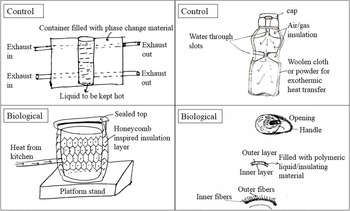
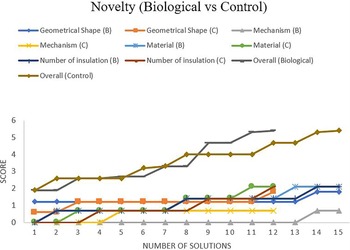
The aforementioned metrics method is used to calculate the novelty of the design concepts generated by the participants. The solutions for the control group and biological group are shown in Figure 2. Figure 3 shows the overall and sub-parameter novelty score of all designers for the control group (C) and biological group (B) in increasing order. The overall novelty quantitative score of biologically inspired solutions is comparable to the unaided solutions. It is evident that solutions generated with biological analogies only have a novelty score at par with solutions generated without biological analogies.
Concept sketches developed by designers in the control group and biological group.

Novelty score of concepts developed with and without biological inspiration.

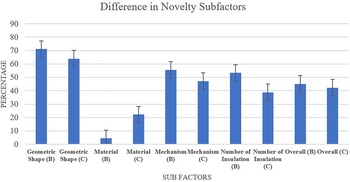
We report that a higher number of solutions are generated in the biological group and the average score of novelty in the biological group is higher than that of the average score in the control group by 7%. Figure 4 shows the variation in individual novelty subfactors scored in the biological and control groups. It is evident that except for material, all novelty subfactors, namely geometric shape, mechanism, and the number of insulations, have higher percentage scores. A high individual subfactor score indicates that more novelty is present in biologically inspired solutions. The material subfactor scored low because, as such biological analogies do not inspire a material name. In the biological group, the novelty subfactors, namely geometric shape, is 8.33% higher, material inspiration is 19.44% lower, mechanism inspiration is 16.67% higher, and inspiration for the number of insulations is 22.22% higher as compared to the control group. The overall novelty with the biological group is 3% higher than the control group.
Novelty subfactors and their respective change in the biological and control groups (error bars are (±) one standard error of the mean).

Table 4 shows the novelty scores for the biological group (B) and control group (C). The overall score is the total score for all concepts. The average novelty score is the overall score divided by the total number of concepts generated. A higher overall novelty score signifies that the biological group has more novelty than the control group. Quantitatively, the average novelty score of the biological group is comparable to the control group. An inter-rater reliability score (Pearson's correlation) of 0.79 is obtained for the novelty metric. This correlation value is high (Clark-Carter, Reference Clark-Carter1997). The novelty scores are not normally distributed, and variances are homogeneously distributed. Kruskal–Wallis test has been performed instead of one-way ANOVA. The H-statistic for novelty scores is 0.1524 (1, N = 27), and the P-value is 0.69627. The result is not significant at P < .05. The novelty score results are not statistically significant. In other words, the novelty for the biological group and novelty for the control group is more or less the same. These findings confirmed that exposure to biological analogies leads to novel design concepts comparable with the unaided condition quantitatively. Statistically, the results show that concept generation supported with provided bioinspired analogies are not more novel as compared to unaided condition.
Novelty scores in the biological group (B) and the control group (C)

Variety evaluation
The third hypothesis stated that exposure to biological analogies leads to conceptual solutions of greater variety. This hypothesis is tested by comparing the variety of concepts in the biological group and the control group. We define variety as the degree of nonuniformness of solutions generated. The higher the degree of nonuniformness in solutions, the higher the variety of solutions generated. The degree of uniformness is already considered by Shah et al., who use genealogy structure to measure variety. They applied variety rating to an entire group of ideas instead of a single idea. The approach of genealogy tree implementation can have large variations in what can constitute to physical principle, the working principle, the embodiment, and the detail level. Our evaluation of variety is somewhat similar to Srinivasan & Chakrabarti's approach (Srinivasan and Chakrabarti, Reference Srinivasan and Chakrabarti2010). Srinivasan & Chakrabarti use a relative method of variety assessment of a concept where the nth concept is compared with all (n−1) concepts (n > 1) generated previously in that concept space to ascertain the ideas that differentiate the nth concept from the others in that concept space and a variety score is assigned based on abstraction level to all the concepts. Then, the average of the variety score is taken in that concept space. The scoring pattern of the seven constructs of Sapphire is Action: 7, State change: 6, Input: 5, Phenomenon: 4, Effect: 3, Organ: 2, and Part: 1
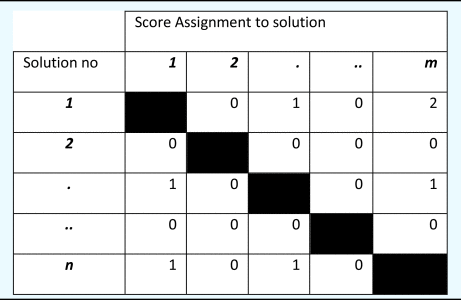
In our variety assessment, we also use a relative method of assigning scores. Instead of the seven parameters of Sapphire, we use three parameters for evaluating the concept, namely mechanism, shape, and structure, with three measuring parameters “similar,” “somewhat similar,” and “different”. A score of 0, 1, and 2 is given to each concept as different, somewhat similar, and similar, respectively, for determining the frequency in the biological group, control group, and biological versus control group. Table 5 shows the 2D matrix developed for assessing solutions for variety. To test our hypothesis, comparisons are made both within groups and between groups to evaluate variety. We evaluate the variety of each concept with respect to all the other concepts within the group and compare the qualitative similarity and dissimilarity. The 2D matrix is developed to evaluate the variety of concepts generated within the group and with other groups for evaluations of sub-parameters, namely mechanism, shape, and structure. In each matrix, each concept is compared with all the other concepts in the group. There are three possibilities when concepts are compared. The concepts can be similar, somewhat similar, and dissimilar. For the control group and biological group, matrices are developed for evaluating similarity or dissimilarity in mechanism, shape, and structure. The counts of dissimilarity are considered as an evaluation of variety. The higher the dissimilarity in the concepts based on mechanism, shape, and structure, more will be the variety within the group. We use two bases, namely score, and frequency of occurrence, for measuring variety. The quantitative comparison of dissimilarity counts clarifies which group has more dissimilarities or variety.
2D matrix for measurement of variety

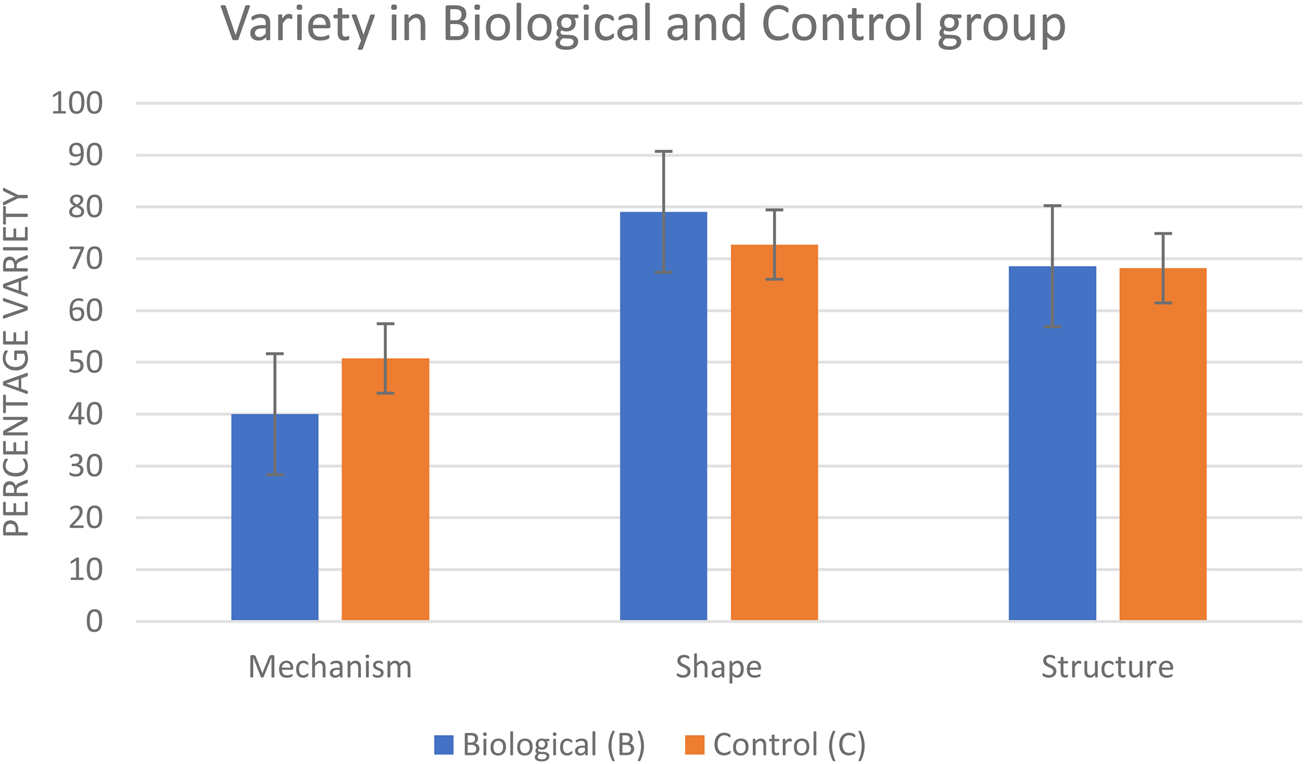
We made three assessments for similarities and dissimilarities in the control group, the biological group, and between the biological group versus the control group. The similarities and dissimilarities have been assessed concept by concept. Three parameters have been assessed, namely mechanism, shape, and structure for somewhat similar, similar, and different. Measuring variety for all concepts in biological and control groups enables understanding of the overall variety produced in these individual groups. This measurement gives the overall variety generated in the design space. Measuring the variety of the control group with the biological group helps us understand how different the variety in the control group is from the biological group. Nine tables have been developed in all. Scores of 0, 1, and 2 are assigned based on the comparison in each table. n and m represent the number of concepts in each condition. When concepts are compared within a group, n = m. This equality is valid for the biological group and control group. When concepts are compared in a different group, usually n ≠ m. This inequality is valid for the biological group versus the control group. A frequency table for each score (0, 1, and 2) is further developed. The frequency is then summed, and the variety percentage is calculated for the control group, biological group, and control group versus biological group. Figure 5 shows the variety of solutions generated with and without provided biological analogies.
Variety of concepts generated in biological and control group based on frequency (error bars are (±) one standard error of the mean).

In the biological group, 40% of mechanisms, 79% of shapes, and 68% of the structure are different with respect to each other. In the control group, 50% of mechanisms, 72% of shapes, and 68% of the structure are different with respect to each other. In both the biological group and control group, most variety is observed in shapes. The control group variety is 63%, and the biological group variety is 62.5%. However, both groups’ variety ground is different and incomparable as this measurement of variety is intragroup and not intergroup. For measuring the intergroup variety, when biological group concepts are compared with control group concepts, there is a significant difference. The biological versus control group variety is 88%. This is indicative of variety in inspiration from biological analogies and control groups for mechanism, shape, and structure. In the biological versus control group concept, the most variety is observed in structure, followed by mechanism and shape.
In order to determine the relationship between biological and control groups with respect to the variety of sub-parameters, a chi-square test is conducted. We found the relationship is insignificant (χ 2[2, N = 119] = 1.236, P = 0.539) and that variety in the biological group and control group are independent of each other. When Mann–Whitney U-test is conducted to analyze variety, the results are significant (U = 49, P < 0.05). The biological group has a significant variety than the control group. The hypothesis that concept generation based on biological analogies results in a wider variety has been confirmed.
Quality evaluation
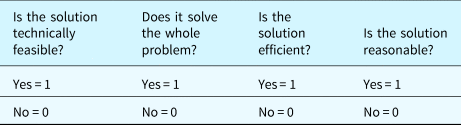
The fourth hypothesis stated that exposure to biological analogies leads to conceptual solutions of higher quality. This hypothesis is tested by comparing the quality scores of the concepts in the biological group and the control group. We evaluate four parameters for the measurement of quality in the solution.
1) Is the solution technically feasible?
2) Does it solve the whole problem?
3) Is the solution efficient? and
4) Is it reasonable?
Technical feasibility is based on the manufacturability of generated solution. If the generated solution is able to fulfill all the requirements of the given problem, then it can solve the whole problem. Generated solutions can be efficient or inefficient. Reasonability depends on many factors, such as cost, durability, and easy handling. Each of these sub-parameters is evaluated with suitable weightage to calculate the overall score for each concept in both groups. The mathematical measurement formula for calculating quality is shown below.
 $${Q} = \mathop \sum \limits_{\,j = 1}^n f_jS_j,$$
where Q is the quality score for the generated solution, n is the number of sub-parameters, fj is the assigned weight for that sub-parameter, and Sj is the sub-quality score. We assume all the quality measures are equally important, so we have assigned equal weight to all. Each sub-parameter is assigned a weightage of 0.25. The sub-quality parameters are shown in Table 6.
Sub-quality score

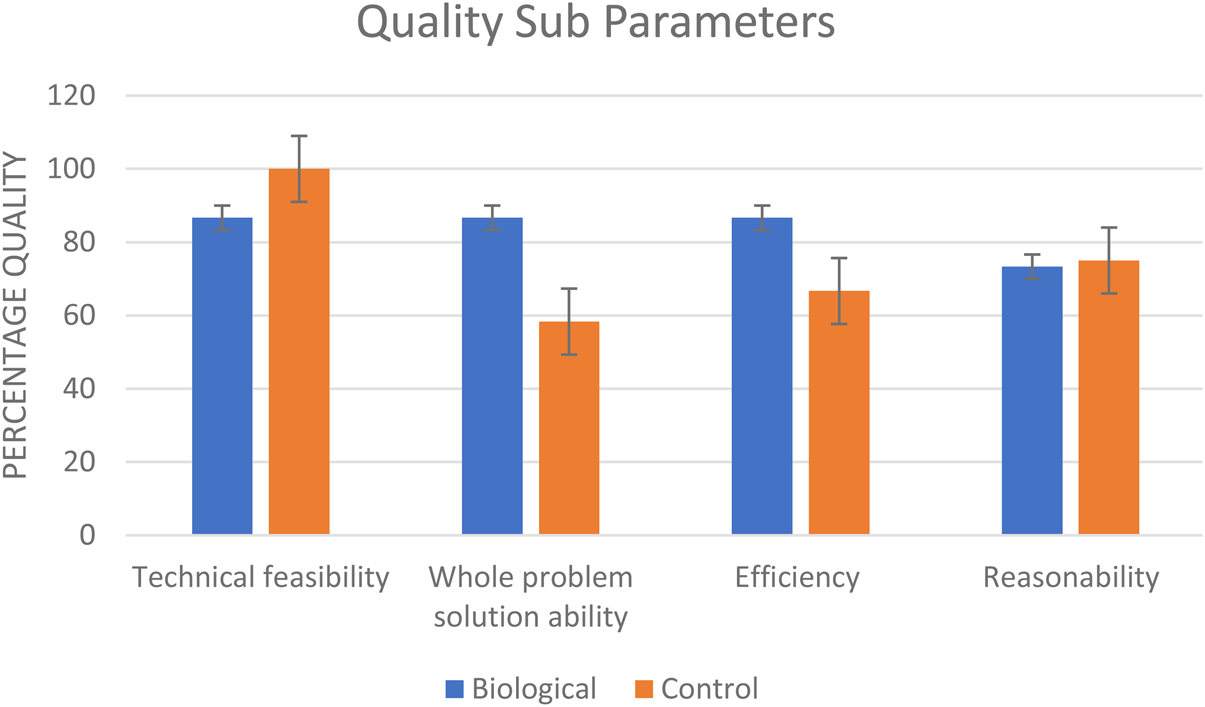
Figure 6 shows the sub-parameters of quality fulfilled by the number of solutions for the control group and biological group. It can be observed that there is more variation in quality sub-parameters for the control group as compared to the biological group. An inter-rater reliability score (Pearson's correlation) of 0.74 is obtained for the quality metric. This correlation value is high (Clark-Carter, Reference Clark-Carter1997).
Sub-parameters and number of solutions for quality parameter.

Quantitatively, the technical feasibility in the biological group is less as compared to the control group. This may be because even if the solution is bioinspired, the designer instantaneously may not think of achieving the functionality by artificial means as the solutions are novel. In other words, similar solutions do not exist. On the other hand, the control group solutions have maximum technical feasibility as these solutions are based on creativity and previous knowledge. A higher percentage of solutions generated by the biological group do solve the complete problem as compared to the control group. This may be attributed to more inspiration provided in the biological group. The biological group solutions are more efficient than the control group. The reasonability of biological group solutions is slightly lower than the control group. The average quality of solutions generated in the biological group is 8% higher than that control group. The overall quality score in the biological group is also higher than in the control group. The quality scores are not normally distributed, and variances are homogeneity distributed. Kruskal–Wallis test has been performed instead of one-way ANOVA. The novelty score H-statistic is 1.1524 (1, N = 27). The P-value is 0.28305. The result (P < 0.05) is not statistically significant. In other words, the quality of the solution generated with biological analogies and without biological analogies is more or less the same. The results depict the hypothesis that concept generation using biological analogies is at par with the unaided condition.
Quantity evaluation
The fifth hypothesis stated that exposure to biological analogies leads to conceptual solutions of greater quantity. This hypothesis is tested by comparing the count of the concepts in the biological group and the control group. In the biological group, the number of solutions generated by the designers is 15. In the control group, the number of solutions generated by designers is 12. Thus, the number of solutions generated is 25% higher when biological analogies are provided. There is not a statistically significant difference in quantity between the control group (M = 2, SD = 0.63) and the biological group (M = 2.5, SD = 0.84); t(12) = 1.16, P = 0.27. Hence, the hypothesis is rejected that the quantity of solutions generated using biological analogies is higher as compared to unaided condition.
Discussion
The results from the experimental research presented in this paper support some hypotheses while others are rejected. Hypothesis 1 is verified as when designers are provided with multiple biological analogies performing a similar function in a presentable format, they can generate bioinspired solutions. To verify hypotheses 2–5, the comparison of respective ideation metrics of the biological group and control group is accomplished. All metrics return quantitatively higher values for the bioinspired group as compared to the control group. The results of this study only support hypothesis 3 as, statistically, variety has been found to be significantly higher in the biological group than in the control group, while other metrics, namely quality, novelty, and quantity, have been found to be insignificant.
Implications of novelty outcome
Previously, novelty of the ideas generated increased when a biological example is given to the participants (Wilson et al., Reference Wilson, Rosen, Nelson and Yen2010). They reported that merely the presence of external stimulation in the ideation process increases the novelty of the design ideas generated. Shah et al. (Reference Shah, Smith and Vargas-Hernandez2003) correlated this increase in novelty to a broadening of the design space of the designer. Our research inquires about the effect of providing multiple biological analogies fulfilling the same function and comparing the novelty of unaided group (engineering design) with aided group (bioinspired design). We conclude that the novelty remains the same when multiple biological analogies fulfilling the same function are provided to designers in a presentable format to when no support is provided. In other words, the novelty produced by aided condition (bioinspired design) is similar to unaided condition (engineering design). We understand that novelty produced in unaided condition relies on the designer's previous knowledge. In the aided condition, we provide new knowledge using biological analogies. In our conclusion, the solutions produced due to designers earlier knowledge are about as novel as those produced due to new biological knowledge.
One possible reason for the inadequacy of bioinspired solutions to be of a higher novelty than unaided solutions is that the design problem is simple. The novelty outcome is dependent not only on the type of problem but also on the input analogies and the output concept. The design task in aided and unaided condition is to provide the solution for a common problem of insulation. The input in unaided condition is earlier knowledge. The input in aided condition is biological analogies. The output unaided condition is concepts generated using earlier knowledge. The output in aided condition are bioinspired solutions. It can be understood that the level of novelty generated from the previous knowledge is at par with the solutions generated using new biological knowledge. The designer space is broadened due to new knowledge, and the bioinspired solutions from aided condition are as novel as conceptual solutions in unaided condition. Another possible reason for the same novelty in aided and unaided groups can be that the data set is not large enough to detect effects on novelty. Our novelty results match with Kim et al. (Reference Kim, McAdams and Linsey2014) and Tsenn et al. (Reference Tsenn, McAdams, Linsey, Gero and Hanna2015), who have used biological analogies to evaluate novelty using the bin sort formula. We have used a similar taxonomic approach as used by Verhaegen et al., but our results contradict theirs, where they report an increase in novelty with AskNature taxonomy.
We understand that the scoring format can also have an effect on the novelty scores. Our measure of novelty is based calculation of novelty scores based on sub-parameters and their weights. This method is different from novelty calculation, where concepts are allocated novelty scores based on the bin allotted to them (Linsey et al., Reference Linsey, Clauss, Kurtoglu, Murphy, Wood and Markman2011), as concepts can hardly be similar in terms of functionality, structure, and principle. For concept evaluation, sub-parameters and weights can be helpful. Shah's novelty score is determined by the number of similar ideas conceived in a particular set. As a result, the higher the number of similar ideas, the lower the overall novelty score. When the set of concepts has a varied number of attributes, Shah's novelty metric is unable to deliver accurate assessments (Fiorineschi et al., Reference Fiorineschi, Frillici and Rotini2020). Our novelty formula fulfills a collection of attributes capable of representing the entire set of concepts for novelty assessment and provide novelty scores for independent of similar, partially similar, or dissimilar concepts. This novelty measure can be extended to conceptual designs for multiple concepts or group of participants.
Our results are in contradiction with Wilson et al. (Reference Wilson, Rosen, Nelson and Yen2010), Vandevenne et al. (Reference Vandevenne, Pieters and Duflou2016), and Nelson et al. (Reference Nelson, Wilson and Yen2009a), who use biological analogies using Shah's formula. Our evaluation of novelty is based on four parameters for assessing individual concepts. However, Shah's formula is based on weightage to the categorized class of similar solutions. We understand that novelty is not only based on working principles but structure and material as well. It is for this reason; we have included multiple parameters for novelty evaluation. Shah et al. does not give individual novelty score but as subgroup of common function. Our implementation of novelty clarifies that using biological analogies for concept generation can generate as novel as in engineering design. This statement reflects that though biological entities can generate novel solutions, perhaps not all solutions provided by biological entities have high novelty impacts.
Improvement in novelty has been reported by Nelson et al. (Reference Nelson, Wilson and Yen2009a) when the bioinspired group showed a higher average novelty score than those from the control group of capstone students for a semester long project. We understand that if a longer duration is given to designers to solve a problem, bioinspired solutions can have more novelty. This may depend upon the problem and the exploration of biological space. When the same short duration is given to solve a problem, the bioinspired group and control group produce statistically about the same novelty. When extended duration is given to designers, the control group may get exhausted, but the biological group, due to the vast biological space, may generate high novelty concepts. The authors understand that when n analogies are present to solve a problem, the designers may utilize 1 to n analogies to generate k solutions. However, utilizing n analogies may require additional time. On the other hand, in the control group, even if additional time is given, the solution generation is limited due to no analogical support for concept generation. Similar results are also reported by Tsenn et al. (Reference Tsenn, McAdams, Linsey, Gero and Hanna2015), where biology students and mechanical engineering students solve a problem using different bioinspired design methods. Another reason for similar novelty in both groups can be the closer scale of the score for novelty. A broader score scale can be employed to justify the difference in novelty. In that case, a modification in the measurement metric is needed.
Implications of variety outcome
Our variety results match with Kim et al. (Reference Kim, McAdams and Linsey2014), which give biological analogies using multiple passages. Vandevenne et al. reported an increase and decrease both in variety when AskNature and AskNature with solution principle illustration are used. We have provided multiple biological analogies to solve the design problem by using functions and multiple working principles. However, our variety results contradict Wilson et al., who have provided one biological example with functionality and working principle. Providing one biological example can limitedly increase the solution space. In our approach, using multiple biological analogies has increased the solution space. Multiple biological analogies have several functions to resolve the same problem using different working principles. Thus, designers who want to solve a design problem can seek multiple biological analogies to provide a variety of solutions to solve the same problem. We attribute the variation in the variety results to formulas used by researchers. Formulas based on the genealogy tree are used by Wilson et al. and Vandevenne et al., while Kim et al. used the bin sort formula. We have used a relative method of assigning scores using a 2D matrix which has not been used previously. This method measures each concept with all the other concepts generated within the solution domain. Previously, it has been established that the genealogy tree can provide large variations in the score. We understand that our variety measurement is more practical and can help designers to evaluate concepts. Our variety metric provides a comparative assessment of all concepts within or outside the group. This variety assessment method can be implemented for any design concept to measure variety based on similarity levels.
To solve a design problem, the biological group showed a considerable improvement in variety compared to the control group. This conclusion is different from previous research, where the variety of design ideas of participants in the biological and unaided condition did not differ significantly (Wilson et al., Reference Wilson, Rosen, Nelson and Yen2010). We understand that significant variety change is due to the fact that designers are provided with vast biological space.
Implications of quality outcome
For quality, not much study has been done with biological analogies. We understand that not much difference in quality exists when biological analogies are provided and when no aid is given. This can allude to the fact that most produced solutions fit within the scope of the posed problem for the biological and the control group. Additionally, the participants are not actual designers who understand the checklist criteria for design concept approvals. We understand that without the knowledge of quality sub-parameters, both groups performed at par statistically. However, concept quality can be enhanced by the greater number of bioinspired concepts following fitting criteria of quality, which is again dependent on available bioinspired space. Vandevenne et al. reported no change in quality when AskNature format is used. However, Kim et al. reported an increase in quality when multiple high-quality passages are used. Both of them have used three point formula, which asks only technical feasibility and technical difficult for the context. In our quality measurement, we have used four parameters, namely technical feasibility, ability to solve the whole problem, efficient solution, and reasonable solution. Hence, our quality evaluation is more wholesome as it covers more parameters. Biological analogies provide bioinspired solutions which have quality factor at par with unaided solutions. This indicates that optimum quality levels are maintained by designers.
We understand that the effect of novelty and quality is higher but statistically insignificant due to the following reasons.
• Limited time: Both studies have been conducted in a limited time frame. An extended duration frame may enable room for higher bioinspired design creativity.
• Unfamiliar bioinspired concept generation method: Even though the training has been provided to the designers, the bioinspired concept generation is entirely new for the participants. The width and depth of bioinspired abstraction can be difficult to understand for beginners.
• Simplicity of the problem: The problem chosen is very simple, and mechanical engineering designers already have a basic idea of how to solve the same.
• Small sample size: The sample size for this study is small. A bigger sample size can clarify the results better.
Conclusions and future work
The overall aim of this research is to establish whether providing multiple biological analogies fulfilling the same function in a presentable format to designers can generate effective solutions in terms of novelty, variety, quality, and quantity metrics. In other words, we intend to find the ideation effectiveness in aided bioinspired design compared to unaided design problem solving. To achieve this, we conducted an experimental study with two groups to verify five hypotheses. These experimental results for concept generation are illustrated by senior doctorate mechanical engineering students exposed to two conditions having biological analogies and no analogies. We have used weight subnovelty scores to measure novelty, a new variety evaluation method using a 2D matrix, and four parameters based formula for quality evaluation. The first hypothesis stated that providing multiple biological analogies can make designers generate solutions. This hypothesis has been proved by the results provided. The second hypothesis stated that novel solutions are generated in the biological group as compared to unaided design solutions. This hypothesis has been unproved by the statistical results, while quantitative results prove otherwise. Similarly, the fourth hypothesis stated that the quality of bioinspired solutions generated by the biological group is higher and has been unproved. In comparison, the third hypothesis stating that biological group solutions have greater variety is proved. The fifth hypothesis stating that biological group solutions have the greater quantity is rejected. Based on the research, we can conclude the following.
1. When multiple biological entities are provided to designers fulfilling the same function in a presentable format, they can generate bioinspired solutions. There is 42% utilization of provided biological analogy space by designers. Some of the biological analogies can be utilized more frequently than others. The most common analogical abstraction in bioinspired solutions is functionality, followed by structure and material.
2. Based on the experimental results, it can be concluded that significant improvement is observed in a variety metric. Other metrics, namely novelty, quality, and quantity, do not vary significantly when biological analogies are provided as compared to unaided condition.
3. The overall metric score for parameters reveals that bioinspired concept generation with relevant provided biological analogies is at par and even better for problem solving when no support is provided to designers.
Our results on variety and novelty match with Kim et al., who give multiple biological passages to participants. However, no change in quality has been reported in our research, while Kim et al. reported an increase in quality for multiple high-quality passage groups. One reason for no change in quality is that problem given in our research is very common. Thus, solutions generated by both groups have no change in quality (Kim et al., Reference Kim, McAdams and Linsey2014). Wilson et al. report an increase in novelty and no change in variety for the biological group as compared to the unaided group. The problem statement in Wilson et al. is uncommon and also provides a not so common biological analogy. This may be the reason for the novelty of the solution generated in the biological group. Additionally, the introduction of biological analogies is equally important. The designers can be at the crossroads of two designs within a single problem as the biological analogy is introduced in half time (Wilson et al., Reference Wilson, Rosen, Nelson and Yen2010). However, we get distinguished results for metrics when the condition of multiple biological analogies supported by formatted text and images is tested with designers. The results of the research presented in this paper have a number of implications for concept generation in bioinspired design. The scope of this research is further limited to the investigation of metrics of bioinspired concept generation as compared to unaided design concept generation. We do not find an interrelation between any of the metric parameters. We ignore the effects of other parameters such as incubation, the analogical distance of analogies, the effect of the type of trigger, and fixation on design problem solving. We do not compare the design space explored and the biological explored space.
At par and even better, concepts can be generated by exploring biological space. However, the biological space has been presented in an organized way. It needs to be checked how designers fare when they are asked to generate bioinspired solutions but not presented with biological support. The preferable abstraction can be another interesting area for research to understand why a designer selected a particular biological analogy for solving a design problem when provided with multiple biological analogies. Future research in this area should include an investigation that explores design space versus bioinspired space. We can compare inter-relation between metrics. A bigger sample of designers might also support broadening the validity space of this study.
Sunil Sharma is currently pursuing PhD in Mechanical Engineering at IIT Ropar. He is working as an Assistant Professor at Lovely Professional University. He has done his Master's at Oklahoma State University. He has got an academic experience of 10 years. His research interests include biomimicry, product design, and manufacturing.
Suraj Gururani has completed his MTech in Mechanical Engineering from IIT Ropar. His research interests include design fixation and creativity.
Prabir Sarkar is an Associate Professor in the Department of Mechanical Engineering at the Indian Institute of Technology Ropar. He is also the Chairman of the Intellectual Property Rights (IPR) cell of the Institute. Dr. Sarkar's research interests include product design, sustainability, creativity, and design research. He has authored more than 80 peer-reviewed journal and conference publications. His research group in the Design Research Laboratory and Sustainable Design and Manufacturing Laboratory are engaged in research in eco-design, biomimicry, engineering aesthetics, sustainable machining, and design creativity.