One of the great thrills of preparing a critical edition is the discovery of new or overlooked sources. Work on Giuseppe Verdi's early jewel I due Foscari has led me to two such documents, an anonymous scenario pre-dating Verdi's collaboration with Francesco Maria Piave, and a manuscript copy of the full score containing several layers of revisions. The former is preserved at the Archive of the Teatro La Fenice in Venice, the latter at the Naples Conservatory; both are also accessible in microfilm copy at the American Institute for Verdi Studies at New York University.Footnote 1 Although the two documents are very different, they shed new light on Verdi's dramatic preferences early in his career: the scenario on the stage of selecting a collaborator and subject matter, and the manuscript copy on the stage of fine-tuning the libretto.
On 6 June 1843, Verdi mailed to Venice the countersigned contract for a new opera to be performed at the Teatro La Fenice during the 1843–4 Carnival season.Footnote 2 In the accompanying letter, he asked for the names of the singers who would be at his disposal and proposed as potential subjects William Shakespeare's King Lear as well as Lord Byron's The Corsair and The Bride of Abydos; as potential librettists, he mentioned Salvadore Cammarano, Temistocle Solera and Domenico Bancalari,Footnote 3 adding the cryptic sentence: ‘Perhaps also a poet of some distinction from Milan could give me this libretto’ (Forse anche un poeta assai distinto di Milano potrebbe darmi questo libretto).Footnote 4 This poet has consistently been thought to be Andrea Maffei.
In addition to the librettists on Verdi's mind, the secretary of the Teatro La Fenice, Guglielmo Brenna, suggested a novice as a potential librettist: Francesco Maria Piave. Piave promptly contacted Verdi, proposing an opera called Cromwell, but Verdi, who had not yet heard back from his first choices, declined.Footnote 5 He appears already to have settled on his ‘poet of some distinction’ because on 29 June, less than two weeks after he had declined Piave's offer, he mailed to Venice a scenario titled Catterina Howard, after the fifth wife of Henry VIII.Footnote 6 A few days later, Verdi added that this poet ‘does not want to be known’ (non vuole essere conosciuto).Footnote 7
At the same time he introduced a new potential subject – I due Foscari – one he hoped would be of particular interest to the Venetians because of its setting in their city. Only five days later, he provided the scenario (presumably written by the same ‘poet of some distinction’), now giving preference to this subject over the ones mentioned earlier and expressing his hope that it would be approved by the censors.Footnote 8 But by 26 July he learned that both Catterina Howard and I due Foscari had been rejected in Venice (the former because it was too atrocious, the latter because it would have reflected badly on the families who still shared the names of the opera's villains).Footnote 9 Verdi was disappointed, not only because he liked the subject but also because – he claimed – the libretto had already been commissioned and was basically written.Footnote 10
With both Catterina Howard and I due Foscari rejected by the censors, Verdi agreed to return to Piave and his Cromwell. But when Mocenigo, the president of the Teatro La Fenice, heard a reading of the full libretto, he began to have doubts about its quality and informed Verdi that he found it of ‘so little dramatic interest and so lacking in grand effects’ (poco interesse teatrale e si povero di grandi effetti) that he suggested Piave start over on a new subject, possibly Victor Hugo's Hernani or Alexandre Dumas père's La Tour de Nesle.Footnote 11 Verdi shared Mocenigo's concerns about Cromwell and enthusiasm for Hernani;Footnote 12Cromwell was dropped, and Ernani became Verdi's first opera for Venice. The première took place at the Teatro La Fenice on 9 March 1844.
When Verdi returned to I due Foscari in April 1844, now intended for the Roman Teatro Argentina, he had abandoned the idea of collaborating with his ‘poet of some distinction’ in favour of Piave. He did not, however, let the work on the Venice scenario go to waste, asking Piave to retrieve it and use as the basis for the needed revisions. What, then, is the content of this scenario and who is its author? The content has remained a mystery, presumably because the scenario has been considered lost; the current attribution to Andrea Maffei – Verdi's eventual collaborator on the scenario of Attila (first performed in 1846) and the librettos of Macbeth and I masnadieri (both first performed in 1847) – seemed to make good sense.Footnote 13
Maffei is an obvious choice. Not only was he from Milan and a close friend of Verdi, he was also known for his translations of Lord Byron's plays, including The Two Foscari, the eventual source of Verdi's opera.Footnote 14 Although his first Byron translation, Cain, was not published until 1852 and that of The Two Foscari until 1862,Footnote 15 Maffei was, according to Marta Marri Tonelli, working on the translation of Cain at the time of the Foscari scenario.Footnote 16 Whether or not he had already embarked on this translation, he was surely familiar with Byron's work in general. Maffei also had reason to request anonymity: at the time, he held the librettist's profession in low esteem, warning his friend Jacopo Cabianca not to write the libretto for Nicola Vaccai's Sposa di Messina (1839). Cabianca disregarded Maffei's advice and, after the work had failed miserably,Footnote 17 received the following letter from Maffei:
For Heaven's sake, leave that dishonest task to the starving scribblers of the theater, and persuade yourself that the needs of composers and singers are the death of sensible opera … You ask me to forgive you, and I do so with plenary indulgence, but only under the inviolable condition that you never again commit such an ugly sin. Amen.Footnote 18
The arguments for Maffei's authorship, convincing at first glance, lose much of their force once we take into consideration what the scenario actually says. Granted, the document may have been considered lost, but it is listed, albeit misleadingly, in the catalogues of both the American Institute for Verdi Studies (as a scenario in Piave's hand) and at the Archivio Storico of the Teatro La Fenice (as a libretto).Footnote 19 When Verdi asked Piave to retrieve it from the Teatro La Fenice, a copy must have been made by an unidentified scribe, and it is presumably this copy that is still preserved there (the entire scenario is transcribed in the Appendix below). This scenario turns out to have relatively little in common with the story of the eventual opera and is, unlike the opera, quite obviously not based on Byron's play.
The discrepancies begin with the dramatis personae. The libretto includes as the principal characters Francesco Foscari (Doge of Venice), his son Jacopo and Jacopo's wife Lucrezia, the latter, at an early stage of the compositional process still called, as in Byron's play, Marina. The scenario, however, has an additional character, the Doge's wife, with the historically accurate name Marina Nani.Footnote 20 Moreover, Marina Nani was at the time conceived as the principal female character, and her part was intended to be sung by one of the leading sopranos of the day, Sofia Löwe. In addition, the scenario covers much of the history leading up to the beginning of the eventual libretto, where it is confined to a prefatory note by Piave titled ‘To the Reader’ (A chi leggerà). Surely Maffei would not have departed from his idol Byron for the sake of sticking closer to history.
These discrepancies are substantial enough to suggest that another source may have provided the basis for the scenario. The likelihood that such a source existed is great, because the tale about Francesco Foscari's suffering over the vengeful and for the most part unjustified torture, incarceration and exile of his son enjoyed considerable popularity in the first half of the century. At least three dramas, all called La famiglia Foscari, were published around the time of Verdi's opera: the first, by Carlo Marenco, in 1835, the other two, by Giacinto Battaglia and Giuseppe Vollo, in 1844.Footnote 21 The latter two would have been published a little too late to have influenced the Venice scenario; Marenco's play, however, was published eight years prior to the scenario and would have been successful enough to inspire a poet of some distinction.
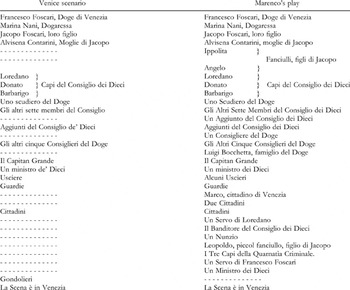
As it turns out, the scenario is indeed based on Marenco's La famigila Foscari: it follows the play's plot to the extent practical in an opera,Footnote 22 includes the same characters except for some very minor ones, and lifts text directly from the play. The scenario follows Marenco's play by including the Doge's wife (Marina Nani) and naming Jacopo's wife Alvisena Contarini. Furthermore, many of the minor characters are listed under virtually identical names or roles, from Donato all the way down to the ‘Cittadini’. Only the ‘Gondolieri’ were added (see Table 1).
The characters of the Venice scenario and of Marenco's play

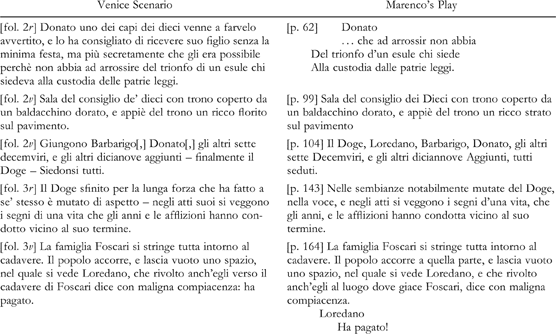
In the scenario, quotations from the body of the play, often verbatim, are abundant. A phrase on fol. 2r of the scenario, for instance, is concocted from three verses in Act I scene 5 of Marenco's play and includes the rather unusual phrase ‘perché non abbia ad arrossire del trionfo di un esule chi siedeva alla custodia delle patrie leggi’ (so that one would not have to be ashamed of the triumph of an exile who had been a guardian of the homeland's laws). Most of the remaining examples pertain to stage directions, which were lifted from the play with only minor changes. In fact, the similarities are so numerous that one is led to wonder whether Marenco concocted the scenario himself. Table 2 shows some of its most prominent quotations from his play.
Instances of quotation from Marenco's play

Born in Ceva (between Turin and Savona) in 1800 and active in that area until his death in 1846,Footnote 23 Marenco made a name for himself as the author of numerous tragedies. The most popular of these, Pia de' Tolomei (1837), became one of Adelaide Ristori's warhorses, but La famiglia Foscari was, as already mentioned, also well received.Footnote 24 With the play already written, Marenco would have been able to provide the scenario on short notice, and with no experience in opera and the reputation of a respected playwright to protect, he would have had reason to request anonymity. But unlike Verdi's prospective librettist, Marenco was not from Milan and no evidence has yet come to light suggesting that Verdi (or Maffei, for that matter) even knew of Marenco. It is therefore highly unlikely that Marenco would have written the scenario.
Whatever the identity of our ‘poet of some distinction’, his haste is evident not only in the frequent direct copying but also in the lack of care he took in putting the scenario together. For instance, both the scenario and the play feature ‘Gli altri cinque consiglieri del Doge’ (the other five counsellors of the Doge), but only the play also includes the first counsellor, the part responsible for the qualification ‘altri’ in the reference to the other five members (see Table 1). A similar problem occurs in the scenario proper, where the author refers without further explanation to the ‘three heads of the Forty’, a group identified only in the introduction to the play.Footnote 25
The poet must have been at least somewhat familiar with operatic structure, because following the dramatis personae, he listed all the musical numbers meant to correspond with the subsequent prose outline (see the Appendix); the first three (the CoroFootnote 26 and the cavatinas for Miral and Löwe) are repeated as cues in the body of the prose outline, but the remaining numbers are not. The scenario nevertheless betrays the poet's lack of operatic experience, which may ultimately have led Verdi to reject the scenario: Alvisena Contarini, the female romantic lead, is without an aria; solo and small-ensemble numbers often leave characters on stage as inactive bystanders;Footnote 27 and the dramaturgy includes redundancies.Footnote 28 The most serious flaw, however, is the broad historical sweep: in trying to cover as much of Jacopo's story as possible, the scenario became too episodic, with the Doge emerging as only a marginal figure.
If neither Maffei nor Marenco was the poet, who was? To try to answer this question, I searched GoogleBooks for some of the scenario's less-common phrases and narrowed the results to three authors who qualify as being ‘of some distinction’ and as being ‘from Milan’. The first, Giuseppe Rovani, was born in Milan in 1818 and died there in 1874. He is the author of the historical novel Lamberto Malatesta (1843) and from 1847 onward wrote reviews for L'Italia musicale, the weekly journal issued by Ricordi's rival Francesco Lucca. In the 1860s he belonged to the so-called scapigliati, a loose group of artists more concerned with tearing down tradition (which by then included Verdi) than with offering a viable new programme.Footnote 29 Although it is possible that Rovani, after having collaborated with Verdi, might have worked for a competing publisher and soiled Verdi's reputation, it is unlikely that he would have done so without leaving any trace of the collaboration.
A second possibility is Massimo D'Azeglio, a patriot, painter and writer who, although born in Turin, settled in Milan in 1831, married Alessandro Manzoni's oldest daughter, Giulia, and wrote two well-received historical novels, Ettore Fieramosca (1833) and Nicolò dei Lapi (1841).Footnote 30 Verdi surely knew D'Azeglio, whether through the Maffeis, D'Azeglio's writings (which reflected Verdi's political views), or both. In 1848, upon Cammarano's suggestion, Verdi even briefly considered Ettore Fieramosca as an operatic subject.Footnote 31
Other factors also point to D'Azeglio as a possible author of the Venice scenario. As a native of Turin, he was likely to have been familiar with Marenco's work, and as an author of historical novels, he would have merited the designation ‘poet of some distinction’ more readily than Maffei, who was known primarily for his translations and had not yet published any original work of significance.Footnote 32 And also like Maffei, D'Azeglio had reason to keep his authorship a secret: one year after his wife's premature death in 1834, D'Azeglio remarried, but this second marriage deteriorated quickly; his new wife, Luisa, ever suspicious of her husband's less lucrative professional activities, would not have condoned his working on a libretto.Footnote 33 Yet, D'Azeglio does not appear to have been the author either. Although some sources mention him as a founding member of Clarina Maffei's salon, his acquaintance with the Maffeis is not documented prior to 1843, the year of the Venice scenario.Footnote 34 It is thus unlikely that Verdi would have known D'Azeglio or that he would have known him well enough to work with him on a libretto in secret. Moreover, D'Azeglio was in Turin from 4 July until at least 12 July, that is, exactly during the days when the scenario must have been written.Footnote 35
The most likely author is Giulio Carcano, a native of Milan and early guest in the Maffei salon. Carcano and Verdi probably met in 1842, the year Verdi – according to his own recollection – was introduced to Clarina Maffei.Footnote 36 In her salon, the two men discovered their common passion for Shakespeare and quickly became close friends; they would have had ample opportunity to conceive scenarios, and Carcano would have known Verdi well enough to trust him with the protection of his anonymity. As an apprentice in the administration of the Lombard government and as a writer whose first published poem was censored by the Austrians, Carcano would have had good reason for not having his name revealed.Footnote 37 In addition, Carcano, like Manzoni, Maffei and D'Azeglio, was of noble descent and might well have avoided public association with the lowly métier of a librettist.Footnote 38 Moreover, like D'Azeglio, he would have merited the designation ‘poet of some distinction’ more than Maffei: by the time of the scenario, Carcano had already published his novel Angiola Maria (1839), a work that earned him notoriety even outside Italy.Footnote 39 And finally, unlike Maffei, Carcano seems to have known of Marenco and his work; in 1858 he briefly considered writing a Buondelmonte ‘even though there is already one by Marenco’ (quantunque ce ne sia già uno del Marenco).Footnote 40
Seven years after the Venice scenario, Carcano suggested a collaboration on an Amleto to Verdi, but the composer answered evasively, calling the project too time-consuming and difficult.Footnote 41 It is entirely possible, however, that, after the experience with the problematic scenario for I due Foscari, Verdi realised Carcano's limitations in the operatic genre. When Carcano eventually did write a libretto, it was for Verdi's student, Emanuele Muzio.Footnote 42
The rediscovered scenario sheds new light on the history of Verdi's I due Foscari. It is now clear that Byron's play was not the inspiration; in fact, Marenco's play probably was not either. It is much more likely that Verdi was, as Marta Marri Tonelli has suggested, inspired by the painter Francesco Hayez, rather than the poet Byron:Footnote 43 Hayez, an artist closely associated with Verdi and the Maffei salon, had recently completed two greatly admired paintings on the subject, which show striking similarities with some of the stage directions found in the eventual libretto.Footnote 44 After Verdi's interest was piqued, the first literary source at hand appears to have been Marenco's play; only when Verdi resumed work on I due Foscari in April 1844 did he urge Piave to ‘stick close to Byron’ (ma sta attaccato a Byron).Footnote 45 Finally, if Carcano did indeed provide the original scenario of I due Foscari (and, we might add, of Catterina Howard), we must add him to the ranks of Verdi's collaborators. We have known that he came close, with an Amleto in 1850 and – to celebrate the end of the war of independence – a Canto per Napoleone in 1859,Footnote 46 but it now appears that Carcano and Verdi were not only close friends but also collaborators on at least one, albeit unsuccessful project.
*
The existence of our second source, the manuscript copy of the full score, has been known for some time, as it has been catalogued by both the Naples Conservatory and the American Institute for Verdi Studies.Footnote 47 Nobody has noticed, however, that one of the layers of revisions is in Verdi's hand. We know of only one other manuscript copy of a Verdi opera that includes the composer's markings: a copy of the 1847 version of Macbeth, preserved at the Conservatory Luigi Cherubini in Florence and described in David Lawton's critical edition.Footnote 48 The composer's corrections in this copy, about fifteen in number, all appear in Act I and largely pertain to performing instructions. Those in our Naples manuscript (henceforth I-Nc2)Footnote 49 of I due Foscari, by contrast, are more numerous and fall into two categories. The first pertains to corrections also made in the autograph score, the second to revisions of the libretto's language.
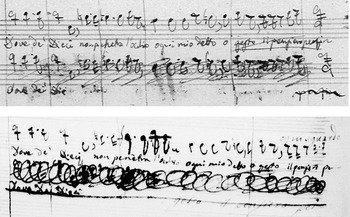
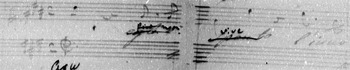
The first category of changes is exemplified by a correction Verdi made in the scena of No. 6 (Scena e Romanza Doge), where he originally had omitted a verse (‘Dove de' Dieci non penetra l'occhio?…’). Once he noticed the oversight, he divided the first of the two bars into three and the second into two, accommodated the omitted verse, and eventually recopied the entire passage on the staff above. This correction appears in virtually the same way in both the autograph (fol. 64v) and in I-Nc2 (Act I, fol. 114v; Fig. 1). The second category is of particular significance because it solves editorial problems that cannot be solved on the basis of the autograph score alone and because it sheds light on Verdi's stylistic views on the mid-nineteenth-century libretto.
A correction in Verdi's hand in both the autograph (top) and I-Nc2 (bottom)

When Verdi arrived in Rome, one month before the première, to rehearse the singers and supervise the production, he had yet to complete the orchestration and, presumably, compose the prelude.Footnote 50 Once a number was orchestrated, Ricordi scribes prepared the parts and a copy of the full score. Verdi continued to revise, making changes helpful to the performers, appropriate to the acoustics of the theatre, or imposed on him by the censors. And since not all these changes made their way into the autograph score, it does not in all instances reflect the composer's final wish.Footnote 51
Most of these last-minute changes made their way into the libretto printed for the première, however, and some, including all those imposed by the censor, were transferred to the autograph by a Ricordi scribe. Nevertheless, an editor seeing only the printed libretto and the autograph score would naturally question the authority of the changes: do they improve the drama and can they in some way be traced to the composer? In doubtful cases the Verdi edition has tended to opt in favour of the autograph score. It is clear, however, that Verdi's corrections in I-Nc2 constitute the last layer of revisions before the première; if they turn out to be dramatic improvements (as opposed to censorial concessions), they may have to override the authority of the autograph score.
I-Nc2 was, as the label at the beginning of each act indicates, prepared under Ricordi's auspices. In fact, I-Nc2 appears to have been the very first copy prepared, because many of the corrections were included in subsequent Ricordi copies. Once the first copy was made, Verdi must have been given a chance to review it. He checked both text and music, made corrections where necessary, and must have expected that these corrections be adopted in performance and future copies. Indeed, on fol. 80v of Act I, a Ricordi scribe confirmed: ‘Spartito vecchio serve per prendere/le parole allo spartito nuovo’ (The old score serves to take the words for the new score).
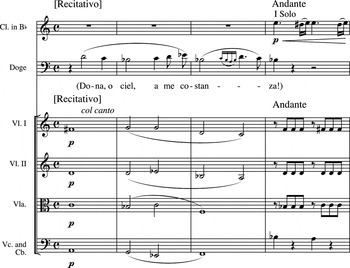
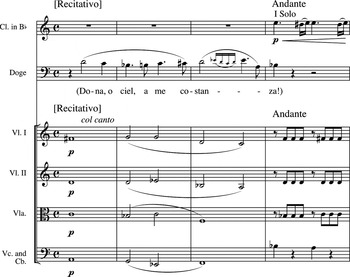
The most interesting example occurs in the Act II finale, a long number consisting of a chorus, a recitative and a concertato. In the recitative, the Doge wonders whether the Council of Ten wants to increase the torment of the father, that is, himself, by asking him to assist in the sentencing of his mostly innocent son, or whether the Council wants to increase the torment of his son, Jacopo, by humiliating him with his father's presence. The Doge expresses his grief in a short but beautiful aside on the text ‘Dona, o ciel, a me costanza’ (Give me, o heaven, constancy) (Ex. 1). This is the version Verdi originally wrote down in his autograph score. But he subsequently altered the melodic line, presumably to improve the prosody (the accent on the third beat of the second bar is no longer on the weak syllable ‘a’ but on the stronger syllable ‘me’), to build to a melodic climax on ‘costanza’, and to avoid the dissonance in the second half of the third bar between the d′ of the Doge and the c′ of the first violin (Ex. 2).
Version of the Doge's phrase as it is printed in the published Ricordi scores

Version of the Doge's phrase as corrected in the autograph

This revision, however, still does not give us the final text, a text that appears only in I-Nc2, where Verdi changed ‘Dona, o ciel, a me costanza’ to ‘Ciel ispira a me costanza!’ (Heaven, inspire in me constancy). The revised text – loftier and syntactically more straightforward – was included in the printed libretto, but neither the musical nor the textual revision appears in any commercially available Ricordi score. With the critical edition, both of them will be given their rightful place as the principal text.
In addition to helping us solve editorial problems, I-Nc2 sheds light on Verdi's role in the stylistic development of the Italian opera libretto. In the first two-thirds of the nineteenth century, Italian librettos – in tandem with much of Italian poetry – were often written in a rather archaic style. More than their northern counterparts, Italian poets resisted abandoning the artificiality of classical verse, and those who did not have the skills of a Felice Romani or Salvadore Cammarano regularly resorted to convoluted syntax not in tune with Romantic ideals. Furthermore, these stylistic features only aggravated the problems of a language, Tuscan, that, even though it served as the national language, was still spoken by fewer than 10 per cent of Italians.Footnote 52 The poet Cesare Cantù rather sarcastically recalled his training in the 1820s as follows:
Poetry … is the language of the gods, and the further you can distance yourself from the speech of the vulgar mob, the better. First of all there is the choice of words: you will not say … affligge [it afflicts] but ange [it anguishes], not cava [it draws out] but elice [it elicits], not innalza [it lifts] but estolle [it extols], not è lecito [it is lawful] but lice [an old-fashioned version for ‘it is lawful’], not spada [sword] but brando [brand], not patria [homeland] but terra natia [native soil], not la morte [death] but fato [expiry], not la poesia [poetry] but musa [muse] … And, my boy, you must abhor base ideas that recall things too everyday. For proper names, substitute an elegant circumlocution; you will not say amore [love] but bendato arciero [blindfolded archer]; not vino [wine] but liquor di Bacco [liquor of Bacchus], not leone [lion], aquila [eagle], but regina de' volanti [queen of flight], and biondo imperator della foresta [blond emperor of the woods]…Footnote 53
Angelo Fabrizi has shown that the language of librettos is in part drawn from famous poets such as Alessandro Manzoni, Giacomo Leopardi and especially Vittorio Alfieri, and that its vocabulary includes a common stock of literary and, to our ears, archaic words and phrases not unlike those listed by Cantù.Footnote 54 This style was superseded only with verismo, but an early attempt to break with formula can already be witnessed in Verdi's earliest librettos.Footnote 55
When Lucrezia comes to inform the Doge that Jacopo – his son and her husband – has died of grief and exhaustion, she launches into a cabaletta that originally began with the text ‘Egli è spento … l'innocente / s'involava a' suoi tiranni’, literally ‘He is extinguished … innocent, / he flew away from his tyrants’. Verdi corrected this text in I-Nc2, not in the autograph score, to ‘Più non vive [He no longer lives]’ but did so only in the first statement of the cabaletta; another hand later added the correction in the repeat.Footnote 56 The archaic nature of ‘Egli è spento’ must have struck Verdi with particular force when he realised that Donizetti had already used this phrase in his Belisario. Moreover, Belisario would have evoked in Verdi's mind the unpleasant memory of Giuseppina Strepponi's – his future wife – mighty struggle in the role of Antonina, precisely the role that contains the phrase ‘Egli è spento, [e del perdono]’ (Fig. 2).Footnote 57
Verdi's autograph correction in No. 14 (I-Nc2, Act III, fol. 60r–v)

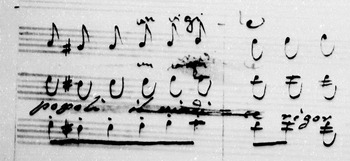
The only other clear example of Verdi's modernising of archaic poetic or literary vocabulary in I due Foscari occurs in the introduction to the Act II finale, where the chorus echoes Loredano's sentiment that Jacopo should face Venice's incorruptible justice and be sent into renewed exile. According to the autograph, this justice should strike Jacopo like a thunderbolt and remind Venice of ‘il vindice rigor’ (its avenging rigor). Verdi did not like the literary ‘il vindice’, crossed it out in I-Nc2 and substituted ‘un vigile’; the chorus now conjures up the city's vigilant rigour (Fig. 3).Footnote 58 As in Lucrezia's cabaletta, Verdi made the change only once, taking its consistent application for granted.
Verdi's autograph correction in No. 11 (I-Nc2, Act II, fol. 118v)

These few examples – to which similar ones from Nabucco and Ernani could be added – suggest that Verdi was trying to avoid archaic literary or poetic words.Footnote 59 Such a conclusion does not tell the full story, however, because Verdi continued to tolerate such words, and occasionally even preferred them to more modern ones. In Ernani, for instance, he was willing to accept the literary ‘latebra più occulta’ (most hidden recess) in replacement of the more modern ‘parte la più occulta’ (most hidden place).Footnote 60 Furthermore, as late as La traviata, a work often associated with early realism, he tolerated such poetically florid phrases as ‘un dì, quando le veneri il tempo avrà fugate’ (one day, when time has put your beauty to flight).Footnote 61 What, then, is the reason for these changes? It appears that Verdi was less concerned with modernising vocabulary than with finding the most specific and accurate word for the dramatic situation. In I due Foscari, although he did replace the literary ‘vindice’, he may have replaced it not because of its literary quality but its lack of expressive precision: ‘vindice’ (vengeful) would have been an adjective accurately describing Loredano and the Council of Ten; for the city of Venice, ‘vigile’ (vigilant) was more appropriate.Footnote 62
Who was responsible for these changes? We know, of course, that Verdi played an important role in the creation of a libretto from beginning to end, that he chose the subject, made suggestions regarding the dramaturgy, and presumably polished the text right up to the première. Nevertheless, the situation is once again not as clear as that. At the time of Ernani, the opera immediately preceding I due Foscari, he wrote to Guglielmo Brenna regarding his attitude towards interfering in the librettist's work:
For my part, I would prefer never to bother a poet to change a single line for me. I have set to music three libretti by Solera, and if you were to compare the original libretti, which I have preserved, with the printed texts, you would find that hardly any verses were changed and those only because Solera desired it.Footnote 63
Verdi's own recollections have to be taken with the usual pinch of salt. Is he suggesting that all the discrepancies between the printed libretto and the text as it appears in his autograph score were made upon Solera's suggestion? For instance, when Abigaille tries to persuade Nabucco to sign the death sentence of the Hebrews, including that of his daughter Fenena, Nabucco originally uttered an aside expressing worry, ‘m'ange un pensier’ (a thought worries me), namely that with the Hebrews he might also kill Fenena, who had converted to Judaism. In the autograph score, however, Verdi wrote, as an utterance to be heard, not as an aside, ‘un rio pensier’ (what an evil thought), showing a stronger, secure and active Nabucco.Footnote 64 Whether the change was Verdi's idea or Solera's, we have no way of knowing; we only know that it must have had Verdi's blessing.
In his subsequent opera, Ernani, Verdi collaborated with a new librettist, Francesco Maria Piave, who unlike Solera had no previous operatic experience. Verdi was aware of it and expected that Piave would make mistakes betraying the beginner.Footnote 65 Even though Verdi always praised Piave's verses,Footnote 66 we find in Ernani the same kinds of changes as in Nabucco, and as in Nabucco, they are in Verdi's hand or in the hand of a Ricordi scribe but were made too late in the compositional process to be included in the printed libretto. Could these changes be Piave's idea?
The situation is clearer in I due Foscari because many of the changes were made not in the autograph score but in the manuscript copy, I-Nc2, a copy Verdi reviewed. It is hard to imagine that during this process of review, Piave would have been looking over Verdi's shoulders, influencing him with his choices of words; rather, Verdi noticed words he did not like and substituted words that were more modern, specific, accurate and thus dramatically effective.
A couple of examples will illustrate Verdi's improvements. When Lucrezia lashes out against Loredano, threatening that his machinations will come to light, Verdi originally wrote ‘E scorgerà ogni ciglio/Il giusto, il reo qual'è!’ (And every eye will perceive/Who is just and who guilty!). ‘Perceive who is just and who guilty’? Verdi noticed the weakness and substituted ‘scoprirà’ (will discover) who is just and who guilty. While it is true that the verb form ‘scorgerà’ was more common at the time than ‘scoprirà’, the latter is more accurate.Footnote 67
The most substantial revision occurs in the Act II finale. The members of the Council of Ten and the Giunta, convinced by Loredano's arguments, want to send Jacopo Foscari to renewed exile, and they wonder why the process is taking so long. In the autograph score, Verdi used text presumably provided by Piave:

Verdi appears to have disliked the fourth verse, ‘ne accusan d'indolenza’, not only because it is rather weak (indolence appears to be a poor reason for shadows to rage) but because the pronoun ‘ne’ refers to an event mentioned three verses earlier, the ‘che più si tarda?’ In his revision in I-Nc2, Verdi succeeded in fixing several problems: he omitted the literary ‘omai’, reinforced the counsellors' rage by having them refer to Jacopo as ‘empio’ (wicked),Footnote 70 and by indicating what they really wanted to take from him, namely his life.

I-Nc2 thus emerges as significant in three respects. First, it includes late revisions that would have been lost as principal text of the critical edition. Second, the revisions in I-Nc2 were made in Verdi's hand, as a part of his review of the manuscript copy; they are thus almost certainly of Verdi's invention.Footnote 72 Finally, I-Nc2 shows the removal of some archaic, literary or poetic vocabulary in favour of modern vocabulary but, more important, a consistent striving for specificity, accuracy and immediacy of expression. These are early signs of what Verdi later would call ‘parola scenica’, a term that will always remain somewhat ambiguous, even though Verdi tried to explain it himself. In a letter of 6 November 1857, he criticised Antonio Somma, the librettist of Un ballo in maschera, for not having found exactly the right words in the quintet ‘È scherzo od è folia’: ‘The entire passage is not sufficiently theatrical: you say all that needs to be said, it is true, but the words do not sculpt well; neither Gustav's indifference, nor the witch's surprise, nor the conspirators' horror is evident and thus does not achieve any effect.’Footnote 73 Nearly thirteen years later, while working with Antonio Ghislanzoni on the libretto for Aida, Verdi actually used the term parola scenica and described it as follows:
I don't know if I make myself clear, saying parola scenica, but I mean the expression that sculpts the situation and makes it stand out cleanly and clearly. For example, the verses ‘Turn your eyes upon me / And lie again if you dare: / Radames is alive’ are less theatrical than the words (ugly, if you want): ‘With one word / I will wring the secret from you, / Look at me, I have tricked you: / Radames is alive.’Footnote 74
Although this is clearly a more striking example than those from I due Foscari, the direction of Verdi's development is clear: his changes forego clichés and traditional grandiloquence in favour of direct and precise ‘expression that sculpts the situation’.
The significance of the Naples manuscript does not end here. Shortly after the première in Rome, Ricordi sent I-Nc2 to Naples, where a score was needed in preparation for the first performance at the San Carlo on 9 February 1845.Footnote 75 In Naples, the manuscript was heavily modified, in part for reasons of censorship, in part to accommodate the interpreters of Lucrezia (Anna Bishop) and the Doge (Filippo Coletti) and in part to enlarge the orchestration. The complexity of these changes required that a clean copy be made and that its accuracy be verified. The task fell to a certain ‘Gorrel’,Footnote 76 who signed every relevant recto with his monogram or last name, both in I-Nc2 and its clean copy.Footnote 77 Verdi, who at the time was rehearsing Giovanna d'Arco in Milan, could not react to any of the changes made to his score. When he arrived in Naples on 26 June 1845 to prepare the première of Alzira, I due Foscari was still being performed, and Verdi attended a performance that very night and on several nights thereafter.Footnote 78 He cannot have been pleased with what he heard.
Censorship was primarily responsible for the mutilation of the score in Naples. In the last movement of her cavatina, for instance, Lucrezia curses the patricians (that is the members of the Council of Ten) with the words: ‘Patricians… tremble… the Eternal one / Will measure your deeds from heaven… / For eternal shame and immense misfortune / He will rightly make you pay’. Such harsh words must have upset the censors and led to the substitution of a cabaletta borrowed from Ernani (Elvira's ‘Tutto sprezzo che d'Ernani’) with new text showing a more accepting and hopeful Lucrezia. This cabaletta was substantially reorchestrated, melodically varied, and harmonically touched up where dramatically appropriate. The substitution required a new transition (to accommodate both the key of the substitution and the new dramatic situation). I-Nc2 does not include the new version, but it shows that the entire aria was first intended to be sung a half-step higher, then a whole-step higher, presumably to accommodate Anna Bishop's voice. Some of these transpositions remained in effect even in the version with the substitute cabaletta.Footnote 79 Thanks to I-Nc2 we know that the Doge's romanza and his final aria were transposed as well.
The most dramatic change in I-Nc2 concerns the alteration of the opera's finale. After having been forced to preside over Jacopo's condemnation to eternal exile, and subsequently having been informed of his death, the Doge is forced to abdicate. Led by the villain – Loredano – the chorus sings the famous lines ‘Cedi, cedi, rinunzia al potere / O il Leone t'astringe a obbedir’ (Surrender, surrender, renounce power / Or the Lion will make you obey). The Doge eventually relents, hears the bell announce his successor, and dies. Not so in the Naples version. Here, it is not Loredano who leads the Council of Ten in asking the Doge to resign, but a newly introduced character – Galbi. And instead of humiliating the Doge, Galbi exonerates him, declares Jacopo innocent and exposes Loredano's vendetta:

The Doge is still relieved of his duties but out of sincere concern for his health, not vengeance. He survives and presumably enters the well-deserved phase of his retirement. These changes made it necessary to recompose a passage of recitative and to change the text of much of the opera's finale.
Verdi must have been upset to see his work mutilated but put a good face on the matter, attending several performances and informing his student Emanuele Muzio about the excellent reception of the work.Footnote 81 Why did he not protest? In 1845, Verdi simply did not yet have the stature to do so. And since he was in Naples to prepare the première of Alzira, he may have decided to exercise caution vis-à-vis the Neapolitan authorities and administration of the San Carlo. Only two years later, however, he would threaten Ricordi with a fine of 1,000 Francs every time a score of his would be mutilated in an important theatre.Footnote 82 It was not a threat that could easily be enforced but shows Verdi's growing confidence with regard to the censors.
I-Nc2 would undergo yet further modifications for two performances of I due Foscari in 1855 with Giuditta Beltramelli as Lucrezia. Beltramelli apparently was not up to the task, requested transpositions in both of her arias, and needed to omit the second one during the second performance.Footnote 83 Verdi was busy supervising Les Vêpres siciliennes in Paris at the time and had no chance to comment on the latest distortions of his first Roman opera. But thanks to I-Nc2, we have a fairly good idea of what was performed and why. This manuscript copy has proven to be of considerable significance beyond the Naples performances, however: it has allowed us to solve editorial problems, shed light on Verdi's role in the development of the language of early nineteenth-century librettos, and illustrated his attitude towards censorship shortly before he began to take a stronger stance.
Appendix: the text of the Venice scenario
[fol. 1r]
I due Foscari.Footnote 84
Tragedia lirica in 2 Atti.
Personaggi.

[fol. 1v]
[fol. 2r]
Atto 1.o
Scena 1.a
Coro – Si parla della risoluzione fatta dal Doge di rinunziare alla ducale corona per liberare, egli diceva, sè stesso e la patria da tanti travagli. Ma il consiglio non accetta la sua rinunzia, e volle [sic] da lui anzi il giuramento di non tentarla mai più. Introduzione
Scena 2.a
Loredano – con alcuni amici e congiunti. Egli attribue ad un veleno amministrato da Foscari la morte di suo padre Pietro Loredano, il grande ammiraglio Veneto, non chè a Jacopo suo figlio del Doge la morte di Marco Loredano suo zio – Questi ed altri ancora erano i motivi per cui questo Loredano nutriva in core un odio feroce contro i Foscari. A far paga la sua vendetta avea preso di mira Jacopo figlio di Francesco a cui fece soffrire le più terribili ambascie. (Cavatina [Miral])
Scena 3.a
Appartamenti nel palazzo Ducale.
Marina – è la più sventurata delle donne – La morte le ha rapiti tre figli – il quarto l'esiglio – Cavatina soprano [Löve]
Scena 4.a
Giunge Foscari [e] palesa ad essa che Jacopo fu conosciuto innocente dell'assassinio di Almorò Donato. Fra poco egli sarà di ritorno [Duetto] – Donato uno dei capi dei dieci venne a farvelo avvertito, e lo ha consigliato di ricevere suo figlio senza la minima festa, ma più secretamente che gli era possibile perchè non abbia ad arrossire del trionfo di un esule chi siedeva alla custodia delle patrie leggi. Alvisena moglie di Jacopo
Scena 5.a
corre a Foscari per accertarsi sulla notizia avuta del vicino arrivo di Jacopo [Terzetto] – S'ode un canto dalla laguna – È Jacopo – Il suo canto esprime la gioja di rivedere dopo sì lungo esiglio il luogo che gli fu culla.
Scena 6.a
Jacopo è fra le braccia della sua famiglia – Affettuosissima scena!
Scena 7.a
Uno scudiero annunzia che penetrava cinto di molte armate nelle soglie Ducali il Capitan Grande e chiedeva di Jacopo. Commossione di Jacopo – Spavento delle donne – Sospetti del Doge – Il capitan grande compare sulla porta – È duopo a Jacopo seguirlo. [Quartetto]
[fol. 2v]
Scena 8.a
Sala del consiglio de' dieci con trono coperto da un baldacchino dorato, e appiè del trono un ricco florito sul pavimento.
Loredano ha raccolto il Consiglio – È pervenuta nelle sue mani una di [sic] lettera di Jacopo Foscari diretta al Duca Sforza di Milano. Era delitto di Stato per quel cittadino di Venezia che invocava mediatore nei fatti della patria un principe straniero.
Scena 9.a
Giungono Barbarigo[,] Donato[,] gli altri sette decemviri, e gli altri dicianove aggiunti – finalmente il Doge – Siedonsi tutti. Loredano espone la causa di quell'unione – Sorpresa ed orrore di Foscari nell'udire il nuovo delitto del figlio – Viene anch'egli chiamato[.]
Scena 10.a
Jacopo in catene introdotto da guardie, che appena si mostrano sulla porta, e tosto si ritirano – Confessa che quella lettera è vergata di sua mano – Pure è innocente – Vedendo infruttuose le continue preghiere che indirizzata [sic] al consiglio dal luogo dell'esiglio suo per poter far ritorno alla diletta sua patria, dopo essergli egli dichiarato innocente dell'assassinio di cui veniva qualche tempo innanzi incolpato, non potendo più reggere al desiderio ardentissimo di abbracciare la sua famiglia, ha voluto ottenere questa gioja ineffabile anche a costo della morte – Per questo e non per altro vergava quella lettera. Era certo che sarebbe venuta in mano del consiglio e che sarebbe stato richiamato a Venezia. – Donato prende le sue difese – Si viene ai voti – Ha vinto il partito di suoi nemici. Un solo voto discorda – quello di Donato. [Finale]
Atto Secondo. Parte I.a Palazzo. Scena 1.a
Alvisena è incerta sull'esito della sentenza – Giunge Marina – Cercano inutilmente consolarsi – Non vedranno mai più il loro diletto Jacopo. [Duetto soprano e contralto]
Scena 2.a
Foscari fa noto alle donne che innanzi di abbandonare per sempre forse la sua terra natale, ha ottenuto Jacopo di abbracciare la sua famiglia –
Gran sala del Palazzo. Scena 3.a
Fra poco il misero figlio dal [sic] Doge lascierà per la terza volta la sua patria – Come un ultimo conforto attende la venuta
Scena 4.a
[fol. 3r] dalla sua famiglia – Marina – Alvisena con i figli per mano – sono gettati al collo di Jacopo – Scena commovente. È presso l'ora della partenza, nè Jacopo vede ancora suo padre! Possibile che la voce di natura sia muta nel suo cuore? Ei dunque sdegnerà di accordare l'ultimo amplesso a suo figlio? Se anco foss'egli colpevole non sarebbe sempre suo figlio?
Scena 5.a
Ma Foscari non ha saputo resistere ai moti del sangue – È venuto anch'egli a dargli l'estremo addio – Jacopo ringrazia il cielo di questa grazia che temeva gli venisse negata – Implora da suo padre la benedizione per lui e pe' figli – Francesco vorrebbe durare nella sua fermezza – ma le lagrime gli spuntano sugli occhi, la sua mano spontaneamente si leva – li ha bendetti [sic] – Suona un' ora – Disperazione di Jacopo è l'ora fatale della partenza. [Asolo tenore]
Scena 6.a
Loredano comparisce col capitan grande al quale dice con freddezza crudele che l'ora è suonata. S'ode Jacopo – l'odono tutti: fremito generale – Si separano… dolorosa separazione! e forse eterna! [Gran finale]
Parte 2.a Palazzo Ducale – Sala con trono. [Scena 1.a]
Il Doge sfinito per la lunga forza che ha fatto a se' stesso è mutato di aspetto – negli atti suoi si veggono i segni di una vita che gli anni e le afflizioni hanno condotta vicino al suo termine.
Scena 2.a
Loredano[,] Donato[,] Barbarigo, i sei Consiglieri del Doge i tre capi dei quaranta – Loredano annunzia a Francesco il volere del Consiglio ch'egli debba cedere la sua corona [–] Sorpresa di Foscari. Egli giurò di serbarla sul suo capo fino all'ultimo respiro, e quel giuramento lo hanno strappato quelli medesimi che adesso vogliono questo suo avvilimento – Ricusa di farlo – È costretto dal Consiglio, è svincolato dal giuramento [fol. 3v] Foscari cede – Sei tu pago ancora? dic'egli a bassa voce a Loredano. Questi gli risponde – non ancora – [Duetto due bassi]
Piazza davanti al palazzo Ducale
piena di popolo – Scena 3.a
Il popolo è intenerito per tante angoscie del suo Doge. Vorrebbe salvarlo [Gran coro] [–] Tumulto – Un banditore da un balcone del palazzo intima sotto pena di morte il silenzio agli astanti.
Scena 4.a
Francesco Foscari con berretta non ducale in capo, Marina Alvisena coi tre figli,Footnote 85 escono dalla porta del palazzo Ducale [–] Quella medesima che adesso ha sortita, asceseFootnote 86 egli un giorno sfolgorante di gloria, fra le acclamazioni di un popolo –
Scena 5.a
Un nunzio che cerca del Doge – Che fia? Un altro colpo pello sventurato Foscari – È morto suo figlio vittima delle sue sofferenze – Disperazione di Foscari – S'odono le campane di S. Marco che suonano a festa – per l'elezione del nuovo Doge – Foscari è prostrato da quest'ultimo colpo – A piè' della scala spira fra breve convulsione. La famiglia Foscari si stringe tutta intorno al cadavere. Il popolo accorre, e lascia vuoto uno spazio, nel quale si vede Loredano, che rivolto anch'egli verso il cadavere di Foscari dice con maligna compiacenza: ha pagato. [Scena finale rondò di Badiali]
*
I due Foscari.
Lyric Tragedy in 2 Acts.
Characters.

Choruses and Supers:
The other seven members of the Council – deputies of the Council
of Ten – the other five counsellors of the Doge – the Police
Chief – a minister of the Ten – usher – guards – citizens –
gondoliers, etc.
The story takes place in Venice
Chorus
Cavatina Miral
Cavatina Löve
Duet, trio, quartet
Scena
Finale
Duet soprano and contralto
Solo for the Tenor
Duet for two basses
Large chorus
Scena, finale (rondò di Badiali)
Act I
Scene 1
Chorus – talking about the Doge's resolution to renounce the ducal crown in order to rid himself and the fatherland, as he says, of so much toil. But the Council does not accept his resignation and rather wants from him a vow never to try it again. Introduzione.
Scene 2
Loredano – with some friends and kinsmen. He attributes the death of his father, Pietro Loredano, the great Venetian admiral, to a poison administered by Foscari, and the death of Marco Loredano, his uncle, to Jacopo, the Doge's son – These and others were the motives why Loredano nurtured in his heart a ferocious hatred of the Foscari. In order to have his vengeance, he took aim at Jacopo, the son of Francesco, whom he made suffer the most terrible anguish. (Cavatina.)
Scene 3
Apartments in the Ducal Palace
Marina – she is the most wretched of all women – Death has robbed her of three children, exile [has robbed her] of the fourth child – Cavatina soprano
Scene 4
Foscari arrives [and] reveals to her that Jacopo has been found innocent of the murder of Almorò Donato. He will soon be back home [duet] – [Gerolamo] Donato, one of the heads of the Ten has come to let him know and advise him to welcome his son without even the smallest celebration but as secretly as possible so that one would not have to be ashamed of the triumph of an exile who had been a guardian of the homeland's laws. Alvisena, Jacopo's wife
Scene 5
runs towards Foscari to make sure the news about Jacopo's impending arrival [is correct] [trio] – A song is heard from the lagoon – It is Jacopo – His song expresses the joy of again seeing his birthplace after such a long exile.
Scene 6
Jacopo is among his family – A very tender scene!
Scene 7
A squire announces that the Police Chief, surrounded by many armed men, has entered the ducal chambers and is asking for Jacopo [–] Jacopo's commotion – the women are afraid – the Doge is suspicious – the Police Chief appears in the door – Jacopo must follow him. [Quartet]
Scene 8
Chamber of the Council of Ten with a throne covered by a gilded baldachin;
next to the throne on the floor a rich floral design.
Loredano has assembled the Council – He has obtained a letter Jacopo Foscari had written to the Duke Sforza of Milan. It was a crime against the state for a citizen of Venice to invoke a foreign prince as mediator in matters of the homeland.
Scene 9
Enter Barbarigo, Donato, the other seven members of the Ten, and the other nineteen deputiesFootnote 88 – finally the Doge – all sit down. Loredano explains the reason for the meeting – surprise and horror of Foscari when he hears about the new crime of his son – he, too, is called.
Scene 10
Jacopo, in chains, is led in by guards, who, just as they appear in the door, quickly withdraw – He confesses that that letter is written in his hand – Yet, he is innocent – Having realised that the continuous pleas to be able to return to his beloved homeland, sent to the Council from the place of his exile, were fruitless; having been declared innocent of the murder of which he had been accused; [and] no longer being able to resist the desire to embrace his family, he wanted to have this indescribable joy even at the cost of death – For this reason and no other did he write that letter. He was sure that it would fall into the hands of the Council and that he would be recalled to Venice. – Donato takes his side – They vote – The party of his enemies has won. There is a single dissenting vote – Donato's. [Finale]
Act II. Part I. Palazzo. Scene 1
Alvisena is not sure about the outcome of the verdict – Marina enters – They are trying to console each other in vain – They will never again see their beloved Jacopo. [Duet soprano and contralto]
Scene 2
Foscari tells the ladies that Jacopo, before having to leave his native soil, perhaps forever, has obtained [permission] to embrace his family.
Large chamber of the palace [–] Scene 3
Soon the Doge's wretched son will leave his homeland for the third time – as a last consolation, he is waiting
Scene 4
for his family – Marina – Alvisena with her children on her hands – they fling their arms around Jacopo's neck – moving scene – the hour of parting is near, and Jacopo will not again see his father! Is it possible that the voice of nature in his heart is silent? Will he not want to grant his son a final embrace? Even if he were guilty, would he not always be his son?
Scene 5
But Foscari could not resist the impulses of his heart – he, too, has come to bid him his last farewell – Jacopo thanks Heaven for this favour, a favour he feared would be denied him – he implores his father for a blessing, for himself and his children – Francesco tries to stay firm – but tears well up in his eyes, and his hand spontaneously raises – he has blessed them – the hour strikes – desperation of Jacopo [–] it is the fateful hour of departure. [Solo Tenore]
Scene 6
Loredano appears with the Police Chief and says to him with cold cruelty that the hour has struck – one hears Jacopo – all hear him: general shudder – they separate… painful separation! and perhaps forever! [Grand finale]
Part 2. Ducal Palace – Chamber with throne. [Scene 1]
The Doge, exhausted from the long work to which he has subjected himself, has changed – his gestures betray signs of a life that years and affliction have brought close to its end.
Scene 2
Loredano, Donato, Barbarigo, the six counsellors of the Doge, the three heads of the FortyFootnote 89 [–] Loredano announces to Francesco the will of the Council that he surrender his crown [–] Foscari's surprise [–] He had sworn to keep it on his head until his last breath, an oath that was wrung by those who now want his humiliation – he refuses to do it – he is forced by the Council and released from his oath – Foscari surrenders – Are you now paid? he says with a low voice to Loredano. The latter responds – not yet – [Duet for two basses]
Square in front of the ducal palace
full of people – Scene 3
The people are moved by the many woes of their Doge – They would like to save him [Grand chorus] [–] tumult – From the balcony of the palace, a town crier commands that, under penalty of death, all bystanders be quiet.Footnote 90
Scene 4
Francesco Foscari with a non-ducal cap, Marina, Alvisena with the three children – They leave through the door of the ducal palace – the same one through which he has now left, he one day entered radiant with glory, under the acclamation of the people.
Scene 5
A messenger looking for the Doge – What is it? Another blow for the wretched Foscari – His son is dead, a victim of his suffering – Foscari's desperation – The bells of San Marco ring in celebration – for the election of the new Doge – Foscari is overwhelmed by this latest blow – He dies at the bottom of the stairs after brief spasms. The Foscari family is surrounding the corpse. The people rush to the scene, freeing up a space in which Loredano can be seen; also turned towards the corpse of Foscari, he says with malicious satisfaction: he has paid. [Final scene; rondò Badiali]