

Introduction
Innocent people continue to be incarcerated for crimes they did not commit, even in democratic nations like Canada, the United Kingdom, and the United States. Researchers have demonstrated that the different choices police officers make can sometimes—intentionally or unintentionally—influence an eyewitness to select a particular suspect or lead suspects to confess to crimes they did not commit (Kassin Reference Kassin1997; Dysart, Lindsay, and Dupuis Reference Dysart, Lindsay and Dupuis2006; Quinlivan et al. Reference Quinlivan, Wells, Neuschatz, Luecht, Cash and Key2017). Our research explores whether particular practices by the police lead people to view a wrongly convicted individual differently, depending upon whether said individual was mistakenly identified or falsely confessed, using Weiner’s (1993) attribution theory of social motivation. We begin by discussing the extent of wrongful conviction, provide a little background on eyewitness issues and false confessions, introduce the literature on perceptions of exonerees, and then explain how Weiner’s social motivation theory informed our work.
The Extent of the Problem
At the time of this writing, 350 US citizens had been exonerated by the Innocence Project (2017a) through post-conviction DNA testing, and the National Registry of Exonerations (2017a)—who do not limit themselves to DNA cases—had documented over 2,000 wrongful conviction cases in the United States for the same time period. These exonerations are not solely the discovery of historic mistakes or biases, as we might like to believe, but include criminal justice errors that continue to occur (Clow and Ricciardelli Reference Clow, Ricciardelli and Reeves2015). For instance, nearly 25 percent of the known cases reported by the National Registry of Exonerations in 2014 were twenty-first-century wrongful convictions, where the original conviction occurred in the year 2000 or later (Clow and Ricciardelli Reference Clow, Ricciardelli and Reeves2015). Considering that a person must exhaust all of their trials and appeals prior to being considered as a possible case of wrongful conviction (a process that takes a considerable amount of time), and new and significant evidence that was not previously presented during those trials must be discovered (an event that does not frequently occur), the currently known cases are a gross underestimate of the actual number of wrongful convictions. Scholars have estimated that there are likely 1,000 wrongful convictions in the United Kingdom, and upwards of 7,500 wrongful convictions in the United States, each and every year (Grounds Reference Grounds2005; Huff 2002).
At the time of this writing, Canada neither tracked national numbers of wrongful conviction cases, nor provided frequency estimates of their occurrence. Moreover, it is sometimes difficult to interpret the numbers that are reported by various sources, as the details are frequently limited, which hinders attempts to compare or group numbers. We do know that Innocence Canada (formerly the Association in Defence of the Wrongly Convicted (AIDWYC)) reports that as of April 2015, they were reviewing ninety-four cases, and sixteen had been adopted, “meaning we have satisfied ourselves that the individual is innocent and legal work is ongoing,” (Innocence Canada 2018). Meanwhile, the Department of Justice (2017a) reports steady but low numbers of applications for review as possible cases of wrongful conviction, what the government calls Applications for Ministerial Review—Miscarriages of Justice. For instance, from April 1, 2016, to March 31, 2017, the Minister received seventeen applications, where one was incomplete and another was screened out, leaving fifteen viable applications (Department of Justice 2018). During the course of the year, five preliminary assessments were completed, eight preliminary assessments were underway but not completed, five applications did not proceed to investigation following the preliminary assessment, two applications did proceed from preliminary assessment to the investigation stage but the investigations are still underway, one remedy was granted, and ten are awaiting preliminary assessments (and those numbers add up to more than fifteen, presumably because some of the cases were received in earlier years and are still being processed during this reporting period). Schuller et al. (Unpublished, 2018) compiled a database of nearly sixty Canadians who have been reported to be wrongfully convicted over the years, from reading government reports (e.g., Department of Justice 2004; Goudge Reference Goudge2008), innocence organizations’ websites (e.g., Innocence Canada, Innocence Project at Osgoode Hall Law School), and scouring news media on the Internet. Roach (Reference Roach2012) suggested that a conservative estimate of actual wrongful convictions (based on criminal court cases in Canada and an error rate of 0.5%) would be 450 Canadians a year, but that would not take into account any innocents who chose to plea-bargain for various reasons. Clearly, wrongful convictions do occur in Canada, as elsewhere, but the extent of the problem—and any distinctly Canadian nuances—are currently unknown.
Factors that Can Contribute to Wrongful Conviction
What is better known are the factors that have been implicated in a number of different wrongful conviction cases. Here, the factors that have been identified by analyzing exonerations in the United states (Garrett, Reference Garrett2008, 75-91) and resulting from Canadian public inquiries (e.g., Cory Reference Cory2001; Goudge Reference Goudge2008) list the same “usual suspects,” such as eyewitness errors, perjury (e.g., false jailhouse snitch testimony), investigative tunnel vision, prosecutorial misconduct, and junk science. Understanding the factors that influence the likelihood of wrongful conviction also comes with the understanding that, in many cases, several factors worked together to lead to the erroneous outcome (Leo Reference Leo2005). In addition, many of the factors that lead to a wrongful conviction can also lead to a correct conviction, further muddying the waters (Kassin Reference Kassin1997). To illustrate the multiple factor issue, we take a brief look at police practices involving eyewitness identification and false confessions—two factors that have received considerable research attention—as well as two different Canadian cases.
Eyewitness Identification
Within post-conviction DNA cases, eyewitness misidentification has been the most frequently identified error (Innocence Project 2017b; National Registry of Exonerations 2015)Footnote 1. Rattner (Reference Rattner1988) reported that 52 percent of all wrongful convictions he studied were the results of eyewitness misidentification. Many factors influence eyewitness misidentification, including eyewitness memory errors and police suggestion (Sharps et al. Reference Sharps, Janigian, Hess and Hayward2009; Quinlivan et al. Reference Quinlivan, Wells, Neuschatz, Luecht, Cash and Key2017). Research on the suggestibility of memory has led to improvements in how to interview an eyewitness and how to present a photographic line-up of suspects to an eyewitness (Lindsay and Wells Reference Lindsay and Wells1985; Frenda, Nichols, and Loftus Reference Frenda, Nichols and Loftus2011). For instance, photographic line-ups presented to an eyewitness should have no major differences between the photographs used (e.g., the clothing of anyone in the line-up should not stand out or match the suspect’s more than anyone else’s, all photos should be of the suspect’s race, all photos should be the same size) (Freire et al. Reference Freire, Lee, Williamson, Stuart and Lindsay2004; Lindsay, Wallbridge, and Drennan Reference Lindsay, Wallbridge and Drennan1987). The suggestion to maintain homogeneity amongst line-up pictures is an attempt to reduce bias against any one person in the line-up (Dysart, Lindsay, and Dupuis Reference Dysart, Lindsay and Dupuis2006; Lindsay, Wallbridge, and Drennan Reference Lindsay, Wallbridge and Drennan1987).
Ivan Henry was convicted in 1983 of three counts of rape and seven counts of sexual assault that occurred in Vancouver (CBC News 2010; Hall Reference Hall2009; Mulgrew Reference Mulgrew2009). Henry was convicted primarily due to eyewitness identification evidence. He spent twenty-seven years in prison—and was declared a dangerous offender—until the Supreme Court of British Columbia acquitted him in 2010, acknowledging that the eyewitness line-up that led to his identification (among other evidence) was biased against him (Fong Reference Fong2010). In the eyewitness line-up, Henry was surrounded by three police officers in uniform, where one officer had Henry in a headlock. This photographic line-up likely caused eyewitnesses to focus on Henry, as he stuck out from the rest of the individuals in the line-up (CBC News 2010; Hall Reference Hall2009). This biased line-up, along with an “inappropriate” relationship between one of the investigating officers and an eyewitness and evidence leading to a different suspect that was not pursued (The Canadian Press 2015), suggest that it was biased police work mixed with eyewitness evidence that likely contributed to Ivan Henry’s conviction.
False Confessions
False confessions—when people provide statements or confessions to the police that implicate themselves in crimes they did not commit (Innocence Project 2017c; Kassin Reference Kassin1997)—have occurred in a number of wrongful conviction cases (Drizin and Leo Reference Drizin and Leo2004; Innocence Project 2017c). In a laboratory setting, Kassin and Kiechel (Reference Kassin and Kiechel1996) found that 69 percent of their innocent participants signed a confession to admit to a wrongdoing they had not committed, 28 percent internalized their guilt, and 9 percent created details to support their false beliefs in their guilt. Although a laboratory setting is far removed from an actual police interrogation, the finding that so many innocent people would confess to actions they had not committed was shocking. Moreover, people appear to place undue weight on the assumption that their innocence will protect them, waiving legal rights, and underestimating the impact of situational factors in a police investigation and interrogation (Gudjonsson Reference Gudjonsson, Daniel Lassiter and Meissner2010; Kassin Reference Kassin2015).
Romeo Phillion was convicted of the murder of Leopold Roy in Ottawa in 1972. He confessed when initially interrogated by the police (Phillion claims that he falsely confessed to protect a friend). Although he later recanted his confession, it was used as a major piece of evidence to convict him (Innocence Canada 2016a). Moreover, Phillion freely admits that he had a long history—and a mutually antagonizing one at that—with the arresting officer (Phillion Reference Phillion2012). Thirty years later, Innocence Canada discovered that Phillion had a documented alibi, evidence that put him 200 kilometers from the scene of the crime, which had been suppressed by the prosecution and not disclosed to Phillion’s defense lawyer (Innocence Canada 2016a). This failure to disclose exculpatory evidence led to his eventual release in 2010, after the Crown withdrew all charges against him (Innocence Canada 2016a; Phillion Reference Phillion2012). If the prosecution had disclosed the exculpatory alibi information to the defense—as is currently required by law—perhaps the recant of the confession would have been taken more seriously. In Phillion’s case, the false confession may have compounded pre-existing biases against him among police and prosecutors, leading to his conviction.
Perceptions of Exonerees
Thinking about these two cases (Ivan Henry and Romeo Phillion), we wondered whether people’s perceptions of an exoneree might depend upon the factors that led to the original wrongful conviction. For instance, Clow and Leach (Reference Clow and Leach2015a) found that an exoneree who falsely confessed was perceived more negatively than an exoneree who was misidentified by an eyewitness or testified against by a jailhouse snitch, lending further support to the notion that people are unable to fully appreciate the situational pressures of an interrogation or to relate to false confessors (Kassin Reference Kassin2015). Moreover, as multiple factors are often involved in wrongful convictions, might the presence of one factor, such as misconduct or bad practices on the part of police or prosecutors, influence how people viewed another factor, such as falsely confessing or being misidentified by an eyewitness? If people thought the police or the government were at least partially to blame, would this translate into more positive perceptions of the exoneree?
Weiner’s (1993) attribution theory of social motivation would suggest that perceptions of responsibility should be key to people’s reactions to an exoneree. This theory has investigated numerous potential stigmas (e.g., contracting AIDS, cancer, drug addiction) and found that the more people are perceived to be responsible for their situation, the more harshly they are viewed and the less willing people are to assist them (Rudolph et al. Reference Rudolph, Roesch, Greitemeyer and Weiner2004; Weiner Reference Weiner1993). More specifically, an illness was perceived as a personal failure if the illness was perceived as having a controllable cause or resulting from a lack of effort. When individuals were perceived as responsible for bringing about their own illnesses, participants felt anger towards them, but if the illness was perceived as having an uncontrollable cause or resulting from a lack of ability, the sick individual was not perceived as responsible and participants felt pity towards the person (Weiner, Perry, and Magnusson 1988; Weiner Reference Weiner1993). Feelings of pity and the desire to help arose from perceptions that the individual lacked control over the situation (Rudolph et al. Reference Rudolph, Roesch, Greitemeyer and Weiner2004; Weiner, Perry, and Magnusson 1988; Weiner Reference Weiner1993). We were interested in testing whether Weiner’s social motivation theory would apply to perceptions of exonerees as well.
Although exonerees are innocent, post-incarceration their troubles and suffering are far from over (Cory Reference Cory2001; Weigand Reference Weigand2009). Many exonerees are unable to find gainful employment or affordable housing (Clow Reference Clow, Ricciardelli and Peters2017; Westervelt and Cook Reference Westervelt and Cook2008). Thomas Sophonow, a Canadian exoneree, has been diagnosed with post-traumatic stress disorder due to his wrongful conviction experiences (Innocence Canada 2016b; see Grounds Reference Grounds2004 for a discussion of mental health and exonerees). As former Supreme Court Justice, Peter Cory (Reference Cory2001) wrote in his report about Thomas Sophonow’s case, “to wrongfully convict someone of a crime, particularly that of murder, is to forever damage the reputation of that person.” Sophonow dealt with the stigma of his boss, coworkers, and neighbours believing that he was a murderer who simply got off on a technicality (Cory Reference Cory2001). He was socially ostracized post-exoneration, and his house was even firebombed (Cory Reference Cory2001). Clearly, the stigma of wrongful conviction can be a significant barrier to exonerees’ reintegration efforts and quality of life.
A better understanding of the variables that can lead to negative perceptions of exonerees would assist efforts to develop effective strategies to combat this stigma. The current study was designed to examine whether knowledge of the police investigation (biased vs. unbiased) influenced perceptions of an exoneree who had been misidentified by an eyewitness or who falsely confessed. We are not looking at how potential jurors might or might not use this information; we are interested in people’s perceptions of exonerees after media reports have indicated that the person was, in fact, wrongly convicted. Many exonerees find themselves in situations where they are interacting with other people, and the views of these people may be influenced by media reports of their wrongful convictions (Grounds Reference Grounds2005; Westervelt and Cook Reference Westervelt and Cook2008).
Current Study
Participants read a vignette about a fictional DNA exoneree, James Barber, who was wrongfully convicted and recently released from prison. Within the vignette, police procedures (high bias vs. low bias) and wrongful conviction factors (mistaken eyewitness vs. false confession) were manipulated. After reading the vignette, participants rated how responsible they perceived the police and the exoneree to be for the wrongful conviction, how angry they were with the police and the exoneree, their feelings of pity towards the exoneree, their willingness to assist the exoneree, and their overall attitudes towards the exoneree.
From Weiner’s (1993) theory of social motivation, we predicted a main effect of police bias, with participants rating the police as more responsible, providing higher ratings of anger towards the police, higher ratings of pity towards James Barber, and being more willing to help James Barber in the high bias versus low bias conditions. We also predicted that participants would report more positive attitudes towards James Barber in the high bias conditions based on their presumed higher ratings of pity and lower ratings of anger towards Barber in those conditions. To extend the findings of Clow and Leach (Reference Clow and Leach2015a), we predicted a main effect of wrongful conviction factor, with participants giving higher ratings of responsibility and anger, and lower ratings of pity and helping, towards James Barber in the false confession conditions in comparison with the eyewitness conditions. In addition, we expected that participants would report more negative attitudes towards James Barber when he falsely confessed than when he was mistakenly identified by an eyewitness. Finally, we wanted to explore whether these variables interacted, to see whether police bias was more damaging to police—or more beneficial to exonerees—in one type of wrongful conviction than another.
Participants
One-hundred and eighty-six undergraduate students (104 women, 80 men, and 2 nonresponses) from a university in the Greater Toronto Area (Ontario, Canada) participated in the study for partial course credit. Ages ranged from seventeen to fifty-four (M = 20.78, SD = 4.32). The most commonly indicated race or ethnicity was Caucasian (n = 53 or 32.7%), followed by South Asian (n = 31 or 19.1%) and Black (n = 18 or 11.1%). A variety of other ethnicities were mentioned, and several participants chose not to answer the question (n = 17 or 10.5%).
Materials
Vignettes
A vignette was created for the study, and then formatted to resemble an online newspaper. It was a page in length, divided into two columns. Across conditions, the vignette contained the same details about the crime and James Barber’s exoneration. For instance, everyone read “Back in 1999, a woman was sleeping alone in her apartment when a man broke in through a window and sexually assaulted her. Two neighbours had testified that they saw Barber’s car in the neighbourhood the night of the attack.” This established that there was a witness to the crime (the victim) and that the crime was sexual assault, as well as how James Barber originally came to the attention of the police. All participants also read general information about Barber’s exoneration, such as “Mr. Barber told reporters that the wrongful conviction has taken a serious toll on his life. His health deteriorated in prison and the wrongful conviction severed many of his relationships with friends and family” and “In prison, he constantly proclaimed his innocence, yet no one was willing to listen. Only after many years of petitioning … [a] DNA test excluded Barber as the perpetrator of the crime.” The main focus of the vignette was on Barber’s exoneration and reintegration efforts.
Within this vignette, key details were manipulated to portray eyewitness identification error or false confession as having contributed to the wrongful conviction. Moreover, in both the eyewitness and false confession conditions, information was manipulated to portray either low or high bias in the procedural operations of the police. This resulted in four different versions: low bias eyewitness, high bias eyewitness, low bias false confession, and high bias false confession. As is often the case in actual news stories, the key details (that were manipulated in the study) were repeated in bold quoted text in sidebars, drawing extra attention to the information.
Eyewitness
In the eyewitness condition, after the details of the crime, and explaining that neighbours saw James Barber’s car in the vicinity on the night in question, participants learned that Barber’s photo was included in a line-up. In the high bias condition, participants were told: “Not following best practices, Barber’s picture stuck out from the rest. Because the victim remembered her assailant wearing a red shirt, Barber was shown in the line-up wearing a red shirt. He was the only one wearing red.” This phrasing was used to demonstrate that the police did bias the line-up against James Barber (Freire et al. Reference Freire, Lee, Williamson, Stuart and Lindsay2004; Lindsay, Wallbridge, and Drennan Reference Lindsay, Wallbridge and Drennan1987) and, as a by-product, may have influenced the victim to pick him as the perpetrator. In contrast, in the low bias condition, participants read: “Following best practices, the police made an effort to ensure that Barber’s picture was not obviously different from all the rest. Because the victim remembered her assailant wearing a red shirt, every photo in the line-up was of a man in a red shirt.” This phrasing was used to demonstrate that the police did not intentionally bias the line-up against James Barber or unduly influence the victim to pick him as the perpetrator. We explicitly told participants that the police did, or did not, follow best practices, as we did not want to assume that participants were aware of the factors that could bias a line-up. Moreover, we focused in on a particular biasing (or not biasing) element, rather than possibly confusing participants by trying to include many different variables.
False Confession
In the false confession condition, after the details of the crime, and explaining that neighbours saw James Barber’s car in the vicinity on the night in question, participants read that Barber was interrogated, and that he “was tired and scared and just wanted to say what the police wanted to hear so that they would let him go home.” Participants learn that Barber confessed to police, but that he recanted his confession. In the high bias condition, participants were also told: “Not following best practices, Barber was interrogated for 10 hours. In a final effort to get a confession, the police lied and said that Barber’s fingerprints were found at the scene of the crime even though no fingerprint evidence was found.” This phrasing was used to demonstrate that the interrogation techniques used by the police were potentially biasing, and may have influenced James Barber to confess (Kassin Reference Kassin1997). In contrast, in the low bias condition, participants simply read that: “Following best practices, police made an effort to ensure that Barber’s interrogation was reasonable in length.” Again, we explicitly told participants that the police did, or did not, follow best practices in an attempt to make it clear to participants whether the procedures should be considered biased or not.
Questionnaire
We modified Weiner, Perry, and Magnusson’s (1988) items to measure perceptions of police responsibility, anger towards police, James Barber’s responsibility, anger towards James Barber, willingness to assist James Barber, and feelings of pity for James Barber. Specifically, to evaluate perceptions of responsibility, participants were asked to what extent they felt “the police are responsible for James Barber’s wrongful conviction” and “James Barber is responsible for his wrongful conviction” (1 = Not at all responsible to 7 = Very responsible). In order to assess feelings of anger, participants were asked to what extent “I feel anger towards the police in the James Barber case” and “I feel anger towards James Barber” (1 = None to 7 = A great deal). To evaluate feelings of pity, participants were asked to what extent “I feel pity towards James Barber” (1= None to 7 = A great deal). To assess willingness to assist, participants were asked to what extent “I am willing to assist James Barber” (1 = Totally unwilling to 7 = Willing). In addition, we created a couple of our own wrongful conviction items to assess participants’ willingness to assist exonerees in general. Using 7-point rating scales, participants were asked to what extent they agreed with the following statements (1 = Strongly disagree to 7 = Strongly agree): “I am willing to financially donate to a charity that assists wrongly convicted individuals” and “I am willing to volunteer my time to assist individuals who have been wrongfully convicted.” The willingness to assist James Barber item and the two willingness to assist wrongly convicted individuals items above were combined to create a composite measure of willingness to assist (α = 0.75).
To assess attitudes towards James Barber, participants were given an Attitude Thermometer and asked to provide a number from 0 to 100 (0 = extremely unfavourable; 100 = extremely favourable). The thermometer was labelled in increments of 10 degrees (i.e., 10 = very unfavourable), increasing in favourability. Participants were told they could pick any number between 0 and 100 (they could pick a number that was not labelled on the thermometer, such as 27). This measure has been found to have high test-retest reliability (e.g., Haddock, Zanna, and Esses Reference Haddock, Zanna and Esses1993) and to be useful for assessing attitudes regarding wrongful conviction (Clow and Leach Reference Clow and Amy-May2015b).
To ensure that participants noted the police procedure manipulation, participants were asked, depending upon their wrongful conviction condition, “How fair was the photo line-up?” or “How fair was the interrogation?” (1 = Not fair to 7 = Very fair). As well, a multiple-choice question asked participants to indicate what it was that “led to James Barber’s conviction?” to make sure participants were aware of the factor at play (i.e., false confession or the mistaken eyewitness). There was also an innocence manipulation check, to ensure that participants realized that being wrongly convicted meant you were innocent of the crime: “Was James Barber innocent?” (Yes or No).
Procedure
Participants were run individually or in small groups (two to six). After reading and signing a consent form, the participant (or group of participants) was randomly assigned to read one of the four printed out vignettes. After reading the vignette, participants were presented with a questionnaire booklet containing the manipulation checks, filler items, and dependent variables. The vignette was not removed while participants completed the questionnaires. Once the participants completed the study they were thanked and fully debriefed. Participants generally completed the study in fifteen to twenty minutes.
Results
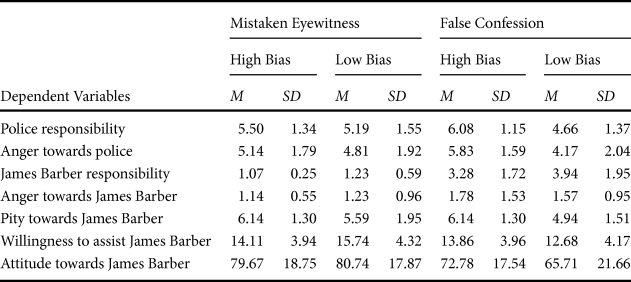
No extreme scores or outliers were detected. A total of twenty-two participants were excluded from analyses because they failed to answer the multiple-choice manipulation checks correctly: three failed to acknowledge the exoneree’s innocence, and nineteen failed to correctly identify the factor that led to the wrongful conviction. See Table 1 for condition means for all dependent variables.
Mean Ratings on Dependent Variables as a Function of Wrongful Conviction Factor and Police Bias

Note: All variables range from 1 to 7, except for Willingness to assist James Barber (ranges from 7 to 21) and Attitude towards James Barber (ranges from 0 to 100).
To ensure that our police bias conditions were interpreted as expected, separate independent t-tests looking at police bias (high vs. low) were conducted on participants’ fairness ratings of the photo line-up and the interrogation. A significant effect of bias was found for both the fairness of the line-up, t (1, 89) = 5.45, p < 0.001, and the fairness of the interrogation, t (1, 69) = 4.18, p < 0.001. As expected, participants in the low bias condition rated the interrogation as significantly fairer (M = 3.48, SD = 1.72) than participants in the high bias condition (M = 1.94, SD = 1.37). As well, participants in the low bias condition rated the photo line-up as significantly fairer (M = 4.13, SD = 1.94) than participants in the high bias condition (M = 2.11, SD = 1.54).
Following the success of the manipulations, analyses of variance were conducted. All analyses originally included participant gender in order to determine whether the findings applied equally to both male and female participants, as this would better inform theory and future research (Eagly Reference Eagly1987). Therefore a 2 (bias: high vs. low) x 2 (factor: false confession vs. mistaken eyewitness) x 2 (participant gender: male vs. female) ANOVA was conducted on all dependant variables. There was only one significant gender finding across all analyses: female participants (M = 5.93, SD = 1.49) reported more pity towards James Barber than did male participants (M = 5.40, SD = 1.7), F (1, 152) = 4.59, p = 0.035, ηp 2 = 0.03. Thus, due to the general lack of significant gender effects, the data reported here were reanalyzed without including participant gender: 2 (bias: high vs. low) x 2 (factor: false confession vs. mistaken eyewitness) ANOVAs.
Police
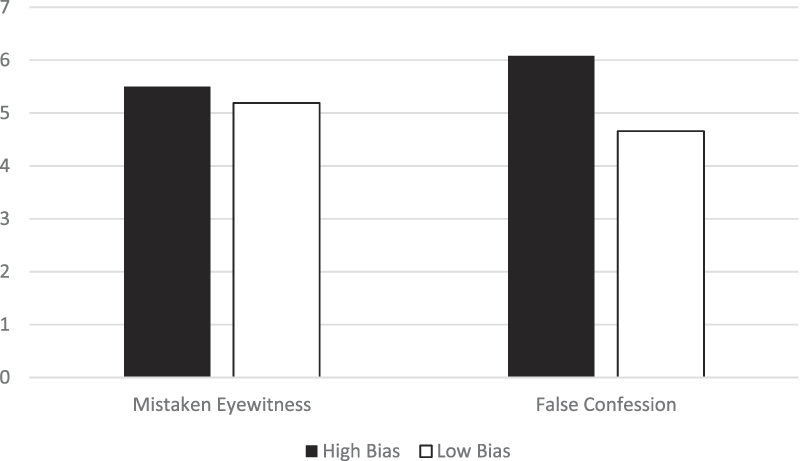
The predicted main effect of bias was found on participants’ ratings of police responsibility, F (1, 158) = 15.85, p < 0.001, ηp 2 = .091. Participants in the high bias conditions (M = 5.76, SD = 1.28) attributed more responsibility to the police for the wrongful conviction than participants in the low bias conditions (M = 4.96 SD = 1.49). The main effect of bias, however, was qualified by a significant bias x factor interaction, F (1, 158) = 6.58, p = 0.011, ηp 2 = 0.040 (see Figure 1). Bonferroni post-hoc tests revealed that when the wrongful conviction involved a false confession after the police interrogation, participants in the high bias condition felt that the police were significantly more responsible than did participants in the low bias condition, t = 4.37, p < 0.05, as predicted. The means in the mistaken eyewitness condition, however, did not differ, t = 1.07, ns.
Mean ratings of police responsibility for wrongful conviction factor (eyewitness error vs. false confession) and police bias (high vs. low bias). Scores range from 0 to 7, with higher scores indicating greater police responsibility.

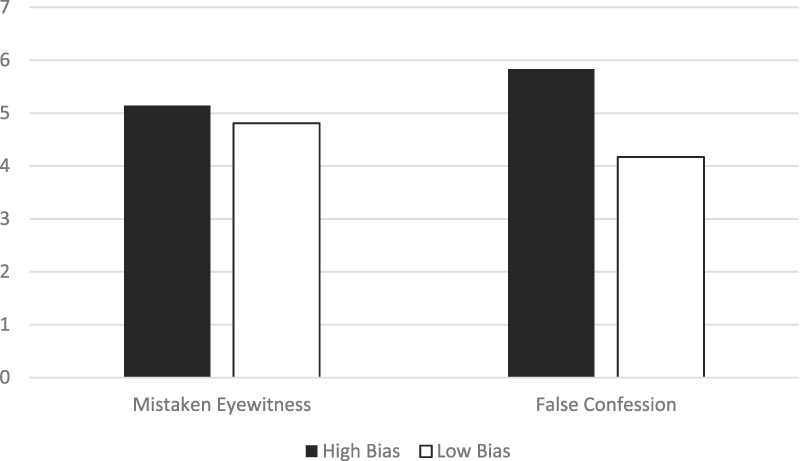
In terms of anger towards the police, as predicted, we found a significant main effect of bias, F (1, 158) = 11.62, p = 0.001, ηp 2 = 0.07. Participants in the high bias conditions (M = 5.45, SD = 1.73) felt more anger towards the police than participants in the low bias conditions (M = 4.54, SD = 1.98). This finding was again qualified by a bias x factor interaction, F (1,158) = 5.22, p = 0.024, ηp 2 = 0.03. Once again, Bonferroni post-hoc tests revealed that participants in the false confession condition felt significantly more anger towards the police in the high bias, as opposed to low bias, condition t = 3.80, p < 0.05, as predicted (see Figure 2). Once again, the means did not significantly differ in the eyewitness condition, t = 0.85, ns.
Mean ratings of anger towards the police for wrongful conviction factor (eyewitness error vs. false confession) and police bias (high vs. low bias). Scores range from 0 to 7, with higher scores indicating greater anger towards the police.

James Barber
Participants’ attributions of James Barber’s responsibility were analyzed. The predicted main effect of bias was found, F (1, 158) = 4.31, p = .04, ηp 2 = 0.03. Participants in the low bias conditions (M = 2.39, SD = 1.90) attributed significantly more responsibility for his wrongful conviction to James Barber than participants in the high bias conditions (M = 2.06, SD = 1.60). The predicted main effect of factor was also found, F (1, 158) = 150.94, p < 0.001, ηp 2 = 0.49. Participants in the false confession conditions (M = 3.60, SD = 1.85) felt James Barber was more responsible for his wrongful conviction than participants in the eyewitness conditions (M = 1.15, SD = 0.47). The interaction was not significant.
In terms of anger, as predicted, we found a significant main effect of factor, F (1, 158) = 8.96, p = 0.003, ηp 2 = 0.05. Participants in the false confession conditions (M = 1.68, SD = 1.27) reported more anger towards James Barber than participants in the eyewitness conditions (M = 1.19, SD = 0.79). We did not, however, find the predicted main effect of bias on ratings of anger towards James Barber, F (1, 158) = 0.11, p = 0.740, ηp 2 = 0.001, or an interaction. Thus, there was no evidence that police bias reduced feelings of anger towards James Barber.
Participants’ feelings of pity towards James Barber revealed the predicted main effect of bias, F (1, 158) = 10.46, p = 0.001, ηp 2 = 0.06, such that participants in the high bias conditions (M = 6.07, SD = 1.29) expressed more pity towards James Barber than participants in the low bias conditions (M = 5.32, SD = 1.80). However, we did not find the predicted main effect of factor on pity ratings, F (1, 158) = 2.55, p = .112, ηp 2 = 0.02. Thus, although participants were angrier when Barber falsely confessed, there was no evidence that participants pitied him less than when he was wrongly convicted because of a mistaken eyewitness. The interaction was not significant.
No statistically significant main effects or interaction effects were found regarding participants’ ratings of their willingness to assist wrongly convicted individuals. There was, however, the predicted main effect of factor on attitude scores, F (1, 158) = 13.37, p < 0.001, ηp 2 = 0.08. Participants in the false confession conditions reported significantly less favourable attitudes towards James Barber (M = 69.30, SD = 19.86) than participants in the eyewitness conditions (M = 80.22, SD = 18.21). Once again, there was no evidence of the impact of bias, F (1, 158) = 0.99, p = 0.320, ηp 2 = 0.006. Attitudes towards James Barber did not appear to differ in the high and low police bias conditions.
Discussion
The results suggest that Weiner’s (1993) attribution theory of perceived responsibility and social motivation may lend some insight into participants’ perceptions of exonerees and wrongful conviction cases. Overall, when participants were told that the police did not follow best practices (i.e., high bias conditions), they viewed the police as more responsible for the wrongful conviction, they viewed the exoneree as less responsible for the wrongful conviction, and they felt more anger towards the police, as Weiner’s (1993) theory would suggest. In addition, Weiner (Reference Weiner1993) theorized that when a person is deemed less responsible for their situation they elicit more pity and, indeed, our participants gave higher ratings of pity towards James Barber in the high bias conditions. Although we did not find less anger and more positive attitudes towards exonerees in the high bias conditions, these findings do suggest that when police do not follow best practices, people are more likely to blame the police than the exoneree for the wrongful conviction.
In addition, our findings replicate and extend the findings of Clow and Leach (Reference Clow and Leach2015a), which demonstrated lower ratings on competency and warmth when an exoneree falsely confessed than when the exoneree was mistakenly identified or a jailhouse snitch was involved. Clow and Leach (Reference Clow and Leach2015a) surmised that perceptions of responsibility were involved, and our findings confirm that to be the case. Our participants felt James Barber was more responsible for his wrongful conviction, felt more anger towards him, and reported more negative attitudes about him in the false confession conditions than the mistaken eyewitness conditions. Other researchers have theorized that participants are unable to relate to an exoneree who falsely confesses, as they cannot imagine themselves falsely confessing; alternately, perhaps falsely confessing is thought to compromise one’s credibility, thereby creating doubt about a person’s innocence (Clow and Leach Reference Clow and Leach2015a; Kassin Reference Kassin2015). Our findings indicate that perceptions of responsibility are also involved.
Thus, our findings contribute to the growing literature that suggests that participants do not understand or appreciate the situational forces at work during a police interrogation and confession (Gudjonsson Reference Gudjonsson, Daniel Lassiter and Meissner2010; Kassin Reference Kassin2015). Even though there are differences in the police protocols and the criminal justice systems between the United States and Canada, our findings suggest that there is a common lack of understanding surrounding false confessions in both countries. This lack of understanding may lead people to falsely assume that providing a confession is primarily under the control of the individual, leading to greater victim blaming when people falsely confess. Possibly, participants are succumbing to the fundamental attribution error (Gilbert and Malone Reference Gilbert and Malone1995) and blame the wrongful conviction on the internal disposition of the false confessor rather than on the situational factors that can lead both guilty and innocent individuals alike to confess (Kassin Reference Kassin2015; Kassin and Kiechel Reference Kassin and Kiechel1996).
Participants rated James Barber higher on responsibility for his wrongful conviction in the false confession conditions regardless of the level of bias in the police procedure, even though participants seemed to understand proper police procedure for an interrogation, as evidenced by them rating the low bias false confession interrogation as being fairer than the high bias false confession interrogation. This result, however, does echo Weiner’s theory, in that when a person perceives an individual as having causal control of a situation, they assign higher responsibility to that individual. Participants seemed to believe that James Barber had more control over his wrongful conviction in the false confession conditions than in the eyewitness conditions. This may be because Barber, by confessing, created the evidence that was used to convict him. In contrast, in the eyewitness conditions, Barber was convicted based on evidence provided by a third party: the eyewitness.
Interestingly, participants did not pity James Barber less when he falsely confessed than when he was misidentified. Although Weiner (Reference Weiner1993) predicts less pity towards individuals who are viewed as responsible, he has found that for some stigmas (e.g., AIDS), the stigma is so great that individuals are pitied whether they are perceived as responsible or not (Weiner, Perry, and Magnusson 1988). It appears that wrongful conviction may be considered a stigma with such severe consequences that its victims are generally pitied despite the circumstances (see Clow and Leach Reference Clow and Leach2015a for similar findings).
The predicted finding of increased willingness to help James Barber in the high bias conditions was not found. Although researchers have found greater willingness to assist individuals suffering from mental or physical illness when they were pitied and viewed as lower in responsibility for their situation (Rudolph et al. Reference Rudolph, Roesch, Greitemeyer and Weiner2004; Weiner Reference Weiner1993), this did not translate to greater willingness to assist exonerees under similar circumstances. Similarly, Clow and Leach (Reference Clow and Amy-May2015b) did not find participants more willing to assist people wrongly convicted of crimes than people who were truly guilty of crimes. Future research is necessary to investigate what variables, if any, might increase people’s willingness to assist exonerees with their reintegration efforts (e.g., employment, housing, compensation).
Limitations and Future Research
As relatively little research has been done on perceptions of exonerees, greater replication and extension of this research is warranted. Although our findings appear in line with Weiner’s (1993) social motivation account of stigma, and generally extend the findings from Clow and Leach (Reference Clow and Leach2015a), we did not obtain the expected willingness to assist results. Advocates fight for greater reintegration assistance for exonerees (e.g., Weigand Reference Weigand2009; Westervelt and Cook Reference Westervelt and Cook2008)—and this seems particularly important in Canada, where exonerees do not have a legal right to financial compensation, as they do in many US states (Robins Reference Robins2008; Norris Reference Norris2012). Thus, further research into the factors that do increase assistance to exonerees, if any, would appear beneficial.
We used a student convenience sample. Although past research has found students and community members to respond similarly in regards to diverse topics, such as reactions to the not criminally responsible on account of mental disorder (NCRMD) defence (Maeder, Yamamoto, and Fenwick Reference Maeder, Yamamoto and Fenwick2015) and perceptions that exonerees are stigmatized (Blandisi, Clow, and Ricciardelli Reference Blandisi, Clow and Ricciardelli2015), future research endeavours may wish to explore non-student samples on this topic. For instance, Blandisi, Clow, and Ricciardelli (Reference Blandisi, Clow and Ricciardelli2015) suggested that although the content expressed by both students and community members was similar, there were differences in the way participants spoke about stigma during qualitative interviews, such that community participants were able to communicate their ideas in a more sophisticated—or socially desirable—manner than the students. Moreover, McCabe, Krauss, and Lieberman (Reference McCabe, Krauss and Lieberman2010) claimed that community members serving as mock jurors were more punitive, more persuaded by clinical expert testimony, and more impacted by gender differences in decision-making than student mock jurors, whereas Hosch et al. (Reference Hosch, Culhane, Tubb and Granillo2011) found that student mock jurors recommended more punitive sentences than their community counterparts.
In addition, only one vignette was used in this research, and it featured a sexual assault. Although many Innocence Project cases involve sexual assault (as these crimes are often more likely than others to involve DNA evidence), future research may wish to determine whether the findings hold across differing crime types. Additional studies using different operationalizations of bias would also help unpack the nuances of the impact of police behaviour on perceptions of exonerees and wrongful conviction cases. In the current study, bias did not have as strong an impact in the eyewitness conditions as the false confession conditions. That might be due to the bias manipulation being insufficiently strong in the eyewitness condition, or perhaps unique to our false confession bias manipulation. The high bias false confession condition used bluffing/lying about evidence and a lengthy interrogation, as these are factors that are frequently associated with actual false confession cases. Although it did not make sense to claim that the police did not lie or bluff in the low bias condition, we did not want to introduce different variables in the low bias condition (e.g., videotaping the interrogation, different police interrogation techniques). Instead, we said that the interrogation was of suitable length, which in hindsight, could have been a disservice to the condition. Our eyewitness vignettes were easier to balance (everyone wore a red shirt like the suspect vs. only James Barber wore a red shirt like the suspect), but as we did not find ratings of the police to differ across our eyewitness conditions, differing manipulations in future research would help test the generalizability of the findings. It would also be interesting to examine the impact of a mistaken eyewitness and a false confession within the same case, as the presence or absence of one variable might influence perceptions of the other variable, in future research endeavours.
Another avenue that future research may wish to explore is the ethnicity of the exoneree. The current study did not mention the race or ethnicity of James Barber. Although race is a significant factor in wrongful conviction cases in the United States, where nearly half (47 per cent) of the known exonerations are African-Americans (National Registry of Exonerations 2017b), Canada is lacking the data to determine whether or not—or to what extent—racial bias impacts Canadian wrongful conviction cases. Aside from a few highly publicized cases (e.g., Donald Marshall Jr.), ethnic information is not readily available regarding Canadian exonerees. Extrapolating from ethnic bias elsewhere in the Canadian criminal justice system (Clow, Lant, and Cutler Reference Clow, Lant and Cutler2013; Department of Justice 2017b), we would predict that Indigenous individuals might be particularly at risk of wrongful conviction, but there is an absence of data to currently speak to this potential issue. The majority of the publicized Canadian exonerees appear to be Caucasian; until Canadian data is available indicating the racial composition of known exonerees, it is unclear whether most Canadian exonerees are indeed Caucasian, or whether they are simply assumed to be because no ethnic information is provided, or whether Caucasian exonerees are simply more highly publicized than ethnic minority exonerees, or a myriad of other possibilities.
Conclusion
Our findings suggest that individuals who falsely confess may be subject to stigma, regardless of the level of police procedural bias. The exoneree was deemed more responsible for his wrongful conviction, and had more anger directed towards him, when he falsely confessed than when he was misidentified by an eyewitness. Nonetheless, police procedure did matter. When the police did not follow best practices, they were seen as more responsible for the wrongful conviction, the exoneree was seen as less responsible, and participants were angrier at the police than when procedures attempted to avoid bias. A better understanding of how people perceive exonerees may benefit organizations that advocate on behalf of exonerees, and assist in increasing public support for policies that would better service exonerees.