I INTRODUCTION
In the fourth book of his Geography, Strabo details the topography and ethnography of the western Alpine regions. In it, he refers to ‘the land of Cottius’ (ἡ Κοττίου γῆ),Footnote 1 subtly marking the area as somehow distinct from others, which he defines by tribal names and ethnics.Footnote 2 That this territory is seen to fall under the ownership of a particular individual is striking since Strabo was writing after the pacification of the Alps, and the reorganization of the area into various administrative districts.Footnote 3 The territory assigned to Cottius in the reorganization had previously been perceived as his kingdom: Vitruvius, writing prior to the pacification, refers to a Cotti regnum.Footnote 4 The continued association of the area with the person of Cottius indicates the importance of this individual in the identification and characterization of the territory, even once it had formally come under Roman control.
The centrality of Cottius to the definition of this area of the western Alps hints at the integral rôle of local élites within the imperial system of provincial administration in the early Principate. Certainly, Augustus himself stresses the relations that existed between himself and various kings and dynasts, which enabled him to claim their inclusion within the scope of Rome's imperium.Footnote 5 Provincial administration during this period rested on a series of relationships at different levels, both within an administrative area, and between that area and the imperial centre.Footnote 6 Cottius’ rôle within the Roman reorganization of the Alpine region may be plausibly understood, in certain senses, as parallel to the relationships created and maintained with eastern monarchs, yet Cottius explicitly abandons the title of king for one that designates him as a Roman administrator.
Unlike the Salassi, who were subjugated and enslaved, and the ‘barbaric’ Ligurians, who came under the control of a Roman governor, Cottius adopted an active rôle in maintaining his position of authority in the Alps, by providing infrastructure that testified an acceptance of Rome's involvement in the region. This activity is most clearly demonstrated through the comparison of Rome's presentation of the pacification of the Alps and Cottius’ own response. A commemorative trophy, set up in 7/6 b.c. at the end of the Alpine chain at La Turbie near Monaco (Fig. 1), recorded the subjugation of forty-five Alpine peoples and the extent of Roman imperium over the Alps from the Adriatic to the Ligurian sea.Footnote 7 This image of Alpine subjugation to the imperium populi Romani and Augustan victory has left a lasting impression on later interpretations of the pacification of the area. An eighteenth-century engraving of an arch at Segusio, modern-day Susa,Footnote 8 reflects the belief that the monument must have been erected to commemorate Augustus’ victory in the Alps (Fig. 2). The drawing gives the dedicatory inscription of the arch over six lines, as opposed to the actual four, with the word VICTOR clearly visible in the sixth line. This reading reflects a desire to see in an arch to Augustus a triumphal monument commemorating his victorious achievements. The actual arch presents the conquest over the Alps in quite a different light.Footnote 9 The language of integration rather than that of subjugation is employed.
View from Mont Justicier, looking towards the Alpine Trophy at La Turbie, and the end of the Alpine chain. (Photo: H. Cornwell)

Drawing of the arch at Segusio published in the fourth volume of Novum Italiae Theatrum (Blaeu 1726: tome 4, pl. XLIII) incorrectly showing the inscription as comprising six lines, with the word VICTOR in the last line. (H. Cornwell with permission from the British School at Rome).
The arch was erected at the western limits of Segusio, in the Italian Alps, over a north–south road linking Italy to Gaul (Fig. 3). The single free-standing arch of local white marble,Footnote 10 with the base and column plinths made of grey limestone, was dedicated to Augustus in 9/8 b.c. by Marcus Iulius Cottius and the communities under his control. Three-quarter columns with Corinthian capitals stand at each corner, supporting the entablature on which a frieze was carved on all four sides, 0.52 m in height and a total of 33.2 m in length.Footnote 11 On the north and south sides, a frieze depicts a sacrifice (suovetaurilia), and on the west side what has been interpreted as a foedus ceremony,Footnote 12 or census.Footnote 13 The east side is badly damaged, but appears to depict a similar scene to that on the west side. This is the only extant example of a narrative frieze on an Augustan arch.Footnote 14 Above the entablature, on both the north and south faces, is the inscription dedicating the arch to Augustus. The original bronze inlaid letters were lost in the Middle Ages, but although some sections of the stone have fallen away, it is possible to reconstruct the inscription from the countersunk letters:
Imp(eratore) Caesari Augusto Divi f(ilio) Pontifici Maxumo Tribunic(ia) Potestate XV Imp(eratore) XIII / M(arcus) Iulius regis Donni f(ilius) Cottius praefectus ceivitatium quae subscriptae sunt Segoviorum, Segusinorum, / Belacorum, Caturigum, Medullorum, Tebaviorum, Adanatium, Savincatium, Egdiniorum, Veaminiorum, / Venismorum, Ieriorum, Vesubianorum, Quadiatium et ceivitates quae sub eo praefecto fuerunt.Footnote 15
Arch at Segusio over the road through the Alps, viewed from the north (left) and south (right) with a view of the Alps (Rochemelon) in the background. (Photos: H. Cornwell)
For Imperator Caesar Augustus son of the deified (Julius), Pontifex Maximus, holding tribunician power for the 15th time, Imperator for the 13th time, Marcus Iulius Cottius, son of King Donnus, praefectus of the communities which are written below — the Segovii, the Segusii, the Belaci, the Caturiges, the Medulli, the Tebavii, the Adantii, the Savincates, the Egdini, the Veamini, the Venismi, the Ierii, the Vesubiani and the Quadiates — and the communities that were in his charge as praefectus (dedicated/gave this).Footnote 16
The inscription raises several questions about the position of the dedicants and the administrative arrangements of the Alpine region involved in the commemoration. This paper examines the arch set up to Augustus by the local dynast in order to understand how the incorporation of the region into the Roman Empire was perceived and presented from a local/regional viewpoint, and how we can then construct ideas of identity and power in the region during the Augustan Principate. This view from the local élite is important to stress in contrast to the viewpoint presented from the centre. The Trophy monument at La Turbie, which is virtually contemporary in date to the arch at Segusio, is a commemoration of the subjugation of the Alpine tribes.Footnote 17 The act of subduing the Alpine peoples by Augustus’ leadership and auspices is reminiscent of his own account of his triumphs and state honours: ‘ob res a me aut per legatos meos auspicis meis terra marique prospere gestas quinquagiens et quinquiens decrevit senatus supplicandum esse dis immortalibus.’Footnote 18 The arch at Segusio tells a different story. Augustus’ rôle in the inscription serves to qualify the position of Cottius as praefectus and the communities ‘sub eo praefecto’.
This paper presents the geopolitical concerns of Rome's involvement in the Alps, before turning to focus on the language of the arch's inscription and the insights it allows us into the interplay between hereditary, pre-existing power structures in the Alps and Roman constructions of authority and governance. It then turns to examine the inscription in relation to the arch's frieze in order to further explore the viewpoint of the dedicants and the message they wished to set out. Through the examination of the arch, I will demonstrate that the pacification and subsequent reorganization gave Cottius the opportunity and the means to emphasize his position within the Roman Empire and within his own sphere of authority.
Control over the Alpine passes was ultimately the driving factor behind Rome's activities in the region, and the example of Cottius illustrates how a local leader engaged with Rome's concerns and view of ‘empire’. Cottius found a way to integrate himself into Roman power structures and to transform his pre-existing position of authority into something palatable to Rome. When viewed within the wider context of the imperial system of administration, the history of the Cottian dynasts,Footnote 19 who governed their territory first as kings, and then as praefecti civitatium under the auspices of Rome, before Nero annexed the area, illustrates the malleability of provincial administration in the early Principate.Footnote 20 As with other areas of the Empire, onto which Rome's power was indirectly imposed through ‘client’ polities, the case of the Cottian Alps illustrates the vital importance of the position and authority of local rulers who wielded power prior to Rome's conquest. No blueprint existed for Augustan provincial administration, rather the diplomatic relationships of power between Rome and the local élites at the periphery were negotiated and articulated according to the needs of the situation. How Cottius chose to react to and interact with Rome is tantamount to understanding the reception and transmission of imperial control in the Augustan period.
II THE REGNUM COTTI: GEOGRAPHICAL BACKGROUND
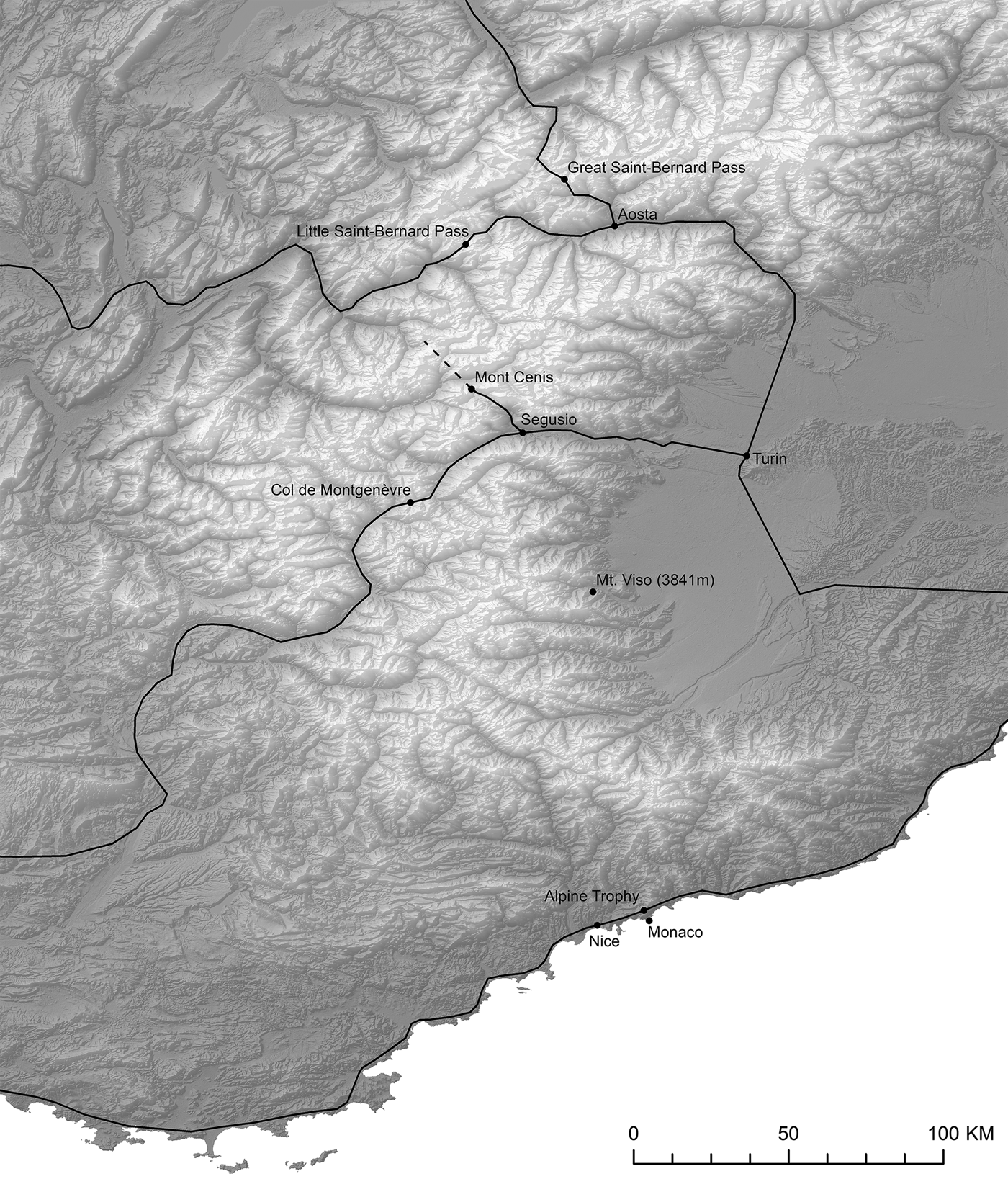
In order to understand Cottius’ relationship with Rome a brief discussion of the geographical and strategic position in the Alps is necessary. The territory over which Cottius governed exemplifies the importance and necessity of understanding how social spaces were created and dictated by the geomorphology of the mountain range. The Cottian kingdom comprised three main mountain passes in the western Alps: the Maddalena in the south (on the French-Italian border), and the Montgenèvre and the Mont Cenis passes in the north, and covered several valleys from the area of what is now the Gran Paradiso National Park above Turin, down to the French-Italian border (Fig. 4).Footnote 21 Not only did the dynasty benefit from control of these Alpine passes, but also from the inaccessibility afforded to their settlements, due to the depth and narrowness of the valleys. These characteristics are highlighted in a description of the area by Ammianus:
In his Alpibus Cottiis, quarum initium a Segusione est oppido, praecelsum erigitur iugum, nulli fere sine discrimine penetrabile. Est enim e Galliis venientibus prona humilitate devexum pendentium saxorum altrinsecus visu terribile praesertim verno tempore, cum liquente gelu nivibusque solutis flatu calidiore ventorum per diruptas utrimque angustias et lacunas pruinarum congerie latebrosas descendentes cunctantibus plantis homines et iumenta procidunt et carpenta; […] A summitate autem huius Italici clivi planities ad usque stationem nomine Martis per septem extenditur milia, et hinc alia celsitudo erectior aegreque superabilis ad Matronae porrigitur verticem, cuius vocabulum casus feminae nobilis dedit. Unde declive quidem iter sed expeditius ad usque castellum Brigantiam patet.Footnote 22
In these Cottian Alps, which begin at the town of Segusio, the mountain ridge rises on an extremely sharp incline, scarcely penetrable for anyone, without distinction. For those coming from Gaul, from a low incline it rises steeply, with the terrifying sight of overhanging rocks on either side, particularly in spring, when the ice and snow melt due to the warmer winds, men and baggage trains descend with cautious steps through sheer passes and hidden hollows with accumulations of hoar-frost. […] But from the summit the plain of this Italian slope extends for seven miles as far as the station-post named Mars, and here another height, even loftier and barely scalable, stretches to the top of Matrona, named after the fall of a noble lady. From here the route certainly slopes, but is a less encumbered descent until the stronghold of Brigantia.
Map showing the routes (indicated by the black lines), passes (the Little and Great Saint-Bernard passes, Mont Cenis and Col de Montgenève), and main civic centres in the western Alps. The broken black line indicates a possible route, whose exact path is uncertain. (H. Cornwell, using A. Jarvis, H. I. Reuter, A. Nelson and E. Guevara 2008, Hole-filled SRTM for the globe Version 4, available from the CGIAR-CSI SRTM 90m Database (http://srtm.csi.cgiar.org))
The landform of the Alps provided strategic points, enabling dominant communities and tribes control over the region,Footnote 23 with Segusio, the main seat of the Cottian dynasty, clearly commanding a suitable position over the passes of the western Alps dividing Italy from Gaul.Footnote 24
The topographical composition of the Alps not only afforded the Alpine communities dominant positions and control over accessible routes, but it also played an important rôle in Rome's conception of the mountain range. The mass of the western Alpine chain, which stretches roughly 300 km from southern France up into Switzerland, was perceived in antiquity as a uniform, continuous barrier to human movement: μέχρι μὲν γὰρ δεῦρο ἀπὸ τῆς Λιγυστικῆς συνεχῆ τὰ ὑψηλὰ τῶν Ἄλπεων διέτεινε καὶ ἑνὸς ὄρους ϕαντασίαν παρεῖχεν.Footnote 25 Accounts of the Alps in Roman authors from Cato the Elder onwards emphasize the mountains as a wall (murus/moenia), a barrier protecting Italy from threats beyond.Footnote 26 The Alps, through their size and scale, captured the imagination of Rome as an insurmountable object.Footnote 27
Yet beyond the conception of the mountains as a barrier, the landforms of the region are articulated by valleys, gorges, rivers and passes influencing and directing human activity.Footnote 28 As Rome began to extend her control over Spain and Gaul, more permanent access routes were required: the Alps were a passageway of connectivity. Rome's interest in the Alps was, first and foremost, a strategic one, providing access to the world beyond.Footnote 29
In this context, it is not difficult to see why securing the Cottian territory, with its control over three mountain passes, was of interest to Rome. Prior to the agreement between Cottius and Augustus, Rome had sought to gain control over the western Alps through a series of protracted campaigns over the course of the first century b.c. against the Salassi, οἱ τῶν παρόδων κύριοι (Str. 4.6.7: ‘Lords of the passes’), controlling as they did the Great and Little Saint Bernard passes. The final defeat of the Salassi in 25 b.c. gave Rome control over the North-Western Alps. Indeed, Strabo presents the peace (εἰρήνη) achieved in relation to the passes through the mountain (τῶν ἄκρων ὑπερβολῶν τοῦ ὄρους).Footnote 30 Although the sources for Cottius’ own opposition to Rome are limited to an account by the fourth-century author Ammianus Marcellinus, it is striking that he emphasizes not only Cottius’ strategic position, but also the key importance of road-building as part of the alliance with Rome:
aggeribus cedit Alpium Cottiarum: quas rex Cottius, perdomitiis Gallis solus in angustiis latens inviaque locorum asperitate confisus, lenito tandem tumore in amicitiam Octaviani receptus principis, molibus magnis extruxit ad vicem memorabilis muneris, conpendiarias et viantibus oportunas, medias inter alias Alpes vetustas.Footnote 31
It gave way to the mass of the Cottian Alps, where, at the time when the Gauls had been subdued, King Cottius alone lay hid in the mountain passes and put his faith in the harsh inaccessibility of the location. Finally, when his pride was placated, he was received into the friendship of the princeps Octavianus and with a great amount of work he built, as a memorable gift, short cuts and routes that were convenient for travellers, midway between other ancient Alpine passes.
This imagery fits well with the picture of Augustus’ activities in the Alps during the period; indeed, Strabo emphasizes his desire to make the routes as passable as possible.Footnote 32 Unlike the Salassi, 40,000 of whom were subjugated and sold into slavery,Footnote 33 or the Ligurians, who were governed by a Roman equestrian prefect once they were subdued,Footnote 34 Cottius’ strategy of playing to the Roman need for accessible routes through the mountains secured his continued position. One way in which he expressed that position was through the dedicatory inscription on the arch at Segusio.
III PRAEFECTVS CIVITATIVM
In the second line of the inscription Cottius presents himself as a Roman citizen (using tria nomina)Footnote 35 with the title of praefectus c(e)ivitatium, and his use of this terminology is important for our understanding of his self-presentation. Furthermore, he distinguishes himself in his titulature from his father, whom he names as Donnus rex. Footnote 36 A brief consideration of King Donnus’ position in the Alps will provide the context within which Cottius is playing with titles and positions of power.
There is little evidence of King Donnus’ interactions with Rome, although he appears much later in Ovid's poems from exile as the progenitor of an Alpine dynasty.Footnote 37 It is possible, however, to suggest some connection or interaction between Donnus and Caesar during the latter's Gallic campaign. In his de bello Gallico, Caesar outlines the quickest route from the Alps to Gaul through the high territories of the Cautriges, Graioceli and Ceutrones, down into the territory of the Allobroges; a route which would have taken him up through the Cottian Alps and likely through the Montgenèvre pass.Footnote 38 Donnus’ possible interactions with and reactions to a Roman presence within the Alps are suggested by numismatic evidence from Lyon and the area around the Drôme.
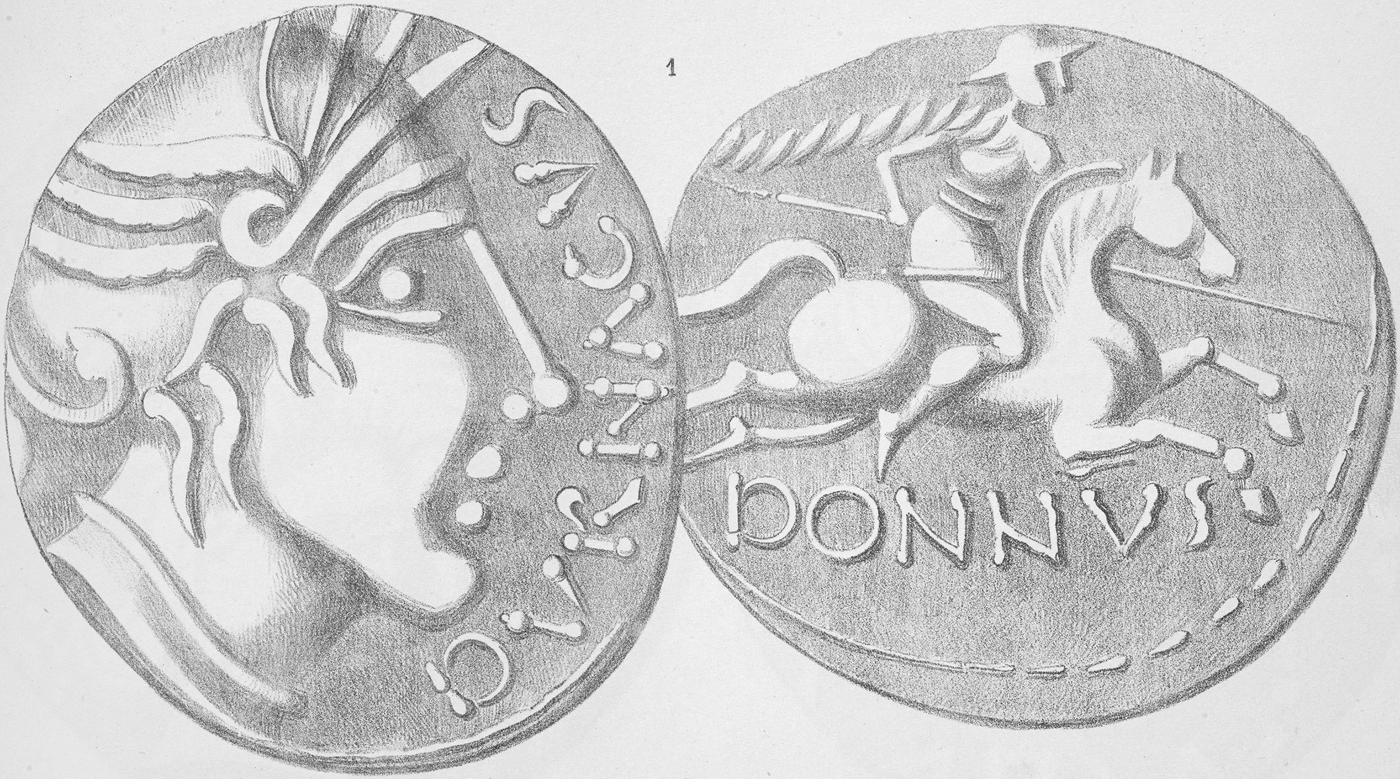
From an analysis of the legends, which contain names and ethnics, the silver coins appear to have been minted by several chieftains, Donnus included, from the region of the Rhône valley and the western Alps (Fig. 5).Footnote 39 The coins imitate a Roman denarius type depicting Roma on the obverse and the Dioscuri on the reverse, which was common from the introduction of the denarius at the end of the third century.Footnote 40 The Celtic coinage differs in the adoption of a single rider in place of the Dioscuri. This alteration of the Roman image is indicative of the importance of the rider as a symbol of power and kingship in Celtic society.Footnote 41 Evidence from coin hoards in the region indicates that a mixture of late Roman Republican and Celtic coins was in circulation, which offers a context for these stylistic imitations.Footnote 42 The influence of the gold Macedonian coinage of Philip II on Celtic coinage is well attested, and the images became deeply embedded and stylized.Footnote 43 By contrast the ‘rider coins’ are not heavily stylized, but copy the style of the Roman prototype relatively faithfully.Footnote 44 This may represent a recent introduction of the images into the Celtic coinage,Footnote 45 and the adoption of the image may indeed indicate a growing awareness of Rome as a power base to either align or compete with. Caesar's Gallic campaign offers one point of contact. In the wake of the Gallic war, gold coinage in the region disappeared, to be replaced by various series in silver and bronze. Scheers assigns the variety of new coins in the Belgic Gallic region to the break-up of the civitas into pagi, a process which had already begun during the war, with the Meldi declaring their independence from the Suessiones and the right to mint their own coins in 57 b.c.Footnote 46 The new minting practices during and after the Gallic war may suggest a political context within which the Celtic copies were produced.
Drawing of a silver Celtic coin of Donnus, found near Lyon, depicting a helmeted female head with the legend DVRNACVS on the obverse, and a galloping cavalryman carrying a spear with the legend DONNVS on the reverse. Diameter: 16 mm, weight: 1.90 g. (After Hucher 1868–1874: I, pl. 64)
Bertrandy has stressed the relationship between this adoption of romanité in the coinage and the control being asserted over the peoples of the region, in terms of a unification of the area by Rome in the mid-half of the first century b.c.Footnote 47 The coins clearly attest a growing awareness of Rome as a power base in this period, yet the positions of local authorities were also asserted through the names of chiefs and ethnics,Footnote 48 as well as the image of the single rider. The adoption of the coinage amongst several chieftains might also imply a standardization and common identity: a redefinition of their identity in the wake of the continued Roman presence.
That Cottius assumed the position and title of king after his father seems highly plausible based on the testimony of Vitruvius.Footnote 49 Yet, by 9/8 b.c., when he erected the arch to Augustus at Segusio, Cottius clearly defined himself not as rex (despite his filial association with the title), but as praefectus. This title continued to be used by Cottius’ successor, his son Donnus,Footnote 50 as an inscription from Turin illustrates:
[C(aius) Iulius Cotti f(ilius) D]onni re[gis n(epos) Donnus] praef(ectus) [ci]v[itatium omnium quibus pa]ter eius praefuit / [M(arcus) Iulius Donni f(ilius) C]otti n(epos) [Cottius port]icum [c]um [suis ornamentis et do]mus dederunt.Footnote 51
C. Iulius Donnus, son of Cottius, grandson of King Donnus, praefectus of all the communities over which his father presided / [and] M. Iulius Cottius, son of Donnus, grandson of Cottius, gave this porticus with its ornaments and building.Footnote 52
Donnus II emphasizes the continuity between the territorial extent of his father's praefecture and his own (‘civitatium omnium quibus pater eius praefuit’), whilst still maintaining links to the dynastic monarchy he could claim descent from.Footnote 53 It is also notable that this inscription was a dedication at the theatre in Turin, a Roman colony (Augusta Taurinorum), and thus suggests to us how the title of praefectus civitatium was used by the Cottian dynasty to confirm their position of administrative authority and benefaction to a Roman audience.
The title of praefectus civitatium was used for other administrative areas during the early Principate, notably the Maritime Alps, Moesia and Trebellia, parts of Pannonia, and even certain communities in Sardinia.Footnote 54 Besides the instance of Sardinia, which had become a Roman province along with Corsica after the First Punic War, praefecti civitatium appear to have been assigned to areas newly brought under Roman administrative control in the Augustan period. Even in the case of Sardinia, the appointment of a praefectus I cohortis Corsorum et civitatum barbariae under TiberiusFootnote 55 involved the administration of a particular area of Sardinia — the interior — which had been far from willing to be subjected to Roman control, and provided a less urbanized area for administrative purposes.Footnote 56 The appointment of praefecti civitiatium suggests a means of overseeing the management of areas containing a number of different tribes, as opposed to colonies and municipalities.Footnote 57
An examination of the careers of C. Baebius Atticus, L. Volcacius Primus, and Sex. Iulius Rufus indicates military men (Volcacius Primus and Iulius Rufus were praefecti cohortis et civitatium), with prefectures held for a fixed term; indeed, Baebius held both the positions of praefectus civitatium Moesiae et Trebelliae and praefectus civitatium in Alpibus Maritumis. Although the system of administration was flexible and evolving during the early Principate, the duration of administrative appointments was fixed-term, even with prolongation of office.Footnote 58 It seems plausible, by contrast, that the Cottian prefecture was permanent, and hereditary: Donnus II is praefectus over the communities which his father governed, and Cottius II governed his πατρῴα ἀρχή,Footnote 59 although he received a different title (that of ‘king’) and recognition from Rome. This hereditary aspect of a Roman administrative position is striking and almost unique, although Caesar appears to have intended the title of ethnarch of the Jews to be passed on in a similar manner.Footnote 60 What is important in the representation of power by the Cottian dynasty is the hereditary aspect of authority (‘filius Donni regi’; ’praefectus civitatium … quibus pater eius praefuit’; την πατρῴαν ἀρχήν), combined with the usual aspect of Roman prefecture: that of administrative and territorial control. The integrity of the Cottian territory is stressed in the inscription at Turin.
The importance of territorial control is emphasized by Cottius listing the communities which comprise his prefecture. He defines his prefecture through the communities under his control. Indeed, the section of the inscription which reads ‘quae subscriptae sunt Segoviorum … Quadiatium’ is a clause dependent on ‘praefectus ceivitatium’. In the latter half of the inscription the co-dedicants are defined by their position within that prefecture: ‘ceivitates quae sub eo praefecto fuerunt’. Both sets of dedicants (Cottius and his communities) are defined by their respective relative clauses. The main dedicatory phrase should simply read: ‘Imp. Caesari Augusto Divi f. Pontifici Maxumo Tribunic. Potestate XV Imp. XIII/M. Iulius regis Donni f. Cottius praefectus ceivitatium et ceivitates <dederunt>’.
The final relative clause (‘quae sub eo praefecto fuerunt’) does, however, present a problem for the interpretation of the inscription and the definition of Cottius’ prefecture. Previous scholars have argued that the second relative clause refers not to the communities already named and listed as the civitates of Cottius’ prefecture, but instead to another group of communities, who were under Cottius’ prefecture before the dedication of the arch, but who had at the time of dedication become ‘former’ Cottian communities.Footnote 61 Letta has argued that when the verb of dedication is in the perfect, relative clauses that refer to action contemporary to the act of dedication never use the perfect, but exclusively the present.Footnote 62 This viewpoint has plenty of support in the epigraphic corpus: Letta himself points to the clear distinction in use of cui praeest and cui praefuit,Footnote 63 whilst comparable examples may be found in the military diplomas issued under Claudius and Nero, distinguishing between those who were still serving (‘qui militant’) at the time of receipt of their diploma, and those who had completed service and received discharge (‘qui miliaverunt … honesta missione’).Footnote 64
Temporal distinctions between the point at which a document had originally been inscribed, and that at which it was re-inscribed/copied are clearly marked by scriptum fuit and scriptum est respectively: ‘descriptum et recognitum ex tabula pro/fes(s)ionum quibus liberi nati sunt / quae tabula proposita erat in foro Aug(usti) / in qua scriptum fui<t=D> id quod infra scri/ptum est’.Footnote 65 This juxtaposition of the perfect and pluperfect tense of scribere serves to indicate a distinction between an action contemporary to the inscription (perfect) and an action that preceded the inscription (pluperfect).Footnote 66Subscriptae sunt clearly indicates an action contemporary to the inscription; could we then imagine supplying scriptae to the second relative clause to create a sense of ‘those who have been listed within that prefecture’, and so referring back to the Cottian communities listed in the first relative clause?
This does, however, lead to the question as to why scriptae has not simply been included in the clause. Indeed, the use of just sub praefecto with esse was a common enough phrase, particularly in military diplomas, to determine the position of various units under a commanding officer; the present tense is consistently used, even when the individuals receiving diplomas have completed their service (qui militaverunt).Footnote 67 However, an inscription from Glanum may offer a potential parallel to the Segusio inscription:
Votum susceptu(m) / Herculi Victori pro / salute et reditu G(ai) Licini(i) / Macri trib(uni) et centurio/num et militum Glanico/rum qui sub vexsillo fue/runt Cn/aeus Pomp(eius) Cornutus / opt(io) ex stipendis et hon[o]/rario quod ei d(onum) const(ituerat) / l(ibens) m(erito).Footnote 68
The vow undertaken to Hercules Victor on behalf of the safety and return of Gaius Licinius Macer, tribune, and of the centurions and of the soldiers of Glanum, who were under the banner. Cnaeus Pompeius Cornutus, optio, willingly fulfilled the vow from the wages and the honorarium, which constituted a gift to him.
The relative clause defines the soldiers of Glanum as specifically being sub vexillo, which seems to imply a secondment for an operation.Footnote 69 One issue is that the discharge of the vow to Hercules Victor for a successful operation may imply that the soldiers’ position sub vexillo has been completed. However, a plausible way of understanding this use of fuerunt is that it works naturally as a historical statement. Such a reading is equally applicable to the second relative clause at Segusio in that it describes the state of those who were under Cottius’ prefecture when he was praefectus.Footnote 70 The first relative clause can, on the other hand, be read as expressing a state that is permanently present as it concerns the inscription itself.
Whilst debate has persisted over the reading of the text, this has traditionally been founded solely on an examination of the language. I would propose that a more comprehensive reading of the monument as a whole would allow for the dedicating civitates to be identified, not as a separate group of unlisted communities, but as those already listed in the genitive: they do not need to be listed when they are presented (again) as the dedicants.Footnote 71 If the phrase ‘sub eo praefecto fuerunt’ were to refer to, in some way, ex-Cottian communities, their rôle with the monument, beyond their place in the inscription, has never been fully explained.Footnote 72
The traditional reading of the inscription not only fixates on a literal reading of the perfect tense, but also places undue focus on the inscription in isolation, without considering how it relates to the rest of the monument. In his study of Roman historical reliefs, Hölscher noted the importance of coin legends for the identification of abstract concepts, particularly during their introduction into the artistic canon, in order for the meaning of the image to be understood — the verbal provides elucidation for the understanding of the visual.Footnote 73 Whilst at Segusio we are not dealing with personifications of abstract concepts, but instead quite formulaic scenes of sacrifice and administration, Hölscher's point about the interrelation of the visual and the verbal is still applicable to a monument such as the arch. We do not have an inscription in isolation nor a frieze without a verbal reference tag. The spatial relationship between the inscription on the attic and the frieze on the entablature is clear and points to a unison of the two for the reading of the monument (Fig. 6).Footnote 74 To have a group of civitates who are not named, following a group of civitates who are, is odd, particularly if we are claiming that they are co-dedicants of the arch. Furthermore, based on a reading of the frieze (see Section iv below), it is extremely difficult (indeed implausible) to find a rôle for these so-called former communities within the visual narrative.
The inscription and frieze on the south side of the arch at Segusio. (Photo: H. Cornwell)
If we take the inscription not simply as a dedication to Augustus, but also as an opportunity for Cottius and his communities to express their position within the Roman world, the very act of listing the civitates that comprise the prefecture is relevant. It is notable that the list of the names of the fourteen communities comes within the first relative clause, presenting them as subjects of Cottius, rather than in their position as co-dedicants of the monument. The listing of the communities delineates Cottius’ territory, and confirms the position of those communities under Cottius by the very act of inscribing their names (subscriptae sunt), similar to the way that inscribing the names of the conquered gentes at La Turbie, or the names of the sixty Gallic tribes on the altar to Roma and Augustus at Lugdunum, acts as a confirmation of Roman control over those tribes and their position as subjects of Rome. In 12 b.c. an attempted census of the Gallic communities resulted in an uprising. Drusus invited the leading men of the communities to Lugdunum to resolve the tensions.Footnote 75 The altar which was set up recorded both the names and the images of the sixty tribes: ἔστι δὲ βωμὸς ἀξιόλογος ἐπιγραϕὴν ἔχων τῶν ἐθνῶν ἐξήκοντα τὸν ἀριθμον καὶ εἰκόνες τοῦτων ἑκάστου μία.Footnote 76 Although the census was the root of the trouble in Gaul, the representation of the tribes in word and visual display upon the altar acted as confirmation of that census, and of Roman control over the area. It is worth noting that the act of census is also suggested in the visual display of the frieze at Segusio. In this respect, Cottius has appropriated Roman imperial discourse, which articulates control through the state's ability to list, arrange, classify and measure, as the cases of La Turbie and the altar at Lugdunum illustrate. Footnote 77 It should be noted, however, that whilst the conquered gentes appear to be listed at La Turbie in a rough geographical order from the Adriatic coast to the Ligurian sea,Footnote 78 there is no obvious geographical ordering of the Cottian communities.Footnote 79
It is also notable that six of the Cottian civitates are also listed as conquered gentes at La Turbie.Footnote 80 Some scholars have sought to explain their presence on the two monuments by a revolt between 9 and 6 b.c., in which the six communities were involved.Footnote 81 This explanation however seems a little tenuous, particularly given the narrow chronological gap. Indeed, if the trophy at La Turbie was planned at the same time as the building of the Via Iulia Augusta, it is plausible to assume that those listed on the trophy were subdued prior to 13/12 b.c.Footnote 82 Furthermore, it ignores the fact the Cottius himself was initially resistant to Rome, even continuing to fight after the Gallic tribes had been conquered.Footnote 83 What the scholarship has failed to fully articulate is that we are dealing with two quite different representations of these communities — the six communities labelled as gentes devictae by Rome at La Turbie were in no way marked out as distinct amongst the civitates at Segusio. The presentation at Segusio, irrespective of the reality of the situation, was that of a cohesive group of communities, along with their governor, who presented themselves in terms of Roman power structures, and as being integrated into a Roman system, rather than being subjugated to it. The language that Cottius chose to define his and his subjects’ position both precludes any concept of subjugation, and further redefines their identity within a Roman worldview in order to confirm and strengthen his own position within the Alps.Footnote 84
IV THE VISUAL NARRATIVE
The relationship between the frieze and the inscription illustrates the rôle of the fourteen communities listed as part of both Cottius’ prefecture and the Roman Empire. Indeed, for a full understanding of the commemorative function of the arch it is necessary to see how the inscription relates to the monument, most notably the narrative frieze below it. I now turn to examine the visual narrative of the frieze and its rôle as part of the monument.
As stated above the north and south friezes show scenes of a suovetaurilia sacrifice, depicting victims, attendants, musicians, cavalry and infantry, and priest processing from either end of the frieze towards a central altar (Fig. 6). The two friezes are not, however, identical in composition. The south side includes, at both ends, a standing figure of a naked youth holding the reins of a horse, generally identified as the Dioscuri. These two figures are absent from the north side. The other distinction is that, whilst on the north side there is a single bull, pig and sheep, on the south there are two bulls, one pig and one sheep. The west side has been interpreted as a scene celebrating the amicitia between Cottius and Augustus, or a scene of census.Footnote 85 Notably all figures on the west side wear togas. As with the north and south sides, the action moves from both sides towards a central altar, at which two figures sit on curule chairs. The balance of two equal individuals either side of the altar suggests the equality of an act or oath undertaken. The frieze also contains fourteen togate figures holding scrolls and tablets, six lictors (three each side), and a figure seated at a table receiving documents, at each far end of the frieze (Fig. 7). The togate figures plausibly represent the fourteen named civitates in the inscription.Footnote 86 Of these civitates, one stands behind the altar, whilst two on either side touch the togas of the two central seated figures, demonstrating their inclusion, along with those who follow them, in the agreement. A reading of the east side is made problematic owing to damage and weathering on the stone; however it is plausible, based on a reconstruction given below, that the east side depicts a similar scene to the west, as the north and south friezes likewise depict, in essence, the same narrative units.
The west frieze, depicting a procession, from both sides, towards a central altar. The procession appears to depict fourteen togate individuals carrying scrolls and tablets, as well as officials, and may be interpreted as the fourteen Cottian communities listed in the inscription. (Photo: H. Cornwell)
Despite this symmetry of composition between the north and south, and east and west sides of the arch, previous studies have sought to identify a successive series of events unfurled in the narrative frieze.Footnote 87 Prieur's interpretation reads the east frieze as the submission of the Cottian Alps in 14/13 b.c.; the north frieze as a sacrifice offered on that occasion; the west, the census ceremony creating the prefecture; and the south, a sacrifice ratifying that ceremony and closing the lustration.Footnote 88 This reading of the frieze is problematic for several reasons: first, Prieur's identification of the east side as an act of submission is based on only two figures at the far right end of the frieze, and therefore cannot be accepted. Secondly, his wish to see a submission represented is at odds with the message of the inscription, where integration is stressed. Figs 8 and 9 give partial reconstructions of the narrative units of the east side, based on autopsy.Footnote 89 The scene clearly shows the procession of figures from the right side towards what may be interpreted as a central altar with a figure standing behind it. Furthermore, at the right end of the frieze a figure seated at a table is discernible, and it is plausible to draw parallels between this scene and the scene at both ends of the west frieze.
The east frieze of the arch (top) with definition lines added by author, which appears to depict a scene comparable to the west frieze of the arch (bottom), depicting the procession of figures from the right side towards the central altar with a figure standing behind it. (Photos: H. Cornwell)
Right-hand corner of the east frieze of the arch (top) with definition lines added by the author, depicting a scene comparable to the left-hand corner of the west frieze of the arch (bottom), showing a figure seated at a table and figures with tablets. (Photos: H. Cornwell)
Another problem with Prieur's interpretation is that it would require the audience to start on the east side, which seems strange when one considers that the arch is set on a north–south axis over the road. Felletti Maj, who like Prieur understands the frieze as a successive series of scenes (from left to right), argues the narrative begins on the north side.Footnote 90 However, as the north and south sides both carry the inscription, these two sides should be understood as two individual starting points from which an audience is to view the arch. The very fact that the arch was set up over a road is an indication that the frieze has more than one starting point; more than one way from which to approach it. Moreover, on each side the frieze draws the eye to the centre of the scene, and does not lead the viewer around the corner to the next frieze.Footnote 91 The central focus of each side is an altar and the participants around it.Footnote 92 As opposed to a progressive narrative across four sides of the arch, these separate, self-contained scenes offer two individual scenes (of a sacrifice and of a census), on the main and lateral axes, that must, in some way, be read together with the inscription. The involvement of the fourteen communities of Cottius’ prefecture emphasizes the relationship between the inscription and the frieze in conveying the message of the monument. Indeed, the presence of these communities on both the inscription (north and south) and frieze (east and west) means they are depicted on all sides of the arch, either in text or image. The frieze is a visual testimony of relations recorded in the inscription.Footnote 93
An examination of the particular narrative units of the frieze, in relation to Roman historical reliefs, will provide further insight into the message of the monument at Segusio. The scenes at both ends of the west side are reminiscent of the scene of census on the so-called Altar of Domitius Ahenobarbus (Fig. 10).Footnote 94 Despite their stylistic differences the two friezes comprise similar thematic units. The left side of the altar frieze depicts, moving towards the central altar, a cavalryman, infantry, victims, attendants, lictors and musicians. The same units are used on the north and south sides of the arch, although the central altar is approached from both sides. On the right side of the altar frieze a scene of census is depicted, showing a seated administrator collecting documents, which again comprises the same units as the west and east sides of the arch. The frieze at Segusio uses narrative patterns that a Roman audience would have been familiar with, both in terms of the actual practice depicted and the visual narrative tradition of the display. Whilst the inscription on the arch represents the communities as under the command of Cottius (who himself defers to the power of Augustus), the visual display, as with the altar at Lugdunum, represents the communities as part of the Roman world in their togas participating in some form of registration.Footnote 95 The frieze articulates the iconography of the Roman world, through which Cottius defined and supported his position and that of the communities under him.Footnote 96
The suovetaurilia procession and census scene from the so-called Altar of Domitius Ahenobarbus.
The visual display of the frieze further emphasizes a strong Roman ideology, not only with the togate figures, but also through the lictors (who are often assumed to be symbols of Cottius’ prefecture),Footnote 97 and even the Dioscuri on either end of the south frieze. It is notable that they are the only mythological aspect of the frieze (Fig. 11). Felletti Maj has suggested that the two bulls on the south frieze were to be sacrificed to the Dioscuri, as protectors of the equestrian order, of which Cottius was plausibly a member, as well as the guardians of treaties.Footnote 98 Mars is shown overseeing the lustratio exercitus in the Domitius Ahenobarbus relief, and the Dioscuri may fulfil a similar function, overseeing the ratification of alliance between Rome and Cottius, as well as illustrating Cottius’ entry into the equestrian order as praefectus.Footnote 99 Yet the Dioscuri may also stand in relation to the castellum, situated on the higher southern slope near the arch (Fig. 12), which is thought to be the seat of the local dynasts both prior to the Roman conquest, and afterwards.Footnote 100 The horseman was an important symbol of authority and power for the Celtic peoples, and it is possible to understand a more ‘local’ reading of the naked horsemen on the arch, in relation to the seat of local authority.
Relief from the left-hand corner of the south frieze from the arch at Segusio, depicting one of the Dioscuri. (Photo: H. Cornwell)
Map of the building structures from the arch to the forum space, in relationship to the road through Segusio. (H. Cornwell)
Whilst the arch's visual display stems from the same narrative tradition as the Altar of Domitius Ahenobarbus, its stylistic presentation is very different.Footnote 101 The altar frieze has a dynamic composition and proportional figures. The frieze of the arch is highly schematic, with disproportional figures, deep linear carving, symmetry of composition and isocephaly.Footnote 102 This is all the more striking given the well-proportioned, elegant dimensions of the arch itself.Footnote 103 Some scholars have argued that the arch's frieze was the work of local artisans, who had come into contact with Gallic workmanship,Footnote 104 whilst more recently McGowen has drawn comparisons with Italic freedmen's funerary reliefs, and suggests that the sculptors of the arch's frieze may have come from such a background. She argues that the schematic style at Segusio gave ‘narrative clarity’ and helped to articulate the message of the frieze more clearly than a more naturalistic style, such as the Altar of Domitius Ahenobarbus presents.Footnote 105
The contrast between the narrative aspects of the frieze and the artistic realization illustrates how a typically Roman narrative formula was utilized for the purposes of the monument. This exemplifies Hölscher's arguments regarding the language of imagery, where what are of fundamental importance in the visual communication of ideals are the static, commonplace formulae, which are not dependent on the stylistic execution of the artwork.Footnote 106 Through the use of a ‘universally’ understood visual language, realized through a simplified and graphical style, the frieze at Segusio should be understood as a ‘historical’ relief in a strict sense, in that it appears to represent the agreement between Cottius and Rome, along with the creation of his prefecture and the enrolment of communities under him. Yet at the same time, the frieze can be read as an idealized abstraction, which serves to continually assert the fidelity and position of Cottius and his communities under the aegis of Rome. Not only does the relief call upon standardized narrative units, comparable to those of the so-called Altar of Domitius Ahenobarbus, but the depiction of the civitates as togate figures may also suggest idealized representations. At the time of the dedication of the arch, the political status of the Cottian communities named and depicted thereon is unclear. Pliny the Elder, writing some seventy years later, notes that the communities had ius Latii,Footnote 107 although when this right was bestowed is uncertain.Footnote 108 Are the togas instances of detaillierender Realismus or ideelle Motive?Footnote 109 At the very least the frieze represents the civitates using a distinctly Roman visual vocabulary to express status.
The frieze at Segusio expresses both the historical realities of the foedus and also the ideological importance of employing Roman scenes.Footnote 110 Integration into the Roman world is ultimately articulated through the cohesion of Roman (the narrative) and local (stylistic realization) elements of the arch's frieze at a particular turning point in the history of the area.Footnote 111
V ROUTES TO INTEGRATION
The inscription and frieze articulate the position and rôle of Cottius and the communities under his authority within a Roman prefecture. It is, however, the monument in its totality and its location that fully communicate how Cottius positioned himself in relation to Rome. The choice of a single free-standing arch, spanning the road through Cottius’ territory, monumentalized the route that ran from Turin to Embrun, in Southern France, by way of Montgenèvre.Footnote 112 The arch's axis deliberately emphasizes the route through the Alps, framing Rochemelon to the north (Fig. 3). In a similar fashion, the arch at Aosta, which was placed in clear relation to the town through its position on the axis of the decumanus,Footnote 113 also articulated the route through the Alps by providing access through the St Bernard passes.Footnote 114 The importance of Cottius’ creation and maintenance of a route through the Alps for his relationship with Augustus is emphasized in Ammianus’ account.Footnote 115 As discussed above, Rome's interest in the Alps during the late Republic and early Principate was primarily strategic, in terms of providing access to Gaul and Spain. In the Cottian Alps, the response to these concerns was the continued articulation of the route in the civic space of Segusio (Fig. 12).
An ancient paved roadFootnote 116 was discovered in 1904–1905 along with the remains of three structures, and various bronze articles, some 65 m north of the arch during the construction of the Palazzina Ramella.Footnote 117 Among the finds was a bronze head together with the remains of a bronze cuirassed statue, and an inscription, made of Foresto marble,Footnote 118 dedicated to Marcus Agrippa by the sons of Cottius. Although the inscription is fragmentary, it is generally agreed to date after the pacification of the Alps, and before Agrippa's death in 12 b.c.,Footnote 119 and suggests the interaction between the rulers of the Cottian Alps and Rome in the wake of the conquest of the Alps. Whilst the bronze head has frequently been attributed to Agrippa and linked to the inscription,Footnote 120 it has also been identified as Drusus Maior.Footnote 121 The possible identification with Drusus lends support for a larger display of the Imperial family or Augustus’ generals.Footnote 122 These finds contribute to a picture of the monumentualization of the road (most likely at its inception or a short time thereafter) through a display of relations with the imperial centre.Footnote 123
The display of the road as a monumentum is further emphasized by the flanking structures (Fig. 12). The development of a forum space with a temple dominating its north end, in the modern-day Piazza Savoia, is dated by terracotta to the mid-Augustan period.Footnote 124 Cottius’ road is set alongside the contemporary monumentualization of the civic centre of Segusio. On the other side of the road is a prostyle tetrastyle temple and adjoining structure, which Brecciaroli Taborelli has suggested is the heroon of Cottius, recorded by Ammianus as being situated ‘moenibus proximum’.Footnote 125 Within the adjoining structure a square stone base and stone urn, similar to cinerary urns from the region preserved in the Museo di Antichità di Torino, were found.Footnote 126 The location of the building, next to the forum area and the road leading to the arch, certainly indicates its significance. Indeed, when Ammianus records the existence of Cottius’ sepulcrum, he emphasizes Cottius’ rôle as road-builder and securer of alliance and peace with the Romans. The possible placement of his heroon at the side of the road would certainly articulate Cottius’ rôle in the creation of the road and its links with Rome, as the dedication to Agrippa and the bronze cuirassed statue of a member of the Imperial family across the road also imply.
The arch, set over the road, demonstrates a control over the landscape, as does the Augustan trophy monument at La Turbie, by the implementation of a route through the landscape (Fig. 1). The framing of the mountains through the archway illustrates this point well. However, unlike at La Turbie, the display is not a commemoration of conquest in terms of Augustus’ victory; rather it utilizes the moment of conquest to assert the integration of the Cottian communities into a Roman framework.Footnote 127
Yet we can still read a ‘local’ element into the context of the arch, through which Cottius may have been drawing links to his ancestral seat of power at Segusio. The south side of the arch stands in relation to the new Roman forum and imperial display. The arch is, however, in close physical relation to the castellum, the possible seat of the Alpine dynasts prior to the Roman conquest.Footnote 128 The elevated location of the site, which dominated the slope above the town, further emphasizes the importance of the site for the Alpine dynasts. If the site continued to be used as the seat of the Cottian dynasty (finds indicate that it was at least still in use during the first and second centuries a.d.),Footnote 129 the arch would have had a further dimension in emphasizing the position of Cottius within his own community — the presence of the Dioscuri solely on the south frieze may be intended to emphasize the castellum as the seat of local authority, as well as potentially alluding to an equestrian, Roman status. The visual tie between the older structure of the castellum and the new arch, and the subsequent monumentalization of the road in the direct vicinity serve a similar function to Cottius’ reference to his father's title of rex, in juxtaposition to his own title of praefectus civitatium. The continuation, and yet transformation of hereditary, local power is integrated into the power structure of Roman provincial administration.
The fate of the dynasty following Cottius allows us further insight into how this area of the Alps was integrated into Roman provincial administrative structures. As the inscription from Turin, discussed above, demonstrates, Cottius’ son, Donnus II, received the same title and position as his father. His son, Cottius II, regained the title of king under Claudius.Footnote 130 On his death, the kingdom was annexed by Nero.Footnote 131 Nero's decision to annex the territory after it had remained in the hands of the Cottian dynasty under the auspices of Rome for nearly seventy years may, in part, be due to concerns regarding tax-collection and the general fiscal problems the Empire faced in the early 60s, as once annexed the Cottian territory would be require to pay imperial taxation.Footnote 132
During the period during which Rome exercised ‘diplomatic control’ over the Cottian Alps, the rôle of the Cottian dynasts may be viewed along similar lines to the so-called ‘client kings’ in the East and Britain. This is perhaps most clear in Claudius’ recognition of the status of Cottius II as king, although the amicitia between Augustus and Cottius, recorded by Ammianus, may reflect the appellation of socius et amicus, used to denote those in a diplomatic relationship to Rome, and described in the scholarship as client-states.Footnote 133
Whilst the concept of the ‘client/friendly king’ is a well-recognized position and status within both the republican and imperial administrative systems, it is also a notoriously fluid and imprecise one.Footnote 134 Despite this, the diplomatic relations such an arrangement afforded enabled Rome to claim power over a vast extent of territories and peoples, without having to exercise direct control or expenditure of resources.Footnote 135 Such relationships, an articulation of ‘soft power’ on the part of Rome, produced a ‘dual sovereignty’, whereby the position and authority of a local ruler rested on the power of the imperial system and was expressed through symbolic language.Footnote 136 The deferral on the part of Cottius I to the power of Augustus, whilst also emphasizing his continued hereditary position of authority over the Alpine region, is clearly attested in the arch erected at Segusio.
Cottius (together with his successors) is perhaps a unique individual amongst the friendly kings, who worked with Rome in terms of provincial administration and control, yet rejected the title of ‘king’ in favour of a Roman administrative title. A possible comparable, although quite different, scenario is the use of the title of ethnarch for the rulers of Judaea. However, the unique nature of the term ethnarch serves to define the official authority ethnically and non-territorially,Footnote 137 as opposed to the territorial definition achieved through the title of praefectus civitatium. Moreover, the characterization of the Cottian Alps by imperial authors is perhaps unique for regions of the western provinces. Although officially a prefecture, the Cottian territory is not clearly defined as such, nor is it characterized as the territory of a particular ethnic group or tribe. Instead it is consistently, both before and after the pacification, characterized as ‘Cottian’; defined not just by the name of its local dynast, but also as a regnum. As mentioned above, Vitruvius had referred to a Cotti regnum, and Strabo refers to the area as ἡ Κοττίου γῆ.Footnote 138 The area continued to be associated with the kingdom and the person of Cottius: although under Tiberius the territory was a prefecture, Suetonius reports a cohort sent by Tiberius from the regnum Cotti to deal with a riot in Pollentina.Footnote 139 Even after the annexation this association with the Cottian dynasty appears to remain, as the accounts of Ammianus suggest, as well as the use of Cottius’ name to create descriptors for the Alpine area and communities: Cottiae Alpes/Cottianae civitiates. Footnote 140
VI CONCLUSION
The arch at Segusio offers a viewpoint on the Roman pacification of the Alps that does not directly reflect the concepts of conquest and subjugation, but rather utilizes the moment of pacification to assert the integration of the Cottian communities into the Roman world: both with the road through the mountains and the declaration of ‘being Roman’ which is embodied in the arch. But more than that, it takes the Roman rhetoric of administrative power and the organization of subject states to promote a message of the continuity of local dynastic power. Although Cottius had fought against Augustus, his acceptance of amicitia allowed him to reinforce his own position and create a new identity for himself and his communities, which denied any concept of conquest or subjugation. Whilst Cottius enforces his new position as praefectus civitatium, he also affirms his hereditary position of power and authority in the area through his father Donnus rex. Cottius’ son carried on the dynastic line of Roman praefecti of the Cottian Alps, and whilst the area continued to be governed by the Cottian dynasty, under Claudius the title of king, instead of praefectus, appears to have been resumed.
The pacification of the Alps and the subsequent organization of Cottius’ kingdom as a praefectura illustrate the adaptation made by the local dynast in order to present his position and authority in Roman terms. Yet the identification of the area as the ‘land’ or ‘kingdom’ of Cottius, from prior to the pacification of the Alps and beyond its annexation, demonstrates how ingrained and embedded Cottius’ own sphere of influence was, even within a Roman framework. The activities of Cottius, both in terms of road-building and the monumentalization of the route through the Alps, illustrate the adaptability of certain local élites, who worked within the sphere of Roman imperial control, to both maintain positions of authority and also to redefine those positions in relation to a hegemonic empire, in acceptance of Augustan ideals.