INTRODUCTION
High-order harmonic generation (HHG) has become very important mechanism for generation of coherent, short pulse duration, extreme ultraviolet (EUV), and soft X-ray (SXR) radiation (Jaegle, Reference Jaegle2006). Pulses of light with femtosecond to attosecond time duration (Lavocat-Dubuis et al., Reference Lavocat-Dubuis, Vidal, Matte, Popovici, Ozaki and Kieffer2011) are already proven to be essential in applications in ultrafast science and pump-probe experiments (Krausz et al., Reference Krausz and Ivanov2009), interferometry (Smirnova et al., Reference Smirnova, Mairesse, Patchkovskii, Dudovich, Villeneuve, Corkum and Ivanov2009), coherent diffractive imaging with nanometer spatial resolution (Sandberg et al., Reference Sandberg, Paul, Raymondson, Hädrich, Gaudiosi, Holtsnider, Tobey, Cohen, Murnane, Kapteyn, Song, Miao, Liu and Salmassi2007), and seeding of free electron lasers (FELs) (Lambert et al., Reference Lambert, Hara, Garzella, Tanikawa, Labat, Carre, Kitamura, Shintake, Bougeard, Inoue, Tanaka, Salieres, Merdji, Chubar, Gobert, Tahara and Couprie2008) among others. However, the possibility of using high-order harmonics in these applications is strongly related to further improvement of harmonic generation efficiency.
Efficient harmonic generation requires phase matching between generated harmonic beam, emerging from a medium, and driving laser pulse (a fundamental wave), as well as efficient coupling of intense laser pulses with a large number of atoms. These conditions can be fulfilled by harmonic generation in gas cells (Schnurer et al., Reference Schnurer, Cheng, Hentschel, Tempea, Kálmán, Brabec and Krausz1999; Tamaki et al., Reference Tamaki, Itatani, Nagata, Obara and Midorikawa1999), hollow-core fibers (Constant et al., Reference Constant, Garzella, Breger, Mével, Dorrer, Le Blanc, Salin and Agostini1999; Zepf et al., Reference Zepf, Dromey, Landreman, Foster and Hooker2007), and elongated gas-jet targets (Hergott et al., Reference Hergott, Kovacev, Merdji, Hubert, Mairesse, Jean, Breger, Agostini, Carre and Salieres2002; Lee et al., Reference Lee, Kim, Hong, Nam, Choi, Bartnik and Fiedorowicz2002; Kim et al., Reference Kim, Kim, Tosa, Kim, Park, Lee, Bartnik, Fiedorowicz and Nam2004). There is, however, ionization of gas that prevents laser pulse from propagation and limits efficient HHG. It was theoretically demonstrated that quasi-phase-matching (QPM) of high-order harmonic generation in media with modulated density may strongly increase harmonic generation efficiency (Shkolnikov et al., Reference Shkolnikov, Lago and Kaplan1994; Geissler et al., Reference Geissler, Tempea and Brabec2000; Auguste et al., Reference Auguste, Carré and Salières2007; Tosa et al., Reference Tosa, Yakovlev and Krausz2008). This approach has been proven experimentally using gas-filled capillaries (Spitzenpfeil et al., Reference Spitzenpfeil, Eyring, Kern, Ott, Lohbreier, Henneberger, Franke, Jung, Walter, Weger, Winterfeldt, Pfeifer and Spielmann2009), gas-filled hollow-core fiber with a modulated inner diameter (Paul et al., Reference Paul, Bartels, Tobey, Green, Weiman, Christov, Murnane, Kapteyn and Backus2003), and coherent superposition of harmonics generated in two successive sources by the same laser pulse (Seres et al., Reference Seres, Yakovlev, Seres, Streli, Wobrauschek, Spielmann and Krausz2007). Strong enhancement of HHG has been observed for an array of gas jets (Pirri et al., Reference Pirri, Corsi and Bellini2008), and dual-gas multi-jet arrays (Willner et al., Reference Willner, Tavella, Yeung, Dzelzainis, Kamperidis, Bakarezos, Adams, Schulz, Riedel, Hoffmann, Hu, Rossbach, Drescher, Papadogiannis, Tatarakis, Dromey and Zepf2011), however, no characterization measurements of gas density profiles in the laser interaction region have been performed. Moreover, which is also of high importance to the efficiency of HHG, continuous flow of gas in the targets mentioned in those experiments requires very strong vacuum pumps to be used to remove excess of neutral gas from the vacuum chamber. This gas may additionally absorb EUV/SXR light reducing overall efficiency of HHG.
In this paper, we present for the first time, characterization measurements of dual gas multi-jet target, developed for high-order harmonic generation experiments. The target is formed by pulsed injection of argon alternately with helium through a nozzle in a form of small orifices drilled in in-line geometry. Pulsed operation mode allows for sufficient removal of gas from the chamber and operation at about 10−2–10−3 mbar residual chamber pressure during the valve operation. The characterization measurements have been performed using EUV backlighting method at 13.5 nm wavelength. Density profiles for the dual-gas multi-jet gas puff targets have been obtained for the first time. The results of the studies will be useful for research on efficiency improvement of high-order harmonic generation and for understanding of the HHG process.
EXPERIMENTAL ARRANGEMENT
Electromagnetic Valve to Produce Multi-Jet Gas Puff Targets
The gaseous target was formed by nozzles, supplied with two gases through alternating channels, connected to two pressurized reservoirs, which could be opened or closed by a fast-acting electromagnetic valve. This valve was developed at the Institute of Optoelectronics, Military University of Technology and reported in Fiedorowicz et al. (Reference Fiedorowicz, Bartnik, Parys and Parys1994; Reference Fiedorowicz, Bartnik, Jarocki, Kostecki, Krzywiński, Mikołajczyk, Rakowski, Szczurek and Szczurek2005a). The valve can operate with gas backing pressures up to 6 bars. The nozzles, positioned in-line, in a form of an array of small orifices, allow producing a dual gas multi-jet target formed by repeatable and periodic modulation of the density of two selected gases. To facilitate the use of this kind of target in HHG experiments, we used argon and helium gases for this demonstration.
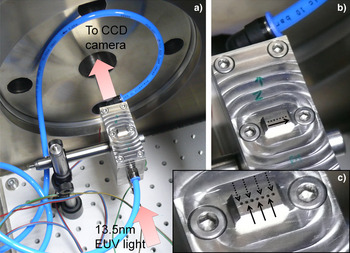
Photographs of the valve (a) and the nozzles (b,c) are depicted in Fig. 1. The target density profiles depend on nozzle geometry, backing pressures of two gases supplied to the valve, time duration of gas flow, and finally on the mode of operation; argon can be supplied to the so-called “inner nozzles,” indicated by solid arrows in Figure 1c, or “outer nozzles” — dotted arrows. Information on the target density profiles is very important for research on HHG and understanding the process. In this study, we have arrangement of seven orifices in in-line geometry, similarly to work described in Wachulak et al. (Reference Wachulak, Bartnik, Jarocki and Fiedorowicz2012a), however, with one important modification. In our previous work, we supplied only one gas to all nozzles at once at the same backing pressure. This approach has some disadvantages related to inability to obtain various density distributions, shown later in the text, limiting its usability. In this work, we altered the construction supplying independently two gases to alternate orifices, each 0.5 mm in diameter, spaced every 1 mm. This allows for additional, pulsed density confinement of the working gas by lighter gas, by controlling pressures separately, producing low divergence gas flow. The orifices were electro-drilled in 8 mm thick stainless steel plate, yielding a diameter to length aspect ratio of 1:16. Black arrow in Figure 1b indicates the direction of density modulation, called in our previous work (Wachulak et al., Reference Wachulak, Bartnik, Jarocki and Fiedorowicz2012a), a modulation vector.
(Color online) Photographs of the valve (a) and the nozzles (b, c). Argon can be supplied to “inner nozzles,” indicated by solid arrows in (c), or “outer nozzles”— dotted arrows. Black arrow in Figure 1b indicates the direction of density modulation — modulation vector.

Experimental Setup for EUV shadowgraphy
The characterization measurements of pulsed gas jets or gas puff targets were reported previously using various diagnostic methods (Behjat et al., Reference Behjat, Tallents and Neely1997; Smith et al., Reference Smith, Ditmire and Tisch1998; Auguste et al., Reference Auguste, Bougeard, Caprin, D'Oliveira and Monot1999; Azambuja et al., Reference Azambuja, Eloy, Figueira and Neely1999; Malka et al., Reference Malka, Coulaud, Geindre, Lopez, Najmudin, Neely and Amiranoff2000; Mosher et al., Reference Mosher, Weber, Moosman, Commisso, Coleman, Waisman, Sze, Song, Parks, Steen, Levine, Failor and Fisher2001; Boldarev et al., Reference Boldarev, Gasilov, Levashov, Mednikov, Pirozhkov, Pirozhkova and Ragozin2004; Lemos et al., Reference Lemos, Lopes, Dias and Viola2009; Landgraf et al., Reference Landgraf, Schnell, Savert, Kaluza and Spielmann2011). The most common method, used in the characterization measurements of target systems (Musinski et al., Reference Musinski, Pattinson, Steinman and Jacobs1982; Li et al., Reference Li and Fedosejevs1994; Kasperczuk et al., Reference Kasperczuk, Pisarczyk, Nicolai, Stenz, Tikhonchuk, Kalal, Ullschmied, Krousky, Masek, Pfeifer, Rohlena, Skala, Klir, Kravarik, Kubes and Pisarczyk2009) is laser interferometry. In this study, however, we used radiography technique (shadowgraphy), reported for the first time in Bartnik et al. (Reference Bartnik, Dyakin, Skobelev, Faenov, Fiedorowicz and Szczurek1997). In our experiment, the gas targets are backlit with EUV pulses at 13.5 nm wavelength. The EUV pulses have been obtained by spectral selection of emission from a xenon-based laser plasma source. The spectral narrowing was performed using both, thin film absorption filters and a Mo/Si multilayer mirror. Similar technique has been previously applied for characterization of gas-jet xenon targets (Rakowski et al., Reference Rakowski, Bartnik, Fiedorowicz, Jarocki, Kostecki, Mikołajczyk, Szczurek, Szczurek, Földes and Tóth2005), elongated geometry gas targets (Wachulak et al., Reference Wachulak, Bartnik, Fiedorowicz, Jarocki, Kostecki and Szczurek2012b) and multi-jet argon gas puff targets (Wachulak et al., Reference Wachulak, Bartnik, Jarocki and Fiedorowicz2012a).
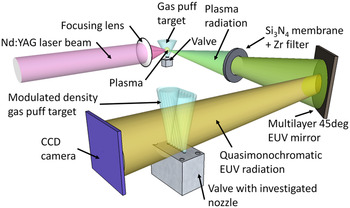
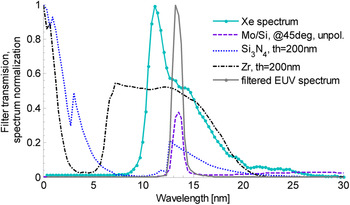
The experimental setup for EUV shadowgraphy, described in details elsewhere (Wachulak et al., Reference Wachulak, Bartnik, Jarocki and Fiedorowicz2012a) is depicted in Figure 2. Pulses of EUV radiation are produced using a compact laser plasma EUV source based on a double-stream Xe/He gas puff target (Fiedorowicz et al., Reference Fiedorowicz2005b). Emission at 13.5 nm wavelength with the bandwidth of about 1nm was obtained using a flat mirror with Mo/Si multilayers, having peak reflectivity for 13.5 nm wavelength of about 38% at 45° incidence angle. Additionally, to eliminate visible light from xenon plasma source a composite Zr/Si3N4 filter was used. The thicknesses of each layer were 200 nm. Spectral measurements were performed using a transmission grating spectrometer (TGS). The TGS was equipped with a 4 µm period, free-standing grating, located 720 mm from the plasma. An entrance slit, 33 µm in width, was positioned about 4 mm from the grating. A normalized Xe plasma spectrum, transmission curves of thin-film filters, the reflectivity curve of the EUV mirror, and EUV spectrum after spectral filtration are depicted in Fig. 3.
(Color online) Experimental arrangement for EUV backlighting imaging of a dual gas multi-jet gas puff target.

(Color online) Spectra obtained using TGS showing the emission in the EUV from Xe plasma, transmission curves for all filters and mirrors and EUV spectrum of radiation used in the experiment after spectral narrowing. Transmission curves of the filters are based on data available from CXRO X-Ray Interactions with Matter: http://henke.lbl.gov/optical_constants/.

With the assumption of an isotropic emission from the plasma source the conversion efficiency of the laser pumping energy into energy of EUV radiation in this band was measured to be about 1.6%. The measurements were performed with the use the absolutely calibrated AXUV-HS1 (IRD) detectors (Rakowski et al., Reference Rakowski, Bartnik, Fiedorowicz, Jarocki, Kostecki, Mikołajczyk, Szczurek, Szczurek, Földes and Tóth2005). Spectrally narrowed, quasi-monochromatic, pulsed EUV radiation, illuminates gaseous target, produced by electromagnetic valve system. To form a stable gas target, both valves, were opened and closed simultaneously for the duration of 2 ms, after which the EUV pulse was generated. Shadowgrams are produced by EUV light illuminating the target, locally and partially absorbed by the gas, forming an intensity image at the detector plane, further downstream the EUV beam. The shadowgrams of the dual gas multi-jet target were registered using a back-illuminated charge coupled device (CCD) camera, X-vision M-25 (from Reflex company, Czech Republic), equipped with 512 × 512 pixels CCD chip, 0.5 × 0.5 in2 in size. The geometrical magnification of this imaging system was equal to 1.14×. The CCD chip was cooled down to −20°C to decrease its thermal, intrinsic noise. Each shadowgrams was obtained using 10 EUV pulses for exposure, in order to minimize a shot-to-shot variation in EUV pulse energy and to statistically average the gas transmission in each shadowgrams, which in turn is beneficial for the accuracy of further density estimation.
EUV CHARACTERIZATION MEASUREMENTS
The characterization measurements have been performed for targets produced using nozzles with seven orifices and supplied with argon and helium gases at different backing pressures (1–6 bars). It needs to be mentioned at this point, that all the pressures are measured in respect to the vacuum. The heavier, or working gas (argon), can be supplied to outer or inner nozzles forming distinctive gas density profiles. EUV shadowgrams show that characteristic gas jets are produced as a result of free, expansion of working gas from the orifices into a shaping gas. Such gas jets are typical for a sonic expansion of gas flowing through a small orifice (sonic nozzle) under high pressure (Wachulak et al., Reference Wachulak, Bartnik, Jarocki and Fiedorowicz2012a).
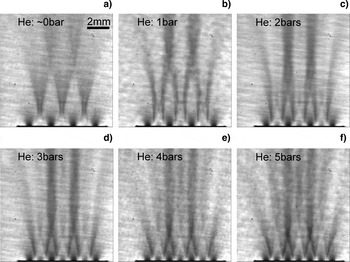
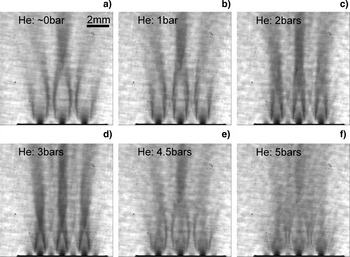
If argon is supplied to the outer nozzles, indicated by dotted arrows in Figure 1c, the two most central gas jets from the nozzles are forming well defined and low divergence gas streams, or actually one-dimensional gas sheets (slices). It is due to the fact, that those nozzles are located between two other nozzles, supplied with helium gas. The flow of helium on both sides of argon jet is responsible for a slice-like shape of the working gas density distribution. Of course the strength or the efficiency of helium gas shaping is directly related to the gas backing pressure; however, it is not a linear relation. For low helium pressure, close to 1 bar, at fixed argon pressure of 4 bars, the effect of argon flow shaping is negligible (Fig. 4a). The spatial modulation of the gas density profiles at short distance from the nozzle, up to about1 mm, corresponds to the positions of the nozzle orifices. For larger distances, more than 2 mm from the nozzle, one can observe formation of secondary jets, which are produced as a result of collisions of the primary jets. The number of secondary jets is at one smaller than the number of primary jets. This case, or mode of operation, is similar to the data presented in Wachulak et al. (Reference Wachulak, Bartnik, Jarocki and Fiedorowicz2012a), where only one gas was supplied to all nozzles.
EUV shadowgrams (raw data) of dual gas multi-jet gas puff target, produced by supplying argon gas to the outer nozzles at 4 bar backing pressure, for variable helium backing pressure from 1 to 6 bars.

If the pressure of helium starts to increase, its effect on argon gas flow is more pronounced, as can be seen in Figures 4b and 4c, for helium pressure of 2 and 3 bars, respectively, finally to reach its maximum for helium pressure of approximately 4 bars (Fig. 4d), where to distinctive slice-like argon jets can be observed. If we further increase helium pressure to 5 and 6 bars the effect is weaker, as depicted in Figures 4e and 4f, because the backing pressure of helium is sufficiently high to disrupt further the flow of argon gas and misshape the argon jets. Moreover, the flow of argon through the most-left and most-right, nozzles is always disrupted, due to the fact that those jets are stabilized by helium jets only on one side.
If, on the other hand, argon is supplied to the inner nozzles, this effect is reversed. The advantage of this mode is that argon flows through the nozzles indicated by solid arrows in Figure 1c, so all argon jets are stabilized by helium jets, resulting in formation of three well defined and low divergence argon sheets, Figure 5d, representing periodically modulated working gas density profiles, that can be used for compensation of velocity mismatch in HHG process. As in a previous case, changing helium backing pressure affects distribution of density profiles, which can be observed in Figures 5a–5f for argon gas pressure of 4 bars and helium pressures ranging from 1 to 6 bars.
EUV shadowgrams (raw data) of dual gas multi-jet gas puff target, produced by supplying argon gas to the inner nozzles at 4 bar backing pressure, for variable helium backing pressure from 1 to 6 bars.

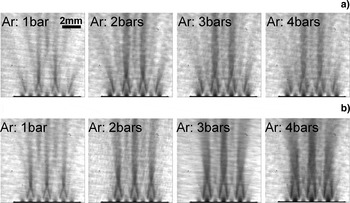
We also studied the shape of the gas target density profiles for fixed pressure of helium (4 bars) and variable argon pressure from 2 to 5 bars. The shadowgrams sequences, representing argon pressure change, when supplied to outer (a) and inner (b) nozzles are depicted in Figure 6. As can be seen in some cases the shadowgrams represent quite complicated patterns of gas flow, which are achievable only in dual gas multi-jet target scheme.
EUV shadowgrams (raw data) for fixed pressure of He (4 bars) and variable argon pressure from 2 to 5 bars. The shadowgrams sequences representing argon pressure change, when supplied to outer (a) and inner (b) nozzles.

From the shadowgrams it is possible to estimate the density of the target. The gas density maps of the three-dimensional gas density distributions were calculated from the EUV shadowgrams using the Eq. (1):
 $$\rho \lpar x\comma \; y\rpar =\displaystyle{{ - \ln \,\left[{Tr\,\lpar x\comma \; y\rpar } \right]} \over {{\rm \mu} _a \cdot d\lpar y\rpar }} \cdot m_{at}$$
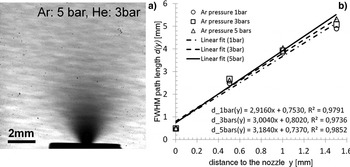
where Tr(x,y) is a two-dimensional transmission map of the gas-puff target, μa = 2r 0 · λ · f 2 is an atomic photo-absorption cross-section, r 0 = 2.82 · 10−15m is the classical electron radius, λ = 13.5 nm is the wavelength, f 2 is the imaginary part of the atomic scattering factor, d(y) is the path-length on which the EUV beam is absorbed in the gas, measured in direction of the EUV beam, in our case it is perpendicular to the modulation vector, indicated with an arrow in Fig. 1b, m at is the atomic mass of the gas-puff target material, and (x, y) are spatial coordinates at the detector plane, horizontal and vertical, respectively. The one-dimensional path-length can be found by measuring averaged FWHM widths of the density sections, obtained at various distances from the nozzle, oriented is such a way, that the modulation vector of the nozzle is aligned parallel to the EUV beam. The FWHM widths, corresponding to the path-lengths, are then interpolated to find analytical equations, d(y), describing the path-length as a function of a distance from the nozzle plane for each gas backing pressure. It needs to be stressed, that this easy approach for density estimation is possible only in case of supplying the working gas to the inner nozzles, due to the fact, that the flow of working gas through three inner nozzles is very similar (Fig. 5d). For the other case, when working gas was supplied to the outer nozzles, the flow of the gas through the two outermost nozzles is heavily distorted, resulting in deviation of the absorption path-length d(y) of EUV light in the gas, from expected analytical expression, which translates directly into additional error of density measurements.
Typical shadowgrams for modulation vector parallel to the direction of EUV beam is depicted in Figure 7a for [Ar, He] = [6, 4] bars. The results of d(y) interpolation were found for shadowgrams recorded at perpendicular orientation, for helium pressure of 4 bars and argon pressures of 2, 4, and 6 bars, and are presented in Figure 7b. The data suggest linear dependence. Fitting equations and correlation coefficients with the data are also presented. In our previous work, we found that the analytical expression fitted to the measured path-length d(y) does not change significantly with the gas pressure. The slope of d(y) changed about 4% at largest distances from the nozzle plane, about 8mm, for gas pressure changing from 2 to 10 bars (Wachulak et al., Reference Wachulak, Bartnik, Jarocki and Fiedorowicz2012a). Similar results are also found in this work for argon pressure changing from 2 to 6 bars, where the slope of fitting curve change is about 8.1%, with slight increase of d(y) slope with gas pressure. This density estimation method is not very accurate and is greatly simplified, however, allows finding the two-dimensional density maps for three-dimensional density distributions. For density calculations, a monochromatic radiation was assumed, however, due to a certain bandwidth of the Mo/Si multilayer mirror, equal to about 1 nm, there is additional error associated with slightly different absorption of the EUV radiation at different wavelengths.
Typical shadowgrams, obtained for modulation vector parallel to the direction of EUV beam, (a). Results of d(y) interpolation for helium pressure of 4 bars and argon pressures of 2, 4, and 6 bars, (b) showing linear dependence.

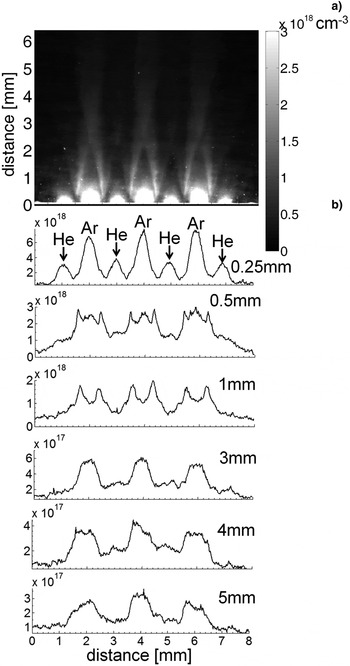
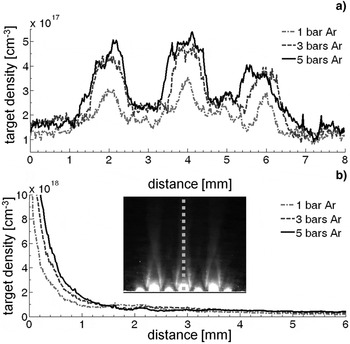
The characteristic features of the dual gas multi-jet target, computed from shadowgrams data to obtain a two-dimensional density map, for [Ar, He] gas pressures of [4, 4] bars, are presented in Figure 8a. For optimum pressures, the gas jet divergence is very low and the cross-sections of the density map, at various distances from the nozzle, starting from about 3 mm, indicate very similar profiles up to the distance of about 5 mm (Fig. 8b). At larger distances the gas jets slowly dissipate. At smaller distances, about 1 mm from the nozzle, the period of density profile is two times smaller, equal to about 1 mm, than expected from spacing of argon-supplied nozzles (2 mm). Even closer to the nozzle, approximately 250 µm, argon density changes smoothly in a sine-like manner, however, helium density in between argon jets is significant as well. Such a small distance is also impractical from the experimental point of view, since it requires focusing femtosecond duration pulses very close to the nozzle plane. At further distances from the nozzle, the modulation depth of argon density profiles reaches up to 50%, 3 mm away from the nozzle plane, with maximum and minimum attainable densities of argon for [Ar, He] = [4, 4] bars pressures equal to 6 × 10¹⁷ atoms/cm3 and 3 × 10¹⁷ atoms/cm3, respectively. The peak density of argon jets depends both on argon backing pressure and the distance from the nozzle. This dependence can be seen in Figure 9a, where cross-sections of density maps were plotted at fixed distance from the nozzle, arbitrarily chosen to be equal to 4.7 mm, as a function of argon gas backing pressure for three different argon backing pressures: 2, 4, and 6 bars. The density maps for each backing pressure were computed based on d(y) approximations depicted in Figure 7b. Figure 9a shows that even up to 5 mm from the nozzle the density profile is distinct, well defined and has density gradient on the slope of the profile equal to about 8.3 × 10¹⁷ atoms × cm−3/mm. Peak density in the profile increases with increase of the backing pressure, finally to saturate at backing pressure of 6 bars. Further increase of the pressure results in peak density drop due to the fact, that sufficiently high backing pressure causes the valve to stop opening. Figure 9b depicts argon density profile along the middle jet in the two-dimensional density map, indicated in the inset of Figure 9b, as a function of the distance from the nozzles, for three different argon gas backing pressures of 2, 4, and 6 bars. One order of magnitude drop of density occurs over 1 mm distance from the nozzle. Further increase in the distance does not influence the density significantly.
two-dimensional density map, obtained from EUV shadowgrams, for [Ar, He] gas pressures of [4, 4] bars (a), cross-sections of the density map, at various distances from the nozzle (b).

Cross-sections of density maps obtained at 1 mm from nozzle exit plane, as a function of Ar gas backing pressure (a) Argon density along the jet as a function of the distance from the nozzle, for three different argon gas backing pressures of 2, 4, and 6 bars (b).

CONCLUSIONS
In summary, we have performed for the first time characterization measurements of the dual-gas multi-jet target, developed for future possible applications in high-order harmonic generation. It was shown that it is possible to obtain low-divergence gas jets at distances up to 5 mm from the nozzle. These jets then compose very uniform, modulated gas density comb-like pattern. The spatial density profiles along the nozzle array are strongly modulated. Their density depends on the distance from the nozzle and the gas pressure, which were studied in detail in this paper. Characteristic features of the gas jets, formed by dual gas multi-jet target system and measured from two-dimensional density maps suggest, that this approach may strongly and positively affect the process of high-order harmonic generation, needs to be considered in the experiments and studied further in the future. This new dual-gas multi-jet gas puff target will be used in experiments on high-order harmonic generation. It can be also useful for different laser-matter interaction experiments, i.e., laser-driven particle acceleration.
ACKNOWLEDGMENTS
The research leading to these results has received funding from LASERLAB-EUROPE (grant agreement n° 284464, EC's Seventh Framework Programme). P.W.W. greatly acknowledges the support from the National Centre for Science, award number DEC-2011/03/D/ST2/00296.