In The Empire of Nature John M. MacKenzie suggests there were “three animals in India with which the British had a special hunting relationship, the tiger, the elephant and the pig” (179). Of these, the tiger is the one most closely associated with Britain's imperial relationship with India. By the mid nineteenth century, as Joseph Sramek explains, “tigers . . . had become invested with several potent meanings” (659). Several critics including Sramek and Annu Jalais demonstrate how tigers were closely associated with Indian rulers, and, at the same time, with all that was wild and untamed about the subcontinent. Thus “[o]nly by successfully vanquishing tigers would Britons prove their manliness and their fitness to rule over Indians” (Sramek 659). Through close readings of selected tiger images from the second half of the nineteenth century, this paper considers the way tigers were consistently used as visual signifiers of India in a series of stock-in-trade images which depict tiger hunts, white men protecting white women from tigers, and tigers menacing Indians.
In her cultural history simply entitled Tiger, Susie Green suggests that “Western imperialists built up a reputation for the tiger that was almost entirely malign” (68). In western eyes, Green argues, the tiger was a “foul, fearsome and vicious killer” that was “painted as a terrible, dangerous yet despicable beast” (68, 70). It is a reputation that, as Diana Donald notes in Picturing Animals in Britain, has a long history: “the tiger . . . was described by every eighteenth-century writer on zoology . . . as the cruellest, bloodiest, least tractable of creatures” (76). Thomas Bewick, in his enormously popular General History of Quadrupeds (1790), singled out the tiger as
the most rapacious and destructive of all carnivorous animals. Fierce without provocation, and cruel without necessity, its thirst for blood is insatiable: though glutted with slaughter, it continues its carnage, nor ever gives up so long as a single object remains in its sight: flocks and herds fall indiscriminate victims to its fury: it fears neither the sight nor the opposition of man, whom it frequently makes its prey, and it is even said to prefer human flesh to that of any other animal. (206)
Bewick provided the illustrations for his General History, of which eight further editions were published in his lifetime (Ritvo 7). Harriet Ritvo notes that by the first decade of the nineteenth century, Bewick had “become a renowned engraver of animals” (6); separate editions of the illustrations were published without the text and continued to have popular appeal well into the middle of the century. Ritvo explains that while the elephant, the other animal which most came to signify India for the British, was seen to possess the “qualities of an industrious, docile and willing servant,” the tiger was reviled as an animal that “not only declined to serve, but dared to challenge human supremacy” (17). She goes on to argue that, “[a]bout the tiger there were no two ways of thinking. It epitomized what man had to fear from the animal kingdom and from restive human subordinates” (28). The textual and visual representation of tigers as unregenerate savages gained momentum in the middle of the nineteenth century. Following the terrible events of what was then commonly referred to as the Indian Mutiny of 1857 – and which have also been variously referred to as the Sepoy Mutiny, the Sepoy Rebellion, the Sepoy Revolt, the Great Revolt, the 1857 Uprising, the First War of Independence, and the Freedom Struggle of 1857 – British artists and illustrators were able to draw on established ideas about the tiger's behaviour and appearance to create immediately legible and powerful images of India generally, and of the mutineers in particular.Footnote 1
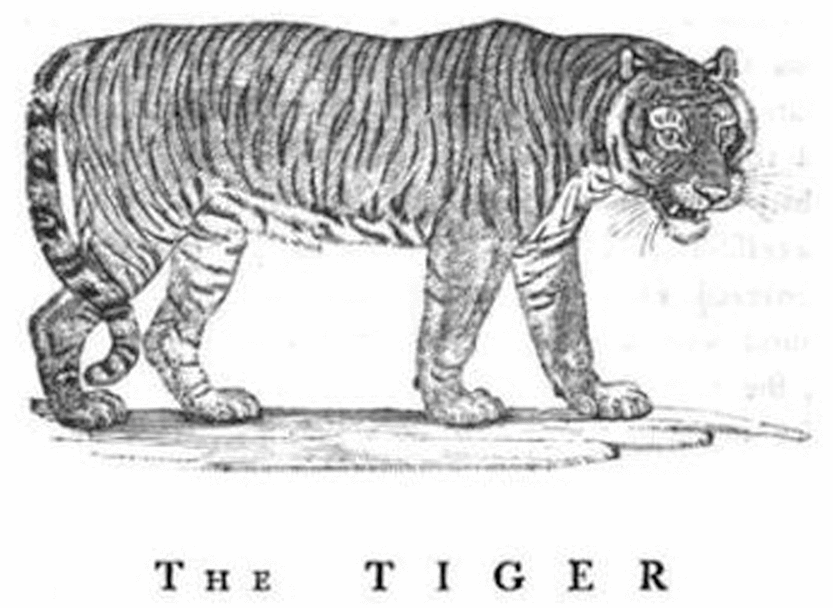
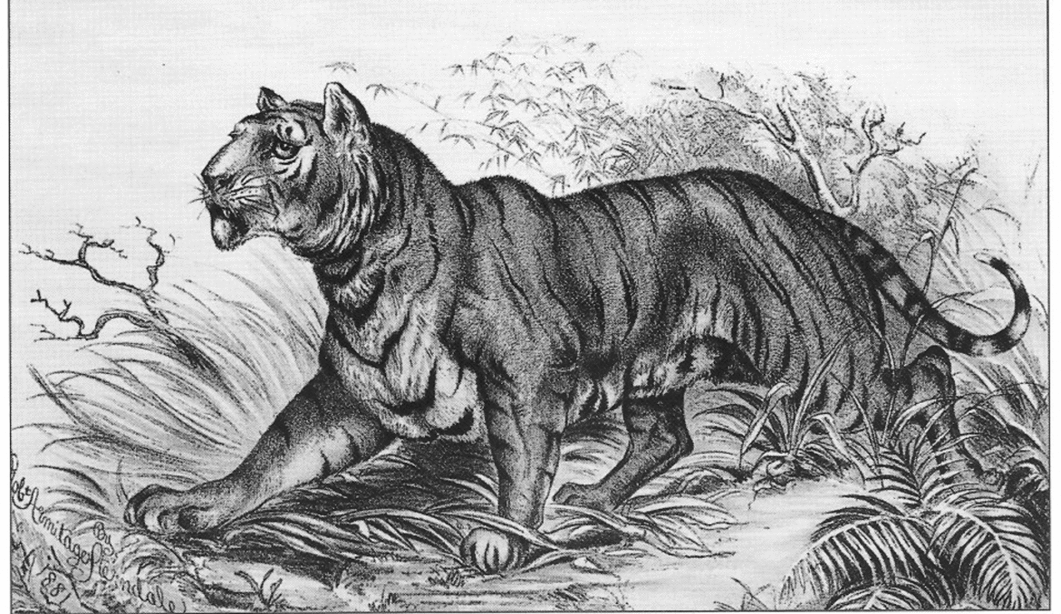
The visual archive of the British relationship with India in the nineteenth century is replete with images of tigers, including: highly realistic oil paintings and watercolours hung at the Royal Academy and other respected institutions; detailed drawings of live tigers and tiger remains in scientific periodicals and naturalist studies; crude sketches drawn in the field by hunters and published in their memoirs; and countless drawings, etchings, and paintings produced to illustrate the obligatory hunting episodes in popular Anglo-Indian adventure fictions and memoirs. Despite the apparent diversity of nineteenth-century pictorial depictions of Indian tigers, the mass of images in periodicals, books, and hung on gallery walls is unified by remarkably consistent conventions for picturing tigers, whether they are shown alone, with other animals, or encountering humans. For instance, Bewick's 1790 full side-view engraving of a tiger, mid-stride with his mouth open to show prominent white teeth (Figure 6) is mirrored in Sir Edwin Henry Landseer's drawings of tigers in the first decades of the nineteenth century and remained a prototype at least until the century's close, when Robert Armitage Sterndale published a similar illustration in his Denizens of the Jungle (Figure 7). The Liverpool-based animal artist, William Huggins's numerous and well-known images of tigers, in particular his 1838 close-up of a Bengal tiger's face, seem to have set the standard for popular illustrations of tiger hunts in India, despite the fact that he never saw a tiger in its natural environment but instead spent hours drawing animals in the Liverpool zoological gardens and, whenever possible, made sketches of the lions and tigers in Wombwell's travelling menagerie (Nicholson). The influence of Huggins's portrait of a Bengal tiger and, less obviously, the snarling cat in his A Tiger and a Serpent (1840), is evident in two illustrations of tiger hunts published in the Graphic: “A Tiger Hunt in India” in March 1887 and “Tiger Shooting in India: A Sketch Made during Prince Albert Victor's Recent Trip to India” in May 1890. The point here is not so much that major and respected early-nineteenth-century artists were knowingly emulated by later artists and illustrators, but that, throughout the century, and especially in its later decades, artists routinely drew on a set of established tropes for portraying Indian tigers. These conventions had little to do with any commitment to creating a visual record of living creatures, and much more to do with prevailing ideas about India and Indians and, related to this, powerful and apparently unquestioned anthropocentric views of tigers. As Green notes, “Observations of the tiger during the Raj . . . tell little of her natural history but something of how a great predator behaves when its entire population is viciously hunted” (16). Like other top predators, the tiger “chooses on the whole to avoid man” (Green 18), and representations of its fierceness are simply not in keeping with its true natural history.
Thomas Bewick, A General History of Quadrupeds (Newcastle Upon Tyne: S. Hodgson, R. Beilby, and T. Bewick, 1790), 206.

“On the Watch.” Illustration from R.A. Sterndale, Denizens of the Jungles (Calcutta: Thacker, Spink & Co., 1886).
The “incredible complexity of encountering animal images” (Adams xi), together with the surprising scarcity of studies of the tiger's place in British imperial iconography, necessitates quite strict parameters on the scope of this article. Our overriding aim is to add to the cultural history of British imperialism in India by considering the degree to which, especially in the decades after the Mutiny, tigers were used as a cipher for hegemonic Victorian attitudes to India and its people. It is certain that even pictures of tigers alone in the wilderness are thoroughly circumscribed by human attitudes to animals – to misquote Erica Fudge, the tiger is a representation of a human; it is not, paradoxically, a tiger (7). Nevertheless, the tiger's role in the iconography of the British Empire is most potent in those images that overtly display encounters between humans and tigers. Our analyses are further limited to images that were readily available to the Victorian public and circulated in periodicals such as Punch, the Illustrated London News, and the Graphic. These images were, of course, meaningful on a continuum with the many and various other ways in which tigers were depicted for British audiences in the nineteenth century: illustrations in periodicals and books made meaning in tandem with their accompanying text (see, for example, Crane and Fletcher); the covers of hunting memoirs were sometimes embossed with tiger skins and included graphic photographs of hunters posing with dead tigers; Britons of all classes had ready access to live tigers in zoos, and travelling menageries or stuffed specimens in museums, some of which were the models for artists; and, both in India and at home, the walls of public venues and private homes were commonly decorated with images and trophies of the hunt.
While the tigers we discuss are all pictorial representations, it would be a grave mistake to treat these images as pure representation and thus to forget the record they provide of actual and invariably violent encounters between humans and animals. Our interrogation of a slice of the visual archive of popular imperial animal art contributes to what Erica Fudge describes as the “history of human attitudes towards animals” (6). To employ Ritvo's terminology, while we read tigers as “rhetorical animals” (5), our analyses are underpinned by an awareness that their capture on paper was, in conceptual and practical terms, closely linked to the entrapment and killing of tigers in India. Steve Baker asks, “What place does the animal hold in our imagination, and how are we to understand the uses to which our imaginative conception of the animal is put?” (6). This question is especially pertinent in relation to the tiger in British India.
MacKenzie writes in relation to the literature of hunting which flooded Victorian bookshelves that the “British and the tiger seemed in some ways to be locked in conflict for command of the Indian environment” (180). Significantly, as Jalais notes, the British were keen to highlight the tiger as a “worthy” enemy, “as it gave them the pleasure of measuring themselves against an ‘equal’ who stood his ground by virtue of his strength” (28); therefore, in the iconography of popular Victorian imperialism metaphorical representations of the death of a tiger served the function of emphasising the power of the British over India. As Ritvo explains, “The connection between triumphing over a dangerous animal and subduing unwilling natives was direct and obvious, and the association of the big game hunter with the march of empire was literal as well as metaphoric” (254). In broad terms, the history of hunting in India in the nineteenth century is a tale of wanton masculine violence and imperial bombast. And by 1859, when Captain George Francklin Atkinson published ‘Curry and Rice,’ on Forty Plates: or, the Ingredients of Social Life at ‘Our Station’ in India, this hyper-imperialist-masculinity was ripe for parody. In his comic portrayal of life in the fictional mofussil station of Kabob Atkinson satirizes a range of British officials and residents including “the experienced Byle,” who has “been accustomed to polishing off a tiger or two before breakfast” (97) and when need arises is able to lodge a rifle-ball in a tiger's head while swimming! The anthropomorphizing (and sexualizing) of tiger behavior is satirized by Atkinson when Byle is called on by an aggrieved agriculturalist “reporting the sudden apparition of a tiger, only fifteen miles off, which had abstracted his oxen and his fatlings, and evinced a desire, moreover, to elope with his wife” (98).
As the century neared its close, the civilian, administrative, and military arms of the British establishment in India reached the “apotheosis of the hunting mentality” (MacKenzie 171). As in Africa, the “hunting craze” was clearly “sanctified by the leaders of British India” (171), and the association of hunting with territorial expansion and legitimate rule of the Indian population is explicit in popular illustrations of Indian tiger hunts. This is nowhere more apparent than in the news images of the Prince of Wales's tour of India in 1875.
By the 1870s the British rulers had adopted the extravagant Mughal tradition of hunting tigers on elephants; they “consciously sought to inherit the mantle of the Mughals through an opulent and highly visible command of the environment” (MacKenzie 169). In parallel to this co-option of an elite Indian tradition, British hunters who did not merit the enormous entourage and expense of hunting on elephants actively and enthusiastically adopted the less spectacular practices of lower-caste Indian hunters. As the century progressed, these British hunters took on the Indian terms shikar (for hunt) and shikari (for hunter) and gradually developed a philosophy of hunting which emphasised the superiority of shikar over the pomp and ceremony of the elephant hunt.
As Ritvo, MacKenzie, and Heather Schell demonstrate, written accounts of elephant-borne hunting and shikar expeditions openly and repeatedly align hunting with British imperial might. Schell argues that the distinction between aristocratic hunting practices and shikar methods was apparent in the popular press and hunting literature: shikaris “were the best big game hunters in India” (239). Further, hunting was never just a leisure pursuit for British shikari, but intersected in fairly obvious ways with the duties of British officials in India. News stories and fictional tales of villagers pleading with white hunters to destroy the “man-eater” in their midst were especially prevalent in the late-Victorian popular press and openly strived to communicate a “sense of the fitness of the structure of imperial domination” (Ritvo 276).
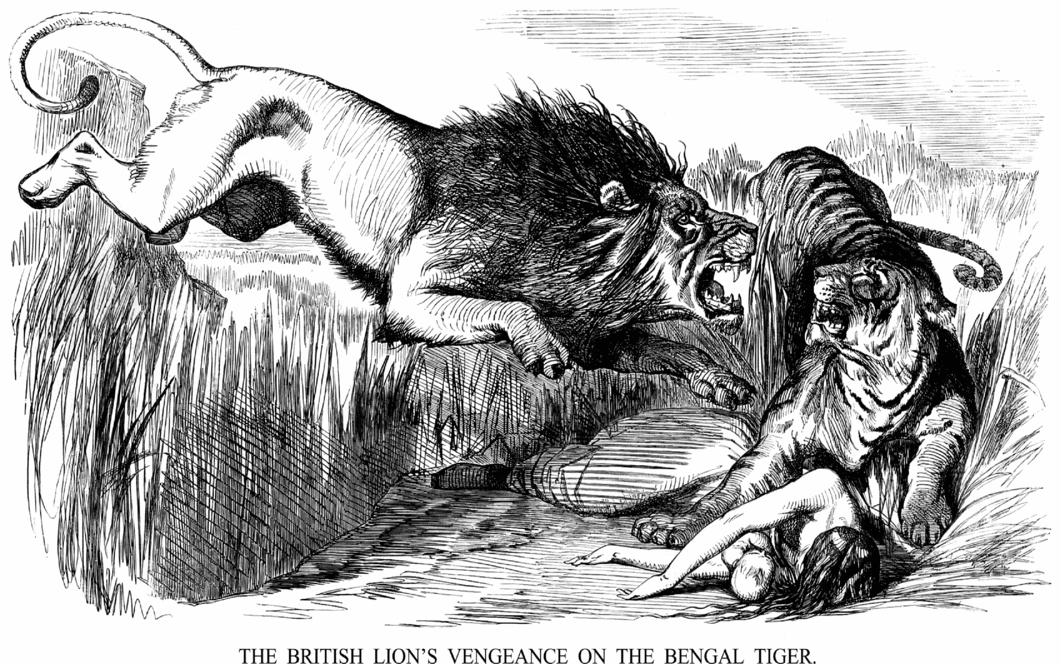
For the British in India the tiger – despite its power and “Royalness” – was regarded as dishonourable while the lion, the symbol of Britain, was regarded as noble.Footnote 2 This is nowhere more evident than in Sir John Tenniel's famous cartoon, “The British Lion's Vengeance on the Bengal Tiger” (Figure 8), published across two full pages of Punch on 22 August 1857. The cartoon was a response to eyewitness accounts of the massacres at Cawnpore, which followed the British surrender there. First, the British party was attacked as it boarded the boats at Satichaura Ghat that had been provided for their safe passage to Allahabad. Then, more shockingly for the Victorian public, the two hundred women and children who had survived the initial massacre and been imprisoned in the Bibighar were murdered and their bodies thrown down a nearby well. Of all the dreadful events which took place during the Uprising of 1857, the events at Cawnpore simultaneously shook British confidence in its control over India and evoked the greatest anger in Britain and across the empire. As a cartoonist responding to this crisis in India, Tenniel deliberately fans the Victorian public's outrage against the mutineers responsible for the slaughter of the British women and children in Cawnpore.
John Tenniel, “The British Lion's Vengeance on the Bengal Tiger.” Illustration from Punch (22 Aug. 1857): 76–77. Reproduced with permission of Punch Ltd., www.punch.co.uk.
The right-hand side of Tenniel's illustration captures a tiger positioned over the prostrate bodies of a dead white woman and her child. The woman's bare shoulders suggest rape as well as murder. The villainous Bengal tiger snarls at the avenging British lion that leaps from the left-hand side of the cartoon, dominating the image. The composition of the emotive picture – the structural positioning of the lion above the tiger – suggests, as Manjita Mukharji notes, a clear opposition between the (colonizer) lion and the (colonized) tiger (37). The tiger is simultaneously depicted as powerful as it stands over the white woman and child, and powerless in the face of the attack of the heroic British lion. The outcome of the battle is never in doubt; the justice of the British lion's vengeance is not questioned. Through its dynamic triangulation between the “innocent victim,” “treacherous criminal,” and “righteous avenger” the cartoon re-inscribes the need for masculine white men to protect virginal white women from bestial brown men (Mukharji 37). The narrative Tenniel communicates to readers in Britain – reinforced in the title – is one of violent retribution (see also Crane and Mohanram, “The Iconography of Gender” 13–15).
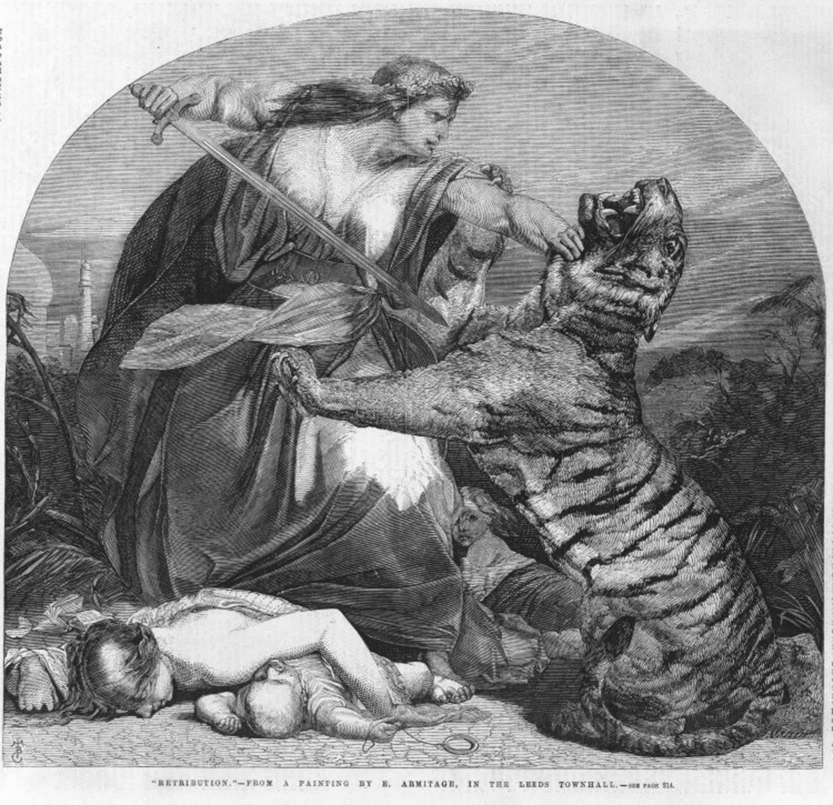
Tenniel's cartoon was readily accessible to the Victorian public, as was Edward Armitage's painting, Retribution (1858) (Figure 9), which was reproduced in the Illustrated London News on 26 February 1859, adding more fuel to the British memory of the Uprising. Like Tenniel's cartoon, Armitage's huge canvas employs a tiger as a signifier of India. The structural composition has striking similarities, too. In the foreground are bodies of a dead white woman and child, and the woman's dishevelled clothing, her bare upper body, and the books and other effects scattered around her suggest that she has been raped before being murdered. The imposing muscular figure of Britannia commands the left side of the painting and is uppermost in the composition, clearly in a dominant position over the strapping tiger. Britannia's straight left arm with locked elbow that grips the tiger's throat, and her right arm extended by the sword she is about to plunge into the writhing beast, are strong phallic tropes common to military art. Both elements direct the viewer's gaze towards the throat and chest of the tiger in anticipation of its death. But this painting is not only one of retribution for the death of the woman and child in the foreground. In the background, partially obscured by Britannia's skirts, is an older child that has been saved, lending a positive tone to the work. The message of Armitage's narrative painting echoes that of Tenniel's cartoon, that Britain will mete out retribution on those who have carried out atrocities on white women and children, while also insisting on the future of Britain's rule and occupation of India.
“‘Retribution.’ – from a painting by E. Armitage, in the Leeds Townhall.” Illustrated London News (26 Feb. 1859): 209. Photograph © Trustees of the British Museum.
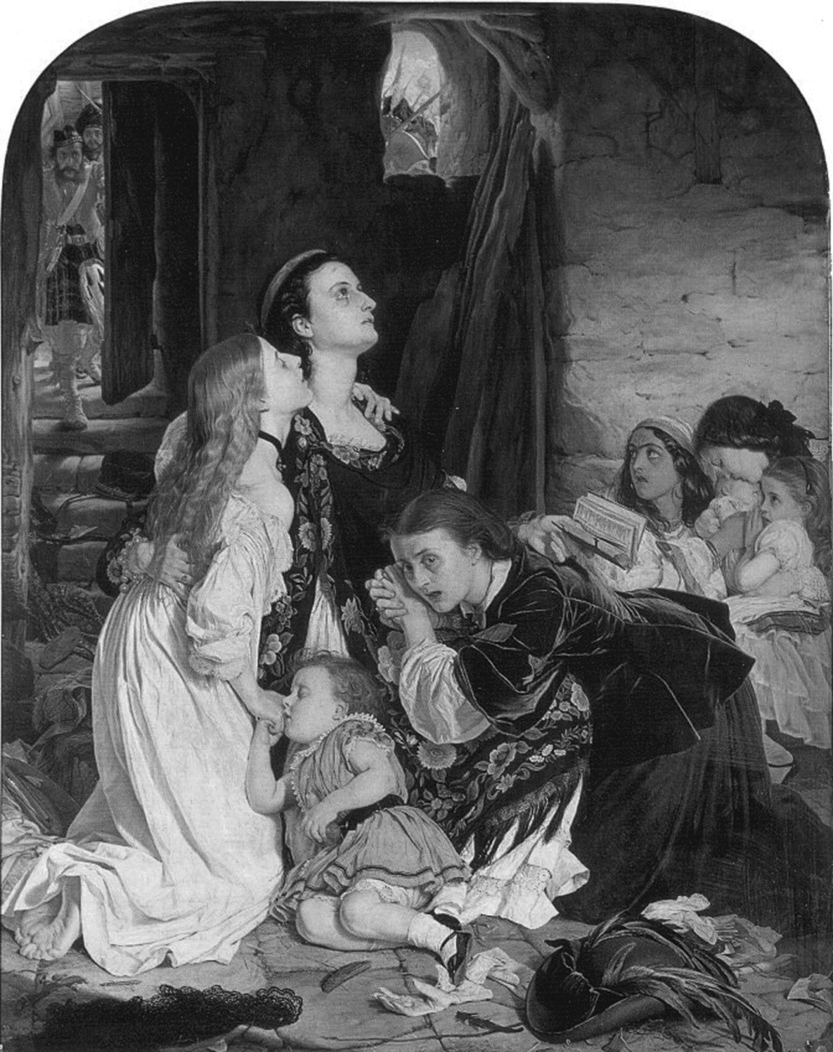
In both these images the tiger replaces Indians because it was necessary to maintain the fiction of white women as inviolable. When Joseph Noel Paton exhibited his work In Memoriam at the Royal Academy in 1858 it showed “maddened Sepoys, hot after blood” about to burst into the room where white women and children were at their mercy (qtd. in Hichberger 175). The idea of white women in the power of Indian sepoys was too much for the Victorian public, and the painting caused so much distress that Paton subsequently replaced the “maddened Sepoys” with Highland soldiers, replacing the narrative of impending slaughter with one of rescue (Figure 10). As J. W. M. Hichberger explains:
Joseph Noel Paton, In Memoriam: Henry Havelock (1858). Private Collection.
The depiction of ladies in the power of black soldiers was deeply offensive. For the wider public Paton decided to sacrifice the martyrdom aspect so as not to disrupt the mythology of white women as inviolable and remote from the male world of war and insurrection. (175)
Perhaps to avoid the possibility of this type of offence, the tiger replaced images of Sepoys in the imagery of the Uprising.
Both Tenniel's cartoon and Armitage's painting leave the viewer in no doubt that power is vested on the side of the British, that the British Empire in India will be restored, and that the unruly tiger will be punished. In each work the Indian landscape provides a background, reminding the viewer that this is a contest over territory and brown bodies as well as white bodies. Both images also serve to remind us that the Uprising of 1857 is what Veena Das might term a “critical event” (see Veena Das, Critical Events and Crane and Mohanram, Imperialism as Diaspora). It introduced a new public discourse on Anglo-India in which agency was held by a militaristic, masculine empire which is in turn reflected in the iconography of the Uprising.
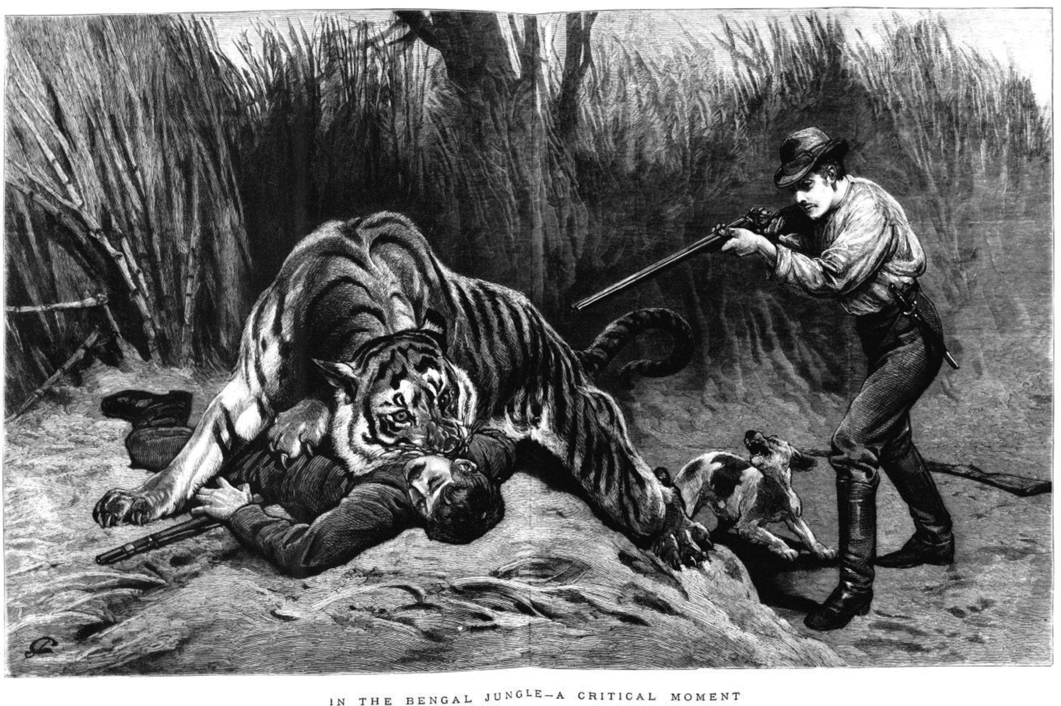
If the Uprising can be seen as a “critical event” in terms of empire, these works by Tenniel and Armitage capture what might usefully be described as “critical moments.” Indeed, “A Critical Moment” is a common caption for illustrations featuring a tiger and hunter. Sterndale, for example, uses this title for an illustration showing two hunters coming face-to-face with a tiger in his autobiographical work Seonee, while it is also used for a two-page narrative illustration in the Graphic depicting the imminent death of a tiger sprawled over the body of a British hunter (Figure 13). Images like those by Tenniel and Armitage certainly influenced later images of tigers, and also contributed to their wholesale slaughter in India. What these images of the Uprising have in common with the more ubiquitous hunting images of tigers is an overwhelming interest in the critical moment after and before two deaths – a moment with a strong pedigree in British animal art. In James Ward's Lion and Tiger Fighting (1798), for example, “a tiger has pinned down a helpless deer, but, at the moment of beginning to feast, is surprised by a lion, which springs upon the less powerful predator to deprive it of its meal” (Donald 77). In the case of illustrations of the Uprising, the critical moment falls between the death of the white woman and child and the impending retributive death of the tiger. In the more common hunting images of the later nineteenth century this trope is repeated in a range of situations, the death of the white woman being replaced by the death of either an Indian, or less commonly, another animal. The iconography of the “critical moment” is so commonplace and so powerful in the years after the Uprising that any image of a tiger with a human victim, or of a tiger caught in the sights of a hunter's rifle, invites the viewer to complete the narrative of retributive justice. It is a narrative which, in the wake of 1857, was always already available to the Victorian public, or as Baker suggests in relation to national animal iconography of the twentieth century, the symbolism of these images is “something which is simply available, out there in the culture” (43). In postcolonial terms the white hunter was increasingly pictured as the ultimate imperialist, while the tiger, officially classified as vermin in India until into the 1930s (Schell 233), was the ultimate subordinate.
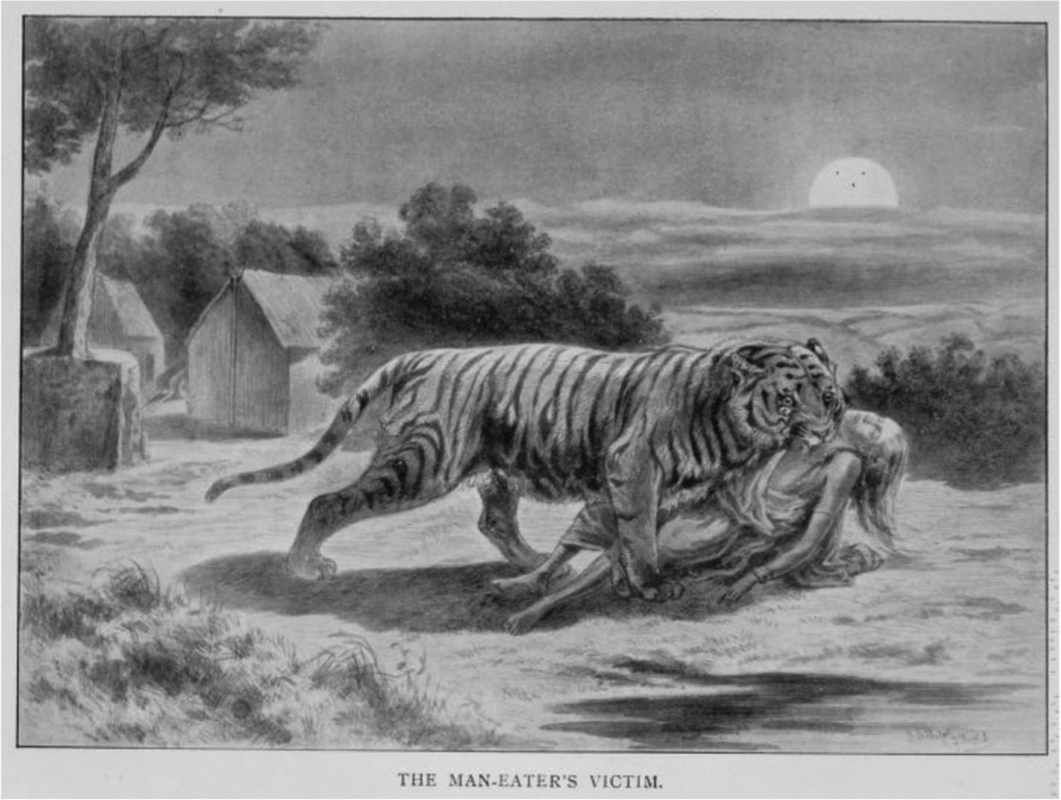
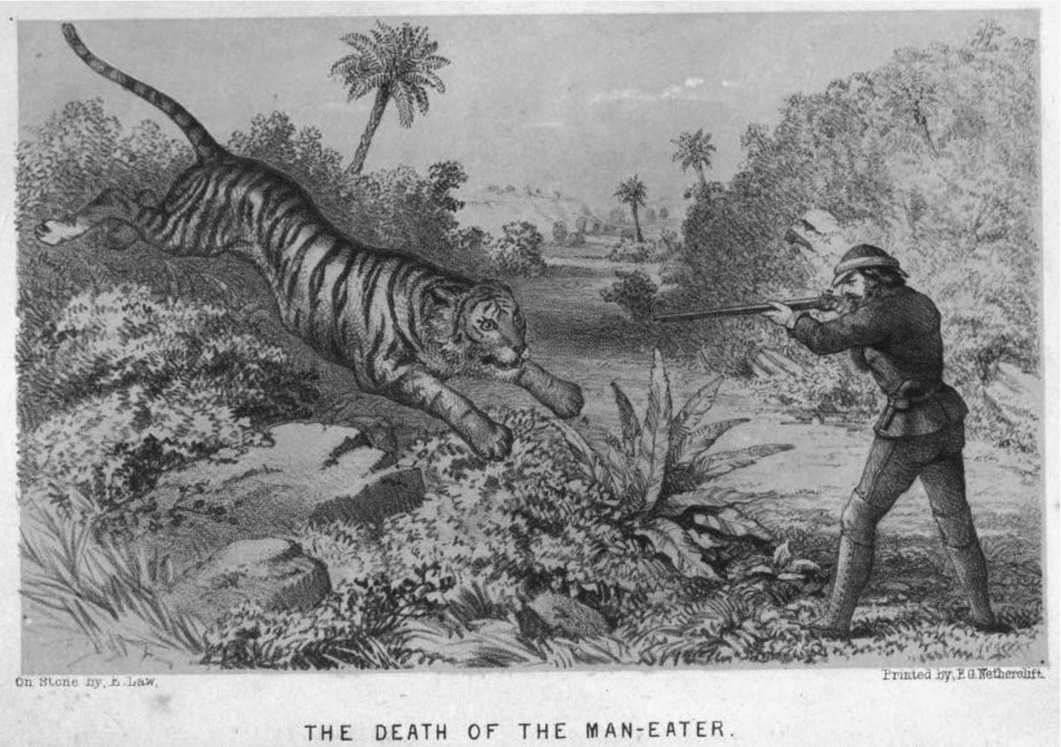
That the racial and sexual codes embedded in these critical moments were readily understood is evident when we look at three typical tiger images from the late nineteenth century (Figures 11–13). Each of these images relies on the Victorian consumer being able to complete the narrative that is only gestured at on the page. In “The Man-eater's Victim,” an illustration in G. P. Sanderson's Thirteen Years Among the Wild Beasts of India (1879), a tiger carries off an Indian village woman.Footnote 3 The viewer knows, though, that the tiger will meet its end at the hands of a white hunter. Conversely, E. Law's illustration, “The Death of the Man-Eater,” from Hunting Grounds of the Old World (1860) by H.A.L. [Henry Astbury Leveson], captures the moment of a tiger being shot by a British hunter. In this case we know that the tiger's death is an act of reckoning for the earlier death of its human victims. These post-1857 illustrations implicitly remind the viewer of the need for firm British rule in India. In both instances, the viewer is familiar with the trope of picturing tigers and is thus equipped to fill in the narrative gaps.
“The Man-eater's Victim.” Illustration from G.P. Sanderson, Thirteen Years Among the Wild Beasts of India (London: Wm. H. Allen & Co., 1879), facing 301.
“The Death of the Man-Eater.” Illustration from H.A.L [Henry Astbury Leveson], Hunting Grounds of the Old World (London: Longman, Green, Longman, Roberts & Green, 1860), facing 125.
“In the Bengal Jungle – A Critical Moment.” Illustration from The Graphic (30 Oct. 1880): 14.
The unsigned illustration from the Graphic, “In the Bengal Jungle–A Critical Moment,” delivers a fuller narrative on the page. The tiger is about to be shot for its attack on the avenging hunter's companion. The hunter is braced for the recoil of his shot, and his extended stance, his pointing rifle, and the hunting knife on his belt echo the phallic tropes common to military art also displayed in Armitage's painting. And while the landscape is, of course, India, the right-hand third of the image, complete with hunting dog, clearly evokes Britain, and claims India as part of the British Isles.
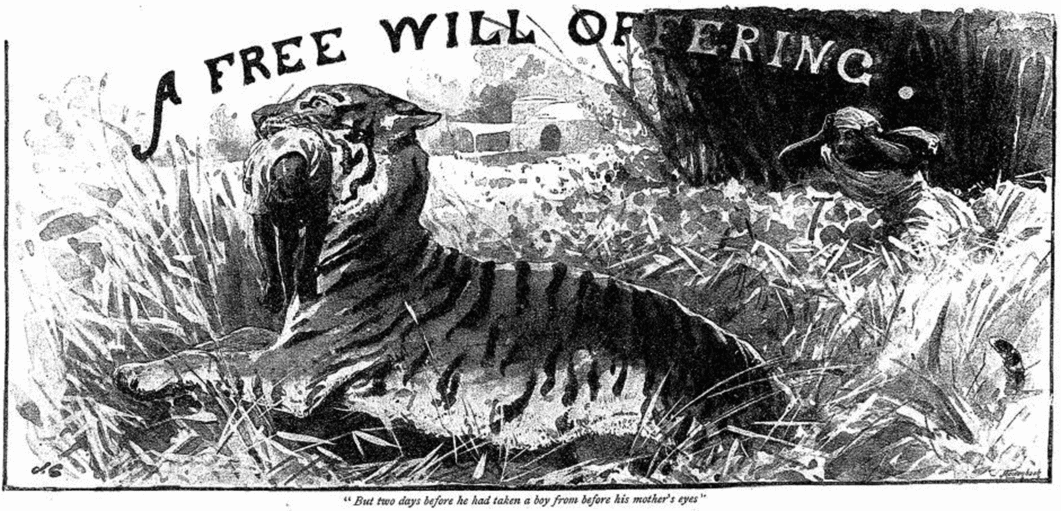
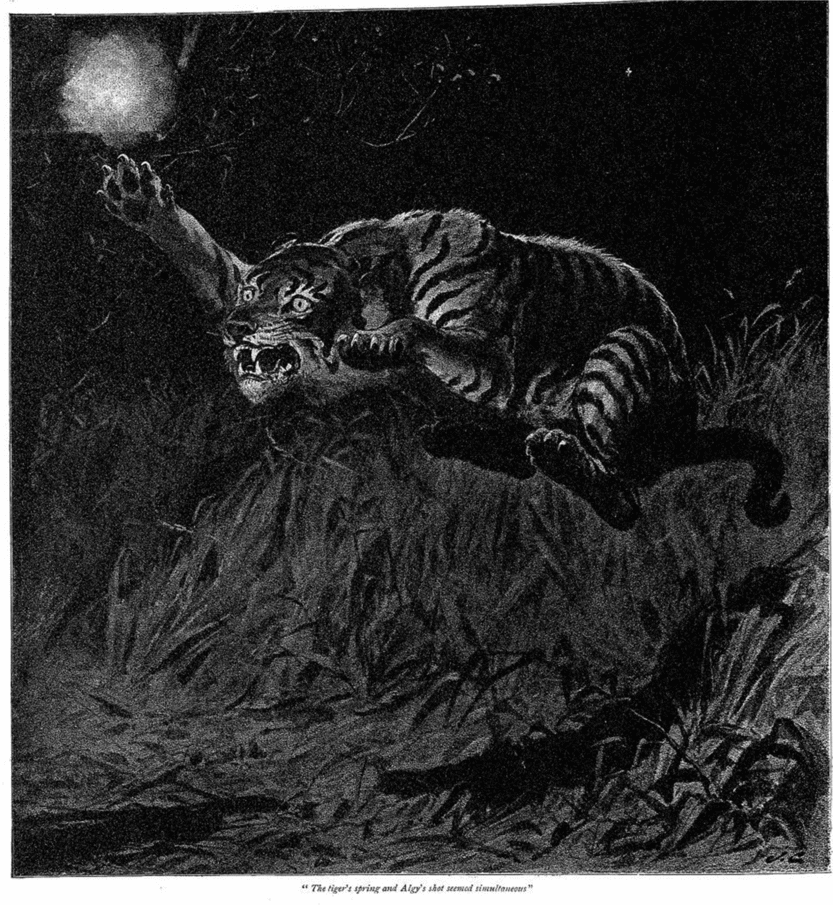
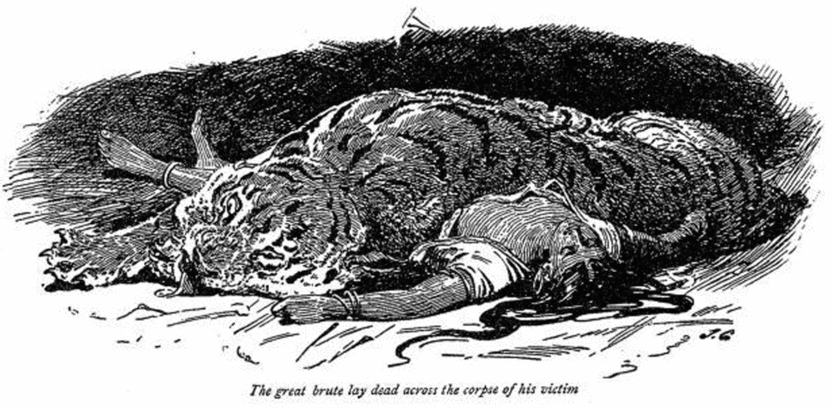
The respected animal and battle painter and illustrator, John Charlton (1849–1917), contributed numerous illustrations to the Graphic between 1876 and 1895, many of them depicting animals or historical events from Britain's colonial possessions in Africa (see Houfe 260). His work includes three drawings of tigers produced to illustrate B. M. Croker's short story “A Free Will Offering,” about white hunters killing a man-eating tiger, published in the Christmas issue of the Graphic in 1894. Charlton's images (Figures 14–16) repeat three of the most common representations of the tiger in the half century following the Uprising: a tiger carrying away a victim; a tiger springing (or poised to spring); and a tiger straddling a prostrated victim. However, at the same time, Croker's story and Charlton's illustrations disrupt, in subtle ways, the narrative and visual tropes established during the nineteenth century.
“But two days before he had taken a boy from before his mother's eyes.” Illustration for B.M. Croker, “A Free Will Offering,” The Graphic Christmas Number (19 Nov. 1894): 8.
“The tiger's spring and Algy's shot seemed simultaneous,” illustration for B.M. Croker, “A Free Will Offering,” The Graphic Christmas Number (19 Nov. 1894): 10.
“The great brute lay dead across the corpse of his victim,” illustration for B.M. Croker, “A Free Will Offering,” The Graphic Christmas Number (19 Nov. 1894): 10.
In the story the British hunters’ desire to “cover [themselves] in glory,” to strip the tiger of his skin, is ultimately undermined when their trophy turns out to be “a poor specimen.” Further, the manly hunter is replaced by an accidental shikari, a foppish “lady-killer” who after shooting the man-eater “relapse[s] from a keen and intrepid sportsman into an indolent, drooling, dandy.” Charlton's first two illustrations conform to a common pattern: the tiger is seen carrying away one of his victims (Figure 14) and then frozen in the moment of leaping towards his final prey (Figure 15). In his last illustration, “The great brute lay dead across the corpse of his victim” (Figure 16), Charlton shows the aftermath rather than the critical moment between two deaths; the dead tiger, with lolling tongue, denies the consumer the pleasure of anticipating the moment of retribution. The anthropomorphized animal is replaced by a dead tiger. This story seems to suggest that by the 1890s writers and illustrators alike were becoming self-conscious about the rhetorical and material implications of using the tiger as a tool in imperialist ideology.
For many twenty-first-century readers Rudyard Kipling's Shere Khan is the tiger that immediately comes to mind in this context. Studies of the sources of Kipling's Jungle Books (1894–95) suggest that some of the settings and characters of the stories were inspired by Sterndale's illustrated books, Seonee, or, Camp Life on the Satpura Range (1877), Natural History of Mammalia of India and Ceylon (1884; illustrated by the author, T. W. Wood, and others), and Denizens of the Jungles (1886; illustrated by the author).Footnote 4
In The Jungle Books no other animal is treated with such unbridled contempt by Kipling as the tiger Shere Khan, the great enemy of the man-cub Mowgli. Shere Khan dies “a dog's death” (59), trampled by a herd of buffaloes when he is trapped in a ravine by Mowgli, who skins the tiger and displays his “gay striped coat” on the Council Rock (65). In displaying Shere Khan's pelt in this way Mowgli takes on the mantle of the British hunter, the skin reflecting the displays of hunting trophies that adorned every club and mess in British India by the end of the nineteenth century. Moreover, in the final decade of the century, Shere Khan's death is redolent of the “retribution” meted out to Indians in the wake of the 1857 Uprising.
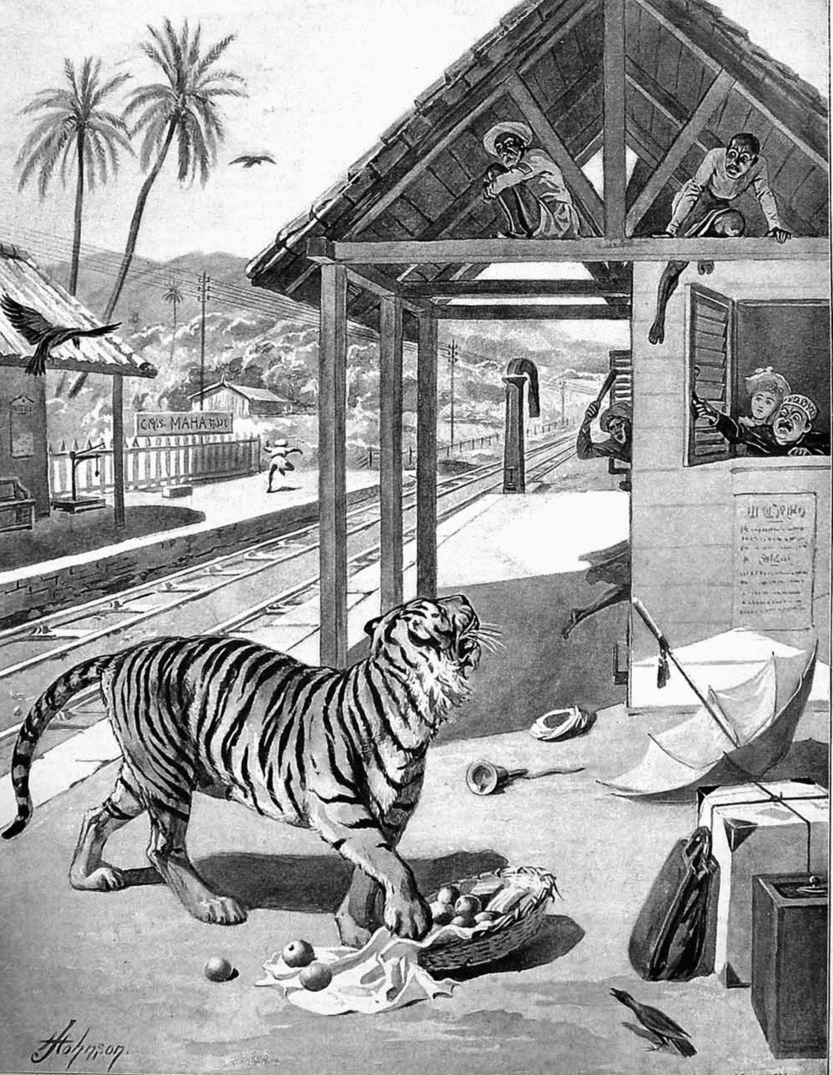
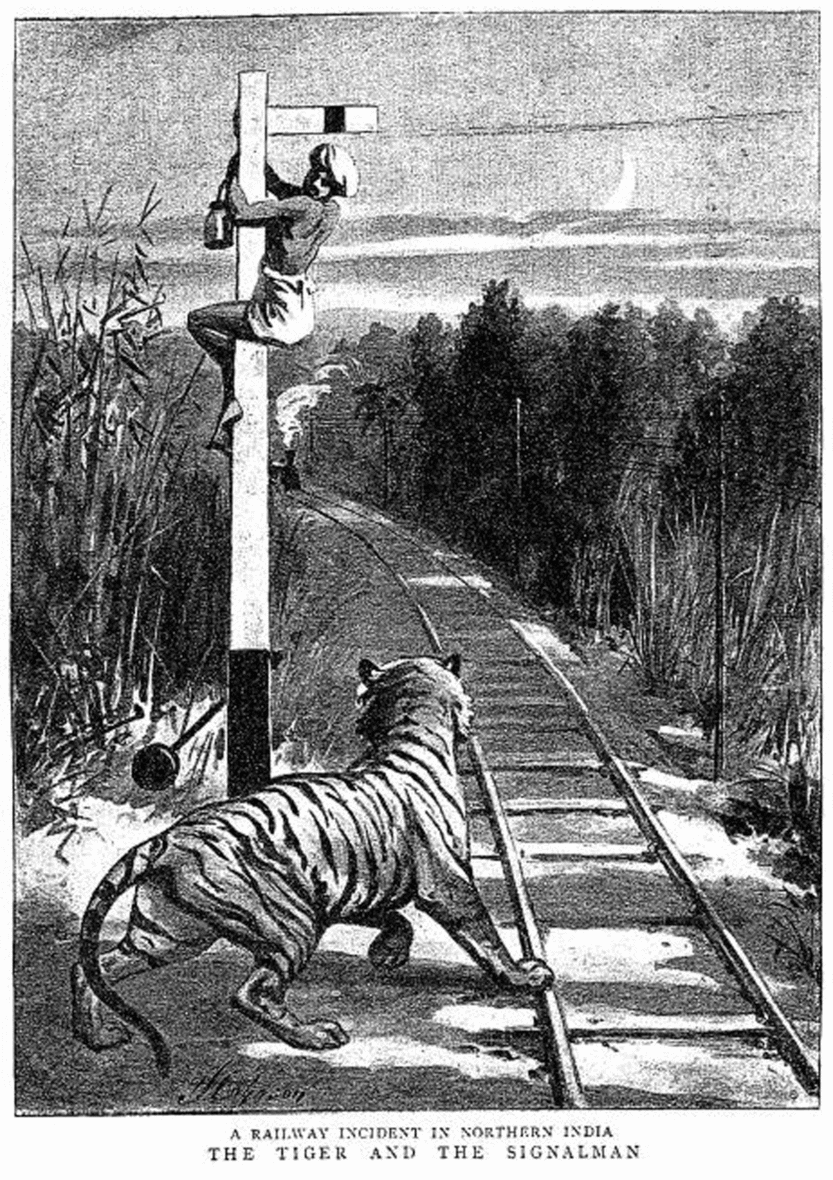
This emerging meta-narrative is also evident in two heavily-coded images by Herbert Johnson – who was sent by the Graphic as a Special Artist on the Royal Tour of India in 1875–76 (Houfe 355) – published during the last decade of Victoria's reign (Figures 17–18). In “An Awkward Visitor at an Up-Country Railway Station in India” the Indian railway staff and passengers hide in the station buildings while the tiger paws at a basket of fruit abandoned on the station platform. The ransacked fruit and the linen hanging from the basket stand in for the dishevelled clothing and exposed upper body of the female victims in the illustrations discussed above, while the books and other effects scattered around the platform emphasise the tiger's menace. Again, the tiger clearly represents a threat to order that can only be restored by the masculine British authorities, to whom the telegram “received at head office of the railway company” that provides the caption is certainly addressed: “Tiger jumping about platform, men will not work; please arrange.” The narrative of “The Tiger and the Signalman” is redolent with the same menace. Here the frightened Indian watchman clings to a signal post out of reach of the predatory tiger. In this drawing the tiger's paw is placed firmly on the iron rail of the railway track, which operates as a symbol of Britain's panoptic control and authority. The train in the middle background proclaims the watchman's imminent deliverance.
“An Awkward Visitor at an Up-Country Railway Station in India,” illustration from The Graphic (18 June 1892): 3.
“The Tiger and the Signalman.” Illustration from The Graphic (5 Jan. 1895): 9.
In both drawings, however, the victim and avenger/hunter of the earlier images discussed are absent, and the mood shifts to one of satirical humour. In these illustrations, which depend on the viewer's ability to instantly recognise the implied narrative, there is no victim, and in each drawing the tiger is likely to be scared away. The latent menace is now a source of humour at the expense of the various Indians who find themselves in what Kipling's fearful Bengali Babu might call a “damn’-tight place” (Kim 183). The iconography of the tiger, as these illustrations demonstrate, was so firmly established by the 1890s that it was immediately and always available for parody. While it may appear in these lighter, comic images that the demonic threat of the tiger is diminished, and the racist overtones of the earlier images are neutralised, rather, at the end of the nineteenth century, this shift in register still suggests the ongoing need for a British presence in India (signified in both illustrations by the railway). The tiger has now become a symbol of Britain's containment of the menace of violent uprising against the British and/or their “loyal” subjects.