Adolescence constitutes a time of particular risk for the onset of depressive disorders (e.g., Kessler, Avenevoli, & Merikangas, Reference Kessler, Avenevoli and Merikangas2001; Lewinsohn, Hops, Roberts, Seeley, & Andrews, Reference Lewinsohn, Hops, Roberts, Seeley and Andrews1993). Furthermore, although the prevalence of mood disorders is relatively low in preadolescence, a sizable proportion of preadolescent youth experience subthreshold levels of depressive symptoms, which constitute a potent risk factor for later depressive disorders (Garber & Flynn, Reference Garber, Flynn, Ingram and Price2001; Goodyer, Herbert, Tamplin, & Altham, Reference Goodyer, Herbert, Tamplin and Altham2000; Pine, Cohen, Cohen, & Brook, Reference Pine, Cohen, Cohen and Brook1999). Hence, early adolescence is a critical developmental period during which to study the impact of factors implicated in risk for adolescent depression on emotional and behavioral development, in order to better understand the mechanisms by which symptoms of depression emerge from such risk factors.
Temperament and personality research has consistently demonstrated that the temperamental dimensions of negative emotionality (NEM) and effortful control (EC) are important risk factors for internalizing problems including major depressive disorder (MDD; e.g., Clark, Watson, & Mineka, Reference Clark, Watson and Mineka1994; Eisenberg et al., Reference Eisenberg, Cumberland, Spinrad, Fabes, Shepard and Reiser2001; Klein, Durbin, Shankman, & Santiago, Reference Klein, Durbin, Shankman, Santiago, Gotlib and Hammen2002; Rothbart & Posner, Reference Rothbart, Posner, Cicchetti and Cohen2006). NEM, which is often called neuroticism, refers to general emotional distress and a susceptibility to negative emotions (Rothbart, Ahadi, & Evans, Reference Rothbart, Ahadi and Evans2000), including sadness, anger, and fear (Shankman & Klein, Reference Shankman and Klein2003). NEM is associated with subsyndromal internalizing problems (Caspi, Henry, McGee, Moffitt, & Silva, Reference Caspi, Henry, McGee, Moffitt and Silva1995), and it is a vulnerability factor for the development of mood and anxiety disorders (Clark et al., Reference Clark, Watson and Mineka1994). The association between NEM and depression is particularly well established and has been documented in both youth and adults (Klein, Dougherty, Laptook, & Olino, Reference Klein, Dougherty, Laptook, Olino, Allen and Sheeber2008; Klein et al., Reference Klein, Durbin, Shankman, Santiago, Gotlib and Hammen2002). In addition to concurrent associations, there is evidence that NEM predicts the development of depressive symptomatology and disorder during adolescence (Lonigan, Phillips, & Hooe, Reference Lonigan, Phillips and Hooe2003). Moreover, a number of studies have demonstrated that NEM during adolescence is a strong independent predictor of depressive disorder later in life (Kendler, Gardner, & Prescott, Reference Kendler, Gardner and Prescott2002, 2006; Krueger, Reference Krueger1999).
EC refers to the ability to suppress affect-driven motivational and behavioral tendencies in order to align behavior with situational demands when there is a conflict between affect and other goals (Rothbart, Ellis, Rueda, & Posner, Reference Rothbart, Ellis, Rueda and Posner2003). EC involves processes serving to modulate reactivity, including the tendency to approach versus withdraw, inhibitory control (inhibiting one's behavior), and attentional control (the ability to focus and shift attention as required; Muris & Ollendick, Reference Muris and Ollendick2005; Putnam, Ellis, & Rothbart, Reference Putnam, Ellis, Rothbart, Eliasz and Angleitner2001). Increasing attention has also been directed toward the role of EC as a risk factor for depression. Although low EC is more closely associated with externalizing disorders, emerging evidence indicates that it is also associated with depressive symptoms and disorder (Compas, Connor-Smith, & Jaser, Reference Compas, Connor-Smith and Jaser2004; Rothbart & Posner, Reference Rothbart, Posner, Cicchetti and Cohen2006). For example, Lonigan, Vasey, Phillips, and Hazen (Reference Lonigan, Vasey, Phillips and Hazen2004) reported substantial correlations between low EC and self-reported depressive symptoms in children and adolescents. At least two mechanisms may explain this association. First, youth low in EC may be less able to use attentional and behavioral strategies to avoid or reduce emotional distress (Compas et al., Reference Compas, Connor-Smith and Jaser2004). Individuals with low EC may be less able to distract themselves or to overcome mood-related motivational deficits, and be more likely to engage in maladaptive responses to distress such as rumination (low attentional control) or substance use (low behavioral control). For example, one study reported that attentional control was (inversely) associated with depressive symptoms, with the association being fully mediated by the children's use of higher order coping strategies (Thomsen, Compas, Colletti, Stanger, & Boyer, Reference Thomsen, Compas, Colletti, Stanger and Boyer2003). Second, conduct problems, which are reliably associated with deficits in EC (Rothbart & Posner, Reference Rothbart, Posner, Cicchetti and Cohen2006), are themselves risk factors for the development of depression (e.g., Kendler et al., Reference Kendler, Gardner and Prescott2002, Reference Kendler, Gardner and Prescott2006), potentially as a function of the adverse consequences conduct problems engender (Burke, Loeber, Lahey, & Rathouz, Reference Burke, Loeber, Lahey and Rathouz2005). The link between EC and depression, in this case, would be mediated by conduct problems. In addition, difficulties with attentional and behavioral regulation may render these youth particularly vulnerable to distress in the face of adverse events.
Several researchers suggest that a combination of high NEM and low EC may operate synergistically to make children especially vulnerable to psychological disorders (Calkins & Fox, Reference Calkins and Fox2002; Lonigan & Phillips, Reference Lonigan, Phillips, Vasey and Dadds2001; Muris & Ollendick, Reference Muris and Ollendick2005). Unfortunately, few studies to date have specifically examined the role of both emotionality (i.e., NEM) and EC in the etiology of internalizing psychopathology during childhood or adolescence. The results up to now have demonstrated that older children with internalizing problems score relatively high on NEM (especially fear) and low on EC (Eisenberg et al., Reference Eisenberg, Cumberland, Spinrad, Fabes, Shepard and Reiser2001; Meesters, Muris, & van Rooijen, Reference Meesters, Muris and van Rooijen2007; Muris, Meesters, & Blijlevens, Reference Muris, Meesters and Blijlevens2007; Oldehinkel, Hartman, de Winter, Veenstra, & Ormel, Reference Oldehinkel, Hartman, de Winter, Veenstra and Ormel2004). Two studies actually found a significant interaction effect of NEM and EC on psychological problems, indicating that the combination of high NEM and low EC (particularly attentional control) is associated with the highest levels of internalizing psychopathology (Muris & Ollendick, Reference Muris and Ollendick2005).
It is less apparent whether there are certain mechanisms through which a particular temperamental disposition may cause an individual to develop depression. In a recent review, Yap, Allen, and Sheeber (Reference Yap, Allen and Sheeber2007) proposed that one of the ways that temperament may increase adolescents' vulnerability for MDD is by shaping their emotion regulation (ER) tendencies and capacities. Early individual differences in temperament, particularly those reflecting emotional negativity and reactivity, appear to influence the development of regulatory capacities (Fox & Calkins, Reference Fox and Calkins2003; Plomin & Stocker, Reference Plomin, Stocker and Reznick1989). The conceptual link between dispositional emotionality and emotion regulatory capacity is actually so close that at times the distinction between the two can be unclear. Thus, an understanding of dispositional contributions to regulatory capacity necessitates articulating the distinction between the two. In this study we define temperament as an enduring emotion–response tendency that is partly biologically based, presents early in life, and is relatively consistent across situations and time (Cole, Martin, & Dennis, Reference Cole, Martin and Dennis2004; Goldsmith, Reference Goldsmith, Lewis and Haviland1993). In contrast, ER refers to the processes by which these emotion–response tendencies, which arise as a function of temperamental predispositions and the characteristics of the eliciting situations, are altered, presumably in the service of goal attainment. Although not part of the thesis of this study, it is worth noting that ER strategies overlap conceptually and empirically with coping strategies. In particular, studies have found children's NEM and EC to be associated with their use of coping strategies in the face of negative life events, including parental divorce (Lengua & Long, Reference Lengua and Long2002; Lengua, Sandler, West, Wolchik, & Curran, Reference Lengua, Sandler, West, Wolchik and Curran1999).
There is evidence to suggest that both NEM and EC are linked to ER. Findings of consistent associations between trait NEM and state measures of negative affect (Gross, Sutton, & Ketelaar, Reference Gross, Sutton and Ketelaar1998) have led researchers to propose that NEM predisposes individuals to experience negative affect. Individuals high in NEM may thus face more challenges regulating their excess negative affect, and if unsuccessful, may experience sustained, heightened negative affect characteristic of depressive disorders. That is, their high levels of dispositional NEM may place greater strains on their ER capacities than would be experienced by persons with similar regulatory capacity but with less to regulate. Preliminary evidence suggests that individuals' temperament or personality may also be associated with the type of regulation strategies they are inclined to use. Gross and John (Reference Gross and John2003) found that (effective) reappraisal strategies were negatively related to NEM, suggesting that adolescents high in NEM may not only tend to experience more negative affect, but also be less inclined to use reappraisal, which would otherwise be effective in managing these excess negative emotions. Nonetheless, we acknowledge the potential tautology inherent in this finding, because it is also possible that individuals who are more successful at regulating their negative affect would be less likely to report being high in NEM.
Researchers have also noted the relevance of the temperamental dimension of EC to ER. Evidence suggests that EC emerges and develops from around age 3 and is an outcome of the development of executive control of attention (Rothbart et al., Reference Rothbart, Ellis, Rueda and Posner2003), consequent to brain maturation and interaction with the environment (Kochanska, Murray, & Harlan, Reference Kochanska, Murray and Harlan2000; Posner & Rothbart, Reference Posner and Rothbart2000). This development enables children to gradually improve their ability to regulate their emotions and control their behavior, which may have important implications for social competence and adjustment (Eisenberg, Fabes, Guthrie, & Reiser, Reference Eisenberg, Fabes, Guthrie and Reiser2000; Fabes et al., Reference Fabes, Eisenberg, Jones, Smith, Guthrie and Poulin1999). For example, Eisenberg et al. (Reference Eisenberg, Guthrie, Fabes, Reiser, Murphy and Holgren1997) found that elementary school children with high EC were better at self-regulating their emotions and coping with their own and others' distress. Similarly, children with low EC may be less inclined and/or able to develop adaptive ER. Thus, in the face of stressful life events, they may be subject to their temperamental reactivity, placing them at higher risk for developing depressive disorders.
There is now an increasing awareness among developmental psychopathologists that childhood and adolescent disorders are characterized to a large extent by disturbances in emotional processes, typically conceptualized as disruptions in ER (Cicchetti, Ackerman, & Izard, Reference Cicchetti, Ackerman and Izard1995; Cicchetti & Toth, Reference Cicchetti and Toth1998). The ability to successfully regulate affective states is central to mental health, and emotion dysregulation figures prominently in mental illness (Gross & Munoz, Reference Gross and Munoz1995). This may be particularly true of depressive disorders, because they are characterized by deficits of positive affect and/or an excess of negative affect (Gross & Levenson, Reference Gross and Levenson1997). Because depressive disorders involve dysfunction of both of the major affective systems (Cole & Kaslow, Reference Cole, Kaslow and Alloy1988; Gross & Munoz, Reference Gross and Munoz1995), failures or abnormalities in ER processes are likely to play a particularly critical role in their etiology. For example, depressed adolescents were found to maintain depressive affective states for a longer duration than did their nondepressed peers during parent–adolescent interactions (Sheeber, Allen, Davis, & Sorensen, Reference Sheeber, Allen, Davis and Sorensen2000). Similarly, an experience sampling study provided evidence that depressed adolescents had greater difficulty shifting out of negative affect states than did nondepressed peers (Silk, Steinberg, & Morris, Reference Silk, Steinberg and Morris2003). These depressed adolescents were also more likely to respond to negative emotions with disengagement (e.g., avoidance, wishful thinking) and involuntary engagement (e.g., rumination; impulsive behavior), responses that were correlated with difficulty shifting out of sad and angry emotional states.
Emerging evidence suggests that emotion dysregulation in at-risk or depressed individuals may be linked to deficits in the strategies they use to respond to negative emotional states. In particular, it seems that depressed adolescents have a more limited repertoire of ER strategies, use less effective strategies, fail to use strategies within their repertoire, and are less likely to believe that their strategies would be effective (e.g., Garber, Braafladt, & Weiss, Reference Garber, Braafladt and Weiss1995; Garber, Braafladt, & Zeman, Reference Garber, Braafladt, Zeman, Garber and Dodge1991).
This study investigated whether early adolescents' ER functions as a mechanism through which temperament shapes their risk for depression. Although the focus of this study is not on biological aspects of temperament, emotion, and depression, it is worth noting that biological origins have been proposed for each of these constructs (e.g., Davidson, Reference Davidson2001; Ochsner & Gross, Reference Ochsner and Gross2005) and that associations among them may be partly attributed to biological or genetic bases (e.g., Klein et al., Reference Klein, Dougherty, Laptook, Olino, Allen and Sheeber2008). Although temperament can have a direct influence on psychological adaptation (Lengua et al., Reference Lengua, Sandler, West, Wolchik and Curran1999), we explored the possible role of early adolescents' ER as a mediator between their temperament and depressive symptomatology. In particular, we were interested in measuring adolescent ER through the observation of their behaviors while they interacted with their parents. It is important that observational methods have the potential to capture the dynamics of the ER process, and thus contribute unique insights to the understanding of ER when compared to methods that focus solely on self-reported ER strategies or affective measures. Although measuring ER in interpersonal contexts approximates a measure of ER in ecologically valid situations, it is noted that the quality of the interpersonal (parent–adolescent) relationship concerned may also contribute to the behaviors observed. Nonetheless, this methodology is consistent with the assessment of ER difficulties in the context of both conflictual marital exchanges (e.g., Lindahl & Markman, Reference Lindahl, Markman and Blechman1990) and problem-solving interactions between adolescents (depressed and nondepressed groups) and their mothers (Sheeber et al., Reference Sheeber, Allen, Davis and Sorensen2000).
In addition, this study also examined the regulatory responses that adolescents have when they experience sadness. In particular, we examined both adaptive and maladaptive responses separately to see if they have independent associations with temperament and depressive symptoms. Such an examination, when combined with microsocial observational evaluation of ER behaviors in early adolescents, complements the existing literature that has focused almost exclusively on self-report regulatory strategies (e.g., Garber et al., Reference Garber, Braafladt and Weiss1995).
The assessment of ER in this study is therefore multimethod and multisource, as has been recommended (Underwood, Reference Underwood1997). Such an investigation comprises a more comprehensive assessment because each source or method provides unique information but also contributes unique error. For example, using a sequential observational system for examining adolescent ER is complementary to using self-report measures. The former permits the detection of microsocial behavioral patterns without the intrusion of perceptual biases inherent in self-report measures, and the latter provides input from individuals who have substantially greater access than observers to internal regulatory processes and behavior patterns as they occur across time and setting. The specific hypotheses for this study were the following:
1. High NEM and low EC as independent main effects and their interactive (multiplicative) effects will be associated with higher levels of depressive symptomatology.
2. High NEM and low EC as independent main effects and their interactive effects will predict higher levels of emotion dysregulation in adolescents. Emotion dysregulation is indexed by greater frequency, duration, and reciprocity of negative affective behaviors displayed by the adolescent during interaction tasks, as well as by more frequent maladaptive responses and less frequent adaptive responses to negative affect (namely, sadness) as assessed by self-report.
3. Adolescent emotion dysregulation will be associated with more depressive symptoms.
4. The relationship between adolescent temperament and depressive symptomatology will be mediated by adolescent ER.
Method
Participants and selection procedure
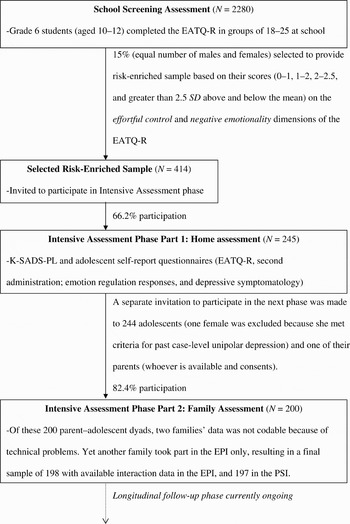
Final-year primary school students across metropolitan Melbourne, Australia, were recruited through their schools to take part in the school screening phase. Through this process, 2,280 students completed the revised Early Adolescent Temperament Questionnaire—Revised (EATQ-R; Ellis & Rothbart, Reference Ellis and Rothbart2001). Given that the main aim of the screening procedure was to provide a risk-enriched sample for the more intensive assessment phase, the school screening EATQ-R scores were used to select a sample that was representative of scores across the full range of the temperament dimensions. Selection was based on scores on NEM and EC dimensions given their hypothesized role as risk factors for emotional and behavioral disorders. As outlined in Figure 1, this produced a risk-enriched sample (N = 414) for the intensive assessment phase that showed a relatively even distribution across EC and NEM, while maintaining the range of temperament scores evident in the larger sample.
The sample selection process. EATQ-R, Early Adolescent Temperament Questionnaire—Revised; K-SADS-PL, Schedule for Affective Disorders and Schizophrenia for School-Aged Children, Present and Lifetime Version; EPI, Event-Planning Interaction.

The first part of the intensive assessment phase (home assessment) included a diagnostic interview (Schedule for Affective Disorders and Schizophrenia for School-Aged Children, Present and Lifetime version; Kaufman et al., Reference Kaufman, Birmaher, Brent, Rao, Flynn and Moreci1997) with the child and a battery of self-report questionnaires. Given that this study is part of a larger longitudinal study designed to prospectively investigate the role of ER as a vulnerability factor in the development of adolescent depression, only participants who had no current or past case-level depressive disorders as assessed by the Schedule for Affective Disorders and Schizophrenia for School Aged Children, Present and Lifetime Version were selected for the intensive phase. Because of the young age of this sample, only one child was excluded as a function of this diagnostic screening. From the selected sample, 245 families consented to participate in the home assessment, which occurred a mean of 9.91 months (SD = 3.10) after the school screening. At the time of home assessment, participating adolescents were 11–13 years old (M = 12.46 years, SD = 0.43 years) and parents were 29–57 years old (M = 42.56 years, SD = 5.19 years). The analyses revealed no differences between adolescents who did not take part in the home assessment and those who did on NEM, t (407) = 0.16, ns, or EC, t (413) = −0.54, ns. The groups also did not differ in gender, χ2 (1, N = 415) = 0.34, ns, or socioeconomic classification, t (405) = −1.00, ns. Socioeconomic classification was based on an index of neighborhood social disadvantage (using participants' residential postcodes), which is calculated as a sum of 13 indicators, such as unemployment, income, criminal offences, child abuse, and early school leaving (Vinson, Reference Vinson2004).
Among the eligible families (N = 245) invited to take part in the family assessment, 198 parent–adolescent dyads (163 mothers, 80 boys) completed the Event-Planning Interaction (EPI) and 197 (162 mothers, 79 boys) completed the Problem-Solving Interaction (PSI). Adolescents who participated in the family assessment did not differ significantly from those who declined further participation in NEM, t (243) = 0.49, ns, EC, t (242) = −0.85, ns, gender, χ2 (1, N = 245) = 0.15, ns, or mother's country of birth, by continental regions: χ2 (7, N = 245) = 12.03, ns. They also did not differ from the selected sample of 414 in the distribution of their NEM and EC (Fs < 1, ns; using the Levene Test). Of the final sample of 198 adolescents, 50% were female, and 92% identified their ethnicity as Australian. Of the remaining 8%, seven were mixed Australian, and one each self-identified as Welsh, English, Swiss, Indian, Chinese, Indonesian, or Lebanese. Given that the sample of fathers is much smaller than that of mothers, and the exploration of differences in adolescent ER and symptomatology according to parent gender is beyond the scope of this paper, analyses involving the behavioral reciprocity of adolescents to their parents' behaviors (as indicators of ER) will include only the subsample of families where mothers participated in the family assessment. Nonetheless, questionnaire measures and all other analyses involving behavioral data (e.g., frequency and duration) will include the full adolescent sample, to maximize the number of eligible participants.
Procedure of family assessment phase
Parent–adolescent dyads participated in two 20-min interactions, the EPI followed by the PSI, which were videotaped for coding purposes. Separate cameras videotaped each participant. The order of interactions was fixed because we believed it would be easier for participants to switch from a positive affective state (as elicited by the EPI) to a conflictual affective state (as elicited by the PSI), given that negative affective states are known to have slower decay rates than positive affective states (Gilboa, Reference Gilboa, van Goozen, Van de Poll and Sergeant1994). Topics for the EPI and PSI were identified based on parent and adolescent responses to the Pleasant Events Checklist (MacPhillamy & Lewinsohn, Reference MacPhillamy and Lewinsohn1976) and the Issues Checklist (Prinz, Foster, Kent, & O'Leary, Reference Prinz, Foster, Kent and O'Leary1979), respectively. The Pleasant Events Checklist comprises 50 activities that people may enjoy doing, such as “Taking a trip or vacation” and “Snow skiing”; whereas the Issues Checklist is a list of 44 topics about which adolescents and parents may disagree, such as “[adolescent] lying” and “[adolescent] talking back to parents.” Up to five activities that both parent and adolescent indicated to be very pleasant in the Pleasant Events Checklist were chosen for parent–adolescent dyads to plan for during the EPI, and up to five issues that were reportedly most conflictual (and recent) on the Issues Checklist were chosen for the dyads to attempt to resolve during the PSI. Participants were given $50 cash (parents) and a $30 voucher (adolescents) as reimbursement for their time and travel.
Measures
EATQ-R
The EATQ-R (Ellis & Rothbart, Reference Ellis and Rothbart2001) is a revision of the EATQ developed by Capaldi and Rothbart (Reference Capaldi and Rothbart1992). It was specifically designed to assess aspects of temperament related to self-regulation in adolescents and has 10 subscales that load onto four higher order factors of NEM (comprising the frustration scale), EC (comprising the activation control, attention, and inhibitory control scales), surgency (comprising surgency, and reverse-scored rear and shyness scales), and affiliativeness (comprising affiliation, pleasure sensitivity, and perceptual sensitivity scales). Given this paper's focus on NEM and EC, only results associated with these temperament dimensions are reported here. Adolescent self-reports of temperament were obtained at two time points (in-school screening and home assessment phases), thus permitting an assessment of the traitlike stability of temperament. In this sample, the test–retest reliability of adolescent self-report ranged from r = .52 to .65 for NEM and EC lower order scales, indicating moderate stability. The state-related variation in temperament was reduced by using the mean of the two measurements as the indicator of adolescent temperament in the present study.
Child Sadness Management Scale (CSMS)
The CSMS (Zeman, Shipman, & Penza-Clyve, Reference Zeman, Shipman and Penza-Clyve2001) was developed to assess children's management of normative sadness experience. Consistent with the literature on ER and dysregulation (Cole, Michel, & Teti, Reference Cole, Michel and Teti1994; Dodge & Garber, Reference Dodge, Garber, Garber and Dodge1991), items that reflect the over- and undercontrol of sadness expression (both of which are maladaptive ER responses) were developed to form the inhibition and dysregulated expression scales, respectively. Examples are “I hold my sadness in” and “I cry and carry on when I'm sad” for these scales, respectively. The ER Coping Scale was also included to assess coping with sadness, for example, “I stay calm and don't let things get to me,” and particularly as an indicator of adaptive responses. Participants are asked to indicate how often they do “the following things when feeling sad” on a scale of 1 (hardly ever), 2 (sometimes), or 3 (often). Reliability and validity of the CSMS were established based on a community sample of 9- to 12-year-old children's self-report, maternal report, and peer ratings of behavior. The Inhibition Scale demonstrated strong internal consistency (α = 0.77), and the ER coping and dysregulated expression scales demonstrated moderate internal consistencies (αs = 0.62 and 0.60, respectively).
Center for Epidemiological Studies—Depression Scale, Revised (CES-D)
Adolescent depressive symptomatology was measured using adolescent self-report on the CES-D (Radloff, Reference Radloff1977). The CES-D has been found to be valid and reliable for adolescents (Radloff, Reference Radloff1991). Most of this adolescent sample reported low levels of depressive symptoms, with 59% reporting total scores of 0 to 10. Approximately 11% (14 males, 11 females) had elevations in depressive symptoms as defined by a total score of 24 or above (Roberts, Lewinsohn, & Seeley, Reference Roberts, Lewinsohn and Seeley1991).
Family observation measure
The affect and verbal content of the videotaped interactions were coded in real time using the Living in Family Environments (LIFE; Hops, Davis, & Longoria, Reference Hops, Davis and Longoria1995) coding system. The LIFE is an event-based coding system in which new codes are entered each time the affect or verbal content of the interactants changes. The LIFE consists of 10 affect codes (contempt, anger, anxious, dysphoric, pleasant, neutral, happy, caring, whining, and belligerence) and 27 verbal content codes (e.g., validation, approve, provoke). Two composite variables, derived from the individual affect and content codes, were used in the present study. Aggressive behavior included all codes with contemptuous, angry, or belligerent affect, as well as disapproving, threatening, or argumentative statements with neutral affect. Dysphoric behavior consisted of all codes with dysphoric, anxious, or whining affect, as well as complaints and self-derogatory comments with neutral affect. More detailed information regarding the development and psychometric characteristics of LIFE is presented in Hops et al. (Reference Hops, Davis and Longoria1995).
All video recordings were coded by extensively trained observers who are blind to participant characteristics (e.g., temperament or symptom levels). Approximately 20% of the interactions were coded by a second observer to provide an estimate of observer agreement. Kappa scores in this study averaged 0.66 and 0.78 for content and affect codes, respectively, and κ coefficients for the aggressive and dysphoric composite codes were 0.77 and 0.68, respectively. Random pairs of observers were assigned to the interactions to minimize drift between any two observers and to ensure that all observers met minimal criteria for acceptable observations. When a composite code had a zero base rate for a particular participant (i.e., it did not occur at all), then the duration per episode (see below) and some of the sequential z scores (i.e., when the antecedent behavior did not occur) were treated as missing data. This results in the variations in the total numbers for different constructs in different tasks.
On the basis of data obtained from the LIFE coding of the family interactions, observational indices of ER during the interaction were derived. These include the following:
1. Rate per minute: The rate per minute variable indicates the number of times behaviors associated with a composite construct occur per minute of interaction between participants. Separate variables were constructed to assess the average frequency of aggressive and dysphoric displays. More frequent aggressive and dysphoric behaviors are indicative of emotion dysregulation.
2. Sequential z score: The Allison–Liker z scores (Allison & Liker, Reference Allison and Liker1982) for sequential relations indicate the extent to which a specified sequence of behavior occurs more or less often than would be expected as a function of the base rate of each behavior. The z scores represent whether a particular antecedent behavior increases (positive z score) or suppresses (negative z score) the likelihood of a particular consequent behavior. In creating these variables, parents' antecedent affective behaviors are regarded as provocative stimuli. Greater reciprocity of parental aggressive and dysphoric behaviors (e.g., positive z scores of adolescent aggressive responses to parental aggressive behavior) is an index of the adolescents' inability to regulate their affective reaction to their parents' behaviors.
3. Duration per episode: The duration per episode represents the average length of time that specific affective behaviors are maintained each time they are displayed during the course of each parent–adolescent interaction task. Separate variables were constructed to assess the average duration of aggressive and dysphoric displays. A longer duration of aggressive and dysphoric behaviors is indicative of emotion dysregulation in that it reflects an inability to promptly downregulate negative affect.
Results
Given the ample evidence from the developmental literature indicating adolescent gender differences in temperament, ER, and depressive symptomatology (e.g., Block, Gjerde, & Block, Reference Block, Gjerde and Block1991; Hankin et al., Reference Hankin, Abramson, Moffitt, Silva, McGee and Angell1998; Thayer, Rossy, Ruiz-Padial, & Johnsen, Reference Thayer, Rossy, Ruiz-Padial and Johnsen2003), main effects of gender were controlled for when testing the hypotheses of this study. Because few prior studies have investigated ER behaviors during parent–adolescent interaction tasks designed to elicit positive affect, adolescent behaviors in the EPI and PSI were examined separately to see if different forms of emotion dysregulation were evident in different parent–adolescent interaction contexts. All hypotheses were tested using hierarchical regressions, controlling for adolescent gender, with statistical significance set at α = 0.05. When testing the effect of the EC × NEM interaction, adolescent gender was entered in Step 1, EC and NEM together in Step 2, and the EC × NEM interaction term in Step 3, with depressive symptoms or ER as the outcome variable.
Following Baron and Kenny's (Reference Baron and Kenny1986) recommendations, the mediation model requires three criterion relationships: (a) the predictor (temperament) variable exerts significant effects on the mediator (ER) and (b) the outcome variable (depressive symptoms) and (c) the mediator exerts significant effects on the outcome variable. Thus, where any of these three relationships were not significant in any model, mediation effects were not tested. Although some scholars have more recently argued that criterion (b) should not be required for mediation (MacKinnon, Lockwood, Hoffman, West, & Sheets, Reference MacKinnon, Lockwood, Hoffman, West and Sheets2002), we chose to set more stringent criteria for this study because the conceptual model being tested (Yap et al., Reference Yap, Allen and Sheeber2007) proposes that adolescent temperament is associated with both their ER and their depressive symptomatology, and that the temperament–symptomatology association is mediated by adolescent ER. Hence, the test of this model would only be meaningful if all three relationships are significant. The significance of mediation effects was tested using the Sobel Test (Aroian version; Preacher & Leonardelli, Reference Preacher and Leonardelli2001), and indirect or mediated effects were calculated following MacKinnon and Warsi's (Reference MacKinnon and Warsi1995) recommendations. This calculation involves a two-stage regression procedure: first, the mediator (ER) is regressed on the predictor (temperament); second, adolescent symptomatology is regressed on both predictor and mediator variables. The product of the regression coefficient of the predictor from the first regression with the coefficient of the mediator in the second regression yields the mediated effect of temperament on adolescent symptomatology.
Correlations among study variables
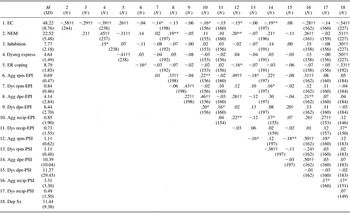
The intercorrelations among all variables are presented in Table 1 along with the means and standard deviations. Note that adolescents' inhibition and dysregulated expression responses to sadness are not correlated with their affective behaviors in both interaction tasks. In contrast, adolescents' ER coping is negatively correlated with aggressive frequency in both tasks. Generally, measures of aggressive behaviors (frequency, duration, and reciprocity) and dysphoric behaviors are correlated with one another across tasks.
Means (standard deviations) and correlations among variables

Note: EC, effortful control; NEM, negative emotionality; Dysreg express, dysregulated expression; ER, emotion regulation; Agg, aggressive behavior; rpm, rate per minute (frequency); EPI, Event-Planning Interaction; Dys, dysphoric behavior; dpe, duration per episode; recip, reciprocity; PSI, Problem-Solving Interaction; Dep Sx, depressive symptomatology.
*p < .05. **p < .01. †p < .005. ††p < .001.
Checking for task effect
A series of paired-samples t tests was conducted to compare the frequency and duration of aggressive and dysphoric behaviors displayed by adolescents in the EPI versus the PSI. Results indicate a significant task effect, with more frequent and enduring negative affective behaviors being displayed during the conflictual task (PSI) compared to the pleasant, nonconflictual task (EPI). The t values ranged from −6.00 to −10.68 (ps < .001) for adolescent behaviors.
Predicting adolescent depressive symptomatology with temperament dimensions
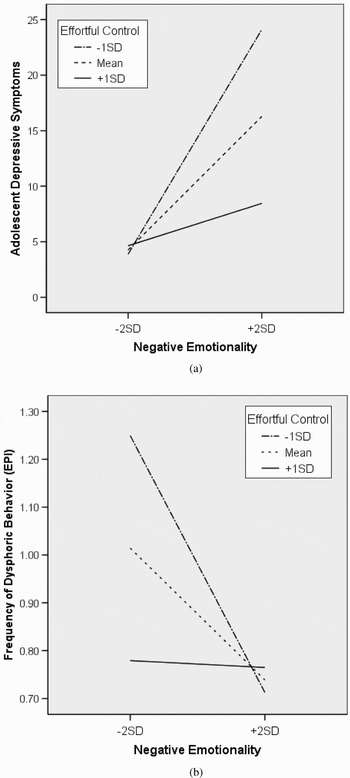
The regression models for the prediction of depressive symptomatology by EC and NEM accounted for 29% and 25%, respectively, of the variance in symptomatology. Adolescents who are low in EC (β = −0.54), t (224) = −9.51, p < .001, and high in NEM (β = 0.50), t (224) = 8.72, p < .001, reported more depressive symptoms. Moreover, the EC × NEM interaction effect explained 5% variance over and above these main effects in adolescent symptomatology (β = −0.24), t (222) = −4.38, p < .001. As shown in Figure 2a, the significant interaction was interpreted by plotting the simple regression lines for the high (+1 SD), average, and low (−1 SD) values of EC (the moderator variable; Aiken & West, Reference Aiken and West1991). Equations were then used to plot values of the DV (depressive symptoms), at high, average, and low values of EC and at high (+2 SD) and low (−2 SD) values of NEM. The t tests revealed that the slopes of the regression lines at low (β = 0.54), t (223) = 6.40, p < .001, and average (β = 0.32), t (223) = 5.05, p < .001, values of EC were significantly different from zero (Aiken & West, Reference Aiken and West1991). Consistent with expectation, among adolescents with high NEM, those with low to average EC reported higher levels of depressive symptomatology.
The interaction effect of effortful control and negative emotionality on (a) adolescent depressive symptomatology and (b) the frequency (rate per minute) of dysphoric behaviors displayed by adolescents during the Event-Planning Interaction (EPI).

Predicting adolescent ER with temperament dimensions
Adolescent emotion frequency
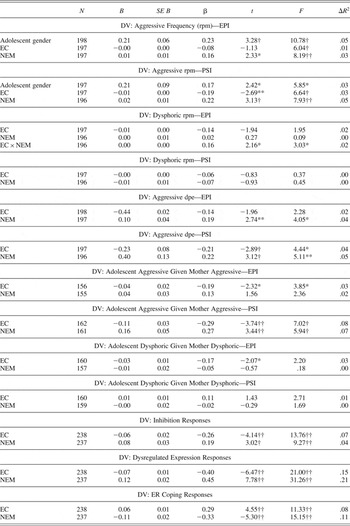
As presented in Table 2, analyses revealed that adolescent gender had a significant independent effect on the frequency (rate per minute) of aggressive behaviors in both tasks, with females behaving aggressively more frequently. Adolescents who are higher in NEM displayed aggressive behaviors more frequently in both the EPI and the PSI. By contrast, adolescents with higher EC displayed less frequent aggressive and dysphoric behaviors in the PSI and EPI, respectively.
Summary of hierarchical regressions predicting adolescent emotion regulation with adolescent self-report temperament

Note: These values are based on the model controlling for adolescent gender effects (only significant effects are shown here). The EC × NEM interaction effects are shown only when they are significant over and above the independent main effects. Analyses involving the duration of dysphoric behaviors are all nonsignificant and thus not shown here. DV, depressive symptoms; rpm, rate per minute (frequency); EPI, Event-Planning Interaction; EC, effortful control; NEM, negative emotionality; PSI, Problem-Solving Interaction; dpe, duration per episode; ER, emotion regulation.
*p < .05. **p < .01. †p < .005. ††p < .001.
The EC × NEM effect explained additional variance in the frequency of adolescent dysphoric behavior in the EPI. The plot of simple slopes is shown in Figure 2b. The t tests revealed that only the slope of the low EC line is significantly different from zero (β = –0.29), t (193) = −2.50, p < .05. Among adolescents who were low in EC, there was a negative association between NEM and frequency of dysphoric behaviors in the EPI. In particular, among adolescents with low NEM, those who were also low in EC displayed the highest rates of dysphoric behavior.
Adolescent emotion duration
As predicted, high NEM was associated with a longer duration of aggressive behaviors in both tasks and low EC was associated with a longer duration of aggressive behaviors in the PSI only. Temperament was not significantly associated with the duration of dysphoric behaviors in both tasks.
Adolescent reciprocity of mothers' behaviors
As shown in Table 2, lower EC was associated with a greater likelihood of adolescents reciprocating maternal aggressive and dysphoric behaviors across tasks. Higher NEM was also associated with more adolescent reciprocity of maternal aggressive behavior in the PSI. The EC × NEM effect failed to explain additional variance in the duration and reciprocity of adolescent behaviors over and above the independent main effects of EC and NEM.
Adolescents' ER responses
As expected, adolescents who are low in EC and high in NEM reported more frequent maladaptive (inhibition and dysregulated expression) responses and less frequent adaptive (ER coping) responses. However, the EC × NEM effect did not explain additional variance in adolescent ER responses.
Predicting adolescent depressive symptomatology with ER
Contrary to expectations, neither the frequency nor duration of adolescent aggressive and dysphoric behaviors was significantly associated with depressive symptomatology. However, adolescents with more depressive symptoms were more likely to respond in kind to their mothers' aggressive behavior in the PSI (β = 0.17), t (148) = 2.15, p < .05, and their mothers' dysphoric behavior in the EPI (β = 0.17), t (147) = 2.14, p < .05. These adolescents also reported having inhibition (β = 0.30), t (224) = 4.60, p < .001, and dysregulated expression (β = 0.50), t (224) = 8.68, p < .001, responses more frequently, and ER coping responses less frequently (β = −0.34), t (224) = −5.47, p < .001, when they experience sadness.
Testing for mediation
Following Baron and Kenny's (Reference Baron and Kenny1986) recommendations outlined above, the potential mediators to be tested here are PSI aggressive reciprocity, EPI dysphoric reciprocity, and all three self-reported ER responses variables, because they meet criteria (a) and (c).
A series of hierarchical regressions was conducted to test the hypothesis that adolescent aggressive reciprocity in the PSI mediates the relationship between adolescent temperamental factors EC and NEM and depressive symptom levels. Analyses revealed that adolescents' aggressive reciprocity failed to predict symptomatology when each temperamental factor was entered into the model. A similar pattern of results was found when testing for adolescent dysphoric reciprocity in the EPI as a mediator between EC and symptomatology.
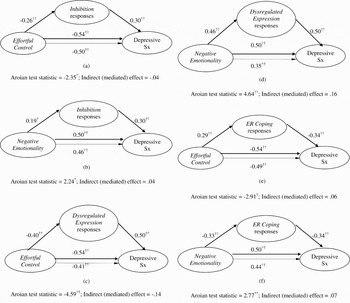
Another series of regressions was conducted to test whether inhibition responses mediate the relationship between temperament (EC, NEM, and EC × NEM as separate predictors) and depressive symptomatology. Mediation analyses using the Sobel Test revealed that significant mediation occurred for EC and NEM as separate predictors, but not for the EC × NEM interaction, as presented in Figure 3. The same pattern of findings was obtained for adolescent dysregulated expression and ER coping responses.
Diagrams showing significant mediation of adolescents' inhibition responses in the relationship between (a) effortful control (EC) and depressive symptomatology; (b) negative emotionality (NEM) and depressive symptomatology; (c) mediation of dysregulated expression responses in the relationship between EC and depressive symptomatology; (d) NEM and depressive symptomatology, as well as mediation of emotion regulation (ER) coping responses in the relationship between (e) EC and depressive symptomatology and (f) NEM and depressive symptomatology. The values shown in the diagram are standardized regression coefficient (β) values. Sx, symptomatology. *p < .05. **p < .01. †p < .005. ††p < .001.

Discussion
In general, the four hypotheses were at least partially supported. The temperament dimensions NEM and EC were significant predictors of both adolescent ER and depressive symptomatology. The interaction between NEM and EC demonstrated the predicted effect on depressive symptoms, but some unexpected associations with observed adolescent dysphoric behaviors. Adolescent self-reported ER responses, but not ER behaviors, mediated the association between their temperament and depressive symptomatology. Furthermore, consistent with previous findings that females are frequently reported to be more emotionally sensitive than males (Thayer & Johnsen, Reference Thayer and Johnsen2000), and more expressive of both positive and negative feelings (Ben-Zur & Zeidner, Reference Ben-Zur and Zeidner1988; Fujita, Diener, & Sandvik, Reference Fujita, Diener and Sandvik1991), female adolescents displayed more aggressive behaviors during parent–adolescent interactions.
Temperament and depressive symptomatology
The association between high NEM and elevated adolescent depressive symptomatology is consistent with extant literature that NEM is implicated in depression (Anthony, Lonigan, Hooe, & Phillips, Reference Anthony, Lonigan, Hooe and Phillips2002; Chorpita, Plummer, & Moffitt, Reference Chorpita, Plummer and Moffitt2000; Joiner, Catanzaro, & Laurent, Reference Joiner, Catanzaro and Laurent1996). The finding that low EC is associated with more depressive symptoms adds to current evidence that low EC is involved in internalizing problems in children and preadolescents (Eisenberg et al., Reference Eisenberg, Cumberland, Spinrad, Fabes, Shepard and Reiser2001; Oldehinkel et al., Reference Oldehinkel, Hartman, de Winter, Veenstra and Ormel2004). It also supports the proposition that high temperamental EC is an important protective factor against psychological disorders (Lonigan et al., Reference Lonigan, Vasey, Phillips and Hazen2004; Muris & Ollendick, Reference Muris and Ollendick2005). Furthermore, the finding that the EC × NEM interaction effect explained unique variance in adolescent depressive symptomatology is consistent with the findings of two recent studies (Meesters et al., Reference Meesters, Muris and van Rooijen2007; Muris et al., Reference Muris, Meesters and Blijlevens2007). This finding supports the proposal that, although high NEM is a risk factor for psychopathology, high EC can buffer the negative impact of this reactive temperament factor (Lonigan et al., Reference Lonigan, Vasey, Phillips and Hazen2004; Muris & Ollendick, Reference Muris and Ollendick2005).
Temperament and ER
During parent–adolescent problem solving interactions, adolescents with low EC displayed more frequent and enduring aggressive behaviors toward their parents. Moreover, these adolescents were more easily pulled into aggressive exchanges with their mothers (i.e., more likely to reciprocate mothers' aggressive behavior) during both interaction tasks, and during the EPI they were also more likely to reciprocate their mothers' dysphoric behaviors. These findings suggest that adolescents with low EC temperaments display more dysregulated negative affect during interactions with their parents. In addition, these adolescents report more frequent dysregulated affect expressions and emotional inhibition and less frequent adaptive coping responses when they feel sad. Hence, low EC is associated with both observed and reported affective behavior that is indicative of poor ER.
Early adolescents who report greater levels of frustration (high NEM) behave aggressively toward their mothers more often, and maintain these behaviors for longer periods, regardless of whether they are planning pleasant activities together (EPI) or trying to resolve a conflict (PSI). In addition, high NEM adolescents are also more easily pulled into aggressive exchanges with their mothers during the PSI. Taken together, this set of findings suggests that high NEM adolescents are more likely to have parent–adolescent interactions characterized by aggressive affect, which are potentially maladaptive for the adolescents' emotional functioning and development, given that such family interaction patterns are characteristic of people with mood disorders (e.g., Sheeber et al., Reference Sheeber, Allen, Davis and Sorensen2000). Furthermore, high NEM adolescents report having maladaptive responses (over- and undercontrol of sadness expression) more frequently and adaptive responses less frequently when they experience sadness. This is congruent with Gross and John's (Reference Gross and John2003) findings in a college sample that high NEM was associated with less frequent use of adaptive cognitive reappraisal strategies. Thus, these multimethod, multisource findings generally support the hypothesis that high NEM is associated with emotional dysregulation in early adolescents, particularly in the predominance of anger-related negative affective experience and the ineffective responses for regulating such emotions. These findings are also notable given that no prior study has examined the association between NEM and ER in early adolescents in such detail.
The hypothesis that the low EC × high NEM interaction would predict adolescent emotion dysregulation over and above the main effects of low EC and high NEM was not supported by both self-report and behavioral measures of ER. The unexpected association between EC × NEM and dysphoric frequency also failed to support the hypothesis. Essentially, this finding indicates that high EC may be a potent protective factor against the frequency of dysphoric behaviors, especially if the adolescent is low in NEM. This suggests that adolescents who are less easily frustrated but also lack EC traits may be especially vulnerable to dysphoria-related emotion dysregulation. It is noted, however, that no study to date has examined the actual effects of a low EC × high NEM temperament on ER; thus, these findings are preliminary. Moreover, it could also be argued that ratings of affective behaviors may capture not just ER but also temperament, and that lower rates of dysphoric behavior may also be attributable to adolescents masking their dysphoria rather than ER per se. Nevertheless, the finding that the low EC–low NEM temperament combination is associated with more frequent dysphoric behaviors is still consistent with findings of the main effects of EC on dysphoric behaviors (i.e., more EC is associated with less frequent and less reciprocity of dysphoric behavior). Moreover, these findings are generally consistent with recent theoretical predictions that EC is important for the development of the capacity to regulate negative affect (e.g., Calkins & Fox, Reference Calkins and Fox2002; Muris & Ollendick, Reference Muris and Ollendick2005). In particular, EC may be especially important for the regulation of dysphoria-related affect.
ER and depressive symptomatology
Adolescents with more depressive symptoms were more likely to reciprocate their mothers' aggressive behaviors during the PSI and dysphoric behaviors during the EPI. In addition, adolescents who engaged in emotion coping responses less often and maladaptive inhibition or dysregulated expressions more often presented with more depressive symptoms. This latter finding is consistent with research on the ER strategies of adolescents and young adults (e.g., Gross, Reference Gross2002; Gross & John, Reference Gross and John2003; Silk et al., Reference Silk, Steinberg and Morris2003).
Early adolescents' greater reciprocity of maternal aggressive behaviors during the PSI suggests that these adolescents are less able to downregulate their own aggressive reactions to their mothers' antecedent aggressive behaviors during a conflictual interaction task. If this is a persistent pattern of mother–adolescent interactions, it can be inferred that these adolescents may have impaired interpersonal conflict resolution skills, which may further contribute to their risk for developing more severe depressive problems. This finding is not consistent with Sheeber et al. (Reference Sheeber, Allen, Davis and Sorensen2000), who found that depressed adolescents were not more likely to reciprocate their mothers' aggressive and depressive (similar construct to dysphoric) behaviors than nondepressed adolescents. Two possible factors may contribute to this difference: first, the adolescents in Sheeber et al.'s study were older (mean age = 15.5 years, SD = 2 years); second, the depressed adolescents in Sheeber et al.'s study met DSM-III criteria for MDD or dysthymia, whereas the current sample was selected to be diagnosis free and differed along a continuous variable of depressive symptoms.
One possible explanation that arises from the age differences between the samples is that as early adolescents move into midadolescence, they become more likely to be pulled into negative affective exchanges with their mothers regardless of their diagnostic status, resulting in the absence of a group difference found by Sheeber and colleagues (2000). A post hoc comparison of the mean z scores for adolescent reciprocity of mother aggressive behavior in the PSI (M = 3.31, SD = 3.30) with those provided by Sheeber and colleagues (M = 3.87, SD = 3.75) using a one-sample t test revealed that the older adolescent sample (combining the depressed and nondepressed groups) in Sheeber et al.'s study was actually more likely to reciprocate their mothers' aggressive behaviors compared to the younger sample in this study, t (161) = −2.18, p < .05. Hence, although it is not surprising, and to an extent normative, for parents and midadolescents to engage in more reciprocal negative affective exchanges because of the normative transitory increase in conflict during the adolescent phase (Collins, Reference Collins, Montemayor and Adams1990), it may be maladaptive for such parent–adolescent interaction patterns to be prevalent during early adolescence. The premature emergence of such negative interaction patterns may reflect a generally dysfunctional family emotional climate, and more specifically poor ER on the part of the adolescent and/or the parent, further supporting the hypothesis that poor ER is a contributor to risk for adolescent depression.
The other possible explanation based on the sample differences is that a continuous variable of depressive symptoms in a larger sample may be more sensitive to individual differences in adolescent reciprocity than a discrete variable of depression diagnostic status in a relatively small sample. Although this possibility cannot be adjudicated in this study, it is in line with the notion that effect sizes for symptom measures of depression will often be larger than that for clinical diagnosis, given that diagnosis is simply not the best characterization of depression in adolescents (and adults), particularly when functional outcomes are considered (Lewinsohn, Solomon, Seeley, & Zeiss, Reference Lewinsohn, Solomon, Seeley and Zeiss2000). Of course, these potential methodological explanations do not preclude the possibility that the effect itself is unreliable, even across methodologically similar studies. It may be that the pattern of responsiveness during parent–adolescent interactions is more strongly determined by factors other than adolescent symptomatology, such as the parent–adolescent relationship. Further research will be required to adjudicate these possibilities.
The positive association between adolescent depressive symptomatology and their reciprocity of maternal dysphoric behaviors during the EPI is an interesting finding that has not been described in previous research. This association is particularly remarkable because it arose not in the PSI but in the EPI, a task that elicited less negative affect than the PSI. This finding provides some indirect support for the association between depression and the decreased ability to anticipate future positive outcomes (Henriques, Glowacki, & Davidson, Reference Henriques, Glowacki and Davidson1994; MacLeod & Salaminiou, Reference MacLeod and Salaminiou2001), given that adolescents with elevated depressive symptomatology were more likely to reciprocate their mothers' dysphoric behavior in an interaction context designed to tap into their ability to anticipate future positives (planning an enjoyable activity).
Taken together, early adolescents who are more likely to be pulled into aggressive and dysphoric exchanges with their mothers tend to present with more depressive symptoms. Such individual differences in aggressive and dysphoric reciprocity during early adolescence may be indicators of risk for depressive disorders later in adolescence, potentially because such exchanges underlie poor ER in these early adolescents.
ER as a mediator
Contrary to expectations, adolescent ER behaviors did not significantly mediate the association between temperament and concurrent depressive symptoms. One possible explanation for this is that temperament and depressive symptoms are both measured using self-report instruments, and they share a strong association that is likely to reflect both substantive and method variance. Conversely, ER behaviors were measured by independent observational coding. It is possible that the shared method variance between the temperament and symptom measures made it difficult for an ER measure from an alternative method to demonstrate mediation between these domains. This is because mediation requires that the mediating variable accounts for the covariation between the other two variables, and when the predictor and outcome share method variance with each other that they do not share with the putative mediator, the effect size required to detect mediation will be greater than when all measures share the same method variance. However, this does not argue against the use of multimethod or multiinformant designs. When effects can be demonstrated using such designs the inferences that can be drawn are stronger, as any covariation is likely to be attributable to substantive rather than method correlation. Thus, that mediation was not observed in this study when examining across method associations should be recognized as a limitation to the strength of inferences that can be drawn regarding the role of ER as a mediator.
In contrast, adolescent self-reported ER responses emerged as significant mediators between temperament and concurrent depressive symptoms. In particular, adolescents with high NEM and/or low EC temperaments present with more depressive symptoms partly because they engage in adaptive responses to sadness less often, and tend to over- or undercontrol their sadness (maladaptive responses) more frequently. However, mediation was partial in all cases (with ER coping and inhibition responses being weaker mediators than dysregulated expression responses), suggesting that ER responses is but one of several potential mediators in the temperament–symptomatology association and that, consistent with extant evidence (Lengua et al., Reference Lengua, Sandler, West, Wolchik and Curran1999), temperament has a considerable direct association with symptomatology. Nonetheless, the associations reported here are cross-sectional, so future longitudinal studies are required to ascertain causative relationships.
Strengths and Limitations
The present study has a number of notable strengths. It was based on a large population sample of early adolescents, from which a smaller risk-enriched subsample was selected to represent a wide variance in temperament, and it used repeated measures of adolescent temperament to obtain a more traitlike stable measurement of adolescent temperament. Assessing early adolescents' temperaments before they develop case-level mood disorders also provides arguably the most relevant evidence of the potentially predispositional role of temperament in the development of mood disorders (Klein et al., Reference Klein, Dougherty, Laptook, Olino, Allen and Sheeber2008). Moreover, this study used multimethod and multiinformant measures of ER, including a behavioral measure of adolescent ER, and self-report measures of adaptive and maladaptive ER responses. This allowed the examination of multiple dimensions of emotions: valence (positive and negative affect), frequency, duration, and reciprocity, as is recommended (Gross & John, Reference Gross and John2003; Larsen, Reference Larsen2000). Furthermore, this study addressed gaps in the literature by examining the effects of EC and the EC × NEM interaction on ER and depressive symptoms in early adolescents.
There were also notable limitations. Temperament, ER responses and symptom measures were reliant on the same informant (adolescent), thus increasing the risk of inflated method-driven associations. Moreover, although we provided clear working definitions to distinguish between temperament and ER and used distinct measures of each construct (i.e., repeated measures of temperament to capture its traitlike stability, and context-specific measures of ER), the potential overlap between the constructs remains an inherent challenge to research in temperament and ER, and tautology in measurement is always a danger. The same challenge applies to the potential overlap between ER measures and measures of temperament and symptomatology, for example, the dysregulated expression subscale (maladaptive ER) may capture aspects of NEM and/or depression. Nonetheless in this study we demonstrated that adaptive ER (the ER coping subscale) was also associated with NEM and depressive symptoms. Similarly, the measure of ER in parent–adolescent interactions may be capturing the quality of the parent–adolescent relationship or the nature of family interaction patterns as well as ER per se; hence, future studies may benefit from controlling for these potential confounds. In addition, although this study focused on depressive symptoms, given the considerable comorbidity of internalizing and externalizing symptoms (e.g., Gjone & Stevenson, Reference Gjone and Stevenson1997), it is possible that adolescents who have elevated depressive symptoms may also be elevated in externalizing symptoms. Thus, future research should examine comorbidity between internalizing and externalizing symptoms in order to reveal factors and associations specific to the etiology of each syndrome specifically, as well as psychopathology more generally. For example, the findings here regarding aggressive behavior may be driven by etiological processes more relevant to externalizing than internalizing given that dysregulated aggressive behavior is a key component of many externalizing syndromes.
Finally, the associations reported here are cross-sectional; thus, findings from the longitudinal follow-up are required to clarify the direction of associations and to examine the possibility that ER mediates the association between preadolescent temperament and depression later in adolescence.
Conclusion
Temperamental dimensions EC and NEM appear to be significant correlates of early adolescents' ER and their concurrent depressive symptoms. In addition, low EC and high NEM may actually have synergistic effects on early adolescents' risk for depression. Adolescents with more depressive symptoms display more emotion dysregulation during parent–adolescent interactions, possibly creating and contributing to a family emotional climate that limits the adaptive development of ER skills and heightens their risk for more severe depressive problems later on. Adolescents with high NEM and low EC report more symptoms partly because they tend to engage in maladaptive responses more frequently and in adaptive responses less frequently when they are feeling sad. It remains to be seen if early adolescent ER behaviors mediate the longitudinal association between their temperament and their diagnostic status, namely, of major depression, later in adolescence, particularly with the more stringent test provided by cross-method measures of ER.