1 Introduction
There are two ways to conceive a set theory that is alternative to the standard first order axiomatization of Zermelo and Fraenkel,
 $\mathsf {ZFC}$
. Either we change the non-logical axioms of the set theory, or we modify its underlying logic. In this paper we will concentrate on the second strategy, presenting models of
 $\mathsf {ZF}$
-like set theories and extending independence results to this non-classical context.
The strategy that we follow in this paper consists in widening the range of application of Boolean-valued models to non-classical set theories. The reason for this choice is twofold. On the one hand Boolean-valued models represent (together with forcing, with respect to which are another side of the same coin) the most versatile and used method for proving independence results from
 $\mathsf {ZFC}$
. On the other hand, the method of Boolean-valued models has been recently extended to include models of (fragments of)
 $\mathsf {ZF}$
whose internal logic is non-classical. This was done by building algebra-valued models able to interpret the sentences of set theory in algebras that are not necessarily Boolean.
The first step in the construction of non-classical algebra-valued models of set theories was undertaken in [Reference Löwe and Tarafder13] where the authors produced a model,
 $\mathbf {V}^{(\mathrm {PS}_3)}$
, of the negation free fragment of
 $\mathsf {ZF}$
, using an algebra,
 $\mathrm {PS}_3$
, associated to a paraconsistentFootnote
1
logic. The model thus produced is very different from those normally studied in paraconsistent set theory.Footnote
2
Indeed, not only Unrestricted Comprehension is not valid in
 $\mathbf {V}^{(\mathrm {PS}_3)}$
, but the set theory of this model shows a close resemblance with the classical one of
 $\mathsf {ZFC}$
, since it allows us to develop a fine-grained notion of ordinal [Reference Tarafder, Banerjee and Krishna16]. This first breakthrough then suggested that
 $\mathsf {ZFC}$
should not be understood necessarily as a classical theory.
This insight was then confirmed in [Reference Jockwich and Venturi10], where the authors discovered algebras that, although neither Boolean nor Heyting, allowed algebra-valued models for all the axioms of
 $\mathrm {ZF}$
. This work was then extended in [Reference Jockwich, Tarafder and Venturi9] to show that all
 $\mathsf {ZF}$
axioms are even compatible with a paraconsistent setting, that is: there are algebras for which the corresponding algebra-valued models are paraconsistent and where all axioms of
 $\mathsf {ZF}$
receive value
 $\mathbf {1}$
. This came of the confirmation for the width of the class of non-classical models of
 $\mathsf {ZF}$
.
The discovery of the existence of many different models of
 $\mathsf {ZF}$
-like non-classical set theories, therefore, raised the obvious question of the status of independence in this new non-classical context. This paper tackles this problem directly introducing a new method for the construction of models of non-classical set theories.
The simple idea on which this new technique is based is that of combining algebras for producing new algebra-valued models of set theories. The way in which the algebras are combined is also quite elementary. Indeed, we will show that by considering a product of algebras, where the operations are defined coordinate-wise, it is possible to merge two algebra-valued models into one that validates what is common to both (Observation 3.22). Thus, these product algebra-valued models will allow us to extend independence to non-classical set theories, by combining them with the standard Boolean-valued constructions.
The two main results of the paper show two important aspects of independence in non-classical set theory. On the one hand we show that we can import into this context all the independence results obtained for classical
 $\mathsf {ZFC}$
(Theorem 5.35), while on the other hand we show that there are new instances of independence that arise in this non-classical context (Theorem 5.48). To show the fruitfulness of this new technique we show the independence of the Continuum Hypothesis (
 $\mathsf {CH}$
) from the non-classical set theory which originated this line of work: that of
 $\mathbf {V}^{(\mathrm {PS}_3)}$
(Theorem 5.45).
The paper is organized as follows. In Section 2, we introduce the main notions and results from the literature on algebra-valued models of set theory. In Section 3, we introduce the product construction and we show how validity in the product-algebra-valued models depends on the validity in the single algebra-valued models that compose the product. Then, Section 4 presents a study of the many non-classical set theories that this new method gives rise to. This variability will take into account the possible mismatch between the logic associated to an algebra and the one associated to the corresponding algebra-valued model (as presented in [Reference Löwe, Paßmann and Tarafder12]). Moreover, as an application of this new method we will also present a new set theory that is both paraconsistent and paracomplete.Footnote 3 The main results on independence are presented in Section 5 Besides presenting the general pattern that independence follows in non classical set theories, we will also give specific applications of the general method of product-algebra-valued models. We conclude with Section 6, where we discuss the relevance of these results for the multiverse debate in set theory. We will discuss to what extent non-classical set theories can offer new interesting additions to the classical multiverse and, moreover, to what extent algebra-valued models can considered models of set theory.
2 Algebra-valued models of set theories
The theory of algebra-valued models of set theory was initiated in the 1960s by Dana Scott, Robert M. Solovay, and Petr Vopěnka. Practically it consists in taking a model of set theory
 $\mathbf {V}$
and a complete Boolean algebra
 $\mathbb {B}$
and to construct a new algebra-valued model of set theory
 $\mathbf {V}^{(\mathbb {B})}$
. Because of the properties of the Boolean algebra, the model
 $\mathbf {V}^{(\mathbb {B})}$
verifies all axioms of
 $\mathsf {ZFC}$
.Footnote
4
Following the Boolean-valued model construction for
 $\mathsf {ZFC}$
, we briefly recall the construction of general algebra-valued models of set theories, which follows very closely the construction described in [Reference Bell3].
2.1 Generalized algebra-valued models
Let
 $\Lambda $
be a set of logical connectives; we shall assume that
 $$ \begin{align*}\{\wedge,\vee,\top, \bot\}\subseteq \Lambda\subseteq\{\wedge,\vee,\to,\neg,\top, \bot\},\end{align*} $$
where
 $\wedge ,\vee $
, and
 $\to $
are binary connectives;
 $\neg $
is a unary connective;
 $\top $
and
 $\bot $
are two
 $0$
-ary connectives.
Definition 2.1. An algebra
 $\mathbb {A}$
with an underlying set
 $\mathbf {A}$
is called a
 $\Lambda $
-algebra if corresponding to every logical connective in
 $\Lambda $
, there is an operation in
 $\mathbb {A}$
such that
 $(\mathbf {A},\wedge ,\vee ,\mathbf {1}, \mathbf {0})$
satisfies the properties of bounded distributive lattices having
 $\mathbf {1}$
and
 $\mathbf {0}$
as the top and bottom elements, respectively.
Definition 2.2. A
 $\Lambda $
-algebra
 $\mathbb {A}$
is said to be complete if for any subset S of the underlying set
 $\mathbf {A}$
of
 $\mathbb {A}$
,
 $\mathrm {sup}(S)$
and
 $\mathrm {inf}(S)$
exist in
 $\mathbf {A}$
, which will be denoted by
 $\bigvee S$
and
 $\bigwedge S$
, respectively.
Definition 2.3. Let
 $\mathbb {A}$
be a
 $\Lambda $
-algebra having the underlying set
 $\mathbf {A}$
. A set
 $D \subseteq \mathbf {A}$
is called a designated set if it is a filter in
 $(\mathbf {A},\wedge ,\vee ,\mathbf {1}, \mathbf {0})$
, i.e., D satisfies the following properties:
-
(i)
 $\mathbf {1} \in D$
,
-
(ii)
$\mathbf {0} \notin D$
, -
(iii) if
$x \in D$
and
$x \leq y$
, then
$y \in D$
, and -
(iv) for
$x,y\in D$
, we have
$x\wedge y\in D$
.


Fix a countable set of propositional variables, that we call
 $\mathrm {Prop}$
, and a countable set of first-order variables, that we call
 $\mathrm {Var}$
. The propositional logic with propositional variables in
 $\mathrm {Prop}$
and connectives in
 $\Lambda $
will be denoted by
 $\mathcal {L}_\Lambda $
. The first-order logic of set theory with variables in
 $\mathrm {Var}$
, the binary predicate symbol
 $\in $
, and propositional connectives from
 $\Lambda $
will be denoted by
 $\mathcal {L}_{\Lambda ,\in }$
. The set of sentences of
 $\mathcal {L}_{\Lambda ,\in }$
will be denoted by
 $\mathrm {Sent}_{\Lambda ,\in }$
. Observe that both
 $\mathcal {L}_\Lambda $
and
 $\mathrm {Sent}_{\Lambda ,\in }$
have the same structure of
 $\Lambda $
-algebra, for a fixed
 $\Lambda $
. This fact will be used in Section §4.1 to define homomorphisms between these structures.
For a set of logical connectives
 $\Lambda $
, we define
 $\mathrm {NFF}_{\Lambda , \in }$
to be the closure of the atomic formulas in
 $\mathcal {L}_{\Lambda , \in }$
under the connectives in
 $\Lambda $
other than the connective
 $\neg $
. It might be the case that
 $\Lambda $
does not contain
 $\neg $
, in which case
 $\mathrm {NFF}_{\Lambda , \in }$
will be same as
 $\mathcal {L}_{\Lambda , \in }$
. Since, any formula
 $\neg \varphi $
is classically (intuitionistically) equivalent to
 $\varphi \to \bot $
,
 $\mathrm {NFF}_{\Lambda , \in }$
and
 $\mathcal {L}_{\Lambda , \in }$
are equivalent in strength in first-order classical (intuitionistic) logic. If the set of connectives is clear from the context, we shall denote
 $\mathrm {NFF}_{\Lambda , \in }$
by
 $\mathrm {NFF}$
only. The formulas in
 $\mathrm {NFF}$
are called the negation-free formulas. By
 $\mathrm {NFF}$
-
 $\mathsf {ZF}$
and
 $\mathrm {NFF}$
-
 $\mathsf {ZF}^-$
we mean the negation free fragment of
 $\mathsf {ZF}$
and the negation free fragment of
 $\mathsf {ZF}$
excluding the
 $\mathsf {Foundation\ Axiom}$
,Footnote
5
respectively.
Consider a model
 $\mathbf {V}$
of
 $\mathsf {ZFC}$
and a complete
 $\Lambda $
-algebra
 $\mathbb {A} = \langle \mathbf {A}, \wedge , \vee , \Rightarrow , ^*, \mathbf {1}, \mathbf {0}\rangle $
, where
-
(i)
$\Lambda = \{\wedge ,\vee ,\to ,\neg ,\top , \bot \}$
, -
(ii) the operators
$\wedge $
,
$\vee $
,
$\Rightarrow $
, and
$^*$
of
$\mathbb {A}$
correspond to the connectives
$\wedge $
,
$\vee $
,
$\to $
, and
$\neg $
of
$\Lambda $
, respectively, -
(iii) the constants
$\mathbf {1}$
and
$\mathbf {0}$
of
$\mathbb {A}$
correspond to the
$0$
-ary connectives
$\top $
and
$\bot $
of
$\Lambda $
, respectively.


A universe of
 $\mathbb {A}$
-names is constructed by transfinite recursion:
 $$ \begin{align*} \mathbf{V}_{\alpha}^{(\mathbb{A})} &= \{x\,:\, x\ \mbox{is a function and }\mathrm{ran}(x) \subseteq \mathbf{A}\\[-3pt] &\hspace{15mm}\mbox{ and there is}\ \xi < \alpha\ \mbox{with }\mathrm{dom}(x) \subseteq \mathbf{V}_{\xi}^{(\mathbb{A})})\},\mbox{ and}\\[-3pt] \mathbf{V}^{(\mathbb{A})} &= \{x\,:\,\exists \alpha (x \in \mathbf{V}_{\alpha}^{(\mathbb{A})})\}. \end{align*} $$
Let
 $\mathcal {L}_{\mathbb {A}}$
stand for the logic in the extended language of
 $\mathcal {L}_{\Lambda , \in }$
, extended by adding constants corresponding to each element in
 $\mathbf {V}^{(\mathbb {A})}$
.
Following the Boolean-valued model construction a map
 $[\kern-1.5pt[ \cdot ]\kern-1.5pt] _{\mathbb {A}}$
is defined from the class of all formulas in the extended language to the set
 $\mathbf {A}$
of truth values as follows. If
 $u,v \in \mathbf {V}^{(\mathbb {A})}$
and
 $\varphi , \psi $
are any two formulas, then
 $$ \begin{align*} [\kern-1.5pt[ \top ]\kern-1.5pt]_{\mathbb{A}} & = \mathbf{1},\\[-0.5pt] [\kern-1.5pt[ \bot ]\kern-1.5pt]_{\mathbb{A}} & = \mathbf{0},\\[-0.5pt] [\kern-1.5pt[ u \in v ]\kern-1.5pt]_{\mathbb{A}} &= \bigvee_{x \in \mathrm{dom}(v)} (v(x) \land [\kern-1.5pt[ x = u ]\kern-1.5pt]_{\mathbb{A}}),\\[-0.5pt] [\kern-1.5pt[ u = v ]\kern-1.5pt]_{\mathbb{A}} &= \bigwedge_{x \in \mathrm{dom}(u)} (u(x) \Rightarrow [\kern-1.5pt[ x \in v ]\kern-1.5pt]_{\mathbb{A}}) \land \bigwedge_{y \in \mathrm{dom}(v)} (v(y) \Rightarrow [\kern-1.5pt[ y \in u ]\kern-1.5pt]_{\mathbb{A}} ),\\ [\kern-1.5pt[ \varphi \land \psi ]\kern-1.5pt]_{\mathbb{A}} & = [\kern-1.5pt[ \varphi ]\kern-1.5pt]_{\mathbb{A}} \land [\kern-1.5pt[ \psi ]\kern-1.5pt]_{\mathbb{A}},\\ [\kern-1.5pt[ \varphi \lor \psi ]\kern-1.5pt]_{\mathbb{A}} & = [\kern-1.5pt[ \varphi ]\kern-1.5pt]_{\mathbb{A}} \lor [\kern-1.5pt[ \psi ]\kern-1.5pt]_{\mathbb{A}},\\ [\kern-1.5pt[ \varphi \rightarrow \psi ]\kern-1.5pt]_{\mathbb{A}} & = [\kern-1.5pt[ \varphi ]\kern-1.5pt]_{\mathbb{A}} \Rightarrow [\kern-1.5pt[ \psi ]\kern-1.5pt]_{\mathbb{A}},\\ [\kern-1.5pt[ \neg \varphi ]\kern-1.5pt]_{\mathbb{A}} & = [\kern-1.5pt[ \varphi ]\kern-1.5pt]_{\mathbb{A}}^*,\\[-0.5pt] [\kern-1.5pt[ \forall x \varphi(x) ]\kern-1.5pt]_{\mathbb{A}} &= \bigwedge_{u \in \mathbf{V}^{(\mathbb{A})}} [\kern-1.5pt[ \varphi(u) ]\kern-1.5pt]_{\mathbb{A}}\mbox{, and}\\[-0.5pt] [\kern-1.5pt[ \exists x \varphi(x) ]\kern-1.5pt]_{\mathbb{A}} &= \bigvee_{u \in \mathbf{V}^{(\mathbb{A})}} [\kern-1.5pt[ \varphi(u) ]\kern-1.5pt]_{\mathbb{A}}. \end{align*} $$
Let
 $D\subseteq \mathbf {A}$
be a designated set. A formula
 $\varphi $
of
 $\mathcal {L}_{\mathbb {A}}$
is said to be D-valid in
 $\mathbf {V}^{(\mathbb {A})}$
if
 $[\kern-1.5pt[ \varphi ]\kern-1.5pt] _{\mathbb {A}} \in D$
and is denoted by
 $\mathbf {V}^{(\mathbb {A})} \models _D \varphi $
. Abusing the notations, sometimes we shall denote the map
 $[\kern-1.5pt[ \cdot ]\kern-1.5pt] _{\mathbb {A}}$
by
 $[\kern-1.5pt[ \cdot ]\kern-1.5pt] $
and the validity relation
 $\mathbf {V}^{(\mathbb {A})} \models _D \varphi $
by
 $\mathbf {V}^{(\mathbb {A})} \models \varphi $
when the algebra
 $\mathbb {A}$
and the designated set D are clear from the context.
It is well-known that if
 $\mathbb {A}$
is a Boolean algebra or Heyting algebra then
 $\mathbf {V}^{(\mathbb {A})} \models \mathrm {ZF}$
, also in particular if
 $\mathbb {A}$
is a Boolean algebra then we get
 $\mathbf {V}^{(\mathbb {A})} \models \mathsf {Axiom \; of \; Choice}$
(cf. [Reference Bell3, Reference Grayson, Fourman, Mulvey and Scott6]).
Bounded quantification in the algebra-valued models
Let us consider a
 $\Lambda $
-algebra
 $\mathbb {A}$
, a formula
 $\varphi (x)$
in
 $\mathcal {L}_{\mathbb {A}}$
and an element
 $u \in \mathbf {V}^{(\mathbb {A})}$
. Then, the formula
 $\forall x (x \in u \to \varphi (x))$
is a bounded quantification over the formula
 $\varphi (x)$
. Following the definition of the map
 $[\kern-1.5pt[ \cdot ]\kern-1.5pt] $
, we have
 $$\begin{align*}[\kern-1.5pt[\forall x(x\in u \to \varphi(x))]\kern-1.5pt] = \bigwedge_{x\in \mathbf{V}^{(\mathbb{A})}} (u(x)\Rightarrow [\kern-1.5pt[\varphi(x)]\kern-1.5pt]).\end{align*}$$
For any formula
 $\varphi (x)$
in
 $\mathcal {L}_{\mathbb {A}}$
, consider the following equation:
 $$\begin{align} [\kern-1.5pt[\forall x(x\in u \to \varphi(x))]\kern-1.5pt] = \bigwedge_{x\in\mathrm{dom}(u)} (u(x)\Rightarrow [\kern-1.5pt[\varphi(x)]\kern-1.5pt]). \end{align}$$
If
 $\mathbb {A}$
is a Boolean algebra (or Heyting algebra) then it can be proved that for any formula
 $\varphi (x)$
and any
 $u \in \mathbf {V}^{(\mathbb {A})}$
,
 $$\begin{align*}\bigwedge_{x\in \mathbf{V}^{(\mathbb{A})}} (u(x)\Rightarrow [\kern-1.5pt[\varphi(x)]\kern-1.5pt]) = \bigwedge_{x\in\mathrm{dom}(u)} (u(x)\Rightarrow [\kern-1.5pt[\varphi(x)]\kern-1.5pt]),\end{align*}$$
which implies that
 $\mathrm {BQ}_\varphi $
holds in
 $\mathbf {V}^{(\mathbb {A})}$
for every formula
 $\varphi $
[Reference Bell3, corollary 1.18]. But there exists
 $\Lambda $
-algebra
 $\mathbb {A}$
and formulas
 $\varphi $
in
 $\mathcal {L}_{\mathbb {A}}$
such that
 $\mathrm {BQ}_\varphi $
does not hold in
 $\mathbf {V}^{(\mathbb {A})}$
[Reference Löwe and Tarafder13, p. 196].
For a given
 $\Lambda $
- algebra
 $\mathbb {A}$
, we say that the bounded quantification property holds for a formula
 $\varphi $
of
 $\mathcal {L}_{\mathbb {A}}$
if
 $\mathrm {BQ}_\varphi $
holds in
 $\mathbf {V}^{(\mathbb {A})}$
. It will said to be that the
 $\mathrm {NFF}$
-bounded quantification property (
 $\mathrm {NFF}$
-
 $\mathrm {BQ}_\varphi $
) holds in
 $\mathbf {V}^{(\mathbb {A})}$
if the bounded quantification property
 $\mathrm {BQ}_\varphi $
hold in
 $\mathbf {V}^{(\mathbb {A})}$
for all negation free formulas
 $\varphi $
. We will heavily depend on this property to establish the results throughout this paper.
2.2 Reasonable implication algebra
$(\mathrm {RIA})$

The notion of reasonable implication algebra was first introduced in [Reference Löwe and Tarafder13] to develop a theory on generalized algebra-valued models which validate a ‘reasonable’Footnote
6
fragment of
 $\mathsf {ZF}$
, viz.
 $\mathrm {NFF}$
-
 $\mathsf {ZF}^-$
.
Definition 2.4 [Reference Löwe and Tarafder13, p. 194].
A complete distributive lattice, augmented with an operation
 $\Rightarrow $
,
 $\mathbb {A} := \langle \mathbf {A}, \wedge , \vee , \Rightarrow , \mathbf {1}, \mathbf {0} \rangle $
is called a reasonable implication algebra
 $(\mathrm {RIA})$
if the following properties hold:
-
P1.
$(x\wedge y)\leq z$
implies
$x\leq (y\Rightarrow z)$
, -
P2.
$y\leq z$
implies
$(x\Rightarrow y)\leq (x\Rightarrow z)$
, and -
P3.
$y\leq z$
implies
$(z\Rightarrow x)\leq (y\Rightarrow x)$
.


A reasonable implication algebra is said to be deductive if, in addition,
 $$\begin{align} ((x\wedge y)\Rightarrow z)=(x\Rightarrow (y\Rightarrow z)). \end{align}$$
Theorem 2.5 [Reference Löwe and Tarafder13, theorems 3.3 and 3.4].
If
 $\mathbb {A}$
is a deductive
 $\mathrm {RIA}$
such that
 $\mathrm {NFF}$
-
 $\mathrm {BQ}_\varphi $
holds in
 $\mathbf {V}^{(\mathbb {A})}$
then for any choice of the designated set we have
 $\mathbf {V}^{(\mathbb {A})} \models \mathrm {NFF}$
-
 $\mathrm {ZF}^-$
.
2.3 A deductive
$\mathrm {RIA}$
,
$\mathrm {PS}_3$


As an example of a deductive reasonable implication algebra, beside Heyting and Boolean, we find a three-valued algebra
 with operations defined in Table 1 and supplemented with a unary operator
 $^*$
defined by
 $\mathbf {1}^* = \mathbf {0}$
,
 , and
 $\mathbf {0}^* = \mathbf {1}$
. We use the symbol
 $\mathrm {PS}_3$
to refer to the augmented structure
 $\langle \mathbb {PS}_3, ^* \rangle $
. The designated set is taken to be
 . In [Reference Tarafder, Chakraborty, Beziau, Chakraborty and Dutta18] a propositional logic
 $\mathbb {L}\mathrm {PS}_3$
is developed which is sound and (weak) complete with respect to
 $\mathrm {PS}_3$
. The axioms of
 $\mathbb {L}\mathrm {PS}_3$
are theorems of the classical propositional logic as well. Theorem 2.6 explains precisely the connection between
 $\mathbb {L}\mathrm {PS}_3$
and the classical propositional logic.
Truth tables of the operations of
 $\mathbb {PS}_3$

Theorem 2.6 [Reference Tarafder, Chakraborty, Beziau, Chakraborty and Dutta18, theorem 4.2].
 $\mathbb {L}\mathrm {PS}_3$
is a maximal paraconsistent logic with respect to the classical propositional logic,
 $\mathrm {CPL}$
, i.e., if the set of axioms of
 $\mathbb {L}\mathrm {PS}_3$
is extended by adding any theorem of
 $\mathrm {CPL}$
, which is not a theorem of
 $\mathbb {L}\mathrm {PS}_3$
, then the extended theory will be equivalent to
 $\mathrm {CPL}$
.
It was proved in [Reference Löwe and Tarafder13] that for any negation free formula
 $\varphi $
,
 $\mathbf {V}^{(\mathrm {PS}_3)}$
satisfies
 $\mathrm {BQ}_\varphi $
. Moreover the negation free fragment of
 $\mathsf {Foundation \; Axiom}$
is valid in
 $\mathbf {V}^{(\mathrm {PS}_3)}$
. Hence, combining these results and using Theorem 2.5 we have the following theorem.
Theorem 2.7 [Reference Löwe and Tarafder13, corollary 5.2].
 $\mathbf {V}^{(\mathrm {PS}_3)} \models \mathrm {NFF}$
-
 $\mathsf {ZF}$
.
As a consequence
 $\mathbf {V}^{(\mathrm {PS}_3)}$
becomes an algebra-valued model for a paraconsistent set theory, which, however, differs from the classical
 $\mathsf {ZF}$
, since some instances of the axiom schemata of
 $\mathsf {ZF}$
fail in
 $\mathbf {V}^{(\mathrm {PS}_3)}$
.
Theorem 2.8. There is a non-negation-free formula
 $\varphi (x)$
in the language
 $\mathcal {L}_{\Lambda , \in }$
of
 $\mathsf {ZFC}$
, for which the corresponding instance of the
 $\mathsf {Separation Axiom}$
fails in
 $\mathbf {V}^{(\mathrm {PS}_3)}$
.
Proof. Consider the following two
 $\mathrm {PS}_3$
-names:
 $u=\{\langle \varnothing , \mathbf {1} \rangle \}$
and

. Then,

by the definitions of implication and equality.
Consider the formula
 $\varphi (x) := \neg \exists y (y \in x)$
. Now,

Similarly, since
 $u(\varnothing ) = \mathbf {1} = [\kern-1.5pt[ \varnothing = \varnothing ]\kern-1.5pt] _{\mathrm {PS}_3}$
, we calculate
 $[\kern-1.5pt[ \varphi (u) ]\kern-1.5pt] _{\mathrm {PS}_3} = \mathbf {0}$
, which implies that
 $[\kern-1.5pt[ \varphi (u) ]\kern-1.5pt] _{\mathrm {PS}_3} \notin D_{\mathrm {PS}_3}$
. We go on to show that
 $\mathsf {Separation}$
fails. Consider the
 $\mathrm {PS}_3$
-names
 $u,v$
and the formula
 $\varphi (x)$
, as defined above and fix an element w of
 $\mathbf {V}^{(\mathrm {PS}_3)}$
as
 $w= \{\langle u, \mathbf {1} \rangle , \langle v, \mathbf {1} \rangle \}$
. In particular, we show that:
 $$ \begin{align*} \bigvee_{y \in \mathbf{V}^{\mathrm{PS}_3}} \big{(} &\bigwedge_{x \in \mathbf{V}^{\mathrm{PS}_3}} ([\kern-1.5pt[ x \in y ]\kern-1.5pt]_{\mathrm{PS}_3} \Rightarrow ([\kern-1.5pt[ \varphi(x) ]\kern-1.5pt]_{\mathrm{PS}_3} \wedge [\kern-1.5pt[ x \in w ]\kern-1.5pt]_{\mathrm{PS}_3} )) \wedge \\ &\bigwedge_{x \in \mathbf{V}^{\mathrm{PS}_3}} ( ([\kern-1.5pt[ x \in w ]\kern-1.5pt]_{\mathrm{PS}_3} \wedge [\kern-1.5pt[ \varphi(x) ]\kern-1.5pt]_{\mathrm{PS}_3}) \Rightarrow [\kern-1.5pt[ x \in y]\kern-1.5pt]_{\mathrm{PS}_3})\big{)} \\ & \notin D_{\mathrm{PS}_3}. \end{align*} $$
Now suppose that, for an arbitrary
 $y_0 \in \mathbf {V}^{\mathrm {PS}_3}$
we have
 $$ \begin{align*}\bigwedge_{x \in \mathbf{V}^{\mathrm{PS}_3}}( [\kern-1.5pt[ x \in w ]\kern-1.5pt]_{\mathrm{PS}_3} \wedge [\kern-1.5pt[ \varphi(x) ]\kern-1.5pt]_{\mathrm{PS}_3} \Rightarrow [\kern-1.5pt[ x \in y_0 ]\kern-1.5pt]_{\mathrm{PS}_3}) \in D_{\mathrm{PS}_3}.\end{align*} $$
In particular
 $\big {(}[\kern-1.5pt[ v \in w ]\kern-1.5pt] _{\mathrm {PS}_3} \wedge [\kern-1.5pt[ \varphi (v) ]\kern-1.5pt] _{\mathrm {PS}_3} \Rightarrow [\kern-1.5pt[ v \in y_0 ]\kern-1.5pt] _{\mathrm {PS}_3} \big {)} \in D_{\mathrm {PS}_3}$
. Since
 $[\kern-1.5pt[ v \in w ]\kern-1.5pt] _{\mathrm {PS}_3} = \mathbf {1}$
and
 $[\kern-1.5pt[ \varphi (v) ]\kern-1.5pt] _{\mathrm {PS}_3} \in D_{\mathrm {PS}_3}$
, we have
 $ [\kern-1.5pt[ v \in y_0 ]\kern-1.5pt] _{\mathrm {PS}_3} \in D_{\mathrm {PS}_3} $
. Therefore, there exists a
 $z_0 \in \mathrm {dom}(y_0)$
such that
 $ y_0(z_0) \wedge [\kern-1.5pt[ v = z_0 ]\kern-1.5pt] _{\mathrm {PS}_3} \in D_{\mathrm {PS}_3}$
. So we get
 $[\kern-1.5pt[ u = v ]\kern-1.5pt] _{\mathrm {PS}_3} \wedge [\kern-1.5pt[ v = z_0 ]\kern-1.5pt] _{\mathrm {PS}_3} \in D_{\mathrm {PS}_3}$
and thus
 $[\kern-1.5pt[ u = z_0 ]\kern-1.5pt] _{\mathrm {PS}_3} \in D_{\mathrm {PS}_3}$
. This implies
 $[\kern-1.5pt[ u \in y_0 ]\kern-1.5pt] _{\mathrm {PS}_3} \in D_{\mathrm {PS}_3}$
. But then since
 $[\kern-1.5pt[ \varphi (u) ]\kern-1.5pt] _{\mathrm {PS}_3} = \mathbf {0}$
we have:
 $$\begin{align*}[\kern-1.5pt[ u \in y_0 ]\kern-1.5pt]_{\mathrm{PS}_3} \Rightarrow ([\kern-1.5pt[ \varphi(u) ]\kern-1.5pt]_{\mathrm{PS}_3} \wedge [\kern-1.5pt[ u \in w ]\kern-1.5pt]_{\mathrm{PS}_3} ) = \mathbf{0}. \end{align*}$$
Thus, for any
 $y \in \mathbf {V}^{(\mathrm {PS}_3)}$
if
 $$\begin{align*}\bigwedge_{x \in \mathbf{V}^{\mathrm{PS}_3}} ( ([\kern-1.5pt[ x \in w ]\kern-1.5pt]_{\mathrm{PS}_3} \wedge [\kern-1.5pt[ \varphi(x) ]\kern-1.5pt]_{\mathrm{PS}_3}) \Rightarrow [\kern-1.5pt[ x \in y]\kern-1.5pt]_{\mathrm{PS}_3}) \neq \mathbf{0},\end{align*}$$
then,
 $$ \begin{align*} \bigwedge_{x \in \mathbf{V}^{\mathrm{PS}_3}} [\kern-1.5pt[ x \in y ]\kern-1.5pt]_{\mathrm{PS}_3} \Rightarrow ([\kern-1.5pt[ \varphi(x) ]\kern-1.5pt]_{\mathrm{PS}_3} \wedge [\kern-1.5pt[ x \in w ]\kern-1.5pt]_{\mathrm{PS}_3}) = \mathbf{0}, \end{align*} $$
i.e.,
 $$ \begin{align*} \bigvee_{y \in \mathbf{V}^{\mathrm{PS}_3}} \big{(} &\bigwedge_{x \in \mathbf{V}^{\mathrm{PS}_3}} ([\kern-1.5pt[ x \in y ]\kern-1.5pt]_{\mathrm{PS}_3} \Rightarrow ([\kern-1.5pt[ \varphi(x) ]\kern-1.5pt]_{\mathrm{PS}_3} \wedge [\kern-1.5pt[ x \in w ]\kern-1.5pt]_{\mathrm{PS}_3} )) \wedge \\ &\bigwedge_{x \in \mathbf{V}^{\mathrm{PS}_3}} ( ([\kern-1.5pt[ x \in w ]\kern-1.5pt]_{\mathrm{PS}_3} \wedge [\kern-1.5pt[ \varphi(x) ]\kern-1.5pt]_{\mathrm{PS}_3}) \Rightarrow [\kern-1.5pt[ x \in y]\kern-1.5pt]_{\mathrm{PS}_3})\big{)} \\ & = \mathbf{0}. \end{align*} $$
And this concludes the proof.□
For latter use, let us give the name
 $\mathsf {Sep}$
to the instance of the
 $\mathsf {Separation\ Axiom}$
that Theorem 2.8 shows to fail in
 $\mathbf {V}^{(\mathrm {PS}_3)}$
:
 $$ \begin{align} \forall x \exists y \forall z \big(z \in y \leftrightarrow (z \in x \land (\neg \exists w (w \in z)))\big).\nonumber \end{align} $$
3 Extending the class of algebra-valued models of set theories
We now introduce a generalization of algebra-valued models in terms of product algebras. We will present their main definitions and describe validity and invalidity for these structures.
3.1 Product of two algebras
In order to extend the class of algebras which give rise to algebra-valued models of set theories we shall combine them, using products. From now on, unless otherwise stated, we fix the following signature
 $\Lambda = \{\wedge , \vee , \to , \lnot , \top , \bot \}$
.
Definition 3.9. Let us consider two
 $\Lambda $
-algebras
 $\mathbb {A} = \langle \mathbf {A}, \wedge _{\mathbf {A}}, \vee _{\mathbf {A}}, \Rightarrow _{\mathbf {A}}, ^{*_{\mathbf {A}}}, \mathbf {1}_{\mathbf {A}}, \mathbf {0}_{\mathbf {A}}\rangle $
and
 $\mathbb {B} = \langle \mathbf {B}, \wedge _{\mathbf {B}}, \vee _{\mathbf {B}}, \Rightarrow _{\mathbf {B}}, ^{*_{\mathbf {B}}}, \mathbf {1}_{\mathbf {B}}, \mathbf {0}_{\mathbf {B}}\rangle $
. The product algebra
 $\mathbb {A} \times \mathbb {B}$
is the structure
 $\langle \mathbf {A} \times \mathbf {B}, \wedge\!, \vee , \Rightarrow , ^*, \mathbf {1}, \mathbf {0} \rangle $
having domain
 $\mathbf {A} \times \mathbf {B}$
and with operations defined coordinate-wise: i.e., for any
 $a, c \in \mathbf {A}$
and
 $b, d \in \mathbf {B},$
 $$ \begin{align*} (a, b) \wedge (c, d) & = (a \wedge_{\mathbf{A}} c, b \wedge_{\mathbf{B}} d),\\(a, b) \vee (c, d) & = (a \vee_{\mathbf{A}} c, b \vee_{\mathbf{B}} d),\\(a, b) \Rightarrow (c, d) & = (a \Rightarrow_{\mathbf{A}} c, b \Rightarrow_{\mathbf{B}} d),\\(a, b)^* & = (a^{*_{\mathbf{A}}}, b^{*_{\mathbf{B}}}),\\\mathbf{1} & = (\mathbf{1}_{\mathbf{A}}, \mathbf{1}_{\mathbf{B}}), \mbox{ and}\\\mathbf{0} & = (\mathbf{0}_{\mathbf{A}}, \mathbf{0}_{\mathbf{B}}). \end{align*} $$
Observation 3.10. From the definition it follows that
 $\mathbb {A} \times \mathbb {B}$
is also a
 $\Lambda $
-algebra having the following property: for any two elements
 $(a,b), (c,d) \in \mathbb {A} \times \mathbb {B}$
,
 $$\begin{align*}(a, b) \leq (c, d) \mbox{ iff } a \leq_{\mathbf{A}} c \mbox{ and } b \leq_{\mathbf{B}} d.\end{align*}$$
Proof. The operations of the product algebra are defined coordinate wise and both the component algebras are bounded distributive lattices. Hence, the product algebra
 $\langle \mathbf {A} \times \mathbf {B}, \wedge , \vee , \Rightarrow , ^*, \mathbf {1}, \mathbf {0} \rangle $
is a bounded distributive lattice.
Let us now consider two elements
 $(a,b), (c,d) \in \mathbb {A} \times \mathbb {B}$
. Then,
 $(a,b) \leq (c,d)$
iff
 $(a, b) \wedge (c,d) = (a,b)$
iff
 $(a \wedge c, b \wedge d) = (a, b)$
iff
 $a \wedge c = a$
and
 $b \wedge d = b$
iff
 $a \leq _{\mathbb {A}} c$
and
 $b \leq _{\mathbb {B}} d$
.□
Notice that, for each element
 $(a, b) \in \mathbb {A} \times \mathbb {B}$
, we have
 $\mathbf {0} \leq (a,b) \leq \mathbf {1}$
.
Theorem 3.11. For two complete
 $\Lambda $
-algebras
 $\mathbb {A}$
and
 $\mathbb {B}$
the product algebra
 $\mathbb {A} \times \mathbb {B}$
is also complete, satisfying
-
(i)
$\bigvee _{i \in I}(a_i, b_i) = (\bigvee _{i \in I}a_i, \bigvee _{i \in I}b_i)$
, and -
(ii)
$\bigwedge _{i \in I}(a_i, b_i) = (\bigwedge _{i \in I}a_i, \bigwedge _{i \in I}b_i)$
,


where I is an index set and
 $a_i \in \mathbf {A}, b_i \in \mathbf {B}$
for every
 $i \in I$
.
Proof. Let us consider an arbitrary collection
 $\{(a_i, b_i) \in \mathbb {A} \times \mathbb {B} : i \in I\}$
, where I is an index set. Since
 $\mathbb {A}$
and
 $\mathbb {B}$
are complete,
 $\bigvee _{i \in I} a_i$
and
 $\bigvee _{i \in I} b_i$
exist. For each
 $j \in I, a_j \leq \bigvee _{i\in I} a_i$
and
 $b_j \leq \bigvee _{i\in I} b_i$
. Hence for each
 $j \in I, (a_j, b_j) \leq (\bigvee _{i \in I}a_i, \bigvee _{i \in I}b_i)$
, which shows that
 $(\bigvee _{i \in I}a_i, \bigvee _{i \in I}b_i)$
is an upper bound of the set
 $\{(a_i, b_i) \in \mathbb {A} \times \mathbb {B} : i \in I\}$
. Let
 $(c, d)$
be an upper bound of
 $\{(a_i, b_i) \in \mathbb {A} \times \mathbb {B} : i \in I\}$
. Then
 $a_i \leq c$
and
 $b_i \leq d$
for all
 $i \in I$
. This leads to the fact that
 $\bigvee _{i \in I} a_i \leq c$
and
 $\bigvee _{i \in I} b_i \leq d$
, i.e.,
 $(\bigvee _{i\in I} a_i, \bigvee _{i\in I} b_i)$
is the least upper bound of the set
 $\{(a_i, b_i) \in \mathbb {A} \times \mathbb {B} : i \in I\}$
. So we get (i)
 $\bigvee _{i \in I}(a_i, b_i) = (\bigvee _{i \in I}a_i, \bigvee _{i \in I}b_i)$
.
By the similar argument we can prove that
 $(\bigwedge _{i \in I}a_i, \bigwedge _{i \in I}b_i)$
is the greatest lower bound of the set
 $\{(a_i, b_i) \in \mathbb {A} \times \mathbb {B} : i \in I\}$
. Hence we have (ii)
 $\bigwedge _{i \in I}(a_i, b_i) = (\bigwedge _{i \in I}a_i, \bigwedge _{i \in I}b_i)$
.□
Theorem 3.12. If two
 $\Lambda $
-algebras
 $\mathbb {A}$
and
 $\mathbb {B}$
are complete deductive
 $\mathrm {RIA}s$
then their product algebra
 $\mathbb {A} \times \mathbb {B}$
is also a
 $\Lambda $
-algebra which is a complete deductive
 $\mathrm {RIA}$
.
Proof. Let us consider two
 $\Lambda $
-algebras
 $\mathbb {A} = \langle \mathbf {A}, \wedge _{\mathbf {A}}, \vee _{\mathbf {A}}, \Rightarrow _{\mathbf {A}}, ^{*_{\mathbf {A}}}, \mathbf {1}_{\mathbf {A}}, \mathbf {0}_{\mathbf {A}}\rangle $
and
 $\mathbb {B} = \langle \mathbf {B}, \wedge _{\mathbf {B}}, \vee _{\mathbf {B}}, \Rightarrow _{\mathbf {B}}, ^{*_{\mathbf {B}}}, \mathbf {1}_{\mathbf {B}}, \mathbf {0}_{\mathbf {B}}\rangle $
and suppose the product algebra
 $\mathbb {A} \times \mathbb {B}$
is the structure
 $\langle \mathbf {A} \times \mathbf {B}, \wedge , \vee , \Rightarrow , ^*, \mathbf {1}, \mathbf {0} \rangle $
. That the product algebra
 $\mathbb {A} \times \mathbb {B}$
is a
 $\Lambda $
-algebra, follows from Observation 3.10 Since, both the algebras
 $\mathbb {A}$
and
 $\mathbb {B}$
are complete, Theorem 3.11 proves the completeness of the product algebra
 $\mathbb {A} \times \mathbb {B}$
.
We claim that the product algebra is a deductive
 $\mathrm {RIA}$
. In order to prove that the property P1 holds in
 $\mathbb {A} \times \mathbb {B}$
, let
 $(a,b), (c, d), (e,f) \in \mathbf {A} \times \mathbf {B}$
be three elements such that
 $(a,b) \wedge (c,d) \leq (e,f)$
. Then by Observation 3.10, we have
 $a \wedge _{\mathbf {A}} c \leq e$
and
 $b \wedge _{\mathbf {B}} d \leq f$
. Since, the property P1 holds in
 $\mathbb {A}$
and
 $\mathbb {B}$
both, we can conclude that
 $a \leq c \Rightarrow _{\mathbb {A}} e$
and
 $b \leq d \Rightarrow _{\mathbb {B}} f$
. Hence, one more application of Observation 3.10 gives that
 $(a,b) \leq (c,d) \Rightarrow (e,f)$
. The other properties P2, P3, and P4 can similarly be proved by applying Observation 3.10 and using the fact that the operations of the product algebra are defined coordinate wise.□
3.2 Algebra-valued models using the product algebras
In this paper, unless otherwise stated, we shall consider the designated set of the product algebra
 $\mathbb {A} \times \mathbb {B}$
as
 $D_{\mathbf {A}} \times D_{\mathbf {B}}$
, where
 $D_{\mathbf {A}}$
and
 $D_{\mathbf {B}}$
are the designated sets of
 $\mathbb {A}$
and
 $\mathbb {B}$
, respectively. Indeed, it is easy to check that
 $D_{\mathbf {A}} \times D_{\mathbf {B}}$
is a designated set of
 $\mathbb {A} \times \mathbb {B}$
. We denote this designated set
 $D_{\mathbf {A}} \times D_{\mathbf {B}}$
of
 $\mathbb {A} \times \mathbb {B}$
by
 $D_{\mathbb {A} \times \mathbb {B}}$
.
Remark 3.13. As a direct consequence of the notion of validity in algebra-valued models, for any two
 $\Lambda $
-algebras
 $\mathbb {A}$
and
 $\mathbb {B}$
, we get that a formula
 $\varphi ($
of the extended language of
 $\mathcal {L}_{\mathbb {A} \times \mathbb {B}})$
is valid in the product-algebra-valued model
 $ \mathbf {V}^{(\mathbb {A} \times \mathbb {B})}$
, i.e.,
 $\mathbf {V}^{(\mathbb {A} \times \mathbb {B})} \models _{D_{A \times B}} \varphi $
, whenever
 $[\kern-1.5pt[ \varphi ]\kern-1.5pt] _{\mathbb {A} \times \mathbb {B}} \in {D_{A \times B}} = D_{\mathbf {A}} \times D_{\mathbf {B}}$
, where
 $D_{\mathbf {A}}$
and
 $D_{\mathbf {B}}$
are the designated sets of
 $\mathbb {A}$
and
 $\mathbb {B}$
, respectively. We will often express the notation of the validity of a formula
 $\varphi $
in the product-algebra-valued model as
 $\mathbf {V}^{(\mathbb {A} \times \mathbb {B})} \models \varphi $
, only when the designated set of
 $\mathbb {A} \times \mathbb {B}$
is considered to be
 $D_{\mathbb {A} \times \mathbb {B}}$
.
Observation 3.14. If
 $\mathbb {A}$
and
 $\mathbb {B}$
are two complete deductive
 $\mathrm {RIA}$
s such that
 $\mathbb {A} \times \mathbb {B}$
in addition satisfies
 $\mathrm {NFF}$
-
 $\mathrm {BQ}_\varphi $
, then from Theorems 2.5 and 3.12 we obtain that
 $\mathbf {V}^{(\mathbb {A} \times \mathbb {B})} \models \mathrm {NFF}$
-
 $\mathsf {ZF}^-$
. Therefore, from two algebra-valued models
 $\mathbf {V}^{(\mathbb {A})}$
and
 $\mathbf {V}^{(\mathbb {B})}$
which validate
 $\mathrm {NFF}$
-
 $\mathsf {ZF}^-$
we immediately get a product-algebra-valued model
 $\mathbf {V}^{(\mathbb {A} \times \mathbb {B})}$
which also validates
 $\mathrm {NFF}$
-
 $\mathsf {ZF}^-$
.
Since, the validity of a formula
 $\varphi $
of
 $\mathcal {L}_{\mathbb {A} \times \mathbb {B}}$
depends on whether the algebraic value of
 $[\kern-1.5pt[ \varphi ]\kern-1.5pt] _{\mathbb {A} \times \mathbb {B}}$
, which is an element of
 $\mathbf {A} \times \mathbf {B}$
, belongs to the set
 $D_{\mathbf {A}} \times D_{\mathbf {B}}$
, an immediate question consists in asking whether the value of
 $[\kern-1.5pt[ \varphi ]\kern-1.5pt] _{\mathbb {A} \times \mathbb {B}}$
depends on the values of
 $[\kern-1.5pt[ \varphi ]\kern-1.5pt] _{\mathbb {A}}$
and
 $[\kern-1.5pt[ \varphi ]\kern-1.5pt] _{\mathbb {B}}$
. If this is the case, then validity in
 $\mathbf {V}^{(\mathbb {A} \times \mathbb {B})}$
can be transferred to the validity in
 $\mathbf {V}^{(\mathbb {A})}$
and
 $\mathbf {V}^{(\mathbb {B})}$
separately. A positive answer of this question will be given in Theorem 3.17 In order to do so we need Definition 3.15 and Lemma 3.16 which will explain how the value of
 $[\kern-1.5pt[ \varphi ]\kern-1.5pt] _{\mathbb {A} \times \mathbb {B}}$
can be calculated coordinate wise.
Then Theorem 3.17 is enough to show Theorem 3.19, which in turn states that if
 $\mathrm {BQ}_\varphi $
holds in both of
 $\mathbf {V}^{(\mathbb {A})}$
and
 $\mathbf {V}^{(\mathbb {B})}$
then
 $\mathrm {BQ}_\varphi $
also holds in
 $\mathbf {V}^{(\mathbb {A} \times \mathbb {B})}$
, for every formula
 $\varphi $
. Thus Theorem 3.19 represents the cornerstone for the constructions of product algebra-valued models of the negation free fragment of
 $\mathsf {ZF}$
.
We shall use (meta-)induction to prove the following results. This principle can be proved in
 $\mathbf {V}^{(\mathbb {A} \times \mathbb {B})}$
by using the same rank arguments used for Boolean-valued models [Reference Bell3, induction principle 1.7]. In
 $\mathbf {V}^{(\mathbb {A} \times \mathbb {B})}$
, the (meta-)induction principle states that, for every property
 $\Phi $
of names, if for all
 $u \in \mathbf {V}^{(\mathbb {A} \times \mathbb {B})}$
,
 $$ \begin{align*}&\forall v \in \mathrm{dom}(u) (\Phi(v)) \mbox{ implies } \Phi(u), \end{align*} $$
then every
 $u \in \mathbf {V}^{(\mathbb {A} \times \mathbb {B})}$
has the property
 $\Phi $
.
Definition 3.15. Let
 $\mathbb {A}$
and
 $\mathbb {B}$
be two complete
 $\Lambda $
-algebras. Then for any
 $u \in \mathbf {V}^{(\mathbb {A} \times \mathbb {B})}$
recursively
 $\bar {u}$
and
 $\underline {u}$
are defined as follows.
-
(i)
$\mathrm {dom}(\bar {u}) = \{ \bar {x} : x \in \mathrm {dom}(u)\}$
and
$\bar {u}(\bar {x}) = a$
if
$u(x) = (a, b)$
, for some
$b \in \mathbf {B}$
. -
(ii)
$\mathrm {dom}(\underline {u}) = \{ \underline {x} : x \in \mathrm {dom}(u)\}$
and
$\underline {u}(\underline {x}) = b$
if
$u(x) = (a, b)$
, for some
$a \in \mathbf {A}$
.


From the definition it is clear that for any
 $u \in \mathbf {V}^{(\mathbb {A} \times \mathbb {B})}$
,
 $\bar {u} \in \mathbf {V}^{(\mathbb {A})}$
and
 $\underline {u} \in \mathbf {V}^{(\mathbb {B})}$
.
Lemma 3.16. Let
 $\mathbb {A}, \mathbb {B}$
be two complete
 $\Lambda $
-algebras. For any
 $u, v \in \mathbf {V}^{(\mathbb {A} \times \mathbb {B})}$
-
(i)
$[\kern-1.5pt[ u = v ]\kern-1.5pt] _{\mathbb {A} \times \mathbb {B}} = ([\kern-1.5pt[ \bar {u} = \bar {v} ]\kern-1.5pt] _{\mathbb {A}}, [\kern-1.5pt[ \underline {u} = \underline {v} ]\kern-1.5pt] _{\mathbb {B}})$
, -
(ii)
$[\kern-1.5pt[ u \in v ]\kern-1.5pt] _{\mathbb {A} \times \mathbb {B}} = ([\kern-1.5pt[ \bar {u} \in \bar {v} ]\kern-1.5pt] _{\mathbb {A}}, [\kern-1.5pt[ \underline {u} \in \underline {v} ]\kern-1.5pt] _{\mathbb {B}})$
.


Proof. (i) The proof is done by (meta-)induction. Let
 $v \in \mathbf {V}^{(\mathbb {A} \times \mathbb {B})}$
be an element such that for any
 $u \in \mathbf {V}^{(\mathbb {A} \times \mathbb {B})}$
and
 $w \in \mathrm {dom}(v)$
, we have
 $$\begin{align*}&[\kern-1.5pt[ u = w ]\kern-1.5pt]_{\mathbb{A} \times \mathbb{B}} = ([\kern-1.5pt[ \bar{u} = \bar{w} ]\kern-1.5pt]_{\mathbb{A}}, [\kern-1.5pt[ \underline{u} = \underline{w} ]\kern-1.5pt]_{\mathbb{B}}),\end{align*}$$
where suppose
 $\mathbb {A} = \langle \mathbf {A}, \wedge _{\mathbf {A}}, \vee _{\mathbf {A}}, \Rightarrow _{\mathbf {A}}, ^{*_{\mathbf {A}}}, \mathbf {1}_{\mathbf {A}}, \mathbf {0}_{\mathbf {A}} \rangle $
,
 $\mathbb {B} = \langle \mathbf {B}, \wedge _{\mathbf {B}}, \vee _{\mathbf {B}}, \Rightarrow _{\mathbf {B}}, ^{*_{\mathbf {B}}}, \mathbf {1}_{\mathbf {B}}, \mathbf {0}_{\mathbf {B}} \rangle $
and
 $\mathbb {A} \times \mathbb {B} = \langle \mathbf {A} \times \mathbf {B}, \wedge , \vee , \Rightarrow , ^*, \mathbf {1}, \mathbf {0} \rangle $
. It is then sufficient to prove that
 $[\kern-1.5pt[ u = v ]\kern-1.5pt] = ([\kern-1.5pt[ \bar {u} = \bar {v} ]\kern-1.5pt] , [\kern-1.5pt[ \underline {u} = \underline {v} ]\kern-1.5pt] )$
.
 $$ \begin{align*} & [\kern-1.5pt[ u = v ]\kern-1.5pt]_{\mathbb{A} \times \mathbb{B}} \\ & \quad= \bigwedge_{x \in \mathrm{dom}(u)}(u(x) \Rightarrow [\kern-1.5pt[ x \in v ]\kern-1.5pt]_{\mathbb{A} \times \mathbb{B}}) \wedge \bigwedge_{w \in \mathrm{dom}(v)}(v(w) \Rightarrow [\kern-1.5pt[ w \in u ]\kern-1.5pt]_{\mathbb{A} \times \mathbb{B}}), \mbox{ definition of } [\kern-1.5pt[ \cdot = \cdot ]\kern-1.5pt]\\ & \quad= \bigwedge_{x \in \mathrm{dom}(u)}(u(x) \Rightarrow \bigvee_{w \in \mathrm{dom}(v)} (v(w) \wedge [\kern-1.5pt[ w = x ]\kern-1.5pt]_{\mathbb{A} \times \mathbb{B}})) \wedge \\ & \quad \bigwedge_{w \in \mathrm{dom}(v)}(v(w) \Rightarrow \bigvee_{x \in \mathrm{dom}(u)} (u(x) \wedge [\kern-1.5pt[ x = w ]\kern-1.5pt]_{\mathbb{A} \times \mathbb{B}})), \mbox{ using the definition of } [\kern-1.5pt[ \cdot \in \cdot ]\kern-1.5pt]\\ &\quad = \bigwedge_{x \in \mathrm{dom}(u)}(\bar{u}(\bar{x}) \Rightarrow_{\mathbb{A}} \bigvee_{w \in \mathrm{dom}(v)} (\bar{v}(\bar{w}) \wedge_{\mathbb{A}} [\kern-1.5pt[ \bar{w} = \bar{x} ]\kern-1.5pt]_{\mathbb{A}}), \; \underline{u}(\underline{x})\Rightarrow_{\mathbb{B}}\\ &\quad \bigvee_{w \in \mathrm{dom}(v)} (\underline{v}(\underline{w}) \wedge_{\mathbb{B}} [\kern-1.5pt[ \underline{w} = \underline{x} ]\kern-1.5pt]_{\mathbb{B}})) \wedge\bigwedge_{w \in \mathrm{dom}(v)}(\bar{v}(\bar{w}) \Rightarrow_{\mathbb{A}}\\ & \quad \bigvee_{x \in \mathrm{dom}(u)} (\bar{u}(\bar{x}) \wedge_{\mathbb{A}} [\kern-1.5pt[ \bar{x} = \bar{w} ]\kern-1.5pt]_{\mathbb{A}}), \; \underline{v}(\underline{w})\Rightarrow_{\mathbb{B}} \bigvee_{x \in \mathrm{dom}(u)} (\underline{u}(\underline{x}) \wedge_{\mathbb{B}} [\kern-1.5pt[ \underline{x} = \underline{w} ]\kern-1.5pt]_{\mathbb{B}})),\\ & \mbox{using the induction hypothesis, that }u(x) = (\bar{u}(\bar{x}), \underline{u}(\underline{x})), \mbox{ and that }\\ & v(w) = (\bar{v}(\bar{w}), \underline{v}(\underline{w})), \mbox{ for all } x \in \mathrm{dom}(u) \mbox{ and } w \in \mathrm{dom}(v)\\ & \quad = ([\kern-1.5pt[ \bar{u} = \bar{v} ]\kern-1.5pt]_{\mathbb{A}}, \; [\kern-1.5pt[ \underline{u} = \underline{v} ]\kern-1.5pt]_{\mathbb{B}}), \mbox{ by using Theorem 3.11. and the definition of}\ [\kern-1.5pt[ \cdot = \cdot ]\kern-1.5pt]. \end{align*} $$
(ii) For any
 $u, v \in \mathbf {V}^{(\mathbb {A} \times \mathbb {B})}$
 $$ \begin{align*} [\kern-1.5pt[ u \in v ]\kern-1.5pt]_{\mathbb{A} \times \mathbb{B}} & = \bigvee_{w \in \mathrm{dom}(v)}(v(w) \wedge [\kern-1.5pt[ w = u ]\kern-1.5pt]_{\mathbb{A} \times \mathbb{B}})\\ & = \bigvee_{w \in \mathrm{dom}(v)}(v(w) \wedge ([\kern-1.5pt[ \bar{w} = \bar{u} ]\kern-1.5pt]_{\mathbb{A}}, [\kern-1.5pt[ \underline{w} = \underline{u} ]\kern-1.5pt]_{\mathbb{B}})), \mbox{ applying (i)}\\ & = (\bigvee_{\bar{w} \in \mathrm{dom}(\bar{v})} (\bar{v}(\bar{w}) \wedge_{\mathbb{A}} [\kern-1.5pt[ \bar{w} = \bar{u} ]\kern-1.5pt]_{\mathbb{A}}), \; \bigvee_{\underline{w} \in \mathrm{dom}(\underline{v})} (\underline{v}(\underline{w}) \wedge_{\mathbb{B}} [\kern-1.5pt[ \underline{w} = \underline{u} ]\kern-1.5pt]_{\mathbb{B}})), \\ & \mbox{ by Theorem 3.11. and the fact that}\ v(w) = (\bar{v}(\bar{w}), \underline{v}(\underline{w})),\\ &\mbox{ for all } w \in \mathrm{dom}(v)\\ & = ([\kern-1.5pt[ \bar{u} \in \bar{v} ]\kern-1.5pt]_{\mathbb{A}}, [\kern-1.5pt[ \underline{u} \in \underline{v} ]\kern-1.5pt]_{\mathbb{B}}). \end{align*} $$
As a conclusion of Lemma 3.16 we have the following theorem.
Theorem 3.17. Let
 $\mathbb {A}$
and
 $\mathbb {B}$
be two complete
 $\Lambda $
-algebras. If
 $\varphi (x_1, \ldots , x_n)$
is a formula of
 $\mathcal {L}_{\Lambda , \in }$
, the language of
 $\mathsf {ZFC}$
, having n free variables
 $x_1, \ldots , x_n$
, then for any
 $u_1, \ldots , u_n \in \mathbf {V}^{(\mathbb {A} \times \mathbb {B})}$
,
 $$ \begin{align*}[\kern-1.5pt[ \varphi(u_1, \ldots, u_n) ]\kern-1.5pt]_{\mathbb{A} \times \mathbb{B}} = ([\kern-1.5pt[ \varphi(\bar{u_1}, \ldots, \bar{u_n}) ]\kern-1.5pt]_{\mathbb{A}}, [\kern-1.5pt[ \varphi(\underline{u_1}, \ldots, \underline{u_n}) ]\kern-1.5pt]_{\mathbb{B}}).\end{align*} $$
Proof. The proof can be completed with the usual induction on the complexity of the formula
 $\varphi $
, where the base cases follow from Lemma 3.16 (and Theorem 3.11 is needed in the cases of quantifiers).□
Corollary 3.18. If
 $\varphi \in \mathrm {Sent}_{\Lambda , \in }$
, i.e.,
 $\varphi $
is a sentence in the language of
 $\mathsf {ZFC}$
, then
 $[\kern-1.5pt[ \varphi ]\kern-1.5pt] _{\mathbb {A} \times \mathbb {B}} = ([\kern-1.5pt[ \varphi ]\kern-1.5pt] _{\mathbb {A}}, [\kern-1.5pt[ \varphi ]\kern-1.5pt] _{\mathbb {B}})$
.
We now prove that not only the properties of the algebra but the property
 $\mathrm {BQ}_\varphi $
for any formula
 $\varphi $
is also hereditary in the product algebras.
Theorem 3.19. Let
 $\mathbb {A}$
and
 $\mathbb {B}$
be two complete
 $\Lambda $
-algebras. If
 $\mathrm {BQ}_\varphi $
holds for a formula
 $\varphi $
in
 $\mathbf {V}^{(\mathbb {A})}$
and
 $\mathbf {V}^{(\mathbb {B})}$
both, then
 $\mathrm {BQ}_\varphi $
holds in
 $\mathbf {V}^{(\mathbb {A} \times \mathbb {B})}$
.
Proof. Consider two complete
 $\Lambda $
-algebras
 $\mathbb {A} = \langle \mathbf {A}, \wedge _{\mathbf {A}}, \vee _{\mathbf {A}}, \Rightarrow _{\mathbf {A}}, ^{*_{\mathbf {A}}}, \mathbf {1}_{\mathbf {A}}, \mathbf {0}_{\mathbf {A}} \rangle $
and
 $\mathbb {B} = \langle \mathbf {B}, \wedge _{\mathbf {B}}, \vee _{\mathbf {B}}, \Rightarrow _{\mathbf {B}}, ^{*_{\mathbf {B}}}, \mathbf {1}_{\mathbf {B}}, \mathbf {0}_{\mathbf {B}} \rangle $
. Consider the product algebra
 $\mathbb {A} \times \mathbb {B}$
with the structure
 $\langle \mathbf {A} \times \mathbf {B}, \wedge , \vee , \Rightarrow , ^*, \mathbf {1}, \mathbf {0} \rangle $
. Let
 $\varphi $
be a formula such that
 $\mathrm {BQ}_\varphi $
holds in both
 $\mathbf {V}^{(\mathbb {A})}$
and
 $\mathbf {V}^{(\mathbb {B})}$
and let
 $u \in \mathbf {V}^{(\mathbb {A} \times \mathbb {B})}$
be any element. Then we have the following.
 $$ \begin{align*} [\kern-1.5pt[\forall x & (x\in u \to \varphi(x))]\kern-1.5pt]_{\mathbb{A} \times \mathbb{B}} \\ & = ([\kern-1.5pt[\forall x(x\in \bar{u} \to \varphi(x))]\kern-1.5pt]_{\mathbb{A}}, \; [\kern-1.5pt[\forall x(x\in \underline{u} \to \varphi(x))]\kern-1.5pt]_{\mathbb{B}}), \mbox{ by Theorem 3.17.}\\ & = (\bigwedge_{x\in\mathrm{dom}(\bar{u})} (\bar{u}(x)\Rightarrow_{\mathbb{A}} [\kern-1.5pt[\varphi(x)]\kern-1.5pt]_{\mathbb{A}}), \; \bigwedge_{x\in\mathrm{dom}(\underline{u})} (\underline{u}(x)\Rightarrow_{\mathbb{B}} [\kern-1.5pt[\varphi(x)]\kern-1.5pt]_{\mathbb{B}})),\\ & \mbox{ since}\ \mathrm{BQ}_\varphi\ \mbox{holds in}\ \mathbf{V}^{(\mathbb{A})}\ \mbox{and}\ \mathbf{V}^{(\mathbb{B})}\ \mbox{both}\\ & = (\bigwedge_{x\in\mathrm{dom}(u)} (\bar{u}(\bar{x})\Rightarrow_{\mathbb{A}} [\kern-1.5pt[\varphi(\bar{x})]\kern-1.5pt]_{\mathbb{A}}), \; \bigwedge_{x\in\mathrm{dom}(u)} (\underline{u}(\underline{x})\Rightarrow_{\mathbb{B}} [\kern-1.5pt[\varphi(\underline{x})]\kern-1.5pt]_{\mathbb{B}})),\\ & \mbox{ follows from the definitions of}\ \bar{u}\ \mbox{and}\ \underline{u}\\ & = \bigwedge_{x\in\mathrm{dom}(u)} ((\bar{u}(\bar{x})\Rightarrow_{\mathbb{A}} [\kern-1.5pt[\varphi(\bar{x})]\kern-1.5pt]_{\mathbb{A}}),(\underline{u}(\underline{x})\Rightarrow_{\mathbb{B}} [\kern-1.5pt[\varphi(\underline{x})]\kern-1.5pt]_{\mathbb{B}})), \mbox{ by Theorem 3.11.(ii).}\\ & = \bigwedge_{x\in\mathrm{dom}(u)} ((\bar{u}(\bar{x}), \underline{u}(\underline{x})) \Rightarrow ([\kern-1.5pt[\varphi(\bar{x})]\kern-1.5pt]_{\mathbb{A}}, [\kern-1.5pt[\varphi(\underline{x})]\kern-1.5pt]_{\mathbb{B}})), \mbox{ by the definition of}\ \Rightarrow\\ & = \bigwedge_{x\in\mathrm{dom}(u)} (u(x)\Rightarrow [\kern-1.5pt[\varphi(x)]\kern-1.5pt]_{\mathbb{A} \times \mathbb{B}}),\\ & \mbox{by Theorem 3.17. and the definitions of}\ \bar{u}\ \mbox{and}\ \underline{u}. \end{align*} $$
Hence,
 $\mathrm {BQ}_\varphi $
holds in
 $\mathbf {V}^{(\mathbb {A} \times \mathbb {B})}$
.□
The following theorem acts as a backbone of the model constructions of non-classical set theories in this paper.
Theorem 3.20. Let
 $\mathbb {A}$
and
 $\mathbb {B}$
be two
 $\Lambda $
-algebras such that they are complete deductive
 $\mathrm {RIA}$
s and
 $\mathrm {NFF}$
-
 $\mathrm {BQ}_\varphi $
holds in both of the algebra-valued models
 $\mathbf {V}^{(\mathbb {A})}$
and
 $\mathbf {V}^{(\mathbb {B})}$
. Then,
 $\mathbf {V}^{(\mathbb {A} \times \mathbb {B})} \models \mathrm {NFF}$
-
 $\mathsf {ZF}^-$
.
Proof. The theorem follows as an application of Theorem 2.5, in addition to the results proved in Theorems 3.12 and 3.19.□
Definition 3.21. For a
 $\Lambda $
-algebra
 $\mathbb {A}$
with a designated set D,
 $\mathrm {ValSent}_{(\mathbb {A}, D)}$
is the collection of all sentences valid in
 $\mathbf {V}^{(\mathbb {A})}$
, i.e.,
 $$\begin{align*}\mathrm{ValSent}_{(\mathbb{A},D)} = \{\varphi \in \mathrm{Sent}_{\Lambda, \in} : \mathbf{V}^{(\mathbb{A})} \models_D \varphi\}.\end{align*}$$
To keep the notation uniform with the other notations used in this paper, we sometimes denote
 $\mathrm {ValSent}_{(\mathbb {A}, D)}$
by
 $\mathrm {ValSent}_{\mathbb {A}}$
when the designated set D is clear from the context.
Observation 3.22. For any two complete
 $\Lambda $
-algebras
 $\mathbb {A}$
and
 $\mathbb {B}$
, having the designated sets
 $D_{\mathbb {A}}$
and
 $D_{\mathbb {B}}$
, respectively,
 $\mathrm {ValSent}_{(\mathbb {A} \times \mathbb {B}, D_{\mathbb {A} \times \mathbb {B}})} = \mathrm {ValSent}_{(\mathbb {A}, D_{\mathbb {A}})} \cap \mathrm {ValSent}_{(\mathbb {B}, D_{\mathbb {B}})}$
.
Proof. For any two complete
 $\Lambda $
-algebras
 $\mathbb {A}$
and
 $\mathbb {B}$
,
 $$ \begin{align*} \mathrm{ValSent}_{(\mathbb{A} \times \mathbb{B}, D_{\mathbb{A} \times \mathbb{B}})} & = \{\varphi \in \mathrm{Sent}_{\Lambda, \in} : \mathbf{V}^{(\mathbb{A} \times \mathbb{B})} \models_{D_{\mathbb{A} \times \mathbb{B}}} \varphi\}\\ & = \{\varphi \in \mathrm{Sent}_{\Lambda, \in} : [\kern-1.5pt[ \varphi ]\kern-1.5pt]_{\mathbb{A} \times \mathbb{B}} \in D_{\mathbb{A}} \times D_{\mathbb{B}}\},\\ & = \{\varphi \in \mathrm{Sent}_{\Lambda, \in} : ([\kern-1.5pt[ \varphi ]\kern-1.5pt]_{\mathbb{A}}, [\kern-1.5pt[ \varphi ]\kern-1.5pt]_{\mathbb{B}}) \in D_{\mathbb{A}} \times D_{\mathbb{B}}\}, \mbox{ by Corollary 3.18.} \\ & = \{\varphi \in \mathrm{Sent}_{\Lambda, \in} : [\kern-1.5pt[ \varphi ]\kern-1.5pt]_{\mathbb{A}} \in D_{\mathbb{A}}\} \cap \{\varphi \in \mathrm{Sent}_{\Lambda, \in} : [\kern-1.5pt[ \varphi ]\kern-1.5pt]_{\mathbb{B}} \in D_{\mathbb{B}}\} \\ & = \mathrm{ValSent}_{(\mathbb{A}, D_{\mathbb{A}})} \cap \mathrm{ValSent}_{(\mathbb{B}, D_{\mathbb{B}})}. \end{align*} $$
This completes the proof.□
Notice that Observation 3.22 depends on the specific choice of the designated set of
 $\mathbb {A} \times \mathbb {B}$
, that is
 $D_{\mathbb {A} \times \mathbb {B}}$
, in terms of the product of the single designated sets
 $D_{\mathbb {A}}$
and
 $ D_{\mathbb {B}}$
. To see this, consider the case when both the algebras
 $\mathbb {A}$
and
 $\mathbb {B}$
are equal to
 $\mathrm {PS}_3$
. The designated set of
 $\mathrm {PS}_3$
is

. Let us now take the following formula in
 $\mathrm {Sent}_{\Lambda , \in }$
:
 $$ \begin{align} \exists x \exists y \exists z (z \in x \wedge z \notin y \wedge x = y). \end{align} $$
It was proved in [Reference Löwe and Tarafder13, theorem 6.2] that

, i.e.,
 $\mathbf {V}^{(\mathrm {PS}_3)} \models _{D_{\mathrm {PS}_3}} \mathsf {Par}$
. Hence,
 $\mathsf {Par} \in \mathrm {ValSent}_{(\mathrm {PS}_3, D_{\mathrm {PS}_3})} \cap \mathrm {ValSent}_{(\mathrm {PS}_3, D_{\mathrm {PS}_3})}$
. If the designated set of the product algebra
 $\mathrm {PS}_3 \times \mathrm {PS}_3$
was taken to be
 $D = \{(\mathbf {1}, \mathbf {1})\}$
, instead of
 $D_{\mathrm {PS}_3 \times \mathrm {PS}_3}$
, then

Hence, by the definition of validity,
 $$\begin{align*}\mathbf{V}^{(\mathrm{PS}_3 \times \mathrm{PS}_3)} \not\models_D \mathsf{Par}, \mbox{ i.e., } \mathsf{Par} \notin \mathrm{ValSent}_{(\mathrm{PS}_3 \times \mathrm{PS}_3, D)},\end{align*}$$
which implies that
 $\mathrm {ValSent}_{(\mathrm {PS}_3 \times \mathrm {PS}_3, D)} \subsetneqq \mathrm {ValSent}_{(\mathrm {PS}_3, D_{\mathrm {PS}_3})} \cap \mathrm {ValSent}_{(\mathrm {PS}_3, D_{\mathrm {PS}_3})}$
.
3.3 Invalidity in product algebras
So far we discussed validity in product algebra-valued models, showing that the product structure determines a coordinate-wise notion of validity. This is enough to transfer from the single algebra-valued models to their product the validity of the negation free fragment of
 $\mathsf {ZF}$
.
Since the general goal of this work is to discuss independence in non-classical set theory, we also need to discuss the notion of invalidity. In this respect, we notice that the coordinate-wise functioning of validity generates a fundamental mismatch between the invalidity of a formula and the validity of its negation. Indeed, given a formula
 $\varphi \in \mathrm {Sent}_{\Lambda , \in }$
, we have that
 $\mathbf {V}^{(\mathbb {A} \times \mathbb {B})} \models \varphi $
iff
 $[\kern-1.5pt[ \varphi ]\kern-1.5pt] _{\mathbb {A} \times \mathbb {B}} \in D_{\mathbb {A} \times \mathbb {B}}$
iff
 $\big {(}[\kern-1.5pt[ \varphi ]\kern-1.5pt] _{\mathbb {A}} \in D_{\mathbb {A}}$
and
 $[\kern-1.5pt[ \varphi ]\kern-1.5pt] _{\mathbb {B}} \in D_{\mathbb {B}}\big {)}$
. Therefore, we get that
 $\mathbf {V}^{(\mathbb {A} \times \mathbb {B})} \not \models \varphi $
iff
 $\big {(}[\kern-1.5pt[ \varphi ]\kern-1.5pt] _{\mathbb {A}} \notin D_{\mathbb {A}}$
or
 $[\kern-1.5pt[ \varphi ]\kern-1.5pt] _{\mathbb {B}} \notin D_{\mathbb {B}}\big {)}$
. However, this does not necessarily means that
 $\mathbf {V}^{(\mathbb {A} \times \mathbb {B})} \models \neg \varphi $
, since this holds only when
 $\big {(}[\kern-1.5pt[ \neg \varphi ]\kern-1.5pt] _{\mathbb {A}} \in D_{\mathbb {A}}$
and
 $[\kern-1.5pt[ \neg \varphi ]\kern-1.5pt] _{\mathbb {B}} \in D_{\mathbb {B}}\big {)}$
.
Let us consider a concrete case, within a Boolean setting. Consider two complete Boolean algebras
 $\mathbb {B}_1$
and
 $\mathbb {B}_2$
and two ultrafilters,
 $D_{\mathbb {B}_1}$
and
 $D_{\mathbb {B}_2}$
of
 $\mathbb {B}_1$
and
 $\mathbb {B}_2$
, respectively, such that the corresponding Boolean-valued models validate, respectively,
 $\mathsf {CH}$
and
 $\neg \mathsf {CH}$
, say,
 $\mathbf {V}^{(\mathbb {B}_1)} \models _{D_{\mathbb {B}_1}}\mathsf {CH}$
and
 $\mathbf {V}^{(\mathbb {B}_2)} \models _{D_{\mathbb {B}_2}} \neg \mathsf {CH}$
. First of all notice that, the product algebra
 $\mathbb {B}_1 \times \mathbb {B}_2$
is a Boolean algebra, as the operations are defined coordinate-wise. Now, because of the validity in
 $\mathbf {V}^{(\mathbb {B}_2)}$
, we have that
 $\mathbf {V}^{(\mathbb {B}_1 \times \mathbb {B}_2)} \not \models _{D_{\mathbb {B}_1 \times \mathbb {B}_2}} \mathsf {CH}$
. However, because of the validity in
 $\mathbf {V}^{(\mathbb {B}_1)}$
, we also have that
 $\mathbf {V}^{(\mathbb {B}_1 \times \mathbb {B}_2)} \not \models _{D_{\mathbb {B}_1 \times \mathbb {B}_2}} \neg \mathsf {CH}$
. This observation is even more striking if we realize that, since both
 $\mathbf {V}^{(\mathbb {B}_1)}$
and
 $\mathbf {V}^{(\mathbb {B}_2)}$
are classical models of
 $\mathsf {ZF}$
, we have that classical logic, including Terzium non Datur, is valid in
 $\mathbf {V}^{(\mathbb {B}_1 \times \mathbb {B}_2)}$
. Hence, for every formula
 $\varphi $
we have
 $\mathbf {V}^{(\mathbb {B}_1 \times \mathbb {B}_2)} \models _{D_{\mathbb {B}_1 \times \mathbb {B}_2}} \varphi \lor \neg \varphi $
. Hence, in particular,
 $\mathbf {V}^{(\mathbb {B}_1 \times \mathbb {B}_2)} \models _{D_{\mathbb {B}_1 \times \mathbb {B}_2}} \mathsf {CH} \lor \neg \mathsf {CH}$
.
The explanation for this peculiar phenomenon is twofold. On the one hand we can simply notice that the filter
 $D_1 \times D_2$
is not an ultrafilter (although both
 $D_1$
and
 $D_2$
are). On the other hand, we can also notice that it is the peculiar structure of the product algebra-valued models which is responsible for the indeterminateness of
 $\mathsf {CH}$
. Indeed, it is exactly the use of a coordinate-wise notion of validity that allows these structures to internalize the meta-theoretical indeterminacy of the truth-value of a sentence like
 $\mathsf {CH}$
. For this same reason, these structures seem perfectly suited to provide a fine-grained analysis of independence in set theory.Footnote
7
Toward this goal let us define what we mean by independence in this context.
The choice of the following definition is motivated by the attempt to separate the notion of independence from the specific (and possibly peculiar) properties of negation. Moreover, it is classically equivalent to the standard one.
Definition 3.23. Let
 $\mathsf {T}$
and
 $\varphi $
be, respectively, a theory and sentence in
 $\mathrm {Sent}_{\Lambda , \in }$
. We say that
 $\varphi $
is independent from
 $\mathsf {T}$
whenever there are two
 $\Lambda $
-algebras
 $\mathbb {A}$
and
 $\mathbb {B}$
such that:
-
(i)
$\mathbf {V}^{(\mathbb {A})} \models \mathsf {T}$
and
$\mathbf {V}^{(\mathbb {B})} \models \mathsf {T}$
, -
(ii)
$\mathbf {V}^{(\mathbb {A})} \models \varphi $
, -
(iii)
$\mathbf {V}^{(\mathbb {B})} \not \models \varphi $
.


Thanks to Definition 3.23 we can account for proper cases of independence, even in the context of paraconsistent negations. For example, in the case of
 $\mathrm {PS}_3$
, we have that if
 , then
 . Thus, every sentence receiving the intermediate value of
 $\mathrm {PS}_3$
(and showing the paraconsistency of
 $\mathbf {V}^{(\mathrm {PS}_3)}$
) could automatically be understood as independent from the set theory of
 $\mathbf {V}^{(\mathrm {PS}_3)}$
. Thus Definition 3.23 avoids these trivial cases allowing one to account for real instances of independence in non-classical set theories.
Before using product algebras to provide independence results, we will devote an entire section to the study of the different logics that can result by taking products of well-known algebras. To this end, we will revise few definitions from the literature. These are devised to account for the variability that can subsist between the logic associate to an algebra and the one associated to an algebra-valued model built from that algebra [Reference Löwe, Paßmann and Tarafder12].
4 The logics and the set theories of product algebras
In this section we will explore the many logical and set-theoretical systems that results in combining well-known logics and by then producing new product-algebra-valued models.
Toward this aim we will first review the issue (and the formal tools to study it) of the separation between the logic associated to an algebra and the logic underlying the set theory of the algebra-valued model thus constructed [Reference Löwe, Paßmann and Tarafder12].
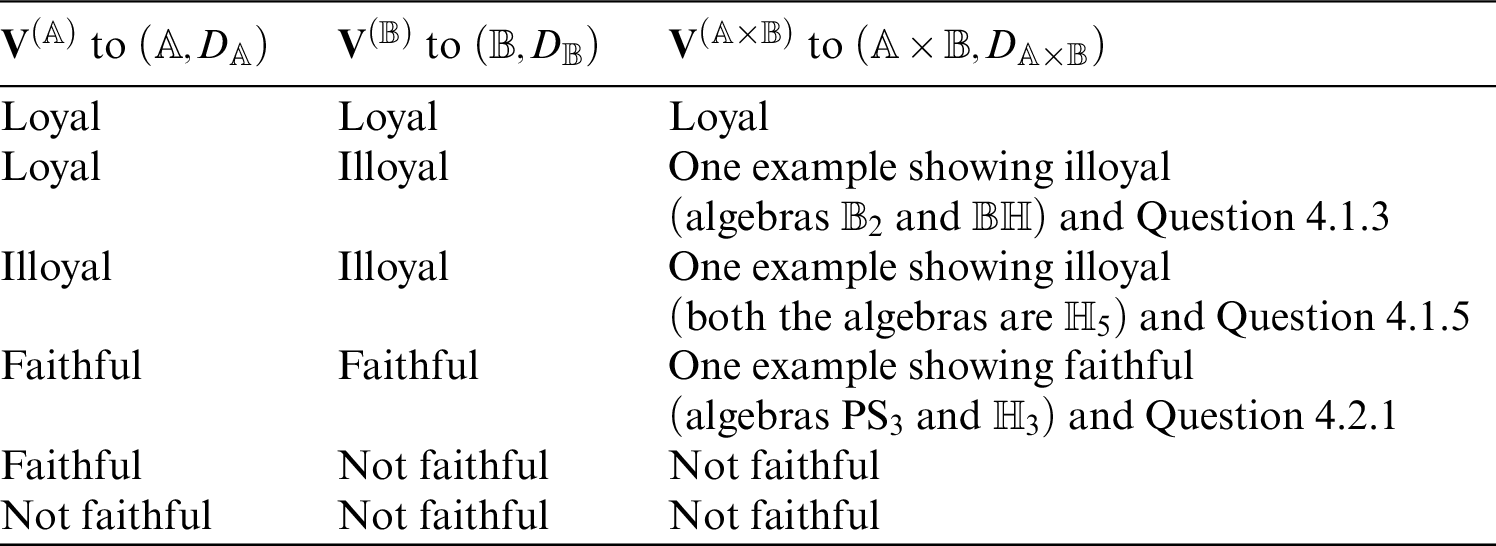
Besides presenting concrete examples of product algebra-valued models, this section presents the first applications of our general method. On the one hand (in Section §4.1), we will continue and deepen the study of the notions of loyalty and faithfulness, introduced in [Reference Löwe, Paßmann and Tarafder12], and we will offer a general characterization of the relation between the logic of a product algebra-valued model and the logics of the component algebras (Table 2). On the other hand (in Section §4.2), we will use the product construction to produce a new example of algebra-valued model which validate a set theory that is both paraconsistent and paracomplete and that still validates the negation free fragments of
 $\mathsf {ZF}$
. This second application will therefore extend the result from [Reference Löwe and Tarafder13], showing that it is possible to validate
 $\mathrm {NFF}$
-
 $\mathsf {ZF}$
in a logical environment that is even weaker than that of
 $\mathrm {PS}_3$
.
4.1 Loyalty and faithfulness with respect to product algebras
In this section we will follow the notations of [Reference Löwe, Paßmann and Tarafder12]. For any two structures
 $\mathcal {U}_1 = \langle \mathbf {U}_1, \Lambda \rangle $
and
 $\mathcal {U}_2 = \langle \mathbf {U}_2, \Lambda \rangle $
having domains
 $\mathbf {U}_1$
and
 $\mathbf {U}_2$
, respectively, and operations corresponding to all the connectives in
 $\Lambda $
, a map
 $f : \mathbf {U}_1 \to \mathbf {U}_2$
is said to be a
 $\Lambda $
-homomorphism if it preserves all the connectives in
 $\Lambda $
. A
 $\Lambda $
-homomorphism f is said to be a
 $\Lambda $
-isomorphism if in addition f is a bijective function. A
 $\Lambda $
-isomorphism from a structure into itself is said to be a
 $\Lambda $
-automorphism.
In Section 2.1, we defined that
 $\mathcal {L}_\Lambda $
is the collection of all propositional formulas and
 $\mathrm {Sent}_{\Lambda ,\in }$
is the collection of all sentences in
 $\mathcal {L}_{\Lambda , \in }$
. Let us now consider any
 $\Lambda $
-algebra
 $\mathbb {A}$
, having domain
 $\mathbf {A}$
. Then, for the structures
 $\langle \mathcal {L}_\Lambda , \Lambda \rangle $
and
 $\mathbb {A}$
, any
 $\Lambda $
-homomorphisms
 $v: \mathcal {L}_\Lambda \to \mathbf {A}$
are called
 $\mathbb {A}$
-assignments. Similarly, consider the two structures
 $\langle \mathcal {L}_\Lambda , \Lambda \rangle $
and
 $\langle \mathrm {Sent}_{\Lambda , \in }, \Lambda \rangle $
;
 $\Lambda $
-homomorphisms
 $T:\mathcal {L}_\Lambda \to \mathrm {Sent}_{\Lambda ,\in }$
are called translations.
For a
 $\Lambda $
-algebra
 $\mathbb {A}$
and a designated set D of
 $\mathbb {A}$
, following the standard way, the propositional logic of
 $(\mathbb {A},D)$
is defined as
 $$ \begin{align*}\mathbf{L}(\mathbb{A},D) := \{\varphi\in\mathcal{L}_\Lambda\,:\,v(\varphi)\in D\mbox{ for all}\ \mathbb{A}\mbox{-assignments}\ v\}.\end{align*} $$
Notice that if
 $\mathbb {B}$
is a Boolean algebra and D is any filter, then
 $\mathbf {L}(\mathbb {B},D) = \mathrm {CPL}$
, the classical propositional logic.
Let
 $\mathbb {A}$
be a
 $\Lambda $
-algebra having domain
 $\mathbf {A}$
and the designated set D. Corresponding to the two structures
 $\langle \mathrm {Sent}_{\Lambda , \in }, \Lambda \rangle $
and
 $\mathbb {A}$
, the map
 $[\kern-1.5pt[ \cdot ]\kern-1.5pt] _{\mathbb {A}}$
restricted over
 $\mathrm {Sent}_{\Lambda , \in }$
,
 $[\kern-1.5pt[ \cdot ]\kern-1.5pt] _{\mathbb {A}} \! \restriction _{\mathrm {Sent}_{\Lambda ,\in }}:\mathrm {Sent}_{\Lambda ,\in }\to \mathbf {A}$
is a
 $\Lambda $
-homomorphism. Following [Reference Löwe, Paßmann and Tarafder12, sec. 2.6], we will define the propositional logic of
 $([\kern-1.5pt[ \cdot ]\kern-1.5pt] _{\mathbb {A}} \! \restriction _{\mathrm {Sent}_{\Lambda ,\in }},D)$
as
 $$ \begin{align*}\mathbf{L}([\kern-1.5pt[\cdot]\kern-1.5pt]_{\mathbb{A}} \! \restriction_{\mathrm{Sent}_{\Lambda,\in}},D) := \{\varphi\in\mathcal{L}_\Lambda\,:\,[\kern-1.5pt[ T(\varphi)]\kern-1.5pt]\in D\mbox{ for all translations}\ T\}.\end{align*} $$
To make the notation more readable, from now on, we will denote
 $\mathbf {L}([\kern-1.5pt[ \cdot ]\kern-1.5pt] _{\mathbb {A}} \! \restriction _{\mathrm {Sent}_{\Lambda ,\in }},D)$
by
 $\mathbf {L}([\kern-1.5pt[ \cdot ]\kern-1.5pt] _{\mathbb {A}},D)$
. Note that, the collection
 $\mathbf {L}([\kern-1.5pt[ \cdot ]\kern-1.5pt] _{\mathbb {A}},D)$
contains all those propositional formulas
 $\varphi $
such that if every propositional variable of
 $\varphi $
is replaced by an arbitrarily chosen set theoretic sentence then the resultant sentence remains valid in
 $\mathbf {V}^{(\mathbb {A})}$
. Intuitively,
 $\mathbf {L}([\kern-1.5pt[ \cdot ]\kern-1.5pt] _{\mathbb {A}},D)$
is the logic of the algebra-valued model
 $\mathbf {V}^{(\mathbb {A})}$
.
It is not hard to check that, for any
 $\Lambda $
-algebra
 $\mathbb {A}$
and a designated set D we have,
 $\mathbf {L}(\mathbb {A},D) \subseteq \mathbf {L}([\kern-1.5pt[ \cdot ]\kern-1.5pt] _{\mathbb {A}},D)$
.
Definition 4.24 [Reference Löwe, Paßmann and Tarafder12].
For a
 $\Lambda $
-algebra
 $\mathbb {A}$
and a designated set D, the map
 $[\kern-1.5pt[ \cdot ]\kern-1.5pt] _{\mathbb {A}}\!\restriction _{\mathrm {Sent}_{\Lambda , \in }}$
is said to be loyal to
 $(\mathbb {A},D)$
if
 $\mathbf {L}(\mathbb {A},D) = \mathbf {L}([\kern-1.5pt[ \cdot ]\kern-1.5pt] _{\mathbb {A}},D)$
.
Intuitively, the loyalty confirms that the logic of an algebra
 $\mathbb {A}$
and the logic of its corresponding algebra-valued model coincide. Hence, abusing notation, sometimes we shall refer to the fact that
 $[\kern-1.5pt[ \cdot ]\kern-1.5pt] _{\mathbb {A}}\!\restriction _{\mathrm {Sent}_{\Lambda ,\in }}$
is loyal to
 $(\mathbb {A}, D)$
by saying that
 $\mathbf {V}^{(\mathbb {A})}$
is loyal to
 $(\mathbb {A}, D)$
.
Although counter-intuitive, it is not the case that for any algebra
 $\mathbb {A}$
the algebra-valued model
 $\mathbf {V}^{(\mathbb {A})}$
is loyal to
 $(\mathbb {A}, D)$
and already at the level of Heyting algebras we find cases of illoyal structures in [Reference Löwe, Paßmann and Tarafder12, sec. 5.2]. For example, consider the Heyting algebra
 $\mathbb {H}_5$
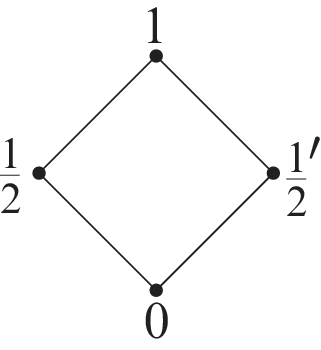
(displayed in Figure 1) of five elements which is the tail stretch of the four-valued Boolean algebra
 $\mathbb {B}_4 = \langle \mathbf {B}, \wedge _{\mathbf {B}}, \vee _{\mathbf {B}}, \Rightarrow _{\mathbf {B}}, ^{*_{\mathbf {B}}}, \mathbf {1}, \mathbf {0} \rangle $
(displayed in Figure 2) by adding one element
 $\mathbf {1}'$
at the top of
 $\mathbb {B}_4$
, where
 .
The structure
 $\mathbb {H}_5$
becomes a complete
 $\Lambda $
-algebra having
 $\mathbf {1}'$
as the top element and
 $\mathbb {B}_4$
as a substructure, where the operator
 $\Rightarrow $
of
 $\mathbb {H}_5$
is defined as follows:
 $$ \begin{align*}a \Rightarrow b := \left\{ \begin{array}{cl} a \Rightarrow_{\mathbf{B}} b & \mbox{if}\ a,b\in \mathbf{B}\ \mbox{such that}\ a\not\leq b,\\ \mathbf{1}' & \mbox{if}\ a,b\in \mathbf{B}\ \mbox{with}\ a\leq b\ \mbox{or if}\ b=\mathbf{1}',\\ b & \mbox{if}\ a=\mathbf{1}',\\ \end{array}\right.\end{align*} $$
One can check that
 $\mathbb {H}_5$
is a Heyting algebra and that
 $\mathbf {V}^{(\mathbb {H}_5)}$
is illoyal to
 $(\mathbb {H}_5, \{\mathbf {1}'\})$
.
The Heyting algebra
 $\mathbb {H}_5$
.

The Boolean algebra
 $\mathbb {B}_4$
.

Definition 4.25 [Reference Löwe, Paßmann and Tarafder12].
For a
 $\Lambda $
-algebra
 $\mathbb {A}$
, the map
 $[\kern-1.5pt[ \cdot ]\kern-1.5pt] _{\mathbb {A}}\!\restriction _{\mathrm {Sent}_{\Lambda ,\in }}$
is said to be faithful to
 $\mathbb {A}$
if for every
 $a\in \mathbf {A}$
, there is
 $\varphi \in \mathrm {Sent}_{\Lambda ,\in }$
such that
 $[\kern-1.5pt[ \varphi ]\kern-1.5pt] = a$
.
To unify the notations of loyalty and faithfulness, the fact that
 $[\kern-1.5pt[ \cdot ]\kern-1.5pt] _{\mathbb {A}}\!\restriction _{\mathrm {Sent}_{\Lambda ,\in }}$
is faithful to
 $\mathbb {A}$
will be expressed by saying that
 $\mathbf {V}^{(\mathbb {A})}$
is faithful to
 $\mathbb {A}$
. Observe that the notion of faithfulness is independent of the choice of the designated set of
 $\mathbb {A}$
.
Theorem 4.26 [Reference Löwe, Paßmann and Tarafder12, lemma 1].
Let
 $\mathbb {A}$
be a
 $\Lambda $
-algebra and D be any designated set. If
 $\mathbf {V}^{(\mathbb {A})}$
is faithful to
 $\mathbb {A}$
, then it is loyal to
 $(\mathbb {A},D)$
.
We shall now explore the loyalty and faithfulness of the product-algebra-valued models depending on the loyalty and faithfulness of the algebra-valued models of the component algebras. In this process we need the following theorem.
Theorem 4.27 [Reference Löwe, Paßmann and Tarafder12, corollary 8].
Let
 $\mathbb {A}$
be a
 $\Lambda $
-algebra having the underlying set
 $\mathbf {A}$
. If there exist an element
 $a \in \mathbf {A}$
and a
 $\Lambda $
-automorphism
 $f : \mathbb {A} \to \mathbb {A}$
such that
 $f(a) \neq a$
, then there does not exist any
 $\varphi \in \mathrm {Sent}_{\Lambda , \in }$
such that
 $[\kern-1.5pt[ \varphi ]\kern-1.5pt] _{\mathbb {A}} = a$
.
4.1.1 Product of algebras corresponding to two loyal models
As expected, the logic of the product-algebra-valued model will be equal to the intersection of the logics of the algebra-valued models of the component algebras.
Theorem 4.28. For any two
 $\Lambda $
-algebras
 $\mathbb {A}$
and
 $\mathbb {B}$
having the designated sets
 $D_{\mathbb {A}}$
and
 $D_{\mathbb {B}}$
, respectively,
 $\mathbf {L}([\kern-1.5pt[ \cdot ]\kern-1.5pt] _{\mathbb {A} \times \mathbb {B}}, D_{\mathbb {A} \times \mathbb {B}}) = \mathbf {L}([\kern-1.5pt[ \cdot ]\kern-1.5pt] _{\mathbb {A}}, D_{\mathbb {A}}) \cap \mathbf {L}([\kern-1.5pt[ \cdot ]\kern-1.5pt] _{\mathbb {B}}, D_{\mathbb {B}})$
.
Proof. For a formula
 $\varphi \in \mathcal {L}_\Lambda $
,
 $\varphi \notin \mathbf {L}([\kern-1.5pt[ \cdot ]\kern-1.5pt] _{\mathbb {A}}, D_{\mathbb {A}}) \cap \mathbf {L}([\kern-1.5pt[ \cdot ]\kern-1.5pt] _{\mathbb {B}}, D_{\mathbb {B}})$
iff there exists a translation
 $T:\mathcal {L}_\Lambda \to \mathrm {Sent}_{\Lambda ,\in }$
such that either
 $[\kern-1.5pt[ T(\varphi ) ]\kern-1.5pt] _{\mathbb {A}} \notin D_{\mathbb {A}}$
or
 $[\kern-1.5pt[ T(\varphi ) ]\kern-1.5pt] _{\mathbb {B}} \notin D_{\mathbb {B}}$
or both iff
 $([\kern-1.5pt[ T(\varphi ) ]\kern-1.5pt] _{\mathbb {A}}, [\kern-1.5pt[ T(\varphi ) ]\kern-1.5pt] _{\mathbb {B}}) \notin D_{\mathbb {A} \times \mathbb {B}}$
iff
 $[\kern-1.5pt[ T(\varphi ) ]\kern-1.5pt] _{\mathbb {A} \times \mathbb {B}} \notin D_{\mathbb {A} \times \mathbb {B}}$
, by Corollary 3.18 iff
 $\varphi \notin \mathbf {L}([\kern-1.5pt[ \cdot ]\kern-1.5pt] _{\mathbb {A} \times \mathbb {B}}, D_{\mathbb {A} \times \mathbb {B}})$
.□
Theorem 4.29. Let
 $\mathbb {A}$
and
 $\mathbb {B}$
be two
 $\Lambda $
-algebras having the designated sets
 $D_{\mathbb {A}}$
and
 $D_{\mathbb {B}}$
, respectively. If
 $\mathbf {V}^{(\mathbb {A})}$
and
 $\mathbf {V}^{(\mathbb {B})}$
are loyal to
 $(\mathbb {A}, D_{\mathbb {A}})$
and
 $(\mathbb {B}, D_{\mathbb {B}})$
, respectively, then
 $\mathbf {V}^{(\mathbb {A} \times \mathbb {B})}$
is loyal to
 $(\mathbb {A} \times \mathbb {B}, D_{\mathbb {A} \times \mathbb {B}})$
.
Proof. We have
 $$ \begin{align*} \mathbf{L}([\kern-1.5pt[\cdot]\kern-1.5pt]_{\mathbb{A} \times \mathbb{B}}, D_{\mathbb{A} \times \mathbb{B}}) & = \mathbf{L}([\kern-1.5pt[\cdot]\kern-1.5pt]_{\mathbb{A}}, D_{\mathbb{A}}) \cap \mathbf{L}([\kern-1.5pt[\cdot]\kern-1.5pt]_{\mathbb{B}}, D_{\mathbb{B}}), \mbox{ by Theorem 4.28.}\\ & = \mathbf{L}(\mathbb{A}, D_{\mathbb{A}}) \cap \mathbf{L}(\mathbb{B}, D_{\mathbb{B}}), \mbox{ since}\ \mathbf{V}^{(\mathbb{A})}\ \mbox{and} \mathbf{V}^{(\mathbb{B})}\ \mbox{are loyal to}\ (\mathbb{A}, D_{\mathbb{A}})\\ & \mbox{ and}\ (\mathbb{B}, D_{\mathbb{B}}),\ \mbox{respectively}\\ & = \mathbf{L}(\mathbb{A} \times \mathbb{B}, D_{\mathbb{A} \times \mathbb{B}}), \mbox{ by the definition of the product algebra}. \end{align*} $$
This completes the proof.□
4.1.2 Product of algebras corresponding to one loyal and one illoyal model
First we shall give examples of two
 $\Lambda $
-algebras
 $\mathbb {A}$
and
 $\mathbb {B}$
such that
 $\mathbf {V}^{(\mathbb {A})}$
is loyal to
 $(\mathbb {A}, D_{\mathbb {A}})$
,
 $\mathbf {V}^{(\mathbb {B})}$
is illoyal to
 $(\mathbb {B}, D_{\mathbb {B}})$
, and
 $\mathbf {V}^{(\mathbb {A} \times \mathbb {B})}$
is illoyal to
 $(\mathbb {A} \times \mathbb {B}, D_{\mathbb {A} \times \mathbb {B}})$
.
Let us first consider the two-valued Boolean algebra
 $\mathbb {B}_2$
. Notice that
 $\mathbf {V}^{(\mathbb {B}_2)}$
is loyal to
 $(\mathbb {B}_2, \{\mathbf {1}\})$
since we have that
 $\mathbf {L}([\kern-1.5pt[ \cdot ]\kern-1.5pt] _{\mathbb {B}_2}, \{\mathbf {1}\}) = \mathrm {CPL} = \mathbf {L}(\mathbb {B}_2, \{\mathbf {1}\})$
, where
 $\mathbf {1}$
is assumed to be the top element of
 $\mathbb {B}_2$
.
Second, consider a four-valued algebra
 such that the operators
 $\wedge , \vee ,$
and
 $\Rightarrow $
are exactly as those of the four-valued Boolean algebra
 $\mathbb {B}_4$
, where
 $\mathbf {1}$
and
 $\mathbf {0}$
are the top and bottom elements of the lattice, respectively, and
 are the two intermediate incomparable values. The unary operator
 $^*$
of
 $\mathbb {BH}$
is defined as follows:
 and
 $\mathbf {0}^* = \mathbf {1}$
. Observe that, there exists a non-trivial automorphism
 $f : \mathbb {BH} \to \mathbb {BH}$
, defined as
 $f(\mathbf {1}) = \mathbf {1}$
,
 $f(\mathbf {0}) = \mathbf {0}$
,
 , and
 . Hence, there is no
 $\varphi \in \mathrm {Sent}_{\Lambda , \in }$
such that
 or
 , by Theorem 4.27 This leads to the fact that the range of
 $[\kern-1.5pt[ \cdot ]\kern-1.5pt] _{\mathbb {BH}}$
is
 $\mathbb {B}_2$
and hence
 $\mathbf {L}([\kern-1.5pt[ \cdot ]\kern-1.5pt] _{\mathbb {BH}}, \{\mathbf {1}\}) = \mathrm {CPL}$
. But for
 $\varphi \in \mathcal {L}_\Lambda $
, the formula
 $\varphi \vee \lnot \varphi \notin \mathbf {L}(\mathbb {BH}, \{\mathbf {1}\})$
, i.e.,
 $\mathbf {L}(\mathbb {BH}, \{\mathbf {1}\}) \subsetneqq \mathbf {L}([\kern-1.5pt[ \cdot ]\kern-1.5pt] _{\mathbb {BH}}, \{\mathbf {1}\})$
. Therefore
 $\mathbf {V}^{(\mathbb {BH})}$
is illoyal to
 $(\mathbb {BH}, \{\mathbf {1}\})$
.
By Theorem 4.28,
 $\mathbf {L}([\kern-1.5pt[ \cdot ]\kern-1.5pt] _{\mathbb {B}_2 \times \mathbb {BH}}, \{(\mathbf {1}, \mathbf {1})\}) = \mathbf {L}([\kern-1.5pt[ \cdot ]\kern-1.5pt] _{\mathbb {B}_2}, \{\mathbf {1}\}) \; \cap \; \mathbf {L}([\kern-1.5pt[ \cdot ]\kern-1.5pt] _{\mathbb {BH}}, \{\mathbf {1}\}) = \mathrm {CPL}$
. But
 $\mathbf {L}(\mathbb {B}_2 \times \mathbb {BH}, \{(\mathbf {1}, \mathbf {1}\}) \neq \mathrm {CPL}$
as
 $\varphi \vee \lnot \varphi \notin \mathbf {L}(\mathbb {B}_2 \times \mathbb {BH}, \{(\mathbf {1}, \mathbf {1})\})$
.
Hence, we get that
 $\mathbf {V}^{(\mathbb {B}_2 \times \mathbb {BH})}$
is illoyal to
 $(\mathbb {B}_2 \times \mathbb {BH}, \{(\mathbf {1}, \mathbf {1})\})$
.
Question 4.1.3. Do there exist
 $\Lambda $
-algebras
 $\mathbb {A}$
and
 $\mathbb {B}$
such that
 $\mathbf {V}^{(\mathbb {A})}$
is loyal to
 $(\mathbb {A}, D_{\mathbb {A}})$
,
 $\mathbf {V}^{(\mathbb {B})}$
is illoyal to
 $(\mathbb {B}, D_{\mathbb {B}})$
, and
 $\mathbf {V}^{(\mathbb {A} \times \mathbb {B})}$
is loyal to
 $(\mathbb {A} \times \mathbb {B}, D_{\mathbb {A} \times \mathbb {B}})$
?
We shall give a partial answer to Question 4.1.3 If there exists a Heyting algebra
 $\mathbb {H}$
such that the intuitionistic propositional logic
 $\mathrm {IPL}$
is complete with respect to
 $\mathbb {H}$
and
 $\mathbf {V}^{(\mathbb {H})}$
is loyal to
 $(\mathbb {H}, \{\mathbf {1}\})$
then the answer to Question 4.1.3 will be affirmative. For such an algebra
 $\mathbb {H}$
, if exists, we have
 $\mathbf {L}([\kern-1.5pt[ \cdot ]\kern-1.5pt] _{\mathbb {H}}, \{\mathbf {1}\}) = \mathbf {L}(\mathbb {H}, \{\mathbf {1}\}) = \mathrm {IPL}$
. Let us one more time consider the Heyting algebra
 $\mathbb {H}_5$
and the
 $\Lambda $
-automorphism
 $f : \mathbb {H}_5 \to \mathbb {H}_5$
, defined as
 $f(\mathbf {1}') = \mathbf {1}', f(\mathbf {1}) = \mathbf {1}$
,
 $f(\mathbf {0}) = \mathbf {0}$
,
 , and
 . By Theorem 4.27, we can conclude that the range of
 $[\kern-1.5pt[ \cdot ]\kern-1.5pt] _{\mathbb {H}_5}\!\restriction \mathrm {Sent}_{\Lambda , \in }$
contains neither
 nor
 , which produces the three-valued Heyting algebra
 $\mathbb {H}_3$
. Hence
 $\mathrm {IPL} \subseteq \mathbf {L}([\kern-1.5pt[ \cdot ]\kern-1.5pt] _{\mathbb {H}_5}, \{\mathbf {1}'\})$
. By our assumption
 $\mathbf {L}([\kern-1.5pt[ \cdot ]\kern-1.5pt] _{\mathbb {H}}, \{\mathbf {1}\}) = \mathbf {L}(\mathbb {H}, \{\mathbf {1}\}) = \mathrm {IPL}$
. So we get
 $$ \begin{align*} \mathbf{L}([\kern-1.5pt[\cdot]\kern-1.5pt]_{\mathbb{H} \times \mathbb{H}_5}, \{(\mathbf{1}, \mathbf{1}')\}) & = \mathbf{L}([\kern-1.5pt[\cdot]\kern-1.5pt]_{\mathbb{H}}, \{(\mathbf{1})\}) \; \cap \; \mathbf{L}([\kern-1.5pt[\cdot]\kern-1.5pt]_{\mathbb{H}_5}, \{\mathbf{1}'\})\\ & = \mathrm{IPL}\\ & = \mathbf{L}(\mathbb{H}, \{(\mathbf{1})\}) \; \cap \; \mathbf{L}(\mathbb{H}_5, \{(\mathbf{1}')\})\\ & = \mathbf{L}(\mathbb{H} \times \mathbb{H}_5, \{(\mathbf{1}, \mathbf{1}')\}). \end{align*} $$
Note that if there exists an illoyal Boolean algebra
 $\mathbb {B}$
then also we get a positive answer to Question 4.1.3 by replacing
 $\mathbb {H}$
and
 $\mathbb {H}_5$
by
 $\mathbb {B}_2$
and
 $\mathbb {B}$
, respectively, in the above argument.
If such Boolean algebra
 $\mathbb {B}$
and Heyting algebra
 $\mathbb {H}$
exist then in addition we shall get
 $\mathbf {V}^{(\mathbb {H} \times \mathbb {H}_5)} \models \mathrm {IZF}$
and
 $\mathbf {V}^{(\mathbb {B}_2 \times \mathbb {B})} \models \mathrm {ZFC}$
. The reason being that for any axiom
 $\varphi $
of
 $\mathrm {IZF}$
,
 $\mathbf {V}^{(\mathbb {H})} \models \varphi $
and
 $\mathbf {V}^{(\mathbb {H}_5)} \models \varphi $
. Hence,
 $\varphi $
belongs to both
 $\mathrm {ValSent}_{\mathbb {H}}$
and
 $\mathrm {ValSent}_{\mathbb {H}_5}$
. This implies that
 $\varphi \in \mathrm {ValSent}_{\mathbb {H}} \cap \mathrm {ValSent}_{\mathbb {H}_5} = \mathrm {ValSent}_{\mathbb {H} \times \mathbb {H}_5}$
, by Observation 3.22 Hence,
 $\mathbf {V}^{(\mathbb {H} \times \mathbb {H}_5)} \models \varphi $
. Similarly, we can show that
 $\mathbf {V}^{(\mathbb {B}_2 \times \mathbb {B})} \models \mathrm {ZFC}$
.
4.1.4 Product of algebras corresponding to two illoyal models
Consider the product algebra
 $\mathbb {H}_5 \times \mathbb {H}_5$
. Notice that the range of
 $[\kern-1.5pt[ \cdot ]\kern-1.5pt] _{\mathbb {H}_5}\!\restriction \mathrm {Sent}_{\Lambda , \in }$
produces the linear three-valued Heyting algebra
 $\mathbb {H}_3$
. So, for any two formulas
 $\varphi , \psi \in \mathcal {L}_\Lambda $
, we have
 $\varphi \to \psi \; \vee \; \psi \to \varphi \in \mathbf {L}([\kern-1.5pt[ \cdot ]\kern-1.5pt] _{\mathbb {H}_5}, \{\mathbf {1}'\})$
. Hence,
 $\varphi \to \psi \; \vee \; \psi \to \varphi \in \mathbf {L}([\kern-1.5pt[ \cdot ]\kern-1.5pt] _{\mathbb {H}_5 \times \mathbb {H}_5}, \{(\mathbf {1}', \mathbf {1}')\})$
. But,
 $\varphi \to \psi \; \vee \; \psi \to \varphi \notin \mathbf {L}(\mathbb {H}_5 \times \mathbb {H}_5, \{(\mathbf {1}', \mathbf {1}')\})$
, since
 $\mathbb {H}_5 \times \mathbb {H}_5$
is not a linear Heyting algebra. Hence,
 $\mathbf {V}^{(\mathbb {H}_5 \times \mathbb {H}_5)}$
is illoyal to
 $\mathbf {L}(\mathbb {H}_5 \times \mathbb {H}_5, \{(\mathbf {1}', \mathbf {1}')\})$
.
Question 4.1.5. Do there exist two
 $\Lambda $
-algebras
 $\mathbb {A}$
and
 $\mathbb {B}$
such that both
 $\mathbf {V}^{(\mathbb {A})}$
and
 $\mathbf {V}^{(\mathbb {B})}$
are illoyal to, respectively,
 $(\mathbb {A}, D_{\mathbb {A}})$
and
 $(\mathbb {B}, D_{\mathbb {B}})$
but such that the product-algebra-valued model
 $\mathbf {V}^{(\mathbb {A} \times \mathbb {B})}$
is loyal to
 $(\mathbb {A} \times \mathbb {B}, D_{\mathbb {A} \times \mathbb {B}})$
?
4.2 The product algebra of a paraconsistent and a Heyting algebra
Notice that
 $\mathrm {PS}_3$
and
 $\mathbb {H}_3$
are two
 $\Lambda $
-algebras, having the same underlying set
 , where the designated sets corresponding to
 $\mathrm {PS}_3$
and
 $\mathbb {H}_3$
are
 and
 $D_{\mathbb {H}_3} = \{\mathbf {1}\}$
, respectively. We shall explore the product algebra
 $\mathrm {PS}_3 \times \mathbb {H}_3$
and its corresponding algebra-valued model. It is proved in [Reference Löwe, Paßmann and Tarafder12] that
 $\mathbf {V}^{(\mathrm {PS}_3)}$
is faithful to
 $\mathrm {PS}_3$
. On the other hand,
 $\mathbf {V}^{(\mathbb {H}_3)}$
is also faithful to
 $\mathbb {H}_3$
:
-
(i)
$[\kern-1.5pt[ \forall x (x = x) ]\kern-1.5pt] _{\mathbb {H}_3} = \mathbf {1}$
, -
(ii)
$[\kern-1.5pt[ \forall x (x \neq x) ]\kern-1.5pt] _{\mathbb {H}_3} = \mathbf {0}$
, and -
(iii)
.


Hence, using Theorem 4.26, one can get the following theorem.
Theorem 4.30. The algebra-valued models
 $\mathbf {V}^{(\mathrm {PS}_3)}$
and
 $\mathbf {V}^{(\mathbb {H}_3)}$
are, respectively, loyal to
 $(\mathrm {PS}_3, D_{\mathrm {PS}_3})$
and
 $(\mathbb {H}_3, D_{\mathbb {H}_3})$
.
The designated set
 $D_{\mathrm {PS}_3 \times \mathbb {H}_3}$
of
 $\mathrm {PS}_3 \times \mathbb {H}_3$
is
 . By Theorem 2.6,
 $\mathbf {L}(\mathrm {PS}_3, D_{\mathrm {PS}_3}) = \mathbb {L}\mathrm {PS}_3 \subsetneqq \mathrm {CPL}$
and
 $\mathbf {L}(\mathrm {PS}_3, D_{\mathrm {PS}_3})$
is paraconsistent. Similarly,
 $\mathbf {L}(\mathbb {H}_3, D_{\mathbb {H}_3}) = \mathrm {IPL} \subsetneqq \mathrm {CPL}$
.
Theorem 4.31.
 $\mathbf {L}(\mathrm {PS}_3 \times \mathbb {H}_3, D_{\mathrm {PS}_3 \times \mathbb {H}_3})$
is neither
 $\mathrm {CPL}$
nor
 $\mathrm {IPL}$
, but it is both paraconsistent and paracomplete.
Proof. It is easy to check that
 $\mathbf {L}(\mathrm {PS}_3 \times \mathbb {H}_3, D_{\mathrm {PS}_3 \times \mathbb {H}_3}) = \mathbf {L}(\mathrm {PS}_3, D_{\mathrm {PS}_3}) \cap \mathbf {L}(\mathbb {H}_3, D_{\mathbb {H}_3})$
. This entails that
 $\mathbf {L}(\mathrm {PS}_3 \times \mathbb {H}_3, D_{\mathrm {PS}_3 \times \mathbb {H}_3})$
is not
 $\mathrm {CPL}$
.
Since, there exist formulas
 $\varphi , \psi \in \mathcal {L}_\Lambda $
such that
 $(\varphi \wedge \lnot \varphi ) \to \psi \notin \mathbf {L}(\mathrm {PS}_3, D_{\mathrm {PS}_3})$
and
 $\varphi \vee \lnot \varphi \notin \mathbf {L}(\mathbb {H}_3, D_{\mathbb {H}_3})$
we get that
 $$ \begin{align*}(\varphi \wedge \lnot \varphi) \to \psi, \; \varphi \vee \lnot \varphi \notin \mathbf{L}(\mathrm{PS}_3 \times \mathbb{H}_3, D_{\mathrm{PS}_3 \times \mathbb{H}_3})\end{align*} $$
as well. Hence,
 $\mathbf {L}(\mathrm {PS}_3 \times \mathbb {H}_3, D_{\mathrm {PS}_3 \times \mathbb {H}_3})$
is both paraconsistent and paracomplete.
On the other hand, we know that for any two formulas
 $\varphi , \psi \in \mathcal {L}_\Lambda $
,
 $(\varphi \wedge \lnot \varphi ) \to \psi $
is a theorem of
 $\mathrm {IPL}$
. Since there exist
 $\varphi , \psi \in \mathcal {L}_\Lambda $
such that
 $(\varphi \wedge \lnot \varphi ) \to \psi \notin \mathbf {L}(\mathrm {PS}_3 \times \mathbb {H}_3, D_{\mathrm {PS}_3 \times \mathbb {H}_3})$
, therefore
 $\mathbf {L}(\mathrm {PS}_3 \times \mathbb {H}_3, D_{\mathrm {PS}_3 \times \mathbb {H}_3})$
is not
 $\mathrm {IPL}$
.□
Observation 4.32.
 $\mathbf {L}(\mathrm {PS}_3 \times \mathbb {H}_3, D_{\mathrm {PS}_3 \times \mathbb {H}_3}) \subsetneqq \mathbf {L}(\mathrm {PS}_3, D_{\mathrm {PS}_3}):$
for any
 $\varphi \in \mathcal {L}_\Lambda $
, the formula
 $\varphi \leftrightarrow \lnot \lnot \varphi $
is an axiom in
 $\mathbb {L}\mathrm {PS}_3 ($
as shown in [Reference Tarafder, Chakraborty, Beziau, Chakraborty and Dutta18]
 $)$
, but
 $\varphi \leftrightarrow \lnot \lnot \varphi \notin \mathbf {L}(\mathrm {PS}_3 \times \mathbb {H}_3, D_{\mathrm {PS}_3 \times \mathbb {H}_3})$
, since
 $\varphi \leftrightarrow \lnot \lnot \varphi \notin \mathbf {L}(\mathbb {H}_3, D_{\mathbb {H}_3})$
.
Hence we can conclude that
 $\mathbf {L}(\mathrm {PS}_3 \times \mathbb {H}_3, D)$
is a paraconsistent logic which is a proper subclass of
 $\mathbf {L}(\mathrm {PS}_3, D_{\mathrm {PS}_3})$
and so it is not a maximal paraconsistent logic with respect to
 $\mathrm {CPL}$
. But still we have the following theorem.
Theorem 4.33.
 $\mathbf {V}^{(\mathrm {PS}_3 \times \mathbb {H}_3)} \models \mathrm {NFF}$
-
 $\mathsf {ZF}$
.
Proof. Both the algebras
 $\mathrm {PS}_3$
and
 $\mathbb {H}_3$
are complete deductive
 $\mathrm {RIA}$
s and
 $\mathrm {NFF}$
-
 $\mathrm {BQ}_\varphi $
holds in both of
 $\mathbf {V}^{(\mathrm {PS}_3)}$
and
 $\mathbf {V}^{(\mathbb {H}_3)}$
. Hence, using Theorem 3.20 we get that
 $\mathbf {V}^{(\mathrm {PS}_3 \times \mathbb {H}_3)} \models \mathrm {NFF}$
-
 $\mathsf {ZF}^-$
. In addition, the
 $\mathsf {Axiom \; of \; Foundation}$
is valid in both
 $\mathbf {V}^{(\mathrm {PS}_3)}$
and
 $\mathbf {V}^{(\mathbb {H}_3)}$
. Hence,
 $\mathbf {V}^{(\mathrm {PS}_3 \times \mathbb {H}_3)} \models \mathsf {Axiom \; of \; Foundation}$
, by Observation 3.22 Combining the results, the proof is complete.□
The logic of the algebra-valued model
 $\mathbf {V}^{(\mathrm {PS}_3 \times \mathbb {H}_3)}$
is not
 $\mathrm {CPL}$
: for
 $\varphi \in \mathcal {L}_\Lambda $
, the formula
 $\varphi \vee \lnot \varphi \notin \mathbf {L}(\mathbb {H}_3, D_{\mathbb {H}_3}) = \mathbf {L}([\kern-1.5pt[ \cdot ]\kern-1.5pt] _{\mathbb {H}_3}, D_{\mathbb {H}_3})$
, which implies
 $\varphi \vee \lnot \varphi \notin \mathbf {L}([\kern-1.5pt[ \cdot ]\kern-1.5pt] _{\mathrm {PS}_3 \times \mathbb {H}_3}, D_{\mathrm {PS}_3 \times \mathbb {H}_3})$
, by Theorem 4.28, but
 $\varphi \vee \lnot \varphi \in \mathrm {CPL}$
.
We can derive from Theorem 4.29 that
 $\mathbf {V}^{(\mathrm {PS}_3 \times \mathbb {H}_3)}$
is loyal to
 $(\mathrm {PS}_3 \times \mathbb {H}_3, D_{\mathrm {PS}_3 \times \mathbb {H}_3})$
, as
 $\mathbf {V}^{(\mathrm {PS}_3)}$
and
 $\mathbf {V}^{(\mathbb {H}_3)}$
are loyal to
 $(\mathrm {PS}_3, D_{\mathrm {PS}_3})$
and
 $(\mathbb {H}_3, D_{\mathbb {H}_3})$
, respectively. We will further show that
 $\mathbf {V}^{(\mathrm {PS}_3 \times \mathbb {H}_3)}$
is faithful to the algebra
 $\mathrm {PS}_3 \times \mathbb {H}_3$
as well.
Theorem 4.34.
 $\mathbf {V}^{(\mathrm {PS}_3 \times \mathbb {H}_3)}$
is faithful to the algebra
 $\mathrm {PS}_3 \times \mathbb {H}_3$
.
Proof. If
 $\gamma := \forall x (x = x)$
then
 $[\kern-1.5pt[ \gamma ]\kern-1.5pt] _{\mathrm {PS}_3 \times \mathbb {H}_3} = (\mathbf {1}, \mathbf {1})$
and
 $[\kern-1.5pt[ \lnot \gamma ]\kern-1.5pt] _{\mathrm {PS}_3 \times \mathbb {H}_3} = (\mathbf {0}, \mathbf {0})$
.
If
 $\varphi := \exists x \; \exists y \; \exists z \; (z \in x \wedge z \notin y \wedge x = y)$
and
 $\psi := (\varphi \wedge \lnot \varphi ) \to \lnot \forall x (x = x)$
then
 $[\kern-1.5pt[ \psi ]\kern-1.5pt] _{\mathrm {PS}_3 \times \mathbb {H}_3} = (\mathbf {0}, \mathbf {1})$
and hence
 $[\kern-1.5pt[ \lnot \psi ]\kern-1.5pt] _{\mathrm {PS}_3 \times \mathbb {H}_3} = (\mathbf {1}, \mathbf {0})$
.
Let
 $\theta := \exists y \forall x (y \in x \vee y \notin x)$
. Then
 . This shows that
 and
 .
Also
 and
 .
Hence we get that
 $[\kern-1.5pt[ \cdot ]\kern-1.5pt] _{\mathrm {PS}_3 \times \mathbb {H}_3}$
is faithful to
 $\mathrm {PS}_3 \times \mathbb {H}_3$
.□
It is not hard to see that if one of the component algebras
 $\mathbb {A}$
(say) is such that
 $\mathbf {V}^{(\mathbb {A})}$
is not faithful to
 $\mathbb {A}$
then the product-algebra-valued model will also not be faithful to the product algebra. But, the following question is still open.
Question 4.2.1. Do there exist two
 $\Lambda $
-algebras
 $\mathbb {A}$
and
 $\mathbb {B}$
such that
 $\mathbf {V}^{(\mathbb {A})}$
and
 $\mathbf {V}^{(\mathbb {B})}$
both are faithful to
 $\mathbb {A}$
and
 $\mathbb {B}$
, respectively, but such that
 $\mathbf {V}^{(\mathbb {A} \times \mathbb {B})}$
is not faithful to
 $\mathbb {A} \times \mathbb {B}$
?
We end Section 4 with Table 2, which displays in one look the loyalty and faithfulness of a product-algebra-valued models.
Loyalty and faithfulness of product algebra-valued model

5 Independence using product algebras
In this section we will use product algebra-valued models to provide independence proofs in non-classical set theories. The backbone of these results is the use of both Boolean and non-Boolean algebras, in order to import the classical independence results to a non-classical setting.
5.1 Sentences which inherit independence from classical set theory
We shall first prove one of the main results of the paper in its most general form and then we will apply it in the context of
 $\mathbb {L}\mathrm {PS}_3$
.
Remark. In this section we shall make a notational distinction between
 $\mathsf {ZF}$
and
 $\mathsf {BZF}$
, in order to distinguish between the system of non-logical axioms of set theory
 $: \mathsf {ZF}$
and the collection of
 $\mathsf {ZF}$
-axioms together with the first order classical logical axioms
 $: \mathsf {BZF}$
.
Theorem 5.35. Let
 $\mathbb {A}$
be a complete
 $\Lambda $
-algebra and
 $\varphi \in \mathrm {Sent}_{\Lambda , \in }$
be such that
-
(i)
$\varphi $
is independent with respect to
$\mathsf {BZF}$
, -
(ii)
$\mathcal {L}_{\Lambda } \subsetneqq \mathrm {CPL}$
, where
$\mathcal {L}_{\Lambda }$
is the corresponding logic of
$\mathbb {A}$
, -
(iii)
$\mathbf {V}^{(\mathbb {A})}$
validates
$\varphi $
and a proper fragment
$\mathsf {T}$
of
$\mathsf {BZF}$
.


Then, there are two algebra-valued models of
 $\mathsf {T}$
, but not of
 $\mathsf {BZF}$
, whose internal logic is
 $\mathcal {L}_{\Lambda }$
and which do not agree on the truth value of
 $\varphi $
.
Proof. Let
 $\mathbb {B}_1, \mathbb {B}_2$
be two Boolean algebras such that
 $\mathbf {V}^{(\mathbb {B}_1)} \models \varphi $
but
 $\mathbf {V}^{(\mathbb {B}_2)} \not \models \varphi $
. We know that
 $D_{\mathbb {A} \times \mathbb {B}_1} = D_{\mathbb {A}} \times D_{\mathbb {B}_1}$
be the designated set of
 $\mathbb {A} \times \mathbb {B}_1$
, where
 $D_{\mathbb {A}}$
and
 $D_{\mathbb {B}_1}$
are the designated sets of
 $\mathbb {A}$
and
 $\mathbb {B}_1$
, respectively. By our assumption,
 $$\begin{align*}[\kern-1.5pt[ \varphi ]\kern-1.5pt]_{\mathbb{A} \times \mathbb{B}_1} = ([\kern-1.5pt[ \varphi ]\kern-1.5pt]_{\mathbb{A}}, [\kern-1.5pt[ \varphi ]\kern-1.5pt]_{\mathbb{B}_1}) \in D,\end{align*}$$
i.e.,
 $\mathbf {V}^{(\mathbb {A} \times \mathbb {B}_1)} \models \varphi $
. On the other hand, since
 $[\kern-1.5pt[ \varphi ]\kern-1.5pt] _{\mathbb {B}_2} \notin D_{\mathbb {B}_2}$
, where
 $D_{\mathbb {B}_2}$
is the designated set of
 $\mathbb {B}_2$
, we can conclude that
 $\mathbf {V}^{( \mathbb {A} \times \mathbb {B}_2)} \not \models \varphi $
. By our assumption we also get that
 $\mathbf {L}(\mathbb {A} \times \mathbb {B}_i, D_{\mathbb {A} \times \mathbb {B}_1}) = \mathcal {L}_{\Lambda } \cap \mathrm {CPL} = \mathcal {L}_{\Lambda },$
for
 $i = 1, 2$
. Moreover, by Observation 3.22 we get that
 $\mathrm {ValSent}_{\mathbb {A} \times \mathbb {B}_i} = \mathrm {ValSent}_{\mathbb {A}} \cap \mathrm {ValSent}_{\mathbb {B}_i}$
, for
 $i = 1, 2$
. Hence, by our assumption,
 $\mathsf {T} \subseteq \mathrm {ValSent}_{\mathbb {A} \times \mathbb {B}_i} \subsetneqq \mathsf {BZF}$
, i.e.,
 $\mathbf {V}^{(\mathbb {A} \times \mathbb {B}_i)} \models \mathsf {T}$
but
 $\mathbf {V}^{(\mathbb {A} \times \mathbb {B}_i)} \not \models \mathsf {BZF}$
, for
 $i = 1, 2$
.□
Notice that the result above shows not only the formal independence of
 $\varphi $
with respect to a proper fragment
 $\mathsf {T}$
of
 $\mathsf {BZF}$
, but also that the independence of
 $\varphi $
is carried out in models that validate only the weaker theory
 $\mathsf {T}$
. Therefore, Theorem 5.35 is telling us more than the trivial observation that independence is preserved in weaker theories.
To get a more concrete sense of this observation, let us consider a theory
 $\mathsf {T}$
which is a proper fragment of both
 $\mathsf {BZF}$
and
 $\mathsf {ZF}$
. In other words, there are axioms of
 $\mathsf {ZF}$
that are not contained in (the deductive closure of)
 $\mathsf {T}$
. To simplify the exposition, let us suppose that this axiomatic difference consists of an axiom
 $\theta $
and consider an algebra
 $\mathbb {A}$
such that the algebra-valued model
 $\mathbf {V}^{(\mathbb {A})}$
validates
 $\mathsf {T}$
and
 $\varphi $
, but not
 $\theta $
, for a sentence
 $\varphi $
as in the proof of Theorem 5.35: i.e., provably independent from
 $\mathsf {BZF}$
using two Boolean algebras
 $\mathbb {B}_1, \mathbb {B}_2$
. Then we get the following:
-
(i)
$\mathbf {V}^{(\mathbb {A} \times \mathbb {B}_1)} \models \mathsf {T}$
and
$\mathbf {V}^{(\mathbb {A} \times \mathbb {B}_2)} \models \mathsf {T}$
, -
(ii)
$\mathbf {V}^{(\mathbb {A} \times \mathbb {B}_1)} \models \varphi $
and
$\mathbf {V}^{(\mathbb {A} \times \mathbb {B}_2)} \not \models \varphi $
, -
(iii)
$\mathbf {V}^{(\mathbb {A} \times \mathbb {B}_1)} \not \models \theta $
and
$\mathbf {V}^{(\mathbb {A} \times \mathbb {B}_2)} \not \models \theta $
.


In this way it is possible to show that the independence of
 $\varphi $
with respect to
 $\mathsf {T}$
does not need the axiom
 $\theta $
(and thus the full strength of
 $\mathsf {ZF}$
). In this sense, Theorem 5.35 can provide a sort of reverse analysis for independence proofs, providing models of weaker theories for independence results.
There is an even stronger version of this phenomenon that is captured by the following definition.
Definition 5.36. Consider a theory
 $\mathsf {T}$
and two sentences
 $\varphi $
and
 $\theta $
in
 $\mathrm {Sent}_{\Lambda , \in }$
. We say that
 $\theta $
is superfluous for the independence of
 $\varphi $
from
 $\mathsf {T}$
if there are four algebra-valued models
 $\mathbf {V}^{(\mathbb {A}_1)}$
,
 $\mathbf {V}^{(\mathbb {B}_1)}$
,
 $\mathbf {V}^{(\mathbb {A}_2)}$
, and
 $\mathbf {V}^{(\mathbb {B}_2)}$
such that
-
(i)
$\mathbf {V}^{(\mathbb {A}_1)} \models \mathsf {T}$
,
$\mathbf {V}^{(\mathbb {A}_1)} \models \varphi $
, and
$\mathbf {V}^{(\mathbb {A}_1)} \models \neg \theta $
, -
(ii)
$\mathbf {V}^{(\mathbb {B}_1)} \models \mathsf {T}$
,
$\mathbf {V}^{(\mathbb {B}_1)} \not \models \varphi $
, and
$\mathbf {V}^{(\mathbb {B}_1)} \models \neg \theta $
. -
(iii)
$\mathbf {V}^{(\mathbb {A}_2)} \models \mathsf {T}$
,
$\mathbf {V}^{(\mathbb {A}_2)} \models \varphi $
, and
$\mathbf {V}^{(\mathbb {A}_2)} \models \theta $
, -
(iv)
$\mathbf {V}^{(\mathbb {B}_2)} \models \mathsf {T}$
,
$\mathbf {V}^{(\mathbb {B}_2)} \not \models \varphi $
, and
$\mathbf {V}^{(\mathbb {B}_2)} \models \theta $
.


Notice that Definition 5.36 can capture a phenomenon that can be recast in syntactic terms. Indeed, if
 $\theta $
is superfluous for the independence of
 $\varphi $
from
 $\mathsf {T}$
, then
 $\varphi $
is actually independent from the theory
 $\mathsf {T} \cup \{\neg \theta \}$
. This observation becomes relevant once
 $\theta $
is taken to be an axiom of
 $\mathsf {ZF}$
. Indeed, in this case,
 $\mathsf {T} \cup \{\neg \theta \}$
is not anymore a fragment of
 $\mathsf {ZF}$
. Therefore, a proof of independence from such a theory represents a result that cannot be obtained using Boolean-valued models.
We will now provide a concrete application of algebra-valued models in the proof of the independence of
 $\mathsf {CH}$
in the context of the logic
 $\mathbb {L}\mathrm {PS}_3$
. We will provide two such proofs. The first uses Theorem 5.35, while the second uses the specific set-theoretical properties of
 $\mathbf {V}^{(\mathrm {PS}_3)}$
. The reason for a second proof is to be found in the possibility to provide a concrete example of the phenomenon captured by Definition 5.36
5.2 The independence of
$\mathsf {CH}$

In this section we offer an important example of independence in non-classical set theory: the independence of
 $\mathsf {CH}$
from a set theory whose underlying logic is
 $\mathbb {L}\mathrm {PS}_3$
. We will provide two proofs of this fact. One using Theorem 5.35 and one using a detailed study of cardinality results in
 $\mathbf {V}^{(\mathrm {PS}_3)}$
. Toward this end we first need to properly define the set theory from which
 $\mathsf {CH}$
will be proved independent.
Definition 5.37. Let
 $\mathbb {A}$
be a complete
 $\Lambda $
-algebra. Then, by
 $\mathbb {A}$
-
 $\mathsf {ZF}$
we mean the fragment of
 $\mathsf {BZF}$
that holds in all algebra-valued models of the form
 $\mathbf {V}^{( \mathbb {A} \times \mathbb {B})}$
, for all complete Boolean algebra
 $\mathbb {B}$
.
In this section, we will work with
 $\mathrm {PS}_3\mbox {-}\mathsf {ZF}$
.
Observation 5.38. We can notice that:
-
(i)
$\mathrm {NFF}$
-
$\mathsf {ZF}$
is included in
$\mathrm {PS}_3\mbox {-}\mathsf {ZF}$
, -
(ii)
$\mathrm {PS}_3\mbox {-}\mathsf {ZF}$
is a proper fragment of
$\mathsf {BZF}$
, and -
(iii)
$\mathrm {PS}_3\mbox {-}\mathsf {ZF}$
is a paraconsistent set theory.


Proof. (i) By Theorem 2.7, we know that
 $\mathbf {V}^{(\mathrm {PS}_3)} \models \mathrm {NFF}$
-
 $\mathsf {ZF}$
. It is also clear that for any complete Boolean algebra
 $\mathbb {B}$
,
 $\mathbf {V}^{(\mathbb {B})} \models \mathrm {NFF}$
-
 $\mathsf {ZF}$
. Hence, we can conclude that
 $\mathbf {V}^{(\mathrm {PS}_3 \times \mathbb {B})} \models \mathrm {NFF}$
-
 $\mathsf {ZF}$
, where
 $\mathbb {B}$
is any complete Boolean algebra.
(ii) Immediate from the definitions of
 $\mathrm {PS}_3\mbox {-}\mathsf {ZF}$
and
 $\mathsf {BZF}$
.
(iii) In Section §3.2, we have already discussed that
 , which implies that
 as well. Now, consider the formula
 $\varphi \in \mathrm {Sent}_{\Lambda , \in }$
as follows:
 $$\begin{align*}\varphi: = (\mathsf{Par} \wedge \neg \mathsf{Par}) \to \bot.\end{align*}$$
Clearly,
 . Hence, independent of the choice of a complete Boolean algebra
 $\mathbb {B}$
, it can be concluded that
 $\mathbf {V}^{(\mathrm {PS}_3 \times \mathbb {B})} \not \models \varphi $
, i.e.,
 $\varphi \notin \mathrm {PS}_3\mbox {-}\mathsf {ZF}$
. Thus, by the definition of paraconsistency, we get that
 $\mathrm {PS}_3\mbox {-}\mathsf {ZF}$
is a paraconsistent set theory.□
The general structure of the proof of the independence of
 $\mathsf {CH}$
from
 $\mathrm {PS}_3\mbox {-}\mathsf {ZF}$
can be summarized as follows. There are two
 $\Lambda $
-algebras
 $\mathbb {A}$
,
 $\mathbb {B}$
, such that the following hold:
-
(i)
$\mathbf {L}(\mathbb {A}, D_{\mathbb {A}}) = \mathbf {L}(\mathbb {B}, D_{\mathbb {B}}) = \mathbb {L}\mathrm {PS}_3$
, -
(ii)
$\mathbf {V}^{(\mathbb {A})} \models \mathrm {PS}_3\mbox {-}\mathsf {ZF}$
,
$\mathbf {V}^{(\mathbb {B})} \models \mathrm {PS}_3\mbox {-}\mathsf {ZF}$
, -
(iii)
$\mathbf {V}^{(\mathbb {A})} \models \varphi $
but
$\mathbf {V}^{(\mathbb {B})} \not \models \varphi $
.


Let us now develop some cardinal notions in
 $\mathbf {V}^{(\mathrm {PS}_3)}$
in order to show that
 $\mathsf {CH}$
is still a meaningful sentence in
 $\mathrm {PS}_3\mbox {-}\mathsf {ZF}$
, which really expresses what we expect it to express.
5.2.1 Cardinality in
$\mathbf {V}^{(\mathrm {PS}_3)}$
and the Continuum Hypothesis

For notational simplicity, let D be the designated set of
 $\mathrm {PS}_3$
. For any
 $u \in \mathbf {V}^{(\mathrm {PS}_3)}$
, the subset
 $\mathrm {dom}_D(u)$
of
 $\mathrm {dom}(u)$
is defined as follows:
 $x \in \mathrm {dom}_D(u)$
iff
 $u(x) \in D$
. It was shown in [Reference Löwe and Tarafder13] that the relation
 $\sim $
, defined as
 $u \sim v$
iff
 $\mathbf {V}^{(\mathrm {PS}_3)} \models u = v$
, is an equivalence relation. Hence,
 $\mathrm {dom}_D(u)$
can be partitioned by
 $\sim $
into equivalent classes. Let
 $\mathrm {Part}(\mathrm {dom}_D(u)) = \mathrm {dom}_D(u)/\sim $
, the quotient (or partition) of
 $\mathrm {dom}_D(u)$
by
 $\sim $
. If
 $\mathrm {InjFunc}(f; x, y), \mathrm {SurjFunc}(f; x, y)$
, and
 $\mathrm {BijFunc}(f; x, y)$
stand for the first order formulas stating that f is an injection, surjection, and bijection from x into y, respectively, then the following theorem holds.
Theorem 5.39 [Reference Tarafder17].
If
 $\mathbf {V}$
is a model of
 $\mathsf {ZFC}$
, then for any two elements
 $u, v \in \mathbf {V}^{(\mathrm {PS}_3)}$
,
-
(i) there exists an injection between
$\mathrm {Part}(\mathrm {dom}_D(u))$
and
$\mathrm {Part}(\mathrm {dom}_D(v))$
in
$\mathbf {V}$
if and only if
$\mathbf {V}^{(\mathrm {PS}_3)} \models \exists f \mathrm {InjFunc}(f; x, y)$
, -
(ii) there exists a surjection between
$\mathrm {Part}(\mathrm {dom}_D(u))$
and
$\mathrm {Part}(\mathrm {dom}_D(v))$
in
$\mathbf {V}$
if and only if
$\mathbf {V}^{(\mathrm {PS}_3)} \models \exists f \mathrm {SurjFunc}(f; x, y)$
, -
(iii) there exists a bijection between
$\mathrm {Part}(\mathrm {dom}_D(u))$
and
$\mathrm {Part}(\mathrm {dom}_D(v))$
in
$\mathbf {V}$
if and only if
$\mathbf {V}^{(\mathrm {PS}_3)} \models \exists f \mathrm {BijFunc}(f; x, y)$
.


Let us denote
 $\mathrm {ORD}$
as the class of all ordinal numbers in
 $\mathbf V$
. Then for each
 $\alpha \in \mathrm {ORD}$
the
 $\alpha $
-like elements in
 $\mathbf {V}^{(\mathrm {PS}_3)}$
are defined by transfinite recursion as follows.
Definition 5.40 [Reference Tarafder, Banerjee and Krishna16].
An element
 $x \in \mathbf {V}^{(\mathrm {PS}_3)}$
is called:
-
(i)
$0$
-like if
$x(y) = \mathbf {0}$
for any
$y \in \mathrm {dom}(x)$
, -
(ii)
$\alpha $
-like for some
$\alpha \in \mathrm {ORD}$
if for each
$\beta \in \alpha $
there exists
$y \in \mathrm {dom}(x)$
which is
$\beta $
-like and
, and for any
$z \in \mathrm {dom}(x)$
if it is not
$\beta $
-like for any
$\beta \in \alpha $
then
$x(z) = \mathbf {0}$
, -
(iii) ordinal-like if it is
$\alpha $
-like, for some
$\alpha \in \mathrm {ORD}$
.


Let
 $\mathsf {Ord}(x)$
be the first order formula in
 $\mathcal {L}_{\Lambda , \in }$
, naively states that x is an ordinal number. Then we have the following theorem.
Theorem 5.41 [Reference Tarafder, Banerjee and Krishna16, theorem 13].
Let
 $\alpha \in \mathrm {ORD}$
and u be an
 $\alpha $
-like element in
 $\mathbf {V}^{(\mathrm {PS}_3)}$
. Then
 $\mathbf {V}^{(\mathrm {PS}_3)} \models \mathsf {Ord}(u)$
.
Theorem 5.42 [Reference Tarafder17].
Let
 $u \in \mathbf {V}^{(\mathrm {PS}_3)}$
be any element and
 $\kappa $
be the cardinality of
 $\mathrm {Part}(\mathrm {dom}_D(u))$
in
 $\mathbf {V}$
, a model of
 $\mathsf {ZFC}$
. Then in
 $\mathbf {V}^{(\mathrm {PS}_3)}$
, there exist bijections between u and
 $\kappa $
-like elements, but there does not exist any bijection between u and any
 $\alpha $
-like element, where
 $\alpha < \kappa $
in
 $\mathbf {V}$
.
Proof. Follows from Theorem 5.39.□
Let
 $\mathsf {Card}(x)$
be the first order formula expressing that ‘x is a cardinal number’. Then, for a given
 $u \in \mathbf {V}^{(\mathrm {PS}_3)}$
, consider the following collection of names of the cardinal number of u in
 $\mathbf {V}^{(\mathrm {PS}_3)}$
:
 $$\begin{align*}\mathsf{Cardinal}_u := \{v \in \mathbf{V}^{(\mathrm{PS}_3)}: \mathbf{V}^{(\mathrm{PS}_3)} \models \mathsf{Card}(v) \wedge \exists f \mathrm{BijFunc}(f;u, v)\}.\end{align*}$$
Any element of
 $\mathsf {Cardinal}_u$
will be called a name of the cardinal number of u or simply a cardinal number of u in
 $\mathbf {V}^{(\mathrm {PS}_3)}$
.
For each
 $x \in \mathbf V$
, let us define an element
 $\hat {x}$
of
 $\mathbf {V}^{(\mathbb {A})}$
recursively as:
 $\hat {\varnothing } = \varnothing $
and
 $\hat {x} = \{\langle \hat {y}, \mathbf {1} \rangle : y \in x\}$
. It is proved in [Reference Tarafder17] that, if
 $u \in \mathbf {V}^{(\mathrm {PS}_3)}$
is an element such that the cardinality of
 $\mathrm {Part}(\mathrm {dom}_D(u))$
in
 $\mathbf {V}$
is
 $\kappa $
, then
 $\mathsf {Cardinal}_u$
is the class of all
 $\kappa $
-like elements and hence, in particular,
 $\hat {\kappa } \in \mathsf {Cardinal}_u$
. Moreover, for any two elements
 $u,v \in \mathbf {V}^{(\mathrm {PS}_3)}$
,
 $\mathbf {V}^{(\mathrm {PS}_3)} \models \exists f \mathrm {BijFunc}(f;u, v)$
if and only if
 $\mathsf {Cardinal}_u = \mathsf {Cardinal}_v$
.
Definition 5.43 [Reference Tarafder17].
For two elements
 $u, v \in \mathbf {V}^{(\mathrm {PS}_3)}$
, it will be said that the cardinality of u is less than the cardinality of v, denoted by
 $|u|_{\mathbf {V}^{(\mathrm {PS}_3)}} < |v|_{\mathbf {V}^{(\mathrm {PS}_3)}}$
, if for any
 $p \in \mathsf {Cardinal}_u$
and
 $q \in \mathsf {Cardinal}_v$
,
 $\mathbf {V}^{(\mathrm {PS}_3)} \models p \in q$
.
In [Reference Tarafder17], it is proved that for any pair
 $u, v \in \mathbf {V}^{(\mathrm {PS}_3)}$
, not only the notion of
 $|u|_{\mathbf {V}^{(\mathrm {PS}_3)}} < |v|_{\mathbf {V}^{(\mathrm {PS}_3)}}$
is well-defined, but also that
 $|u|_{\mathbf {V}^{(\mathrm {PS}_3)}} < |v|_{\mathbf {V}^{(\mathrm {PS}_3)}}$
holds if and only if
 $\mathbf {V}^{(\mathrm {PS}_3)} \models \exists f \mathrm {InjFunc}(f;u, v) \mbox { but } \mathbf {V}^{(\mathrm {PS}_3)} \not \models \exists f \mathrm {InjFunc}(f;v, u)$
.
Theorem 5.44 [Reference Tarafder17].
For a model
 $\mathbf {V}$
of
 $\mathsf {ZFC}$
,
 $\mathbf {V} \models \mathsf {CH}$
if and only if
 $\mathbf {V}^{(\mathrm {PS}_3)} \models \mathsf {CH}$
.
Proof. Let
 $\mathbf {V} \models \mathsf {CH}$
. Suppose
 $u \in \mathbf {V}^{(\mathbb {A})}$
be an
 $\omega $
-like element and
 $v \in \mathbf {V}^{(\mathrm {PS}_3)}$
be a name for the power set of u in
 $\mathbf {V}^{(\mathrm {PS}_3)}$
. Then, it can be proved that
 $\hat {\aleph }_0 \in \mathsf {Cardinal}_u$
and
 $\hat {(2^{\aleph _0})} \in \mathsf {Cardinal}_v$
. If there exist
 $s \in \mathbf {V}^{(\mathrm {PS}_3)}$
such that
 $|u|_{\mathbf {V}^{(\mathrm {PS}_3)}} < |s|_{\mathbf {V}^{(\mathrm {PS}_3)}} < |v|_{\mathbf {V}^{(\mathrm {PS}_3)}}$
and
 $\hat {\kappa } \in \mathsf {Cardinal}_s$
, where
 $\kappa $
is a cardinal number in
 $\mathbf {V}$
, then we can conclude that
 $\hat {\aleph }_0 \in \hat {\kappa } \in \hat {(2^{\aleph _0})}$
holds in
 $\mathbf {V}^{(\mathrm {PS}_3)}$
. Hence,
 $\aleph _0 < \kappa < 2^{\aleph _0}$
holds in
 $\mathbf {V}$
, which contradicts our assumption
 $\mathbf {V} \models \mathsf {CH}$
.
Conversely, suppose
 $\mathbf {V} \not \models \mathsf {CH}$
. Then there exists a cardinal number
 $\kappa $
in
 $\mathbf {V}$
such that
 $\aleph _0 < \kappa < 2^{\aleph _0}$
. Hence,
 $\hat {\aleph }_0 \in \hat {\kappa } \in \hat {(2^{\aleph _0})}$
holds in
 $\mathbf {V}^{(\mathrm {PS}_3)}$
, which implies that
 $\mathbf {V}^{(\mathrm {PS}_3)} \not \models \mathsf {CH}$
.□
We are now in the position to state the independence result for
 $\mathsf {CH}$
.
Theorem 5.45. There are two algebra-valued models of
 $\mathrm {PS}_3\mbox {-}\mathsf {ZF}$
, and not of
 $\mathsf {BZF}$
, which do not agree on the validity of
 $\mathsf {CH}$
, thus showing the independence of
 $\mathsf {CH}$
from
 $\mathrm {PS}_3\mbox {-}\mathsf {ZF}$
.
Proof. Let
 $\mathbb {B}_1, \mathbb {B}_2$
be two Boolean algebras such that
 $\mathbf {V}^{(\mathbb {B}_1)} \models \mathsf {CH}$
and
 $\mathbf {V}^{(\mathbb {B}_2)} \not \models \mathsf {CH}$
and, without loss of generality, let us assume that
 $\mathbf {V} \models \mathsf {CH}$
(if not, i.e.,
 $\mathbf {V} \models \neg \mathsf {CH}$
, we just need to switch the role of
 $\mathbb {B}_1$
and
 $\mathbb {B}_2$
in the rest of the proof). Then using Theorems 5.35 and 5.44 we can conclude that:
-
(i)
$\mathbf {L}(\mathrm {PS}_3 \times \mathbb {B}_1, D_{\mathrm {PS}_3 \times \mathbb {B}_1}) = \mathbf {L}(\mathrm {PS}_3 \times \mathbb {B}_2, D_{\mathrm {PS}_3 \times \mathbb {B}_2}) = \mathbb {L}\mathrm {PS}_3$
, -
(ii)
$\mathbf {V}^{(\mathrm {PS}_3 \times \mathbb {B}_1)} \models \mathrm {PS}_3\mbox {-}\mathsf {ZF}$
,
$\mathbf {V}^{(\mathrm {PS}_3 \times \mathbb {B}_2)} \models \mathrm {PS}_3\mbox {-}\mathsf {ZF}$
, and -
(iii)
$\mathbf {V}^{(\mathrm {PS}_3 \times \mathbb {B}_1)} \models \mathsf {CH}$
, but
$\mathbf {V}^{(\mathrm {PS}_3 \times \mathbb {B}_2)} \not \models \mathsf {CH}$
.


Then, remember that
 $\mathsf {Sep}$
is the instance of the
 $\mathsf {Separation\ Axiom}$
schema that, as shown in Theorem 2.8, fails in
 $\mathbf {V}^{(\mathrm {PS}_3)}$
. Because of the coordinate-wise definition of validity in product algebras, we get that
 $\mathbf {V}^{(\mathrm {PS}_3 \times \mathbb {B}_1)}\not \models \mathsf {Sep}$
and
 $\mathbf {V}^{(\mathrm {PS}_3 \times \mathbb {B}_2)}\not \models \mathsf {Sep}$
. Hence
 $\mathbf {V}^{(\mathrm {PS}_3 \times \mathbb {B}_1)}$
and
 $\mathbf {V}^{(\mathrm {PS}_3 \times \mathbb {B}_2)}$
are two algebra-valued models of
 $\mathrm {PS}_3\mbox {-}\mathsf {ZF}$
, but not of
 $\mathsf {BZF}$
, witnessing the independence of
 $\mathsf {CH}$
.□
It is possible to improve Theorem 5.45 by providing a more direct proof of the independence of
 $\mathsf {CH}$
that uses only the ability to transfer cardinal properties from
 $\mathbf {V}$
to
 $\mathbf {V}^{(\mathrm {PS}_3)}$
.
Theorem 5.46.
 $\mathsf {CH}$
is independent from
 $\mathrm {NFF}$
-
 $\mathsf {ZF}\cup \{\neg \mathsf {Sep}\}$
.
Proof. It is sufficient to consider two classical models of
 $\mathsf {ZFC}$
,
 $\mathbf {V}_1$
and
 $\mathbf {V}_2$
such that
 $\mathbf {V}_1 \models \mathsf {CH}$
and
 $\mathbf {V}_2 \models \neg \mathsf {CH}$
and then to build an algebra-valued model with values in
 $\mathrm {PS}_3$
over each of these two classical structures, say
 $\mathbf {V}_1^{(\mathrm {PS}_3)}$
and
 $\mathbf {V}_2^{(\mathrm {PS}_3)}$
. Then, because the validity of Theorem 2.7 only depends on the fact that the ground model satisfies
 $\mathsf {ZFC}$
, we get that both
 $\mathbf {V}_1^{(\mathrm {PS}_3)}$
and
 $\mathbf {V}_2^{(\mathrm {PS}_3)}$
validate
 $\mathrm {NFF}$
-
 $\mathsf {ZF}$
. Moreover, Theorem 2.8 can be applied in both
 $\mathbf {V}_1^{(\mathrm {PS}_3)}$
and
 $\mathbf {V}_2^{(\mathrm {PS}_3)}$
to provide the validity of
 $\neg \mathsf {Sep}$
. Finally, Theorem 5.44 yields
 $\mathbf {V}_1^{(\mathrm {PS}_3)} \models \mathsf {CH}$
and
 $\mathbf {V}_2^{(\mathrm {PS}_3)} \not \models \mathsf {CH}$
.□
Notice that Theorem 5.46 states the independence of
 $\mathsf {CH}$
with respect to
 $\mathrm {NFF}$
-
 $\mathsf {ZF}\cup \{\neg \mathsf {Sep}\}$
and not
 $\mathrm {PS}_3\mbox {-}\mathsf {ZF}\cup \{\neg \mathsf {Sep}\}$
. The reason is that the theory of an algebra-valued model based on
 $\mathrm {PS}_3$
depends on the theory of the ground model (as shown in Theorem 5.44). Our definition of
 $\mathrm {PS}_3\mbox {-}\mathsf {ZF}$
is given in terms of (the real)
 $\mathbf {V}$
as the ground model, but nothing forbids us to define a similar theory in terms of a different ground model. It is unknown to the authors if the definition of
 $\mathrm {PS}_3\mbox {-}\mathsf {ZF}$
is invariant on the choice of a ground model.Footnote
8
For this reason we decided to state Theorem 5.46 in terms of
 $\mathrm {NFF}$
-
 $\mathsf {ZF}$
. However, we should remark that the proof of Theorem 5.46 yields the independence of
 $\mathsf {CH}$
from the theory that is stronger than
 $\mathrm {NFF}$
-
 $\mathsf {ZF}\cup \{\neg \mathsf {Sep}\}$
, namely,
 $Th_\in (\mathbf {V}_1^{(\mathrm {PS}_3)}) \cap Th_\in (\mathbf {V}_2^{(\mathrm {PS}_3)})$
, where
 $Th_\in (\mathcal {M})$
is the theory (in the model theoretic sense) of
 $\mathcal {M}$
, in the signature of the pure language of set theory i.e., of
 $\mathcal {L}_{\Lambda , \in }$
.
Now, considering that
 $\mathsf {CH}$
is independent from
 $\mathsf {BZF}$
, using the standard Cohen construction, we get the following corollary.
Corollary 5.47. There are instances of
 $\mathsf {Separation\ Axiom}$
that are superfluous for the proof of independence of
 $\mathsf {CH}$
from
 $\mathrm {NFF}$
-
 $\mathsf {ZF}$
.
The example of
 $\mathsf {CH}$
has given an example of the preservation of independence from the classical to the non-classical case. We now turn to the study of set theoretic sentences which are only independent with respect to proper fragments of
 $\mathsf {BZF}$
.
5.3 Sentences independent from non-classical set theory only
Let
 $\mathbb {A}$
be a
 $\Lambda $
-algebra and recall that, by definition,
 $\mathbb {A}$
-
 $\mathsf {ZF}$
is a first order fragment of
 $\mathsf {BZF}$
. The second main result of the paper states the following.
Theorem 5.48. If
 $\mathbf {V}^{(\mathbb {A})}$
is an algebra-valued model of set theory and
 $\varphi \in \mathrm {Sent}_{\Lambda , \in }$
is a formula such that one of the following two
 $($
exclusive
 $)$
conditions holds:
-
(i)
$\mathbf {V}^{(\mathbb {A})} \models \varphi $
but
$\mathsf {BZF} \models \neg \varphi $
, -
(ii)
$\mathbf {V}^{(\mathbb {A})} \not \models \varphi $
but
$\mathsf {BZF} \models \varphi $
.


Then,
 $\varphi $
is independent from
 $\mathbb {A}$
-
 $\mathsf {ZF}$
but not from
 $\mathsf {BZF}$
.
Proof. (i) Suppose
 $\mathbf {V}^{(\mathbb {A})} \models \varphi $
but
 $\mathsf {BZF} \models \neg \varphi $
. For any complete Boolean algebra
 $\mathbb {B}$
,
 $\mathbf {V}^{(\mathbb {A} \times \mathbb {B})} \models \mathbb {A}$
-
 $\mathsf {ZF}$
and also
 $\mathbf {V}^{(\mathbb {A})} \models \mathbb {A}$
-
 $\mathsf {ZF}$
. Then by the assumption,
 $\mathbb {A}$
-
 $\mathsf {ZF}$
has an algebra-valued model
 $\mathbf {V}^{(\mathbb {A})}$
which validates
 $\varphi $
. However, since
 $\mathsf {BZF}$
is preserved in every Boolean-valued model,
 $\mathbf {V}^{(\mathbb {A} \times \mathbb {B})}\not \models \varphi $
.
(ii) Suppose
 $\mathbf {V}^{(\mathbb {A})} \not \models \varphi $
but
 $\mathsf {BZF} \models \varphi $
. Then, for any complete Boolean algebra
 $\mathbb {B}$
,
 $\mathbf {V}^{(\mathbb {B})} \models \varphi $
and
 $\mathbf {V}^{(\mathbb {A} \times \mathbb {B})} \not \models \varphi $
. But notice that, since
 $\mathbb {A}$
-
 $\mathsf {ZF} \subseteq \mathsf {BZF}$
, we have that both of
 $\mathbf {V}^{(\mathbb {B})}$
and
 $\mathbf {V}^{(\mathbb {A} \times \mathbb {B})}$
are algebra-valued models of
 $\mathbb {A}$
-
 $\mathsf {ZF}$
.□
Notice that there is a small difference between the two possibilities described in Theorem 5.48 Indeed, while in the proof of (i) both models witnessing the independence of
 $\varphi $
are only models of the smaller theory
 $\mathbb {A}$
-
 $\mathsf {ZF}$
, this is not the case anymore in (ii). As a matter of fact, in (ii) we need to resort to a classical Boolean-valued model, which being a model of
 $\mathsf {BZF}$
is a fortiori a model of
 $\mathbb {A}$
-
 $\mathsf {ZF}$
. However, it is important to stress the importance of (ii) from a more conceptual perspective, since it shows that the strength of a stronger theory is only a matter of solving independence from the perspective of a weaker theory.
The following examples are few applications of Theorem 5.48
Example 5.3.1. Let us one more time consider the proper fragment
 $\mathrm {PS}_3\mbox {-}\mathsf {ZF}$
of
 $\mathsf {BZF}$
and the sentence
 $\mathsf {Par} \in \mathrm {Sent}_{\Lambda , \in }$
. Since
 ,
 $\mathbf {V}^{(\mathrm {PS}_3)} \models \mathsf {Par}$
. But clearly
 $\mathsf {BZF} \vdash \neg \mathsf {Par}$
. Using the condition (i) of Theorem 5.48, we get that
 $\mathsf {Par}$
is independent from
 $\mathrm {PS}_{3}\mbox {-}\mathsf {ZF}$
but not from
 $\mathsf {BZF}$
.
Example 5.3.2. To produce another example using the sentence
 $\mathsf {Par}$
, let us consider the formula
 $$\begin{align*}\mathsf{SB}(x, y) := \big{(}\exists f \mathrm{InjFunc}(f; x, y) \wedge \exists g \mathrm{InjFunc}(g; y, x)\big{)} \to \exists h \mathrm{BijFunc}(h; x, y).\end{align*}$$
Intuitively
 $\mathsf {SB}(x,y)$
states that ‘if there exists an injective function from x into y and an injective function from y into x then there exists a bijective function from x onto y’. By the Schröder–Bernstein theorem we know that
 $\mathbf {V} \models \forall x \forall y \mathsf {SB}(x,y)$
. In [Reference Tarafder17], it is proved that
 $\mathbf {V}^{(\mathrm {PS}_3)} \models \forall x \forall y \mathsf {SB}(x,y)$
. Hence, considering the formula
 $$\begin{align*}\varphi := \exists x \exists y \exists z \big{(} z \in x \wedge \neg(z \in y) \wedge x = y \wedge \mathsf{SB}(x,y)\big{)},\end{align*}$$
we get that
 $\mathbf {V}^{(\mathrm {PS}_3)} \models \varphi $
but clearly
 $\mathsf {BZF} \vdash \neg \varphi $
. Hence,
 $\varphi $
is independent from
 $\mathrm {PS}_3\mbox {-}\mathsf {ZF}$
but not from
 $\mathsf {BZF}$
, by using the condition (i) of Theorem 5.48. However, notice that,
 $\mathbf {V}^{(\mathrm {PS}_3 \times \mathbb {B})} \models \forall x \forall y \mathsf {SB}(x,y)$
, for any complete Boolean algebra
 $\mathbb {B}$
. Hence, we have
 $\forall x \forall y \mathsf {SB}(x,y) \in \mathrm {PS}_3$
-
 $\mathsf {ZF}$
, which shows that
 $\forall x \forall y \mathsf {SB}(x,y)$
is not independent from
 $\mathrm {PS}_3$
-
 $\mathsf {ZF}$
.
Example 5.3.3. Let us consider the formula
 $\mathsf {Sep}$
. We know that
 $[\kern-1.5pt[ \mathsf {Sep} ]\kern-1.5pt] _{\mathrm {PS}_3} = \mathbf {0}$
, by Theorem 2.8 Hence,
 $\mathbf {V}^{(\mathrm {PS}_3)} \not \models \mathsf {Sep}$
. In addition, we get
 $\mathsf {BZF} \models \mathsf {Sep}$
, as
 $\mathsf {Sep}$
is an instance of the
 $\mathsf {Separation\ Axiom}$
. Therefore, by using condition
 $($
ii
 $)$
of Theorem 5.48, it can be concluded that
 $\mathsf {Sep}$
is independent from
 $\mathrm {PS}_3$
-
 $\mathsf {ZF}$
but not from
 $\mathsf {BZF}$
.
Example 5.3.4. Consider the three-valued Heyting algebra
 $\mathbb {H}_3$
. We will provide an example of a set theoretic sentence which is independent from the proper fragment
 $\mathbb {H}_3$
-
 $\mathsf {ZF}$
of
 $\mathsf {BZF}$
, but not from
 $\mathsf {BZF}$
. Let
 $\varphi \in \mathrm {Sent}_{\Lambda , \in }$
be the formula which intuitively states that ‘if
 $\kappa $
is the cardinal number of a set, then
 $2^{\kappa }$
is the cardinal number of its power set’. It is well-known that, in
 $\mathsf {IZF}$
, the cardinality of the power set of a singleton set cannot be
 $2 ($
since this would imply the Law of Excluded Middle
 $)$
. Using this fact, we can prove that
 $\mathbf {V}^{(\mathbb {H}_3)} \not \models \varphi $
. However, we know that
 $\mathsf {BZF} \models \varphi $
. Hence, by the condition
 $($
ii
 $)$
of Theorem 5.48,
 $\varphi $
is independent from
 $\mathbb {H}_3$
-
 $\mathsf {ZF}$
, but not from
 $\mathsf {BZF}$
.
6 Classical vs. non-classical multiverses
We are now in a position to reflect on the philosophical import of the results of this paper. In these pages we introduced a technique that allows us to extend the scope of independence to non-classical contexts. But did we make the puzzles surrounding independence even broader? In other terms, by extending forcing-like constructions to non-classical logic, did we strengthen independence in set theory? In order to address these questions we need, first, to recall the recent debate on the foundations of set theory and, then, to explain the effect of our results for this discussion. Toward this end we will clarify to what extent the structures built in this paper can be seen as non-classical models of set theory.
One of the many effects that the introduction of forcing brought to set theory was the proliferation of the models of
 $\mathsf {ZFC}$
. This had the consequence to put into question the foundational role of set theory and it sustained a more algebraic approach to its models. Therefore, these structures started to be investigated for their own sake and not necessarily with the aim to settle, once and for all, questions like the Continuum Problem. The sharp contrast of this algebraic perspective with the classical role of set theory as a foundations for mathematics generated a heated debate on the role and the goal of set theory. Recently, this debate took the form of a contraposition between two alternative positions: universism vs. multiversism.
The main point of disagreement between universism and multiversism lays in the interpretation of the independence phenomenon. For the universist, independence is seen as a defect of our theory of sets to capture truth, whereas for the multiversist it is a natural phenomenon corresponding to the way things really are and that, although witnessing the limits of the axiomatic approach, it nonetheless testifies the richness of a set theoretical semantics. A possible way to overcome the weakness of the axiomatic side consists in fulfilling Gödel’s program which consists in extending
 $\mathsf {ZFC}$
with justified new axioms able to capture the truth in
 $\mathbf {V}$
.Footnote
9
Contrary to this proposal, multiversists maintain that there is not a unique universe of sets, but a plurality of universes (a multiverse), each with its own right of existence and expression. Consequently, truth in set theory is taken, by the multiversists, to be the study of the truths of the different universes.
An important point, relevant for the present discussion, is that the choice of the models that compose a multiverse is also up for discussion. Indeed, we find in the literature different views on the composition of the multiverse, from more restrictive ones that only include generic extensions of countable transitive models of
 $\mathsf {ZFC}$
(e.g., [Reference Woodin, Woodin and Heller21]), to more liberal ones that allow also ill-founded models (e.g., [Reference Hamkins7]).Footnote
10
However, one aspect that seems to be fairly agreed upon is that the elements of the multiverse should be models of set theory. Thus, the variability of the parameters that occur in the definition of a multiverse is found in the choice of the techniques allowed to construct models and in the choice of the theories of sets validated in these models. Consequently, we might wonder whether and to what extend the algebra-valued models produced in this paper can enrich a multiverse perspective.
In order to address this point we first need to clarify in which sense an algebra-valued model is a model. As a matter of fact, stricto sensu, an algebra-valued model is a definable class and not a model, since its domain is not a set. This aspect is normally overcome, in the classical case, by quotienting a structure
 $\mathbf {V}^{(\mathbb {B})}$
by a filter
 $G \subseteq \mathbb {B}$
and thus by identifying two elements
 $x, y \in \mathbf {V}^{(\mathbb {B})}$
, whenever the truth value of their equality is in G: i.e.,
 $[\kern-1.5pt[ x = y ]\kern-1.5pt] _{\mathbb {B}} \in G$
. This process then allows us to reduce Boolean-valued models to generic extensions obtained by forcing. However, this identification is far from straightforward. As discussed in Section §3.3, Boolean-valued models represent only blueprints for possible (even incompatible) models of
 $\mathsf {ZFC}$
. It is only after quotienting a Boolean-valued model by means of an ultrafilter that one of these possibilities is realized. In this sense, every Boolean-valued model represents a small multiverse in itself. This observation seems to sustain the idea of using Boolean-valued models, and more in general algebra-valued models, to define a corresponding multiverse. But there is caveat. Is this quotient construction available in a non-classical setting? Is it possible to turn an algebra-valued model into a bona fide model of set theory? And is this a necessary condition for a semantic structure to be rightfully considered a member of a multiverse?
With respect to these questions we have, in turn, a negative answer, a positive one, and a proposal. Let us start with the negative part. In order to obtain a well-behaved quotient structure
 $\mathbf {V}^{(\mathbb {A})} / G$
from an algebra-valued model
 $\mathbf {V}^{(\mathbb {A})}$
(one that for example satisfies Łos Theorem), we normally need
 $\mathbf {V}^{(\mathbb {A})}$
to satisfy the so-called schema of Leibniz’s Law
 $($
of indiscernibility of identicals
 $)$
:
 $( x=y \land \varphi (x)) \to \varphi (y)$
, for all formula
 $\varphi $
. In this way, the elements of
 $\mathbf {V}^{(\mathbb {A})} / G$
can act as a proper ontology for the amount of set theory realized in
 $\mathbf {V}^{(\mathbb {A})}$
. Unfortunately this is not the case in
 $\mathbf {V}^{(\mathrm {PS}_3)}$
, since in this structure, there are non-negation-free formulas for which Leibniz’s Law fails [Reference Löwe and Tarafder13, p. 202]. This failure seems to be linked to the same reason that prevents
 $\mathbf {V}^{(\mathrm {PS}_3)}$
from being a model of
 $\mathsf {ZFC}$
. Indeed, the proof of Theorem 2.8 can be immediately adapted to show the failure of Leibniz’s Law in
 $\mathbf {V}^{(\mathrm {PS}_3)}$
. Let us now turn to the positive part of our analysis.
But is it even possible to quotient non-classical algebra-valued models and thus to construct nice models of set theory? We have here a positive answer. As a matter of fact, there are non-classical algebras
 $\mathbb {A}$
’s for which not only we can construct non-classical algebra-valued models
 $\mathbf {V}^{(\mathbb {A})}$
validating all axioms of
 $\mathsf {ZF}$
, but in which also Leibniz’s Law holds.Footnote
11
Therefore, for these structures we can build proper models of
 $\mathsf {ZF}$
, by quotienting them down, as in the classical case. The key ingredients of this construction are two: (1) a modification of the function evaluating the
 $\mathcal {L}^{\mathbb {A}}$
-sentences in
 $\mathbb {A}$
and (2) a modified
 $\mathsf {Extensionality\ Axiom}$
:
 $\forall x \forall y \big {(}\forall z \big {(}(z \in x \leftrightarrow z \in y) \land (z \notin x \leftrightarrow z \notin y)\big {)} \rightarrow x = y\big {)}$
. What makes these modifications well justified is that they produce an evaluation function and an Extensionality axiom which are classically equivalentFootnote
12
to, respectively, the standard evaluation function (as the one used in this paper) and the standard form of the Extensionality axiom. It is interesting to notice that, thanks to this construction, even the algebra
 $\mathrm {PS}_3$
can give rise to a model of
 $\mathsf {ZF}$
. Thus, by quotienting these algebra-valued models we obtain proper models of
 $\mathsf {ZFC}$
, that, however, because of their non-classical character, are not Tarskian. This is of course expected, since we are modifying the underlying logic of a model. Indeed, by extending algebra-valued constructions to non-classical logics we will also extend the notion of model for set theory, in order to match it with the logic. In this sense the notion of multiverse generated by such well-behaved algebra-valued models has a very strong family resemblance with the notion of classical multiverse, although it is not identical.
It is now time to introduce our proposal on what should count as a multiverse. To be very straightforward, we anticipate that our position is very liberal and we believe that any collection of algebra-valued models of set theory should be taken as a multiverse. Of course the crux of the matter here is whether a given algebra-valued model should count as a model of set theory. We have just named two different collections of set-theoretic structures: one made of non-classical algebra-valued models of fragments of
 $\mathsf {ZF}$
and another of proper non-classical models of full
 $\mathsf {ZF}$
. Although the latter case is clearly closer to a classical multiverse, however, we believe that also the first one should be considered a multiverse. To state our view more clearly, we believe that it is sufficient to validate a sufficiently reasonable fragment of
 $\mathsf {ZF}$
to be considered a model of set theory. On the contrary, the failure of Leibniz’s Law (and the consequent failure of the Łos Theorem) does not seem to be a fundamental impediment to such a goal, at least from a non-classical perspective. The reason being that, once we start to explore the world of non-classical set theories, we should probably not stick to classical logic (and its properties) as the benchmark to measure the success of our discoveries. Leibniz’s Law is of course desirable in the context of a classical ontology of sets, where the objects of our investigation should not contradict the Law of Non-Contradiction. However, once we embrace a more liberal semantic perspective (one including non-classicality), we should probably expect to need to give up some of the most familiar principles from classical logic. We believe that this does not betray the expectation of doing non-classical set theory, at least as far as we do not contradict the axiom of Extensionality (or classically equivalent forms).Footnote
13
Another important point in favor of considering algebra-valued models as acceptable semantic structures (that can witness independence) is their relationship with the universe of all sets
 $\mathbf {V}$
. Exactly as the Boolean-valued models, also algebra-valued models consist of definable inner classes of
 $\mathbf {V}$
. However, a fundamental difference between these constructions (both Boolean and non-Boolean) and other inner models of set theory is their treatment of equality, which, being defined algebraically, does not coincide with the classical meta-theoretical relation of equality.Footnote
14
But again, we should keep in mind that we are dealing here with non-classical set theories. To include standard equality in the logical part of our theory is the effect of a choice that clearly reduces the spectrum of what counts as a logic. In other words we are facing here a difficult problem that is well-known and discussed in the literature on logical pluralism: where should we trace the dividing line between the logical and the non-logical parts of a theory?Footnote
15
We do not have a clear answer to this question, but we just acknowledge that the liberty defended by the multiversists should probably not be restricted only to the non-logical part of a theory.
So far we have defended the possibility of considering algebra-valued models as legitimate elements of a multiverse on the ground that the non-standard picture of set theory they offer is compatible with a more liberal perspective that is opened to non-classical logics. In appealing to non-classicality, however, we lay ourselves open to two possible criticisms. One may object that the appeal to a non-classical perspective is not genuine, since we are constantly using classical logic in the meta-theory.Footnote 16 Moreover, someone might also object that the position defended here corresponds to a logical laissez-faire that will inevitably dilute the liberal perspective of multiversism into a form of “anything goes.” It is to answering these two objections that we now turn.
For what concerns the role of classical logic in our investigations, it is true that a classical meta-theory is the background theory where all the results of this paper are proved. However, this is not a problem for the proposal defended here. Indeed, it is neither the aim of this paper, nor the general goal of our work, to defend that the correct underlying logic of set theory is non-classical, let alone paraconsistent. On the contrary, being an algebra-valued model constructed within
 $\mathbf {V}$
, what we propose is to expand the concept of classical multiverse to include also non-classical models of set theory. Hence, from this perspective the appeal to a classical meta-theory is perfectly justified. As a matter of fact, we agree with the multiversists that the many different models of set theory we have at disposal witness the expressive strength and the versatility of a set-theoretical semantics. The possibility to build non-classical structures for set theory using classical methods (algebra-valued constructions within
 $\mathbf {V}$
), therefore, suggests that we should not restrict ourselves only to classical models of set theory. Then, to ask whether there is just one set theory or many different ones (one for each choice of a logic) is not very different from asking whether set theory describes one or many different universes. In other terms, we are suggesting that the debate between universism and multiversism is not very different from the one that opposes logical monism and logical pluralism. The former is centered on the non-logical part of a theory, while the latter on the logical part. Without taking position here, we are only suggesting that a comprehensive multiverse should also include non-classical models of set theory.
For what concerns the answer to the second objection (whether to include non-classical models in the multiverse results in a form of “anything goes”), we follow the same line of reasoning that guided the answer to the first one: a neutral position with respect to the foundations of set theory. To stress the point one more time, we believe that by extending the range of variability for the elements of a multiverse we do not force ourselves to accept that each such structure displays a correct, alternative, picture of the universe of set theory. It is only in the arena of applications that we might test the fruitfulness of competing set theories (classical or non-classical). In this paper we just started this study, showing how an algebraic semantics can offer a sufficiently inclusive arena where to consider (and potentially to evaluate the competition between) set theories based on different logics.
7 Conclusion
We believe that the results of this paper can be of interest for both universists and multiversists, in the context of the philosophy of set theory, and both for monists and pluralists, for what concerns the philosophy of logic.
From the perspective of a multiversist and a pluralist, the extension of the multiverse to non-classical set theory brings clear benefits. Not only we can extend to this context the independence results from classical set theory (Theorem 5.35), but we can also produce new independence proofs, which were not available with the standard tools of Cohen forcing (Theorem 5.48). For this reason we can see the method presented in this paper as a generalization of the forcing technique. In connection to this, a problem that still remains open is whether it is possible to extend to the non-classical context an analog of the forcing relation, in order to have a more fine-grained control of truth in a non-classical algebra-valued models.
From the perspective of an universist and a classical monist, the possibility of proving independence in theories that are weaker than
 $\mathsf {BZF}$
allows a finer control of the classical tools used for such proofs. Indeed, results like Theorem 5.46 allow us to understand which axioms of classical set theory are needed in independence results. In conclusion, we hope to have drawn attention to the study of independence in non-classical set theory, showing its relevance for an open discussion on the set theoretical multiverse.
Acknowledgments
The first author wants to acknowledge FAPESP for providing him a Visiting Researcher grant (n. 2016/25891-3) to spend one year at the Philosophy Department of the University of Campinas. The second author acknowledges support from FAPESP, Jovem Pesquisador grant (n. 2016/25891-3), and from CNPq grant (n. 301108/2019-6). We are also very grateful to an anonymous referee for providing valuable comments which helped to improve the content and the presentation of the present work. We finally thank the editors of the Review of Symbolic Logic for their work during these difficult times.