Lactoperoxidase (LPO) is a heme-containing antimicrobial enzyme present in human and animal secretory fluids, such as milk, saliva and tears. It is a member of the mammalian peroxidase family, which also includes myeloperoxidase, eosinophil peroxidase and thyroid peroxidise (Zamocky and Obinger, Reference Zamocky, Obinger, Torres and Ayala2010). The mode of action of LPO against fungi, bacteria, and viruses depends on many parameters like protein conformation, the electron donor type, temperature and pH of the experiment. As LPO catalyzes the oxidation of many organic molecules, so the antimicrobial activity of LPO is due to the production of potent oxidizing and bactericidal compounds in the presence of hydrogen peroxide (H2O2). Within the human body, LPO plays a key role in humoral defence mechanisms against microorganisms by protecting the lactating mammary gland and the intestinal tract of newborn infants. The lactoperoxidase system has three components, LPO itself, hydrogen peroxide and halides/pseudohalides (García-Graells et al., Reference García-Graells, Valckx and Michiels2000). The use of the LPO system for increasing the shelf life of milk and milk products is an easy alternative to traditional preservation techniques, especially in areas where refrigeration facilities are not available (García-Graells et al., Reference García-Graells, Valckx and Michiels2000). This is done by adding small quantities of H2O2 to milk. However, these systems are hampered by limitations such as selective inhibition, resistance development and adsorption of antimicrobial components by fat, protein, and other molecules present in food items (Gould, Reference Gould1996).
LPO also shows a potential role in the innate immune response due to its activity which is not restricted to the antimicrobial activity, since it can also degrade toxins such as aflatoxin (Doyle and Marth, Reference Doyle and Marth1978). However, the activity of free LPO noticeably reduces with time even if it is stored at low temperature (Moghimi et al., Reference Moghimi, Hunter and Murray2005). Therefore, the development of novel methods to increase the stability, activity and recovery of LPO and other related enzymes or proteins is required.
In recent years, commercial applications of nanoparticles (NPs) in many areas, such as chemistry, electronics, medicine and energy have maximized and because of this, nanotechnology has been gaining importance in various fields of science and industry (Abu-Serie et al., Reference Abu-Serie and El-Fakharany2017). Nanoparticles are of great biotechnological importance as they are a bridge between molecular and atomic structures. Nanoparticles possess a remarkable driving force for diffusion and permit the transfer of bioactive candidates like drugs, nucleic acids, proteins and peptides to target locations (Shahverdi et al., Reference Shahverdi, Fakhimi, Shahverdi and Minaian2007). Nanoformulation of immobilized LPO enhances the formation of reactive oxygen species (ROS) including hydroxyl radicals (HO°), peroxide (O2−2), superoxide anion (O2°), hydroxyl ions (HO−) and perhydroxyl radicals (HOO−) (EL-Fakharany et al., Reference EL-Fakharany, Abd-Elhamid and El-Deeb2019). Therefore, the antibacterial mechanisms could be explained as a result of the interaction of these enhanced ROS in the microbial environment, which significantly act as a potent biocidal candidate against a broad spectrum of microbial pathogens (summarized diagrammatically in online Supplementary Fig. S1).
An effective mixture of nanomaterials and particular bioactive ingredients such as proteins, peptides, antibodies or ligands that can accumulate, localize and increase the affinity of these nanocombinations to target specific tissues of the host body has recently become feasible (EL-Fakharany et al., Reference EL-Fakharany, Abd-Elhamid and El-Deeb2019). Hence, all of these advantages of NPs can offer protection of the agents of interest from hydrolysis by different enzymes (DNAses, proteases) which in turn provide extended term usage and sustainability without affecting any systemic side effects (El-Fakharany, Reference El-Fakharany2021). In this regard, protein nanoparticles have been known to have inhibitory and bactericidal effects and have been shown to increase the antimicrobial activities of various antibiotics against bacteria. Synthesis of LPO nanoparticles is a promising way to enhance the efficiency of LPO and is expected to be commercially beneficial because of the broad working spectrum of LPO. To our knowledge, there are no studies available on enhancing the antimicrobial activity of LPO using nanoformulation approach. Indeed, nanoformulation of LPO enzyme may be a promising candidate for biotechnological uses in drug delivery systems, infections, disease diagnosis, food preservation and tumor management (Sharma et al., Reference Sharma, Singh, Kaushik, Sinha, Singh, Sharma, Sirohi, Kaur and Singh2013) (illustrated diagrammatically in online Supplementary Fig, S2). Hence, the objective of this study was to prepare the nanoformulation of LPO to increase antimicrobial efficiency.
Materials and methods
Purification of LPO and preparation of nanoparticles
LPO was purified from fresh bovine mammary gland secretions (detailed method is given in the online Supplementary File).The purified protein was lyophilized and stored at −20°C. LPO nanoparticles were prepared by dissolving 0.2% (w/v) of bLPO powder in phosphate-buffered saline (PBS). After 1 h of agitation, bLPO solution was adjusted to different pH values (4, 7 and 10) and kept at different thermal conditions (60–90°C) for different holding times (0–60 min). The most favorable condition for LPO nanoparticle formation was found at pH 7, holding time of 20 min at 75°C (Bengoechea et al., Reference Bengoechea, Peinado and McClements2011).
Characterization of LPO nanoparticles
The particle-size distribution and surface morphology of LPO nanoparticles were measured using dynamic light scattering (DLS) and TEM respectively. For TEM analysis, LPO nanoparticles were resuspended in 0.01 M PBS (pH 7.4). The particles were then placed on carbon-coated copper grid, air-dried for 2 min. and negatively stained using 1% aqueous solution of uranyl acetate for 1 min. Samples were examined using transmission electron microscopy (TEM, Talos L120C, Thermo Fisher, Waltham, MA, USA) for morphology. DLS measures the intensity of the light scattered over time. It has also reconfirmed the stability and size of LPO nanoparticles having particle diameter relatively similar with TEM results.
Antibacterial studies: Medium and bacterial strains
The bacterial strains were obtained from the American Type Culture Collection (ATCC, Manassas, VA, United States). A differential medium xylose-lysine deoxycholate agar (XLD agar) was used for the cultivation of Shigella flexneri. Luria–Bertani (LB agar) medium was used for the cultivation of Escherichia coli, Staphylococcus aureus and Pseudomonas aeruginosa. Mueller Hinton broth (MHB) was used for antimicrobial susceptibility testing of proteins. Kanamycin was acquired from Sigma Aldrich (India). All the chemicals were analytic grade chemicals and media components were acquired from Himedia (India).
Antibacterial studies: measurement of minimum inhibitory concentration
Minimum inhibitory concentration (MIC) was determined using a standard serial dilution broth method for lactoperoxidase (LPO) and LPO nanoparticles against S. flexneri, P. aeruginosa, S. aureus, and E. coli. For this a 24 h culture of bacterial strain was prepared. After preparation of 0.5 McFarland bacterial suspension in MHB medium, the highest to the lowest concentration of LPO and LPO nanoparticles was added to each well of a 96-well microtitre plate. The protein concentration in the wells ranged from 2 mg/ml to 0.019 μg/ml. After incubation at 37°C for 24 h, the absorbance at 600 nm for LPO and its nanoparticles was measured.
Antibacterial studies: growth inhibition curve
The effect of LPO and LPO nanoparticles on the growth of S. flexneri P. aeruginosa, S. aureus, E. coli was examined. Bacteria were cultured at 37°C, agitation (200 rpm). The culture was grown in MHB to an O.D at 600 nm of 0.1, and then equally allocated into 96 well microtitre plates (200 μl/well). Then LPO and its nanoparticles were added to their MIC concentration. Kanamycin was used as a positive control, and the culture without the protein was used as bacterial growth control. The absorbance was recorded at 600 nm by a microplate spectrophotometer (Epoch, Biotek, USA) at 1hr intervals.
Antibacterial studies: Agar disc diffusion assay
The method of Bauer et al. (Baure et al., Reference Bauer, Kirby, Sherris and Turck1966) was used to assess the antimicrobial activity of LPO and LPO nanoparticles. Bacterial cultures of S. aureus, E. coli, Pseudomonas aeruginosa, and Shigella flexineri were grown at their optimum temperature (37°C) overnight in MHB. Thereafter, the bacteria were diluted to about 105 colony forming units (CFU)/ml. The protein minimum inhibitory concentration (MIC) was loaded onto sterile papers (10 mm diameter) and placed on the MHA (Muller Hinton Agar) surface. Plates were incubated at the optimal temperature for each strain for 18–24 h. The diameter of the bacterial inhibition zone indicated the antibacterial activity.
Results
Purification of LPO
The purified LPO had a concentration of 20.99 mg/ml. The final purity of the protein was assessed using SDS-PAGE (online Supplementary Fig, S3). After purity assessment, the final protein was lyophilized and further used for nanoparticle preparation.
Preparation and characterization of LPO nanoparticles
Bovine LPO nanoparticles and free LPO were prepared and then subjected to TEM and DLS analysis. Transmission electron microscopy (TEM) showed that these nanoparticles were spherical shaped, exhibiting good stability. The particle size was about 229 nm (online Supplementary Fig, S4), with a narrow particle-size distribution. These results were confirmed by DLS, which indicated a particle size of 281.4 nm (online Supplementary Fig, S4). The prepared nanoparticles were stable and showed relatively similar results in both analyses.
Antibacterial studies
The antibacterial activity of LPO nanoparticles was studied and compared with the blank LPO. MIC was calculated against four bacterial strains, namely S. aureu, S. flexineri, E. coli and P. aeruginosa. We found that the MIC value of LPO nanoparticles against S. flexneri was 0.5 mg/ml, 0.0311 mg/ml for P. aeruginosa, 0.031 mg/ml for S. aureus and 0.015 mg/ml for E. coli. These MIC values of LPO nanoparticles were much lower than those of free LPO (online Supplementary Table S1).
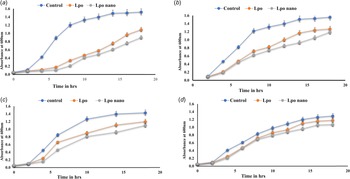
The growth inhibition studies indicate that LPO nanoparticles can inhibit E. coli and P. aeruginosa up to 75% at its MIC, while it can inhibit S. aureus and S. flexneri up to 60% at its MIC. On the other hand, LPO nanoparticles at double the concentration of its MIC value inhibit each strain up to 80%, while free LPO can only inhibit up to 50% at the same concentration (Fig. 1). The disc diffusion results also indicate that the LPO nanoparticles are more potent antibacterial agents than the LPO itself alone (online Supplementary Fig, S5). The diameters of the ZOI in each strain were found to be higher in the case of LPO nanoparticles (online Supplementary Table S2).
Growth inhibition curve of (a) E. coli (b) P. aeruginosa (c) S. aureus, and (d) S. flexneri at MIC concentrations of free LPO and LPO nanoparticles. Kanamycin at its MIC was used as a positive control.

Discussion
Without a doubt, there are still lots of space for the development of better diagnostic systems and novel therapeutics that would be able to combat infectious pathogens and malignant diseases. Recently developed drugs using chemical moieties have proved beneficial, but on the other hand they can also cause serious damage to the body with their side effects and resistance to the microorganisms. Thus, to conquer this problem, there is an urgent need to develop methods and technologies which are safer and more effective. With the advancement in the field of nano-biotechnology, nanoformulations can be effective and safer solutions to fight the infectious diseases. These nanobodies can be used for delivering the drug precisely to the location of disease leaving behind the fear of side effects and providing longer half-life to the drugs.
The antimicrobial activity experiment using S. aureus, P. aeruginosa, E. coli, and S. flexneri culture showed that LPO nanoparticles resulted in increased antimicrobial activity in comparison to free LPO. Minimum inhibitory concentration (MIC) was calculated against the four bacterial strains. We have found that MIC value of LPO nanoformulations against S. aureus was 0.031 mg/ml, 0.5 mg for S. flexineri, 0.031 mg/ml for P. aeruginosa and 0.015 mg/ml for E. coli. Our results indicate that free LPO maintained its activity of inhibiting bacterial growth until 6 h (Kussendrager and Von Hooijdink, Reference Kussendrager and Von Hooijdink2000). From 6 h onwards LPO started to lose its antimicrobial activity as shown by the OD increase of E. coli culture (Sheikh et al., Reference Sheikh, Yasir, Khan, Khan, Azum, Jiffri, Kamal, Ashraf and Beg2018), which could be attributed to many factors including temperature and protein stability. In this study, LPO nanoparticles inhibited the culture growth of all four bacterial species until 18 h, reflecting more effectiveness than free LPO. This indicated that LPO nanoparticles retain their efficiency for a longer time in comparison to free LPO enzymes.
In conclusion, the results of TEM and DLS showed that LPO nanoparticles were successfully synthesized and exhibited stronger antibacterial activity against all four bacterial species in comparison to free LPO. The outcomes of LPO nano formulations clearly indicate that these NPs could be promising safe agents for various biotechnological applications. Further studies are still required for the applications of these nanobodies in other fields of biotechnology, medicine, food industry and diagnosis.
Supplementary material
The supplementary material for this article can be found at https://doi.org/10.1017/S0022029922000796.
Acknowledgments
PS and SS express their gratitude towards the Indian Council of Medical Research (ICMR), New Delhi, for grants. TPS thanks the Department of Science and Technology (DST) for the SERB Distinguished Research Professorship.