Introduction
In their 2012 report, the World Health Organization (WHO) states that dementia should be considered as a part of the world's Public Health agenda. The total number of patients with dementia worldwide in 2010 was estimated at 35.6 million, and is projected to nearly double every 20 years, to 65.7 million in 2030 and 115.4 million in 2050. Because dementia is typically regarded as a disease of old age, the importance and implications of the occurrence of dementia at a younger age may be overlooked. Young-onset dementia (YOD) is defined as dementia with symptom onset before the age of 65 years. Estimated prevalence rates of YOD range from 42.3 to 54 per 100,000 cases (Harvey et al., Reference Harvey, Skelton-Robinson and Rossor2003; Ikejima et al., Reference Ikejima, Yasuno, Mizukami, Sasaki, Tanimukai and Asada2009). The etiology of YOD differs from that of late onset dementia (LOD), since Alzheimer's disease (AD), vascular dementia (VaD), and frontotemporal dementia (FTD) are the main causes of YOD (Miyoshi, Reference Miyoshi2009; Picard et al., Reference Picard, Pasquier, Martinaud, Hannequin and Godefroy2011).
As in LOD, YOD patients can show a wide range of dementia-associated neuropsychiatric symptoms (NPS) such as changes of personality, depression, psychosis, anxiety, and specific problem behaviors such as agitation and aggression. (Lyketsos et al., Reference Lyketsos, Steinberg, Tschanz, Norton, Steffens and Breitner2000)
Different etiology and the young age at which dementia occurs in people with YOD make that the prevalence and type of NPS in YOD patients differ from those in LOD patients. Toyota et al. (Reference Toyota2007) found that NPS (as measured with the Neuropsychiatric Inventory (NPI)) were significantly less frequent in YO–AD patients as compared with LO–AD patients. We found in our previous study (van Vliet et al., Reference van Vliet2012) that over the course of two years, the incidence, prevalence, and persistence of NPS were in general lower in YO–AD than in LO–AD, specifically for delusions, agitation, depression, anxiety, apathy, irritability, and aberrant motor behavior.
Neuropsychiatric symptoms are often managed with psychotropic drugs, although all (inter)national dementia guidelines recommend psychosocial interventions as a first-line treatment.
It is becoming increasingly controversial to treat NPS with psychotropic drugs, especially antipsychotic drugs, since these are associated with an increased risk of stroke and mortality and many other adverse events in dementia patients (Ballard and Howard, Reference Ballard and Howard2006).
However, a comprehensive PUBMED search on the prevalence of psychotropic drug use (PDU) in community-dwelling YOD patients revealed no published papers. There are also only few papers on the prevalence of PDU in community-dwelling LOD patients. Chan et al. (Reference Chan, Kasper, Black and Rabins2007) found that 28.8% of patients were prescribed at least one type of psychotropic drug: 3.5% used cognitive enhancers, 13.7% used antidepressants, 4.9% used antipsychotics, and 14.1% used anxiolytics/hypnotics. Semla et al. (Reference Semla1995) found that 31% of 671 community-living patients with AD used psychotropic drugs.
Most studies on the prevalence rates of PDU in dementia are done in institutionalized patients with LOD. Figures reveal that 63–78% of patients have at least one prescription of a psychotropic drug. Antipsychotics are used by 21–42% of patients, sedatives by 15–31%, and over 40% use antidepressant drugs (Kim and Whall, Reference Kim and Whall2006; Selbaek et al., Reference Selbaek, Kirkevold and Engedal2008; Nijk et al., Reference Nijk, Zuidema and Koopmans2009).
We have found no studies on correlates of PDU such as age, gender, severity of dementia, and type of NPS in community-dwelling people with YOD.
Because of the limited knowledge on PDU in YOD and the known adverse effects, there is a need to gain insight into the prevalence of PDU in community-dwelling YOD patients and the factors that are associated with this use. We hypothesized that PDU would be associated with dementia type and severity, unmet needs, and NPS. The aim of this study was to investigate PDU in Dutch community-dwelling YOD patients and its association with age, gender, dementia type and severity, depressive symptoms, disease awareness, unmet needs, and type of NPS.
Methods
Participants
For this study the baseline data of the Needs in Young-Onset Dementia (NeedYD)-study were used. Methods have been reported in more detail elsewhere (van Vliet et al., Reference van Vliet, Bakker, Koopmans, Vernooij-Dassen, Verhey and de Vugt2010). The NeedYD-study is a prospective cohort study with a follow-up of two years in which 215 YOD patient–caregiver dyads are assessed at six-month intervals. Patients were recruited through the memory clinics of the three Alzheimer's centers in the Netherlands located in Amsterdam, Nijmegen, and Maastricht, the memory clinics of general hospitals, and through other mental health services in the south of the Netherlands, as well as through specialized day care facilities that are affiliated with the Dutch National YOD Taskforce.
Patients were considered for inclusion when symptom onset was before the age of 65 years, thus age at inclusion could be over 65 years. Patients were excluded if they met the following criteria: (1) Dementia caused by human immunodeficiency virus (HIV), traumatic brain injury, Down's syndrome, Huntington's disease, or alcohol-related dementia, (2) lack of a reliable informant, or (3) lack of informed consent of the participant (van Vliet et al., Reference van Vliet, Bakker, Koopmans, Vernooij-Dassen, Verhey and de Vugt2010)
Types of dementia
Types of dementia are diagnosed using regular criteria. Disease etiology was categorized into AD, VaD, FTD, and dementia not otherwise specified (NOS).
Dementia severity
The Global Deterioration Scale (GDS) was used to assess dementia severity. The GDS is a seven-point rating scale ranging from “no global impairment” (stage 1) to “very severe global impairment” (stage 7). It is a widely used instrument that has been validated against behavioral, neuroanatomic, and neurophysiologic measures, for which significant correlations have been found (Reisberg et al., Reference Reisberg, Ferris, de Leon and Crook1982).
Assessments
Demographic characteristics and medical information of the patients were gathered using a structured interview with the caregiver and through information from the patients’ medical file.
Psychotropic drug use (PDU)
Information about PDU was retrieved from the interviews with the caregivers and checked against available pillboxes and medication lists. PDU was classified with the Anatomical Therapeutical Chemical classification (ATC; Nordic Council on Medicines, 1990). The drugs were grouped into antipsychotics, anxiolytics, hypnotics/sedatives, antidepressants, and anti-dementia drugs.
Neuropsychiatric symptoms
Neuropsychiatric symptoms were assessed with the Dutch version of the NPI (Cummings et al., Reference Cummings, Mega, Gray, Rosenberg-Thompson, Carusi and Gornbein1994), which has high inter-observer agreement and is found to be a valid rating scale for measuring a wide range of NPS (Kat, Reference Kat, de Jonghe, Aalten, Kalisvaart, Droes and Verhey2002). The NPI is a structured interview with the primary caregiver. The NPI includes ten NPS and two neurovegetative symptoms: delusions, hallucinations, agitation/aggression, depression/dysphoria, anxiety, euphoria, apathy, disinhibition, irritability/lability, aberrant motor behavior, nighttime behavior disturbances, and appetite/eating abnormalities. Screening questions determine whether NPS are present. Severity (S) and frequency (F) of NPS are also determined; these are respectively rated on a three-point (0–3) and a four-point (0–4) Likert scales, resulting in a F × S score, which ranges from 0 to 12.
In addition, the Cornell Scale for Depression in Dementia (CSDD; Alexopoulos et al., Reference Alexopoulos, Abrams, Young and Shamoian1988) was administered to screen for depressive symptoms. The CSDD is widely used to assess depressive symptoms in dementia and to distinguish depressed from non-depressed patients. This scale has adequate inter-rater reliability, internal consistency, and sensitivity when administered in people with YOD (Leontjevas et al., Reference Leontjevas, van Hooren and Mulders2009).
Awareness
To assess disease awareness, the Rating of Awareness of Deficits (GRAD) was administered, which consists of four categories ranging from absent awareness to intact awareness (Verhey, Reference Verhey, Rozendaal, Ponds and Jolles1993).
Unmet needs
The Dutch version of the Camberwell Assessment of Need for the Elderly (CANE) was administered to access (un)met needs (Reynolds et al., Reference Reynolds2000). The CANE is administered as a semi-structured interview with the caregiver consisting of 24 domains that cover social, physical, psychological, and environmental needs. The first section of the CANE determines (un)met needs.
Analysis
Clinically relevant NPS were defined as an F × S score ≥4 for each individual symptom. NPI items were grouped into psychosis (hallucinations, delusions) and agitation-cluster (agitation/aggression, disinhibition, irritability/lability, aberrant motor behavior). Depression/dysphoria, anxiety, apathy, nighttime behavior, and eating changes were analyzed separately. Euphoria was excluded from analysis because of low prevalence rate.
We categorized CSDD in no, mild, and moderately severe depression with cut-off scores of 8 and 12 respectively (Barca et al., Reference Barca, Engedal and Selbaek2010). Furthermore, we categorized unmet needs into no unmet needs, one or two unmet needs, or three or more unmet needs.
Multivariate analysis using binomial logistic regression was used to explore associations between gender, age (as continuous variable), dementia etiology, stage of dementia, symptoms of depression, unmet needs, disease awareness, and type of NPS as independent variables, and total PDU as dependent variable. We used multiple imputation to replace missing values (Donders et al., Reference Donders, van der Heijden, Stijnen and Moons2006). In the imputation model we used all the variables of the analysis model. The analyses were performed using the imputed datasets.
Results
Patients’ characteristics
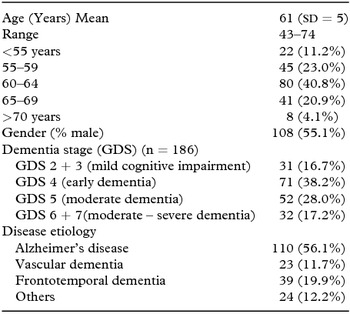
A total of 215 patients were included in the NeedYD-study. Six caregivers refused to participate due to high levels of subjective burden, and PDU information of 13 patients was missing, so the study population consisted of 196 patients. Item non-response was below 1% for most variables; non-response for CSDD was 16.8 %, for GRAD 6.6 %, for GDS 5.1%, and for CANE 2%. Patients had a mean age of 61 years, 55.1% were males, and most patients had AD and were in GDS stage 4 (Table 1). The most prevalent NPS were agitation/agression (58.2%), apathy (55.1%), eating changes (39.3%), anxiety (19%), and depression/dysphoria (18.9%). Mild depressive symptoms as measured with the CSDD were found in 22.7% of the patients and 25.2% had moderately severe depressive symptoms. Disease awareness in most patients was mildly (38.8%) to moderately (28.4%) disturbed and absent in 14.2%. A total of 97 patients (49.5%) had three or more unmet needs, 71 patients (36.2%) had one or two unmet needs, and 24 patients (12.5%) had no unmet needs.
Patients’ characteristics (n = 196)

Note. GDS: Global Deterioration Scale.
Prevalence of psychotropic drug use
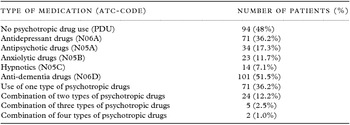
Fifty-two percent of the patients were prescribed at least one psychotropic drug; 36.2% of the patients used one drug, and 12.2% used two different drugs (Table 2). Antidepressants (36.2%) and antipsychotic drugs (17.3%) were the most frequently prescribed psychotropic drugs. Anti-dementia drugs were prescribed in 51.5% of the patients. The most frequently prescribed combination was an antidepressant with an antipsychotic drug.
Prevalence of psychotropic drug use (ATC-code) among patients (n = 196)

Associations between patients’ characteristics and total psychotropic drug use – multivariate analysis
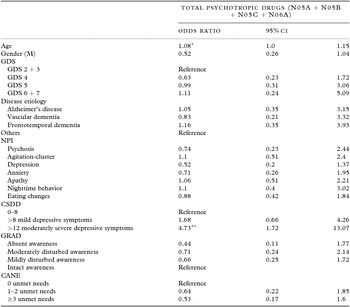
Multivariate analysis revealed that age and CSDD had a statistically significant association with total PDU. Increase of one year in age was associated with 8% increase in PDU (OR: 1.08), and patients with a moderate to severe depression had almost a fivefold risk to use psychotropic drugs (OR: 4.7) as compared with those with no symptoms of depression.
Association between patient characteristics, dementia stage, dementia type, NPI, CSDD, GRAD, CANE, and total psychotropic drug use

Discussion
To our knowledge this is the first study that reports on the prevalence and correlates of PDU in community-dwelling patients with YOD. We found that 52% of the patients were prescribed at least one psychotropic drug. The most frequently prescribed drugs were antidepressants and antipsychotics. The combination of these two types of psychotropic drugs was also most prevalent. Although our study was focused on PDU, we found that 51% of the patients were also prescribed an anti-dementia drug. Age and moderate to severe depressive symptoms were associated with the total use of psychotropic drugs.
We found high prevalence rates of PDU compared with the prevalence rates that Chan et al. (Reference Chan, Kasper, Black and Rabins2007) reported in their LOD community-dwelling sample, with 52% of our patients using at least one psychotropic drug compared with 28.8% in the Chan et al. study. Maybe these differences can be explained by the severity of NPS, which can be expressed in a more pronounced manner by young and strong YOD patients as compared with older and often frail elderly adults, resulting in a higher risk of PDU. However, lack of psychosocial interventions focused on the needs of patients with YOD, such as suitable support and day care services, may also be an underlying factor.
In addition, our patients used up to two times more anti-depressants. This may be related to the prevalence rates of depressive symptoms in our patient sample, which appears an important issue in YOD (Rosness et al., Reference Rosness, Barca and Engedal2010). Van Vliet et al. (Reference van Vliet2013) found that young-onset AD patients had higher levels of disease awareness compared with late onset AD patients and this was significantly associated with depression. The use of antipsychotics versus anti-agitation drugs was comparable (Chan et al., Reference Chan, Kasper, Black and Rabins2007). The prevalence rates of PDU in our community-dwelling YOD patients were relatively low compared with the population of institutionalized LOD patients (Kim and Whall, Reference Kim and Whall2006; Selbaek et al., Reference Selbaek, Kirkevold and Engedal2008; Nijk et al., Reference Nijk, Zuidema and Koopmans2009). However, these figures cannot be compared, since these two populations differ too much in etiology, disease severity, and NPS prevalence rates.
It is difficult to interpret the finding that patients with YOD with a higher age are more at risk of receiving psychotropic drugs. One could expect that older YOD patients have progressed more in their disease and therefore show a different pattern of NPS resulting in more PDU. However, this seems not the case, because the association of age was independent of the stage of dementia as measured with the GDS. In contrast to our findings, in patients with LOD, the younger patients are more at risk at receiving psychotropic drugs (Selbaek et al., Reference Selbaek, Kirkevold and Engedal2007). The positive association between depression and PDU in general was also found in other US and Dutch studies, but might primarily be explained by the high rates of antidepressant use (Kim and Whall, Reference Kim and Whall2006; Nijk et al., Reference Nijk, Zuidema and Koopmans2009). However, it is not clear if antidepressants, especially selective serotonin reuptake inhibitors, have also been prescribed for reasons other than depression, such as agitation and anxiety. For instance, there is some evidence that trazodone is effective in the treatment of agitation and irritability in patients with FTD (Lebert et al., Reference Lebert, Stekke, Hasenbroekx and Pasquier2004).
We found no association between unmet needs and PDU, although we found in the same patient sample an association between unmet needs and NPS (Bakker et al., Reference Bakker2013) and one could expect that higher rates of NPS lead to more PDU. In our study we used the caregiver report on patient's unmet needs instead of the patient's self-report. Considering the known differences in patient and caregiver perspectives on the amount of unmet needs as well as the areas in which unmet needs occur, the patient's perspective might show different results (Orrell et al., Reference Orrell, Cooper and Braithwaite2006). However, we were not able to use the patient's self-report due to the high number of patients that were not able to complete the CANE, which is a known issue with this instrument (Orrell et al., Reference Orrell, Cooper and Braithwaite2006).
Furthermore, although one might expect that higher rates of NPS lead to more PDU, we did not find any association between NPS and PDU. This may be explained by the fact that we did not differentiate between types of psychotropic drugs, nor did we include information about dosage and reasons for prescription. It is also possible that patients with PDU did not show clinically significant amount of NPS anymore at the time of assessment. It could be that NPS were effectively treated by psychotropic drugs, although we know from research in people with LOD that the effects are modest. The lack of association could also imply that in YOD other factors influence the decision to prescribe psychotropic drugs.
This study has some limitations. First, we did not record the reasons for drug prescription, the severity of the symptoms when the drugs were first administered, nor the duration of usage. Second, although we measured the use of formal and informal care in our study (Bakker et al., Reference Bakker2013), we had no specific information about the administration of psychosocial interventions, which might have influenced rates of PDU and prevalence rates of NPS. Third, we retrieved PDU from the interviews with the caregivers and not from the medical or pharmacy files, which could have lead to some information bias. Finally, our sample was too small to analyze differences in PDU between different dementia types. This is important since one can expect that prevalence rates of NPS differ between dementia etiologies, although we have found no literature on this aspect.
Conclusions
More research on PDU in this specific group of young people with dementia is warranted.
Since there has been evidence that the use of antipsychotic drugs is associated with an increased risk of stroke and mortality in dementia patients, it is very important to systematically monitor the effects of prescribed drugs. All guidelines recommend lowering the dose or even discontinuation of drug at least every three to six months. It is also important to develop YOD-tailored psychosocial interventions, since we know from research in LOD care-home patients that these are able to reduce the rates of PDU (Richter et al., Reference Richter, Meyer, Mohler and Kopke2012). Finally, more research is needed to study the relationship between unmet needs, NPS, and PDU.
Conflict of interest
None
Acknowledgments
This study was funded by the Florence care group in the Hague, the Dutch Alzheimer's Society, Maastricht University, Alzheimer's Center Limburg, and stichting wetenschaps bevordering verpleeghuizen (SWBV).
Description of authors’ roles
R. Koopmans, F. Verhey, and M. de Vugt designed the study, interpreted the results, and drafted the manuscript. C. Bakker and D. van Vliet collected the data, interpreted the results, and drafted the manuscript. R. Reinders performed analysis and drafted the first versions of the manuscript. H. Bor did the statistical analysis. R. Koopmans drafted the final versions of the manuscript.