Introduction
Cosmic rays play a significant role in the natural mutation and evolution of life on Earth. Indeed, cosmic rays can seriously damage DNA, and if the damaged DNA cannot be repaired by the cell, then the cell may die. If the damage is copied into more cells, then a mutation could occur. The risks for cancer, cataracts and neurological disorders may be increased by exposure to large amounts of cosmic rays.
People in more northern and southern latitudes are exposed to more of this radiation from the Sun, thus the rates of cancer death are higher in these regions than near the equator. On average, the oscillation in cancer deaths was between 10 and 15% during the period of the study.
Weather is affected by the Sun. Cosmic rays are an indication of the Sun's activity, and thus weather patterns have been correlated to cosmic ray behaviour. There was a period between the years 1645 and 1715, called the Maunder Minimum, when there was low solar activity and few sun spots. Coincidently, during the same time there was a period called the Little Ice Age, when temperatures became cooler in North America and Europe. Variation in the Earth's magnetic field is also a factor triggering mutation and affecting the evolution of life. The Earth's magnetic field shuts out the inflow of cosmic rays (charged particles) such as the solar wind to the Earth's surface.
This paper presents an attempt to use a wavelet technique form which resolves any pattern at a given point within different scales, enabling it to be applied to the problem under consideration.
Unlike conventional spectral analysis, the wavelet transform is a suitable tool for the description of non-stationary processes containing multi-scale features, detection of singularities and analysis of transient phenomena. However, this approach is not frequently used for cosmic ray time series.
Starting with the cosmic ray variation curve given by the Moscow neutron monitor (http://helios.izmiran.troitsk.ru/cosray/main.htm), we first analysed this variation function and decomposed it in Morlet wavelets; we then proceeded, for reconstruction and extrapolation, to zoom and predict new periods, details or singularities hidden behind the original curve describing cosmic rays variations in time.
The continuous wavelet transform (CWT) is used to decompose a signal into wavelets – small oscillations that are highly localized in time. Whereas for the Fourier transform a signal is decomposed into sines and cosines of infinite length, effectively losing all time-localization information, the CWT's basis functions are scaled and shifted versions of the time-localized mother wavelet.
When the wavelet coefficient magnitudes are plotted for the scale and the elapsed time, a so called scalogram is produced (Mallat Reference Mallat1999, Chao & Naito Reference Chao and Naito1995). Time-varying harmonics are detected from the position and scale of high amplitude wavelet coefficients. The inverse wavelet transform is then used to calculate the corresponding time series. New wavelet spectra are finally calculated for each partial time series.
The following section examines those properties of the wavelet transform which are relevant for our scheme. The multiple level decomposition technique is described in detail, and the reconstruction and extrapolation or prediction of structures follows.
Morlet wavelet methods
The wavelet theory involves representing general functions in terms of simple, fixed building blocks at different scales and positions. We use translations and dilations of one fixed function for wavelet expansion. Sophisticated wavelets are more powerful in revealing hidden detailed structures; for example, the Morlet wavelet has been used to examine the processes, models and structures behind the variability of solar activity (Lundstedt et al. Reference Lundstedt, Liszka and Lundin2005, Grzesiac et al. Reference Grzesiac, Sadowski, Rothkaehl, Sadowski and Rothkaehl1997). Using the same wavelet expansion, we present in this work a mathematical zoom to discover the hidden structures and to extrapolate unknown aspects in cosmic variation.
The CWT is an ideal tool for mapping the changing properties of non-stationary signals and also for determining whether or not a signal is stationary in a global sense. CWT is then used to build a time-frequency representation of a signal that offers very good time and frequency localization (Kudela et al. Reference Kudela1991; Mallat Reference Mallat1999; Kudela et al. Reference Kudela, Storini, Antalova and Rybak2001).
Wavelet analysis is more complicated than Fourier analysis; in fact, one must fully specify the mother wavelet from which the basis functions will be constructed. While Fourier analysis uses complex exponential (sine and cosine) basis functions, wavelet decomposition uses a time-localized oscillatory function as the analysing or mother wavelet. The mother wavelet is a function that is continuous in both time and frequency and serves as the source function from which scaled and translated basis functions are constructed. The mother wavelet can be complex or real, and it generally includes an adjustable parameter controlling the properties of the localized oscillation.
The Morlet wavelet is defined as a complex sine wave (Morlet et al. Reference Morlet, Arehs, Forgeau and Giard1982), localized with a Gaussian. The frequency domain representation is a single symmetric Gaussian peak, and frequency localization is very good. This wavelet has the advantage of incorporating a wave of a certain period, as well as being finite in extent.
Results and discussion
Decomposition in Morlet wavelets
When decomposing a non-linear time series into time-frequency space, wavelet analysis is a useful tool both to find the dominant mode of variation and also to study how it varies with time (Attolini et al. Reference Attolini1975; Mallat Reference Mallat1999). The wavelet transform of a function y(t) uses spatially localized functions called wavelets and is given by

where a is the scale dilation, compressing and stretching of the wavelet g used to change the scale, b is the translation parameter, the shifting of g used to slide in time, and g* the complex conjugate of g. The Morlet wavelet is a complex sine wave multiplied by a Gaussian envelope and given by

where we have taken ω0=2π and the period was fixed to T=1 year.
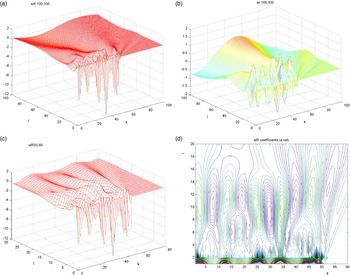
(a) and (c) real components of decomposition coefficients; (a) whole coefficients 100,100; (c) a part of coefficients 30,80; (b) imaginary components of coefficients; (d) a cut showing highest real components wR and more important periods.

To analyse a discrete signal y(t i) we need to sample the continuous wavelet transform on a grid in the timescale plane (b, a) by setting a=j and b=k.
The wavelet coefficients ωj,k are

It is computationally impossible to analyse a signal using all wavelet coefficients (Figs 1(a) and (c)), so one may wonder if it is sufficient to pick a discrete subset of the upper half-plane to reconstruct a signal from the corresponding wavelet coefficients (Mallat Reference Mallat1999). One such system is the affine system for some real parameters j>1, k>0.
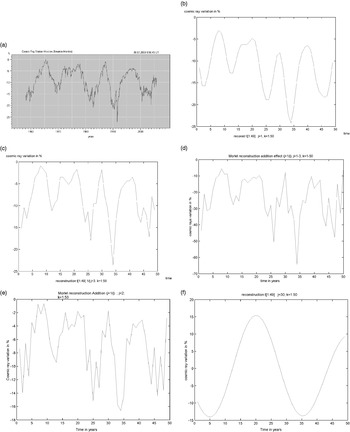
Different levels of wavelet reconstruction for cosmic ray variation described by the origin curve of Moscow neutron monitor (Fig. 3(a)); for all curves the study begins in 1958, so the year 1958 and all time axes have been translated to zero.

The method implemented employs a multi-level decomposition scheme via the Morlet wavelet transform, and interactive weighted recomposition. Different reconstruction strategies are discussed.
Only the real component of complex wavelet in the time domain (Figs 1(a) and (c)) determines the real wavelet. The frequency domain transform of a real wavelet is symmetric about frequency 0 and contains two peaks. The nature of an oscillation with the CWT spectrum will vary greatly with whether the wavelet is real or complex (Figs 1(a) and (b)). The complex wavelet will evidence a constant power across the time duration of the oscillation. Otherwise, a real wavelet produces power only at those times where the oscillation is at an extreme or where a sharp discontinuity occurs.
We have used data from the Moscow neutron monitor for cosmic ray variation corresponding to years ranging from 1958 to 2007, and have reproduced the main details of the curve of cosmic ray variation in time. We have then decomposed and analysed the corresponding variation of cosmic rays in Morlet wavelets. The following figures show the real and imaginary coefficients of decomposition.
The coefficients of decomposition of real and imaginary components were calculated and plotted versus scale dilation and translation parameters j and k:

For discretization we have used the following expression, for a 49-year period of study:

Reconstruction – zooms in cosmic rays variation
We have reconstructed the cosmic ray variation function; we were interested in the real component of the reconstructed function:

We searched for a reconstruction strategy to gain resolution of diffuse loops in cosmic ray variation. We report the results which arose from applying our technique to cosmic ray variation data from the Moscow neutron monitor, registered from 1958–2007 (Fig. 2(a)). The original figures for cosmic ray variation, determined by the Moscow neutron monitor along with reconstruction examples are seen in Figs 2(a)–(f).
The wavelet transform can also detect and characterize transients with a zooming procedure across scales. Sharp single transitions create large amplitude wavelet coefficients. Singularities are detected by following across scales the local maxima of the wavelet transform. The proposed technique for the reconstruction of structures consists of more than one level of decomposition via the Morlet wavelet transform.
In a first phase, scales are assigned for fixed values of j and for a varying values of translation parameter k (Fig. 2(b)). For scale parameter j=1 the original curve is reproduced without details and the main 11-year cycle is apparent.
For j=2 to 30, periods of j years are then zoomed, and we can see 2-, 3-, and 5-year cycles or fluctuations, and a longer cycle of 30 years arises (Fig. 2(f)).
In a second step we have rewritten a program where we have considered fractional scaling values. Thus the details of original curve describing cosmic ray variation occurs (Fig. 2(c)). Once the effect of each integer and fractional scaling are seen, we have plotted the curves corresponding to the total effect of both fractional and integer scales (Fig. 2(d) and (e)). These plots were determined after computing via a program in which we have considered both types of scaling. It is worth noting that the effect of fractional scaling is very important with respect to integer scaling in our framework.
We show that wavelet analysis gives more complete and quantitative results. The idea behind this method is to resolve any pattern at different locations with variable resolution. By studying cosmic ray variation within various scales one can learn about the space-time evolution of the process as a whole.
Extrapolation and prediction
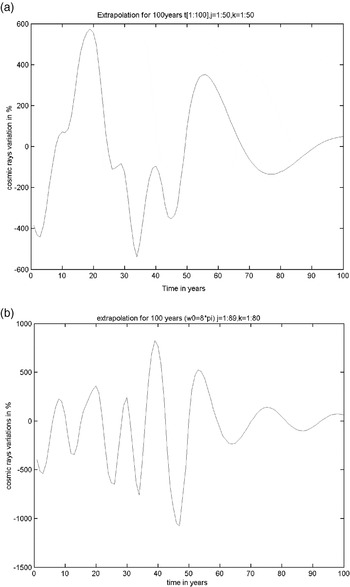
In this step of our work we extrapolated the time of study from 49 years to 100 years to see how cosmic ray variation will behave, and to investigate whether there may be other types of modulation or periods. We used a number of strategies; before varying scale and translation parameters j and k, we increased the time of the study to 100 years; then we changed the variation interval of j. We also varied the interval of translation parameter k. We derived the variation of cosmic rays for fractional j and we compared the corresponding variations for the same interval of variation from integer and fractional j. For a fixed value of j we examined the zoom in and out of cosmic ray variation in other terms for j and 1/j, for example, for scale parameter k=2 and 0.5, or 3 and 0.33 and so on. In the same program we summed the contributions of integer and fractional j to see the total effect of variation of j. In these strategies we always maintained the same primary period T=1 year, ω0=2π; we have seen the extrapolation but did not succeed in maintaining the original reconstructed signal (Fig. 3(a)).
Extrapolation for 50 years ahead after 2008 (additional effects fractional and integer scaling j), in both basis (a) ω0=2π and (b) ω0=8π.

In a second phase we varied the base period to T=0.25 year, ω0=8π. New long periods of 50 years appear with extrapolation, after the 50 years of the study period (after 2008), and the reconstructed original curve for the first 50 years of study is also improved.
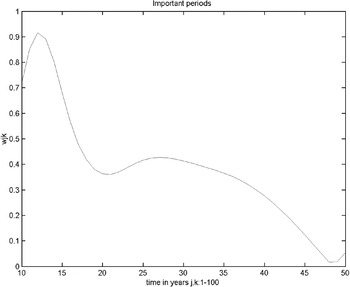
Higher magnitudes of decomposition coefficients are found around a 12-year period.

Detected periods
The curves showed in Fig. 4 and Fig. 1(d) give a summary for the highest coefficients magnitudes (0.9) of the main periodicity already found around 12 years. In fact, during the whole period the 11-year timescale solar cycle period is dominant.
Timescale spectra present interesting properties such as deterministic periodic or semi-periodic structures mapped on the graphs. The information can appear until 100 years from the year 1958, so the extrapolation has succeed for about 50 years ahead after 2008.
Conclusions
Structures and periodicities revealed particularly in Morlet extrapolations for cosmic ray variabilities provide us at least a qualitative aspect for variations in cosmic rays for many years ahead. The well-known 11-year solar activity period is the main modulation, thus modulating human health and life.
Looking for the contribution of significant periods, different research teams have analysed time variabilities in cosmic ray records. In particular, CWT has been used recently, and is useful for data series with non-stationary processes when dealing in terms of time-frequency decomposition.
The most important step is the wavelet choice; the wavelet type influences the time and frequency resolution of the results. Indeed while the Derivative of Gaussian wavelet provides a poor frequency resolution but a good time localization, on the other hand we found, as expected, that the Morlet wavelet choice gives a high frequency resolution. The wavelets can then be used as a mathematical microscope to reveal structures at different scale lengths j and at different locations, k.
The results of modelling solar activity are presented in this work. Regularities and periodicities were derived, and will be also investigated using a neural network. The 11-year main cycle dominated as expected, but also more detailed pictures appeared.
A dominant 11-year periodicity is found in all neutron monitors, and in all wavelet reconstructions graphs. We also report short-term periodicities in the power of rapid cosmic-ray fluctuations of 2 years, appearing in cosmic ray power fluctuation since 1958. Three- and 5-year periods also are present, and other long periodicities are found of around 30 years and 50 years.
We demonstrated, in the example of cosmic ray variation, that wavelet analysis helps reveal event patterns in the available phase space, providing quantitative measures for typical features in terms of location b and scale a. Moreover, we have found that the wavelet plots present an ideal tool to discover, through analysis coefficients and reconstruction periodicities, small details and space irregularities versus time hidden before decomposition, and better wavelet plots give a prediction for modulation of cosmic ray variation for 50 years ahead or even longer.