Introduction
New Zealand’s long isolation from other land masses has resulted in the evolution of a unique biota. Many bird species show gigantism and loss of flight as adaptations to the absence of mammalian predators. These large flightless birds are thus extremely vulnerable to habitat destruction by deforestation and predation by people and introduced mammals since human settlement c. 600 years ago (Walter et al. Reference Walter, Buckley, Jacomb and Matisoo-Smith2017). More than 40 bird species have become extinct since human arrival (Gill & Martinson Reference Gill and Martinson1991). One survivor, albeit marginally, is the kākāpō (Strigops habroptilus), a parrot endemic to New Zealand. The kākāpō is unique in that it is the only flightless and lek-breeding parrot (Powlesland et al. Reference Powlesland, Merton and Cockrem2006). It is also nocturnal and at up to 4 kg is the world’s heaviest parrot. It’s longevity, estimated up to 90 years, makes it possibly the longest-lived parrot.
Fossil remains show that the kākāpō was once widespread throughout New Zealand (Worthy & Holdaway Reference Worthy and Holdaway2002). Habitat loss and predation reduced the population to approximately 50 known individuals remaining in the 1950s, although conservation efforts have resulted in an increase to around 250 at the time of this writing (https://www.doc.govt.nz/our-work/kakapo-recovery/). As the only representative of a unique sub-family of parrots, it has no close relatives and has a global conservation status of Critically Endangered, i.e., most severely threatened, facing an immediate high risk of extinction (IUCN 2022). Their current distribution is restricted to three relatively small-sized, predator-free conservation sanctuaries, two of which are offshore islands. Despite the intense conservation activity surrounding these birds, very little is known of their parasite fauna.
In the late 1800s, when kākāpō were still common, the Austrian naturalist Andreas Reischek observed that the birds were often infected with tapeworms (Reischek Reference Reischek1884). The unique cestode species, Cittotaenia psittacea (Fuhrmann, Reference Fuhrmann1904), was briefly described from a single specimen with additional details provided later (Furhmann Reference Fuhrmann1922). The same specimen was redescribed in further detail in 1978 (Beveridge Reference Beveridge1978), when the genus Stringopotaenia was erected to accommodate its unique features. Subsequent conservation workers have since noticed worms passed by kākāpō that presumably represent the same species, which, given the unique lifestyle and ancient origins of the kākāpō, make it almost certain that the cestode is host-specific. However, no positive identification was made, and the birds were routinely de-wormed (Boast Reference Boast2014).
Stringopotaenia psittacea is placed in the Anoplocephalinae, a subfamily of the Anoplocephalidae, found in herbivorous mammals, and unusually, parrots (Beveridge Reference Beveridge, Khalil, Jones and Bray1994). The only other New Zealand anoplocephalid cestode (Pulluterina nestoris Smithers, 1954) is known from the kea (Nestor notabilis Gould), another parrot. New Zealand’s large parrots, the kākāpō, kea, and kākā (Nestor meridionalis (Gmelin)), comprise the most ancient lineage of all living parrots (Schirtzinger et al. Reference Schirtzinger, Tavares, Gonzales, Eberhard, Miyaki, Sanchez, Hernandez, Müeller, Graves, Fleisher and Wright2012).
There have been several New Zealand native bird coprolite studies to date, mostly from limestone rock shelters and overhangs in the South Island, providing evidence of diet and helminth infections. The birds studied, several moa (Dinornithiformes, now extinct) species and kākāpō, are herbivores. Most are diet studies, examining the plant remains in coprolites (Kondo et al. Reference Kondo, Childs and Atkinson1994; Horrocks et al. Reference Horrocks, D’Costa, Wallace, Gardner and Kondo2004; Wood et al. Reference Wood, Richardson, McGlone and Wilmshurst2020), but ancient DNA techniques have allowed detection of a number of parasites in moa coprolites (Wood et al. Reference Wood, Wilmshurst, Rawlence, Bonner, Worthy, Kinsella and Cooper2013; Boast et al. Reference Boast, Weyrich, Wood, Metcalf, Knight and Cooper2018, Reference Boast, Wood, Bolstridge, Perry and Wilmshurst2023).
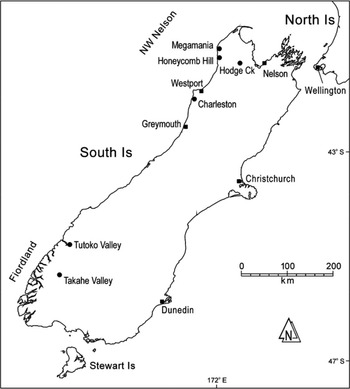
In 2008, Horrocks et al. (Reference Horrocks, Salter, Braggins, Nichol, Moorhouse and Elliott2008) examined 52 kākāpō coprolites preserved in caves and overhangs along a wide (620 km) northeast to southwest latitudinal section of the western South Island, from north-west Nelson to Fiordland (Horrocks et al. Reference Horrocks, Salter, Braggins, Nichol, Moorhouse and Elliott2008) (Figure 1). The sites included lowland, montane, and sub-alpine settings. As kākāpō are nocturnal, during daylight hours they had roosted in the overhangs and short distances into the caves. The study analysed plant microfossils (pollen, phytoliths, and starch and other plant remains) within the coprolites, but no parasites were reported at the time.
Map showing sampling site locations.

The present study examined the same 52 kākāpō coprolite samples from the work of Horrocks et al. (Reference Horrocks, Salter, Braggins, Nichol, Moorhouse and Elliott2008), this time for helminth eggs. Given the lack of knowledge about the cestode Stringopotaenia psittacea, which by default is either critically endangered or possibly extinct, the aim was to look for its eggs in the coprolites, shedding light on the former distribution of this parasite in New Zealand.
Study areas
The sampled sites were limestone caves and overhangs at six locations in the western South Island. Three of the sites (Hodge Creek, Megamania, and Honeycomb Hill) are in northwest Nelson, one is at Charleston, and the remainder, which are the only two overhangs, are in Fiordland (Tutoko Valley and Takahe Valley) (Figure 1). Further details of the sites are given in the initial, plant microfossil article (Horrocks et al. Reference Horrocks, Salter, Braggins, Nichol, Moorhouse and Elliott2008).
Materials and methods
All 52 of the starch slide preparations from the initial, plant microfossil study were examined for helminth eggs, and presence/absence noted (Horrocks et al. Reference Horrocks, Salter, Braggins, Nichol, Moorhouse and Elliott2008). Samples had been prepared for analysis of starch and other remains by density separation with sodium polytungstate (Horrocks Reference Horrocks2020). Having a lower specific gravity (ca. 1.130–1.238) than the heavy density solution used for the starch separation (1.7–1.8 specific gravity), helminth eggs were also recovered (David & Lindquist Reference David and Lindquist1982). The starch separations were mounted in glycerol jelly. The pollen and phytolith preparations were not included because these methods use corrosive chemicals harmful to helminth eggs, often destroying them completely. Photomicrographs for the present study were taken with a Canon EOS 600D camera (Auckland Camera Centre, Auckland, New Zealand) mounted on a Nikon 400E microscope (Olympus New Zealand Ltd, Auckland, New Zealand), with a blue light filter.
Results
All slides showed a high concentration of very well-preserved macro- and microscopic plant material and fungal spores, among which was found a type of helminth egg. These were observed in only one of the six main locations, namely the Honeycomb Hill cave system, in two of the three caves sampled (referred to as Honey B and C in Table 1 and the graphical diagrams in Horrocks et al. Reference Horrocks, Salter, Braggins, Nichol, Moorhouse and Elliott2008). The eggs were observed in all six samples (1–6) from Honey B (1550 ± 48 14C BP) and samples 4 and 5 from Honey C (2514 ± 43 14C BP).
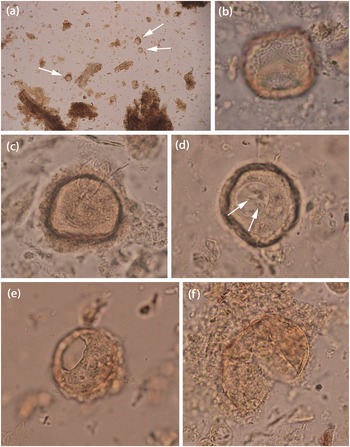
The eggs are morphologically attributable to the family Anoplocephalidae. They are subspherical, 50–70 μm in diameter, and with a delicate reticulation that often gives a dimpled or scalloped appearance (Figure 2b). Degraded eggs can appear grainy. When the pyriform apparatus is visible, it appears forked, with twin points (Figure 2c). The oncosphere is c.25 μm in diameter, and some hooklets can be seen as straight lines (Figure 2d). These characteristics are consistent with Beveridge’s (Reference Beveridge1978) redescription of the type specimen of Stringopotaenia psittacea. He described the egg as “approximately spherical, thick shelled. Inner membrane present. Oncosphere surrounded by pyriform apparatus terminating in two elongate horns” (Beveridge Reference Beveridge1978, p. 43). The size was given as 60 μm in diameter.
Microfossil eggs of cf. Stringopotaenia psittacea, showing characteristic features. Mounted in glycerol jelly; (a) 100x, remainder 600x; these examples are 60 μm in diameter, +/- a few μm; (a) three eggs (arrows) among plant material, shown in one field of view; (b) egg showing delicate reticulation, giving a dimpled or scalloped appearance; (c) egg with abraded surface layer, showing twin-pronged, pointed pryriform apparatus, in this case protruding above upper edge; (d) egg showing hexacanth and hooklets, seen here as faint, dark- or light-coloured straight long or shorts lines (arrows); (e) egg with a neat, round hole, suggested as possible oribatid mite damage; (f) damaged egg.

Discussion
Stringopotaenia psittacea eggs were observed in the six Honey B samples in up to reasonably large numbers: between approximately 15 to 50 individuals per slide, with a 10 x 40 mm coverslip. Only one egg was observed in each of the two Honey C samples. Sometimes several were seen in one field of view at 100x magnification (Figure 2a). The Honeycomb system is 250–300 m above sea level in the Oparara River Valley, on the western side of the river, and covers an 800 x 1000 m area. Coprolites at this site have been 14C dated to 1550 ± 48 BC (Horrocks et al. Reference Horrocks, Salter, Braggins, Nichol, Moorhouse and Elliott2008). Boast et al.’s (Reference Boast, Wood, Bolstridge, Perry and Wilmshurst2023) coprolite study also included this cave system.
The intermediate hosts of anoplocephaline cestodes are invariably soil mites of suborder Oribatida (Beveridge Reference Beveridge, Khalil, Jones and Bray1994), which are presumably picked up with plant and fungal material during feeding. As the mites are infected via the eggs in the bird’s faeces, it is understandable that infection could be localised, since the birds appear to use a roosting site habitually for long periods of time (Powlesland et al. Reference Powlesland, Merton and Cockrem2006).
An unusual observation was made while examining the eggs in these coprolite samples. Most of the eggs exhibited a neat round hole in the surface of the shell (Figure 2e). Caley (Reference Caley1975) wrote that the shelled egg is too large and tough for an oribatid mite to ingest whole. He noted that mites manipulate the eggs for some time without swallowing them, possibly causing mechanical disruption of the shell, which allows them to remove the onchosphere. It was suggested that the rough or sometimes tetrahedral shape of the egg increased their ability to handle the eggs. Caley (Reference Caley1975) was observing the eggs of Moniezia, but those of this subfamily share similar features, and the intermediate host of all of them is an oribatid mite. We wonder whether the neat round holes in the shell of our specimens were made by mites feeding on eggs within the faeces.
The observations reported in this study constitute only the second time this species of cestode has been positively identified. Stringopotaenia psittacea has not been formally reported since 1884, and although we are aware of anecdotal evidence from wildlife veterinary sources, the species has been presumed extinct in the literature (e.g., Lafferty et al. Reference Lafferty and Hopkins2018). There is growing concern among conservationists about parasites becoming extinct along with their hosts (Spencer & Zuk Reference Spencer and Zuk2016). When the last remaining individuals of a species are taken into captivity, they are often routinely de-wormed, ostensibly for the health of the individual. But an extreme change of environment and ecological conditions, along with concomitant loss of intermediate hosts and generations of captive breeding, can also result in parasite extinction (Stringer & Linklater Reference Stringer and Linklater2014). However, parasites are now known to be fundamental drivers of ecosystem structure and evolution (Poulin Reference Poulin2021). In addition, it has been shown that low to moderate levels of infection boost the immune system of hosts in defending against a wide variety of infections (Spencer & Zuk Reference Spencer and Zuk2016). Parasites are part of their host’s biology and as such, should be considered in conservation plans and not expurgated without careful thought.
Conclusions
Results suggest that prior to human settlement, S. psittacea was not widespread within and between kākāpō populations, in marked contrast to other parasite types of the extinct moa spp. Intense management of the last remaining kākāpō has endangered or possibly caused the extinction of this cestode. This is the first confirmed record of S. psittacea since its discovery in 1884. Our findings of eggs of this species in coprolites of pre-human settlement age depict a time when the kākāpō was abundant and its cestode parasite prevalent.
Acknowledgements
The study in which the coprolites examined here were initially reported was funded by the National Geographic Society and the New Zealand Department of Conservation. We thank an anonymous reviewer for very helpful comments.
Financial support
There was no direct financial support for this project.
Competing interest
There was no competing interest for this project.
Ethical standard
We met the required ethical standard.