


%20--%3e%3c!DOCTYPE%20svg%20PUBLIC%20'-//W3C//DTD%20SVG%201.0//EN'%20'http://www.w3.org/TR/2001/REC-SVG-20010904/DTD/svg10.dtd'%3e%3csvg%20version='1.0'%20id='Layer_1'%20xmlns='http://www.w3.org/2000/svg'%20xmlns:xlink='http://www.w3.org/1999/xlink'%20x='0px'%20y='0px'%20width='64px'%20height='64px'%20viewBox='5.5%20-3.5%2064%2064'%20enable-background='new%205.5%20-3.5%2064%2064'%20xml:space='preserve'%3e%3cg%3e%3ccircle%20fill='%23FFFFFF'%20fill-opacity='0'%20cx='37.785'%20cy='28.501'%20r='28.836'/%3e%3cpath%20fill='%23595959'%20d='M37.441-3.5c8.951,0,16.572,3.125,22.857,9.372c3.008,3.009,5.295,6.448,6.857,10.314%20c1.561,3.867,2.344,7.971,2.344,12.314c0,4.381-0.773,8.486-2.314,12.313c-1.543,3.828-3.82,7.21-6.828,10.143%20c-3.123,3.085-6.666,5.448-10.629,7.086c-3.961,1.638-8.057,2.457-12.285,2.457s-8.276-0.808-12.143-2.429%20c-3.866-1.618-7.333-3.961-10.4-7.027c-3.067-3.066-5.4-6.524-7-10.372S5.5,32.767,5.5,28.5c0-4.229,0.809-8.295,2.428-12.2%20c1.619-3.905,3.972-7.4,7.057-10.486C21.08-0.394,28.565-3.5,37.441-3.5z%20M37.557,2.272c-7.314,0-13.467,2.553-18.458,7.657%20c-2.515,2.553-4.448,5.419-5.8,8.6c-1.354,3.181-2.029,6.505-2.029,9.972c0,3.429,0.675,6.734,2.029,9.913%20c1.353,3.183,3.285,6.021,5.8,8.516c2.514,2.496,5.351,4.399,8.515,5.715c3.161,1.314,6.476,1.971,9.943,1.971%20c3.428,0,6.75-0.665,9.973-1.999c3.219-1.335,6.121-3.257,8.713-5.771c4.99-4.876,7.484-10.99,7.484-18.344%20c0-3.543-0.648-6.895-1.943-10.057c-1.293-3.162-3.18-5.98-5.654-8.458C50.984,4.844,44.795,2.272,37.557,2.272z%20M37.156,23.187%20l-4.287,2.229c-0.458-0.951-1.019-1.619-1.685-2c-0.667-0.38-1.286-0.571-1.858-0.571c-2.856,0-4.286,1.885-4.286,5.657%20c0,1.714,0.362,3.084,1.085,4.113c0.724,1.029,1.791,1.544,3.201,1.544c1.867,0,3.181-0.915,3.944-2.743l3.942,2%20c-0.838,1.563-2,2.791-3.486,3.686c-1.484,0.896-3.123,1.343-4.914,1.343c-2.857,0-5.163-0.875-6.915-2.629%20c-1.752-1.752-2.628-4.19-2.628-7.313c0-3.048,0.886-5.466,2.657-7.257c1.771-1.79,4.009-2.686,6.715-2.686%20C32.604,18.558,35.441,20.101,37.156,23.187z%20M55.613,23.187l-4.229,2.229c-0.457-0.951-1.02-1.619-1.686-2%20c-0.668-0.38-1.307-0.571-1.914-0.571c-2.857,0-4.287,1.885-4.287,5.657c0,1.714,0.363,3.084,1.086,4.113%20c0.723,1.029,1.789,1.544,3.201,1.544c1.865,0,3.18-0.915,3.941-2.743l4,2c-0.875,1.563-2.057,2.791-3.541,3.686%20c-1.486,0.896-3.105,1.343-4.857,1.343c-2.896,0-5.209-0.875-6.941-2.629c-1.736-1.752-2.602-4.19-2.602-7.313%20c0-3.048,0.885-5.466,2.658-7.257c1.77-1.79,4.008-2.686,6.713-2.686C51.117,18.558,53.938,20.101,55.613,23.187z'/%3e%3c/g%3e%3c/svg%3e)
%20--%3e%3c!DOCTYPE%20svg%20PUBLIC%20'-//W3C//DTD%20SVG%201.0//EN'%20'http://www.w3.org/TR/2001/REC-SVG-20010904/DTD/svg10.dtd'%3e%3csvg%20version='1.0'%20id='Layer_1'%20xmlns='http://www.w3.org/2000/svg'%20xmlns:xlink='http://www.w3.org/1999/xlink'%20x='0px'%20y='0px'%20width='64px'%20height='64px'%20viewBox='5.5%20-3.5%2064%2064'%20enable-background='new%205.5%20-3.5%2064%2064'%20xml:space='preserve'%3e%3cg%3e%3ccircle%20fill='%23FFFFFF'%20fill-opacity='0'%20cx='37.637'%20cy='28.806'%20r='28.276'/%3e%3cg%3e%3cpath%20fill='%23595959'%20d='M37.443-3.5c8.988,0,16.57,3.085,22.742,9.257C66.393,11.967,69.5,19.548,69.5,28.5c0,8.991-3.049,16.476-9.145,22.456%20C53.879,57.319,46.242,60.5,37.443,60.5c-8.649,0-16.153-3.144-22.514-9.43C8.644,44.784,5.5,37.262,5.5,28.5%20c0-8.761,3.144-16.342,9.429-22.742C21.101-0.415,28.604-3.5,37.443-3.5z%20M37.557,2.272c-7.276,0-13.428,2.553-18.457,7.657%20c-5.22,5.334-7.829,11.525-7.829,18.572c0,7.086,2.59,13.22,7.77,18.398c5.181,5.182,11.352,7.771,18.514,7.771%20c7.123,0,13.334-2.607,18.629-7.828c5.029-4.838,7.543-10.952,7.543-18.343c0-7.276-2.553-13.465-7.656-18.571%20C50.967,4.824,44.795,2.272,37.557,2.272z%20M46.129,20.557v13.085h-3.656v15.542h-9.944V33.643h-3.656V20.557%20c0-0.572,0.2-1.057,0.599-1.457c0.401-0.399,0.887-0.6,1.457-0.6h13.144c0.533,0,1.01,0.2,1.428,0.6%20C45.918,19.5,46.129,19.986,46.129,20.557z%20M33.042,12.329c0-3.008,1.485-4.514,4.458-4.514s4.457,1.504,4.457,4.514%20c0,2.971-1.486,4.457-4.457,4.457S33.042,15.3,33.042,12.329z'/%3e%3c/g%3e%3c/g%3e%3c/svg%3e)
Introduction
Urinary tract infections (UTIs) cause over 8 million outpatient visits a year in the United States (US) and are one of the most common indications for antibiotic use. Reference Shapiro, Hicks, Pavia and Hersh1,Reference Schappert and Rechsteiner2 Around 20% of all UTIs occur in men, and the annual healthcare cost for men alone is over a billion dollars. Reference Griebling3 Healthcare visits, costs, and antibiotic use may increase if UTI rates continue to rise steadily by ~2%–3% per year. Reference Bruxvoort, Bider-Canfield and Casey4 However, evidence-based clinical practice guidelines for managing outpatient men with afebrile UTI are non-existent in the US. Reference Trautner, Cortés-Penfield and Gupta5,Reference Gupta, Hooton and Naber6
Existing evidence on diagnosing UTIs in the outpatient setting is primarily based on studies of women and is extrapolated to men. Reference Bent, Nallamothu, Simel, Fihn and Saint7 This is despite the fact men have an anatomically distinct genitourinary tract, with potential for infectious involvement of the prostate and epididymis. Thus, application of clinical trials data from women to guide management of UTIs in men is problematic.
Conversely, concluding diagnosis and management should be different for UTIs in men and women is also a risky assumption. Men were historically classified as having a complicated UTI by default and often received longer courses of antibiotics as a result; Reference Drekonja, Rector, Cutting and Johnson8 however, a subsequent randomized controlled trial revealed that 7 days of treatment was noninferior to 14 for afebrile men with UTIs in an outpatient setting. Reference Drekonja, Trautner, Amundson, Kuskowski and Johnson9 Meanwhile, for men with febrile UTIs, the new Infectious Diseases Society of America (IDSA) complicated UTI guidelines recommend 7 days of therapy only when acute bacterial prostatitis (ABP) is excluded. Reference Trautner, Cortés-Penfield and Gupta5 Unfortunately, diagnostic criteria for prostatitis remain ill-defined, with conflicting opinions on evaluation such as the use of the digital rectal exam (DRE), leaving clinicians with limited guidance on diagnosing and managing febrile UTIs in men. Reference Brehm, Trautner and Kulkarni10,Reference Soudais, Gallais and Schuers11
Assessing clinicians’ practice patterns will help us understand how these uncertainties about diagnosis and management of UTI in men impact care. In this study, we assessed clinicians’ diagnostic and treatment approach to men with UTIs via a quantitative survey designed using domains from the Theory of Planned Behavior. Reference Ajzen12,Reference Nicolle, Gupta and Bradley13 We aimed to estimate the prevalence of clinicians who intend to prescribe antibiotics for longer than 7 days for afebrile UTIs in outpatient men. We hypothesized that clinician diagnostic and treatment approaches to UTIs in men would vary and that these variations would be associated with provider characteristics (eg, specialty and professional role as well as confidence in their clinical skills). Specifically, we studied factors associated with 1) reliance on non-specific symptoms/signs to diagnose UTI, 2) clinician confidence in UTI diagnosis and treatment, and 3) choice of longer treatment duration (> 7 d).
Methods
Study design, patient population, survey content, and distribution
This survey was performed at the Michael E. DeBakey Veterans Affairs Medical Center (MEDVAMC), an academic tertiary care hospital located in Houston, Texas, and its associated community-based outpatient clinics. It was approved by the Baylor College of Medicine Institutional Review Board (H-55342). This study is reported in accordance with the strengthening the reporting of observational studies in epidemiology (STROBE) statement. Reference von Elm, Altman, Egger, Pocock, Gotzsche and Vandenbroucke14
Survey respondents were clinicians who commonly diagnose and treat UTIs in outpatient men (clinic or emergency room encounters); included specialties were internal medicine, family medicine, emergency medicine, and urology. Demographic information collected included professional role, specialty, primary area of practice, years in practice, and gender (see Supplementary Material: Demographics Cover Sheet).
Survey instructions asked clinicians to consider how they diagnose and treat outpatient men with UTIs. Survey content explored clinician confidence, suggestive symptoms and signs, diagnostic workup, treatment duration, antibiotic selection, and number of men seen with UTIs in the past year (see Supplementary Material: Male UTI Survey). The survey consisted of a mix of 16 multiple-choice and open-ended questions divided into two sections: diagnosis and treatment. Earlier survey drafts were tested in one-on-one interviews with two clinicians in the target population and iteratively adjusted based on feedback to create the final survey. The symptoms offered in the survey included those that are evidence-based indicators of symptomatic UTI in women (dysuria, frequency), some that are unique to men (penile pain), and some that are specifically not evidence-based. These non-evidence-based symptoms and signs are non-specific and indicative only of bladder colonization (asymptomatic bacteriuria [ASB]) rather than symptomatic UTI. Reference Nicolle, Gupta and Bradley13 The non-specific, non-evidence-based symptoms and signs included in the survey were cloudy urine, foul-smelling urine, and a change in urine color or odor.
Surveys were distributed from September 6, 2024, to January 3, 2025. Hard copies were hand-delivered and collected in person for all internal medicine resident respondents. Outpatient primary care clinic providers at the MEDVAMC had hard copies hand-delivered to their clinic offices and received an emailed link to electronically fill out the survey via the Veterans Affairs (VA) REDCap. Reference Harris, Taylor and Minor15,Reference Harris, Taylor, Thielke, Payne, Gonzalez and Conde16 If clinicians were absent during initial distribution, repeated attempts were made to deliver surveys at different times and days of the week to account for differences in clinical schedules and time off. Surveys were completed unobserved by study personnel and collected later. Responses were then de-identified and manually entered into REDCap and cross-verified by the authors (TJB; LD); we acquired no duplicate survey entries. All other respondents completed surveys via VA REDCap.
The theory of planned behavior
We mapped questions based on the Theory of Planned Behavior (Figure 1) which we used as a model to explain two intended clinician behaviors: 1) diagnosing a UTI and 2) treating a man with a UTI for greater than 7 days. Reference Ajzen12
Theory of Planned Behavior—diagnosis and management of UTIs in outpatient men. Attitude refers to the subject’s evaluation of the behavior (ie, positive or negative). Subjective norms refers to how subjects believe their peers behave. Self-efficacy in TPB refers to a subject’s belief they can successfully execute a behavior. Outcome expectancy is the belief that a certain behavior will lead to a desired outcome. Behavioral intention correlates with actual behavior in the Theory of Planned Behavior (TPB).

Statistical analysis
We performed all statistical analyses using SPSS version 29. We excluded unanswered questions from partially completed surveys. We performed descriptive statistics (ie, median, standard deviation, etc.) for all applicable collected variables. The primary outcome was intention to prescribe antibiotics for longer than 7 days for afebrile, UTIs in outpatient men. Based on prior studies, we expected that at least 20% of the providers would report intention to prescribe antibiotics for longer than 7 days in afebrile men with UTI. With the expected prevalence of 20%, to obtain a precision of 0.10, the sample size needed was 62 clinicians. Given an anticipated response rate of 25%, we distributed the survey to at least 248 clinicians to achieve the target sample size. Univariable analysis involved t-test and analysis of variance (ANOVA) for continuous variables and chi-squared for categorical variables as appropriate. We used multiple logistic regression to analyze 1) clinician characteristics associated with identifying non-specific symptoms (cloudy or foul-smelling urine) as suggestive of UTI, 2) clinician characteristics associated with confidence in diagnosis and treatment of UTIs in men, and 3) variables associated with preferred antibiotic duration, categorizing 5–7 days as “appropriate” and greater than 7 days as “inappropriate.” For clinician confidence comparisons, confidence was categorized as low (“not at all confident,“ “a little confident,” or “somewhat confident”) or high (“very confident”) based on their responses to survey questions 1 and 8. Only variables with a P value less than .2 on univariable analysis were included in the multivariable analysis. Specialty was not included in the multivariable analysis as it was only answered by physicians and would exclude advanced practice professionals (APPs). For multivariable analysis of factors associated with longer treatment duration, we excluded confidence in diagnosis due to collinearity with confidence in treatment.
Results
Clinician demographics
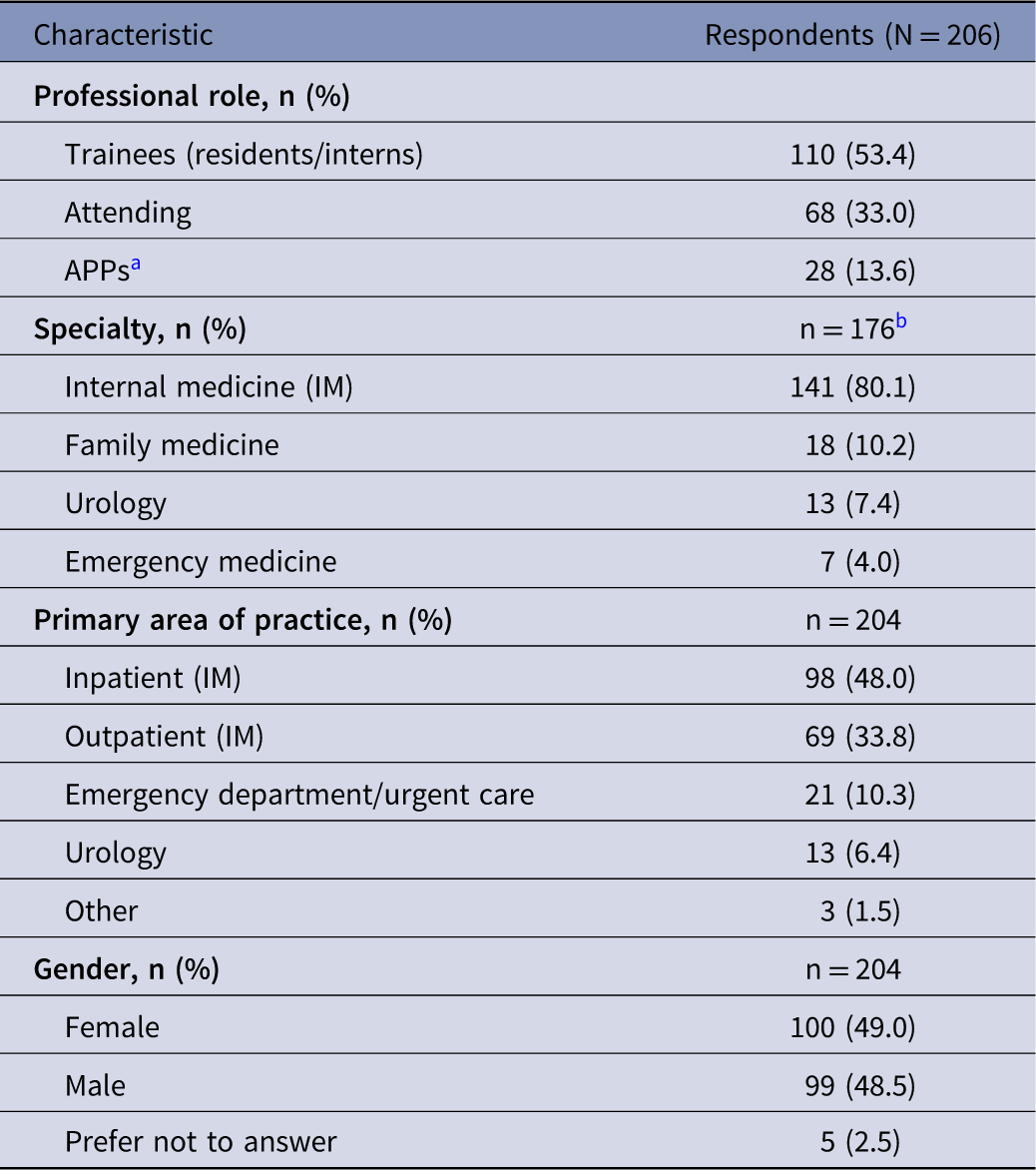
Of 363 surveys distributed, 221 were completed (61% response rate). Fifteen of these were excluded as respondents did not belong to the targeted specialties, leaving 206 surveys for final analyses (Table 1). Respondents were evenly distributed by gender (49.0% female). Professional roles were trainees (53%), attendings (33%), and APPs (14%). Most physicians were internal medicine trained (80%), with a smaller proportion of family medicine (10%), urology (7%), or emergency medicine (4%).
Clinician characteristics of the survey respondents

Table 1. Long description
A table with 6 rows and 2 columns. The columns are labeled ‘Characteristic’ and ‘Respondents (N = 206)’. The table details the professional roles, specialties, primary areas of practice, and gender distribution of survey respondents. Professional roles include trainees (53.4 percent), attending (33.0 percent), and APPs (13.6 percent). Specialties include internal medicine (80.1 percent), family medicine (10.2 percent), urology (7.4 percent), and emergency medicine (4.0 percent). Primary areas of practice include inpatient (48.0 percent), outpatient (33.8 percent), emergency department/urgent care (10.3 percent), urology (6.4 percent), and other (1.5 percent). Gender distribution is 49.0 percent female, 48.5 percent male, and 2.5 percent prefer not to answer.
a APP = advanced practice professional.
b APPs excluded.
UTI symptoms and signs
The most common symptoms clinicians endorsed as indicative of UTI in men were dysuria (96%), suprapubic tenderness (88%), and increased urinary frequency (88%; Figure 2). A notable proportion of clinicians also reported that non-evidence-based symptoms, such as a change in urine color (47%) or odor (55%), indicated UTI. For physical examination signs, clinicians thought suprapubic tenderness (91%; Figure 3) was the most suggestive, followed by flank/costovertebral angle tenderness (83%). There was similarly a high proportion that deemed non-evidence-based signs, such as cloudy (59%) or foul-smelling urine (63%), as indicative of UTI.
Symptoms clinicians endorse as indicative of UTIs in men. Symptoms are patient-reported, subjective evidence of illness. Free text responses in other was “purulent penile discharge” (n = 1). N = 206.

Signs clinicians endorse as indicative of UTIs in men. Signs are clinician-evaluated, including evidence of illness from physical examination and vital signs. Free text responses in other were “clinical context” (n = 1), “dysuria, urinary frequency, and urgency” (n = 1), and “no suprapubic tenderness” (n = 1). N = 199.

We examined clinician characteristics associated with increased likelihood to use non-specific urine characteristics to diagnose UTI (Supplemental Table 1). Among professional roles, APPs were significantly more likely to use cloudy (OR 3.62, CI 1.29–10.18, P = .02) or foul-smelling urine (OR 2.93, CI 1.05–8.22, P = .01) to diagnose UTI compared to attending physicians (Supplemental Figure 1a). Among primary areas of practice, clinicians practicing in the emergency department were significantly more likely to use both cloudy and foul-smelling urine compared to outpatient internal medicine clinicians (Supplemental Figure 1b; OR 4.41, CI 1.40–13.92, P = .01).
Diagnostic evaluation
For men suspected to have a UTI, clinicians examine for suprapubic tenderness “almost always” (55%) or “most of the time” (28%; Figure 4 and Supplemental Table 2). They commonly examine for flank/costovertebral angle tenderness (“almost always”—53%, “most of the time”—31%). Conversely, clinicians rarely examine the prostate (“almost never”—59%, “some of the time”—25%) or the penis, testes, or scrotum (“almost never”—28%, “some of the time”—35%). Urinalysis is “almost always” ordered (95%), but interpretation was variable with clinicians considering cutoffs of ≥3 white blood cells [WBC]/hpf (5%), ≥5 WBC/hpf (21%), ≥10 WBC/hpf (55%), and ≥100 WBC/hpf (18%) to be consistent with UTI. Urine culture was similarly “almost always” ordered (85%). Prostate-specific antigen [PSA] is rarely ordered (“almost never”—60%; “some of the time”—24%). Imaging is uncommonly ordered, including computed tomography of the abdomen and pelvis (“almost never”—35%, “some of the time”—50%) and renal ultrasound (“almost never”—35%, “some of the time”—49%).
Diagnostic evaluation of UTIs in outpatient men. Questions answered on a Likert scale by respondents (“almost never,” “some of the time,” “half of the time,” “most of the time,” and “almost always”). Number of respondents differed by variable, N = 188–197. Please refer to Supplemental Table 2 for specifics by variable.

Treatment
Most clinicians preferred to treat UTIs in outpatient men for 7 days or less (87%) and believed other clinicians prescribe similar durations (Supplemental Figure 2). There was heterogeneity in what clinicians deemed first-line empiric antibiotics for men with UTIs (Figure 5). The most common choice was trimethoprim-sulfamethoxazole (68%) followed by nitrofurantoin (54%) and fluoroquinolones (48%).
Preferred empiric antibiotic selection for UTIs in outpatient men. IM = intramuscular; PO = per os. Respondents could choose as many options for “appropriate” empiric antibiotic therapy as they wanted. N = 206.

Variables affecting clinician confidence
We examined clinician characteristics associated with confidence in diagnosis and treatment of UTIs in outpatient men (Supplemental Table 3). Among professional roles, trainees were significantly less confident than attending physicians in diagnosing UTIs in outpatient men (OR 0.18, CI 0.04–0.77, P = .02). Conversely, urologists were significantly more confident than those practicing outpatient internal medicine in both diagnosis and treatment of UTIs in outpatient men (OR 5.83, CI 1.18–28.74, P = .03).
Variables affecting treatment duration
On multivariable analysis (Supplemental Table 4), less confidence in treatment was associated with intention to prescribe longer than 7 days of antibiotics for an outpatient man with a UTI (OR 2.33, CI 1.01–5.56, P = .05). Additionally, the belief that other providers treated for longer than 7 days (ie, subjective norms) was strongly associated with an intention to prescribe longer than 7 days themself (OR 17.77, CI 6.55–48.17, P < .01).
Discussion
Our survey results show that most clinicians rely on non-specific UTI signs and symptoms (ie, cloudy or foul-smelling urine), and that these characteristics are more commonly used by APPs and emergency department clinicians. We found that clinicians with lower confidence in clinical skills for management of UTIs in men were more likely to choose a longer treatment duration. Similarly, those who perceived that peers were choosing longer durations were more likely to treat with longer durations themselves.
Most clinicians endorsed dysuria (96%) and increased urinary frequency (88%) as indicative of a UTI, which is consistent with evidence-based symptoms and signs for UTIs in women. Reference Bent, Nallamothu, Simel, Fihn and Saint7,Reference Medina-Bombardó, Jover-Palmer, Medina-Bombardó and Jover-Palmer17 Interestingly, although hematuria is also an evidence-based sign of UTI in women, it is only used by half of clinicians, and it is unclear why this differs from the other evidence-based symptoms and signs. Reference Bent, Nallamothu, Simel, Fihn and Saint7 In general, clinicians used an array of symptoms and signs, ranging from 20% to 96% for the 14 surveyed variables, highlighting a lack of consensus.
A notable proportion of clinicians (~50%) relied on non-specific, non-evidence-based urine characteristics (ie, changes in urine odor or cloudy appearance) which lack specificity for symptomatic UTI compared to symptoms like dysuria. Reference Bent, Nallamothu, Simel, Fihn and Saint7,Reference Nicolle, Gupta and Bradley13,Reference Midthun, Paur and Lindseth18 The reliance on these non-specific characteristics to diagnose UTI in men probably reflects the pervasive but incorrect belief that these symptoms and signs are reliable predictors of UTI. We found that emergency department clinicians were more likely to rely on non-specific urine characteristics, consistent with studies showing overdiagnosis of UTI in general in the emergency department. Reference Tomas, Getman, Donskey and Hecker19 Use of these non-specific characteristics may be related to increased diagnostic pressures and high patient turnover in the emergency department. Increased use of these characteristics by APPs may be due to their disproportionately increased involvement in both emergency room moonlighting and same-day urgent care visits at our institution.
Clinician respondents tend to omit key components of the physical examination in diagnosing UTIs in men. While clinicians commonly evaluated for suprapubic or flank/costovertebral angle tenderness, they rarely evaluated the prostate or genitals, which could lead to missed diagnoses of prostatitis and epididymo-orchitis. The limited use of DRE may be due to a perceived lack of benefit or concerns for causing harm in acute prostatitis. A qualitative evaluation of the primary care clinician view of DRE in evaluating men with UTI deemed it “painful and irrelevant in the management strategy.” Reference Soudais, Gallais and Schuers11 Another study reported that DRE was performed in only 6.6% of outpatient men presenting with a UTI. Reference Soudais, Lacroix-Hugues, Meunier, Gillibert, Darmon and Schuers20 However, a tender prostate is present in 63%–90% of cases of ABP and is one of the few symptoms or signs which may distinguish ABP from other UTI syndromes in men. Reference Millán-Rodríguez, Palou and Bujons-Tur21 It is possible clinicians are fearful of precipitating bacteremia, a common refrain in review articles going back decades. Reference Nickel22 Notably, no citation in these articles supports this claim and these reviews do recommend a gentle prostatic exam, just not a prostatic massage. Another contributing factor to the limited use of DRE may be perceived self-efficacy by clinicians—only 33.6% of physicians felt confident their training to perform DREs was sufficient in a recent study. Reference Wong, Drossman and Bharucha23 Overall, the limited use of DRE represents an opportunity to improve clinical practice as DRE is a low cost, low risk intervention that may help distinguish ABP from other UTI syndromes in men.
Of our respondents, only 13% reported prescribing longer than 7 days of therapy for UTIs in outpatient men, significantly less than the 65% of clinicians who treated men with UTI for over 7 days in a 2009 observational VA cohort. Reference Drekonja, Rector, Cutting and Johnson8 This reported willingness to treat with shorter courses of antibiotics may reflect a nationwide trend of decreasing antibiotic usage within the Veterans Health Administration (VHA) or could be related to social desirability bias in answering survey questions. Reference Kelly, Jones and Echevarria24 The behavioral factor (based on the Theory of Planned Behavior framework) which contributed the most to continued prescription of longer durations was subjective norms, as the perception that peers prescribed longer antibiotic durations was significantly associated with intention to prescribe longer antibiotic durations. Self-efficacy, as evidenced by clinician confidence questions, was another contributory factor in which respondents who felt lower self-efficacy were more likely to treat for a longer duration. The inverse relationship between confidence and treatment duration has been reported in prior studies of intensive care physicians specifically and more generally with antimicrobial prescribers at acute-care hospitals. Reference Janssen, Oerlemans, Van Der Hoeven, Ten Oever, Schouten and Hulscher25–Reference Pandolfo, Horne and Jani27
Our survey uncovered significant heterogeneity in antibiotic selection, with only two antibiotics deemed appropriate for empiric treatment by more than half of clinicians, and none by more than 70%. This reflects not only a difference in preference but a lack of agreement on appropriate empiric therapy among providers. Less than half of the surveyed clinicians preferred fluoroquinolones (48%) for UTIs in outpatient men, and over half endorsed nitrofurantoin (54%). These preference patterns may be due to overall decreased fluoroquinolone use for UTI treatment in the U.S. and increased recognition that men can have uncomplicated UTIs (and thus nitrofurantoin may be an effective choice). Reference Trautner, Cortés-Penfield and Gupta5,Reference Umarje, Alexander and Cohen28 The lack of treatment consensus may also reflect the lack of applicable guidelines for treatment of uncomplicated UTI in men. Reference Trautner, Cortés-Penfield and Gupta5,Reference Gupta, Hooton and Naber6
Limitations of our study are that this was a single-center survey, although in a very large, tertiary care medical center with 12 outlying referral clinics serving over 131,000 Veterans with over 2 million outpatient visits per year. Additionally, we surveyed clinicians about their self-reported behavior, meaning that they may manage men with UTI differently than what they reported in the survey. This limitation may be particularly relevant for the reported duration of treatment for men with UTI, as responses may have been shaped by social desirability bias. Social desirability bias inherent to survey studies may have been further exacerbated by the face-to-face interactions incorporated into our survey distribution and collection.
In conclusion, our survey showed significant heterogeneity in clinician approaches to diagnosis and treatment of UTIs in outpatient men. For diagnosis, the impact of evidence gaps is noteworthy, leading to reliance on non-specific UTI symptoms and signs and minimal use of important physical examination tools (ie, DRE). For treatment, more recent evidence supporting the use of shorter durations of therapy has been reflected in local practice. Subjective norms and limited self-efficacy play a role in overtreatment of UTIs in outpatient men; both factors can be addressed in antibiotic stewardship programs tailored for UTI in men.
Supplementary material
The supplementary material for this article can be found at https://doi.org/10.1017/ash.2026.10763.
Data availability statement
Data available upon reasonable request to the corresponding author within the limitations of our approved institutional review board protocol.
Acknowledgements
None.
Author contribution
Conceptualization—TJB, LG, TMH, BWT; Data curation—TJB, LG, LD; Formal analysis—TJB, LG; Funding acquisition—TJB, LG, BWT; Investigation—TJB, LD; Methodology—TJB, LG, TMH, BWT; Project administration—TJB, LG, LD, BWT; Resources—LG, BWT; Software—N/A; Supervision—LG, TMH, BWT; Validation—TJB, LG, LD; Visualization—TJB, LG; Writing (original draft)—TJB; Writing (review and editing)—TJB, LG, TMH, LD, BWT.
Financial support
This work was supported by the Michael E. DeBakey Veterans Affairs Medical Center seed grant and the US Department of Veterans Affairs Health Services Research and Development Service at the Center for Innovations in Quality, Effectiveness, and Safety [grant number CIN 13-413].
Competing interests
The content is solely the responsibility of the authors and does not necessarily represent the official views of the Government of the United States. All authors have no relevant conflicts of interest to report.
Manuscript preparation
The funding source had no role in the design, practice, or analysis of this study.



 Open access

