1. Introduction
A key question in loanword adaptation is whether the process is driven primarily by phonetics or phonology. In the context of loanword adaptation, phonetics refers to the borrower's perception of a word's acoustic signal, whereas phonology refers to the borrower's interpretation of the word's sounds and structure in the light of how they are classified in the brain. Note that when we use the term ‘borrower’, we are referring to the adapter, the on-line borrower, not simply a user of established loanwords. Phonetics is attuned only to the acoustic aspects of foreign sounds, not how those sounds are classified in the source language (L2), while phonology is sensitive to how those sounds are mentally categorized in L2. In the phonetic view (also referred to as the perceptual stance), borrowers cannot access the phonology of the source language and may, in fact, be monolinguals with virtually no knowledge of the L2's system. In this scenario, the goal is to produce, within the parameters of the borrowing language (L1), the adapted form that is the best phonetic match for the input. In contrast, in what we call the phonological view, borrowers must be sufficiently bilingual to know how the sounds of a loanword are classified in the L2, since the goal of adaptation is to produce, within the parameters of their L1, a form that best matches the mental classification of the L2 output with that of the L1 input.
A possible explanation for the theoretical divide is that researchers on each side are viewing equally plausible, but different, scenarios. Perhaps in some language situations adaptation is carried out mainly by those without access to L2 phonology and is, perforce, perceptually driven. In other situations, adaptation may be done by bilinguals who actively draw upon their knowledge of L2 phonology in adapting loanwords. In short, perhaps there are alternative routes, that is two co-existing strategies for adapting loanwords, one phonetic and one phonological. The phonetic strategy would most likely be favored in situations where the vast majority of the population did not know the L2, thus having no access to the L2 phonological system. The phonological strategy, on the other hand, is likely to be favored in situations where there is a high proportion of speakers who are bilingual in the L1 and L2, since it has been amply demonstrated that phonological knowledge, once acquired, is difficult, if not impossible, to suppress (Foss & Hakes Reference Foss and Hakes1978; Elman Reference Elman and William1989; Gathercole Reference Gathercole and Martin1997; Yeni-Komshian Reference Yeni-Komshian, Jean and Nan1998; Kuhl Reference Kuhl2000; contributions in Cenoz, Hufeisen & Jessner Reference Cenoz, Hufeisen and Jessner2003; etc.). This alternative route hypothesis, in relation to community bilingualism, is informally proposed by Hefferman (Reference Hefferman2005). We formalize it in (1).
(1) The Alternative Route Hypothesis in Relation to Community Bilingualism
(a) Phonological adaptation of loanwords is prevalent in communities where the rate of bilingual speakers is high.
(b) Phonetic adaptation of loanwords is prevalent in communities where the rate of bilingual speakers is low.
How can we best test the Alternative Route Hypothesis in (1)? We need to compare loanwords, using the same L1 and L2, under two distinct conditions, one in which there is a very low rate of community bilingualism, and one where the rate of community bilingualism is high. A real-world ideal is to compare loanword adaptations from a ‘before widespread exposure to L2’ with those from an ‘after widespread exposure to L2’ scenario. Both corpora need to be sufficiently large and well-detailed for phonetic/phonological comparisons to be made. Clearly, such situations are few and far between.Footnote 2
However, we believe that we have a nearly ideal test case. This test case permits what is, to the best of our knowledge, the first longitudinal study in loanword adaptation. It consists of a corpus of 485 English borrowings from late 19th- and early 20th-century Quebec French (the Old Quebec French (OQF) corpus) that is compared to two large corpora of English loanwords in contemporary Quebec French (QF), one from Quebec City and one from Montreal (which combine to yield the Recent Quebec French (RQF) corpus). The crucial point of comparison between these language situations is that the rate of community bilingualism in late 19th- and early 20th-century Quebec was extremely low (under 8%), while that of contemporary Quebec is many times higher (30% in Quebec City and 50% in Montreal). If phonological adaptation is an artifact of a high rate of community bilingualism, and perceptual (i.e. phonetic) adaptation the fruit of a low rate of community bilingualism, then the OQF corpus should show strikingly different adaptation patterns from the RQF corpus.
However, as we will show, the adaptation patterns of the OQF and RQF corpora are very similar. What does this mean? It means that adaptation is either phonetic or phonological in both cases, despite dramatic differences in the levels of community bilingualism. This casts serious doubt on the Alternative Route Hypothesis in (1). Now, if adaptations must be either phonetic or phonological in both cases, the obvious question is which is it? Given that the patterns observed in RQF reflect those observed in the whole Project CoPho loanword database (described in appendix A) and that those patterns have been shown to be phonological (Paradis & LaCharité Reference Paradis and LaCharité1997, Reference Paradis and LaCharité2001; Paradis & Prunet Reference Paradis and Prunet2000; Paradis Reference Paradis2006), and inconsistent with the perceptual stance (LaCharité & Paradis Reference LaCharité and Paradis2005), it follows that adaptations in the OQF corpus are most likely to be also mainly phonological.
In LaCharité & Paradis (Reference LaCharité and Paradis2005), phonetic approximation is, for the first time, defined in specific operational terms, and a large and varied database (that of Project CoPho) is examined closely for its effects. That definition includes all the logically possible manifestations of phonetic adaptation and establishes explicit criteria for identifying it. LaCharité & Paradis's specific goal is to compare the perception/interpretation of sounds by monolinguals confronted with cross-linguistic stimuli to the adaptations found in the CoPho loanword database. In every case, the predictions of the perceptual stance are resoundingly disconfirmed. The criteria for identifying phonetic approximation will be presented and discussed in relation to the OQF and the RQF corpora. However, as our current focus is on the comparison between the OQF and the RQF these two corpora, and also because of space limitations, we will not repeat the arguments presented in LaCharité & Paradis (Reference LaCharité and Paradis2005) in favor of the phonological stance, and against the perceptual one.
If bilinguals, but not monolinguals, have the access to L2 phonology needed to make phonological adaptations, how can we explain that adaptation is phonological in OQF, since there were very few bilinguals in the community at that time? We will conclude that even in situations where the number of bilinguals in a society is relatively small, bilinguals, not monolinguals, control the adaptation of loanwords.
Yet a low rate of community bilingualism does have an impact. We find in the OQF corpus a lower rate of imported foreign segments, a slight increase in the rate of phonetic approximation, and a somewhat higher rate of false analogy. Also, false analogy in OQF is more often based on L1 than L2. The impact of a low rate of community bilingualism is summed up in (2).
(2) A low rate of community bilingualism yields
(a) a lower rate of imported segments;
(b) a very modest increase in the rate of phonetic approximation;
(c) a higher rate of false analogy, mostly based on L1 (very rarely on L2).
This article is structured as follows: In section 2, we present statistics on the general adaptation patterns of the three QF corpora and highlight the similarities in the adaptation patterns of the three corpora. In section 3, we present our results concerning importations. However, we first draw a distinction between intentional and naive phonetic approximation, which is crucial to the discussion of importations, and we present the criteria used to identify phonetic approximation in the adaptation of loanwords. In section 4, we turn to phonetic approximation within the OQF corpus, and discuss our findings according to the criteria established in section 3. In section 5, we consider the topic of false analogy within the corpora. Section 6 discusses the importance of understanding the phonologies of both the source and the borrowing languages at the time the words were borrowed, so that loanword adaptation can be distinguished from the effects of native processes. Our conclusions follow in section 7. The general statistics for the CoPho database, from which the three QF corpora are taken, and which includes nearly 12,000 loanwords, are provided in appendix A. In appendix B, the rationale for the corpus of OQF is fully discussed.
2. General comparative results: the predominance of phonology
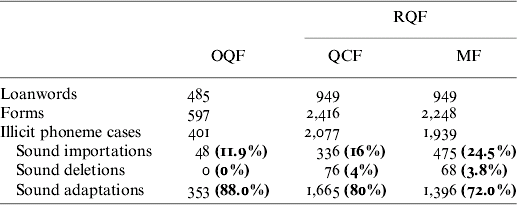
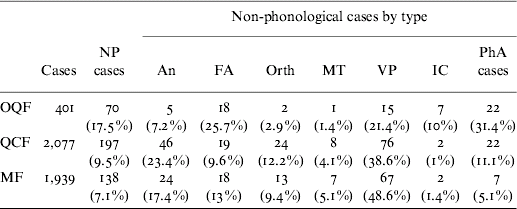
The general statistics for the OQF–RQF comparison, which includes Quebec City French (QCF) and Montreal French (MF), are presented in table 1.
General statistics for the three corpora of Quebec French
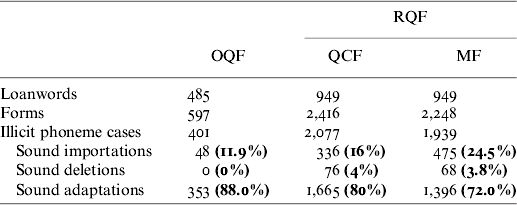
The 597 OQF forms comprise the attested pronunciations of the 485 popular and familiar English loanwords found in the Glossaire du parler français au Canada by Rivard & Geoffrion (Reference Rivard and Geoffrion1930) (henceforth the Glossaire). The words in the Glossaire were collected mainly at the end of the 19th and the beginning of the 20th centuries. In its compilation, more than two hundred consultants from all regions of Quebec were interviewed and their pronunciations recorded in phonetic transcriptions intended to document how words, including the English loanwords, were pronounced in that period.Footnote 3 Two million pronunciations were gathered, but only those attested as being used in the wider speech community (not idiosyncratic ones) were included in the Glossaire. We extracted from the Glossaire all the words flagged as being borrowed from English, or that seemed to be clearly derived from English even if they were not so tagged (e.g. it seemed clear that OQF tomship came from English township). We classified each pronunciation of an English borrowing recorded by the Glossaire as a form. For example, five different pronunciations of English hornpipe are recorded for OQF, yielding five forms ([ɛrlapap], [ɛrlapat], [ɛrləpajp], [arləpap] and [ɔrləpajp]). All the 597 forms (i.e. variant pronunciations of the 485 loanwords) provided by the Glossaire were analyzed, and the statistics we provide take all forms into account.
To avoid misleading duplication, we excluded predictable derivatives of the same base word. For instance, although the Glossaire provides bluff, bluffeur and bluffer as independent borrowings, we included only bluff in the OQF corpus. However, if a derivative existed, but not the base form, then it was included in the list. For example, English broker [bɹók-əɹ] (→OQF [brokər]) is included, because underived broke is not attested. Finally, we did not include calques or semantic borrowings (e.g. OQF changement de venue from English change of venue) or French words whose meanings were extended by analogy to English (e.g. OQF valoir, which came to be used in the sense of ‘he's worth two million dollars’, by analogy to English worth).
In the RQF corpora, a form is also an attested pronunciation of a loanword. Loanwords were gathered from written and oral sources and their pronunciations were elicited from several different QF speakers via tasks such as picture-naming, fill-in-the-blanks and definitions. Words were not presented in written form. Every pronunciation (i.e. form) of every loanword was taken into account in the analysis and statistics. In RQF, 949 loanwords yielded 2,416 forms in QCF and 2,248 forms in MF.
Illicit phonemes, also referred to as malformations, are counted on the basis of forms, and they refer to English phonemes that were/are not permitted phonemes in QF. Importations, also referred to as non-adaptations, are foreign phonemes that are adopted rather than adapted by the borrowing language. Deletions are illicit phonemes that are lost, while sound transformations refer to illicit segments that are changed, be those changes phonological, phonetic or due to other factors. Here, we are mainly concerned with the analysis of phonemes that undergo some kind of transformation when they are borrowed.
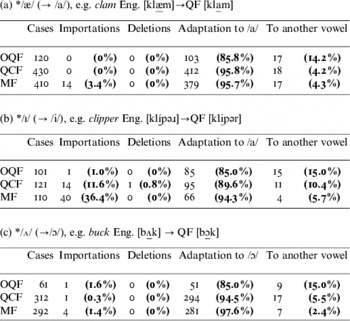
The most pertinent finding of the OQF–RQF comparison is the similarity in the treatment patterns of illicit phonemes in the three corpora. All illicit foreign segments are adapted in the same way, at surprisingly close rates across the three corpora.Footnote 4 This is exemplified in tables 2(a)–(c) by the treatment of illicit English /æ, ɪ, Λ/, which represents the general picture for all the illicit segments of the corpora.Footnote 5
Examples of the treatment of illicit English /æ, ɪ, Λ/ in Quebec French

Tables 2(a)–(c) give the main adaptation for a particular illicit English segment and the pertinent figures for each corpus. As shown, */æ/ is usually adapted to /a/, */ɪ/ to /i/ and */Λ/ to /ɔ/ in all three corpora. Also noteworthy is the rarity of deletion (0–1% for these segments) in the three corpora. Most importantly, tables 2(a)–(c) show that there is one main adaptation pattern for a given illicit segment and that adaptation is the same in all three corpora. This is true for all the illicit English phonemes in the corpora of English loanwords in QF, not just these three segments. Despite the fact that there were very few bilinguals in OQF society, we do not find a different adaptation pattern than in the RQF corpora, nor do we find in OQF a variety of adaptation patterns for a given L2 segment.
The stability of adaptations within each corpus and among the corpora is highly significant. The perception of an unfamiliar language by non-native speakers is notoriously unstable, in the sense that their interpretation of a given foreign sound is influenced by phonetic context, speaking rate, etc. Indeed, a hallmark of phonetic interpretation of foreign sounds by naive listeners is variability. Speaking specifically of the classification of English and French vowels by non-native speakers, Escudero & Polka (Reference Escudero, Polka, Maria-Josep, Recasens and Romero2003: 861) state that
the non-native listener may perceive variability in different productions of a non-native phoneme that the native listener does not. For example, non-native listeners have been shown to assimilate the same non-native phoneme to different native categories when it is produced in different speaking styles or phonetic contexts.
Speaking more generally and summing up an extensive body of research, Best & Tyler (2007) conclude that a monolingual's perception of L2 contrasts varies systematically according to L1 phonotactic, allophonic, and co-articulatory patterning. In brief, there is a wealth of psycholinguistic evidence showing that perceptual stability is a function of increased mastery of the L2. Hence, the very fact that the adaptation patterns are basically the same in both corpora and that there is one overwhelmingly preferred adaptation pattern for each L2 sound in both OQF and RQF strongly suggests that the interpretation of the foreign sounds was and is phonological, not phonetic. One would expect a variety of adaptations, not stability, if limited community bilingualism drove L2 sounds to be adapted on a purely phonetic basis.
Nonetheless, the figures in tables 1 and 2 do suggest higher rates of non-phonological influence in OQF. For each illicit segment in tables 2(a)–(c) the rate of adaptation to the main pattern is negatively correlated with the proportion of bilinguals in the society. Although phonology drives the adaptations in the majority of cases, for each segment, as the rate of community bilingualism drops, the rate of non-phonological cases increases. It is to the differences between the OQF and RQF corpora, including differences in rate of phoneme importation and rate of non-phonological influence (including phonetic approximation), that we now turn.
3. Importation as intentional phonetic approximation
The rate of importation of English phonemes is lower in OQF (11.9%) than in either QCF (16%) or MF (24.5%). But before discussing the importation results, we think it is crucial to distinguish between intentional and naive phonetic approximation. Intentional phonetic approximation, which can result in the importation of foreign sounds and structures, is associated with the phonological view, which maintains that, in loanword adaptation, reference is normally made to systemic facts, not directly phonetic ones (see Hyman Reference Hyman1970; Lovins Reference Lovins1975; Danesi Reference Danesi1985; Ulrich Reference Ulrich1997; Paradis & LaCharité Reference Paradis and LaCharité1997, Reference Paradis and LaCharité2001, Reference Paradis and LaCharité2002; Jacobs & Gussenhoven Reference Jacobs, Gussenhoven, Joost, Leeuw and Weijer2000; Paradis & Prunet Reference Paradis and Prunet2000; LaCharité & Paradis Reference LaCharité and Paradis2002, Reference LaCharité and Paradis2005; Davis Reference Davis2004; Uffman Reference Uffman2004a, Reference Uffmanb; etc. for discussion of the phonological adaptation of loanwords). This view presupposes that borrowers are, on the whole, bilingual and that they accurately classify L2 sounds (phonemes and variants) and structures in borrowed words. When bilinguals import foreign sounds and structures, they do so from a standpoint of perceptual mastery of L2 sounds and structures, which may include phonetic variants. Intentional phonetic approximation is the borrower's best attempt to produce an authentic L2 pronunciation (Danesi Reference Danesi1985) and is thus what lies behind the imported phonemes and structures that find their way into an L1 when borrowings from the L2 are numerous and the borrowing language community is receptive to those foreign sounds and structures.
What we call naive phonetic approximation results from perceptual distortion, which occurs because the L2 word is filtered through a perceptual system shaped by, and attuned exclusively to, the L1. According to the phonetic approximation or perceptual stance, the sound changes in loanwords are due to the borrower's inability to perceive foreign sounds correctly, either because the borrower does not speak the L2, or because both the L1 and L2 sound systems cannot be active simultaneously. This view is summed up by Vendelin & Peperkamp (Reference Vendelin and Peperkamp2004: 128):
[A]ll loanword adaptations are phonetically minimal transformations that apply in perception … all aspects of non-native phonological structure, including segments, suprasegmentals, and syllable phonotactics, are systematically distorted during speech perception. That is, non-native sound structures are assimilated to ones that are well-formed in the native language … both by monolinguals and by bilinguals. [See also Peperkamp & Dupoux Reference Peperkamp and Emmanuel2003.]
In this view, misperception is held responsible, implicitly or explicitly, for most, if not all, the sound changes in loanword adaptation (see Silverman Reference Silverman1992; Yip Reference Yip1993; Kenstowicz & Sohn Reference Kenstowicz, Sohn and Michael2001; Peperkamp & Dupoux Reference Peperkamp and Dupoux2002, Reference Peperkamp and Emmanuel2003; Kang Reference Kang2003; Kenstowicz Reference Kenstowicz2003, etc. for discussion of how phonetic approximation is thought to apply in loanword adaptation).
Although naive phonetic approximation is regularly assumed or invoked in the loanword adaptation literature, it was only recently formally defined (Paradis & LaCharité Reference Paradis, LaCharité, Mark and Reiss2003; LaCharité & Paradis Reference LaCharité and Paradis2005). That definition, which encompasses all the logical possible manifestations of phonetic approximation and which guided our classification of adaptations in OQF and RQF, is reprised in (3).
(3) Criteria for identifying Naive Phonetic Approximation
A. Phoneme non-perception (manifested in its deletion)
B. Incorrect phoneme categorization (manifested in phoneme mismatching)
1. perceptual confusion (due to perceptual proximity)
a. illicit phoneme-to-phoneme mismatching: an L2 phoneme that does not occur in L1 is adapted to the perceptually, not phonologically, closest L1 phoneme
b. licit phoneme-to-phoneme mismatching: an L2 phoneme that is permitted in L1 nonetheless changes phoneme category in loanword adaptation because the phonetic cues associated with the L2 phoneme relate to a different L1 phoneme
2. level confusion (mistaking variants for phonemes and vice versa)
a. variant-to-phoneme mismatching: an L2 phonetic variant is identified as phonemic in L1
b. phoneme-to-variant mismatching: an L2 phoneme is identified as a phonetic variant of a different phoneme in L1
In debates over the phonetic versus phonological nature of loanword adaptation, proponents of phonetic approximation generally focus on phonetic approximation of the types expressed in (3A) and (3B1). Therefore, we will likewise be mainly (though not exclusively) concerned here with these manifestations of phonetic approximation.
Since an inability to access the L2 phonological system underlies naive phonetic approximation, the resulting sound substitutions are likely to be L1-influenced misinterpretations of L2 sounds. There is little likelihood of foreign sounds making their way into the L1 system under these conditions. Naive phonetic approximation thus protects the L1 system from change, while intentional phonetic approximation attempts to have the L1 phonological system accommodate certain phonological characteristics of the L2. As pointed out in LaCharité & Paradis (2005), intentional phonetic approximation, which is a characteristic behavior of bilinguals, can introduce L2 sounds and structures into the L1 system whereas naive phonetic approximation, which is more characteristic of monolinguals, does not. This is stated in (4).
(4) The systemic implications of intentional versus naive phonetic approximation
Intentional phonetic approximation (importation/non-adaptation) introduces L2 sounds and structures into the L1, whereas naive phonetic approximation (phoneme deletion or mismatching) does not.
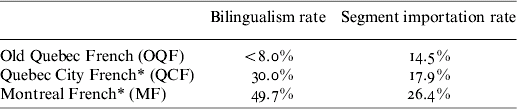
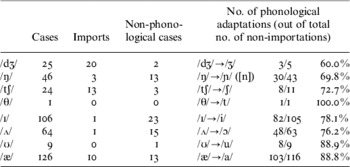
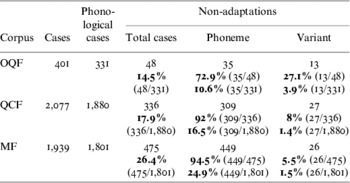
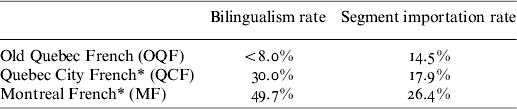
With respect to importations, we observe a positive correlation between the percentage of bilinguals in a community and the segment importation rate, as shown in table 3. Thus, there are more non-adaptations in the MF corpus (26.4%), where the rate of bilingualism is 49.7%, than in that of QCF (17.9%), where the rate of bilingualism is 30% (according to Statistics Canada's 1996 figures, which correspond to the period in which the data of our RQF corpora were gathered). In the OQF corpus the rate of importation drops to 14.5%, and although we cannot present hard statistics on bilingualism rates for the late 19th and early 20th centuries, we can state with assurance that their numbers were substantially smaller than is currently the case in either Montreal or Quebec City. The English–French bilinguals were found mainly in Montreal and Quebec City, but as recently as 1871, only 8% of the French-speaking population lived in those urban areas. Not all of these were bilingual, and the 92% comprising the rural population was almost exclusively monolingual French-speaking (for an extensive discussion and references, see appendix B). Hence we estimate that less than 8% of the population was bilingual.
Importation and bilingualism rates for Quebec French
* Figures are from Statistics Canada 1996 (www.statcan.ca)
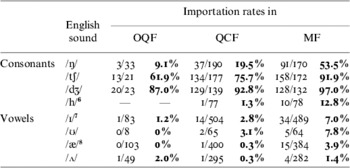
The correlation between the rates of bilingualism and importation is evident not just generally, but also at the level of individual L2 sounds. An exhaustive comparison of importation rates of illicit English phonemes in OQF and RQF (QCF and MF) is presented in table 4.
An exhaustive comparison of importation rates of English sounds in Quebec French

Table 4 shows that, except for English /Λ/, for every imported L2 phoneme, the more bilinguals there are in a community, the more importations/intentional phonetic approximations we find. This positive correlation supports the view that most phoneme importation is due to intentional, rather than naive phonetic, approximation.
4. Non-phonological adaptations including naive phonetic approximation in OQF
The main criteria for identifying an adaptation as phonological were that it conformed a) to the general pattern (stability) and b) to phonological principles, including Category Preservation and Category Proximity. Category Preservation states that if a given L2 phonological category (i.e., feature combination) exists in L1, this L2 category will be preserved despite phonetic differences. For example, the English rhotic is preserved as a rhotic in loanword adaptation, even if the borrowing language's rhotic(s) is/are phonetically very different. According to Category Proximity, if the L2 phonological category does not exist in L1, it will be replaced by the phonologically closest L1 feature combination, even if the inventory contains acoustically closer sounds. For example, in loanword adaptation French recognizes illicit English /ɪ/ as a high front vowel and replaces it with /i/, though French /ɛ/ is phonetically closer.Footnote 9 According to the criteria of stability and conformity to phonological principles, 1,880/2,077 (90.5%) of the adaptations in QCF, 1,801/1,939 (92.5%) of those in MF and 331/401 of the adaptations (82.5%) in OQF are most likely phonological.
This means that only 70/401 sound changes (17.5%) in the OQF corpus are likely to be non-phonological. However, not all non-phonological adaptations are due to phonetic approximation, as we will show. Non-phonological sound substitutions include any substitutions not conforming to phonological principles, including cases of analogy (true and false), orthography influence, missed targets, and variable pronunciations in the source language; such substitutions simply fail to provide a window onto the phonology or phonetics of a given adaptation. Identifying and analyzing non-phonological (or non-phonetic) influences in a corpus of loanwords is necessary for a fuller understanding of the borrowing process, but it is also necessary because linguists need to be sure that in constructing an argument either for or against phonology/phonetic approximation in loanword adaptation, we are relying on evidence that speaks to the issue. As we will try to show, most kinds of non-phonological influence do not.
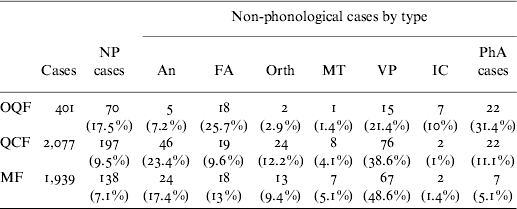
The breakdown by subcategory and the figures for each non-phonological category in the three QF corpora are given in table 5. The first type of non-phonological influence considered is analogy, which is defined in (5).
(5) Analogy
The replacement of an L2 morpheme by an L1 morpheme with the same, or nearly the same, signification.
As noted earlier, we excluded calques (complete true analogies), which left us with cases of partial analogy, in which one morpheme of a word, or one word of an L2 compound, was replaced by an L1 form. That part of a word affected by analogy reveals nothing about phonological or phonetic principles in loanword adaptation, and hence it has to be set aside. However, we note that in making a true analogy, the borrower is basically translating and so must have access to L2 lexical knowledge, to correctly substitute an L1 morpheme.For example, the OQF borrowers who replaced English double [d bəl] in double breasted with French double [dubl], which is phonetically different though etymologically related, most likely knew the English word. Otherwise, we would have expected the phonological adaptation [dɔbəl].
Statistics for non-phonological cases in Quebec French
NP=non-phonological, An=analogy, FA=false analogy, Orth=orthography influence,
MT=missed target, VP=variable pronunciation, IC=isolated cases, PhA=phonetic approximation
False analogy, unlike true analogy, suggests limited L2 lexical knowledge. It divorces the sound of an L2 word from its L2 meaning. A formal definition is stated in (6).
(6) False analogy
Matching a word or an affix to an L1 or L2 form primarily on the basis of its phonetic shape, independent of, or only indirectly related to, its L2 meaning.
False analogies often contain what seem to be unexpected substitutions or deletions of one or more L2 sounds, so such cases might be mistaken for phonetic approximation. For example, brickyard [bɹ kjὰɹd] is adapted as OQF [brikad];Footnote 10 the morpheme yard [jɑɹd] was apparently mistaken for the French suffix -ade [ad]. If false analogy is not recognized, one might attribute the disappearance of /j/ in this borrowed form to phonetic approximation, even though /j/ is also a licit onset phoneme of French (e.g. voyage ‘journey’ [vwa$jaʒ]). False analogy in the OQF corpus will be discussed in greater depth in section 6.
Orthography is considered to have influenced a borrowing when the adaptation of one or more of its sounds departs from the general pattern of adaptation found in the same corpus of loanwords and, instead, corresponds to another possible pronunciation of the grapheme(s) used to represent the sound in either L1 or L2. This is stated in (7).
(7) Orthography influence
A phoneme is adapted, not according to the pattern generally seen in the corpus of loanwords, but rather according to another possible pronunciation for the grapheme(s) used to represent the target sound.
For example, pilot [pajlət], which is adapted as OQF [pilo], was likely influenced by orthography. The vowels are probably interpreted as [i] and [o] because these are the sounds generally represented by the graphemes <i> and <o> in French. Orthography influence based on French conventions is further suggested in the unpronounced final [t] of the English form.Footnote 11 In French, final orthographic consonants, especially <t>, are often silent (e.g. Fr. <îlot> ‘a small island’ →[ilo_]; Fr. <chiot> ‘puppy’→[ʃjo_]). Another example is QCF [k pər], from English camper [k
 mpəɹ]. The grapheme <am> is interpreted as a phonemic nasal vowel, just as would be the case in French when there is no orthographic <e> following (e.g. ampoule ‘bulb’ [mpul]; flambe ‘to blaze’ [flbe]; etc.).Footnote 12
Orthography influence can come from either L1 or L2. For monolinguals, orthography influence must be from L1 (in this case, French), but for those with knowledge of the L2 and its orthography, L2-based sound-spelling correspondences might come into play. In the QF corpora there is only one apparent case of L2-based orthography influence: punching bag [p ntʃɪŋb
 ɡ]→QCF [pʊntʃɪɲbag] (one form), instead of the usual [pɔntʃɪɲbag], where /Λ/ is adapted as /ɔ/. In the form [pʊntʃɪɲbag], we think English <u> has been interpreted as /u/, based on English spelling conventions (e.g. <use> [juz]; <tune> [tun]); /u/ then surfaces as [ʊ] by a regular QF process that laxes /u/ in a closed syllable (if <u> were pronounced according to French spelling conventions, it would be [y]; /u/ is represented by the digraph <ou> in French).
Orthography influence might signal that the borrower does not have access to the phonological form of the borrowed word, since the phonological form, if available, should be preferred. However, the overall rates of orthography influence are low in all three corpora. In OQF, it affects only 2.9% of the non-phonological cases (2/70) and 0.5% (2/401) of the cases overall. In QCF, orthography influence accounts for 12.2% (24/197) of the non-phonological cases, comprising 1.2% (24/2,077) of all cases; and in MF, orthography influence accounts for 9.4% (13/138) of the non-phonological cases and makes up only 0.7% (13/1,939) of the cases overall. Thus, even if orthography influence in QF always resulted from an inability to access the L2 phonological representations of borrowed words, this would not constitute a powerful argument against the idea that loanword adaptation is mainly phonological. We further note that cases of orthography influence likewise do not provide evidence for or against the phonological/phonetic approximation view. Irrespective of theoretical bias, we need to identify orthography influence and set such cases aside before undertaking a phonological or phonetic analysis of loanword adaptation.
A variable pronunciation is defined in (8).
(8) Variable pronunciation
An L2 word for which there is more than one pronunciation (with respect to a target phoneme) that is widely accepted by native speakers of the L2.
For example, English speakers pronounce status, which occurs in the QF corpora, variably as [stétəs] or [sttəs]. If the treatment of English [æ] is at issue, the word is not especially revealing, since the input to the borrower might not contain it. Similarly, if one were interested in the treatment of English [ɛ] in loanword adaptation, leisure would not provide reliable information, since it is widely pronounced [líʒəɹ], as well as [lέʒəɹ], in English. In short, when it comes to variable pronunciations in the source language, we cannot be sure which pronunciation borrowers have been exposed to and are basing their adaptations on. Such cases are classed as non-phonological, not because they indicate that the borrower treats variably pronounced words in a non-phonological way, but because the availability of more than one acceptable L2 pronunciation impedes us from clearly identifying the particular input on which the adaptation was based.
Likewise, missed targets, defined in (9), do not provide an argument for or against the idea that loanword adaptation is phonological/phonetic.
(9) Missed target
A missed target occurs when the form produced by the informant corresponds to a different derivative of the borrowing (often a truncated one), or one that relates to an input other than that elicited, and which does not contain the target sound.
In the contemporary corpora of QF, forms were elicited via picture-naming, fill-in-the-blanks, the providing of definitions, etc. Loanwords were not presented in written or spoken form to consultants, so they did not always produce exactly the word sought. For instance, when we tried to elicit speech [spitʃ], one QCF consultant produced the form [spɪk]. When we analyzed the treatment of English /tʃ/, then, [spɪk], which is likely an adaptation of English speak [spik], had to be discounted as a missed target for this segment, because what was produced did not contain /tʃ/. Again, these non-phonological cases must be set aside, not because they argue either for or against the idea that adaptation is phonological/phonetic, but because they have nothing to contribute to the phonological/phonetic approximation debate.
The isolated cases are those that did not fit any other category. Examples are the OQF forms [ɡalaɲ], [ɡalɔɲ], [ɡɔlɔɲ], [ɡjəlaɲ], [ɡjəlɔɲ], the origin of which is debated. According to the Glossaire, these forms may be derived from English go along [ɡóəlάŋ], or they may be onomatopoeic expressions imitating the sounds of the bells on the horses. Whatever the truth, there are only seven such isolated cases in the OQF corpus, which constitutes 10% (7/70) of the non-phonological cases, or 1.7% (7/401) of the cases overall. Only four cases occur in QCF and MF, yielding a still lower rate (QCF: 2/197=1% of the non-phonological cases, 2/2,077=0.1% of the cases overall; MF: 2/138=1.4% of the non-phonological cases, 2/1,939=0.1% of the cases overall).
As previously indicated, most non-phonological subcategories do not argue for or against either the phonological or the phonetic approximation stance. In OQF, 48/70 cases (68.6%) are of this nature. The figures are 175/197 (88.8%) for QCF and 131/138 (94.9%) for MF. In sum, most non-phonological cases simply do not address the questions posed by a phonological or phonetic analysis. As such, they must be identified in a corpus of loanwords and set aside.
We now consider relevant non-phonological cases – those identified as phonetic approximation, on the basis of the criteria in (3). These include mainly phoneme deletions and mismatchings.
4.1 Naive phonetic approximation in the form of phoneme deletion
In the phonetic approximation view, segment deletion in loanword adaptation is due to the borrower's failure to perceive unfamiliar L2 sounds, or sounds that, albeit familiar, occur in positions that the L1 prohibits, such as within clusters, or word-finally (e.g. Silverman Reference Silverman1992: 290, Peperkamp & Dupoux Reference Peperkamp and Emmanuel2003). Significantly, there are no deletions of illicit segments in the OQF corpus, so the low rate of bilingualism in OQF society is not reflected in an increase in the rate of non-perception of illicit English phonemes. In other words, among the malformed/illicit segments found in the corpus, the OQF corpus contains no cases of phonetic approximation of type (3A), whereby a foreign phoneme is deleted because it is not perceived. Note, however, that twelve cases of /h/ deletion were excluded from consideration because /h/, which was still a phoneme in many dialects of Quebec French at the beginning of the 20th century, was subject to a native deletion process. Because /h/ has now disappeared from almost all contemporary QF dialects (Gendron Reference Gendron, Jean-Denis and Straka1967: 46), we took into account h-deletions in the RQF corpora. This is the main factor accounting for the slightly higher deletion rates found in MF, 3.8% (68/1,801 cases), and QCF, 4% (76/1,880 cases).
However, segment deletion might be expected to affect, not just illicit L2 phonemes, but licit ones that are phonetically different in L1 (e.g. /l/, when it is realized as [ɫ] in English, is phonetically different from the French realization [l], and so might be ill perceived and thus more subject to deletion). In fact, there are 50 licit phoneme deletion cases in the OQF corpus that had to be considered. Some occur in the context of false analogy, or under the influence of orthography. For instance, /l/ in somersault [sməɹsὰlt], which is adapted as OQF [somɔrisɛt], is likely lost because the first syllable of the English word, [sΛ], sounds close to French saut ‘jump’ [so], and the remaining ones are influenced by false analogy to the well-known QF name Morissette [mɔrisɛt].Footnote 13 Other cases, such as /t/ deletion in the previously discussed pilot [pájlət] (→OQF [pilo]), appear to be instances of orthography influence, namely, the French sound-spelling convention by which final written consonants are often unpronounced.
However, the majority of licit segment deletions are likely due to a native QF process, not to phonetic approximation or other non-phonological factors. For instance, canister and flask, which are adapted as [kanis] and [flas] in OQF, are treated on par with native ministre ‘minister’ /ministr/ and casque ‘helmet’ /kask/, which even today are commonly realized as [minɪs] and [kas] in QF. Such segment deletions are most probably due to a well-documented tendency to reduce final consonant clusters in French, particularly in QF (Gendron Reference Gendron, Jean-Denis and Straka1967: 50, Pupier & Drapeau Reference Pupier and Drapeau1973, Walker Reference Walker1984: 108, Ostiguy, Sarrasin & Irons Reference Ostiguy, Sarrasin and Irons1996: 123–125, Brousseau & Nikiema Reference Brousseau and Nikiema2001: 95, etc.). When all is said and done, a study of the licit segment deletions in OQF yields only the four shown in (10) that are most credibly attributed to phonetic approximation.
(10)
Cases of licit segment deletion in OQF

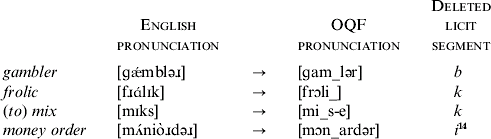
Though few, these examples still show that when phonetic approximation is at play in loanword adaptation, it can affect what should be considered well-formed sounds. The deletion of /b/ in the adaptation of gambler possibly occurs because post-nasal stops are often effectively deleted in casual English, due to a kind of mistiming between the release of oral closure and the closing of the velum (MacKay Reference MacKay1987: 132–134). As for frolic [fɹάlɪk], which is adapted as OQF [frɔli], this might be due to orthography influence since final <c> can be mute in French (e.g. <tabac> ‘tobacco’→[taba__]). However, we have cautiously considered the loss of final /k/ in frolic to be a case of phonetic approximation for two reasons. First, there is no independent evidence that orthography is the guiding influence here, unlike the case of pilot, where the unexpected substitution of the vowel also suggests orthography influence (English <i>→French [i], in keeping with French spelling conventions, though syllable-final /aj/ in [pájlət] should be acceptable in French; e.g. Fr. bail [baj] ‘lease’). Second, this kind of deletion is often cited as evidence for phonetic approximation in loanword adaptation. The argument is that English final stops are often unreleased, and thus prone to going unperceived by the borrower. We also consider the loss of the unstressed vowel in money order, and of the less perceptually salient /k/ in English to mix /mɪks/ that yields OQF [mis-e], to be cases of phonetic approximation. Nonetheless, the scarcity of such cases shows that final stops (released or not), unstressed vowels and perceptually less salient consonants in clusters usually are perceived; the few cases in (10) stand in stark contrast to the norm. For example, there are 21 cases comparable to gambler in the OQF corpus (e.g. tumbler and laundry), but only this one case of post-nasal stop deletion. The more instances of a given licit segment there are in the corpus, the more obvious is the deviance of its deletion. The case of post-vocalic word-final stops, as in frolic [fɹάlɪk], illustrates this. In the OQF corpus, there are 151 cases comparable to frolic, in which a word-final stop follows a vowel (e.g. pluck, shellac, grapefruit), but outside of the already-discussed case of pilot, the only deletion occurs in the adaptation of frolic. Elsewhere the final post-vocalic stop is kept (e.g. pluck [plΛk]→OQF [plɔk]∗[plɔ_], shellac [ʃəlk]→OQF [ʃəlak]∗[ʃəla_], grapefruit [ɡrépfɹùt]→OQF [ɡrepfrut]∗[ɡrepfru_]/∗[ɡre_fru_]). Licit post-vocalic word-final stop deletion occurs in only 1/151 (0.7%) cases in the OQF corpus.
In sum, illicit segment deletion does not occur in OQF and licit segment deletion is very unusual. This suggests that phonetic approximation according to (3A), whereby a phoneme is deleted because it is unperceived by the borrower, is rare in loanword adaptation. Surely, if loanword adaptation were effected phonetically, by monolinguals, there would be much more deletion of both illicit and licit phonemes in the OQF corpus.
4.2 Naive phonetic approximation in the form of illicit phoneme-to-phoneme mismatching
Phonetic approximation due to illicit phoneme-to-phoneme mismatching occurs when an unacceptable L2 phoneme departs from the usual adaptation pattern and is adapted to the phonetically closest rather than the phonologically closest L1 phoneme. For reference, the usual adaptation patterns of illicit English segments in OQF, along with pertinent statistics on the treatment of those segments, are provided in table 6.
The treatment of illicit English phonemes in Old Quebec French

As shown in table 6, there is always a favored replacement for an illicit L2 phoneme. This confirms the story told by table 2.Footnote 15 Illicit phoneme-to-phoneme mismatching is found among cases deviating from the usual adaptation pattern. Adaptations of the illicit phonemes in table 6 that seem to be influenced by phonetic approximation are exemplified in (11).
(11)
Phoneme mismatches among malformations in the OQF corpus

The first column in (11) provides the deviant sound substitutions and the second indicates the number of such substitutions among the sound changes for that segment. For instance, English /ɪ/ is changed (not imported) in 105 cases. In 9/105 cases, illicit English /ɪ/ is replaced by /e/ (which is normally laxed to [ɛ] in a closed syllable in QF); in 2/105 cases, /ɪ/ is replaced by /ə/. The sound substitutions in (11) are phonetically, not phonologically, motivated. The illicit sound is replaced by one that is phonetically close – usually phonetically closer than the sound adaptations of the regular phonological pattern.
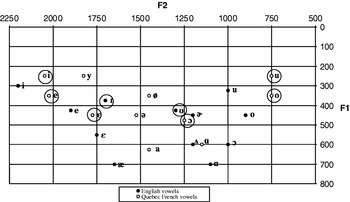
Let us take a closer look at the vowel changes in (11). The phonetic proximity of the North-American English vowels and the QF oral vowels (according to formants provided by Martin Reference Martin2003) is shown in figure 1 (from LaCharité & Paradis Reference LaCharité and Paradis2005).Footnote 16 As figure 1 reveals, English /ɪ/ is acoustically closer to the QF vowels /e/ and /ɛ/ than to /i/. Likewise, English /ʊ/ is acoustically closer to QF /ɔ/ than to QF /u/.Footnote 17 The adaptation of English /Λ/ to QF /a/ is roughly as close phonetically as the usual phonological adaptation of /Λ/ to /ɔ/, which makes the adaptation to /a/ likely to be phonetically driven.
F1–F2 norms for English and Quebec French oral vowels

One might object, however, that measuring phonetic proximity on the basis of F1 and F2 is overly simplistic. After all, French and English vowels are distinguished phonetically by more than F1 and F2 values (e.g. English tense vowels are often diphthongized and are at least sometimes longer than their lax counterparts). However, in this case, the spectral comparison is most appropriate because spectral cues are those used by French speakers to distinguish vowels. Just because other acoustic cues, such as duration or diphthongization, are available does not mean that they can be used by non-native speakers. Cue reliance is dependent on the type of input to which speakers have been exposed (Escudero Reference Escudero, Anna, Dominguez and Johnson2001, Reference Escudero2005). Crucially, L2 speakers have to learn to exploit acoustic cues that are superfluous or absent, or that serve another function, in their L1. For instance, Fox, Flege & Munro (Reference Fox, Flege and Munro1995) showed that Spanish speakers cannot use duration to distinguish English /i/ and /ɪ/ because their L1 does not predispose them to exploit duration. Particularly pertinent to the OQF–RQF case is that QF L2 learners of English have been shown to initially rely exclusively on spectral cues to categorize English vowels in spite of the fact that QF uses vowel length and diphthongization. They must learn to perceive and exploit secondary cues in English, such as length and diphthongization (Gottfried & Beddor Reference Gottfried and Beddor1988, Escudero & Polka Reference Escudero, Polka, Maria-Josep, Recasens and Romero2003), which are different from those in French. Thus it is reasonable to assume that if monolingual French speakers were behind the adaptation of vowels in English loanwords in QF, their adaptations would be based mainly on spectral cues and proximity.
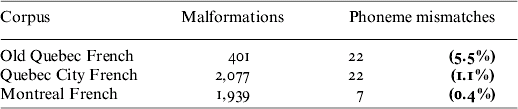
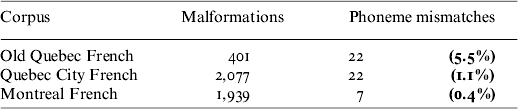
Though the final figure is still modest, there are undeniably more illicit phoneme-to-phoneme mismatches in the OQF corpus than in the RQF ones. A summary with comparative rates for the three corpora is provided in table 7. In both RQF corpora, the rate of phoneme mismatching is below 1.5%, whereas in the OQF corpus it is 5.5%. A lower rate of bilingualism in the society is thus correlated with a higher rate of phonetic approximation. However, the rate of phoneme mismatching whereby a disallowed L2 phoneme changes its general category, because of perceptual proximity to an L1 phoneme, still possibly affects only 5.5% of all the malformations. Nevertheless, we highlight the need for caution here because not all 5.5% of the illicit phoneme-to-phoneme mismatches could be easily accounted for by phonetic proximity. For instance, sulky [slki] is adapted as OQF [sɛlkji], but QF [ɛ] is arguably not especially close to English [Λ] phonetically. We cannot automatically assume that because a case does not fit the phonological pattern, it supports the phonetic approximation point of view.
Illicit phoneme-to-phoneme mismatching in the three Quebec French corpora
4.3 Naive phonetic approximation in the form of licit phoneme-to-phoneme mismatching
Phonetically motivated adaptation of permitted phonemes happens when a given phoneme is part of the inventory of French as well as English, but the English sound is misclassified because the phonetic cues associated with the English phoneme relate to a different category in QF. Phonetic approximation of this type may also occur at a somewhat higher rate in the OQF corpus than in the RQF ones. Consider the case of stop devoicing, exemplified in (12).
(12)
Stop devoicing in the adaptation of English loanwords in OQF

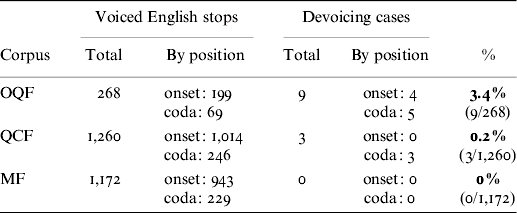
French, like English, has the stops /p, b, t, d, k, g/, so there is no phonological reason to replace English /b, d, g/ with /p, t, k/. Phonetically speaking, however, what English classifies as voiced stops are, from the French point of view, voiceless. This is true for both QF (Caramazza et al. Reference Caramazza, Yeni-Komshian, Zurif and Carbone1973) and European French (Caramazza & Yeni-Komshian Reference Caramazza and Yeni-Komshian1974). If loanword adaptation were effected on the basis of L1-guided perception of the surface phonetic form, then QF borrowers should interpret English stops in accordance with the norms of QF Voice Onset Time, thus interpreting English voiced stops as voiceless (see LaCharité & Paradis Reference LaCharité and Paradis2005 for an extensive discussion of this). Yet this seldom occurs, as shown in table 8 by the comparative rates of stop devoicing in the three QF corpora.
Devoicing of English /b, d, ɡ, dʒ/ in the three Quebec French corpora
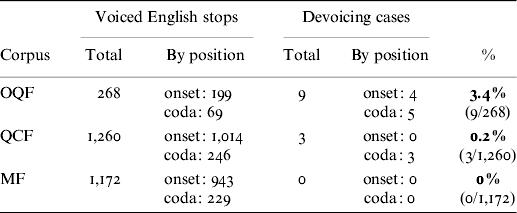
The devoicing of English stops on the basis of phonetic cues never occurs in the MF corpus and occurs in only 0.2% of the voiced stop cases in the QCF corpus. In contrast, devoicing occurs in 3.4% of the cases in the OQF corpus. Still, even if all such cases are due to phonetic approximation (which may not be the case, as discussed in section 7), 96.6% of the English voiced stops are interpreted phonologically, not phonetically, in the OQF corpus as well.
Other cases of licit phoneme-to-phoneme mismatching in OQF present a scattered picture, as expected of phonetic approximation. For instance, in four cases a coronal nasal is replaced by a labial (e.g. horehound [hóɹhàwnd]→OQF [hɔrɔm], township [táwnʃ p]→OQF [tɔmʃɪp]). In all four cases, the substitution is likely due to the masking influence of the neighboring labial offglide /w/. However, in the end, this and similar cases of apparent misperception of /n/ is rare in the OQF corpus, affecting only 14/127 instances (11%) of /n/. In another apparent misperception case, English /l/ is replaced by /w/ (sirloin [s
 ɹl
 jn]→OQF [sirwan]). This might be phonetic approximation, given that children acquiring English as a first language routinely (and erroneously) replace /l/ with [w] (e.g. like /lajk/→[wajk], call /kɑl/→[kɑw], etc.). However, English /l/ is subject to non-phonological treatment in only 3/163 cases (1.8%) in the OQF corpus.
Finally, there are 7/33 cases in which /ɛ/, a phoneme also of French, is modified. In 4 out of these 7 cases, /ɛ/ is replaced by /a/ (e.g. bevel [bέvəl]→OQF [bavɛl]). Substituting Fr. /a/ for English /ɛ/ is phonologically unexpected. However, Fr. /a/ is the expected phonological adaptation of illicit English /æ/. Perhaps in these few cases the English phoneme /ɛ/ was mistaken for the variant [ɛ] which occurs as a surface pronunciation of English /æ/. The pronunciation of /æ/ as [ɛ] is attested for contemporary Canadian English (Rogers Reference Rogers2000: 77) and it was observed also in early Canadian English (Ahrend Reference Ahrend1934: 137). Whatever the reason for the replacement in these four loanword forms, we considered it prudent to classify /ɛ/→/a/ as a case of phonetic approximation.
Overall, the rate of licit phoneme-to-phoneme mismatching, including devoicing cases, is very low. Though there are more stop voicing confusions and more isolated examples of phonetic approximation in the OQF corpus, it certainly was not a major driving force in the adaptation of English loanwords. Only 33/558 pertinent cases (i.e. cases of /b, d, g, n, l, ɛ/ in the OQF corpus) (5.9%) occur. Although the rate of phonetic approximation of type (3B1b) is a bit higher in OQF, it is still rare in loanword adaptation, even when there are few bilinguals in the society.
4.4 Naive phonetic approximation in the form of variant-to-phoneme mismatching
We now consider whether there are cases where an English phonetic variant is identified as phonemic in OQF (3B2a). Although we think it is important to distinguish conceptually between naive and intentional phonetic approximation in loanword adaptation, in practice it can be difficult to tell whether non-adaptations are done intentionally to produce a more authentic English pronunciation or whether we are dealing with level confusion, whereby an English variant is taken at face value. This is especially true of a non-contemporary corpus, where consultants cannot be directly questioned or tested. So here we gave the notion of naive phonetic approximation the widest possible latitude and counted all variant importations as variant-to-phoneme mismatchings. Because apparent variant importations are more numerous in OQF than in RQF, and because the non-adaptations of illicit English phonemes is less frequent, as shown in table 9, we believe that such level confusion occurs more in OQF than in RQF. This is consistent with the fact that the number of bilinguals was smaller in 19th- and early 20th-century Quebec.
Rate of variant importation in the malformations of the three Quebec French corpora (4B2a)

Compare the 27.1% (13/48) variant importation rate in OQF to the rates of 8% (27/336) and 5.5% (26/475) that occur in QCF and MF, respectively. Since higher rates of variant importation are correlated with lower numbers of bilinguals in the society – in contrast to the direct correlation between rates of foreign phoneme importation and the number of bilinguals – it seems logical to assume that at least some variant importation found in OQF is due to mistaking variants for phonemes, i.e. to naive phonetic approximation of the type in (3B2a). As noted above, we have taken the most conservative approach and classified all OQF variant importations as phonetic approximations of this type.
Examples of two closely related variant importations in OQF are shown in (13).
(13)
Examples of apparent variant imports in the malformations of OQF

In English, one of the most favorable environments for realizing /æ/ as [ɛ] is before a nasal (Pickett Reference Pickett1999: 115–118). Indeed, in 8/10 cases of variant [ɛ] importation, English /æ/ precedes a nasal. The two case where it occurs elsewhere in our OQF corpus are backhouse /bkhàws/ ([bέkhàws]) (→OQF [bekɔs]) and scrap /skɹæp/ ([skɹɛp]) (→OQF [skrep]).
The variant importation exemplified in (13b) is very closely related. Here the surface variant [ɛ] is also imported, but the vowel-nasal sequence is further interpreted as a nasalized vowel. Though English does not have phonemic nasalized vowels, it does have phonetically nasalized ones. According to Ladefoged (Reference Ladefoged2001: 164), ‘nasalized vowels are common in all dialects of English’. Jones (Reference Jones1972: 212, 359) remarks on the nasalization of pre-nasal vowels as a characteristic of American speech, and notes that nasalization is especially pronounced on non-high vowels.
In both cases illustrated in (13), we might plausibly assume that OQF listeners correctly heard the surface vowel, but misidentified the phoneme to which it belongs. This is misclassification rather than misperception but it does suggest limits on the borrower's knowledge of the L2 phonological system. However, even if all 13 variant imports are cases of naive phonetic approximation, 13/401 is still only a 3.2% phonetic approximation rate.
4.5 Naive phonetic approximation in the form of phoneme-to-variant mismatching
Phoneme-to-variant mismatching (3B2b) occurs when an L2 phoneme is taken as a phonetic variant of a different L1 phoneme – another classification error. For example, English /h/ might be mistaken for the Quebec French variant [h], which can occur as a variant of /ʃ/ or /ʒ/ in some Quebec French dialects. Thus, a word like changer /ʃãʒe/ ‘to change’ may be pronounced as [hãhe] in such dialects. The dialectal substitution of [h] for the alveopalatal fricatives is considered substandard in Quebec, so we might expect hypercorrection, i.e. phonetic approximation of type (3B2b), yielding such forms as *[ʃitər]/[ʒitər] for English heater /hítəɹ/. This particular substitution is not attested, but there are three possible cases within the OQF corpus that may be the result of hypercorrection: the adaptations of peppermint [pέpəɹmnt], trestle ([tɹέsəl]) and bevel ([bέvɛl]) as OQF [papərman], [tʀasɛl] and [bavɛl]. English /ɛ/ may be interpreted here as [ɛ], the surface pronunciation of /æ/ often produced by native Canadian English speakers; this would explain the unexpected adaptation of /ɛ/, a licit phoneme of French, to /a/. However, with only three such cases, and 35 cases of correct interpretation of /ɛ/, we can only speculate that hypercorrection is what lies behind these cases. Regardless, these were classified as cases of phonetic approximation.
In the broader picture, if the phonologies of the L1 and L2 are well understood, hypercorrection is generally easy to identify and it clearly plays a role in the adaptation of loanwords by less proficient speakers. For instance, the French borrowing vichyssoise [viʃiswɑz] is sometimes hypercorrected to *[viʃiswɑ_] by anglophones who erroneously apply the rule that final consonants in French are often not pronounced. It would obviously be wrong to attribute the loss of the final consonant here to deletion caused by phonetic approximation. To be insensitive to hypercorrection in loanword adaptation would, we think, be an oversight.
5. False analogy: apparent naive phonetic approximation
Many apparent cases of naive phonetic approximation stem from false analogy. As previously noted, false analogy occurs when an L2 word or an affix is matched to an L1 or L2 word or affix, predominantly on the basis of its phonetic shape, independent of, or only indirectly related to, its actual L2 meaning (though mistaken ideas of meaning are often implicated). For instance, in an Ontario district where French speakers were extremely few in Canada's early days, the French-named Petit [sic] Côte Stream became Petticoat Stream (Ahrend Reference Ahrend1934: 137). The two names sound very similar, and the meaning of petite côte, ‘small coast’, appears not to have played a role. Examples of French-based false analogy cases found in the OQF corpus are given in (14).
(14)
Examples of false analogy in old Quebec French

False semantic links may be apparent in a word's written form. They may also range from being quite transparent (e.g. mâcher ‘to chew’ for mash) to being opaque, even to the point of seeming to be non-existent (e.g. -aille for eye), a point to which we return shortly.
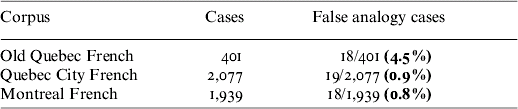
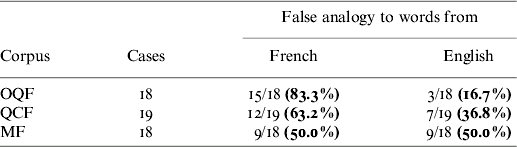
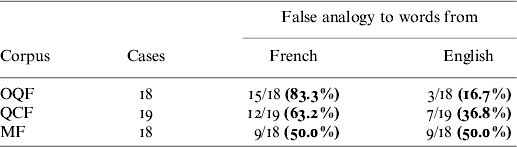
Table 10 shows the number of illicit English phonemes in each corpus whose substitutions were guided by false analogy rather than phonology. Though the rate of false analogy in OQF is low (4.5%), it is nonetheless higher than in the two RQF corpora. Not only that, but the rate of false analogy to French words, as opposed to English ones, is also higher than in the two other corpora. This is shown in table 11. False analogy to English occurs in only 3/18 false analogy cases (16.7%) in OQF, which is not surprising in a situation where there were very few bilinguals. In contrast, the rate of false analogy to English is more frequent in RQF. It accounts for 7/19 (36.8%) of the false analogy cases in the QCF corpus and 9/18 cases (50%) in the MF corpus. This again directly correlates with the higher number of bilinguals in those societies and with the broader base of their bilingualism. As well as having some English instruction at school (with schooling nowadays being obligatory and thus widespread), the English L2 bilinguals of modern Quebec are exposed to English music, movies, newspapers, etc.
Rate of false analogy in malformations in the three corpora of Quebec French
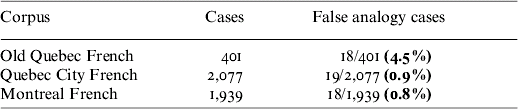
Rates of false analogy to French vs. English in the Quebec French corpora
The greater knowledge of English in modern Quebec City and Montreal is reflected not only just in the number of false analogies to English, but also in the kind of folk etymologies that appear to have given rise to them. Consider these RQF examples of false analogy.
(15)
False analogy based on English in the RQF corpora
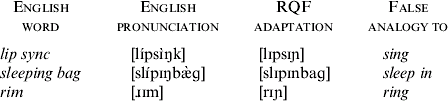
Though from the point of view of English there are false semantic links here, we can easily see the rationale for the associations. For instance, the confusion of sing for sync (which is a truncation of synchronization) in lip sync makes sense. Many native English speakers might be similarly confused. We can also understand how rim, which is commonly associated with round objects like drinking glasses, plates and wheels, could be confused with ring, or how a sleeping bag could be considered a *sleep-in bag. Such transparency is less evident in the few English-based false analogies of the OQF corpus. For instance, English Indian rubber [ndjənɹbəɹ] was adapted as OQF <djime-robette> [dʒimrɔbɛt]. We surmise that Indian, which would often have been pronounced [ndʒən] in the English of the period, was falsely identified as the English proper name Jim [dʒm]. There is no discernable semantic connection between Indian and Jim; sound alone seems to motivate the confusion.
False analogy is not a form of phonetic approximation as defined in (3), and it is risky to invoke it as an argument for phonetic approximation over phonology in loanword adaptation, as it bears a striking resemblance to folk etymology, for which native speakers are responsible. In false analogy, as in folk etymology, the speaker is reaching for meaning, especially obvious and transparent meaning. In short, false analogy may occur after adaptation has taken place and be carried out mainly by monolinguals as a type of folk etymology. False analogy may contain sound substitutions that give a misleadingly magnified impression of phonetic approximation. Consider, as an example, how English Gathering Bay, so named because it was a bay where logs were gathered, was transformed into QF Baie Sainte-Catherine. At some point, the voiced onset stop /g/ was devoiced. This could be a form of phonetic approximation whereby a permitted phoneme is replaced because of different phonetic cues associated with that phoneme in the L2. In the case at hand, devoicing could have been what led to the word gathering being interpreted as the proper name Catherine, yielding Catherine Bay. In 19th-century Quebec, places were named after saints, so Catherine Bay became Saint Catherine's Bay, or Baie Sainte-Catherine in French. Note that only the devoicing of the stop /g/ suggests possible phonetic approximation. The final velar nasal surfaces as [n], but this could well have resulted from a native QF process whereby final [ɲ]→[n] (Juneau Reference Juneau1972: 126), or it could be that the final nasal was /n/ in English, as will be discussed shortly. Nonetheless, the transformation of Gathering Bay to Baie Sainte-Catherine indicates that the original meaning behind English Gathering Bay had been lost.
Another reason that false analogy can give an exaggerated impression of phonetic approximation in loanword adaptation is that it can result in morphological and syntactic reanalysis. Though it is no longer in use in Quebec, as far as we know, the word La Pinouillère in (14e), which was derived from Happy New Year, provides a good illustration of this. Its transformation from Happy New Year to La Pinouillère is described in (16).
(16) English Happy New Year [hæpɪnuj
ɹ]→OQF La Pinouillère [lapinujɛr](a) predictable one-to-one phonemic adaptations and phonetic adjustments:
• /h/→Ø
• /æ/→ /a/
• /p/ [pʰ]→ /p/ [p]
• /ɪ/→ /i/
• /r/ [ɹ]→ /r/ [ʀ, r]
(b) word boundary loss:
• between happy and new
• between new and year
(c) false analogy – creation of new word boundaries:
• /a/→ the French feminine definite article la, partly because of the ending [-jɛʀ], which was mistaken for the feminine suffix -ière
• year→ the French feminine suffix -ière [-jɛr], which derives a noun from another one (soupe ‘soup’→soupière [sup-jɛr] ‘tureen’)
As indicated in (16a), most one-to-one adaptations are predictable; the illicit English phonemes are predictably adapted according to the main patterns and English phonetic manifestations of permitted phonemes are replaced by French phonetic manifestations of those same phonemes. Thus, initial English /h/ is deleted. This could be due to the native QF process of /h/-deletion referred to earlier, but even for those dialects from which /h/ had already disappeared as a native phoneme, the deletion of /h/ in English loanwords would be typical of languages that lack gutturals (Paradis & LaCharité Reference Paradis and LaCharité2001). Also, the illicit English vowels /æ/ and /ɪ/ are phonologically adapted to French /a/ and /i/, respectively, the same adaptations of those segments that occur in the RQF corpora. Finally, the English pronunciations of /r/ and /p/ are replaced by the French pronunciations of those phonemes.
However, as shown in (17b), English word boundaries are lost. The syntactic breaks between happy and new and between new and year disappear. In (16c), we see the creation of new word boundaries, based on false analogy to similar-sounding French words and affixes. The low vowel is interpreted as part of the French feminine definite article la, an interpretation influenced also by the final word year in English, which was mistaken for the feminine suffix -ière. This is how Happy New Year came to be adapted as La Pinouillère: ‘souhaiter’ or ‘fêter La Pinouillère’.
To sum up, a study of the OQF corpus reveals both a higher rate of false analogy generally and a higher rate of false analogy to L1, rather than L2. While false analogy does reveal limits on L2 lexical knowledge, and while such forms may sometimes contain phonetic approximations (cf. /g/→/k/ in Engl. Gathering Bay→OQF Baie Sainte-Catherine), they do not argue that loanword adaptation is generally phonetic rather than phonological. Most of the substitutions that occur in false analogies fail to show that borrowers adapt phonetically and many pose problems for a phonetic view of loanword adaptation. Also, false-analogy – influenced substitutions may result after the words are passed on to monolinguals, who are more likely to assume different semantic connections. This indicates that false analogy cases, like cases of orthography, missed targets and other categories of non-phonological influence, should be identified as such and set aside, irrespective of one's theoretical bias. In any case, false analogy is not all that common, even in the OQF corpus, where only 4.5% of the ill-formed phonemes have fallen under its influence, rather than being adapted phonologically.
6. Native processes: another case of apparent naive phonetic approximation
At various points in the preceding discussion, we have indicated that certain apparent adaptations were due to native processes, not loanword adaptation. The study of the OQF corpus clearly highlights the importance of understanding native processes in both the source and the borrowing languages, so that they can be distinguished from loanword adaptation per se. The purpose of this section is to show, with the help of several detailed examples, that substitutions that might look like phonetic approximation often yield to other equally plausible or even more plausible explanations, when the substitutions are considered in the context of the phonologies of the borrowing and source languages. Many changes that appear, at first glance, to be departures from the principles guiding contemporary adaptations (hence likely candidates for explanation in terms of phonetic approximation) may be due to native processes in either the borrowing or the source language at an earlier time. We cannot simply assume that apparently aberrant adaptations are due to phonetic approximation by a largely non-English-speaking population.
(17)
Apparent phonetic approximations in the OQF corpus
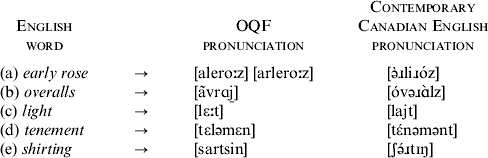
If we take as our point of reference the contemporary Canadian English pronunciation of early rose ([ ɹliɹóz]) in (17a), the OQF pronunciation suggests a few apparently non-phonological sound substitutions. First, there is the apparent adaptation of initial English /ə/ to OQF /a/. Second, there is /r/-deletion in one of the forms. Finally, there is what seems to be the adaptation of English /i/ to OQF /e/. Let us consider each of these changes individually.
With respect to the initial schwa in the English form, Wyld (Reference Wyld1906: 317) says that
in M.E. [Middle English] e before r was often made into ɑ doubtless through an intermediate stage (æ) … This has happened in star, far … In eighteenth-century colloquial literature these words [i.e. those now pronounced with schwar, but previously pronounced ɑɹ, as in learn and servant] are sometimes spelled larn, sarvant, which expresses a then common pronunciation.
In other words, the English pronunciation of the initial sound of early was likely to have been [æ], which regularly adapts to French [a]. In fact, this pronunciation persists in some dialects of English, including Scots and Irish (Wells Reference Wells1982: 199), which exerted some influence on Canadian English in the 18th and 19th centuries in Quebec (Avis Reference Avis and Thomas1973: 50, Bloomfield Reference Bloomfield and Jack1975: 6). Therefore, it seems more likely that the English pronunciation of the initial sound of words like early has changed over the last two hundred years than that this represents phonetic approximation in loanword adaptation.
As for the /r/-deletion that is illustrated by one of the forms for early rose, one might mistakenly regard this as phonetic approximation, either an instance of non-perception of the phonetically different English [ɹ], or a case where a surface English form is taken at face value. This latter interpretation would assume that Canadian English, which is often thought to have been more lastingly influenced by British English than was American English (see Avis Reference Avis and Thomas1973: 48), was at one time an r-less dialect. However, Canadian English was never an r-less dialect, generally speaking, so it is unlikely that borrowers were exposed to r-less English forms on any but a sporadic basis. More important, though, /r/-deletion was pervasive in OQF (and still occurs to a certain extent in many contemporary QF dialects). It affected /r/ in consonant clusters and codas (e.g. trois /trwa/ ‘three’→[t__wa], argent /arʒã/ ‘silver’→[a__ʒã]) (Straka Reference Straka1965: 591, Gendron Reference Gendron, Jean-Denis and Straka1967: 42, Juneau Reference Juneau1972: 163f., 273, Poirier Reference Poirier, Marcel and Straka1975: 212–216, Chauveau & Lavoie Reference Chauveau and Lavoie1993: 412, etc.).
Finally, there is the apparent adaptation of English /i/ to OQF /e/, which is fairly common in the OQF corpus and which might be held up as evidence of phonetic approximation in loanword adaptation in QF. However, in describing the sounds of 18th-century English, Smith (Reference Smith1795: xxvii) notes that words such as vanity [vnɪti] and charity [tʃέɹɪti] end in a sound nearly identical to the French word charité [ʃarite]. He goes on to say that
Mr. Walker, the author of the Critical Pronouncing Dictionary invariably marks this  ound of the i, and y, with the long e. I think he mut be in the wrong; for, urely, there is an evident ditinction between the firt and lat yllable in the word eāfy: nor could vanity, I apprehend, with any degree of propriety, be written vanitee, as he ays […].
Thus the substitution of /e/ for /i/ again appears to be an artifact of Canadian English pronunciation of the epoch, rather than phonetic approximation. In short, one cannot simply assume that phonetic approximation is what is guiding these adaptations if we consider them in the context of the native phonologies of Canadian English and Quebec French of the 19th century.
OQF [ãvrɑj], in (17b), which comes from English overalls [óvəɹὰlz], also appears to be particularly aberrant. The change in the initial sound [o], which was, and is, a licit sound in QF, might well be explained as a native process of some dialects of Quebec French. One of the limitations of the OQF corpus is that the loanwords were gathered from all over the province and there is not necessarily an indication of which adaptations came from which dialect areas. Lavoie, Bergeron & Côté (Reference Lavoie, Bergeron and Côté1985: 73) state that nasalization occurs in several dialects, and give examples such as attelle /atɛl/ ‘splint’, avaler /avale/ ‘to swallow’ and appat /apa/ ‘bait’ being pronounced [ãtɛl], [ãvale] and [ãpa]. The realization of final English /l/ as /j/, too, can be attributed to a common native process in OQF (Juneau Reference Juneau1972: 172). For example, métal ‘metal’ [metal]→OQF [metaj], cristal ‘crystal’ [kristal]→OQF [kristaj].
As for (17c), the OQF pronunciation [lɛːt], for light, represents the regular adaptation of a once-common Canadian English pronunciation. Ahrend (Reference Ahrend1934: 138) says of early Canadian English that ‘[ei] is substituted for [aj] in nice [neis], night [neit], quite [kweit], white [weit], and similar words’.
The most notable feature of the adaptation of tenement, i.e. [tɛləmɛn], in (17d), is the substitution of [l] for the coronal nasal. Again, this is the result of a common native OQF l-n alternation. As Juneau (Reference Juneau1972: 177) remarks, ‘Dans certains mots, le québécois connaît encore ce flottement entre l et n’ [In certain words, Quebecers still exhibit this alternation between l and n]. Among many examples are caleçon [kals )] ‘briefs; underpants’, which was written as <cannessons> (and is still pronounced [kans)] by many QF speakers), and tisonnier ‘poker’, transcribed as <tisollié>. Thus the variation between [n] and [l] is unlikely to be attributable to phonetic approximation in loanword adaptation.
The adaptation of shirting, i.e. [sartsin], in (17e) exhibits multiple changes: the change of initial [ʃ], a licit QF phoneme, to [s]; the same treatment of the pre-r vowel seen in early rose; affrication of the English [t]; and apparent adaptation of final [ŋ] to [n], rather than [ɲ], as we have come to expect from RQF. However, all these changes were plausibly due to common native processes of OQF or to English itself, rather than being part of the loanword adaptation process as such. Juneau (Reference Juneau1972: 139−144) shows that the substitution of [s] for [ʃ] was common in OQF. For example, during the 17th–19th centuries, chopine ‘bottle (of wine)’ [ʃɔpin] was found spelled <sopine>, indicating the pronunciation [sɔpin]; échange ‘exchange’, now pronounced /eʃʒ/, was often written <esange>, yielding [esʒ]. The affrication of /t/ to [ts] results from a native QF process that affects coronal stops before high front vowels. Regarding the treatment of the final English nasal, it is worth noting about the English of the period that
/ŋ/ in unstressed syllables [as in -ing] was hardly known. The sound was used in stressed syllables, but only before a velar stop, as in the now dialectal pronunciation /sɪŋɡ/ … As an independent phoneme it is new, noted by some 17c[entury] observers, but not generally accepted even at the close of the 18c[entury] … (Strang Reference Strang1970: 80)
Strang adds that the older pronunciation (/ɪn/, /ən/) was observed by some scholars to be widespread even among educated speakers as late as 1936. Thus, many Canadian English speakers with whom OQF borrowers were in contact would have pronounced shirting as [ʃáɹtɪn], which would reasonably have yielded OQF [sartsin]. Certainly, there would have been variation in the forms to which QF speakers were exposed, some ending in the velar nasal and some ending in the coronal. However, it was common in OQF to realize word-final [ɲ] as [n], anyway, so even cases where the English velar nasal occurred and was adapted to [ɲ] could have been subsequently subject to the application of the native process [ɲ]→[n].
Often, an apparently aberrant form not only fails to provide evidence for phonetic approximation, it may even provide support for the phonological nature of loanword adaptation. For instance, the fact that affrication applies to [d] in dipper [dɪpəɹ] (to yield OQF [dzipər]) reveals that English [ɪ], a phonologically illicit vowel from the point of view of French, which only occurs phonetically in closed syllables, is identified as a high (front) vowel (i.e. categorically), despite its closer phonetic proximity to the French mid vowels /e/ and /ə/.
As another example, Görlach (Reference Görlach1991: 70) says that ‘[t]he short front vowels /ɪ, ɛ/ remained unchanged in standard [English] speech, but [ɪ] was frequently lowered to [ɛ] in some [English] dialects’. This is held responsible for such [English] spellings as <menysters>, <cete>and <consperacy>for ministers, city and conspiracy, respectively. If lowering were behind such adaptations as OQF [tremɛn] for English trimming, then these might be considered to be importations of a variant. We have not yet found evidence that lowering was common in the particular English dialects to which OQF speakers were exposed, so we have interpreted such cases as instances of naive phonetic approximation.
In sum, when 19th- and early 20th-century Canadian English pronunciation and native OQF processes are taken into account, many apparent phonetic approximations are, at the very least, cast in doubt. When we remove such obviously debatable cases from consideration, there remain very few phonetic approximations in the OQF corpus. Yet the message from even those cases that were deemed to be phonetic approximation is clear: before deciding whether a given sound substitution is, in fact, a substitution and, if so, whether it results from loanword adaptation per se, we have to know a lot about both the source and the borrowing languages at the time the words were borrowed. If we fail to take into account earlier pronunciations in the source language and native processes in both the source and the borrowing languages, we cannot achieve a correct understanding of the nature of loanword adaptation.
7. Conclusion
To conclude, a lower rate of bilingualism in a community is reflected in a lower rate of imported segments in loanword adaptation. It is also correlated with more naive phonetic approximation, manifested in more perceptual confusion between L1 and L2 phonemes/variants, and in higher rates of false analogy. Yet the increases in naive phonetic approximation and in false analogy are surprisingly small. Generally speaking, the adaptations found in loanwords are overwhelmingly categorical, i.e. there is generally one exclusive or strongly dominant strategy for adapting an unacceptable L2 phoneme, and this adaptation strategy does not necessarily correspond to the closest perceptual match. This is true even when the number of bilinguals in a community is relatively small, as was the case in OQF.
As far as we know, this is the first longitudinal study of loanword adaptation, whereby loanwords gathered from what was earlier a highly monolingual community could be compared to those gathered from communities that, over the intervening years, have become more bilingual. Although Project CoPho's corpora of French loanwords in Kinyarwanda, Lingala and Fula are also drawn from societies where knowledge of French is limited to a small proportion of the population, these corpora do not yet permit the kind of longitudinal view of loanword adaptation that we offer here. The OQF–RQF comparison uniquely demonstrates that phonetic approximation does not drive loanword adaptation, even when the rate of community bilingualism is low. The overwhelming tendency to adapt borrowed words phonologically, rather than phonetically, cannot be an artifact of researchers having gathered loanwords from highly bilingual societies. This disconfirms the Alternative Route Hypothesis in (1). We therefore conclude that monolinguals do not generally control the adaptation of loanwords, even where they make up the great majority of the population. Accordingly, even a corpus of loanwords drawn from a society where bilingualism is quite limited is relevant to phonology. Although one must be careful to exclude non-phonological cases such as orthography influence and analogy (true or false), such exclusion does not unduly distort the picture that emerges from the study of a large corpus whose linguistic context is well understood.
Before closing, let us anticipate a question that our results might raise in the reader's mind and suggest a possible avenue for future research: if the Alternative Route Hypothesis is not viable (at least it is not supported by our results), then how can our results be reconciled with those used to support the phonetic view that loanwords are adapted largely on the basis of phonetic approximation? We are referring to studies such as Kim & Curtis (Reference Kim and Curtis2002) and Vendelin & Peperkamp (Reference Vendelin and Peperkamp2004), among others. Their different results may be due to the fact that they conducted experiments with monolinguals. Now, the adaptations of foreign words by monolinguals are highly similar to the errors made by L2 learners in the early stages of L2 acquisition. As discussed in LaCharité & Paradis (Reference LaCharité and Paradis2005), such confusions are often obvious cases of phonetic approximation. Thus, it is not surprising if studies using monolinguals have led some authors to conclude that phonetic approximation is the driving force in loanword adaptation. Monolinguals cannot equate an L2 category with one from L1 because they have no access to L2 categories. However, as we have tried to show here and more directly in Paradis & LaCharité (Reference Paradis and LaCharité1997), monolinguals are not the on-line borrowers and adapters, which underscores the importance of using sufficiently proficient bilinguals, not monolinguals, in loanword adaptation research. We suggest that this would certainly help to reconcile our results with those obtained experimentally by other researchers.
8. APPENDIX A
8.1 General statistics for the Project CoPho database
The table below summarizes the statistics for Project CoPho's 13 corpora of English and French loanwords in various languages. These statistics includes figures for the treatment of the segmental, syllabic, metrical and accentual malformations of the corpora.
General statistics for Footnote 18Footnote 19 the Project CoPho corpora of loanwords (updated October 2006)

9. APPENDIX B
9.1 The rationale for the OQF Corpus
There are four reasons for choosing OQF to represent the low-number-of-bilinguals case. The first is that the number of bilinguals in 19th-century Quebec French society is known to have been much smaller than it is today. During that period, Quebecers living in the countryside were almost exclusively monolingual French-speaking, and the population was overwhelmingly rural. According to Statistics Canada, as late as 1871 almost 92% of the population lived outside the urban areas of Montreal and Quebec City. Bilinguals were mainly those few who worked in industry or domestic service, those who went to the United States as migrant workers and, of course, most of the elite. Bouchard (Reference Bouchard2002: 104) circumscribes the spheres of English bilingualism and acknowledges its limited influence among the general population when she says that
[i]n the course of the first century of the English regime, bilingualism became progressively installed in the political and judicial institutions of Quebec […] However, the practice of bilingualism among individuals remained a marginal phenomenon. Obligatory and unilateral in the political and judicial sectors, necessary for those who wanted to do business in the towns or advance in industry, bilingualism remained limited for the majority of Quebecers, who still lived in the countryside.Footnote 20
As suggested by this statement, the spread of bilingualism was linked to urbanization and industrialization, which really only got underway towards the end of the 19th century (Bouchard Reference Bouchard2002: 104).Footnote 21 However, in response to the idea that, as a result of urbanization and industrialization, the Quebec French of that period was heavily contaminated by contact with English, Bouchard (Reference Bouchard2002: 94) says that ‘[t]he language of the masses, in the period up to 1910, was still that of rural folk. As their language was not particularly contaminated by English, reproaches to that effect are limited’.Footnote 22
A second reason for selecting OQF as a test case is that English was abruptly forced on Quebec through conquest. Not only was the influence of English restricted to particular spheres of life and certain segments of the population, but it came about quickly, under conditions unlikely to foster a positive attitude to the L2. A good portion of those who were bilingual in 19th-century Quebec might reasonably be thought to have been ‘grudgingly bilingual’ and less competent than is the case when bilingualism has had time to take root and is supported through education and positive feelings toward the L2.
Third, there is good information about English borrowings, as well as the pronunciation of both the source language (English) and the borrowing language (French), at the time the words were borrowed. The Glossaire (the Glossaire du parler français au Canada by Rivard & Geoffrion 1930) provides a good-sized corpus of English words (485) that were borrowed by OQF, in a form that indicates their pronunciation. Also, there is a lot of information about the pronunciation of English (including Canadian English) during that period, some of which provides generally reliable phonetic transcriptions. It is not enough to know how the loanwords were pronounced; we also have to know about the phonologies of both the source and the borrowing languages of the period. This is important for understanding adaptations and distinguishing them from native processes, as we discussed in section 7. Importantly, the phonologies of both Canadian English and Quebec French (past and present) have been well researched, and the information is accessible in many published works.
The final reason for focusing on OQF is that it yields a sizeable corpus that can be compared to existing corpora of English loanwords in contemporary Quebec.