INTRODUCTION
Water-retting was the traditional method of post-harvest processing of fibre flax (Linum usitatissimum L.) for linen production. Although this method produces the highest quality fibre (Seaby & Mercer Reference Seaby and Mercer1984; Sharma & Faughey Reference Sharma and Faughey1999), it is very labour intensive and effluent from the ponds used could pollute rivers. It has therefore been abandoned in favour of dew-retting, where the crop is cut and laid on the ground to ret. This is very successful in continental Europe, but in cooler wetter climates such as in Northern Ireland the flax plants tend to rot, rather than ret, due to an excess of moisture and low temperatures (Seaby & Mercer Reference Seaby and Mercer1984). The development of stand-retting, where the flax plants are sprayed with a desiccating herbicide and left to ret standing in the field prior to cutting and baling, was seen as a potentially viable alternative for the cooler, wetter climates of northern Europe (Courtney & Robinson Reference Courtney and Robinson1982).
Stand-retting of fibre flax using the desiccating herbicide diquat was first reported in Canada in 1981 (Gubbels & Kenaschuk Reference Gubbels and Kenaschuk1981), where it was observed that application of the herbicide resulted in the fibre bundles separating in a similar manner to that achieved by dew- or water-retting. However, diquat is a contact herbicide, with little movement within the plant, and therefore it was hard to achieve even coverage over the plant, often resulting in green unretted material at the base of the stems.
Following the development of glyphosate, a highly mobile translocated desiccating herbicide, the opportunity for stand-retting flax was revisited by Courtney & Robinson (Reference Courtney and Robinson1982) in Northern Ireland. They found that desiccation occurred in about 20 days regardless of rate of application, fibre flax variety or use of additional surfactant and that the application of glyphosate increased the ease of fibre separation, although care was needed to ensure that loss of fibre did not occur through over-retting. Further work during 1983 and 1984 found that glyphosate was poorly translocated in dry seasons, during times of low soil moisture (Sharma Reference Sharma1986) and that in very wet years it resulted in loss of the crop due to over-retting (Sharma et al. Reference Sharma, Mercer and Brown1989). Lodging within a crop also caused uneven retting. It was therefore concluded that stand-retting was not possible for cooler, wetter climates such as in Northern Ireland as the weather was too unpredictable to consistently achieve evenly retted material for high quality linen production (Easson & Long Reference Easson and Long1992a; Easson & Molloy Reference Easson and Molloy1996).
The release of a new formulation of glyphosate based on a trimesium salt (TMS) (Touchdown, Zeneca Ltd) led to a resurgence in interest of the potential of stand-retting fibre flax (Easson Reference Easson2001; Easson & Cooper Reference Easson and Cooper2002). It was found that the TMS of glyphosate was more effective than earlier formulations and that later applications, 30 days after mid-point of flowering (MPF), still resulted in good desiccation of the stems, while allowing seed development to be completed prior to spraying. The main problem for cooler climates is that stand-retting takes 2–3 weeks longer than dew-retting due to the lower humidity around the stems (Sharma Reference Sharma1986), delaying harvesting until mid-September, a time of unpredictable and often wet weather. It can therefore be difficult to achieve the straw moisture contents of less than 200 mg/g that are required prior to cutting and baling. The TMS of glyphosate was also found to be ineffective in dry seasons, as reported for 2003 by Dimmock et al. (Reference Dimmock, Bennett, Wright, Edwards-Jones and Harris2005), where little desiccation was observed after the initial herbicide application.
A new formulation of glyphosate (Roundup Biactive) has been released by Monsanto Ltd since the work of Easson & Cooper (Reference Easson and Cooper2002). This is based on an isopropylamine (IPA) salt, which is safe to plants, causing no damage to the cuticle or epidermal cells on entry. Other formulations such as TMS may be faster acting, but are more aggressive causing surface cell damage to the plant, which may result in a lack of translocation of the glyphosate around the plant (Easson & Cooper Reference Easson and Cooper2002). Roundup Biactive also has a biactivator incorporated in the formulation. This is a patented (Monsanto Ltd) blend of a cationic quaternary ammonium compound (QAC) and a humectant that prolongs herbicide uptake and increases activity. Although symptomology is slower than in most other formulations, as a result of lack of tissue damage on entry through the leaves, translocation is very efficient. In the present study, 400 mg/g ammonium sulphate was added to the Roundup Biactive as a second treatment, as it was suggested (M. Sansom, personal communication) that where there were problems of incomplete translocation of the glyphosate around the plant, such as in hard water areas, the addition of ammonium sulphate to the glyphosate would increase the success of desiccation of the flax plants.
Fibre flax production in mainland UK is mainly for industrial fibre, where fibre requirements are very different from those for linen production and where fibre yield may be as important as fibre quality (Scheer-Triebel & Bartsch Reference Scheer-Triebel and Bartsch1992; Foster et al. Reference Foster, Pooni and Mackay1997). A field trial was therefore conducted to determine the effect of time of application of Roundup Biactive and Roundup Biactive plus 400 mg/g ammonium sulphate on ease of decortication and fibre yields of stand-retted flax. The trial incorporated three varieties differing in their ease of retting, so that variety and time of spraying interactions could be investigated. Fibre properties and yield after stand- and water-retting were assessed.
MATERIALS AND METHODS
The field trial was conducted at the Henfaes Research Centre, Abergwyngregyn, Wales (4°0·9′W, 53°13·9′N, 30-year average annual rainfall of 1070 mm). The experiment was conducted on soil of the Denbigh series, a freely draining, low base status Eutric cambisol, with a parent material of glacial drift. Three fibre flax varieties were included in the trial: Electra, Diane and Elise. Earlier research with glyphosate (Touchdown, Syngenta Crop Protection UK Ltd) had shown that Electra and Diane are high yielding (Dimmock et al. Reference Dimmock, Bennett, Wright, Edwards-Jones and Harris2005) but hard to desiccate, whereas Elise is marginally lower yielding, but is easier to desiccate (J. Dimmock, personal communication).
The trial was sown on 30 March 2004 as a randomized complete block design with four blocks. Treatments within the trial included all combinations of four desiccant spray dates: MPF plus 7 days (MPF+7), MPF+14, MPF+21 and MPF+28, two different desiccant herbicides: glyphosate (Roundup Biactive, Monsanto UK Ltd) and glyphosate (Roundup Biactive, Monsanto UK Ltd) plus 40% w/w ammonium sulphate (Restore, AmegA Sciences PLC) and three different varieties.
The seedbed was prepared by ploughing. On 5 March, a basal application of compound fertilizer supplying 50 kg P2O5/ha and 50 kg K2O/ha was broadcast and incorporated by rotary cultivation. Prior to sowing the seedbed was power-harrowed. The seed was sown on 30 March at a rate of 1000 seeds/m2, drilled to a depth of 15 mm, with a plot size of 7·5×1·8 m (row width 0·14 m). Discard plots of Elise were sown around the edge of the trial to eliminate edge effects. All seed was pre-treated with a fungicide; cultivars Diane and Elise were treated at source with prochloraz (Prelude 20LF, Agrichem (International) Ltd), and Electra was treated on arrival with iprodione (Rovral Flo, Aventis Crop Science UK Ltd) at a rate of 10 ml/kg. All plots received 40 kg/ha of nitrogen as NH4NO3 on 17 May. Good weed control was achieved by applying 550 g/ha of bentazone (Basagran, BASF (UK) Ltd) on 30 April and 330 ml of bromoxynil (Flagon 400 EC, Makhteshim-Agan (UK) Ltd) over the trial site on 14 May. Both products were applied in 60 litres water/ha.
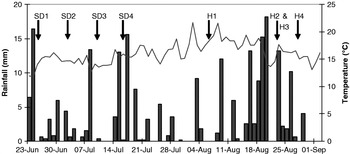
Flax establishment was recorded on 10 May. Flowering commenced on 8 June, with the first plots reaching MPF by 15 June. MPF was taken to be when half of the buds present had opened (Easson & Cooper Reference Easson and Cooper2002). All plots had attained MPF by 22 June. The 18 June was taken as ‘mean MPF’ and used for all subsequent calculations on date of application of desiccant herbicides. No difference in attainment of MPF was observed between varieties. The desiccant herbicides were applied to the trial plots on 25 June (MPF+7), 2 July (MPF+14), 9 July (MPF+21) and 16 July (MPF+28). Glyphosate (Roundup Biactive) was applied at 4 litres/ha and glyphosate (Roundup Biactive) plus ammonium sulphate (Restore) at 4 litres Roundup Biactive/ha+2 litres Restore/ha. Both treatments were applied in 200 litres water/ha using a knapsack sprayer at a pressure of 2 bars. No lodging was observed in any of the plots. Daily rainfall and temperature during the period from the first spray date on 25 June to the final harvest of plots from the last spray date (MPF+28) on 27 August are shown in Fig. 1.
Rainfall and temperature from the first spray date to the final harvest of the flax in 2004. SD1–SD4=spray date 1 to spray date 4, H1 to H4=harvest 1 to harvest 4.

Sequential harvesting
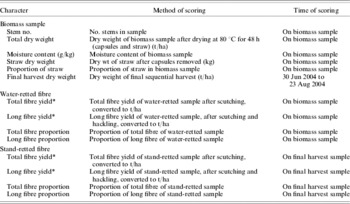
Thirty random stems were pulled from each plot once a week from prior to spraying until final harvest. The 30 stems were weighed, dried in an oven at 50°C for 4 days and re-weighed to determine the moisture content of the straw during retting. Once the moisture content of the straw of all plots from a single spray date had stabilized below 200 mg/g for 2 weeks, 60 stems were pulled from each plot as a final harvest and the material used for stand-retted fibre analysis. Biomass samples (1 m×8 central rows) were also taken from the relevant plots 10 days after each spray date by being pulled from the ground, weighed and dried in an oven at 50°C for 4 days. This material was used for water-retted fibre analysis. The 30 stem samples taken each week were used to estimate the ease of extraction of the fibres from the stems using a ramp decortication method. A list of the variables measured, together with details of when and how they were assessed, is given in Table 1. The methods of water-retting and fibre extraction, scutching and hackling are described below.
Characters scored on flax in 2004, along with details of method and time of scoring

* Explained in more detail in text.
For water-retting, a sub-sample of the dried unretted flax stems from each biomass sample was placed in a large tank of water at 30°C for 5–7 days. Single stems were removed from the tank daily after 5 days, dried and crimped to assess the ease of fibre extraction, and therefore the retting progress. Once retting had been completed, the remaining stems were removed from the tank and oven-dried at 60°C for 30 h. Fibre yields following both water- and stand-retting were compared to determine potential fibre yields of the field stand-retted material to that of the water-retted material, where the controlled conditions during the retting process enabled accurate maximum fibre yields to be obtained (van den Oever et al. Reference van den Oever, Bas, van Soest, Melis and Van Dam2003).
Assessment of fibre yield and quality from small-scale experimental plots is problematic as it is not possible to use modern commercial methods, which require large quantities of flax straw (Turner Reference Turner1954). Therefore, fibre yields of each variety were determined using the method developed by Long et al. (Reference Long, Easson and Frost1988), specifically for small-scale experimental plots and modified for this experiment, in which retted stems were manually pulled between two pairs of oscillating crimping plates to separate the shive from the fibres (scutching). Tow fibre was then removed from the line fibre by combing on a set of sharp pins (hackling). This combing process also separated the fibres to some extent. Three weighed sub-samples of 20–25 g from each field plot of both stand- and water-retted flax stems were passed ten times through the scutcher (five times in each direction) and reweighed to determine a total fibre yield. Each sub-sample was then pulled ten times through the hackling pins (again five times in each direction) and the remaining fibre weighed to determine long or line fibre yield. The number of times the material was passed through the scutcher ensured that the shive content remaining on the fibre was below the maximum acceptable level (0·02) for most industrial applications (Munder et al. Reference Munder, Furll and Hempel2004). All scutching and hackling work was conducted in a controlled environment room at 21°C and 65% relative humidity (RH), and all samples were conditioned in this environment for at least 48 h before processing.
Ramp decortication
The method for the ramp decortication of individual flax stems was adapted from Booth et al. (Reference Booth, Harwood, Wyatt and Grishanov2004) to measure the ease of decortication or separation of the fibre from the non-fibre fractions of the stem. All ramp work was conducted in a controlled environment room at 21°C and 65% RH, and all samples were conditioned in this environment for at least 48 h before processing. The ramp was inclined with a slope of about 6° and covered with a horizontally aligned ribbed, rubber surface. A 4 kg roller with a ribbed, rubber surface was allowed to run down the ramp from a fixed starting point. A 0·1 m length of flax stem, taken from the centre of the stem, was placed parallel to the slope, 0·5 m down from the starting point, thus ensuring that the speed of the roller at the point of contact with each stem sample was consistent and reproducible. Each time the roller passed over the flax stem some of the shive separated from the fibre. Each flax stem sample was placed on the ramp for four successive rolls and the weight of the shive removed after each roll was expressed as a proportion of each stem's total shive content. The final stage was to remove all the shive from the fibre by hand to determine the total fibre and shive content of each stem.
Ramp decortication was conducted on ten stems taken from the 30 stem samples, using samples taken 1, 3 and 5 weeks after spraying with the desiccating herbicide.
Statistical analysis
Data were analysed using Genstat® 7.2 for Windows (Lawes Agricultural Trust 2003). The mean and standard error were calculated for each variable and following tests for normality and homogeneity of variance, analyses of variance (ANOVAs) were conducted on all the variables measured. For variables recorded prior to the application of the desiccating herbicide treatments an ANOVA between varieties was calculated. For variables scored on the biomass sample, an ANOVA was calculated between variety and spray date and for the variables scored from the final harvest material an ANOVA was calculated between variety, spray date and herbicide. Herbicide was not included as a treatment in the ANOVA on the biomass variables as its effect would not have commenced 10 days after application. Repeated measures ANOVA was computed on the data derived from the 30 stem samples taken at weekly intervals from the date of spraying to determine if there was an effect of time in addition to any effects of variety, spray date and herbicide treatment. A repeated measures ANOVA was also computed on the data obtained from the ramp decortication study to determine if significant differences were present between variety, spray date, treatment and time after spraying in the amount of shive removed from the fibres with each successive roll down the ramp.
RESULTS
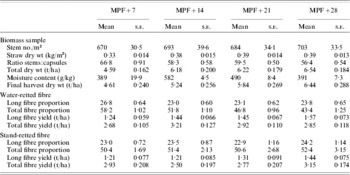
Means, standard errors of the mean and ranges within each variable are shown in Table 2. In the biomass samples total dry weight and straw weight increased with later spray dates. The proportion of straw decreased in later spray dates, even though the actual weights increased and is a result of an increase in the proportion of capsules during this time (S. Bennett, personal communication). The total dry weight of the final harvest also increased with later spray dates.
Variation in variables scored in relation to spray date, shown as means, standard error of the mean and ranges. Data are the means of all three varieties and two desiccating herbicide treatments

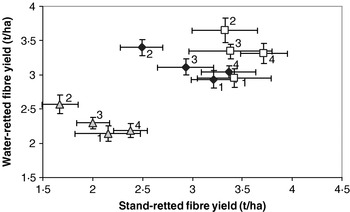
In the water-retted fibre analysis, the proportion of total fibre recovered decreased with successive spray dates (Table 2), although the long fibre yields increased slightly over the same time period and the total fibre yields increased and then marginally decreased. Stand-retted fibre analysis revealed less variation in both long and total fibre proportions with a small increase in long fibre yield, but not in total fibre yield across spray dates. For both water- and stand-retted total fibre yield there was a significant difference between varieties, with Diane producing the highest fibre yields and Elise the lowest, following both water- and stand-retting (Fig. 2). However, the spray date that resulted in the highest fibre yields varied between water- and stand-retting with spraying at MPF+14 giving the highest yields following water-retting, and spraying at MPF+28 following stand-retting.
Comparison between water-retted and stand-retted total fibre yields of flax varieties over four spray dates; 1=25 June, 2=2 July, 3=9 July, 4=16 July; ◆=Electra, □=Diane, ▲=Elise. Values are means of two herbicide treatments (n=8). Vertical and horizontal bars represent s.e.m.

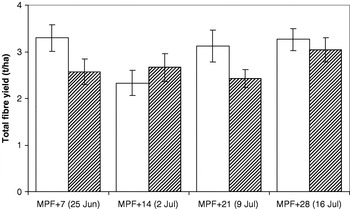
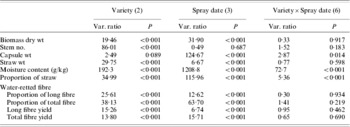
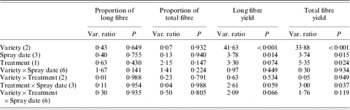
Following tests for normality and homogeneity of variance, data for all variables scored were found to be normal. ANOVA revealed that there was a significant effect of variety on all variables scored prior to spraying with the desiccant herbicide or taken from the biomass sample. There were significant effects of variety and spray date on those variables taken from the biomass sample, apart from the number of stems (Table 3). Variables to show a significant interaction between variety and spray date were proportion of straw, capsule weight and moisture content. Significant differences were found following the stand-retted fibre analysis (Table 4) between varieties and between spray date in long and total fibre yield, and between herbicide treatments in total fibre yield. A significant interaction was also found between herbicide treatment and spray date in total fibre yield, where the use of Roundup Biactive as the desiccant herbicide resulted in higher fibre yields than with Roundup Biactive plus Restore in all three varieties, and particularly at the first spray date (Fig. 3), but gave slightly lower total fibre yields at the second spray date (MPF+14).
Stand-retted total fibre yields in response to two desiccating herbicides. Open columns=Roundup Biactive, shaded columns=Roundup Biactive+Restore. Values are means of all three varieties (n=24). Vertical bars represent s.e.m.

ANOVA for variables scored prior to spraying or at the time of the biomass sample. Degrees of freedom given in brackets
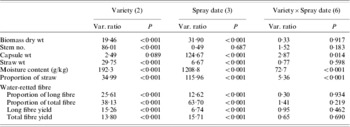
ANOVA of stand-retted fibre analysis variables scored after retting. Degrees of freedom given in brackets

Sequential harvesting
The time taken to complete the retting process, as measured by the drop in moisture content in the sequential harvesting, was around 6 weeks for all four spray dates, although spray date 2 (MPF+14) was harvested a week later due to heavy rainfall the previous week (Fig. 1).
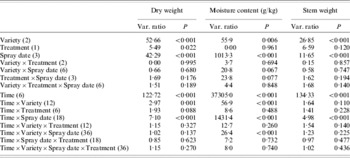
A repeated measures ANOVA of the sequential harvesting data showed that there were significant differences between varieties, herbicide treatments and spray dates in stem dry weight, plant dry weight and moisture content, but no significant interactions (Table 5). The highest plant and stem dry weights were recorded in Elise and in plots sprayed with Roundup Biactive plus Restore. They were lowest in Diane. Plant and stem dry weights were significantly lower at the first spray date (MPF+7), but there was no significant difference between the other three spray dates. Moisture content was significantly lower in Elise than in the other two varieties, and the moisture content dropped continually from MPF+7 through to MPF+28.
Repeated measures ANOVA for variables scored during desiccation period after spraying (sequential harvesting)

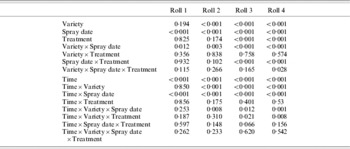
Probabilities in repeated measures ANOVA for successive rolls down a ramp to decorticate flax stems sampled during the desiccation period after spraying (sequential harvesting)

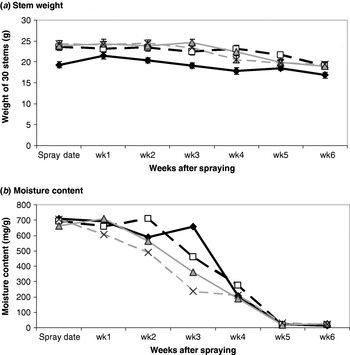
All three variables showed significant differences over time, with plant and stem dry weight and moisture content dropping over time, and significant interactions were found between time and spray date in plant and stem dry weight, and moisture content, and between time, spray date and variety in moisture content. The stem weights and the moisture content measured each week from the date of spraying are shown in Fig. 4, where it can be seen that stem weight in the first spray date (25 June) is lower at all times than the other three spray dates, but that there is little variation between the later three dates. It can also be seen that moisture content dropped from 650–700 mg/g at the time of spraying to around 200 mg/g at the time of final harvest, with the moisture content in the last spray date on 16 July dropping faster and more consistently than with any of the other spray dates. The small peaks in the moisture content graph relate to dates when there had been heavy rainfall on the date of sampling.
Stem weight and percentage moisture content of fibre flax from day of spray with desiccating herbicide over 6 weeks with four different spray dates. —◆—=Spray date 1 (25 June), - -□- -=spray date 2 (2 July),  =spray date 3 (9 July),
 =spray date 4 (16 July). Values are means of all three varieties (n=24). Vertical bars represent s.e.m.

Ramp decortication
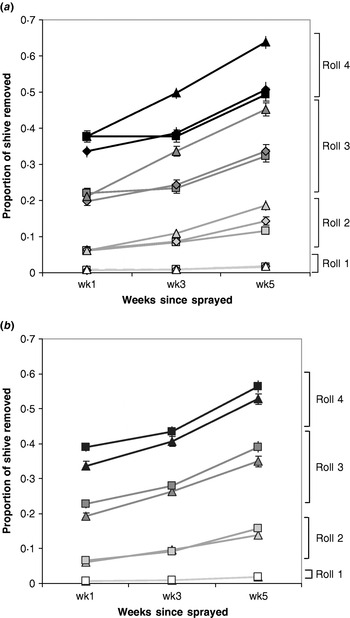
A repeated measures ANOVA on the proportion of shive removed following ramp decortication found that there was a significant effect of variety and spray date at all rolls of the wheel down the ramp and that there was a significant difference between herbicide treatments at the last two rolls down the ramp (Table 6). When application time was included as a factor it was found to be very significant at all four ramp rolls, and that there was a significant interaction between time and variety and between time and spray date. The proportion of shive removed increased with each successive roll of the wheel down the ramp and with an increase in the number of weeks after spraying. The amount of shive removed with each roll was greater in Elise than in the other two varieties, particularly 3 and 5 weeks after the flax plants had been desiccated, thus when retting had commenced (Fig. 5 a). The proportion of shive removed increased with each successive roll down the ramp at all four spray dates, but the proportion of shive removed was much greater from the first and last spray dates, with the proportion removed from spray date 2 (MPF+14; 2 July) significantly less than the other spray dates. A significant difference between herbicide treatments was also recorded in rolls 3 and 4 with a greater proportion of shive removed from plants sprayed with Roundup Biactive+Restore (Fig. 5 b).
Proportion of shive removed from retted flax stems with successive rolls down a ramp at increasing weeks after spraying in (a) three flax varieties: values are means of all herbicide treatments (n=32), and (b) with different desiccating herbicide treatments: values are means of all varieties (n=48). (a) -■-=Electra, -◆-=Diane, -▲-=Elise; (b) -▲-=Roundup Biactive, -■-=Roundup Biactive+Restore. Vertical bars represent s.e.m.

DISCUSSION
There are several published reports of the optimum time to spray flax plants to obtain the highest fibre yields, with significant yield penalties recorded when the plants are not sprayed at the optimum time. These range from after MPF+14 (Easson & Long Reference Easson and Long1985; Reference Easson, Long, Sharma and van Sumere1992b), between MPF+14 and MPF+21 (Easson & Molloy Reference Easson and Molloy1996), after MPF+20 (Sharma et al. Reference Sharma, Mercer and Brown1989) and after MPF+30 (Easson & Cooper Reference Easson and Cooper2002). Harvey et al. (Reference Harvey, Spence and Crothers1985) and Harvey & Crothers (Reference Harvey and Crothers1988b) also found that application of glyphosate between MPF+14 and 28 days did not result in satisfactory desiccation, and attributed this to the upward movement of the translocates during the period of seed filling, rather than the downward translocation of assimilates that is required for successful action of glyphosate. In the present trial a slight yield penalty for long and total fibre yields was observed following spraying with Roundup Biactive glyphosate at MPF+14, and with Roundup Biactive glyphosate plus Restore application at MPF+21, with a general increase in fibre yields from MPF+7 to MPF+28. It is unclear why the reduction in fibre yield should occur at different spray dates between the two herbicide treatments, but is possibly related to increased movement of assimilates in combination with Restore, compared with glyphosate alone. The yield penalty was less than that reported following desiccation with TMS-based glyphosate (Easson & Cooper Reference Easson and Cooper2002). It is suggested that this is related to the mode of uptake of the IPA salt-based glyphosate combined with the biactivator used in the present study which causes no damage to the plant on uptake, compared to the TMS-based glyphosate which causes damage to the leaf cuticle and surface epidermal cells on entry, thus potentially reducing transportation of the glyphosate around the plant. This would be enhanced during periods of seed fill (MPF+10 to MPF+25) when plant translocation to the roots is reduced.
The ease of separation of the fibres from the shive after desiccation is very important for industrial processing (Booth et al. Reference Booth, Harwood, Wyatt and Grishanov2004) and the results from the present trial using ramp decortication show that there is a significant difference between varieties in the ease of decortication, and that the use of Restore in combination with Roundup Biactive glyphosate increases the ease of decortication. Booth et al. (Reference Booth, Harwood, Wyatt and Grishanov2004) suggest that the choice of variety may be important in achieving a particular end user specification, although this is confounded by variations in both fibre fineness and strength that occurs depending on the time of application of the desiccating herbicide (Sampaio et al. Reference Sampaio, Bishop and Shen2005). However, the average proportion of long or line fibre obtained in the present trial is comparable to that reported in other trials, for example van den Oever et al. (Reference van den Oever, Bas, van Soest, Melis and Van Dam2003) and the Centre for Genetic Resources, The Netherlands flax collection (van Soest & Bas Reference van Soest, Bas, Maggioni, Pavelek and van Soest2002).
The present trial has shown that the ease of decortication is related to the ease of desiccation with those varieties that desiccate relatively easily, such as Elise, also being those that decorticate the easiest. The ease or rate of retting is related to both the weather at the time of retting and to the quantity of pectic substances within the plant to be degraded (Brown et al. Reference Brown, Sharma and Black1986); the lower the levels of pectic substances within the flax stem the quicker and easier the retting process. Varietal differences in the ease of retting were observed by Meijer et al. (Reference Meijer, Vertregt, Rutgers and Van De Waart1995) and Brown et al. (Reference Brown, Sharma and Black1986) and this was attributed to the different levels of cellulose and non-cellulosic compounds, including pectins, in the stems (Sharma & Faughey Reference Sharma and Faughey1999).
An early sowing date, frequent monitoring of the crop during the retting process and the use of the IPA salt-based glyphosate can be attributed to the successful retting of the flax plants at all the spray dates. Easson & Long (Reference Easson and Long1985) reported that for successful desiccation and retting of flax for fibre the crop should be sprayed when the fibre has formed in the plants but before seed development commences, therefore between MPF+7 and MPF+14. Sharma et al. (Reference Sharma, Mercer and Brown1989) stated that it was not possible to spray the plants for desiccation more than 30 days after MPF when the seeds would have matured, as the crop would then be retting as the weather started to get colder and wetter, resulting in a crop in which the moisture content never dropped to the required 200 mg/g. However, in the present trial the plots sprayed at 28 days after MPF were sprayed on 16 July and the moisture content had dropped to 200 mg/g after only 4 weeks and was harvested 6 weeks after spraying on the 27 August, resulting in a successful fibre crop harvested before the weather deteriorated in September and in which the seed on the plants had matured prior to spraying.
A further factor that may contribute to the success of the retting process at all spray dates is that the present trial was sown for industrial fibre production in which the sowing density is about 1000 seeds/m2, resulting in a final stem density of about 800 stems/m2. The majority of the work currently reported on the use of glyphosate for stand-retting has been conducted on flax crops grown for linen production, where the sowing density is around 2000–2500 seeds/m2 (Sharma Reference Sharma1986; Harvey & Crothers Reference Harvey and Crothers1988b), resulting in a final stem density of around 1700–1800 plants/m2 (Anon. 1994; Meijer et al. Reference Meijer, Vertregt, Rutgers and Van De Waart1995). Harvey & Crothers (Reference Harvey and Crothers1988a), in a study on the penetration of glyphosate, found no significant differences between sowing densities of 1000, 1500 and 2000 seeds/m2. However, they sampled the plants immediately after spraying rather than waiting for any translocation to occur, and although the depth of penetration does not vary between sowing rates, the amount of herbicide landing on each plant may be greater at lower sowing densities increasing successful translocation around the plant.
To conclude, the use of IPA-based glyphosate was shown to be successful at evenly desiccating the flax plants at all four of the spray dates, ranging from MPF+7 to MPF+28, with greatest fibre yields achieved at MPF+28. Including the adjuvant ammonium sulphate to the desiccant herbicide reduced fibre yields slightly, but increased the ease of decortication. This may be important when desiccating varieties, such as Electra and Diane, which are known to be hard to desiccate. Frequent monitoring of the crop during the retting process has been shown to be important in ensuring that the crop is not over-retted and is harvested as soon as the moisture content falls below 200 mg/g. This, combined with an early sowing date, meant that even with a desiccation date of MPF+28 (when mature seeds have developed and highest fibre yields are achieved), the crop can be out of the ground before the traditionally cooler and wetter weather of September arrives.
We thank the European Union, The National Assembly for Wales Agricultural Department and the Welsh Development Agency for funding this work. Thanks also to Kirsty Brayson, Lucy Johnson, Mark Hughes and Tony John for technical help, and to Dr Jim Dimmock for construction of the decortication ramp and helpful discussion prior to starting the field trials.