


1. Introduction
Why do some territorial disputes experience third-party settlements rather than military or bilateral ones? Why do some disputants prefer binding third-party settlements to non-binding third-party settlements, although they lose the freedom to decide? Since the territorial dispute is one of the major causes of interstate war (Hensel, Reference Hensel1996; Vasquez and Henehan, Reference Vasquez and Henehan2001; Senese and Vasquez, Reference Senese and Vasquez2005; Atkinson et al., Reference Atkinson, Owsiak, Jackson and Buechler2024), it is crucial to understand how states can resolve disputes peacefully to avoid unwanted wars. However, there is variation in the patterns of peaceful attempts in territorial disputes: Some disputants try to resolve their conflicts with third-party involvement, such as mediation, arbitration, or adjudication, whereas other disputants settle with bilateral negotiations or military conflicts.Footnote 1 In this study, I seek to explain variations in peaceful attempts in territorial claims.
To date, research on territorial claims emphasises a bevy of conditions, such as the salience or type of the contentious issues (Hensel, Reference Hensel2001; Huth and Allee, Reference Huth and Allee2002a; Hensel et al., Reference Hensel, Mitchell, Sowers and Thyne2008; Owsiak and Mitchell, Reference Owsiak and Mitchell2019), a history of militarised disputes or failed peaceful attempts (Hensel et al., Reference Hensel, Mitchell, Sowers and Thyne2008), regime types (Huth and Allee, Reference Huth and Allee2002a), or power balance between the disputants (Simmons, Reference Simmons2002; Allee and Huth, Reference Allee and Huth2006). Nonetheless, none of these studies has explored how historical contexts condition the trajectory of dispute.
To investigate this issue, the remainder of this paper proposes that the origins of territorial claims affect the occurrence and success of third-party peaceful attempts. The origins (i.e., immediate causes) of territorial claims are disaggregated into three types: (1) opportunism; (2) territorial loss; and (3) national independence. In many cases, territorial claims are initiated opportunistically by formerly independent states to establish sovereignty over territory whose status was left undetermined by previous agreements (e.g., the dispute between Denmark and Canada over Hans Island [the Whiskey War]). Moreover, states sometimes initiate a claim over territory annexed or occupied by another country as a consequence of a previous conflict (e.g., the French claim over Alsace-Lorraine after the Franco-Prussian War). Finally, a nontrivial frequency of claims originates from processes of national independence, such as disputes between India and Pakistan.
I argue that the claim origination affects the expected utility of third-party involvement by changing its salience. Claims arising from national independence often lead to an impasse in bilateral negotiations because of their salience in the process of state formation, resulting in the reliance on third parties that generate the ‘political cover’ effect, such as the International Court of Justice (ICJ) or former colonial powers, whose ruling is difficult to reverse in general. Therefore, the origins related to national independence increase the likelihood of both the occurrence and success of binding third-party peaceful attempts. Among such cases, the impact may be even greater when claims stem from the claimant’s decolonisation process. This is because the former colonial power, having a stake in resolution and sharing cultural, historical, and linguistic ties, can serve as a trusted third party capable of mitigating information and commitment problems.
I test these hypotheses using original global data on the origins of 843 territorial claims between 1816 and 2001. The empirical results from the logistic regression and competing risk analyses support these expectations regarding the role of claim origination qualities in peaceful attempts. Territorial claims arising from national independence are more likely to invite and be settled with a binding third-party involvement than other types of claims. These findings suggest the importance of historical contexts in understanding peaceful attempts and settlements in territorial disputes, as well as the effectiveness of international legal bodies as a means to resolve competing claims successfully.
In the following section, I summarise the findings of previous studies on peaceful attempts in territorial disputes and point out the insufficient attention to their historical contexts. The third section conceptualises three types of origins and discusses three hypotheses regarding the impact of origination qualities on peaceful attempts. The fourth section describes the coding rules for the origin types as well as the sample, variables, and statistical models employed to test the hypotheses. The empirical analysis section reports the findings from the logistic regression and competing risk analyses. The paper concludes by proposing directions for future research.
2. Research on peaceful attempts in territorial claims
The literature on peaceful attempts to settle territorial disputes has clarified several factors leading to negotiations and third-party involvement. This section summarises what is known about the occurrence and choice of peaceful efforts from the following three perspectives: territorial salience, domestic political dynamics, and dyadic strategic interactions. Thereafter, I explain the gap in the literature regarding the role of historical contexts.
The major approach to understanding the occurrence of peaceful attempts is to focus on territorial salience and contentious issue types. Several works by Hensel propose that territorial claims with higher salience, such as the presence of natural resources and identity ties, are more likely to experience peaceful attempts than claims with lower salience (Hensel, Reference Hensel2001; Hensel and Mitchell, Reference Hensel and Mitchell2005; Hensel et al., Reference Hensel, Mitchell, Sowers and Thyne2008). Moreover, river claims are more likely to have peaceful attempts than territorial claims because claimants have a weak emotional attachment to rivers and can make concessions in the negotiation more easily (Hensel et al., Reference Hensel, Mitchell, Sowers and Thyne2008). However, issue salience decreases the likelihood of binding conflict management (e.g., arbitration and adjudication) because claimants do not want to lose their control of the important issues (Gent and Shannon, Reference Gent and Shannon2011). Likewise, Owsiak and Mitchell (Reference Owsiak and Mitchell2019) find that territorial claims are more likely to involve informal strategies such as bilateral negotiations than river claims because territorial claims possess more salience, more localised interests, and fewer transaction costs. These studies suggest that issue salience is closely associated with the occurrence of peaceful attempts.
The second body of work relates the domestic political dynamics to peaceful attempts. A robust empirical finding is that democracies are more likely to have peaceful attempts in territorial disputes (Huth and Allee, Reference Huth and Allee2002b; Chiozza and Choi, Reference Chiozza and Choi2003; Allee and Huth, Reference Allee and Huth2006; Hensel et al., Reference Hensel, Mitchell, Sowers and Thyne2008). Since leaders in democracies need to be more attentive to domestic popularity to remain in power, they hesitate to use force over territorial conflict and pursue settlements by negotiation rather than costly military conflict, although they tend to refrain from initiating talks and changing the territorial status quo as an election approaches (Huth and Allee, Reference Huth and Allee2002b). Still, it is costly for democratic leaders to make concessions in disputes because it signals weak leadership and can lead to the loss of domestic popularity. Making concessions following the decision by third-party adjudication may be preferable to making concessions to the political adversary in a bilateral negotiation (Simmons, Reference Simmons2002). Thus, democratic leaders seek legal means of dispute resolution when they anticipate domestic political costs associated with settlements through the making of direct concessions in bilateral negotiations (Allee and Huth, Reference Allee and Huth2006). Such political costs include the presence of strong domestic opposition and ethnic ties between domestic audiences and the disputed territory. These factors increase the salience of the dispute and raise the political costs of making concessions in bilateral negotiations. Under these conditions, democratic leaders are more likely to rely on international legal bodies.
Strategic interactions between disputants also shape peaceful attempts in territorial disputes. As for the capability of disputants, binding third-party involvement is less likely to occur when the military power of disputants is unbalanced because the stronger side, which can pressure the weaker side to make concessions by force, prefers bilateral negotiations to a formal legal settlement (Simmons, Reference Simmons2002; Allee and Huth, Reference Allee and Huth2006; Gent and Shannon, Reference Gent and Shannon2011). In addition, when leaders have a legal advantage, they prefer negotiated settlements to the use of force because it is likely to get recognition of their sovereignty over the disputed territory without costly conflicts (Huth et al., Reference Huth, Croco and Appel2011). This effect is enhanced when only one of the disputants has a clear legal advantage over its adversary (Huth et al., Reference Huth, Croco and Appel2012).
The expectations of future benefits and the adversary’s behaviours also affect the decision-making of leaders. Since the opportunity costs of military conflict increase, disputants are more likely to use third-party assistance to resolve the dispute when the settlement of the territorial dispute opens the way for bilateral trade (Simmons, Reference Simmons2002). Moreover, the history of recent militarised disputes and peaceful attempts also indicates a higher probability of another peace effort, possibly because disputants and third parties try to avoid the risk of future conflict (Hensel, Reference Hensel2001; Hensel et al., Reference Hensel, Mitchell, Sowers and Thyne2008; Mattes, Reference Mattes2018). Particularly, binding third-party settlement is more likely with a history of previous agreements (Gent and Shannon, Reference Gent and Shannon2011).
However, previous studies have paid less attention to the historical contexts of territorial claims. Historically, some territorial disputes arising from national independence escalated to interstate rivalry and accumulated a number of failed attempts in bilateral negotiations, and in the end, political leaders tried to settle them with a third-party ruling. For instance, Honduras submitted its border dispute with Nicaragua to the Spanish arbitration in 1906 and the century-long dispute with El Salvador to the ICJ in 1986 (Huth and Allee, Reference Huth and Allee2002a). The dispute between Colombia and Venezuela also tried to submit their case to Spanish arbitration in 1891. These cases illustrate that claimants rely on third parties to break the impasse in bilateral negotiations to settle disputes commencing after decolonisation. On the other hand, some territorial disputes in Europe were initiated with a military conflict, such as the Franco-Prussian War and the Winter War. These cases are often settled quickly by a peace conference or non-binding third-party settlement such as mediation. From these observations, there is a reason to suspect that peaceful attempts are conditioned not only by the characteristics of territory or claimants but also by historical contexts in territorial disputes.
With respect to the origins of territorial claims, few empirical studies have explored their causes. Huth (Reference Huth1996) explains that territorial claims arise in the following conditions: (1) the disagreement over previous border agreements; (2) the absence of border agreements; (3) territorial occupation by another country; (4) the disagreement over the sovereignty of another state over some portion of the country; and (5) the disagreement over the independence or sovereignty of another country over external territory. Similarly, Gibler (Reference Gibler2017) disaggregates the type of territorial disputes based on the location and actions, producing six categories: (1) disputed ownership; (2) general border issues, (3) opportunity-based conflict, (4) state-system changes, (5) border violations, and (6) fishing rights and the hot pursuit of rebels. Although these two studies distinguish between different types of territorial claims, they do not explicitly examine the direct causes of such claims. In other words, it remains unclear what kind of events prompt a state to initiate a claim and how the origins of such a claim influence its subsequent trajectory. To tackle this issue, Watanabe and Enterline (Reference Watanabe and Enterline2025) identify four origin types: (1) pristine; (2) territorial incursion; (3) territorial loss; and (4) national independence. Nonetheless, because each origin type is not mutually exclusive in this classification, the distinctions between categories are blurred. Furthermore, this classification confuses the cause of the action with the method of initiating a claim. Building on this literature, this study aims to elaborate on a modified version of origin typology and its impact on peaceful attempts and settlements in the following sections.
3. Claim origin & binding third-party involvement
This study differentiates three direct causes of territorial claims: (1) opportunism; (2) territorial loss; and (3) national independence. In the case of opportunism, territorial claims commence when existing states opportunistically claim sovereignty over external territory for strategic reasons or after exploration of unclaimed territories (e.g., the Russian expedition and claim over Alaska in the early 19th century). In the case of territorial loss, states initiate a claim over the territory lost in a previous conflict (e.g., the French claim over Alsace-Lorraine after the Franco-Prussian War of 1870–71). In other words, the shift in territorial ownership causes a new claim in these cases. The third cause is national independence. Newly independent states often have disputes over their national borders, as happened in many Latin American countries in the 19th century. Hence, this type of dispute involves at least one newly independent state.
How does the origin of territorial claims affect the occurrence of peaceful attempts and settlements in territorial claims? I propose that the claim origination affects the expected utility of third-party involvement by changing its salience for both the claimant (the demand side) and the third party (the supply side). When the claim originates from border issues after national independence, the disputes are associated with an impasse in bilateral negotiation, leading to greater reliance on the ‘political cover’ effect of the binding third-party settlement. These cases are more difficult to reverse the outcome and tend to end with a binding third-party settlement because of the reputational costs of reneging on the ruling and the presence of credible third parties, such as the ICJ and former colonial powers, that facilitate communication and reduce the information and commitment problems. This mechanism increases the expected utility of third-party settlement for the demand side. Furthermore, former colonial powers, which often feel a sense of guilt regarding the dispute, frequently get involved in territorial disputes stemming from national independence because they have a vested interest in its resolution. Therefore, the origins affect the expected utility of third-party settlement for both the demand side and the supply side. This section explores how the origin affects peaceful attempts and settlements by third parties.
3.1. Claim origination by national independence
The origin related to national independence leads to difficulty in border settlements in bilateral negotiations for security and psychological reasons. Although the majority of territorial disputes commence when two formerly independent states disagree over the ownership of the territory that was explored in the process of territorial expansion (e.g., Alaska and many other disputes over island territories), some border disputes stem from national independence, such as the dispute over Kashmir between India and Pakistan. In the case of opportunistic territorial expansionism, the disputed territory is sometimes far from the homeland or the capital city. Thus, the loss of the territory is not an immediate threat to the country’s survival and should be less salient to both sides (or at least the challenger). In the case of national independence, the disputed territory is generally part of the homeland, and the loss of the territory can be a critical threat to the state’s survival, particularly when the contested territory involves strategic values that affect the military balance, leading to a bargaining failure and the evolution of contiguous interstate rivalry (Hensel and Mitchell, Reference Hensel and Mitchell2005; Rider and Owsiak, Reference Rider and Owsiak2015, Reference Rider and Owsiak2021).
Besides, territorial disputes emerging following national independence have symbolic meaning to domestic audiences because the territory belonged to the same political entity as at least one of the disputants before independence and is thought of as their homeland.Footnote 2 A survey experiment demonstrates that a notion of historical ownership makes people believe that the disputed territory is indivisible and like a zero-sum game (Fang and Li, Reference Fang and Li2020). Since the border demarcation is a central issue in the process of state formation for the claimants that have achieved national independence recently, the acquisition or loss of the territory has a symbolic meaning for the competence of political leaders (Clay and Owsiak, Reference Clay and Owsiak2016). Hence, the dispute is closely related to states’ identity and national pride (Toft, Reference Toft2014), and making concessions signals weak leadership to domestic audiences, which can result in leadership change (Allee and Huth, Reference Allee and Huth2006).
According to the bargaining theory, this hinders bilateral negotiations from reaching an agreement, even if both sides recognise the negative impact of the dispute on political and economic relations. When states dispute over divisible issues such as natural resources, it may be possible to divide the territory and share the benefits (Fearon, Reference Fearon1995). In contrast, when the territory is imbued with intrinsic psychological salience, such a resolution becomes difficult. This mechanism reduces the expected utility of bilateral negotiations, in which both parties are required to make some concessions (Hensel and Mitchell, Reference Hensel and Mitchell2005).
Alternatively, binding third-party settlements of highly salient issues are less costly than bilateral negotiations because the international legal body is assumed to be credible, and the public does not assign blame to its leader even if the ruling favours the opponent (Simmons, Reference Simmons2002; Allee and Huth, Reference Allee and Huth2006). This political cover mechanism saves the face of leaders when both sides recognise the political and economic benefits of the dispute settlement but cannot solve the issue with bilateral negotiations, and thereby, it increases the expected utility of peaceful negotiation relative to the status quo or military settlements that can worsen the relationship between the two countries (Beardsley, Reference Beardsley2010; Beardsley and Lo, Reference Beardsley and Lo2014). Consequently, claims originating from national independence are more likely to involve binding third-party peaceful attempts because of their political cover effect.
After their independence, Mali and Burkina Faso disputed the area called the Agacher Strip for two decades without concessions from either side. Since the French colonial authorities did not clearly delineate the borderline, Mali claimed its ethnic ties to the territory while Burkina Faso relied on old maps, resulting in a small-scale military clash in 1974 (Naldi, Reference Naldi1986). Although the two countries agreed to avoid a military settlement after the mediation by the Organization of African Unity, Thomas Sankara, the leader of the Burkinabe revolutionary government, was wary that the Malian government was plotting to aggravate the dispute and overturn the regime by supporting a counterrevolution. Then, Sankara sent a warning to the Mali counterpart, which exacerbated the hostility, and a local skirmish escalated to the ‘Christmas War’ of 1985. Both countries petitioned the ICJ to impose interim measures to prevent further conflicts and settle the dispute peacefully (Naldi, Reference Naldi1986). This case highlights the instability of newly independent states, the difficulty in making concessions in the territorial dispute after national independence, and the utility of binding third parties for a peaceful settlement. This leads to the first hypothesis about the onset of a binding third-party peaceful attempt in territorial disputes:
Hypothesis 1: Territorial claims originating from national independence are more likely to experience binding third-party peaceful attempts than other types of claims.
The origin related to national independence also affects the settlement type of territorial claims for two reasons. First, if these cases tend to have the involvement of binding third parties, they should be more likely to end with binding peaceful settlements rather than military settlements or other types of settlements, given the international audience costs associated with reversing the ruling. Mitchell and Hensel (Reference Mitchell and Hensel2007) argue that claimants are more likely to comply with the outcome of binding third-party settlements, which is associated with a higher credibility, because noncompliance generates reputational costs that the international audience perceives as the country lacking respect for the international legal order and the rule of law. Hence, a higher likelihood of a binding peaceful attempt should increase the likelihood of a binding third-party peaceful settlement.
Second, the involvement of credible third parties reduces information asymmetry and commitment problems during the negotiation and implementation process and increases the expected utility of a binding third-party settlement. The international organisations are equipped with sophisticated administrative capabilities to collect and provide information about both sides’ interests and evidence necessary for the judgement of settlement (Boehmer et al., Reference Boehmer, Gartzke and Nordstrom2004). This mitigates the information asymmetry that is inherent in the anarchic international system, where states have an incentive to misrepresent their preferences and resort to the negotiation process to get a better deal (Fearon, Reference Fearon1995; Mitchell and Hensel, Reference Mitchell and Hensel2007).
Moreover, the international legal bodies assume credibility as third parties and reduce commitment problems by facilitating communications and reducing uncertainty about the future between the disputants. To settle, disputants have to overcome commitment problems caused by uncertainty about whether or not the opponent will renege on the agreement and gain benefits in the future. Since international organisations such as the ICJ commit to the issue seriously and do not withdraw from the ruling process, they can be credible third parties, which attenuates the commitment problems. Therefore, the presence of credible third parties increases the expected utility of the settlement (Melin, Reference Melin2011). For these reasons, the use of international legal bodies should be more effective than other types of mediation to bring about a peaceful settlement of territorial disputes.
In addition to the international legal organisations, disputes after national independence sometimes involve former suzerains who have interests in the settlement and can be a credible third party because of their historical and cultural ties. To prevent disputants from misrepresenting their private information, third parties need to have prior knowledge about the contexts of the dispute and disputants’ preferences. Colonial ties help third parties understand these contexts because the colonial power is a part of the cause of the dispute and is familiar with the governance of the newly independent disputant (Wiegand et al., Reference Wiegand, Rowland and Keels2021). Besides, the linguistic, cultural, political, and economic ties with their former colonial states reduce misunderstanding and enhance the trustworthiness of the third party (Greig, Reference Greig2005; Melin, Reference Melin2011). Empirical studies find that colonial ties between conflict parties and third parties increase the likelihood of both the occurrence and success of mediation in both interstate and intrastate conflicts (Melin, Reference Melin2011; Reid, Reference Reid2017; Wiegand et al., Reference Wiegand, Rowland and Keels2021).
Given the colonial ties, it is reasonable to assume that disputants are more likely to invite peaceful attempts by colonial powers when the origin of the dispute is associated with national independence because the expected utility of third-party settlement is high for both the demand and supply sides. For the demand side, it is not easy to make concessions in bilateral negotiations, and the claimants need legitimate, credible third parties who will commit to the negotiation process to settle the dispute. For the supply side (i.e., former colonial powers), third parties have an interest in the settlement of those disputes because the security of former colonies is closely related to the trade, politics, and immigration in the metropole. Furthermore, colonial powers often show a sense of guilt or responsibility for conflicts in their former colonies even after independence. For example, Koen Vervaeke, a Belgian envoy, stated that Belgium bears responsibility for the conflicts in Central Africa and has a moral obligation to demonstrate solidarity with it, although it no longer has significant interests in the region (Rosoux, Reference Rosoux2014). For these reasons, the presence of colonial ties serves to mitigate information problems and strengthens the arbitrator’s commitment, thereby enhancing the utility of third-party settlement for both the demand side and the supply side. Hence, territorial claims originating from national independence should be more likely to end in third-party settlements.
Colombia and Venezuela disputed sovereignty over the Guajira Peninsula since both countries gained independence. As bilateral negotiations between the two parties were not successful, they submitted the case to the 1894 arbitration by Spain, which had interests in the settlement of former colonies and assumed credibility for ruling (Klock, Reference Klock1980). This case suggests that territorial disputes originating from national independence tend to be associated with impasse in bilateral negotiations and rely on a binding third-party ruling that assumes a political cover effect. Besides, the presence of colonial ties increases the likelihood of third-party settlement because of its increased expected utility.
However, this argument may not apply to cases where claimants become independent through secession from another country or after the breakup of multiethnic countries, because those states do not necessarily have third parties with strong colonial ties. Thus, the effect of origins associated with national independence may appear only when the claimants become independent through decolonisation from major powers. This line of argument leads to the following hypotheses:
Hypothesis 2: Territorial claims originating from national independence exhibit a higher risk of a binding third-party settlement than other types of claims.
Hypothesis 3: Territorial claims originating from the claimant’s decolonisation exhibit a higher risk of a binding third-party settlement than claims originating from other types of independence.
4. Research design
4.1. Sample & coding of the origin of territorial claims
Relying on the ICOW Data version 1.1 (Hensel et al., Reference Hensel, Mitchell, Sowers and Thyne2008) and version 1.2 (Frederick et al., Reference Frederick, Hensel and Macaulay2017), this study uses a global sample of 843 territorial claims between 1816 and 2001. A territorial claim is defined as explicit competing claims to territorial sovereignty made by official government representatives who are authorised to make foreign policy (Frederick et al., Reference Frederick, Hensel and Macaulay2017). For the first hypothesis, I use the claim-dyad-year data in the ICOW 1.1 to examine the likelihood of peaceful attempts in a given year in the Americas and Europe. There are 5,896 claim-dyad years in the dataset. For the second and third hypotheses, I use a global sample of the claim-level data that identifies settlement types for each claim in the ICOW 1.2.Footnote 3 Hence, the unit of analysis is claim-dyad (one observation per one claim) in this global sample.
Examining the hypotheses requires coding the origin of each territorial claim. This study identifies three types of origins: (1) opportunism; (2) territorial loss; and (3) national independence. The term ‘Origin’ refers not to the deep historical root of the dispute but to the immediate cause of the claim. Since borders have been redrawn many times, and states may make multiple claims to the same territory at different periods, it is virtually impossible to pinpoint a single historical context for claims spanning many years. When two parties have multiple claims over the same territory, the immediate causes of each claim may differ. For example, Prussia annexed Alsace-Lorraine during the Franco-Prussian War [1870–1871], and France subsequently asserted its sovereignty over the region. While German opportunism was the cause of the former claim, the direct cause of the latter claim should be France’s loss of territory. Therefore, the causes of territorial claims may differ even for the same territory. The coding rules and examples are as follows:
-
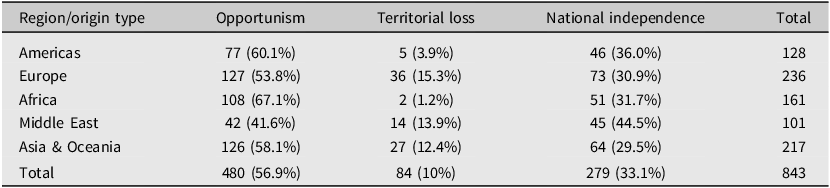
1. Opportunism. A territorial claim is classified as ‘opportunism’ if the territory is disputed between formerly existing states without recent shifts in territorial ownership. This is a subset category of the other two, so the necessary condition is the absence of newly independent claimants or recent ownership change. Examples include the Canadian and Danish claims over Hans Island between 1971 and 2022, whose border was not clearly defined by previous agreements. Of the 843 territorial claims, 480 claims (56.9%) satisfy this origination quality;
-
2. Territorial Loss. A territorial claim is classified as ‘territorial loss’ when a challenger asserts a claim over an area that was previously claimed by the affected country before a change in sovereignty within the past ten years. Hence, the conditions required for coding are (1) two states claim the same territory at multiple time periods; (2) the roles of the challenger and the target have been reversed; and (3) the time interval between the first and second claims is within ten years. The change in territorial ownership is often caused by military conflicts or annexation by the former challenger state. Examples include France’s claim to Alsace-Lorraine following the German annexation during the Franco-Prussian War. Of the 843 territorial claims in the sample, 84 claims (10%) satisfy this origination quality; and
-
3. National Independence. A territorial claim is classified as ‘national independence’ if the claim involves the national independence of at least one of the claimants in the previous ten years, without recent shifts in territorial ownership. To identify the date of independence, I rely on the COW Territorial Change data ver. 6 (Tir et al., Reference Tir, Schafer, Diehl and Goertz1998) and the ICOW Colonial History Data Set ver. 0.4 (Hensel and Mitchell, Reference Hensel and Mitchell2007). Examples include the border dispute between India and Pakistan. I choose ten years as the threshold because several studies find that the effect of independence on militarised disputes or enduring rivalry shrinks or disappears within a decade (Maoz, Reference Maoz1989; Goertz and Diehl, Reference Goertz and Diehl1995; Stinnett and Diehl, Reference Stinnett and Diehl2001; Hensel, Reference Hensel2006). In the sample, 279 out of 843 claims (33.1%) satisfy this origination quality.
Although this classification is based in many respects on Watanabe and Enterline (Reference Watanabe and Enterline2025), it offers at least two advantages. First, the categories are mutually exclusive, enabling us to examine the impact of each origin type individually. Second, because this coding method automatically determines the origin type based on changes in ownership, national independence dates, and the start dates of territorial claims, it eliminates subjective judgement by coders and enables coding of a global sample.
The frequency distribution of origin type is reported in Table 1. Opportunism is the most common origin, while territorial loss is the least frequent across regions. In Europe, the Middle East, and Asia, cases involving territorial loss are more frequent than average, whereas causes related to independence are more common in the Americas and the Middle East. This table demonstrates that the causes of territorial claims vary by region.
Frequency of origin type by region (1816–2001)

Table 1. Long description
The table presents the frequency distribution of origin types for territorial claims across various regions from 1816 to 2001. It includes five columns: Region/origin type, Opportunism, Territorial loss, National independence, and Total. The regions listed are Americas, Europe, Africa, Middle East, and Asia & Oceania. Each region has corresponding values for Opportunism, Territorial loss, National independence, and Total. The table shows that Opportunism is the most common origin type across all regions, while Territorial loss is the least frequent. Europe has the highest total number of cases, while the Middle East has the lowest. Notable trends include higher than average Territorial loss cases in Europe, the Middle East, and Asia, and more frequent National independence cases in the Americas and the Middle East.
4.2. Model specification
Since the dependent variable is the occurrence of peaceful attempts, I employ logistic regression with standard errors clustered on claim-dyad for the first hypothesis. For the second and third hypotheses, this study conducts the competing risk analysis of settlement types because there are different types of settlements in territorial claims, as well as no settlement (right-censoring). In other words, it examines the time until a binding third-party settlement takes place instead of other options such as military, bilateral, or no settlements. I rely on the proportional sub-distribution hazards regression model (Fine-Gray model), which is identical to the Cox model, except that it models a hazard function based on a cumulative incidence function (Fine and Gray, Reference Fine and Gray1999).Footnote 4
There are two reasons for choosing the duration model rather than the multinomial logit model. First, competing risk analysis examines the effect of each independent variable on the risk of a specific outcome, which is well-suited for evaluating the hypotheses discussed in the previous section. Second, the duration model allows us to analyse whether independent variables shorten or prolong the time until a specific outcome, which may provide important insights for policymakers. Therefore, this study adopts the duration model in the main analysis.Footnote 5
4.3. Dependent variables
To test Hypothesis 1, I operationalise binding third-party attempt by the variable ‘att3bind’ in the ICOW 1.1. This is a dummy variable coded 1 if the dyad has at least one binding peaceful attempt (e.g., arbitration or adjudication) in the year. The dependent variable for Hypothesis 2 and Hypothesis 3 is binding third-party settlement. This variable is the duration until a binding third-party settlement.Footnote 6
4.4. Independent variables
The first independent variable is independence. This dummy variable is coded as 1 if the claim directly originates from the national independence of at least one of the claimants and 0 otherwise. The second independent variable is territorial loss, which is coded as 1 if the claim originates from the recent shift in territorial ownership and 0 otherwise. By including these two variables in the same model, we can differentiate the effect of each origin type. The third independent variable is decolonisation, drawn from the ICOW Colonial History Data Set ver. 0.4 (Hensel and Mitchell, Reference Hensel and Mitchell2007). This is a dummy variable coded as 1 if at least one of the claimants achieves independence after decolonisation, regardless of the timing of independence. Hence, decolonisation (i.e., claimant characteristics) is not necessarily a subset of independence (i.e., claim characteristics). However, the third hypothesis focuses on decolonisation as a subset category of independence-origin cases. Accordingly, I analyse the variable using a restricted sample containing claims originating from independence only. This allows us to compare independence achieved through decolonisation with independence achieved through other means.
For the valid estimation, a set of control variables is included in the models. Each model has six common control variables. Tangible salience and intangible salience affect both the initiation of territorial claims and peaceful attempts (Hensel et al., Reference Hensel, Mitchell, Sowers and Thyne2008). The ICOW aggregates the data on tangible salience (e.g., resources, strategic location, and population) and intangible salience (e.g., homeland, identity ties, and historical sovereignty). These two variables range from 0 (lowest) to 6 (highest).
I also control for three characteristics of claimants. Capability ratio should affect the occurrence of third-party involvement. This variable ranges between 0 and 1, which is calculated by the ratio of the challenger’s CINC score to the sum of both claimants’ CINC scores drawn from the National Material Capabilities Dataset version 6.0 (Singer, Reference Singer1988). Joint democracy is less likely to have territorial disputes but is more likely to rely on third-party settlements. This is a dummy variable coded as 1 if both claimants receive a score of 6 or higher on Polity2 (Marshall and Jaggers, Reference Marshall and Jaggers2002). Joint membership in multilateral institutions for peaceful settlements should also affect the settlement types. Relying on the Multilateral Treaties of Pacific Settlement (MTOPS) data set version 1.4 (Hensel, Reference Hensel2005), I operationalise the numerical variable Shared institution, which counts the number of shared institutions calling for the peaceful settlement of disputes. In the logistic regression model, these variables are lagged for one year. In the Fine-Gray model, I use the CINC score and polity score one year before the final year of each claim, given the unit of analysis.Footnote 7
To control for the institutional change in the international system before and after WWII, pre-Cold War is another control variable. In the logistic regression model, the variable is coded as 1 for observations before 1946 and 0 otherwise. In competing risk analysis, the variable is coded as 1 for claims initiated before 1946 and 0 otherwise. Since the sample of the logistic regression covers only the Americas and Europe, I also include a dummy variable of America coded as 1 for the case in the Americas and 0 for Europe.
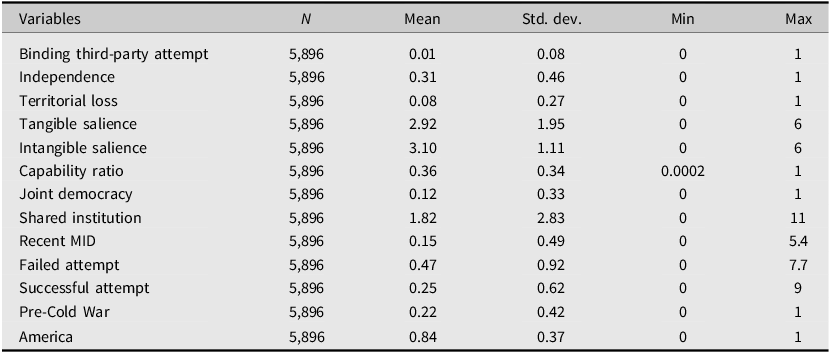
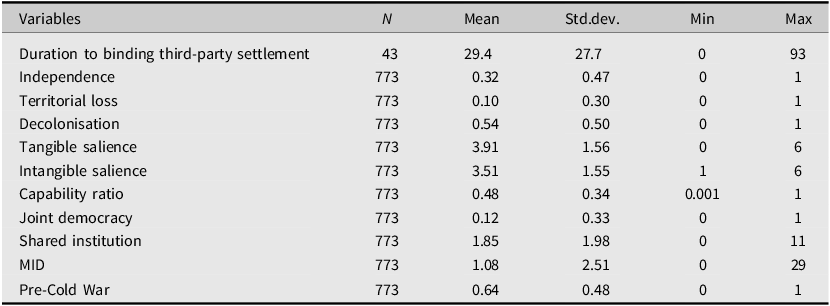
To account for the selection bias of peaceful attempts and settlements (Beardsley and Lo, Reference Beardsley and Lo2014), the different model specifications require additional and distinct controls. In the logistic regressions, I include continuous variables of Recent MID, Failed attempt, and Successful attempt that count the total number of militarised disputes and failed/successful peaceful attempts in the last ten years, weighted by recency (i.e., the variables ‘recmidwt’, ‘recnowt’, and ‘recyeswt’ in the ICOW 1.1).Footnote 8 Since the initiation of peaceful attempts is not random, the competing risk analysis includes the total number of MID (i.e., the variable ‘midsiss’ in the ICOW 1.2) in each claim.Footnote 9 Descriptive statistics for these samples are reported in Table 2 and Table 3.
Descriptive statistics of sample for the logit model

Table 2. Long description
A table with 14 rows and 6 columns displaying descriptive statistics for variables in a logit model. The columns are labeled Variables, N, Mean, Std. dev., Min, and Max. Each row lists a variable along with its sample size, mean, standard deviation, minimum value, and maximum value. The variables include Binding third-party attempt, Independence, Territorial loss, Tangible salience, Intangible salience, Capability ratio, Joint democracy, Shared institution, Recent MID, Failed attempt, Successful attempt, Pre-Cold War, and America. Each row provides specific numerical values for these statistical measures.
Descriptive statistics of sample for Fine-Gray model

Table 3. Long description
The table presents descriptive statistics for various variables used in a Fine-Gray model. It includes 12 variables with their respective counts, means, standard deviations, minimum values, and maximum values. The variables are Duration to binding third-party settlement, Independence, Territorial loss, Decolonisation, Tangible salience, Intangible salience, Capability ratio, Joint democracy, Shared institution, MID, and Pre-Cold War. Each row lists the statistical measures for one variable. For example, the Duration to binding third-party settlement has 43 entries with a mean of 29.4, a standard deviation of 27.7, a minimum value of 0, and a maximum value of 93. Independence has 773 entries with a mean of 0.32, a standard deviation of 0.47, a minimum value of 0, and a maximum value of 1. The table provides a comprehensive overview of the data distribution for each variable.
5. Analysis
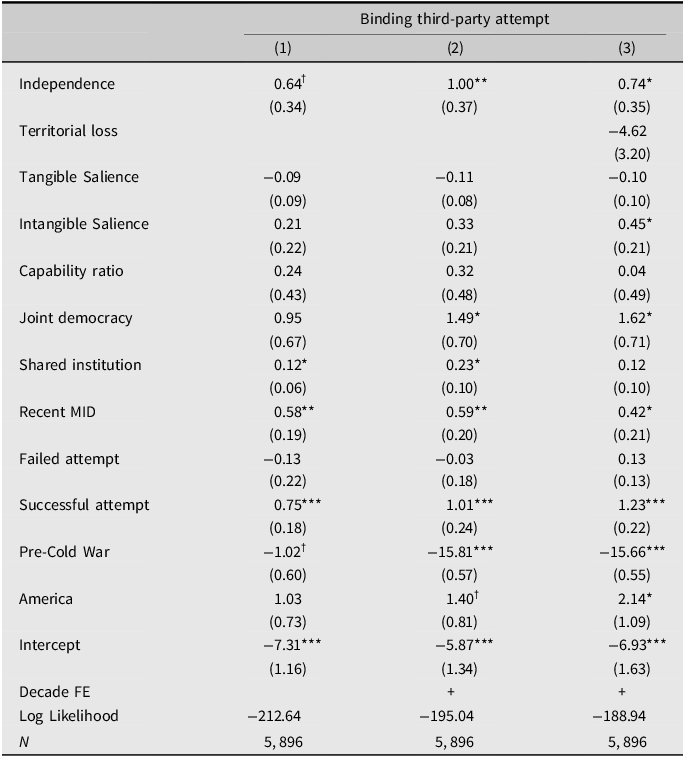
Table 4 reports the results of the logistic regression analyses of 5,896 claim years in the Americas and Europe, in which the dependent variable is the occurrence of a binding third-party peaceful attempt. Model 1 compares independence cases with non-independence cases, while Model 2 adds decade fixed effects that capture the changing pattern of the occurrence of binding third-party attempts. Model 3 includes two of the three origin types to evaluate the effect of each origin. In these models, a positive coefficient represents a higher likelihood of a binding peaceful attempt.
Origin and binding third-party peaceful attempts in territorial claims (logit model)

Table 4. Long description
The table presents the results of logistic regression analyses of 5,896 claim years in the Americas and Europe. It examines the occurrence of binding third-party peaceful attempts. The table has 17 rows and 3 columns. The columns are labeled as Model 1, Model 2, and Model 3. The rows include variables such as Independence, Territorial loss, Tangible Salience, Intangible Salience, Capability ratio, Joint democracy, Shared institution, Recent MID, Failed attempt, Successful attempt, Pre-Cold War, America, Intercept, Decade FE, Log Likelihood, and N. Each cell contains numerical values and standard errors in parentheses. The table compares different models to evaluate the likelihood of binding third-party peaceful attempts based on various factors.
Robust standard errors clustered on claim-dyad are in parentheses.
***p < 0.001, **p < 0.01, *p < 0.05, † p < 0.1.
Hypothesis 1 predicts a positive effect of the origin related to national independence on the initiation of a binding peaceful attempt, and the empirical results support this hypothesis. While it fails to reach the conventional level in Model 1 (p = 0.06), the variable of independence exhibits a positive coefficient with statistical significance in Models 2 and 3, indicating that the origin associated with national independence increases the likelihood of a binding third-party peaceful attempt, providing evidence in support of Hypothesis 1. This suggests that territorial claims arising from national independence carry significant psychological weight, making it easy for bilateral negotiations to reach an impasse. As a result, claimant states are more likely to rely on third-party arbitration, thereby reducing the political costs of border resolution.
Notably, Model 3 highlights the distinct role of the independence-related origin. While the coefficient for independence is statistically significant (p = 0.03), this model finds no systematic difference between territorial loss and opportunism (p = 0.14). This suggests that only origins related to national independence affect the occurrence of a binding peaceful attempt.
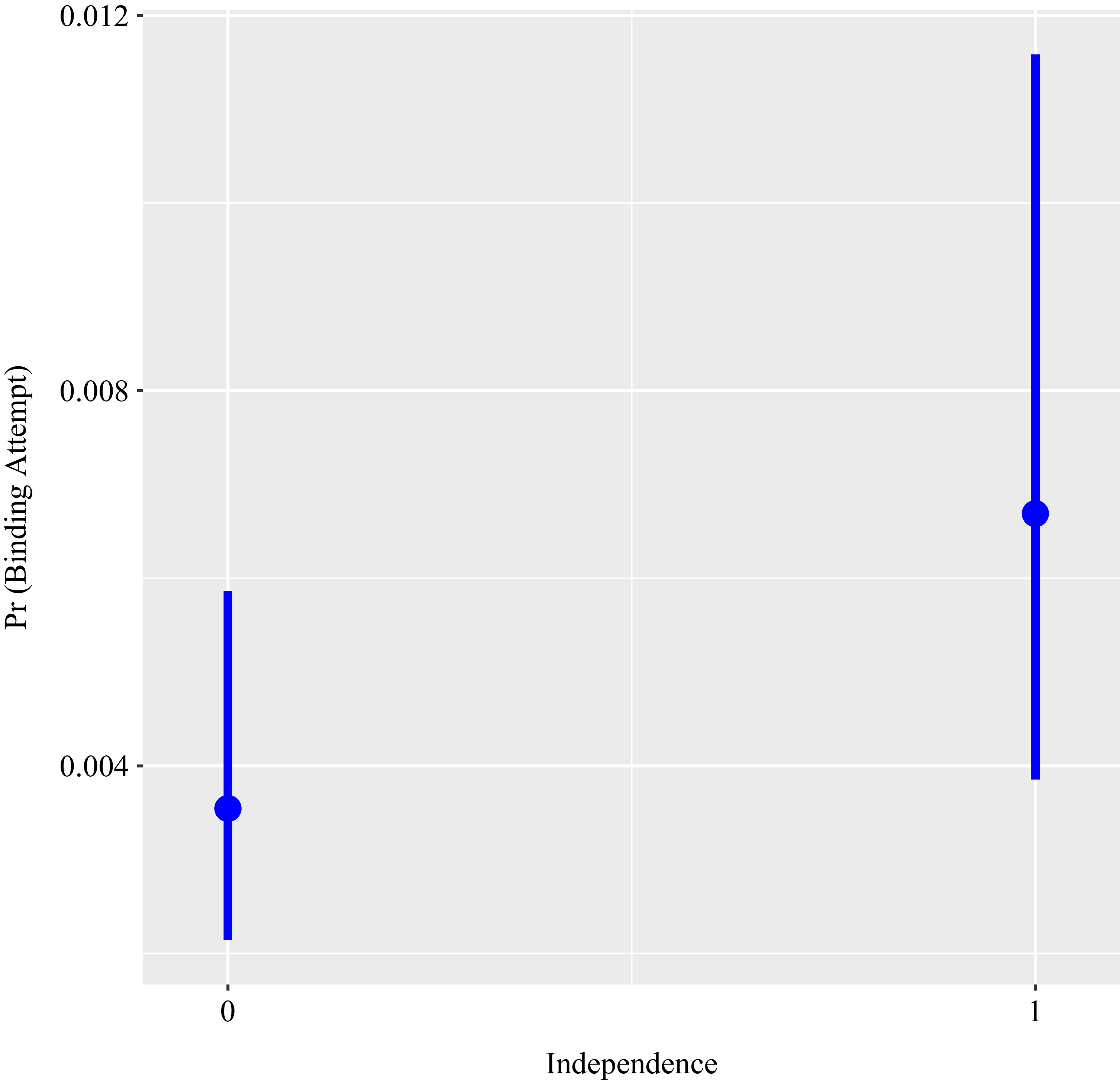
Figure 1 presents the predicted probabilities of a binding third-party attempt by claim origin. Relative to cases originating from the other origin types, the independence-related origin increases the likelihood of a binding third-party attempt by 0.3% in a year. Given the average duration per claim in the Americas and Europe (33 years), this variable increases the likelihood of a binding peaceful attempt by 9.5% until the end of a claim. This effect is substantial, considering the proportion of binding attempts in the sample (17% per claim).
Predicted probabilities of a binding third-party attempt by claim origin.

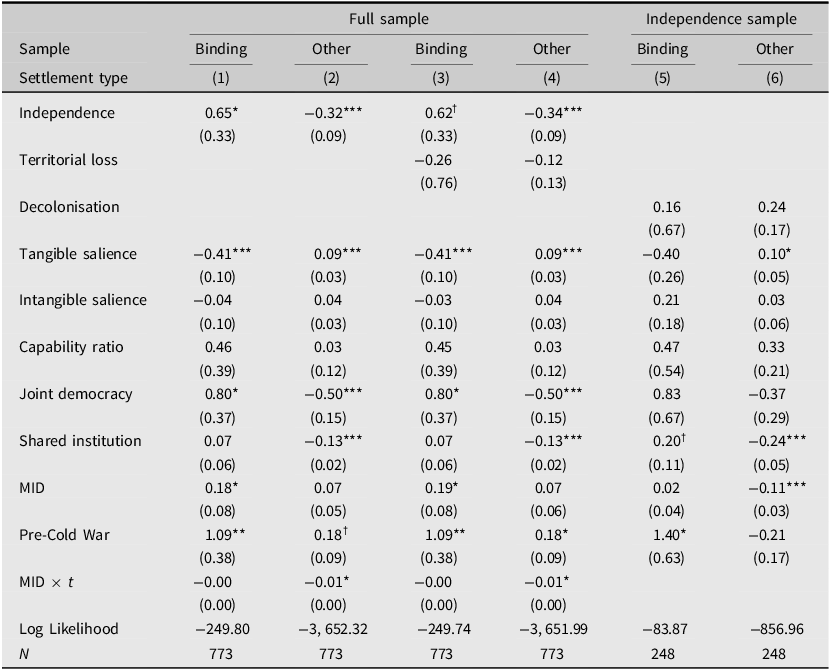
Moving on to the examination of Hypothesis 2 and Hypothesis 3, Table 5 summarises the results of the competing risk analysis. Models 1 through 4 analyse the global sample of 773 claims, while Models 5 and 6 examine the restricted sample of 248 claims originating from national independence. Models 1 and 2 compare the independence cases to non-independence cases (combining the other two origin types), and Models 3 and 4 differentiate the effect of each category (the reference category is opportunism). Models 5 and 6 examine the effect of independence after decolonisation. Positive coefficients represent a higher risk of the event of interest; in other words, a shorter duration until the specific outcome. By contrast, negative coefficients suggest that the variable reduces the risk of the event.Footnote 10
Origin and duration to binding third party settlement (Fine-Gray model)

Table 5. Long description
The table presents the results of a competing risk analysis, focusing on the global sample of 773 claims and a restricted sample of 248 claims originating from national independence. It includes six models, with Models 1 through 4 analyzing the global sample and Models 5 and 6 examining the restricted sample. The table compares independence cases to non-independence cases and differentiates the effect of each category. Positive coefficients indicate a higher risk of the event of interest, while negative coefficients suggest a reduced risk. The table is organized into columns labeled Sample, Settlement type, and various models, with rows labeled with different variables such as Independence, Territorial loss, Decolonisation, Tangible salience, Intangible salience, Capability ratio, Joint democracy, Shared institution, MID, Pre-Cold War, and MID x t. Each cell contains specific values and standard errors for the respective variables and models.
Robust standard errors are in parentheses. The reference category of outcome is no settlement (right-censored).
***p < 0.001, **p < 0.01, *p < 0.05, † p < 0.1.
Model 1 exhibits a positive coefficient of independence for binding third-party settlement (p = 0.048), while Model 2 shows a negative coefficient for other settlements (p < 0.001). These results indicate that territorial claims originating from national independence have a higher risk of binding third-party settlement than other claims or tend to end with such a settlement in a shorter period. In addition, these cases are hard to resolve through other types of settlements, such as bilateral negotiations and military settlements, providing evidence in support of Hypothesis 2. These results suggest the difficulty in the successful settlements of territorial claims originating from national independence and the necessity and effectiveness of the settlement by the international legal bodies or former colonial powers.
Similar results can be found in Models 3 and 4 that include both independence and territorial loss. Compared to opportunism, independence increases the risk of a binding settlement (p = 0.06). In contrast, both models show no systematic difference between territorial loss and opportunism. Consequently, origins associated with national independence have distinct impacts on both the occurrence of peaceful attempts and binding third-party settlements.
However, Model 5 shows a negative coefficient and lacks statistical significance for decolonisation, which is inconsistent with the expectation in Hypothesis 3 that the effect of independence appears only when independence is achieved through decolonisation. This suggests that the involvement of international legal bodies such as the ICJ is more influential than the effect of the colonial ties with former colonial powers when the origin is related to national independence in general. Since these cases tend to reach an impasse in bilateral negotiations due to the psychological salience of the dispute, claimants are more likely to make use of the political cover effect of the ruling by international organisations. Those credible third parties may facilitate communication and strengthen the claimants’ commitment to the border negotiation process, which increases the utility of peaceful settlements. In other words, the effect of independence origin holds regardless of the type of independence.
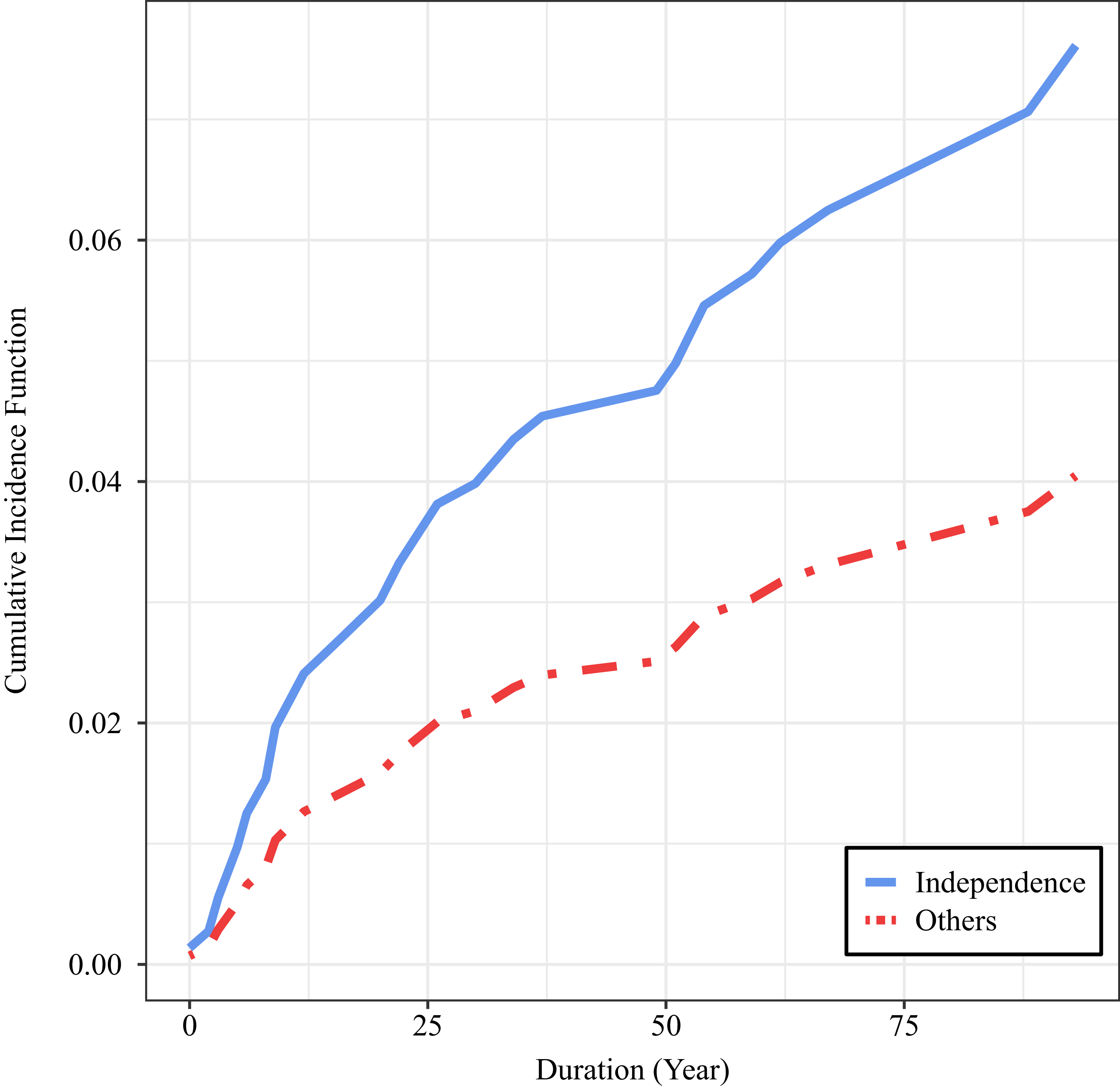
Figure 2 draws the predicted cumulative incidence function of binding third-party settlement, calculated by the estimates of the Fine-Gray model in Table 5. The solid line represents the risk of binding third-party settlement for claims with independence-related origination, and the dashed line depicts the risk for non-independence cases. If we compare the two graphs at the period of the average duration in the full sample (15 years), claims originating from independence exhibit a higher risk of binding third-party settlement than other claims by 1.3%. This effect is not trivial, given that only 5% of 843 claims in the sample result in the outcome. Regarding the time until the settlement, it takes 30 years for 4% of independence cases to end with a binding third-party settlement, while it takes about 90 years for non-independence cases theoretically.
Predicted CIF of binding third-party settlement.

6. Conclusion
In this study, I argue that the origins of territorial claims affect the occurrence and success of peaceful attempts. The main contribution of this research is twofold. First, this study elaborates on the origins of territorial claims and identifies three origin types. This classification updates the typology by Watanabe and Enterline (Reference Watanabe and Enterline2025) by making the categories mutually exclusive and eliminating subjectivity in the coding scheme. The second contribution is the examination of the effect of origins on peaceful attempts and settlements. The empirical results show that territorial claims originating from national independence are more likely to have binding third-party attempts and settlements than other types of claims.
These findings provide an implication for the study on territorial disputes: it is important to consider historical contexts to understand the settlements of territorial disputes. The findings about the effects of origins are consistent with the observations about the regional difference between Europe and the Americas in terms of peaceful attempts: the Americas experienced more long-lasting cases originating from national independence that employed binding peaceful attempts ruled by third parties.Footnote 11 This regional tendency cannot be explained by the findings about micro, or unit-level, factors in previous studies, such as dyadic power balance and regime types. This implies that historical context matters to the evolution of the dispute.
This paper concludes with three directions for future research. First, future research is expected to develop theories on each origin type. Although this study focuses on national independence and binding peaceful attempts/settlements, a couple of previous studies have demonstrated that territorial loss and the notion of historical ownership can influence the perceptions of issue indivisibility and escalation of the dispute (Fang and Li, Reference Fang and Li2020; Watanabe and Enterline, Reference Watanabe and Enterline2025). Consequently, developing theories regarding the remaining two types of origins is a direction for future research.
Second, a concern in this study is the external validity of the findings about the onset of binding peaceful attempts. Due to the data availability of peaceful attempts, this study focuses on a sample from Europe and the Western Hemisphere. Hence, it has not been tested whether the finding is generalisable beyond the two regions regarding the onset of peaceful attempts (Hypothesis 1), although the theory holds across regions for the settlement types (Hypothesis 2). On the one hand, the finding may apply to African cases, such as the border dispute between Mali and Burkina Faso, that originated from national independence and employed binding third-party attempts. On the other hand, previous studies have highlighted factors specific to Latin America, such as its longer history of democracy and engagement with international organisations, as well as the hegemonic influence of the United States in the region, raising a question about the generalisability of the findings of this study (Hensel and Mitchell, Reference Hensel and Mitchell2005). Therefore, it is worth elucidating both generalisability and regional heterogeneity regarding the resolution of territorial claims.
While this study focuses on the origin of territorial claims, it is also plausible that the occurrence of third-party peaceful attempts is conditioned by regional power balance, such as the unipolar system in the Americas compared to the multipolar system in Europe. In the Americas, some territorial disputes invited peaceful attempts by the regional hegemon, the United States. For instance, Venezuela repeatedly demanded US assistance in the border settlement with British Guyana in the 19th century (US Department of State). Likewise, the United States or the Organization of American States (OAS) mediated disputes between Honduras-Guatemala, El Salvador-Honduras, and Nicaragua-Honduras (Huth and Allee, Reference Huth and Allee2002a). These cases indicate that the presence of a strong regional hegemon facilitates settlements of territorial disputes in the region. Although the pre-Cold War and American dummy variables should capture structural changes in regional and global hegemony to some extent, they do not reflect the distribution of power or temporal fluctuations within each region. Therefore, further empirical research is needed to examine the impact of regional balances of power on peace efforts.
Supplementary material
The supplementary material for this article can be found at https://doi.org/10.1017/S1468109926100383.
Data availability statement
Replication data for this article can be found at https://doi.org/10.7910/DVN/S6H1BK.


 Open access

