I
In his 1920 book The American Credo, the American satirist H. L. Mencken and his cowriter George Jean Nathan set about listing in aphoristic form what they considered to be the fundamental beliefs of the American herd. Among others, these included §88, “That a man like Charles Schwab, who has made a great success of the steel business, could in the same way easily have become a great composer like Bach or Mozart had he been minded thus to devote his talents”; §399, “That all negroes who show any intelligence whatever are actually two-thirds white, and the sons of United States Senators”; and §246, “That all Bolsheviki and Anarchists have whiskers.”
Item §314 read, “That all immigrants come to America in search of liberty, and that when they seek to exercise it they should immediately be sent back.” This distilled the central thesis of the Credo, developed at much greater length in the preface of the work. (In an absurdist touch, the preface ran to several times the length of the “book” proper.) It amounted to a sweeping critique of the politics of loyalty enforcement and nativism that had swept across the country over the previous decade; one, notably, which sought to indict America for hypocrisy as well as illiberalism.
“Ask the average American what is the salient passion in his emotional armamentarium,” the two authors wrote,
and it is very probable that, nine times out of ten, he will nominate the hot and unquenchable rage for liberty. He regards himself, indeed, as the chief exponent of liberty in the whole world, and all its other advocates as no more than his followers … To question his ardour is to insult him as grievously as if one questioned the honour of the republic or the chastity of his wife.
Yet over time this passion had lost “its old burning reality and descended to the state of a mere phosphorescent superstition.” The modern American enjoyed such little freedom that it was now “practically impossible for him to exhibit anything describable as genuine individuality, either in action or thought, without running afoul of some harsh and unintelligible penalty.” The authors speculated they might one day awaken to find the motto on the coins of the nation, “In God We Trust,” replaced with the word verboten, and the image of the goddess of liberty “taken off the silver dollars to make room for a bas relief of a policeman in a spiked helmet.”Footnote 1
Giving Tocqueville's observations on American sociability a sharp edge, Nathan and Mencken argued that the true passion of the American was not liberty but status or “social aspiration.” In a society with no firm or fixed classes, traditions or principles to give its citizens a sense of common identity separate from material rewards and thrill of popular acclaim, the American found himself “violently eager to get on” not least because he was so “sickeningly fearful of slipping back.”Footnote 2 Rather than a nation of rugged frontiersmen and independent yeomen farmers, the country had run “down the channel of mob emotion” so far that “in no other country in the world is there so ferocious a short way with dissenters.” During the war, the supposedly freedom-loving American people had “acquiesced docilely” in the passage of repressive measures designed to destroy the possibility of meaningful political dissent. Indeed, the “really startling phenomenon,” they argued,
was not the grotesque abolition of liberty in the name of liberty, but the failure of that usurpation to arouse anything approaching public indignation … Thus the Americano, put to the test, gave the lie to what is probably his proudest boast, and revealed the chronic human incapacity for accurate self-analysis.Footnote 3
Mencken and Nathan's argument resonates with many later attempts to account for the United States' periodic bouts of political repression. The words of the Credo parallel Sinclair Lewis's mockery of middle-class culture in the 1920s and 1930s, not to mention the writings of lesser authors and journalists who saw in “100 percent Americanism” an embryonic fascism of the cross and the flag built around a politics of failure. Theorists and public intellectuals in the interwar years drew on William F. Ogburn's concept of “cultural lag” to suggest that reactionary movements stemmed from the particularly intense anxieties of rootlessness in a time of rapid technological change.Footnote 4 And while infused with newer strands of sociological and psychoanalytic thinking, broadly similar themes would be reprised by Richard Hofstadter in his formulation of the thesis of the “paranoid style” in the early 1960s.Footnote 5 At the core of most liberal Cold War criticism of McCarthyism and its successor movements lay the idea that nationalist crusaders were not just hypocritical but even pathological: with a desire for status, a fury brought about by its loss, or the manipulation of such nonrational urges by calculating elites transforming liberty from a meaningful practice into a ritual and a parody.Footnote 6 According to this view, the discourse of loyalty allowed conservatives to present underlying interest-group conflicts as matters of the national public good, while patriotic crusades permitted the release of the sublimated id through the emulation of the imagined other. “Citizens who joined the crusade for one hundred per cent Americanism,” Stanley Coben writes, “sought, primarily, a unifying force which would halt the apparent disintegration of their culture” in the face of unceasing social change.Footnote 7 Murray Levin hypothesized in 1971, “Promoting one's secret, despised, and wished-for inner self onto filthy sexually lascivious enemies of America may be a great relief and source of renewal.”Footnote 8
More recently, both the strongly normative thrust of this line of argument and the simple political dichotomies that underpin it have been challenged by a new generation of historians of American conservatism. Arguing that the endurance and broad appeal of conservative thought in the United States obliges scholars to examine it on more neutral terms, Alan Brinkley suggested in 1994 that the supposed “problem” of American conservatism was actually a failure of the liberal historical imagination. As well as pointing out a scholarly reluctance to take conservative commitments to various systems of social cohesion and authority seriously, Brinkley argued that historians tended to be unwilling to accept that “the defense of liberty, the preservation of individual freedom, has been as central to much of American conservatism in the twentieth century as it has been to American liberalism.”Footnote 9
Whether enacted by self-described conservatives or progressives, crusading Americanism in the early twentieth century was undoubtedly coercive, designed for purposes of social organization and ordering. By expanding upon nineteenth-century visions of the United States as a masculine, white, Protestant republic, nationalists sought to exclude or control groups who failed to fit this image. However, even as they embarked upon these projects, “100 percent Americans” proved unwilling to relinquish entirely the more open terms of traditional liberal thinking about citizenship. Instead, they argued that the superiority of “the American race” was precisely revealed in its members' capacity for higher reason and their conscious obedience to the rule of law, much as the predestined grace of the Calvinist of an earlier era was shown in his frugality and industry. Attempts to build programmatic and exclusive visions of American national identity that could be leveraged for more or less authoritarian ends thus built on, and never fully replaced, a classical liberal constitutionalism which largely rejected such exclusive definitions of the political community: a manifestation of what Gary Gerstle has elsewhere identified as the “divided character of American nationalism.”Footnote 10 Put another way, Nathan and Mencken's words hit home because commitments to liberty, law and the Constitution were as central to American nationalists' sense of self as they were to the satirists who opposed them. The American Credo provoked because its imagery – the spiked helmet of the wartime enemy atop the goddess of liberty; the cries of the irrational, unreasoning mob echoing along the streets of American cities; the docile and fearful social animal longing desperately for the approval of his peers – likened patriotic crusaders to the hated figure of the un-American that they had themselves imagined.
So while Nathan and Mencken sought to explain what they saw as hypocrisy in a principally satiric register, the problem of political repression in the United States may perhaps be better understood dialectically. A minimalist conception of American national identity clashed with more assertive visions of national identity that equated “Americanism” with specific, positive attributes belonging only to parts of the civic whole. But since liberalism and national pride were intimately related in US political culture, neither could be unpicked from the other. Classical liberalism was both vital and unsatisfying; assertive nationalism was powerful and appealing, but constitutionally questionable. Questions of status, identity and the law thus interacted uneasily, resulting in a constant and unstable renegotiation of the acceptable boundaries of political dissent.
Perhaps no clearer illustration of this ambiguity can be found than in the concept of the “un-American,” a term which powerfully shaped the history of political repression in the twentieth century, especially during President Woodrow Wilson's second term of office, and yet which defies simple categorization precisely because its chief popularizers sought to use it to straddle the divide between positive and negative definitions of American liberty, to coopt Isaiah Berlin's famous schema. Politicians, writers and journalists who sought to describe the un-American drew heavily upon traditional liberal arguments for criminalizing individuals and groups who threatened the established political order. However, the very act of imagining the un-American provided opportunities to exchange contractual terms of debate for social ones, to define status or identity rather than illegal action as the crucial determinant of un-Americanism. Contradictory in theory, these two conceptions of un-Americanism sat together awkwardly in practice, giving the imagined un-American, and by extension the politics of repression, a curiously enduring instability.
II
Until the early twentieth century, systematic attempts to consider “Americanism” as a distinctive political ideology were surprisingly rare. The Library of Congress holds only a small number of published items with the word included in the title prior to the publication in 1897 of Theodore Roosevelt's essays on True Americanism. By contrast, between 1915 and 1930 more than eighty works were issued on the topic. At least fifty more were published before the US entry into World War II. Meanwhile, the number of articles in national newspapers mentioning the term shot up: during the 1880s, the New York Times had on average only around one article or editorial a month mentioning the word “Americanism”; by the 1920s there was one every third day.
This effusion of interest was undoubtedly linked to broader processes of state building and overseas expansion, as elite groups sought to leverage nationalism as a tool for mass mobilization and policy advocacy. Most prominent among them were the neo-Hamiltonian progressives, figures such as Theodore Roosevelt, Henry Cabot Lodge, Albert Beveridge, Elihu Root, Leonard Wood and latterly S. Stanwood Menken, who led early twentieth-century efforts to expand American power overseas and later headed the pre-World War I preparedness movement; and their principal rivals in the Wilson coalition, such as Albert Burleson, Thomas Watt Gregory, George Creel and A. Mitchell Palmer, who orchestrated the World War I mobilization campaigns and led the postwar Red Scare efforts to break labour militancy and crush the American communist movement at birth.
Balancing their efforts to turn the United States into a world power against the endurance of popular anti-imperial sentiment, turn-of-the-century expansionists depicted the occupations of Cuba and the Philippines following the defeat of Spain not as permanent acquisitions but as temporary custodianships, necessary only to implement a process of “Americanization” – a combination of military force, colonial collaboration, commercial patronage, propaganda, education and the promotion of limited democracy – that would ultimately lead to self-government. In this context, “Americanism” served as shorthand for the blend of ethnic, racial, class and gendered stereotypes that underpinned visions of the United States' self-proclaimed mission to spread order, civilization, Protestantism and commercial capitalism around the world.Footnote 11
The turn toward overseas markets had originally been justified as a way of managing the problems of industrial America, as a kind of social safety valve. But in practice overseas expansion exacerbated the very problems it was intended to mitigate. Anticolonial resistance and bloody counterinsurgency, particularly in the Philippines, fuelled political conflict at home and generated radical anti-imperial sentiment on the left of American politics. New opportunities to sell industrial goods overseas contributed to the growth of domestic industry, but by extension enlarged the industrial working classes, offering radical groups such as the Industrial Workers of the World a ready supply of potential new recruits. Strategic commitments in the Caribbean and Asia entangled America in rivalries with European and Asian powers, increasing a sense of national vulnerability. And mass immigration gathered pace as the US economy integrated into global labour markets, even as elite fears of subaltern groups intensified in response to the heightened racial sensibilities of the Progressive Era. As Matthew Frye Jacobsen notes,
World labor migration was a natural twin to the phenomenon of the world market; and since their own superiority to most of the world's peoples was a powerful current in American thought about illimitable foreign markets, Americans were decidedly uneasy about the growing presence of these inferior foreigners, either within the gates of the American factory or within the bounds of the domestic polity.Footnote 12
Thus, in a complex process of cross-fertilization, the imperial conception of Americanization, which had itself taken inspiration from earlier efforts to control non-Anglo-Saxon groups at home during the nineteenth century, was reapplied to sites of domestic political conflict, and used to justify the militarization of society and the continued expansion of executive power. This process gathered steam through the prewar preparedness movement; World War I efforts to engineer, in O'Leary's words, “a specifically antiliberal, chauvinistic conception of the nation”; the labour repression and mass political raids of 1919 and early 1920. It culminated in the campaigns for immigration restriction in the early 1920s.Footnote 13
Stimulated by these high-political projects, the war and postwar period also saw the efflorescence of a range of mass nationalist movements seeking to promote the Americanization of society – most notoriously the Ku Klux Klan, which built up a membership base of several million in the 1920s. While public displays of enthusiasm for the war effort at home and gallant stories of sacrifice in Europe had partially reconciled American nationalists to the patriotic potential of the masses, many nevertheless concluded from the experience of World War I that effective Americanism required ongoing efforts at positive engineering through the same mechanisms that had previously been applied overseas, such as limiting suspicious groups' access to normal legal and democratic processes, supporting education and propaganda campaigns to promote positive values of citizenship and personal conduct, and applying military and police power both to silence dissent and to generate positive examples of patriotism among the uniformed classes. Technocratic texts such as Dynamic Americanism (1920), written by the reform-minded Wisconsin professor of political science Arnold Bennett Hall, argued the case for directing patriotic sensibilities toward social and moral education on progressive and pseudo-scientific grounds.Footnote 14 Further along the political spectrum, others began to push for the wholesale exclusion of groups whose inferior blood was believed to be polluting the American racial stock.Footnote 15 Meanwhile, in his book Average Americans, Theodore Roosevelt Jr. called for a system of compulsory military training to preserve the wartime ethic of national sacrifice. To him, the armed forces were a laboratory of citizenship. With the unity forged in the fire of battle, recruits of German, Italian and Irish origin proved themselves more committed to the United States than to their former nations or classes of origin. “For this reason,” he argued, “the army is the least of the country's fears as far as Bolshevism and its kindred anarchies are concerned.”Footnote 16 While universal service did not come to pass, the ethic that underpinned Roosevelt Jr.'s words found fertile soil in the American Legion that he helped found in 1919, and which would emerge as perhaps the most powerful shock troops of 100 percent Americanism.
As advocates of positive, programmatic visions of American nationalism debated the best ways to manufacture communal solidarity, they turned away from discussion of rights and freedoms and instead stressed the language of duty and sacrifice, concepts that had long been prized by Rooseveltians. (H. L. Mencken declared that both Roosevelt and Henry Cabot Lodge “preached incessantly the duty of the citizen to the state, with the soft pedal upon the duty of the state to the citizen.”Footnote 17) “For we Americans not only have certain well-known constitutional rights, which we all highly prize,” George Eames Barstow wrote in 1920, “but each one of us has also certain obligations as respects the home and the state, which he can not afford to ignore for his own sake and that of his country.”Footnote 18 Liberty in this sense could only be earned collectively, and at cost. Henry A. Wise Wood claimed that the American community of liberty was only possible due to the Anglo-Saxon's willingness to set a higher value upon his institutions than upon his life.Footnote 19 World War I, Barstow argued, demonstrated the need for mutual sacrifice and a willingness to resist the “plea of puerile and selfish leaders who urged them to preserve their peace and prosperity by abstaining from taking a part in the world struggle for liberty and democracy.” In these terms, it seemed that an excess of liberal individualism could itself be un-American. “Becoming unduly self-contained, dwelling with overmuch pride upon their own personal strength and ability, they [un-Americans] thereby dwarf their souls and narrow and emasculate their truest selves,” Barstow suggested. “No more complete or brutal illustration of this axiomatic truth has been found in history than in the world's recent experience with the German people,” although “the present deplorable condition of Russia” also gave notice of the path upon which such selfish attitudes would set the American people.Footnote 20
III
As it developed, the ideology of Americanism came to offer a powerful assault on orthodox liberal thinking: an authoritarian extension of the Progressive Era's critique of decentralized democracy. At their most ambitious, advocates of Americanization called for something not far short of a revolutionary effort to build a new American man.
As Mencken and Nathan would observe, it seemed that the “hot and unquenchable rage for liberty” was fast burning itself out. Talking about Americanism reflected traditional liberal principles in crisis, as political elites and members of the public alike came to fear that forces of modernity were pulling the nation apart at its seams and sought new ways to bind people together. Nevertheless, the idea of codifying and institutionalizing a specific, political definition of “Americanism” was far from universally accepted and, despite the rise of new forms of nationalism, the difficulty that many advocates had in precisely defining Americanism testified to the tenacious appeal of the traditional, negative definition of liberty to elite political identity. Americans prided themselves on not thinking ideologically: one of the most consistent claims of nationalists was that their enemies sacrificed their independence of mind in order to cleave fanatically to rigid and sectional doctrines, while true Americans resisted the temptation to subject themselves to what American Legion later famously referred to as “isms.”Footnote 21 In this sense, to define Americanism in any strict sense would itself be an un-American thing to do.
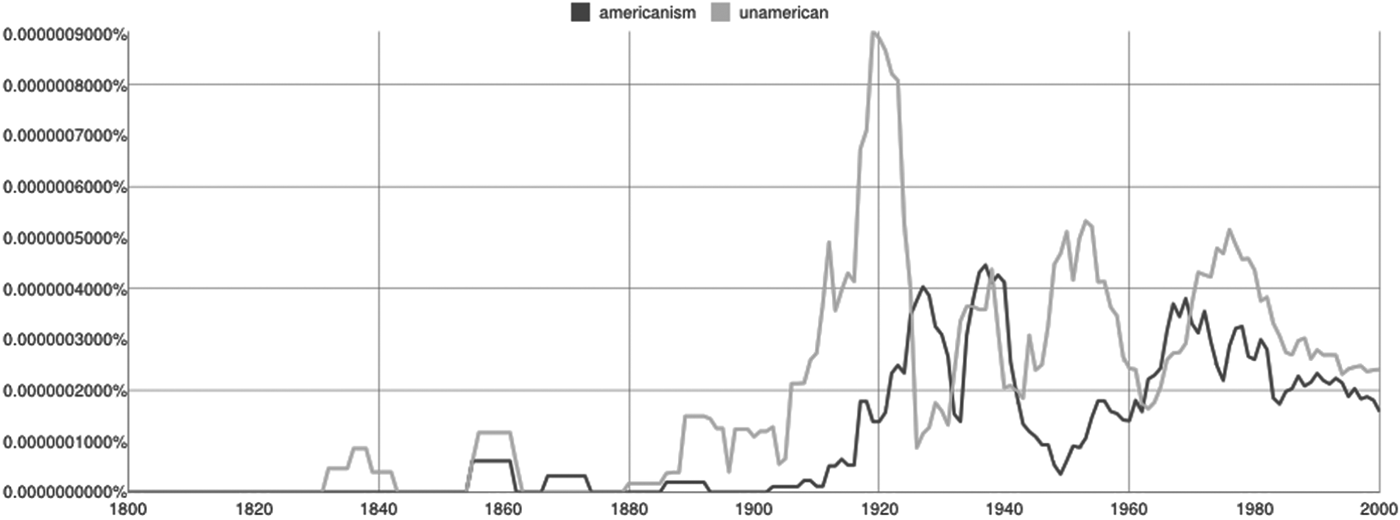
In short, the American was to be conceived of as a diverse category of free individuals with no simple or easily summarized features. By contrast, the un-American was the category of persons who threatened the established political order and therefore exempted themselves from the privileges of citizenship. The un-American thus gave meaning to a more open definition of nationhood by showing where its boundaries lay. As a result, even at their peak, writings on Americanism paled in comparison to the use of the pejorative “un-American.” This was especially true between 1914 and 1924, when discussion of un-Americanism reached its zenith, but was the case for most of the rest of the century as well (see Figure 1). Except for short periods in the later 1920s and during the 1960s, it seems that Americans were consistently less comfortable describing what America was, than what it was not.
The frequency of appearance of “Americanism” and “un-American” in selected literature, 1800–2000. Source: www.google.com.

David Jayne Hill, former Republican assistant secretary of state, a preparedness advocate and expansionist, illustrated this particularly clearly in his book Americanism: What Is It (1916), in which he sought to answer the question posed in his title by focussing on what he believed America was not. Americanism, he argued, was not limited to a particular race or religion. Birth in US territory alone was not sufficient to qualify an individual to the status of American either. However, he reasoned, “We feel that we are not misusing language when we say of a man who entertains certain ideas and sentiments that he is un-American.”Footnote 22 America was founded upon a commitment to individualism, a belief in the inherent rights of all citizens, and an abandonment of European dynastic politics. Hill thus rejected as un-American the radical democratic claim, which he attributed to Rousseau, that any law desired by the majority was right. Life, liberty and property were not open to negotiation, and the state had an absolute right to defend them. Indeed, with half an eye on President Wilson, he pointed out that dangers to the political order did not solely come from external threats but also from people within who sought to compromise the fundamental rights of American citizens even while they pretended to be their strongest defenders. In his view, the class antagonism and diminished respect for law and order that he believed were blighting America were the product of a more general revolution against principle in favour of pragmatism: the substitution of “experiment for experience.”Footnote 23
In many ways, this was a sophisticated, if conservative, reading of the liberal tradition. Few classical English and Scottish liberal thinkers believed that the state had no right to impinge upon individual liberties: restrictions on personal freedoms were permissible when needed to defend the liberal state's existence. Space for coercion thus existed, though at root the decision about whether to limit an individual's freedom was a matter of law, facts, evidence and proof, not speculation, conspiracy theories, or ad hominem attacks.
If early un-Americanism talk was nothing more than an expression of classical liberal values, then defining the un-American was simply a matter of haggling over the legitimate limits to individual freedoms necessary to defend the social order as a whole. Indeed, much of this kind of haggling took place. Critics won important concessions from the Wilson administration during the debate over the 1917 Espionage Act on these grounds, for instance. Attorney General Gregory's original draft of the bill had granted broad executive powers to censor the press, but in the face of opposition that crossed parties and political orientations the administration substantially rewrote the offending section to make it more closely conform with liberal norms. “I would put no restriction on the American press that is not absolutely necessary to the salvation of the Republic,” argued Charles Thomas of Colorado in the heated Senate debate over the bill.Footnote 24
Nevertheless, if the language of un-Americanism was nothing more than a restatement of traditional liberalism, there would have been no need for it in the first place. Dealing with this kind of “un-American” conduct was already built into the structure of politics; it was a basic function of the judicial system. Nationalists, advocating positive and preventative actions for inculcating political loyalty, thus shifted debate from the question whether particular rules or laws had been violated, and toward a discussion of what attributes gave the un-American a dispensation for violating them. From un-Americanism as a state of rule-breaking came the un-American as an embodiment of the rule-breaker – who could then be defined in racial, ethnic, gendered or class terms; through religious affiliation; or through a negative assessment of individual character. The un-American thus began to take on specific, definable forms. In cartoons and articles, the un-American assumed caricatured racial, ethnic and class features, speaking foreign languages, wearing dirty and unkempt clothes, and engaging in a range of “alien” practices. In time, as Mencken and Nathan wryly noted, the faces of Bolsheviks represented in the media all seemed to be covered with whiskers.
Since, in these terms, nature, rather than conduct, defined one's status, an un-American could conceivably conform to the law of the land but still be un-American. And once un-Americanism ceased to be a matter of lawbreaking and became a question of subversive potential stemming from specific, externally designated characteristics, policies could again focus on exclusion and conditioning, rather than simply post facto criminal prosecution. The utility of the image of the un-American thus lay in the fact that it could be used to make space for positive assertions of the need to engineer the national community, yet still appear to represent an expression of a traditional commitment to negative liberties.Footnote 25
IV
As it gathered pace between 1910 and 1920, the language of un-Americanism thus reflected both challenges to the traditional liberal vision of national identity and its continuing appeal. Of course, no completely liberal system had ever existed. Figures from Thomas Jefferson onward had used the supposedly neutral language of the constitutional settlement to present chauvinism as a rhetoric of liberation, while throughout the nineteenth century the mythology of a supposedly liberal revolution was hitched to republican and religious understandings of resistance to suggest that apparently universal freedoms were applicable only to specific people, races and genders possessing particular predetermined attributes of virtue.Footnote 26 As Rogers M. Smith points out, “American law had long been shot through with forms of second-class citizenship, denying personal liberties and opportunities for political participation to most of the adult population on the basis of race, ethnicity, gender, and even religion.”Footnote 27 “Individualism, except as a mode of implicit contempt for the scattered sheep below,” historian Robert H. Wiebe argued of the Progressive Era, “almost always referred to the rights of an elite to retain what they held and to acquire more; cohesion meant an imposed order, one that would necessitate a sharp-edged enforcement.”Footnote 28 Nevertheless, the tensions and transformations of the early twentieth century heightened and highlighted these contradictions, while the image of the un-American helped bring the conflict between negative liberalism and positive nationalism to a head by placing both traditions within a single imagined form, effectively centring debate over the ethics of political repression on a deep contradiction. Indeed, the more emphatically political elites sought to leverage nationalism to partisan ends, the more contradictory their arguments became.
To square the circle, nationalists argued that the superiority of Americans as a race was precisely demonstrated by their love of order, their capacity for higher reason and self-control, and their commitment to the individual rights enshrined in the constitution. Instead of following the path of European fascists by turning to mystical or eugenic conceptions of nationhood, the overwhelming majority of American nationalists sought instead to match their growing communal sentiments with a redoubled constitutionalism. Rather than a straightforward rejection of liberalism, the situation was more analogous to the conservative response to the challenge of historicism in the reformed churches, with nationalists articulating a kind of constitutional fundamentalism.Footnote 29 New programmatic measures for engineering a restrictive national identity thus focussed on inculcating quite orthodox visions of citizenship. Arguing that reverence for tradition was the only thing that could defend “our national legislatures from dangerous proletarians,” groups such as the National Security League launched campaigns to encourage the teaching of the Constitution at schools, lobbied to have the original constitutional documents placed on display at a public “shrine” in the capital for visitors to look at, and pushed for the official designation of a Constitution Day in order to raise public awareness of the centrality of the document to American national identity.Footnote 30 Modern constitutional fetishism in no small part originates from these years – years when, not coincidentally, the constitutional order was being transformed in significant ways.
The contradictory idea that the innate superiority of Americans was shown in a commitment to universal human values was a persistent theme in discussion of the un-American. It had been presaged in earlier arguments over imperial expansion, wherein the nation's destiny had been envisaged as one of “rescuing the world ‘from its natural wilderness and from savage men,’ an inevitable, evolutionary process by which the world was subjected to order and liberty.”Footnote 31 As debate over the threat posed by “hyphenated Americans” grew more intense prior to US intervention in World War I, Wilson argued that the un-Americans who “poured the poison of disloyalty into the very arteries of our national life” were “creatures of passion, disloyalty, and anarchy,” and thus alien to American systems of reason and law.Footnote 32 The Socialist Party was “fundamentally un-American,” the prowar socialist John Spargo wrote in 1918, because “it seeks to impose a rigid discipline upon its membership which is utterly alien and repugnant to the American spirit,” promoted through the machinations of “German dogmatists, alien in their thinking from the American people, and largely incapable of understanding American institutions and traditions.”Footnote 33 Similarly, after the war ended, the bane of Seattle radicals, Mayor Ole Hanson, remarked that with syndicalism and Bolshevism “thrive murder, rape, pillage, arson, free love, poverty, want, starvation, filth, slavery, autocracy, suppression, sorrow and Hell on earth.” So while radicalism could be identified in class-based terms as government of “the scum, of the dregs, of the cruel, and of the failures,” the results of their degeneracy would be found in a society where
[f]reedom disappears, liberty emigrates, universal suffrage is abolished, progress ceases, manhood and womanhood are destroyed, decency and fair dealing are forgotten, and a militant minority, great only in their self-conceit, reincarnate under the Dictatorship of the Proletariat a greater tyranny than ever existed under czar, emperor, or potentate.Footnote 34
Even the most extreme and prescriptive denunciations of the un-American tended to pay lip service to liberalism. In defending the restrictive immigration quota system proposed in 1924, South Carolina's Senator Ellison DuRant Smith, an enthusiastic promoter of Madison Grant's notorious eugenic text The Passing of the Great Race, argued that closing the borders was necessary so that Americans not admit “those who imperfectly understand the genius of our Government and the opportunities that lie about us. Let us keep what we have,” he said, “protect what we have, make what we have the realization of the dream of those who wrote the Constitution.”Footnote 35
As internally contradictory as this was, the equation turned out to be enduring and surprisingly flexible, not least because it was so hard to falsify. Commitments to education and legal due process were cited as evidence of the innate superiority of Americans over less developed peoples who preferred the sword over the pen. However, since the un-American was defined by emotionalism, passion, and resistance to reason, he would ultimately only be vanquished by force of arms – so violent repression was justifiable as well. Despite its higher order, nationalists argued that American civilization ultimately rested “upon the superiority of its military power, of its weapons and warlike prowess.”Footnote 36 Liberal values marked out the American as superior to other races, yet this superiority paradoxically gave them the right to act illiberally, whether at home or abroad.
V
At its worst, this thinking represented a doublespeak that would not have been out of place in Nineteen Eighty-Four. But while some critics pointed to the contradictions built into the language of un-Americanism as a sign of the irrevocable corruption of the American system, the persistence of liberal rhetoric left a small but meaningful space for opponents to challenge nationalists by likening their repressive behaviour to the kinds of emotional communalism that supposedly characterized the enemy.
Since it entailed subscribing to nationalistic tenets at the same time as asserting the centrality of liberal ones, this was not always a successful strategy. In the long run, appropriating the language of un-Americanism may help to explain why so many reformers struggled to defend themselves against conservative campaigns couched in the language of patriotism. Throughout the 1910s, racial liberals fought a failed rearguard action against racial segregation by denouncing it as a fundamentally un-American practice. The Chicago Defender went so far as to label the entire state of South Carolina un-American. (Some right-thinking newspapers in neighbouring states, it reported, had called for the expulsion of the state from the union. South Carolina had been “likened to Russia and a more fitting comparison could not be made,” the editors asserted, “save that Russia is a bit more humane.”Footnote 37) Following the lynching of the German American socialist Robert Prager in April 1918, the Defender asked how long it would be necessary to wait “before the federal government swoops down on these un-American states and holds them strictly to account, the same as they hold a foreign country for taking the life or abridging the rights of a true American citizen?”Footnote 38 The answer, it turned out, would be counted in decades.
Similar unsuccessful efforts were made to use the language of un-Americanism to challenge the immigration restriction laws of 1920 and 1924.Footnote 39 Nevertheless, the strategy had more success when it came to efforts to roll back federal political policing after the Red Scare. As the resistance to political repression gained momentum in 1920, defenders of civil liberties turned the image of the un-American on its head, setting in place an oscillating political discourse over the limits of police power that would persist for the rest of the century. Trading on the very nationalistic feelings of America as a land of civilization and rational order that had been used to fuel nativism and antiradicalism, critics presented Attorney General A. Mitchell Palmer and his peers as emotional, erratic and dangerously alien to American traditions. Indeed, Assistant Secretary of Labor Louis F. Post, a key figure in the rolling back of political repression after the Palmer Raids, had implied as early as 1903 that crusading antiradicals were both godless and irrational. Post wrote acidly that the “patriotic pagan banishes principle from his patriotism, and substitutes brilliant bunting.”Footnote 40
In the immediate aftermath of the Red Scare, Palmer had neutered allegations of Bureau of Investigation misconduct by contrasting the negative caricature of the un-American with that of honourable officers of the Department of Justice, assuming (rightly) that most Americans reflexively considered the latter to be more trustworthy than the former.Footnote 41 However, outrage grew during the course of 1920 as the fears of the immediate postwar environment receded, and investigations into the Palmer Raids were launched in both houses of Congress. In a virtuoso piece of cross-examination when Palmer was called before the Senate Judiciary Committee in early 1921, the Irish Catholic Senator from Montana, Thomas J. Walsh, swept the Pennsylvania Quaker's defences away by coopting the ambiguous language of American liberal nationalism for his own ends. Walsh began by agreeing completely with Palmer's argument about the untrustworthiness of the un-American. “Anyone who has had experience with the criminal law realizes that nearly every fellow that is put in jail has some complaint to make about it,” he said. “That does not concern me at all.” Everyone could agree that communism was noxious and aliens who preached revolution were unwelcome on America's shores. Palmer was forced to concede that both he and his interlocutor were united in their determination to defend the Constitution. And that, Walsh pointed out, was why it was of such concern that the Attorney General had presided over a series of clear violations of due process. The Department of Justice had assumed functions that were delegated to the Department of Labor. It had held both citizens and noncitizens for extended periods incommunicado and denied many of them counsel. Most dangerous of all, it had conducted a series of unlawful searches and seizures of property, which were expressly banned under the Bill of Rights. What could be more un-American than that?
In laying out his indictment, Walsh made great play of the fact that Palmer was violating statutes written by the Founders to preserve the sanctity of the home and the supremacy of private property. After Walsh completed his examination, the Harvard law professor and civil liberties activist Zechariah Chafee took the stand to press the point further. He noted that the Attorney General had defended extended detentions as a necessary measure to avoid suspects absconding, but pointed out that the American constitutional system was always likely to restrict the easy functioning of justice. “It is simply a choice of whether you want the German or French system, the complete state scheme, or whether you want our system,” he explained. “To say that because you have a desirable purpose, you have the right to disregard the law, is a revolutionary attitude.”Footnote 42 The insinuation must have stung Palmer intensely. More importantly, the implication that antiradicals were themselves behaving in an un-American way helped bring federal police repression to a halt.
VI
In its critical years of development, the idea of un-Americanism was therefore framed by two conflicting conceptions of national identity: one rooted in a classical liberal ideal and another which imagined the United States as a community of people similar in kind, ruling themselves and excluding or re-engineering those who failed to conform. These two concepts were in fundamental tension. Yet the defining character of the discourse of un-Americanism was the uneasy hitching together of these competing concepts within a single political symbol.
In summing up their observations on the political repression of the war years, Mencken and Nathan wondered whether perhaps the real danger to the American system was not posed by revolutionaries but by the person who sought to turn the rhetoric of American liberty into a reality. A true liberal, they speculated, might reject the slavish politics of conformity apparently essential to the good functioning of the modern state. This, then, was why advocates of free speech had to be silenced. “This proceeding, of course, was theoretically violative of their common rights, and hence theoretically un-American,” they noted. “All the theory, in fact, was on the side of the victims. But war time is no time for theories, and a man with war powers in his hands is not one to parley with them.”Footnote 43
The two were, as usual, half joking and half bitter. Nevertheless, they were right to point to the intellectual difficulties American elites had got themselves into when talking about un-Americanism in these years, despite it being such a central topic of debate. And like many other defenders of civil liberties in the early twentieth century, the authors of the Credo instinctively realized that the best way to make their criticisms stick was to tie them to the flag of liberty, to point out to a nation of nationalists that their efforts would end up with them writing verboten on their coins and giving the goddess of liberty a Prussian spiked helmet to wear. In this way, the chauvinism that was used to justify political repression could be turned against itself because it was intimately tied to a liberal tradition that was antipathetic to chauvinistic values.
The Credo's cutting phrase, “the abolition of liberty in the name of liberty,” is perhaps as good a summary as one can find of the effects of “un-Americanism talk” in the twentieth century. But Mencken's ability to turn the language of un-Americanism against its chief advocates also helps to explain why authoritarian nationalism has been such an unstable force in American political life. Scholars examining the history of un-Americanism are forced to confront the apparent contradiction between the sporadic, unpredictable and unstable ways in which political repression has come to the fore and swiftly fallen away in modern America, and the remarkable persistence of its recurrence throughout time and across space and class. Advocates rarely seem to be able to sustain their claims for long, and yet their successors always seem to return for more. Perhaps one of the reasons why scholars have in the past been so eager to focus on irrationality, paranoia and hysteria as explanatory factors is because this pattern of disruption and return seems to fit so well with the lay definition of insanity: namely doing the same thing repeatedly and expecting different results. But rather than a product of psychological or sociological aberration, the idea of the un-American is perhaps better understood as the hybrid child of two competing conceptions of national identity. The peculiar combination of consistency and irregularity that characterizes the American discourse of repression is therefore as much the result of intellectual ambivalence as of any personal deficiencies of its advocates.