

Historians usually blame Zhang Zuolin, civil and military governor of the Three Eastern Provinces, a region also known as Manchuria, for the economic instability that occurred in the winter of 1928. Zhang, favoured by the political and military regime, concentrated all his efforts on political and military expansion in northern China, engaging in regional conflict between 1922 and 1928. The increasing military spending brought disastrous consequences for the economy resulting in high inflation, currency devaluation and the collapse of many companies (Nishimura Reference Nishimura1971, Reference Nishimura1992; Kobayashi Reference Kobayashi1972, Reference Kobayashi1975; McCormack Reference McCormack1977; Suleski Reference Suleski2002).
However, through the analysis of primary statistical data on the exchange rate and currency issuance of major currencies in Manchuria, published by the South Manchuria Railway Company (SMRC), one can verify an ongoing seasonal variation in the demand for monies that was especially high in the winter period. This seasonality was relatively high between the months of September and March, since it corresponded to the period of pre-sowing and post-harvest commerce in soybeans, and the migration of seasonal workers, as well as the festive period of the Chinese New Year. Thus, it is believed that economic instability in the winter of 1928 was not just a result of political and military conflict led by Zhang, but may also reflect the effects of an ongoing seasonal variation in the demand for monies.
Seasonal variation is usually related to the seasonal changes during the year, and its causes are the climatic characteristics of each season (spring, summer, autumn, winter) and the effects of special dates in the calendar (such as Christmas and New Year). The seasonal variation is one major factor that affects the demand for money, especially in regions where the main economic activity is related to agricultural production. Generally in these regions the demand for money is high in both pre-sowing and post-harvest periods (Kemmerer Reference Kemmerer1910; Kuznets Reference Kuznets1933).
The seasonal demand for money in Manchuria is a case that deserves special attention because Manchuria, as well as other parts of China, adopted a monetary system with a variety of currencies, of which the total exceeded a few hundred, circulating side by side (Kasahara Reference Kasahara1917). These currencies can be divided on the basis of use, i.e. peasants use specific currencies that are not the same as those used by merchants. Local merchants, in turn, use currencies that differ from those of exporters, who use specific currencies to negotiate with the international market. There was not yet a uniform monetary system in the region, thus there were different periods of demand for different types of currencies (Kaminishi Reference Kaminishi2011).
Thus, the scope of this article is to examine the seasonal variation of the demand for monies during the period of Zhang Zuolin's government and analyse it to assess the economic instability of 1928. This article is divided into three sections, complemented by the introduction and the concluding final section: Section I is an overview of the process of soybean production and trade. The process required a large amount of manpower from neighbouring regions such as Hebei and Shandong, and this movement of temporary workers contributed to the demand for money since they also received their wages in cash. Also described will be how a variety of currencies was used during the different stages in the process of soybean trade.
Having presented a general picture of Manchuria, the article moves to the analysis of political and economic conditions under the command of Zhang Zuolin, who ruled Manchuria from 1916 to 1928. In June 1928 he suffered a fatal attack planned by a Japanese army officer. Between 1916 and 1921, Zhang's administration was a period of relative political and economic stability in which some economic reform was undertaken in an attempt to align the circulation of different currencies under a new silver yuan standard (Fengtian silver dollar). However, between 1922 and 1928, there were outbreaks of political and military conflict between different warlords in China, including Manchuria. These outbreaks resulted in an economic instability that reached its peak in the winter of 1928 with high inflation, bankruptcies of countless companies and currency devaluation.
Thus there is a distinction between these two periods of Zhang's government and the seasonal demand for monies, as outlined in Sections II and III. Section II examines the period between 1916 and 1921, with its relative political and economic stability and without the impact of military conflict. Here one can see a seasonal trend in the demand for monies, which corresponded to the seasonal variation of soybean production. Section III portrays the period between 1922 and 1928, which was characterised by economic instability caused by the military conflict in which Zhang took part in northern China. Nevertheless, the production and export of soybeans, as well as migration, continued to grow, influencing the seasonal course in the demand for monies. The final section concludes that the seasonal variation in demand for monies was statistically modest since the political and military policies of the regional government may have influenced the result of the analysis.
I
Zhang Zuolin was appointed as the military and civil governor of the province of Fengtian (Liaoning) in April 1916, some years after the fall of the Qing Dynasty and the early Republican period in 1912. During this period, Manchuria was considered a vast region rich in agricultural, mineral and forest resources. Agriculture was the main economic activity in Manchuria and the five major grains produced in the region were: soybeans, accounting for 30 per cent of total production, followed by kaoliang with 28 per cent, millet with 20 per cent, corn with 12 per cent, and wheat with 10 per cent (SMR 1929). However, with the exception of soybeans, the production of the other grains was mostly consumed locally. About 56 per cent of the soybean production was exported in the form of grain, bean cake and bean oil. About 70 per cent of the total was exported to Japan, and the remaining 30 per cent to Europe and the United States. Soybean production in Manchuria represented 80 per cent of the world production (SMR 1929, p. 112; International Institute of Agriculture 1939, p. 59). These data show how the region was dependent on the production and export of soybeans.
In general, the cultivation of major agricultural products (especially soybean, millet and kaoliang) was concentrated over about six months, between spring and autumn. The beginning of the sowing and the harvesting periods varied by a few weeks according to the grain and also the area where it was cultivated. Usually the sowing period started in late March and April and the harvest was held from September.
The commerce in soybeans took place from September, after the harvest period. At first, soybean was traded in cities near the rural area and usually negotiated among grain dealers and trading houses known as liangzhan 糧棧 (MMTK (KC) 1933, p. 11). The liangzhan could be of small, medium or large size, depending on their location and management. The importance of these liangzhan was related to the characteristic of peasants who usually maintained a small production area scattered throughout the countryside. Thus the liangzhan was responsible for gathering and buying the grain, in addition to reselling soybean to other larger commercial houses and transporting it between one city and another. Due to the poor transport system in the countryside, the trade process, which was conducted by transportation on carts, took around two months between October and November.
Thus, between November and December, the agricultural products intended for the foreign market had already been delivered to major commercial cities such as Harbin, Fengtian and Dalian. Products consumed in the region were negotiated locally and were not transported between different cities. Soybean, for example, because it was mostly intended for the international market, was delivered to oil refineries or to exporters and exported from approximately late December to March. There was therefore a high demand for monies before the sowing period, which took place in March, and during the post-harvest period between autumn and winter.
Furthermore, it was during the harvest period that the region needed a large concentration of labour (Manshu jijo an'naijo 1939). According to Young (Reference Young and Condliffe1929), with the arrival of spring, many migrant workers left their families to work in Manchuria and stayed there until autumn. In late autumn, they returned to their provinces with the money they had managed to save, ‘partly forced to this by the seasonal character of their employment, but equally influenced by the desire to spend the meaningful festive season of the Chinese New Year at home with their families’ (Young Reference Young and Condliffe1929, p. 432). As can be seen in the Figures 1 and 2, the number of migrants arriving and returning indicates as well that a large portion remained in the region.
Monthly arrivals of Chinese migrants in Dalian, 1923–9 (thousands per month)

Monthly returns of Chinese migrants in Dalian, 1923–9 (thousands per month)
There was not a single factor that explains this temporary migratory movement or why migrants stayed in Manchuria. The reasons for settling in a place depended on the type of job, the facilities for sending money to their families and the security of the city where they remained (Kaminishi Reference Kaminishi2011). Certainly, most of these migrants were searching for the better wages offered in Manchuria and most of them were involved in soybean production and trade activities (Aratake Reference Aratake2008, p. 188). According to the survey conducted in 215 companies in Manchuria by the SMRC in 1927, the major currencies adopted in payment of wages in these companies were Japanese yen, guantie 官帖, xiao yangqian 小洋錢, Harbin silver dollar or ha dayang piao 哈大洋票, Fengtian silver dollar or Fengtian piao 奉天票 (MMTK (SS) 1929, p. 182).
The migrants' salaries were paid in cash according to the local currency where the labourer was hired. Migrant workers with low income and little education were usually unable to have easy access to banking systems in Manchuria. Thus many temporary workers returning to their provinces took with them the money they could save during the working period, while those who remained for longer periods used remittance services to send some money to their families, albeit in smaller amounts than the money taken by those who left.
As an example, according to the report elaborated by the Research Bureau of Yokohama Specie Bank, between the months of October and November 1939, each migrant worker was carrying an average of 31.61 yen when leaving Manchuria each season. Those who stayed and used the remittance service sent an average of 3.39 yen. These amounts alone do not seem to be very significant, but are surprising when calculated by the total number of migrants who left the region every year in early winter. An average of 10 million yen per year is estimated to have been taken by migrants who left the region and those who used the service of money remittance at the end of each work season (YSGC 1942, p. 13). This amount may have influenced the demand for money and the exchange rate in Manchuria.
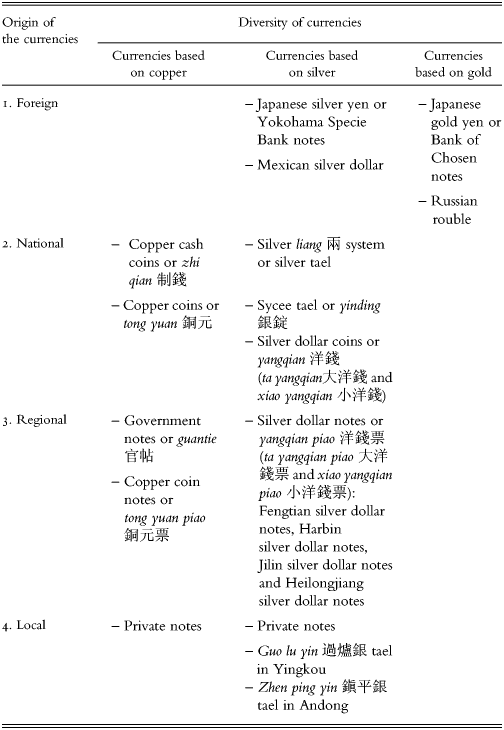
The currencies circulating in Manchuria can be divided into different groups according to their origin and the basis of the precious metal adopted. There was no homogeneous monetary system. Yet some currencies were in common circulation in a large area in China including Manchuria and will be called national currencies here. Regional currencies, mostly in paper money, were those issued by regional authorities and had the national currencies as their reference. Private notes and also local silver tael were considered as local currencies because their acceptability was limited to a small area, and they were not following a specific monetary standard. Foreign currencies, particularly the Japanese and Russian ones, were adopted in areas under the influence of those governments. Table 1 presents a list of the currencies.
Major currencies in Manchuria
Sources: Economic History of Manchuria (1920); SMR (1929); Report of the Commission of Enquiry Appointed by the League of Nations (1932).
In the first group there are foreign currencies. Most foreign currencies in circulation were of Japanese origin, based on gold and silver, and a small portion was Russian, based on gold. The circulation of these currencies became popular from the late nineteenth century, after the Sino-Japanese and Russo-Japanese Wars. However, following Japan's acquisition of the Guandong territory in 1905 and after the Russian Revolution of 1917, the circulation of the Russian currencies was restricted to an area in northeast Manchuria. Hence the most popular foreign currencies were the Japanese silver yen notes, known as yinpiao 銀票 or chaopiao 鈔票, issued by Yokohama Specie Bank (YSB), and the Japanese gold yen notes issued by the Bank of Chosen (BoC). The foreign currencies, according to Kobayashi, accounted for 20 to 25 per cent of the total currency in circulation in the region (1972, p. 123).
In the second group there are national currencies. They were not standardised (varying in weight, size and value) but were in common circulation in other areas of China proper. Some of them are copper cash coins or zhi qian 制錢, copper coins tong yuan 銅元, silver dollar coins or yangqian 洋錢 (divided in xiao yangqian 小洋錢 and ta yangqian 大洋錢), and silver liang 兩 system or silver tael system (Kann Reference Kann1926, pp. 83–4).
The regional currencies make up the third group. They were issued and accepted regionally (in two or more provinces close to each other, but not throughout China). As an example, there are: (i) the higher value of silver dollar notes (ta yangqian piao 大洋錢票), which could be issued by each authority of the three provinces of northeast China (Fengtian, Jilin and Heilongjiang) and also by the authority of Harbin district. Usually, they could circulate throughout northeast China, but each region had its own silver dollar note. The silver dollar notes in those regions received the name of the province in which they were issued, such as Fengtian silver dollar notes or Fengtian ta yang piao 奉天大洋票, Jilin silver dollar notes 吉林大洋票, Heilongjiang silver dollar notes 江省大洋票, and Harbin silver dollar notes or ha dayang piao 哈大洋票; (ii) the small-denomination paper notes based on silver, such as xiao yangqian piao 小洋錢票; (iii) the government notes, known as guantie 官帖, issued only by the provincial authority of Jilin and Heilongjiang; and (iv) the copper coin notes or tong yuan piao 銅元票.
The currencies of the fourth group are those adopted locally, such as the guo lu yin tael 過爐銀, the zhen ping yin tael 鎭平銀 and private notes. The guo lu yin tael was a unit of account that was used only in Yingkou city, as well as the zhen ping yin tael that was adopted in Andong city. The private notes were issued by private institutions, such as local companies, and also by merchants, and adopted in a restricted area. Usually, they were issued based on silver, but could also take copper as reference (Report of the Commission of Enquiry Appointed by the League of Nations 1932).
The silver-based currencies (such as ta yangqian, ta yangqian piao and those of the liang silver system) and those based on gold were currencies of larger denomination, generally required for trade of large volume between merchants. The currencies based on copper (like guantie), silver (such as xiao yangqian and xiao yangqian piao) and some private notes were the smallest-denomination currencies, required in general for daily transactions and popular among peasants. In the following sections, the effect of seasonal variation on the demand for monies during the period of Zhang Zuolin's administration will be analysed.
II
When Zhang took office in 1916, he faced numerous financial difficulties, according to Suleski. The main financial problem was the provincial currency devaluation due to the excessive printing of paper money and the lack of homogeneity in the monetary system. Suleski argues that the over-issuance of money in that period reflected the economic imbalance of the previous government. To keep the new government after the Revolution of 1911, several loans were acquired in Shanghai and from the BoC totalling over 12 million yuan. The annual payment of loans had become a burden on the provincial government, which, to meet the payment, began to issue more paper money than their reserves for conversion (Suleski Reference Suleski2002, p. 34).
The excess of issuance and rumours of non-convertibility of paper currency resulted in a run on banks, causing a depreciation of the currency's value. It started when many traders began exchanging their banknotes for metal coins. This distrust came mainly from Japanese traders who had business in the southern region of Manchuria (Suleski Reference Suleski1979; Hirano Reference Hirano1983). According to Hirano, the causes of dissatisfaction were the variation of the exchange rate of different currencies, and also because the Japanese traders were hurt by the diversity of markets and currencies (1983, p. 317). These merchants needed to exchange local currencies, typically paper currency for Japanese money, based on gold or silver, to negotiate over agricultural products in regional markets. The constant demands of convertibility had already induced a state of economic disorder that reached its peak between 1914 and 1915.
Aiming to overcome this previous problem, Zhang Zuolin appointed Wang Yongjiang as Provincial Director of the Office of Police Affairs in November 1916, and six months later, he was nominated to the post of Director of the Fengtian Bureau of Finance. The first action taken by the new cabinet was to adopt a new official currency based on silver – the yuan – aligning the new unit to the system adopted by the new central government in Beijing (Shibutani Reference Shibutani1993; Suleski Reference Suleski2002). The measure was to adopt this new silver standard and to level the yuan to the Japanese yen, based on gold, with the aim of strengthening the currency and reducing the pressure for convertibility from Japanese traders (YSGC 1926). The adoption of the new unit was announced in August 1917 and the new exchange note, or huidui piao 滙兌票, based on the new silver yuan standard, was named as the new Fengtian silver dollar.
The new Fengtian dollar was not convertible, it being issued to replace old redeemable Fengtian notes which were first issued in 1905 (Economic History of Manchuria 1920; Report of … League of Nations 1932). Moreover, monetary authorities tried to align the various currencies in Manchuria with the new Fengtian dollar (Suleski Reference Suleski2002, p. 133). Nevertheless, regional and local currencies, as well as foreign currencies, continued to circulate side by side.
The Fengtian dollar, according to data from the YSB, accounted for 70 per cent of the total of regional currencies in circulation, and was also being used in Shandong and Zhili provinces (YSGC 1926). It seems that the new Fengtian dollar gained ready acceptance across the region. Thus the provincial government enjoyed relative economic stability (Suleski Reference Suleski1979, p. 653) between approximately 1916 and 1921.
Let us now see whether the economic stability influenced the seasonal variation in demand for some of the major currencies in circulation. According to Figure 3, from November 1916, the oscillation of the average value of the Fengtian dollar remained relatively stable between 90 and 109 yuan (to the 100 yen gold). It would keep this stability until September 1919, increasing its value from October that year until May 1920, as seen in Figure 4. On the one hand, this indicates that the measures adopted by the monetary authorities brought relative monetary stability to the currency, unlike the period immediately before 1917.
Exchange rate of Fengtian silver dollar and xiao yangqian and variation of silver price between 1914 and 1917
Exchange rate of Fengtian silver dollar and xiao yangqian and variation of silver price between 1918 and 1921
On the other hand, Nishimura (Reference Nishimura1971, p. 140) states that the exchange rate appreciation was also due to the appreciation of silver on the world market, which was influenced by the Pittman Act. In 1918, during World War I, the US Congress passed the Pittman Act limiting the export of silver, with the goal of keeping the reserves in the country. Thus the high value of silver on the international market influenced the Fengtian dollar exchange rate, which did not have an extreme devaluation, especially from 1918 to 1919.
However, with the suspension of the Pittman Act in 1920, and the discovery of new mines in the US, the price of silver declined, directly affecting the exchange rate from mid 1920, as shown in Figure 4. The value of the Fengtian dollar, which had reached its peak of 54 yuan (to the 100 yen gold) in January 1920, fell to 114.70 yuan in June of the same year. A similar trend happened to the xiao yangqian currency, which reached a maximum value of 44.90 yuan in January, falling then to 82.87 yuan in July 1920.
According to Kemmerer (Reference Kemmerer1910), the periods of largest demand for money are in spring, during the pre-sowing season, and in autumn, which correlate with the post-harvest and trading periods of the agricultural commodity. In the example of Manchuria, one can consider two additional elements in the demand for money: the movement of seasonal workers and the Chinese New Year, usually celebrated between January and February.Footnote 1
Thus, to put it simply, the greater movement of business in the market from September to March would be one of high demand for monies and therefore a period of high issuance of currencies in Manchuria. In view of this, it seems that high demand for money would push its value up, and in the offseason the opposite would happen: low demand for money would represent low issuance of currency, devaluing it.
Now, let us take a look at the exchange rate of the Fengtian dollar and xiao yangqian. Except for the year 1920, which was influenced by the end of the Pittman Act in general, the data indicate that the Fengtian dollar has a tendency to increase its value from October to March when compared with the offseason period. The opposite condition prevails if we base it on the current seasonal variation, i.e. currency depreciation in the offseason and appreciation in the other months. One can see, therefore, a certain trend in the exchange rate between 1916 and 1921, even though it was a period without internal conflict and marked by some economic reforms that brought economic stability.
Let us then check whether there is any change in the price of soybeans for export and whether it follows a seasonal trend, i.e. if in the period immediately after harvest, the price was relatively low due to the high supply of soybeans, and increased in the months prior to autumn.
As seen in Figure 5, between 1914 and 1917, the price of soybeans follows an upward trend in the period before harvest and a downward trend in the period just after harvest, from September, indicating a seasonal trend in the variation of price. However, between 1918 and 1921, Figure 6 does not show the same seasonal trend as that in the previous period, i.e. a bias towards the high price of soybeans from September until early the following year, and low prices during the offseason.
The price of soybean between 1914 and 1917 (unit: silver yen/60kg)
The price of soybean between 1918 and 1921 (unit: silver yen/60kg)
Thus one can see that the tendency of the exchange rate and price of soybeans in the same period, between 1918 and 1921, was not the same as in the period between 1914 and 1917. In other words, between 1918 and 1921, foreign buyers would need to change more of their own (foreign) currencies into local currencies according to the high price and exchange rate appreciation if they wanted to buy soybeans from October to March.
According to Kobayashi (Reference Kobayashi1975, pp. 29–30), the provincial government could handle the issuance of money and control the price of soybeans in order to earn profit. Given this analysis, and based on the data presented, what could be suggested then is that with its political and military power, the provincial government not only controlled the issuance of money, but could also regulate the exchange rate and price of soybeans with the aim of obtaining profits.
Let us examine the issuance of Japanese currencies in Manchuria. Soybeans were exported mainly to Japan and that trading was done with Japanese monies issued by the BoC and YSB. Usually, the transaction was carried out among liangzhan, which controlled the trade between peasants and foreign merchants. Thus, to buy soybeans from liangzhan, the Japanese merchants needed to exchange local currency, usually the Fengtian dollar in the southern area, and to a lesser extent the Harbin dollar in northern Manchuria. In this regard, there are two periods that deserve more attention. Roughly speaking, the first one is the period between approximately October and March in which a high issuance of Japanese currencies occurs due to the increase in soybean negotiation during these six months. The second period is between April and September, during which the issuance of currency is relatively lower. Thus one can see in Table 4 a seasonal variation in the issuance of the BoC and YSB that follows a trend similar to that of the period of soybean negotiation.
The total of BoC notes corresponds mainly to the amount issued in Korea, including a small portion in Manchuria, Siberia and other parts of China. An estimate of 64 per cent of that total is related to the amount that circulated in Korea, 30 per cent in Manchuria, 4 per cent in Siberia and the remainder in China (Chosen Ginkoshi 1987, pp. 11–12). It is also worth remembering that the main economic activity of Korea was agriculture, especially the production of rice, which follows a similar seasonality.
Despite the lack of data on the issuance of the Fengtian dollar during this first period that could show the periods of upward and downward trend, it is reasonable to say that there is a seasonal variation on the demand for money that corresponds to the seasonality of agricultural production and trading of soybeans, between 1916 and 1921.
III
The period of economic stability that the region achieved in the early years of Zhang's government was also marked by surprising military spending. Suleski (Reference Suleski1977, p. 18) shows that between 1917 and 1921, military spending in the province of Fengtian reached an average of 68.8 per cent of total government spending. However, due to conflicts during the 1920s, the cost jumped to almost 80 per cent of the Fengtian government's spending and reached 90 per cent in 1926 (Nishimura Reference Nishimura1971).
The Zhili–Fengtian conflict arose due to a political quarrel between Zhang Zuolin and his rival Wu Peifu, the chief commander of Zhili province, over the influence of the central government of Beijing. The dispute escalated into a military confrontation and the first Zhili–Fengtian conflict broke out on April 1922. Zhang was defeated few months later and relieved of the title of governor of the three provinces (Suleski Reference Suleski2002, p. 66). However, in the second Zhili–Fengtian confrontation, from September to November 1924, Wu Peifu was defeated and Zhang became the top military commander. In Suleski's words ‘from 1924 until 1926, the deeper his involvement in China Proper became, the harder Zhang pushed for total victory. The more costly military operations grew, the more Zhang demanded from the resources of Manchuria’ (2002, p. 145).
It seems that part of the income of Manchuria was obtained from the export of agricultural products, mainly soybeans, this figure accounting for more than half of the income of the military government in the years 1927 and 1928 (Kobayashi Reference Kobayashi2008). Another part of that income was acquired from the issuance of the Fengtian dollar; this was, however, beyond what the finances of the provincial government could sustain (Suleski Reference Suleski2002). According to Nishimura (Reference Nishimura1971, p. 139), the issuance had more than doubled from 30 million yuan in 1921 to 134 million in 1925 and, consequently, the Fengtian dollar began to depreciate against the Japanese gold yen and accelerated from 1925.
Owing to the high cost of the wars in which Zhang took part, the period of stability that Wang Yongjiang, mentor of the financial soundness of Manchuria, tried to maintain could not last (Shibutani Reference Shibutani1993; Suleski Reference Suleski2002). The constant conflicts were affecting the public accounts of the three provinces, forcing Wang to resign in early 1926. Furthermore, due to the confrontation with the forces of Guomindang (Kuomintang) led by Jiang Jieshi (Chiang Kai-shek), Zhang was increasingly in need of financial resources to keep his troops in northern China. The government funds of the three provinces were being mostly consumed by military expenditures.
Zhang's forces already showed signs of retreat when they started to be attacked by the alliance between the regional warlords and the Guomindang army in 1927, in the military campaign known as Northern Expedition. In early 1928, because of the strength of the Guomindang army in northern China, the Fengtian army began to retreat and Zhang, being in no condition to keep up the conflict, decided to return to Manchuria. On 4 June, he suffered a fatal attack planned by an officer of the Guandong army, the army of Imperial Japan. After this attack, his son Zhang Xueliang was appointed new Acting Military Director of Fengtian Province.
Let us now see how the political and military issues influenced the seasonal course of monetary circulation in the period between 1922 and 1928. To better understand how the variation of the exchange rate in 1922 was vulnerable to the events of the time, McCormack (Reference McCormack1977, p. 90) shows that
from around 116 (yuan to the 100 yen) in January, the rate fell steadily as the prospects of war rose. In mid-April, as Fengtian troops poured through the passes, and substantial amounts of hard currency were reported to have been withdrawn from the treasury and from the main banks in Mukden [Fengtian] to support them, the p'iao [Fengtian dollar or Mukden note] crashed to 147. For a time, in an attempt to stem its collapse, transactions on the Exchange were limited to 500,000 yuan on any one day and the rate fixed at 138. Despite the restrictions, and the jail penalties that met their infringement, news of the debacle on the front in May produced a slump in the Exchange price to 156. Recovery in the Shan-hai-kuan fighting that followed the regrouping of the armies saw a strengthening to around 130 in July and August. However, in September rumors of a renewal of hostilities were rife, and again, as the rate dropped to 145 (September 14), and three days later a further reduction to 142.5, backed by a contingent of police to supervise the market proceedings.
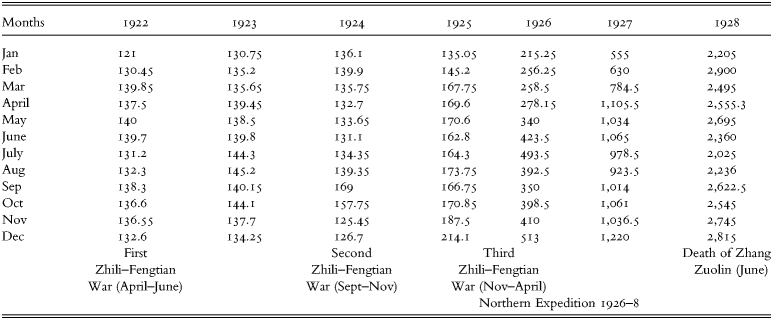
One can see, according to McCormack, that the Fengtian dollar exchange rate varied considerably from one day to the next in relation to the military events. However, the issuance of Fengtian dollar notes continued its high seasonal trend during the months from approximately October to February, as we can see in Table 2 and Figure 9. These data may indicate that the issuance corresponds to the period of greatest demand for money in relation to the end of the harvest and the commerce in agricultural commodities. The period between April and August was one of comparatively low currency issuance, also indicating low business activity in the region.
Fengtian silver dollar exchange rate between 1924 and 1928, monthly average (unit: yuan/100 yen gold)
Note: Minor correction on the average between 1924 and 1928 from the original data.
Source: MMTK (SC) (1928).
It is also reasonable to say that while Wang Yongjiang was directing the Bureau of Finance of Manchuria, the Fengtian dollar did not fluctuate harshly. However, after his resignation in early 1926 the Fengtian dollar depreciated considerably, as shown in Table 2. Indeed it seems that he was the mentor of financial soundness of the three eastern provinces, as attested by Shibutani (Reference Shibutani1993) and Suleski (Reference Suleski2002).
From 1926 the economy started to show signs of collapse. The exchange rate of the Fengtian dollar ended the year of 1927 with a peak high of 1,220 yuan and reached the beginning of 1928 with an average rate of 2,205 yuan, a huge difference compared to the previous month of December. In February this exchange rate reached a maximum of 3,300 yuan, closing with an average of 2,900 yuan, and the issuance of the Fengtian dollar increased monthly on an unprecedented scale (see Figure 9). This change did not correspond to seasonal variation in agricultural production during the period of political stability, between 1916 and 1921 (and also the years 1922 and 1923), with a trend towards appreciation of the Fengtian dollar between approximately October and February and certain devaluation in other months.
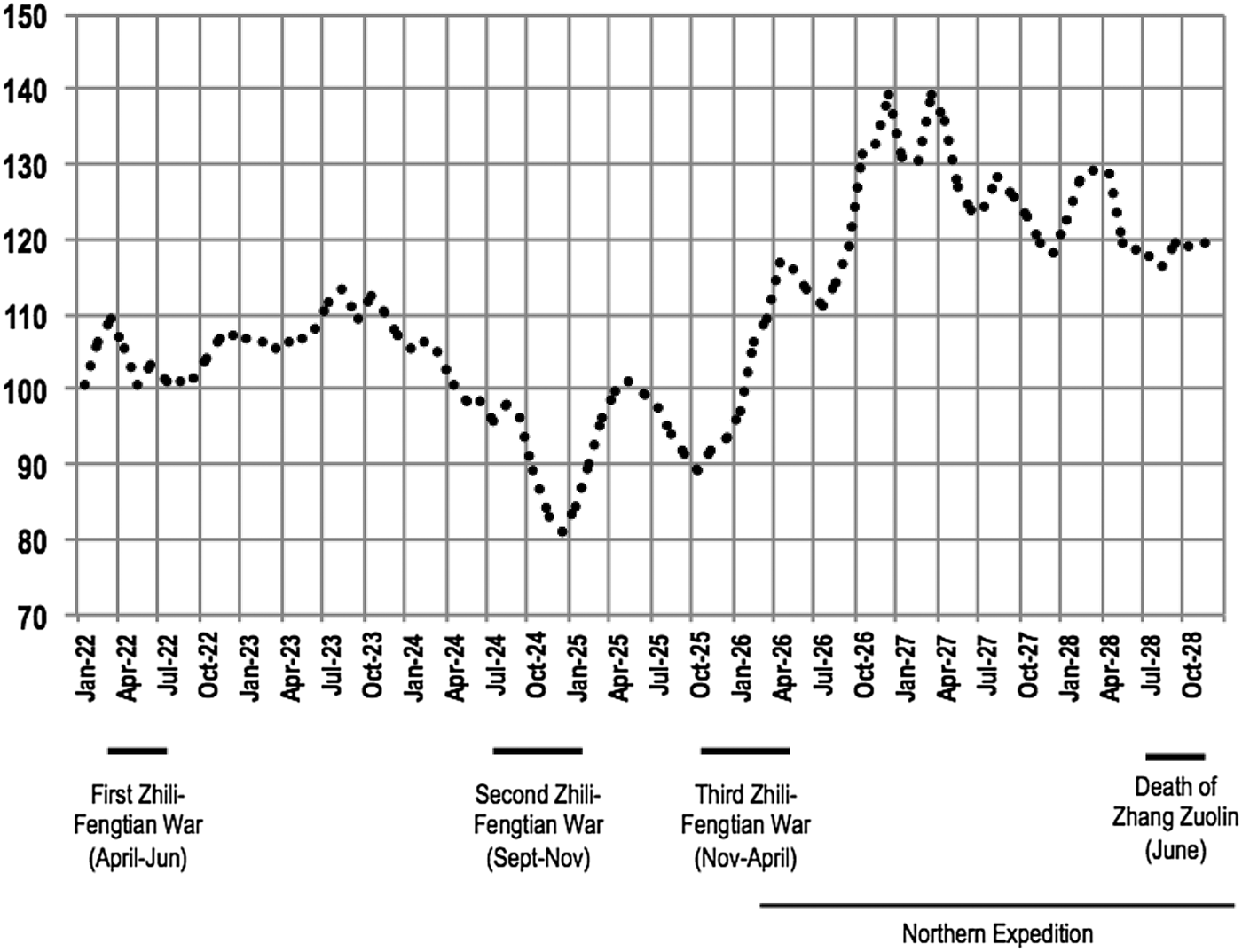
The exchange rate of the smaller-denomination xiao yangqian currency followed a similar seasonal trend to the exchange rate of the Fengtian silver dollar in the first period between 1916 and 1921. There was a tendency for the xiao yangqian to appreciate between approximately October and February, which corresponded to the period of high demand for currencies in the region. Also, the xiao yangqian rate did not seem to be influenced as the Fengtian silver dollar was in the second period, especially between 1925 and 1928.
Although the exchange rate of the Fengtian dollar during this period was susceptible to the military confrontation, as demonstrated above, the money issuance of the BoC and YSB seemed not to have been influenced. The currencies' issuance follows a seasonal trend, i.e. high issuance between approximately October and February and a lower issuance period in other months.
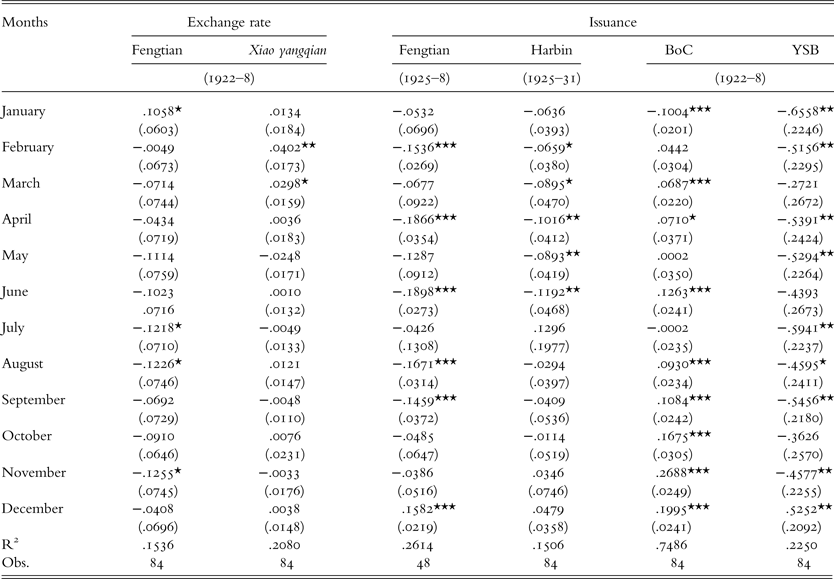
We can see in Table 5 that the currency issuance of the BoC followed a certain seasonal trend, between 1922 and 1928, which also seems to correspond to the period of soybean negotiation. On the other hand, the seasonal variation in YSB issuance followed a less stable trend if compared with the issuance of the BoC. The main reason for that may be found in the stability of gold compared to silver in the same period.
It is worth remembering that gold was the standard of the international monetary system, which Japan had joined in 1897. Also the accounts of the General Government of Guandong leased territory and the SMRC were set in gold yen since 1908. Although some scholars consider that the YSB was ‘the de-facto central bank of the Japanese area in Manchuria’ (Hirano Reference Hirano1983, p. 308), which may explain the relationship between the surge in issuance of the YSB in June 1928, as shown in Figure 8, and the incident that led to the death of Zhang Zuolin. The high issuance started in May 1928, reaching its peak in June, and then declined significantly. Although no concrete data are available, we may assume that the high issuance of YSB notes was designed to protect the interests of the Guandong army in the region. Despite the adoption of gold as the standard of the accounts of the General Government of Guandong and SMRC, it seems that the YSB still played an important role behind the scenes.
Xiao yangqian exchange rate between 1922 and 1928, monthly average (unit: yuan/100 yen gold)
Currency issuance of the YSB between 1922 and 1928, monthly average (unit: 10,000 silver yen)
One can see in Figure 9 that Fengtian dollar issuance shows a seasonal trend of greatest period of demand for money that may correspond to the commerce in soybeans. The period between April and September is one of lower currency issuance, also indicating lower business activity compared to the period between October and March. Thus, besides the high demand for money to maintain the conflict in northern China in which Zhang had been involved, it is reasonable to say that there was an ongoing seasonal demand for currency that was related to the seasonality of agricultural production.
Issuance of Fengtian silver dollara between 1924 and 1928, monthly average (unit: 100,000 yuan)
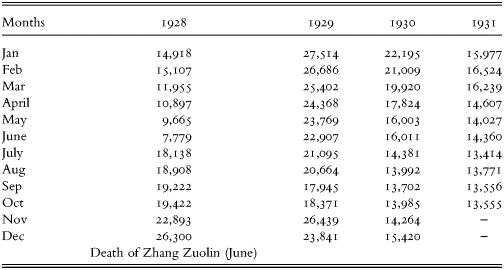
There was a similar trend in the issuance of the Harbin silver dollar note between 1928 and 1931, which circulated in northern Manchuria. The issuance of the Harbin dollar seemed to follow a seasonal course of high issuance from September to March, which corresponded to the period of soybean negotiation.
It is reported that the devaluation of the Fengtian dollar as well as the high issuance of regional currencies was due to the regional government's inability to maintain a stable monetary policy in the face of constant conflicts led by Zhang Zuolin. It is also broadly reported that the economic instability of 1928 was an event which resulted in the collapse of the economy of Fengtian province. Suleski (Reference Suleski2002, p. 175) noted that
as the value of the Fengtian dollar notes tumbled, prices soared because desperate merchants, who knew the notes would be worth even less the following day, tried to compensate for the expected decline in value by raising prices. Workers' wages could not be raised as quickly as the inflation progressed, so many workers found that their wages were inadequate to meet the demands of daily living. Within the province workers began going on strike for higher pay. When the traditional Chinese New Year came in February 1928, many merchants were unable to pay either employees or creditors. By long established custom the New Year was a time to settle accounts and repay all debts, but many merchants found it impossible to meet the demands of their suppliers or the banks that had lent them money.
Nishimura (Reference Nishimura1992, p. 8) maintains that inflation caused the price of foodstuffs to rise by an average of 40 per cent, reaching 36 per cent on January of 1928. He also states that high inflation diminished the workers' wages and as a result the number of strikes increased from 43 cases in 1927 to 51 cases in 1928 (1971, p. 141).
Moreover, Suleski (Reference Suleski1979, p. 659) says that at the beginning of 1928, a large number of companies had closed down, a number that reached 5,089 commercial establishments, ‘among them 456 sundry goods shops, 416 restaurants, 165 factories, 157 machine shops, 142 rice shops, 116 foreign goods stores, and 83 general stores’.
One cannot deny that the political and military events throughout the 1920s made a significant contribution to the economic instability of 1928. However, it is reasonable to say that the seasonality of soybean production and commerce also led to a seasonal demand for different monies in Manchuria.
IV
Although the analysis of this study is far short of a final conclusion, the period analysed can be divided into two phases: first, between 1916 and 1921, we can see a seasonal trend in the demand for monies in Manchuria mainly attributed to commercial negotiations over agricultural products, and also including the seasonal movement of migrant workers, and the festive period of the Chinese New Year. This demand for monies was higher in the post-harvest and pre-seeding period.
Second, the period between 1922 and 1928 was marked by political and military conflict. To deal with the hostilities, the Manchurian authorities had over-issued paper money. This situation adversely affected the economy in the winter of 1928, causing the depreciation of currencies, high inflation and a large number of bankruptcies. Yet one can see an ongoing seasonal variation in the issuance of some of the major currencies in Manchuria that corresponds to the period of soybean commerce.
In addition, in this second period one can see that the exchange rate of the Fengtian silver dollar does not vary seasonally, but is influenced by the political and military events. On the other hand, the exchange rate of the xiao yangqian seems relatively stable compared to that of the Fengtian dollar. There is also a slight difference in the period of adoption of both currencies. The Fengtian silver dollar, as well as currencies of large denomination, was usually required in transactions of large amounts, and this kind of transaction was performed in central markets from November on. However, in some areas of Manchuria a sales contract drawn up in advance between May and June was common practice between peasants and grain dealers, which affected the demand for money considerably.
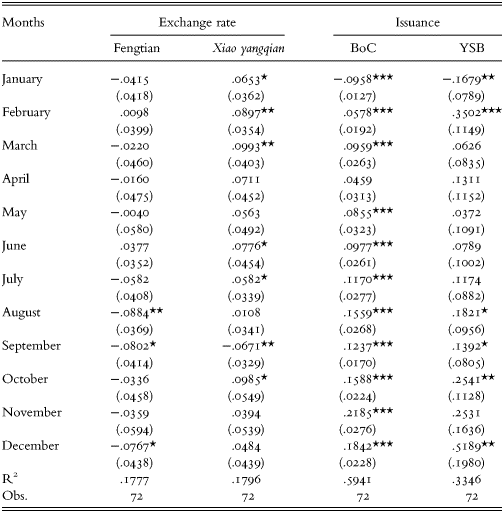
Formal statistical tests (Tables 4 and 5), by regressing the growth rate of the major currencies on twelve seasonal dummies, show a result with slightly seasonal variation. As for the exchange rate of the Fengtian dollar and xiao yangqian, one can see a similar trend of high demand for money. The result shows that the exchange rate varies more seasonally during the first period (1916–21) than during the second period (1922–8) analysed. This suggests that the data of the second period are substantially influenced by the political and military events occurring at the time.
Issuance of Harbin silver dollara 哈大洋票 between 1928 and 1931, monthly average (unit: million yuan)
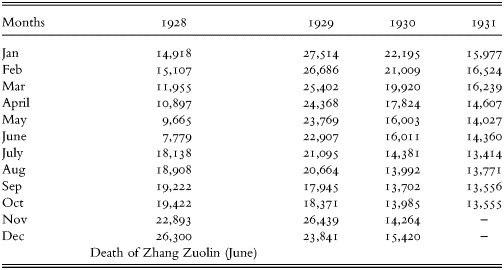
a The issuance of the Three Eastern Provinces Bank.
Source: MMTK (KC) (1932, pp. 2–3).
Summary statistics of the major currencies in Manchuria, monthly average of growth rate between 1916 and 1921
Note: The data are in growth rate of the exchange rate of the Fengtian silver dollar and xiao yangqian, and currency issuance of the BoC and YSB. Coefficients are from regression analysis using seasonal dummies. June is the intercept month for the Fengtian dollar, September for xiao yangqian, and January for both the BoC and YSB. Robust standard errors are in parentheses.
* significant at 10%;** significant at 5%;*** significant at 1%
Summary statistics of the major currencies in Manchuria, monthly average of growth rate
Note: The data are in growth rate of the exchange rate of the Fengtian silver dollar and xiao yangqian, and currency issuance of the Fengtian silver dollar, Harbin silver dollar, BoC and YSB. Coefficients are from regression analysis using seasonal dummies. January is the intercept month for both the Fengtian dollar (exchange rate) and BoC, December for Fengtian dollar (issuance), Harbin dollar and YSB, September for xiao yangqian. Robust standard errors are in parentheses.* significant at 10%;** significant at 5%;*** significant at 1%
The result also shows a statistically significant increase in the issuance of the BoC and YSB, especially between approximately October and December. The result of regression analysis of the available regional currencies such as the Fengtian and Harbin dollars suggests an increase in issuance between October and December. However, in January one can see a pattern change in the issuance of some of those currencies, suggesting a lower issuance then compared to other months between September and December.
The historical analysis of Manchuria of this period normally holds Zhang Zuolin responsible for the economic instability of 1928. Indeed, one cannot overlook the fact that the political and military policies that he adopted directly influenced the economy. However, it seems reasonable to note that a seasonal demand for monies in previous periods, in addition to the political and military conflict, may have contributed significantly to the economic instability during the winter of 1928.