


Introduction
Since the beginning of modern psychotherapy, clinicians have realized that treatment should be tailored to the specific individual features of the patient – beyond the diagnosis and target symptoms (Norcross and Wampold, Reference Norcross and Wampold2011). The present study was developed to bring this perspective to Acceptance and Commitment therapy (ACT) for psychosis and trauma. Building upon research that suggests the possible effectiveness of ACT among patients with a history of trauma and psychosis (Spidel et al., Reference Spidel, Daigneault, Kealy and Lecomte2017), this study sought to investigate pre-treatment patient characteristics in a novel, group-based ACT intervention.
ACT (Hayes et al., Reference Hayes, Strosahl and Wilson1999) is a treatment that emphasizes acceptance, mindfulness and values to overcome problematic emotional reactions. According to Chadwick et al. (Reference Chadwick, Taylor and Abba2005), ACT and cognitive therapy share a common premise – that distress and suffering result from the relationship between human language and cognition rather than directly from sensations or events. ACT attempts to promote behavioural change by increasing mindfulness and acceptance of internal events in the pursuit of the individual's intrinsically valued goals (Gaudiano and Herbert, Reference Gaudiano and Herbert2006). ACT therapies have been applied to several clinical problems, including substance abuse (Hayes et al., Reference Hayes, Strosahl and Wilson1999), generalized anxiety disorder (Orsillo et al., Reference Orsillo, Roemer and Barlow2003; Roemer and Orsillo, Reference Roemer and Orsillo2003), and psychotic symptoms (Bach and Hayes, Reference Bach and Hayes2002; Gaudiano and Herbert, Reference Gaudiano and Herbert2006; Shawyer et al., Reference Shawyer, Farhall, Mackinnon, Trauer, Sims and Ratcliff2012; White et al., Reference White, Gumley, McTaggart, Rattrie, McConville, Cleare and Mitchell2011). Indeed, on the basis of these studies, ACT appears to be a promising psychotherapy for individuals experiencing psychosis. Recently, Spidel et al. (Reference Spidel, Daigneault, Kealy and Lecomte2017) investigated ACT in a sample of outpatients with psychosis and childhood trauma and found a significant decrease in overall symptom severity over the course of the treatment, a significant increase in acceptance of emotions and experiences, and a significant increase in treatment compliance among patients receiving ACT compared with treatment as usual (TAU) patients.
Childhood trauma may predict an unfavourable course of illness and treatment outcome. Compared with individuals who have not been maltreated, those with a history of childhood trauma are at greater risk of meeting criteria for a psychotic episode later in life (Arseneault et al., Reference Arseneault, Cannon, Fisher, Polanczyk, Moffitt and Caspi2011). Research has shown that people with childhood trauma and psychosis have worse treatment outcomes than their non-traumatized counterparts (Larkin and Read, Reference Larkin and Read2008; Bendall et al., Reference Bendall, Jackson and Hulbert2010). It has been found that this group has more severe depression, anxiety, suicidality (Schenkel et al., Reference Schenkel, Spaulding, DiLillo and Silverstein2005; Tarrier et al., Reference Tarrier, Khan, Cater and Picken2007) and substance abuse problems (Neria et al., Reference Neria, Bromet, Sievers, Lavelle and Fochtmann2002). Moreover, Tyrrell et al. (Reference Tyrrell, Dozier, Teague and Fallot1999) found that the attachment style of both the client and the therapist directly influenced the formation of a working alliance and treatment outcome. In studies of those with serious mental illness (Mueser et al., Reference Mueser, Rosenberg, Goodman and Trumbetta2002; Varese et al., Reference Varese, Smeets, Drukker, Lieverse, Lataster, Viechtbauer and Bentall2012), about 50% of people reported significant childhood trauma, which was linked to being more likely to refuse psychological treatment or to avoid seeking help, to having trouble forming a therapeutic alliance and to having lower self-esteem. In addition, patients with psychosis reported more severe and frequent childhood trauma compared with non-psychotic patients (Mørkved et al., Reference Mørkved, Endsjø, Winje, Johnsen, Dovran and Arefjord2017). As such, severity of childhood abuse is important to consider when evaluating treatment effectiveness of those with psychosis and trauma history.
The current study sought to investigate the role of trauma severity, other patient characteristics such as attachment style and dispositional mindfulness, and treatment attendance, in potentially moderating the effectiveness of ACT. We focused on two research questions: (1) does the severity of childhood trauma moderate the ACT group's effectiveness?; and (2) are there different outcome change profiles among patients who received ACT group therapy? Related to the second question, we sought to determine which among the following factors were predictive of patient change profiles: age, attachment, mindfulness, severity of trauma, and number of sessions attended. The study is thus exploratory in nature, rather than designed to test specific hypotheses.
Method
Participants
Participants were 50 outpatients attending community mental health centres who consented to take part in the study. The mean age of the 50 participants was 40.4 years (SD = 12.7; range 19–64), mean age at first psychiatric hospitalization was 22.7 years (SD = 11.7; range 11–55), and mean age at first visit to a psychiatrist was 19.2 years (SD = 11.9; range 10–54). In terms of gender, 52% of the sample was female and 48% male. The mean number of years of education was 11.84 (SD = 1.42). Based on clients’ psychiatric assessment, 66% of the participants were diagnosed with schizophrenia (n = 33), 20% with bipolar disorder (n = 10), and 14% with psychosis not otherwise specified (n = 7). The majority (66%; n = 33) were single/never married; 20% (n = 10) were separated or divorced and 14% (n = 7) were married or had a common-law partner. There were no significant differences between the experimental and control groups for the demographic data including age (see Spidel et al., Reference Spidel, Daigneault, Kealy and Lecomte2017). To address our first research question, the total sample of N = 50 participants was used. Subsequent analyses regarding our second research question were conducted using the subsample of n = 30 patients who received ACT treatment.
Measures
Attachment Styles Questionnaire (ASQ)
The ASQ is a 40-item questionnaire that uses a 6-point Likert-type scale (1 = ‘totally disagree’ to 6 = ‘totally agree’). The ASQ (Feeney et al., Reference Feeney, Noller, Hanrahan, Sperling and Berman1994) yields five factor scores: one is a factor representing secure attachment, the other four represent a particular aspect of insecure attachment. Brennan et al. (Reference Brennan, Clark, Shaver, Simpson and Rholes1998) recommended measuring two underlying factors or dimensions, anxiety/preoccupied and avoidance. Two subscales were thus used to provide measures of the two principal constructs underlying insecure attachment: avoidance (17 items) and anxiety (9 items). The total scores vary between 43 and 90 for attachment avoidance and 19 and 52 for attachment anxiety/preoccupation. Higher scores are indicative of problematic attachment styles of avoidance and anxiety. The ASQ has demonstrated high levels of internal consistency (Cronbach's alpha = .80) and test–retest reliability (r = .76) (Feeney et al., Reference Feeney, Noller, Hanrahan, Sperling and Berman1994). For both groups this measure was administered at baseline only.
Childhood Trauma Questionnaire-short form (CTQ-SF; Bernstein et al., Reference Bernstein, Fink, Handelsman, Foote, Lovejoy and Wenzel1994)
The CTQ is a self-report inventory that assesses recollections of childhood abuse and neglect using 25 items with a five-point frequency scale (0 = ‘never true’ to 5 = ‘always true’). It inquires about five types of maltreatment: emotional (EA), physical (PA) and sexual abuse (SA), as well as emotional (EN) and physical neglect (PN). Each subscale is composed of five items, with scores that range from 5 (no history of abuse or neglect) to 25 (severe history of abuse or neglect). Participants completed the CTQ at baseline. For this study we used the recommended cut-off scores that divide each subscale into four levels of severity based on the number of items endorsed and their reported frequency: none, low, moderate and severe (for more details, see Bernstein et al., Reference Bernstein, Fink, Handelsman, Foote, Lovejoy and Wenzel1994). We then combined the two lowest severity categories (none and low) into a low-trauma group and the two highest severity categories (moderate and severe) into a high-trauma group. The CTQ has been found to be a reliable and valid measure of childhood trauma and abuse (Bernstein et al., Reference Bernstein, Ahluvalia, Pogge and Handelsman1997), with moderate to high internal consistency (Cronbach's alpha ranges from .81 to .95) and good test–retest reliability (r = .80 to .83) (Bernstein and Fink, Reference Bernstein and Fink1998; Bernstein et al., Reference Bernstein, Fink, Handelsman, Foote, Lovejoy and Wenzel1994).
Toronto Mindfulness Scale (TMS; Lau et al., Reference Lau, Ioannidis, Terrin, Schmid and Olkin2006)
The TMS is a 13 item self-report questionnaire consisting of two subscales of dispositional mindfulness (curiosity and decentring) using a 5-point frequency scale (0 = ‘not at all’ to 4 = ‘very much’). The TMS has shown good reliability (internal consistency of .95) and validity (mean convergent validity with other measures of absorption and self-consciousness of .35). A total score was obtained, with higher scores indicating higher mindfulness.
Dependent variables (outcomes)
For both groups, the following measures were completed at baseline, after treatment, and at 3-month follow-up.
Acceptance scale (CERQ; Garnefski and Kraaij, Reference Garnefski and Kraaij2007). The acceptance scale of the CERQ was used. This is a four-item self-report measure that uses a 5-point Likert-type scale (1 = ‘almost never’ to 5 = ‘almost always’) to reflect acceptance of emotional experience. The total score of the CERQ varies from 4 to 20, with higher scores indicating a greater frequency of reliance on acceptance as a cognitive regulation strategy. The Acceptance subscale has an acceptable internal consistency (Cronbach's α = .62; Garnefski and Kraaij, Reference Garnefski and Kraaij2006) and moderate test–retest reliability (r = .41; Garnefski et al., Reference Garnefski, Kraaij and Spinhoven2001).
Anxiety symptoms (GAD-7)
Anxiety symptoms were assessed using the Generalized Anxiety Disorder Scale-7 (GAD-7), a brief self-administered seven-item questionnaire using a 4-point scale (0 = ‘not at all’ to 3 = ‘nearly every day’). A continuous total score was used in this study, with higher scores indicating greater anxiety symptom distress. The GAD-7 is frequently used and has good psychometric properties (Cronbach's α = .92; Spitzer et al., Reference Spitzer, Kroenke, Williams and Löwe2006).
Psychiatric symptoms (BPRS)
The Brief Psychiatric Rating Scale-Expanded (BPRS-E; Ventura et al., Reference Ventura, Lukoff, Nuechterlein, Liberman, Green and Shaner1993) is a 24-item semi-structured interview used to assess the presence and the severity of psychiatric symptoms evaluated on a 7-point Likert scale depending upon the severity of symptoms (1 indicates a complete absence of symptoms and 7 indicates a very severe level). The total score thus varies between 24 and 168, with higher scores indicating greater symptom severity. The BPRS interview was conducted individually by two research assistants who had been trained to administer the BPRS according to the UCLA ‘gold standard’ criteria (Ventura et al., Reference Ventura, Liberman, Green, Shaner and Mintz1998) and did not know which condition the participants were assigned to. The total scale internal consistency (Cronbach's alpha) of the BPRS varies between .75 and .79 (Thomas et al., Reference Thomas, Donnell and Young2004) and test–retest reliability had an intraclass correlation of .78 (Crippa et al., Reference Crippa, Sanches, Hallak, Loureiro and Zuardi2001).
Service Engagement Scale (SES)
Treatment adherence was assessed with the 14-item SES (Tait et al., Reference Tait, Birchwood and Trower2002). Clinicians (psychiatrist or case manager) rate the SES using a four-point Likert-type scale (0 = ‘not at all or rarely’ to 3 = ‘most of the time’) with reference to the patient's engagement, with higher scores indicating reduced engagement. Availability is assessed using three items (e.g. ‘when a visit is arranged, the client is available’); collaboration with three items (e.g. ‘the client actively participates in managing his /her illnesses); help-seeking with four items (e.g. ‘the client seeks help to prevent a crisis’); and treatment adherence with four items (e.g. ‘the client refuses to cooperate with treatment’). The raters were kept blind by the researchers as to what condition they were in (the clients were also asked to not reveal their conditions) and were not told about attendance until the completion of the entire study including follow-ups. Excellent internal consistency (Cronbach's α = .91) and test–retest reliability (r = .90) has been reported for the full scale (Tait et al., Reference Tait, Birchwood and Trower2002).
Procedure
Participants with psychosis and childhood trauma history were recruited through community mental health clinics at three sites: White Rock, Surrey and New Westminster, in British Columbia, Canada. The Fraser Health Ethics board approved the study. Case managers at the clinics asked clients with a documented history of psychosis and childhood trauma if they were interested in learning about the study. A research assistant then met with each interested person to explain the study and to obtain informed consent. Participants were randomly divided into two groups at each site. One group received ACT and treatment as usual (ACT group) and the second group was waitlisted for the treatment and received only treatment as usual during the study (TAU group). Each ACT group included eight participants, who were offered eight group sessions lasting approximately 70–75 min. Among the 58 clients approached by participating case managers, 50 agreed to participate and provided data at pre-treatment (ACT group = 30 and TAU group = 20). All 30 in the treatment condition completed the treatment (i.e. attended four sessions or more) and provided data after the treatment, and at follow-up (i.e. 3 months later). Mean therapy attendance among the participants was 6.32 sessions (SD = 1.21).
Treatment
ACT was delivered in a group format, guided by a treatment manual, over eight sessions (for more information about the treatment, see Spidel et al., Reference Spidel, Daigneault, Kealy and Lecomte2017), covering various ACT skills such as acceptance, defusion, compassion and mindfulness (Khoury and Lecomte, Reference Khoury and Lecomte2012). Two therapists, an experienced therapist from each Mental Health center, and the first author, conducted all of the sessions as co-therapists.
TAU consisted of regular treatments received at the clinic. This included contact with their case manager, their psychiatrist, and any pharmacological treatments they regularly received at the clinic. Individuals in the TAU group were allowed to receive the ACT sessions, if desired, after the last follow-up.
Statistical analyses
A post-hoc G*Power analysis revealed that on the basis of the mean, between-groups comparison observed in the present study on the BPRS, an n of approximately 26 would be needed to obtain statistical power at the recommended .80 level (Cohen, Reference Cohen1988; hence the study was just slightly underpowered to determine if trauma moderated the effectiveness of ACT. To address the first research question we examined the use of acceptance, overall psychiatric symptoms, anxiety, and help-seeking (found to be significant in the previous article by Spidel et al., Reference Spidel, Daigneault, Kealy and Lecomte2017), when compared with the control group over time. To assess if trauma severity moderated the effectiveness of ACT we used a series of four random coefficient analyses (RCAs: one for each outcome found to have significant improvements following ACT in Spidel et al., Reference Spidel, Daigneault, Kealy and Lecomte2017) using Group, Time and CTQ as predictors of change between T1 and T2 (Heck et al., Reference Heck, Thomas and Tabata2010, Reference Heck, Thomas and Tabata2013). All 3-way interactions were included in the analyses. The moderation (3-way interaction) considers all three variables simultaneously, yielding a clear answer, which does not require extrapolation. The 2-way interaction determines if ACT is effective and associated with greater improvements over time than TAU. The 3-way interaction determines if this effectiveness (ACT/TAU × Time) is the same or not for all ACT participants according to their level of past trauma exposure (ACT/TAU × Time × Trauma). If the 3-way interaction is statistically significant, this would indicate that the effectiveness of ACT is moderated by – or depends on the level of – past trauma exposure.
Cluster analyses were used to investigate different outcome profiles among the 30 participants who received the ACT intervention. For these analyses, T1 to T2 change scores were created for each outcome (CERQ Acceptance, GAD-7, BPRS and SES Help-seeking) and a two-step hierarchical cluster analysis was used to identify clusters. This was done by first reviewing the dendograms and then using an iterative cluster (k-means) analysis (Galbraith et al., Reference Galbraith, Moustaki, Bartholomew and Steele2002). These profiles were then compared with regard to the percentage of participants reporting severe to extreme childhood trauma in each of the five CTQ subscales (EA, PA, SA, EN and PN) using chi-squared analyses to determine if severity of trauma was associated with the change profiles of those receiving ACT.
Finally, a multinomial logistic regression (a logistic regression method for multiclass problems meaning those with more than two possible discrete outcomes) was used (Hosmer et al., Reference Hosmer, Lemeshow and Sturdivant2013) to predict cluster membership using other potential predictors of change (total CTQ score, attachment, a measure of mindfulness, number of sessions attended and age).
Results
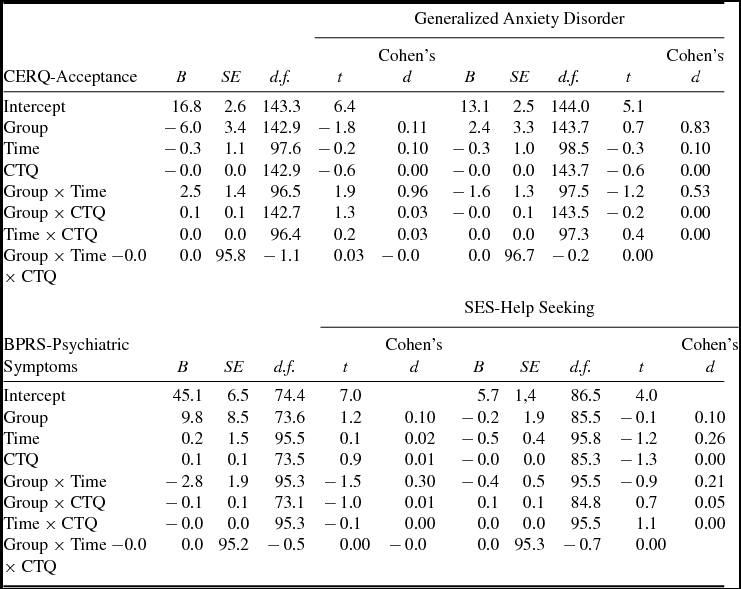
Results of the RCAs indicate that there was no significant 3-way Time × Group × CTQ interaction for the four outcome variables assessed (CERQ, BPRS, GAD and SES for help-seeking); see Table 1. This indicates that, as a group, participants in the ACT group benefited similarly from the intervention regardless of their self-reported level of childhood trauma.
Reduced RCA models when predicting each outcome

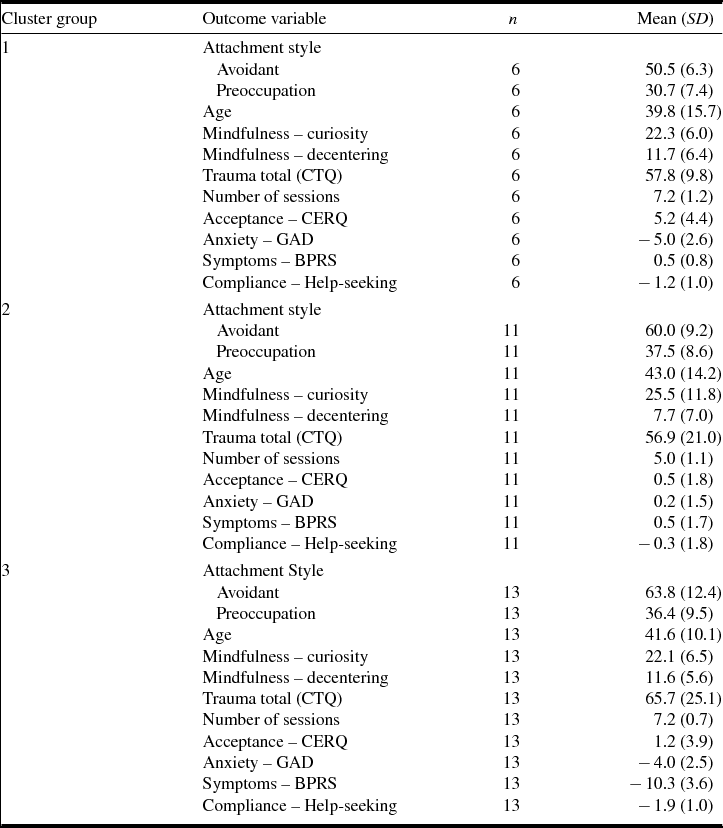
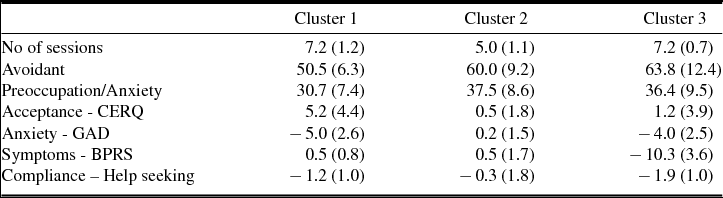
Among participants who received the ACT intervention (n = 30), results from the k-means cluster analyses suggested three different outcome change clusters or profiles – all significantly different from each other (see Tables 2 and 3). Although the three clusters do not have equal numbers of participants (one has fewer), they are clinically and statistically different. The F-values for outcomes were as follows: CERQ Acceptance, F (2,27) = 54.9, p = 0.00; BPRS, F (2,27) = 14.9, p = 0.00; GAD, F (2,27) = 5.4, p = 0.01; and SES Help seeking, F (2,27) = 4.6, p = 0.02.
The means and standard deviations for each outcome variable across clusters

Means and Standard deviations for each variable across clusters.

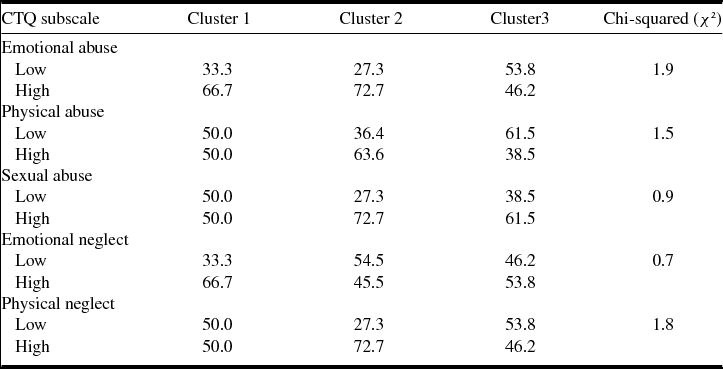
Results from the chi-squared analyses and Cramer's V effect sizes are given in Table 4. They indicate that none of the CTQ subscales’ (EA, PA, SA, EN and PN) distributions was significantly different across the three outcome change profiles.
Childhood trauma across outcome clusters

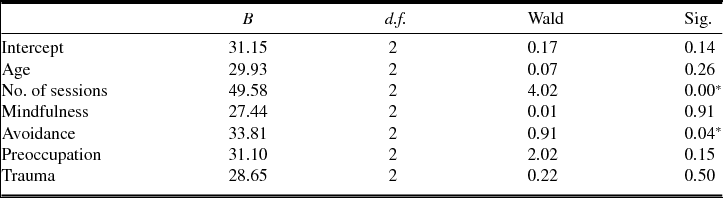
The results from the multimodal regression based on our outcomes to predict cluster membership indicated that two of the five variables (age, attachment, mindfulness, type or severity of trauma, and number of sessions attended) were significantly associated with cluster membership (see Table 5): number of sessions and avoidant attachment style. Participants who attended more ACT sessions were more likely to be in clusters 1 and 3, the clusters that showed the most improvements in clinical symptoms, increased help-seeking and acceptance. In addition, participants who had higher attachment avoidance were more likely to be in clusters 2 and 3, the clusters with the least acceptance compared with cluster 1.
The values of the regression for the variables used as outcomes

Sig., significance at p < .05; Wald is the Wald test value for logistic regression.
Discussion
The goal of the present study was to investigate if the severity of trauma moderated several outcomes of a group-based ACT intervention for psychosis and history of childhood trauma. Severity of trauma did not significantly impede improvement in the domains of emotional acceptance, psychiatric symptoms and anxiety. These findings suggest that group-based ACT may be particularly well suited for individuals with greater severity of childhood maltreatment. This is somewhat divergent from other literature indicating that severity of childhood trauma results in poorer treatment outcomes (Follette et al., Reference Follette, Polusny, Bechtle and Naugle1996; Keller et al., Reference Keller, Zoellner and Feeny2010; Sacks et al., Reference Sacks, McKendrick and Banks2008). That severity of childhood trauma did not result in poorer treatment outcomes in this study may be due to low statistical power as a consequence of our fairly small sample size. On the other hand, it may be that there are unique properties of a group treatment that help to mitigate the impact of trauma severity on therapeutic effectiveness. This is an important finding as the goal of ACT is not direct symptom reduction, although this has been found to occur as a by-product of reducing distress in previous studies (Gaudiano and Herbert, Reference Gaudiano and Herbert2006). It would be of interest to explore in future studies if the symptom reduction seen here can be explained in the same way. Obviously more studies will be needed to determine if this is case and to look at other variables that may be moderating the relationship between severity of trauma and therapeutic effectiveness.
In addition to symptom and emotion regulation domains, the study found that treatment compliance, in the form of help-seeking behaviour, was not impacted by trauma severity. This is an important finding as help seeking and compliance are generally found to be lower for those who have suffered more severe childhood trauma (Lecomte et al., Reference Lecomte, Spidel, Leclerc, MacEwan, Greaves and Bentall2008). Thus, this therapy holds considerable potential as an adjunct treatment in community mental health settings as it may contribute to overall engagement in care, despite patients’ severity of childhood trauma. Highly traumatized patients who complete an ACT group may consequentially be just as likely to utilize further support services as their counterparts with lower levels of trauma exposure.
Three different outcome clusters or profiles emerged, reflecting different clinical characteristics of participants. Two distinct groups benefited from the ACT treatment group in different ways. Participants in profile 1 achieved greater emotional acceptance and reduced their anxiety levels more than the other profiles, while participants in profile 3 had the highest change scores on overall psychiatric symptoms (BPRS) and Help-seeking, along with moderate changes in anxiety and acceptance. Interestingly, one profile with a substantial proportion of participants (36.7%) did not seem to benefit from the ACT treatment group at all. Indeed, participants in profile 2 did not show evidence of improvements in any of the four outcomes assessed. In addition, the severity of trauma for each of the subscales did not seem to distinguish these three outcome change profiles, indicating that other factors would explain the varied ACT treatment effectiveness across those profiles.
With regard to session attendance, patients in profiles 1 and 3 attended an average of two sessions more than those in profile 2. This may explain why participants included in profile 2 were found to change the least in terms of the four change outcomes we investigated. Patients in the two profiles with the highest session attendance improved the most, which would be expected given the brevity of the intervention (eight sessions). Indeed, eight sessions may be the minimum needed to see an effect with this population with complex problems and needs (i.e. psychosis and childhood trauma histories). This result suggests that efforts need to be made to increase treatment attendance, which is recognized as an issue when working with people with a severe mental illness (Lecomte et al., Reference Lecomte, Spidel, Leclerc, MacEwan, Greaves and Bentall2008).
Among the three outcome change profiles, the group of patients who experienced the greatest changes in acceptance, anxiety symptoms and help-seeking exhibited the lowest avoidant attachment scores (profile 1). This is consistent with previous research showing that attachment style may be linked to differences in emotion regulation (Kerns et al., Reference Kerns, Abraham, Schlegelmilch and Morgan2007), and certain emotion regulation strategies seen in depression and anxiety disorders (Marganska et al., Reference Marganska, Gallagher and Miranda2013). Those with the greatest improvement in psychiatric symptoms and the second-greatest improvement in acceptance had the highest levels of pre-treatment attachment avoidance (profile 3). It is unclear why these configurations of improvement would be associated with different levels of attachment avoidance. One could speculate that patients’ avoidance may have influenced their degree of disclosure during therapy sessions, which in turn might shape the nature of the benefit obtained from the treatment. Further research is needed to better understand how patient characteristics might interact with therapeutic processes in contributing to outcome in brief group-based ACT interventions.
Overall, the findings suggest that group-based ACT may be a promising treatment regardless of the severity of patients’ childhood trauma. Nevertheless, one-third of patients did not improve, most likely due to their reduced attendance. This underscores the need to promote engagement and attendance, potentially through the use of pre-group preparatory sessions. Moreover, future refinement of the intervention may optimize its effectiveness, particularly if process-outcome research can shed light on the mechanisms of change that operate differentially on the basis of patients’ characteristics. Despite the encouraging findings, there are some limitations of the current study. First, the small sample size and low power limited the interpretations we could make and therefore how specifically we could look at some of the measures. For example, it would be helpful with a larger sample to examine the subscales of the BPRS and the CERQ to allow us to see if different profile types had a different response to different psychiatric symptoms or emotion regulation strategies. Second, the comparison group was TAU rather than another recognized treatment (such as CBT for psychosis), which would have allowed for comparisons that could reveal specific advantages of such treatments. Without this, it is difficult to tell if the improvements here were linked to mechanisms other than the treatment, such as the social interaction within a group setting, or the additional contact at the clinic. A third limitation was the absence of a measure of post-traumatic stress disorder symptoms which prevented us from addressing specific questions about the role of trauma severity as a moderator of psychotic or post-traumatic symptoms, which would be worth addressing in future research.
Notwithstanding these limitations, our findings suggest the potential of using ACT with those individuals that have experienced childhood maltreatment – despite the severity of trauma – and are suffering from psychosis. Thus, the findings offer hope for individuals who may have struggled for many years with the burden of severe childhood trauma, which has often been considered an impediment to treatment success. Further research is needed to determine if modifications of the treatment are warranted on the basis of other patient characteristics. In the meantime, given the brevity of the intervention, treatment attendance should be a focus of ACT clinicians who are working towards maximum benefit for their patients.
Ethical statement: The authors have abided by the Ethical Principles of Psychologists and Code of Conduct as set out by the APA (http://www.apa.org/ethics/code/). The Fraser Health ethics board approved this study (FHREB 2013–065).
Conflicts of interest: Alicia Spidel, Isabelle Daigneault, David Kealy and Tania Lecomte have no conflicts of interest with respect to this publication.
Financial support: This research received no specific grant from any funding agency, commercial or not-for-profit sectors.



Comments
No Comments have been published for this article.