


Introduction
The popularity of mindfulness-based interventions is reflected in the increasing number of evaluations of the approach in different service settings. Although Mindfulness-Based Cognitive Therapy (MBCT) is not currently recommended by NICE (2004, 2009) as a ‘first-line’ treatment for disorders other than prevention of relapse in depression, there is growing evidence that mindfulness-based interventions are effective for a range of psychological disorders (see the meta-analytical reviews of Hofmann et al. Reference Hofmann, Sawyer, Witt and Oh2010 and Khoury et al. Reference Khoury, Lecomte, Fortin, Masse, Therien, Bouchard, Chapleau, Paguin and Hofmann2013). There is also increasing interest in the role of mindfulness-based interventions in preventing or reducing work-related stress and burnout in the healthcare professions (Ruths et al. Reference Ruths, de Zoysa, Frearson, Hutton, Williams and Walsh2013; Marx et al. Reference Marx, Strauss and Williamson2014).
MBCT is a skills-based intervention held over 8 weeks in a group format. In sessions lasting about 2 h, participants are taught mindfulness skills as well as strategies drawn from CBT. Group participants are asked to make a significant commitment to practice at home (45 min a day). Mindfulness training teaches people to access the ‘being mode’ of mind by attending to experience moment by moment with openness and non-judgement, so that narratives triggered by low mood or anxiety are not treated as real threats or losses and therefore do not need to be dealt with using the ‘doing mode’ of mind, which can increase levels of rumination, suppression, distress or sense of hopelessness (Surawy et al. Reference Surawy, McManus, Muse and Williams2014). The underlying principles behind MBCT are the same regardless of depressive or anxious presentation.
Our secondary-care Psychology and Psychotherapy Service (PPS) treats a full range of complex mental health problems (with the exception of co-morbid substance misuse) and we wanted to make MBCT available to all, regardless of diagnosis. There is practice-based evidence supporting the potential effectiveness of using mindfulness-based interventions in patients with mixed presentations in primary care (Finucane & Mercer, Reference Finucane and Mercer2006; Radford et al. Reference Radford, Crane, Eames, Gold and Owens2012) and secondary care (Green & Bieling, Reference Green and Bieling2012). Although this evidence comprises uncontrolled service evaluations with relatively small numbers of participants, a recent RCT has provided evidence of the effectiveness of a mindfulness-based group intervention for mixed presentation groups (Sundquist et al. Reference Sundquist, Lilja, Palmér, Memon, Wang, Johansson and Sundquist2015). Discussing mindfulness-based interventions for mental health problems, Mace (Reference Mace2008) suggested a focus on ‘what the service user is seeking relief from’, rather than diagnostic categories. He suggested classification based on categories of unwanted experiences, such as ‘moods (anxiety, depression, anger); intrusions (ruminations, hallucinations, memories); behaviours (bingeing, substance dependence, violence, physical self-harm)’ (p. 86). According to Buddhist psychological models, attempted avoidance of the difficult or unpleasant experiences and clinging onto pleasurable experiences are two of the common sources of suffering (Grabovac & Lau, Reference Grabovac and Lau2011). This view allows applicability of mindfulness-based approaches to a variety of presenting problems and has additional normalizing value, promoting awareness of the challenges of being human instead of focusing on concepts of pathology. We therefore made the decision to offer trans-diagnostic groups, focused on developing skills in mindfully relating to inner experiences, whether unwanted emotions, thoughts or bodily sensations.
Demarzo et al. (Reference Demarzo, Cebolla and Garcia-Campayo2015) describe mindfulness-based intervention as a ‘complex intervention’ which therefore requires innovative approaches and delivery models to be implemented. Perhaps unsurprisingly, Crane & Kuyken (Reference Crane and Kuyken2013) report that an expert within the service increases the chances of successful implementation. Setting up MBCT provision within our service was related to the first author having prior expertise in mindfulness-based interventions, including having completed doctoral-level research into mindfulness. In our service, it was clear that the ongoing implementation of MBCT would require training more staff; therefore we decided to run groups that included staff as participants. Good practice guidelines emphasize the need for clinicians’ personal practice (Good Practice Guidelines for Mindfulness-Based Teachers, 2011) so we offered staff the opportunity to participate for three reasons: to build capacity for mindfulness-based interventions within the service; to increase understanding of mindfulness-based interventions (therefore enabling support for patients using the approach); and to offer the opportunity for self-practice to staff, which has been shown to reduce stress (Marx et al. Reference Marx, Strauss and Williamson2014).
The focus of MBCT is on learning skills rather than discussing individuals’ life histories and presenting problems, and there is limited scope for monitoring risk. Since the patients of our PPS are highly complex and often present with ongoing suicidal ideation or deliberate self-harm, it was agreed that that the referring clinician would hold the responsibility for managing risk. MBCT was therefore an adjunct to individual therapy, although therapy appointments were suspended or finished except for planned follow-up appointments. We hoped that patients would benefit from learning skills in mindfully relating to their difficulties (for some this was considered to be part of relapse prevention but that was not necessarily the case). We were keen to evaluate if offering this would be a useful addition to individual therapy regardless of therapeutic model used; our service might then offer a package of therapeutic interventions including mindfulness. As the MBCT groups were not intended to be a stand-alone treatment we called our groups ‘mindfulness skills courses’. To our knowledge there is no research investigating MBCT's compatibility with a range of psychotherapy treatment models. We decided that the emphasis on changing the awareness of and relationship with internal experiences (including thinking processes) would be compatible with the range of therapeutic approaches offered in our service (CBT including Acceptance and Commitment Therapy; Compassion-Focused Therapy and Behavioural Activation; Eye Movement Desensitization and Reprocessing; Family Therapy; Psychodynamic Therapy; Cognitive Analytic Therapy (CAT); and Integrative Psychotherapy) therefore we accepted referrals from all practitioners. Moreover, we have not come across any literature on MBCT offered in addition to, or as a part of, an individual therapy intervention. Knowing that this may be a novel way of implementing MBCT, in addition to collecting evaluation and outcome data we collected feedback from referring clinicians regarding the group's compatibility with the therapeutic intervention they offered.
To enhance the relevance to a diagnostically diverse group of participants, the mindfulness skills course followed the outline developed by Alistair Smith and Lisa Graham called ‘MBCT for common mental health issues’ which is an adaptation of the original MBCT manual (Segal et al. Reference Segal, Williams and Teasdale2002). The sessions, homework tasks and main in-class practices are the same except for a stronger emphasis on mindful movement and stretching and a lesser emphasis on depressive symptoms in the fourth session, which instead focused on the overall impact the relationship between thoughts, emotions and bodily sensations. Further details of course structure and materials, including evaluation, are available on request. To facilitate referrals we provided ‘Referral and Orientation Sessions’ for staff. These sessions covered: within-service referral criteria, contraindications for mindfulness, hypothesized mechanisms, potential benefits, attitudes supportive of mindfulness practice, course content and themes for each class, compatibility with other therapeutic approaches, formal and informal practice requirements.
The first course was for clinicians only. This was intended as an initial capacity-building activity and a way of facilitating mindfulness skills and knowledge development among staff, in line with Crane & Kuyken's (Reference Crane and Kuyken2013) recommendations. Four staff (who had prior mindfulness practice ranging from 1–17 years) from that initial group then co-facilitated the later courses while receiving mindfulness supervision. The lead facilitator (K.H.) has completed Teacher Development Training levels 1 and 2, Mindfulness Supervision training and has an established meditation practice of 9 years’ duration. Throughout the courses she was receiving regular supervision from a senior MBCT supervisor and trainer.
In total we ran nine groups, with 6–11 participants in each group. One or two places per group were available for staff, who were accepted onto courses after attending a ‘Taster and Information’ session or after individual discussion with the main course facilitator. Staff participants were interested in developing their own mindfulness practice and supporting their patients’ practice; it was understood that attending the group would not equip them to run MBCT courses (although it may be a first step on the journey of becoming a mindfulness facilitator). We thought that having staff and patients participating together had additional de-stigmatizing value.
This form of MBCT provision was offered as a pilot. While we had some evidence to support our decision to include both staff and patients in the groups (Moorhead, Reference Moorhead2012), we took the risk of assuming that it could be beneficial to patients of our service regardless of their presenting difficulties and the therapeutic model being used in their individual therapy. We wanted to evaluate the intervention while it was being provided and to use feedback to improve the service. This project was therefore registered as a Service Evaluation Project with our local Research and Development Department.
Procedure
Each participant was offered a 1-h individual ‘Assessment and Orientation’ session before starting the 8-week mindfulness skills course. This allowed discussion of how and why developing skills in mindfulness may be helpful, in line with their individual formulation. It was an opportunity to explain to participants the commitment required (45 min of practice for 6 days a week) and to agree on responsibilities and strategies in case any difficulties arose during the programme. During these sessions patients were screened for suitability, informed of the evaluation procedures and reminded that they did not have to complete the self-report measures or feedback forms if they did not wish to.
Commitment to attend all the classes was emphasized and prospective participants were informed that if two classes were missed within the first four this would trigger a discussion about their ability to continue; if three sessions were missed they should not continue with the course as it would be too difficult to develop the intended skills. In such cases, if appropriate, they would be offered an opportunity to join the next available course if they wished.
Outcome measures were completed at the start of session 1 and at the end of session 8; the qualitative feedback forms were completed in the final session (by participants) and sent to the referrers after course completion.
Outcome measures
The outcome measures used were those in use in the wider service. Full-scale scores are reported due to our interest in whether the course impacted general levels of distress.
The Clinical Outcomes in Routine Evaluation measure (CORE; Evans et al. Reference Evans, Mellor-Clark, Margison, Barkham, Audin, Connell and McGrath2000) is a 34-item self-report questionnaire designed to assess a pan-theoretical ‘core’ of clients’ distress. It is a global measure of distress covering clients’ subjective wellbeing, commonly experienced problems/symptoms, and life/social functioning. Clinical scores range from 0 to 40. A higher score indicates a higher level of distress.
The Depression Anxiety and Stress Scale – Short Form (DASS-21; Antony et al. Reference Antony, Cox, Enns, Bieling and Swinson1998; Henry & Crawford, Reference Henry and Crawford2005) is a 21-item self-report measure of depression, anxiety and stress. Scores are doubled to allow comparison with the full-scale DASS. Total scores range from 0 to 126, with higher scores indicating more difficulties.
Evaluation measures
The feedback form for participants was closely based on material from the original MBCT manual (Segal et al. Reference Segal, Williams and Teasdale2002) that aimed to facilitate reflections and to elicit qualitative feedback. Questions were used as prompts for discussion in pairs, then participants wrote down their responses. Questions included: ‘What did you want/hope for?’; ‘What have you learned/gained during the course?’; ‘What were the obstacles/costs to you?’; ‘What may help you in the future if you are in danger of becoming overwhelmed?’; ‘How important the course has been and why?’ (rated on a 10-point scale).
A feedback form for referrers was designed by the first author (in collaboration with her mindfulness supervisor and the co-facilitators) in order to elicit perceived changes in the participants’ presentation and to assess the clinicians’ opinions on the compatibility of the course with the therapy they were offering. It consisted of questions such as: ‘Any particular changes observed in your client's presentation since taking the course?’; ‘Do you think mindfulness added something to the individual therapy you offered?’; ‘To what extent in your opinion is mindfulness compatible with the form of therapy you have been offering and why?’ (rated on a 10-point scale).
Participants
Patients
A total of 54 patient participants started the course; 35 were female and 19 male. The average age was 48 years (range 25–81 years); nine participants were aged ≥65 years. The average number of individual therapy sessions attended before starting the MBCT course was 13 (range 2–35).
The average CORE score at the start of the course was 18 (range 5.3-27.9). The average DASS-21 score at the start was 61 (range 16–116). These scores indicate moderate to severe levels of distress.
To facilitate the trans-diagnostic focus of the groups both referrers and patients were specifically asked about the ‘presenting problem’ as opposed to diagnostic category. Problems included: recurrent depression, anxiety, PTSD symptoms, bipolar disorder, body dysmorphic disorder, history of early trauma, worries, rumination, panic attacks, work stress, obsessive-compulsive disorder, chronic pain, self-criticism, complex bereavement, self-blame, social anxiety, health anxiety, generalized anxiety, health problems, suicidal ideation, and intrusive thoughts.
Staff
A total of 16 staff attended the course. Despite recognizing that many staff were participating in order to develop skills in using mindfulness with their patients, all were asked to identify personal reasons or problems they wished to focus on when attending the course. The main problems identified were: stress, being easily distracted, worries, anxiety, rumination, living in the future, racing mind, inability to relax, rushing, no energy, and sleep problems. Participants in the first ‘staff only’ course were not asked to complete the CORE, but in subsequent groups we decided to ask all participants to complete both measures. All staff participants completed the course. Staff data was not analysed for the current paper.
Results
Acceptability
A total of 62 referrals were made by 28 clinicians from PPS. The majority of referrals (37) came from CBT-inclined therapists. Ten patients were referred by CAT therapists, 10 by psychodynamic therapists and three by integrative therapists. One referral came from the Family Therapy Service and one was a result of a neuropsychological assessment.
All 62 referred patients were offered an assessment appointment. Three patients did not attend their assessments. Post-assessment, one patient was deemed to be unsuitable; four were offered a place on the programme, but did not attend. Therefore, a total of 54 patients started the course.
Attendance and drop-out
In total there were 347 attendances out of 432 possible for patient participants (80% attendance rate). Forty-six patient participants (85%) attended at least five sessions.
Of the 54 patient participants, seven (13%) dropped out before completing the course. Reasons for drop-out included ill health (3); worsening in mental health (2); problems in engaging in homework practice (1); and unknown (1).
Outcome measures
Complete pre- and post-MBCT data were available for 35 patient participants on the CORE and for 41 patients on the DASS. We checked that for both measures the pre-group and post-group data was normally distributed. Paired-samples t tests were used to compare means and assess significance of outcomes.
A comparison of CORE scores revealed a reduction from pre-group (mean = 18.47, s.d.= 5.58) to post-group (mean = 14.87, s.d.= 7.02) scores, indicating a reduction in distress. This difference was statistically significant (t = 3.31, p < 0.002, r = 0.50) with a medium effect size [d = 0.57, 95% confidence interval (CI) 0.20–0.92]. DASS scores also reduced from pre-group (mean = 60.68, s.d.= 22.71) to post-group (mean = 42.73, s.d.= 22.07), indicating a reduction in symptoms. This difference was statistically significant (t = 5.35, p < 0.001, r = 0.54) with a large effect size (d = 0.80, 95% CI 0.46–1.14).
Evaluation measures
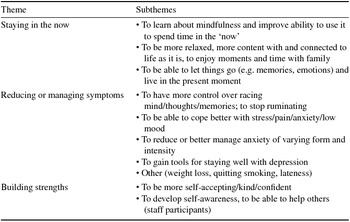
We used thematic analysis (Braun & Clarke, Reference Braun and Clarke2006) to examine the key questions of interest from the feedback forms. The analysis of participants’ written feedback comments (both patients and staff) revealed several main themes/categories. Table 1 outlines the themes emerging from the question: ‘What did you want/hope for? What was the main goal you wanted to achieve?’
Themes and subthemes regarding hoped for changes

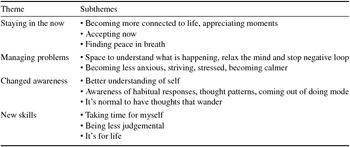
Table 2 outlines the themes identified in response to the question: ‘What have you learned/gained during the course?’
Themes and subthemes regarding the benefits of the course

Responses to the question ‘How important out of 10 the course has been for you and why?’ were available from 42 patients. The average score was 8.5, indicating that the programme was experienced as important.
In line with these high ratings of importance, the qualitative answers to this question were very positive, indicating that participants found the course to be beneficial. The responses to this question echoed the above categories (Table 2) and included the following examples (selected from six of those patient participants who gave permission for us to use their words in this paper):
It's completely changed my way of thinking, how I spend my time and how much I worry. It's made me recognize the importance of ‘me time’ and build this into my life. It's made me slow down, recognize the things in life I enjoy and learn to accept uncomfortable, unpleasant feelings. I also feel more confident as I am not constantly striving to be perfect at everything.
This course, in conjunction with other therapies, has given me the first time in 22 years to face up to the past with a realistic prospect of coping and accepting that the past is indeed the past and I cannot change it.
I have found it extremely helpful to be given practical help to spend some time on me. Having an excuse to shut the world off and just be by myself in the present moment is a great thing and will hopefully give me the grounding I need to carry on.
MBCT has helped me to focus on me and what I actually think and feel rather than what I think I should be thinking and feeling. It's helped me settle and ground myself through breathing practice. I feel that MBCT has given me a freedom to recognize that thoughts are just that.
Over the course of the course, I have grown, changed my thinking and outlook, developed an inner confidence and resilience in a way in which I could not have imagined. The course came at the right time for me – when I was ready to embrace a new approach to my life and find new ways to approach my issues. You have participated rather than taught the course, which has made the work even more powerful.
The course has shown me the tools to help cope with my negative thinking much more effectively and to realize how important it is not to live in the past or the future, but to be aware of enjoying the present for what it is. The meditation exercises help alter my automatic negative thought pattern. I didn't have any expectations that it would make any difference but I think it can help. It's also made me more aware of how self-critical I am and how damaging this can be.
Feedback from referrers
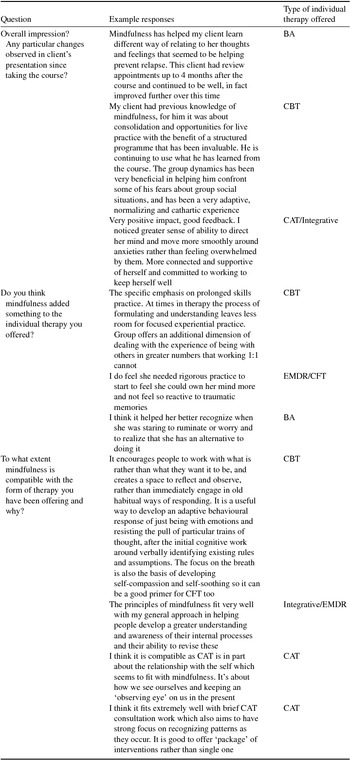
Alongside the impact on symptom reduction and value to participants we aimed to evaluate therapists’ perception of the compatibility of MBCT with therapeutic interventions delivered in one to one format. Seventeen referring clinicians provided feedback on MBCT's compatibility, returning 27 feedback forms. Twenty-five of these included numerical ratings the compatibility of MBCT with their therapeutic approach with the referred patient: 20 rated it extremely high (10/10) and five rated it as very high (8–9/10). See Table 3 for examples of the qualitative comments from these forms.
Examples of referrers’ feedback

BA, Behavioural Activation; CAT, Cognitive Analytic Therapy; CBT, Cognitive Behaviour Therapy; CFT, Compassion-Focused Therapy; EMDR, Eye Movement Desensitization and Reprocessing.
Discussion
The results of this evaluation provide initial evidence that MBCT is feasible and effective when delivered in a secondary-care PPS to groups of mixed-diagnosis patients, as an adjunct to a variety of therapeutic approaches. Our preparation of referrers appears to have been successful, with only one assessed patient not offered a place on the course. The course seems to have been an acceptable intervention to patients, with high levels of attendance and low drop-out rates (cf. Strauss et al. Reference Strauss, Cavanagh, Oliver and Pettman2014, who report drop-out rates of 8–38% in RCTs). Furthermore, our secondary-care participants rated the course as important to them at a similar level to Radford et al.’s (Reference Radford, Crane, Eames, Gold and Owens2012) primary-care patients. Qualitative feedback from both patients and referrers was mostly very positive, and indicates that MBCT can be offered as an adjunct to individual therapy of different types. Finally, despite the complexity of our participants’ problems, statistically significant change was observed on outcome measures, which in conjunction with the qualitative feedback indicates that the course had a positive impact.
Although Teasdale et al. (Reference Teasdale, Segal and Williams2003) caution against injudicious use of MBCT, they also recognize that mindfulness practice may positively affect processes common to different presentations. They stress the importance of individual formulations, both to improve outcomes and to prevent the possible adverse effects of mindfulness practice, and this was addressed in our assessment sessions. Our results indicate that, as a group, our diagnostically diverse participants experienced significant improvements in symptoms, which adds to the growing evidence supporting this way of offering MBCT (Radford et al. Reference Radford, Crane, Eames, Gold and Owens2012; Green & Bieling, Reference Green and Bieling2012). Strauss et al.’s (Reference Strauss, Cavanagh, Oliver and Pettman2014) meta-analysis of mindfulness-based interventions for people with a current episode of anxiety or depression found significant reductions in symptom severity for depressed patients; however, improvements in anxiety symptom severity were not statistically significant. The inclusion in our study of participants who would meet diagnostic criteria for anxiety disorders may therefore have weakened our findings. Given that our evaluation had good results, it could be that many of our patient participants had co-morbid depression and anxiety. Arch & Ayers’ (Reference Arch and Ayers2013) evaluation of a shortened mindfulness-based intervention for anxiety found that patients with significant depressive symptoms or unipolar mood disorders had better outcomes at 3-month follow-up than those offered a CBT intervention. In order for us to address these issues it would have been useful to collect full diagnostic data; however, this would not have fitted with our clinical approach.
As a service evaluation we did not have a comparison or control group, nor did we attempt to control for other factors which may have impacted participants’ symptoms (other interventions, medication changes, life events, etc.) so we cannot definitively attribute the observed changes to the MBCT intervention. Furthermore, the quantitative analysis is based group averages, which disguise individual patterns of change: for example, we know that three participants’ scores worsened on the outcome measures over the course of the group. While we know that most of the course participants were not receiving individual therapy at the same time as attending the course we did not formally record this, nor did we record use of other support accessed during the course. In hindsight, it would have been useful to use a measure designed to capture changes relating directly to the mindfulness intervention, such as the five Facets Mindfulness Questionnaire (Baer et al. Reference Baer, Smith, Hopkins, Krietemeyer and Toney2006) to explore the relationship between mindfulness skills and changes in symptoms. It would also have been useful to collect information on mindfulness practice between the sessions as there is evidence that regular formal homework practice (i.e. 40 min) a minimum of three times per week enhances the benefits obtained from attending the MBCT courses (Crane et al. Reference Crane, Crane, Eames, Fennell, Silverton, Williams and Barnhofer2014). The evaluation could have also benefitted from a more robust approach to collecting the symptom outcome measures; there were a number of problems with incomplete forms or missing data (e.g. ID number).
Our positive findings are likely to have been influenced by the referral of appropriate clients from interested clinicians who already had positive beliefs about the potential benefits of mindfulness, many of whom had completed an MBCT course themselves. We have considered whether there could be other reasons for our positive findings. The staff who participated had other work relationships with facilitators and may have been inclined to provide positive feedback in order to maintain good relationships. The positive nature of the qualitative feedback was possibly also influenced by the nature of the questions (e.g. ‘What have you learned/gained during the course?’) although we did also ask about obstacles and costs. Given the nature of the evaluation, we did not have feedback from those who did not complete the group and it is also possible that those patients who were most engaged in the course were the best at fully completing the outcome measures. Furthermore, we are aware that there is potential bias relating to participants’ agreement to use their quotes in this paper: perhaps those who gave us permission to use their quotes had also given the most positive feedback. Finally, we are also aware that there is a potential for positive bias in the feedback provided by participants, given that the outcome and qualitative data were collected at the last session by the facilitators, although this ensured high levels of completion.
There is no follow-up data at the time of writing, but we hope to collect follow-up data from patients to establish whether gains were maintained. A recent study indicates long-term maintenance of improvement in a heterogeneous group of primary-care patients (Mitchell & Heads, Reference Mitchell and Heads2015). We would also like to monitor re-referral rates to the service in order to establish whether there is a longer term impact of the intervention on the utilization of services. This would allow these patients’ data subset to be compared to a service norm. Findings from a recent study examining the impact of MBCT on healthcare utilization (including A&E visits and psychiatric input) over a 7-year period suggest that MBCT can have the added benefit of reducing distress-related high healthcare utilization (Kurdyak et al. Reference Kurdyak, Newman and Segal2014).
We would like to further explore the experience of our staff participants, as this sort of intervention has been shown to have good benefits for mental health staff (Ruths et al. Reference Ruths, de Zoysa, Frearson, Hutton, Williams and Walsh2013; Marx et al. Reference Marx, Strauss and Williamson2014). While ratings of the personal importance of participation in the MBCT course were generally high for both staff and patients, they were slightly lower for staff participants. This may indicate the mixed group format of delivery is less acceptable for them than for patients, as was the case in Moorhead's (Reference Moorhead2012) feasibility study of mindfulness groups for patients, staff and carers. However, it may simply be related to the fact that the changes experienced by staff were less marked, since staff had generally lower symptoms ratings at the start of the course.
Summary
While there is growing evidence that MBCT is helpful for a range of conditions it is a high demand intervention involving practical and psychological challenges for patients. This evaluation describes how we enabled the intervention to be embedded in a wider psychological therapy service. The mindfulness skills course resulted in benefits for patients and proved to be compatible with a variety of other therapeutic approaches. We believe that these groups can enhance service delivery in secondary care; as one of our referrers stated: ‘it is an invaluable part of the PPS service and it is good to offer “package” of interventions rather than single one’. This paper was intended to be relevant to mental health practitioners interested in offering MBCT courses in similar clinical settings and we hope that this contributes to the dissemination of MBCT across services.
Final word
While it is unusual in a journal article, we wish to end with the comments of one participant, who wrote the following when approached for permission to use quotes from their feedback form (some identifying information removed):
On completion of the course, I returned to full-time work for 9 months, before resigning and launching into freelance . . . consultancy. I now work 1–2 days a week, earning a bit less but have time to volunteer in my community, fundraise for mental health charities, bake, and LIVE!
Since last December, I have been in a fantastic, supportive and fully intimate relationship . . . and to think last time you saw me I could barely shake hands!! I am hoping to reduce medication in the months ahead.
Thank you doesn't come close – your skilful leading of the course and the power of learning within and from the group changed my life in profound ways and helped me to move on from a life barely worth living to a place of contentment and fulfilment.
Ethical standards
Ethical approval was not required as the project involved an evaluation of psychological service provision using information collected as part of routine clinical practice. The ethical standards of our professional bodies have been adhered to.
Acknowledgements
We are grateful to all patient and staff participants and referrers for their participation. We thank Julie Gallagher for the administration support of the courses and help with the preparation this paper. We also thank Rebekah Sutherland for help with statistical analysis, Alistair Smith and Sally Rose for their helpful comments on the earlier version of this paper and ongoing support with this implementation project. We express gratitude to Helen Radelaar, who provided initial strategic support within the service.
This research received no specific grant from any funding agency, commercial or not-for-profit sectors.
Declaration of Interest
None.
-
(1) To enhance practitioners’ awareness of the adaptability of MBCT intervention and its potential compatibility with other therapeutic approaches.
-
(2) To provide practice-based evidence for the feasibility and potential benefits of implementation of MBCT with heterogeneous populations.
-
(3) To encourage implementation of MBCT in secondary-care NHS settings across adult and older adult populations.



Comments
No Comments have been published for this article.