A Zaramo oral tradition tells of an immigrant Khutu elephant hunter named Kibamanduka, who agreed to protect coastal people from Kamba invaders in exchange for recognition as paramount chief – called the pazi – and for a tribute that included salt and cloth.Footnote 1 One version of the story holds that the cloth tribute was originally as much as could be piled to the top of an mvinje tree, but Kibamanduka's sister persuaded him that an annual tribute would be more profitable. Descendants of Kibamanduka thereafter assumed the title of pazi, and many of the region's chiefs in subsequent years took on both the title of pazi and the claim of descent from Kibamanduka. This tradition and its variations suggest that the exchange of ivory for cloth was an important economic basis for the consolidation of Zaramo political authority in nineteenth-century Tanzania. Ivory dominated the East African export market at Zanzibar, and historians have identified it as important to the formation of many mainland polities.Footnote 2
Although the East African ivory–cloth trade nexus is well known, less explored are the connections between political consolidation and the trade in the second most desired mainland product for most of the nineteenth century, ‘gum’ copal, used for high-value varnishes. Copal is among the African trade goods frequently mentioned in explorers' reports and scholarly studies, but its unique geographic location, methods of extraction and importance for economic, social and political development have been neglected. This omission is not just neglect of a specific commodity, but stems from a general inattentiveness among historians of Africa to landscapes of extraction of commodities such as ivory, wax, copal, game, animal skins, charcoal, mangroves and other woods.Footnote 3 The history of the copal trade adds an important dimension to our understanding of political formation in nineteenth-century Tanzania in a narrow belt of the coastal hinterland that produced a variety of copal that was considered to be the best in the world. This region lacked other commodities valued in East African trade networks, such as cattle, sesame and coconuts, and its ability to supply ivory from its own environs was also waning. Although some regions of the coastal hinterland, notably the lower Rufiji River, were able to produce exportable quantities of grain in good years, it was not on the scale of the grain belt of the coast. Despite these obstacles, distinct polities and networks of authority emerged in the nineteenth-century coastal hinterland in large part due to the ability of its leaders to control the lowland dry coastal forests that were distinct to this region and the only East African sources of copal. Locating copal extraction in a specific time and place demonstrates why this commodity and its environment contributed to the evolution of patronage and authority. This geographical framework also adds a more nuanced understanding of the trajectory of colonial conquest at the end of the nineteenth century, when the demand for copal waned relative to wild rubber, a product of more diverse landscapes. The copal economy would have its virtual demise with the emergence of colonial rule and conservation policies that severed coastal hinterland communities from their forests.
THE COPAL–CLOTH TRADE NEXUS AND THE MAPPING OF THE COASTAL FORESTS
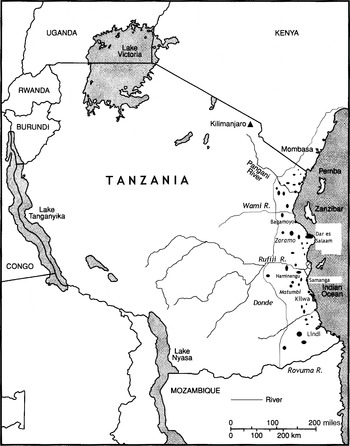
Unlike ivory, which came from a moving frontier as elephants near the coast were hunted out or migrated inland, copal came from a fixed region and distinct landscape, the fragmented forests of the East African coastal hinterland, stretching from southern Somalia in the north well south into Mozambique and Madagascar. Coastal forests are dry lowland or hill-land forests sandwiched between the Indian Ocean littoral and the Eastern Arc montane rain forests (see Fig. 1). There are some 66 coastal forests in Tanzania and some 200 along the East African coast, surrounded by savannah woodlands and cultivated land. Coastal forests are distinct biota from rain forests because of their annual 3- to -5-month dry season.Footnote 4 They are continuous stands of trees with a canopy layer, ranging in altitude from sea level to 750 m. Once connected to the rain forests of Central and West Africa, the coastal forests were separated about 20 million years ago by the uplift of the Central Tanganyika Plateau. This created ‘island’ environments in which indigenous forest plants and animals adapted to water scarcity, making for a large number of unique species, including the copal tree. Copal is a product of the Hymenaea verrucosa tree, known in Swahili and the Indian Ocean as msandarusi and among Bantu-speaking farmers of the coastal hinterland as mnangu.Footnote 5 Copal trees were rare directly on the coastal plain and disappeared west of the coastal hinterland only 200 km inland.
Coastal forests of Tanzania.

This specificity of location is important to the argument here that the copal trade was vital to the consolidation of many of the dominant lineages of the narrow belt from roughly the Wami River in the north to the Rovuma River in the south in modern Tanzania, and perhaps much further south in Mozambique. Although other gums and resins found in other parts of Africa and the world could be used for varnishes and lacquers, copal had unique properties that made it especially desired by traders from North America and Europe. These qualities gave those who controlled the coastal forests a decided trade advantage for most of the nineteenth century, when the demand for copal reached its peak on world markets. Control of copal provided hinterland polities with the ability to accumulate material wealth that enabled them to negotiate relations of protection with ‘big men’ like the ivory trader Kibamanduka, or to establish bases of power and security in their own right. The nineteenth century was also a time when Arab and Swahili slave-owning planters under Zanzibari suzerainty grew coconuts, sugar cane, grain and sesame along the coast, threatening to expand into nearby coastal forests and their environs. Copal provided hinterland communities with a negotiating leverage and power bases to ward off this and other threats, while integrating hinterland communities into the Zanzibar commercial orbit as both consumers and middlemen. Historians have become aware in recent years of how consumers, including East Africans, shaped nineteenth-century patterns of global commerce.Footnote 6 Integral to this leverage as consumers was an equivalent control over the extraction and exchange of highly desirable exports. In nineteenth-century East Africa, where there was no superordinate political authority away from the coast, trade wealth was the basis of patronage relationships that had the power to reorder societies.Footnote 7 In the absence of other significant marketable commodities, copal gave hinterland polities access to prestigious imports such as cotton cloth, wire and beads, and enhanced power outright when traded for firearms and gunpowder. These products in turn enabled emergent chiefs to strengthen local patronage relations, attract followers and dependents and assert a limited territorial control that centered on the coastal forests.
Extant local evidence points to the importance of copal in nineteenth-century political formation. Southern Zaramo traditions, for example, hold that the dominant lineage was founded by an elephant hunter named Kibasira who migrated east where the trade in ‘gum’ to coastal Arabs ‘augmented his prestige’, enabling him to maintain his power base.Footnote 8 Kibasira formed an alliance and blood brothership with an immigrant leader named Matimbwa from Kitope, south of the Rufiji River, who founded a chiefly lineage among the Ndengereko of the coastal plain.Footnote 9 The name kitope (pl. vitope) is a Matumbi word designating a place of exceptional fertility, and the area had two principal sites south of the Rufiji that were important sources of copal.Footnote 10 One was surrounded by a forest known as Naminangu, meaning ‘the place of the copal trees’. The other was located at Muhamiri forest about 160 km from the coast, which was the most extensive single site of copal trees south of the Rufiji. Matimbwa himself had branched off from earlier Hehe migrants from the west who occupied the Matumbi and Kichi hills and founded polities of the same name.Footnote 11 While some oral accounts give a vague chronology of these migrations as having occurred some 400 years in the past, others are more definite that the most recent migrations occurred during the first decades of the nineteenth century.Footnote 12 It was at that time that the copal trade began to take off as the most important link between coastal hinterland communities and Indian Ocean traders.
Copal was traded into Indian Ocean networks for thousands of years along with a variety of other resins and gums such as gum arabic, myrrh and frankincense.Footnote 13 Copal was among the products traded during the genesis of Swahili coastal communities between the eighth and tenth centuries AD, and was burned as incense in religious ceremonies at Jerusalem and Mecca during the middle ages.Footnote 14 Copal was mixed with oils to coat paintings in medieval Europe, a process which led to its recognition as a superlative varnish on account of its hardness and color. European penetration of the Indian Ocean after 1500 created new outlets for the substance known as ‘Bombay copal’ or ‘Calcutta copal’. In 1591 the first English ship to visit Zanzibar left with half a ton of copal.Footnote 15 Copal allowed European varnish manufacturers to make a product that could rival Chinese and Japanese lacquers in beauty and hardness. By the seventeenth century ‘Zanzibar copal’ was in high demand in Europe for coach varnish based on intricate formulae and processes that were closely guarded from rival coach makers. In 1653 a merchant with the English East India Company at Zanzibar was informed by a mainland ruler that he would be able to find good trading there of ivory, beeswax and ‘Sanderoos’, ‘A Gumm like Amber’.Footnote 16 The copal trade took off with European settlement in Asian trade ports, which created a demand for carriages, for other conveyances such as palanquins and for furniture.Footnote 17 Small quantities of copal – a little less than $500-worth, or perhaps 4,375 lb – found a market in Bombay in 1802.Footnote 18 The next year, ten times that amount was fetched at Bombay, doubling again by 1815, by which time the Bombay market was well established. In the 1840s some 420,000 lb of copal per year were traded to Bombay, which might have been the height of this branch of the copal market. The Bombay trade was facilitated by the migration of Indian traders to East Africa since the mid eighteenth century, who became essential middlemen of the copal trade between Africans and Westerners.Footnote 19
As with other ‘legitimate trade’ commodities of nineteenth-century Africa, the real boom in the copal trade came with the rise of a Western middle-class culture and the demand it created for finished furniture, household ornaments, pianos and, most importantly, carriages, all of which required large quantities of varnish. From the late eighteenth century, commercial varnish makers emerged in England, the first in Surrey in 1791. The first American commercial varnish factory was founded in 1815 in Philadelphia and others followed shortly thereafter in New York and Boston to supply a rapidly expanding carriage industry.Footnote 20 By mid-century an emergent railway industry created a new demand for railway car varnish that would sustain the copal trade well into the twentieth century.
Fossil copal's specific properties set it apart from other resins and copals found in Africa and other parts of the world. ‘True copal’ was a fossilized resin resembling amber found several feet below living copal trees or in the red laterite soils where living trees once stood, perhaps thousands of years before.Footnote 21 Fossil copal was not soluble in water or alcohol, but had to be melted to produce varnish, strictly speaking excluding this type of ‘gum copal’ from the category of gums. Generally, copal found at the greatest depths was the most fossilized, thus the most labor-intensive and valuable. Once extracted from the ground, fossil copal underwent a contracting process that gave it a ‘goose flesh’ surface. This and its amber shade distinguished it from fresh copal resins, called msandarusi mti and chakazi, which were collected from incisions on the tree or from recent drippings in the ground.Footnote 22 These ‘white’ copals, though inferior products, still found a market as ingredients in lesser-grade varnishes, typically fetching half the price of fossil copal. About 8 lb of copal, mixed with turpentine and linseed oil, could produce 5 to 8 gallons of varnish, depending on grade.Footnote 23 The finest carriage varnishes had high melting points, dried quickly, resisted cracking in the sun and deterioration in moist climates, were elastic and had pleasing shades.
The boom in the copal trade came with the entry into the East African market of Americans, especially merchants from Salem.Footnote 24 The first Salem ship arrived in Zanzibar in 1826, and the second arrived home in 1827, ‘carrying a valuable amount of gum copal’.Footnote 25 In 1832 the Black Warrior returned to Salem from East Africa ‘bringing the largest cargo of gum copal yet received. Makers of fine varnish and lacquers gobbled it up so greedily’.Footnote 26 By 1845, American traders dominated the Zanzibar market, by that time taking 42 per cent of copal compared to Bombay's 28 per cent and Britain's 24 per cent. In that year a total of 42,500 frasila (1,487,500 lb) of copal were traded from Zanzibar, all coming from the mainland's coastal forests.Footnote 27 In 1859, New England merchants took 68 per cent of East African copal compared to Germany's 24 per cent, with British India taking most of the rest.Footnote 28 Supply disruptions caused by the American Civil War displaced Americans as the dominant traders in copal and other East African produce. By the end of the war, the American share of copal dropped to less than 20 per cent compared to Germany's 45 per cent and France's 35 per cent.Footnote 29 The opening of the Suez Canal in 1869 gave European traders a decided advantage over the Americans in the import of copal and other goods.Footnote 30 In 1870 the last Salem ship returned home with a load of copal from Zanzibar.Footnote 31 By the 1880s, Germany, India and Hong Kong were the most important destinations for East African copal, although copal trans-shipped through British ports still accounted for 10 per cent of American imports from East Africa.Footnote 32
The rise of the American and European trade in the early nineteenth century was important enough that the Omanis who dominated Zanzibar came to rely on the export and import tolls that it accrued. From early in the century the sultan prohibited Westerners from trading directly on the mainland so that the transit trade could be taxed through Omani-appointed officials in coastal towns. By the late 1830s the importance of ivory and copal led the sultan to monopolize these two commodities along the coast from Mombasa in the north to the Rovuma River in the south, roughly the coastline of modern Tanzania.Footnote 33 This coastal monopoly exacted a fixed 20 per cent duty on ivory and copal.Footnote 34 North and south of this region the duty on copal was 5 to 7 per cent of market prices which climbed from about $4 per frasila (p.f.) in 1830 to $8 p.f. in the 1840s and $9 p.f. in the 1860s.Footnote 35 This lower tariff was meant to encourage the copal trade in peripheral areas that the sultan could not control. The vast bulk of East African copal was traded from the mainland opposite Zanzibar.Footnote 36 Although the duty increased the price for copal paid by European merchant houses, it did not deter the trade, so desirable was East African copal to Western merchants and varnish makers. In 1848 some 1,872,500 lb of copal were exported from East Africa, and between 1859 and 1865 copal exports ranged from 800,000 to 1.2 million lb per year.Footnote 37 In the 1860s copal purchased for $9 p.f. in Zanzibar fetched as much as $21 p.f. in Salem.Footnote 38
Whereas copal was mentioned only incidentally in travelers' reports before 1820, by mid-century one of the aims of explorers was to identify its sources. Indeed, the coastal hinterland was mapped largely based on the location of copal diggings.Footnote 39 British abolitionists hoped that trade in ‘legitimate’ products such as copal would displace the East African trade in slaves, although generally the trade in all mainland products was carried out in concert with the slave trade. Frederic Elton's observations are by far the best source on the copal trade and the copal extraction process in the coastal hinterland from Dar es Salaam to Kilwa.Footnote 40 Journeying south in 1873, he noted that virtually all villages were engaged in copal digging, and that the land was so honeycombed with copal pits that it created a hazard for pack animals. Although Elton visited only a few of the copal diggings personally, his informants told him that the entire range of hills and forests that marked the ‘border’ between the Swahili coast and the hinterland possessed abundant copal diggings. Near the caravan port of Mbwa Maji, 21 Indians were engaged in ‘a considerable trade in copal’.Footnote 41 Elton wrote that copal ‘constitutes the most lucrative commerce of the Indian settlers’ in the many small trading towns located at the coast and on the main inland trade route, and was also ‘the principal business’ of the Rufiji region. The entire right side of the main route south to the Rufiji River consisted of old copal workings: ‘Everywhere signs of copal diggings were visible. In fact we were passing through the main fields from which the Zanzibar market was once almost entirely supplied, and which still produce this valuable gum in considerable quantities’.Footnote 42
Whereas specialist hunting networks organized by territorial chiefs controlled the ivory trade, copal was a commodity of local societies, requiring only modest technology, mainly iron hoes and wooden digging sticks. Village headmen controlled copal digging by using a variety of taboos to determine access to coastal forests in which ancestors were buried or potentially malevolent spirits resided.Footnote 43 Elton noted that ‘the natives are only too ready to unite against the slightest encroachment on their monopoly’ and was himself confronted by some 800 armed men near the Rufiji River, who believed he was there to disrupt their trade.Footnote 44 Each gang of copal diggers was led by a ‘big man’ (mtu mkuu) who determined how the product would be traded and its profits distributed.Footnote 45 Six hours march south of Mbwa Maji, Elton came across a group of copal diggers, local villagers who worked in parties of twenty to thirty that fanned out in small groups to locate copal trees. The method used involved first probing test holes beneath the trees, about 2 feet deep, to prospect for fossil gum, then, if gum was found, this was followed by digging out a complete square to a depth of about 3 feet. After being completely gone over for fossil gum, a new square was started in the same way until the ground beneath the tree had been entirely excavated. Further south Elton observed that:
in the early morning, strings of natives are seen on the paths, each party led by a few men armed with old muskets and bows and arrows, and consisting of women and lads carrying copal baskets, and, except during the very dry season, these arrivals take place daily.Footnote 46
Copal digging was seasonal activity, one American merchant reporting in June 1845: ‘At present there is no Gum on hand as it is the harvest of Corn, after which Gum is collected’.Footnote 47 Fossil copal was most likely to be acquired during the rainy season when soils were soft and greater depths could be reached.Footnote 48 After sufficient copal had been collected, negotiators contacted Indian traders and began a lengthy process of bargaining over the price. Extractors often mixed fossil copal with inferior copal resins, and sometimes with other adulterants like sand and gravel in attempts to inflate the price. From $3 to $5½ p.f. were paid to copal sellers in the mid 1870s.Footnote 49 At that time Western merchants in Zanzibar paid about $9 p.f., after Indian merchants took their share and the sultan's duty of 20 per cent was added.
Once Indian middlemen purchased copal at coastal and inland stations it was sent to Zanzibar for cleaning and sorting.Footnote 50 Before 1857 Salem merchants preferred to clean their own copal when it reached home, enabling them to keep the price per frasila $1–$2 lower at the Zanzibar market.Footnote 51 More usual was for the copal to be cleaned in Zanzibar by ijara slaves, who received wages of 6 to 12 cents per day.Footnote 52 Sometimes copal cleaners spirited some of it away to sell on their own at a later time.Footnote 53 Cleaning was done by first soaking the copal in a soda solution for 36 hours to get rid of dirt and other impurities. Once removed from the soda solution it was dried on rooftops, then brushed clean piece by piece. Usually Western and Indian merchant houses awaited copal that they purchased far in advance. In the 1860s there were eight Western merchant houses that traded copal, but by the 1870s there were only five: three American and two German.Footnote 54 Each merchant house had a different method of classifying copal according to color and size. A single ship might export as much as 70 tons of copal in a good year.Footnote 55 Varnish manufacturers classified the copal again according to degrees of hardness and solubility.Footnote 56
Without an African demand for imported commodities, especially cotton cloth, the copal trade would not have developed, since American traders were keen on marketing their products to Africans in order to pay for the long, expensive, dangerous trip to the Indian Ocean, and Africans would not have extracted copal without sufficient incentive.Footnote 57 The peculiar evolution of the New England textile industry gave this region an advantage over the British and Indian textile industries in supplying cotton cloth to East Africans. From the late 1780s New England's early textile entrepreneurs adopted Arkwright's water frame for mechanized spinning, which produced a strong, coarse cotton yarn that could make use of American long-staple cotton.Footnote 58 Under the aegis of the Boston Manufacturing Company after 1815, cotton spinning and weaving was integrated into a single factory by adopting power looms, in part because hand weavers were in short supply. The goal of the Bostonians was to create a single, uniform cloth, a ‘plain, coarsely woven, but durable fabric’ that could compete with hand-woven Indian coarse cotton cloths on the American domestic market.Footnote 59 Combined with protective tariffs when the industry was in its infancy, close access to American raw cotton sources through coastal shipping, a cheap raw material owing to its reliance on slave labor, and access to cheap rural female labor near the factory towns, the Bostonians specialized in manufacturing a strong, inexpensive cloth that bumped Indian textiles out of the American market and then went on to out-compete Indian textiles in East Africa at a time when the British were preoccupied with supplying a multitude of domestic and international tastes in cotton cloth. Merikani, as the cloth was called in Swahili, dominated East African markets, and by mid-century was as cheap to produce per yard as Indian hand-loom textiles. In 1859 Americans supplied 51 per cent of textile imports into Zanzibar compared to 29 per cent from British India and 21 per cent from Britain.Footnote 60 American cloth imports into Zanzibar rose steadily from 4,250 bales (one bale equaling 750 yards) worth $239,655 in 1848 to 6,950 bales worth $421,850 in 1856. In that year American purchases at Zanzibar totaled $565,925, 63 per cent of which was copal.Footnote 61
Cloth and other commodity imports ‘opened’ the economies of the Tanzanian coastal hinterland, allowing otherwise subsistence societies to accumulate material wealth. The value of cotton cloth went far beyond clothing.Footnote 62 Anthropologists note that cloth is a unique commodity in its ability to ‘mediate between self and society’ and express status and identity.Footnote 63 Headmen who controlled copal trading also presided over cloth distribution according to established hierarchies of patronage. In this respect the copal–cloth networks of the coastal hinterland ‘helped to consolidate many a political system’, especially during a period of rapidly shifting ethnic identities such as that of the nineteenth century in East Africa.Footnote 64 The ability of a pazi to accumulate cotton cloth (and other commodities, including beads, copper wire and grain) to attract a following and thereby strengthen his society was a key factor in coastal hinterland politics.Footnote 65 Burton noted that almost all Zaramo men and women wore cotton cloth, making them distinct from peoples further west beyond the copal belt who were not able to corner the caravan routes or trade their own products. Cloth thus allowed Zaramo, Rufiji and other coastal hinterland peoples to establish trading links with people further inland. At mid-century, traders at the coast could obtain a six-foot length of merikani cotton sheeting from Salem for 25 cents and sell it in the interior for one dollar.Footnote 66 At about that time one copal digger's daily product – about 10 to 12 lb – might earn one dollar in the hinterland, and three times that on the coast.Footnote 67 The cloth–copal networks were important for survival, since cloth could be traded for food in times of famine. American traders were well aware of this connection, one writing (in reference to the Madagascan port of Majunga) ‘it is the beginning of the rice season & they want Cottons to buy rice with’.Footnote 68 The explorer Beardall noted in 1880 that Kichi and Zaramo people brought copal down the Rufiji River to trade for rice and cloth.Footnote 69 Accumulated wealth also enabled hinterland communities to retain their food reserves for their own use. Thomson noted of the Makonde in 1882:
Owing to the large amount of rubber and copal which they are able to collect each year, they have become exceedingly saucy and difficult to deal with. We found it almost impossible to buy food from them, as at that time they did not choose to dispose of their surplus grain and, indeed, prefer to turn it into native beer.Footnote 70
The widespread adoption of cloth led to transformations in perceptions of style and status that were influenced by interaction with coastal Swahili town and material culture and the gradual penetration of Islam into the hinterland.Footnote 71 This association between cloth and status affected men before women, since male porters and traders came into more direct contact with coastal culture, were influenced earlier by Islamic norms and had prior access to cloth. Elton noted in 1873 that Rufiji people only desired to trade for ‘“kaniki” [Indian calicoes], firearms, and powder’, and observed that many Rufiji men wore a piece of blue cloth around the waist, but only some women wore blue kisutu cottons.Footnote 72 Twenty years later Behr believed cotton cloth to be fairly generalized among Makua people near the Rovuma River, while further west people still wore pelts and leather.Footnote 73 As the possibility of obtaining cotton cloth through trade increased during the nineteenth century, social traditions changed to reflect this new commodification – for example, women were able to acquire cloth through marriage. In the hinterland of Kilwa in the 1890s the bride price paid to a woman's father could be as high as $50, half of which went to the bride, including marriage cloth.Footnote 74 A man's absence for three years without providing a woman with food or cloth was grounds for divorce. This meant that there was steady pressure to maintain trade links in order to obtain cloth and other prestige goods in this cattleless region.
The copal trade also enabled hinterland societies to purchase firearms in fairly large numbers, which were used for defense against inland military societies or coastal slave raiders, and for hunting. Elton observed Rufiji men using firearms to guard copal diggers at work, and he estimated that half of the 800 men who confronted him in 1873 were armed with firearms.Footnote 75 In the late 1830s an American trading firm in Zanzibar supplied 1,000 muskets to a coastal leader in Kenya, and at least one caravan marched inland with an estimated 1,000 muskets in 1847.Footnote 76 In 1859 Americans traded 8,000 muskets and 11,000 25-lb barrels of gunpowder in Zanzibar, and other nations traded an additional 16,000 muskets.Footnote 77 The Sultan exacted a high duty on imported gunpowder and a 5 per cent duty on firearms.Footnote 78 In 1864 the Sultan assured the American consul that he did not oppose the sale of firearms and gunpowder to the mainland ‘as every increase in any branch of trade denotes increased prosperity among his people’.Footnote 79 In a six-month period between January and July 1888, 37,441 firearms, 1 million bullets, and 70,000 lb of gunpowder were imported into Zanzibar in order to provision Indian merchants for the trade to the coast.Footnote 80 At that time the British consul in Zanzibar believed that 80,000 to 100,000 firearms were imported into East Africa annually, including large quantities of ‘arms of precision and breech-loading rifles’ that competed with the trade muskets that had been imported for generations.
Trade muskets manufactured specifically for the African market effected the most far-reaching changes on African societies. Widely disparaged by modern armies, trade muskets were ‘ideal for Africa’ because they were more easily repaired by African smiths than modern rifles, thus were in higher demand.Footnote 81 It is furthermore probable that the biggest impact firearms had in Africa was not on warfare, but on hunting, and for this purpose trade muskets had advantages over modern rifles because accuracy at a distance was not important when hunting in the bush or forests, where ‘an ounce musket ball is more likely to stop the animal in its tracks’ than was a small rifle bullet.Footnote 82 Muskets facilitated the hunting of animals with a marketable value – elephants for their tusks, hippopotami for their teeth, buffaloes for their horns. During the nineteenth century, muskets supplemented or replaced spears, axes and traps used to hunt large game.Footnote 83 Muskets also facilitated the acquisition of game meat from elephants, gazelles, antelopes and other animals, an important supplement to the diet, particularly in the cattleless tsetse-infested regions of the coastal hinterland. In times of famine, availability of game meat could be a matter of group survival. Perhaps most importantly, firearms provided an edge in eradicating crop predators, particularly wild pigs, baboons, monkeys, hippopotami and elephants, all of which caused great destruction to crops and could devastate whole fields overnight. Pfund noted that an entire village along the Ulanga (upper Rufiji) was forced to relocate because of the destruction that baboons caused to the millet crop.Footnote 84 Muskets could be owned by common villagers for use against crop predators: ‘The trade musket, not intended for rapid reloading, cheap to buy, simple to repair, light in weight and with no delicate parts, would be more popular than either a military musket or a later military weapon dependent on imported parts and cartridges’.Footnote 85 Firearms altered the balance of the hunt in favor of farmers. Although elephant populations along the coastal belt were clearly in decline by the end of the nineteenth century, so were wild pigs. On some islands of the Rufiji delta, wild pigs had been almost completely wiped out, enabling people to colonize the delta islands and grow rice and cassava.Footnote 86
Although cloth and muskets were the most significant imports to effect social and political changes on coastal hinterland communities, other products, such as beads, brass wire and coins, also empowered hinterland polities to foster exchange and prestige relationships with neighboring peoples.Footnote 87 During the US Civil War, American merchants in Zanzibar were suddenly faced with a shortage of cotton goods, muskets and powder that they needed in order to acquire ivory and copal.Footnote 88 As a substitute they reluctantly paid for these goods with gold coins in an attempt to maintain their dominant trade position on the East African coast. Fifteen years later, at a time of general famine in the coastal hinterland, when the maize crop was six weeks away from harvest, villagers living on the upper Rufiji approached the explorer Beardall seeking to buy rice with dollars.Footnote 89 Other villagers weathered the crisis by traveling down river to purchase grain with coins and cloth.
Apart from their role as sources of copal, control of coastal forests offered other advantages to hinterland societies. All caravans that made their way inland and back in the nineteenth century passed through regions dominated by coastal hinterland polities, who demanded transit tolls to pass through their lands. Burton observed of the Zaramo:
The p'hazi, or chief of the district, demands a certain amount of cloth for free passage from all merchants on their way to the interior; from those returning he takes cattle, jembe, or iron hoes, shokah or hatchets, in fact, whatever he can obtain, if not contented his clansmen lie in ambush and discharge a few poisoned arrows at the trespassers.Footnote 90
The result of such tolls was that the Zaramo emerged as a prosperous people at mid-century as chiefs distributed cloth and other imports down a hierarchy of officials, who in turn distributed them among their own followers. Furthermore, if either coastal or inland peoples undertook military expeditions against them, coastal forests were used for refuge. The Zaramo, for example, built palisaded villages in inaccessible forest locations. The caravan stop at Dunda, outside Bagamoyo, was both a forest fortress and a major site of copal digging. A caravan leader reported, ‘At Dunda there is an immense forest; even their houses they have built them in the forest. If anyone came, he would not know that there was a village, not until he was actually in the village itself’.Footnote 91 The worst abuses of the Indian Ocean slave trade by-passed much of the coastal hinterland because of such refuges. While control was being asserted over the coastal forests, they also emerged as spiritual sites, burial grounds for local founding lineages, locales of sacred trees and places to conduct initiation rites. Coastal forests were synonymous with local identity.
THE DECLINE OF COPAL AND ITS COMMUNITIES
Although the demand for copal continued well into the twentieth century, its decline as a product of the Tanzanian coastal forests was noticeable already by the 1880s, the decade that saw the advent of German colonialism. The decline of the copal trade paralleled an erosion in the autonomy of hinterland communities, particularly with respect to their leverage in negotiating terms of exchange for cloth and other imports as well as cash. Copal's decline was both absolute, as the most accessible fossil copal deposits were exhausted, and relative, as world demand opened up for wild rubber, ultimately competing with copal extraction. German colonialism itself presented forest communities with major new challenges, including the encroachment of a cash crop and wage labor economy, a tax burden, and especially colonial scientific forestry that severed peasants from their forests and forest resources.
The arrival of the wild rubber economy was the earliest of these challenges to face coastal hinterland communities. Rubber emerged as an important trade commodity by the late 1870s, well before Dunlop's 1888 patent for pneumatic tires boosted global demand.Footnote 92 Coupland's figure of 1,000 tons of rubber worth about $1.5 million exported through Zanzibar in 1879, compared to $150,000-worth of copal, is probably exaggerated, yet it does attest that the rubber trade was quickly outdistancing copal extraction.Footnote 93 The importance of rubber for coastal trade was clear in 1885 when the Sultan imposed on it a 15 per cent export tax, the same as for ivory and copal at that time.Footnote 94 Initially the rubber and copal economies acted in concert to the advantage of coastal hinterland peasants, the extraction and trade of rubber first being superimposed on copal networks.Footnote 95 Sometimes rubber vines used copal trees as hosts, enabling copal diggers and tappers to add rubber tapping to their industry.Footnote 96 However, because rubber was found in much more diverse landscapes, hinterland communities could not monopolize it as they could copal. Some 38 Tanzanian tree and vine species found in different forest and woodland environments produced rubber, the most favored coming from Landolphia shrubs and vines found in savannah woodlands.Footnote 97 The most sought-after was Landolphia dondeensis, named for the Donde region west of the Matumbi coastal forests, a major rubber frontier by the 1880s.Footnote 98 Coastal traders flocked to Donde and further west, bringing cloth, gunpowder and muskets to trade, and thereby usurping the middleman trading position that Matumbi, Rufiji and other coastal hinterland peoples once had. It was much easier for tappers to extract rubber latex than it was for copal diggers to prospect at the roots of trees or in copal grounds where trees had vanished, and by the 1880s it appears that most of the obvious copal diggings were exhausted. During the 1890s, when consistent figures are first available, an average of 411,000 lb of copal was exported from the Tanzanian coast, down from an average of about 1 million lb per year in the late 1850s.Footnote 99 Whereas the average total revenue per year from copal exports for the 1890s was $85,664, the figure for rubber was $279,188. At that time a frasila of rubber brought in $19.50, while copal had slipped to about $7 p.f., a decline that reflected a greater percentage of lower-value tree copal than fossil copal. Faced with a more deficient product from East Africa, some varnish manufacturers turned to West Africa, especially Sierra Leone, as a source of good copal from a much closer market to Europe and the United States.Footnote 100
German colonial rule itself presented a major challenge to the copal economy. This began with the activities of the German East Africa Corporation (DOAG), which by 1884 acquired control over a vast swath of territory in central-eastern Tanzania that included all of Uzaramo. A few years later the DOAG received a concession from the Sultan of Zanzibar to collect tolls along the coastal strip. The treaties that legitimated these actions granted the DOAG the ‘exclusive and unhindered right to exploit mines, rivers, forests’ of these domains.Footnote 101 Coastal Swahili notables, in concert with hinterland peoples, reacted to this intrusion with a major rebellion from 1888 to 1890 that ended with the German government abrogating the authority of the DOAG and imposing direct colonial rule on the territory beginning in 1891.Footnote 102 The German government maintained the 15 per cent export tolls on ivory, copal and rubber, and began to intrude into the marketing process at coastal and inland stations.Footnote 103 German officials mandated that public auctions determine the price of copal and rubber, which enabled purchasers to manipulate price levels in their favor. By the 1890s a situation of deep bitterness developed between African copal and rubber extractors and Indian traders. In 1897 Africans around Samanga, the most important trade port for the Matumbi hills just south of the Rufiji River, reportedly lynched Indian traders, drove some into the bush and plundered their shops.Footnote 104 The tension was persistent enough for the German regime to station soldiers at Samanga and forbid Indian and Arab traders to reside or trade in some coastal hinterland villages. By the end of the decade the German government set prices for rubber, copal and other commodities, pricing fossil copal at $7 p.f., tree copal at half that price, and rubber at $17 p.f.Footnote 105 Gone were the days when copal extractors could patiently negotiate prices upward over a period of hours or days.
German colonialism strangled the copal economy. This was paradoxical in the sense that for the first time a centralized government was in a position to develop a communications and marketing infrastructure to bring a uniform, quality product onto the international market, as Western traders had long advocated. There is no reason to suspect that the German colonial government intentionally undermined the copal economy, dependent as it was on export revenues of all sorts. However, one of the defining characteristics of colonial rule in Tanzania was an incessant labor shortage for colonial endeavors, notably railway construction, cash crop plantations, porterage and peasant cash crop production.Footnote 106 Colonial conquest was built on an economy of extraction, but mature colonialism was based on production, and in German East Africa that meant primarily cash crops. Some colonialists opposed copal and rubber collection because they believed that it led to the general decline of African agriculture and colonial prosperity.Footnote 107 Under these circumstances, the colonial government prioritized how it would use limited human resources, and it considered copal extraction peripheral to other activities. This was seen most clearly with the implementation of hut taxes beginning in 1898, which made no mention of copal in the list of products that could be used to pay taxes in kind, but did allow for ‘labor in kind’.Footnote 108 Perhaps this was because there were no strong industrial interests in Germany promoting copal extraction, the Continental varnish market being dominated by British firms that procured their copal supplies from Kenya, Mozambique or West Africa.Footnote 109 The revised tax ordinance of 1905 expressly excluded copal as a substitute for tax in kind. Although some people doubtless paid their taxes by selling copal, it was in fact becoming much easier for men to enter into the wage labor economy temporarily to pay the 3 rupee annual hut tax. This was especially true as the colonial government began to take over the coastal forests and evict their peasant communities.
Colonial scientific forestry was the major challenge to confront the copal economy by the turn of the century. Based on models of forestry developed in Germany and elaborated upon under British and Dutch colonial rule in Asia, scientific forestry sought to manage forests for sustainable timber and fuel production and revenue generation through rotational harvesting and planting of economic tree species. In so doing, forests were declared to be Crown Land, and peasant communities living within their domains were relocated into villages where their labor and access to forest resources could be controlled.Footnote 110 In the decade after 1894 German colonial forest ordinances controlled African forest exploitation by requiring permits to cut wood and by regulating the timber markets. Beginning in 1904 scientific forestry moved dramatically forward with an ordinance that empowered the colonial government to declare forest reserves wherever it was deemed necessary for the public good. Colonial foresters evicted villagers living in newly declared forest reserves, and informed them in public declarations that henceforth all exploitation of trees and their produce was prohibited without express government consent. The first forests to be declared as reserves were the coastal mangroves, followed by the dry lowland forests in closest proximity to the capital, Dar es Salaam, and other coastal trading ports. It is probably a coincidence that the first coastal forest south of the Rufiji River declared to be a forest reserve in 1904 was Naminangu (‘the copal forest’).Footnote 111 In the next decade virtually all coastal forests would follow as colonial forest reserves, closing the door to the unencumbered extraction of copal. Although some of the protocols establishing forest reserves provided local headmen with concessions to collect rubber, no such concessions were granted for copal. Between 1908 and 1913 copal exported from German East Africa averaged just over 253,000 lb worth $47,139, or about $6.50 p.f., the lowest prices and quantities since the 1830s.Footnote 112 Villagers who once were able to dig and sell copal in order to obtain commodity imports that could in turn bolster their position as entrepôt traders now worked as wage laborers or market-oriented peasants.
CONCLUSION
For most of the nineteenth century the extraction and trade of copal represented prosperity and strength for coastal hinterland polities, and was an important factor in the consolidation of many societies in a region deficient in other commodities, notably ivory, cattle and oil crops. From early in the century new lineages formed around Tanzania's coastal forests, which were sites of ancestral burial grounds, sacred trees and fortress strongholds and the only sources of fossil copal, the second most valuable mainland commodity export after ivory. Western merchants, led by New Englanders, traveled around the world to obtain East African copal, considered the finest in the world for carriage varnishes, and to sell their own products, especially cotton cloth. The organized extraction and selling of copal enabled coastal hinterland polities to act as a sub-entrepôt of Zanzibar, trading cloth, beads and wire to people further inland beyond the copal belt. This gave those who controlled the coastal forests a decided advantage until the demand for rubber outpaced that for copal from about 1880. Derived from much more diverse landscapes, rubber was an industrial raw material that was almost coterminous with colonial conquest itself. During the period of the early colonial rubber boom, from about 1890 to 1905, copal producers were hard pressed to compete with a commodity that paid more, was easier to procure, and over which they held no geographical monopoly. The Germans who colonized Tanzania clearly favored rubber extraction over copal, as seen in the ability of rural communities to pay taxes with rubber after 1905, while copal was excluded. Furthermore, colonial scientific forestry prohibited unregulated access to coastal forests after 1904, sharply curtailing the ability of peasants to collect copal. Rubber, in contrast, was largely a product of savannah woodlands that were not reserved as forests.Footnote 113
The copal trade would have a modest revival under British rule following the First World War. The British encouraged African entry into the forests during the interwar years to obtain products that would add to colonial revenues, and again during the Second World War when the Japanese occupation of Southeast Asia cut off other sources of varnish gums and resins.Footnote 114 By the 1930s copal also had to compete with synthetic resins as bases for varnishes and paints.Footnote 115 Yet this was a vastly different copal economy, one based on tapping the trees rather than prospecting for fossil copal. Asked about the role of copal in their history, villagers on the periphery of several coastal forests in modern Tanzania asserted that copal was an important commodity to obtain money to buy cloth during the interwar years, but few remember it as a product dug from the ground.Footnote 116 The twentieth-century high point for Tanzanian copal exports was 1944, when about 200 tons were exported. The last year of the war collapsed the demand to 20 tons, and thereafter the copal market ended abruptly, even though colonial officials hoped that it could be used in the manufacture of linoleum for a new postwar Western consumer culture.Footnote 117 The end of copal coincided with a major new push to evict peasants of the coastal hinterland from their ancestral forests, a struggle that in many respects continues today.Footnote 118