The opera house in Leipzig opened its doors during the Easter fair in May 1693. The founding of the institution grew out of a collaboration between three men: Dresden vice-Kapellmeister Nikolaus Adam Strungk, the Venetian architect Girolamo Sartorio and Heinrich Friedrich Glaser, a lawyer from Leipzig. In 1692 the three entrepreneurs petitioned the electoral court in Dresden for a privilege to perform operas in Leipzig during the three annual trade fairs and the request was granted for a period of ten years.Footnote 1 The performances at the newly established opera house took place during the regular trade fairs after New Year’s Day, Easter Sunday and Michaelmas. While these were the only times during which performances were permitted, these were also the weeks during which Leipzig was full with visitors from all over Germany and the limited performance times were therefore the most lucrative periods to stage a cost-intensive event such as an opera production.
Although the beginnings of the opera house in Leipzig are well documented, the developments leading up to the opening of the opera are less clear, and more contentious. The older literature – such as Arnold Schering’s history of music in Leipzig, and Fritz Reuter’s history of the opera in Leipzig – suggests that a long history of secular pieces, drammi per musica, composed for special occasions and performed by local forces, led directly to the establishment of the opera house.Footnote 2 Indeed, the number of plays with incidental music in Leipzig increased significantly from 1630 onwards, and after the end of the Thirty Years’ War the composition of secular drammi per musica became increasingly popular.Footnote 3 Most of these pieces feature dialogues (often between allegorical figures or gods from Greek and Roman mythology) and have a more or less dramatic character.
Michael Maul, however, in his seminal study on the history of baroque opera in Leipzig, has recently rejected such a teleological reading. He convincingly argues that the opening of the opera house in 1693 was initiated by forces in Dresden and not from Leipzig. Any earlier pieces should therefore not be viewed as predecessors to the operas that were performed from 1693 onwards.Footnote 4 Yet while Maul is right that there is no direct causality leading from earlier drammi per musica to the founding of the opera, his criticism of the established view also has its shortcomings. In the first place, at least one of the initiators of the opera house, the lawyer Heinrich Friedrich Glaser, came from Leipzig and was very familiar with local musical traditions. Even more significant is the fact that the first librettist for the Leipzig opera, Paul Thymich (1656–94), worked as a teacher at the local St Thomas school and had been highly active as a poet of religious and secular casual poetry for years. When Nikolaus Adam Strungk composed his first operas for Leipzig, he therefore relied on someone who had been deeply involved in the creation of secular and sacred dramatic pieces in the years leading up to the founding of the institution. For about a decade, then, Thymich had gained experience as a librettist before he joined forces with Strungk. Finally, opera in the 1690s was a highly contested genre. Numerous theologians, fearing for the virtues of their flock, posed objections to the performance of musical dramas. Without local support from Leipzig, the opening of the opera house would thus have been difficult, even if it was sanctioned by the electoral court in Dresden.
In this article, I therefore argue that a number of factors led to the opening of the opera house in Leipzig: the initiative of Strungk and other forces in Dresden, traditions of theatrical and musical entertainment during the Leipzig trade fairs that went back several decades, and also the interest of local musicians and poets in the new genre of opera.Footnote 5 Whatever the limitations of arguments that seek to prove direct causality towards the establishment of the opera house, it is nevertheless important to recognise local roots as significant. Music dramatic pieces of different kinds had been a staple in Leipzig for some time and they were already woven into the social fabric of the city before the opera house opened its gates in 1693. It is therefore critical to separate the history of opera as institution from the history of opera as genre in Leipzig. To this end, I will focus here on the decade before 1693 to show how the developments shortly before the opening of the opera house laid a foundation for the establishment of the genre and to demonstrate in four case studies how local forces in the city exhibited an increased interest in dramatic music. None of these activities made the foundation of the opera house necessary, but they all supported it.
Dramma per musica: Thymich and Kuhnau
In 1683, central European armies – including the Imperial army and a contingent from Saxony – defeated the Ottomans and ended the siege of Vienna, famously marking the end of Ottoman expansion to the west.Footnote 6 This victory was commemorated all over Germany, including in Leipzig, which put on a celebration for the return of the victorious Saxon Elector, Johann Georg III, in the form of a small musico-dramatic composition, featuring a dialogue between Apollo, Fama, Mercurius and Mars. The Leipzig chronicler Johann Jacob Vogel reports in his Leipzigisches Geschicht-Buch from 1714:
Diesen Tag kam Se. Churfürstliche Durchlauchtigkeit zu Sachsen/ nach glücklich-erfreulicher Rückkunfft/ von der bey Wien wider den Erbfeind Christlichen Nahmens erhaltenen glorieusen Victorie höchst erwünscht zum ersten Mahl wieder nach Leipzig/ kehrte in das Amlungsche Haus am Marckte ein/ und ward den 3. dieses Weinmonats von denen sämtlich allda Studierenden in einer Nacht-Music unterthänigst bewillkommet und bedienet.Footnote 7
Today his Electoral highness of Saxony appeared for the first time after his fortunate return from the glorious defeat of the arch-enemy of the Christian name; he stayed in the Amelung-house on the market square and was welcomed and served on the third of October by all students with a serenade.
According to Kuhnau’s autobiographical sketch in Johann Mattheson’s Ehren-Pforte, this ‘Nacht-Music’ (serenade) was performed with the protagonists of the musical drama arriving from different directions before they joined each other on a stage.Footnote 8 The libretto was written by Paul Thymich, a supplementary teacher (Hilfslehrer) at St Thomas’s school. Thymich had studied in Leipzig and had been appointed teacher at the school in 1681; he had extensive musical training, and led rehearsals of St Thomas’s choir as well. His contribution to the festivities in 1683 is documented in the diary of the rector of St Thomas’s school, Jakob Thomasius:
Ante meridiem oblatum est mihi mittente Paulo Thymichio, Collaboratore scholae neostrae, quem ea de re rogaveream Carmen Germanicum in großfol., welches am negstverwichenen … 4. Octobr. die sämptlichen Studiosi allhier auff der Vniversität Leipzigk Ihr. Churf. Durchl. vnserm gnädigsten Herrn Joh. Georgio III. (so sich bey itziger Michaelismeß allhier eingefunden, vnd sein Quartier im Amlungischen Hause am Marckt genommen,) in einer schönen Nacht-Musik darstellen lassen. Carminis hujus initium: Mercurius: Komm, Fama, komm mit deiner Welt-Trompete etc. Autor autem Carminis fuerat is ipse, quem nominavi Scholae nostrae Collaborator Paul. Thymich, est enim poeseos Germanicae peritissimus, wie er denn auch bisher die Carmina Evangelica, so des Sontags itzo vor der Frühepredigt musiciret werden, auffgesetzet.Footnote 9
Before noon I received from Paul Thymich, a teacher at our school, the German ‘carmen’ [libretto], which I had requested [from him]. [It was printed] in large folio. [The piece] had been performed on 4 October by all students of Leipzig University in a beautiful serenade when his electoral highness Johann Georg III had been here [in Leipzig] and had stayed during the Michaelmas Fair in the Amelung-house. The beginning of the carmen [libretto] goes: ‘Mercurius: Come, Fama come with your world-trumpet, etc.’ The author of the carmen was teacher Paul Thymich himself, since he is most skilled in [the writing of] German poems, as he is also the author of the libretto for the gospels [cantatas], which are performed on Sunday mornings before the sermon.
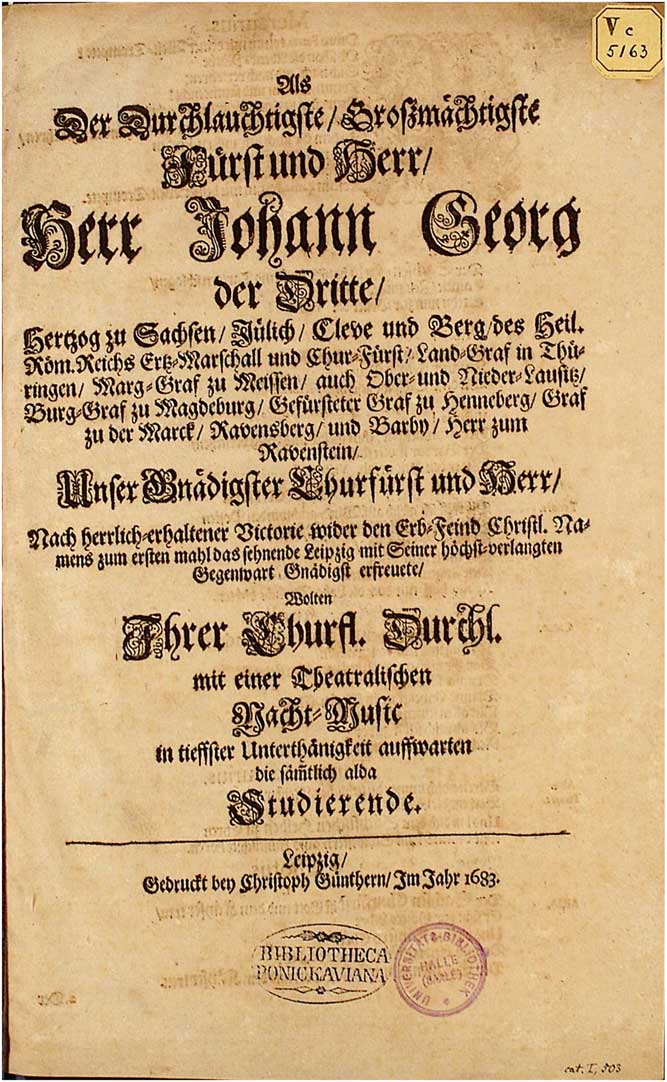
We will return to Thomasius’s remark that Thymich was also known for writing cantata texts, because it will lead to the second area in which dramatic music had its place in Leipzig. First, it should be mentioned that the music for the celebrations in 1683 was composed by Johann Kuhnau, at that time organist at St Thomas.Footnote 10 While the music is lost, Thymich’s libretto has been preserved in the University Library in Halle (see Fig. 1).Footnote 11 The print neither references the composer nor the librettist, but since Thomasius’s diary mentions both contributors and the beginning of the libretto’s text, there cannot be any doubt that the print in Halle represents the serenade in question.
[Paul Thymich], Nacht Music, Leipzig, 1683 (Halle, Universitäts- und Landesbibliothek Sachsen-Anhalt, Pon Vc 5163, FK).
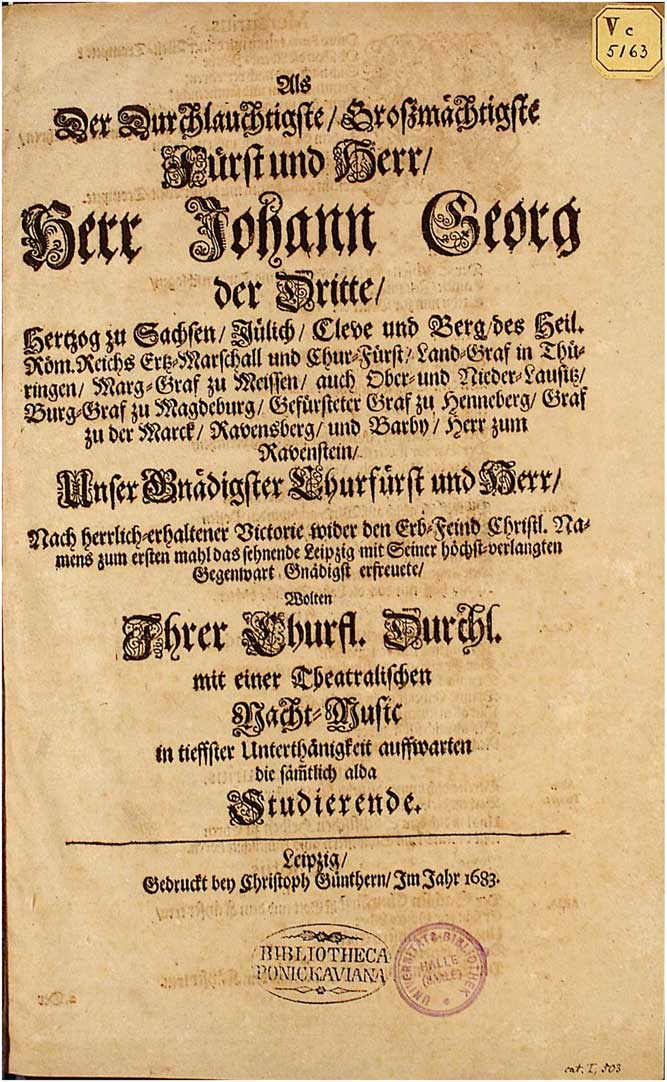
The plot of the dramma per musica expounds on the recent victory in Vienna but also takes into account the current situation in Leipzig. The four protagonists of the little dramatic scene – Mercurius, Fama, Apollo and Mars – discuss the accomplishments of the Saxon Elector, not only on the battlefield but also as supporter of the arts and of trade, both important aspects for the local community in Leipzig. Since the text had been written by a teacher and was performed by university students, its focus is not only on military accomplishments – the protagonists also insist on the importance (and even superiority) of art and education:
Apollo: Wer wüste was von Krieg und Siegen/ Wenn ich und meine Musen schwiegen?
Fama: Wer würde was vom Hector lesen/ Wenn kein gelehrter Mann gewesen?
Mercurius:Wer hörte von Æneas Ehre/ Wenn kein Virgil gewesen wäre?Footnote 12
Apollo: Who would know anything about a war victory if I and my muses had been silent?
Fama: Who would read anything about Hector if there had been no educated men?
Mercurius: Who would hear about the honorable Aeneas if there had not been a Virgil?
While the libretto does not clearly indicate individual movements, the arrangement in the print suggests that the dramma per musica consisted of eleven sections: five arias for the soloists, one choral aria and one tutti chorus (all in strict metrical organisation), as well as metrically freer sections that were sung either as recitatives or in a lighter arioso style.Footnote 13
Even though the libretto is an interesting contribution to our knowledge of Johann Kuhnau’s works and his collaboration with a local poet, the piece is even more significant for Thymich’s contribution of one of his earliest known libretti for a musical composition. As Thomasius noted in his diary in the same year, he also contributed texts for other occasions, such as the settings of the gospel texts, which show some remarkable similarities to the work he had done for Kuhnau.
Dramatic cantatas: Thymich and Schelle
During the ecclesiastical year 1683–4 the cantor of St Thomas’s, Johann Schelle, joined Paul Thymich for the creation of a cycle of sacred cantatas.Footnote 14 The cycle combined biblical texts in recitatives, hymn stanzas and reflective poetry in an innovative way, thus creating a model for Erdmann Neumeister’s cantata reform in the early eighteenth century.Footnote 15 The rector at the St Thomas school, Jakob Thomasius, described this new type of cantata in his diary: ‘the Sunday Gospel is set partly in Luther’s German version word for word … and partly in a German rhymed version; there are also strophes of the usual hymns used alternately, and also German arias’.Footnote 16
The innovative form of the cycle built on already existing models from the second half of the seventeenth century, such as the sacred dialogues that had been popular in Lutheran church music since the middle of the century, transformed biblical narratives into small dramatic scenes.Footnote 17 Another model was the concerto-aria cantata, which amalgamated the traditional sacred concerto with the modern, reflective song-like aria.Footnote 18 What was novel in Thymich and Schelle’s project was the systematic use of all these elements in a complete cycle and the introduction of recitatives as a constitutive feature. While the new form appealed to some members of the congregation in Leipzig, it was rejected by others. Soon after the cycle was begun, the Leipzig burgomaster, Christian Lorenz von Adlershelm (1608–84), voiced reservations and insisted that the new music should be abandoned and replaced with Latin church music. Lorenz von Adlershelm observed that ‘there were also people who did not like this Gospel music, and the chorales that occur in it could be sung at home instead’.Footnote 19 The conflict came before the city council, which took the side of Schelle and Thymich and allowed the cycle to continue. Lorenz von Adlershelm’s criticism, however, raised the question of what the function of church music should be. Should it be a celebration of a religious ritual (as in Latin motets) or should it be accessible and introduce forms that were familiar to the congregants from their own extra-liturgical, domestic piety? A supportive recommendation, made by Thomasius, highlights that in his view the proper form of sacred music should appeal to a broad audience. He states that Schelle’s music ‘pleased listeners at all social levels (from “plebeians” to “the erudite”)’.Footnote 20 Such attempts to create church music that could please everybody would later, in 1689–90, go one step further, when Schelle collaborated with the preacher of St Thomas’s, Johann Benedict Carpzov in a cycle of chorale cantatas, which served as a musical counterpart to a cycle of hymn sermons that Carpzov had preached the year before and that he had partly repeated in 1689–90.Footnote 21
Most of Schelle’s compositions are lost, including this cycle of chorale cantatas as well as much of earlier cycle he had created with Thymich. Only three pieces can in fact be associated with this earlier cycle: the cantata Durch Adams Fall, composed for the twelfth Sunday after Trinity 1683; the Actus musicus auf Weyh-Nachten, composed for Christmas Day 1683; and the cantata Und da die Tage ihrer Reinigung, for the Purification of Mary, 2 February 1684.Footnote 22 These three cantatas constitute only about 5% of the cycle, but they allow us to extrapolate patterns that were feasibly characteristic for the cycle in its entirety.
The cantata Durch Adams Fall tells the story about the healing of the deaf-mute in Mark 7:31–7. In his libretto, Thymich combines the biblical text with the first and seventh stanzas of the hymn ‘Durch Adams Fall ist ganz verderbt’ by Lazarus Spengler (1479–1534),Footnote 23 and Thymich’s own poetic interpretation of the gospel text. The following overview shows the structure of the composition:
Sonata (instrumental)
Chorale: ‘Durch Adams Fall ist ganz verderbt’ (stanza 1)
Recitative, tenor: Mark 7:31
Aria, canto 1
Ritornello (instrumental)
Recitative, tenor: Mark 7:32
Aria a 3, alto, tenor, bass
Ritornello (instrumental)
Recitative, tenor: Mark 7:33–5
Aria, bass
Ritornello (instrumental)
Chorale: ‘Wer hofft in Gott und dem vertraut’ (stanza 7 of ‘Durch Adams Fall’)
Recitative, tenor: Mark 7:36–7a
Chorus: Mark 7:37b and free poetryFootnote 24
The two chorale settings follow a type Friedhelm Krummacher has labelled ‘Leipziger Reprisensatz’: each line is presented either by a solo voice or by a few voices of the vocal ensemble and then repeated in a homophonic four-part setting.Footnote 25 This way, the composer moves successively through the lines of the hymn while simultaneously creating the impression of a regular ritornello-form.Footnote 26 Schelle repeats the same setting later in the cantata for the seventh stanza from the same chorale.Footnote 27 The final chorus, which is based on Thymich’s own poetry, employs a similar model. The line ‘Er hat alles wohl gemacht’ (borrowed from the gospel reading) is first sung by a soloist, followed by a repetition by the whole ensemble; then the same soloist continues with Thymich’s poetic text. That way, Schelle sets all four stanzas of Thymich’s text, giving the solo parts successively to canto 1, alto, tenor and bass. The ritornello form of the final movement and its way of bringing back the soloists from the previous movements resembles the finales of early operas as they would soon be heard at the opera houses of Weissenfels or Leipzig. Not that ritornello forms in themselves suggested opera, but they could have easily found a place in a contemporary opera.
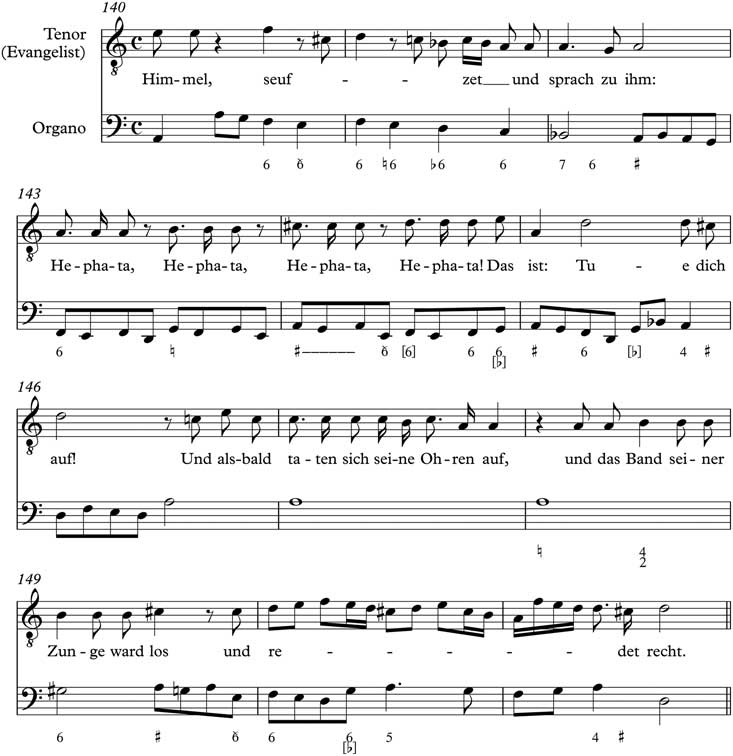
The gospel text from Mark 7:31–7 is sung by the tenor (as had been common for oratorios and historiae in the seventeenth century). And in general, Schelle’s gospel recitatives are simple and declamatory but occasionally feature melismatic embellishments when the text calls for them. A characteristic example is the setting of the healing of the deaf-mute. The word ‘seufzet’ (sighed) is set with an emphatic sigh motive and the healing word ‘Hephata’ appears four times in a climax, combined with a more animated basso continuo setting. The movement calms down and the voice leading becomes more declamatory when the narrative continues, only to turn more animated again when the story reports that the man can speak again (‘redet’) (see Ex. 1).
Johann Schelle, Durch Adams Fall, bb. 140–51.

The three arias, two for soloists and one for three-part ensemble, refer back to the preceding gospel passages, interpreting the biblical narrative and reflecting on its theological meaning. In contrast to most reflective arias in Johann Sebastian Bach’s oratorios, the arias in Thymich and Schelle’s cantatas often remain within the chronological framework of the narrative and become part of the dramatic action. This becomes clear in the Aria a 3, which follows the gospel text ‘And they brought to Jesus a deaf man who was mute, and they begged him to lay his hand on him’:Footnote
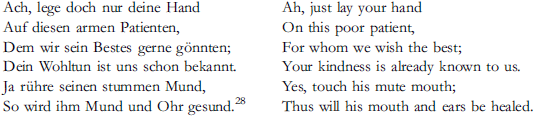
By becoming part of the action, the arias add a more dramatic note to the narrative. This is a distinct difference from the concerto-aria cantata, where the newly written poetry has a mostly reflective function and meditates on the biblical texts from the perspective of the contemporary, seventeenth-century listener.
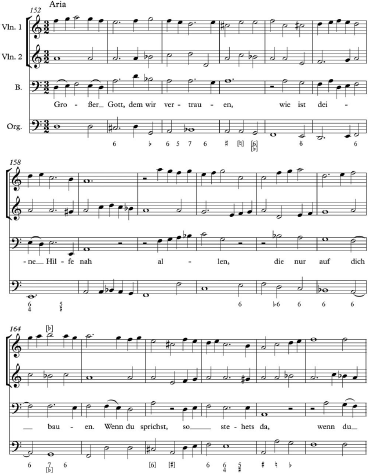
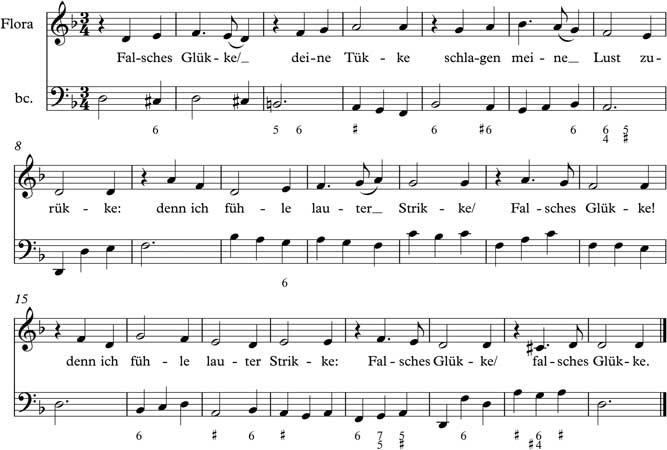
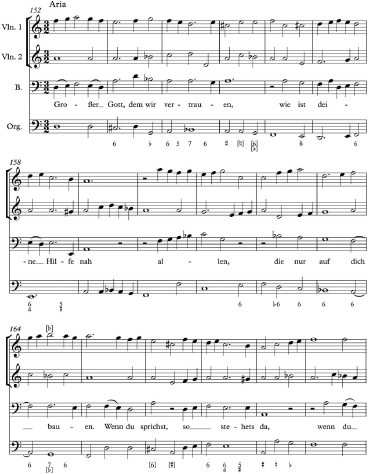
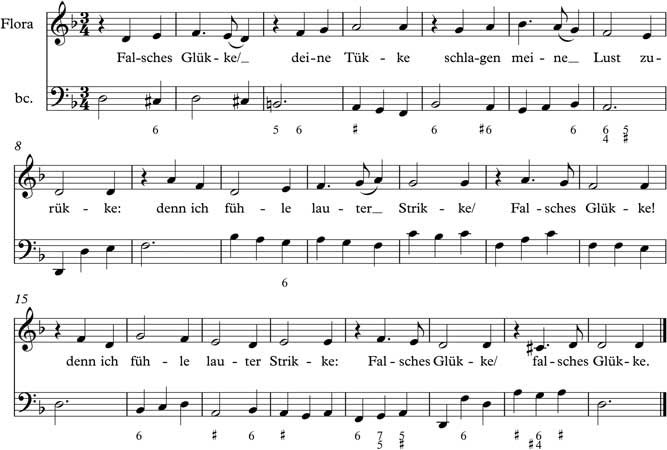
Not that we would necessarily consider Schelle’s music particularly ‘operatic’ by modern standards. But that would imply measuring a German composition from the early 1680s against Italian opera from the early eighteenth century. Compared with arias from German operas from the late seventeenth century, Schelle’s arias are quite similar to what can be found in the works by his contemporaries, as can be seen by comparing the bass aria ‘Großer Gott, dem wir vertrauen’ from Schelle’s cantata for Leipzig in 1683 and the aria ‘Falsches Glücke, deine Tücke’ from Johann Philipp Krieger’s opera Flora, composed for the court in Weissenfels and partly published in 1690 (Krieger’s opera is also based on a text by Paul Thymich).Footnote 29 This is not to suggest that Schelle borrowed an operatic style in his cantata, then, but rather that opera and cantata shared a similar aria style in the late seventeenth century (see Ex. 2a and 2b).
Johann Schelle, Durch Adams Fall, bb. 152–69.
Johann Philipp Krieger, Flora (aria ‘Falsches Glücke’), bb. 1–22.
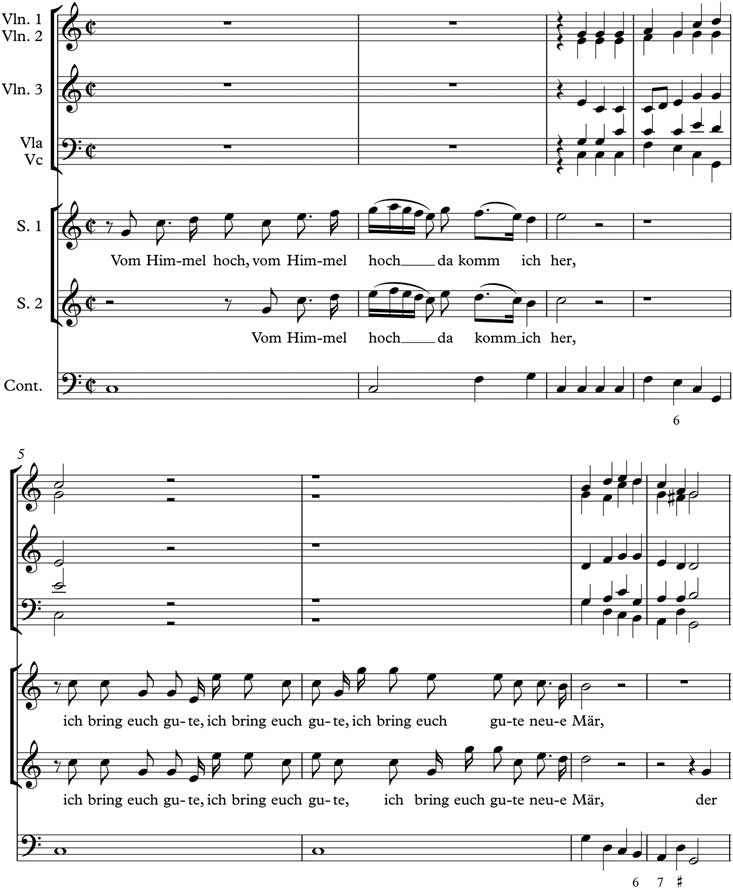
A second piece that probably belongs to the same cantata cycle is Schelle’s Actus musicus auf Weyh-Nachten.Footnote 30 While the structure of the piece is very similar to Durch Adams Fall, the libretto for the Christmas piece lacks any free poetry, and is instead a pasticcio of sections of the gospel text and hymn stanzas. As in the previous cantata, several stanzas from the same hymn are used throughout the piece; in this case the Lutheran Christmas chorale ‘Vom Himmel hoch, da komm ich her’, to which the libretto adds further verses from other chorales.Footnote 31 The gospel text is again sung by a tenor and the announcement of the angel is given to a solo soprano. Additionally, the choir of the angels is performed by a six-part choir (S1, S2, A, T1, T2, B) while the choir of the shepherds features the lower voices (A, T1, T2, B).
Although Thymich did not provide newly written poetry on this occasion, it is still likely that he compiled the texts for the piece. In the first place, the criticism of the new cantata form by Lorenz von Adlershelm had been voiced shortly before Christmas 1683 and the decision had to be made by the city council whether a cantata should be performed at all. Possibly the ruling came too late to write new poetry and then compose the cantata. Another possibility is that Thymich (and Schelle) refrained from inserting new texts because of an ongoing struggle over how to celebrate Christmas. The early 1680s were overshadowed by the abolition of older Christmas traditions in favour of more internalised and spiritualised ways of debates, about the culture of Christmas, as is reflected in numerous prints from the 1680s and 1690s.Footnote 32 Given these discussions, it was presumably safest to keep to established texts and hymns. Alternatively, maybe it was simply the wealth of already existing Christmas hymns that motivated Thymich not to write new poetry. Stanzas from popular Christmas hymns could easily be arranged to interpret and elaborate on the biblical Christmas narrative. In fact, Thymich uses the stanzas from Luther’s Christmas hymn ‘Vom Himmel hoch’ in the same way as he uses his own poetry in the other two cantatas from the cycle, interpreting the biblical text and adding a new, dramatic element to the narrative.
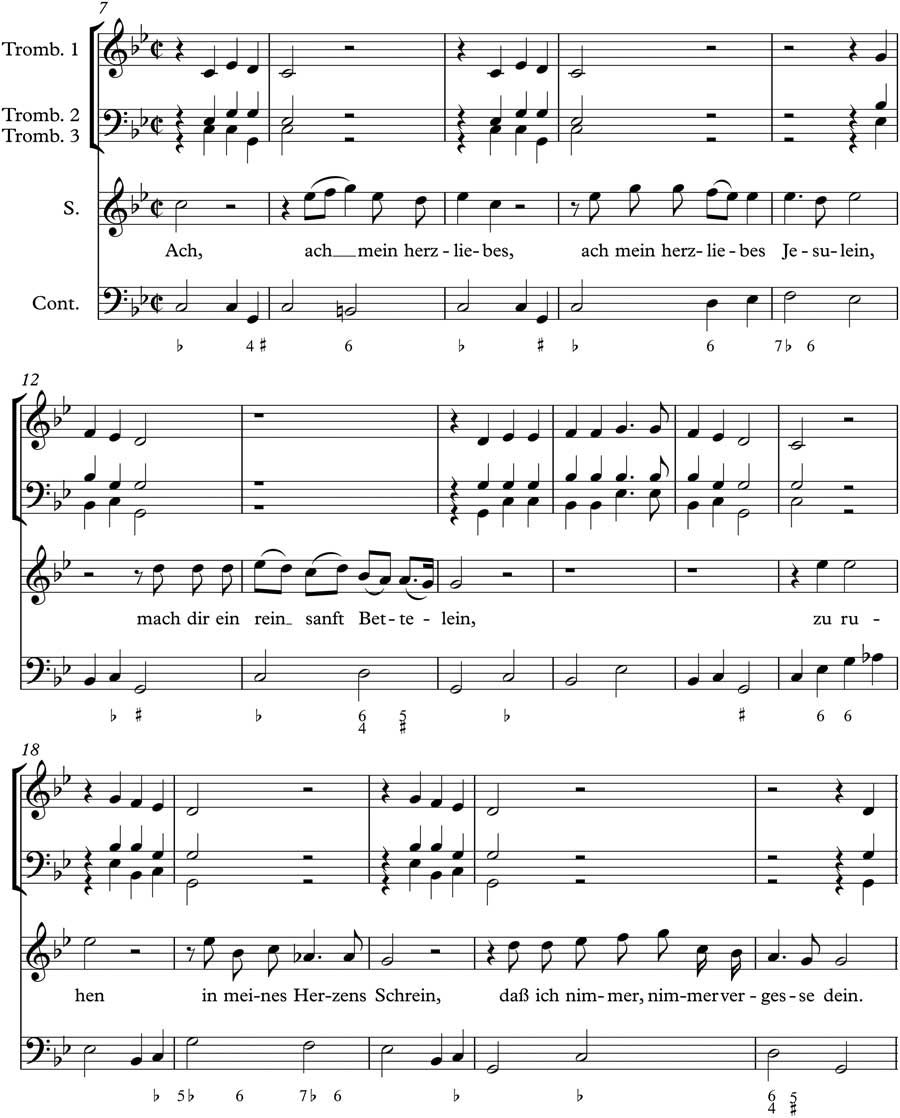
Meanwhile, although Thymich did not write reflective aria texts for the cantata for Christmas Day 1683, this does not mean that the Actus musicus does not also contain movements that evoke comparisons with contemporary arias. The chorale melodies in the hymn settings, for instance, appear slightly embellished, often featuring sigh figures and two-note melismas and thus approximating them melodically to common arias. And the opening setting of the first stanza of ‘Vom Himmel hoch’ assigns the text to two sopranos, who sing the words in embellished fashion (see Ex. 3). At the most emotional and intimate moment of the Christmas narrative, when Mary reflects on all the things she has seen, Schelle sets a stanza from Luther’s Christmas hymn, but abandons the familiar chorale melody in favour of a freely conceived, highly emotional and plaintive melody. At the same time, while Schelle borrows melodic gestures familiar from baroque arias, he breaks up the conventional form by inserting short instrumental interludes.Footnote 33 The result is a movement that resembles an aria in tone but is still recognisable as a chorale setting (see Ex. 4).
Johann Schelle, Actus musicus auf Weyh-Nachten, mov. 7, bb. 1–8.
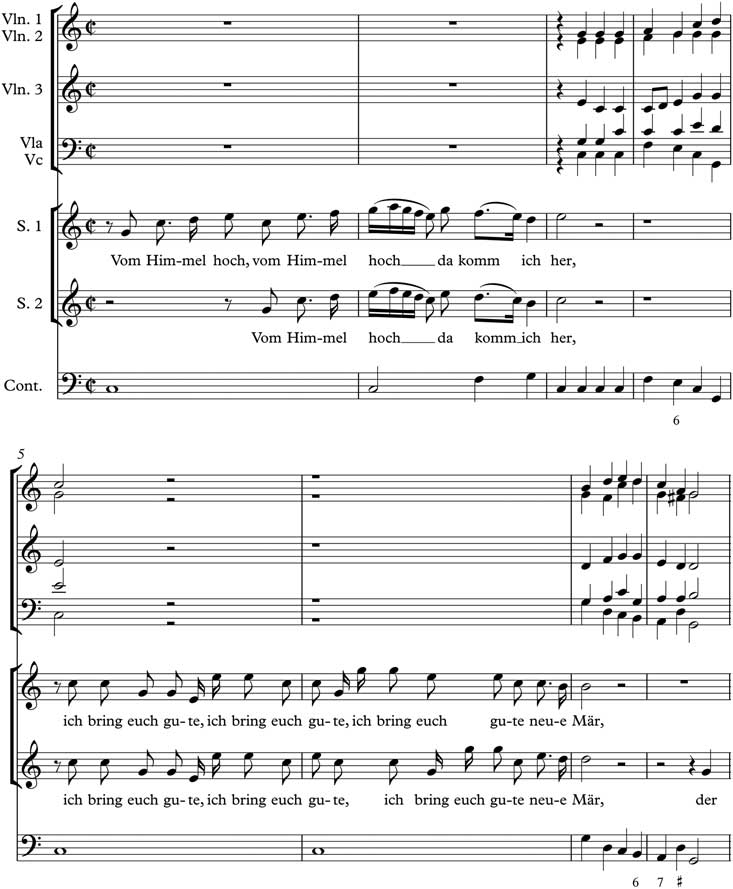
Johann Schelle, Actus musicus auf Weyh-Nachten, mov. 16, bb. 7–22.

The text for this movement is one of those central for the new understanding of Christmas in the late seventeenth century. While written by Luther about 150 years earlier, it became an emblem for an internalised understanding of the Christmas feast, emphasising the presence of the divine child in the human heart. The theological basis for this revised understanding was already clear in the early seventeenth century. The following excerpt from an Advent sermon by Johann Gerhard (1582–1637), one of the leading orthodox Lutheran theologians of the time, differentiates between three modes of Christ’s coming, putting the strongest emphasis on the presence of Christ in the human heart:
Erstlich ist die Zukunft Christi ins Fleisch, wie Er nämlich in die Fülle der Zeit wahre menschliche Natur angenommen …
Die andere Zukunft ist die geistliche Zukunft, da nemlich der Herr Christus durchs Wort uns seine Gnade anbeut und in unsern Herzen sein Gnadenreich anfangen will. …
Die dritte Zukunft ist nun zum Gericht, da Er nemlich einmal am Ende der Welt kommen wird mit großer Kraft und Herrlichkeit in den Wolken des Himmels zu richten die Lebendigen und die Todten. …
Dieß sind die dreierlei Arten der Zukunft Christi, der erste ist vergangen, die ander geschieht noch täglich, die dritte ist noch zu gewarten. Die erste siehet auf die andere, denn darum ist Christus Mensch geworden und hat in seiner angenommenen Menschheit das Werk der Erlösung verrichtet, auf daß Er solche Wohlthaten durchs Wort austheile und ihm eine Kirche sammle. Die andere siehet auf die dritte, denn darum glauben wir an Christum und dienen ihm in seinem Gnadenreich, auf daß wir einmal in der letzten Zukunft Christi zum Gericht vor ihm bestehen mögen und ins Reich der Herrlichkeit aufgenommen werden.Footnote 34
The first is the coming of Christ in the flesh, as he took on human nature when the time was fulfilled … The other coming is the spiritual coming, as the Lord Christ offers us through the word grace and wants to begin in our hearts his kingdom of grace. … The third coming is now the coming for judgment, as He will come at the end of the world with great power and glory in the clouds of heaven, to judge the living and the dead. … These are the three kinds of the coming of Christ; the first has already passed, the next still happens daily, the third has yet to come to pass. The first one leads to the second, as Christ has become man and has in his assumed manhood done the work of salvation so that he may distribute such blessings through the word and that he may assemble a church. The second one leads to the third since we believe in Christ and serve him in his kingdom of grace so that we can stand in judgement at his last coming and be accepted into his kingdom of glory.
The aria-like setting of the hymn text in the Actus musicus simultaneously represents the voice of the Virgin Mary and the voice of the faithful believer observing the scene in the manger. It therefore has a dramatic function and also provides a model of contemplation for the contemporary listener. In addition, Schelle’s use of sigh figures highlighted the affectionate way theologians in the late seventeenth century conceived of the relationship between Christ and the believer.
Such a combination of hymn, recitative and aria might well seem rather conventional for an observer who is familiar with cantatas from the eighteenth century, by composers such as Bach and Telemann. Within the development of sacred music in Leipzig, however, this was highly innovative, introducing a new musical style into the liturgy. Although this style was not uncontested, it prevailed, and even after ending his collaboration with Thymich, Schelle continued to work with librettists on cantata cycles that transferred new dramatic musical forms into the Leipzig liturgy. He composed a cycle of cantatas based on texts by Gottfried Erdmann in 1690–1, and a cycle on texts by Johann Neunhertz in 1700–1.Footnote 35 His music was highly popular among contemporary listeners – as Thomasius’s remarks from 1683 already suggested. As Erdmann Neumeister writes about Schelle’s 1690 settings of Erdmann’s Evangelisches Honig: ‘[w]hen one considers the lovely melodies, which the well-known Schelle, the director of the Leipzig choirs, cultivated every Sunday, one can say that listeners swarmed here like bees to the hive’.Footnote 36
A printed libretto for the Pentecost service in Leipzig from 1693 confirms that Schelle continued to write cantatas that expanded the biblical narrative with newly written texts into a dramatic scene:
Evangelist: Und als der Tag der Pfingsten erfüllet war
A.T.B: Liebster Jesu/sey so gütig
Evangelist: Und es geschach schnell ein Brausen vom Himmel
Canto: Komm du werthe Himmels-Taube
Evangelist: Es waren aber Jüden zu Jerusalem wohnend
Der Chor: Siehe/ sind nicht diese alle
Alto: Wo der Geist ist eingekehrt
Evangelist: Sie entsatzten sich alle
à 5. Voc.: Was will daraus werden?
Evangelist: Die andern aber hattens ihren Spott und sprachen
à 3. Voc.: Sie sind voll süsses Weins
Basso: Weicht ihr Sünder! flieht ihr Spötter!
Tutti: Nun so bleib in unsern HertzenFootnote 37
While the music for this piece is lost, the libretto print not only shows the composer’s continuing interest in the form of the dramatic cantata he had established with Thymich a decade earlier, but also serves as the earliest example of a published libretto that would have been in the hands of the congregation in Leipzig while listening to the music. Libretto prints had been common for secular occasional works for quite some time, and they were a common feature in contemporary opera, but within the liturgy these listening aids were something new. Congregants at St Thomas’s were therefore now able to follow the sacred cantatas in the same way as they were used to following these secular compositions, or – just a few months later – the first operas at Leipzig’s own opera house. The listener was not only a listener anymore, in other words, but also became a reader, following the dramatic narrative as it unfolded in the music.
Schelle’s music is not straightforwardly operatic; yet once again the form of the music as well as the mode of listening to the music followed the same paradigms of the operas soon to be performed. And though Schelle would not be involved in composing the music for the opera house (as far as we know), his librettist from 1683 would use his experience in writing dramatic texts when he provided libretti for the court opera in Weissenfels and then from 1693 for the opera in Leipzig. But before he tackled these larger genres, he wrote another libretto for a Leipzig composer, which took a religious topic and transferred it to an extra-liturgical performance context. The libretto was again published and the listeners were able to follow the drama that unfolded in front of them.
A shepherds’ play: Thymich and Knüpfer
During the Christmas season of 1685, Paul Thymich collaborated with the son of Johann Schelle’s predecessor, Sebastian Knüpfer, on a piece that was quite remarkable, and much closer to later operas than the previously discussed compositions. Only recently have several printed librettos surfaced for performances of this work, and they fill an interesting gap in the music history of Leipzig in the 1680s. According to the earliest print, the composition, called Geistliche Hirten Freude was presented in Leipzig after the ‘days of Christmas’ 1685 and performed by the Collegium musicum, a group of student musicians.Footnote 38 The Geistliche Hirten Freude, however, is not a liturgical Christmas play but an extra-liturgical composition (although the text has biblical roots). It offers a paraphrase of the Christmas story from Luke 2, expanded with free poetry based mostly on texts from the Old Testament, and describes four shepherds, meditating on their miserable life and expressing their hopes for the coming of the saviour. An angel then appears and announces the birth of Jesus. The shepherds leave their flock and embark on their march to the manger. Meanwhile, the focus shifts and we see Mary, the Christ child and a choir of angels. Mary and the angels sing lullabies for the newborn Jesus. When the shepherds finally arrive at the manger, they continue to praise the newborn child and promise to spread the good news in the world:
[Prologue] Praise of Music
Section 1 Lament of the shepherds and hope for the coming of the Savior
Section 2 Message of the Angel; paraphrase of Gloria
Section 3 Shepherds depart for the manger
Section 4 Mary and the angel rock the child (‘Kindlwiegen’)
Section 5 Shepherds arrive at the manger and the child
Section 6 Shepherds leave and praise God and Mary
Section 7 Shepherds ask Jesus to come to them
Section 8 Expanded paraphrase of Gloria; choirs of shepherds and angels
As shown above, the action is divided into eight sections, called ‘Abtheilungen’, each containing one distinct scene, and the text is mostly conceived as a dialogue between the four shepherds. The libretto identifies ten arias, four of them with two or more stanzas, and three movements for choir. The verse structure of the arias is simple and similar to the type of strophic aria that was common in Germany in the second half of the seventeenth century. Some are in the established bar form (AAB), others are more complex.
The libretto belongs to the popular genre of sacred pastorals or shepherds’ plays: the shepherds on the meadows near Bethlehem represent a typical bucolic scene, in which nature reflects their emotional state. The night is cold and the shepherds are desperate. This locus terribilis is then turned by divine intervention into a locus amoenus; a transformation at least partially realised through musical means.Footnote 39 At the beginning of the play, the fifes of the shepherds are frozen and cannot produce any sound; after their encounter with the newborn Jesus, the fifes have thawed and the shepherds are finally able to praise the Christ child by playing for him.Footnote 40 In addition, the structure of the piece resembles contemporary pastorals, as it consists of what amounts to a single act, subdivided into several independent scenes.Footnote 41 The structure of the libretto is not much different from an act in a contemporary opera: ten arias are about the norm for a single act of the operas performed in Leipzig or Weissenfels.
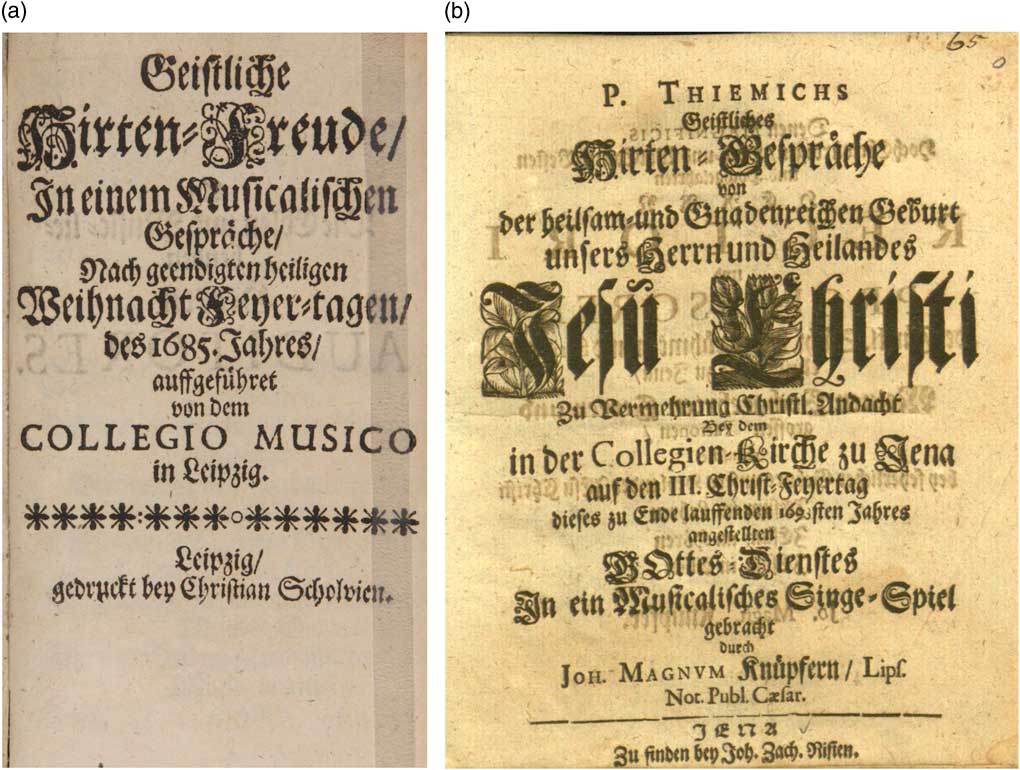
The printed libretto from 1685 does not indicate the name of the author or the composer of the music. Serendipitously, however, the piece was performed on at least one other occasion: in 1693, the Hirten Freude was presented in the University Church at Jena, about 50 miles south-west of Leipzig, and the libretto printed for that performance lists Paul Thymich as the author of the text and Johann Magnus Knüpfer as the composer (see Fig. 2a and 2b).Footnote 42 Knüpfer was at the time organist at the University Church and he probably directed the performance of his piece. He had grown up in Leipzig and had lived there until 1690, when he took up the post at Jena that he would hold until 1694. He also worked as court musician for the court in Zeitz and we later find him as the composer of at least one musico-dramatic piece for the court in 1705, where he wrote the opera Cupido and Psyche, based on a libretto by Johann Ulrich (von) König (1688–1744).Footnote 43
Paul Thymich, Geistliche Hirten-Freude, (a) libretto from Leipzig, 1685 (Yale University, Beinecke Library, 2005 801); and (b) libretto from Jena, 1693 (Berlin, Universität der Künste, RC 0127).

For Thymich, writing the libretto for the play in 1685 was in a way a continuation of his librettos from 1683, both the secular composition for the celebration of the liberation of Vienna and the cantata cycle. The new piece features musical dialogue, and like the cantata cycle, served as a basis for recitative-like sections, choral movements and arias. It is not entirely clear, however, in what context Thymich’s and Knüpfer’s Hirten Freude was originally performed. The libretto states that it was presented after the ‘days of Christmas’ of 1685. When did the days of Christmas end? It could imply a performance after the three Christmas holidays (after December 27). For a seventeenth-century Lutheran, however, the Christmas season lasted from Christmas Day to the feast of Epiphany, 6 January. We still see this in the days for which Bach composed his Christmas Oratorio. And if the ‘Days of Christmas’ 1685 ended with 6 January, the performance would actually have been in early January 1686.Footnote 44 The performance would then been composed as religious entertainment to coincide with the first week of the New Year’s fair, with the possible result that it would also have had a similar function within the musical life of the city to the operas of the 1690s.
Once Knüpfer brought his composition to Jena, Thymich’s libretto for Hirten Freude served as a model for another dramatic piece, performed on Good Friday 1693. The students of the university presented a passion play (‘Singspiel’) at the university church, based on the libretto by Johann Christoph Wentzel (1659–1723). Der Gott=liebenden Seelen Wallfahrt closely follows the text by Thymich in the way the biblical narrative is paraphrased and turned into a dramatic libretto.Footnote 45 The action is divided into seven ‘Abtheilungen’, just like in Thymich’s libretto for Leipzig in 1685, and the sequence of arias, recitatives and choral movements follows the Leipzig model as well. The Jena performance of Thymich and Knüpfer’s Hirten Freude took place a few months after the performance of Wentzel’s Passion Singspiel; since Knüpfer’s piece is older, however, we can assume that Wentzel used it as a model.
Wentzel’s libretto has an interesting history of its own. After the performance in Jena in 1693, in 1710 it was borrowed by Hamburg organist and composer Georg Bronner (1667–1720) for his own oratorio Der Gott=liebenden Seelen Wallfahrt.Footnote 46 Bronner was also active as a composer for the opera in Hamburg. However, what worked on stage did not necessarily please the authorities during Lent. The performance of Bronner’s oratorio was prohibited by the city of Hamburg but some of the movements were later used by Johann Mattheson in a St Mark Passion. At this point, most likely nobody was aware that the model for the libretto had originated in Leipzig in the mid-1680s and that it had been written by the first librettist of the Leipzig opera. There is no evidence for later performances of Thymich’s Hirten Freude in Leipzig, and it is unlikely that the piece was mounted again after Knüpfer had left the city in 1690, and once Thymich had moved on to other projects. But the original performance of the Hirten Freude fits well into Thymich’s own development as a librettist and also the increasing interest in musico-dramatic pieces in Leipzig during the 1680s.
Das bezwungene Ofen: another libretto by Paul Thymich?
The defeat of the Turks outside Vienna in 1683 marked the beginning of several defeats of the Ottoman armies in central and eastern Europe. In 1686 armies of the Holy German Empire fought against the Ottoman occupants of Budapest.Footnote 47 The liberation of Ofen (one area of the city) was celebrated as a symbol for the re-Christianisation of eastern Europe. The victory, in which once more the Saxon Elector had been successful, was celebrated all over Saxony and records exist for peace celebrations in Dresden, Leipzig and other cities.Footnote 48
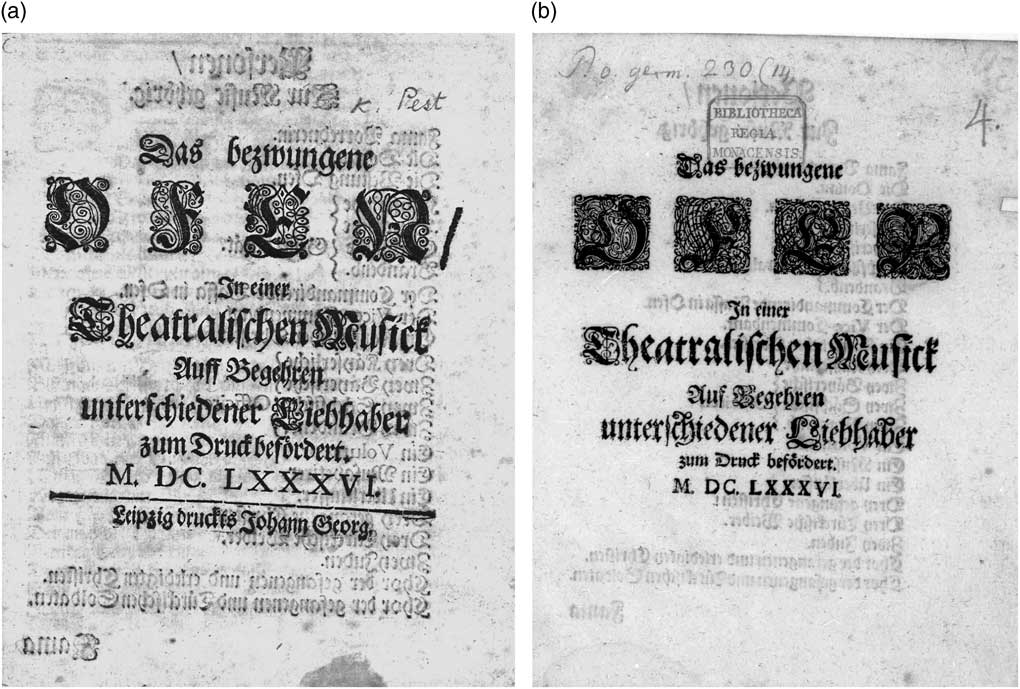
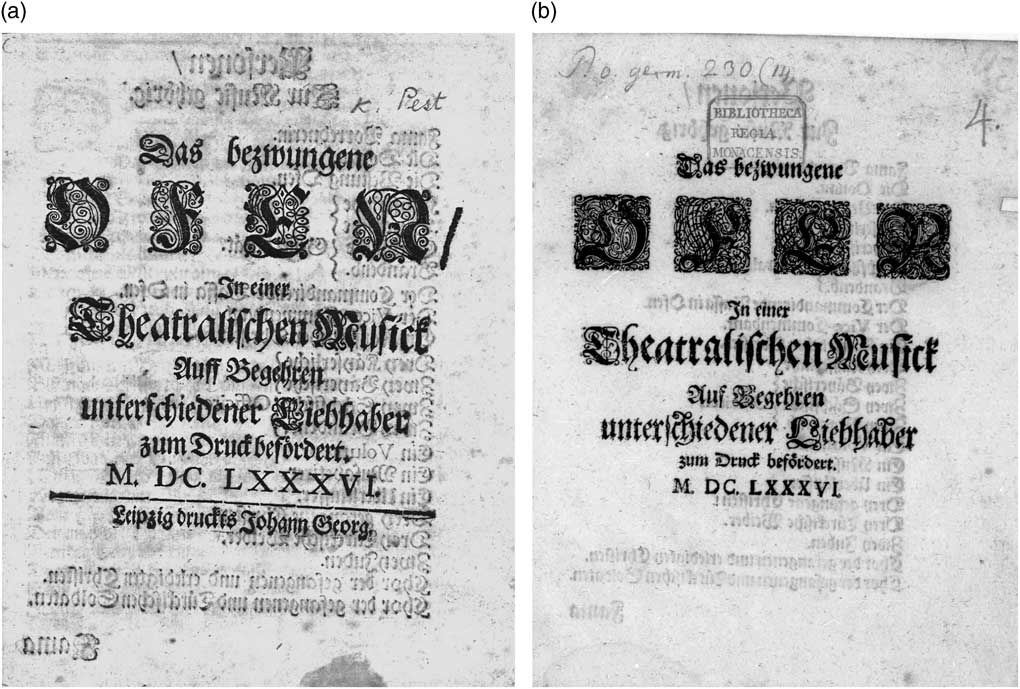
A composition that was performed during the celebrations in Leipzig was the musical drama Das bezwungene Ofen. The subtitle in the printed libretto from 1686 calls it ‘eine theatralische Musick’ (a theatrical piece of music). The libretto has occasionally been associated with the pre-history of the opera in Leipzig, and Johann Christoph Gottsched already lists it in his Verzeichnis aller deutschen Trauer- Lust- und Singspiele from 1757 as an opera.Footnote 49 Gottsched’s terminology is often ambiguous, however, and the mere fact that he lists the piece as an opera does not say much about its actual genre, especially since he did not have access to the music, which was already lost. For a long time the libretto was also lost and it was impossible to judge the nature of the work. In the course of his research on the history of the opera in Leipzig, however, Michael Maul discovered a copy of the libretto in the Bavarian State Library in Munich, and I have since traced two additional copies of the text – one in the British Library and the other one in the University Library in Tallinn, Estonia. The copies from Tallinn and London are identical, while the print preserved in Munich shows small differences: the name of the printer is missing, the typeface used is different and the spelling of some words shows some variants, such as a lesser number of doubled consonants and ‘ei’ instead of ‘ey’ (see Fig. 3a and 3b). It is safe to assume that the Munich copy was furnished by a different printer from the other two copies. We can rule out a performance at another place because the prologue remains unchanged, and it explicitly refers to Leipzig as the place of the performance. The prints could either have been made for different performances in Leipzig or, as seems more likely, several printers were involved in the production of the texts in order to have a large number of librettos available as swiftly as possible.
[N.N.], Das bezwungene Ofen, Leipzig, 1686, (a) libretto from Tallinn (Tallinn University Academic Library, V-2395); and (b) libretto from Munich (Munich, Bayerische Staatsbibliothek, Res/4 P.o.germ. 230,14).
Already a cursory glance at the libretto explains why Gottsched identified the piece as an opera: it has a prologue, in which Fama praises the heroic victory of the German armies, followed by three acts, each of them containing between nine and eleven scenes, describing the battle of Ofen and the defeat of the Ottoman army. The libretto features thirty-two arias and a number of choral movements. Some of the arias are again strophic. Stylistically, the libretto is very similar to the one for the Christmas play from 1685.
The focus of the dramatic narrative in the libretto shifts between the camp of the Ottoman army in Ofen and the victorious armies from Bavaria, Saxony and Brandenburg, as well as the Imperial troupes. The narrative stays quite close to contemporary sources about the siege of Ofen and it is clear that the librettist based his text on these reports that were widely available shortly after the victory on 2 September 1686. He also added a number of comic elements, however, for instance in several scenes in which he mocks the Ottoman soldiers and adds ridicule to the military defeat. The librettist further includes the tragi-comic character of the Volunteur, who volunteered to join the armies but has doubts when he is confronted with the reality of war:

And he sings later:
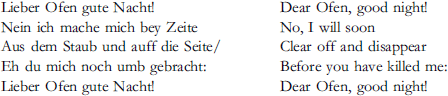
The presence of comic characters (even in plays that do not necessarily lend themselves to such an addition) was a characteristic feature for Leipzig opera librettos in the early years, and apparently this was already the case a few years before the first operas were staged in the city.Footnote 50
The students of the St Nicholas school in Leipzig performed the piece, but the occasion for the performance is not clear.Footnote 51 The siege of Ofen ended on 2 September, and we have evidence for a celebration in Leipzig on 29 September. A contemporary chronicle for the city mentions the feast but does not list the performance of Das bezwungene Ofen as one of the major events.Footnote 52 This does not necessarily rule out that it was performed then, but I want to suggest a different occasion. Shortly after the peace celebration came the start of the annual Michaelmas fair in Leipzig. The victory of Ofen was one of the primary topics discussed during the fair and the Mess Relationen, a newspaper published during the fair in 1686, reported extensively about the siege.Footnote 53 The trade fair, during which the city was filled with merchants from all over Germany, would have provided a large audience for the play, which in turn would explain why several printers had to be commissioned to print the libretto.
The composer and the librettist of Das bezwungene Ofen remain unknown. The most likely candidate for the librettist, however, is probably again Paul Thymich, as he had already gained experience in writing similar librettos; most recently the large-scale libretto for the Hirten Freude. And only two years later he started providing librettos for the court opera in Weissenfels. In terms of possible composers, as we have seen Leipzig housed several experienced composers at this time, who had proven that they were interested and capable of writing the music for an opera or a Singspiel, whether Schelle, Kuhnau or the young Knüpfer (who may have been still hoping to find a position in his home town). Whoever was responsible, the pieces written between 1683 and 1686 show an increasing interest in dramatic music among Leipzig’s composers; we can even notice an expansion of the size of the pieces from the dramma per musica by Kuhnau and the Schelle-cycle in 1683 to Knüpfer’s Christmas pastoral to finally Das bezwungene Ofen for 1686. And Paul Thymich, who seems to be at the centre of most of these developments, would soon move on to write real opera librettos, in 1688 providing the texts for several of Johann Philipp Krieger’s operas composed for the court in Weissenfels. If Thymich was indeed the author of the Ofen libretto from 1686, the piece would have been another step on his way from smaller-scale dramatic pieces to full-fledged opera librettos.
Opening the curtain
Thymich’s interest in opera might have been partly a literary one, but soon he was also personally invested in the genre. In 1689 Thymich married Anna Catharina Grempler, a singer at the court opera in Weissenfels who later also appeared on the stage of the opera house in Leipzig.Footnote 54 Erdmann Neumeister praised her for her pleasant voice and her skilful performances.Footnote 55 Anna Catharina Thymich’s father, Christian Grempler, had been the town musician in Jüterbog, a small city in Brandenburg. She probably received her musical education from him before starting as an opera singer; she survived her husband and probably continued to sing at the Leipzig opera house after his death in 1694.
Johann Kuhnau, who in 1683 had set Thymich’s little dramatic scene to music, did not embark on a career as an opera composer, though he did compose the opera Galathea, performed in 1702.Footnote 56 Shortly thereafter, however, he began criticising the Leipzig opera for withdrawing too many musicians from the church music for which he was now responsible. In 1701 he had succeeded Johann Schelle as cantor at St Thomas’s after his predecessor’s death. Part of his disdain for the opera might have been caused by finding himself in competition with a young musician, who had moved to Leipzig in 1701 to study law at the university. He was Georg Philipp Telemann and he soon not only took over the position as organist at the Neue Kirche (New Church), where he established a vibrant and modern church music programme, but also started composing for the opera in 1703.Footnote 57
As mentioned above, Johann Magnus Knüpfer, who had unsuccessfully applied first for the position of organist and later of cantor at St Thomas’s, left for Jena in 1690 and later in 1694 moved to Naumburg, where he composed at least one opera of his own. It is not known whether he wrote more music dramatic pieces, but we cannot rule out that he returned to the stage later in his career.
None of the activities in the 1680s necessarily led to the founding of the opera house in Leipzig in 1693. But the proliferation of the music dramatic activities in the ten years before the opening of the opera in Leipzig demonstrates that the city saw an increased interest in opera-related genres. The citizens of Leipzig as well as the visitors during the regular trade fairs experienced the performances not only of smaller drammi per musica but also – especially in the second half of the 1680s – of pieces of considerable length. And the dimensions of these pieces (as far as we can tell from the surviving librettos) became more expansive. When the opera house opened its doors in 1693, local musicians had already fought (and won) the dispute over dramatic cantatas with recitatives and arias in the Sunday morning services at the main churches of the city. While Johann Schelle had not participated in the composition of operas, he had brought operatic genres into the church.Footnote 58
When the opera house opened in 1693, larger musico-dramatic pieces were therefore already familiar to the citizens of Leipzig. Not only had operas been performed at nearby courts such as Dresden and Weissenfels, but within the walls of the city, pastorals and other dramatic works with music had also been performed for quite some time. Not only Thymich, Knüpfer and Kuhnau had performed their works, but also travelling theatre groups such as the Veltensche Bande, who had performed staged plays with incidental music during the Leipzig Fairs between 1683 and 1692.Footnote 59 These plays saw their greatest success just at the time when the Thymich and others created their own pieces.
As Michael Maul has emphasised, the impulse to open an opera house in Leipzig came from outside the city. The opera was founded by Nicholas Adam Strungk and architect Girolamo Sartorio, both from outside Leipzig. But Leipzig lawyer Heinrich Friedrich Glaser was also involved, who had not only lived there during the 1680s but who had also attended the university at the same time as Thymich (Glaser matriculated in 1672, Thymich in 1673).Footnote 60 Both had an interest in music and both were obviously fascinated by the genre of opera. While Paul Thymich does not appear in the founding documents for the Leipzig opera house, he was one of the driving forces behind the establishment of dramatic genres in sacred and secular music in the ten years before 1693. His experience in the writing of libretti made him Strungk’s first choice as librettist for the first operas in the new opera house. This article has also shown that modern, dramatic music was supported by a wide circle of musicians in Leipzig at that time. The St Thomas’s cantor Schelle had collaborated with Thymich, as well as the St Thomas organist Kuhnau, and the young composer Knüpfer. In other words, the institution of ‘opera’ came from Dresden, but it met a taste for a genre that was already well established in Leipzig.
Markus Rathey is Robert S. Tangeman Professor of Music History at Yale University, with appointments in the Institute of Sacred Music, the School of Music, the Music Department and the Divinity School. His research interests are music of the seventeenth and eighteenth centuries, Johann Sebastian Bach and the relationship between music, religion and politics during the Enlightenment. His most recent books are Johann Sebastian Bach’s Christmas Oratorio: Music, Theology, Culture (Oxford University Press, 2016) and Bach’s Major Vocal Works (Yale University Press, 2016), which also appeared in a Japanese translation in 2017. His articles have appeared in journals such as Eighteenth-Century Music, Early Music History, Bach-Jahrbuch and Schütz-Jahrbuch. He is president of the American Bach Society and past president of the Society for Christian Scholarship in Music. He currently serves on the editorial boards of Bach: Journal of the Riemenschneider Bach Institute and the Yale Journal for Music and Religion.