This paper asks a question that has not been raised in the literature on Japan's approach to regionalism in East Asia: Why is Japan disposed toward an East Asian community with a fluid boundary?Footnote 1 Why is there an apparent lack of political will to be more definite about the requirements for membership in the dreamt-of East Asian community? The paper offers an explanation: the lack of a firm commitment to an ideology. Does the theory explain Japan's behavior only in the present (that is, from the 1960s to the present)? The paper argues that the same explanation holds true in the case of Japan's approach toward regionalization before World War II.Footnote 2
The paper nuances the tendency of extant literature to give a historical background to Japan's efforts at regionalization by referring only to the Greater East Asia Co-Prosperity Sphere of the 1940s. Instead of going back only this far, the paper goes back to the first half of the twentieth century, especially the 1920s and 1930s. It departs from the tendency, implicit or explicit, to compare the present Japanese involvement in the building of an East Asian community to Japan's policy of building a Greater East Asia Co-Prosperity Sphere during World War II. Rather, the paper compares the present Japanese involvement to that of the 1920s through the 1940s, which includes the Greater East Asia Co-Prosperity Sphere. Further, the paper explains the differences between Japan's international situation in the 1920s and 1930s to the present and shows that, given these differences, it would be unlikely that the present efforts of Japan would repeat the Greater East Asia Co-Prosperity Sphere.
To tie up the two main arguments – that (a) the lack of a firm commitment to an ideology predisposes Japan toward boundary fluidity in an East Asian community, and (b) the present involvement of Japan in community building will not repeat the Greater East Asia Co-Prosperity Sphere – the paper uses the longitudinal comparative method. A longitudinal comparison has been chosen because the aim of the paper is limited to a more or less general theory of Japan's approach to regionalism; it does not aim to arrive at a general theory of regionalism. Specifically, the paper uses the ‘most different cases’ logic.
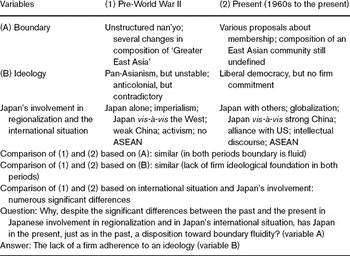
The two most different cases are (1) Japan's pre-World War II regionalization, and (2) Japan's present participation in the building of an East Asian community. Coupled with this are (1) Japan's pre-World War II international situation, and (2) Japan's present international situation. The comparative logic states that if there are at least two similarities in cases that are very different, one of the similarities may explain the other similarity.Footnote 3 The two similarities in this longitudinal comparison are (A) the boundary fluidity of the Japanese target of expansion and influence before World War II and the present Japanese disposition toward boundary fluidity for an East Asian community, and (B) in both the pre-World War II period and the present time, Japan did not and does not have a firm adherence to an ideology. The paper treats (B) as the independent variable and (A) as the dependent variable. Thus, the paper argues that (B), the lack of a firm commitment to an ideology, explains (A), Japan's prejudice toward boundary fluidity, in both the pre-World War II period and the present. (Table 1 shows this argument in a simplified manner).
Matrix summarizing the article's arguments

For the sake of debate, it may be asked: Why not make (A) the dependent variable, and (B) the independent variable? The answer is that it is more logical to make (A) the independent variable and (B) the dependent variable than the other way around. And this is because of the definition of ideology adopted in this paper.
Ideology is ‘an interrelated set of convictions that reduces the complexities of a particular slice of reality to easily comprehensible terms and suggesting appropriate ways of dealing with that reality.’Footnote 4 The nation-states that want to be members of an East Asian community comprise part of the reality. They may be likened to pieces of a jigsaw puzzle. The frame and contours of the jigsaw puzzle, on the other hand, may be likened to ideology. Why cannot the actor put a piece of the puzzle anywhere he wants? He cannot because it does not fit into the contours and the frame. Since the picture to be formed – in our analogy, the ideology – is prior to the puzzle pieces, it is logical to treat ideology as the independent variable, and boundary fluidity as the dependent variable. Using this analogy, the argument of the paper can be elaborated as follows: Japan's propensity toward a fluid boundary for a community, in the past and now, is due to the lack of a firm commitment to an ideology, similar to the difficulty that would be caused to a player in completing a jigsaw puzzle by loose or careless treatment of its contours and frame.Footnote 5
Moreover, several scholars on regionalism have observed (A), boundary fluidity, and have used it to describe community building in Asia; but they have not asked why the boundary is fluid. Katzenstein points out the ‘inclusive character of Asia's network-style integration in contrast to the exclusive character of Europe's emphasis on formal institutions’, and Larner and Walters call Asian regionalism ‘new regionalism’, in which ‘regions, unlike empires or nation-states, are not mutually exclusive. The regions are open and fluid, allowing multiple linkages with other geographical and governmental scales’. Footnote 6 T. J. Pempel, too, observes: ‘Regions are fluid and complex mixtures of physical, psychological, and behavioral traits continually being re-created and redefined. They vary with the policy issues that confront a region and what the dominant political actors in a given group of countries see as their political priorities.’Footnote 7 These are insightful and valid descriptions of the present regionalization efforts in Asia, but the description needs to be explained – it is a dependent variable that needs an independent variable.
Proposals for an East Asian community came from Southeast Asia. Why focus on Japan? The focus on Japan is dictated by the fact that among the countries that are involved in building some kind of a community in Asia, Japan is the only one that attempted to establish a regional bloc before World War II. It also arises from the fact that among the three dialogue partners of the Association of Southeast Asian Nations (ASEAN), Japan has the greatest potential to influence the creation of an East Asian community. This potential derives from its democratic political system and its possession of the most developed and stable economy.
Among the numerous regional bodies in Asia and the Asia-Pacific, why does the paper focus on East Asia? East Asia, for the purpose of this paper, is defined as consisting of the ten ASEAN members, namely, Singapore, Thailand, Malaysia, Indonesia, the Philippines, Myanmar, Cambodia, Vietnam, Brunei, and Laos, plus the three dialogue partners, China, Japan, and South Korea.Footnote 8 It is, in other words, ASEAN + 3. The dreamt-of, still nonexistent, East Asian community deserves attention precisely for the reason that it does not yet exist. There seems to be a consensus to avoid discussion of the requirements for membership despite talks and paeans given to the economic integration that East Asia has achieved. A readily observable characteristic of the kind of membership envisaged for an East Asian community is that it is amoeba-like: it expands and contracts depending on who is making the list of possible members.
Japan's pre-World War II regionalism
The pre-World War II period was the age of imperialism. Japan was one of the empires, having obtained Taiwan in 1898, Korea in 1910, and the former German colonies in the Pacific at the end of World War I in 1918. In the 1920s, Japan followed the Shidehara diplomacy (Foreign Minister Shidehara Kijuro's diplomacy) of peaceful expansion through trade and Japanese emigration to several parts of the world, especially North America, Hawaii, South America, China, Southeast Asia, and Australia. And finally, in 1941, Japan waged a war against its fellow imperialists, in the hope of replacing France in French Indo-China, the Netherlands in the Dutch East Indies, the United States in the Philippines, and the British in Malaya, Borneo, Australia, and India. Japan wanted to create a Greater East Asia Co-Prosperity Sphere.
Pre-World War II boundary fluidity
In the Japanese literature of the 1920s, ‘nan'yo’ was the target of economic expansion. The boundary of nan'yo was vague. It simply referred to any exotic islands south of Japan. A number of authors sought to have a clearer definition. For example, the prewar Japanese Ministry of Agriculture and Commerce defined ‘nan'yo’ as ‘the area consisting of innumerable big and small islands scattered between the Southeast part of the Asian continent and the continent of Australia’. Footnote 9 Soejima Yasoroku, a nan'shin (southward advance) advocate, on the other hand, listed the countries comprising ‘nan'yo’ as the Straits Settlements, the Malay states, Siam, French Indo-China, the Dutch East Indies, British Borneo, Portuguese Timor, British (formerly German) New Guinea, the Pacific Islands, and the Philippines.Footnote 10 The newspaper Shin Aichi included Taiwan and China in the scope of ‘nan'yo’.Footnote 11 Nitobe Inazo, in his essay ‘Nan'yo no keizai-teki kachi’ [The Economic Importance of Nan'yo], described the area as ranging from the Philippines in the north, to the Sunda Strait in the south, the Malay peninsula in the west, and all the islands in the east ‘related to Asia’.Footnote 12
Nan'yo at times tended to cover both peninsular and insular Asia (Oceania), and at times, only insular Asia. A Japanese geography textbook used at the elementary level made a distinction between the two, but after World War I the distinction disappeared. A textbook published in February 1919 put both peninsular and insular Asia under the term Tonan Ajia, which literally translates to today's Southeast Asia.Footnote 13
Nan'yo as the destination of Japanese immigrants, products, and investment was important to Japan's policy of peaceful expansion in the 1920s. It did not matter where the Japanese people and the Japanese products went, as long as they went to places south of Japan, and the farther their reach, the better. South America, indeed, was a major destination of Japanese immigrants. After all, it was located ‘south’ of Japan. And so was Hawaii. Official encouragement was echoed by Japanese businessmen, entrepreneurs, journalists, and recruitment agencies, who prodded the Japanese to go south, invest in rich natural resources, stay there for a long period of time, say, ten years, and contribute to Japanese expansion in a peaceful way. Many prospective emigrants romantically imagined ‘nan'yo’ as islands with lots of palm trees, but all they knew was that they were located south of Japan. Kiyoshi Osawa, who went to the Philippines from Japan in the 1920s, had been to a recruitment agency and said he wanted to go south. Asked where in the south, he said: anywhere ‘where there are coconut trees and blue skies’.Footnote 14
To the Western imperialists, Japan's nan'shin or southward advance was acceptable, as long as Japan did not expand beyond Korea, Taiwan, and the mandated territories, and the advance was peaceful and merely for economic reasons. To the Japanese, emphasis on economic expansion was a desirable policy because it kept the good relationship between Japan and the colonial powers of the territories where they were migrating, trading, and investing. It was also convenient to keep the boundary of nan'yo loose and undefined because the further away Japanese money, goods, and people went, the better for Japanese economic development.
However, in 1931, Japan invaded Manchuria. In January 1933, during the deliberation of the League of Nations regarding the Manchurian Incident, Foreign Minister Uchida Yasuya defended the Japanese invasion by saying that if the United States could claim monopolistic power over Central and South America, Japan's right to claim Manchuria should also be recognized by the League of Nations. Uchida's successor, Hirota Koki, popularized this idea of dividing the world between Japan and the West by pronouncing the ‘Asiatic Monroe Doctrine’ and its slogan, ‘Asia for the Asians’.Footnote 15
‘Asia for the Asians’ did not come out of the blue. It was a reincarnation of pan-Asianism, an idealistic call for Asian brotherhood under the leadership of Japan. In the 1880s, it was espoused by small groups of conservative nationalists, particularly the Genyosha, founded in 1881, and the Kokuryukai (Black Dragon Society), founded in 1901. ‘Asia’ in pan-Asianism often referred to China and Korea. Asian brotherhood was inspired by the fact that China, Korea, and Japan shared the same culture and the same race (dobun, doshu).
But the Philippines, which did not share the same culture and the same race with Japan, China, or Korea, also attracted the attention of some of the pan-Asianists. This was in the 1890s, when the Philippines was fighting, initially, for liberty and equality under Spain, and finally, in 1896–8, for independence from Spain.Footnote 16 The pan-Asianists tried to help the Filipino revolutionaries buy arms and weapons from Japan, but the attempt was unsuccessful. Nonetheless, the nationalism of the pan-Asianists inspired the Filipino revolutionaries. Pan-Asianists tended to be concerned with any Asian country fighting for independence, including India and Indo-China (Vietnam).
The Japanese government avoided an obvious connection with pan-Asianism because of the movement's support for Asian countries’ fight for independence from their Western colonizers. Open espousal of pan-Asianism as a policy was out of the question, because the Japanese government did not want to antagonize the Western powers. However, covert encouragement was given, to place Japan in a strategic position with the Asian revolutionary leaders and to prepare Japan for any eventuality, such as the victory of an independence movement and the ousting of a Western power.Footnote 17
The Japanese government had openly adopted nan'shin in the 1920s because it was a peaceful southward expansion and it smoothly blended with good relations with the Western imperialists. Support for nan'shin and disowning pan-Asianism was Japan's policy until the Western imperialists became protectionist and uncooperative with Japan. For example, by the mid-1920s, the Western powers had increased the tariffs on Japanese exports. The United States Congress passed the National Origins Act of 1924, which banned people ineligible for American citizenship from entering the United States as laborers or immigrants. The Act adversely affected Japanese migrants, and the Japanese government criticized it as anti-Japanese and a slap in the face for the Japanese.
Hirota's declaration of the Asiatic Monroe Doctrine and proclamation of ‘Asia for the Asians’ signaled Japan's decision to openly espouse pan-Asianism, a policy it had long covertly encouraged. The Japanese military advocated a military southward advance (as opposed to the peaceful southward advance of the 1920s) to grab nan'yo from the Western imperialists and claim it for Japan.
From the Japanese point of view, there was a clear distinction between its territories in the north (China, Manchuria, Taiwan, and Korea) and nan'yo. The territories in the north, from its point of view, traditionally belonged to Japan. Nan'yo belonged to the Western colonizers, but the Western colonizers should allow the Japanese to trade with them, invest, and emigrate. In 1938 this distinction changed when Prime Minister Konoe Fumimaro announced the New Order in East Asia, putting nan'yo together with China, Manchuria, and Korea. Konoe's announcement in effect combined the military's advocacy of southward advance with pan-Asianism.Footnote 18
The New Order was called Greater East Asia. Later, in August 1940, Foreign Minister Matsuoka Yosuke announced the Greater East Asia Co-Prosperity Sphere, which, he said, was the same as the New Order announced in 1938, except that the Greater East Asia Co-Prosperity Sphere included ‘such southern regions as the Dutch East Indies and French Indochina’.Footnote 19
Gordon Berger points out that there was no official attempt to delineate the boundaries of the Greater East Asia Co-Prosperity Sphere. His observation can be nuanced by saying that the northern part of the sphere (Japan, China, Manchuria, and Korea) was clearly and officially delineated, but nan'yo, which was added to it, thus making the sphere ‘greater’, was not.Footnote 20 Through the last years of the 1930s up to September 1941, the exact composition of nan'yo had remained vague. Statements were particularly vague as to whether the Philippines was included in this nan'yo which, according to the 1940 announcement of Matsuoka, was part of the Greater East Asia Co-Prosperity Sphere. The attempt not to provoke the United States into joining Great Britain in a war with Japan caused the vagueness. The United States was at that time the colonial power in the Philippines. Hence, statements about peaceful economic interest in the Philippines and Japan's willingness to guarantee Philippine neutrality in case of a war continued to be expressed, even though no one believed them.Footnote 21 The disguise of excluding the Philippines for political reasons, if actually carried out, would have made a hole in the middle of the Greater East Asia Co-Prosperity Sphere.
Unstable ideological basis of economic pursuit
Without defining the boundaries of nan'yo, the Japanese government encouraged its subjects to go ‘south’. It promoted Japanese goods all over the world. Japan's real interest was economic profit, and therefore the only factors that defined the boundaries of economic expansion were economic opportunities, such as market, virgin lands, and other natural resources. When, in the 1940s, the Japanese army deemed it necessary to invade nan'yo, the scope had remained vague because the pursuit of economic goods, such as natural resources and war materials, had remained the major goal, guided by no other principle than economic profit.
Up to the late 1930s, Japanese policy was economic expansion. It tried to maintain a good relationship with the Western imperialists by veering away from the pan-Asianists’ ideals of liberty, freedom, justice, and Asian brotherhood. In the first place, Japan really could not embrace these ideals because they were contrary to its exercise of suzerainty over Korea and Japanese colonization of Taiwan. At least, up to the 1930s, the Japanese government was upfront about its lack of adherence to any principle except economic expansion and state interest. In the 1940s, however, it made pronouncements about liberty, freedom, justice, and Asian brotherhood, but these ideals were only used to clothe its real goal of further economic, territorial, and political expansion.
The nan'shin of the 1880s to the early 1920s for economic profit became a nan'shin for the ‘liberation’ of nan'yo from the Western powers. ‘Liberation’ was inspired by one of the ideals of pan-Asianism. What used to be peaceful trade and Japanese emigration to the vast, virgin lands of nan'yo became Japan's military actions for a ‘just’ share of nature's riches – a Japanese version of international equality and justice. The ideal of ‘justice’ was central to the slogan of ‘Asia for the Asians’, but the idealistic meaning had been given a different twist. As a result, what used to be Asian brotherhood, as originally proclaimed by the pan-Asianists in the 1880s, became Japanese exploitation of Asia's natural resources.
The present Japanese involvement in an East Asian community
The presently evolving talks about an East Asian community may be summarized as referring to three distinct but overlapping circles, namely, an economic circle, a security circle, and a political circle, wherein the political circle, that is, an East Asian community, is yet to be formed. Whether it will evolve from one of the present structures such as East Asia Summits, or will be created as an entirely new structure, remains to be seen.
The economic circle already exists, woven together by free trade agreements, economic partnership agreements, trade, investment, movement of human beings, and by loose regional organizations, such as Asia-Pacific Economic Cooperation (APEC). The economic circle falls into what is called ‘open regionalism’. It is the largest of the three circles because money follows the market, and is, under normal conditions, not hemmed in by political and ideological considerations. Indeed, APEC, as an example of an open regional organization, goes beyond the commonly accepted regional boundaries. As John Ravenhill perceptively notes, ‘it is more appropriate to regard APEC as a trans-regional rather than a regional body’.Footnote 22 ‘APEC relies upon a strong assertion of the liberal postulate that politics and economics constitute separate spheres. APEC is an association of ‘member economies’, not nation-states [Taiwan and Hong Kong are members]; it seeks only loose, voluntary relationships between its members.’Footnote 23
The principle of the separation of politics and economics is usually given as a justification for forging economic relations with any nation-state regardless of ideological beliefs.Footnote 24 Although there have been occasions when states decided to erect barriers to economic relations in the form of sanctions for political and ideological reasons, such ideological barriers are assumed to be an undesirable disturbance of profitable trade and investment and should be only temporary.
A security circle already exists in the form of the bilateral alliances of the United States with Japan, South Korea, and Australia.Footnote 25 Of these, the US–Japan security alliance is the most prominent. This prominence is visible not only in the mass media and the actual presence of US bases abroad and US visiting forces, but also in Japan's proposals regarding membership in an East Asian community. This will be discussed below. The security circle is not as ‘open’ as the economic circle in the sense that, while the economic circle aims to include as many as possible in the circle, the security circle is only for friends and is aimed against their common enemies, whether real or perceived. Even though the security circle goes beyond the regional boundaries of Asia because of the inclusion of the United States, it is much smaller than the economic circle because of major political and ideological limitations.
A political circle does not yet exist, but talks are ongoing about its creation – that is, of the dreamt-of East Asian community. If it is actually established, it could be the smallest of the three circles, because of political and ideological decisions about inclusion and exclusion, the deliberate listing of requirements for membership. As of now, however, there are very faint indications that this would happen. The present tendency is to make it a loose organization. Japan, for example, proposes the inclusion of the United States, even if only as an observer.
East Asian community: indecision about what its composition should be
Right after World War II, it was unthinkable to even speak of integration or cooperation among Japan, China, and Korea (South Korea), because of the negative legacy of World War II. The Cold War also made it impossible, except for Southeast Asian countries that organized precisely to fight the spread of communism.
Until the formation of ASEAN in 1967, all attempts by Southeast Asia to form regional organizations had been explicitly anticommunist and pro–United States. The ASEAN of the 1960s was only implicitly anticommunist and not too strongly pro–United States, but its original members (Indonesia, Malaysia, Philippines, Singapore, Thailand) were anticommunist. The pre-ASEAN regional organizations, because of their ideological orientations, had well-defined boundaries. The original ASEAN also had a well-defined boundary. The expanded ASEAN, however, consists of states adhering to various ideologies. Some are democratic, others claim to be democratic, others are authoritarian, and still others are under military rule.
It was much easier for Japan to seek acceptance in ASEAN than to formally form an organization with China and Korea. The same was true for China and South Korea. Japan, China, and Korea are now dialogue partners of ASEAN. For this reason, talks about an East Asian community often include ASEAN, Japan, China, and South Korea. The United States occasionally makes pronouncements about it. The US presence in the Japanese government's consciousness, however, may be presumed as not just occasional but constant, due to the close alliance between the two.
Unstructured membership of the dreamt-of East Asian community dominates the discourse. Expandable membership has its precedence in ASEAN's policy of accepting a new member regardless of its ideological orientation. But the example provided by ASEAN only reinforces the Japanese disposition toward boundary fluidity, already seen in the pre-World War II period.
In December 1998, during the ASEAN + 3 Summit in Hanoi, Korean President Kim Dae-jung proposed the creation of an East Asian Vision Group (EAVG), with the task of drafting a recommendation for the creation of an East Asian community.Footnote 26 The draft recommendation identified peace, prosperity and progress as the major guiding principles of the community.Footnote 27 The draft also stressed ‘cooperation and openness’.
As has been repeatedly stated in this paper, the proposed East Asian community does not exist yet. The main stumbling block to its formal creation is the question of membership.
Japanese Prime Minister Koizumi Jun'ichiro proposed that in addition to ASEAN + 3, Australia, New Zealand, and India be included and the United States be given observer status.Footnote 28 Former prime minister Hatoyama Yukio, in his address on November 15, 2009 at the S. Rajaratnam School of International Studies in Singapore, spoke of a more diluted concept of an East Asian community. To his own question as to who would be the members of the proposed East Asian community, he replied: ‘my answer is people who share these ideals and dreams’.Footnote 29
China, which originally wanted the membership to be limited to ASEAN + 3, changed its mind in response to Koizumi's proposal of an expanded membership. China proposed an East Asia Summit wherein the members would only be ASEAN + 3, but China, Japan, and South Korea would no longer be mere dialogue partners, represented by the plus sign and the numeral three, but rather, equals of ASEAN. Had China gotten its wish, the membership of ASEAN would no longer be consistent with its name, Association of Southeast Asian Nations. China wanted the East Asia Summit to be the platform for an East Asian community. Japan opposed this and insisted on the inclusion of more members.Footnote 30 Japan won, and when indeed the membership of the East Asia Summit was expanded with the inclusion of Australia, New Zealand, and India, China insisted that its allies be invited too. As a result, Russia attended the first East Asia Summit as an observer.
Since then, ASEAN has had to be very diplomatic in its treatment of the ASEAN + 3 Summit and the East Asia Summit. The difficult diplomatic verbal acrobatics could be detected in the two Kuala Lumpur statements of 2005. The December 12 declaration on ASEAN + 3 said: ‘We will continue to hold the ASEAN Plus Three Summit annually in conjunction with the ASEAN Summit to guide and provide political momentum to the East Asian community building under the ASEAN Plus Three cooperation.’Footnote 31 The December 14, 2005 declaration on the East Asia Summit said: ‘Sharing the view that the East Asia Summit could play a significant role in community building in this region . . . the efforts of the East Asia Summit to promote community building in this region . . . will form an integral part of the evolving regional architecture.’Footnote 32
Later, however, China abandoned the idea of making the East Asia Summit the platform for an East Asian community. It went back to its original proposal of limiting membership in an East Asian community to ASEAN + 3.
Lack of a firm commitment to democracy and human rights
It has been mentioned above that the reason for the ever-changing list of possible nation-state membership in an East Asian community is the lack of a firm ideological foundation that could be used as a guide in making the list. This section will elaborate on this.
The major participants in the crafting of an East Asian community are Japan, China, and ASEAN. All these major actors claim to adhere to democracy and protection of and respect for human rights. But their records on this matter belie the claim.
China violated the human rights of the demonstrators at Tiananmen Square in 1989. Japan sanctioned China for this, but only for a short period of time, after which it resumed aid and investment to China.Footnote 33 In 2008, China used the Olympics to justify a tighter control over mass protests. In 2010, it did not allow Nobel Peace Prize winner Liu Xiaobo or anyone who could represent him to attend the awards ceremony. ASEAN, on the other hand, has admitted as regular members Laos, Burma, Cambodia, and Vietnam, which are hardly democratic. Moreover, ASEAN has admitted China, a socialist country, as one of its dialogue partners, and has signed a free trade agreement with it.Footnote 34
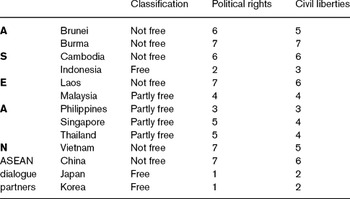
Table 2 shows that among ASEAN + 3, only Indonesia, Japan, and South Korea are classified by Freedom House as free. Half of the total membership of ASEAN consists of countries classified as ‘not free’. One of the three dialogue partners (China) is ‘not free’.
Ratings of freedom in ASEAN + 3, 2011 (January to December 2010 survey)

Note: 7 is least free, 1 is most free
Source: www.freedomhouse.org, last viewed on April 25, 2011
China and ASEAN reveal a culture that dilutes their commitment to democracy. China prioritizes economic gains over democratic values, and state interests over rights of the individual. ASEAN, on the other hand, has cultivated the strategy of avoiding confrontation and prioritizing harmony and consensus over ideology. Regarding Japan, Pyle observes: ‘pragmatic nationalism more than fixed principles has been Japan's guiding philosophy. An opportunistic adaptation to international conditions in order to enhance the power of the Japanese state has been characteristic of Japanese foreign policy.’Footnote 35
Optimistic views about the creation of an East Asian community focus on goals, projects, and common endeavors that may serve as motivations for East Asians to work together.Footnote 36 They eschew ideology. They claim that whatever commonalities East Asian countries presently have will be reinforced through the joint efforts of achieving functional goals, and the time will come when East Asians will share a common identity, on which a community may be built.
Shiraishi Takashi believes that it is possible to establish an East Asian community. He identifies ASEAN as the hub of networks now existing in East Asia, and sees Japan and China competing over leadership in this hub and spoke network. To win in the competition, Shiraishi lists the tasks for Japan: ‘first, [Japan] must promote the further growth of networks centered on the ASEAN hub. Second, it must find ways to involve the United States in regional affairs beyond security, such as energy cooperation, confidence building and preventive diplomacy in Northeast Asia, and the creation of an international code governing activities in the South China Sea. By reinforcing the ASEAN hub and building up America's position as a hub for East Asian networks, Japan must seek to both engage and deter China.’Footnote 37 These are tasks to keep China from a position of leadership, but Shiraishi does not say what Japan can offer as leader, and he does not say what the ideological guide for Japan would be.
The August 2005 policy report of the Council on East Asian Community (CEAC) can be taken to represent the views of the Japanese elite regarding an East Asian community. Inaugurated on May 18, 2004 under the leadership of former prime minister Nakasone Yasuhiro as chair and Ito Kenichi, a specialist on Japan's international relations, as president, the CEAC is a forum of Japanese think tanks, intellectuals, politicians, policy makers, and corporate executives, holding several meetings and publicizing commentaries on an East Asian community. The 2005 report says that Japan should have a vision of an East Asia that is ‘peaceful and prosperous . . . where the values of freedom and democracy are embraced. . .’Footnote 38 The report mentions ‘freedom and democracy’, but when the report lists several recommendations for the gradual creation of an East Asian community, there are no strong recommendations that stress the promotion of freedom and democracy.
Japan, in tandem with ASEAN, earlier expressed the same commitment to democracy in a declaration issued at the conclusion of the Japan–ASEAN Commemorative Summit held in Tokyo on December 11 and 12, 2003. The declaration states: ‘Japan and ASEAN will contribute to the creation of an East Asian region where countries and peoples can live in peace with one another and with the world at large in a just, democratic and harmonious environment.’Footnote 39 ‘Democracy’ is mentioned as one of the fundamental principles and values, but nowhere else in the document is it mentioned again and there is no mention of how to promote democracy.
The East Asian Vision Group (EAVG), proposed by Korean president Kim Dae-jung at the ASEAN + 3 Summit in Hanoi in December1998 to draft recommendations for the creation of an East Asian community, has also been miserly on democratic principles and human rights. It describes the proposed community as one of peace, prosperity and progress. Peace refers to avoidance of regional conflict; prosperity, to economic aspects of regional cooperation; and progress refers to improvement of governance, basic rights, and quality of life.Footnote 40 It identifies eight principles, but democracy and human rights are not one of them.
The vision and goals of an East Asian community, as proposed by the EAVG, may be stated in the two words: ‘peace’ and ‘stability’. They are realistic enough, for they are two of the basic goals of East Asian states, namely, national survival, national prosperity, and regional peace and stability.Footnote 41 What these basic goals mean may vary from one East Asian state to the other, and the EAVG avoids just one interpretation. Rather it stresses ‘cooperation and openness’.
On the whole, pronouncements, discussions and analysis of an East Asian community, as well as government actions, avoid confronting ideological issues. The extant literature yields voluminous information about the economic integration achieved by East Asia in the last decade, the emerging middle class culture that identifies with Asia, and Japan's desire to play an active role in the creation of an East Asian community, but very little is said about democracy and human rights. Democracy and human rights are mentioned as ideals to be achieved, but the commitment to these is not as strong as the commitment to the promotion of economic ties. There is very little in the literature that is critical of the nonideological government actions.
Among the active participants in the attempt to create an East Asian community, Japan has the greatest potential to advance democracy and human rights because of its own domestic record and its formal political structure, which is democratic parliamentarism. Not much can be expected of China. It is a socialist country without a record as good as that of Japan with respect to democracy and human rights. Not much can be expected of ASEAN, because it has institutionalized ideological neutrality through the policy of nonintervention and respect for state sovereignty – the so-called ASEAN Way.Footnote 42 Korea's democratic record is good, but it is not as active as Japan and China in the discourse about membership in the proposed East Asian community.
However, Japan has failed to measure up to this expectation. As ASEAN's dialogue partner, it did not object to the expansion of ASEAN membership to include nation-states with failing grades on democracy and human rights. It did not object to the inclusion of China as a dialogue partner. It does not object to the current talks about East Asian membership, which always assume that China is one of the major members.
From the perspective of realpolitik, such weak adherence by Japan to democratic ideology as a requirement for membership in an East Asian community is understandable for several reasons.
East Asia contains states with various political and economic systems. Even Japan, the most economically developed, politically stable democratic state in Asia, still has protectionist, illiberal, nationalist economic policies. It is becoming a liberal state, but ‘on Japanese terms’.Footnote 43 Given such an array of economic and political systems, Japan cannot be too selective. First, it would be a nightmare to neatly classify these states to find out if they were democratic enough to be members of an East Asia community, assuming that democracy were a requirement for membership. Second, even if a classification was successfully made, too few states might qualify.
Moreover, Japan has had the experience of separating economics from politics. In other words, it has isolated ideology from the pragmatic concerns of trade and investment in dealing with China, and it has not been harmed by it. Why change? To quote Edward J. Lincoln: ‘For the developing countries in Asia, Japan has a very clear and strong principle: economic success is important, and it can be achieved through a modified capitalist framework that accepts a strong role for the government (and downplays emphasis on democracy or human rights).’Footnote 44 If I were Lincoln, I would not put the downplaying of democracy or human rights in parentheses, but rather, underline it.
Differences between the Pre-World War II and the Present International Position of Japan
The two major sections above discuss pre-World War II Japanese regionalism and present Japanese participation in listing possible members in the proposed East Asian community. Both sections focus on boundary fluidity and the lack of a firm adherence to democratic ideology, characteristics shared by the two historical periods. Except for these two similarities, the two periods are greatly and significantly different from each other. This section elaborates on the major differences and their significance.
Japan's relationship with the United States
The present Japan–US relationship differs greatly from the way it was during the pre-World War II period. Before World War II, there was mutual suspicion between Japan and the United States. Since the Sino-Japanese War of 1898, when Japan became an empire by acquiring its first possession, Taiwan, and especially since the end of the Russo-Japanese War in 1904, when Japan became the first Asian power to defeat a European power, the United States had looked at Japan with suspicion. In the 1920s, Japan and the United States became economic rivals. Especially in the Philippines, where the United States enjoyed free trade, Japan had difficulty in promoting its products. Japan wished fervently that the Philippines would soon get its independence from the United States, and end the free trade agreement. In the end, Japan declared war with the United States and lost.
Today, Japan and the United States are allies. The end of World War II and Japan's defeat were soon followed by the Cold War, and Japan's fortunes turned for the better in terms of speedy economic development. The United States judged Japan a reliable and important ally in its fight against communism. To this day, the Japan–US alliance is still strong. The end of the Cold War brought about uncertainties in the alliance, but both sides have endeavored to maintain it. To Japan, the United States is a friend who should not be excluded from the proposed East Asian community – it should at least be accepted as an observer. But the United States does not relish the idea of being a mere observer.
Before World War II, Japan, a respected nation in Asia, stood up against a Western imperialist, the United States. Japanese proclamation of Asia for the Asians and liberation from the shackles of Western imperialism had an ideological potential that Japan could have used to guide its decisions and actions. But the potential was wasted, as history shows. Today, the former enemies are the best of allies in the Asia-Pacific. But one is in Asia, the other beyond Asia. Despite the obvious geographical anomaly, Japan is not willing to exclude the United States from an East Asian community. This disposition is not backed by an ideological commitment. It is simply a pragmatic consideration, if not an emotional one (for the sake of friendship).
Japan's relationship with China
Prewar Sino-Japanese relations were very different from the present Japan–China relations. In its prewar attempts at regionalization, Japan considered China as part of the region under Japan's influence, no matter what the region might be called. On the other hand, China considered Japan an enemy. Japan–China relations before World War II cannot be described as easily as Japan–US relations were described above because the former was not a black-and-white situation. The Sino-Japanese relationship pre-World War II was a mixture of grey areas of rivalry, cooperation, cultural affinity, and cultural contempt. But it can be simply said that Japan then was strong, and China was weak.
Today, the risen China is clearly Japan's rival for leadership in the efforts at regionalizing East Asia. Japan's rival today is no less than the source of its civilization, its cultural ancestor. Moreover, its rival suffered Japanese invasion and colonization. Thus, Japan does not have a moral edge over China in the way it had, at least initially and theoretically, a moral edge over the United States and other Western powers before World War II.
It is true that Japan has a democratic political system, which may be considered a moral edge over China, but this has no significant impact on most East Asian countries, many of which have authoritarian governments, and many of which have also experienced Japanese colonization. Moreover, Japan, in its attempt to engage China, is often forced to accommodate the socialist Chinese political system.
Respect for and protection of human rights is another moral principle that gives Japan more of an edge than China. But again, because of Japan's policy of engagement, Japan has not been able to strictly castigate China for human rights violations.
As seen above, China and Japan hold different views regarding membership in an East Asian community. And their views are colored by power politics and the desire to prevent the other from being more powerful or influential in the community, if it is ever created. Their views are different only in the sense that China wants to limit membership to ASEAN + 3, while Japan proposes a bigger membership. But they are the same in the sense that neither proposal is guided by any ideological consideration.
Imperialism then and globalization now
Japanese attempts at regionalization before World War II happened in the era of imperialism. Although imperialism was already battling with nationalist movements in the 1880s through the 1940s, Japan still took it as a model of modernization and also became an imperialist. In the 1940s, Japan decided to brand imperialism in Asia as Western, and described it as devoid of morality and justice. Japan branded its own imperialism as Asian and described it as a just force to liberate Asia from the Western imperialists.Footnote 45
Japanese participation in the creation of an East Asian community today is happening in the age of globalization. Globalization has many facets, but the one most relevant to regionalization is the perceived potential threat to state power coming from globalization. At first glance, it may seem far-fetched, but regionalization has become a tool to meet globalization's challenge to state power. Footnote 46 Closer examination would show that regionalization makes sense because a region's scope is smaller than the globe. The logic is that states would have more power in shaping a regional organization. Moreover, state powers collected in a regional organization would be stronger in meeting the challenges of globalization. The European Union was partly a reaction to globalization. APEC, a very loose organization not of states but of economies, was a response to globalization. The North American Free Trade Agreement (NAFTA) was also a response to globalization.
Japan is now trying to do the same – signing free trade agreements and economic partnership agreements. Japanese government pronouncements say that these separate economic partnership agreements and free trade agreements will form a ladder that will lead to an East Asian community. It remains to be seen if this will happen.
Globalization and regionalism are different from imperialism, in that the former is a relationship of equality and cooperation (at least in principle), while the latter is one of hierarchy and exploitation. If Japan, in the age of imperialism, resorted to violence to achieve its national interest, it is unlikely it would do the same today, in the era of globalization. After all, globalization offers more benefits than damage to a trading nation like Japan. It is more likely that Japan would aim at adroitly balancing globalization with regionalism.Footnote 47 On the other hand, balancing and cautious action like this would take a long time, and the realization of an East Asian community with a clear boundary could not be expected in the near future.
Activism and intellectual discussion
Before World War II, advocates of pan-Asianism were mostly activists. From the 1890s to the 1920s most of them were passionately committed to the ideals of pan-Asianism and had actual contacts with their sympathizers in China, Korea, India, and Southeast Asia. And this was why the Japanese government considered them troublemakers whose activities would create tension between Japan and the Western powers. From the 1920s to the 1940s, pan-Asianism, recreated in different phraseologies – the Asiatic Monroe Doctrine, followed by the New Order called Greater East Asia, and finally, the Greater East Asia Co-Prosperity Sphere – became Japanese official policy. In whatever phraseology, pan-Asianism was activist.
On the other hand, the discourse on the southward advance (both the peaceful discourse and the military advocacy) was replete with unscientific and groundless claims of Japanese racial and cultural unity with the peoples of nan'yo, as well as claims of long historical ties and the importance of the natural resources of nan'yo for Japan. Claims like this could be found in the writings of recruitment agencies, entrepreneurs, businessmen, and journalists, as well as government publications such as geography textbooks.Footnote 48 Nan'shin was attacked, supported, and analyzed in foreign publications, but there was no systematic international structure that provided a platform for discussion.Footnote 49
In contrast to the activist and unscientific discourse of Japanese regionalism before World War II, participants in the discourse on an East Asian community today are drawn from different sectors of society. They are academics, journalists, business people, professionals, students, politicians, members of civil society groups. They are not activists who passionately carry out their ideals. Today's discourse on regionalism is more intellectual and theoretically grounded than it was before World War II, because intellectuals, academics, and practitioners have history, the European Union, and other regional projects to learn from. Intellectual and theoretical discourse may alienate the public, but such a fear is unwarranted because advocacies by civil society groups can bring the discourse down to earth. In Japan, when the Council on East Asian Community (CEAC) was set up in 2004, it was created among politicians, intellectuals, business people, and representatives from other sectors of Japanese society.
This is a significant difference because the present discourse is more democratic than that of the pre-World War II period. Moreover, the participation of intellectuals and civil society groups is important because they are usually more idealistic than the practitioner businessmen and entrepreneurs. With this kind of participation, injecting ideology into Japan's foreign policy could happen.
Japan was alone before, but not nowFootnote 50
In the Japanese regionalization pre-World War II, taking place in the age of imperialism and at a time when Japan had a totalitarian government, the Japanese government was alone in deciding about the scope of nan'yo, as well as the Greater East Asia Co-Prosperity Sphere. The discussion took place only between the government and the military. Contrary opinions could not be published in the mass media.
Today, membership in the proposed East Asian community will have to be decided, if ever there is a decision to decide on it, by different actors. Aside from China, which often puts forward proposals different from those of Japan, Australia also wants to join. The United States does not want to be excluded, although for obvious reasons it has not explicitly volunteered to join. It is, however, cold to the idea of an East Asian community.
Intellectual discussions are held internationally. An example of this is NEAT, the Network of East Asian Think-Tanks. Scholars from research institutions and universities in ASEAN + 3 countries participated in the inaugural meeting of NEAT on September 29–30, 2003 in Beijing.Footnote 51 Another example is the eminent persons group of ASEAN, which was instrumental in drafting the ASEAN Charter.
In the prewar period, Japan could have unilaterally opted for a smaller scope over which to exert power and influence. But it did not, because of the lure of economic opportunities. Japan alone refused to be guided by an ideology beyond economic profit. The present discourse gives priority to economic development and economic integration. It is not only Japan that refuses to be guided by an ideology; Japan is joined by other actors.
The example set by ASEANFootnote 52
The secret of ASEAN's durability is its ideological neutrality and nonintervention in the domestic and foreign policies of member states. According to Acharya, the policy of nonintervention is deeply rooted in the Asian states’ desire to protect state sovereignty.Footnote 53 ASEAN, by respecting state sovereignty, has avoided making enemies, and has therefore avoided collapse through withdrawal of dissenting members.
East Asian experience has shown that ideology is divisive. That ASEAN is now the hub of networks of relationships that may lead to an East Asian community shows that a refusal to impose ideological requirements on members assures survival.
There was no organization similar to ASEAN in the prewar period and there was no strategy similar to the ASEAN Way. The prewar Japanese propensity to a nonideological approach to its regionalization efforts was therefore unprecedented. The example set by ASEAN today, on the other hand, reinforces Japan's predisposition toward a nonideological approach to an East Asian community.
No more Greater East Asia co-prosperity sphere
To sum up this section, Japan's efforts at regionalization today are taking place in an age of globalization, active civil society participation, competition with China, and Japan's commitment to the US–Japan alliance. In contrast, Japan's regionalization efforts before World War II took place in an age of imperialism, competition with the Western powers, particularly the United States, and the presence of a weak China. The two periods are very different from each other.
Japan's international position before World War II, its totalitarian political system, and the general international situation led Japanese efforts at regionalization to an advocacy of the Greater East Asia Co-Prosperity Sphere. The advocacy was only secondary to the military and violent action that Japan finally took. It had a catastrophic end.
It is therefore not surprising that the Japanese government is overcautious in its pronouncements about an East Asian community. It is fully aware of the negative legacy of World War II, and it is afraid that an aggressive stance might be compared with the much maligned Greater East Asia Co-Prosperity Sphere.Footnote 54 Implicitly, there is a tendency among government officials, and even among intellectuals, to compare the present efforts at regionalization with the efforts that led to the Greater East Asia Co-Prosperity Sphere.
The vast difference between the present Japan and the Japan of the pre-World War II period, plus the vast difference between the prewar world situation and the present world situation do not justify the comparison of the present Japanese participation in the project of building an East Asian community with the Greater East Asia Co-Prosperity Sphere. Japan, Asia, and the world have changed so much, making the possibility remote that a regional community or bloc could be built through force.
Conclusion
Rather than comparing Japan's present participation in making a list of potential members of the proposed East Asian community only with the Greater East Asia Co-Prosperity Sphere, this paper has found it more fruitful to compare it with the processes that took place from the prewar period, particularly the 1920s to the 1940s.
The exercise shows that despite the vast difference between the prewar and the present periods, Japan's disposition toward a vague delineation of nan'yo and the Greater East Asia still exists in its present participation in the creation of an East Asian community. Moreover, in the prewar period, Japan was not guided by an ideology beyond economic profit. Even up to the 1940s, the very name of the regional organization it sought to establish, the Greater East Asia Co-Prosperity Sphere, was about prosperity, interpreted as economic prosperity. Copying the ideals of the original pan-Asianism of the 1880s, Japanese war propaganda proclaimed freedom and liberty, but they turned out to be empty slogans. The same is true about Japanese adherence to the ideals of liberal democracy and human rights today. The Japanese government has an excellent record in carrying them out at home, but it has been weak in advocating and carrying them out in its foreign relations.
The fluidity of the boundaries of nan'yo and the Greater East Asia in the prewar period was due to the lack of a firm ideological foundation. Today, Japan's disposition toward a fluid boundary for an East Asian community is also caused by the lack of a firm adherence to the ideals of liberal democracy and human rights in the conduct of its foreign relations.
If the Japanese government had been guided by some kind of ideology in its southward advance in the pre-World War II period, the scope of nan'yo would not have been so vast and irregularly shaped. If the Greater East Asia Co-Prosperity Sphere had been guided by some principles higher than economic exploitation, Japanese pronouncements about the delineation of the sphere would not have been so far from reality.
Today, if Japan were consistently guided by the principles of democracy and human rights, its proposals as to which states should comprise an East Asian community would have a clearer basis and direction. Admittedly, this would require a challenging diplomatic skill and might even cause Japan economic losses. Japan, therefore, has taken the rational and realist course of action: suspend the principles of democracy and human rights and relegate them to a commitment for the future.
Looking to the future and choosing to be overly optimistic in doing so, one may imagine that a time will come when all the candidates for membership in an East Asian community will be democratic and respectful of human rights. If this happens, then an East Asian community's boundary, or a boundary of any proposed regional community, will no longer be problematic in the way it has been problematized in this paper. Until that happens, the paper maintains that, at present, the dreamt-of East Asian community has an ever-changing boundary and Japan does not contribute to its more permanent delineation. Just like the other major actors, Japan is not guided by a clear set of ideals and principles called in this paper ideology. Japan showed the same kind of tendency before World War II.
About the author
Lydia N. Yu Jose, Professor of Political Science at the Ateneo de Manila University and current director of the Ateneo Center for Asian Studies, obtained her PhD from Sophia University, Tokyo. Among her recent works are chapters in The Past, Love, Money and Much More: Philippines–Japan Relations after the Second World War (Quezon City: Japanese Studies Program, Ateneo de Manila University, 2008), which she edited. Her article in the Japanese Journal of Political Science (Vol. 5, No. 1, 2004) on ‘Global Environmental Issues: Responses from Japan’ has been reprinted in Christopher Hood, ed., The Politics of Modern Japan, Vol. 3: Japanese Politics on the International Stage (London: Routledge, 2008). Her current interest in Japan–East Asia relations is an offshoot of her longtime interest in Japanese politics and Philippines–Japan relations.