Introduction
The fear of anxiety and related physical sensations is known as anxiety sensitivity (AS) (Reiss, Peterson, Gursky, & McNally, Reference Reiss, Peterson, Gursky and McNally1986). AS is a cognitive style through which patients become sensitive to anxiety symptoms and believe that these symptoms have dangerous or catastrophic consequences (Riskind, Black, & Shahar, Reference Riskind, Black and Shahar2010); thus, they become vulnerable to emotional disorders (Schmidt, Zvolensky, & Maner, Reference Schmidt, Zvolensky and Maner2006) by following avoidant mechanisms (Wilson & Hayward, Reference Wilson and Hayward2006). The developmental and maintenance role of AS attracted the attention of psychopathology studies and aetiological models of emotional disorders. This construct, which includes the three dimensions of physical, cognitive, and social concerns, was initially known as vulnerability to panic disorder (PD) (Dixon, Sy, Kemp, & Deacon, Reference Dixon, Sy, Kemp and Deacon2013). However, subsequent studies have shown that AS is a dimensional construct and is associated with a range of emotional disorders (Naragon-Gainey, Reference Naragon-Gainey2010; Schmidt, Mitchell, & Richey, Reference Schmidt, Mitchell and Richey2008; Wheaton, Deacon, McGrath, Berman, & Abramowitz, Reference Wheaton, Deacon, McGrath, Berman and Abramowitz2012).
Olthuis, Watt, and Stewart (Reference Olthuis, Watt and Stewart2014b) showed that physical, cognitive, and social concerns predict PD, depressive symptoms, and social anxiety. AS is not only a predisposing factor in emotional disorders but is also known as an obstacle to the treatment process. Evidence suggests that difficulty in distress tolerance in some patients with post-traumatic stress disorder (PTSD) reduces imaginal exposure achievements. Boswell et al. (Reference Boswell, Farchione, Sauer-Zavala, Murray, Fortune and Barlow2013) also suggested that similarly, AS can interfere with imaginal or in vivo exposures of patients to obsessive–compulsive disorder (OCD), social anxiety disorder (SAD), and generalised anxiety disorder (GAD). Some studies have suggested that AS is correlated with the severity of OCD symptoms and that patients with higher AS achieved fewer OCD treatment outcomes in post-treatment (Blakey, Abramowitz, Reuman, Leonard, & Riemann, Reference Blakey, Abramowitz, Reuman, Leonard and Riemann2017). Given the evidence that elevated AS is associated with poorer treatment outcomes for emotional disorders, targeting AS may improve the efficacy of these interventions.
Cognitive behavioural interventions based on AS include the three categories of diagnosis-specific cognitive behavioural protocols, construct-specific cognitive behavioural protocols, and transdiagnostic protocols. Diagnosis-specific protocols of PD focus on cognitive restructuring, interoceptive exposure, or both (Pompoli et al., Reference Pompoli, Furukawa, Efthimiou, Imai, Tajika and Salanti2018) to reduce perceived danger and fear of physical symptoms associated with anxiety. Construct-specific cognitive behavioural protocols include the Anxiety Sensitivity Amelioration Training (ASAT) (Schmidt et al., Reference Schmidt, Eggleston, Woolaway-Bickel, Fitzpatrick, Vasey and Richey2007), Anxiety Sensitivity Education and Reduction Training (ASERT) (Keough & Schmidt, Reference Keough and Schmidt2012), and AS self-help protocol (Stewart & Watt, Reference Stewart and Watt2007). The results of clinical trials have supported the efficacy of these protocols. For example, Schmidt et al. (Reference Schmidt, Eggleston, Woolaway-Bickel, Fitzpatrick, Vasey and Richey2007) showed that the ASAT protocol had high efficacy in individuals with high AS and was able to reduce their overall Anxiety Sensitivity Index-3 (ASI-3) score by approximately 30%. However, this protocol was not effective in reducing anxiety and depression due to the non-clinical sample and the lack of samples with various diagnoses. The ASERT protocol similarly had a significant effect on reducing AS. Approximately 58% of the total AS score in patients with high AS decreased regardless of their diagnosis (Keough & Schmidt, Reference Keough and Schmidt2012). Moreover, reducing AS through ASERT can significantly reduce worry and anxiety in individuals with high AS, but in the long term, it does not affect their depression (Norr, Allan, Macatee, Keough, & Schmidt, Reference Norr, Allan, Macatee, Keough and Schmidt2014). A clinical trial that evaluated the effectiveness of telephone-based cognitive behavioural therapy (CBT) in reducing AS showed that AS self-help protocol effectively reduces AS and significantly improves PD, SAD, and PTSD. However, it has not been effective in improving GAD and depressive symptoms (Olthuis, Watt, Mackinnon, & Stewart, Reference Olthuis, Watt, Mackinnon and Stewart2014).
The third group of AS-based interventions emerged from the development of a transdiagnostic perspective on CBT. Transdiagnostic CBT (T-CBT) changed the focus of treatment from diagnosis and symptoms to vulnerabilities and underlying constructs (Khakpoor, Saed, & Armani Kian, Reference Khakpoor, Saed and Armani Kian2019b). The Unified Protocol (UP) is an emotion-based T-CBT designed to target anxiety and depression and other problems associated with experiencing intense emotions. Boswell et al. (Reference Boswell, Farchione, Sauer-Zavala, Murray, Fortune and Barlow2013) evaluated the transdiagnostic construct of AS and interoceptive exposure as a change strategy in a UP clinical trial. They found that the highest efficacy of the UP on AS was between the eighth session of treatment and post-treatment, meaning that the most significant effect was related to the interoceptive and situational emotion exposure module; in addition, AS reduction led to a reduction in emotional symptoms at post-treatment and follow-up. Also, results from a study that investigated the efficacy of web-based transdiagnostic intervention on affective and mood disorders showed a large effect size in reducing AS (Tulbure, Rusu, Sava, Salagean, & Farchione, Reference Tulbure, Rusu, Sava, Salagean and Farchione2018). Furthermore, several studies have reported the efficacy of the UP in reducing anxiety disorders and their comorbidities (Ellard, Fairholme, Boisseau, Farchione, & Barlow, Reference Ellard, Fairholme, Boisseau, Farchione and Barlow2010; Farchione et al., Reference Farchione, Fairholme, Ellard, Boisseau, Thompson-Hollands and Carl2012) and treating major depressive disorder (Khakpoor, Mohammadi Bytamar, & Saed, Reference Khakpoor, Mohammadi Bytamar and Saed2019a; Sauer-Zavala et al., Reference Sauer-Zavala, Bentley, Steele, Tirpak, Ametaj and Nauphal2019). Boswell, Anderson, and Barlow (Reference Boswell, Anderson and Barlow2014) have shown that emotional tolerance-related modules of the UP can effectively reduce depression and anxiety through change mechanisms such as mindfulness, cognitive reappraisal, and emotional avoidance.
In addition to these differences, it seems that there is insufficient research evidence for the selection of an effective intervention for patients with high AS. The results of diagnosis-specific protocols for PD can hardly be generalised to other diagnoses. Moreover, in the case of construct-specific protocols, there are some issues such as the lack of the use of clinical samples in studies, the low efficacy of these protocols on anxiety and depression, and specifically insufficient evidence from clinical trials for the evaluation of the efficacy of AS self-help protocol. Additionally, the lack of adequate clinical trials and the lack of studies with a sample of individuals with high AS have created a research gap in the UP literature. Therefore, the present study was conducted to compare the efficacy of construct-specific CBT (CS-CBT) and T-CBT on AS, anxiety, depression, and negative and positive affect in patients with high AS.
Methods
The present study was a double-blind clinical trial with two interventions and a wait list that has been registered in the Iranian Registry of Clinical Trials (IRCT20180501039497N1). Participants’ screening was performed in three stages. In the primary screening, participants were assessed using ASI-3. Individuals with 23 (the cut-off score) or higher points (Otto, Smits, Fitzgerald, Powers, & Baird, Reference Otto, Smits, Fitzgerald, Powers and Baird2019) underwent a second screening. Those who met the inclusion criteria in telephone screening were invited to participate in the third screening. Individuals who did not meet the inclusion criteria were excluded from the study. Finally, they were randomly allocated to one of the three groups of T-CBT by UP, CS-CBT by overcoming the AS protocol, and the wait list. The dependent variables in this study included AS, anxiety, depression, and positive and negative affect, which were assessed using a questionnaire in the four stages of pre-treatment, post-treatment, 3-month follow-up, and 6-month follow-up.
Screening and Participants
In the primary screening, 500 university students were selected using convenience sampling and assessed using ASI-3. Of the selected students, 187 scored higher than 23. The participants who had the cut-off score were identified and contacted for the second screening. The inclusion criteria were willingness to participate in the study and being between 18 and 35 years old. The exclusion criteria included a history of cardiovascular disease (CVD), a history of psychological interventions in the past year (more than five sessions), a history of taking psychiatric medications in the past year (more than 1 month), a history of substance addiction, and a history of personality disorders. Among those who underwent the second screening, 115 individuals were unwilling to participate in the study, 8 individuals were over 35 years of age, 6 individuals had a history of cardiovascular problems, 4 individuals attended more than five sessions of psychological interventions in the last year, and 5 individuals were taking psychiatric medications. Thus, 49 individuals remained and were invited to the third screening. At this stage, patients who met all the criteria for one or more emotional disorders did not have CVD, personality disorders, and had not experienced substance addiction, and a history of psychological interventions and psychiatric medications were included in the study. Eventually, 42 patients (18–35), who met the criteria for at least one emotional disorder, remained and were assigned to the three groups. In addition, during the treatment sessions, one patient dropped out of CS-CBT due to unwillingness to continue attending the sessions, and another was excluded from T-CBT due to absence from more than three consecutive sessions (Figure 1).
CONSORT diagram of enrolment, randomised allocation, and follow-up.

Randomisation and Blinding
Stratified random allocation (with a 1:1:1 allocation ratio) was used for the randomisation and blinding of patients and therapists. A research colleague who was unaware of the screening stages assigned the patient codes to one of the groups (T-CBT, CS-CBT, and wait list) using computer block randomisation by two gender and therapists strata. In this way, the patients were blinded to their type of treatment and therapists, and the therapists were blinded to the patients.
Interventions
Construct-specific CBT
In the present study, overcoming AS self-help protocol was used. Stewart and Watt (Reference Stewart and Watt2007) introduced this protocol for overcoming AS and its related emotional disorders. The protocol, designed in 11 chapters as a self-help programme to overcome AS, consists of five major parts to target AS. The first part is psychoeducation, which aims to increase patients’ understanding of AS and its relation to psychological problems. The second part is cognitive restructuring; this part of the intervention addresses the decatastrophising of physical sensations using cognitive therapy for both catastrophising and overestimating probability. The third part is behavioural interventions that focus on interoceptive exposure to habituate to anxiety-related bodily sensations. The fourth part is changing lifestyle habits, since a stressful lifestyle is associated with AS; interventions in this area focus on changing breathing, nutrition, exercise, hobbies, and humour. Finally, in relapse prevention, patients were educated on the nature of change, setbacks, failure, and relapse in order to increase their awareness of their condition in the post-treatment and learned to maintain treatment outcomes. Patients received 11 sessions of treatment; every treatment session was approximately 45–50 min.
Transdiagnostic CBT
T-CBT is based on the UP (Barlow et al., Reference Barlow, Farchione, Bullis, Gallagher, Murray-Latin and Sauer-Zavala2017). The UP relies on vulnerabilities and transdiagnostic treatment processes instead of common symptoms and diagnoses. The UP is relatively similar to the classical cognitive behavioural protocols, with the difference being that its focus is the type of reaction to emotional experiences (Barlow et al., Reference Barlow, Farchione, Bullis, Gallagher, Murray-Latin and Sauer-Zavala2017). The protocol includes eight modules: goal setting and motivation, understanding emotions, mindful emotion awareness, cognitive flexibility, countering emotional behaviours, understanding and confronting physical sensations, emotion exposures, and relapse prevention (Barlow et al., Reference Barlow, Farchione, Bullis, Gallagher, Murray-Latin and Sauer-Zavala2017; Ellard et al., Reference Ellard, Fairholme, Boisseau, Farchione and Barlow2010). Given that the UP is a module-based protocol, the number of sessions can vary from 12 to 18. In the present study, patients received weekly 45-min sessions for 13–16 weeks.
Therapists and Interviewer
The therapists in this study included two cognitive behavioural therapists who trained under the supervision for 2 years to improve their skills in T-CBT and CS-CBT. During the treatment, in order to check the therapists’ adherence to the protocols, patients’ records were observed, reviewed, and approved by the supervisor. Furthermore, the ADIS-5 interviewer was administered by a trained hospital clinical psychologist who had received regular supervision with an experienced PhD clinical psychologist, and her interviews in this study were reviewed by supervision.
Assessments and Instruments
Anxiety and Related Disorders Interview Schedule for DSM-5
This version was introduced to adapt the previous version to the Diagnostic and Statistical Manual of Mental Disorders, Fifth Edition (DSM-5). The Anxiety and Related Disorders Interview Schedule for DSM-5 (ADIS-5) is a structured clinical interview for anxiety disorders, substance abuse, and other psychological disorders. In ADIS-5, the severity of mental disorders is scored using the Clinician's Severity Rating (CSR). The CSR is a 9-point index that ranges from 0 (meaning no clinical symptoms) to 8 (meaning very severe symptoms). A score of 4 or higher indicates the diagnostic threshold in the DSM-5 (Brown & Barlow, Reference Brown and Barlow2014).
Anxiety Sensitivity Index-3
Reiss et al. (Reference Reiss, Peterson, Gursky and McNally1986) introduced the first version of the ASI-3 as a unidimensional scale with good psychometric properties. Subsequent studies have shown that the structure of this index is multifactorial, meaning that it consists of a higher-order factor of AS and three lower-order factors that include fear of somatic sensations, fear of cognitive dyscontrol, and fear of publicly observable anxiety symptoms (Asmundson, Weeks, Carleton, Thibodeau, & Fetzner, Reference Asmundson, Weeks, Carleton, Thibodeau and Fetzner2011; Zinbarg, Barlow, & Brown, Reference Zinbarg, Barlow and Brown1997). Currently, the ASI-3 is the most commonly used scale for AS. The ASI-3 is an 18-item index presented by Taylor et al. (Reference Taylor, Zvolensky, Cox, Deacon, Heimberg and Ledley2007). A cut-off score of 23 has been suggested for ASI-3 (Otto et al., Reference Otto, Smits, Fitzgerald, Powers and Baird2019). A preliminary study on 4494 non-clinical samples from the United States, Canada, France, Mexico, Netherlands, and Spain, and 390 clinical samples from the United States and Canada showed that, in addition to excellent psychometric properties, ASI-3 has a three-factor structure (physical, cognitive, and social concerns) (Ghisi et al., Reference Ghisi, Bottesi, Altoè, Razzetti, Melli and Sica2016; Stewart & Watt, Reference Stewart and Watt2007). Moreover, its test–retest reliability was good (.78) (Ghisi et al., Reference Ghisi, Bottesi, Altoè, Razzetti, Melli and Sica2016).
Beck Anxiety Inventory
The Beck Anxiety Inventory (BAI) was introduced in 1988 for the measurement of clinical anxiety (Beck, Epstein, Brown, & Steer, Reference Beck, Epstein, Brown and Steer1988). It is one of the most widely used anxiety assessment measures in clinical trials. The BAI is a self-report inventory and consists of 21 items rated on a 4-point Likert scale ranging from 0 (not at all) to 3 (severely — it bothered me a lot). Each item represents the anxiety symptoms experienced by individuals who are clinically anxious or in a state of anxiety. Various studies have examined the psychometric properties of this questionnaire. A study on 40 patients with anxiety disorders has shown that this questionnaire has a good internal consistency (α = .91), good test–retest reliability in clinical and non-clinical samples (.66 and .65, respectively) (Bardhoshi, Duncan, & Erford, Reference Bardhoshi, Duncan and Erford2016), and high sensitivity (85.0%) and specificity (88.1%) (Oh et al., Reference Oh, Park, Yoon, Kim, Lee and Choi2018).
Beck Depression Inventory-II
The Beck Depression Inventory (BDI) has three versions; the original version was first introduced in 1961 (Beck, Ward, Mendelson, Mock, & Erbaugh, Reference Beck, Ward, Mendelson, Mock and Erbaugh1961) and was later revised in 1978 as the BDI-1A. Despite the good psychometric properties of the BDI-IA, BDI-II was introduced in 1996 to include more clinical symptoms consistent with the DSM (Beck & Steer, Reference Beck and Steer1984). The BDI-II is a self-report inventory designed to assess the severity of depressive symptoms. It consists of 21 items. The total score of this questionnaire ranges from 0 to 63 points. The scores of 0–13, 14–19, 20–28, and 28–63 suggest a lack of symptoms of depression, mild depression, moderate depression, and high severity of depressive symptoms (Taylor, Koch, Woody, & McLean, Reference Taylor, Koch, Woody and McLean1996). This questionnaire also has excellent psychometric properties. The BAI-II is one of the most widely used tools for measuring depression in clinical research. Furthermore, Wang and Gorenstein (Reference Wang and Gorenstein2013) reported good internal consistency (α = .90) and good test–retest reliability (.73–.96) for the BAI-II.
Positive and Negative Affect Schedule
Watson, Clark, and Carey (Reference Watson, Clark and Carey1988) first introduced the Positive and Negative Affect Schedule (PANAS). This scale consists of 20 items that assess positive affect and negative affect. The items are scored on a 5-point Likert scale. The total score range of each of the positive and negative affect subscales is 10–50. The internal consistency coefficients of the positive and negative affect subscales of this scale in the initial study were reported to be .88 and .87, respectively. Watson et al. (Reference Watson, Clark and Carey1988) reported that negative affect was correlated with both participants’ anxiety and depression, but positive affect was related only to depressive symptoms. Furthermore, Leue and Lange (Reference Leue and Lange2011) reported a moderate to high internal consistency for PANAS.
Statistical Analysis
To begin with, a descriptive analysis related to the patients’ characteristics was performed. Pre-treatment differences were investigated using one-way analysis of variance (ANOVA). Repeated-measures ANOVA was performed to examine the changes in T-CBT, CS-CBT, and wait list. Analysis of covariance (ANCOVA) was used to compare the interventions with the wait list and compare the efficacy of T-CBT and CS-CBT. Moreover, Hedges’ g effect size was used to estimate the clinical effect size in the three-time condition of the study (pre- to post-treatment, pre-treatment to 6-month follow-up, and post-treatment to 6-month follow-up) and compare the treatment conditions.
Ethical Considerations
This study was registered in the Zanjan University of Medical Sciences ethics committee (No. IR.ZUMS.REC.1396.306) and was carried out according to the instructions of this committee. Ethical frameworks, including adherence to secrecy, confidentiality, informed consent, and the patients’ welfare at all stages, were considered by the researchers and therapists. Ethical challenges were raised continuously in the meetings of the executive team, and decisions were made based on the ethical principles of psychologists and code of conduct. The study's general conditions were explained to the patients, and they were made aware of their rights and completed the informed consent form. Moreover, to protect patients’ information, all their information was recorded in assessments and the statistical software using codes.
Results
Sample Characteristics
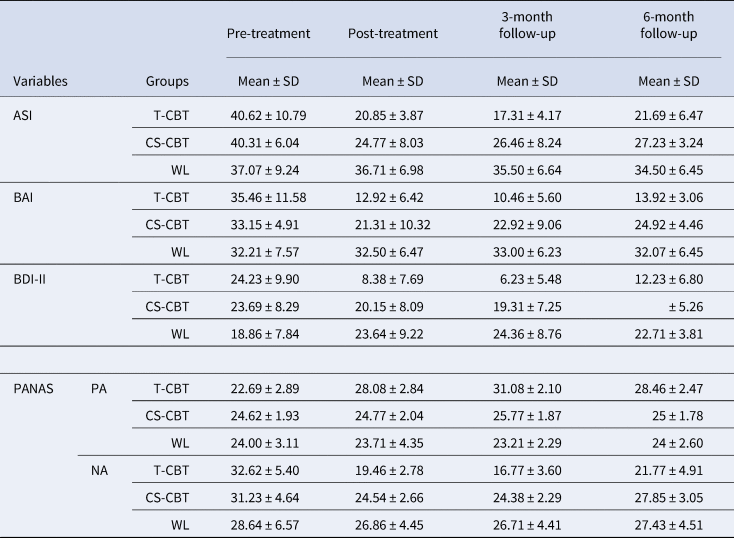
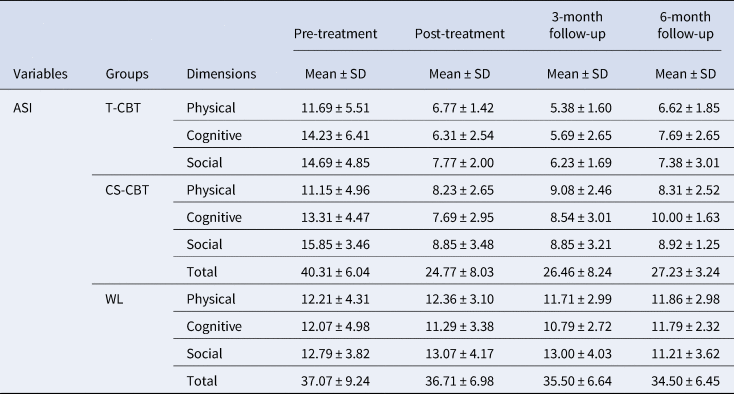
The demographic and diagnostic characteristics of the patients are presented in Table 1. The χ2 test results showed no significant difference in the gender and age of patients between the three groups (p < .05), which indicates the homogeneity of the groups in terms of the demographic characteristics. Moreover, 92.85% of the participants met the criteria for a comorbid emotional disorder. The mean and standard deviation of the dependent variables (AS, anxiety, depression, and negative affect) in T-CBT, CS-CBT, and wait list groups by scores obtained in pre-treatment, post-treatment, and 3-month and 6-month follow-up are presented in Table 2. Also, the mean and standard deviation of the physical, cognitive, and social dimensions of AS are reported separately (Table 3).
Demographic and Diagnostic Characteristics

Note: T-CBT = transdiagnostic cognitive behavioural therapy; CS-CBT = construct-specific cognitive behavioural therapy; WL = wait list; OCD = obsessive–compulsive disorder; SAD = social anxiety disorder; GAD = generalised anxiety disorder; PTSD = post-traumatic stress disorder; MDD = major depressive disorder.
Descriptive Statistics for Outcome Variables From Pre-treatment to Follow-up

Note: T-CBT = transdiagnostic cognitive behavioural therapy; CS-CBT = construct-specific cognitive behavioural therapy; WL = wait list; ASI-3 = Anxiety Sensitivity Index-3; BAI = Beck Anxiety Inventory; BDI-II = Beck Depression Inventory-II; PANAS = Positive and Negative Affect Schedule.
Descriptive Statistics for Dimensions of ASI-3 From Pre-treatment to Follow-up

Pre-treatment Differences Between Conditions
The Kolmogorov–Smirnov test results showed that the assumption of normal distribution was met, and Levene's test illustrated the homogeneity of variances; thus, repeated-measures ANOVA was performed to examine baseline differences between independent variables in pre-treatment. The variances in AS (F = 0.52; p > .598), anxiety (F = 0.66; p > .523), depression (F = 1.21; p > .310), positive affect (F = 1.71; p > .195), and negative affect (F = 1.74; p > .189) showed that there was no significant difference between the groups in pre-treatment (p > .05). Therefore, baseline differences in pre-treatment were controlled through stratified random allocation.
Efficacy of Interventions
Repeated-measures ANOVA was used to evaluate the efficacy of the interventions on outcome variables during the assessments. The Huynh–Feldt correction was used due to the significance of the Mauchly's test of sphericity on AS, anxiety, depression, and negative affect. The results showed that the main effect of T-CBT on AS (F = 29.87; p < .001), anxiety (F = 45.77; p < .001), depression (F = 36.62; p < .001), positive affect (F = 22.93; p < .001), and negative affect (F = 41.90; p < .001) was significant. Moreover, in the CS-CBT group, changes in AS (F = 17.79; p < .001), anxiety (F = 11.46; p = .001), and negative affect (F = 14.32; p = .001) during the assessments were significant (p < .001), while changes in depression (F = 1.62; p > .213) and positive affect (F = 1.36; p > .268) were not significant. In the wait list group, no significant changes were observed in AS (F = 0.995; p > .360), anxiety (F = 0.182; p > .846), positive affect (F = 1.92; p > .218), and negative affect (F = 11.97; p > .829); however, the depression score (F = 3.53; p < .042) increased significantly in the follow-up compared with the pre-treatment stage.
Comparing the Efficacy of Interventions
The results of ANCOVA in comparing T-CBT and the wait list at post-treatment showed a significant difference in AS (F = 53.83; p < .001), anxiety (F = 116.86; p < .001), depression (F = 34.22; p < .001), positive affect (F = 9.33; p < .005), and negative affect (F = 43.73; p < .001). At the 3-month follow-up stage, there was a significant difference between T-CBT and the wait list in terms of AS (F = 67.91; p < .001), anxiety (F = 142.10; p < .001), depression (F = 58.40; p < .001), positive affect (F = 32.98; p < .001), and negative affect (F = 40.32; p < .001). Furthermore, at the 6-month follow-up, there was a significant difference between T-CBT and the wait list in terms of AS (F = 26.46; p < .001), anxiety (F = 108.30; p < .001), depression (F = 5.31, p < .030), positive affect (F = 53.99; p < .001), and negative affect (F = 12.64; p < .002). In other words, T-CBT was significantly more effective in reducing AS, anxiety, depression, positive affect, and negative affect than the wait list.
Moreover, the results of ANCOVA in comparing CS-CBT with the wait list showed a significant decrease in AS (F = 20.03; p < .001) and anxiety (F = 15.72; p < .001) in the CS-CBT group in the post-treatment. Nevertheless, the difference between these groups in terms of depression (F = 2.84; p > .105), positive affect (F = 0.386; p > .001), and negative affect (F = 3.97; p > .058) was not significant. There was a significant difference between CS-CBT and the wait list in terms of AS (F = 10.75; p < .005), anxiety (F = 13.91; p < .001), depression (F = 8.12; p < .009), positive affect (F = 4.52; p < .044), and negative affect (F = 4.90; p < .037) at the 3-month follow-up. In other words, CS-CBT was significantly more effective in reducing AS, anxiety, depression, and positive and negative affect during the 3-month follow-up compared with the wait list. At the 6-month follow-up, the differences between these groups in terms of AS (F = 20.10; p < .001), anxiety (F = 19.95; p < .001), and depression (F = 5.31; p < .030) remained significant, but there was no significant difference between them in terms of positive affect (F = 3.86; p > .061) and negative affect (F = 0.027; p > .871).
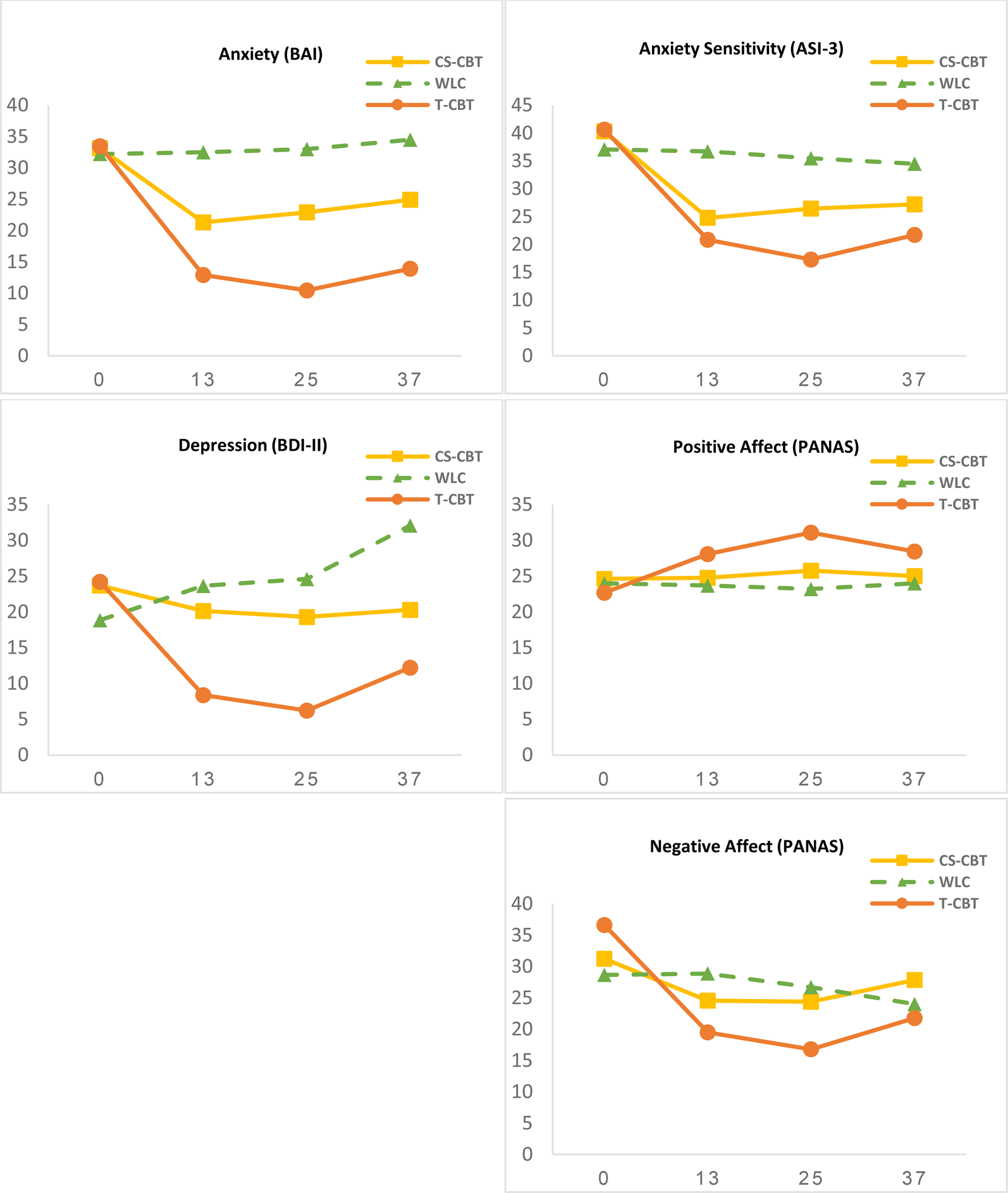
The results of ANCOVA showed no significant difference between T-CBT and CS-CBT in terms of AS (F = 2.40; p > .135) in the post-treatment. However, a significant difference was observed in anxiety (F = 8.45; p < .008), depression (F = 16.59; p < .001), positive affect (F = 9.04; p < .006), and negative affect (F = 24.78; p < .001) in the T-CBT group compared with the CS-CBT group. In addition, at the 3-month follow-up, AS (F = 12.38; p < .002), anxiety (F = 17.93; p < .001), depression (F = 37.81; p < .001), positive affect (F = 15.50; p < .001), and negative affect (F = 39.03; p < .001) were significantly improved in the T-CBT group compared with the CS-CBT group. These differences in AS (F = 7.50; p < .012), anxiety (F = 53.83; p < .001), depression (F = 11.44; p < .002), positive affect (F = 35.68; p < .001), and negative affect (F = 13.71; p < .001) remained significant at the 6-month follow-up. In other words, T-CBT was significantly more effective in reducing AS, anxiety, depression, positive affect, and negative affect in comparison with CS-CBT (Figure 2).
Comparison of outcomes in pre-treatment, post-treatment, 3-month follow-up, and 6-month follow-up.

Clinical Significance
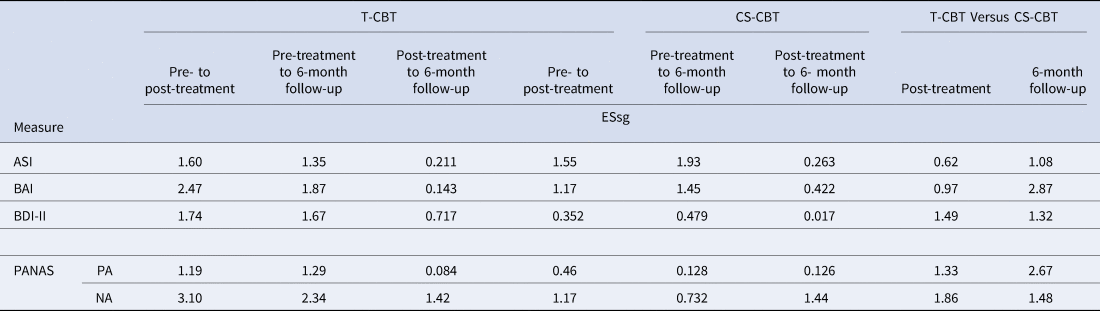
Hedges’ g effect size, which is suitable for small samples (n < 20) (Lakens, Reference Lakens2013), was used to estimate effect size significance at the three stages (pre- to post-treatment, pre-treatment to 6-month follow-up, and post-treatment to 6-month follow-up) of the study and compare them. Given that Hedges’ g effect size is similar to Cohen's effect size, the scores of .2, .5, and .8 were considered small, medium, and large, respectively. In the present study, the effect size of T-CBT was large in all outcome variables from pre-treatment to post-treatment and 6-month follow-up. The post-treatment to 6-month follow-up effect size was small in AS, anxiety, and positive affect, moderate in depression, and large in negative affect.
Moreover, the effect size of CS-CBT was large in AS, anxiety, and negative affect and moderate in depression and positive affect from pre-treatment to post-treatment. Furthermore, the effect size was large in AS and anxiety, small in positive affect, moderate in depression, and large in negative affect from the pre-treatment to the 6-month follow-up. In addition, from the post-treatment to the 6-month follow-up, there was a large effect size on negative affect, a moderate effect size on AS and anxiety, and a small effect size on positive affect and depression. Moreover, except for the post-treatment effect size of AS which was moderate, the 6-month follow-up effect size of AS and the post-treatment and 6-month follow-up effect size of anxiety, depression, and positive and negative affect between T-CBT and CS-CBT were high. Indeed, T-CBT has created more significant and powerful effects than CS-CBT (Table 4).
Hedges' g Effect Sizes for Outcome Variables

Note: T-CBT = transdiagnostic cognitive behavioural therapy; CS-CBT = construct-specific cognitive behavioural therapy; ASI-3 = Anxiety Sensitivity Index-3; BAI = Beck Anxiety Inventory; BDI-II = Beck Depression Inventory-II; PANAS = Positive and Negative Affect Schedule.
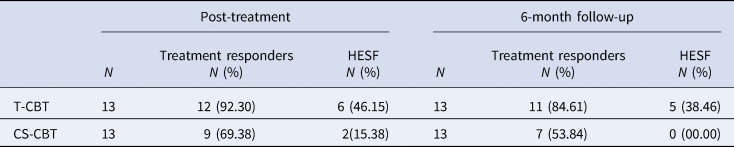
Based on the algorithm used in previous studies (Farchione et al., Reference Farchione, Fairholme, Ellard, Boisseau, Thompson-Hollands and Carl2012; Wilamowska et al., Reference Wilamowska, Thompson-Hollands, Fairholme, Ellard, Farchione and Barlow2010), clinical significance was estimated by two states of treatment responder status, and their high end-state functioning (HESF) was considered based on participants’ results in the post-treatment and 6-month follow-up stages. Patients with a 30% reduction in at least three out of the four scales were included in treatment responder status (CSR, ASI, BAI, and BDI-II). Moreover, patients who had symptoms lower than the clinical threshold of all scales (CSR ≥ 4, ASI ≥ 23, BAI ≥ 16, and BDI-II ≥ 17) were included in HESF. The results showed that the T-CBT group had significant positive changes compared with the CS-CBT group in the post-treatment and 6-month follow-up (Table 5).
Proportion of Responder Status and HESF

Discussion
Previous studies have compared the efficacy of T-CBT and diagnosis-specific CBT on specific disorders; however, the present study compared the efficacy of T-CBT with CS-CBT among patients with high AS and emotional disorders. Consistent with the findings of Boswell et al. (Reference Boswell, Farchione, Sauer-Zavala, Murray, Fortune and Barlow2013), the present study results showed that T-CBT effectively reduces AS. It is believed that T-CBT reduces AS through its interoceptive exposure modules and that most changes occur from session 8 to the end of the treatment. The significant reduction in AS in the CS-CBT group was in line with the results of the research by Olthuis et al. (Reference Olthuis, Watt, Mackinnon and Stewart2014), who found that CBT could reduce the catastrophic beliefs about the physical, cognitive, and social consequences of anxiety. Although both T-CBT and CS-CBT had a significant effect on reducing AS and physical, cognitive, and social dimensions from the pre-treatment to 6-month follow-up, the efficacy of T-CBT was higher; in fact, unlike CS-CBT, T-CBT reduced the mean ASI score to below the cut-off point. It seems that T-CBT has had better and more sustainable effects on participants’ AS due to its transdiagnostic strategies, such as emotional tolerance and cognitive flexibility, and therapeutic techniques, such as increasing motivation, emotional awareness, countering emotional behaviours, and understanding and confronting physical sensations. Regarding the cognitive dimension of AS, CS-CBT aims at restructuring these cognitions and replacing them with new ones to help patients underestimate the likelihood of catastrophic events. However, instead of restructuring, T-CBT focuses on increasing cognitive flexibility to increase patients’ emotional tolerance.
In addition, there is evidence of the positive effect of cognitive reappraisal on the experience of emotions and individuals’ physiology (Troy, Shallcross, Brunner, Friedman, & Jones, Reference Troy, Shallcross, Brunner, Friedman and Jones2018). Also, emphasis on the readiness to change and overcome relapse leads to the maintenance of therapeutic achievements. Both CS-CBT and T-CBT focus on relapse prevention skills, but T-CBT also uses the increased motivation module and improves readiness to change in the beginning, which seems to be effective in maintaining the treatment achievements (Boswell, Sauer-Zavala, Gallagher, Delgado, & Barlow, Reference Boswell, Sauer-Zavala, Gallagher, Delgado and Barlow2012).
The anxiety reduction in T-CBT was consistent with a previous trial by Farchione et al. (Reference Farchione, Fairholme, Ellard, Boisseau, Thompson-Hollands and Carl2012), which showed that the UP effectively reduced anxiety in patients with emotional problems. T-CBT appears to lead to relatively stable changes in anxiety using mindfulness, cognitive reappraisal, prevention of emotional avoidance (Eustis et al., Reference Eustis, Cardona, Nauphal, Sauer-Zavala, Rosellini and Farchione2020), and emotion exposure as a response style (Boswell et al., Reference Boswell, Anderson and Barlow2014). Furthermore, a reduction has been reported in anxiety disorder symptoms following the reduction in AS (Boswell et al., Reference Boswell, Farchione, Sauer-Zavala, Murray, Fortune and Barlow2013), which may represent the mediating role of AS in reducing anxiety. Moreover, in the present study, CS-CBT led to a significant reduction in anxiety, which was consistent with the findings of Norr et al. (Reference Norr, Allan, Macatee, Keough and Schmidt2014), which suggested that CS-CBT was effective in reducing the symptoms of patients with anxiety disorders due to the high correlation between AS and anxiety. Thus, reducing AS can significantly reduce worry and anxiety in patients with high AS.
In line with studies that reported a low and unstable efficacy of AS-based CBT in terms of depression reduction (Norr et al., Reference Norr, Allan, Macatee, Keough and Schmidt2014; Olthuis et al., Reference Olthuis, Watt, Mackinnon and Stewart2014; Schmidt et al., Reference Schmidt, Eggleston, Woolaway-Bickel, Fitzpatrick, Vasey and Richey2007), the present study found that CS-CBT was not effective in reducing depression. The inability of CS-CBT to reduce depression may be due to the low effects of this intervention on the cognitive concern dimension of AS (Olthuis et al., Reference Olthuis, Watt, Mackinnon and Stewart2014). Among the different aspects of the relationship between AS and depression, a significant point is the cognitive concern dimension that is also identified as a fear of cognitive dyscontrol (Taylor et al., Reference Taylor, Koch, Woody and McLean1996). However, T-CBT significantly reduced depression in the present study, which was in line with previous trials on depression (Farchione et al., Reference Farchione, Fairholme, Ellard, Boisseau, Thompson-Hollands and Carl2012; Sauer-Zavala et al., Reference Sauer-Zavala, Bentley, Steele, Tirpak, Ametaj and Nauphal2019). There are probably mechanisms for reducing the symptoms of depression in T-CBT. The first explanation is a change in negative affect and the use of non-emotional, behavioural activation-based strategies (Sauer-Zavala et al., Reference Sauer-Zavala, Bentley, Steele, Tirpak, Ametaj and Nauphal2019). The next one, the emphasis on motivational interviewing and mindfulness, is effective in treating depression and preventing its relapse (Boswell et al., Reference Boswell, Anderson and Barlow2014; Farchione et al., Reference Farchione, Fairholme, Ellard, Boisseau, Thompson-Hollands and Carl2012). The sustainability of the effects of T-CBT on depressive symptoms is probably related to the role of mindfulness in preventing depression relapse.
Although cognitive behavioural interventions often emphasise the reduction of negative affect, evidence suggests that these interventions effectively increase positive affect, and there is no difference between T-CBT and diagnosis-specific CBT (Wilner Tirpak et al., Reference Wilner Tirpak, Cassiello-Robbins, Ametaj, Olesnycky, Sauer-Zavala and Farchione2019). However, in the present study, the effect of T-CBT on increasing positive affect and reducing negative affect was more significant than that of CS-CBT. The UP is essentially an emotion-based (positive and negative) treatment programme (Sakiris & Berle, Reference Sakiris and Berle2019) designed with the aim of increasing patients’ capacity to accept and experience a range of positive and negative emotions by using emotional awareness and improving emotional responses. A significant decrease is reported in the frequency of negative affect and negative emotional reactivity (fear of emotions and AS) following T-CBT; it has been shown that if negative affect is controlled, negative reactivity will still predict outcomes. Reducing negative affect and increasing positive affect lead to a reduction in patients’ clinical suffering and the severity of their symptoms, but their reactivity to emotions plays an important role in improving their emotional disorders (Sauer-Zavala et al., Reference Sauer-Zavala, Boswell, Gallagher, Bentley, Ametaj and Barlow2012).
Effective cognitive behavioural interventions, in addition to reducing the symptoms of emotional disorders, should lead to the maintenance of therapeutic effects. Thus, it seems that focusing on therapies that target transdiagnostic constructs increases patients’ readiness for using effective coping strategies. Decreased AS and increased self-efficacy have been identified as mechanisms of change in the treatment of patients with PD (Gallagher et al., Reference Gallagher, Payne, White, Shear, Woods and Gorman2013). Moreover, improved emotion regulation, reduced intolerance of uncertainty, and experiential avoidance have been identified as mechanisms for change in the UP (Khakpoor et al., Reference Khakpoor, Mohammadi Bytamar and Saed2019a, Reference Khakpoor, Saed and Armani Kian2019b). The higher efficacy of T-CBT in this study appears to be due to the application of the UP to use effective change mechanisms to reduce anxiety and depression; in contrast, CS-CBT focused only on AS, which is probably why its results were more limited. Post-treatment and 6-month follow-up and treatment responder status showed that T-CBT had a higher level of treatment responder status; in other words, T-CBT had sufficient potential to target the spectrum of the emotional problems related to the vulnerabilities of participants. Furthermore, CS-CBT had a lower treatment responder status, which appears to be due to its focus solely on AS and the absence of other underlying constructs.
Regarding HESF, T-CBT was relatively successful in the post-treatment and 6-month follow-up, to the extent that some patients no longer met the diagnostic criteria for emotional disorders. However, most of the patients still did not meet their HESF. In contrast, CS-CBT had a poor performance with regard to HESF, and most patients continued to experience clinical signs and decreased performance after the treatment. It seems that T-CBT has been able to sustain the effects of treatment on AS by focusing on other anxiety-related transdiagnostic constructs, because T-CBT suggests that underlying constructs in the maintenance of emotional problems are common and affect each other. High AS is a recognised vulnerability in the development and maintenance of emotional disorders. Although preventive and therapeutic interventions are essential to reduce AS, they do not appear to be useful in the pathology of emotional disorders alone due to the multidimensional nature of emotional disorders and the role of other distal and proximal vulnerabilities in these disorders. Although interventions that focus solely on AS may have a high therapeutic response rate, they cannot effectively treat emotional disorders. The present study results support the efficacy of UP as an effective T-CBT in improving AS, anxiety, depression, and negative and positive affect in patients with high AS. The participants in the T-CBT group experienced a high and acceptable response rate and performance from pre-treatment to 6-month follow-up.
The present study is one of the first studies to compare these two treatments among patients with high AS. In most early clinical trials, many challenges may affect the results; so, it should be interpreted with caution. In this study, an attempt was made to eliminate the interfering factors and present a reliable report using a well-designed study. However, the sample that was used was small, suggesting that future studies replicate the same study with a larger and more diverse sample. Also, the duration of T-CBT and CS-CBT sessions was different, which can be due to the structural differences between these treatments. CS-CBT is often more specific and shorter, while T-CBT is broader, and the number of sessions varies. Thus, this may have affected the results of the present study. Therefore, it is suggested that the effect of session length on the efficacy of these two treatments be investigated in future studies.