O, monstrous! O, strange! We are haunted. Pray, masters! Fly, masters! Help! (Shakespeare, A Midsummer Night’s Dream, 3.1.99–100)
On the evening of 23 August 1662, in the small village of Great Driffield in the East Riding of Yorkshire, Isabell Binnington sat by her hearth fire. Happening to look up, she suddenly found a young, blond-haired man, barefoot and dressed in green, standing in her home. Initially believing the individual to be some wandering person looking for lodging, she was soon startled to find him moving silently closer, whereupon the presumably frightened woman demanded in the name of the Father, Son, and Holy Spirit that he speak.Footnote 1 Thus compelled, the man, or more precisely the spirit of a man, declared that it had wandered this place for fourteen years and was condemned to wander another seven. He further explained that he would never hurt her and offered the additional assurance that she should never want. The spirit appeared again the next day, saying nothing, and again on 27 August, whereupon he explained that he had been murdered by three women. In testimony she later offered to her local justices of the peace (JPs), Binnington associated the appearance of the ghost with her previous discovery of human bones apparently buried in a small depression in her house’s floor. She had dug in the depression, she later told her neighbors, because, having lived in the house for only three months, she wondered if a previous resident might have buried some money there. What she found was something quite different. In a series of subsequent visits and conversations, the ghost described the last events in his human life—his initial arrival in Great Driffield, the arguments he had with a local woman, and his subsequently brutal robbery and murder at the hands of this woman and two fellow conspirators, all of which had occurred within the walls of the house Binnington now called home. Apparently stirred by the digging in his grave, the ghost charged Binnington with securing justice for his death. A series of extensive examinations ensued, with Binnington serving as an intermediary between the ghost and the local JPs charged with maintaining order in the region. Despite the wealth of detail the ghost provided about both his life and death—who his family was, precisely how he had died—Binnington’s initial testimony seems to have encountered a skeptical response from the local magistracy. Undaunted, Binnington and the ghost redoubled their efforts, offering additional evidence while demanding that the ghost be prayed for during local church services. Their efforts culminated in the case’s most shocking revelation, one that exposed not a past murder but one perhaps to come. Repeating information provided to her by the ghost, Binnington disclosed the existence of a London plot to murder Charles II, restored to his throne less than two years earlier. Binngton’s information was more than just another patchwork of rumor and innuendo common during the period. She identified, by name and position, two men already ensconced in the king’s household as the plot’s primary conspirators, further detailing both their mode of communication and their possible confederates. All that remained, the ghost and Binnington insisted, was for the JPs to act. The fate of the nation, if not of this single ghost, lay in the balance.
Despite its wealth of detail, emotional appeal, and clear sense of political urgency, however, Binnington’s story never progressed beyond its initial tellings. Perhaps not surprisingly, given the state of its chief victim and witness, this case of murder was never prosecuted at the Yorkshire assizes.Footnote 2 Without any formal legal proceedings, records of the initial investigation might well have disappeared. In this case, however, details of Binnington’s testimony before her local JPs remain, curiously enough, in a pair of pamphlets and a single manuscript, the latter of which is currently held at the Folger Shakespeare Library.Footnote 3 These texts, each of which claims to reproduce the testimony offered by Binnington during her examinations, share the same basic story yet differ in significant ways. One pamphlet, the brief and anonymous A Strange and Wonderfull Discovery of a Horrid and Cruel Murther (1662), simultaneously draws from and challenges the conventions of the cheap, printed accounts of crime. Another, the more formal The Examination of Isabell Binnington of Great-Driffield in the East-Ryding of the County of Yorke (1662), printed in York, presents a much more complex intervention via print in the popular conversation and gossip throughout Yorkshire that must have accompanied this ghost’s appearance. Folger MS X.d.442, entitled “The relation, or examination of Isabell Billington of Greate Driffield in Yorkshire taken ye 24th of Sept 1662 of a Spirit that appeares to her,” shares much of its content with the York pamphlet (including the assassination plot, which is absent from the other pamphlet) while simultaneously offering different details and omitting others, including additional letters written to the JPs by other informants.
Scholars of early modern crime and legal procedure regularly emphasize the importance of such documents as these as crucial to uncovering the lived experience of criminal justice in early modern England.Footnote 4 Most recently, Malcolm Gaskill has insisted that depositions in particular be read not simply as records of fact but as rhetorically charged constructions designed to establish a certain version of the truth that is itself reflective of communal values and mentalities.Footnote 5 The three differing accounts of Binnington’s encounters with the ghost, each of which emphasizes the case’s extensive, repeated examinations, allow us to investigate more fully the narrative dynamic that must have attended such proceedings, a dynamic less easily recovered from a single deposition. As narrative, the construction of legal testimony operates simultaneously in multiple dimensions—deponents and questioners react to past events and attitudes, engage in a present dialogue, and anticipate future objections or attempt to compel future action. Tracing Binnington’s multiple examinations, especially when these exchanges are preserved in multiple texts, allows us to track all of these elements, resulting in a fuller understanding of how early modern English justice might have operated not only institutionally but also rhetorically. The effect is akin to reading an entire play rather than a single scene.Footnote 6 That details from Binnington’s testimony are preserved in varying textual forms also compels us to consider not just the facts of this case but their presentation, and in doing so to reconsider the connection between the law and its means of circulation.
The repeated retellings of Binnington’s story help mark the beginning of what Peter Marshall has called “without a doubt a golden age of British ghosts,” a moment in which the circulation and analysis of evidence testifying to the existence of witchcraft, poltergeists, and other similar phenomena found a receptive audience among those individuals seeking to counter what they perceived as a growing challenge from Hobbists, materialists, and atheists of all forms.Footnote 7 Most important for understanding this case, however, are the immediate historical circumstances of these texts. Written and printed in the aftermath of the Restoration, they bear witness to the considerable political, religious, and judicial uncertainties of the moment. As evidenced most prominently by the revelation of the assassination plot, conspiracies against Charles II—both real and imagined, dangerous and ineffectual—were in the air. Complicating matters further was the need for the country’s judiciary to secure its position of authority following the tumultuous changes of the Civil War, Interregnum, and Restoration, each of which in Yorkshire had brought significant instability to the bench. In Binnington’s particular case, even those most immediately involved in the case could not definitely resolve whether a ghost truly had appeared or whether a young man had indeed been murdered, since the absence of a trial deprived the community of a formal arena in which to consider evidence, evaluate testimony, and conclude upon an acceptable narrative resolution. What remained was print. Indeed, as I shall argue, Binnington’s contemporaries resolved this case of the murder and ghostly visitor not through a legal mechanism per se but through print in a final retelling of the story. What in the shorter, anonymous pamphlet is an intriguing ghostly mystery becomes, most prominently in the York pamphlet, a presentation in which readers must sift through competing accounts and resolve upon an authoritative narrative of an event. Attentive reading and judicial inquiry run parallel as the pamphlet takes the place of a trial that, by the very nature of its evidence, would have been difficult to pursue. That such a process might occur even in the absence of formal legal proceeding thus makes these stories a case study not only in the operation of local justice in early modern England but also in print’s usefulness as a judicial technology.
The Deposition as Textual Form
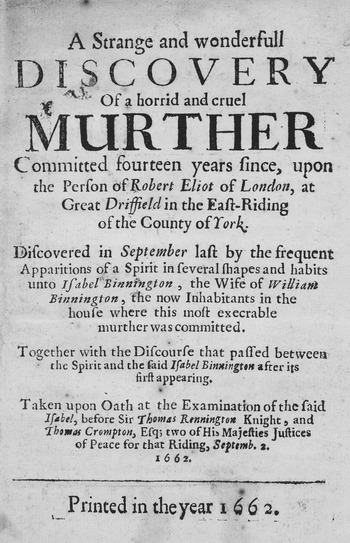
A potential reader in 1662 who picked up a copy of the anonymous A Strange and Wonderfull Discovery of a Horrid and Cruel Murther would have encountered, at least to judge by its cover, a document similar to any number of the lurid crime pamphlets that circulated in seventeenth-century England. With an eye clearly turned toward what might grab a browser’s attention, “Discovery” and “Murther” both appear in all capital letters, with the latter word being further emphasized with bold type (fig. 1). Interestingly, the emphasis remains with the crime itself
Title page, A Strange and Wonderfull Discovery (London, 1662). This item is reproduced by permission of the Huntington Library, San Marino, California.

rather than the medium of its discovery; the initial and larger text block of the title page identifies the victim, one Robert Eliot of London, and the approximate date (some fourteen years ago) and location (Great Driffield, East Riding, York) of his death. Only in the next text block do we find what is precisely so “strange and wonderfull,” namely, that the crime was uncovered by “the frequent Apparitions of a Spirit in several shapes and habits unto Isabel Binnington,” who is further identified, along with her husband, as the current resident in the house where “this most execrable murther” had occurred. This information, along with the fact that the text includes additional discussion of the exchanges between Binnington and the ghost drawn from an examination taken by two Yorkshire JPs on 2 September 1662, is printed below in smaller type. The title page offers little else about the particulars of the pamphlet’s production—there is no printer’s name, no potentially identifying woodcut, no bookseller’s location, and no date beyond the year 1662—nothing to distinguish it from the various lurid tales of murder that fascinated the period’s reading public.Footnote 8
Upon opening the pamphlet, however, the reader of A Strange and Wonderfull Discovery might have initially been somewhat disappointed. Reflecting the essentially constructed nature of their accounts, murder pamphlets of the period regularly situated their accounts of crime, including both the perpetrators and their victims, within a moralizing framework supportive of both secular and spiritual order.Footnote 9 Seventeenth-century readers thus regularly encountered opening statements immediately insistent upon the need for justice and reform. “God that made man after his own Image, made a Law, Gen 9.6 Who so sheddeth mens blood, by man shall his blood be shed,” declared The Bloody Husband, and Cruell Neighbour (1653).Footnote 10 Decrying the declining morality of the country, the anonymous author of An Exact Relation of the Barbarbous Murder (1661) bemoaned, “The forwardness of people in these days (by their Covetousness); doth, and hath oftentimes caused the untimely end of many.”Footnote 11 And in an account of another set of Yorkshire murders published just a year after A Strange and Wonderfull Discovery, the author began, “Oh the Cruelty and hard-hearted of this Iron Age wherein we live! an Age cruel indeed (as I may say) wherein many to accomplish their own ends and satisfie their most lascivious desires care not what they undertake to effect them.”Footnote 12 Readers who opened A Strange and Wonderfull Discovery, however, would have encountered much drier legal language: “The Examinant sworn and examined, saith, That she and her Husband William Bennington came to the house where she now dwels (being the house of one Mr. Belt of Hull) about the beginning of June last.”Footnote 13 Whatever the title page might have promised, what the text itself appears to deliver is simply a copy of the examination of Isabell Binnington before two Yorkshire JPs on 2 September 1662. It offers no explicit commentary on ghosts, murder, or the place of women as either murderers or vicarious witnesses, topics that would have likely drawn significant interest from contemporary readers. At least upon a quick, initial review, the uneasy contrast between the dramatic title page and legalistic tone of the text itself suggests that the printer perhaps knew little about the incident itself but recognized the potential commercial value of such a tale and thus moved quickly to get the document to market, trusting in the subject itself, when amplified by a sensationalist title page, to draw sufficient interest from prospective readers.
By simply offering a transcript of an examination within the covers of a pamphlet aimed at a popular audience, however, the printer created a curiously hybridized document. For both its initial readers and later scholars, the piece is now both a legal instrument and a popular text, one that might circulate well beyond its initial audience and serve a substantially different purpose. Since 1555 English JPs had in cases of felonies been required to conduct examinations like that of Isabell Binnington as the first step in any potential prosecution, with the resulting depositions then being used to guide the initial indictment and prosecution, after which they were often destroyed.Footnote 14 Recognizing an examination’s function as a source of evidence, however, does not thereby remove its contents from rhetorical analysis. In each of the three documents at issue here, for example, pains have been taken to emphasize the text’s authenticity, and thus by subtle extension to insist upon the authenticity of the story itself. In A Strange and Wonderfull Discovery, the printer reproduced the deposition as a legal form, printing before the majuscule “T” that opens the text the Latin abbreviations “Com.” and “Ebor.,” likely intended to signify “county” and “York.” With this addition, it is as if the pamphlet now bears a “dateline,” one that situated its contents in both a location and a believable discourse. A similar opening accompanies The Examination of Isabell Binnington, whose cover page identifying both the printer (Alice Broad) and the location of its production (York) further reinforced the immediate relationship between the event and its textual reproduction. The Folger manuscript similarly details the circumstances of its creation. At the bottom of the four-page document the scribe noted, “This was taken by Mr Thomas Bluckwell / who lived at Whitsondine from the mouth / of ye said Isabell. & from Mr Bluckwells / paper this was transcribed.”Footnote 15 “Whitsondine” is likely Whissendine, a small parish and manor located in county Rutland, situated almost equidistant between Great Driffield to the north and London to the south. Though the reference helpfully situates the document geographically, it was the name (Thomas Bluckwell or, more likely, “Blackwell”) and the mode of communication (directly from mouth to pen to copy) that likely most interested its initial readers. Not only might Blackwell’s name itself have carried with it some authority, but the entire inscription offers an assurance of accuracy, an insistence that the text itself had not been corrupted in its transmission. With such moves, print becomes less protean and more fixed, and the manuscript scribe less an author than an amanuensis.
This careful reassertion of the story’s authenticity bespeaks the ambivalent and contested position of ghosts and ghost stories in mid-seventeenth-century England. From the very outset of the Reformation, committed Protestants had sought to dismiss ghosts and the attendant Catholic doctrine of purgatory as fabulistic creations meant to seize the minds of the unwary.Footnote 16 That a doctrine has been presumptively disavowed, of course, does not necessarily mean that it is similarly abandoned in popular practice or discourse. Sasha Handley has estimated, for example, that the years between the Restoration and the turn of the century saw the issuance of 42 percent of all of the chapbooks on ghosts and ballads printed between 1660 and 1800.Footnote 17 Alongside these chapbooks appeared a variety of more learned “apparition narratives.”Footnote 18 Especially in the years following the Restoration, a belief in ghosts, once considered a vestigial attachment to traditional religion that might undermine the advance of Protestantism, had become instead, like a belief in witchcraft, a means to reassert the broader connection between church and society that the outbreak of the Civil War had so recently troubled. Writing at the opening of Saducismus Triumphatus, his expansive collection of both ghost and witchcraft lore begun as early as 1663 but only published posthumously in 1689, Joseph Glanvill thus insists that should his nation come to disbelieve in spirits, “all Religion comes to nothing.”Footnote 19 As Glanvill reveals, by the time Isabell Binnington encountered her ghost, the perceived threat to many members of the Protestant establishment was not Catholicism but the twin devils of Hobbism and atheism. Against these movements ghosts were a valuable weapon, employed by scholars and theologians like Glanvill, Henry More, Bishop Thomas Bromhall, and Richard Baxter to demonstrate the existence not of purgatory but of a more general afterlife and, by extension, a divinely infused moral order more materialist understandings of the cosmos might implicitly if not explicitly deny.Footnote 20 In a letter by More to Glanvill included in Saducismus Triumphatus, More makes plain what theologians of the period saw was at stake in defending the existence of ghosts: “And I know by long experience, that nothing rouzes them so out of that dull Lethargy of Atheism and Sadducism, as Narrations of this kind. For they being of a thick and gross spirit, the most subtile and solid deductions of reason does little execution upon them; but this sort of sensible Experiments cuts them and stings them very sore.”Footnote 21
In its emphasis on practical examples rather than abstract reasoning, however, More’s letter also suggests the challenges facing judicial rather than theological or philosophical investigation of ghostly phenomena. Much of the difficulty came in translating a general belief in the existence of ghosts into a legally actionable guide to resolving specific cases. In this regard the presence of ghosts within a courtroom posed the same difficulty that cases of witchcraft did, namely, that there was a significant difference between the denial of the existence of witches—an extreme and unlikely position—and a suspicion that a particular case might be an instance of imposture or false dealing.Footnote 22 The discovery of a body, let alone a buried jumble of bones, was not necessarily evidence of an illegal killing.Footnote 23 Early moderns thus placed significant emphasis not only on discovering the identity of the deceased but also on uncovering an accusation of murder, regardless of whether that accusation came pre- or postmortem. Most useful in this regard, of course, was a dying statement, one in which the victim communicated the unlawfulness of his or her killing. Absent such a statement, from an evidentiary standpoint, the appearance of a condemning ghost worked in much the same manner as cruenation, or the bleeding of a body in the presence of its murderer, for in both cases an apparently supernatural event revealed a hidden crime.Footnote 24 In presenting evidence that was unavailable by more conventional means, ghosts could thereby serve the potentially useful purpose of catalyzing suspicion and investigation.Footnote 25 Such forms of evidence, of course, could also be falsified or abused, a fact that likely contributed to the growing skepticism of seventeenth-century JPs and local magistrates toward testimony reliant on providence, magic, or other elements of the supernatural. As I will explore later, the presence of such skepticism may well have wielded a crucial influence over the progress of Binnington’s examination. At this point, however, it is simply worth emphasizing that though popular interest in ghosts intensified during the period, making it likely that A Strange and Wonderfull Discovery would find an initially receptive audience among its readers, the conditions of reception for a story like Binnington’s were particularly fraught. Much like testimony delivered in an actual trial, if a publication hoped to transform its readers’ initial curiosity into conviction it needed to establish not only that a particular individual had spoken but also that such an event had indeed happened.
Establishing the authenticity of a ghostly event was thus of particular importance not only to a formal trial but also to its public reception in print, especially since the ability of print to bring tales from the provinces meant that a carefully crafted and authenticated story could transform even more distant readers into the seventeenth-century equivalent of “armchair detectives.” In Binnington’s case a small difference between the manuscript and the two pamphlets highlights the potential for at least a bit of such sleuthing. During an initial examination the JPs asked Binnington to provide details about this ghost, including his name and any other identifying information. According to A Strange and Wonderfull Discovery, Binnington first offered Eliot’s name and birthplace, which she described as being “within three miles of London at [______] she is not certain of the Towns name but she is sure that it ends with Ham.”Footnote 26The Examination of Isabell Binnington contains a similarly blank space to signify Binnington’s uncertainty. Unlike the two pamphlets, however, the manuscript’s account of this moment notes that Eliot “lived at Westham 3 miles from London,” suggesting that either Binnington later remembered the name or, more likely, either Blackwell or the later scribe helpfully (and silently) solved this initial riddle.Footnote 27 The completion of “Westham,” we might imagine, was the first thing a reader might attempt, especially a metropolitan reader intrigued by the death and reappearance of a fellow city resident some distance to the north. Reading might therefore enhance rather than disrupt the functionality of the text as a legal document. As Hal Gladfelder contends, “If the immediacy of criminal reports implicated the reader in an imaginary unfolding of the present (imaginary because the narrated moment was already, irretrievably, past), this implication led in turn to a new orientation of the narrative toward the discovery of truth.”Footnote 28 Solving even small riddles in a text—or leaving open the opportunity to do so—helps move readers from being passive observers into being potential participants in a search for justice. Yet like the locative lacuna “[something] Ham,” the account that remained for the reader over a decade later was at least initially more suggestive than complete, for, as Gladfelder notes, the “world of the news report is full of information but fragmented; if things are to signify, meanings must be attached to them.”Footnote 29 To attach such meaning—to understand fully the shaping of Binnington’s account—requires that we now turn to the substance of Binnington’s ghostly encounter and her subsequent negotiations with those individuals who in the East Riding of Yorkshire served as the most immediate and influential representatives of legal authority. Reading all three accounts for both the details of the story and their presentation, however, complicates rather than clarifies Eliot’s death and his subsequent haunting of Binnington’s house, highlighting the myriad ways in which ostensibly stable historical documents are themselves shaped by the rhetoric and motives of those who produce them.
Deposition as Story
Understanding Binnington’s testimony and its varied textual reproductions as story first requires that we recognize the multiple occasions upon which she presented it to her local JPs, and thus the multiple occasions for it to be recorded. The anonymous A Strange and Wonderfull Discovery presents itself as the copy of an examination held on 2 September 1662, and its comparative shortness and the absence of references to any events that took place after this date suggests that at least the contents of the pamphlet (though not necessarily its production) are bound by this same date. The Examination of Isabell Binnington similarly dates its examination to 2 September, but its interior text appears to blend together testimony delivered as late as 20 October, as if the original scribe (or subsequent printer) merely continued the narrative on the original piece of paper.Footnote 30 The Folger manuscript, by contrast, offers an entirely different set of dates. While its title dates its contents to an examination on 24 September, the manuscript itself continues further, ultimately including events that occurred as late as 3 October. The variation of dates, besides making the comparison of these documents difficult, also suggests just how extensive an investigation Binnington’s ghost story catalyzed. The Examination of Isabell Binnington, for example, records at least eight separate questionings of Binnington by local JPs.Footnote 31 Each of these occasions, of course, are individual opportunities for a story to be altered or developed. Such alterations, however, would not occur in a vacuum. Rather, much like the exchanges between questioner and deponent that characterize a single examination, these multiple sessions themselves existed in a dialogic interdependence in which an examinant developed a narrative to meet not just the demands of a particular individual moment but the demands of both previous queries and those that might reasonably have been predicted to occur in the future.Footnote 32 The increasing complexity of Binnington’s testimony likely derived in part from its repeated performance, much in the way a storyteller gains in confidence and ability as she is exposed to a variety of audiences and their reactions. Importantly, this recognition need not mean that Binnington subsequently embellished or otherwise falsified her tale.Footnote 33 Rather it simply recognizes that, at least in the case of testimony, evidence and rhetoric possess a peculiarly symbiotic and mutually constitutive relationship sprung from the negotiation between speaker and listeners that characterizes any public utterance.
While recent investigations such as Peter Marshall’s Mother Leakey and the Bishop reveal how archival data regarding the characters of a ghost story can serve as vital pieces of interpretative evidence, there is unfortunately little data extant on the woman at the center of this story. Isabell Binnington first appears in the parish registers for Great Driffield on 27 April 1662, when as Isabell Meek she arranged for the baptism of her “bastard childe” Cornelius. No father’s name is mentioned in the entry, though a month later she married William Binnington, with whom she later had three children, Maria, William, and Anna. While the registers do not consistently distinguish among the various Williams, there are records of one dying in 1666 and another—explicitly identified as a pauper—dying in 1679.Footnote 34 That Isabell may have been married to a near pauper at the time of her encounter with the ghost would not be surprising given the general makeup of Great Driffield during the period. The town, whose inhabitants focused primarily on agriculture and common grazing, was relatively small and declining in population; in 1640 it possessed about 840 inhabitants, while in 1672 there were about 770, a more than 10 percent drop. Records from the 1672 Hearth Tax indicate that much of the remaining population was relatively poor, with 52 percent of the community exempt from the tax entirely. Of those remaining, 86 percent were assessed for only one hearth and 9 percent were assessed for two. Only two names had any titles: Mrs. Etherington and Mr. Pearson.Footnote 35 Little else remains to help us identify the position of Isabell Binnington in 1662—no lease or employment records in the Beverley archives remain, nor are there probated wills from the immediate family in the Borthwick Institute for Archives at the University of York.Footnote 36
In the absence of archival data, we must instead mine the texts themselves, and what they reveal is indeed significant. While the basic events and actors in Binnington’s story are the same across all three texts, there are also differences in presentation that upon closer examination bear significant rhetorical weight. At least in their descriptions of Binnington’s initial encounters with the ghost, the pamphlets and the Folger manuscript recount essentially the same details, including the time of day of the initial encounter and the descriptions of the ghost’s first appearances. The varying arrangement of these details, however, results in somewhat different narratives. The pamphlet accounts emphasize the suddenness of the ghost’s first appearance and its intrusion upon Binnington’s presumably quiet evening. Only after the reader experiences the initial shock of the encounter and the ghost’s cryptic reference to his fourteen years of suffering do we learn that other ghosts (presumably the same spirit in different guises) had appeared before Binnington twice before, and only later in the texts do we learn that prior to the appearance of the green-clad spirit, Binnington had, while cleaning the room, found a loose area of dirt which, upon investigation and digging, revealed a skull, teeth, and several other apparently human bones.Footnote 37 By contrast, the Folger manuscript presents all of this information in quick, narrative succession, beginning with the earlier appearances of the spirit and moving rapidly to the story of Binnington digging into the floor of her house and finding bones, an arrangement that directly suggests that the discovery of the bones prompted the appearance of the spirit in its second form, that of a child in white. Upon first consideration we might think that it is the manuscript’s rearrangement of events that is more deliberate, since it seems designed to provide a more linear summary of the case’s initial events, one that clarifies previously implicit causal relationships and helps readers orient themselves to the overall structure of the case. Yet the pamphlets provide evidence of a similar sort of rearranging. In each case the story of the bones is itself buried within the text, coming either midway through An Examination of Isabell Binnington or at the very end of A Strange and Wonderfull Discovery.Footnote 38 In the former, the text introduces the digging without much commentary (“This examinate being questioned concerning digging the place”), while the latter introduces the story of the bones with the phrase “the Examinant being further questioned about the digging in the place where the murthered Person is supposed to have been buryed,” even though no previous reference has been made to the digging.Footnote 39 Together these variations remind us that transcripts themselves are constructions, arrangements of testimony ordered for the benefit of both scribes and subsequent readers. In the pamphlets, the recorder or printer chose to begin at the moment of greatest suspense, emphasizing the sudden appearance and identification of the ghost/victim rather than what first conjured him to Binnington’s fireside. The attractiveness of this pattern in engendering interest from a potential reader should, I hope, be evidenced in this very article, which begins in precisely the same manner as the pamphlets.
The three accounts also differ in how they present Robert Eliot’s robbery and murder at the hands of three women. These differences further suggest how, much like a scribe or printer preparing his text, Binnington herself might have consciously attended to the rhetorical dimensions of her testimony in order to influence her immediate audience. Again, the basic facts are the same across all three versions. According to Binnington’s account of the ghost’s story, Roger Eliot, while traveling in the region, sought out one Mary Burton in order to secure repayment of some monies he had lent her. He arrived at Burton’s house seeking lodging, only to have Burton reject him, whereupon, A Strange and Wonderfull Discovery simply notes, “they had some cross words about it.”Footnote 40 The Folger manuscript, by contrast, provides a more vivid recounting of the dispute: “he called for some ale, and dranke, and said hee was come for his money, and shee said shee had it not to give him, hee said he would either have it to morrow of send for the Baliffe & distraine, upon that she uttered some Oathes or idle words, and hee called her blody Queane then shee swore by God shee could finde in her heart to drinke as freely of his blood as shee did drinke of that Cup & drunke it of immeadiately.”Footnote 41
The rapid back-and-forth of argumentative speech, the oaths and swearing punctuated by the final flourish of the cup rapidly drained, together dramatically intensify the confrontation between Eliot and his soon-to-be murderer. All of this might seem simply to be fancy, an embellishment, however consonant with the basic facts, by a scribe seeking to enhance the emotive impact of his tale, perhaps by emphasizing Mary Burton’s corrupted femininity and the ease with which she moved from being a difficult, indebted scold to a vicious attacker ready to murder a man in his sleep.Footnote 42 Yet the more formal The Examination of Isabell Binnington provides an important bit of contextual evidence that suggests it was Isabell Binnington, rather than an anonymous scribe, who sought to heighten the moment’s drama. According to this pamphlet, the details of the confrontation between Eliot and Burton were the product of another examination, one that occurred two days after the date listed on A Strange and Wonderfull Discovery’s title page. On 4 September, Binnington related “that when Mary Burton and he fell out about the money before he went to bed, Mary Burton said, I could find in my heart to drink thy blood, as freely as this cup of Ale.”Footnote 43 With this new information, the manuscript’s addition becomes less fanciful conjecture and more transcribed details, the substance and import of which are summarized in the York pamphlet.
Yet recognizing the potential accuracy of these details, at least to what was spoken, need not efface the rhetorical power of the account. Rather it should reorient our understanding of by whom and to whom such affective force was directed. What emerges from these accounts is less a ghost story than the record of a continuing conflict waged between Isabell Binnington and her examiners, one in which information is sought after and offered not simply for factual but for fundamentally rhetorical purposes. At its core, successful litigation asserts the consonance between belief and power. When petitioners can secure the assent of a judge or jury to a particular narrative of events they can also force those individuals—and the institutions they represent—to act in ways the petitioners desire. Thus when Malcolm Gaskill describes depositions as “primarily a dialogue revealing both popular responses to authority, and official responses to actions from below,” we should remember that such dialogues could be fraught with conflict and played out on stages and to audiences well beyond that of the initial examination.Footnote 44
Such a struggle marks nearly every interaction Binnington has with her examiners, who extensively questioned her regarding the nature of the ghost and his prior existence on earth. Though summarized simply in A Strange and Wonderfull Discovery as a process in which Binnington “being before advised by the next Justice of Peace, to ask it the names of those that murthered it, and its own name, and some other questions,” the extent of the inquiries seems extraordinary, and indeed provided the local JPs with an exceptional amount of information about this ghostly victim.Footnote 45 In this first pamphlet Binnington relates that the ghost’s father’s name was Jacob, his mother’s Rebecca (née Hutchinson), and that while his father was “a Hackney-Coachman in London” he had become “an Apprentice to a Raft-man” who sent him on business to the area.Footnote 46 In testimony recorded in the Folger manuscript, Binnington adds that Eliot’s sisters, Kate and Jane, were both married and living in London, “one of them at ye black nags head in Southwarke and the other at the horse shooe in London,” further explaining that according to the ghost his father had been an upholsterer in Cheshire, and that if her inquisitors desired some sort of evidence regarding his mother “they might looke in St Johns Church in London and finde [her maiden name] in ye Register.”Footnote 47 This information is echoed in The Examination of Isabell Binnington, which adds even more detail:
the first question she this examinate asked the spirit was, what they called his Mother before she was married; the spirit replyed they called her mistris Hutchinson, and she was borne within three houses of the Horseshooe in London, and named not the street. She further saith she enquird of the spirit what they called his Sisters, and if they were married, and where? It replyed they were both married, the one to one Jordan, the other to one Stra[v]eler and that they both dwell in London; and that Master Stravler liveth in South-street at thereabouts signe of the Black-Nagge.Footnote 48
For an investigator, of course, these are potentially significant and strikingly specific details. Names, for example, are crucial to identifying subjects and thereby subjecting them to judicial inquiry and regulation.Footnote 49 More intriguing than individual details, however, is the pattern of questioning. Instead of simply insisting upon the spirit’s reality or making reference to some sort of magical occurrence in order to justify her story, Binnington meets the JP’s repeated demands in kind. Crompton asks for the birthplace of the spirit’s father; she offers not only his birthplace but also his present whereabouts and occupation. He asks where Elliot’s sisters live; she gives directions to apparently specific London locales, in the York pamphlet going so far as to specify the precise house. As the spirit takes form in Binnington’s narrative—he has a mother and father, a family, and a birthplace—he also becomes a potentially recognizable legal entity, one that can be categorized, investigated, and, if necessary, even avenged. Finally, in the Folger manuscript, when queried regarding Eliot’s mother, the spirit provides not only a name but the location of a document that substantiates his claim. It is as if a textual existence in the historical record transforms the spirit from an insubstantial bit of supernatural ephemera into something of real, if not entirely tangible, substance. At the very moment in which Binnington remedied what seem to be crucial gaps in her story, the spirit becomes not only text but flesh, albeit a flesh that has long since passed from this plane of mortal existence, leaving only a scattered pile of bones behind.
Taken together as interdependent elements, these pieces of information create a story whose compulsive power lies in its specificity, its very assertion that its facts could be verified should anyone care to do so. Developed in continuing response to her inquisitor, Binnington’s testimony is thus less a disinterested exchange than an argumentative story designed not simply to inform but to convince and ultimately to compel action from her immediate audience. The Examination of Isabell Binnington bears this assertion out, as immediately after providing this information Binnington further reported that “the spirit hath given her in charge to go to two Justices of the peace, (and pointed Eastward, and held out its hand, to that she plainly saw light through the fingers;) and bad her be sworne, thy examination shall be on thy knees, and that on thursday before tenne of the Clocke and it further charged her to get their hands to her examination.”Footnote 50
As Binnington relates the ghost’s demands, her detailed testimony becomes charged with a sort of spiritual authority that demands action both from Binnington, who must take on the posture of the bereft female petitioner, and from the justices who question her. In both the manuscript and York pamphlet, the ghost joins to this compulsion another demand, namely, that, as the pamphlet puts it, Justice Crompton should order “the Churches hereabout to pray for the discovery of a wandring spirit that hath wandred fourteen years.”Footnote 51 The Folger manuscript is even more pointed: “it wished her to desire ye Justice it might be pray: / :ed for in the Church as a wandering soule for ye discovery of mur: / :der at the next assizes.”Footnote 52 Not content to exist simply as a spirit, the ghost instead seeks recognition as a victim. Much like the London parish register that would substantiate his mother’s existence, the prayers of the faithful for Eliot—themselves profoundly public acts—would simultaneously affirm the existence of both the ghost and the crime that had undone him. In doing so, such prayers also carried an implicit threat against a dilatory or disbelieving inquisitor, one who might otherwise dismiss Binnington and leave Eliot’s murder unacknowledged and therefore unsolved. Demands such as this drew their rhetorical and practical power from the period’s complex understanding of the law and the church. In his frequently reprinted handbook for JPs, William Lambarde thoroughly warned that officers of the law “ought to take heede what they doe, knowing (as Jehosaphat saide), that they exercise not the judgements of Men onelie, but of God himselfe, whose power, as they doe participate: so he also is present on the Bench with them.”Footnote 53 Beginning an assize session with a sermon, Lambarde later explained, was meant to reiterate this interdependency: “For, seeing that the lawes of men must be obeyed for God, it doth of necessitie ensue, that he which will seeke to haue man obeyed rightly, must first cause God to be preached truely.”Footnote 54
The introduction of the church into what had previously been a purely secular legal matter offers the opportunity for us to consider further the much larger effect of the ghost itself, and of the telling of a ghost story in seventeenth-century England. While a magistrate such as Thomas Crompton might not believe in ghosts, the consonance of such stories with popular belief might well encourage, if not force, him to pursue such a case. As noted earlier, by the mid-seventeenth century and later ghost stories were most effective as tools for catalyzing suspicion and investigation rather than securing a conviction, the latter of which increasingly demanded empirical evidence.Footnote 55 In 1660 Exeter, for example, the discovery in a house of a buried skull and linen cap only generated local suspicions and rumor until, some seven years later, the repeated appearance of the murdered man’s ghost finally spurred the new owner of the house to swear out before a local magistrate an account of the ghost’s story. Only then, it seems, did a servant of the house’s former owner recall that some thirty years prior a guest of the house had indeed strangely disappeared one morning. One pamphlet account of the events concludes that “there are several people under Examination, and ’tis not doubted, but there will be made a complete Discovery, and the Barbarous Actors (if there any are yet alive) brought to condign Punishment for a Warning to all.”Footnote 56 These were not simply idle or moralizing speculations, as the appearances and information provided by ghosts generated not only public interest but also investigations that led to confessions and convictions. In 1679 Lincolnshire a ghost revealed his death to have been the result of a murder-by-hire plot initiated by his brother, who under questioning later confessed to the crime, while the appearance of a Yorkshire ghost in 1690 to her brother-in-law helped uncover her murder at the hands of her husband, who had previously said he had sent his absent wife to her uncle.Footnote 57 While such reports of ghostly appearances may well have been a means for the poor to gain the attention of local authorities or for individuals to express suspicions they could not otherwise substantiate, the fact remains that ghostly testimony continued to wield a powerful if limited influence over those who might receive it.Footnote 58
Whatever her larger motivations might have been—and they are at present seemingly unrecoverable—catalyzing an investigation was, at least in the short term, precisely what Binnington sought to achieve. Yet Binnington’s case, and in particular the ghost’s initial refusal to speak to anyone other than Binnington, reminds us that the acceptance of ghostly testimony was not necessarily a pleasant or mutually satisfactory process.Footnote 59 At one point in the Folger manuscript, for example, the ghost complains that Crompton has not made good on an apparent concession to have Eliot prayed for in church, a promise we might suspect was offered to mollify Binnington and potentially other concerned members of the community. According to the ghost, “therefore [Crompton] should not see it unless he thought darke would be no danger to him.” The ghost’s statement, part explanation and part threat, places Crompton in a difficult bind, for it seems the easiest way for Crompton to gain proof of the ghost’s existence is if he preemptively acknowledges it. Otherwise, Crompton must visit in the dark, a haunting exercise that suggests a challenge not just of simple courage but of spiritual fitness. Communal resolution thus might mask significant division and contention, for as the moment suggests, the very act of repeating a ghost’s words was itself a deeply problematic and potentially confrontational endeavor, one that in its appeal to communal values and beliefs potentially deprived a JP of the cognitive and investigative agency he might otherwise hope to wield.
In addition, the telling of a ghost story remains crucial to the essential function of the deposition itself. Litigation is at once both a forward-thinking and retrospective endeavor, one that seeks to catalyze present or future action through the deployment of information “retrieved by Memory and Recollection.”Footnote 60 In similar fashion, ghosts like that of Robert Eliot above all demanded remembrance, the activation of memory in order to reconstitute the existence of an individual already ushered from this mortal plane.Footnote 61 In this sense, the deposition itself—its record of Binnington’s testimony—acted as a preservative of enduring power, promising Eliot’s continued existence in both script and print. Though scholarly analysis of the Protestant “art of memory” regarding the dead has tended to emphasize religious responses—funeral sermons, epitaphs, the architecture of tombs and monuments—depositions and other ostensibly “secular” elements of the judicial process could serve the same function.Footnote 62 To tell the story of a ghost, especially as a means to catalyze action, was to reanimate the soul itself, giving it the expression and agency it had long since lost. Doing so, however, tread on theologically charged ground.Footnote 63 With the abandonment of the Catholic doctrine of purgatory had come a similar, though halting, abandonment of traditional beliefs and rituals designed to enable the living to alleviate the potential suffering of the dead. Not so readily forsaken were the prayers and desires to remember or otherwise memorialize the dead. Something of these contrary impulses animates the York pamphlet’s account of Binnington’s testimony. There the end of the examination record indicates that Binnington was encouraged—by whom we do not know—“to aske the spirit whether there were any more spirits in its condition or no.”Footnote 64 The ghost replied that there were four additional spirits in a similar condition. Then, upon what seems to have been her own initiative, Binnington inquired whether there was such a place as purgatory. Binnington testified that “the spirit made answer that there was no Purgatory, there are but two places of Receiving.”Footnote 65 The ghost, whom in the Folger manuscript Binnington describes as a Protestant ghost, had made an orthodox Protestant answer.Footnote 66 The ghost’s demand for prayer, however, was potentially unorthodox, especially in its implicit contention that the words and thoughts of Great Driffield’s living might bring some relief to one of its dead. Crucially, however, the ghost demanded prayers not for his soul but for the discovery of his death and murder, and by extension for the instruments of justice to be wielded upon his behalf. What confronted the faithful was not the past failings of a sinful creature but a resolutely present crime.
Ghosts, as Frances Dolan has recently argued, “seem to have persisted as a post-Reformation problem because the dead and the claims they might make on the living continued to be a problem.”Footnote 67 Concentrating as she does on the late sixteenth and early seventeenth century, Dolan identifies this problem as the continuing persistence in England of Catholic beliefs, an instance of what Catherine Gallagher and Stephen Greenblatt have called the “problem of the leftover.”Footnote 68 In the case of Binnington and Robert Eliot, however, there is a different “leftover,” one particular to the years immediately following the restoration of Charles II in 1660. What haunted these years and this story, as the Folger manuscript and the York pamphlet ultimately reveal, was a fear of rebellion. In both documents we find what must have been the ghost’s most shocking and unsettling revelation. Following his appeal to be prayed for in the local church, the ghost later appeared to Binnington and declared that the newly restored Charles II would be betrayed unless, as the Folger manuscript records, “the Country Magistrates and his loveing friends writ to him in secret.”Footnote 69 As with his account of his own lineage, the spirit is quite detailed about this pending plot. The main actors, it seems, are a Mr. Jenkins and his son, the former of whom is a king’s steward and the other a page in the household, but not a foot page.Footnote 70 The plot itself, whatever its particular details (the manuscript does not say), was to be communicated on the back of a pack of cards and received by a Mr. Craven of Waltham. Though the Folger manuscript combines these details, the York pamphlet records them as being offered at two separate examinations (16 and 22 September), during the latter of which, in testimony not recorded in the manuscript, Binnington adds that Jenkins is a kinsman of “Judge Jenkins.”Footnote 71 By this she presumably means Judge David Jenkins, who during the Civil War had been tried by Parliament for sedition stemming from his repeated and public defenses of royal supremacy.Footnote 72 Jenkins’s Restoration career seems to have been a relatively quiet one, a fact that, when combined with his royalist sympathies during the Civil War, might make him an unlikely relative of a royal assassin.Footnote 73 But as a rhetorical symbol, Jenkins could serve more effectively, tainting this supposed conspiracy with his own history of political rebellion.
One can only imagine the potential public impact of such a revelation, especially in the confused years following the collapse of Cromwellian rule and the return of the monarchy. Plots both real and imagined were in the air throughout the realm. January 1661 saw the eruption and suppression of a small (though violent and unnerving) Fifth Monarchist rising, and in May of the same year the election of the new Cavalier Parliament brought with it an increasing desire to settle scores, a tendency that might well have been expected to stir a counterreaction.Footnote 74 In March 1662, three regicides were arrested in The Hague and subsequently hanged at Tyburn on 19 April. In an era rife with plots—or at least the suspicion of plots—rumors, let alone a carefully described conspiracy, likely fed the preconceived worries of both the general public and their more immediate hearers. N. H. Keeble’s description of the small and largely ineffectual revolts immediately following the Restoration captures the impact that reports such as Binnington’s might have had: “The reason they could spread such terror was precisely that fear of instability ran so deep; it was expected.”Footnote 75 In such a tense atmosphere, her warning of a potential assassination plot against the king must have resonated deeply with both her immediate audience—gentry JPs tasked with maintaining civic order—and those who would have heard or read of it as the account circulated. Details like the supposed transmission of the plot via playing cards, however fanciful they might seem, would have made her story convincing in their richness.Footnote 76 As was the case with the detailed description of the ghost’s lineage, the accuracy of the particular details in this ghost story matters less than their combined coherence as narrative. In this sense the manuscript’s seemingly last-minute, off-hand discussion of Burton’s sale of Eliot’s presumably abandoned (if not stolen) horse is not as much an afterthought as it might appear. A nonclergyable offense, and therefore regularly excluded from general pardons, horse theft was “the epitome of a crime founded in avarice and calculation.”Footnote 77 Nearly always pursued for the profit to be gained from a quick reselling of the horse, the crime was often linked to the existence of shadowy networks of professional criminals.Footnote 78 The potential existence of a greater conspiracy—the assassination of a king—was thus subtly bolstered by evidence of a much smaller, though just as nefarious, plot.Footnote 79 That a ghost some two hundred miles away from London might reveal the existence of such a sinister plot during the course of a murder investigation is also not as strange as it might seem. Like the treason of which the ghost speaks, murder was a crime of secrecy, and its occurrence represented an attack on not just an individual but upon the state itself. A 1657 pamphlet would declare that “a man is a member of the Commonwealth, and so the murderer kills part of himself,” and early modern England reserved particular horror for those murders that bordered on treason, such as a wife killing her husband or, more significantly in this case, a servant, perhaps such as Jenkins, killing his master. The death of a king, recent history had shown, was no mere flight of fancy.
Whatever its actual basis in reality, the claim of yet another plot against the king clearly offered Binnington a powerful rhetorical weapon to gain not only the attention of her audience but also a certain crediting if not outright acceptance of her story. Indeed, the very structure of her story seems carefully calculated to force her examiner’s hand, especially if, as the spirit suggested, country gentlemen such as Crompton and his fellow JPs were the only thing that stood in the way of renewed civil strife. This appeal to such “country gentlemen” was more than simply words. Rather it likely played upon a deep-seated sense of noble entitlement that had made Yorkshire a particularly troubled region during the Civil War, one in which considerations of virtue and honor had caused several members of the nobility to abandon the parliamentary cause and others to be suspected of doing the same.Footnote 80 Perhaps the most famous case was that of Sir John Hotham, the parliamentary commander who initially barred Charles I from seizing Hull and its stores of munitions, only later to switch allegiances and plot to open the town to royalist forces. Captured before he could put his plan into effect, he was defended at his subsequent trial by Sir Thomas Remington, one of the JPs who examined Isabell Binnington and a signatory with Hotham to a 1642 letter to Parliament warning that disregard for the gentry would have grave consequences for the realm. At the time Hotham was engaged in an open feud with Oliver Cromwell, complaining of (among other things) Cromwell’s promotion of freeholders to the officer ranks. Defending Hotham, the letter declares, “There is nothing in this world next to their duty to God Almighty, dearer to men of honour than their reputations … and if we shall be subject to be abused by such mischievous instruments as these are … we shall be excused both before God and man, to do the best we can for our own preservation.”Footnote 81 Clearly these were men deeply self-possessed with their role to play in governance, supporters not necessarily of the king per se but of a traditional order of political power within the region and nation.Footnote 82 From a rhetorical (if not practical) standpoint, the information regarding the plot thus seems tailor-made for those who would receive it, for it presents the role of “Country magistrates” in precisely the same terms in which these men saw themselves. Only the swift action of these men, the ghost insists, could ensure the stability of the nation’s political system. All that is required, of course, is to believe the ghost’s story, and, in doing so, act upon it.
Deposition as Trial
Reading Binnington’s testimony as a story bent on securing belief helps clarify both the significance of that testimony’s details and the potential motivation of their presenter. It also reminds us that her testimony had multiple audiences, ranging from her immediate inquisitors to her fellow villagers and those readers who might have encountered her story through pamphlet and manuscript. It does not, however, provide us much in the way of immediate insight on the reception of this testimony, nor have I uncovered any contemporary commentary on her case. We can safely assert, I think, that her story must have catalyzed a significant amount of interest—she was examined multiple times, produced a narrative increasingly resonant with her contemporaries’ heightened political anxieties, and then had that same narrative circulated well beyond her immediate environs. Indeed, the conflicts of the era seem to have transformed ghosts in the region into a potentially evocative discursive resource. One late nineteenth-century collection of Yorkshire folklore details the Civil War tale of a Catholic woman residing between Beverley and Driffield at what was once Watton Abbey. Fearing for her safety after the Parliamentarian’s victory at Marston Moor and the arrival in Driffield of Puritan irregulars seeking to slay any hidden Catholics, she hid in a secret room with her child, whereupon she was discovered and demanded of her jewels and other valuables. An angry confrontation ensued, and the soldiers slew her baby and then beheaded her, leaving her ghost to haunt the room wherein they died. Even if the story is not true, it represents the sort of tale that might have gained a wide currency during the period.Footnote 83 The Folger manuscript gestures toward the circulation and credibility that seems to have attended Binnington’s initial recounting of her ghostly encounters, noting toward the end that some unnamed “gentlemen”—presumably not her inquisitors but other intrigued parties—encouraged her to ask the ghost where it ultimately expected to live (“the happy eternity”), and that on 3 October the ghost appeared and was seen by several people in the town while Binnington was not present.Footnote 84 That these appearances occurred after Binnington’s repeated examinations may suggest that at least some members of her community shared her enthusiasm for and belief in the story of this ghost.Footnote 85
In at least two versions—the anonymous A Strange and Wonderfull Discovery and the Folger manuscript—the story also has no identifiable ending, no resolution that might secure justice for the ghost or safety for the king’s person. Like the ghost itself, the open-endedness of this testimony thus haunts its readers, leaving them bereft of narrative closure. The result is what Gladfelder calls a “story-in-progress,” one tantalizingly dependent upon the reader for narrative if not actual resolution.Footnote 86 Binnington’s testimony, I suspect, also haunted her inquisitors, who were placed in the unenviable position of investigating a long-past murder on the say-so of an ephemeral witness and under what we can only imagine was significant personal and community pressure. Resolving this pressure, I want to argue, was the fundamental purpose of The Examination of Isabell Binnington, which differs from both its fellow pamphlet and the Folger manuscript in some important ways. Along with the presence of two woodcut images, one of a young man and another of a woman, it also bears the name of its printer, one Alice Broad of York, who printed the text “with privilege.”Footnote 87 Much more than the anonymous A Strange and Wonderfull Discovery, this text can therefore be contextualized within the immediate environs and aftermath of Binnington’s testimony. It also, and this is the most crucial point of all, appends two letters and another summary deposition to its account of Binnington’s examinations. These documents created a new narrative and voice distinct from both the short, anonymous pamphlet and the Folger manuscript. Instead of a univocal text reliant upon a single examination for its story, there are now multiple pieces of evidence, the presence of which transforms the reader from a passive recipient of testimony into an evaluator. Binnington and the ghost quite literally no longer have the last word. Rather their story becomes part of a larger investigative record, one which when read simultaneously blunted their appeal and reconfirmed the competence and efficacy of Justice Crompton and the judicial institutions he represented.
Knowing the specific printer responsible for the York pamphlet helps us understand not only the circumstances of that text’s production but also something of the civic dialogue into which it entered. For York, the Restoration marked the beginning of significant changes in town governance and politics that were themselves reflective of larger national trends. Local movements toward godly reformation in the 1650s gave way in the 1660s to a post-Restoration regeneration in which the city’s burgesses and more reform-minded citizens were supplanted by Charles II’s representatives, members of the local gentry, and more moderate churchmen.Footnote 88 In 1661, for example, the city returned two members of Parliament entirely unsympathetic to those who had seemingly pursued the destruction of church, state, and king during the 1640s.Footnote 89 Reform efforts in the church similarly gave way to a more narrow retrenchment of Anglicanism in which a revitalization of church courts was accompanied by an increased attention to complaints regarding religious practice and governance.Footnote 90 All of these changes occurred amidst the anxiety over rebellion and conspiracy in both the city and its surrounding districts, fears that by 1665 helped make the royal garrison at York the third busiest in the entire country.Footnote 91
The course of Alice Broad’s career as a printer runs directly parallel with these shifts in the politics and religion. Alice Broad first arrived in York with her husband, Thomas Broad, sometime soon after the city’s capitulation to Parliamentary forces on 16 July 1644.Footnote 92 Thomas Broad, a staunch parliamentarian, may have traveled to the city on his own private initiative to offer his services to the cause, in part perhaps to counter the work of the recently fled royalist printer Stephen Buckley, a former apprentice to Charles I’s own printer. With the fall of York, Buckley had gone into hiding, though he remained fitfully active throughout the war.Footnote 93 Thomas Broad’s first imprint, a tract on the National Covenant, dated 26 September 1644, was soon followed by a variety of explicitly parliamentarian and military texts. Thomas Broad died sometime in 1660, sparing this committed parliamentarian from having to live under the restored Charles II. Less fortunate, however, was his wife. Alice Broad continued her husband’s business in less than ideal circumstances, maintaining her shop as the widow of a parliamentarian in a political environment that had turned potentially hostile. Making matters worse was the reemergence of Stephen Buckley, who quickly set up shop in York and became Alice Broad’s primary commercial rival for the rest of her life.Footnote 94 Alice Broad’s initial attraction to Binnington’s story is thus easy to understand. A text that promised details of a ghostly visitation and gruesome murder was likely to be a strong seller. That it detailed a plot against the newly restored Charles II, and thus perhaps offered a means by which to deflect criticism of her family’s previous political leanings, was all the better.
Alice Broad also seems to have had a particular connection to law texts during the Restoration, printing among other works a sermon originally delivered at the March 1663 York assizes, precisely the first formal judicial session at which Eliot’s murderers could have been tried. Delivered by Thomas Bradley, prebendary of York Cathedral and former chaplain to Charles I, the sermon gives us perhaps the most immediate available insight into the pressures facing Crompton and the other JPs investigating Binnington’s story. Taking as his text Job 29.14–17, Bradley echoed Lambard and other writers of the time by insisting that with the great power of the magistracy came great obligations, especially to the poor and the powerless.Footnote 95 Yet reciprocal respect, Bradley explained, must also come from the people to both state and church, and “the neglect of which duty toward them, and their undutifull murmurings, mutinings, seditions, conspiracies, treasons, and rebellions against them, is the ruine of Kingdoms, the desolation of Monarchies.”Footnote 96 These are words with particular import in the aftermath of the Civil War, ones that likely would have been welcomed by men who, like Crompton, saw themselves as bulwarks against anarchy. More intriguing, however, is Bradley’s analysis of the cognitive and investigative functions of early modern JPs. Recognizing that not even the wisest magistrate can “free himselfe from the calumnies and obloquies of wicked, and unreasonable men,” Bradley insisted upon the care which must mark the magistrate’s examination of the law and the search for its violators.Footnote 97 Drawing upon various portions of Genesis, Bradley compared the searching of God for sin to the investigations of a magistrate, further noting that “hence it is that Judges were anciently called Cognitores, and to hear a cause (in the Roman Orators language) was cognostere causam, to know a cause; and this requires much paines and patience, prudence and diligence, not slightly to passe it over but to search into it.”Footnote 98 Consideration and deep thought ensure that cases are not simply examined but mined, plumbed for not only their most obvious facts but also those motives and evidence less easily uncovered. When a magistrate is, as must often have been the case, presented with only partial information, Bradley insisted, “how exceedingly doth it stand them upon to use all diligence, not only by examining witnesses, but observing circumstances, comparing testimonies, casting in Quaeries upon the by.”Footnote 99 Nothing, it seems, is to be taken at face value.
Bradley’s sermon provides a useful interpretative framework for understanding The Examination of Isabell Binnington, and in particular its relationship to the other texts that record this ghostly story. Bradley perhaps inadvertently highlighted the primary dilemma facing Crompton and his fellow JPs in this case, namely, that their work needed to be thoroughly convincing to surmount the sort of gossip and rumors that inevitably accompanied a murder, let alone a plot to assassinate the king. More than simply enforcing laws and regulations, the local JP was also tasked with maintaining civic stability and amity. Especially in the aftermath of the English Civil War, local JPs seem to have been increasingly sensitive to popular abuse and presumably similarly eager to reassert the proper operation of the judiciary as a legal institution rightfully possessed of significant power.Footnote 100 In Yorkshire, as elsewhere in the kingdom, the inherent difficulty of such work was compounded by the repeated changes the Civil War, Interregnum, and Restoration had brought to the bench. Of the eighty-one JPs appointed in the East Riding during those first two periods, only thirteen served continuously, and where the last Cromwellian commission had put forth fifty-five JPs, the king instead appointed thirty-eight, only eight of whom were holdovers.Footnote 101 Binnington’s story was thus coming before an inexperienced bench, one presumably intent upon establishing publicly its own competence and authority. For someone like Justice Crompton, simply ignoring or otherwise dismissing the matter of Binnington’s ghost would thus not likely have been sufficient, for even if the case could not be brought formally to trial, the moment, the public, and the instability of the judicial machinery all would have demanded that it nonetheless be somehow resolved.
In the absence of a formal trial, the matter was instead resolved via print, a medium ideal not only for presenting the case but also for addressing the wider public. While the York pamphlet does contain some new information in its main transcript of Binnington’s various examinations, of more interest is material documenting the investigative efforts pursued by Crompton.Footnote 102 All of these efforts either undermine Binnington’s testimony or justify further inaction by the local authorities. The text includes, for example, two letters from local pastors responding to inquiries from Crompton regarding Anne Harrison, a conspirator whom the ghost specifically noted was alive and had provided refuge for Burton. The first, written by a pastor from the nearby village of Rudston, reports that inquiries among the community there had failed to find anyone by that name, a fact that seems to have irritated the ghost enough for it to appear later and insist, seemingly with some frustration, that Binnington had gotten the name of the village wrong—“thou thold master Crompton Rudston, and I told thee Barmston, Barmston.”Footnote 103 Crompton appears to have followed up on this assertion as well, as the second letter, this time from a pastor in Barmston, reports that while there had been an Alice Harrison born in that town, she had married some thirty years prior and moved to another local village named Thwing, where she had since died. What had seemed in the ghost’s telling to be a hot trail had suddenly gone cold. The pamphlet then concludes with an additional, short deposition from two of Great Driffield’s church-wardens who reported that, on both 7 and 12 September, they investigated the floor of Binnington’s house and found it “very firme and hard channest [grooved or rutted, see “channeled,” OED, definition 1], and that they digged till they came at hard Clay: that they could not discover any hollownesse at all in the earth, nor any appearance of a Grave, nor any Bones but what they have in readinesse.”Footnote 104 One should not necessarily underestimate the impact of such a failed investigation. In Saducismus Triumphatus, Glanvill and his subsequent editors recount a story in which a ghost revealed where he had murdered and buried a man some thirty years prior, only to be later contradicted by the fact that when the mayor of the town later sent men to dig for the body, they found nothing—a “most considerable” objection.Footnote 105
Though as individual reports these documents provide some support for Binnington’s testimony—there does seem to have been an Alice Harrison somewhere, and there do seem to have been some bits of bones—combined they ultimately introduce a potentially crippling element of skepticism into the case, one presented in a pamphlet that openly asserted its status as an officially licensed document. The assertion of copyright, I would argue, insisted upon not only Broad’s prerogatives as publisher but also the prerogative of the authorities who sanctioned her work. The very arrangement of the pamphlet’s material seems designed to secure the resolution, at least in terms of narrative, that the legal system could not. A reader moving through the pamphlet would first encounter Binnington’s compelling testimony, but then find that testimony mitigated or even challenged by the thorough work of Justice Crompton, who had indeed fulfilled Bradley’s injunction “to use all diligence, not only by examining witnesses, but observing circumstances, comparing testimonies, casting in Quaeries upon the by.”Footnote 106 That the pamphlet ends with the examination of the Great Driffield church-wardens, even though that examination occurred before the letters from other local pastors had been written, is clearly no accident. Rather, as the final word on the case the examination strikes directly at the most vulnerable point of Binnington’s testimony, namely, whether the ghost ever truly existed at all, or whether a murder had actually taken place. Without such assurances, and in the face of a carefully documented inquiry into Binnington’s reports, the case could not stand.
Text as Judicial System
While these three records of Isabell Binnington’s examinations are, as I suggested at the outset, valuable accounts of the pretrial procedures that marked murder investigations in early modern England, they are also clearly something more. Simply to tell this ghost story was, as we have seen, a potentially combative act. The detailed charting of this combat contained within these three texts—the successive series of examinations, the rhetorical impact of Binnington’s specificity, and the shaping of that testimony in response to the interests of her examiners—suggests that in early modern England not only deponents but also examiners were acutely aware of how the very telling of a crime’s story was an integral part of the procedures of justice. As story, and in particular a publicly circulated story, the case of Isabell Binnington and those like it can thus be profitably read not only by historians, who have recognized the inherent combativeness of such early modern depositions, but also by literary scholars, especially those attentive to the dialogic aspects of testimony as narrative. In terms of the law, such considerations have been most famously explored by Stanley Fish, who has insisted that “interpreters are constrained by their tacit awareness of what is possible and not possible to do, what is and is not a reasonable thing to say, what will and will not be heard as evidence, in a given enterprise; and it is within those same constraints that they see and bring others to see the shape of the documents to whose interpretation they are committed.”Footnote 107 While it may initially appear strange to view deponents like Binnington as “interpreters”—Fish, for example, concentrates on the judge as interpreter—there is much to recommend such a stance, especially in this case. Binnington, we must remember, related prior encounters with a ghost who seemed obstinately unwilling to testify on his own behalf, and she did so in response to queries from her examiners, fitting her account to the desires of the ghost, Justice Crompton, and even herself, for at the very least she certainly desired to be believed. It is that last desire—to be believed—that structures legal testimony, and records of such testimony must thus be read with an eye toward the rhetorical methods brought to bear in order to secure such belief.
This matter of reading provides the last, and perhaps the most important, conclusion one might draw from this case. For as the succession of texts, and in particular the contents of the York pamphlet, reveal, the process of judicial investigation runs parallel to the very act of reading. Both share, especially in this case, the burden of Bradley’s insistence that a proper judge must examine witnesses, observe circumstances, and compare testimonies. Indeed, the power of the York pamphlet—its status as an authoritative rendering of the case in both legal and literary terms—stems in part from its attention to how Binnington’s story might be read, and how that process of reading might be reoriented to serve those who could write it most effectively. Reviewing the era’s popular crime literature, Paul Griffiths has argued cogently that “putting criminals between book-covers controlled their narratives.”Footnote 108 The same thing can be said for Binnington’s narrative—in a different book, it becomes a very different story.Footnote 109 Despite the apparent immediacy of the shorter pamphlet’s appearance, for example, its removal from the story’s original context and the maelstrom of post-Restoration Yorkshire helps support Walter Ong’s description of print as a “radically decontextualizing mechanism.”Footnote 110 By contrast, the York pamphlet, and in particular both its additional contents and its explicit identification of its printer, demonstrates how print might actually help us recover context as well. It also reveals how, in addition to control over formal mechanisms of authority, the establishment and maintenance of order demands a mastery of print as a judicial technology. That we might wish to know more of Binnington and her story is in one sense precisely the desire the York pamphlet was meant to satisfy, and at least in its immediate context it seems indeed to have done so. Where Binnington seems to have disappeared quickly from the records, Sir Thomas Crompton became one of the few JPs in the East Riding appointed at the Restoration who maintained his office through to 1688, a success, we might speculate, that was heralded by a deft handling of the Binnington case.Footnote 111 Perhaps the best evidence of the success of the York pamphlet and its ability to resolve Binnington’s potentially explosive testimony, however, may surprisingly come in the Folger manuscript. On its final page the manuscript bears two notations that seem to have been meant as aids to cataloging the piece. One, in a hand that at least seems closer to the main text, reads “The Storey of ye Spirit / in Yorkshier. 1662.” The other, written toward the edge in a different hand, reads “Of a spirit in Yorkshire / 1662.”Footnote 112 Though we cannot date the two descriptions, it is tempting to think of them as final vestiges of the textual and rhetorical struggle over Isabell Binnington’s ghost, in which the story of the spirit—a recognizable, singular individual who demands justice through the voice of a village woman—has through the influence of the final, authorized account of his case become simply a spirit, consigned to folkloric oblivion by the same medium that had initially revived both his case and life.Footnote 113