A central aim of psycholinguistics is to reveal how readers parse sentences during online reading. One well-attested property of sentence parsing is that readers incrementally select (e.g., Frazier & Rayner, Reference Frazier and Rayner1982) or rank (e.g., Gibson, Reference Gibson1991) a certain analysis among several grammatically permissible alternatives. As a result, both native (L1) and nonnative (L2) readers sometimes encounter processing difficulty during online reading. For example, it is known that readers have difficulty reading temporarily ambiguous garden-path sentences like (1).
(1) When Mary dressed the baby laughed happily.
The temporary ambiguity occurs at “the baby,” which can be interpreted either as the direct object of the subordinate clause verb (“dressed”) or as the subject of the main clause verb (“laughed”). The globally correct interpretation turns out to be the latter at the main clause verb. However, many previous studies have shown that readers initially adopt the former interpretation and subsequently are required to abandon or rerank the selected interpretation (e.g., Frazier & Rayner, Reference Frazier and Rayner1982).
Traditionally, it was considered that the initial misinterpretation was discarded once it turned out to be incompatible with the globally correct interpretation. However, recent studies provide considerable evidence that both L1 and L2 speakers often persist with the initially assigned misinterpretation (e.g., Christianson, Holingworth, Halliwell, & Ferreira, Reference Christianson, Hollingworth, Halliwell and Ferreira2001; Jacob & Felser, Reference Jacob and Felser2016). There is also some evidence that L2 speakers persist with initial misinterpretations more strongly than L1 speakers (e.g., Pozzan & Trueswell, Reference Pozzan and Trueswell2016).
We report an eye tracking while reading experiment using the structural priming paradigm in language comprehension to examine these issues in L1 and L2 comprehension. Specifically, we aimed to examine potential L1/L2 differences in persistence of the initially assigned misinterpretation caused by garden-path sentences. To investigate this issue, we tested how unambiguous and ambiguous prime sentences influence processing of subsequent ambiguous and unambiguous target sentences. Our results indicated initially assigned misinterpretations persisted in L1 and L2 readers. We also found evidence of priming during L1 and L2 comprehension, but only when the same verb was repeated between a prime and target sentence. There were not however clear L1/L2 differences in these priming and persistence effects. These findings provide evidence that both L1 and L2 speakers persist with misinterpretations even after reanalysis of garden-path sentences, and that comprehension priming is strongly lexically mediated in L1 and L2 comprehension.
Below, we begin by discussing reanalysis and lingering misinterpretation in L1 processing, before discussing recent work on L2 processing in this domain. We then discuss how structural priming can inform our understanding of reanalysis in L1 and L2 comprehension.
Reanalysis in L1 sentence processing
Reanalysis in sentences like (1) has been widely studied in the L1 processing literature (e.g., Ferreira & Henderson, Reference Ferreira and Henderson1991; Pickering & Traxler, Reference Pickering and Traxler1998; Sturt, Pickering, & Crocker, Reference Sturt, Pickering and Crocker1999). Christianson et al. (Reference Christianson, Hollingworth, Halliwell and Ferreira2001) were the first to examine whether the initial misinterpretation lingers after reanalysis. In their study, L1 participants read temporarily ambiguous sentences like (1) and unambiguous sentences disambiguated with a comma (“When Mary dressed, the baby laughed happily”), and answered comprehension questions that referred to the initially assigned misinterpretation (e.g., Did Mary dress the baby?). The correct response to this question is “no,” as “Mary dressed herself,” not “the baby”. However, Christianson et al. observed more incorrect “yes” responses when comprehension questions followed ambiguous than unambiguous sentences. This result suggests that the initial misinterpretation remains activated even after reanalysis and influences subsequent language comprehension. Of importance, a number of subsequent works have corroborated this “persistence of misinterpretation” using a variety of research designs (e.g., Christianson, Williams, Zacks, & Ferreira, Reference Christianson, Williams, Zacks and Ferreira2006; Kaschak & Glenberg, Reference Kaschak and Glenberg2004; Malyutina & den Ouden, Reference Malyutina and den Ouden2016; Nakamura & Arai, Reference Nakamura and Arai2016; Patson, Darowski, Moon, & Ferreira, Reference Patson, Darowski, Moon and Ferreira2009; Staub, Reference Staub2007; Sturt, Reference Sturt2007; van Gompel, Pickering, Pearson, & Jacob, Reference van Gompel, Pickering, Pearson and Jacob2006).
The good enough language processing model attempts to account for this persistence of misinterpretation (Christianson et al., Reference Christianson, Hollingworth, Halliwell and Ferreira2001; Ferreira, Bailey, & Ferraro, Reference Ferreira, Bailey and Ferraro2002; Ferreira, Christianson, & Hollingworth, Reference Ferreira, Christianson and Hollingworth2001; Ferreira & Patson, Reference Ferreira and Patson2007; Karimi & Ferreira, Reference Karimi and Ferreira2016; Slattery, Sturt, Christianson, Yoshida, & Ferreira, Reference Slattery, Sturt, Christianson, Yoshida and Ferreira2013). Slattery et al. (Reference Slattery, Sturt, Christianson, Yoshida and Ferreira2013) considered different ways in which processing may be “good enough” (see also Christianson et al., Reference Christianson, Hollingworth, Halliwell and Ferreira2001; Ferreira et al., Reference Ferreira, Christianson and Hollingworth2001). First, they reasoned that readers may not complete syntactic reanalysis, such that the initial misinterpretation is maintained and a fully specified structure is not constructed. Alternatively, readers may complete reanalysis but fail to fully erase the initial misinterpretation. Based on the results of two experiments, Slattery et al. argued for the second possibility in L1 processing. In their experiment 1, L1 participants read sentences like (2), which manipulated sentence ambiguity by inclusion or removal of the comma, along with gender (mis)match between a reflexive (“himself”) and its antecedent, the temporarily ambiguous noun phrase (“David’s father/mother”).
(2a) After the bank manager telephoned(,) David’s father grew worried and gave himself approximately five days to reply.
(2b) After the bank manager telephoned(,) David’s mother grew worried and gave himself approximately five days to reply.
When the comma is absent, (2) requires reanalysis at “grew” due to misanalysis of the temporarily ambiguous noun phrase. The reflexive requires an antecedent that, according to Binding Principle A (Chomsky, Reference Chomsky1981), must be in the main clause subject position in (2). Crucially, this antecedent is the temporarily ambiguous noun phrase, which either matches or mismatches the reflexive in gender (“David’s father/mother”). For unambiguous sentences, reading times at the reflexive were expected to be longer in (2b) compared to (2a), as a result of gender mismatch effects (e.g., Sturt, Reference Sturt2003). For ambiguous sentences, if reanalysis is syntactically incomplete, the temporarily ambiguous noun phrase would remain as the direct object after reanalysis. In this syntactic configuration, it cannot act as an antecedent for the reflexive as it would not be in the reflexive’s local domain. It can only act as an antecedent for the reflexive, if reanalysis is complete. Therefore, Slattery et al. predicted that if syntactic reanalysis is incomplete, this should lead to absent or reduced gender mismatch effects in the ambiguous conditions. Contrary to this prediction however, Slattery et al. observed gender mismatch effects in both ambiguous and unambiguous conditions. They took this as evidence that readers conduct syntactic reanalysis of the temporarily ambiguous noun phrase during online reading.
In a second experiment, Slattery et al. tested texts like (3) that contained a continuation sentence after the temporarily ambiguous/unambiguous sentence.
(3a) While Frank dried off(,) the truck that was dark green was peed on by a stray dog.
Frank quickly finished drying himself off then yelled out the window at the dog.
(3b) While Frank dried off(,) the grass that was dark green was peed on by a stray dog.
Frank quickly finished drying himself off then yelled out the window at the dog.
The first sentence is either ambiguous or unambiguous. It also manipulates the temporarily ambiguous noun phrase to be either a plausible (“truck”) or implausible (“grass”) theme for the subordinate clause verb (“dried off”). The critical region is “himself” in the second continuation sentence, which is consistent with the globally correct interpretation of the first sentence (“Frank dried himself off”) but inconsistent with the initially assigned misinterpretation in the plausible, ambiguous condition (“Frank dried off the truck”). Slattery et al. reasoned that if misinterpretation lingers in memory after reanalysis, readers may misinterpret the continuation sentence as being inconsistent with the first sentence in the plausible, ambiguous condition. Slattery et al. reported longer reading times at the reflexive in this condition, suggesting a failure to discard the initial misinterpretation from memory. Taken together, Slattery et al. claimed that their experiments suggest syntactic reanalysis of the temporarily ambiguous noun phrase is complete, but the initially assigned misinterpretation lingers in memory. Slattery et al. accounted for lingering misinterpretations based on a lexically guided tree-adjoining grammar parsing model (Ferreira, Lau, & Bailey, Reference Ferreira, Lau and Bailey2004) such that after reanalysis, the temporarily ambiguous noun phrase is syntactically reanalysed as the main clause subject but the initially constructed direct object misparse may remain in the tree (see also Ferreira et al., Reference Ferreira, Christianson and Hollingworth2001; Fodor & Inoue, Reference Fodor, Inoue, Fodor and Ferreira1998).
Reanalysis in L2 sentence processing
L2 speakers also have difficulty upon disambiguation when reading temporarily ambiguous sentences like (1) (e.g., Hopp, Reference Hopp2015; Juffs & Harrington, Reference Juffs and Harrington1996; Roberts & Felser, Reference Roberts and Felser2011). Recent studies have shown that misinterpretations also linger in L2 language comprehension, and that initially assigned misinterpretations may be more likely to persist in L2 speakers than L1 speakers (Cunnings, Fotiadou, & Tsimpli, Reference Cunnings, Fotiadou and Tsimpli2017; Jacob & Felser, Reference Jacob and Felser2016, Pozzan & Trueswell, Reference Pozzan and Trueswell2016; Roberts & Felser, Reference Roberts and Felser2011). Pozzan and Trueswell, for example, examined L2 reanalysis of prepositional phrases like (4), using the visual world paradigm.
(4a) Put the frog on the napkin onto the box.
(4b) Put the frog that’s on the napkin onto the box.
Sentence (4a) causes reanalysis at the second prepositional phrase (“onto the box”), as listeners initially misinterpret the first prepositional phrase (“on the napkin”) as the destination of the verb (“put”) while it is a modifier. Sentence (4b) is unambiguous due to the overt relativiser “that.” In Pozzan and Trueswell (Reference Pozzan and Trueswell2016), L1 and L2 participants heard sentences like (4) while viewing a display containing the referents mentioned in the sentence, and then had to act out the instruction. Eye movements during listening showed similar processing patterns between L1 and L2 participants, with “on the napkin” being temporarily misinterpreted as the destination of the verb in both groups. However, L2 participants performed more incorrect actions than L1 speakers following ambiguous sentences. This result suggests that L2 participants persisted with the initial misinterpretation in ambiguous sentences more often than L1 speakers.
Jacob and Felser (Reference Jacob and Felser2016) examined L2 reanalysis of subject–object ambiguities like (5) in a reading experiment that manipulated ambiguity via the presence or absence of a comma.
(5) While the gentleman was eating(,) the burgers were still being reheated in the microwave.
Question: Was the gentleman eating the burgers?
In (5) the main clause verb phrase (“were still being reheated”) is inconsistent with the initial misinterpretation of the subordinate clause verb phrase in the ambiguous condition (“eating the burgers”), as it is not possible to “eat the burgers” that “are being reheated in the microwave.” Comprehension questions always referred to the initially assigned misinterpretation of ambiguous sentences (e.g., Christianson et al., Reference Christianson, Hollingworth, Halliwell and Ferreira2001). If L2 speakers persist with the initial misinterpretation, reading times at the main clause verb phrase may be longer for ambiguous than unambiguous sentences due to inconsistency effects. Reading times showed this inconsistency effect in both L1 and L2 participants, suggesting that L2 speakers persist with misinterpretations as L1 speakers do. There was also evidence that the size of garden paths was smaller for L2 than L1 participants during sentence processing. For example, in regression path duration and total viewing times at the disambiguating verb, L1 speakers exhibited larger garden-path effects than L2 speakers, which Jacob and Felser took as indicating that L2 readers may be more reluctant to initiate reanalysis. Comprehension accuracy showed more incorrect responses for L2 than L1 participants. Although this group effect did not interact with ambiguity, Jacob and Felser interpreted it as indicating that L2 speakers have more difficulty recovering from garden paths than L1 speakers.
One potential account of why L2 speakers have particular difficulty with temporarily ambiguous sentences is that unlike L1 speakers, L2 speakers do not complete syntactic reanalysis. This possibility may be compatible with the shallow structure hypothesis, which claims that L2 speakers have difficulty constructing fully specified syntactic parses during online reading (Clahsen & Felser, Reference Clahsen and Felser2006, Reference Clahsen and Felser2018). Alternatively, L2 speakers may initiate and conduct syntactic reanalysis successfully like L1 readers, but are more prone to initially assigned misinterpretations lingering in memory than L1 speakers (Cunnings, Reference Cunnings2017). The present study does not intend to tease apart these accounts. Rather, we aimed to test how strongly lingering misinterpretations remain activated after garden paths in L2 as compared to L1 comprehension. To address this issue, we adopted the structural priming paradigm as a tool to investigate the representation that remains following garden-path sentences.
Structural priming
Structural priming refers to the phenomenon that processing and use of a certain grammatical structure is facilitated by (repeated) exposure to it (Bock, Reference Bock1986; see Branigan & Pickering, Reference Branigan and Pickering2017; Pickering & Ferreira, Reference Pickering and Ferreira2008; Tooley & Traxler, Reference Tooley and Traxler2010, for a review). For example, Bock (Reference Bock1986) showed that during a picture description task, participants produced more prepositional phrases after being exposed to prepositional phrases (e.g., A rock star sold some cocaine to an undercover agent), while more double object phrases were produced after double object phrases (e.g., A rock star sold an undercover agent some cocaine). This structural priming has been observed widely in both production and comprehension in L1 speakers (e.g., production: Bock, Reference Bock1986; Bock & Griffin, Reference Bock and Griffin2000; Cleland & Pickering, Reference Cleland and Pickering2003, Reference Cleland and Pickering2006; Pickering & Branigan, Reference Pickering and Branigan1998; comprehension: Branigan, Pickering, & McLean, Reference Branigan, Pickering and McLean2005; Ledoux, Traxler, & Swaab, Reference Ledoux, Traxler and Swaab2007; Tooley & Bock, Reference Tooley and Bock2014; Tooley, Swaab, Boudewyn, Zirnstein, & Traxler, Reference Tooley, Swaab, Boudewyn, Zirnstein and Traxler2014; Tooley, Traxler, & Swaab, Reference Tooley, Traxler and Swaab2009; Traxler, Reference Traxler2008; Traxler & Tooley, Reference Traxler and Tooley2008; Traxler, Tooley, & Pickering, Reference Traxler, Tooley and Pickering2014), and more recently in L2 processing (e.g., production: McDonough, Reference McDonough2006; McDonough & Chaikitmongkol, Reference McDonough and Chaikitmongkol2010; McDonough & Kim, Reference McDonough and Kim2009; Shin & Christianson, Reference Shin and Christianson2012; comprehension: Nitschke, Kidd, & Serratrice, Reference Nitschke, Kidd and Serratrice2010; Nitschke, Serratrice, & Kidd, Reference Nitschke, Serratrice and Kidd2014; Weber & Indefrey, Reference Weber and Indefrey2009; Wei, Boland, & Brennan, Reference Wei, Boland and Brennan2018; Wei, Boland, Cai, Yuan, & Wang, Reference Wei, Boland, Cai, Yuan and Wang2019).
There are broadly two accounts for the cause of structural priming. According to Pickering and Branigan’s (Reference Pickering and Branigan1998) residual activation account, a recently processed word and its related structure remain activated after being processed for a short term. Alternatively, the implicit learning account (Bock & Griffin, Reference Bock and Griffin2000; Chang, Dell, & Bock Reference Chang, Dell and Bock2006) assumes that priming results from long-term implicit learning effects: that is, when a certain structure is processed repeatedly, readers regularize to the structure, which results in (cumulative) priming. We do not attempt to tease these two accounts apart in our study. For present purposes, both accounts predict that what is represented in the comprehension system is the source of priming (e.g., Cai, Pickering, Wang, & Branigan, Reference Cai, Pickering, Wang and Branigan2015; Raffray, Pickering, Cai, & Branigan, Reference Raffray, Pickering, Cai and Branigan2014).
One issue that has been examined in the priming literature is whether structural priming is abstract in nature or lexically mediated. This has been tested by manipulating the lexical overlap between prime and target sentences. Priming effects are larger when prime and target sentences share a certain word (e.g., Pickering & Branigan, Reference Pickering and Branigan1998). This lexical boost may be particularly important in structural priming during language comprehension. While some studies have shown both lexically mediated and abstract structural priming in comprehension (e.g., Pickering, McLean, & Branigan, Reference Pickering, McLean and Branigan2013; Tooley & Bock, Reference Tooley and Bock2014; Traxler, Reference Traxler2008), others report an absence of structural priming in comprehension when prime and target sentences do not share a critical word (e.g., Arai, van Gompel, & Scheelers, Reference Arai, van Gompel and Scheepers2007; Branigan et al., Reference Branigan, Pickering and McLean2005; Ledoux et al., Reference Ledoux, Traxler and Swaab2007; Traxler, Reference Traxler2015).
Structural priming in language comprehension is often indicated by decreased reading times, showing facilitated sentence processing, and end-of-sentence language comprehension indicative of regularization to a certain interpretation. For example, Traxler (Reference Traxler2015) tested whether L1 structural priming occurs in early closure sentences like (6a), compared to late closure sentences like (6b) during self-paced reading.
(6a) As Jason watched the birds came closer and closer.
(6b) As Jason watched the birds the fox came closer and closer.
Like (1), (6a) is temporarily ambiguous and causes reanalysis at the main clause verb (“came”). Sentence (6b) is unambiguous because another noun phrase (“the fox”), which follows the theme of the subordinate clause verb, is the main clause subject. Note that the unambiguous condition in (6b) is different to the unambiguous condition used in some previous studies on lingering misinterpretation, as exemplified in (2), (3), and (5) above, and our own study. Specifically, the unambiguous condition in our study includes an optionally transitive verb that is disambiguated to an intransitive interpretation using a comma, while Traxler’s unambiguous condition contained an optionally transitive verb that was disambiguated to its transitive interpretation, by including an explicit direct object.
Traxler observed reduced reading times when L1 participants read early closure sentences like (6a) consecutively, compared with when they read early closure sentences after reading late closure sentences as in (6b). However, such priming effects disappeared when prime and target sentences did not share the same verb, highlighting the role of lexical overlap in priming during comprehension. While these results suggest that repeated exposure to garden-path sentences facilitates the globally correct analysis, particularly when critical verbs are repeated across prime and target sentences, they do not inform us about the extent to which the initially assigned misinterpretation lingers. This is because Traxler compared ambiguous prime sentences (6a) to unambiguous prime sentences (6b), where the subordinate clause verb (“watched”) is used transitively. Thus, comparisons of (6a) and (6b) provide evidence regarding the extent to which ambiguous prime sentences are successfully reanalysed, but do not test the extent to which the initial misinterpretation lingers.
Van Gompel et al. (Reference van Gompel, Pickering, Pearson and Jacob2006) investigated how garden-path sentences like (1) are represented after reanalysis at the production level. In their study, L1 participants read temporarily ambiguous/unambiguous sentences like (7a) and then completed target fragments like (7b).
(7a) While the man was visiting(,) the children who were surprisingly pleasant and funny played outside.
(7b) When the doctor was visiti…
Van Gompel et al. reasoned that if L1 speakers fully discard the initial transitive misinterpretation after reanalysis, temporarily ambiguous prime sentences should facilitate the intransitive interpretation to the same degree as unambiguous sentences. However, van Gompel et al. observed a higher proportion of transitive sentence productions after ambiguous than unambiguous sentences, irrespective of whether or not the subordinate clause verb was shared between prime sentences and target fragments. They took this result as evidence that the initially assigned transitive misinterpretation remains activated after reanalysis.
Fewer studies have examined structural priming in L2 speakers. However, most relevant to current purposes, existing studies have shown that L2 speakers are similarly subject to immediate and long-lasting structural priming in language comprehension (Nitschke et al., Reference Nitschke, Kidd and Serratrice2010; Weber & Indefrey, Reference Weber and Indefrey2009; Wei et al., Reference Wei, Boland, Cai, Yuan and Wang2019). The extent to which priming is lexically mediated in L2 processing is however debated. Some studies have shown lexically independent structural priming during comprehension (e.g., Nitschke et al., Reference Nitschke, Serratrice and Kidd2014; Wei et al., Reference Wei, Boland, Cai, Yuan and Wang2019), while others suggest lexically mediated structural priming (e.g., Wei et al., Reference Wei, Boland and Brennan2018). Thus, as also found in L1 studies of priming during comprehension discussed above, priming during comprehension in L2 speakers appears stronger in the presence of lexical overlap. These existing studies examined structural priming effects on interpretation and processing of (reduced) relative clauses. However, no study, to our knowledge, has directly examined how structural priming affects garden-path sentences like (1) in L1 and L2 speakers.
The present study
Against this background, we aimed to contribute to the currently limited amount of research comparing reanalysis and lingering misinterpretation in L1 and L2 processing. Using a structural priming paradigm, we aimed to test whether and how strongly the initial misinterpretation lingers in L1 and L2 processing. While van Gompel et al. (Reference van Gompel, Pickering, Pearson and Jacob2006) provided evidence of lingering misinterpretation in L1 production, to our knowledge, no study has used a priming paradigm to examine this issue in comprehension, and no existing study has compared L1 to L2 processing in this regard. By comparing priming effects following reanalysis in L1 and L2 processing, this study aimed to test whether L2 speakers have more difficulty discarding initial misinterpretations compared to L1 speakers.
Following van Gompel et al. (Reference van Gompel, Pickering, Pearson and Jacob2006), we reasoned that if a representation of the initial misinterpretation lingers in memory even after reanalysis of garden-path sentences for L1 readers, ambiguous prime sentences should not prime the globally correct interpretation of a subsequent garden-path sentence to the same degree as unambiguous prime sentences disambiguated to the correct intransitive interpretation by a comma. Note that as discussed above, the present study differs from Traxler (Reference Traxler2015). Traxler’s results indicated that ambiguous prime sentences facilitate the globally correct interpretation of a subsequent garden-path sentence to some degree but did not show whether the initial misinterpretation lingers, as comparisons of early closure and late closure sentences only confirm existence of the globally correct interpretation after reanalysis. Our research design aimed to investigate existence of the initial misinterpretation during sentence comprehension.
We also investigated the extent to which L2 speakers show priming effects as evidence of lingering misinterpretation. If L2 speakers have more difficulty erasing initial misinterpretations compared to L1 speakers during sentence processing, the difference in reading times for ambiguous target sentences preceded by an ambiguous compared to unambiguous prime sentence may be larger in L2 speakers than L1 speakers. Finally, whether L1 and L2 comprehension priming is lexically mediated is debated (Nitschke et al., Reference Nitschke, Serratrice and Kidd2014; Wei et al., Reference Wei, Boland and Brennan2018, Reference Wei, Boland, Cai, Yuan and Wang2019). To investigate this issue, we also manipulated the degree of lexical overlap between prime and target sentences.
Method
Participants
Forty-eight L1 English speakers (9 males, mean age = 20; range 18–48) and 48 L2 English speakers (12 males, mean age = 21; range 17–36) of various L1 backgrounds,1 from the University of Reading community, participated for either course credit or payment. The L2 participants started learning English in a school environment from age 5 onwards. After the main experiment, the L2 participants completed the Quick Placement Test (Oxford University Press, 2004) to measure their L2 proficiency. This indicated an average score 48 out of 60 (range 31–59), showing that L2 participants were upper intermediate to advanced English language learners.
Materials
We created 36 sets of experimental texts as in (8) and (9). Each set contains a prime sentence and a target sentence manipulating ambiguity and lexical overlap, resulting in six conditions.
(8a) Lexical overlap, prime-unambiguous, target-unambiguous
Prime sentence: While James washed, his child waited very quietly in the bathroom.
Target sentence: After the lady washed, the dog started eating some food quickly.
(8b) Lexical overlap, prime-unambiguous, target-ambiguous
Prime sentence: While James washed, his child waited very quietly in the bathroom.
Target sentence: After the lady washed the dog started eating some food quickly.
(8c) Lexical overlap, prime-ambiguous, target-ambiguous
Prime sentence: While James washed his child waited very quietly in the bathroom.
Target sentence: After the lady washed the dog started eating some food quickly.
(9a) Nonlexical overlap, prime-unambiguous, target-unambiguous
Prime sentence: While James called, his child waited very quietly in the bathroom.
Target sentence: After the lady washed, the dog started eating some food quickly.
(9b) Nonlexical overlap, prime-unambiguous, target-ambiguous
Prime sentence: While James called, his child waited very quietly in the bathroom.
Target sentence: After the lady washed the dog started eating some food quickly.
(9c) Nonlexical overlap, prime-ambiguous, target-ambiguous
Prime sentence: While James called his child waited very quietly in the bathroom.
Target sentence: After the lady washed the dog started eating some food quickly.
Question: Did the lady wash the dog?
The first sentence is a prime sentence followed by the second, target sentence. Each sentence was presented as a separate trial (without any indication to the participant that it was a prime or target). Participants first read the prime sentence in full, pressing a button once complete. They then separately read the target sentence, again pressing a button once complete. Target (but not prime) sentences were followed by a comprehension question referring to the initial misinterpretation of the sentence (Christianson et al., Reference Christianson, Hollingworth, Halliwell and Ferreira2001) that required a yes/no push button response.
The subordinate clause verb (“washed/called”) is identical across prime and target sentences in (8a), (8b), and (8c) but different in (9a), (9b), and (9c). Prime sentences in (8c) and (9c) are ambiguous while those in (8a), (8b), (9a) and (9b) are unambiguous. Target sentences also manipulated ambiguity such that (8b), (8c), (9b) and (9c) are ambiguous while (8a) and (9a) are unambiguous. Unambiguous target sentences, as in (8a) and (9a), were included to index the extent to which ambiguous target sentences, in (8b), (8c), (9b) and (9c) caused reanalysis. The subordinate clause verb of target sentences always consisted of either a reflexive absolute transitive (RAT) verb or a reciprocal verb such as “wash” and “hug” (Ferreira & McClure, Reference Ferreira and McClure1997). When being used without any direct object, RAT verbs must be interpreted reflexively. For example, “the lady washed” in (8) must be interpreted as “the lady washed herself,” unlike “the lady called,” which can take another implied noun phrase as the direct object. Similarly, reciprocal verbs need to be interpreted reciprocally when the subject is plural. For example, “the lady and the girl hugged” can only mean “the lady and the girl hugged each other.” These verb properties allow each comprehension question to have only one absolute correct answer, which is crucial in examining the final interpretation of garden-path sentences (Christianson et al., Reference Christianson, Hollingworth, Halliwell and Ferreira2001). The full set of experimental items used for the present study is included in Appendix A.
Each prime and target sentence was presented separately on one line of text. The experiment also contained 86 filler sentences of which two sentences were structurally similar to target ambiguous sentences and two sentences to target unambiguous sentences. The other 82 fillers contained various syntactic structures, most of which contained a transitive verb, but none consisted of a multiclause sentence separated by a comma. Two to four filler sentences appeared between each set of experimental sentences. In total 56 filler sentences were followed by a yes/no comprehension question that asked about different parts of the sentences equally.
We expected longer reading times at the disambiguating verb in both prime and target sentences following ambiguous than unambiguous sentences, as evidence of garden-path effects (e.g., Frazier & Rayner, Reference Frazier and Rayner1982). We also expected lower accuracy rates for comprehension questions following ambiguous than unambiguous target sentences, as evidence of lingering misinterpretation (Christianson et al., Reference Christianson, Hollingworth, Halliwell and Ferreira2001; Jacob & Felser, Reference Jacob and Felser2016). If the initial misinterpretation lingers in language comprehension, ambiguous target sentences should have longer reading times when they follow ambiguous prime sentences, in (8c) and (9c), than unambiguous prime sentences, in (8b) and (9b). Similarly, if this lingering misinterpretation affects offline comprehension (e.g., Christianson et al., Reference Christianson, Hollingworth, Halliwell and Ferreira2001), participants may answer comprehension questions to target sentences less accurately after ambiguous than unambiguous prime sentences. If structural priming in language comprehension is lexically mediated (e.g., Arai et al., Reference Arai, van Gompel and Scheepers2007), any priming effect should be observed only in lexical overlap conditions.
In terms of L2 processing, if L2 speakers have particular difficulty discarding the initial misinterpretation, the differences between ambiguous target sentences preceded by ambiguous compared to unambiguous prime sentences may be larger for L2 speakers than L1 speakers. L2 speakers should also have lower comprehension accuracy than L1 speakers in ambiguous, but not unambiguous, conditions.
Procedure
Eye movements were recorded from the participant’s right eye though viewing was binocular, using an SR Research Eyelink 1000. Before the experiment began, calibration of the eye tracker was conducted on a 9-point grid. Recalibration was conducted where appropriate between trials. Care was taken not to conduct recalibration between prime and target sentences to avoid priming effects being reduced due to lapses in concentration. Before each sentence appeared, a gaze trigger was presented above the first word of the sentence. Once participants fixated on it, the sentence appeared. Participants pressed a button on a game pad once they completed reading each sentence. Either the next sentence or a yes/no comprehension question then appeared onscreen as appropriate. Participants answered the question by pressing a button on a game pad. After the main experiment, L2 participants looked through a vocabulary list containing words used for the subordinate clause verb (e.g., “washed/called”) to check if there was any word that they did not know, and then completed the Quick Placement Test. Experimental and filler sentences were presented in a pseudorandomized order. Participants completed one of six presentation lists such that each participant saw six examples of each condition but saw only one version of each item. The entire experiment lasted approximately 40 min with an additional 20 min for the Quick Placement Test.
Data analysis
Each prime and target sentence was divided into two regions for analysis. The disambiguating region consisted of the main clause verb (“waited/started”) while a spillover region (“very quietly in/eating some”) was defined as the lexical material after the disambiguating region except the last two words of each sentence, to minimize end-of-trial effects influencing reading times. From the recorded eye movements, we calculated three reading times measures: first pass reading time, the sum of fixations within a region entered from the left up until an eye movement away from the region; regression path duration, the summed duration of all fixations measured from when a region is first fixated from the left, up until but not including the first fixation in a region to the right; and total viewing times, the summed duration of all fixations in a region. Prior to the calculation of reading time measures, fixations shorter than 80 ms that were within 1 degree of visual arc of another fixation were merged. Any other fixations below 80 ms or above 800 ms were then removed. Any region that a participant skipped was also removed from data analysis, which affected 9% of the L1 data and 6% of the L2 data. Trials including a subordinate clause verb that L2 participants did not know were also removed, which resulted in 0.1% data loss of the L2 data.
Dependent variables were reading times and comprehension accuracy rates. Data analysis was conducted in R (R Core Team, 2019). We fit linear mixed effect models (Baayen, Davidson, & Bates, Reference Baayen, Davidson and Bates2008) to reading times after log-transforming them. Accuracy rates were fit to binomial distributions using generalized linear mixed-effect models. For prime sentences, the models included fixed effects of ambiguity to test for garden-path effects (ambiguous/unambiguous), group (L1/L2), and lexical overlap (same verb/different verb). For target sentences, in addition to these fixed effects, the models also included a fixed effect of prime sentence ambiguity (ambiguous/unambiguous). For reading times, to minimize the number of independent statistical tests run on eye-movement data (see von der Malsburg & Angele, Reference von der Malsburg and Angele2017) across regions, we also included region (disambiguating region/spillover region) as an additional fixed effect (see Cunnings & Sturt, Reference Cunnings and Sturt2018; Paape, Nicenboim, & Vasishth, Reference Paape, Nicenboim and Vasishth2017).
The fixed effects for prime sentences were all sum coded (–1/1). For target sentences, fixed effects of group, lexical overlap, and region were sum coded likewise. For ambiguity, we adopted helmert coding with two contrasts, one (ambiguity) that compared unambiguous and ambiguous conditions, and a second that tested for priming effects within the ambiguous conditions (i.e., effect of unambiguous vs. ambiguous prime sentences on ambiguous target sentences).
All models were fit using the maximal random effects structure that converged, including by-subject and by-item random intercepts and random slopes for each within-subject and within-item fixed effect (Barr, Levy, Scheepers, & Tily, Reference Barr, Levy, Scheepers and Tily2013).2 In addition, as analysing region as a fixed effect includes two nonindependent data points from the same trial, a by-trial intercept and a random slope of region under subject, item and trial were also included. For each fixed effect, p values were estimated using the Satterthwaite approximation implemented by the lmerTest package (Kuznetsova, Brockhoff, & Christensen, Reference Kuznetsova, Brockhoff and Christensen2017).
When ambiguity interacted with region or lexical overlap, follow-up analysis was performed at the two levels of region or lexical overlap to examine effects of ambiguity at each region and lexical overlap condition, respectively. In the case of an interaction between ambiguity and group, pairwise comparisons were planned at the two levels of ambiguity to test for L1/L2 differences. Data and analysis code for all experiments reported here is available at the first author’s Open Science Framework webpage (https://osf.io/dqnsj/).
Results
Mean accuracy rates for filler sentences were 91% for L1 participants (range 74%–98%) and 92% for L2 participants (range 75%–100%). The reading time and comprehension accuracy data and inferential statistics are provided in Tables 1–6. Below, we do not discuss main effects of region or group by region interactions, as these are not related to our research questions and have little meaning unless they interact with another fixed effect of theoretical interest. For brevity, there were main effects of group in most of the measures and regions, as reading times were longer for L2 than L1 participants.
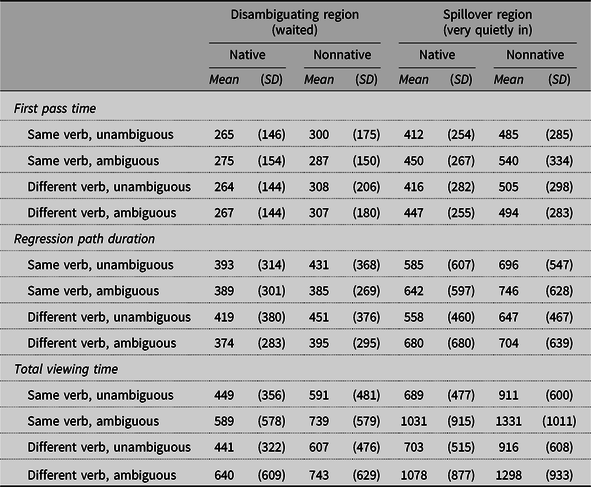
Reading times of prime sentences for three eye-movement measures at two regions of text

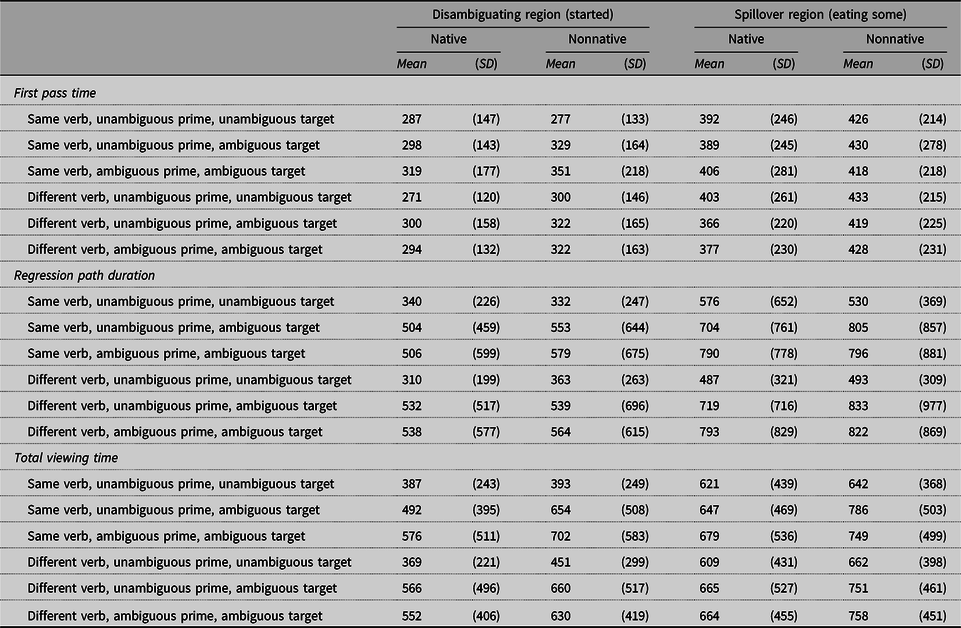
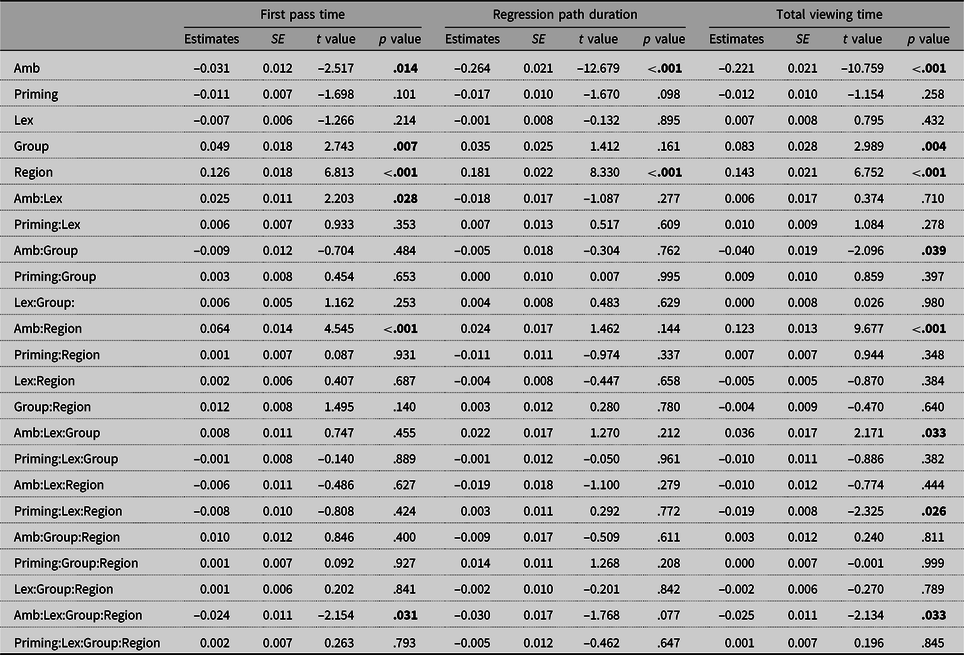
Reading times of target sentences for three eye-movement measures at two regions of text

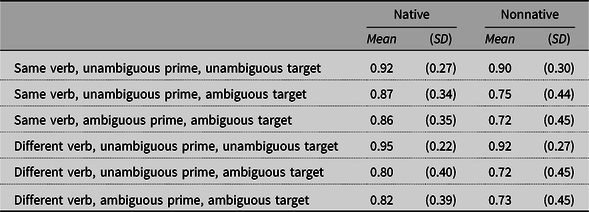
Accuracy rates for comprehension questions following target sentences

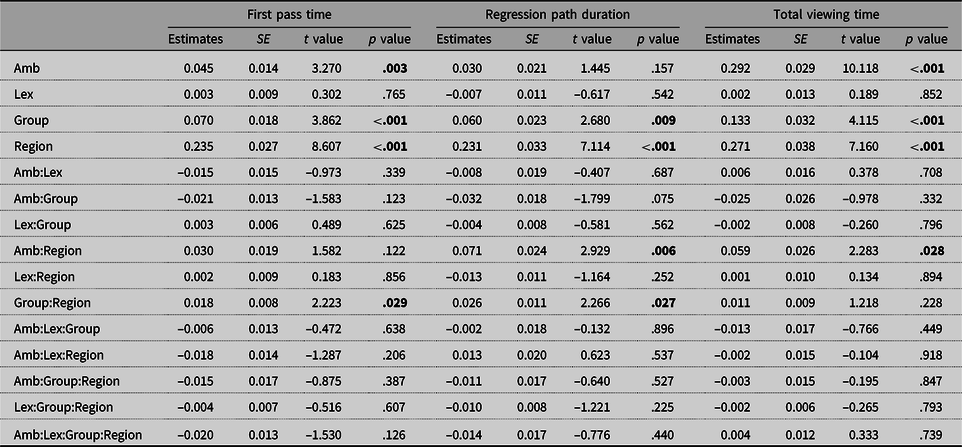
Summary of statistical analyses for prime sentence

Note: Amb, ambiguity. Lex, lexical overlap.
Summary of statistical analyses for target sentences

Note: Amb, ambiguity. Lex, lexical overlap.
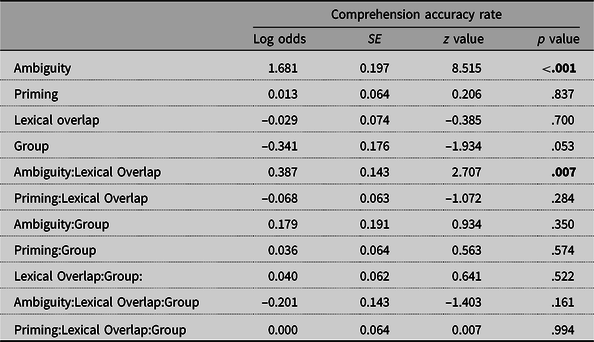
Summary of statistical analyses for comprehension accuracy rates

Prime sentences
First pass reading times showed a significant main effect of ambiguity due to longer reading times for ambiguous than unambiguous sentences. In regression path duration, there was a significant interaction between ambiguity and region. Pairwise comparisons by region showed a significant main effect of ambiguity only in the spillover region (disambiguating region: estimate = –0.044, SE = 0.02, t = –1.54, p = .133, 38 ms; spillover region: estimate = 0.101, SE = 0.03, t = 2.92, p = .005, 71ms).
Total viewing times showed a significant main effect of ambiguity, as ambiguous sentences induced longer reading times. This main effect was modulated by a significant interaction with region due to a larger garden-path effect for the spillover region (estimate = 0.351, SE = 0.04, t = 9.16, p < .001; 380 ms) than the disambiguating region (estimate = 0.236, SE = 0.04, t = 6.05, p < .001; 156 ms). In sum, reading times for the prime sentences indicated garden-path effects for both L1 and L2 participants.
Target sentences
First pass reading times revealed a significant main effect of ambiguity, as ambiguous sentences induced longer reading times. This was qualified by a significant four-way interaction between ambiguity, group, lexical overlap, and region. As planned, we conducted additional analyses for each region.
For the disambiguating region, this analysis showed a significant main effect of ambiguity due to garden-path effects (estimate = –0.095, SE = 0.02, t = –6.00, p < .001) and a significant interaction between ambiguity and lexical overlap (estimate = 0.030, SE = 0.02, t = 1.97, p = .049). Separate analyses at the twolevels of lexical overlap showed larger garden-path effects in lexical overlap (estimate = –0.123, SE = 0.02, t = –5.63, p < .001; 43 ms) than nonoverlap conditions (estimate = –0.065, SE = 0.02, t = –3.02, p = .003; 24 ms). No effects were significant for the spillover region (all t < 1.57, all p > .127).
In regression path duration, the only significant effect of theoretical interest was the effect of ambiguity, with longer reading times in ambiguous than unambiguous sentences. Total viewing times showed a significant main effect of ambiguity, which was modified by a significant four-way interaction between ambiguity, lexical overlap, region, and group. There was also a significant three-way interaction between priming, lexical overlap, and region.
For the four-way interaction with ambiguity, analysis by region showed that there was a significant three-way interaction between ambiguity, lexical overlap, and group in the disambiguating region (estimate = 0.059, SE = 0.02, t = 2.90, p = .007). Further comparisons by lexical overlap showed that for the lexical-overlap condition, there was a significant two-way interaction between ambiguity and group (estimate = –0.103, SE = 0.03, t = –3.31, p = .0013) due to larger garden-path effects for L2 (estimate = –0.464, SE = 0.05, t = –10.10, p < .001; 285 ms) than L1 participants (L1: estimate = –0.256, SE = 0.04, t = –6.18, p < .001; 147 ms). For the non-lexical-overlap condition, there was a significant main effect of ambiguity due to garden paths (estimate = –0.328, SE = 0.03, t = –9.90, p < .001). The spillover region similarly showed garden-path effects irrespective of lexical overlap (estimate = –0.099, SE = 0.02, t = –4.62, p < .001).
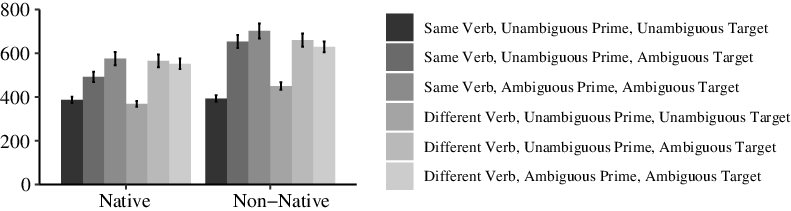
For the three-way interaction with priming, analysis by region showed a significant priming by lexical overlap interaction in the disambiguating region (estimate = 0.029, SE = 0.013, t = 2.20, p = .036). Further analysis by lexical overlap showed a significant effect of priming due to longer reading times for ambiguous target sentences following ambiguous than unambiguous prime sentences in lexical-overlap but not non-lexical-overlap conditions. (lexical-overlap: estimate = –0.048, SE = 0.02, t = –2.65, p = .012; non-lexical-overlap: estimate = 0.011, SE = 0.02, t = 0.58, p = .568). This priming effect found in both groups for the lexical-overlap conditions only is shown in Figure 1. The spillover region did not show any significant effects related to priming (all t < 0.81, all p > .418).
Total viewing times in milliseconds at the disambiguating region in target sentences.

Comprehension question accuracy
Comprehension accuracy rates revealed a significant main effect of ambiguity, with lower accuracy for ambiguous sentences than unambiguous sentences. This ambiguity effect was qualified by a significant ambiguity by lexical overlap interaction, as the size of the difference between ambiguous and unambiguous conditions was larger in the non-lexical-overlap conditions (estimate = 2.099, SE = 0.28, z = 7.58, p < .001; 17%) than the lexical-overlap conditions (estimate = 1.295, SE = 0.23, z = 5.68, p < .001; 11%). However, the effect of priming was not significant, nor did it interact significantly with any other factors. Although L2 speakers tended to have lower comprehension accuracy than L1 speakers particularly in the ambiguous sentences, the main effect of group as well as the ambiguity by group interaction were not significant.
Summary
The results showed reading difficulty when participants read temporarily ambiguous compared to unambiguous sentences in both prime and target sentences. There was some evidence of group differences in the size of these ambiguity effects in one measure, suggesting larger garden-path effects for L2 speakers than L1 speakers during online reading (cf. Jacob & Felser, Reference Jacob and Felser2016).
Of importance, total viewing times of the disambiguating region of ambiguous target sentences were significantly increased when prime sentences were ambiguous, compared with when they were unambiguous. This indicates that ambiguous prime sentences did not facilitate the globally correct interpretation to the same degree as unambiguous prime sentences. We take this as evidence that the initial misinterpretation in ambiguous prime sentences lingered. Total viewing times further showed that this priming effect was dependent on lexical overlap: that is, longer reading times induced by ambiguous prime sentences were observed only in the lexical-overlap condition. This priming effect did not differ significantly between L1 and L2 readers.
Comprehension accuracy rates showed that participants persisted with the initially assigned misinterpretation, as ambiguous sentences were responded to less accurately than unambiguous sentences. Although we did not find any significant L1/L2 differences in accuracy, in contrast with previous studies (e.g., Pozzan & Trueswell, Reference Pozzan and Trueswell2016), numerically L2 speakers had lower accuracy than L1 speakers. We discuss the implications of these results in turn below.
Discussion
The present study investigated the structural representation of temporarily ambiguous sentences that L1 and L2 readers derive during reanalysis of the subject-object ambiguity, using the structural priming paradigm. By using a priming paradigm, we aimed to explore potential L1/L2 differences in persistence of misinterpretation following reanalysis. Our results indicated that the initially assigned misinterpretation of temporarily ambiguous sentences is not fully discarded after reanalysis in language comprehension, and this affects subsequent online reading in both L1 and L2 participants. The priming effects we observed also suggested priming in L1 and L2 comprehension is lexically mediated. However, we did not find significant L1/L2 differences in reanalysis of temporarily ambiguous sentences, or in the size of priming effects. Below, we discuss the implications of these findings.
Priming and lingering misinterpretation in L1 processing
The present study observed structural priming effects indicating that the initial misinterpretation lingers after reanalysis. This was shown in total viewing times, where reading times of temporarily ambiguous target sentences were longer following ambiguous rather than unambiguous prime sentences. This finding is consistent with van Gompel et al. (Reference van Gompel, Pickering, Pearson and Jacob2006), who reported that L1 speakers produce more transitive interpretations after reading temporarily ambiguous than unambiguous sentences. Our results thus extend van Gompel et al.’s findings from priming during production to priming during comprehension. One finding from the present study that is different than van Gompel et al. is that while they showed priming irrespective of lexical overlap between primes and targets, total viewing times in the present study indicated structural priming only in the lexical-overlap condition. This discrepancy may be accounted for by the asymmetrical finding between production and comprehension such that comprehension priming is heavily lexically mediated (e.g., Arai et al., Reference Arai, van Gompel and Scheepers2007; Branigan et al., Reference Branigan, Pickering and McLean2005; Traxler, Reference Traxler2015).
Note that this priming effect may also have been facilitated by the fact that RAT verbs were used in both prime and target sentences, while in non-lexical-overlap conditions the verb in the prime sentence was not only different but also an optionally transitive, rather than RAT, verb.3 As such, it is difficult to tease apart whether the lexical overlap effect we observed is truly down to pure lexical overlap, or the overlap in argument structure (i.e., RAT vs. optional transitivity). Irrespective of this issue, our results suggest overlap in some aspect of lexicalized argument structure influences priming in L1 comprehension. Further research is required to tease these issues apart.
Traxler (Reference Traxler2015) recently showed that early closure prime sentences facilitate the correct interpretation of subsequent ambiguous target sentences, compared with late closure prime sentences. This indicates that L1 speakers reanalyze temporarily ambiguous sentences at least to some degree. Our results in addition show that the initially assigned misinterpretation is not fully discarded in comparison to unambiguous sentences. We believe that this lingering misinterpretation can be accounted for by the good enough language processing model (e.g., Ferreira et al., Reference Ferreira, Christianson and Hollingworth2001). Slattery et al. (Reference Slattery, Sturt, Christianson, Yoshida and Ferreira2013) recently showed that L1 speakers complete reanalysis of the temporarily ambiguous noun phrase but fail to erase the initially assigned misinterpretation. We believe that our results are consistent with this claim, given that our L1 participants generally showed high comprehension accuracy in ambiguous sentences (averaged across ambiguous conditions, L1 participants’ average was 84%), and because the results of Traxler (Reference Traxler2015) suggest L1 speakers attempt reanalysis.
Although priming influenced reading times of target sentences, it did not influence comprehension accuracy rates. This may suggest that priming has little influence on overall comprehension accuracy. However, note that L1 comprehension accuracy for ambiguous sentences was high across conditions, which may have made it difficult to observe small differences related to priming. Further research is required to further examine how priming may influence comprehension accuracy of garden-path sentences in L1 reading.
Reanalysis in L2 processing
As shown in previous studies (e.g., Jacob & Felser, Reference Jacob and Felser2016; Juffs & Harrington, Reference Juffs and Harrington1996; Hopp, Reference Hopp2015; Roberts & Felser, Reference Roberts and Felser2011), L2 participants showed garden-path effects with longer reading times for temporarily ambiguous than for unambiguous sentences. Jacob and Felser (Reference Jacob and Felser2016) recently reported reduced garden-path effects for L2 than for L1 speakers, which they interpreted as indicating that L2 speakers may hesitate to initiate reanalysis or quit reanalysis earlier than L1 speakers. We did not find significant evidence of this in our study and, in one measure, L2 speakers exhibited significantly larger garden-path effects than L1 speakers. As such, while we are cautious in interpreting potential differences in the size of garden-path effects between L1 and L2 speakers in the present study, we did not consistently find reading time evidence suggesting that L2 speakers are more hesitant to conduct reanalysis than L1 speakers.
In addition, we did not find significant evidence of increased L2 reanalysis difficulty in offline comprehension accuracy. This contrasts with Pozzan and Trueswell (Reference Pozzan and Trueswell2016), who reported that L2 speakers were more persistent with initial misinterpretations than L1 speakers. Although we found numerical tendencies suggesting lower accuracy for L2 than L1 speakers irrespective of ambiguity, this effect as well as the ambiguity by group interaction were not statistically significant (see also Jacob & Felser, Reference Jacob and Felser2016, who found a significant main effect of group, but not a significant group by ambiguity interaction). The strongest evidence of increased misinterpretation in L2 readers would have been lower comprehension accuracy for L2 speakers in ambiguous conditions only. Although numerically the difference between L1 and L2 speakers is small in unambiguous conditions (L1 94% vs. L2 91%) and larger in ambiguous conditions (L1 84% vs. L2 73%), the difference between unambiguous and ambiguous conditions is far smaller in our study compared to Pozzan and Trueswell, who reported L2 comprehension accuracy of approximately 50% correct in certain ambiguous conditions, while L1 comprehension accuracy was always at least 90% correct. We acknowledge that differences in the types of garden-paths tested and the different tasks used between our study and Pozzan and Trueswell may contribute to these different findings, but further research is required here to test the extent to which L2 speakers have increased persistence of lingering misinterpretations compared to L1 speakers.
Most important for present purposes, L2 participants showed that unambiguous but not ambiguous prime sentences facilitated processing of the globally correct interpretation of ambiguous target sentences, as also found in L1 participants. This suggests that the structural representation that L2 speakers create during online reading is stable enough to cause priming effects during language comprehension (Nitschke et al., Reference Nitschke, Kidd and Serratrice2010, Reference Nitschke, Serratrice and Kidd2014; Wei et al., Reference Wei, Boland, Cai, Yuan and Wang2019). Furthermore, priming was found only in lexical overlap conditions (see Wei et al., Reference Wei, Boland and Brennan2018), which suggests that priming during comprehension in L2 processing is strongly lexically mediated. Note that we did not find evidence that priming in the L2 is significantly more or less lexically mediated than in L1 processing. The lexically mediated priming effect observed in L1 and L2 speakers may indicate that L1 and L2 grammatical information is bound to each lexical item, and that structural priming occurs or is facilitated as a result of a certain lexical item being accessed during sentence processing (Pickering & Branigan, Reference Pickering and Branigan1998; Wei et al., Reference Wei, Boland and Brennan2018). However, given some previous studies have observed lexically independent structural priming in L2 language comprehension (e.g., Nitschke et al., Reference Nitschke, Serratrice and Kidd2014; Wei et al., Reference Wei, Boland, Cai, Yuan and Wang2019), further research is required to examine the extent to which structural priming is lexically mediated in L2 sentence processing.4 In addition, we acknowledge that we found priming effects in only one measure, total viewing times. Further confirmatory research is required here to examine L1 and L2 comprehension priming, and to further assess the time-course of priming in different eye-movement measures.
Based on previous studies suggesting that L2 speakers have particular reanalysis difficulty (e.g., Pozzan & Trueswell, Reference Pozzan and Trueswell2016), we reasoned that L2 participants may show larger priming effects than L1 speakers. However, we did not find significant differences between L1 and L2 speakers in the size of priming effects. This is consistent with our offline results that did not show clear evidence of increased L2 reanalysis difficulty. One difference between our study and previous studies is the L1 of the L2 speakers tested. Pozzan and Trueswell (Reference Pozzan and Trueswell2016) only tested L2 English speakers with L1 Italian, while our L2 group included learners from a variety of different L1 backgrounds. It is possible that properties of our L2 participants’ L1, such as whether or not the L1 is head-final or whether it has RAT verbs, may have influenced the results (e.g., Frenck-Mestre & Pynte Reference Frenck-Mestre and Pynte1997). As the present study did not aim to explore transfer effects, we leave this issue open to future research.
It is also possible that our study did not show clear evidence of L1/L2 differences due to lack of statistical power, although we note that our participant sample was larger than previous L2 studies (e.g., Jacob & Felser, Reference Jacob and Felser2016; Pozzan & Trueswell, Reference Pozzan and Trueswell2016). Alternatively, previous studies may have overestimated the L1/L2 difference, or differences in the L2 participants sampled may have influenced the results across studies.5 Further research is required here to elucidate potential individual differences in analysis and lingering misinterpretation in both L1 and L2 readers.
Conclusion
The present study investigated the nature of language comprehension during reanalysis of garden-path sentences with the subject–object ambiguity (e.g., When Mary dressed the baby laughed happily), using the structural priming paradigm. While a number of previous studies have shown that reading difficulty occurs during reanalysis processes, less research has examined the nature of reanalysis in terms of potential similarities and differences between L1 and L2 processing. Our study suggests that L1 and L2 speakers both persist with misinterpretation after reanalysis during sentence processing, and that comprehension priming is strongly lexically mediated in both L1 and L2 language processing. The reanalysis difficulty we observed in L1 and L2 speakers we argue is largely related to difficulty in erasing initially assigned misinterpretations from memory.
Acknowledgments
This research was supported by a Language Learning Dissertation Grant awarded to H.F. We would like to thank the editor and three anonymous reviewers for their comments on previous drafts of the paper.
APPENDIX A
Below are the experimental items from the present study. For each set, the first sentence is a prime sentence and the second sentence is a target sentence. Each target sentence was followed by a comprehension question referring to the initial misinterpretation of the ambiguous sentences (e.g., “Did Richard wake up his wife?” for [1]).
1
After the doctor woke up/called(,) the nurse worked for hours in the hospital.
When Richard woke up(,) his wife looked very sleepy and tired.
2
When Mary calmed down/watched(,), the child sat quietly on the sofa.
Although the man calmed down(,) his wife looked quite nervous that day.
3
While James washed/called(,) his child waited very quietly in the bathroom.
After the lady washed(,) the dog started eating some food quickly.
4
Before the small cat scratched/watched(,) the boy played very happily in the park.
While the dog scratched(,) the lady started to prepare for dinner.
5
When the children hugged/watched(,) the baby laughed very happily by the bed.
After the tourists hugged(,) the tour guide decided to relax on the bench.
6
After the grandparents kissed/helped(,) the small child watched the television in the lounge.
When the babies kissed(,) their mother smiled very happily on the chair.
7
Although the boxer fought/visited(,) the coach didn’t give any advice at all.
While the men fought(,) the criminal tried to escape down the street.
8
As Tom dressed/helped(,) his son began cooking lunch in the kitchen.
When the parents dressed(,) their baby smiled very happily in the bed.
9
When Eva woke up/asked(,) her husband started to cook breakfast.
After the secretary woke up(,) the politician prepared some documents for the meeting.
10
While Brian washed/cleaned(,) the small towel fell to the floor and got dirty.
After the woman washed(,) her daughter decided to arrange a plan for the trip.
11
While the coach calmed down/helped(,) the baseball players prepared for the big game.
When Lily calmed down(,) her boyfriend watched the television very contently.
12
While the black cat scratched/watched(,) Thomas hid under the blanket.
When the mouse scratched(,) the researcher checked the monitor very carefully.
13
When the girls hugged/met(,) the large dog yawned very sleepily in the garden.
After the students hugged(,) their teacher smiled quite happily at school.
14
When the children kissed/helped(,) their cousin had some lunch at the table.
After the neighbors kissed(,) their baby started crying aloud for milk.
15
When the soldiers fought/stopped(,) the enemy tried to retreat from the battlefield.
As the people fought(,) the politician seemed quite irritated in the street.
16
Before the grandmother dressed/telephoned(,) her grandchild drank some water in the room.
After the parents dressed(,) their children began to prepare for dinner.
17
As Helen woke up/asked(,) her old friend cleaned the room very quickly.
After the researcher woke up(,) the assistant started working on the project.
18
When the farmer washed/approached(,) the horse jumped suddenly at the farm.
After Mark washed(,) his little son waited very quietly in the bathroom.
19
Before the owner calmed down/approached(,) the large dog behaved very badly in the garden.
Although Linda calmed down(,) the young actor looked quite nervous until the show ended.
20
While the lady dressed/called(,) the little girl waited very quietly in the room.
After the parents dressed(,) their children enjoyed the television show quietly.
21
Before the waiters fought/asked(,) the customers checked the menu in the restaurant.
When the two boys fought(,) their mother started to become very annoyed.
22
When the brothers met/called(,) their friends ran together slowly around the park.
While the politicians met(,) the president considered the important project quietly.
23
After the dog hid/left(,) the food washed away down the sink.
When Jessica hid(,) the small key dropped suddenly to the floor.
24
After the trainers hugged/watched(,) the runner prepared for the important race.
While the hosts hugged(,) the guest drank some wine in the kitchen.
25
When the workmen met/called(,) the employer looked exhausted after a busy day.
After the soldiers met(,) the king rested very quietly in the room.
26
When Steven hid/approached(,) the painting fell down in the hallway.
While the captain hid(,) the weapon dropped accidentally from the shelf.
27
When the customers met/visited(,) the shop assistant tried to sell some new products.
After the artists met(,) the director worked very hard in the studio.
28
While Anna hid/read(,) some books fell to the floor in the living room.
After the student hid(,) the pencil dropped quietly from the table.
29
After the relatives kissed/hugged(,) the young boy became very embarrassed quite quickly.
When the parents kissed(,) the little girl looked really happy in the room.
30
While the maid woke up/hurried(,) the woman looked very annoyed in the hotel.
After Judy woke up(,) the pilot started preparing for the long flight.
31
While the engineer washed/watched(,) the bicycle stopped in front of the window.
After Julia washed(,) the little girl played with friends in the garden.
32
Before the manager calmed down/visited(,) the singer got worried about the concert.
After the king calmed down(,) the queen ordered the guards to be alert.
33
While the fans hugged/approached(,) the basketball player smiled very happily on the court.
When the little girls hugged, the big teddy bear dropped down from the bed.
34
As Angela dressed/helped, the child stayed very quiet in the room.
After Michael dressed(,) his little brother began watching the television show.
35
As the two friends fought/approached(,) the guest started to get annoyed.
After the children fought(,) the neighbor cleaned the street very quietly.
36
When the pupils met/called(,) their teacher had lunch quietly in the cafeteria.
After the professors met(,) the young researcher analyzed some data very quietly.