Introduction
Chronic rhinosinusitis affects 10–15 per cent of the Western population and has adverse effects on health-related quality of life. 1 , Reference Pleis, Lucas and Ward 2 Chronic rhinosinusitis is attributed to multifactorial causes such as environmental factors and host characteristics.Reference Van Cauwenberge, Van Hoecke and Bachert 3 Endoscopic sinonasal surgery is indicated for the treatment of chronic rhinosinusitis refractory to medical treatment.Reference Fokkens, Lund, Mullol, Bachert, Alobid and Baroody 4 Nasal adhesions or synechiae are a common cause of endoscopic sinus surgery failure, resulting in poorer outcomes and a higher likelihood of revision surgery,Reference Musy and Kountakis 5 with adverse effects on patients’ health-related quality of life scores.Reference Henriquez, Schlosser, Mace, Smith and Soler 6 Adhesions are associated with middle turbinate lateralisation and may cause secondary obstruction to the osteomeatal complex, resulting in symptomatic failure and an increase in the need for revision endoscopic sinus surgery.Reference Bassiouni, Chen, Naidoo and Wormald 7
Poor wound healing can result in an increased amount of tissue remodelling and subsequent scarring, leading to impaired mucociliary clearance due to loss of functioning respiratory epithelium.Reference Jorissen 8 , Reference Rudmik, Soler, Orlandi, Stewart, Bhattacharyya and Kennedy 9 Other complications include bleeding, mucosal oedema and infection. Various surgical measures such as the use of mucosal sparing techniques, stents, absorbable and non-absorbable nasal packing, and biodegradable materials are used to minimise adhesion formation.Reference Jorissen 8 , Reference Rudmik, Soler, Orlandi, Stewart, Bhattacharyya and Kennedy 9 All of these have their benefits, and the potential risk for predisposition to granuloma formation and increased discomfort upon removal of the nasal pack.Reference Brody 10
Hyaluronic acid is a physiological macromolecule from the family of the glycosaminoglycan, synthesised by the cellular plasma membrane and highly concentrated in the extracellular matrix. Its particular binding mechanisms and architectural configuration within the connective tissue have effects on stability, lubrication, water homeostasis, molecule filtering and cell behaviour modification (such as anti-inflammatory modulation).Reference Fraser, Laurent and Laurent 11 The unique hygroscopic, viscoelastic and mucoadhesive capability of hyaluronic acid, together with its high immunological and toxicological safety, have led to its use in cosmetic surgery, ophthalmology, orthopaedics, general surgery and gynaecology.Reference Chen and Abatangelo 12 Furthermore, there is evidence that the application of hyaluronic acid aids in the healing of acute and chronic wounds and burns.Reference Goa and Benfield 13 – Reference Voigt and Driver 15 Hyaluronic acid also augments mucociliary clearance and has been shown to reduce the frequency of acute exacerbations of chronic bronchitis.Reference Souza-Fernandes, Pelosi and Rocco 16
The mucosal regenerative properties may be beneficial in the post sinus surgery environment, where the normal physiological processes are disrupted in a wound. The modulating effect of hyaluronic acid in wound healing and mucosal regeneration has been demonstrated in clinical trials following sinonasal surgery, in which safety, tolerability and efficacy of a hyaluronic acid cream were reported.Reference Soldati, Rahm and Pasche 17 Recent studies have supported the role of hyaluronic acid in improving endoscopic and cytological parameters of chronic rhinosinusitis.Reference Casale, Sabatino, Frari, Mazzola, Dell'Aquila and Baptista 18 Animal studies similarly show mucosal surface restoration with the use of hyaluronic acid following sinus surgery, particularly in preventing stenosis.Reference Chen, Sun, Wang, Zhong and Shu 19 – Reference Yildirim, Turgut, Bebek, Gumus, Kocaturk and Kunt 22
Alternative strategies include a wide range of materials such as absorbable and non-absorbable spacers, spacers impregnated with steroid, mitomycin C applied locally, and Silastic splints (used to promote ostial patency and wound regeneration in the sinus environment after surgical disruption).Reference Zhao, Grewal, Briel and Lee 23
In otorhinolaryngology, hyaluronic acid has been found to promote wound healing and preserve ostial patency following endonasal endoscopic dacryocystorhinostomy in primary chronic dacryocystitis.Reference Wu, Cannon, Yan, Tu, Selva and Qu 24
The effect of hyaluronic acid following endoscopic endonasal sinus surgery for chronic rhinosinusitis is not well defined. Hence, a systematic review was conducted on the existing literature to evaluate endoscopic outcomes compared to standard regimens and controls for preventing post sinus surgery complications.Reference Smith, Hwang, Murr, Lavigne and Koreck 25 , Reference Smith, Mendolia-Loffredo, Loehrl, Sparapani, Laud and Nattinger 26
Materials and methods
A systematic review was performed using the Preferred Reporting Items for Systematic Reviews and Meta-Analyses (‘PRISMA’) statement as a framework. The review was registered with Prospero, an international prospective register of systematic reviews (CRD42014013610).
Search strategy
The following electronic databases were searched for randomised controlled trials (RCTs) of hyaluronic acid versus a control for post-endoscopic sinus surgery care: the Cochrane Central Register of Controlled Trials (‘CENTRAL’), Medline (1966 to May 2015), Embase (1988 to May 2015), and the Cumulative Index to Nursing and Allied Health Literature (‘CINAHL’) (1984 to May 2015). A hand search of bibliographic references was undertaken in relevant articles, to ensure a comprehensive search.
Inclusion criteria
The studies included in the review were RCTs that evaluated hyaluronic acid preparations in patients following sinus surgery compared to standard treatments (including control saline preparations), for subsequent meta-analysis. Studies meeting the National Health and Medical Research Council levels II and III evidence that were not RCTs were considered in the qualitative review. Two investigators were involved with independently assessing study eligibility. In the event of discrepancies between investigators, consensus was achieved through discussion. A title and abstract screen was completed, and studies measuring the efficacy of hyaluronic acid using endoscopic outcomes were selected.
Exclusion criteria
Studies not relating directly to the comparison of hyaluronic acid with a control, or those with patient follow up of less than four weeks, were excluded. The full text was obtained for selected articles and these were critically evaluated.
Study population
Participants were adults with a diagnosis of unilateral or bilateral chronic rhinosinusitis with or without nasal polyposis, as per the ‘EPOS’ European Position Paper on Rhinosinusitis and Nasal Polyps 2012 guidelines on primary endoscopic sinus surgery.Reference Fokkens, Lund, Mullol, Bachert, Alobid and Baroody 4 Studies on children and cystic fibrosis patients were excluded, as the mucosal immunity and physiology in these patients may be different to that of normal adults with rhinosinusitis.Reference Chang 27 , Reference Anfuso, Ramadan, Terrell, Demirdag, Walton and Skoner 28 All cases of hyaluronic acid preparations for post-endoscopic sinus surgery care were compared to controls, including placebo (standard treatments included saline or nasal packs) and no active treatments (standard treatment with no intervention). All types of hyaluronic acid preparations were reviewed.
Primary outcome measures
To meet the minimum criterion for the systematic review, studies were required to report the rate of synechiae formation as an outcome according to endoscopic appearance. The endpoint of outcome follow up was at least four weeks post-operatively, which represents a routine follow-up timeframe.
Secondary outcome measures
The qualitative synthesis included studies that reported on: safety, other endoscopic measures such as discharge, crusting or oedema, and patient-reported symptom scores.
Data extraction
An independent extraction process was undertaken by two of the investigators (EF and MG). Any disagreements were resolved through discussion (between EF and MG). Extracted data included: baseline study characteristics (design, study year, setting), population characteristics (disease type, disease location, operation type), operation technique, data relating to the intervention (e.g. preparation type and hyaluronic acid dosing), follow-up duration and primary outcome measures (synechiae). Strict limits were applied to studies included in the meta-analysis. These studies had to meet eligibility criteria, including hyaluronic acid nasal pack use, in order for homogeneous assessment, as well as endoscopic outcomes.
Quality appraisal
The quality of studies was assessed using the Joanna Briggs Institute appraisal assessment tool (scored out of 5). 29 The tool has a structured evaluation for specific types of studies, including qualitative, quantitative and systematic review protocols.
Statistical analysis
The statistical aspects of the meta-analysis were calculated using RevMan software version 5.2. 30 The number of events of sinonasal adhesion in the hyaluronic acid group were recorded and compared to the control group. Risk ratio and confidence intervals (CIs) for adhesion formation frequency were calculated using the Mantel–Haenszel method. The I2 test was used to assess for heterogeneity. The results were considered significant if the 95 per cent CIs did not include ‘1.0’ for the risk ratio.
Results
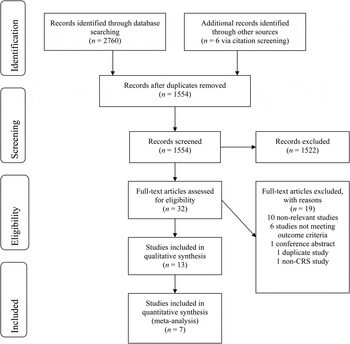
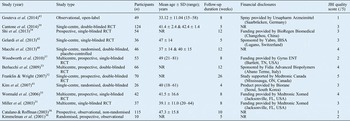
A total of 2760 studies were identified in the search, with 1554 unique records after duplicates were removed (Figure 1). Of these, 32 studies were eligible for full text review, of which 13 studies (involving 501 participants) met the selection criteria (Table I).Reference Miller, Steward, Tami, Sillars, Seiden and Shete 31 – Reference Gouteva, Shah-Hosseini and Meiser 43 The analysis included five double-blinded, randomised controlled trials (RCTs) (National Health and Medical Research Council level II), five single-blinded trials and three prospective studies (National Health and Medical Research Council III). Seven RCTs met the standards for selection into the meta-analysis.
Preferred Reporting Items for Systematic Reviews and Meta-Analyses (‘PRISMA’) flow diagram. CRS = chronic rhinosinusitis

Study characteristics

SD = standard deviation; JBI = Joanna Briggs Institute; RCT = randomised controlled trial; NR = not reported
The studies could be grouped into three types of hyaluronic acid preparations, including absorbable dressing packs of hyaluronic acid, non-absorbable dressing packs impregnated with hyaluronic acid, and topical preparations such as nebulised ampules, sprays and creams (Table I). Eight studies used resorbable hyaluronic acid nasal dressings or packs, of which seven were RCTs. Of these, four studies were controlled against a standard non-absorbable pack,Reference Miller, Steward, Tami, Sillars, Seiden and Shete 31 – Reference Shi, Zhou, Wang, Wu, Shen and Wang 34 three studies were controlled with an unpacked sideReference Wormald, Boustred, Le, Hawke and Sacks 35 – Reference Woodworth, Chandra, Hoy, Lee, Schlosser and Gillespie 37 and one study compared hyaluronic acid against an absorbable gelatine stent.Reference Catalano and Roffman 38 One study used non-absorbable packing that was impregnated with hyaluronic acid. Three RCTs utilised 9 mg of hyaluronic acid in 3 ml of normal saline, applied for 60–90 seconds twice daily.
Outcomes in post sinus surgery care with hyaluronic acid usage included endoscopic evaluation, subjective scores, safety, and secondary objective parameters such as rhinomanometry findings. The quality of studies was generally poor, with only one study achieving a quality score of 5 out of 5 using the Joanna Briggs Institute tool (Table I). Only three studies addressed incompleteness of data.Reference Franklin and Wright 32 , Reference Shi, Zhou, Wang, Wu, Shen and Wang 34 , Reference Wormald, Boustred, Le, Hawke and Sacks 35 Four studies failed to disclose how the products used were obtained.Reference Kimmelman, Edelstein and Cheng 36 , Reference Catalano and Roffman 38 – Reference Macchi, Terranova, Digilio and Castelnuovo 40
Nasendoscopic evaluation
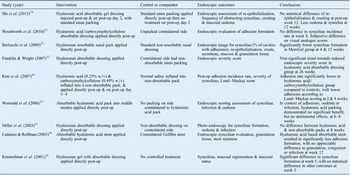
There were mixed outcomes when comparing absorbable hyaluronic acid packs to placebo pack controls (Table II). Franklin and Wright found that endoscopic severity scoring at post-operative week two was significantly lower in the hyaluronic acid absorbable pack group.Reference Franklin and Wright 32 However, there was no statistically significant difference in the primary outcome measure of adhesion formation, or secondary outcome measures of oedema or infection frequency, on endoscopic analysis at six months, although there was a trend favouring improvement.Reference Franklin and Wright 32
Summary of study findings for hyaluronic acid nasal packs

Post-op = post-operative(ly); w/v = weight/volume
Berlucchi et al. found that hyaluronic acid dressings had a significant effect on adhesion rates, with less than 5 per cent of sinonasal cavities found to have adhesions compared to controls; the latter of which had 23 per cent of non-obstructing and 8 per cent of obstructing adhesions at 12 weeks on endoscopic evaluation (p < 0.001).Reference Berlucchi, Castelnuovo, Vincenzi, Morra and Pasquini 33 Similarly, Shi reported a significant difference in synechiae (both obstructing and non-obstructing), oedema crusting and mucopurulent discharge, with these being significantly lower in the treated group (p = 0.0481).Reference Shi, Zhou, Wang, Wu, Shen and Wang 34 In contrast, Miller et al. could not find any significant difference in the rate of adhesion formation, oedema or infection at eight weeks’ follow up between intervention and control.Reference Miller, Steward, Tami, Sillars, Seiden and Shete 31
Kim et al. compared a standard non-absorbable pack soaked in 6 ml of hyaluronic acid with carboxymethylcellulose against a non-absorbable pack with a normal saline preparation, and reported a significantly lower adhesion frequency in the treatment group.Reference Kim, Lee, Yoon, Chang, Bae and Kim 41 That study found that the incidence of adhesions in terms of endoscopic scoring on a four-point severity scale was significantly lower in the treated hyaluronic acid/carboxymethylcellulose group compared to the control group (3 per cent and 18 per cent respectively; p = 0.02).Reference Kim, Lee, Yoon, Chang, Bae and Kim 41
Three studies compared the use of hyaluronic acid dressing against an unpacked contralateral middle meatus (Table II). Woodworth et al. used hyaluronic acid/carboxymethylcellulose dressings and found no significant difference between the packed and unpacked sides with any grade of adhesions (p = 0.09).Reference Woodworth, Chandra, Hoy, Lee, Schlosser and Gillespie 37 A single-blinded study by Wormald et al. found no difference in primary adhesion rates (p = 0.109), or other secondary endoscopic parameters including infection and mucosal oedema (p = 0.317 and p = 0.704 respectively), at six to eight weeks post-operatively when compared to an unpacked side.Reference Wormald, Boustred, Le, Hawke and Sacks 35 A prospective observational study by Kimmelman suggested that adhesion formation and meatal stenosis frequency was lower in the interventional group compared to a non-active treatment group at five weeks (p < 0.05), but there were no other differences (including in mucosal oedema) observed at that time point.Reference Kimmelman, Edelstein and Cheng 36
Catalano and Roffman conducted a prospective non-randomised study comparing the use of MeroGel against Gelfilm, and found that use of the hyaluronic acid dressing in association with a minimally invasive surgical technique minimised the mucosal scarring, with lower adhesion formation on endoscopic examination at 12 weeks (0 adhesions in the intervention group vs 4 in the control group; p = 0.04).Reference Catalano and Roffman 38 However, there were no differences in secondary outcome measures in terms of the frequency of granulation, oedema or infection.
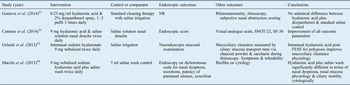
Three studies utilised nebulised hyaluronic acid delivery, with endoscopic endpoints (Table III).Reference Cantone, Castagna, Sicignano, Ferranti, Rega and Di Rubbo 39 , Reference Macchi, Terranova, Digilio and Castelnuovo 40 , Reference Gelardi, Guglielmi, De Candia, Maffezzoni, Berardi and Quaranta 42 Macchi conducted a pilot study using 9 mg nebulised hyaluronic acid for 15 consecutive days per month for 3 months versus 5 ml nebulised normal saline twice daily.Reference Macchi, Terranova, Digilio and Castelnuovo 40 Adhesion formation was similar between the hyaluronic acid with saline group and the saline nebuliser only group, with incidences of 34.8 per cent and 39.1 per cent (not significant) respectively. There was no difference in improvement for other secondary endoscopic parameters, including oedema and sinus patency, at the end of the three-month study (p > 0.05). Nebulised hyaluronic acid was associated with a more normal appearance in mucosal integrity compared to saline (91.3 per cent vs 52.2 per cent respectively, p = 0.007). Cantone et al. similarly demonstrated that nebulised hyaluronic acid was associated with a better Lund–Kennedy endoscopic mean score than the control (1.43 ± 1.85 vs 4.16 ± 3.35, p = 0.0001).Reference Cantone, Castagna, Sicignano, Ferranti, Rega and Di Rubbo 39 A study by Gelardi et al. using nebulised hyaluronic acid showed that the median exudate score was also lower in the sodium hyaluronate group compared to the control group (0 vs 4 respectively, p < 0.05).Reference Gelardi, Guglielmi, De Candia, Maffezzoni, Berardi and Quaranta 42
Studies using hyaluronic acid as a nebulised preparation

NR = not reported; SNOT-22 = 22-item Sino-Nasal Outcome Test; SF-36 = 36-Item Short Form Survey; FESS = functional endoscopic sinus surgery
Meta-analysis of adhesion rates
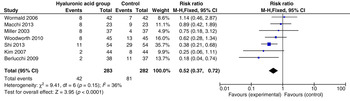
There were 7 studies (involving 324 patients and 565 sinus cavities) that met the criteria for analysis in the quantitative part of the study (Figure 2). The most common reported parameter was adhesion formation, with lower adhesion rates in the hyaluronic acid group compared to the control group at 4–12 weeks post-operatively (odds ratio = 0.42, 95 per cent CI = 0.27–0.64).
Meta-analysis of adhesion formation frequency on endoscopy for hyaluronic acid versus control groups. M-H = Mantel–Haenszel; CI = confidence interval; df = degrees of freedom

Subjective outcomes
Only one study employed patient-reported outcome tools to investigate the effect of hyaluronic acid on quality of life. A double-blinded RCT conducted by Cantone et al. (involving 122 participants) investigated the effect of nebulised hyaluronic acid on quality of life, and reported improvements in subjective parameters at day 30 post-operatively, including the total visual analogue scale (mean of 3.8 vs 5.6 points, p < 0.05), sinus nasal obstruction test (22-item Sino-Nasal Outcome Test) (sum score mean of 47.8 ± 25.4 vs 59.33 ± 23.2, p < 0.05) and medical short form-36 (mean of 83.7 per cent vs 73 per cent, p < 0.05).Reference Cantone, Castagna, Sicignano, Ferranti, Rega and Di Rubbo 39
Macchi et al. supported symptomatic relief with nebulised hyaluronic acid, demonstrating slightly improved satisfaction with regard to reported nasal dyspnoea in the interventional group compared to the control group (odds ratio = 21.36; 95 per cent CI = 1.07–426.56).Reference Macchi, Terranova, Digilio and Castelnuovo 40
Safety profile
Seven of the 13 studies in this systematic review reported on safety in terms of adverse events.Reference Franklin and Wright 32 – Reference Shi, Zhou, Wang, Wu, Shen and Wang 34 , Reference Kimmelman, Edelstein and Cheng 36 , Reference Cantone, Castagna, Sicignano, Ferranti, Rega and Di Rubbo 39 , Reference Kim, Lee, Yoon, Chang, Bae and Kim 41 , Reference Gouteva, Shah-Hosseini and Meiser 43 Six studies found that topical hyaluronic acid preparations to the post-surgical nasal cavity were safe. Gouteva et al. reported one participant with an intolerance to an ingredient in the hyaluronic acid nebulised preparation, resulting in mild transient irritation.Reference Gouteva, Shah-Hosseini and Meiser 43 Satisfaction was generally better than in the control group, and statistically better compared to the non-absorbable packing group.Reference Gouteva, Shah-Hosseini and Meiser 43 Tolerability, as measured by general patient satisfaction scales, was reported in four studies, which demonstrated at least equal judgement by patients on tolerance for all preparations.Reference Catalano and Roffman 38 – Reference Macchi, Terranova, Digilio and Castelnuovo 40 , Reference Gelardi, Guglielmi, De Candia, Maffezzoni, Berardi and Quaranta 42
Other outcomes
Three studies using microbiological, saccharin and charcoal, and rhinomanometric techniques provide useful information regarding recovery of the sinus mucosa following post-operative sinus care. Macchi et al. established that ciliary motility, as measured by phase contrast microscopy, was favoured in the treated group; improvement in terms of ciliary function scores was reported in 87 per cent of participants in the treated group compared to 11 per cent of those in the control group (p < 0.001).Reference Macchi, Terranova, Digilio and Castelnuovo 40 The study also found that hyaluronic acid participants had lower numbers of fungi, with a frequency of 0, versus 1 in controls (p = 0.044). In addition, there was a trend for higher biofilm presence in the hyaluronic acid participants (47.8 per cent, compared to 17.4 per cent in controls), but this difference was not statistically significant (p = 0.057).Reference Macchi, Terranova, Digilio and Castelnuovo 40
A study by Gelardi et al. reported that at one month post-operatively, mucociliary clearance, as measured by the saccharin and charcoal test, was faster in the hyaluronic acid group compared to the saline control group (14.3 ± 2.5 vs 23.6 ± 3.3 minutes respectively; p = 0.000).Reference Gelardi, Guglielmi, De Candia, Maffezzoni, Berardi and Quaranta 42 Participants in the hyaluronic acid group also reported less nasal obstruction compared to controls (2 vs 3 participants respectively, p = 0.023) and less rhinorrhoea (4 vs 10 participants respectively, p = 0.039).
One open-label study was included in the qualitative synthesis, which involved the use of a spray containing hyaluronic acid.Reference Gouteva, Shah-Hosseini and Meiser 43 Mucosal regeneration was measured by rhinoscopy sum score, representative of the efficacy of a spray preparation of 0.25 mg/ml hyaluronic acid with 2 per cent dexpanthenol, which was applied three times a day following nasal cavity surgery and compared to a saline spray. Rhinoscopy scoring was not significantly different between the hyaluronic acid with dexpanthenol spray group and the saline spray group at week six post-operatively.
Discussion
This systematic review evaluates the effects of hyaluronic acid on endoscopic outcomes following endoscopic sinus surgery for patients with chronic rhinosinusitis. The endoscopic outcomes evaluated included adhesion formation. Despite the development of minimally invasive surgical techniques, complications following sinus surgery can occur, with adhesions cited as the most common issue.Reference Pleis, Lucas and Ward 2 , Reference Van Cauwenberge, Van Hoecke and Bachert 3 In order to avoid post-operative failure, surgical techniques and devices have been used, both in the intra-operative and post-operative periods, with diverse findings.Reference Fokkens, Lund, Mullol, Bachert, Alobid and Baroody 4 , Reference Musy and Kountakis 5
This systematic review evaluates and compares 13 studies involving 501 participants with chronic rhinosinusitis treated with hyaluronic acid preparations following endoscopic sinus surgery. Hyaluronic acid may be a useful adjunct to saline irrigation following endoscopic sinus surgery for chronic rhinosinusitis, as evidenced by lower endoscopic adhesion formation in the meta-analysis, significant objective features of mucosal healing including reduced saccharin clearance delay and histological improvement, and patient-reported satisfaction in terms of perceived symptoms and quality of life.
Adhesion rates
Four of the nine studies using hyaluronic acid packs demonstrated a significant reduction in the rate of adhesions on endoscopic examination. Berlucchi et al. showed that resorbable nasal packing was associated with lower adhesion formation than non-resorbable nasal dressings after 12 weeks.Reference Berlucchi, Castelnuovo, Vincenzi, Morra and Pasquini 33 Kim et al. found objective evidence, using the Lund–Mackay scoring system, to indicate that adhesion rates were lower at four weeks post-operatively.Reference Kim, Lee, Yoon, Chang, Bae and Kim 41 Those patients using hyaluronic acid packs were more likely to have no adhesions, defined as grade 0, and lower numbers of grade 1 adhesions, defined as adhesions limited to the middle turbinate, as compared to the controls. Studies by Catalano and RoffmanReference Catalano and Roffman 38 and Kimmelman et al.Reference Kimmelman, Edelstein and Cheng 36 also supported lower adhesion rates in non-randomised controlled environments. In the post-operative stage, at up to 12 weeks, adhesion formation appears to be lower than in the controls, as demonstrated by the meta-analysis. The other five studies showed no difference in adhesion rate.
The meta-analysis found that adhesion formation occurred in 42 out of 283 cases (15 per cent), with a risk ratio of 0.52 (95 per cent CI = 0.37–0.72; I2 = 36 per cent), compared to 81 out of 282 cases (29 per cent) in the control arm of the meta-analysis. The 29 per cent synechiae formation rate in the control group found in the meta-analysis is comparable to the 18.9–44 per cent adhesion rate after endoscopic sinus surgery reported in non-packed controls in the literature.Reference Henriquez, Schlosser, Mace, Smith and Soler 6 , Reference Lee and Lee 44 , Reference Shrime, Tabaee, Hsu, Rickert and Close 45 The meta-analysis excluded the studies by Catalano and RoffmanReference Catalano and Roffman 38 and Kimmelman et al.Reference Kimmelman, Edelstein and Cheng 36 because they had no randomisation and no control respectively (Figure 2). Given the heterogeneity of the control preparations and the study methodologies, however, the true effect is unclear. Larger, better-conducted studies may better ascertain the actual effect of hyaluronic acid on adhesion formation.
Although Shi et al. reported improvement of re-epithelialisation up to 8 weeks post-operatively in their intervention group, their hyaluronic acid side was refilled on day 2 post-operatively, with the control side not having similar treatment, and this may have influenced the early outcomes.Reference Shi, Zhou, Wang, Wu, Shen and Wang 34 At 8–12 weeks, there is weak evidence that hyaluronic acid packs have an anti-adhesion effect, with only 1 of 6 studies demonstrating long-term evidence of reduced synechiae formation.Reference Berlucchi, Castelnuovo, Vincenzi, Morra and Pasquini 33
Safety and tolerability
Absorbable hyaluronic acid dressing preparation appears to be well tolerated, according to patient satisfaction scores across two of the studies when compared with non-absorbable packs.Reference Franklin and Wright 32 , Reference Berlucchi, Castelnuovo, Vincenzi, Morra and Pasquini 33 Lower adhesion rates suggest an improvement of the mucosal surface healing process compared to the control. The nebulised preparation poses difficulties for patients because of the need for specialised devices to deliver the drug, the monthly or daily frequency, and the time required for each nebulisation (which could be overly time consuming for the patient).Reference Casale, Sabatino, Frari, Mazzola, Dell'Aquila and Baptista 18 , Reference Macchi, Terranova, Digilio and Castelnuovo 40 Despite this, it is a well-tolerated, safe and non-aggressive drug delivery method.
It is clear that hyaluronic acid in all preparations is safe and well-tolerated by patients, as evidenced by only one adverse event not related directly to hyaluronic acid, and the overall satisfaction with its use in absorbable nasal packs.Reference Gouteva, Shah-Hosseini and Meiser 43
Quality assessment
The quality assessment demonstrated that bias may play a role in the strength of this review, given the low rate of blinding and poor frequency of reporting of incomplete data. None of the studies included in the systematic review stated that they had used the Consolidated Standards of Reporting Trials (‘CONSORT’) standard for randomised controlled trial publishing and reporting.Reference Turner, Shamseer, Altman, Weeks, Peters and Kober 46
Study limitations
There are a number of limitations to the studies included in this review. Surgical technique may be a confounding factor where institutions perform endoscopic sinus surgery differently to one another, and the post-operative complication rates may be different, resulting in variable findings. In addition, the studies comprised primary endoscopic sinus surgery cases, and therefore the effect of hyaluronic acid on the revision sinus surgery population is unknown. Lastly, unpacked sinus cavities may be more useful in future research to determine the effect of topical post-operative preparations, which may reduce confounding. There is poor and conflicting evidence on how absorbable versus non-absorbable packs differ in the post-operative setting, although the trend appears to favour absorbable preparations.Reference Wang, Tai, Tsou, Tsai, Li and Tsai 47
Conclusion
This systematic analysis of 501 patients in 13 studies found that the use of hyaluronic acid in post-operative care following sinus surgery for chronic rhinosinusitis appears to be useful as an adjunct, in addition to routine care, for the recovery of mucosal physiology, as demonstrated by lower adhesion rates. The meta-analysis included seven studies that showed a significant improvement in adhesion formation at least four weeks post-operatively. Several different hyaluronic acid preparations have been studied, demonstrating beneficial endoscopic outcomes of lower adhesion rates in primary chronic rhinosinusitis post-surgical patients. Further research is required to establish the most effective preparation for clinical practice.