INTRODUCTION
Consumption of red meat has declined in some European countries because it has an unhealthy composition of saturated fatty acids (SFAs; Van Wezemael et al. Reference Van Wezemael, Ueland, Rødbotten, de Smet, Scholderer and Verbeke2012). Increasing the levels of linoleic and linolenic fatty acids (FAs) in meat is an effective nutritional strategy to increase product quality (Or-Rashid et al. Reference Or-Rashid, Wright and McBride2009; Herdmann et al. Reference Herdmann, Martin, Nuernberg, Dannenberger and Nuernberg2010). Therefore, diet formulation can be used to reduce ruminal FA biohydrogenation (BH) and, consequently, increase unsaturated FAs (USFAs) in meat.
The proportion of non-fibre carbohydrates (NFCs) in the diet and fibre sources are significant factors that can modify the flow of FAs to the duodenum (Zebeli et al. Reference Zebeli, Metzler-Zebeli and Ametaj2012a ). Use of different sources of forage diets with high levels of concentrate may be associated with different ruminal degradation rates and, consequently, lower intake and nutrient digestibility (Tafaj et al. Reference Tafaj, Kolaneci, Junck, Maulbetsch, Steingass and Drochner2005). In vitro studies have shown that the lipolysis rate is altered by diet composition, being more extensive in response to increased nitrogen (N) content in high-starch diets and decreased N content when dietary fibre is replaced by starch (Shingfield & Wallace Reference Shingfield, Wallace, Sels and Philippaerts2014). Conversely, rapid degradation of NFCs (concentrate) leads to high concentrations of volatile FAs and low pH. In spite of this, there is no consensus on pH thresholds that may cause ruminal upset. One generally accepted indication of ruminal disorders is pH < 5·6–5·8 (Lechartier & Peyraud Reference Lechartier and Peyraud2010), which could create a shift in the microbiome (Hook et al. Reference Hook, Steele, Northwood, Dijkstra, France, Wright and McBride2011; Saleem et al. Reference Saleem, Ametaj, Bouatra, Mandal, Zebeli, Dunn and Wishart2012).
Healthy rumen function is maintained by including adequate fibre content in high-concentrate diets that stimulate digesta stratification in the rumen and chewing activity, hence increasing salivary output (Tafaj et al. Reference Tafaj, Zebeli, Maulbetsch, Steingass and Drochner2006). Effectiveness of forage in stimulating chewing activity, rumen fermentation and ruminal retention time and, therefore, ruminal microbiota, varies with different botanical origin, processing, particle size (PS) and neutral detergent fibre (NDF) content (Owens et al. Reference Owens, Secrist, Hill and Gill1998). Nevertheless, there is evidence that not all FAs present in forage behave similarly when exposed to bacterial BH (Dewhurst et al. Reference Dewhurst, Shingfield, Lee and Scollan2006). However, there is a lack of information on the effects of similar NDFs in low-quality forage (fNDFs) in diets with higher concentrate and glycerine on ruminal fermentation, ruminal BH, duodenal flow of FAs and rumen microbiota in Nellore steers. Therefore, it was hypothesized that sources of low-quality forage with different fibre digestibility may be used in high-concentrate diets to modulate ruminal fermentation and FA flow to the duodenum without affecting the intake of Nellore feedlot steers. Thus, the present study aimed to evaluate the effects of different sources of forage in high-concentrate diets on intake, digestibility, rumen fermentation, ruminal BH, duodenal flow of FAs and rumen microbiota in Nellore feedlot steers.
MATERIALS AND METHODS
The protocol used in the present experiment was in accordance with the Brazilian College of Animal Experimentation (COBEA – Colégio Brasileiro de Experimentação Animal) guidelines and was approved by the Ethics, Bioethics and Animal Welfare Committee (CEBEA – Comissão de Ética e Bem Estar Animal) of the UNESP – Univ Estadual Paulista, Jaboticabal (protocol number 021118/11).
Animals and experimental feeds
Nine Nellore steers (body weight [BW], 300 ± 30 kg; age, 18 ± 2 months) fitted with 10-cm (internal diameter) silicone-type ruminal cannulas and duodenal T-type cannulas (Kehl®, São Carlos, Brazil) were used in a triple Latin square design 3 × 3 to evaluate dietary intake, apparent total tract digestibility, ruminal pH, ammonia-N (NH3-N) concentration, ruminal BH, duodenal flow of FAs and rumen microbiota. The steers were fitted with the cannulas at about 10 months of age and underwent at least 8 weeks of recovery before the start of the study. The steers were treated for internal and external parasites at the beginning of the experiment and maintained in individual pens of ~21 m2 for adaptation with protected feeders and water. Initially, the animals were weighed, identified and housed in individual pens with feeders and drinkers. The animals spent 21 days adapting to the facilities and management. The experiment consisted of three consecutive 20-day periods. Each study period consisted of 15 days for adaptation, 4 days for recording dry matter intake (DMI) and faeces collection, and 1 day for ruminal fluid sampling. Ruminal fluid was collected for measuring ruminal pH and NH3-N and quantifying bacteria and protozoa on 1 day during each 20-day period (see later).
The diets were formulated to provide DMI of 22 g/kg of BW (6·6 kg per animal/day), calculated using the method described by Alderman (Reference Alderman1993) and fNDF was fixed at 0·15 of DMI to ensure ruminal fibre requirements and avoid ruminal upsets (Goulart & Nussio Reference Goulart and Nussio2011).
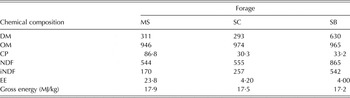
The dietary treatments were as follows: maize silage (MS), sugar cane (SC) and sugar cane bagasse (SB, Table 1). Maize silage used in the present study was obtained from the UNESP farm. A whole plant of the maize hybrid 2B688Hx (Dow AgroSciences, Indianapolis, IN, USA) was harvested and ensiled at about 0·31 DM and chopped into pieces 5 cm long. The chopped maize material was placed in a trench-type silo, covered with black plastic and ensiled for at least 2 months. Sugar cane was obtained from a local farm and chopped into pieces of about 2–3 cm in length, while SB was obtained from a private biofuel plant and chopped into pieces 3–4 cm long. The differences in the length of the forage pieces was due to current practice. Crude glycerine was acquired from the soybean oil-based biodiesel production company ADM, Rondonópolis, Brazil (803·4 g glycerol/kg; 15·9 g ether extract/kg; 50·3 g ash/kg and 120·2 g water/kg).
Chemical composition of maize silage (MS), sugar cane (SC) and sugar cane bagasse (SB) (g/kg on a dry matter basis)

DM, dry matter; OM, organic matter; CP, crude protein; NDF, neutral detergent fibre; iNDF, indigestible neutral detergent fibre; EE, ether extract.
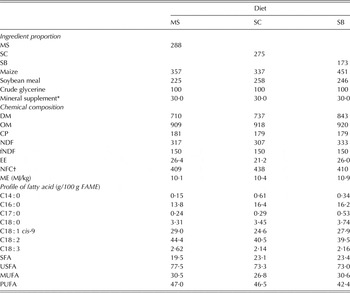
The diets were isonitrogenous and the concentrate was composed of ground maize, soybean meal, crude glycerine and mineral supplements (Table 2). Ingredients for the concentrate were ground using a hammer mill fitted with strainers and 2-mm sieves. Continuous homogenization of the diets was performed in a horizontal mixer for 15 min.
Composition of the experimental diets (g/kg on a dry matter basis)

MS, maize silage; SC, sugar cane; SB, sugar cane bagasse; DM, dry matter; OM, organic matter; CP, crude protein; NDF, neutral detergent fibre; fNDF, NDF from forage; EE, ether extract; NFC, non-fibre carbohydrates; ME, metabolizable energy; FAME, fatty acid methyl esters; SFA, saturated fatty acid; USFA, unsaturated fatty acid; MUFA, monounsaturated fatty acid; PUFA, polyunsaturated fatty acid.
* Composition = 210 g calcium; 20 g phosphorus; 37 g sulphur; 80 g sodium; 490 mg copper; 1·424 mg manganese; 1·830 mg zinc; 36 mg iodine; 29 mg cobalt; 9 mg selenium;333 mg fluorine (max).
† Non-fibrous carbohydrate (NFC) estimated as: NFC = 100 − (CP + EE + ash + NDF).
The animals were fed twice daily at 08.00 and 16.00 and feed refusals were recorded daily for each pen. The concentrates and forage for each animal were weighed individually and mixed manually in the troughs. Throughout the entire experimental period, refusals of ~100 g/kg were allowed in relation to the total amount consumed on the previous day. Feed refusals were collected and weighed before feeding; sub-samples of ~100 g/kg of feed refusals were collected for each animal and frozen at −20 °C.
Data collection and sampling procedures
Total faeces were collected for 4 days between days 15 and 18 (Barbosa et al. Reference Barbosa, Valadares, Valadares Filho, Pina, Detmann and Leão2011). Faeces were collected immediately after each spontaneous defecation and stored in 20-litre buckets. At the end of each 24-h collection period, the buckets were changed and the faeces were weighed, blended manually and aliquots (~300 g) were collected. Afterwards, these samples were dried in a forced-ventilation oven at 55 °C for 72 h and ground in a mill with a 1-mm mesh sieve, and a composite sample was prepared for each animal per period on the basis of the air-dry weight.
Duodenal samples were collected over 2 days (fourth and fifth data collection days during the study period) at 6-h intervals. The sampling was delayed for 3 h on the second day to represent the 24-h period (de Oliveira et al. Reference de Oliveira, Berchielli, Pedreira, Primavesi, Frighetto and Lima2007). The samples were maintained at −10 °C and at the end of the period, the samples for each animal were pooled for each period. Indigestible NDF (iNDF) was used as an indicator of daily DM flows in the duodenum (Harvatine & Allen Reference Harvatine and Allen2006) and obtained via an in situ method after 240 h (Casali et al. Reference Casali, Detmann, Valadares Filho, Pereira, Henriques, De Freitas and Paulino2008) with incubated samples of feed offered, feed refusals, faeces and ground duodenal digesta (Wiley mill, 2-mm screen). Indigestible NDF was analysed using an Ankom 200 Fibre Analyser (Ankom Technology Fairport, NY, USA).
Rumen pH and NH3-N were measured on day 18 of each period. To assess rumen fermentation parameters, rumen fluid samples (c. 80 ml) were collected manually before supplying the diet (time zero) and 1, 2, 4, 6, 8, 10 and 12 h after feeding. Immediately after collection, pH of the rumen fluid was determined using a digital potentiometer (ORION 710A, Boston, MA, USA). The ruminal fluid (40 ml) was placed in a plastic bottle and frozen at −20 °C for NH3-N analysis, according to the methodology adapted by Fenner (Reference Fenner1965). In brief, ruminal fluid NH3 was analysed by distilling with 2 m potassium hydroxide (KOH) in a micro-Kjeldahl system.
The feed offered, feed refusals and faeces samples were dried at 55 °C for 72 h and ground in a Wiley mill (Thomas Scientific, Swedesboro, NJ, USA) to pass through a 1-mm screen. Samples of Tifton 85 hay, concentrates and feed refusals were analysed for DM (934.01), mineral matter (MM, 942.05) and ether extract (EE, 920.39), according to AOAC (1990). Ether extract contents in faeces were determined by extraction in ether (EE, 920.39). Nitrogen was determined using an LECO FP-528 nitrogen analyser (LECO Corp., St. Joseph, MI, USA).
The NDF was determined using α-amylase and without the addition of sodium sulphite, according to the method reported by Van Soest et al. (Reference Van Soest, Robertson and Lewis1991) and adapted for the Ankom200 Fibre Analyser (Ankom Technology, Fairport, NY). Acid detergent fibre was determined using the method described by Goering & Van Soest (Reference Goering and Van Soest1970) and adapted for the Ankom200 Fibre Analyser (Ankom Technology, Fairport, NY). Acid detergent lignin was determined by solubilisation of cellulose with sulphuric acid, according to Van Soest & Robertson (Reference Van Soest and Robertson1985). Gross energy was obtained by the combustion of samples in an adiabatic bomb calorimeter IKA® model 2000 Basic.
The flows of DM to the duodenum were calculated as the ratio of iNDF consumed to the concentration of iNDF in duodenal contents. Ruminal BH was estimated by the differences in USFA between the intakes and flows to the duodenum (Xu et al. Reference Xu, Jin, He, Li, Beauchemin and Yang2014).
Fatty acid quantification
Fatty acid composition was analysed according to the protocol described by Shingfield et al. (Reference Shingfield, Ahvenjarvi, Toivonen, Arola, Nurmela, Huhtanen and Griinari2003). Briefly, lipids were extracted from 100 mg of freeze-dried samples in a mixture (3 : 2, v/v) of hexane and isopropanol after adjustment of pH to 2 by using 2 m hydrochloric acid and methylation with an acid-based catalyst using methanolic sulphuric acid (1%, v/v). The FA profile was determined using a gas chromatograph (Focus CG – Finnigan, Thermo Finnigan, San Jose, CA, USA) with a fused silica capillary column (100 m × 0·250 mm, 0·20-m film thickness; CP-Sil 88 for FA methyl esters – FAME) by using hydrogen as a carrier gas at a constant flow of 1·5 ml/min). The flame ionization detector was set at 300 °C. The time–temperature programme used was as follows: initial temperature of 70 °C for 4 min before increasing to 175 °C (13 °C/min) with waiting time of 27 min; 215 °C (4 °C/min) with waiting time of 9 min; and finally 230 °C (7 °C/min) for 4 min (total 65 min). Identification of FAs was performed by comparing their retention times with those observed in commercial standards (C4–C22) such as Supelco 18919-1AMP, a methyl ester mixture of 37 FAs. The major FAs were identified using the following pure commercial standards: 05632-SIGMA, methyl ester mixture of the conjugated linoleic acid cis-9, trans-11 and trans-10, cis-12; V1381-SIGMA and methyl ester vaccenic acid.
Microbiological analysis
Samples for bacteria and protozoa quantification were collected on day 19. For quantification and identification of rumen ciliate protozoa, samples of ruminal contents were collected via cannula, 3 h after the morning feeding. Cell counts were performed using rumen content aliquots preserved in formalin (a solution of equal parts water and 370 ml/l formaldehyde), according to D'Agosto & Carneiro (Reference D'Agosto and Carneiro1999). Ciliate protozoa species were identified and quantified in a Sedgewick-Rafter chamber, according to Dehority (Reference Dehority1984). Each sample was homogenized and 1 ml of ruminal content was pipetted and transferred to vials with Lugol's solution, according to the methodology of D'Agosto & Carneiro (Reference D'Agosto and Carneiro1999). After 15 min, 9 ml of 30% glycerine was added to the vials. To quantify the protozoa, 1 ml was transferred from each vial to fill the Sedgewick-Rafter chamber.
Bacterial population was quantified using quantitative polymerase chain reaction (qPCR). Samples of ruminal contents were collected via cannula before the morning feeding (Saro et al. Reference Saro, Ranilla, Cifuentes, Rosselló-Mora and Carro2014). Fifty grams of the rumen contents was weighed and immediately added to 50 ml of phosphate-buffered saline (pH 7·4), stirred vigorously for 3 min, and then filtered with a mesh fabric (100 µm). The filtrate was centrifuged at 16 000 g for 10 min at 4 °C. The supernatant was discarded and the precipitate was resuspended in 4 ml of tris-ethylenediaminetetraacetic acid buffer (10×, pH 8). The re-suspended content was centrifuged at 16 000 g for 10 min at 4 °C, the supernatant was discarded, and the precipitate stored immediately in a freezer (–20 °C) for 2 months.
A ‘Fast spin kit for soil’ (MP Bio®, Biomedicals, Illkirch, France) extraction kit was used to extract DNA from 250 mg of the sample, according to the manufacturer's instructions. Integrity and quantity of the DNA was checked using agarose gel electrophoresis (0·8%) and complementary DNA was assessed using a spectrophotometer (Thermo Scientific NanoDrop 1000, Thermo Fisher Scientific, MA).
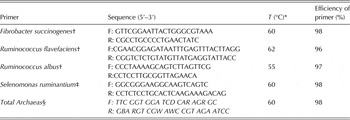
Absolute quantification of total bacteria and relative quantification of cellulolytic bacteria (Ruminococcus albus, Fibrobacter succinogenes and Ruminococus flavefaciens) was achieved by qPCR. The primers used in the present study are listed in Table 3. Four concentrations (200, 400, 600 and 800 nM) of forward and reverse primers were tested to determine minimum primer concentration giving the lowest threshold cycle (Ct) and to reduce non-specific amplification before the start of the reaction. Validation of the chosen concentration of primers was performed with different concentrations of DNA (150, 125, 100, 50 and 25 ng). The value of the ‘slope’ was determined and efficiency was calculated using the following equation:
 $${\rm Efficiency} = 10\left( { - 1/{\rm slope}} \right){\rm} -{\rm} 1$$
Primers used in the present study

F, forward; R, reverse.
* Temperature of annealing.
† Denman & McSweeney (Reference Denman and McSweeney2006).
‡ Khafipour et al. (Reference Khafipour, Li, Plaizier and Krause2009).
§ Denman et al. (Reference Denman, Tomkins and Mcsweeney2007).
The amplifications were performed in triplicate. Real-time PCR was performed using the Applied Biosystems 7500 Real-time PCR System (Applied Biosystems, Foster City, CA). Rox was used as a passive reference dye. The qPCR was performed using 100 ng of total DNA in a reaction containing 6·25 µl of SYBR® Green PCR Master Mix (Bio-Rad, Hercules, CA), 400 or 600 nM of the primer pair and water to a final volume of 12·5 µl. Cycling conditions were 50 °C for 2 min and 95 °C for 10 min, followed by 35 cycles of denaturation at 95 °C for 15 s, pairing at 60 °C for 60 s and extension at 78 °C for 1 min. After one cycle of amplification, a step was added to increase the temperature from 60 to 95 °C to obtain the dissociation curve of the reaction products for analysing amplification specificity.
Relative quantification was used to determine species proportion. The results were expressed as a 16S rDNA ratio of general bacteria:
 $${\rm Relative}\;{\rm quantification} = {2^{-({\rm Ct}\;{\rm target}-{\rm Ct}\;{\rm total}\;{\rm bacteria})}}$$
where Ct is defined as the number of cycles required for the fluorescent signal to cross the threshold.
Statistical analyses
The data of intake, digestibility, ruminal BH, duodenal FA flows and protozoa populations were analysed using a triple 3 × 3 Latin square design with the PROC MIXED procedure of SAS (version 9.2). The general mathematical model was as follows:
 $${Y_{ijk}} = \mu + {\alpha _i} + {\beta _j} + {s_k} + \alpha {\beta _{ij}} + {e_{ijk}}$$
where Y ijk represents the observation of steers k given diet i at period j; μ represents overall mean; α i represents the fixed effect of the ith diet, i = 1, 2,…, nt; β j represents the fixed effect of the jth period, j = 1, 2,…, np; and s k represents the random effect of the kth steers, k = 1, 2,…, ns, μ; αβ ij represents the interaction between diet i and period j; and e ijk represents the residual experimental error with variance component σ2c (Tempelman Reference Tempelman2004).
Ruminal pH and NH3-N data were analysed using a triple 3 × 3 Latin square design with repeated measures over time and the PROC MIXED procedure of SAS (version 9.2). The model included fixed effects of diet, time, diet × time interaction and random effects of steers and periods. The structure of errors that best fitted the data according to the Bayesian information criterion was used. Differences between treatment means were determined using Tukey's test. Differences among means with P < 0·05 were accepted as representing statistically significant differences.
Relative quantities of 16S rRNA, as determined using real-time PCR, were analysed using R software (version 3.1.1), with three treatments and three periods. The fixed effects were treatments and Latin Square, and random effects were time, animal and error. When significant, the means between treatments were compared using Tukey's test and the significance was set at P < 0·05.
RESULTS
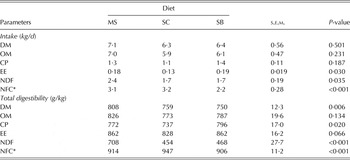
There was no effect of different sources of forage in high-concentrate diets on DM, organic matter (OM) and CP intake. However, NDF intake was higher in animals fed with MS than in animals fed with SC, which did not differ from animals fed with SB. The NFC intake (P < 0·05) was reduced in animals fed with SB compared with those fed MS and SC. A higher intake of EE was observed in animals fed with SB and MS than in animals fed with SC (Table 4).
Effect of different sources of forage in diets with crude glycerine on intake and digestibility of dry matter (DM), organic matte (OM), crude protein (CP), ether extract (EE), neutral detergent fibre (NDF) and non-fibre carbohydrates (NFC) by feedlot Nellore steers

MS, maize silage; SC, sugar cane; SB, sugar cane bagasse; DM, dry matter; OM, organic matter; CP, crude protein; EE, ether extract; NDF, neutral detergent fibre; NFC, non-fibre carbohydrate.
* Non-fibre carbohydrates = 100 − (CP + EE + ash + NDF), NRC (2001).
Digestibility of DM and NDF increased (P < 0·05) when the MS diet was used. In addition, higher crude protein (CP) digestibility was observed in animals fed with SB and MS than in those fed with SC (P < 0·05). The NFC digestibility was higher in animals fed with SC than in those fed with the other diets (P < 0·05, Table 4).
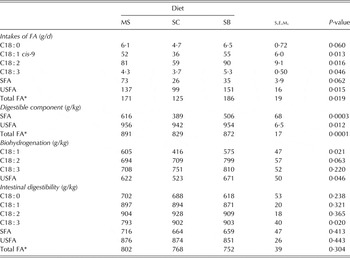
Intakes (g/d) of total and individual FAs, such as C18 : 1 cis-9, C18 : 2 and C18 : 3, were similar between animals fed with MS and SB, but decreased in animals fed with SC (P < 0·05, Table 5). Diets containing MS and SB showed higher values for total digestibility of SFA, USFA and total FAs (P < 0·05). Ruminal BH of C18 : 1 and USFA was higher in animals fed with SB and MS than in animals fed with SC (P < 0·05, Table 5). Overall, intestinal digestibility of FAs (g/100 g) did not differ among treatments, except for C18 : 3, which increased in animals fed with SC and SB (P < 0·05, Table 5).
Effect of different sources of forage in diets with crude glycerine on intake, total and intestinal digestibility of fatty acid, ruminal biohydrogenation of unsaturated fatty acids by feedlot Nellore steers

MS, maize silage; SC, sugar cane; SB, sugar cane bagasse; SFA, saturated fatty acid; USFA, unsaturated fatty acid; Total FA, total fatty acid.
* Total FA = sum of C10 : 0, C12 : 0, C14 : 0, C16 : 0, C17 : 0, C18 : 0, C16 : 1, C18 : 1 cis-9, C18 : 2 and C18 : 3.
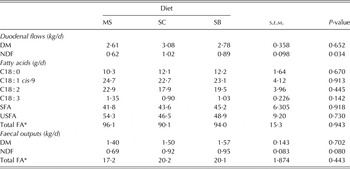
The profile of FAs in duodenal digesta and faecal outputs did not differ among treatments. However, the flow of NDF was higher in animals fed with SC than in those fed with MS and SB (P < 0·05, Table 6).
Effect of different sources of forage in diets with crude glycerine on duodenal flow of dry matter (DM), neutral detergent fibre (NDF) and fatty acid and faecal outputs in feedlot Nellore steers

MS, maize silage; SC, sugar cane; SB, sugar cane bagasse; SFA, saturated fatty acid; USFA, unsaturated fatty acid; Total FA, total fatty acids.
* Total FA = sum of C10 : 0, C12 : 0, C14 : 0, C16 : 0, C17 : 0, C18 : 0, C16 : 1, C18 : 1 cis-9, C18 : 2 and C18 : 3.
There was no interaction between diet and time for pH or NH3-N. Animals fed with SB showed higher values of pH (P < 0·05) than those fed with MS and SC. Animals fed with SC showed decreased NH3-N values (P < 0·05, Table 7).
Effect of different sources of forage in diets with crude glycerine on pH and ammonia nitrogen (NH3-N)

MS, maize silage; SC, sugar cane; SB, sugar cane bagasse; D, diet; T, time effect; D × T, diet and time interaction effect.
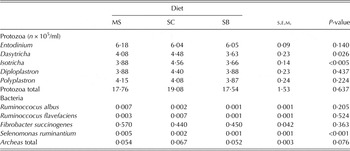
The protozoan populations were not influenced by the different sources of forage in high-concentrate diets, with the exception of Dasytricha and Isotricha (Table 8). Dasytricha populations were higher in animals fed with SC than those fed with SB and MS. In addition, Isotricha populations were higher (P < 0·05) in animals fed with SC. The populations of fibrolytic bacteria (R. flavefaciens, R. albus and F. succinogenes) were similar among diets (Table 8). However, the population of Selenomonas ruminantium, a bacterium that consumes lactic acid, increased 2·5 and 5 times (P < 0·01) in animals fed with MS when compared with animals fed with SC and SB, respectively. Moreover, the populations of methanogens were similar among diets.
Effect of different sources of forage in diets with crude glycerine on rumen fluid protozoa numbers, relative proportion of cellulolytic bacteria and methanogenic archaeas of Nellore steers in feedlot

MS, maize silage; SC, sugar cane; SB, sugar cane bagasse.
DISCUSSION
According to Piatkowski et al. (Reference Piatkowski, Gürtler and Voigt1990) and Hoffmann (Reference Hoffmann1990), addition of at least 400 g of structural crude fibre per 100 kg of animal BW to a concentrate-rich diet is necessary to ensure sufficient amounts of fibre for adequate ruminal fermentation. Thus, in the present study, fNDF was fixed at a proportion of 0·15 of the diet to avoid ruminal upsets. This level of fNDF inclusion was recommended by Goulart & Nussio (Reference Goulart and Nussio2011), who suggested that ruminal functions may not be affected at this inclusion level in concentrate-rich diets. Thus, in the present study, forage: concentrate was different among the diets (MS = 288 g/kg, SC = 275 g/kg and SB = 173 g/kg), because of the different NDF contents from the forage sources studied (MS = 544 g/kg, SC = 555 g/kg and SB = 865 g/kg).
The reduction in NDF intake in animals fed with low-quality forages could be due to lower fibre digestion of these sources (Corrêa et al. Reference Corrêa, Pereira, de Oliveira and Ramos2003; Rotta et al. Reference Rotta, Valadares Filho, Engle, Silva, Sathler, Prado, Bonafé, Zawadzki and Visentainer2014), which results in NDF accumulation and limitation of voluntary intake (Ørskov & Hovell Reference Ørskov and Hovell1978). However, in diets with high proportions of concentrate, the intake is rarely limited by physical fill (Galyean & Defoor Reference Galyean and Defoor2003). Thus, the results for NDF intake were possibly due to the animals sorting through their feed and tending to sort mixed rations to a greater extent in diets with low forage content (DeVries et al. Reference Devries, Beauchemin and Von Keyserlingk2007, Reference Devries, Dohme and Beauchemin2008). The NDF content of refusals was 0·53, 0·83 and 1·25 kg NDF/day for MS, SC and SB diets, respectively, This suggests that animals fed with MS actively sought those parts of the diet with high NDF content in an attempt to increase the intake of physically effective fibre and reduce the intake of starch, indicating that cattle may adapt their feed selection to minimize ruminal disturbances (DeVries et al. Reference Devries, Schwaiger, Beauchemin and Penner2014).
The results highlight the concept of physically effective NDF (peNDF) used by Zebeli et al. (Reference Zebeli, Aschenbach, Tafaj, Boguhn, Ametaj and Drochner2012b ) as a more accurate indicator of fibre adequacy when compared with fNDF: it combines information on chemical fibre content and PS of feedstuffs. Nutritional effects of dietary PS and peNDF are complex and involve feed intake behaviour (absolute intake and sorting behaviour), ruminal mat formation, rumination and salivation and ruminal motility.
The different sources of forage in the high-concentrate diets changed DM and NDF digestibility, which could be related to the passage rate and fibre quality. Sugar cane and SB have low digestibility and high concentrations of iNDF. Since high-concentrate diets may increase the passage rate, fibre degradation could be limited and lead to reduced NDF digestibility (Galyean & Defoor Reference Galyean and Defoor2003). This is consistent with observations by Henrique et al. (Reference Henrique, Beltrame Filho, Leme, Lanna, Alleoni, Coutinho Filho and Sampaio2007) and Menezes et al. (Reference Menezes, Valadares Filho, Magalhães, Valadares, Mariz, Detmann, Pereira and Leão2011), who reported that SB and SC have low digestibility and high concentrations of iNDF. Diets containing fibre with higher fractions of iNDF associated with a high concentrate in the diet may have a higher passage rate (Pereira et al. Reference Pereira, Queiroz, Paulino, Cecon, Valadares Filho, Miranda, Fernandes and Cabral2000; Mertens Reference Mertens2001; Magalhães Reference Magalhães, Campos, Cabral, Mello, de Freitas, Torres, Valadares Filho and de Assis2006), preventing further degradation of the fibre and resulting in lower digestibility of NDF, as observed in animals fed with SB and SC.
Treatment with SB and MS showed the highest intake of FA C10 : 0, C12 : 0, C18 : 1 cis-9, linoleic (C18 : 2), linolenic (C18 : 3), UFA and total FAs. This is probably due to FA composition of individual ingredients and chemical composition of the experimental diets.
Among the three forage sources, the highest concentrations of C10 : 0, C12 : 0, C16 : 0, C17 : 0, C18 : 0 and C16 : 1 were found in SB. Maize silage had the highest concentrations of C18 : 1 cis-9, C18 : 2, C18 : 3 and UFA. Substantial concentrations of all FAs analysed were found in soybean meal and ground maize.
Fixing the proportion of NDF in the diets at 0·15 led to the MS treatment having the highest proportion of forage (288 g/kg DM) while the SB treatment had the lowest (173 g/kg DM). Therefore, the MS treatment presented the lowest inclusion of maize (357 g/kg DM) and soybean meal (225 g/kg DM) and the SB treatment, the highest (451 g maize/kg DM and 246 g soybean meal/kg DM). Therefore, different quantities of the concentrate in the diets modified the ingestion of EE and consequently, the quantity of FAs.
Digestibility of SFA, total FA and BH of UFA were higher for the SB and MS treatments than for the SC treatment. Reduction in UFA BH in the SC treatment could be explained by the fast passage rate, which resulted in inadequate attachment of lipids to fibre particles because of the reduced superficial area for bacterial adhesion and BH (Dewhurst et al. Reference Dewhurst, Evans, Scollan, Moorby, Merry and Wilkins2003). This is in agreement with the higher duodenal flow of NDF in the SC and SB treatments. The physical and chemical characteristics of forage, such as density and fibre concentration (e.g., NDF), are associated with modifications in the kinetics of ruminal fermentation and FA flow (Defoor et al. Reference Defoor, Galyean, Salyer, Nunnery and Parsons2002).
Biohydrogenation of C18 : 1 in animals fed with SB and MS was higher than that in animals fed with SC. According to Murphy et al. (Reference Murphy, Udén, Palmquist and Wiktorsson1987), BH of C18 : 1 cis-9 increased by 38–73% in concentrate-rich diets. The intermediate C18 : 1 is preferably hydrogenated to C18 : 0 because of its high availability in the ruminal environment (Loor et al. Reference Loor, Herbein and Jenkins2002).
The low ruminal pH in concentrate-rich diets can limit ruminal BH, with reduction of conjugated linoleic acid and trans C18 : 1 formation (Kalscheur et al. Reference Kalscheur, Teter, Piperova and Erdman1997), which suggests inhibition of isomerases (Van Nevel & Demeyer Reference Van Nevel and Demeyer1996; Troegeler-Meynadier et al. Reference Troegeler-Meynadier, Bret-Bennis and Enjalbert2006). However, Loor et al. (Reference Loor, Ueda, Ferlay, Chilliard and Doreau2004) also demonstrated that changes in the extent of BH can be independent of ruminal pH in diets with high proportions of concentrates. Biohydrogenation of C18 : 1, C18 : 2, C18 : 3 and UFA was lower (about 10–20%) when compared with experimental diets containing reduced proportions of the concentrate. Biohydrogenation can be modified by starch (Zened et al. Reference Zened, Troegeler-Meynadier, Nicot, Combes, Cauquil, Farizon and Enjalbert2011) and inhibited in diets rich in NFCs (Kucuk et al. Reference Kucuk, Hess, Ludden and Rule2001; Loor et al. Reference Loor, Ueda, Ferlay, Chilliard and Doreau2004).
In contrast to NDF flow, duodenal flow of FAs did not differ among the treatments. There was a considerable difference between the results of the present study and those obtained by Murphy et al. (Reference Murphy, Udén, Palmquist and Wiktorsson1987), Loor et al. (Reference Loor, Herbein and Jenkins2002) and Shingfield et al. (Reference Shingfield, Lee, Humphries, Scollan, Toivonen, Beever and Reynolds2011). This can be explained mainly by animal production specificity (milk or meat) and diet type. There was no interaction among sources of forage with respect to the digestibility of C18 : 0, C18 : 1, C18 : 2, SFA, UFA and total FAs, as demonstrated by the similar duodenal flow of FAs among the diets.
Although the diets were formulated with the same concentration of fNDF, the ruminal pH was affected by forage source. The increased pH in SC and SB diets could be explained by the positive effect of fibre on ruminal motility and salivary production (Tafaj et al. Reference Tafaj, Kolaneci, Junck, Maulbetsch, Steingass and Drochner2005). The greater fermentability of MS was due to NDF digestibility (>0·7 in the present study; Taylor & Allen Reference Taylor and Allen2005) and possibly lower peNDF (Zebeli et al. Reference Zebeli, Aschenbach, Tafaj, Boguhn, Ametaj and Drochner2012b ), whereas other forage sources such as SB (digestibility, 0·46) affect ruminal buffer capacity and consequently reduce the pH. In addition, because of the high fermentability of MS NDF, animals fed this diet sought fibrous particles high in NDF within the ration to reduce discomfort associated with low ruminal pH conditions, suggesting that cattle will attempt to select a diet to normalize rumen conditions (DeVries et al. Reference Devries, Dohme and Beauchemin2008). The present study demonstrated this effect because animals fed with SB were more efficient at maintaining adequate pH; however, 8 h after feeding, the ruminal pH of animals fed with MS had reduced to 6. In addition, the minimum ruminal pH value in the present study was 5·88, which does not characterize sub-acute ruminal acidosis. This result could be attributed to the inclusion of crude glycerine in the diets and forage PS. According to Shin et al. (Reference Shin, Wang, Kim, Adesogan and Staples2012), glycerine is more rapidly fermented in the rumen than starch, which may not lower ruminal pH. Furthermore, according to DeVries et al. (Reference Devries, Schwaiger, Beauchemin and Penner2014), diets with higher proportions of concentrate and forage PS <1·9 cm tend to attenuate the effects of acidosis in cattle.
Carbohydrate availability determines the rate of microbial growth in the rumen and efficiency of ruminal NH3-N utilization. Increasing amounts of readily fermentable carbohydrates such as sugar decrease NH3-N concentrations because of improved N uptake by ruminal microbes (Bach et al. Reference Bach, Calsamiglia and Stern2005). In addition, Chamberlain et al. (Reference Chamberlain, Thomas, Wilson, Newbold and Macdonald1985) reported that sucrose was more effective than starch in reducing ruminal ammonia concentration, which is in accordance with the present results.
Diet is a major factor that influences rumen microbial composition because of the substrate preferences of microbes and, indirectly, by modifying the rumen environment because of fermentation of the ingested substrates. The genus Entodinium is most resistant to low ruminal pH, representing 0·90–0·99 of the total protozoa population in cattle fed high grain diets (Hristov et al. Reference Hristov, Ivan, Rode and McAllister2001). In addition, Holotrichid protozoa (Isotricha and Dasytricha) use soluble sugars for metabolism, and cattle fed with SC tend to have a greater population of these protozoa (Ryle & Ørskov Reference Ryle and Ørskov1987).
Increased NFC intake has been associated with acidic rumen conditions that reduce the activities of fibrolytic bacteria and increase the activities of amylolytic and lactic-acid-utilizing bacteria in the rumen (Nagaraja & Titgemeyer Reference Nagaraja and Titgemeyer2007). In the present study, three ruminal bacteria important for fibre degradation were found; they are highly sensitive to low pH when values remain <6·0, which results in reduced activity (Russell & Dombrowski Reference Russell and Dombrowski1980). In the present study, pH in all diets remained above 6·0 and this was the main factor responsible for the fact that the quantified cellulolytic species were not affected. The results are consistent with the observations reported by a previous study that showed that F. succinogenes and other cellulolytic species such as R. albus and R. flavefaciens did not disappear completely from diets with high proportions of concentrate (Petri et al. Reference Petri, Forster, Yang, McKinnon and McAllister2012).
According to Nagaraja & Titgemeyer (Reference Nagaraja and Titgemeyer2007), S. ruminantium can tolerate low pH and has the ability to utilize starch and sugars for growth; thus, higher numbers of S. ruminantium in MS diets could be because the forage source added starch to the diet and led to lower ruminal pH in animals fed this diet. Furthermore, the different sources of forage in diets with crude glycerine did not influence total Archaeas population, which is agreement with methane emission measurements.
In summary, the present study suggests that the inclusion of low-quality forages to provide similar fNDF in diets with crude glycerine does not affect intake, digestibility of OM, fibrolytic bacteria, and total number of microbes that belong to Archaeas. Use of MS increased intake and digestibility of NDF, and use of SC decreased ruminal BH of total USFA without changing the flow of FAs to the duodenum. The different source of forage at 0·15 of fNDF can be used in diet formulation to modulate ruminal disturbances without altering feed intake or the FA profile.
The authors would like to thank the São Paulo Research Foundation (FAPESP) for providing financial support through grant # 2011/00060-8, # 2013/06379-1, # 2013/04625-5, and # 2014/09033-1.