Introduction
Parasite transmission between hosts can be significantly altered by the ambient communities in which parasite–host interactions take place. The associated change in disease risk for hosts in a given environment can result from indirect mechanisms, e.g. via competitors or predators affecting host densities (Keesing et al., Reference Keesing, Holt and Ostfeld2006; Johnson and Thieltges, Reference Johnson and Thieltges2010), but can also stem from direct mechanisms in form of the removal of free-living infectious stages by other organisms (Thieltges et al., Reference Thieltges, Jensen and Poulin2008a; Johnson and Thieltges, Reference Johnson and Thieltges2010). In the latter case, consumption of parasites by non-hosts living in the vicinity of target hosts has been identified to lead to significant reduction in infectious stages which subsequently leads to lower infection levels and disease risk for hosts (Johnson et al., Reference Johnson, Dobson, Lafferty, Marcogliese, Memmott, Orlofske, Poulin and Thieltges2010). For example, consumption of cercarial stages of trematodes by various aquatic invertebrates and juvenile fish has repeatedly shown to reduce cercarial density and lower infection levels in target hosts (e.g. Thieltges et al., Reference Thieltges, Bordalo, Hernández, Prinz and Jensen2008b; Kaplan et al., Reference Kaplan, Rebhal, Lafferty, Kuris, Biology and Science2009; Orlofske et al., Reference Orlofske, Jadin, Preston and Johnson2012; Welsh et al., Reference Welsh, van der Meer, Brussaard and Thieltges2014; Mironova et al., Reference Mironova, Gopko, Pasternak, Mikheev and Taskinen2018). The removal of cercariae and other infective stages of parasites is not limited to specific feeding types but occurs in pursuit and ambush predators as well as in filter and deposit feeders (Thieltges et al., Reference Thieltges, Jensen and Poulin2008a; Johnson et al., Reference Johnson, Dobson, Lafferty, Marcogliese, Memmott, Orlofske, Poulin and Thieltges2010). Similarly, parasite removal can also be caused by hosts, either in form of conspecifics or by susceptible alternative host species. In both cases, additional hosts can become infected by infectious stages and thereby remove infective stages from the local infection pool and reduce average infection intensity of individual target hosts (Thieltges and Reise, Reference Thieltges and Reise2007; Orlofske et al., Reference Orlofske, Jadin, Preston and Johnson2012; Magalhães et al., Reference Magalhães, Freitas, Dairain and de Montaudouin2017). It is likely that both forms of removal of infectious stages are very common in natural systems and thus understanding the mechanisms driving the magnitude of parasite removal are important for our understanding of the multiple effects of ambient communities on disease risk.
One of the factors likely to affect parasite removal rates is the body size of both consumers and hosts of infective stages. The importance of consumer size for resource consumption is well known from predator–prey interactions where it is strongly linked to both prey and predator population dynamics (Caswell, Reference Caswell1989; Fryxell and Lunberg, Reference Fryxell and Lunberg1998; Beaugrand et al., Reference Beaugrand, Brander, Alistair Lindley, Souissi and Reid2003). Predators usually target prey of specific sizes with larger predators generally consuming larger prey and smaller predators consuming smaller prey (Brose et al., Reference Brose, Jonsson, Berlow, Warren, Banasek-Richter, Berier, Blanchard, Brey, Carpenter, Blandenier, Cushing, Dawah, Dell, Edwards, Harper-Smith, Jacob, Ledger, Martinez, Memmott, Mintenbeck, Pinnegar, Rall, Rayner, Reuman, Ruess, Ulrich, Williams, Woodward and Cohen2006; Costa, Reference Costa2009). The preference for specific prey size classes can result in a match-mismatch between a predator and its prey if prey items are either too small or too large (e.g. Neill, Reference Neill1975; Nilsson and Bronmark, Reference Nilsson and Bronmark2000; Strasser, Reference Strasser2002). Such a match-mismatch can also be expected to occur in the case of predation upon infective stages of parasites. Indeed, a negative relationship between predator body size and parasite removal has been observed in invertebrate predators (damselfly nymphs and dragonfly larvae) and vertebrate (juvenile vs. adult mosquitofish) of trematode cercarial stages in freshwater systems (Orlofkse et al., Reference Orlofske, Jadin and Johnson2015; Catania et al., Reference Catania, Koprivnikar and Mccauley2016). Further studies, also from different ecosystems, would be helpful to evaluate the generality of the effects of predator body size on parasite removal. Secondary to the size match-mismatch phenomenon, consumer-size may also determine the per capita removal rates of parasites, with larger consumers removing more infective stages than smaller ones. This may be particularly true for some known parasite consumers such as filter feeders. For example, the filtration rate of bivalve filter feeders increases as filter feeders grow (Møhlenberg and Riisgård, Reference Møhlenberg and Riisgård1979; Jones et al., Reference Jones, Richards and Souther1992; Gosling, Reference Gosling2003). Consequently, the number of parasites of a given size range removed (the clearance rate) can potentially increase with an increase in the size of the filter feeder. Finally, similar to consumers, the size of alternative hosts is likely to affect parasite removal rates as host body size is generally positively correlated with parasite infection levels (Poulin, Reference Poulin2011). Hence, larger hosts may remove more infective stages than smaller hosts. To date, neither the effects of filter feeder or alternative host body size on parasite removal rates have been investigated.
In this study, we investigated the effects of consumer and host body size on parasite removal using cercariae of a marine trematode as a model system. The echinostome trematode Himasthla elongata (body length: 605–665 µm; tail length: 535–605 µm; Werding, Reference Werding1969) is found in marine intertidal systems around Europe and has a complex life cycle with birds serving as definitive hosts and periwinkles (Littorina littorea) as first intermediate hosts (de Montaudouin et al., Reference de Montaudouin, Thieltges, Gam, Krakau, Pina, Bazairi, Dabouineau, Russell-Pinto and Jensen2009). The cercarial stages released from the periwinkles infect bivalves such as the common cockle Cerastoderma edule as second intermediate host (Thieltges and Reise, Reference Thieltges and Reise2007; de Montaudouin et al., Reference de Montaudouin, Thieltges, Gam, Krakau, Pina, Bazairi, Dabouineau, Russell-Pinto and Jensen2009). Several intertidal non-host organisms (organisms which are not infected by H. elongata) have been shown to remove the cercariae of H. elongata and subsequently reduce infection levels in bivalve target hosts (Thieltges et al., Reference Thieltges, Bordalo, Hernández, Prinz and Jensen2008b; Welsh et al., Reference Welsh, van der Meer, Brussaard and Thieltges2014). Among those are predatory brown shrimps Crangon crangon and shore crabs Carcinas maenas and filter feeding Pacific oysters Magallana gigas (also known as Crassostrea gigas) which do not become infected by the parasite. We used mesocosm experiments to investigate the removal rates of these consumers (crabs, shrimps, oysters) and hosts (cockles) depending on their body size to identify potential size match-mismatches and to quantify whether larger individuals remove more cercariae than smaller individuals. With this experimental approach investigating several different parasite removal mechanisms, we aim to advance our understanding of the phenomenon of parasite removal and its effects on disease risk.
Materials and methods
Source of consumers and hosts
Shore crabs (Carcinus maenas), brown shrimps (Crangon crangon), common cockles (Cerastoderma edule) and Pacific oysters (Magallana gigas) of various sizes were collected from the intertidal area along the eastern coast of the island of Texel (Wadden Sea, The Netherlands). Cockles (known to serve as intermediate hosts for Himasthla elongata) were collected from an intertidal sand flat north of Texel where H. elongata infections are known to be low (confirmed by dissecting 50 cockles: 3 infected individuals with <2 metacercariae per host). The other three species do not serve as hosts for H. elongata (Thieltges et al., Reference Thieltges, Krakau, Andresen, Fottner and Reise2006) and were therefore not dissected. After collection, all epibionts, if present, were gently removed and all four species were kept in tanks containing filtered and aerated seawater within a climate-controlled room (15 °C) at the NIOZ Royal Netherlands Institute for Sea Research (Texel, The Netherlands).
Source of cercariae
Periwinkles (Littorina littorea) collected from the intertidal area around the island of Texel were screened for the presence of H. elongata infections by checking for the release of cercariae under increased temperature treatments (for details see Welsh et al., Reference Welsh, van der Meer, Brussaard and Thieltges2014). Infected periwinkles were stored in flow through aquaria at 15 °C and regularly fed sea lettuce (Ulva lactuca). To obtain cercariae for the experiments, 150–200 infected snails were incubated in 1800 mL of filtered seawater at 27 °C under light for 3 h to encourage the release of cercariae. From this concentrated cercariae solution, 50 H. elongata cercariae (40 in the crab experiment) were pipetted under a stereo microscope into small 100 mL plastic containers within 1.5 h and then added to the experimental units (thus a maximum age of cercariae of 4.5 h).
Experimental setup
The effect of consumer and host body size on removal rates of cercariae was investigated in laboratory experiments by determining removal rates of five size categories of each species (Table 1). In addition, a sixth treatment without consumers or hosts served as a control to account for potential losses of cercariae due to other factors (knowing the number of added cercariae was 40 or 50) and to test for the general presence of a cercarial reduction effect (control vs. species addition treatments). The experiments were conducted in four separate runs, with each run testing removal rates of a single species (one individual per replicate, 6 replicates per treatment level, Table 1). Each replicate consisted of a 2 L aquarium filled with 1500 mL of filtered seawater and randomly placed in a single climate-controlled room (18.5 °C ± 0.2 °C).
Size ranges (cm) of the five size categories (A–E) used in the experiments to determine the effect of a consumer or host body size on the removal of cercariae of Himasthla elongata. Size measurements based on carapace width for shore crabs (Carcinus maenas), carapace length for brown shrimps (Crangon crangon), shell length for common cockles (Cerastoderma edule) and maximum shell diameter (accounting for the usually irregular shape) for Pacific oysters (Magallana gigas; also known as Crassostrea gigas).

All consumers and hosts were starved and kept in the experimental aquaria for 24 h prior to the experiments to allow for acclimation. After this acclimation period, 40 or 50 (for crab treatments and all other species, respectively) cercariae were added to each replicate aquaria and left undisturbed for 3 h. This time period ensured full swimming ability of cercariae for the whole experimental period, which is known to slowly decrease after about 8 h (Thieltges and Rick, Reference Thieltges and Rick2006; Studer and Poulin, Reference Studer and Poulin2013). At termination, the test organisms were quickly removed from the aquaria using long forceps and the water from the aquaria was sieved using a 25 µm sieve. The retained cercariae were backwashed into individual 100 mL pots which contained 10 mL of 99% ethanol for fixation and 0.5 mL Rose Bengal for staining. Cercariae were later enumerated under a light stereomicroscope. In addition, 24 h after the experiment ended all cockles were dissected under a light microscope and metacercariae counted to determine infection intensity. This allowed for the determination of actual cercarial removal from cercarial loss due to infections.
Analyses
The effect of presence/absence and of the size of cercarial consumers and hosts was analysed using three binomial Generalized Linear Models with log-links. Including a log-link assumed a linear pure death process, i.e. all predatory incidences were considered to be independent events (see Liddell et al., Reference Liddell, Welsh, Van Der Meer and Thieltges2017 for further details).
The first model (1) included all factor levels for each consumer or host body size class, the second model (2) included only two levels, the control vs. consumer or host presence and the third model (3) only included a constant, thus assuming that the control and all size class treatments show the same removal rate. Comparing model 1 and 2 allowed to test whether consumer or host body size had a significant effect on the removal of cercariae. Comparing models 2 and 3 allowed to test whether there was an overall effect of consumer or host presence. Model comparisons were done using analysis of deviance. The difference in deviance between two models (Δ Dev) was divided by the dispersion factor (ϕ) from the most complete model and then compared with the delta degree of freedom χ 2 at 0.05. Calculations of ϕ were derived by dividing the residual deviance for the most complex model by the degrees of freedom. When two models significantly differed, this indicated that the most complex model had the better fit. From the best fitting models, the clearance rate (L h−1) of each consumer or host was calculated by dividing the instantaneous cercarial removal rates retrieved from the model outputs by the volume of the experimental units (2 L). This was done in an effort to allow for comparisons with literature data on clearance rates.
All analyses were carried out using R (R Development Core Team, 2013) version 3.0.2 in R Studio (version 0.98.1103; R Studio Team, 2014).
Results
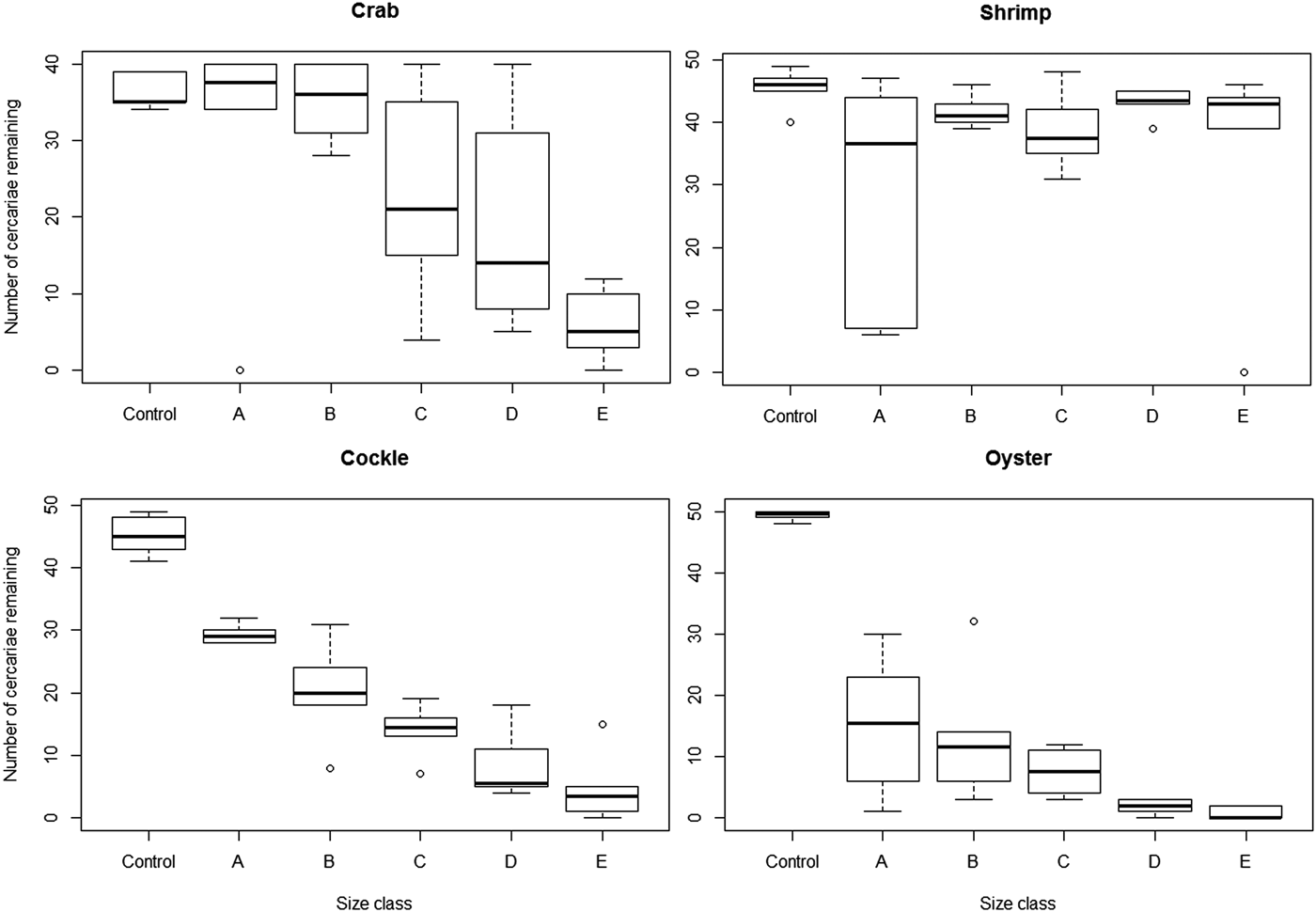
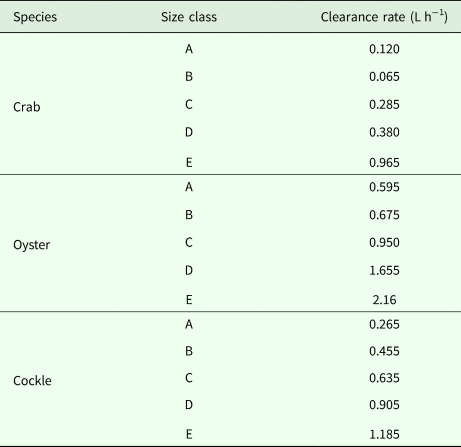
Consumer or host body size significantly affected cercarial removal in crabs, oysters and cockles, but it did not affect removal by shrimps (Fig. 1; Table 2). Similarly, while these three species lead to a significant removal compared with the control, the presence of shrimps had no significant effect on the number of remaining cercariae (Table 2). The removal of cercariae by crabs showed an overall increase with an increase in crab size, i.e. the number of cercariae remaining decreased with an increase in crab size class (Fig. 1). As such, the clearance rate of crabs increased with crab size (Table 3). A similar pattern was seen in the filter-feeding oysters and cockles (the latter also serving as host for the parasite). In both cases the number of cercariae remaining decreased with an increase in shell length (Fig. 1, Table 2), hence the clearance rates increased with an increase in oyster and cockle size (Table 3).
Number of cercariae remaining after 3 h in the presence of consumers (crabs, shrimps, oysters) and hosts (cockles) of different body size categories (A–E) and in absence of any organisms (control). For size classes see Table 1, for raw data see Welsh et al. (Reference Welsh, Hempel, Markovic, van der Meer and Thieltges2018).

Results of the binomial GLMs for the different consumer and host species showing model deviance for model 1 (including consumer or host body size), model 2 (including only presence-absence of consumer or host) and model 3 (only the constant), the dispersion factor (ɸ) and results of significance tests for effects of predator or host body size (model 1 vs. 2) and predator or host presence (model 2 vs. 3) on cercarial removal.

Significance levels: ***: p < 0.001; **: p < 0.01; *: p < 0.05; n.s.: not significant. n = 6 replicates per treatment level in experiments with 5 levels of body size and a control without addition of predators or hosts.
Clearance rates (L h−1) for each consumer or host size category in the three experiments (crabs, oysters, cockles) that showed a significant effect of body size on cercarial removal. Clearance rates were calculated by dividing the instantaneous cercarial removal rates retrieved from the respective model outputs by the volume of the experimental units (2 L).

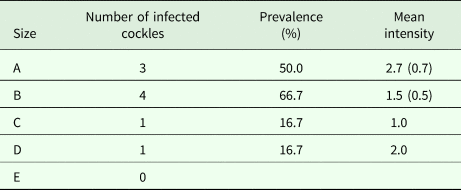
Although cockles are known to serve as intermediate host for Himasthla elongata, overall infection levels were unexpectedly low. Prevalence varied between 16.7 and 66.7% among the cockle size classes but infected cockles harboured, on average, only between 1 and 2.7 metacercarial stages (Table 4), suggesting that the observed cercarial loss in the experimental units only marginally resulted from cercariae infecting the cockles.
Number of infected cockles from a total of 30, prevalence (%) and mean intensity (± s.d.) of cercariae recovered as metacercariae in cockles in each of the five cockle size categories.

Discussion
Our series of experiments revealed that consumer and host body size significantly affected cercarial removal in crabs, oysters and cockles but not in shrimps. In general, cercarial removal rates increased with consumer or host body size.
In the two filter feeders, oysters and cockles, this increase in parasite removal rates with oyster or cockle body size relates to the general feeding ecology of the species. Bivalves constantly filter water via their gills and the filtration rate is a function of gill area which is positively correlated with bivalve body size (Møhlenberg and Riisgård, Reference Møhlenberg and Riisgård1979; Jones et al., Reference Jones, Richards and Souther1992; Gosling, Reference Gosling2003). However, as the filter feeding mesh of the bivalves’ gills is largely independent of body size (Gosling, Reference Gosling2003), prey size selection in bivalve filter feeders is much less affected by organism size compared with predators. Hence, particles that are captured by the filter-feeding mesh of the gills will be filtered at an increasing rate with increasing body size. As cercarial stages of trematodes fall within the size range of particles filtered by bivalves (Gosling, Reference Gosling2003), cercarial removal can also be expected to increase with bivalve body size as observed in our experiments. As the positive relationship between body size and filtration rates are universal in bivalves and possibly also in other filter feeders, measures of filtration capacity such as clearance rates can probably, as long as the size range of the particles captured overlaps with the size of the respective infective stages of parasites, be used as a proxy for the parasite removal capacity of any filter feeding organism. As filtration is often relatively unspecific within the range of particles filtered, a large range of filter feeding organisms such as bivalves may be able to remove infective stages of parasites and may thus play an important role in altering parasite transmission in aquatic ecosystems (Burge et al., Reference Burge, Closek, Friedman, Groner, Jenkins, Shore-Maggio and Welsh2016).
Although both oysters and cockles significantly removed cercariae from the water, the subsequent fate of the removed cercariae is likely to differ between oysters and cockles. In the case of oysters, the uptake of cercariae of Himasthla elongata will not lead to infections as Pacific oysters are not infected with metacercarial stages of the species (Krakau et al., Reference Krakau, Thieltges and Reise2006). The cercarial removal capacity of oysters has previously been recognized and has been shown to lead to reduced infection levels in the parasite's target hosts (Thieltges et al., Reference Thieltges, Reise, Prinz and Jensen2008c). However, when those studies were conducted, the dependency of cercarial removal on oyster body size was, and remained, unknown until now. In contrast to the oysters, common cockles do serve as hosts to metacercarial stages of H. elongata (Thieltges et al., Reference Thieltges, Krakau, Andresen, Fottner and Reise2006; de Montaudouin et al., Reference de Montaudouin, Thieltges, Gam, Krakau, Pina, Bazairi, Dabouineau, Russell-Pinto and Jensen2009). Hence, in this case, the uptake of cercarial stages by cockles via their filtration can lead to infections. As filtration rates increase with body size, larger cockle hosts will be exposed to larger numbers of infective stages and most likely have higher infection levels. While there is some evidence for a positive relationship between cockle size (or age) and metacercarial infection levels in the literature (de Montaudouin et al., Reference de Montaudouin, Wegeberg, Jensen and Sauriau1998; Jensen et al., Reference Jensen, Castro and Bachelet1999; Thieltges, Reference Thieltges2008; but see de Montaudouin et al., Reference de Montaudouin, Binias and Lassalle2012), cercarial removal only lead to very low infections of cockles in our experiment, with a mean intensity of 1–2.7 metacercariae and no relationship with cockle size. This suggests that the uptake of cercariae by cockles does not necessarily lead to infections but that a large number of cercariae may rather be lost in the course of the filtration, possibly by immobilizing cercariae on the cockles’ gills and subsequent digestion. However, the larger infection success reported from previous experiments on cerariae of H. elongata suggests that the effect may vary depending on conditions. Wegeberg et al. (Reference Wegeberg, de Montaudouin and Jensen1999) reported an infection success of H. elongata cercariae of about 60% in cockles ranging from 0.6 to 1.4 cm which is much higher than the 5.4% observed in the smallest size class (1.6 cm) in our experiment. Whether the difference in infection success relates to differences in cockle size classes or ambient conditions (Petri-dishes in Wegeberg et al. (Reference Wegeberg, de Montaudouin and Jensen1999) vs. 1.5 L aquaria in our experiments), remains to be studied.
Like oysters and cockles, crabs also showed a positive relation between body size and cercarial removal but this pattern differed from our expectation. We had assumed that a size match – mismatch would occur in crabs, whereby the infective parasite stages would be too large for smaller crabs and too small for larger crabs to remove. However, cercarial stages were removed by all size classes of crab with larger crabs removing more cercariae than smaller crabs. As the range in crab sizes used in our study not only covered the most common sizes found in our study area but also included very small and very large crabs, it is not expected that a size mismatch has been missed. The observed increase in cercarial removal rates with crab size suggests that cercarial removal is possibly not a result of direct predation by crabs (using their claws) but rather a different mechanism. Various crab species have been shown to use their mouth parts to catch small particles, similar to filter feeding in bivalves (Gerlach et al., Reference Gerlach, Ekstrøm and Eckardt1976; Watts, Reference Watts, Lewis, Goodhead, Beckett, Moger, Tyler and Galloway2014). In addition, small 10 µm polystyrene microspheres have been shown to be taken up by C. maenas crabs and retained by their gills which are normally used only for oxygen uptake and not particle filtration (Watts, Reference Watts, Lewis, Goodhead, Beckett, Moger, Tyler and Galloway2014). It is thus likely, that cercarial removal in shore crabs is based on mechanisms similar to filter feeding in bivalves and indeed we have observed cercariae stained with fluorescent dye in the digestive tract and on the gills of shore crabs (pers. obs.). Such alternative mechanisms of cercarial removal may explain the different findings in other aquatic predators where a negative relationship between predator body size and parasite removal due to prey size mismatches has been observed (e.g. damselfly nymphs, dragonfly larvae, mosquitofish; Orlofkse et al., Reference Orlofske, Jadin and Johnson2015; Catania et al., Reference Catania, Koprivnikar and Mccauley2016). Our findings thus suggest that predator effects on cercarial removal rates may be more diverse and may also include mechanisms such as removal via mouth parts or gills similar to the filter feeding in bivalves and other filter feeders.
In contrast to shore crabs, the second predator investigated, the brown shrimp, did not significantly remove cercariae. This contradicts with previous studies which have reported cercarial removal by brown shrimps (Thieltges et al., Reference Thieltges, Bordalo, Hernández, Prinz and Jensen2008b; Welsh et al., Reference Welsh, van der Meer, Brussaard and Thieltges2014). However, these differences in findings are probably related to differences in the experimental designs used among the studies. Welsh et al. (Reference Welsh, van der Meer, Brussaard and Thieltges2014) used 6 shrimps with a length of 3 cm per replicate and found a significant reduction in the number of cercariae by 93%. In contrast, our study only used a single shrimp per replicate and we observed about 20% fewer cercariae in a comparable size class (3.2–3.5 cm). Although cercarial removal was not statistically significant in this study, the results from Welsh et al. (Reference Welsh, van der Meer, Brussaard and Thieltges2014) suggest that higher densities of shrimps would have probably led to higher removal rates. In a different previous study, brown shrimps of 1.5–2.5 cm length lead to a reduction in infection levels of cockle hosts by 78% (Thieltges et al., Reference Thieltges, Bordalo, Hernández, Prinz and Jensen2008b). However, this study used 10 shrimps per replicate and the observed effect was most likely not only due to cercarial removal by shrimps but also due to interactions of shrimps and cockles leading to disturbances in cockle filtration and subsequently to lower infection levels (Thieltges et al., Reference Thieltges, Bordalo, Hernández, Prinz and Jensen2008b). These comparisons show that brown shrimps have the ability to remove cercariae but only at higher shrimp densities. The absence of an effect of shrimp body size shown in this study may further suggest that cercarial removal may be independent of body size in shrimps in general, again differing from the expectation that there should be a size-dependent match-mismatch as observed in other cercarial predators (Orlofkse et al., Reference Orlofske, Jadin and Johnson2015; Catania et al., Reference Catania, Koprivnikar and Mccauley2016). Hence, the effect of predators on cercarial removal may be less predictable than in filter feeders and probably depends strongly on the mechanisms of cercarial removal in a respective predator.
In conclusion, our study shows that consumer and host body size can significantly affect cercarial removal rates and that removal rates generally increased with the body size of consumers (crabs and oysters) and hosts (cockles). In the case of filter feeders (oysters and cockles), the observed effects probably directly relate to the filter feeding activity and suggest that general measures of filtration capacities, such as clearance rates, may be used as proxies of cercarial removal capabilities. In contrast, size effects on cercarial removal rates by predators were more complex and did not show a consistent size match-mismatch, suggesting cercarial removal rates depend on species-specific mechanisms. Future studies on other host and non-host organisms would be informative to confirm the generality of our findings. In addition, research on other species of cercariae would be useful to investigate the potentially mediating effects of cercarial size and behaviour. Our results indicate that more research into the various mechanisms of cercarial removal is needed to arrive at a comprehensive understanding of the mechanisms underlying parasite removal in communities.
Acknowledgements
We are grateful to Andreas Wasser, Hans Witte and Siem Gieles for their assistance in collecting the organisms used in these experiments. We would also like to thank the two anonymous reviewers for their helpful comments and suggestions.
Financial support
This research received no specific grant from any funding agency, commercial or non-profit sectors.
Conflicts of interest
None
Ethics statement
Not applicable