The term ‘Pasifika’ is commonly used in New Zealand to describe the various ethnic groups who are first generation Pacific or New Zealand-born with Pacific ancestry or heritage (Ministry for Pacific Peoples, 2017). Collectively, Pasifika are the fastest growing ethnic group in New Zealand (Statistics New Zealand, 2013), with one in five New Zealand learners expected to be Pasifika by the year 2050 (Ministry of Education, 2018). While the term may appear to some to suggest homogeneity among Pasifika, unique forms of diasporic Pasifika identities have developed over time (Tupuola, Reference Tupuola2004; Samu, Reference Samu2006; Statistics New Zealand, 2013; Tongati'o et al., Reference Tongati'o, Mitchell, Tuimauga and Kennedy2016). The educational achievement of Pasifika learners has increased over the last decade (New Zealand Qualifications Authority, 2017), however Pasifika achievement lags non-Pasifika. In response, the New Zealand government is prioritising improvement of learning opportunities for Pasifika (Ministry of Education, 2013, 2018). Examples include the Pasifika Education Plan (Ministry of Education, 2013), which, underpinned by a Pasifika values base, conveys expectations in relation to teaching Pasifika learners in culturally responsive ways. Tapasā, a policy implementation document (Ministry of Education, 2018), provides information to support the development of the cultural competencies of non-Pasifika teachers, leaders and boards of trustee members towards better teaching of and in-school support for Pasifika learners.
Described as ‘the exploration and use of patterns and relationships in quantities, space, and time’ (Ministry of Education, 2007, p. 26), mathematics, a key learning area of the New Zealand curriculum, is intended to ‘equip students with effective means for investigating, interpreting, explaining, and making sense of the world in which they live’ (p. 26). The curriculum emphasises that mathematics offers ‘a broad range of practical applications in everyday life, in other learning areas, and in workplaces’ (p. 26), and that mathematics is pertinent within ‘a wide range of social, cultural, scientific, technological, health, environmental, and economic contexts’ (p. 26). Equitable learning opportunities that enable all to engage in and experience success in the mathematics classroom are vital (Anthony and Walshaw, Reference Anthony and Walshaw2007; Hunter and Anthnoy, Reference Hunter and Anthony2011; Ministry of Education, 2007). However, a history of underachievement and disengagement of New Zealand Pasifika learners in mathematics indicates there is work to be done for these ideals to be realised. For example, the Third International Mathematics and Science Study (TIMSS) found that Year 9 Pasifika students generally have lower self-confidence in mathematics and lower mathematical achievement than their European, Māori and Asian peers (Ministry of Education, 2016). Similarly, the Year 11 mathematics attainment of Pasifika learners typically lags that of most other ethnic groups (New Zealand Qualifications Authority, 2017).
Culturally responsive pedagogy draws from the cultural characteristics, experiences and perspectives of students to inform teaching practice towards supporting learning (Gay, Reference Gay2010). Culturally sustaining pedagogy moves beyond being responsive to the cultural experiences and practices of learners, requiring teachers and school leaders to ‘support young people in sustaining the cultural and linguistic competence of their communities while simultaneously offering access to dominant cultural competence’ (Paris, Reference Paris2012, p. 95). Reflecting Pasifika learners' cultural contexts, values, languages and identities, important for engaging and connecting Pasifika students with mathematics (Hunter et al., Reference Hunter, Hunter, Bills, Cheung, Hannant, Kritesh and Lachaiya2016), is consistent with both culturally responsive and culturally sustaining pedagogy.
Some researchers argue that the disparity in academic performance among ethnic groups is attributed to the curriculum favouring the worldviews and values of the dominant (in our case, the New Zealand European) cultural group, and underserving minority groups including Pasifika (Ferguson et al., Reference Ferguson, Gorinski, Wendt Samu and Mara2008). The New Zealand national curriculum (Ministry of Education, 2007) was intended to provide opportunities for schools to create a local curriculum that reflects the lives of students, families and community. The curriculum includes principles to inform such school curriculum decision making and planning, including attention to ‘cultural diversity, inclusion, high expectations, community engagement, and coherence’ (p. 9). Values that ‘should be evident in the school's philosophy, structures, curriculum, classrooms, and relationships’ (Ministry of Education, 2007, p. 10) including diversity, equity, community and participation, respect, innovation, inquiry and curiosity are also described. These curriculum principles and values align well with core values shared among Pasifika; reciprocity, respect, service, inclusion, relationships, spirituality, leadership, love, belonging and family (Ministry of Education, 2013). Strong reflection of these Pasifika values within schools is believed to lead to improved educational achievement opportunities for Pasifika learners (e.g., Ministry of Education, 2013; Edwards and Krishnan, Reference Edwards and Krishnan2016; Si'ilata et al., Reference Si'ilata, Samu, Siteine, McKinley and Smith2018).
Born in Samoa and raised in New Zealand, the first author, Sinapi, is a secondary school mathematics teacher of Samoan descent responsible for her school's Poly group (a group of students who learn and perform Pasifika cultural dances and songs). Sinapi noticed many of her Pasifika students struggle to readily grasp mathematical concepts presented in ways considered traditional for mathematics teaching, disengaging in the learning especially when they felt it challenging. At these times, the students would sing and practise their dances for upcoming events. In Poly group rehearsals she saw these same students come alive, fully engaged in the learning process. Sinapi saw them easily grasp and retain challenging songs, dances and movement from the Samoan, Tongan, Tokelauan, Cook Island and Fijian cultures, with a clear sense of enjoyment, pride and unity when learning and performing. Reflecting on the differences in Pasifika students' engagement and learning between their traditional mathematics classroom learning and Poly group learning, we wanted to find out if dance could be a useful pedagogy for mathematics learning. We set out to explore whether literature suggests that drawing from Pasifika learners' cultural capital, specifically in relation to dance, may have the potential to enhance mathematics engagement and achievement. Hence, the research question guiding the literature review reported in this article was: Can a case be made for using dance as a pedagogy for mathematics learning for Pasifika and other students?
Method
To answer our research question, our purpose was to synthesise available literature related to dance and mathematics learning, interconnecting key ideas from diverse research areas. Hence, a narrative literature review method was chosen (Baumeister and Leary, Reference Baumeister and Leary1997; Green et al., Reference Green, Johnson and Adams2006). Given the limited literature available on dance integration in mathematics and educational research focusing on Pasifika learners, searching outside these areas was necessary. Search strategies drew on expert experience (mathematics education, dance education and cultural expertise) and included systematic database searches. Six electronic databases were searched: Te Waharoa at Victoria University of Wellington, A+ Education, Education Source, ERIC, ProQuest Education and Springerlink—Education & Literature. Google Scholar, ‘snowballing’ (i.e., considering relevant references of identified publications). The search terms included: Pacific Island, Pasifika, Indigenous, marginalised communities, mathematics, secondary school, college, high school, primary, elementary, community sites, theoretical, teaching practices, arts integration, dance integration, alternative methods, equity, culturally responsive, culturally relevant, culturally sustaining, physical activity, outcomes, evidence, health benefits and equitable. Truncations were used to include all related terms and combinations of terms were used to focus and refine the search.
Published and unpublished journal articles, books, book chapters, conference papers, theses and government reports were sought. There was preference for studies that were peer reviewed, included theoretical discussions, literature reviews and empirical research findings on outcomes from any form of dance integration in mathematics, culturally responsive/relevant/sustaining pedagogies in Indigenous/Pasifika community settings and/or for mathematics learning and dance as a physical activity/intervention for improving health and/or wellbeing. Excluded were articles for which full text was not available or was not written in English and publications dated before 2000 or after 2018. Exclusions regarding participants, setting and outcomes were not used as they would have been detrimentally limiting. Search limitations include the possibility that key works were not identified despite the care taken.
Screening of titles and abstracts and analysis of key themes from identified publications (Boland et al., Reference Boland, Cherry and Dickson2017) was generally carried out by the lead author. The studies used comprised those that offered the most substantial research evidence to help answer the research question. The texts used included: government reports (4), curriculum policy documents (2), and research on Pasifika learners in New Zealand (6), arts integration (4), mathematics (9), mathematics pedagogies integrating dance (6), embodied learning (1), movement-based learning (1), multiple benefits of dance on cognitive development, emotional, physical, social, spiritual health and mental wellbeing (7), Indigenous learners (3), Indigenous dance (3), Pasifika dance (4), theories on culturally responsive (2), relevant (1), and sustaining pedagogies (1) and studies on culturally responsive/relevant/sustaining pedagogies for Pasifika learners (11). Analysis involved identifying and refining themes through reading, rereading and discussing findings with mathematics education and cultural experts. Results are presented by theme.
Benefits of dance
Dance, ‘a worldwide human activity that integrates the coordination of intentional body movements, performed in synchronisation with rhythmical stimuli, usually together’ (Murcia et al., Reference Murcia, Kreutz, Clift and Bongard2010, p. 149), is considered one of the most important art forms, one ‘involving direct expression through the use of body movements and expressions’ (Alpert, Reference Alpert2011, p. 155). Dance and mathematics share unifying ideas such as aesthetics, symmetry, pattern and storytelling (Schaffer et al., Reference Schaffer, Stern and Kim2001). Dance is culturally based, and for most cultures including Pasifika, dance cannot be separated from cultural practices, traditions and knowledge (Taylor and Bailey, Reference Taylor and Bailey2011; Taouma, Reference Taouma2014). Most Pasifika cultures place high value on dance as it strengthens bonds within their families, churches and cultural groups, while at the same time ‘retaining their ethnic/cultural specific dance forms and linked to specific song and music forms or cultural events’ (Taouma, Reference Taouma2014, p. 30). Pasifika cultural dances also hold a spiritual dimension. For example, Trinick and Sauni (Reference Trinick, Sauni, Ashley and Lines2016) argue that the Samoan dance sāsā ‘enables Sāmoan children to develop a highly tuned sense of lagona, or faith and intuition’ (p. 55).
Participation in dance has a positive effect on cognitive development (e.g., Giguere, Reference Giguere2011), as it helps to create neural pathways through kinaesthetic, rational, musical and emotional connectivity. Studies exploring physical activity and movement therapy have found that dance can have positive influences on emotional and physical wellbeing (Haskell et al., Reference Haskell, Lee, Pate, Powell, Blair and Franklin2007; Murcia et al., Reference Murcia, Kreutz, Clift and Bongard2010). Cultural dance forms with ‘sociocultural or traditional/ceremonial influences’ (Jain and Brown, Reference Jain and Brown2001, p. 217) engage participants in physical activity designed for a range of purposes including information sharing, celebration and healing. Culturally relevant physical activity programmes to address health disparities in Pasifika communities around New Zealand and the Pacific are increasing in number (Maskarinec et al., Reference Maskarinec, Look, Tolentino, Trask-Batti, Seto, de Silva and Kaholokula2015). These programmes overcome common barriers to exercising, such as lack of enjoyment, motivation and confidence, as activities are largely based on Pasifika values and norms and use Pasifika music and dance with which participants are already familiar and comfortable.
Dancing with others is social. Keeping in time with one another is a fundamental mechanism that can strengthen social bonds between individuals, thus helping create and sustain communities (Murcia et al., Reference Murcia, Kreutz, Clift and Bongard2010). As well as eliciting strong feelings of togetherness and affiliation, dancing is perceived to facilitate sympathy, empathy and understanding towards other people and cultures (Robinson and Aronica, Reference Robinson and Aronica2015). Studies involving Pasifika students within the Poly group describe these Pasifika spaces within schools as important to Pasifika students especially where they are a minority, as such group involvement connects students with their cultures, helps strengthen their social bonds with others and elicits feelings of ‘community’ and a sense of belonging (Fairbairn-Dunlop, Reference Fairbairn-Dunlop, Ward, Liu, Fairbairn-Dunlop and Henderson2010; Rimoni, Reference Rimoni2016; Reynolds, Reference Reynolds2018).
Embodied Pasifika and Indigenous knowledge
Ancient wisdom is shared through Pacific dance (Te Ava & Page, Reference Te Ava and Pagen.d.). Dance, alongside music and storytelling, is used to pass down important cultural information and traditions from generation to generation in many Pasifika and Indigenous cultures (Anderson and Atkinson, Reference Anderson and Atkinson2013). For example, the history of how the Native Hawaiians had resilience and ‘kept strong in the face of adversity’ (Johnson and Beamer, Reference Johnson and Beamer2013, p. 1369) was conveyed through song and dance.
Indigenous dance was forbidden in many Indigenous communities living in colonised countries such as New Zealand, Australia, United States, Canada and Africa, disempowering these groups from sustaining their Indigenous history, language and culture (e.g., Cruz Banks, Reference Cruz Banks2009; Wilson, Reference Wilson, Ashley and Lines2016). Similarly, many Pasifika dances were forbidden by missionaries in the eighteenth century who associated the dances with paganism (Vilisoni, Reference Vilisoni, Sears and Raffel2006). However, many dances in the Pacific survived, as knowledge was passed on ‘in secret until the public arena was safe for the re-emergence of traditional dance’ (Vilisoni, Reference Vilisoni, Sears and Raffel2006, p. 34). Over the last twenty years, contemporary Pasifika and Indigenous dance is being developed and revived in many places, with Pasifika and Indigenous communities creating dances that keep true to traditional practices, as well as dances that fuse traditional with contemporary forms (Taouma, Reference Taouma2014).
That dance constitutes ‘embodied knowledge’ of Pasifika and Indigenous ontology and epistemology, contributes to arguments for ‘deconstructing a Western episteme about the transmission and definitions of knowledge’ (Cruz Banks, Reference Cruz Banks2009, p. 360). The ‘embodied knowledge’ nature of dance also plays out in mathematical thinking and learning (Alibali and Nathan, Reference Alibali and Nathan2012; Matthews, Reference Matthews and Price2015; Siemon, Reference Siemon and Chronaki2017). For example, Matthews (Reference Matthews and Price2015) describes students at an Indigenous mathematics camp working in groups to create a story for a mathematical expression they had been given, a dance to depict their story, and then performing the dance. An Indigenous education worker, (a ‘Song Man’ from the region) helped the students create their dances, with the ‘process of creating a dance from a story and how various movements and sound can create meaning and provoke feelings and emotions pivotal to the story’ (p. 116). The students created stories and dances about ‘hunting kangaroo, about gathering food and about rain drops falling from a cloud’ (p. 116). These contexts, unusual for mathematics learning, were highly relevant to students' lived experiences.
Dance as a culturally responsive and sustaining pedagogy
Asset-based teaching approaches to mathematics are ‘grounded in the belief that students’, families' and communities' ways of knowing, including their language and culture, serve as intellectual resources and contribute greatly to the teaching and learning of high-quality mathematics' (Celedόn-Pattichis et al., Reference Celedόn-Pattichis, Borden, Pape, Clements, Peters, Males, Chapman and Leonard2018, p. 375). Sadly, however, there are few opportunities for Pasifika learners to express and create their own identities in New Zealand classrooms (e.g., Ferguson et al., Reference Ferguson, Gorinski, Wendt Samu and Mara2008; Smith, Reference Smith2016). Particularly in schools with many Pasifika learners, Pasifika cultures need to be ‘viewed by education planners as sources for curriculum content, and as ways for improving and informing teaching’ (Mackley-Crump, Reference Mackley-Crump2011, p. 258). Progress with culturally responsive practices has been made in many schools, such as through teachers pronouncing Pasifika students' names correctly and celebrating cultural days and Pasifika language weeks. However, although such practices are important, teachers must move ‘beyond superficial culturally appropriate tokenistic efforts’ (Siope, Reference Siope2011, p. 11), as these do not necessarily meet the needs of Pasifika learners. Incorporating the arts across the New Zealand curriculum is one ‘way for schools to be culturally responsive and thus accelerate Pasifika student achievement’ (Edwards and Krishnan, Reference Edwards and Krishnan2016, p. 78).
Valuing and reflecting Pasifika students' cultural characteristics (e.g., language, values, tradition, communication and learning preferences) in the classroom can positively impact their identity development and learning (Spiller, Reference Spiller2012; Fa'avae, Reference Fa'avae2017). Integrating Pasifika dance in mathematics can also provide opportunities for appreciating and acknowledging Pasifika and Indigenous families' ‘funds of knowledge’ (Si'ilata et al., Reference Si'ilata, Samu, Siteine, McKinley and Smith2018, p. 26) and strengthening home-school relationships, a key priority in New Zealand for promoting academic Pasifika student achievement (Flavell, Reference Flavell2017; Ministry of Education, 2018).
Looking to New Zealand's Indigenous culture, Kapa haka (a Māori cultural contemporary performing art) is a ‘powerful and dynamic “culturally responsive” learning experience that enhances a level of self-worth, self-belief and confidence among many Māori students who participate’ (Whitinui, Reference Whitinui2010, p. 20). Similarly, Pasifika dance offers an effective culturally responsive pedagogy for Pasifika as it also provides the potential to enhance learners' self-worth, self-belief and confidence. The skills and values behind learning Pasifika dance forms include ‘discipline to the task, focus, and aiming for excellence’ (Fairbairn-Dunlop, Reference Fairbairn-Dunlop, Ward, Liu, Fairbairn-Dunlop and Henderson2010, p. 454), all qualities central to academic success and transferable to the classroom. Using dance as mathematics pedagogy aligns well with the Pasifika values of family, spirituality, respect, leadership, service, inclusion and belonging (Ministry of Education, 2013). For example, for the Pasifika male students in Fairbairn-Dunlop's (Reference Fairbairn-Dunlop, Ward, Liu, Fairbairn-Dunlop and Henderson2010) study, the Poly club ‘provided a safe and trusted space for students to engage in cultural activities and processes; to build a sense of belonging and identity; to gain esteem, support and confidence through shared activities’ (p. 451).
Pasifika dance as a mathematics pedagogy
The benefits of dance integration in mathematics include deepened understanding of mathematics concepts (e.g., Palmer, Reference Palmer2010; Gerofsky, Reference Gerofsky, Hart and Sarhanfi2013), increased levels of enjoyment and engagement (e.g., Rosenfeld, Reference Rosenfeld2011) and strengthened social classroom interactions (e.g., Buranich, Reference Buranich2016). Using dance as a pedagogy can encourage students to ‘come alive’ in the mathematics classroom and see that through dance, mathematics ‘no longer feels static, but living and in motion’ (Gerofsky, Reference Gerofsky, Hart and Sarhanfi2013, p. 343). Both students and teachers can experience an increase in engagement and enjoyment in mathematics through movement-based teaching approaches (e.g. Riley et al., Reference Riley, Lubans, Holmes, Hansen, Gore and Morgan2017). Shaffer and Stern, specialists working in the fields of mathematics and dance, have created many innovative activities exploring the mathematics in whole-body movement and dance for the classroom (Schaffer et al., Reference Schaffer, Stern and Kim2001; Moore and Linder, Reference Moore and Linder2012). Examples of their work include developing number sense through rhythm and combined rhythm using clapping games and exploring symmetries, shapes and geometric concepts through choreography involving hand, arm and body movements.
In this section we discuss one of the most common Samoan dance forms, sāsā. The purpose of most sāsā dances is to tell a story through actions that depict Samoan histories, practices and daily activities. The sāsā is performed in unison, with clarity and commitment, and represents the Samoan value of collectivism. The sāsā, ‘literally means “to strike”’ (Trinick and Sauni, Reference Trinick, Sauni, Ashley and Lines2016, p. 53), is usually performed in a seated position and in large groups of all ages. Although most Pasifika dance forms are gender-specific, the sāsā can be performed by both males and females. The sāsā actions are a combination of traditional and contemporary movements, reflecting the diverse nature of Samoan identities in New Zealand and worldwide. A sāsā is unique and provides opportunities for each group to dance in their own ‘flavour’ and style, ‘exemplifying the dynamic and creative of this art form’ (Trinick and Sauni, Reference Trinick, Sauni, Ashley and Lines2016, p. 4). The sāsā involves:
clapping rhythms with hands and slapping chests, with legs and arms moving in unison and in various combinations…[T]he movements and gestures used in sāsā represent Sāmoan histories, lands and people, and depict actions from everyday life such as slapping off mosquitos, cooking, cleaning house or paddling canoes…[G]athering and preparation of coconuts for the ‘ava ceremony, a solemn Sāmoan ritual where a ceremonial beverage is shared to acknowledge important events such as the bestowal of chiefly titles (Trinick and Sauni, Reference Trinick, Sauni, Ashley and Lines2016, p. 53).
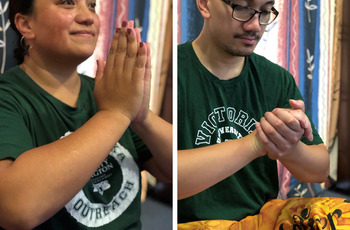
A standard sāsā consists of sequences of actions executed within an eight-beat measure repeated throughout the dance. The dance is accompanied by the pātē (Samoan percussion drum), fala (rolled-up mat) or an empty biscuit tin. A pati (clap) and a pō (hollow clap from cupped hands) (figure 1) before and after each sequence helps indicate the transition between consecutive sequences. When learning the sāsā, each sequence is broken down into parts and taught at a slow pace, the actions repeated over and over, until all performers are comfortable to move onto the next sequence. This process is repeated for each sequence. Commonly each new sequence is combined with previous sequences, and the sāsā is practised from the beginning up to the section being taught. This process is repeated until the whole sāsā is memorised completely and can be performed at the correct tempo. Strategies to assist learning the sāsā include breaking into smaller groups with faster learners or experts leading the group practices, and practising while watching a slow-motion video recording. Each individual is also responsible for practising in between group practices. Input from Pasifika students' parents and family can be sought when choreographing the sāsā. Another approach is for small groups to make up a sequence of actions, for example, to represent aspects of their lives, then to put all sections together to create a whole class sāsā.
Pati (clap) and Pō (hollow clap from cupped hands).

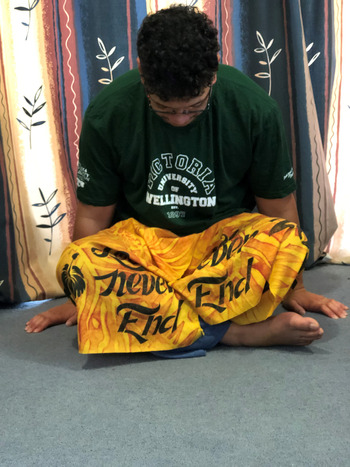
Embedded in sāsā are rhythmic and geometric patterns that together make the sāsā effective and entertaining. These patterns can be shown or taught to students and observed, explored, discussed and described mathematically. For example, algebraic patterns and sequences can be watched and listened for in hand clapping and floor hitting rhythms and actions (figure 2), in knee actions (lue) and in drum beats. Rhythmic sāsā patterns can range from simple sequences (e.g., clap, clap, clap, clap—repeated in groups of four) to very fast sophisticated sequences of drumbeats incorporating regular, irregular and syncopated rhythms. Simple repeating patterns from sāsā can be used to introduce or reinforce numerical strategies and knowledge such as repeated addition, skip counting and multiples (Ministry of Education, 2008), while students can be encouraged to break down and slow down more sophisticated patterns into their component parts to describe or recreate them algebraically.
Floor hitting.

Rotation is a key feature of many sāsā. Movements using rotation in sāsā can require turning the whole body at certain angles, either while seated or standing, and turns created with different parts of the body (e.g., neck, shoulders, elbows and hands). Rotation in the dance moves can be observed, explored and discussed in relation to the centre, angle and axis of rotation, depending on the curriculum level relevant to the learners.
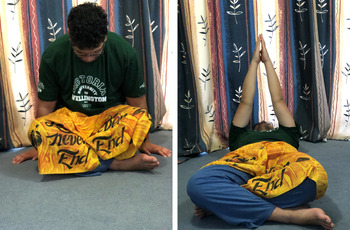
Ideas associated with reflection and symmetry are also strongly present in the sāsā. Many movements are mirrored across the body with a vertical axis of symmetry, such as when sitting cross legged, dipping knees, or clapping in front of one's chest or above one's head (figure 3). In other moves, actions are mirrored between pairs of performers, or by rows of performers, or between entire sections of the group. Discussion about the moves can include identifying the location of axes of symmetry, with rationale, predicting and designing movements that will create symmetry in the dance, discussing the reflection features as specifically as possible (e.g., by measuring and stating distances between people or parts of the body).
Symmetry across the body.

The geometric transformation of translation can also be identified in sāsā. When in unison, each performer can represent a translation of the others, with distances and directions of the ‘translation’ able to be planned and discussed. Translation across time can also be present, such as when the group performs in canons (commonly known as ‘dominos’). For these moves, the same movements are executed at different times by different rows, columns or sections of the group.
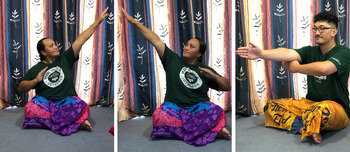
Further mathematical ideas that could be explored using sāsā include discussing geometrical properties and angles made when arm movements make parallel lines, right-angles and 45-degree angles to the body (figure 4), rates (e.g., how many claps per second or movements per minute for sāsā of different speeds) and measurement (e.g., estimating the total distance moved through the whole dance for the whole body or a part of the body such as a hand or knee, or how many hours it would take to learn and memorise a two-minute sāsā). How performers can be spaced out across performance stages of specific dimensions to accommodate all of the moves of a sāsā could also make for an engaging problem solving task. To support algebraic thinking and written mathematical communication skills, students could be encouraged to create a notation for writing down instructions for their dance and to share and explain their written sāsā descriptions with others.
Parallel and perpendicular lines.

Turning to ways sāsā could be used to help students develop, explore and describe mathematical ideas such as these students could be invited to share sections or entire sāsā they already know. If no students already know a sāsā, You-tube clips of sāsā could provide useful sources of sāsā dances. Pausing the dance and reviewing selected sections could be used to highlight, support understanding of and describe identified mathematical features, ensuring all students are confident they can see and describe the focus mathematical feature to the degree of sophistication expected of the curriculum. Mathematical properties can also be introduced and discussed in relation to the sāsā moves. For example, variant and invariant features can be explored and explained in relation to the geometrical transformations in the dance. In groups, students could design their own short sāsā that incorporates the focus mathematical ideas to practise and perform for the class. For each performance, observers would together identify and describe the mathematical features included. Demonstrating their sāsā and describing the mathematical features within it would provide an engaging activity for students to share their learning with others at home. Using the sāsā as a mathematics learning experience can also help ensure classroom learning both reflects real life experiences and develops key curriculum competencies such as ‘relating to others’ and ‘participating and contributing’ (Ministry of Education, 2007, pp. 12, 13).
The sāsā is but one Pasifika dance enabling mathematics investigation and discussion. Further Pasifika dance examples with rich opportunities for exploring mathematical concepts include the Tokelauan fatele and the Cook Island ura. The fatele dance is carried out by groups performing in lines using singing or chanting and hand movements including patting the body. Fatele comprises a repeated set of movements and words, with each repetition carried out with knees bent slightly more and with the movements slightly faster and at a higher pitch than the previous repeats. Comparing the pace of each repetition in the fatele provides opportunities to examine and discuss rates. Reflection can also be discussed in relation to the fatele, as movements made to one side of the body are then repeated in mirror image, to the other side of the body.
The ura is accompanied by rhythmic drumming and includes knee, hip and hand movements carried out with a variety of speeds. Again, mathematical ideas relating to counting, rates and algebraic and geometric patterns can be discussed in relation to movements in this dance. Comparing drumbeats associated with Samoan, Tokelauan and Cook Island dances could also be used to explore concepts of counting, time, tempo and multiples. Involving students in planning for and implementing using dance for mathematical learning, and in assessment of their learning through these experiences, could help to gauge the effectiveness of the learning experiences for enhancing mathematical understanding, learner motivation and engagement.
Considerations
There are important considerations for educators contemplating using Pasifika dance as a pedagogy. Some Indigenous dance forms are sacred to their communities, are to be explained with much respect and are not to be replicated (Anderson and Atkinson, Reference Anderson and Atkinson2013). Knowledge of which dances can and cannot be used with cultural safely is vital. Using Pasifika dance in teaching must also be carried out in ways that maintain the cultural integrity of the dances and reflect Pasifika values. As for all Pasifika dances, the ‘sāsā requires appropriate pedagogical content and cultural knowledge’ (Trinick and Sauni, Reference Trinick, Sauni, Ashley and Lines2016, p. 59). These aspects of the sāsā and other dances need to be considered by learners alongside the mathematics inherent in the dance, providing rich opportunities for dance specialists from the Pasifika community to work collaboratively in schools.
Pasifika learners are not homogenous, and it is important not to make assumptions that all Pasifika learners are familiar with Pasifika dance or are willing participants. Indeed, some Pasifika learners ‘learn not to draw attention to themselves at school’ and ‘live in “siloed” worlds in which their school, family and church lives are kept separate’ (Siope, Reference Siope2011, p. 10). Implementing Pasifika dance could pose challenges for such learners.
Important in employing cultural activities to help develop mathematical learning is ensuring the integrity of the activity being explored mathematically is not lost (Trinick et al., Reference Trinick, Meaney and Fairhall2016). Suitable considerations for integrating cultural dances into mathematics learning experiences include drawing from Pasifika funds of knowledge, such as through involving parents and other family members in planning and implementation, and incorporating instructions and practices traditionally used for the dances. For example, common calls to action in sāsā, tulolo (head down) and nofo (sit up) can be incorporated, and each dance is best managed with a fa'aluma (caller) who knows the sequence best and leads the performance using creative personality and skill.
A fear of change or losing control in the classroom and potentially being unsuccessful in front of students could be barriers for mathematics teachers implementing dance as a pedagogy. Limited classroom time and a crowded curriculum can also be barriers to implementing new teaching strategies which can take considerable time to plan for, implement and refine (e.g., Riley et al., Reference Riley, Lubans, Holmes, Hansen, Gore and Morgan2017).
Conclusions
Improving educational outcomes for Pasifika learners has been a priority in New Zealand for many years. It is evident that current teaching methods are not serving all students well. All mathematics teachers have responsibilities to create equitable learning programmes. Our study has shown that a case can be made for exploring dance as a suitable culturally responsive and sustaining pedagogy for mathematics learning for Pasifika and other students. Dance provides opportunities to draw from the cultural capital and funds of knowledge of Pasifika learners, their families and members of the community. Pasifika dance has the potential to be useful for teaching mathematical concepts such as geometry, symmetry, shapes, angles, fractions and number patterns through choreography and movement. Using dance as a pedagogy has the potential to nurture students' emotional, physical, social and spiritual wellbeing and to connect Pasifika traditions and knowledge with mathematics learning. Integrating dance with mathematics learning can help to create an effective learning environment aligned with the Pasifika values of family, spirituality, respect, leadership, service, inclusion and belonging (Ministry of Education, 2013). Given the central place of dance in Pasifika cultures, it seems logical that dance could be placed more centrally in the mathematics classroom to teach mathematical concepts creatively, particularly with Pasifika students.
Poly club is an integral part to the school lives of many Pasifika students in which their Pasifika identities are reinforced and developed. This review indicates the potential for Pasifika learners, through dance, to be exposed to Pasifika and mathematical abstractions and symbolism in ways relevant to them. Incorporating Pasifika dance in mathematics teaching and learning can enable opportunities for Pasifika learners to utilise the knowledge, expertise and passion they may have for it while enhancing for them the relevance and enjoyment of mathematics learning.
This review indicates that research into the effects of using dance as a mathematics pedagogy on affect, engagement, achievement and wellbeing, and as a pedagogy in curriculum areas other than mathematics would be valuable and timely. Such research can help ensure student, teacher and family perspectives can inform the development and implementation of mathematics pedagogies. In keeping with the Samoan proverb ‘tu'utu'u le upega i le loloto’ (cast the net into deeper waters), we call for educators to ‘cast their nets further’ and rethink their pedagogical practice in substantial ways. It is timely and vital to rethink how all aspects of the education system, curriculum, pedagogical approaches and learning settings, can better suit Pasifika and all learners. There is much evidence to indicate that incorporating cultural activities such as dance into learning programmes not only contributes to sustaining important cultural practices, knowledge and values, but can also help enhance equity, pleasure and wellbeing in learning opportunities in culturally authentic ways. Siva mai! Let's dance!
Acknowledgements
None.
Financial support
The research reported in this article received no specific grant from any funding agency, commercial, or not-for-profit sectors.
Conflicts of interest
None.
Sinapi Taeao is a mathematics, religious studies and japanese teacher of Samoan descent. She has a passion for improving educational outcomes for Pasifika learners, particularly in mathematics. Sinapi has recently completed her master's degree on a TeachNZ study award at Victoria University of Wellington.
Robin Averill is an Associate Professor at Victoria University of Wellington, Te Whare Wānanga o te Ūpoko o te Ika a Māui. Robin's research focusses on ways to improve equity of access to mathematics achievement particularly for Māori and Pasifika students.