I. INTRODUCTION
High density inorganic scintillator is very important in many fields such as high energy physics and nuclear medical imaging. Although some heavy scintillators such as PbWO4, Bi4Ge3O12 (BGO), Ce:Lu2SiO5 (Ce:LSO), and Ce:LuAlO3 (Ce:LuAP) with density values of 8.28, 7.13, 7.35, and 6.69 g/cm3, respectively, have been used in practice, the scintillators with higher density and better performance are still desired. Reference Pontes, Maurera, Souza, Longo, Leite, Magnani, Machado, Pizani and Varela1–Reference Lempicki and Glodo3 Recently there are many reports about the luminescence properties of rare earth tantalates. Reference Yang, Peng, Zhang, Shi, Guo, Wei, Sun, Wang, Dou, Xing and Zhang4–Reference Peng, Zhang, Shi, Guo, Zhao, Yang, Sun, Luo and Liu6 Among these rare earth tantalates, gadolinium orthotantalate (GdTaO4) and lutetium orthotantalate (LuTaO4) have been proved to be promising hosts for efficient luminescent materials. LuTaO4 is an efficient luminescence host material, especially if excitation occurs by ionizing radiation. Reference Blasse, Dirksen, Brixner and Crawford7 LuTaO4 also has outstandingly high density (9.81 g/cm3), and is far higher than those of the above-mentioned scintillators. Reference Forbes, Nyman, Rodriguez and Navrotsky8,Reference Liu, Zhang, Ding, Sun, Luo and Yin9 It has been reported that the structures of LuTaO4 have two crystallographic structures Reference Tsunekawa, Yamauchi, Sasaki, Yamaguchi and Fukuda10,Reference Silva, Tirao, Cusatis and Andreeta11 : one is high-temperature phase with space group I2/a which is named M-type and the other is low-temperature phase with space group P2/a and named M′-type. Both of the structures could be considered as monoclinic distortion of scheelite structure and their main difference lies in the coordination of Ta atom. In M-type structure, the Ta atoms are located as a tetrahedron, while in M′-type, the Ta atoms exist in a distorted octahedron.
Nd-doped and Yb-doped GdTaO4 single crystals have been grown successfully with Czochralski method by our group, Reference Yang, Peng, Zhang, Shi, Guo, Wei, Sun, Wang, Dou, Xing and Zhang4,Reference Liu, Zhang, Ding, Sun, Luo and Yin9 but it is very difficult to grow the single crystal LuTaO4, of which the density is the highest in rare earth orthotantalates. Furthermore, the site symmetry of Nd3+ is C 2 and very low, which is advantageous to relax the parity-forbidden rule and improve its photoluminescence efficiency. So, 5 at.% Nd3+:LuTaO4 polycrystalline is synthesized, and its spectral property and crystal-field are also studied to evaluate its application future in this work.
The crystal-field model has been widely and successfully applied in parameterization for the energy levels of the 4f configuration in various crystal structures. In past years, many of the energy-level structures on Nd3+-doped in crystal hosts were analyzed in terms of parametric model Hamiltonian that consists of coulombic, spin–orbit, crystal-field interaction, and so on by many researchers. The rare-earth compounds of crystal-field parameters and the multiple correlated fitting techniques were reported by G.W. Burdick and C. Rudowicz et al. Reference Burdick, Jayasankar, Richardson and Reid12,Reference Rudowicz, Chua and Reid13 The energy levels and crystal-field analysis of Nd3+:GYSGG and Er3+:GSGG were reported by J.Y. Gao et al. Reference Gao, Zhang, Sun, Luo, Liu and Yin14,Reference Gao, Sun, Zhang, Wang, Liu, Luo, Sun and Yin15 Also, the fluorescence lifetime of Nd3+:LuTaO4 at 418.5 nm emission was about 263.2 ns, which may render it a promising inorganic scintillation material with high density and short lifetime. Reference Zhao, Zhang, Guo, Shi, Peng, Yang, Sun, Luo and Liu16
Moreover, the energy levels and crystal-field calculations could help us to calculate the absorption cross-sections associated with optical transitions between the ground and various excited states, and also branch ratios observed in optical emission from one or several excited multiplet levels. Also, the energy levels transition of Nd doped LuTaO4 from spectra determined in Refs. Reference Peng, Zhang, Shi, Guo, Zhao, Yang, Sun, Luo and Liu6 and Reference Zhao, Zhang, Guo, Shi, Peng, Yang, Sun, Luo and Liu16 is too little. Thus, the study of the spectral analysis, energy levels fitting, and crystal-field calculations on Nd3+:LuTaO4 is of great significance.
II. MODEL
The complex energy level scheme of the Nd3+ ion in the crystal results from several interactions—both within the 4f 3 electron configuration and between the Nd3+ ion and its environment. The parametric model Hamiltonian used in this study can be written as
 $$\hat H = {\hat H_{\rm{A}}} + {\hat H_{{\rm{CF}}}}\quad ,$$
where
 ${\hat H_{\rm{A}}}$
denotes the atomic Hamiltonian and
 ${\hat H_{{\rm{CF}}}}$
denotes the crystal-field interaction Hamiltonian. The
 ${\hat H_{\rm{A}}}$
operator can be written as
 $${\hat H_{\rm{A}}} = {E_{{\rm{avg}}}} + \sum\limits_{k = 2,4,6} {{F^k}{{\hat f}_k} + \xi {{\hat A}_{{\rm{SO}}}} + \alpha \hat L\left( {\hat L + 1} \right) + \beta \hat G\left( {{G_2}} \right) + \gamma \hat G\left( {{R_7}} \right)} + \sum\limits_{i = 2,3,4,6,7,8} {{T^i}{{\hat t}_i}} + \sum\limits_{j = 0,2,4} {{M^j}{{\hat m}_j}} + \sum\limits_{k = 2,4,6} {{P^k}{{\hat p}_k}} \quad .$$
In this expression, the parameter E avg is the spherically symmetric one-electron part of the Hamiltonian, the electrostatic interaction is described with the Slater integrals F k f k (k = 2, 4, and 6), where F k and f k are the radial part and the angular part, respectively; ξ and A SO are the radial part and the angular part of spin–orbit interaction, respectively; α, β, and γ are two-body electrostatic parameters, G(G 2) and G(R 7) are Casimir operators for the G 2 and R 7 groups, and L is the total orbital angular-momentum, T i t i (i = 2, 3, 4, 6, 7, and 8) describes the three-body configuration interactions, where T i is a parameter and t i is an operator; higher-order magnetic spin–spin and spin-other-orbit interactions as well as the electrostatically correlated spin–orbit interactions can be represented by Marvin integrals M j (j = 0, 2, and 4) and P k (k = 2, 4, and 6), and the operators associated with these parameters are designated by m j and p k , respectively. The parameters obey the ratios M 2 = 0.56M 0, M 4 = 0.38M 0 and P 4 = 0.75P 2, P 6 = 0.5P 2. Reference Christiane, Koen, Gschneidner and Eyring17
The
 ${\hat H_{{\rm{CF}}}}$
can be expressed as
 $${\hat H_{CF}} = \sum\limits_{k,q} {B_q^kC_q^{\left( k \right)}} \;\left( {k = 2,4,6{\rm{\ and\ }}q = - k \,\,\le\,\, q\,\, \le\,\, k} \right)\quad ,$$
where
 $B_q^k$
are the crystal-field parameters and
 $C_q^{\left( k \right)}$
is a angular part spherical tensor operator.
Reference Christiane, Koen, Gschneidner and Eyring17
For the C
2 symmetry of Nd3+ doped in LuTaO4, it has the following nonvanished crystal-field parameters:
 $B_0^2$
,
 $B_2^2$
,
 $B_0^4$
,
 $B_2^4$
,
 $B_4^4$
,
 $B_0^6$
,
 $B_2^6$
,
 $B_4^6$
,
 $B_6^6$
, where
 $B_0^2$
,
 $B_2^2$
,
 $B_0^4$
,
 $B_0^6$
are real and
 $B_2^4$
,
 $B_4^4$
,
 $B_2^6$
,
 $B_4^6$
,
 $B_6^6$
are complex. Thus, the crystal-field Hamiltonian is expressed as follows:
 $${\hat H_{{\rm{CF}}}}\left( {{C_2}} \right) = \sum\limits_k {B_0^kC_0^k} + \sum\limits_{k,q > 0} {\left[ {{\mathop{\rm Re}\,\nolimits} B_q^k\left( {C_q^k + C_{ - q}^k} \right) + {{i}}\,{\mathop{\rm Im}\,\nolimits} B_q^k\left( {C_q^k - C_{ - q}^k} \right)} \right]}$$
with k = 2, 4, 6, and q ≤ k. Reference Loro, Vasquez, Camarillo G., del Castillo, Camarillo, Munoz, Flores J., Hernandez A. and Murrieta S.18
The crystal-field parameters are calculated from experimentally determined crystal-field split energy levels. And the iterative method is least-square fitting procedure. Reference Newman and Betty19
The parameter set is optimized in a general least-squares fitting by minimizing the squares of the differences between the experimental and calculated energy levels. The root mean square deviation (σ) is used as a figure of merit to describe the quality of the fit, and it is given as Reference Christiane, Koen, Gschneidner and Eyring17 :
 $$\sigma = {\left( {{{\sum {{{\left( {{E_{\exp }} - {E_{{\rm{calc}}}}} \right)}^2}} } \over {N - P}}} \right)^{{1 \mathord{\left/ {\vphantom {1 2}} \right. \kern-\nulldelimiterspace} 2}}}\quad ,$$
where E exp and E calc are the experimental and calculated energy levels, respectively. N is the number of experimental energy levels, and P is the number of variable parameters. The σ is reduced to a value as small as possible. If σ is less than 20 cm−1, it is believed that the parameter set can give a good description of the system.
Once the crystal-field parameters are obtained, we can estimate the crystal-field strength N ν as defined by Auzel and Malta for the garnet structure hosts as follows Reference Auzel and Malta20 :
 $${N_{\rm{v}}} = {\left( {\sum\limits_{k,q} {{{4\pi } \over {2k + 1}}{{\left| {B_q^k} \right|}^2}} } \right)^{{1 \mathord{\left/ {\vphantom {1 2}} \right. \kern-\nulldelimiterspace} 2}}}\quad ,$$
where the values of N ν are calculated from the two sets of crystal-field parameters, which are defined in terms of the length rather than the rotational invariants of the crystal-field parameters vector in the spherical harmonics space, allowing a direct comparison of the crystal-field strength in any type of symmetry.
III. RESULTS AND DISCUSSION
A. Structure and spectral analysis
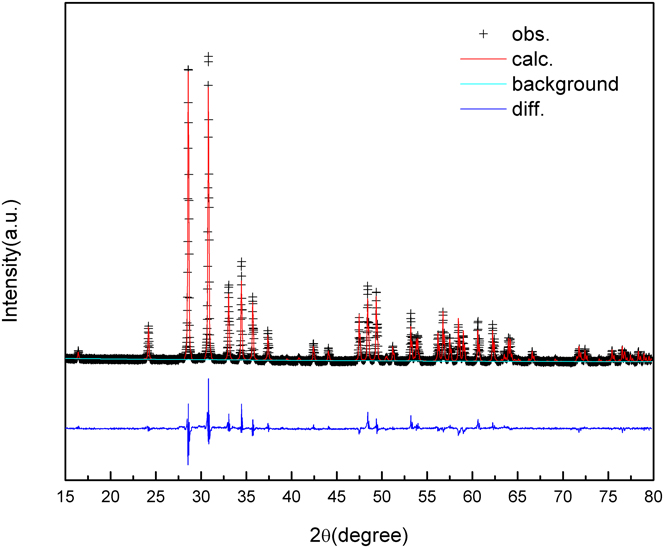
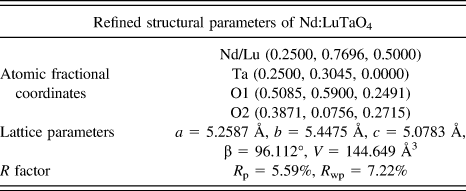
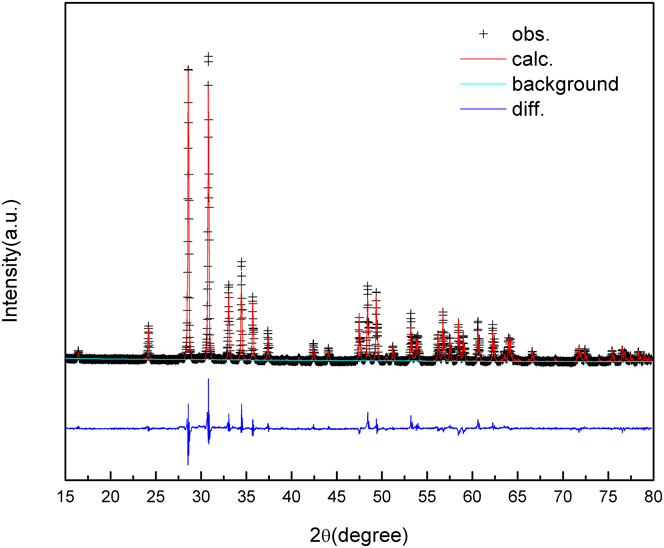
The 5 at.% Nd3+:LuTaO4 polycrystalline has been synthesized by using the high temperature solid-state reaction method, and the starting materials were Lu2O3, Ta2O5, and Nd2O3 with a purity of 99.99%. Reference Zhao, Zhang, Guo, Shi, Peng, Yang, Sun, Luo and Liu16 The power x-ray diffraction (XRD) was carried out by a Philips X'pert PRO diffractometer (FEI Company, Amsterdam, The Netherlands) with Cu Kα radiation (λ = 0.15406 nm) operated at 40 kV and 40 mA at room temperature. A scan step of 0.02° was applied to record the patterns in the 2θ range 15–80°. The structure of 5 at.% Nd3+:LuTaO4 was refined by general structure analysis system according to their XRD. Using the structure data of GdTaO4 [the inorganic crystal structure database, cards #24–1263] as initial values, we refine thirty-two parameters including profile parameters, atom coordinates, temperature, background curve parameters, and so on. Reference Rietveld21 The refined results of 5 at.% Nd3+:LuTaO4 are shown in Fig. 1. The residuals R p and R wp are 5.59% and 7.22%, which are very small, indicating that the observed and calculated XRD patterns are consistent very well. The fitting structural parameters by Rietveld refinement are listed in Table I.
Rietveld refinement of the powder XRD profile of 5 at.% Nd:LuTaO4. The observed data, calculated data, background, and difference profiles are displayed.
Structural parameters of Nd3+:LuTaO4, which were obtained by Rietveld refinement to their x-ray powder diffraction.

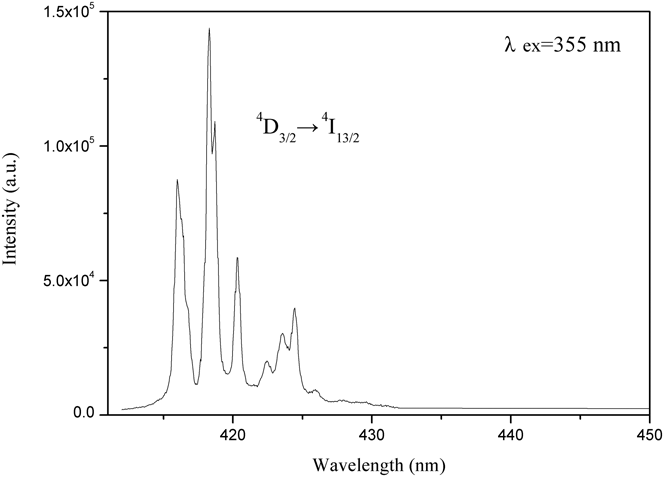
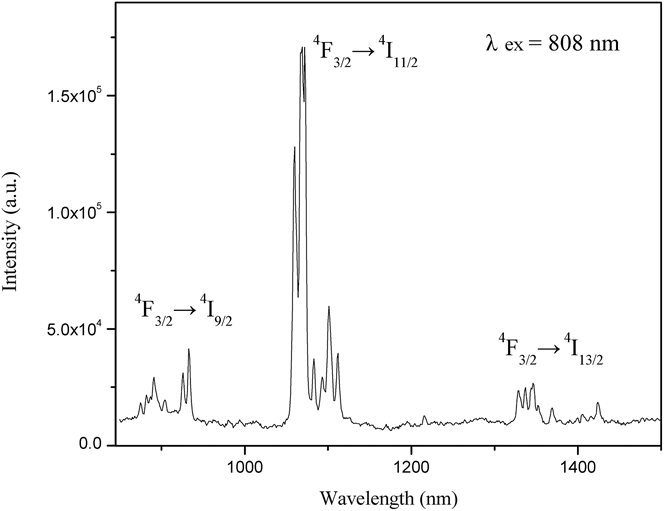
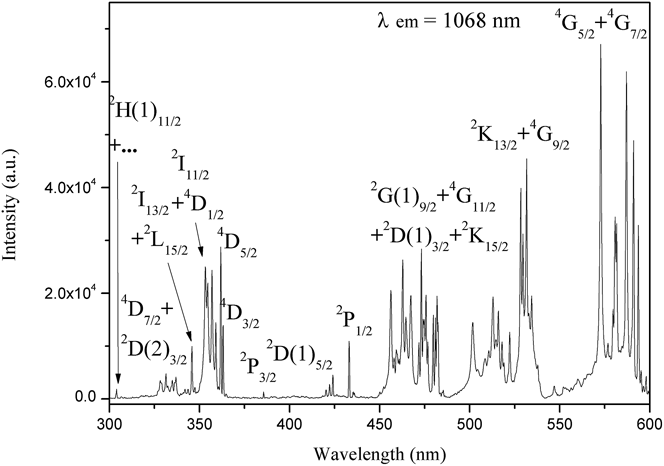
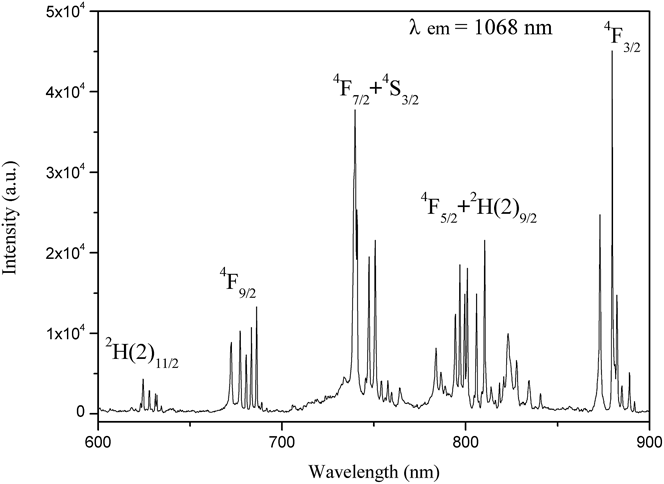
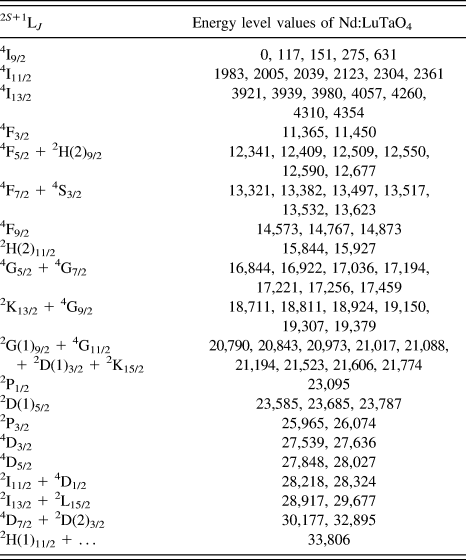
The emission spectra at 7.6 K of Nd3+:LuTaO4 were measured under the excitation wave lengths of 355 nm and 808 nm, respectively. And the excitation spectrum at 7.6 K was measured under the emission wave length of 1068 nm. The excitation and emission spectra were measured using JY Fluorolog-3-Tou spectrometer (Horiba Scientific, Edinburgh, Scotland). The characteristic emission bands under 355 nm excitation (shown as Fig. 2) are ascribed to the transitions from 4D3/2 to 4I13/2, and the characteristic emission bands under 808 nm excitation (shown as Fig. 3) are ascribed to the transitions from 4F3/2 to 4I J (J = 9/2, 11/2, and 13/2) of Nd3+, of which the emission peak at 1068 nm of 4F3/2 → 4I11/2 transition is the strongest one. Therefore, the excitation spectrum was measured with monitor wave length at 1068 nm, which are shown in Fig. 4 (wave length range of 300–600 nm) and Fig. 5 (wave length range of 600–900 nm), and the 14 spectral bands correspond to transitions of 4I9/2 → 2I13/2 + 2L17/2 + …, 2I11/2 + 2L15/2, 2P3/2 + 4D3/2, 2D(1)5/2, 2P1/2, 2G(1)9/2 + 4G11/2 + 2D(1)3/2 + 2K15/2, 2K13/2 + 4G9/2, 4G7/2, 4G5/2 + 2G7/2, 2H(2)11/2, 4F9/2, 4S3/2 + 4F7/2, 4F5/2 + 2H(2)9/2, and 4F3/2 of Nd3+, respectively.
The emission spectrum of Nd:LuTaO4 (λex = 355 nm).

The emission spectrum of Nd:LuTaO4 (λex = 808 nm).

The excitation spectrum of Nd:LuTaO4 with wave length range of 300–600 nm (λem = 1068 nm).

The excitation spectrum of Nd:LuTaO4 with wave length range of 600–900 nm (λem = 1068 nm).

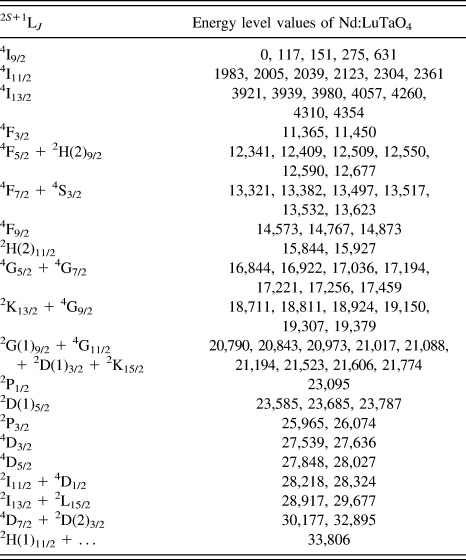
Based on the above consideration, the spectra allow us to discern 152 energy levels from among the 364 Stark energy levels of the 4f 3 (Nd3+) configuration, which are listed in Table II.
Experimental energy level values of Nd:LuTaO4 from spectral analysis.
B. Energy levels fitting
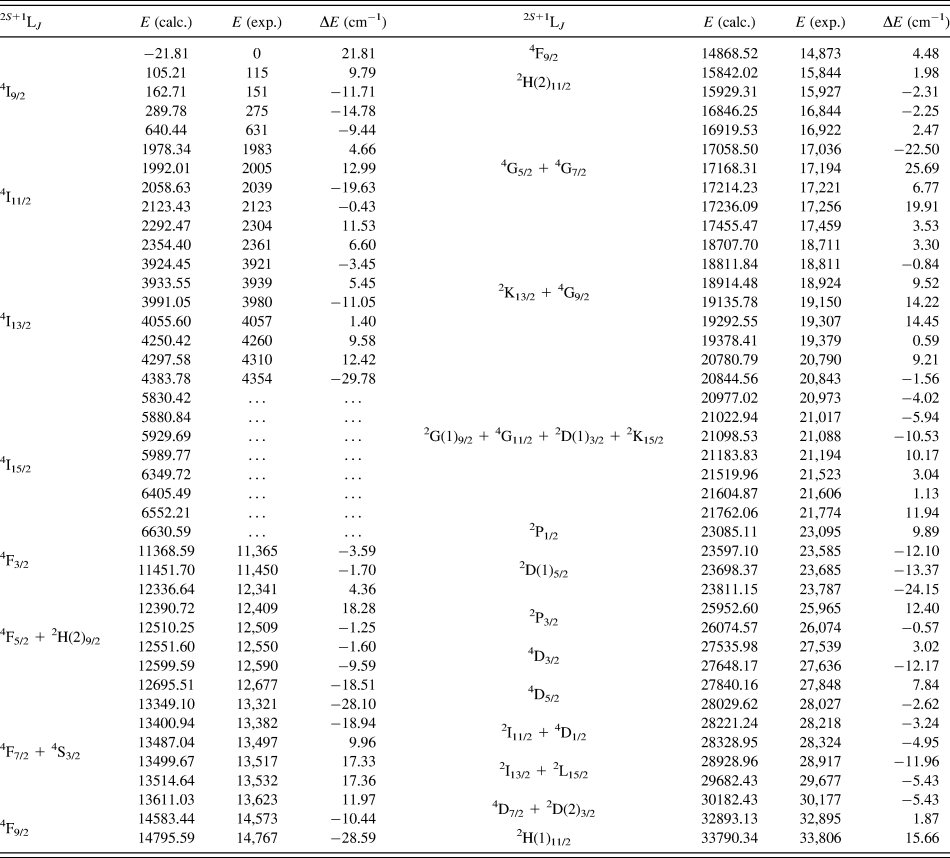
The experimental energy level values of Nd3+ are obtained from the previous spectroscopic analysis. Then, the crystal-field and free-ion parameters from Ref. Reference Gao, Zhang, Yang, Zhou, Sun, Yin and He22 are used as the initial values to fit the experimental energy levels of Nd3+ in LuTaO4 with the f-shell fitting program. The calculated results, experiment results, and their difference are shown in Table III.
Crystal-field energy levels fitting of Nd:LuTaO4.

From Table III, most of calculated levels are consistent with experimental energy levels very well. Among the 152 experimental energy levels, there are four Stark levels (4354, 13,321, 14,767, and 17,194 cm−1) with poor fitting quality with deviations of −29.78, −28.10, −28.59, and 25.69 cm−1, respectively. The deviation of calculated energy levels and experimental energy levels are less than 30 cm−1, which indicates that the energy levels fitting results are satisfactory.
C. Crystal-field analysis
The experimental energy levels of Nd3+ give a basic set for a reliable energy level simulation. A model with 25 parameters including 16 free-ion and 9 crystal-field parameters is used for Nd3+ in LuTaO4, with the root mean square deviation (σ) of 14.6 cm−1. In the simulation process, 10 free-ion parameters were treated as independent fitting variables among the 16 parameters. These 10 free-ion parameters were E avg, F 2, F 4, F 6, ξ, α, β, γ, M 0, and P 2, and other 6 three-body interaction parameters (T 2, T 3, T 4, T 6, T 7, and T 8) could set to fixed values. By crystal-field calculated, the 152 crystal-field energy levels of Nd3+ are assigned, which included 15 J multiplets and 7 LS terms for Nd in LuTaO4.
The free-ion and crystal-field parameters of Nd3+ in LuTaO4 and YAlO3 hosts are shown in Table IV. The parameters of Nd3+:YAlO3 are cited from Ref. Reference Duan, Tanner, Makhov and Kirm23.
Comparisons between Hamiltonian parameters of Nd doped in LuTaO4 and YAlO3.

The values of free-ion parameters of Nd3+ in LuTaO4 are similar to those in YAlO3 hosts. However, the electrostatic interaction between two 4f electrons of Nd3+:LuTaO4 is stronger than that of Nd3+:YAlO3, because of the more delocalized electrons and decreased Slater integrals. With the Slater integrals decreasing, the individual 2S+1L J state will be lowered, so the energy positions of 2P1/2 are 23,095 and 23,164 cm−1 for Nd3+ in LuTaO4 and YAlO3 hosts, respectively. The spin–orbit interaction varies slightly for these two hosts whereas the other free-ion parameters show no clear trend. This is because Nd3+ ion occupies the 4e site of Lu with C 2 point symmetry, and each of the ion in LuTaO4 is octahedrally coordinated with six O2− ions, forming a distorted square antiprism. Whereas Nd3+ ion occupies the 4c site of Y with C S point symmetry, and each of the ion is dodecahedrally coordinated to eight O2− ions in YAlO3. Also the values of two-body electrostatic parameter γ are −1694 and 1690 of two hosts, respectively. There might be two reasons for the negative of parameter γ of Nd:LuTaO4. One reason may be that rare earth is weightiness element whose inner orbit has many electrons and relativistic effect is very strong. The other reason may be that the configuration interaction would be influenced by the Nd:LuTaO4 host which has system N 4f electrons of Lu and Ta, because the group R 7 is used to describe the states of 4f configuration.
The value of crystal-field parameters are affected by the distances, bonding angles, and the nature of ligands. Reference Christiane, Koen, Gschneidner and Eyring17 The 4-rank and 6-rank crystal-field parameters are related only to the ions of the nearest neighbor rather than the ions of next nearest neighbor and further, while 2-rank are related not only to the ions of the nearest neighbor but also the ions of next nearest neighbor and further. In Table IV, 4-rank and 6-rank crystal-field parameters of Nd3+:LuTaO4 and Nd3+:YAlO3 have been close to each other, but other crystal-field parameters have relatively large differences. This is because the interaction between 4f electrons of Nd3+ and Ta5+, Lu3+ surrounding Nd3+ are strong in LuTaO4. It is indicated that the charge interpenetration and coulomb exchange of Nd3+:LuTaO4 are stronger than those of Nd3+:YAlO3 while covalency and overlap of Nd3+:LuTaO4 are weaker than those of Nd3+:YAlO3. In fact, the overlap and coulomb exchange are responsible for about half the total parameters values, the other half coming mostly from covalency. When the charge penetration contributions are taken into account, the magnitudes of the net electrostatic contributions are only of the order of 10% of the combined contributions from covalency and exclusion. So in the analysis of the lanthanide crystal fields, approximations which neglect electrostatic contributions are likely to be far more realistic than those which neglect overlap and covalency. Reference Newman and Betty19
The values of N ν were calculated from the two sets of crystal-field parameters, which are defined in terms of the length rather than the rotational invariants of the crystal-field parameters vector in the spherical harmonics space, allowing a direct comparison with the crystal-field strength in any type of symmetry. Reference Auzel and Malta20 From Table IV, we see that the contribution of 6-rank crystal-field parameters to the total crystal-field strength is larger in LuTaO4 than YAlO3. Taking into consideration the electronegativity values of Lu and Y ions, it might be concluded that in LuTaO4, the neighbor ions of impurities are slightly nearer than those in YAlO3, so that the contribution to the total crystal field of these neighbors is greater in LuTaO4 than in the YAlO3 hosts, as indicated from the calculations. Thus the N ν value of Nd3+ in LuTaO4 (2927 cm−1) is larger than that in YAlO3 (2545 cm−1), therefore, crystal-field interaction of LuTaO4 is stronger than that of YAlO3.
IV. CONCLUSIONS
The 5 at.% Nd3+:LuTaO4 polycrystalline was synthesized by using the high temperature solid-state reaction method, and the structure was determined by applying the Rietveld refinement to its XRD. Also, the emission and excitation spectra were analyzed. By using the initial crystal-field parameters from Nd3+:Gd x Lu1−x TaO4 (x = 0.85), we fit the energy levels of Nd3+ in LuTaO4 host. The crystal-field calculations enable the assignment of 152 experimental energy levels of Nd3+ in LuTaO4 with the root mean square deviation (σ) of 14.6 cm−1. It was found that the deviations of the calculated energy levels and experimental energy levels are less than 30 cm−1, which indicates that the energy levels fitting results were satisfactory. These results could be used to calculate the spectral parameters, absorption cross-section and so on in a further work.
ACKNOWLEDGMENTS
This work was supported by the National Natural Science Foundation of China (Grant No. 91122021, 51172236, 51272254, 61205173, 61405206), the Knowledge Innovation Program of the Chinese Academy of Sciences (Grant No. YYYJ-1002, CXJJ-15M055).