Introduction
Africa is a continent that has high rates of children born with low birth weight, particularly sub-Saharan Africa and recent studies have shown a high rate of mortality.Reference Andersen, Jensen and Erikstrup 1 – Reference Sania, Spiegelman and Rich-Edwards 3 Low birth weight (LBW) is defined as a birth weighing 500 g but below 2500 g irrespective of gestational age.Reference Wardlaw, Blanc, Zupan and Åhman 4 – Reference Goldenberg and Culhane 6 At the extreme end of LBW, a distinction is made of very LBW (VLBW), depicting infants <1500 g and extremely LBW (ELBW), depicting infants <1000 g.Reference Ballot, Potterton, Chirwa, Hilburn and Cooper 7 VLBW and ELBW infants are at high risk for growth failure and co-morbidities that result in delayed neurodevelopment and academic achievement.Reference Hack and Klein 8 – Reference Litt, Gerry Taylor and Margevicius 10
It is estimated that in sub-Saharan Africa, LBW represents 14.3% that is almost twice of the rate of European countries.Reference Namiiro, Mugalu, McAdams and Ndeezi 11 A study performed in Congo showed that rates of LBW children were 164 per 1000 live births in Kama, and 270 per 1000 in Kipaka.Reference Milabyo Kyamusugulwa 12 In Jimma, southwestern of Ethiopia, it was found a prevalence of 22.5% LBW around 145 newborn infants.Reference Tema 13 In Zimbabwe, a study found a prevalence of 12.9% of LBW children.Reference Ticconi, Arpino, Longo and Mapfumo 14 Because there is a high percentage of LBW in Sub-Saharan Africa, it is important to assess the impact during the stages of growth of those children.
Growth evaluation during the neonatal period is determined by the changes in anthropometric measurements and the body weight gain is a valuable guide to indicate an adequate growth.Reference Rugolo 15 The change in the body weight during the neonatal period of LBW children is characterized by an initial loss of ~8–15% in the first 7 days of life followed by a recovery that occurs around 10–21 postnatal day.Reference Garn 16 The body weight loss in the postnatal period is higher in VLBW and ELBW children than normal children.Reference Garn 16 Growth retardation or failure to recover body weight may occur due several factors that may be medical, nutritional or environmental.Reference Namiiro, Mugalu, McAdams and Ndeezi 11 This delay in growth or failure in the body weight regain may have consequences in adulthood.
VLBW and ELBW are associated with motor difficulties or developmental coordination disorders.Reference Powls, Botting, Cooke and Marlow 17 , Reference Holsti, Grunau and Whitfield 18 Insufficient attention has been paid to the prevention and control of LBW in Africa, particularly programs that target VLBW and ELBW infants. Data are required to advocate intervention studies in Africa. Thus, the main goal of the present study was to analyze the repercussions of the low, very low and extreme low birth weight in Africa. This review will focus on studies that associate birth weight with the growth, neurodevelopmental parameters and mortality of African children.
Methods
Search strategy
A systematic review was carried out in the PubMed, scopus and scholar Google databases, using combinations of the following keywords: Africa, low birth weight, growth, neurodevelopment, mortality, children (PubMed); low birth weight, mortality, African children, growth, motor neurodevelopment (scopus and scholar Google).
Inclusion and exclusion criteria
Articles were included in this review should be published in English language between January 2008 and September 2015. The characteristics of articles were: Africans, humans, LBW, VLBW, ELBW associated with growth, non-infectious diseases and neurological disturbs. Original articles and available articles as full text were also criteria of inclusion. It was used as exclusion criteria: review articles, articles related to AIDS-HIV and infection diseases, alcohol, cigarettes, animals. Studies that linked LBW, VLBW and ELBW with supplementation of any medication, disease of sexual transmission, and domestic violence during pregnancy were excluded. Studies with other countries than African countries were excluded. Articles without abstract and out of the study period were excluded. Newborns were classified as low birth weight (LBW<2500 g), very low birth weight (VLBW<1500 g), and extremely low birth weight (ELBW<1000 g).
Selection process
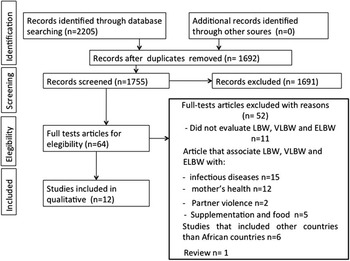
The flow diagram in Fig. 1 displays the process for selecting the studies of this review. The titles and abstracts were screened by two authors. The initial search resulted in a total of 1755 articles, of which 1691 were excluded after the title and abstract were read. These 1691 articles were mostly articles related to AIDS-HIV and infection diseases, alcohol, supplementation with medication, disease of sexual transmission and domestic violence during pregnancy. Full texts of 64 articles were read, and a further 52 excluded due to ineligibility, leaving 12 papers appropriate for this review.
Flow of studies included in the review.

Data abstraction
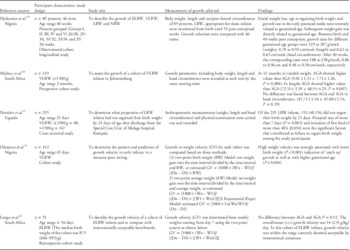
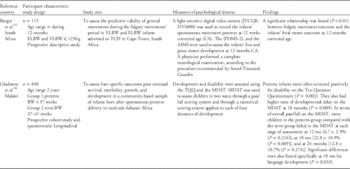
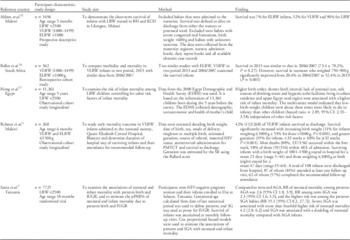
The relevant information from the studies are shown in three tables. All authors reviewed the summary of each study. Tables 1–3 summarize studies that examined the associations among LBW, VLBW and ELBW with growth (Table 1), neurodevelopmental outcome (Table 2) and mortality (Table 3). The tables included information about the country of study, design, sample characteristics, objectives, methodology, and findings of each study.
List of studies that examined the repercussion of low birth weight (LBW), very low birth weight (VLBW) and excessive low birth weight (ELBW) with the indicators of growth

WHO, World Health Organization; AGA, appropriate for gestational age; SGA, small for gestational age; P value determined using the unpaired t-test; P<0.005. W=body weight in grams, D1, beginning of the time interval; Dn, end of the time interval, in days; NBW, normal birth weight.
List of studies that examined the repercussion of low birth weight (LBW), very low birth weight (VLBW) and excessive low birth weight (ELBW) with neurodevelopmental outcomes

BW, birth weight; TCH, Tygerberg Children’s Hospital; PDMS-2, Peabody Developmental Motor Scale, second edition; AIMS, Alberta Infant Motor Scale; TQQ, Ten Question Questionnaire; MDAT, Malawi Developmental Assessment Tool.
List of studies that examined the repercussion of low birth weight (LBW), very low birth weight (VLBW) and excessive low birth weight (ELBW) and mortality

BMI, body mass index; BH, Bwaila Hospital; KCH, Kamuzu Central Hospital; CMJAH, Charlotte Maxeke Johannesburg Academic Hospital; PMTCT, Prevention of mother-to-child transmission; SR, Senior clinician; IUGR, Intrauterine growth restriction; p PAR%, partial population attributable risk per cent; AGA, appropriately sized babies; RR, relative risks.
Results
Association between LBW, VLBW and ELBW with growth
Five different studiesReference Namiiro, Mugalu, McAdams and Ndeezi 11 , Reference Njokanma, Egri-Okwaji and Babalola 19 – Reference Lango, Horn and Harrison 22 analyzed the association between LBW, VLBW and ELBW with growth and regain of body weight and length (Table 1). A longitudinal study verified that gestational age is negatively correlate with initial weight loss and growth and positively correlated with the body weight regain.Reference Njokanma, Egri-Okwaji and Babalola 19 Two cohort studies (prospective and retrospective) were performed in South Africa and compared body weight and length, head circunferance and growth velocity at diferent gestational ages [average for gestational age (AGA) and small for gestational age (SGA)].Reference Mackay, Ballot and Cooper 20 , Reference Lango, Horn and Harrison 22 In Uganda, from 235 LBW infants evaluated, 113 (48.1%) remained with their body weight until 21 postnatal daysReference Namiiro, Mugalu, McAdams and Ndeezi 11 and high body weight velocity, as an indicative of catch up growth, was found in LBW Nigerian children.Reference Olusanya and Renner 21
Association between LBW, VLBW and ELBW with neurodevelopmental outcomes
Table 2 presents the two prospective studies that investigated the relationship between VLBW and ELBW with neurodevelopmental outcomes.Reference Burger, Frieg and Louw 23 , Reference Gladstone, White, Kafulafula, Neilson and van den Broek 24 A significant relationship was found between fidgety movement outcome and the ELBW and VLBW infants’ final motor outcome at 12 months.Reference Burger, Frieg and Louw 23 Preterm infants (VLBW) are more often screened positively for disability on the Ten Question Questionnaire, presented developmental delay on the MDAT and language development.Reference Gladstone, White, Kafulafula, Neilson and van den Broek 24
Association between LBW, VLBW and ELBW with mortality
Table 3 presents five studies that associated LBW, VLBW and ELBW with mortality.Reference Rylance and Ward 2 , Reference Sania, Spiegelman and Rich-Edwards 3 , Reference Ahlsen, Spong, Kafumba, Kamwendo and Wolff 25 – Reference Hong and Ruiz-Beltran 27 Survival significantly increased with increasing birth weight and time of gestation.Reference Rylance and Ward 2 , Reference Ahlsen, Spong, Kafumba, Kamwendo and Wolff 25 Survival in two period of study (2013 and 206/2007) was similar, but for ELBW, the rate of survival increased from 20.4% (in 2006/2007) to 52.4% (in 2013).Reference Ballot, Chirwa and Ramdin 26 In an observational longitudinal study with Egyptian children, LBW children were about three times more likely to die in infancy than other children independent of socioeconomic risk factors.Reference Hong and Ruiz-Beltran 27 Gestational age was associated with more than four-fold higher risk of neonatal mortality according to a randomized trial study in Tanzania.Reference Sania, Spiegelman and Rich-Edwards 3
Discussion
The findings of the relationship between birth weight and growth were relatively consistent across studies. The studies of this review presented some limitations, such as, lack of detailed information regarding length of hospital stay and time to regain birth weight. The studies had no control over timing of discharge and scheduling of follow-up dates. Since all recorded informations were obtained from the mother and the available medical records, recall bias and incomplete documentation, respectively, may have affected the results. Gestational age estimates were based on hospital records derived from parental accounts of last menstrual period which may be prone to errors.
Significant associations were found between LBW, VLBW and ELBW with lower values of growth, body weight and length regain, and catch up growth.Reference Namiiro, Mugalu, McAdams and Ndeezi 11 , Reference Njokanma, Egri-Okwaji and Babalola 19 , Reference Mackay, Ballot and Cooper 20 Accordingly, LBW and intrauterine growth retardation were significantly associated with growth impairment,Reference Padonou, Cottrell, Guerra and Choudat 28 and the growth rate of VLBW infants is characterized by early suboptimal growth followed by a period of catch up growth.Reference Niklasson, Engstrom, Hard, Wikland and Hellstrom 29 Rapid catch up growth is advantageous with respect to improved neurodevelopmental outcomes, fewer psychosocial problems in later childhood and lower risk of persistent short stature but may be associated with an increased risk of childhood obesity and other metabolic complications.Reference Niklasson, Engstrom, Hard, Wikland and Hellstrom 29 , Reference Hack, Schluchter, Cartar, Rahman, Cuttler and Borawski 30 SGA is an independent risk factor of persistent short stature, excessive fat mass gain during infancy and metabolic disease in later life.Reference Singhal, Wells, Cole, Fewtrell and Lucas 31 The developmental origin of health and disease (DOHaD) hypothesis suggests that SGA children have a higher risk of developing metabolic syndrome later in adult life.Reference Parlee and MacDougald 32 Epidemiological studies have shown that humans born small- or large-for-gestational-age have a higher likelihood of developing obesity during infancy and adolescence.Reference Njokanma, Egri-Okwaji and Babalola 19 , Reference Parlee and MacDougald 32 – Reference Westwood, Kramer, Munz, Lovett and Watters 34 Aligned with this proposition, some African countries have shown an increase in the prevalence of obesity during infancy and adolescence, for example Mozambique.Reference Bosu 35 , Reference dos Santos, Maia and Gomes 36
Two prospective cohort studies analyzed the neurodevelopmental outcomes of studies and found associations among ELBW and VLBW and developmental delay.Reference Burger, Frieg and Louw 23 , Reference Gladstone, White, Kafulafula, Neilson and van den Broek 24 ELBW are prone to a range of long-term complications in comparison to their born-at-term counterparts.Reference Marlow, Wolke, Bracewell and Samara 37 , Reference Aylward 38 These complications include: severe handicap such as cerebral palsy, cognitive impairment, blindness and hearing loss to impairment of short-term memory, strabismus, language delays, learning difficulties and behavioural disorders.Reference Aylward 38 – Reference Delobel-Ayoub, Kaminski and Marret 40 In addition, infants with neurodevelopmental disabilities can present a secondary musculoskeletal impairments and a decline in mobility and functional abilities.Reference Papavasiliou 41 Early intervention, such as, physiotherapic treatment and physical education classes during the first infancy would be able to minimize the short-effects of ELBW and VLBW on neurodevelopment of children.Reference Moura-Dos-Santos, Wellington-Barros and Brito-Almeida 42 , Reference Moura-Dos-Santos, De Almeida and Manhaes-De-Castro 43 The methods of Malawi study, MDTA and TQQ, found interesting results, but more sophisticated tests are necessary to provide more details. The studies follow-up the children only 2 years but the minimum age required for a proper distinction between the normal trajectory, with slow motor development, and an abnormal pattern of development appears to be around 4 years of age.Reference Rosenbaum 44
The current review found the association between LBW, VLBW and ELBW with mortality.Reference Rylance and Ward 2 , Reference Sania, Spiegelman and Rich-Edwards 3 , Reference Ahlsen, Spong, Kafumba, Kamwendo and Wolff 25 – Reference Hong and Ruiz-Beltran 27 To born VLBW and ELBW is the most important cause of neonatal mortality.Reference Velaphi 45 In a study of 795 mother–infant pairs in rural Malawi, the odds of neonatal mortality among preterm babies was 11 times greater than that of term babies.Reference Kulmala, Vaahtera and Ndekha 46 The studies of this review only investigated the short-term survival of the infants with LBW, VLBW and ELBW. There is no information about long-term survival or morbidity of the infants. Only one study provided information about cases of death,Reference Hong and Ruiz-Beltran 27 others did not.
Limitations
This review does not provide data on long-term neonatal outcomes. We found studies until the age of 2 or 3 years old. There is an extreme lack of studies with African population that associated LBW, VLBW, ELBW with growth and development during childhood, adolescence and adulthood. In almost all countries, the studies were carried out at the reference hospitals, which have a higher standard of care than most other hospitals in the countries, so it is bias to generalize the results. Gestational age estimation based on the date of last menstrual period depends on women’s recall ability and, therefore, there is a high probability of error. This might lead to differential misclassification in preterm birth leading to an underestimate of the true risk of mortality due to preterm birth. This review analyzed studies only in English language and did not follow-up the articles of other languages.
Conclusion
The results of this review showed that for surviving VLBW and ELBW babies, there is disadvantage with increased risk of death, growth retardation, and developmental delay. The association between LBW, VLBW and ELBW and risk of disturb during growth and development in childhood is considered the most consistent evidence supporting the thrifty phenotype hypothesis proposed by Hales and Barker.Reference Hales and Barker 33 Post-neonatal interventions, such as, program of nutritional recovery, physiotherapist care and habitual physical activity in the school age need to be carried out which might improve outcomes in this group of VLBW and ELBW. In addition, hospitals must take this problems seriously increasing access to quality prenatal care.
Acknowledgments
This study was supported by Coordination for the Improvement of Higher Level (or Education) Personnel (CAPES).
Conflicts of Interest
None.