1. Introduction
The investigation of spatial language, and more specifically of the linguistic description of motion in space, is a classical topic in research, focusing on the interface between language and cognition (Slobin, Reference Slobin, Gumperz and Levinson1996). Linguistic differences in the way speakers habitually describe motion are often related to differences as to how motion and space are cognitively construed, at least in the form of the ‘thinking for speaking’ hypothesis put forward by Slobin (p. 71). Slobin’s suggestion is to focus on the mental processes involved when speakers prepare an utterance, rather than on ‘thought’ and ‘language’. Acquiring a particular language thus entails acquiring a particular way of ‘thinking for speaking’ that is shaped by the grammatico-lexical make-up of this language (p. 76). Given cross-linguistic differences (discussed below, Section 2.2), bilingualism and second language acquisition research raises the question of how a second language learner or a bilingual handles two markedly different systems, both linguistically (i.e., regarding the grammatical and lexical differences between the two linguistic norms) and conceptually (i.e., regarding the processes of thinking for speaking). SLA (Second Language Acquisition) research has yielded evidence of gradual restructuring of the individual’s languages, with cross-linguistic influences going both ways between L1 and L2 (Pavlenko & Jarvis, Reference Pavlenko and Jarvis2002; Brown, Reference Brown2007; Pavlenko, Reference Pavlenko2011). Most of the research on SLA and bilingualism, however, sees its participants as occupying a distinct point on a continuum between a native speaker of L1 and a balanced bilingual or even dominant speaker of L2. In this contribution, we focus on short-term effects of cross-linguistic influence, namely those triggered by different language modes. The main goal of this study is to investigate the influence of a bilingual or monolingual language mode on the description of spatial motion in bilinguals mastering two typologically different languages.
The study thus draws on two lines of research: first, theoretical and empirical work on the state of activation of the bilingual’s languages is the backdrop of the main research question. Therefore, a brief and selective overview of the literature on this topic will be given below. Second, studies on the verbalization of motion events, with monolinguals and bilinguals, are a source of inspiration for this work and are discussed below.
2. Previous research
2.1. language mode and language dominance
In this paper, we use the term ‘bilingual’ to refer to individuals who regularly use two or more languages. Bilingualism, as many scholars agree (Mackey, Reference Mackey and Wei2004), is a matter of degree and not a binary category. As will be discussed below, this requires that bilingualism researchers model bilingualism (conceptually and statistically) as a cline. Furthermore, it is uncontroversial that languages exert mutual influence in bilinguals. ‘Cross-linguistic influence’ (Kellerman & Sharwood Smith, Reference Kellerman and Sharwood Smith1986; Odlin, Reference Odlin, Doughty and Long2003) is a term often used to cover different sorts of phenomena, from positive transfer in learning closely related languages (Ringbom, Reference Ringbom1992) to convergence (Toribio, Reference Toribio2004) and what was traditionally termed ‘interference(s)’ (Weinreich, Reference Weinreich2011) and ‘borrowing’ (see Cenoz, Hufeisen, & Jessner, Reference Cenoz, Hufeisen and Jessner2001, for an extensive discussion of cross-linguistic influence). The scholarly discussion today focuses on the determinants of the degree of influence (CLI) between the bilinguals’ languages. It has been observed that, within individuals, the degree of cross-linguistic influence of the languages involved can differ greatly. Two factors are often cited as explanatory variables for these differences: dominance and language mode.
According to Grosjean (Reference Grosjean1998, p. 136), language mode is “a state of activation of the bilingual’s languages and language processing mechanisms”. Grosjean’s most important point for our present purposes is his claim that there is a need to control for language mode in order to be able to distinguish between interferences and (nonce) borrowings. According to Grosjean, interferences are “most visible” in monolingual mode, since they are not overshadowed by other, more performance-related phenomena (such as code-switching or nonce borrowings). Grosjean’s main objective is to distinguish between individually entrenched CLI phenomena and momentary ‘blips’. Grosjean refers to entrenched patterns using the term ‘interference’, which can be confusing since many scholars use this term to refer to the momentary blips (or for both). Grosjean’s interest in controlling for language mode is due to the idea that in order to assess the bilingual’s competence in one language, the momentary influence of the other language needs to be limited. In other words, bilinguals who are in a bilingual mode and “deviate” (p. 133) from monolingual norms may do so not because the language(s) they speak show signs of (negative) transfer, but because they know that their interlocutor shares the same languages, and that it is thus communicatively adequate to code-switch or use nonce borrowings.
Today, scholars who attempt to integrate theoretical approaches from psycholinguistics and contact linguistics generally assume a continuum between switches and borrowings, with a large fuzzy ground (Matras, Reference Matras2009, p. 114), an area in which the exact status of deviations from the monolingual norm remains unclear. From a methodological point of view, the distinction between interference (Grosjean’s notion is based on the seminal work by Weinreich, Reference Weinreich1953) and nonce borrowing is very difficult to establish. Interference, in the sense used by Grosjean, is an individually entrenched pattern, whereas nonce borrowing, by definition, is created on the spot. This distinction thus requires an assessment of the degree of speaker-internal as well as community-level generalization of the use of specific ‘deviations’: Is the phenomenon under investigation a community phenomenon (e.g., in contact varieties), an individual (stable) pattern (classical interference), or a momentary linguistic choice (nonce borrowing or also a bilingual slip of the tongue)? Thus, the phenomena generally subsumed under the term CLI represent a rather fuzzy conceptual space. This fuzzy space unfolds between clear, prototypical reference points such as alternational code-switching (Auer, Reference Auer1999), community-generalized borrowings (Haugen, Reference Haugen1950), and individual transfer that can unambiguously be attributed to the presence of at least two different languages in the repertoire (Jarvis, Reference Jarvis2000).
Taking all these phenomena together, we expect the highest degree of CLI in bilingual mode: following Grosjean (Reference Grosjean1998), the bilingual mode allows for a much greater use of borrowings than the monolingual mode.
The influence of the state of activation of the bilinguals’ languages on language processing is inconclusive. In some cases, language mode is claimed to be a determinant of processing (Soares & Grosjean, Reference Soares and Grosjean1984; Dunn & Fox Tree, Reference Dunn and Fox Tree2012). Other results seem to be in disagreement with the language mode hypothesis (Dijkstra & van Hell, Reference Dijkstra and van Hell2003; Marian, Spivey, & Hirsch, Reference Marian, Spivey and Hirsch2003), since findings from lexical decision tasks with bilinguals suggest that lexical access is non-selective. Such findings thus do not speak to an influence of language mode on processing. Some scholars do not assume the overall activation of languages, but activation and inhibition on the level of lemmas and task schemas (Green, Reference Green1986, Reference Green1998). Due to lack of space, we cannot provide a comparative discussion of the architectures of all relevant psycholinguistic models here. What is important for the present contribution, however, is the fact that regardless of the validity of the assumption of global language activation, varying degrees of CLI as a function of use-related factors are plausible. The activation (and, if part of the model at all, inhibition) may simply take place on the level of lemmas or task schemas instead of languages (e.g., in Green’s, Reference Green1998, model). It can therefore be hypothesized that usage patterns of competing lemmas or task schemas in two languages have an influence on their availability: the more frequent and/or recent the use, the more active the item.
As we have seen above, it is not only the activation pattern immediately before the moment of a subject’s response to a critical stimulus that can influence language tasks in most psycholinguistic frameworks, but also the relative weight or dominance of a language within the bilingual’s repertoire. Whereas the idea of bilingualism as a continuous (and, again, fuzzy) category is by no means new, it is still surprising to what extent research on bilinguals makes use of binary categorizations (and their corresponding statistical techniques, such as ANOVAs). As Dunn and Fox Tree noted (Dunn & Fox Tree, Reference Dunn and Fox Tree2012), bilingualism is rarely modelled as a gradient predictor. However, if claims on bilingualism as a matter of degree should be taken seriously, research should model the phenomenon as a continuous construct. Several scholars have suggested measures for the relative weight of languages in the repertoire (Dunn & Fox Tree, Reference Dunn and Fox Tree2009; Bedore et al., Reference Bedore, Pena, Summers, Boerger, Resendiz, Greene, Bohman and Gillam2012; Gertken, Amengual, & Birdsong, Reference Gertken, Amengual, Birdsong, Leclercq, Edmonds and Hilton2014). Because bilingualism is a matter of degree, the boundary between bilinguals and learners of a second language is arbitrary. We do not deny that extreme group approaches, e.g., comparing prototypical bilinguals to monolinguals, can be useful. However, given that purely monolingual participants, at least in the contexts in which we work, are increasingly hard to find, modelling bilingualism as a continuous predictor rather than comparing carefully selected groups seems an empirically adequate way to take into account both theoretical stances and demographic realities.
2.2. motion event research with bilinguals
The investigation of spatial language, and in particular of differences in the lexicalization patterns of the expression of motion across languages, is by now an established subfield (Slobin, Reference Slobin, Strömqvist and Verhoeven2004). Scholars in descriptive linguistics and comparative stylistics (Malblanc, Reference Malblanc1968; Tesnière, Reference Tesnière1969) first compared ‘representative’ texts and introspective data in order to show different ways of referring to motion in space. Later, researchers started using constraining stimulus material for the elicitation of spatial language, e.g., the widely used frog story (Strömqvist & Verhoeven, Reference Strömqvist and Verhoeven2004). Other researchers use parallel texts (e.g., bible translations) to compare a large number of languages (Wälchli, Reference Wälchli2001, Reference Wälchli2009). Again, it is impossible to give a comprehensive overview of this research. For our current purposes, a fundamental distinction between two types of languages needs to be briefly discussed. Following a terminological suggestion of Talmy (Reference Talmy and Shopen1985, Reference Talmy2000), many scholars have shown that there are robust differences in the lexicalization of motion in narrative texts produced by speakers of French or Spanish (and other Romance languages) and English or German (and other Germanic languages; see Goschler & Stefanowitsch, Reference Goschler and Stefanowitsch2013, and Blomberg, Reference Blomberg2014, for recent contributions to the field). Other language families sometimes also fit into this distinction, but since we will be focusing on French–German bilinguals, we will limit our discussion to Romance and Germanic. These differences pertain to the conflation patterns of semantic content into morphemes (mostly into the verb root) and to the exact locus where crucial information about displacement is typically expressed. Examples (1) and (2)Footnote 1 illustrate these fundamental differences in German and French.
(1) Sie läuft rückwärts über die Strasse.
figure manner+ manner path ground
activating
process
‘She walks/runs backwards across the street.’
(2) Elle traverse la route en reculant.
figure path+ ground manner
activating
process
‘She crosses the street backwards.’
The crucial difference, according to Talmy’s (Reference Talmy2000) framework, is the typical locus of the expression of path: the verb in so-called verb-framed languages, and particles (e.g., prepositions, verb prefixes) ‘floating around’ the verb in so-called satellite-framed languages. However, path does not mandatorily have to be expressed in motion descriptions (e.g., a speaker can simply describe a motion event by “he runs” or “he crawls”). Furthermore, the more scholars investigate these differences, the more the evidence shows that this difference is a matter of degree (Slobin, Reference Slobin, Hickmann and Robert2006b), and that it is not always empirically correct to categorize languages and varieties according to their genealogical affiliation. Berthele (Reference Berthele and Kortmann2004, Reference Berthele2007a), for instance, has shown that Romansh, genealogically a Romance language, is satellite-framed (due to contact with German or to an archaic Latin pattern, or both), and Kopecka (Reference Kopecka, Goschler and Stefanowitsch2013) has shown the diachronic changes that French underwent from a satellite- to a verb-framed language. Talmy’s and Slobin’s work also emphasized that manner is expressed in an obligatory slot in satellite-framed languages (there has to be a verb), whereas it is often mapped onto an optional syntactic slot in verb-framed languages (see example (6)). However, as examples (3), (4), and (5) show, there is no categorical rule that prevents speakers of verb-framed languages from using manner verbs, and there is no need in satellite-framed languages to choose a finite verb that expresses manner.
(3) Jemand überquert rückwärts eine Strasse.
‘Somebody crosses backwards a street.’
(4) Elle marche par-dessus une chaine.
‘She walks over a chain.’
(5) Une fille marche dans la rue et passe par-dessus une chaine.
‘A girl walks in the street and passes over a chain.’
(6) Une femme passe par-dessus une chaine en levant les pieds.
‘A woman passes over a chain raising the feet.’
Moreover, the expression of manner, in satellite-framed languages, is by no means as frequent as path (Berthele, Reference Berthele and Kortmann2004, Reference Berthele, Goschler and Stefanowitsch2013), since many speakers often use generic verbs such as to go to express the motion. Example (4) above represents a violation of a constraint that many scholars found in verb-framed languages (Aske, Reference Aske, Hall, Meacham and Shapiro1989; Slobin & Hoiting, Reference Slobin and Hoiting1994; Hickmann, Reference Hickmann1998, Reference Hickmann and Hickmann2003), often called the ‘boundary-crossing constraint’: speakers deprecate the combination of manner verbs with the predication of the crossing of a physical boundary. Example (4) thus is not a typical example of how speakers of French describe this event. Examples (5) and (6), on the other hand, stand for the more characteristic French regularity in which this constraint is not violated: either by avoiding the predication of the boundary-crossing in the clause expressing manner (5), or by expressing manner in a participial construction (generally referred to as ‘gérondif’/‘gerund’ in French grammar; cf. (6)). The constraint is not a categorical one, especially when high-energy motor patterns are involved: the combination of manner verbs with boundary-crossing predication is frequently observed also in verb-framed languages (Slobin, Reference Slobin, Hickmann and Robert2006b; Cadierno, Reference Cadierno, Han and Cadierno2010).
Despite this rather variable nature of the phenomena, we know from research on French and German, that
a. speakers of French typically map the path onto the finite verb;
b. speakers of German hardly ever express path in the finite verb, but they very often use the verb for the expression of manner (or of a generic activating process);
c. speakers of French can express manner in the verb, preferably if no crossing of spatial boundaries is predicated (example (6) complies with this constraint, but not example (4));
d. speakers of French typically add manner – if it is relevant – in adverbial constituents (e.g., gerunds, e.g., “en levant les pieds” ‘raising the feet’, example (6)).
After a first period during which scholars mostly focused on the comparison of languages, over the last ten years we observe a growing interest in the process of adding a language to the repertoire that differs from the first and/or dominant language of the bilingual (Cadierno & Ruiz, Reference Cadierno and Ruiz2006; Brown, Reference Brown2007; Cadierno, Reference Cadierno, Han and Cadierno2010; Larrañaga, Treffers-Daller, Tidball, & Gil Ortega, Reference Larrañaga, Treffers-Daller, Tidball and Gil Ortega2012; Goschler, Reference Goschler, Goschler and Stefanowitsch2013). Studies that involve the learning of contrasting preferences due to a satellite-framed L1 show that learners need to acquire considerable proficiency in the verb-framed L2 in order to comply with the target language’s typical preferences and constraints (e.g., the boundary-crossing constraint in the study by Larrañaga et al., Reference Larrañaga, Treffers-Daller, Tidball and Gil Ortega2012). Conversely, learning the preferential patterns of a satellite-framed language when the L1-pattern is verb-framed is clearly more difficult than if the L1 is already satellite-framed (Cadierno, Reference Cadierno, Han and Cadierno2010). Within a bilingualism perspective, the study of Hohenstein, Eisenberg, and Naigles (Reference Hohenstein, Eisenberg and Naigles2006) shows that, compared to monolingual groups, bilinguals (in English and Spanish) use more path verbs in English and more manner verbs in Spanish. For the sake of brevity, we cannot discuss all studies on SLA and emerging bilingualism in detail. Overall, the evidence currently available suggests that some features of the target language are acquired rather easily, while in other cases learners try to map material of the new language onto the patterns of the dominant language until relatively high levels of proficiency. Moreover, studies within a bilingualism and convergence framework often reveal more or less subtle influence of the language not used in the task on the actively used language.
A final remark needs to be made on studies that attempt to integrate problems emerging from the research on motion verbs in bilinguals with the issue of language modes discussed in Section 2.1. In at least two studies on motion events (Nicoladis, Alyssa, & Cassandra, Reference Nicoladis, Alyssa and Cassandra2010; Lai, Rodriguez & Narasimhan, Reference Lai, Rodriguez and Narasimhan2014), the potential influence of language mode during data collection on the responses is explicitly addressed. However, in these studies the mode is not systematically manipulated for the sake of comparison; the goal is merely to induce a monolingual mode in the target language. The study of Kersten, Meissner, Lechuga, Schwartz, Albrechtsen, and Iglesias (Reference Kersten, Meissner, Lechuga, Schwartz, Albrechtsen and Iglesias2010) compares the attention to manner of motion in bilinguals that are tested in either a Spanish- or an English-speaking context. According to the results of their categorization task, context (arguably inducing either a monolingual Spanish or a monolingual English mode) influences the attention to manner in the expected way, based on the linguistic typology. In a similar vein, Athanasopoulos et al. (Reference Athanasopoulos, Bylund, Montero-Melis, Damjanovic, Schartner, Kibbe, Riches and Thierry2015) test linguistic relativity effects by analyzing paired sets of data from bilinguals (which is a similar methodology to the one chosen in the present paper), revealing the dynamic context-bound nature of bilingual processing. In another study (on L2 acquisition), Treffers-Daller and Tidball (Reference Treffers-Daller, Tidball, Guijarro-Fuentes, Schmitz and Müller2015) induce an ‘L2 speaking mode’ before starting the data collection, but they admit that the influence of such manipulations of language mode on the responses remains unclear as long as no comparative data across different modes are collected and analyzed. The study described in this paper is an attempt to do exactly this, by systematically controlling for language mode and collecting paired sets of data from informants.
3. The study
3.1. participants
All participants are bilinguals in German and French, with varying dominance configurations (see below for details on dominance). Forty participants took part in the data collection (26 females, 14 males, aged between 20 and 78, mean age 30).Footnote 2 The selection criteria were that (i) they all completed their maturité/MaturaFootnote 3 and (ii) that they consider French and (Swiss) German their two strongest languages. Due to widespread diglossia with bilingualism in German-speaking Switzerland (Fishman, Reference Fishman and Wei2005 [1967]), all native Swiss-Germans are already bilinguals within German. For the present study, participants mastering a Swiss-German dialect were asked to consider their proficiency in dialect and the German standard language as one category.
3.2. materials
Participants filled in a language background questionnaire that included all items of the bilingual dominance scale BDS (Dunn & Fox Tree, Reference Dunn and Fox Tree2009) (translated into German). The BDS is a quick, paper-and-pencil based self-assessment measure which can be used to quantify a speaker’s dominance between two languages.
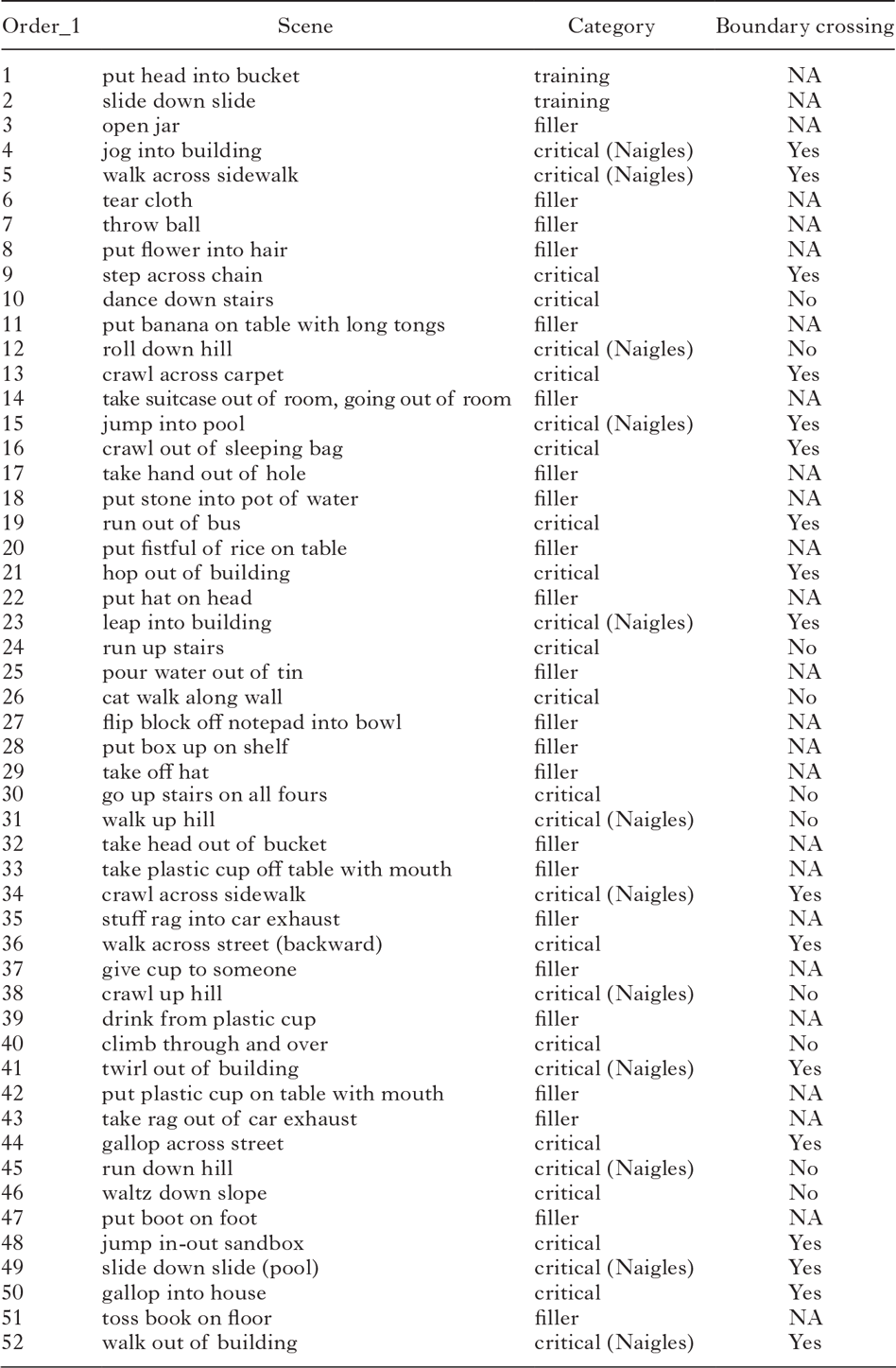
In the main task, participants had to describe a series of fifty-two video clips, of which two were training items to become acquainted with the task, twenty-seven were critical, and twenty-three were fillers. The critical items showed short films of people moving in different manners and different paths (see ‘Appendix’). Twelve of these items are identical to those used by Naigles, Eisenberg, Kako, Highter, and McGraw (Reference Naigles, Eisenberg, Kako, Highter and McGraw1998). Eighteen critical stimuli showed motion events involving the crossing of a spatial boundary, e.g., a man entering a building, or a woman stepping over a chain. The fillers showed events of caused motion, which made them relatively similar to the critical items without triggering the same verbs, as in the case of self-propelled motion. The purpose of using filler items in this study was twofold. On the one hand, fillers were implemented to distract participants and, as mentioned, prevent them from using the same verb types. On the other hand, fillers are used as an inherent part of the research design to establish a bilingual mode and being able to compare the same critical items in a monolingual and bilingual mode (see ‘Procedure’ below).
3.3. procedure
All participants took part in two data collection sessions, one in monolingual mode,Footnote 4 the other in bilingual mode. Half of the participants were first in the monolingual mode while the other half were first in the bilingual mode. Two random orders of the stimuli were used, i.e., a participant who got order A in monolingual mode got order B in bilingual mode and vice versa. While in the monolingual mode, fieldworkers used only German; they alternated using French and German in the bilingual mode in oral communication. The goal was to use each language for about 50% of the time in interaction. Such alternational use of two languages is not unusual in the bilingual town of Fribourg, where twenty-eight informants were recorded (12 informants were recorded in German-speaking Switzerland). In bilingual mode, all the fillers were displayed with a different background colour and participants were told to describe them in French. The responses to the critical items were to be given in German. In monolingual mode, everything took place in German. Only the German descriptions of motion events are analyzed.
The responses were recorded, transcribed, and coded for various syntactic and semantic aspects, based on the motion verb typology outlined in Section 2. Each response was coded for the use of a path verb, a manner verb, other (e.g., deictic) verbs, manner modifiers, and path particles, following the conceptual categories in the Slobin (Reference Slobin2006a) coding scheme.
3.4. design and hypotheses tested
Based on the findings discussed above, i.e., drawing on bilingualism research and on descriptions of motion verb usage patterns, we postulate the following hypotheses:
Bilinguals who are in a bilingual mode, i.e., in a setting where both languages are used alternately, will show more CLI than bilinguals in a monolingual mode. In terms of the typical motion verb usage patterns, we expect bilinguals with German and French to produce more constructions that converge towards typical French patterns when speaking German. Thus, when comparing the bilingual to the monolingual mode, we expect the German of bilinguals to show:
a. an increase in the number of path verbs;
b. a decrease in the number of manner verbs;
c. an increase in the number of constructions that are equivalent to violations of the boundary-crossing constraint in French (i.e., the combination of a manner verb and the predication of boundary crossing)
Since, as discussed in Section 2.1, we construe bilingualism as a gradual phenomenon, we also need to take into account the influence of relative proficiency in the respective languages, or more generally the influence of the dominance balance. Thus, we hypothesize that relative dominance of the two languages in the focus of this study influences the prevalence of CLI phenomena. More concretely, we expect an increased use of French patterns (a–c above) in German, with increasing dominance of French within the individual repertoire – independently of language mode. The balance of French and German within the individual repertoire thus needs to be modelled as a covariate in the model.
The results of the analyses are described for three dependent variables separately (i.e., the number of path verbs, the number of manner verbs, and the number of boundary-crossing violations). First, descriptive tools are used to show the usage patterns as a function of language mode and bilingual dominance. Second, logistic mixed-effects models are fitted to test the predictions listed in Section 2.Footnote 5 Third, specific items and responses that contribute to or deviate from the general tendencies are discussed in more detail.
4. Results
Regarding the BDS predictor variable, the participants range from –22 (French dominant) to 27 (German dominant), with a mean of 14.9. By definition, a perfectly balanced bilingual would score around zero on the BDS, the theoretically possible extreme is ±30. The sample is thus skewed in terms of dominance with more speakers who are dominant in German.
4.1. path verbs
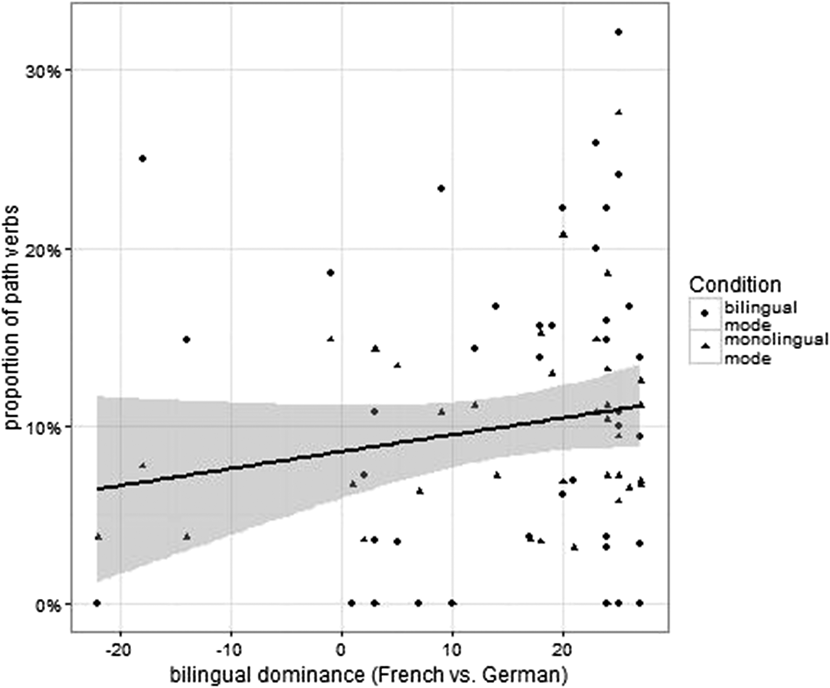
As outlined above, the use of path verbs is the default choice of typical speakers of verb-framed languages. However, as shown in example (3), path verbs exist and are used, to a certain extent, in satellite-framed languages as well. Figures 1 and 2 show the proportion of path verbs used per participant in the two conditions investigated and across the BDS continuum.
Difference between proportions of path verbs in bilingual and in monolingual mode (y-axis) by path verb use in monolingual mode. The points above the horizontal line stand for participants who use more path verbs in bilingual mode. Plot inspired by Vanhove (Reference Vanhove and Vanhove2015).

Proportion of path verbs in responses and bilingual dominance (BDS). The further to the right a datapoint, the more German is dominant in the repertoire.

The straight line in Figure 1 models the idealized graph generated by the null hypothesis, i.e., that there is no difference in the proportion of path verbs in the monolingual and bilingual mode. A majority of the points in Figure 1 lies above this line. This suggests that, as expected, responses made in bilingual mode show a higher likelihood of involving the use of a path verb. On the other hand, being more dominant in German, quite surprisingly, also involves a higher probability of path verb usage (Figure 2). The latter tendency goes against our predictions, since path verbs are the characteristic choice in verb-framed languages. We will come back to this in the Section 5.
After visual inspection of the data, the impact of language mode and BDS has to be tested inferentially. To this end, a logistic model was fitted to the data. In this model, each response to any of the critical stimuli represents a datapoint. The binary dependent variable is the presence or absence of a path verb. The dependencies within the data are accounted for by means of random effects. Random intercepts and random slopes per participant and per stimulus are modelled, as suggested by Barr, Levy, Scheepers, and Tily (Reference Barr, Levy, Scheepers and Tily2013). The first model fitted turns out to be overparametrized (with perfect correlations between random slopes and random intercepts), thus a simpler model without those correlations was fitted. Three fixed effects are included, namely language mode, BDS, and an interaction of language mode and BDS. This model yields the parameters given in Tables 1 and 2.
Fixed effects on the probability of the choice of a path verb in the response

note: parameters in log-odds.
a The intercept represents the predicted probability of 3% (transformed from log-odds) that a manner verb is chosen for a randomly chosen participant with an average value of BDS averaged over monolingual and bilingual mode.
Random effect adjustments of the probability of selecting a path verb

As Table 1 shows, only language mode turns out to be significantly related to the use of path verbs. This corroborates the tendency visible in Figure 1 above, i.e., participants in the monolingual mode, do indeed use significantly fewer path verbs than in the bilingual mode, hence the negative estimate in Table 1. Table 3 shows the choices of the forty participants for one stimulus. For instance, six people use no path verb in monolingual mode but a path verb in bilingual mode. Most participants (N = 32) use no path verbs at all. Only one person uses a path verb in monolingual mode and a path verb in bilingual mode.
Individual verb choices by language modes for the stimulus “run out of bus”

Examples (7), (8), (10), and (11) illustrate the changes (within the same subject) that are typically triggered by the manipulation of language mode. Examples (9) and (12) illustrate typical responses in French (see footnote 1).
(7) Sie verlässt den Bus springend. (bilingual mode)
‘She exits the bus hopping.’
(8) Sie rennt aus dem Bus. (monolingual mode)
‘She runs out-of the bus.’
(9) Elle sort du bus en courant avec un snowboard sous le bras.
‘She exits from-the bus running with a snowboard under the arm.’
(10) Sie überquert hüpfend den Platz. (bilingual mode)
‘She crosses hopping the square.’
(11) Sie hüpft über die Strasse. (monolingual mode)
‘She hops across the street.’
(12) Quelqu’un traverse la route en sautant.
‘Somebody crosses the street hopping.’
Some stimuli are almost never described by a clause with a finite path verb (e.g., the stimulus “jog into building”), independently of language mode, thus there is no variation across language modes. For such invariant stimuli there is a negative random intercept adjustment compared to the other stimuli. The variation in impact of language mode across stimuli is small. This is shown in Table 2, where the two random slope parameters for the language mode predictor interacting with the stimuli and the participants converge towards zero.
The first analysis thus confirms the hypothesis that, in bilingual mode, which involves the activation of French, a language with a clear preference for path verbs, participants tend to use more path verbs in the scene descriptions. At the same time, there is no impact of the degree of dominance of German or French in the individual repertoire, although Figure 2 shows a tendency that goes against the expectations formulated on theoretical grounds.
4.2. manner verbs
In the strong formulation of Talmy’s (Reference Talmy2000) approach, a motion clause in a satellite- or verb-framed language contains either a manner or a path item in the slot of the finite verb. If this were the case, then no separate analysis of manner verb usage would be necessary, since it could not yield anything else than the flip-side of the path verb analysis. However, it is also possible to use generic motion verbs that are neither, such as deictic verbs (deictic verbs represent a separate category; cf. Ricca, Reference Ricca1991; Matsumoto, Akita, & Takahashi, n.d.). As Berthele (Reference Berthele, Geist and Rothstein2007b, Reference Berthele, Goschler and Stefanowitsch2013) has shown, speakers of certain varieties of German frequently describe motion events without manner or path verbs, and within German there are varieties in which speakers use significantly more path and manner verbs than others. There is a growing consensus that path and manner domains “are not relevant for the same kinds of motion events in a clear majority of cases” (Wälchli, Reference Wälchli2009, p. 211), and that the negative correlation between the use of manner verbs and of path verbs is at best a rather weak one (Berthele, Reference Berthele, Goschler and Stefanowitsch2013). Thus, it seems appropriate to analyze manner and path verb usage separately. The categorization of manner and path verbs in (Swiss-) German is not always straightforward, as will be briefly discussed below. We will come back to the question of the correlation of the manner and path domains in the Section 5.
The analysis of manner verb usage follows the same principles as the discussion of the path verb data in the preceding section. First, plots of the manner verb proportions (Figures 3 and 4) give a general impression of the data.
Difference between proportions of manner verbs in monolingual and in bilingual mode (y-axis) by manner verb use in monolingual mode. Points above the horizontal line stand for participants who use fewer manner verbs in bilingual mode.

Proportion of manner verbs in responses and bilingual dominance (BDS). The further to the right a datapoint, the more German is dominant in the repertoire.

The two conditions plotted in Figure 3 seem to trigger slightly different proportions of manner verbs, since a majority of the points lies above the line that illustrates the null hypothesis: as predicted, the tendency to use manner verbs in the bilingual condition is slightly lower than in the monolingual condition. If this pattern is statistically significant, it could suggest that bilinguals, when speaking German in bilingual mode, do indeed use fewer manner verbs than in monolingual mode, maybe due to the influence of the preferred pattern in French.
The factor of individual bilingual dominance configurations, on the other hand, again does not correlate with the predictions, since the mean proportion of manner verbs in the responses does not vary across different degrees of dominance.
In order to test the impact of the fixed effects (language mode and BDS), a logistic mixed-effects model was fitted to the data. Tables 4 and 5 give an overview of the model parameters.
Fixed effects on the probability of the choice of a manner verb in the response

a The intercept represents the predicted probability of 91% (transformed from log-odds) that a manner verb is chosen for a randomly chosen participant with an average value of BDS averaged over the two language modes.
Random effect adjustments of the probability of selecting a manner verb

The impact of language mode is statistically significant, with a higher probability of the selection of a manner verb in monolingual German mode. All other fixed factors do not contribute significantly to the model.
As in the case of the model discussed in the previous section, the exploration of individual stimuli reveals only negligible differences in the way language mode impacts on the selection of a manner verb: the random slopes for language mode per item and participant converge towards zero.
Table 6 shows the typical response pattern that is also exemplified in examples (18–23): bilingual language mode comes with a decrease in the propensity to use a manner verb.
Individual verb choices by language modes for the stimulus “step across chain”

There are some problems regarding the categorization of German verbs as manner verbs, path verbs, or other verbs. As noted by Slobin (Reference Slobin, Strömqvist and Verhoeven2004), verbs can conflate both manner and path. An example of this is the German verb klettern ‘to climb’, as discussed in Berthele (Reference Berthele2006). Responses containing these verbs are thus coded as containing both a finite path and a finite manner verb.
Moreover, the status of the two high-frequency verbs kommen ‘to come’ and gehen ‘to go/walk’ is problematic, due to polysemy and to dialectal differences in lexical semantics. The verb gehen is ambiguous: in Swiss-German dialect, the cognate verb denotes an equivalent to English to go, without reference to manner of motion. In Standard High German, however, gehen also denotes ‘to walk’. When Swiss-Germans speak the standard language, the verb can be used either to refer to the manner ‘walk’ or ‘go’. Moreover, even in Standard German that is not spoken in bilingual/diglossic situations with (Swiss-German) dialects, the verb can be used to refer to locomotion that is not self-propelled (ich gehe morgen nach China ‘Tomorrow I go to China’). Given all these restrictions on a possible manner reading of the verb, we decided to code it as a neutral verb (thus neither as manner nor as a path verb).Footnote 6 Furthermore, the verb for walking in Swiss-German is laufe (which, confusingly, is cognate with the verb meaning ‘to run’ in Standard German, laufen). The verb laufen is thus also ambiguous in our data, since native Swiss-Germans use it to refer either to ‘walk’ or to ‘run’. In any case, the verb is denoting manner of motion and is thus regarded as a manner verb.
(13) Eine Frau überquert eine Kette. (bilingual mode)
‘A woman crosses a chain.’
(14) Eine Frau läuft über eine hochgelegene Kette. (monolingual mode)
‘A woman walks/runs over a high-located chain.’
(15) Die Frau geht über die Kette auf die Strasse. (bilingual mode)
‘A woman goes/walks over a chain onto the street.’
The analysis of the choice of manner verbs reveals a pattern that is almost the mirror image of the pattern uncovered for the path verbs: in line with the typological expectations, bilingual language mode lowers the likelihood of the choice of a manner verb. There are some counter-examples to this tendency, especially stimuli that are almost categorically described with manner verbs (e.g., the scene ‘jump into pool’), regardless of language mode. This ties in with the tendency even in speakers of verb-framed languages to combine manner verbs and boundary-crossing predication if high-energy motor patterns are involved (see discussion below on the boundary-crossing constraint, and the references in Section 2.2). Again, the tendency is statistically clear, as the fitted model (Table 4) shows.
We have seen that the propensity to use path verbs is increased in bilingual mode, whereas the propensity to use manner verbs is lower compared to monolingual mode. This can be interpreted as converging behaviour of the bilinguals towards the monolingual baselines of the two languages involved. As discussed in Section 2.2, an important difference between French and German is the presence of the boundary-crossing constraint in French, a constraint that predicts a relatively low likelihood of combining manner verbs with the predication of boundary-crossing. Not all stimuli analyzed so far involve the crossing of a boundary. And within the response sets to stimuli showing the crossing of a boundary, not all responses predicate boundary-crossing (see examples (16) and (17)).
(16) Sie spaziert von einem Haus weg. (bilingual mode)
‘She strolls from a house away.’
(17) Eine Person läuft rückwärts. (bilingual mode)
‘A person walks/runs backwards.’
4.3. boundary-crossing events
To conclude the analysis of manner verb usage, we will take a brief look at only those responses that involve boundary-crossing. The responses to the eighteen stimuli showing boundary-crossing were coded for the presence of boundary-crossing predication. In French, the combination of a manner verb and boundary-crossing predication would be a violation of the constraint, and, as expected, the tendency to combine manner verbs with boundary-crossing predication for this subcategory of stimuli is higher in monolingual mode (mean: 64%) than in bilingual mode (mean: 60%). A qualitative analysis of the responses reveals that there seems to be a particularly striking difference by language mode in the case of the responses to stimuli involving motion into or out of container-type spaces. Examples (18–23) show response pairs from the same individuals in monolingual and bilingual mode. They are all descriptions of the same stimulus showing a person hopping though a door into a house.
(18) Sie hüpft in die Garage. (monolingual mode)
‘She hops into the garage.’
(19) Sie geht springend in die Garage hinein. (bilingual mode)
‘She goes/walks hopping into the garage into.’
(20) Sie hüpft in ein Gebäude rein. (monolingual mode)
‘She hops into a building into.’
(21) Sie geht seitlich in das Haus. (bilingual mode)
‘She goes/walks sideways into the house.’
(22) Eine Dame springt seitwärts durch eine Tür. (monolingual mode)
‘A lady jumps sideways through a door.’
(23) Jemand geht seitwärts hüpfend in ein Gebäude. (bilingual mode)
‘Somebody goes/walks sideways jumping into a building.’
As the examples show, in bilingual mode, participants select the high-frequency verb gehen ‘to go’ or ‘to walk’, whereas they use verbs such as hüpfen ‘to hop’ or springen ‘to jump’ in monolingual mode. Moreover, as argued in Section 4.2, ‘come’ and ‘go’ are verbs that need to be categorized separately and are thus neither path nor manner verbs.
Examples (19), (21), and (23) show that manner does not remain unexpressed in bilingual mode: participants add manner in adverbials, such as gerunds, (19), (23), or adverbs (21). The choice of a gerund, especially, although perfectly grammatical in German, represents the notoriously ‘French way’ of specifying manner of motion. The examples discussed here represent a general tendency in the data, as Figure 5 shows: responses with manner verbs are less frequent in the bilingual language mode, and within the responses that do not feature a manner verb, manner is almost categorically mapped onto an adverbial.
Proportions of manner verbs and manner modifiers across the two language modes (descriptions of stimuli showing ‘into’-paths only).

5. Discussion
We have tested three related predictions with respect to the impact of language mode on the description of motion events. In comparison to the monolingual condition, bilingual mode was expected to (a) increase the number of path verbs, (b) decrease the number of manner verbs, and thus (c) lead to more ‘violations’ of the boundary-crossing constraint (this constraint is generally only postulated for verb-framed languages, thus it cannot be violated in the strict sense in German).
Summing up the analyses of manner verb usage and of the expression of manner of motion, the predictions regarding the impact of language mode are met: more manner verbs are used in monolingual mode than in bilingual mode, and the description of manner of motion converges towards the French model in bilingual mode. This is achieved mainly by using fewer manner verbs and by adding manner in an adverbial constituent rather than in the verb. We have discussed pairs of responses produced in the two different language modes that show how individuals change their descriptions of the same stimulus as a function of language mode. The effects of the manipulation of language mode are not dramatic, as Figures 1 and 3 show, but they are statistically significant.
A more fine-grained analysis of the combination of manner verbs and the predication of boundary-crossing sheds more light on the possible transfer of this constraint from French into German: in German, according to the literature (Slobin & Hoiting, Reference Slobin and Hoiting1994), no such constraint exists, i.e., manner verbs and directional prepositional phrases predicating the crossing of a boundary are freely combinable. The data discussed in this paper show that in particular the displacement from outside a bounded space into this space is less likely to be described by a manner verb in bilingual mode. Manner is often purposefully salient in the clips shown; therefore, many participants deem manner of motion sufficiently relevant to express it. The analysis of the in-path, again in bilingual mode, shows that manner is almost categorically expressed in an adverbial if no manner verb is chosen. Moreover, the responses produced by the informants in bilingual mode often involve gerund constructions, which are a typical means of Romance verb-framed languages to add manner into the motion verb clause whenever it is relevant.
Path verb frequencies, on the other hand, show the expected inverted tendency: in bilingual mode, the bilinguals select significantly more path verbs than in monolingual mode. As for the manner verbs, the degree to which they describe stimuli differently across language modes varies. Whereas responses to many stimuli show the expected tendencies, others are invariant, often due to ceiling effects (categorical use of manner verbs in both conditions), which is probably due to a manner saliency of the respective item.
A second fixed factor, the relative dominance of French or German in the repertoire, was included in all analyses. Descriptively, there is either no tendency (Figure 4) or even a counter-intuitive tendency (Figure 2). The latter regards the increase in path verb frequency with increasing German dominance. This unexpected tendency could simply be an effect of vocabulary size: arguably, dominant speakers of German have larger vocabulary sizes in German, which in turn leads to an increased use of German path verbs. Some of the German path verbs, e.g. überqueren ‘to cross’ (2,871 occurrences in the Leipzig newspaper corpusFootnote 7), are stylistically marked for a higher register and relatively infrequent compared to generic motion verbs or common manner verbs (gehen ‘to go’: 146,036 occurrences). Moreover, as shown in Berthele (Reference Berthele2006), speakers of demographically larger varieties of German use both significantly more manner and path verbs than speakers of other, mostly small-scale dialects. The present study does not control for the participants’ L1-dialects, but a similar confounding factor could play a role in our data, too. Whatever the reason for this tendency may be, it turns out to be statistically negligible, since the BDS variable does not reach significance in the models fitted in this study. Bilingual dominance configurations thus seem surprisingly irrelevant for the choice of verbs (and other related patterns). Moreover, there is no evidence for an interaction between dominance and language mode. The interaction was modelled because Grosjean (Reference Grosjean2008, p. 21) predicts that “bilinguals who are highly dominant in one language may simply not be able to control language mode in the same way as less dominant or balanced bilinguals”. We would therefore expect the production of bilinguals who are highly dominant in German to be affected differently by the language mode manipulation (fewer instances of CLI compared to bilinguals who are more balanced). However, no such prediction is supported by our data.
6. Conclusions
This study shows that inducing a bilingual language mode does indeed have an impact on the way bilinguals describe spatial motion in German. The activation of French in the description of the interspersed filler items leads to a decrease of manner verb usage and an increase of path verb usage. This effect is certainly compatible with Grosjean’s (Reference Grosjean2008) account of activation of whole languages in the bilingual system: the likelihood of converging towards the French pattern is higher, if French (the whole language subsystem) is activated by means of the fillers. The fillers do not trigger self-propelled motion clauses but always caused motion, thus triggering different verbs (of putting and taking) with different subcategorization features (transitives rather than intransitives) and different constructions (mover + verb + figure / moved object + ground). In terms of Green’s (Reference Green1998) idea of competing task schemata and lemmas we can thus conclude that, at least on the lemma level, there is no direct competition between French caused motion verbs (e.g., mettre ‘to put’) and German intransitive motion verbs (e.g., rennen ‘to run’). However, on a more schematic level of motion constructions, we could hypothesize that, in the caused motion domain, too, there is a German tendency to add manner via the typically Germanic verbal classification. Verbs such as setzen ‘to put sitting’, legen ‘to put lying’, stellen ‘to put standing’ could be categorized as manner verbs, whereas French uses verbs that do not encode the orientation of the figure at the end of the motion event (see Kopecka & Narasimhan, Reference Kopecka and Narasimhan2012, for a cross-linguistic study of caused motion verbs). Thus, if we postulate competition between manner constructions and manner-less constructions representing German and French, we could explain the pattern emerging from the data as a consequence of bilingual activation and inhibition on the level of certain features of the linguistic competitors. Activating French (caused motion) schemata, with their low propensity to use manner verbs, thus inhibits the selection of German manner verbs. Moreover, even if we do not postulate activation of whole languages, we can still argue that activating words in one language leads to higher activation of other words of that same language; and this, in turn, leads to spill-over effects in the sense discussed in Section 2.1 that yield patterns of converging verbal behaviour in bilingual mode.
Many scholars hypothesize that differences in motion descriptions also represent differences in mental construal – either in the sense of Slobin’s (Reference Slobin, Gumperz and Levinson1996) thinking for speaking hypothesis, or even more fundamentally, as, e.g., in the data discussed in Filipovic (Reference Filipovic2011), where the typological characteristics of the language spoken by participants influence their memory of visual stimuli. If language has an impact on thinking in any of these two perspectives, then bilinguals could be argued to have different world views, depending on their dominance configurations on the one hand and the language mode they find themselves in on the other hand. Many studies have shown that learning a typologically different language, at least at more advanced levels of proficiency, leads to convergence in mental construal (Cook, Bassetti, Kasai, Sasaki, & Takahashi, Reference Cook, Bassetti, Kasai, Sasaki and Takahashi2006; Bassetti, Reference Bassetti2007; Athanasopoulos, Reference Athanasopoulos, Cook and Bassetti2011; Cook & Bassetti, Reference Cook and Bassetti2011). Language dominance can thus constitute an important factor impacting on a bilingual’s mental construal. Concerning the influence of language mode on bilingual’s mental perception, it must be emphasized that we are dealing with linguistic data in this study, and relativistic or neo-relativistic conclusions are not in the focus of our contribution. Nevertheless, and in addition to the conclusions drawn in the studies cited above, and based on the analyses presented here, we could hypothesize that this convergence in mental construal is also a matter of language mode, i.e., bilinguals’ mental construals are variable and dynamic as a function of language mode. The relationship between language dominance, language mode, and a bilingual’s mental construals would thus merit attention and empirical testing in further research.
A series of questions remains unanswered: What happens in the other language that was not the object of investigation here? Will we find the mirror image of the phenomena described above in French, i.e., more manner verbs and fewer path verbs in bilingual mode? Is French, given that it imposes more constraints on the combination of verbs and prepositional phrases indicating the direction of motion, more resistant to interference from German? Moreover, the question arises whether the sample size used in this research was large enough to uncover the impact of bilingual dominance on linguistic choices: a larger sample size with more statistical power might reveal the expected (or unexpected) patterns. Finally, we might question the bilingual dominance scale used in this paper as a measure of the configuration of the bilinguals’ languages. Other suggestions, taking into account more and other dimensions of language use, have been made, e.g., the bilingual language profile (Gertken et al., Reference Gertken, Amengual, Birdsong, Leclercq, Edmonds and Hilton2014). Thus, further research using other instruments might show that dominance or other aspects of the bilingual repertoire nevertheless play a role with regard to the dynamics of convergence within the bilingual mind.
APPENDIX
List of stimuli