Depressive episodes may have clinical features in people with bipolar disorder (BD) that are distinct from unipolar depression Reference Berk and Dodd(1,Reference Berk, Hallam and Lucas2). Concomitant (hypo) manic symptoms are frequently unnoticed, especially when they do not reach the threshold of Diagnostic Statistical Manual-IV (DSM-IV) mixed episodes Reference Berk, Dodd and Malhi(3,Reference Berk, Berk, Moss, Dodd and Malhi4). Generic depression scales fail to capture unique phenomenological aspects of bipolar depression, particularly atypical symptoms and mixed states, making their use problematic Reference Berk, Malhi and Mitchell(5). Combining measures of depression and mania is one alternative that may mitigate this problem Reference Goodwin and Jamison(6). The Bipolar Depression Rating Scale (BDRS) has been developed to identify typical and atypical depressive symptoms as well as depressive mixed states Reference Berk, Malhi and Cahill(7). We report here on the internal structure and reliability of the Portuguese version of the BDRS in a sample of outpatients with BD.
A total of 71 subjects were consecutively recruited. They had a diagnosis of BD, currently depressed, confirmed with the Structured Clinical Interview for DSM-IV. For this validation study, a threshold mixed episode according to DSM-IV criteria was an exclusion criterion. Every participant was evaluated and had the clinical ratings scored by the same interviewer, a master's level psychiatrist with extensive training and certification on the instruments (BSF). All participants gave written informed consent and the local ethics committee approved the study.
Briefly, the BDRS is a scale developed to assess the typical symptoms of bipolar depression. It consists of 20 items, and the English validation study showed sufficient validity and reliability to be used in research and clinical practice. In the translation phase, the BDRS was translated into Portuguese by two independent translators. The translations were compared by the authors, and a consensus version was agreed upon. Back-translation to English was then carried out. The author of the original scale evaluated the back-translations, which produced the final version. This is available online at www.barwonhealth.org.au/bdrs and www.pesquisabipolar.com.br.
We evaluated the structure of the BDRS using cluster analysis (for a recent review, see Henry et al. Reference Henry, Tolan and Gorman-Smith(8)). This method involves sorting variables according to their similarity on one or more dimensions and produces a solution that maximises within-group and minimises between-group similarities. Here, we used Ward's method with squared Euclidian distance as a similarity method, so that our solution could be compared with a recent Korean validation Reference Chang, Ahn, Yu, Park, Lee, Kim and Kim(9). Cronbach's α was used to evaluate internal consistency. Concurrent validity was studied in comparison with the Hamilton Depression Reference Fleck, Chaves, Poirier-Littré, Bourdel, Loo and Guelfi(10) and the Young Mania Reference Vilela, Crippa, Del-Ben and Loureiro(11) rating scales with Spearman's ρ.
For this validation study, 71 patients were recruited (78% women). The median age was 47 [interquartile range (IQR) 41;50] and the median Montgomery-Asberg Depression Rating Scale (MADRS) score was 23 (IQR 16;31) and Young Mania Rating Scale (YMRS), 2 (IQR 0;4). There were no missing BDRS items. BDRS median total scores were 21 (IQR 11;28).
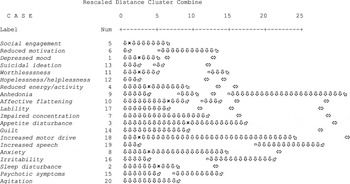
A two-cluster structure of the BDRS was suggested (Fig. 1). The first cluster includes 13 items of depressive symptoms (depressive cluster). The second, eight mixed symptoms (mixed cluster). As expected, the depression cluster was more strongly associated with the MADRS (ρ = 0.91, p < 0.001) than with the YMRS (ρ = 0.64, p < 0.001). The mixed cluster was more closely related to the YMRS (ρ = 0.74, p < 0.001) than to the MADRS (ρ = 0.63, p < 0.001). The subscales were correlated (ρ = 0.66, p < 0.001). Cronbach's α was 0.90 for the whole scale, 0.89 for the depression subscale and 0.74 for the mixed subscale.
Dendogram showing cluster solution for the Bipolar Depression Rating Scale in 71 Brazilian patients with bipolar depression.

We believe that the excellent reliability and the meaningful two-cluster solution indicate sufficient validity for the use of the Portuguese version of the BDRS. In the original validation study, Berk et al. found a three-factor solution for the scale Reference Berk, Malhi and Cahill(7). The structure we found, however, was clearly interpretable in terms of what the scale intends to measure. Similar to the original version, we found a strong correlation with the MADRS and a somewhat less strong one with the YMRS. Furthermore, a Korean study found a very similar two-cluster solution. This should be taken as further evidence for the validity of the scale.
Transcultural validations are increasingly being called for, as they are necessary for international multisite observational studies and clinical trials. Scale validation is an iterative process, and certainly international versions of the BDRS should continue to be probed.
Acknowledgments
P. V. S. M. is supported by a doctoral scholarship from Coordenação de Aperfeiçoamento de Pessoal de Nível Superior (CAPES), Brazil. M. B. has received grant/research support from the Stanley Medical Research Foundation, MBF, NHMRC, beyondblue, Geelong Medical Research Foundation, Bristol Myers Squibb, Eli Lilly, Glaxo SmithKline, Organon, Novartis, Mayne Pharma, Servier; has been a consultant/speaker for Astra-Zeneca, Bristol Myers Squibb, Eli Lilly, Glaxo SmithKline, Janssen-Cilag, Lundbeck, Pfizer, Sanofi Synthelabo, Servier, Solvay, Wyeth. B. S. F. is supported by a scholarship from CNPq, Brazil. F. K. has received grant/research support from Astra-Zeneca, Eli Lilly, the Janssen-Cilag, Servier, CNPq, CAPES, NARSAD and the Stanley Medical Research Institute; has been a member of the speakers' boards for Astra-Zeneca, Eli Lilly, Janssen and Servier; and has served as a consultant for Servier. C. S. G. has received grant/research support from CNPq, CAPES, FIPE-HCPA, Endeavour. She has been a paid speaker for Astra-Zeneca. The other authors declare that they have no conflict of interest in the matter.