INTRODUCTION
The signing of the African Union Maputo Declaration in 2003 and the ambition to devote 10% of public expenditure to agriculture has signalled growing policy interest in smallholder-based African agriculture. This policy interest has however failed to increase productivity in the smallholder sector, at least in the short term (Andersson et al. Reference Andersson and Djurfeldtin press; Jirström et al. Reference Jirström, Andersson, Djurfeldt and Djurfeldtin press). Food markets characterised by uncertainty, depressed prices, atomism and prohibitive transaction costs have been identified as major causes of low productivity (Jayne et al. Reference Jayne, Zulu and Nijhoff2006; Poulton et al. Reference Poulton, Kidd and Dorward2006). Figures showing that maize production, although growing in real terms, has failed to keep pace with population growth during the past four decades have led to suggestions by some commentators that the African population is best fed by increased imports of maize (Wood Reference Wood2002) or, as advocated by more recent commentaries, by concentrating investment in domestic large-scale agriculture (Collier Reference Collier2008). In this context attention has also been directed towards non-agricultural sources of rural livelihoods, and tendencies towards what has become known as de-agrarianisation – a situation in which smallholder households are gradually squeezed out of agriculture (Ashley & Maxwell Reference Ashley and Maxwell2001; Bryceson Reference Bryceson, Bryceson and Jamal1997, Reference Bryceson1999, Reference Bryceson2002; Ellis Reference Ellis2005).
Rapid urbanisation and the increasing reliance of rural households on urban incomes has been one focus of such studies, suggesting the declining importance of agriculture to rural livelihoods. Indeed, the United Nation's World Urbanization Prospects predicts that more than half of Africa's population will be living in cities by 2030. Urbanisation and population growth will also lead to population increase in intermediate urban areas and small towns (UN 2006). While urban populations are growing, global food prices especially for staple crops rose rapidly in the closing months of 2007 and early 2008. Although prices have since fallen, over the long term global population increase and rising living standards in populous countries like India and China are likely to increase the demand for food, limiting the possibility of feeding African cities with cheap imports of grains. Africa's urban poor have been especially hard hit by such price rises, and the combination of growing urban populations and rising food prices poses numerous challenges to urban food security and livelihoods. Meanwhile, household level linkages between rural and urban areas are intensifying as a result of increasing population mobility and growing small and intermediate-sized urban areas. Many recent studies point to livelihoods that operate along a rural–urban continuum (Andersson Reference Andersson2002; Bah et al. Reference Bah2003; Cohen Reference Cohen2004; Tacoli Reference Tacoli2006). The combination of growing urban populations, rising global food prices, poorly developed food markets and more dispersed livelihoods may mean that the urban poor will be increasingly fed through domestic production, mediated through the household rather than the market.
In this context, the role of smallholder food production for urban livelihoods as well as the subsistence responsibilities of rural households may be underestimated if the agrarian household level linkages from rural to urban areas are not recognised in national production and consumption surveys and among policy makers. Recent household data from a number of African countriesFootnote 1 points to the existence of household level food remittances that widen the subsistence responsibilities of farm households, both spatially and numerically (Andersson, Reference Andersson and Djurfeldtin press).
This article explores the phenomenon of in-kind remittances and its implications for rural household livelihoods and food consumption. Maize is the focus of the study as it is Africa's largest staple crop, while occupying a special historical role for smallholder production geared towards the market in both colonial and post-colonial times (Bates Reference Bates1989; Ranger Reference Ranger1985).
Explanations for in-kind remittances are sought in theoretical perspectives and literature related to the micro-level interaction between three key social and economic elements and structures: the formal market realm, informalised exchange systems, and the household. In Malawi, recent government efforts to raise smallholder productivity in the maize sector through the introduction of seed and fertiliser subsidies and the revival of government procurement functions occur in the context of largely uncommercialised maize production (Chinsinga Reference Chinsinga2007; Dorward & Chirwa Reference Dorward and Chirwa2008). This raises the question of how in-kind remittances should be interpreted. Should these be viewed as an expression of poorly working markets which necessitate the reliance on non-market based flows of food? Using maize to feed non-resident household members would by this account be explained by poor commercial incentives for maize sellers, as well as lacking consumer confidence on the part of the receivers. Or should remittances instead be seen as an example of households that operate on a multi-spatial basis, not only in terms of production but also in relation to consumption, i.e. with different sub-units or individuals residing in different locations? The purpose of this article is to test these two possible interpretations by exploring the implications of in-kind remittances in the context of Malawi, using a number of theoretical perspectives as a starting point.
Empirically, the interplay between the market, informalised exchange systems and the household will be studied on the basis of micro-level data. First, the relationship between maize remittances (as an example of informalised in-kind exchange) and household participation in formal, cash-mediated market exchange is used to assess whether remittances should be perceived as signs of poorly functioning markets. Second, the article assesses the reciprocal and food security implications for the remitters in order to evaluate the role of remittances as an expression of the consumption side of multi-spatial livelihoods. A sample of 391 households in eight villages in Malawi, interviewed in late 2007, are used to substantiate the discussion.
THEORETICAL FRAMEWORK
Perspectives from three complementary theoretical vantage points are used to frame an empirical discussion of the market, informalised, non-commodified exchange systems and the household. First, literature describing and evaluating the market as an institution can be used to explain the rationale for engaging in non-market transfers. The second body of literature on informalised exchange systems provides an understanding of how such systems operate. The latter literature draws mostly on empirical work carried out outside Africa, and therefore needs to be complemented with literature on the African household and multi-spatial livelihoods (see Andersson Reference Andersson2002).
Market characteristics
Poor market participation is commonly attributed to a number of characteristics of African maize markets as well as production environments in general. Smallholder populations suffer from a range of poverty traps aggravated by the malfunctioning of markets, but related also to the inability to participate in the market. The instability of maize prices, both seasonally and from one year to the next, leads to disinvestment in maize production as the risks associated with such price variations limit the incentive to produce a surplus that can be marketed. Rural consumers meanwhile continue to self-provision, even at very low levels of productivity, as a result of their lack of confidence in the market and its strong seasonality (Dorward & Chirwa Reference Dorward and Chirwa2008). At the regional and national level, explanations for poorly developed markets are also sought in high transaction costs resulting from dilapidated or absent infrastructure and inadequate coordination, which means that pockets of surplus production coexist with shortages. Fafchamps and Minten's (Reference Fafchamps and Minten2001) characterisation of the African grain trade as a ‘flea market economy’ in this respect reaffirms a set of constraints which may prevent market engagement outside the village economy. Such constraints may also to some extent account for the emergence and persistence of non-market based transfers.
Non-market based transfers and informal exchange systems
Theoretically, an understanding of the rationale for engaging in non-market based transfers can be sought from the field of New Institutional Economics and the sub-field of transaction cost economics developed by Coase (Reference Coase1937; Reference Coase1960) and Williamson (Reference Williamson1971; Reference Williamson1979; Reference Williamson1985; Reference Williamson1996). The assumptions of ‘bounded rationality’ and market imperfections are relevant in the context of an African setting in general, and more specifically in relation to the characteristics of grain markets outlined above. The interest in organisational forms which develop as a consequence of such costs and the limited possibilities of obtaining goods through the market are likewise relevant to this discussion (Arrow Reference Arrow and Intriligator1971). While such failure may result in the development of social institutions to compensate for market imperfection (Ensminger Reference Ensminger1992; North Reference North1990), as pointed out by Acheson (Reference Acheson and Ensminger2005), Williamson's work concerns organisations rather than institutions. More specifically it considers how firm owners through various organisational forms have sought to lower transaction costs within a given legal framework. In countries both within and outside the developing world, the role of ethnic allegiances and personal contacts to compensate for information and for lowering transaction costs has been noted in the literature (Acheson Reference Acheson and Ensminger2005; Khavul et al. Reference Khavul, Bruton and Wood2009).
To some extent this literature draws on the classical perspectives of Mauss (Reference Mauss1925), Bourdieu (Reference Bourdieu1977), and a long-standing discussion in economic anthropology on the role of exchange versus markets (Bohannan Reference Bohannan1963; Polanyi Reference Polanyi1957), gifts versus commodities (Gregory Reference Gregory1982) and Sahlins' (Reference Sahlins and Banton1965, Reference Sahlins1972) work on generalised, negative and balanced reciprocity. Guyer's (Reference Guyer1981) review of early anthropological literature on Africa suggests that a preoccupation with social relations limited the understanding of how early African gift economies operated in terms of production and commodity flows. This also holds for current situations.
More recent contributions have sought to demonstrate the economics of systems operating on the basis of both monetary and in-kind currencies. Ledeneva's (Reference Ledeneva1998, Reference Ledeneva2008) work on provisioning in the former Soviet Union and China shows how personalised systems of exchange were used to counteract shortages and complement market relations. Guyer's (Reference Guyer2004) discussion of how institutionally framed practices adapt and relate to monetary shortages and volatility in Atlantic Africa points to the interplay between different kinds of currency, where labour contributions especially play an important role as an alternative to money. While the notion of parallel (rather than separate) currencies and systems based on in-kind transactions is applicable to an African setting, the discussion needs to be framed by a number of additional perspectives. The lack of financial institutions encourages saving in physical forms, such as grain stores or cattle (Aryeetey Reference Aryeetey2004; Guyer Reference Guyer2004). Moreover, such savings may be attractive in highly inflationary environments and markets characterised by strong seasonal price variation. In many cases remittances, whether in cash or kind, should also be considered against the historical backdrop of migrant labour systems which institutionalised peasantries' reproduction of urban labour (Stichter Reference Stichter1982; van Onselen Reference van Onselen1976; Wolpe Reference Wolpe1972). Accounts of in-kind transfers of food from rural to urban areas can be found in the historical literature on food provisioning in African cities (Bryceson Reference Bryceson and Guyer1987, Reference Bryceson1993; Guyer Reference Guyer1987). Generally speaking, however, the literature depicting post-independence relations between rural and urban areas has tended to focus on the importance of urban cash remittances for rural livelihoods.
The African household
The literature on the African household connects to the recent interest in rural urban relations by stressing the contextual influences on households and family relations. Heterogeneous household constellations are in turn related to the spatial, structural and functional circumstances of such relationships (Adepoju Reference Adepoju1997; Guyer Reference Guyer1981; Yaro Reference Yaro2006). While the household as defined by the new household economic approach may be the most immediate structure of decision-making, it also needs to be viewed as part of a web of social and economic relations between members of the extended family (Andersson Reference Andersson2002; de Haas Reference de Haas2006). In an African context, moreover, extended family relations may compensate for missing welfare functions, by supporting the elderly, the unemployed, the ailing or the less advantaged. In this sense, the general preoccupation with the household as a production unit especially in agrarian studies needs to be widened to include also perspectives related to consumption. Some literature on the African family (perhaps misleadingly) suggests that the historically long-standing operation of extra-household support systems is being undermined by external economic pressures (Devereux Reference Devereux1999) and a growing culture of individualism (Bank & Qambata Reference Bank and Qambata1999; Ferguson Reference Ferguson1999). The persistence and perhaps even resurgence of such systems do however need to be considered in a situation in which households have few other resources to bank upon in the event of misfortune.
Rapid urbanisation and generally increasing mobility suggest that approaches drawing on the literature on multi-spatial livelihoods may be a fruitful addition to a discussion not only of the household itself, but also of rural livelihoods. As suggested by a vast literature (Baker Reference Baker1995, Reference Baker1997; Baker & Pedersen Reference Baker and Pedersen1995; Foeken & Uwuor Reference Foeken, Uwuor, Bryceson and Jamal2001, Reference Foeken and Uwuor2008), strategies of rural and urban households and individuals straddling the rural–urban divide carry very different connotations depending on access to economic and social resources. Baker (Reference Baker1995) usefully distinguishes between accumulation and survival strategies. An important consideration in this respect is also the ways in which market-mediated and inter-household rural–urban linkages interact to reinforce or undermine the viability of the household. In-kind transfers need to be considered both as a possible outcome of processes related to non-market based systems (which may in turn be connected to poorly functioning markets), and as the spatialised operation of household support systems.
METHODOLOGY AND STUDY SITES
This article draws on three sets of data. Data was collected in eight villages in Malawi in 2002 as part of a larger project on African agricultural intensification reported elsewhere (Djurfeldt et al. Reference Djurfeldt, Holmen and Jirstroml2005). 400 households were surveyed at the time, and qualitative village-level data collection was carried out to supplement the survey data. A second round of this project was carried out in 2007, when the households were resurveyed. Again, the purpose of the larger survey was to analyse the drivers of smallholder staple crop production in the villages in question (Andersson et al., Reference Andersson and Djurfeldtin press). In relation to maize, a detailed set of questions were posed concerning production, technology and marketing in both 2002 and 2007. A set of questions were added to the household survey in 2007 to cover maize remittances and rural–urban linkages. Information was gathered on the annual amount of maize sent to relatives, as well as the amount of maize collected by relatives. In the presentation below, these amounts have been grouped together and are collectively discussed as in-kind remittances of maize. Since the questions on maize remittances were not included in the 2002 questionnaire, only household data from the 2007 cross-section is used in this article.
Household level survey data is complemented with qualitative village-level data collected in 2002, as well as qualitative data on perceptions of the Agricultural Input Supply Programme, crop patterns and rural–urban linkages collected in three of the villages (Ntonda, Linthipe, Malomo) in July 2008. In-depth interviews were conducted with fifteen heads of households which had been surveyed in late 2007.Footnote 2
Village sampling followed a multi-stage purposive sampling design. Original sampling aimed to shed light on the possibilities for intensified smallholder agricultural production in Africa as a whole, with data collected in nine countriesFootnote 3 in the African maize and cassava belt. Since the purpose of the project was to analyse intensification potential, countries as well as regions within countries were purposively sampled in areas that were deemed to be above the average in terms of ecological and market access, but excluding the most vibrant local rural economies. Given this overarching criterion at the national level, sites within countries were sampled to provide variety in terms of agricultural and economic dynamism. In the case of Malawi, four regions were purposively sampled: one with close links to an urban area but with relatively poor production potential in Blantyre District (Southern Region); one in the tobacco producing area in Ntchisi District (Central Region); one in the relatively high-potential area of Dedza District (Central Region); and one in the rice producing heartland of Chiradzulu (Southern Region). Eight villages in total were sampled: Kalira and Malomo in Ntchisi District, Linthipe, Kabwazi, Golomoti and Mtakataka in Dedza District, Mombezi in Chiradzulu District, and Ntonda in Blantyre District. In each village households were sampled randomly, meaning that the sample is representative at the village level. Although the use of the household as a unit for data collection is in some respects problematic, presuming that decision-making and control of resources is made on a household basis while also obscuring intra-household dynamics, it also has advantages (Chant Reference Chant1997; Guyer Reference Guyer1981; Udry Reference Udry1996). For reasons of cross-country comparability the household, as defined by residence, has been used as the data collection unit, with interviews carried out with the household head.
BACKGROUND: MAIZE PRODUCTION AND RURAL LIVELIHOODS IN MALAWI
Maize constitutes the primary staple of the rural population in terms of diets as well as cropping patterns (Ellis et al. Reference Ellis, Kutengule and Nyasulu2003). Although some observers suggest a growing role for cassava as a component of both rural and urban diets (Haggblade & Zulu Reference Haggblade and Zulu2003; Jayne et al. Reference Jayne, Zulu and Nijhoff2006), maize dominates smallholder cropping patterns. The ratio of maize growers varies from 93% to 99% in the country's four regions (Dorward & Chirwa Reference Dorward and Chirwa2008). During the past four decades farm sizes have halved, mainly as a result of population growth, with 80% of smallholdings comprising less than 1 ha of land (Jayne et al. Reference Jayne, Zulu and Nijhoff2006). Low and falling soil productivity aggravated by lacking income to purchase inputs have during the past decade led to a reliance on low-input agriculture and to severe food insecurity problems, as well as dependence on imports of maize mainly from South Africa and informally from Zambia, Tanzania and Mozambique (Jayne et al. Reference Jayne2010; Minde et al. Reference Minde2008).
Following severe food shortages during the 2004/5 growing season, the government despite initial donor resistance introduced the Agricultural Input Supply Programme (AISP) in the 2005/6 season. The major aim of the AISP at the time was to improve smallholder productivity and food security, with a secondary aim of promoting national food self-sufficiency. To some extent, the AISP represented the resurrection of earlier agricultural policies which as in many African countries had consisted of universal fertiliser subsidies, coupled with subsidised smallholder credit and regulated maize markets. The breakdown of this system in the mid 1990s and the fall in fertiliser use and maize production prompted more limited and erratic policy measures during the late 1990s as well as irregular price interventions (Dorward et al. Reference Dorward2007). Following a somewhat rough start, related mainly to the lack of private sector involvement as well as poor weather conditions, the AISP was fine-tuned on the basis of such experiences and continued into the 2006/7 season (Minde et al. Reference Minde2008). The criteria for receiving subsidised fertiliser have changed between the seasons, such that the targeting recommendations were altered to select households of productive full-time farmers. Dorward et al.'s (Reference Dorward and Chirwa2008) evaluation of the 2006/7 programme also suggests that these recommendations were followed to some extent, since recipients of subsidies were overrepresented among the wealthier households, while wage, remittance and poor female-headed households received fewer coupons.
Given the extremely favourable weather during the 2006/7 growing season, the role of the AISP in itself in raising maize production has been debated (Chinsinga Reference Chinsinga2007; Dorward & Chirwa Reference Dorward and Chirwa2008). Nonetheless, the improvements to the programme in combination with the weather resulted in what was initially assumed to be a record harvest in 2007, with the government estimating production at 3·4 million tons, well in excess of domestic requirements of 2·0 million tons. A number of incidents, however, shortly afterwards led to a reconsideration of the record harvests as an overly optimistic government estimate. The government failed to secure enough maize for government-tendered exports, and domestic food prices rose rapidly. Exports were subsequently suspended and the government was forced once again to resort to imports from neighbouring countries. Indeed, domestic prices outstripped regional food prices by US$100–50 per tonne in early 2008, and local maize shortages as well as rationing by the marketing board ADMARC were observed (Minde et al. Reference Minde2008).
Most smallholders figure within the Malawian maize market, despite policies directed at increasing input use and improving productivity, as consumers. Indeed, only 10% of Malawian maize growers are net sellers, with 60% being net buyers. Of these in turn, 56% bought but did not sell any maize. Fewer than 15% of producers participated as sellers in the maize market; hence the very large majority, 85%, did not market any of their production (Dorward & Chirwa Reference Dorward and Chirwa2008).
Poor market participation is commonly attributed to a number of characteristics of the Malawian maize market as well as the production environment in general. Malawi's smallholder population suffers from a range of poverty traps aggravated by the functioning of markets, but related also to the inability to participate in the market as sellers. The lack of income-earning opportunities outside staple-based agriculture, or agriculture as a whole, in conjunction with poorly functioning staple markets, moreover means that many households are forced to rely on casual labour – ganyu in Chichewa – to ensure their access to food (Minde et al. Reference Minde2008).
EMPIRICAL RESULTS AND ANALYSIS
Production systems and income composition in the villages
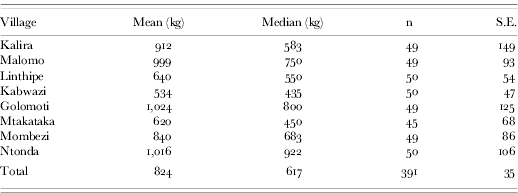
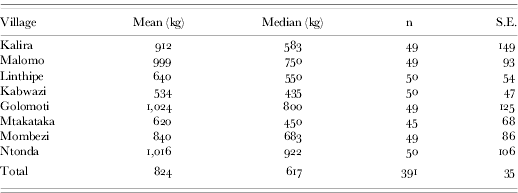
In many respects the sampled population reflects the national patterns described above. Female-headed households are in the minority, varying from 14% of the total sample population in Linthipe and Malomo to 35% in Mombezi. Land sizes are small, but vary considerably from 0·7 ha to 2·2 ha, with the largest average land size by far found in Malomo. Although maize dominates, cropping patterns are relatively diverse in terms of staples produced. The relative dependence on the different staples as sources of food and income varies among the villages, but production of maize is universal. Production levels among the sampled farmers are likewise low, although they differ somewhat among the villages in question (see Table 1).
Mean and median household maize production, kg (2006–8 average) per household, by village
Source: Own survey data (2007).
Differences in production are in some cases reflected in technology use and input intensity. The proportion of farmers using hybrid or improved maize varieties ranges from 22% in Kabwazi to 76% in Ntonda. Despite the introduction of the AISP, fertiliser use is relatively low in most villages, from 12% of households in Golomoti to 52% in Ntonda. The exception here is Mombezi, where 82% of smallholders use chemical fertiliser. Since the use of fertiliser generally is more widespread than the use of improved maize varieties, chemical fertiliser is in many cases being used on traditional maize varieties. This is likely to be suboptimal in terms of yields, since these do not respond to fertiliser to the same extent as improved varieties.
Sweet potatoes constitute an important supplement to maize in dietary patterns in all the villages, and have a complementary role in relation to the maize production cycle as they are planted on the maize field post-harvest. Relatively drought resistant, sweet potatoes also have the advantage of keeping in the ground for up to six months. They were grown by between 29 and 65% of the sampled farmers, except for the village of Mtakataka, where rice is grown by all farmers. Cassava was the next most important complement to maize.
In terms of income sources, maize was reported to be sold by a third of the sample, with commercialisation most pronounced in Malomo and Ntonda. As suggested also by the literature, maize is therefore used mainly for own consumption, and commercialisation levels are low. In contrast, the rice producing villages, Mtakataka and Golomoti, stand out as most reliant on staple sales, with the large majority (91% and 79% respectively) of rice growers selling all or part of their produce. In these villages, rice can be considered both a staple and a cash crop. For the sample as a whole, staple sales represent less than a fifth of average cash income. A variety of indicators reflecting local market development since 2002 suggest that the large price increases noted at the national level in 2005/6 as well as early 2008 (Minde et al. Reference Minde2008) have bypassed the villages. Only a handful of households reported increased maize sales or sale price improvements since 2002. In some respects this may be related to the income patterns noted above, and the nature of the sample which deliberately sought to target villages with varied crop patterns. Households in the rice and tobacco-producing villages may have been less sensitive to price changes in the maize markets. Another source of error may be the survey question which compared the situation at two points: the time of the interview in 2007 to the time of the interview in 2002, providing little information on price changes during the period.
Despite the limited earning opportunities for incomes outside the staple crop sector noted by Dorward & Chirwa (Reference Dorward and Chirwa2008) among others, sale of other food crops is the most important source of cash income for nearly 30% of the total sample. Only in one village, Malomo, does sale of non-food cash crops contribute significantly to cash incomes, with 33% of mean household income being sourced from such sales. Tobacco constitutes the most important cash crop in the village. Salaried non-farm employment is generally unimportant, except for two villages, Mombezi and Ntonda. Remittances from non-resident household members are also relatively minor, with only 3% of households stating that this was their main source of cash income. Despite reports of de-agrarianisation tendencies (see Bryceson Reference Bryceson1999, Reference Bryceson2002), only 13% of average cash income was derived from small-scale micro-business. The data collected did not cover incomes in kind, and therefore incoming ganyu payments in kind are not possible to trace among the respondents.
A number of constraining factors were reported in the community-level discussions in all of the villages in 2002. Labour constraints arising from food shortages leading to casual work for food (ganyu) in the villages affect agricultural production in all villages. Although labour migration as such was not pronounced, except in Ntonda, ganyu in itself can inhibit production through the loss of labour. Production is entirely hoe-based, and the labour-intensive nature of cultivation means that labour shortages are at times severe, especially for female-headed households (Kadzandira Reference Kadzandira2002). The low prices paid for agricultural produce by vendors who trade in the villages were generally cited as major constraints to production. On the input side, awareness of fertiliser and seed was not translated into practice due to lack of income, and farmers identified input constraints as severe. The 2008 qualitative data reaffirmed these constraints, but also pointed to the generally positive view of the AISP and government efforts to improve access to fertilisers and seeds. All the interviewed farmers suggested that livelihoods had improved in the villages since the introduction of the AISP.
Maize remittances
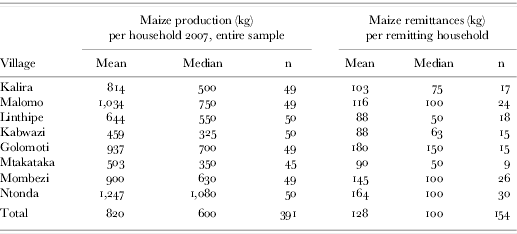
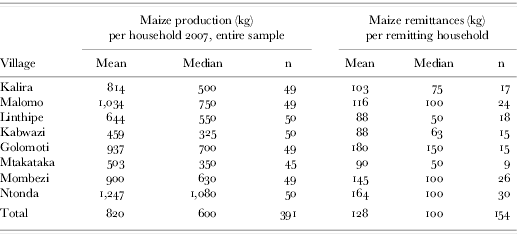
In spite of differences in production and income portfolios, the number of maize remitters in each village varies between 30 and 64% of farmers. The average size of maize remittances is highest in Golomoti and Ntonda (see Table 2). 176 households in the sample also remitted cassava, although the remitted amounts varied, but were generally small. In the rice producing villages, Mtakataka and Golomoti, maize remittances were supplemented by relatively large rice remittances, especially in the case of Mtakataka, where average rice remittances were nearly 80 kg. In addition, slightly less than half of all households (regardless of whether they remitted maize or not) sent non-staple food stuffs to their relatives. For the sample as a whole, 46% of the households remitted one or more food stuffs.
Mean and median maize production per household (2007) for all households and maize remittances by village for remitting households
Source: Own survey data (2007).
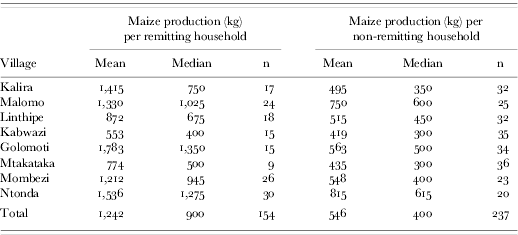
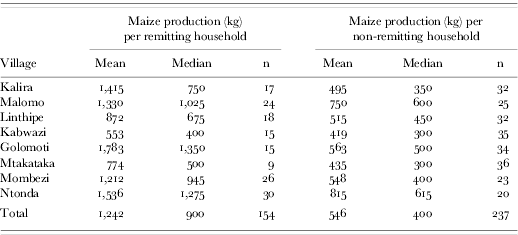
The maize remitters are generally found among households with higher levels of production, being overrepresented in the higher production quartiles (see Table 3). In the fourth quartile roughly 70% of households remitted maize. The proportion of household production that is remitted is however highest among households in the first production quartile, with nearly a third of total household production being remitted among the remitting households. In relative terms, substantial amounts of total production is remitted, varying from 9 to 31% with the proportion inversely proportional to total production. Amounts remitted range from 61 kg per household in the bottom quartile to 188 kg in the fourth quartile.
Mean and median maize production per household (2007) for remitting and non-remitting households
Source: Own survey data (2007).
Markets and informal exchange: in-kind remittances and commercial behaviour among rural households
As suggested above, the constraints of African grain markets may explain the engagement in informal exchange both on the part of the remitter and the receiver. On the part of the remitter, investment in social networks may at least theoretically be considered as an understandable alternative to formal commercial transactions, given the poor commercial incentives for maize sellers. Such investments can pay off through reciprocal arrangements in cash and kind, through incoming cash and in-kind remittances, political allegiance or labour contributions. Similarly, at the receiving end, urban households' reliance on informal access to food may indicate the failure of urban food markets to meet urban demand at a price affordable to consumers (Andersson Reference Andersson2002).
For the rural senders, the relationship between remittances and market participation would be expected to be negative if remittances are indeed an alternative use of a commodity which would have been sold under more favourable market conditions. In other cases, remittances may function as a residual to sale, if for instance food is remitted that would otherwise have been wasted due to limited storage facilities for instance.
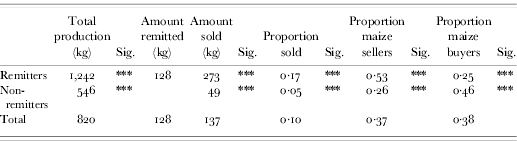
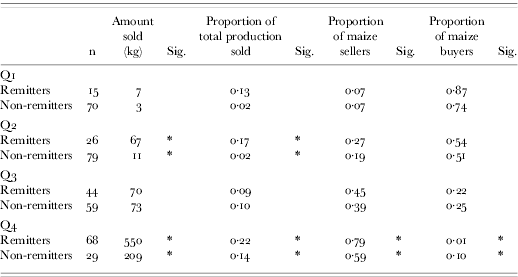
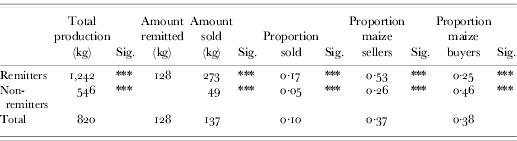
Generally speaking commercialisation is low, both among remitters and non-remitters, but contrary to what might be expected on the basis of the theoretical perspectives outlined above, it is significantly more pronounced among remitting households. As suggested by Table 4, this is the case when commercialisation is considered in terms both of market participation and of amounts and proportions sold. Indeed the differences are striking among the two groups and in statistical terms strongly significant, with more than half of the remitting households selling maize, compared with around a quarter for the non-remitters. The proportion of maize buyers likewise is much lower for remitting households. Sending remittances therefore does not appear to directly undermine commercial participation among remitting households. Indeed, the amount both remitted and sold is correlated to total household production. For the sample as a whole the correlation between production and sale (Pearson's r=0·751, significant at the 0·01 level) is stronger than that between production and amount remitted (Pearson's r=0·492, significant at the 0·01 level).
Mean household maize production, amounts remitted, amounts sold, proportion sold and proportion of maize sellers and buyers among remitters and non-remitters of maize
Source: Own survey data (2007).
Note: Statistical significance is tested for differences between remitters and non-remitters throughout:
* significant at the 5% level; ** significant at the 1% level; *** significant at the 0·1% level.
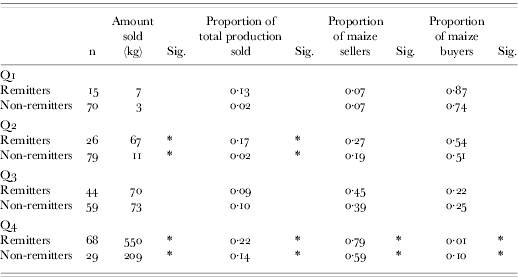
However, breaking down the data only on the basis of whether households remit or do not remit maize obscures important variation within the sample. As both the amount remitted and the frequency are closely related to the amounts produced, it makes sense to divide the sample further, by production quartiles. When this is done (see Table 5), most of the significant differences between the two groups disappear, and these remain for all variables only in the uppermost production quartile, where the remitters are also overrepresented (sixty-eight out of ninety-seven households in the fourth production quartiles were remitters).
Commercialisation among remitting and non-remitting households divided by maize production quartiles
Source: Own survey data (2007).
Note: See note to Table 4.
Remittances as such are therefore not connected to lower levels of commercialisation, suggesting that the explanation for remittances should be sought in the production and consumption patterns of households, rather than in their commercial behaviour. Moreover, the small proportion of maize-buyers in the uppermost quartile (see Table 5) suggests that households which do remit maize in this quartile are among the more food-secure. The ability to engage in remittances may therefore also be connected to characteristics of the households themselves which make possible both remittances and market participation, as well as higher production levels.
Remittances as an expression of multi-spatial livelihoods?
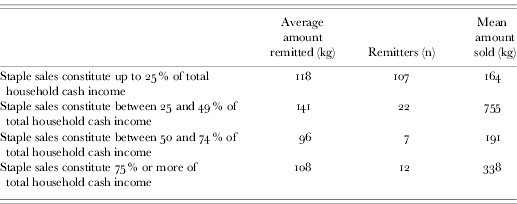
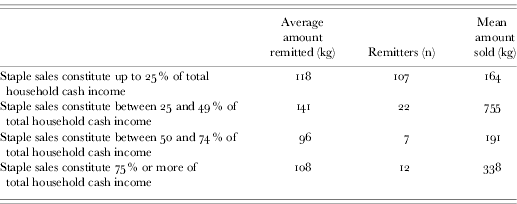
The role of maize as a crop grown mainly for consumption by both resident household members and non-resident relatives is underscored by the cash income composition of the households. The remitters, like the rest of the sample, have cash incomes that are predominantly non-staple based, with 107 out of 148 remitters earning less than 25% of their cash income from staple sales (see Table 6). Remitting households therefore appear to earn their income primarily outside the staple crop sector, while using their excess production to feed family members outside the village.
Distribution of remitters in relation to household composition of cash income by proportion of staple sales, showing average amount remitted, number of remitters and mean amount sold per remitting household
Source: Own survey data (2007).
Note: The table only includes households with a recorded cash income, hence the differences in frequencies in relation to Table 4. Three of the remitting households in the first group (where staple sales constituted up to 25% of total household income) did not sell anything.
Average household cash income is remarkably higher among remitters: 45,140 Malawi Kwacha (MKw) compared with 26,550 MKw among non-remitting households (significant at the 0·1% level).Footnote 4 When disaggregated by production quartiles, this difference is only statistically significant (at the 5% level) in the fourth quartile, where the average household income is 65,404 MKw for remitters, compared with 37,851 for non-remitters. This striking difference in average income between remitters and non-remitters suggests that the explanation for remittances may be found both in differences in production levels and also in the higher cash incomes of the remitting households. This underscores two major characteristics of the smallholder sector in general: the poor commercial environment for staple crops where income-earning opportunities are better outside the maize sector, and the price volatility facing the rural consumer which prompts even the wealthier households to continue growing maize for their own consumption.
The role of the remitting household as an extended unit of consumption is interesting in this context. Although remittances may not be directly undermining commercial participation among the co-resident household members, subsistence obligations or gifts to non-resident family members and relatives may limit the ability of the rural household to rely entirely on subsistence production. Although remitters are overrepresented in the fourth quartile, the proportion of maize buyers in each quartile (see Table 5) is roughly the same between the two groups, except for the fourth quartile. This in turn suggests that the remitting households in the fourth quartile operate on a multi-spatial basis, in large measure because they are able to provide support to family members outside the village. As suggested by Barrett (Reference Barrett2008), autarky in terms of food security remains the preserve of households with sufficient resources to avoid the market, and in these instances such households appear to stretch their subsistence obligations outside the immediate household to provide some measure of autarky also for non-resident family members.
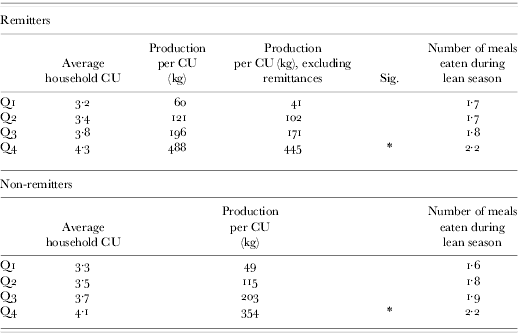
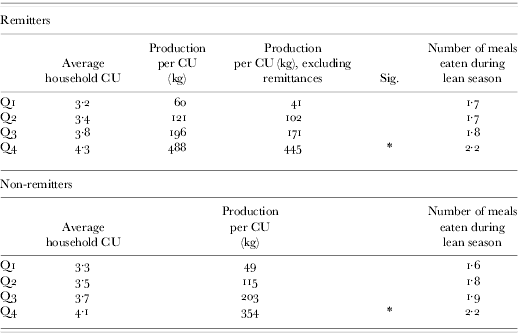
Whether remittances should be seen as a way of providing support for non-resident relatives can in some measure be evaluated by analysing the interplay between the consumption needs of the resident household and the size and direction of remittances. Table 7 details average production in relation to the consumption units of the household.Footnote 5 Remitting and non-remitting households contain almost identical numbers of consumption units, but among the two first production quartiles, production per consumption unit is slightly higher among the remitters. To permit comparison between remitting and non-remitting households, the amount remitted has been deducted from the total household production of the remitters and presented in the fourth column from the left (Production per CU excluding remittances). As suggested by the table, remittances take out a relatively large proportion of total production for already food-insecure households, pushing them below their non-remitting counterparts in terms of maize production per consumption unit. Production per consumption unit is higher among remitters than non-remitters only in the fourth quartile.
Average household consumption units, production per consumption unit and household food security of remitting and non-remitting households divided by maize production quartiles
Source: Own survey data (2007).
Note: See note to Table 4.
Remitters thus appear to be forfeiting their own consumption needs, and only in the third and fourth quartiles are they able to fulfil the FAO annual consumption norm of 117 kg of maize. As suggested by the number of meals eaten during the lean season, however, households in all the production quartiles fail to eat three meals per day, and the lack of food security is a striking feature of the sampled households in general, although the average number of meals eaten was slightly higher among the remitters.
The sending of remittances appears to point in two different directions on the part of the senders: on the one hand the most affluent and food-secure households engage in remittances as a widening of family consumption over space, without compromising the resident household's ability to feed itself. On the other hand, the more vulnerable households undermine the food security of the co-resident household unit to support family members outside the village. From the receivers' point of view, in-kind remittances may hold important food security implications for households constrained by land, income or other productive resources, while also enabling a degree of disengagement from the seasonality and unpredictability of the market as a source of food.
Informalised exchange, alternative currencies and reciprocity
As suggested by the theoretical overview, scholarly work on informalised, personalised exchange and alternative currencies situates and analyses the role of institutions and informal exchange systems emanating from malfunctioning markets or situations characterised by shortages especially. In-kind transactions (whether conducted through services, favours or material goods) as well as reciprocal arrangements are an important aspect of such parallel systems. In the data reported above, both the nature of localised maize markets and the existence of remittances seem to point to the operation of such systems. Whether remittances should be viewed as one of many outcomes of an informalised system of exchange in which maize is used as an alternative currency is however questionable.
First, the use of maize as an alternative currency seems to be limited. Despite the well-known phenomenon of using maize as payment for labour, the widespread practice of ganyu, and the dominant role of maize in local dietary patterns, the use of maize as payment for labour was comparatively limited. Thirty-four remitters used maize as labour payment, but the amounts involved were relatively small. In total, fifty-five households used maize to pay for labour, but the mean payment was only 27 kg, compared with the average 128 kg used as remittances. Remitting households reported hiring labour more frequently than non-remitters, with 41% of remitters regularly hiring farm labour, compared with 19% for non-remitters (significant at the 0·1% level). Such labour appears however to be paid predominantly in cash rather than in kind. When compared with remittances, both the amounts and the number of persons using maize to pay for labour were limited, and remittances were the major in-kind use of maize reported by households. Second, and most important, remittances as such do not constitute an explicit exchange relation, although they may carry latent expectations of reciprocity. Since it seems to occur within families, generalised exchange in Polanyi's terminology seems to predominate. In this sense, the wider family network may be able to cushion economic hardship for individual households. Nonetheless, as suggested above, remitters are overrepresented among the upper production and income-levels, and as such are less vulnerable than those who do not remit maize. In terms of directions, remittances were occurring less to immediate family members than to more distant relatives: only one household was listed as de facto female-headed, with an absentee husband working outside the village. Incoming cash remittances moreover were disproportionately directed to households that did not remit maize. Only 15% of maize remitters received cash remittances in return, hence direct reciprocity was not pronounced. Likewise, the use of exchange labour was largely the same between remitters and non-remitters (17% and 13% respectively, with the difference not being statistically significant between the two groups), suggesting that remittances are not reciprocated through family labour. On the basis of the qualitative interviews, the flow of other goods into the rural household unit, such as agricultural inputs or other foodstuffs, is not widespread, although data was not collected to verify this in the larger survey. This limited reciprocity points to an arrangement directed primarily towards supporting non-resident family members, rather than a system of informalised exchange. Related evidence on household food expenditure in the upper income quintile from Ghana suggests that an apparent contradiction of Engel's law among these households may hide food expenditures connected to family members and relatives outside the immediate household (Guyer Reference Guyer2004; Hill Reference Hill1957, Reference Hill1958; Udry & Woo Reference Udry and Woo2007).
The impression that remittances are part of a support system that stretches outside the co-resident household is reaffirmed by the number and nature of destinations for remittances. Thirty per cent of the remitting households sent remittances to more than one destination. Given this relatively large number of destinations, the amount remitted to each receiver is likely to be relatively small, and cultural aspects of remittances may explain why households spread their remittances thinly among a number of destinations.
Remittances are also predominantly directed towards rural destinations, especially in surrounding rural areas. Indeed, 52% of the remitters reported that maize was being sent or collected by relatives in neighbouring villages, and an additional 17% went to relatives in other rural areas. Since the survey aimed to cover multi-spatial aspects of remittances, within-village transfers of food among family members were not included, potentially underestimating the redistributive role of remittances.
Remittances may to some extent even out production differences between the relatively food-secure and the food-insecure within the context of the wider household network, but they may also exist as a result of poor production potential in surrounding rural areas. The details of how remittances are distributed according to lineage, age or gender were not covered in the survey, however, and are difficult to analyse for this reason.
While rural–rural linkages have received little attention in the literature, numerous studies of the role of urban remittances to rural livelihoods attest to the traditional connection between rural and urban areas throughout the African sub-continent (Bah et al. Reference Bah2003). In Malawi, rapid urbanisation has characterised the period since the mid 1990s. According to the World Bank's (2009) development indicators, the urban population growth rate averaged 5·2% between 1995 and 2007, compared with 2·1% for the rural population. The urban population comprised 18·3% of the total in 2007, compared with 13·0% in 1995. Although the urban poverty headcount rate at 54·9% (in 1997) was considerably lower than its rural equivalent of 66·5%, measuring changes in poverty levels is difficult due to the lack of time series data. Unlike other African countries, notably Kenya and Zambia (World Bank 2007; Foeken & Uwuor Reference Foeken and Uwuor2008), where urban recession has led to rural return migration, urban population growth in Malawi shows no signs of abating. To some extent, this rapid urbanisation is reflected in the direction of remittances, with 23% of remitters reporting that they sent maize to relatives in towns both within and outside the district, while 16% remitted maize to Lilongwe. Given the projections of rapid urban growth in combination with long-term upward pressures on urban food prices and the limited possibilities for self-provisioning in urban areas, the destination of remittances is likely to be more urbanised in the future. Whether food remittances will be able to abate both urban and rural food insecurity among less food-secure relatives depends in large measure on increased smallholder productivity among the remitters.
* * *
Disregarding food remittances in household economic surveys leads to a number of sources of underestimation. Most obviously, the contribution of smallholder agriculture to urban food security may be undervalued as a result of the invisibility of intra-household linkages between the rural and urban sectors. Food remittances in this sense constitute an important element of the African smallholder sector which is obscured in surveys and studies. While the general contribution of the domestic smallholder sector to urban food security may be underestimated if remittances are not considered, the consumption levels of the rural household unit may also be underestimated if in-kind contributions to non-resident family members are not covered in studies of rural food security.
The focus in most studies of rural–urban linkages has been the role of accumulation versus survival-based livelihoods. In the case presented above, the remitters would in this narrative in most cases be found in the accumulative slot by virtue of higher incomes and larger production. The traditional focus on the production side of livelihoods, especially in agrarian studies, may however also underestimate the redistributive function of remittances and the importance of food transfers in improving the food security of more vulnerable family members and relatives.