Introduction
Attachment refers to an affective relationship that in infancy aims at maintaining proximity to a caretaker to maintain safety.Reference Bowlby1 It is regarded as an innate propensity and evolutionarily functional as it promotes survival. Attachment relationships formed with the primary caretaker in infancy and early childhood may have a long-term influence on adulthood relationship styles, carried by generalized representations, or working models of close relationships formed during the childhood years.Reference Bowlby1–Reference Waters and Merrick4 A secure childhood and adulthood attachment pattern is important in promoting the physical, psychological, and social well-being of an individual, while an insecure attachment pattern may have opposite effects.Reference Maunder and Hunter5–Reference Raikes and Thompson9
Severely preterm birth may pose a challenge to the development of early attachment relationships. It is often accompanied by neonatal complications and weeks, often months, spent in neonatal intensive care units.Reference Ward and Beachy10 Together with parental distress that may follow preterm birth,Reference Singer, Salvator and Guo11, Reference Miles and Holditch-Davis12 this may elicit differing parenting behaviors,Reference Zelkowitz, Papageorgiou, Bardin and Wang13, Reference Feldman14 which may be aggravated by immaturity-related behaviors that characterize preterm infants.Reference Weiss, Jonn-Seed and Wilson15–Reference Langkamp and Pascoe17 Another explanation for potential alterations in attachment development of preterm infants could be related to the cause of preterm birth, for example, conditions associated with intrauterine growth restriction (IUGR). The distinction between the effects of preterm birth and IUGR may be important from the perspective of developmental origins of health and disease since while both conditions are associated with a wide variety of mechanisms that link early life conditions with adult health and disease,Reference Kajantie, Dunkel and Turpeinen18–Reference Hay22 some of the mechanisms are shared and some more specific to each condition. For example, IUGR is characterized by glucocorticoid overexposure and hypoxia,Reference Kajantie, Dunkel and Turpeinen18, Reference de Boo and Harding20 whereas characteristics of the neonatal period after preterm birth may include at least temporarily low hypothalamic–pituitary–adrenal axis activity, undernutrition and protein deficiency.Reference Fernandez and Watterberg21, Reference Hay22 Thus, attachment alterations that are present regardless of the etiology of preterm birth may reflect postnatal conditions experienced by both infants with or without IUGR, whereas outcomes that are specific to IUGR may rather reflect consequences related to mechanisms operating during pregnancy.
Empirical evidence concerning attachment between parents and their premature infants is not consistent, however. Mangelsdorf et al.Reference Mangelsdorf, Plunkett and Dedrick23 have reported that preterm infants more often showed an insecure pattern of attachment than full-term infants; Sajaniemi et al.Reference Sajaniemi, Mäkelä and Salokorpi24 found an overrepresentation of atypical attachment patterns in 4-year-old children born severely preterm, and Goldberg et al.Reference Goldberg, Perrotta, Minde and Corter25 reported that even among infants who were categorized as securely attached, those born preterm showed more resistant and avoidant behaviors in comparison to children in a normative data set. However, not all studies have found altered attachment patterns in preterm infants.Reference Frodi and Thompson26–Reference Rode, Chang, Fisch and Sroufe28 Beyond childhood, Lubetzky and GilatReference Lubetzky and Gilat29 showed that 14–16-year-old adolescents with birth weight less than 1600 g scored lower than their peers born full-term at normal birth weight on self-reported attachment security related to close/romantic relationships, but the groups did not differ in self-reported dimensions of attachment-related anxiety or avoidance. Further, recent observations from Europe and North America have shown that young adults born severely preterm are less likely to engage in romantic relationships, start a family and produce offspring than their peers born at term.Reference Hack, Flannery and Schluchter30–Reference Swamy, Ostbye and Skjaerven34
Whether severe prematurity is associated with attachment patterns in adulthood is not known. Accordingly, we examined if patterns of attachment in romantic relationships differed between young adults born with very low birth weight (VLBW; <1500 g) and their counterparts born at term. We also assessed whether the effects were modified by sex or being born small for gestational age (SGA), which is used as a proxy of IUGR.
Method
Participants
The original study cohort consisted of 335 VLBW infants who were born between February 1978 and November 1985, treated in neonatal intensive care units of the Children’s Hospital at Helsinki University Central Hospital in Finland and discharged alive (survival rate 70.7%). We collected a control group from the hospital records by selecting for each VLBW infant the next singleton infant with the same birth hospital and same sex and who was born at term (gestational age of 37 weeks or above) and appropriate for gestational age (AGA, birth weight for gestational age greater than −2 s.d. according to the Finnish birth weight chartsReference Pihkala, Hakala, Voutilainen and Raivio35).
The early phases of the study cohort and recruitment of the participants in adulthood have been described in detail.Reference Hovi, Andersson and Eriksson36, Reference Räikkönen, Pesonen and Heinonen37 In brief, of all cohort members who were traced in their early adulthood, those 255 VLBW and 314 control adults living in the greater Helsinki area were invited to clinical visits and 166 (65.1%) and 172 (54.8%) of them, respectively, participated at an average age of 22.4 years (range 18.5 to 27.1). In conjunction with the clinical visit, the participants were asked to complete a questionnaire concerning their attachment behavior. Adequately completed questionnaires were received from 162 VLBW and 172 control adults.
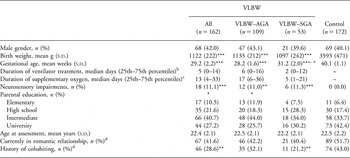
Of the VLBW participants, 53 (32.7%) were born SGA. Among the VLBW group, median age at discharge from birth hospital (25th to 75th percentile) was 70 days (53–90); since many children were discharged home from a step-down unit, the exact date of discharge home was not available for 70 infants. With regard to neonatal complications and treatments among the VLBW participants, 12 (7.4%) had septicemia, 46 (28.4%) received indomethacin and 8 (4.9%) underwent surgery because of patent ductus arteriosus, and 26 (16.0%) underwent blood exchange transfusion because of hyperbilurinemia. In addition, 28 (17.3%) participants were diagnosed with bronchopulmonary dysplasia. A summary of other characteristics of the participants is shown in Table 1.
Descriptive characteristics of the VLBW and control groups

VLBW, very low birth weight; SGA, small for gestational age.
aP < 0.001 in comparison between the VLBW–AGA and VLBW–SGA groups.
bInformation missing for 1 VLBW–AGA and 2 VLBW–SGA participants.
cInformation missing for 5 VLBW–AGA and 3 VLBW–SGA participants.
dInformation missing for 1 VLBW–SGA participant.
*P < 0.05; **P < 0.01; ***P < 0.001 in comparison with the control group.
The neonatal characteristics were collected from hospital records and adult characteristics from questionnaires and data gathered in conjunction with the clinical visits. Every participant gave a written informed consent and the study protocol was approved by the Ethics Committee for Children and Adolescents’ Diseases and Psychiatry at the Helsinki University Central Hospital.
Assessment of romantic attachment
Attachment was assessed with the 36-item Experiences in Close Relationships Questionnaire – Revised (ECR-R),Reference Fraley, Waller and Brennan2 measuring two dimensions of adult attachment in romantic relationships. Dimension of attachment-related anxiety (18 items) measures concerns about being rejected or abandoned by the partner and is suggested to reflect a negative working model of the self.Reference Brennan, Clark and Shaver38, Reference Bartholomew39 Dimension of attachment-related avoidance (18 items) measures discomfort being close to others and avoidance of intimacy. Correspondingly, it is proposed to reflect a negative model of others.Reference Brennan, Clark and Shaver38, Reference Bartholomew39 Positive models of both self and others (i.e. low levels of attachment-related anxiety and avoidance) are suggested to be related to secure attachment, whereas negative models of self and/or others (i.e. high levels of attachment-related anxiety and/or avoidance) are suggested to be related to insecure attachment.Reference Bartholomew39 Each item of the ECR-R is rated by a respondent on a scale from 1 (strongly disagree) to 7 (strongly agree). The ECR-R is shown to have good psychometric properties in measuring avoidance and anxiety in adult romantic attachment.Reference Fraley, Waller and Brennan2, Reference Sibley, Fischer and Liu40 Cronbach’s alphas in the current sample were 0.91 for anxiety and 0.87 for avoidance.
Statistical analyses
Individual sum scores were calculated for both scales. Owing to skewness of the sum score distributions, we used logarithmic conversions in multiple linear regression analyses to examine the group differences. We compared the control group with the VLBW adults as one group and with the VLBW-AGA and VLBW-SGA adults separately. We also compared the VLBW-AGA and VLBW-SGA groups with each other. All analyses were adjusted for potential confounding variables, which included sex, age, parental education, and whether the participant was currently in a romantic relationship. Sex interactions were examined by entering sex, VLBW/SGA/AGA status and their interaction term to the regression equation as predictors. If a statistically significant sex interaction was found, we analyzed men and women separately. Finally, we examined whether the results stayed similar after excluding the VLBW participants with neurosensory deficits including cerebral palsy, developmental deficit, blindness, and deafness.
Results
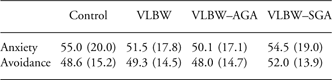
Group-specific means and standard deviations (s.d.) for original, untransformed sum scores in attachment-related anxiety and avoidance are presented in Table 2. Correlation coefficient between attachment-related anxiety and avoidance was 0.48 (P < 0.001). From confounding variables, current romantic relationship correlated negatively with attachment-related anxiety and avoidance (Pearson’s correlation coefficients −0.39 and −0.30, respectively, P-values <0.001).
Mean scores and s.d. in attachment-related anxiety and avoidance for the control group and for the VLBW group as a whole and VLBW–AGA and VLBW–SGA groups separately
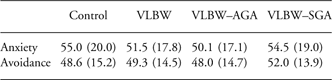
VLBW, very low birth weight; SGA, small for gestational age.
VLBW v. controls
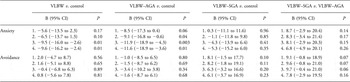
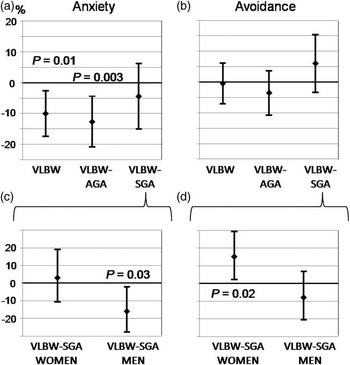
We first compared the whole VLBW group with the controls. The VLBW group showed less attachment-related anxiety, although the difference was statistically significant only after adjusting for the current relationship status in addition to adjusting for sex, age, and parental education (P = 0.01; Table 3; Fig. 1a). Excluding participants with neurosensory impairments did not weaken the effect (P = 0.01). The VLBW and control groups did not differ in attachment-related avoidance (Table 3; Fig. 1b).
Group differences in percent in attachment-related anxiety and avoidance: 1. unadjusted; 2. adjusted for sex, age and parental education; 3. adjusted for sex, age, parental education and current relationship status; 4. adjusted for sex, age, parental education and current relationship status and participants with neurosensory impairments excluded

VLBW, very low birth weight; SGA, small for gestational age.
Error bars represent the mean differences in percentage and their 95% CI between the controls (zero line) and the VLBW group as a whole or the VLBW-AGA and VLBW-SGA groups separately in attachment-related anxiety (a) and avoidance (b). Due to statistically significant sex interactions (P < 0.05), the VLBW-SGA v. controls comparison was carried out separately for women and men in anxiety (c) and avoidance (d). Adjustments were made for age at assessment, parental education and whether the participant was currently in a relationship, and in (a) and (b) also for sex; VLBW, very low birth weight; AGA, appropriate for gestational age; SGA, small for gestational age.

VLBW-AGA v. VLBW-SGA v. controls
When we contrasted the VLBW-AGA and VLBW-SGA groups against each other, there were no statistically significant differences between the groups (Table 3). We then contrasted both the VLBW-AGA and VLBW-SGA groups separately against the control group and found that the VLBW-AGA group scored lower than the controls in attachment-related anxiety, although this difference was statistically significant only after adjusting for sex, age and parental education (P = 0.04; Table 3). The result remained after further adjustment for the current relationship status (Fig. 1a) and after excluding the VLBW individuals with neurosensory impairments (Table 3).
In the VLBW-SGA v. control comparison, we found a sex interaction for both anxiety (P = 0.03) and avoidance (P = 0.01), and these interactions remained statistically significant after adjusting for confounders and excluding participants with neurosensory impairments (P = 0.04 and 0.01, respectively). In separate analyses for men and women, the VLBW-SGA women showed on average 18.3% (95% CI 5.7–31.0, P = 0.005) higher scores in attachment-related avoidance than the control women, which remained similar after adjustments for confounders (P = 0.02; Fig. 1d) and exclusion of those with neurosensory impairments (P = 0.03). The VLBW-SGA women did not differ from control women in attachment-related anxiety. Among men, no difference was found in attachment-related avoidance, but the VLBW-SGA men scored marginally lower in attachment-related anxiety than the control men (−15.3, 95% CI −31.3 to 0.7, P = 0.06). This difference among men became stronger after adjusting for confounders (−17.3, 95% CI −32.5 to −2.1, P = 0.03; Fig. 1c) and excluding participants with neurosensory impairments (−19.6, 95% CI −35.4 to −3.8, P = 0.02).
Discussion
We examined differences between VLBW and term-born young adults in patterns of romantic attachment. We found that, in comparison to the control adults born at term, the VLBW adults reported less attachment-related anxiety, but showed no difference in their attachment-related avoidance. However, when we divided the VLBW adults into those born AGA and SGA, we found that the VLBW-SGA women reported more attachment-related avoidance than the term-born women, although there was no difference in attachment-related anxiety.
The majority of previous studies have been conducted among infants and children. Thus, our study in young adults adds a long-term perspective to the study of attachment in individuals born preterm. The previous studies do not form a consistent picture: some of them show no differences between preterm and term infants,Reference Goldberg, Perrotta, Minde and Corter25–Reference Rode, Chang, Fisch and Sroufe28 while some report more insecureReference Mangelsdorf, Plunkett and Dedrick23 and atypical attachment patterns in pretermsReference Sajaniemi, Mäkelä and Salokorpi24 or more insecure behaviors within the group of securely attached preterms than could be predicted based on normative data.Reference Goldberg, Perrotta, Minde and Corter25
Reports concerning attachment styles beyond the childhood are, however, very scarce. Lubetzky and GilatReference Lubetzky and Gilat29 found that prematurely born 14–16-year-old adolescents scored lower on self-reported attachment-related security related to close/romantic relationships than their peers born at term, but did not differ in self-reported attachment-related anxiety or avoidance. The ECR-R used in this study does not include a separate dimension for secure attachment, but our finding showing no difference in attachment-related avoidance is in agreement with the previous findings, whereas our finding showing lower attachment related-anxiety in the VLBW group as a whole is in contrast to them.Reference Lubetzky and Gilat29
In interpreting the similarities and differences between our and the previous findings, some methodological and age-related differences ought to be kept in mind. Our 18- to 27-year-old participants’ self-reported attachment was related to romantic relationships. In addition, previous results concerning 14- to 16-year-old adolescents were based on self-reported attachment in close/romantic relationships.Reference Lubetzky and Gilat29 Although attachment styles show clear continuity, their expression in romantic relationships may vary across emerging adulthood. In children, attachment styles usually concern parent–child relationships and are assessed by trained observers.Reference Mangelsdorf, Plunkett and Dedrick23–Reference Rode, Chang, Fisch and Sroufe28
However, several reports have shown that young adults born prematurely, even those without impairments, leave their parental home, start cohabiting with an intimate partner, become parents later and have less sex partners than their peers born at term,Reference Hack, Flannery and Schluchter30–Reference Swamy, Ostbye and Skjaerven34 although not all studies confirm these results.Reference Saigal, Stoskopf and Streiner41 Our current results now suggest that these earlier findings concerning slower pace in transition to adulthood are unlikely to be due to higher attachment-related anxiety or avoidance in the VLBW group as a whole, although they may contribute in subgroups such as the VLBW-SGA women.
With regard to the effects of sex, some studies suggest a higher risk of internalizing symptoms in VLBW women than in those born at term, but no such difference among men.Reference Hack, Youngstrom and Cartar42 Interestingly, attachment literature suggests that while more securely attached adults have less mood and anxiety disordersReference Marazziti, Dell’osso and Catena Dell’Osso6 or their symptoms,Reference Picardi, Caroppo, Toni, Bitetti and Di Maria7, Reference Gittleman, Klein, Smider and Essex43 women in particular are sensitive to the effects of adult attachment on mental health.Reference Gittleman, Klein, Smider and Essex43
With regard to being born SGA, we have previously shown within the same study cohort that the VLBW-SGA adults reported more symptoms of attention deficit hyperactivity disorderReference Strang-Karlsson, Räikkönen and Pesonen44 and were more likely to suffer from depressionReference Räikkönen, Pesonen and Heinonen37 than VLBW-AGA adults or controls born at term, and further that the VLBW-SGA women were less likely to have begun cohabiting than the VLBW-AGA women.Reference Kajantie, Hovi and Räikkönen31 Although in this study the VLBW-SGA women showed more attachment-related avoidance than the control women, the VLBW-SGA group as a whole showed no statistically significant differences from the VLBW-AGA group. This may have been due to small group sizes or it may imply that, although these groups have experienced different intrauterine conditions, they share a similar experience after preterm birth. While suboptimal prenatal conditions may increase the risk of certain psychiatric disorders in later life, it seems likely that socioemotional features such as attachment style are more dependent on postnatal social experiences throughout development. It is also possible that these postnatal effects override those related to conditions leading to preterm birth such as IUGR.
Given that postnatal social environment is crucial in terms of attachment development, our results should be reflected against what is known about attachment development in general. The child and the parent form a dynamic system in which they both influence each other and the developing relationship. It has been suggested that the immature nervous system of the preterm infants may induce behavioral characteristics such as negative mood, low adaptability, high distractibility and irregular biorhythm.Reference Weiss, Jonn-Seed and Wilson15–Reference Langkamp and Pascoe17, Reference Gennaro, Medoff-Cooper and Lotas45 These characteristics may influence parenting behavior and the influence may be aggravated by parental distressReference Singer, Salvator and Guo11, Reference Zelkowitz, Papageorgiou, Bardin and Wang13, Reference Eisengart, Singer, Fulton and Baley46 and perception of vulnerability of the small preterm infant.Reference Allen, Manuel and Legault47–Reference Stern, Karraker, McIntosh, Moritzen and Olexa49 For example, parents of preterm infants have been reported to be more intrusive, less reciprocal and less sensitive with their infantReference Feldman14 and more likely to show a controlling parenting styleReference Forcada-Guex, Pierrehumbert, Borghini, Moessinger and Muller-Nix50 than parents of term-born infants. Lesser parental sensitivity and poorer parent–child synchrony, in turn, are reported to be associated with less optimal neurobehavioral development in preterm children.Reference Treyvaud, Anderson and Howard51, Reference Magill-Evans, Harrison and Burke52 A suboptimal social interaction between the preterm infant and the parent may thus be a challenge for the developing attachment.
While attachment representations show a clear continuity from childhood to adult life,Reference Roisman, Madsen, Hennighausen, Sroufe and Collins3, Reference Waters and Merrick4 they are not definitive. They are modified by accumulating attachment experiences, and despite the potential deficiencies in parent–infant interaction in the earliest phases, a preterm child may develop a secure attachment along with decreasing parental distress and increasing parental sensitivity and responsiveness as the child matures.Reference Muller-Nix, Forcada-Guex and Pierrehumbert53, Reference Egeland and Farber54 In line with this, Hoff, Munk and GreisenReference Hoff, Munck and Greisen55 found no differences in sensitivity between parents of preterm and term children, when they measured parenting of 4–5 year-olds. This may also explain why the potential problems in early parenting and attachment do not seem to carry influences into adulthood. Intervention studies have also shown how relatively small interventions aiming at enhancing sensitive and responsive parenting following a preterm birth improve the parent–infant interaction and the child developmental outcomes considerably.Reference Deater-Deckard and Bulkley56–Reference Newnham, Milgrom and Skouteris58 Such interventions have become a part of routine care today.
We have previously shown that, as young adults, the VLBW women retrospectively assessed their mothers’ parenting as more protective than did the control women born at term.Reference Pyhälä, Räikkönen and Pesonen59 We have also shown that parents of VLBW adults retrospectively assessed their own parenting as more supporting than parents of term-born adults did.Reference Pyhälä, Räikkönen and Pesonen59 In addition to these findings, overprotective parenting has previously been shown among 8-year-old children born preterm.Reference Wightman, Schluchter and Drotar60 Although parental overprotectiveness may also be disadvantageous,Reference Overbeek, ten Have, Vollebergh and de Graaf61, Reference Lizardi and Klein62 it is possible that protective, supportive and more involved parenting may have even promoted a positive self-image among severely preterm VLBW individuals, which is then reflected as lower attachment-related anxiety.
As one limitation of our study, we cannot rule out selection bias. However, our results were based on internal comparisons within the sample. While it is possible that participants and non-participants differ in terms of their adult attachment style, selection bias would only be a concern if the relationship between non-participation and attachment would be different in the VLBW participants and term controls. Accordingly, a previous detailed non-participation analysisReference Hovi, Andersson and Eriksson36 raised little concern over selection bias. As a second limitation, the group sizes were relatively small in the subgroup analyses. Since prior studies concerning associations between IUGR and adult attachment are missing, our results derived from these subgroup analyses need to be confirmed by future studies.
To conclude, our findings shed light on the early life origins of adult romantic attachment, a characteristic that is associated with the physical, psychological and social well-being of an individual. We found that despite the early challenges, adults born at VLBW experience less attachment-related anxiety than do their term-born peers. We found signs for less secure adult attachment pattern only in the subgroup of VLBW-SGA women, who reported more attachment-related avoidance. A lesser degree of attachment-related anxiety in the VLBW adults may, however, be a protective aspect in adult life.
Acknowledgments
This study was supported by the Academy of Finland, University of Helsinki, European Science Foundation, Ministry of Education, the Emil Aaltonen Foundation, the Finnish Medical Society Duodecim, Finska Läkaresällskapet, the Finnish Foundation for Pediatric Research, the Finnish Special Governmental Subsidy for Health Sciences, the Jalmari and Rauha Ahokas Foundation, the Juho Vainio Foundation, the Novo Nordisk Foundation, The Päivikki and Sakari Sohlberg Foundation, the Signe and Ane Gyllenberg Foundation, the Yrjö Jahnsson Foundation, the Orion-Pharma Foundation, the Sigrid Juselius Foundation, the Finnish National Graduate School of Clinical Investigation and the Pediatric Graduate School, University of Helsinki.
Statement of Interest
None.