The dramatic growth in international trade and investment during the past two decades has intensified the debate over globalization in American politics. The recent controversy about “outsourcing” of jobs to foreign locales, arguments about the North American Free Trade Agreement (NAFTA) and other trade agreements, and protests and demonstrations that have disrupted meetings of the World Trade Organization have all revealed substantial political opposition to trade liberalization. A major political battle over trade policy may well be looming in the near future. Indeed, the idea of an imminent popular backlash against globalization has emerged in a variety of scholarly studies in recent years. Based on data drawn from the most prominent political opinion surveys, analysts have concluded that roughly 60 percent of voters in the United States and in other Western economies are opposed to trade liberalization.1
Taken at face value, this finding is actually quite shocking. In the most developed, democratic economies, where governments have officially championed greater trade openness since the 1940s, almost two-thirds of voters are—apparently—opposed to it.However, particular opinion surveys may provide unreliable guides to the real attitudes and policy preferences of voters, in so far as spontaneous, top-of-the-head responses to pollsters tend to be strongly influenced by the specific wording of the questions posed and how these words “frame” particular issues. Powerful framing effects have been discovered across a range of policy issues in experimental studies that present subjects with choices that are logically equivalent but differ in whether some purportedly relevant information is presented in various ways.2
Surveys of attitudes toward trade seem especially open to framing effects because trade, similar to other aspects of foreign and economic policy, is a complex issue about which many voters are notoriously uninformed, and about which various emotions—such as national pride—are often easily invoked.3 To make reliable inferences about voters' attitudes toward trade one needs a much better understanding of the impact of framing on responses to survey questions about this issue.This article presents findings from a survey experiment aimed at measuring the impact of framing on individuals' stated attitudes toward international trade. The results demonstrate that issue framing has large effects on responses. Respondents given an antitrade introduction to the main survey question, linking trade to the possibility of job losses, were 17 percent less likely to favor increasing trade with other nations than those asked the same question without any introduction at all. Since existing surveys have typically incorporated a similar (antitrade) wording when posing questions about international trade, this strongly suggests that concerns about widespread opposition to trade among voters have been overstated (at least relative to what they would have been had alternative question wordings been used in earlier surveys). Overall, among those administered no introduction at all to the question about trade, 71 percent favored increasing trade. Curiously, respondents who were given a protrade introduction to the question, suggesting that trade can lead to lower prices for consumers, were not more likely to express support for trade than those asked the question with no introduction. The most common protrade rhetoric thus appears to be completely ineffective in raising support for trade among voters.
I also report results from a second experiment to test whether advice about trade from a third-party source might influence the degree to which respondents are swayed by issue framing. The idea here is that, while framing might have a large impact on the way individuals respond to survey questions on issues about which they have little information, when making choices in the real world (say, about whether they should vote for a particular electoral candidate) individuals can take advice from sources of information they trust.4
The results indicate that the (antitrade) framing effects observed in the main experiment are significantly reduced among respondents who are informed that most leading economists endorse trade liberalization. The knowledge about the advice from economists also raises support for trade substantially and across the board. Combined, these results suggest that competition for endorsements may play a far larger role in actual politics than competition in framing. Framing effects, though, remain a critical problem for research that blindly uses data from existing surveys.Attitudes Toward International Trade
A growing body of research by economists and political scientists has examined survey data on individual attitudes toward trade. These studies have had two types of goals: first, to gauge overall levels of opposition to trade openness among voters to see whether a popular backlash against globalization is imminent; and second, to assess various determinants of individual policy preferences to see whether opposition to globalization is concentrated among particular socioeconomic groups.
Measuring Opposition to Trade Liberalization
Scheve and Slaughter have recently reviewed a large body of evidence from opinion surveys administered in the United States in past decades, concluding that, in general, a plurality or a majority of Americans have been opposed to policies to liberalize trade, at least since the 1970s.5
Scheve and Slaughter 2001.
See Mayda and Rodrik 2005; and O'Rourke and Sinnott 2002. Mayda and Rodrik also examined the data on a broader variety of countries provided in the third wave of the World Values Survey, conducted between 1995 and 1997 in 47 countries: they report that 65 percent of respondents surveyed in these countries favored stricter limits to trade; see Mayda and Rodrik 2005, 1401.
How much faith can one place in these findings? The clearest danger, in terms of the validity of the inferences about voters' trade policy preferences, is that spontaneous responses to survey questions may be strongly influenced by the specific ways in which the questions are worded or framed. Framing effects are produced when an alteration in the particular words used when presenting individuals with a choice problem causes them to select different options.7
Druckman 2001a, 227. For similar definitions, see Iyengar 1991, 11; Rabin 1998, 36; Page and Shapiro 1992, 168; and Zaller 1992, 32. One can also identify framing effects in cases where individuals make similar choices but for different reasons; on these types of framing effects, see Nelson, Oxley, and Clawson 1997.
Kahneman and Tversky 1979. Researchers in the growing field of “behavioral economics” have been exploring related issues involving tendencies among individuals to make seemingly irrational choices; see Rabin 1998.
See Druckman 2001a.
Sniderman and Theriault 1999.
Bauer, Pool, and Dexter 1972, 81–84. By one count, some 45 percent of American survey respondents are unable to define the meaning of a “tariff,” casting grave doubt over any surveys asking people's views on whether tariffs or import duties are good or bad. See Pryor 2002. Data reported in Delli Carpini and Keeter 1989, 70, suggest that even simpler terms are problematic: only 39 percent of respondents to a 1953 survey could define “free trade.”
See, for example, Bauer, Pool, and Dexter 1972, 81–84; Destler 1995, 180; and Pryor 2002. See also Schneider 1985. This is also the traditional assessment of voter opinions on foreign policy issues more generally (for example, Lippmann 1922; Almond 1950; and Converse 1964). Although recent studies suggest there may be more stability in some core attitudes toward foreign policy issues than originally thought. See Holsti 1996, chap. 3.
One immediate question is whether particular surveys, and specifically those that have been used in the most recent studies of attitudes toward trade, employ question wordings that might encourage respondents to answer in a certain way. The NES surveys of 1992 and 1996, examined in detail by Scheve and Slaughter, employed the following wording when asking about the trade issue:
Some people have suggested placing new limits on foreign imports in order to protect American jobs. Others say that such limits would raise consumer prices and hurt American exports. Do you favor or oppose placing new limits on imports, or haven't you thought much about this?13
Scheve and Slaughter 2001.
While this question is designed to provide both sides of the argument to respondents, the ice here seems very thin. Much depends on whether the two opposing sets of considerations are really equivalent in terms of their framing effects. One might suspect that an appeal to protecting American jobs is likely to have much more raw appeal to an uncertain respondent than an argument about consumer prices or American exports; but without some way to gauge the preferences of individuals independently from this particular question wording, it is impossible to tell.14
I refrain from a discussion of the economics here: in particular, whether it is actually correct to suggest that trade barriers result in more jobs (or better jobs) than trade liberalization. For a detailed discussion, see Irwin 2002.
The question on trade in the 1995 ISSP National Identity module, used by Mayda and Rodrik and O'Rourke and Sinnott, is even more clearly biased by an antitrade frame.15
It reads:
Now we would like to ask a few questions about relations between [respondent's country] and other countries. How much do you agree or disagree with the following statement: [respondent's country] should limit the import of foreign products in order to protect its national economy?
There is an obvious problem here because the question refers to the benefits of restricting imports but not the costs. It also uses the value-laden language of protecting the national economy and forces the hesitant protrade respondent to disagree with an antitrade point of view. The trade question posed in the World Values Survey (WVS), which Mayda and Rodrik have also used in their work, is similarly problematic.16
Mayda and Rodrik 2005.
Do you think it is better if: Goods made in other countries can be imported and sold here if people want to buy them; There should be stricter limits on selling foreign goods here, to protect the jobs of people in this country; or Don't Know.
The scholarly work that has applied data from these surveys to make inferences about voters' attitudes toward trade has not overlooked the possibility of framing effects. Mayda and Rodrik and O'Rourke and Sinnott acknowledge that the framing of the ISSP question may have biased responses in favor of protectionism, but they are for the most part unconcerned because they are more interested in explaining variation in attitudes across individuals than in gauging overall levels of opposition to trade17
—although whether framing effects can be safely ignored for the latter purpose is actually debatable (an issue discussed in the next section). O'Rourke and Sinnott also suggest that the language used by the ISSP survey is unproblematic since “this is the way protectionist measures are defended in political discourse.”18O'Rourke and Sinnott 2002, 164.
Scheve and Slaughter are more keenly interested in estimating overall levels of support for trade protection among the public and argue that this can be accomplished using existing surveys regardless of framing effects. They compare results from a large variety of surveys administered in recent years in the United States and conclude that, even when questions about trade have been worded quite differently, one can confidently infer that a plurality or majority of Americans are opposed to trade liberalization.19
Scheve and Slaughter 2001 acknowledge that question wording does affect survey results; in fact, they point out various ways in which changes in question wording appear to have altered responses to surveys about trade in substantial ways. But they maintain, nevertheless, that a general (majority or plurality) opposition to trade liberalization among voters can be clearly discerned.
Ibid., 20–26.
Some of the “two-sided” survey questions that Scheve and Slaughter examine actually seem rather unfair, employing wordings tilted in favor of more protectionist responses. A 1996 CNN poll, for instance, presented individuals with two statements: “The United States should tax foreign goods imported into this country in order to protect American jobs and wages,” and “The United States should not tax foreign goods imported into this country because this will raise the prices American consumers will have to pay for these goods.” It is not surprising that 66 percent of respondents said they supported taxing foreign goods, as this was the only option consistent with protecting American jobs and wages, and the tax on foreign goods sounds as if it might be something paid by foreigners.
The second reason Scheve and Slaughter give for discounting the importance of framing is that, when asked a question that does not mention either the benefits or the costs of trade, a plurality or majority of individuals still oppose trade liberalization.22
Scheve and Slaughter 2001, 27–33.
A prime example is a 2002 Harris poll that asked: “Do you consider yourself to be someone who believes in free trade or trade without any restrictions, someone who believes in fair trade or trade with some standards for labor and the environment, or someone who is protectionist, meaning that there should be rules to protect US markets and workers from imports?” Only 10 percent of respondents described themselves as “free traders,” while 52 percent favored fair trade, and 37 percent considered themselves protectionist. Scheve and Slaughter conclude from this that protectionists outnumber free traders by four to one. But how one should count the 52 percent who chose the middle option is unclear given the way the question is worded, forcing a choice between an extreme free trade position (no restrictions) and options that allow for a large range of viewpoints.
See PIPA 1999. In the same year a PIPA survey generated almost identical results in response to the following question: “I would like to know how you feel about the process of increasing trade between countries through lowering trade barriers, such as taxes on imports. Do you feel this process has been going too fast, too slowly, or at the right pace?” The responses were: much too fast (12.6 percent); a bit too fast (17.3 percent); at about the right pace (38.9 percent); a bit too slowly (14.2 percent); much too slowly (9.1 percent). Thus some 62 percent of those polled said that trade liberalization was proceeding at about the right pace or too slowly.
Pew 2003. The Pew results must be treated cautiously too, of course. Seligson (1999, 133) points out that focus group research has shown that survey questions about “economic integration” in Latin America that do not mention potential costs appear to elicit “knee-jerk” support—that is, respondents tend to answer very quickly and positively.
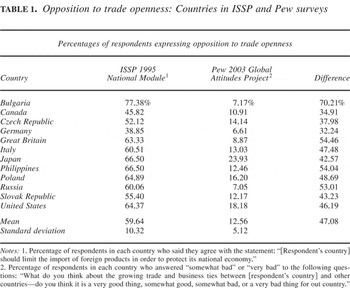
Opposition to trade openness: Countries in ISSP and Pew surveys

The differences are dramatic: according to the responses to the Pew survey, opposition to increasing trade constitutes a minority view in all these countries (representing the position of as little as 6 percent of surveyed individuals in Germany). But responses to the ISSP give the opposite impression, suggesting that clear majorities in most of these countries favor new limits on trade (reaching as high as 77 percent in Bulgaria). The surveys were conducted eight years apart, which might explain some of this variance, but clearly the different ways in which the questions have been worded are critical.
Which Individuals Are Opposed to Trade Liberalization and Why?
To date, the analysis of survey data aimed at revealing the determinants of individual attitudes toward trade has focused predominantly on occupational differences among respondents. A principal aim has been to test standard economic models that describe the income effects of trade for different individuals as a function of the types of productive inputs they own and the types of industries in which they are employed. Examining data from recent NES surveys in the United States, Scheve and Slaughter emphasized the importance of respondents' “human capital” or skills (measured principally by years of education), finding that individuals with lower skills were more likely to support restrictions on imports than those with higher skills.26
Scheve and Slaughter 2001.
Stolper and Samuelson 1941. This theorem has been used extensively in the analysis of trade politics. See Rogowski 1989; and Hiscox 2002.
The specific factors approach underpins much of the most recent analysis of the political economy of trade in contemporary advanced economies. See Magee 1980; Grossman and Helpman 1994; Hiscox 2002.
There are other predictors of trade policy preferences besides these standard economic variables, of course, although the theoretical underpinnings for these are typically less clear. Age appears to be significantly associated with support for protection among individuals in some studies32
but not in others.33 Gender shows up as an even stronger and more consistent predictor of views on trade: women seem to be substantially more protectionist than men in almost every study.34For a detailed study of the gender gap in trade policy preferences, see Burgoon and Hiscox 2003.
Is it reasonable to ignore potential framing effects when making inferences about the various determinants of attitudes toward trade? Both Mayda and Rodrik and O'Rourke and Sinnott suggest that it is, as long as one makes a critical assumption. As Mayda and Rodrik put it when discussing the antitrade wording in the ISSP survey: “Even though the responses on trade may be biased in one direction, our results will not be affected unless the magnitude of the bias is also correlated with our explanatory variables.”36
Mayda and Rodrik 2005, 1400.
See Kinder and Sanders 1990; Iyengar 1991, 118; McGraw and Hubbard 1996; Sniderman and Theriault 1999; and Haider-Markel and Joslyn 2001.
See Stanovich and West 1998; and Levin, Schneider, and Gaeth 1998. There is some debate in the literature on political communication, it might be noted, about how these results should be interpreted. Nelson, Oxley, and Clawson 1997 have argued that framing, which they define as “activating” information that respondents have stored as memory, can be distinguished from priming (making particular information temporarily more “accessible”) and persuasion (“adding” new information). They thus expect more informed respondents to be more susceptible to framing per se, because they make a better connection between frames and information stored in their own memories, but less susceptible to priming and persuasion. In recent experiments, Druckman and Nelson 2003 have found that more informed respondents were more responsive to issue framing, but only controlling for the firmness of a prior opinions (which was highest among the most informed and strongly associated with less susceptibility to framing). The various distinctions made by scholars of political communication are less relevant here than the weight of evidence suggesting that responsiveness to question framing is related to levels of knowledge (and thus education).
Delli Carpini and Keeter 1989, 144–45, 188–99, shows that education is the most important single predictor of political knowledge.
The Survey Experiment
Design of the Core Experiment
The experiment was conducted through the Time-Sharing Experiments for the Social Sciences (TESS) program.40
Time-Sharing Experiments for the Social Sciences, NSF Grant 0094964, Diana C. Mutz and Arthur Lupia, Principal Investigators.
An extensive set of presurvey tests, along with interviewer training, were conducted by CSR in May and June 2003, aimed at making the questions as clear as possible and improving response rates and reliability. For a full description of the TESS/CSR survey process, see 〈http://www.experimentcentral.org〉. Accessed 15 March 2006.
- Group 1 (15 percent)—protrade introduction: “Many people believe that increasing trade with other nations creates jobs and allows Americans to buy more types of goods at lower prices.”
- Group 2 (15 percent)—antitrade introduction: “Many people believe that increasing trade with other nations leads to job losses and exposes American producers to unfair competition.”
- Group 3 (15 percent)—both introductions: “Many people believe that increasing trade with other nations creates jobs and allows Americans to buy more types of goods at lower prices. Others believe that increasing trade with other nations leads to job losses and exposes American producers to unfair competition.”
- Group 4 (15 percent)—no introduction.
In addition to these core experimental groups, four separate groups (each making up 10 percent of the sample) were assigned the same set of “frames” as above but were also read an introduction that described the consensus view among economists that favors trade openness (that separate experiment is discussed below).
The specific claims made in the introductions provided to the different groups about the potential costs and benefits of trade were chosen using the results from Roper polls from the 1970s that asked respondents to rate the most persuasive arguments for and against import restrictions.42
See Schneider 1985.
After the introductions were read, all survey respondents were asked the same core question about their attitudes toward international trade: “Do you favor or oppose increasing trade with other nations?” Depending on their answer, the interviewer then asked: “Is that strongly favor (oppose) or somewhat favor (oppose)?”
Choosing the specific language for this core question was a difficult task. As in most recent surveys, I avoided references to “tariffs” (or “duties”) because there is evidence that a large proportion of respondents do not know what a tariff is; I also avoided references to trade “restrictions” and “barriers,” because the presurvey tests revealed similar anxiety among respondents about the meaning of these terms. Asking respondents whether they favored “limits” on imports was the most serious alternative to asking them about increasing trade. But to avoid forcing respondents to choose between an extreme view (no limits) and all other plausible views, one would have to allow for a variety of choice options (for example, some limits, many limits?), the meaning of which would be rather difficult to interpret.
The reference to “increasing trade with other nations” does not distinguish as to whether this change is (or would be) due to government policies (for example, trade liberalization) or to other forces (for example, technological improvements in communication and transportation) not counteracted by new government regulations. This particular form of ambiguity is a good thing, I think. It allows for respondents to take a position on globalization writ large—the process that is a function of both deliberate liberalization and changes in technology—and avoids confusion about the past or potential use of specific types of policy instruments. In terms of the theoretical predictions about the distributional effects of trade drawn from economic theory, it makes no substantive difference whether the stated expansion in trade is due to alterations in policy or to other types of changes that lower the costs of international transactions.
One final point is worth making about the core trade question employed here. Obviously, no question can be entirely frame-free in the sense that the language chosen, even if it is not intentionally designed to invoke positive or negative views about the trade issue, may still unintentionally bias respondents toward a particular response. In this case, substantive considerations aside, whether asking people about “increasing trade with other nations” is more likely to elicit positive responses than alternative types of wordings (for example, a reference to decreasing trade with other nations) is unclear. It presumably hinges on whether people are inherently more likely to respond in a positive or negative way to trends in general. The only point here is that it would be misleading to describe the question itself, devoid of any of the introductions, as completely unframed or neutral.
Framing Effects on Support for Trade
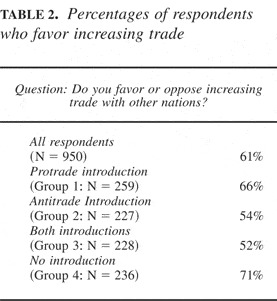
Table 2 reports the simple frequencies of each type of response in each of the four core experimental groups.43
Less than 2 percent of all respondents answered “Don't know” to the trade question. These observations were excluded from all the analysis reported here.
Full estimations of preferences are presented below, with tests of the effects (with standard errors) of the experimental treatments and other variables, but using two-sample difference-of-means tests (with unequal variances) shows that the differences between average support for trade in Groups 2 and 3, compared with Group 4, are significant at the .99 level.
Percentages of respondents who favor increasing trade

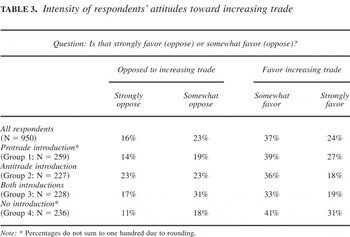
Table 3 reports the response frequencies in each experiment group categorized according to the intensity of stated support for, or opposition to, increasing trade. Across the board, those respondents who were read the protrade introduction (Group 1) did not differ significantly in their stated views, or the intensity of those views, from those who received no introduction (Group 4). Large differences appear, on the other hand, in comparing those groups with respondents who were read the antitrade arguments alone (Group 2) or in combination with protrade arguments (Group 3). What is perhaps most interesting in this regard is that the differences are starkest at the extremes; that is, differences in the way the question was framed had the greatest impact on the frequency with which respondents stated they were either strongly in favor of, or strongly opposed to, increasing trade. Compared to those who were read no introduction, for instance, among those who heard the antitrade arguments 13 percent fewer individuals said they strongly favored increasing trade and 12 percent more said they were strongly opposed to increasing trade.
Intensity of respondents' attitudes toward increasing trade

Overall, the results suggest that there is considerably more popular support for trade liberalization than suggested by previous studies. Across all experimental groups, some 61 percent of respondents stated that they favored increasing trade with other nations, and 24 percent said that they strongly favored increasing trade. Among those who were asked to state their views without hearing any kind of introduction to the trade question, 71 percent favored increasing trade (31 percent strongly). These results fit well with the findings from the recent Pew Global Attitudes Project, which reported majority support for “growing trade and business ties” in the United States. It seems clear why some prominent alternative surveys—most notably, the NES and the ISSP surveys—have produced different results suggesting majority opposition to trade. The questions posed in those surveys use wordings that have a powerful effect on responses. The results from the experiment indicate that when common antitrade arguments frame the trade issue for survey respondents, their stated views about trade are shifted radically in a protectionist direction.45
It should be noted here that even among those respondents given the antitrade introduction in the experiment (Group 2), a majority (54 percent) still favored increasing trade. The difference between this result and the findings from the NES and ISSP surveys might be explained by the other critical differences in the question wordings (for example, the invocation of “foreign” versus “American” in the NES question). It is also possible that agreement or acquiescence bias might be a factor: both the NES and ISSP surveys ask respondents whether they agree with (favor) limits on imports, whereas here respondents are asked whether they favor increasing trade. To the extent that individuals are biased toward simply agreeing with any proposition posed by an interviewer, this may have biased the results in opposite ways. On acquiescence bias in surveys, see Schuman and Presser 1981.
This result will not come as a great surprise to those familiar with opinion surveys (and with surveys on foreign policy issues in particular). What is perhaps more curious is the clear finding that respondents who were read the protrade arguments before being asked to state their opinion about the issue were not significantly more likely to express support for trade than those asked the question with no introduction at all (and that, among respondents given both protrade and antitrade arguments, support for trade was essentially the same as it was among those given only the antitrade introduction). In a nutshell, the most common forms of protrade rhetoric, focusing on the creation of jobs in exporting industries and the lowering of prices for consumers, appear to be completely ineffective in raising support for trade among survey respondents.
Why is the protrade frame so ineffective, compared with the antitrade frame? One possible answer is that these specific arguments in favor of increasing trade are not actually the most persuasive ones (despite the findings from the Roper polls in the 1970s). Perhaps one would see bigger effects using alternative arguments, about trade providing competition for protected monopolies, for instance, and spurring development in poorer nations. An interesting related question is whether reactions to the different types of arguments employed in the experiment reflect some version of the famous “loss aversion” effect: when told to expect losses (the job losses in the antitrade frame) people react more strongly than when they are told to expect gains (the job creation in the protrade frame). Unless protrade arguments can be stated in terms of meaningful losses (for example, lost jobs in specific industries due to decreasing trade), they may not be able to compete with antitrade frames when it comes to influencing the views of wavering individuals.46
A related issue is the so-called “negativity bias” discussed in the psychological literature. Evidence suggests that people generally tend to expect good things to happen, and when they are confronted with evidence to the contrary, they attach more weight to such “negative” news when updating their prior beliefs than they do to good news. See Kanouse and Hanson 1972; and Skowronski and Carlston 1989.
Individuals' Sensitivity to Framing and Education
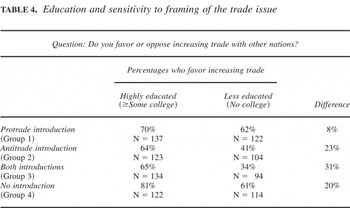
It seems clear that any general assessment of public attitudes toward trade must take into account the effects of issue framing in the survey questions. This brings us to the next issue: whether some groups of individuals are more sensitive to framing than others. In particular, given that education is typically treated as a core determinant of trade policy preferences, it is critical that one knows whether sensitivity to framing is correlated with education at all. The evidence from the experiment is revealing on this question. The magnitude of the observed framing effects is strongly related to the education levels of respondents. Table 4 provides a simple picture of this relationship. Looking first at highly educated respondents (that is, those with at least some exposure to college-level education), comparing across experimental groups shows that the percentage favoring trade was only 6 percent lower among those receiving the antitrade introduction than among those who heard the protrade introduction (17 percent lower than among those who received no introduction at all). For respondents with less education (that is, no college-level education at all), the support for trade was 21 percent lower among those who heard the antitrade introduction than among those who heard the protrade arguments (20 percent lower than among those who heard no introduction).47
The TESS survey asks respondents to report the highest level of education they have attained, coding these by type of institution. For the basic comparisons I have simply grouped those reporting “some college” or a bachelor's or higher degree as “highly educated,” in contrast to all other respondents. Finer distinctions are made in the estimations below.
Education and sensitivity to framing of the trade issue

Comparing the difference between the responses of the highly educated and less educated in each experimental group (reading horizontally in Table 4) highlights the potential danger here: the difference between the support for trade among highly and less educated individuals is only 8 percent for those receiving the protrade frame, but this difference is 23 percent among those who were read the antitrade introduction, and 31 percent among those in the both-introduction group. If one only looked at the responses to the question prefaced with antitrade arguments, or at the question incorporating both frames, one would have a much larger estimate of the impact of education on trade policy preferences than if examining responses in the other experimental groups.
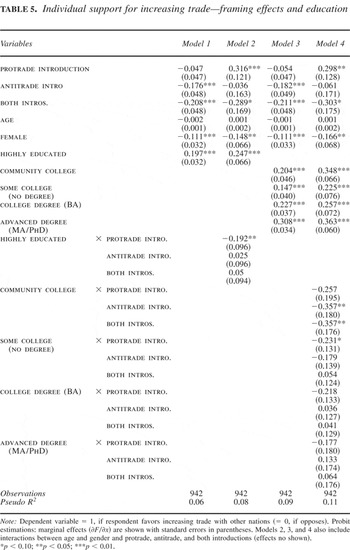
To gauge the impact of framing in a more precise fashion, one can also estimate individual trade preferences using respondents' answers to the question about whether they favored or opposed increasing trade as the dependent variable (1 = favor and 0 = oppose). Table 5 reports the results from probit estimations that include a standard set of core explanatory variables (see Appendix for descriptive statistics). It is a simple matter to estimate the general impact of each different introduction to the trade question, using the “no introduction” treatment as the excluded category here. As shown in the simplest specification (Model 1), and consistent with the findings reported above in Table 2, the estimated general effect of the antitrade introduction is to reduce support for trade by 18 percent (SE 5 percent); the antitrade and the protrade introductions applied together reduce support for trade by approximately 21 percent (SE 5 percent); while the protrade arguments by themselves have no significant impact on responses. While age appears to have no significant effect on attitudes toward trade, gender has a strong effect, with women being approximately 11 percent (SE 3 percent) less likely to favor increasing trade than men. As reported in previous studies, highly educated respondents (those with any college-level education) are, in general, 20 percent (SE 3 percent) more likely to support increasing trade than less-educated counterparts.
Individual support for increasing trade—framing effects and education

Model 1 imposes the constraint that all individuals are equally sensitive to framing effects—an assumption that one might now suspect to be too restrictive. Model 2 incorporates separate interaction effects between each of the experimental treatments and each of the explanatory variables in Model 1. The findings confirm the results from the analysis of response frequencies above. Most importantly, the estimated effects of education can vary substantially depending on the way the question is framed. Specifically, education accounts for four to five times as much of the variation in responses among those who heard the antitrade arguments, than it does among those who received just the protrade frame—the effect of exposure to college education in the former group is to raise the probability of support for trade by roughly 25 percent, all else equal, while in the latter group the corresponding effect is only a 5 percent increase.48
Note that interaction effects between age and gender and the experimental treatments are included in Models 2 to 4, but are not reported in Table 5 to economize on space. Men appear no more or less sensitive than women to any of the issue frames (none of the interactions between gender and the experimental treatments was statistically significant). There is some evidence that younger respondents are more susceptible to protrade framing than older individuals—the interaction between age and the protrade experimental treatment was negative and significant. Full results are available on request and at 〈http://www.people.fas.harvard.edu/∼hiscox/Hiscox_IOw06.html〉.
Models 3 and 4 repeat the analysis using more detailed measures of educational attainment. Model 3 just reestimates the restricted form of the specification, replacing the binary variable for “highly educated” with an array of dummy variables indicating whether the highest level of education attained was a degree from a community college, some college education (but no college degree), a bachelor's degree from a college or university, or an advanced degree from a college or university. The excluded category here includes those respondents who finished their formal education at the high school level.49
The TESS data does distinguish those who received their high school diploma from those who did not, but the latter group is so small (6 percent of the sample), that it is incorporated here in a larger excluded category that includes those who finished high school but gained no further formal educational qualifications (24 percent of the sample).
Overall, these results raise significant doubts as to whether one can make reliable inferences about particular determinants of attitudes toward trade by using the available survey data and just assuming that such determinants are unrelated to sensitivity to issue framing. The relationship between individual sensitivity to framing and education, in particular, suggests that the magnitude of the estimated effects of education on trade preferences will vary markedly with changes in question wording, and thus perhaps provides less robust support for the Stolper-Samuelson theorem than has been suggested in previous studies.
The Endorsement Experiment
Given that issue framing can have such large effects on survey responses, this raises a variety of questions about whether and how these effects carry over into real world politics. The traditional view is that voters are susceptible to manipulation by politicians and by the media, who have more information about key issues and can shape the language and concepts employed in public debates,50
and recent work on political communication and public opinion has highlighted this possibility.51 Thus trade politics, as other areas of politics, may best be viewed as a competition in framing—a competition that is revealed in the intimate relationships that have developed between news organizations and the media experts (or “spin doctors”) employed by governments, political parties, and special interests to frame issues in ways that benefit them most.52See Nelson, Oxley, and Clawson 1997, 224.
See Holsti 1996, 52.
Although the NAFTA legislation did ultimately make it through Congress, this media-driven scenario is not a happy one for supporters of greater trade openness. While there is an almost unshakeable consensus among economists on the benefits of trade openness, the counterintuitive loveliness of the law of comparative advantage ironically makes it much more difficult to convey the principal case for trade to the general public. There has long been a concern among economists that the case for trade openness, while stronger theoretically and empirically than arguments in favor of trade barriers, is actually much harder to make rhetorically54
Krugman 1993.
However, new research on political communication has suggested that issue framing, while having large effects on responses to surveys and questions asked in laboratory experiments, has a more limited impact in real political contexts.55
See Druckman 2001a.
As a preliminary test, I designed a second experiment to gauge whether knowledge of the endorsement of trade openness by economic experts mitigated framing effects among respondents to the TESS survey. Another four experimental groups were created for this experiment (each consisting of 10 percent of the total TESS sample) and, as before, these were read protrade, antitrade, or both types of introductions, or no introduction at all; but now, before being read the assigned introduction, all respondents in these four groups were also read the following statement:
According to the New York Times, almost 100 percent of American economists support increasing trade with other nations. In 1993 over a thousand economists, including all living winners of the Nobel Prize in economics, signed an open letter to the New York Times urging people to support efforts to increase trade between the United States and neighboring countries.
The baseline assumption is that economists, especially Nobel Prize–winning ones, are generally regarded as credible and trustworthy sources of information about the effects of economic policies. The experiment is modeled on those conducted by Druckman, who has demonstrated that framing effects are reduced when subjects in experiments observe an endorsement of one choice option or another by some set of credible experts (the specific case he examined involved a choice between types of medical treatments for cancer, with one option being endorsed by “a group of lung cancer specialists” from a well-known medical research institution).58
Druckman 2001b.
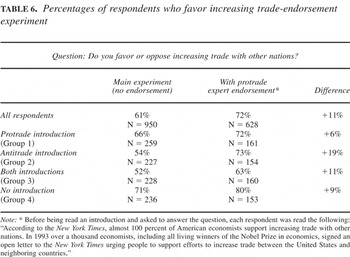
Percentages of respondents who favor increasing trade-endorsement experiment

The most obvious effect of the economists' endorsement was to raise support for trade across the board. Overall, those stating that they favored increasing trade rose from 61 percent, in the main experiment, to 72 percent among those who received the extra information about economists. The endorsement had the largest impact on those who were also given the antitrade introduction, either alone (the endorsement pushed support for trade up by 19 percent among those respondents) or in combination with the protrade introduction (11 percent). The endorsement had the smallest effect on those who received only the protrade introduction (6 percent), presumably because the new information was less divergent from the information already available to those respondents. Most importantly, the endorsement does seem to mitigate the impact of other types of issue framing. Among those who received the antitrade introduction, for instance, 17 percent fewer favored increasing trade compared with those who heard no introduction at all in the main experiment; once the expert endorsement was introduced, that difference fell to just 7 percent. Support for trade was 12 percent lower among those who heard the antitrade introduction compared with those who heard the protrade introduction in the absence of the endorsement; with the endorsement, the difference was only 8 percent.
These findings suggest that the types of issue framing effects observed in the core experiment, while a critical problem for interpreting the results from opinion surveys (which require that respondents give their views with no time for reflection and no access to advice or information from third-party sources) may be less critical for predicting choices by voters in the real world of politics (where citizens have time to obtain information from numerous sources about which choices are best for them). This does leave open the question, of course, of which types of sources individuals regard as trustworthy or credible on the trade issue—that is, just where will voters look for their cues about how to react (in the political realm) to globalization? It also shifts the focus of research in an important way, suggesting that the popular politics of trade may be less of a competition in framing than a competition for endorsements.59
Recent research suggests that, in general, voters rely heavily on informational cues from political parties and special interest groups; see Popkin 1994; and Lupia and McCubbins 1998. Organized lobby groups have always played a critical role in American trade politics, but much of the scholarly debate has focused on behind-the-scenes lobbying by groups aimed at winning special favors from policymakers, typically in the form of trade barriers (for the classic treatment, see Schattschneider 1935; more recently, see Grossman and Helpman 1994). There has been much less work on the role of groups as “endorsers” of trade policy positions: see Milner 1997, 83–95. The experimental results above, along with evidence from recent trade debates, suggest that more research along these lines would be very illuminating. It seems clear, for instance, that in order to increase support for NAFTA during the height of the debates in Congress, the Clinton administration focused much of its efforts on winning endorsements from key groups. For instance, one important turning point came when, in response to the announced environmental side agreement to NAFTA, some prominent environmental groups (including the World Wildlife Fund and the Environmental Defense Fund, but not the Sierra Club) gave their support to NAFTA.
Conclusions
Just how strong is the opposition to trade liberalization among voters? How deep are the divisions over trade between particular groups in society? These are important political questions at a time when multilateral trade negotiations have stalled and controversy about the “outsourcing” of jobs to foreign countries has come to dominate media coverage of the trade issue and policy debates in the United States. The rhetorical attack on trade liberalization seems only to have been stepped up in recent years, with self-styled populists such as Ralph Nader and Patrick Buchanan attacking globalization by invoking voter antipathy toward large corporations and foreigners, in roughly equal measure.60
Irwin 2002, 1–2.
The statement about CEOs was made by Senator John Kerry on 4 February 2003. In the same month, Gregory Mankiw, Chairman of the President's Council of Economic Advisers, was forced to retract (and apologize for) comments he made describing outsourcing as just another aspect of international trade that benefits the American economy. See The Economist, 19 February 2004, 7.
The findings from the experiments reported above suggest that opinion surveys can be unreliable guides to gauging the extent of opposition to international trade among voters, due to the powerful effects of issue framing. These effects may also make it difficult to make robust estimates of the effects that some key individual-level characteristics (such as education) have on opinions about trade. In the main survey experiment, respondents hearing antitrade arguments were far less likely to favor increasing trade with other countries than those asked the same question without introduction; on the flip side, however, respondents who were read protrade arguments were actually no more likely to express support for increasing trade than those who heard no introduction to the trade question. In addition, the responses of less educated individuals were more sensitive to framing effects than those of highly (that is, college) educated individuals. The results from the second experiment indicate that the (antitrade) framing effects observed in the main experiment are dramatically reduced when subjects are informed that most leading economists endorse trade openness. Access to this advice from economists raises support for trade substantially and across the board. Combined, these results suggest that competition for endorsements may play a larger role in actual trade politics than competition in framing. Framing effects, though, remain a critical problem for research that uses survey data to measure and explain attitudes toward trade and, by presumptive extension, other aspects of globalization.
Appendix: Descriptive statistics