Introduction
Management of local breeds is closely linked to the global challenges of genetic resources management (FAO, 2007). The first challenge when dealing with genetic resources concerns the conservation of a potential from a genetic point of view. In this perspective, importance is given to the uniqueness of a breed from a genetic point of view (e.g. Tapio et al., Reference Tapio, Varv, Bennewitz, Maleviciute, Fimland, Grislis, Meuwissen, Miceikiene, Olsaker, Viinalass, Vilkki and Kantanen2006). However, it has been emphasized in numerous research projects that the question of local breed management cannot be reduced to this genetic dimension alone (Audiot, Reference Audiot1995; Vissac, Reference Vissac2002; Lambert-Derkimba, Reference Lambert-Derkimba2007; Labatut, Reference Labatut2009; Lauvie, Gonzalo-Turpin and Labatut, Reference Lauvie, Gonzalo-Turpin and Labatut2009). The breed can be a resource for specific farming systems and is, at the same time, a product of long-time breeding practices within farming systems. Genetic management practices, going from the level of the animal to that of the whole population, are strongly linked to the aims of the farmers who use these animals, and to their expectations. The management practices are themselves a key component of the global livestock farming systems (LFS) of which the animals of the breed are an integral part.
The aim of this paper is to show why it is essential to have an approach to local breed management that takes the dynamics of LFS into account and does not just reduce them to their genetic aspect. We will show that if we consider those two dynamics as being linked, the analysis of local breed management dynamics raises the question of the articulation of several organization levels, i.e. several scales at which we consider the systems. We will then illustrate our statements and questions using French examples from the literature.
The main principles of the LFS approach
The system approach (von Bertalanffy, Reference von Bertalanffy1968) has been used since the 1980s in the agricultural sciences. It is based on the definition of a system as a complex organization of components in interaction. The system is a whole, indivisible, and it is more than just the sum of its parts. A change in one of its components leads to a change in the other components and in the system as a whole. The systemic approach focuses on the interactions between components in order to describe and understand the behaviour of the whole system as a unit, rather than studying each component and its causal relationships with other components as in an analytic approach.
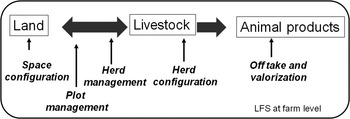
A LFS is a conceptual model of the whole livestock farm. It represents a duality between the view of a farm as a human activity system, with a farm family (or an enterprise) seeking to satisfy specific objectives, and the view of a farm as a production process, with the transformation of physical inputs to physical outputs (Gibon et al., Reference Gibon, Sibbald, Flamant, Lhoste, Revilla, Rubino and Sorensen1999). Practices are a key component that links these two views of LFS. They are the result of the farm family's decision-making process, through the perception of its context, and ultimately determine the production process. We distinguish five categories of practices (Figure 1, from Moulin and Bocquier, Reference Moulin and Bocquier2005).
The LFS approach at the farm level (from Moulin and Bocquier, Reference Moulin and Bocquier2005).

First, over the years, the farm family configures the herd (choice of species and breeds, culling and replacement, etc.). It also configures the farmland: acquiring or relinquishing land areas, creating equipment or buildings (fencing, trails, water points, outbuildings, etc.) and rehabilitating some plots (stone removal, bush clearance, etc.). Then, over an annual cycle, the family farm operates the system. It links the herd and the farmland through rearing practices (breeding, feeding, etc.) and land-use practices (assigning a crop to a plot or a batch to a pen). It also collects the outputs of the herd and markets animal products, possibly after processing.
The use of several levels of organization is also a classic principle of the systemic approach, extensively used in ecology. As an example, in order to understand the localization of an animal on a specific vegetation unit in a landscape, Bourbouze (Reference Bourbouze1986) used several spatial organization levels: from a plot where the vegetation, a flock and a shepherd interact, to a large area within a geographic space where a human society maintains a population of domestic animals.
Understanding local breed management dynamics in relation to other dimensions of LFS
Articulation of genetic management and other dimensions of LFS at the farm level
At the organization level of the farm, the farmer's aims and choices are of the utmost importance. Of course, the first point concerns the choice of the genetic resource itself, consistent with the motives and aims of the farmer (Gandini et al., Reference Gandini, Avon, Bothe-Wilhelmus, Bay, Colinet, Choroszy, Diaz, Duclos, Fernandez, Gengler, Hoving-Bolink, Kearney, Lilja, Mäki-Tanila, Martin-Collado, Maurice-Van Eijndhoven, Musella, Pizzi, Soini, Toro, Turri, Viinalas and Hiemstra2010). Several studies have attempted to develop a better understanding of those choices (e.g. Bebe et al., Reference Bebe, Udo, Rowlands and Thorpe2003; Mwacharo and Drucker, Reference Mwacharo and Drucker2005). The second point concerns all of the decision making involved in breeding practices. This decision-making process is linked to the other dimensions of the production system (marketing, feeding, etc.). As a consequence, to understand decision making in terms of breeding, it is necessary to understand links with other dimensions of the farming system, which is a crucial aspect of the systemic approach.
Feeding systems can have an impact on the choice of a specific breed or on breeding choices, as illustrated in the case of the Bretonne Pie Noire cattle breed (reared in the western part of France). As a motive for choosing that breed, many farmers mention that it is well adapted to their low-input systems that are mainly based on grassland (Quéméré, Reference Quéméré2006). Another example is given by Lambert-Derkimba, Verrier and Casabianca (Reference Lambert-Derkimba, Verrier and Casabianca2011) concerning the Nustrale pig breed, a local Corsican breed that is used in extensive farming systems based on the use of natural resources.
Breeding practices can be linked to marketing choices, as illustrated in the case of the Gascon pig breed. This breed is a rare pig breed from the southwestern part of France. In this case, a group of stakeholders (localized in a specific area known as Bigorre) has expressed the desire to use the breed to produce high-quality dried ham. A Protected Designation of Origin (PDO) project has been built and has led to the development of a new selection criterion – leg slenderness – directly linked to the product. As a consequence, the farmers involved in this project have a marketing opportunity as a result of the good reputation of the Noir de Bigorre ham product (even if the PDO is still pending), and it has led them to take this selection criterion into account in their selection practices (Audiot et al., Reference Audiot, Bouche, Brives, Casabianca, Gaillard, Roche, Trift and Steyaert2005).
Another example is the one of the Merino sheep breed. Sheep farming in the Crau Region (southeastern part of France) is based on a long transhumance (several hundred kilometres covered to reach high mountains), valorizing several resources depending on the season: high mountain pastures in summer, irrigated grassland in autumn and winter, steppic rangeland and cereals in spring (Moulin, Pluvinage and Bocquier, Reference Moulin, Pluvinage and Bocquier2004). The local Merino breed is considered to be well adapted for rangeland use and transhumance, but the lamb carcasses do not comply with the standard market expectations, particularly because of their small size. As a consequence, cross-breeding is used to produce lambs with the desired conformation, and this practice is encouraged by the operators of the lamb supply chain. Farmers who use cross-breeding have smaller flocks within the diversity of the systems encountered in the area (300–500 ewes). These farmers aim at selling more effectively valorized carcasses (considering the limited size of the flock), and at selling all their lambs for meat. They then buy ewes to replace them in order to have a simpler type of management, with only one breed of rams to manage (Moulin, Pluvinage and Bocquier, Reference Moulin, Pluvinage and Bocquier2004). They buy pure Merinos ewes because they still use transhumance with their flocks of ewes, even if they respond to a specific market demand with cross-bred lambs.
Articulation of genetic management and other dimensions of LFS at the collective action level
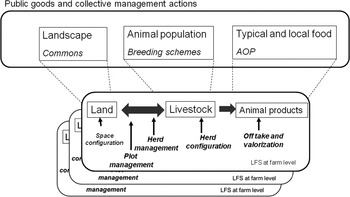
The evolution of the animal population is also linked to decision making at the collective level (selection criteria can be defined at an individual level, but also at a collective level, e.g. in official breeding schemes where the breeders involved have to agree on common selection criteria). The constitution of networks for exchanging, buying and selling breeding animals can also have an impact on the evolution of the animal population. This decision making at collective levels and the way individual practices are articulated at the scale of the animal population is also linked to the characteristics of the farming systems. In the same way, several dimensions of the farming system may be concerned by specific collective management systems such as, in the case of landscape, questions of collective land management, or in the case of product marketing, Geographical Indication projects (e.g. like PDOs). These different collective dynamics can interact as well (see Figure 2).
Interactions between genetic management and other dimensions of LFS at the collective level.

The Tarentaise cattle breed is an example of this question of decision making based on selection criteria at a collective level, in relation to the characteristics of the LFS. This breed is involved in the production of cheeses with a PDO (including cheeses with a production limit mentioned in the specification, like Beaufort). It has an official selection scheme in which it was chosen to give less weight to milk production in the selection index, compared to most French dairy cattle breeds. With that decision, breeders underline the fact that their breed is adapted to a mountain farming system (since they give more weight in their selection to criteria other than the quantity of product), and take the marketing process into account (PDO cheese and the associated production limits) (Lambert-Derkimba, Reference Lambert-Derkimba2007). In this example, the collective decision making in the breeding scheme is clearly linked to the collective decision for product valorization (PDO). The collective decision making is also linked to a global dynamics of the territory (maintaining mountain pastures considered as a heritage landscape of the area).
Links between LFS and local breed management: the articulation between levels of organization
From the farm to the collective level: where system diversity co-exists
The articulation of different levels of organization and, in particular, the articulation between expectations at the farm level and decision making at the collective level, can take several shapes and dynamics. At the scale of the animal population, several systems (farming systems, products valorized) generally co-exist.
The Aubrac cattle breed, a rustic and multi-purpose breed (draught, milk, meat) from the mountainous central part of France, was threatened with extinction in the 1950s and 1960s, during the period of modernization of French agriculture and the spread of the use of tractors, replacing draught animals. This is a good example of the use of cross-breeding to add value to local breeds by producing cross-bred animals better suited to market expectations. Such a strategy involves, in parallel to the cross-breeding practices, to continue to strictly manage the pure breed (Vissac, Reference Vissac2002). Such a collective strategy has led to a considerable increase in the animal population. The same breed produces a diversity of products. Very few dairy cows remain but a conservation program for milk production does exist. Most of the animals are instead used for meat production and, in particular, for the valorization of cross-bred animals in fattening channels in other areas such as Italy, as well as for the production of local (Fleur d'Aubrac), and pure-bred animals (Boeuf Fermier d'Aubrac). The maintenance of the breed in its territory is linked to the maintenance of local farming systems based on grazing.
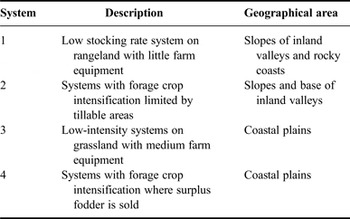
In Corsica, a mountainous island in the Mediterranean Sea, the local sheep breed, known as the Corsican Sheep, is the object of an official breeding scheme that only involves a part of the sheep farmers (55 in 2014 out of a total of about 400 sheep breeders in CorsicaFootnote 1 ). However, even if the part of the breeders involved in the breeding scheme is limited, and even if the tools proposed by this breeding scheme, e.g. artificial insemination, are practically not used by farmers outside of the breeding scheme, this single local sheep breed is involved in a diversity of LFS types, including feeding systems. A first step in the identification of the types of systems has made it possible to distinguish four types briefly described in Table 1 (Paoli et al., Reference Paoli, Viollet, Santucci, Gambotti and Lauvie2014). Breeders of the official scheme are found in all of the types except the most traditional, based only on rangeland grazing. The official breeding scheme co-exists using management practices from farmers who are not involved in this scheme. Stakeholders in the breeding scheme consider taking the diversity of systems into account since they work with farmers from a diversity of systems. However, the breeding scheme is mainly oriented towards increasing milk production, even if they are considering the introduction of new criteria to more effectively take account of the diversity of farmers' expectations. Except for a few farmers that want to avoid animals from the selection scheme, there are exchanges of animals among farmers involved or not in the selection scheme. Some farmers outside of the scheme buy rams from the selection scheme, and breeders and farmers exchange breeding animals, whether they are part of the scheme or not.
The four farming systems using the Corsican Sheep breed identified.

In the second case, the collective action encompasses a wide variety of LFS throughout the territory of the Corsican Sheep breed, but a large part of the interrelations also occurs outside of the official management system. This example raises the question of the extent to which the breeding program can be made flexible enough to accommodate different production goals.
Our paper focuses on local breeds, but we can nevertheless observe that in most of the highly represented breeds such as the Holstein Friesian, the selection index built at a collective level produces a specialized population that can be used in a diversity of systems (as witnessed by the geographical extension of those breeds). However, the maximal expression of the genetic potential of the animals of such breeds is implicitly linked to specific farming systems (feeding systems to express the potential of the breed, specialization systems, etc.).
From the farm to the collective level: when tensions are expressed
The articulation of points of view at one level of organization may sometimes lead to tensions at another level of organization.
In the Maraîchine cattle breed, for example, a rare breed from the Atlantic marshland area in western France, we can see the link between breed management and other dimensions of LFS at a collective level. The association created for the breed conservation mentions the link between breed management and marshland management in its very name. The breed was also faced with the challenge of finding outlets for products of the breed, and this challenge was discussed at the collective level (Steyaert, Reference Steyaert2006). Two types of tensions between breeders were identified by Steyaert (Reference Steyaert2006). The first concerns the animals’ conformation. Some of the breeders prefer hardy animals with good qualities for grazing (but lacking conformity for the standard meat market), whereas others consider conformity for meat. The second is linked to the feeding systems associated with the breed, some of which are in favour of grazing systems, whereas others are in favour of more intensive fodder systems (use of silage maize, in particular) (Steyaert, Reference Steyaert2006). Consequently, a debate exists among these farmers as to the management criteria and different visions of the relevant type of animal in the breed, in relation to the feeding system that they consider to be relevant, and the type of product valorization they desire.
The Manech Tête Noire is a dairy sheep breed from the western part of the French Pyrenees. Labatut (Reference Labatut2013) identified two ways to collectively manage the breed: the first one is the official breeding scheme that emphasizes milk production in quantity and quality and that is based on milk recordings and index calculations. The second one concerns a group of breeders who practice transhumance, use other collective tools such as livestock shows, and focus on the hardiness of the breed and its “standard” (i.e. a description of some traits of the breed's phenotype such as the morphological characteristics and the colour of the animals). The vision of the relevant animal is different here as well, depending on the breeders and their systems (Labatut, Reference Labatut2009).
Slow growth is a characteristic of the Nustrale breed mentioned earlier. This local pig breed from Corsica is associated with extensive systems that use natural resources and, in particular, chestnuts and acorns. Lambert-Derkimba, Verrier and Casabianca (Reference Lambert-Derkimba, Verrier and Casabianca2011) showed that for some farmers who have less chestnuts or acorns available during the finishing period, they can supplement their animals’ feed with purchased barley. In this case, the farmers can select animals that more effectively valorize this barley and, by doing so, run the risk of losing the slow growth rate, which is considered by other breeders as a characteristic of the breed that should not be lost (linked by farmers to the ability to valorize natural resources).
In the Merino example presented earlier, at the collective level, debates have arisen among Mérinos d'Arles breeders as:
-
(i) What products for what market (the pure-bred lambs are used for non-standard markets and these niche strategies are linked to reinforced pure-breeding strategies).
-
(ii) The definition of the good Merino ewe (there are different opinions as to the size of the good ewe)
Discussion and conclusion
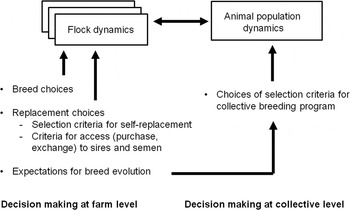
Finally, Figure 3 illustrates the fact that dealing with local breed management in a systemic approach makes it possible to better understand the decision-making process: what is the impact of feeding strategies, the use of the territory by the herd, marketing processes and sanitary issues on the breeding choices of the farmer? On the contrary, what are the consequences of breeding practices on the herd composition and on the way it valorizes the resources in the farming system?
Local breed management and LFS.

Such an approach also involves questioning the articulation of levels of organization from the animal to collective action. It is essential to take decision making at the farm level into account, as well as to analyze the diversity of points of view and practices at a larger level (the animal population). At a collective level, it is necessary to question the forms of coordination that lead to shared selection criteria or to the exchange of breeding animals.
To address those questions raised by the articulation of the different levels of organization, we need to take a systemic and global approach to those dynamics, linking the general dynamics underlying farming systems, to a deeper analysis of genetic management practices.
Moreover, methodological tools from the social sciences can be useful for dealing with tensions at the collective level, for example, the “dispositif” notionFootnote 2 , controversy analysis and organization science tools such as design workshops.
A first step is to analyze how collective action is built at the collective level (how breeders interact and are associated with animals, tools, products, etc., as proposed, e.g. with the “dispositif” notion defined by Foucault). In this collective action, it is necessary to understand the controversies expressed by stakeholders, the challenges they face, and how they establish practices that can cause tension at the scale of the animal population (e.g. Lauvie et al., Reference Lauvie, Danchin-Burge, Audiot, Brives, Casabianca and Verrier2008).
A step further can be taken with research action practices as in the example of the Manech Tête Noire mentioned earlier, where Labatut (Reference Labatut2013) has organized design workshops to gather all of the stakeholders involved in breed management to overcome the tensions in their projects and to build a common project. This approach has led to the establishment of a new association that brings together farmers from the two previous groups around a common project describing the relevant animal as “a beautiful ewe that allows them to make a good living.”
Our statements are illustrated in this article with examples taken from a diversity of species and geographical areas in France, including areas qualified as having “harsh conditions”, such as marshlands, mountains and the Mediterranean region. As a consequence, the scope of our statements extends beyond French territory and may concern any area where local breeds are raised.
Acknowledgements
This paper is a follow-up to our presentation at the Regional Workshop on the Characterization and Value Addition to local Breeds and their Products in the Near East and North Africa, organized by the FAO in Rabat, Morocco, in November 2012. It was made possible thanks to the Galimed Project (INRA ACCAF metaprogram) and the Domestic Project (Arimnet project).