Introduction
Temperatures on Mars at temperate and low latitudes would permit, at least temporarily, the existence of liquid water on the surface of present Mars; however, the total atmospheric pressure (global average 600 mPa) on the majority of the surface of Mars is below the triple point of water at 273.16 K and 611.73 Pa. Thus, only at areas of low elevation with a resulting local higher atmospheric pressure, there are appropriate thermodynamical conditions that could be given to, at least temporarily, having liquid water on the surface. However, a free surface of water will (at 0°C) effectively evaporate a mass of 3.207×10⁻⁴kgm−2s−1 of water (Taylor et al. Reference Taylor2006). To have a steady lake on the surface of present Mars, this amount of water would be needed to be steadily delivered from a continuous subsurface source, and this already over ‘geologic time-scales’. These sources are not known to exist.
The conditions for liquid water to stably or temporarily exist change when considering the subsurface of the Martian regolith. There, the pressure due to attractive van der Waals interactions between the mineral grains and ice can be the cause of a freezing point depression. In addition, liquid interfacial water can evolve there at temperatures below the standard triple point. This is described in the following section.
The formation of interfacial water will be followed by the formation of brines, if the grains, which are ‘mantled’ by liquid interfacial water, are soluble salts. In the case of temperatures below 0°C, ‘cryo-brines’ will evolve. The liquid state can remarkably extend, in the case of cryo-brines, down to the eutectic temperature. As described in the cryo-brines on Mars section, this liquid water in brines is a second type of water, which may possibly exist at present in the Martian surface.
As shown in the final section, a third type of water can be shown to evolve due to the solid-state greenhouse effect under Martian conditions in the case of insolated ice, which absorbs the insolation energy below the solid surface that acts as an optically translucent lid.
Interfacial water
In the case of a freezing point depression, thermodynamics permit liquid water to exist at ‘sub-zero C’ conditions. This is described by the generalized Clapeyron equation (Möhlmann & Rempel Reference Möhlmann, Rempel, Gudipati, Castillo and Pappalardo2010) as follows:

Here, T is the temperature, T m is the standard melting point temperature (273.15 K=0°C at 1013.25 hPa, q is the latent heat, ρS is the mass density of ice, γSL is the surface tension, κ is the curvature (=2/R in the case of a curvature radius R, of a capillary, for example), A is Hamaker's constant, which is a measure of the van der Waals interaction forces between molecules at the two adjacent sides of an interface (of ice and mineral, for example) at a distance ‘d’, p L and p m are the pressures in the liquid water and the melting pressure, respectively and ρL is the mass density of the liquid water.
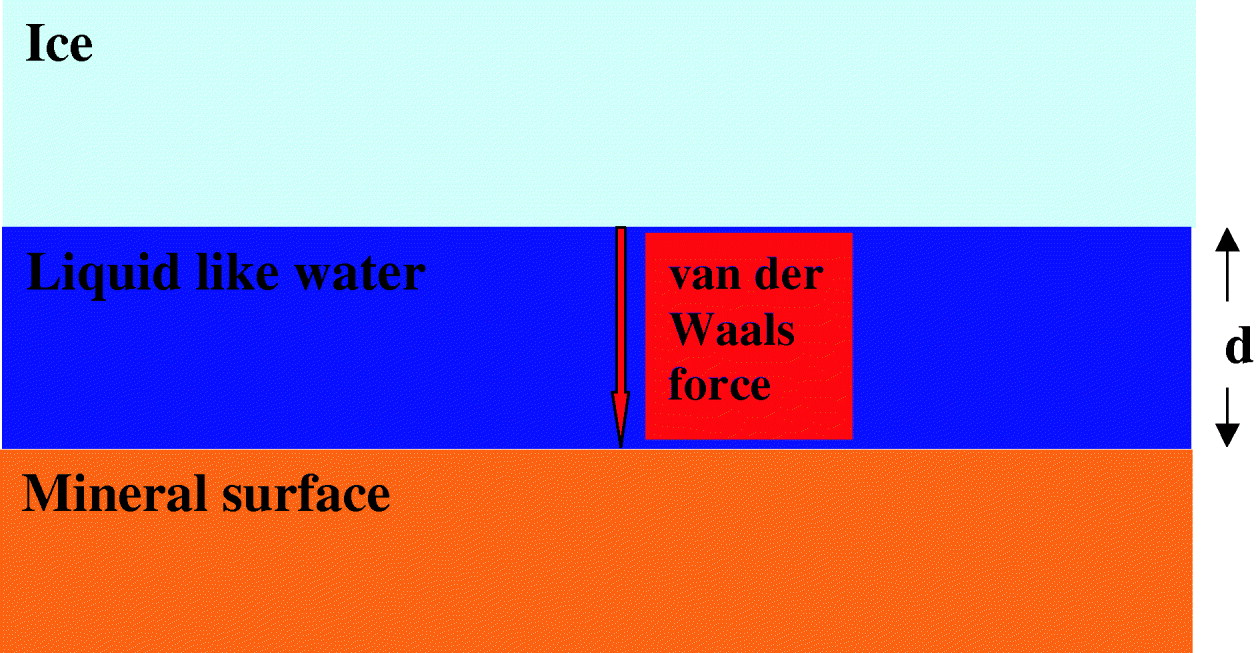
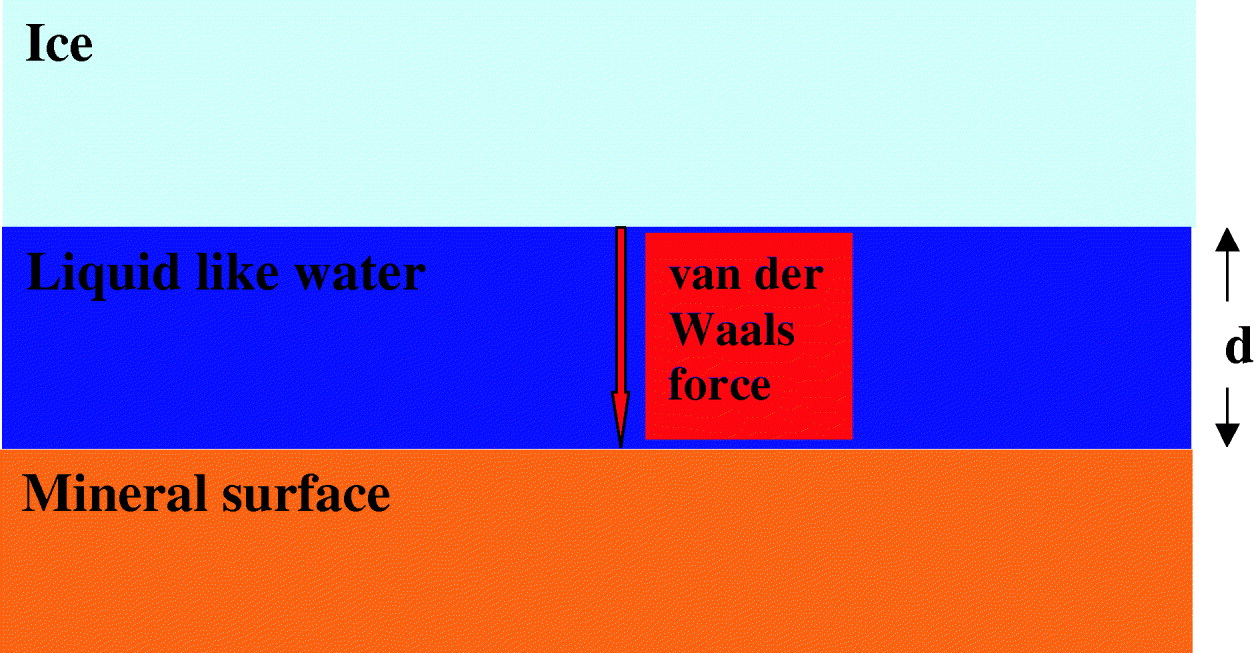
The right-hand side ‘van der Waals term’ dominates at small distances d between interfaces. The basic situation is in this case described by Fig. 1. The van der Waals force per surface S between two parallel surfaces is given by

(cf. Tadmor Reference Tadmor2001). In this case, the above given generalized Clapeyron equation reduces to
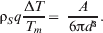
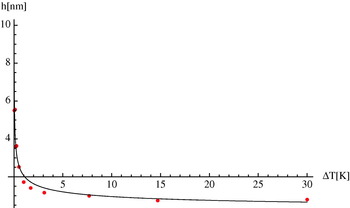
Experimental investigations by Engemann (Reference Engemann2004) (also see Engemann et al. (Reference Engemann, Reichert, Dosch, Bilgram, Honkimäki and Snigirev2004)) verify this relation, as shown in Fig. 2.
Liquid interfacial water has to evolve in equilibrium between adjacent surfaces of ice and a mineral, for example.
Experimentally determined thickness of a film of undercooled interfacial water on a SiO2-surface (dots), according to Engemann (Reference Engemann2004). The curve is fitted according to Eq. (3) for A=1.84×10⁻¹⁹ J.

It is a current challenge to determine the Hamaker constants for interactions between mineral surfaces and ice, which are also relevant for the Martian soil. Obviously, this wetting of frozen soils by undercooled liquid interfacial water (ULI water) is known on Earth too. Terrestrial examples of ULI water can be found in permafrost soil. Nersesova (Reference Nersesova1950), Anderson (Reference Anderson1968), Anderson et al. (Reference Anderson, Tice and McKim1973), Low et al. (Reference Low, Anderson and Hoekstra1968) and Cahn et al. (Reference Cahn, Dash and Fu1992) have published measurements of the content of ‘unfrozen’, i.e., stable, ULI water, in soils of terrestrial permafrost. A remarkable conclusion of these investigations is that unfrozen water will exist in measurable quantities in terrestrial permafrost down to temperatures around −30°C and lower (Anderson Reference Anderson1968).
The content of ULI water in porous soil can, according to the above given relations, be estimated to be

where  is the temperature-dependent mass of liquid water in the soil material, m dry is the dry mass of the soil material and S M is the specific (intrinsic) surface of the dry porous material.
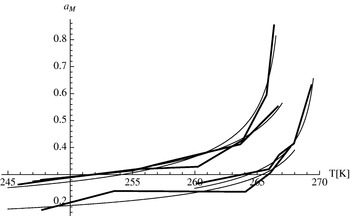
Figure 3 gives an example that compares the measured ULI water content of different montmorillonites with curves according to Eq. (4), which are fitted by appropriate Hamaker constants and specific surfaces.
Dependence of the moisture content ‘am[g water/g dry soil]’ of undercooled liquid water on temperature in soils of different types of montmorillonites. Data from Anderson (Reference Anderson1968) – thick lines – and curves according to Eq. (4) – thin lines.

Thus, ULI water must unavoidably exist in the subsurface of Mars as long as atmospheric water vapour adsorbs and freezes on cool soil grains, which is followed by the formation of interfacial water in between the mineral and the ice. In other words, the mineral–ice interface is thermodynamically unstable. An interfacial layer of liquid water must be formed.
Cryo-brines on Mars
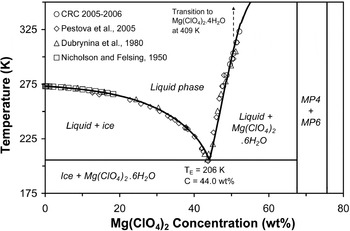
The existence of undercooled interfacial water in the surface of Mars must be followed by the formation of brines if the grains, which are mantled by interfacial water, are salt grains. The ‘eutectic temperature’ is the lowest temperature at which the resulting aqueous salty solution (the brine) remains liquid. For some salts the eutectic temperatures can be far below 0°C. Hecht et al. (Reference Hecht2009) have reported the existence of perchlorates at the Phoenix landing-site. Figure 4 gives, as an example of an eutectic diagram, magnesium perchlorate, which has been shown to exist in the environment of the National Aeronautics and Space Administration's (NASA's) Phoenix lander, and possibly also in droplets on a strut of Phoenix (Renno et al. Reference Renno2009).
Eutectic diagram of magnesium perchlorate (after Chevrier et al. Reference Chevrier, Hanley and Altheide2009). The eutectic temperature is at 206 K.

The existence of cryo-brines on the surface of Mars is to be expected in view of the unavoidable presence of ULI water and of salts or salty grains in the soil. The existence of halophilic bacteria on Earth and of cryo-brines on Mars is a current challenge with respect to hypothetical biological processes on the surface of Mars.
Subsurface melting in Martian ice
In the upper subsurface parts of snow/ice packs on Mars, conditions for melting can temporarily be given. This melting is due to the solid-state greenhouse effect, which will occur in water ice and snow (‘snow/ice’) if they are optically thin in the visible and opaque in the thermal infrared (Kaufmann et al. Reference Kaufmann, Kömle and Kargl2006). The conditions for this possible temporary melting are given for a large range of bolometric albedo values, and for model parameters, which are typical for the thermo-physical conditions at snow/ice sites on the surface of present Mars (cf. Möhlmann Reference Möhlmann2010). The numerical model calculations can be based on the heat conduction equation, i.e., on the assumption that the heat transport in the ice is to thermal conductivity only:

where ρi is the ice mass density, c is the specific heat of ice, λ is the thermal conductivity, Sc is the incoming insolation [average 608 Wm−2] on Mars, A is the albedo of the snow and L abs is the penetration depth of incoming energy (or the extinction length). Instead of the extinction model, an ‘absorption model’ can be used by assuming that all incoming power is absorbed at one dark subsurface level (of a corresponding absorption depth). Then, the right-hand side term can be described in a d-function-like manner.
The used boundary conditions assume a cooling at the upper surface (of the ice lid) by sublimation, loss (and gain) due to infrared re-radiation (into and from the sky) and loss due to winds. Furthermore, it is assumed that no heat flows at large depths. For details see Möhlmann (Reference Möhlmann2010).
Reaching the melting temperature in the subsurface is a necessary condition for melting to occur. However, sufficient power is also required to provide the necessary power to compensate for the latent heat and allow the ice to melt. It is to be noted, therefore, that (1 – A)=0.2 for a bright surface (of A=0.8) is, on Mars, already equivalent to an effective insolation flow Sc(1 – A)=122 Wm−2. To give an example, this heat flow is, according to q 1ρ1h=Sc (1−A)Δτ, sufficient to melt within Δτ=27 minutes a sheath of porous water ice of density ρi=600 kg m−3 over a ‘liquefaction-depth’ h=1 mm directly at the heated internal surface (latent melting heat q l=333.5 kJ kg−1). Thus, and surprisingly, subsurface sheaths with thicknesses of a few millimetres of molten water could theoretically be reached already for high-albedo conditions on Mars, and, of course, slopes and ‘properly’ inclined ice surfaces are more prone to evolve molten subsurface layers.
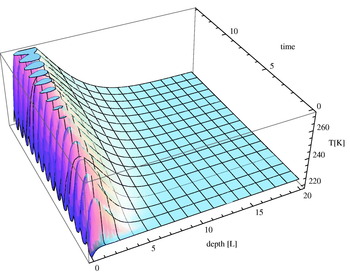
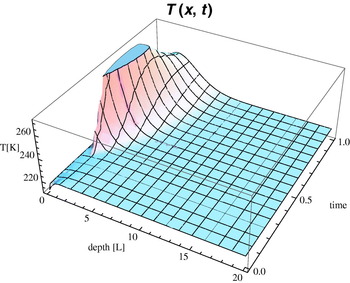
Comparison (cf. Figs 5 and 6) teaches that, as is to be expected, adsorption models are more effective for comparable conditions in subsurface heating than extinction models. Figures 5 and 6 also indicate that the melting point temperature can be reached in a subsurface with a closing lid, which is optically transparent.
Evolution of the temperature field T(x,t) over 20 sols for the ‘extinction model’ with an absorption depth L abs=10 cm, a bolometric albedo A=0.2 and a thermal conductivity λ=0.17 Wm−1K−1. The diurnal thermal penetration depth is L=11.4 cm. The plateaus at T=T m=273.15 K at sol 7 and later indicate that the melting point temperature is reached over hours in cm- to dm-deep depths. Temperatures T >T m are not shown.

Evolution of the temperature field T(x,t) over 1 sol for the ‘absorption model’ with an absorbing internal surface at depth 1 L=3.8 cm, bolometric albedo A=0.8 and thermal conductivity λ=0.019 Wm−1K−1. Temperatures T>T m are not shown.

Acknowledgement
This work was partially supported by the ESA ECS-project No. 98076 at Collegium Budapest (A.K.), and it has been supported by the Helmholtz Association through the research alliance “Planetary Evolution and Life” (D.M.).